



Abstract
The Learning and Study Strategies Inventory (LASSI) is widely used in assessing students’ learning and study strategies at both university and high school levels. The present study developed a Chinese version of LASSI (LASSI-C) and then further investigated the reliability, factor structure, and validity of LASSI-C scores, using a sample of 612 university students from Hong Kong. Results confirm that the scores measured from LASSI-C generally revealed the expected 10 subscales and a 3-factor structure that was originally postulated in LASSI.
Introduction
The Learning and Study Strategies Inventory (LASSI; Weinstein, Zimmermann, & Palmer, 1988) was first developed to assess different areas of the strategic learning model of Weinstein, Husman, and Dierking (2000). The strategic model of learning intends to account for students’ academic performance in a general framework. This model consists of three core components of learning—will, self-regulation, and skill—which are interconnected. The will component is used to assess students’ perception of self-efficacy, ability to maintain motivation, and to sustain a positive attitude toward their learning. The self-regulation component is used to assess students’ self-regulated skills such as time management, self-testing strategies, and concentration. The skill component is used to assess students’ ability to use different cognitive strategies effectively in their learning. These three core components are operating interactively to complement each other in order to enhance the holistic learning of the learner. This model was demonstrated to succeed in capturing the different aspects of students’ learning behaviors, relationships between study strategies and academic performance, students’ metacognitive skills and study strategies, as well as some other related research areas in a number of studies conducted in different countries (Albaili, 1997; Diseth, 2007; Diseth & Martinsen, 2003; Yip & Chung, 2005).
The LASSI contains 10 fundamental subscales that reflect the functions of the three components in the strategic learning model. These 10 subscales were included to measure the following aspects according to the three core components of the strategic learning model: will component (Scales 1-3), self-regulation component (Scales 4-7), and skill component (Scales 8-10).
Anxiety: This scale measures students’ feelings of worry toward school and their academic performance.
Attitude: This scale measures students’ interest and attitude about school and their desire to achieve academic excellence.
Motivation: This scale measures students’ desire and willingness to work hard (i.e., level of motivation, incentive for school, and diligence and self-discipline).
Concentration: This scale measures students’ ability to maintain attention and concentration about the learning materials.
Self-testing: This scale measures students’ techniques to review course materials and to check the comprehension level attained.
Scheduling: This scale measures students’ own time management on academic tasks.
Study aids: This scale measures students’ use of various aids and techniques to support their learning.
Information processing: This scale measures students’ use of elaboration, strategies of organizing and interrelating information, and skills of comprehending, reasoning, and using logic in their learning.
Selecting main ideas: This scale measures students’ ability to figure out the critical points and key ideas in the learning materials.
Test strategies: This scale measures students’ knowledge of different types of test strategies and the necessary preparation for the tests.
In the present study, we developed a Chinese version of the LASSI (LASSI-C). In order to further validate the LASSI-C, the present study was conducted to address three research-focus criteria in terms of the psychometric properties and latent structure of LASSI-C: (1) the internal consistency coefficients of the scores arising from the 10 LASSI-C subscales, (2) the factor structure underlying LASSI-C, and (3) the comparability of the LASSI-C in comparison with the original LASSI measure.
Method
Participants
The participants in the study were 612 university students in Hong Kong (sampled from five universities in Hong Kong). They took part in the study voluntarily. Two research assistants randomly distributed the questionnaires in the libraries of the five universities. There were altogether 618 questionnaires that were returned, but 6 of them were discarded due to incomplete answers. The final 612 respondents were 388 female students (63%) and 224 male students (37%), with the mean age of 20.6 years (SD = 2.3). All of them were second-, third-, and fourth-year undergraduate students from different majors in their respective universities.
Measure
The Chinese version of LASSI was translated from the original inventory by the author (a bilingual psycholinguist) and his research assistant. Efforts were made to ensure appropriateness of the language as well as the cultural and educational context during the translation process. The Chinese version was back-translated into English by a professional bilingual editor. The English back-translation was further reviewed by the author and two other educational psychologists who had previously used the original LASSI in their research. All the discrepancies were discussed and changes that required modifications received unanimous agreement. This Chinese version contained the original 10 fundamental subscales of LASSI with 5 to 7 test items on each subscale, with a total of 55 test items.
Procedure
The research assistants asked each participant’s consent to participate in the study by asking him or her to sign a consent form before completing the questionnaire at the time of distributing the questionnaires. Each participant was given about 20 min to complete the questionnaire. The research assistants reminded the participants that this was simply a self-report survey on their own learning strategies and that they were not allowed to, nor was it necessary, to discuss with others. In addition, to ensure anonymity, participants were not required to write down their names. These techniques are useful for reducing the social desirability effect of the participants and for increasing the reliability of the scores obtained.
Results and Discussion
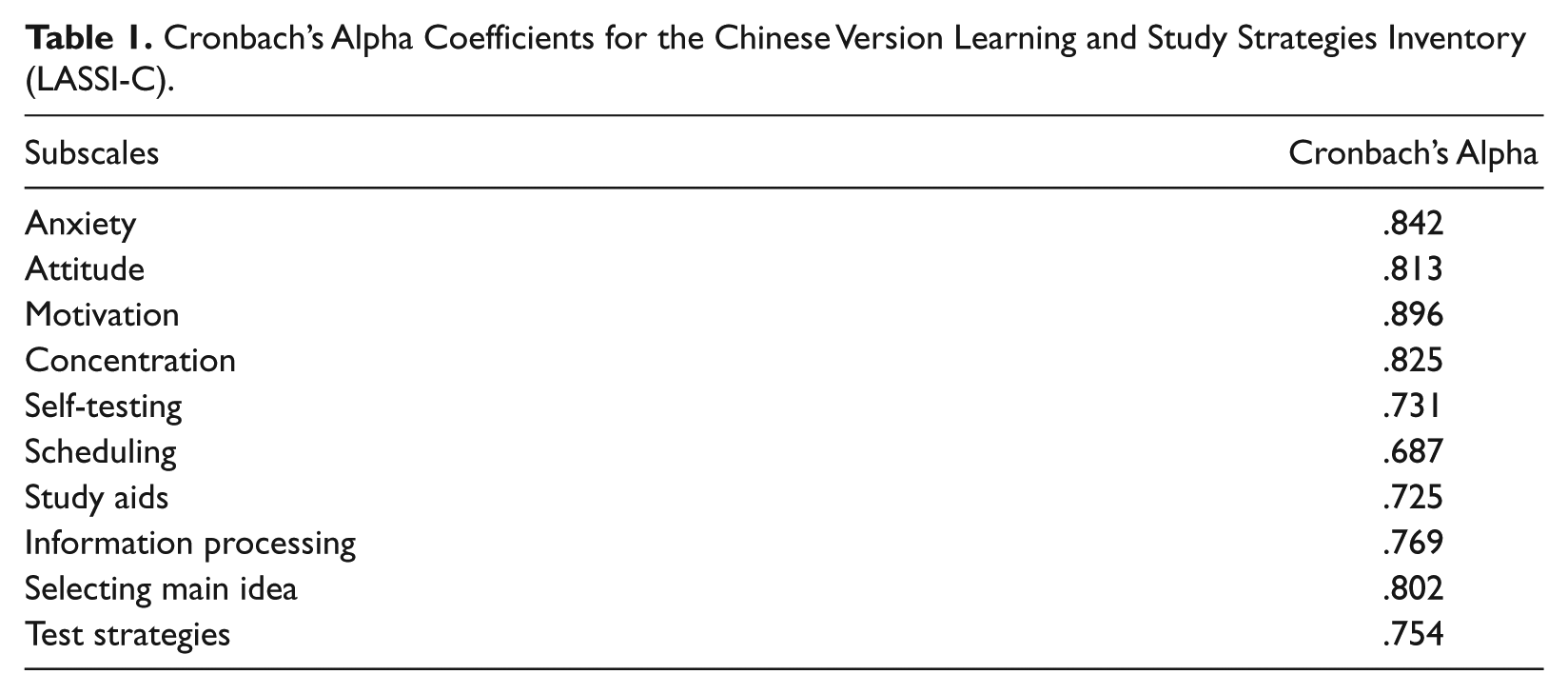
With regard to the three research-focus criteria, we first examined the internal consistency to the subscales of LASSI-C. The Cronbach’s alpha coefficients for each of the 10 subscales are presented in Table 1. The results suggest that the scores of all the subscales were of sufficiently high internal consistency.
Cronbach’s Alpha Coefficients for the Chinese Version Learning and Study Strategies Inventory (LASSI-C).
Second, to explore the underlying factor structure of the LASSI-C, we conducted a varimax-rotated principal components analysis of the participants’ scores to the inventory. As postulated in the original LASSI, there are 10 subscales of the inventory, and hence, 10 factors were extracted finally. The patterns of structure coefficients of LASSI-C are presented in Table 2.
Factor Structure of the Chinese Version Learning and Study Strategies Inventory (LASSI-C) After Varimax Rotation.

Note: Coefficients greater than 0.3 are in italics.
The measurement model identified above only provided an indirect test of the theoretical framework of the original LASSI; therefore, to further validate the factor structure of LASSI-C and to verify the consistency with the original LASSI, a number of confirmatory factor analyses (CFAs) were performed using the Structural Equation Modeling software (EQS) for Windows 6.1 (Bentler & Wu, 1993). Three competing models were tested for their degree of data–model fit to the present data set. The 1-factor model (Model 1) nested all the scales of LASSI-C on a single latent construct. Model 2 (a 10-factor correlated model) and Model 3 (a 3-factor hierarchical model) were derived from the work of Weinstein et al. (2000). That is, in keeping with the work of Weinstein et al., the 55 test items were hypothesized a priori that could be explained by 10 correlated first-order factors in Model 2 and three second-order factors assuming to further explain the 10 first-order factors in Model 3. In the present study, model fit was evaluated using χ2 statistics, comparative fit index (CFI), nonnormed-fit index (NNFI), root mean square error of approximation (RMSEA), and 90% confidence interval (CI) of RMSEA. According to previous research, CFI and NNFI value ≥ 0.9, and RMSEA value ≤ 0.08, were considered as good indicators of the data–model fit (Bentler & Bonett, 1980; Browne & Cudeck, 1993; Hu & Bentler, 1999).
The patterns of CFAs results in the present data set for the three models are presented in Table 3. Model 1 did not indicate an acceptable fit to the original measure of LASSI for the present data set (CFI > 0.9). Both Model 2 and Model 3 seemed to fit the present data set reasonably well with respect to meeting the criteria of all the fit indexes, except for the RMSEA value of Model 2 (0.08), which was at the margin to the criterion. Therefore, Model 3 was considered here as the best-fit model to represent the underlying factor structure of LASSI-C. The standardized factor loadings of the items for this model were all statistically significant (p < .05; Figure 1).
A Summary of the CFA Results of the Three Competing Models.
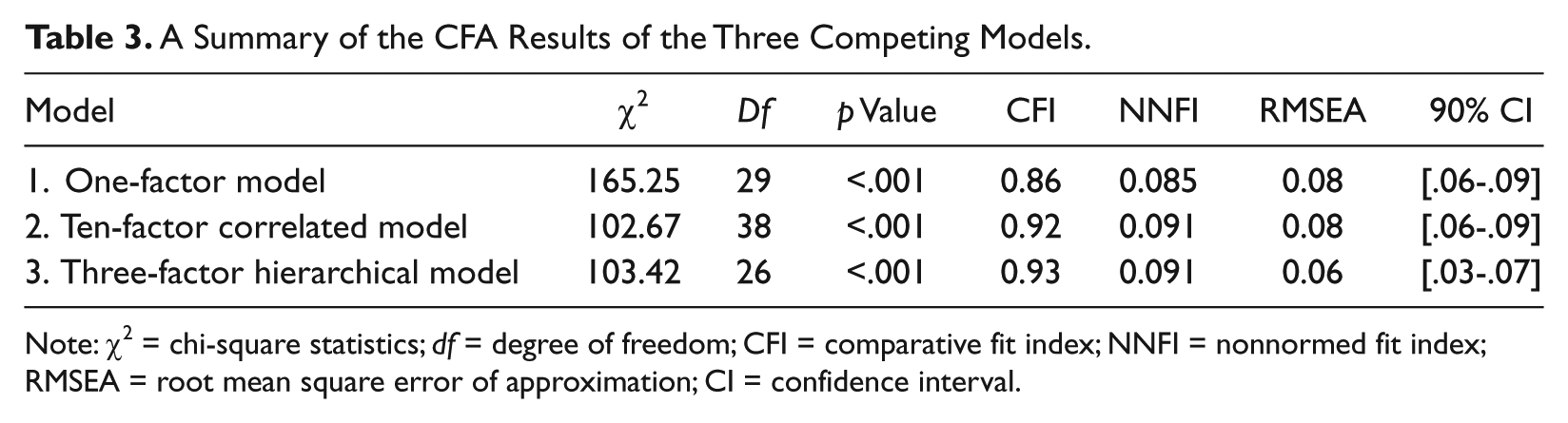
Note: χ2 = chi-square statistics; df = degree of freedom; CFI = comparative fit index; NNFI = nonnormed fit index; RMSEA = root mean square error of approximation; CI = confidence interval.
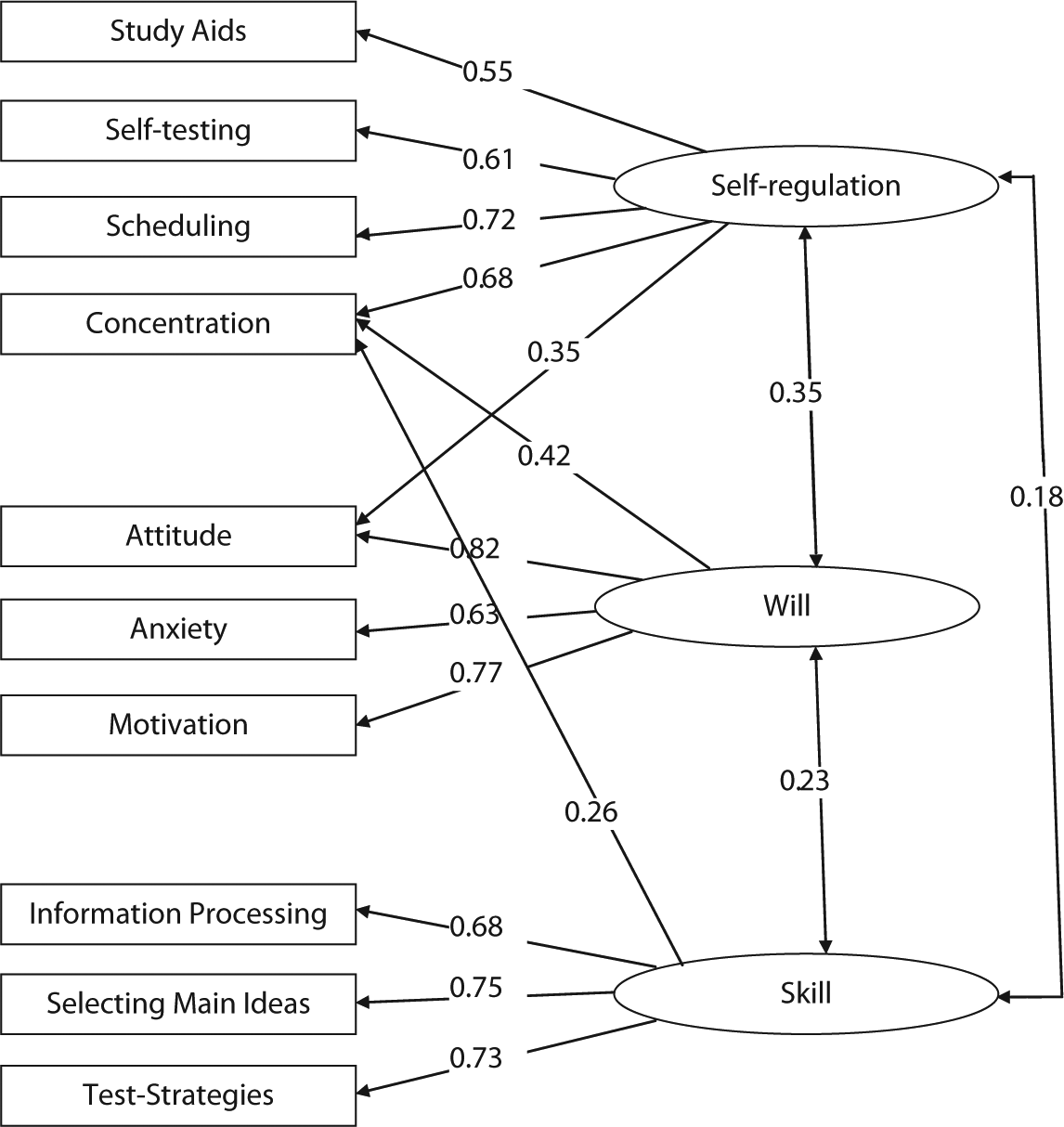
Standardized Path Coefficients for the Three-Factor Hierarchical Model of Learning and Study Strategies Inventory—Chinese Version (LASSI-C).
In summary, the present study developed a Chinese version of LASSI (LASSI-C) and then conducted a large-scale survey to validate the inventory. On the reliability and validity of LASSI-C, the present results reflected consistent patterns of scores in comparison to the original LASSI. All the coefficients for the 10 subscales are close to, and within, ±.04 in comparison with the alpha coefficients reported in the original LASSI manual. It is suggested that this version is sufficiently suitable for use to assess university students’ learning and study strategies in Chinese educational settings (e.g., Hong Kong). On the underlying factor structure of LASSI-C, the results are also consistent with the three-factor structure of the original LASSI model (see Cano, 2006; Melancon, 2002; Olaussen & Braten, 1998; Olejnik & Nist, 1992).
Finally, the present study developed a Chinese version of the LASSI (LASSI-C) that was successfully validated to be in line with the original LASSI with regard to the different psychometric properties. Therefore, the LASSI-C is considered as a reasonably useful instrument in a variety of educational projects in this research area, in particular to the investigations of Chinese (or even Asian) cultures.
Footnotes
Acknowledgements
I would like to thank Katherine Leung and Walker Wong for their assistance in the present study and the constructive comments from Dr. Rebecca Ang and two anonymous reviewers.
Declaration of Conflicting Interests
The author(s) declared no potential conflicts of interest with respect to the research, authorship, and/or publication of this article.
Funding
The author(s) received no financial support for the research, authorship, and/or publication of this article.