




Abstract
Measures of adaptive behaviors provide an important tool in the repertoire of clinical and school/educational psychologists. Measures that assess adaptive behaviors typically have been built in Western cultures and developed in light of behaviors common to them. Nevertheless, these measures are used elsewhere despite a paucity of data that examine their cross-national transportability. The issue of test transportability of such measures is important because they are used in cultures that differ from those in which they initially were developed as well as with immigrants. This present article describes the Romanian and Taiwan adaptation process of the U.S.–developed Adaptive Behavior Assessment System, Second Edition (ABAS-II) Parent Form for ages 5 to 21. Steps taken to help ensure a valid translation and cultural adaptation process are described. Data from more than 3,000 parents who completed the ABAS-II are examined across these three test versions, focusing on score differences, internal consistency, intercorrelations, and factor structure equivalence. Data from the three versions display considerable similarity. Score differences are infrequent between the three versions yet display some differences mainly at lower ages. Scale reliabilities are high and comparable for all the three versions. Correlation patterns are sufficiently similar between the three versions. Confirmatory factor analyses show a similar fit for all three versions.
Keywords
Adaptive behavior refers to an individual’s independent display of behaviors associated with meeting his or her daily personal and social needs, including behaviors expected in domestic and social environments (Nihira, Leland, & Lambert, 1993; Oakland & Harrison, 2008). The authoritative American Association on Intellectual and Development Disabilities (AAIDD) 1 currently defines adaptive behavior more formally as “the collection of conceptual, social, and practical skills that have been learned and are performed by people in their everyday lives” (American Association on Intellectual and Developmental Disabilities, 2010, p. 43). AAIDD’s further discussion of adaptive behavior promotes the belief that “adaptive skills should be documented within the context of community and cultural environments typical of a person’s age peers” (American Association on Intellectual and Developmental Disabilities, 2010, p. 45). Thus, the assessment of adaptive behavior should be sensitive to the cultural contexts in which a person lives, including possible sociocultural differences together with opportunities, expectations, and standards for the development of adaptive behaviors. Expected age differences, especially among infants and children, also need to be considered (American Association on Intellectual and Developmental Disabilities, 2010).
Scales that measure adaptive behavior typically are normed on a representative national sample, including those with intellectual disabilities and other disorders. Age differences are accounted for by reporting norms separately for various ages. Efforts to account for possible sociocultural differences within a country occur through the use of a well-planned and executed item development, selection, and norming process. A person’s opportunities and expectations for the acquisition of adaptive behaviors typically are considered during the assessment process by clinicians who acquire relevant background information on the client.
Clinicians may be wary to use a measure of adaptive behavior to assess these qualities in immigrants or other recent arrivals to their country. Some clinicians may believe measures of adaptive behavior are relevant only within the culture in which the test was normed and standardized. Community and broader cultural environments are assumed to differ between countries, resulting in differences in qualities that influence the development and display of important and valued adaptive skills, thus questioning the relevance of measures nationally normed elsewhere. Thus, cautious clinical judgment can be expected, given a lack of information on the cross-national validity of measures of adaptive behavior.
However, a closer examination of issues associated with the transportability of measures of adaptive behavior leads to a more refined perspective, one that considers the degrees of cultural similarities and differences between countries and the degree an individual’s cultural experiences resemble those of the culture in which the test was normed. For example, measures of adaptive behavior developed in the United States commonly are used, albeit with changes in some terminology, in Australia, Canada, New Zealand, and the United Kingdom because such measures are believed to assess behaviors somewhat characteristic of and common to the prevailing cultures in these five countries. Thus, higher degrees of cultural similarities may support their transportability. However, the question of whether U.S. norms are relevant in these countries remains unanswered.
In contrast, measures of adaptive behavior developed in Western countries may be less likely to be suitable for use in Africa or the Middle East because their cultures generally differ considerably from Western cultures. Measures of adaptive behavior developed in the United States are thought to not reflect opportunities, expectations, and standards influencing adaptive behavior in these and other regions in which large cultural differences exist.
Tesse and Craig (1999) provide a thoughtful description of issues associated with the cross-national assessment of adaptive behavior. They acknowledge Hambleton and Kanjee’s (1995) belief that a decision to adapt an existing measure rather than develop a new measure for use in a country may be driven by a sense of security and marketing issues—adapting an existing and highly regarded test developed elsewhere may be seen more favorably than developing a new measure locally. For example, an adaptation of an existing measure may capitalize on its item selection and validation studies and thus require less time and fewer professional resources than those needed when developing and validating a new measure. This belief lead to the adaptation of the U.S.-developed Adaptive Behavior Assessment System-II (ABAS-II; Harrison & Oakland, 2003) in Romania and Taiwan.
A main purpose of this research was to examine possible similarities and differences in key psychometric qualities between the U.S.-developed ABAS-II and its Romanian and Taiwanese adaptations. The article also describes this adaptation process. The article examines whether data from three age groups of children from these three countries differ in reference to the measure’s General Adaptive Composite (GAC), its three domains, and nine skill areas. Data from the 84th, 50th, and 16th percentile are reported, thus providing a range of scores. Scores at or below the 16th percentile may be of most interest as they commonly are used when diagnosing intellectual disability (American Association on Intellectual and Developmental Disabilities, 2010; American Psychiatric Association, 2000). Thus, attention to possible score differences at this level may be relevant when using the data to diagnose intellectual disabilities.
The construct validity and structural equivalence of the ABAS-II were examined, based on recommendations by Byrne et al. (2009), that the examination of equivalence for both the original and adapted version of a test provides the needed evidence for the similarity of the two measures. Information on the structural equivalence of the ABAS-II also may answer questions to which the scientific literature has not yet offered a clear answer. For example, factor analyses’ results on measures of adaptive behavior generally do not offer clear support either for their uni- or a multi-dimensional structure (Jacobson & Mullick, 1996). Data from the ABAS-II may help inform this issues. Findings from factor-analytic studies that use data from this measure show a strong underlying single factor of adaptive behavior (Aricak & Oakland, 2009; McGrew & Bruininks, 1989; Oakland & Algina, 2011; Wei, Oakland, & Algina, 2008). This contrasts somewhat with the general policy governing intellectual disability and mental retardation (e.g., American Association on Mental Retardation, 2002) that advocates a three-factor model, with Conceptual, Social, and Practical domains as separate factors. The current study offers some evidence regarding the structure of adaptive behavior as measured by the ABAS-II Parent Form for ages 5 to 21 in three cultures.
Methods
Participants
Romania
Standardization data were obtained from 801 parents, stratified by children’s age and gender, parent’s education level, and geographic region to be representative of the Romanian population (Oakland & Harrison, 2012).
Taiwan
Standardization data were obtained from 660 parents stratified by children’s age and gender, parent’s education level, and geographic region to be representative of the Taiwan population (Harrison & Oakland, 2008).
United States
Standardization data were obtained from 1,670 parents stratified by children’s age, gender, and race/ethnicity; parent’s education level; and geographic region to be representative of the U.S. population (Harrison & Oakland, 2003).
Instrumentation
The ABAS-II provides five forms: parent and caregiver forms for ages 0 to 5, parent and teacher forms for ages 5 to 21, and an adult form for ages 16 to 89. This study utilizes data only from the Parent Form for ages 5 to 21. It assesses nine adaptive skills: communication, community use, functional academics, home living, health and safety, leisure, self-care, self-direction, and social skills. Data from these nine skill areas contribute to one of the three domains: conceptual, social, or practical. The domain scores are used to obtain the GAC.
Principles That Guided Test Adaptations
The test adaptation processes in Romania and Taiwan were guided by the following principles: Use terminology commonly understood in the country; examine the cultural appropriateness of each item carefully; attend to the item’s implied meaning, not a literal translation, in order to retain the item’s psychological meaning, not merely its semantic meaning; maintain the equivalent meaning of the original item; when substituting items, strive to maintain the difficulty of the original item; maintain the test administration, format, and scoring designs; strive to maintain the factor structure of the original test; promote item comprehension; work to ensure persons understand the methods used to complete the scale.
The tests from the three countries have the same number of items: communication (24), community use (23), functional academics (23), home living (25), health and safety (22), leisure (22), self-care (24), self-direction (25), social (23), conceptual (72), social (45), practical (94), and GAC (211).
Methods That Guided the ABAS-II Translation and Adaptation in Romania
A committee of four professionals (i.e., two doctoral-level psychologists, one social worker with 15 years experience working with children, and one linguist without academic training in psychology) translated the ABAS-II items from English into Romanian. This method, called a parallel approach (Schoua-Glusberg, 1992) or team translation (Acquadro, Jam bon, Ellis, & Marquis, 1996), involves several translators working independently. The prior professional experiences of this team are consistent with van de Vijver and Hambleton’s (1996) recommendation for committee diversity.
The ABAS-II items sample adaptive behaviors. Thus, the translators found that the items designate widely recognized daily behaviors expressed in simple and understandable words. The items were easier to translate than those found in measures that assess more complex personal qualities (e.g., personality). The translators reported the items and test forms to be readily understandable and streamlined for simplicity. Their work was guided by the explicit requirement to adhere to the best linguistic equivalence for the items. Every item was examined to ensure it measured a behavior typical of Romanian culture for children and youth and whether the behavior described by each item was likely to be exhibited by Romanian children and youth.
The project leader of the Romanian adaption process served as the committee leader—a position of authority recommended by Harkness and Schoua-Glusberg (1998). He compared the four resulting translations and decided on the final version of every item. When possible, this decision was based on consensus when at least three translators expressed identical or nearly identical translations for an item. Supplementary opinions were requested from all translators on six items before the coordinator made his decision. When consensus was not possible, decisions were made as to the best way to reconcile discrepancies.
This draft translation was back-translated from Romanian into English. The back-translation was analyzed during two 3-hour review meetings between the adaptation project leader and the second author of the ABAS-II, resulting in a revision of 18 items. This process lead to the final translation of the ABAS-II that then was used to obtain Romanian norms utilized in this research and reported in the test’s manual.
Methods That Guided the ABAS-II Translation and Adaptation in Taiwan
A committee of eight professionals were engaged in the Taiwan adaption. Two professors of special education who have rich research experience in adaptive behavior and measurement served as coauthors for the Taiwan ABAS-II adaption. The other six were senior special education teachers who have more than 25 years experience, on average, in assessing and educating children with intellectual and development disabilities.
The preliminary item-translation work was done through frequent discussions between the two professors. The items first were translated into the Taiwanese language by an experienced project coordinator who has a psychology background and more than 15 years experience in academic research and psychological test adaptations. Each of the two professors reviewed the translated work individually. During the review process, each item in the original U.S version was examined carefully to ensure the translated item is loyal to the meaning of the U.S. version. Then, during a 2-month repetitive discussion process, each item was examined in detail (e.g., to determine whether an item was cultural and linguistically appropriate and was suitably matched with its construct).
After the two professors reached agreement, the other six team members then reviewed the draft test independently. Finally, discussions involving all eight members considered whether other modifications were needed. Modifications were based on agreement between all members. A back-translation was performed on this revised draft to further promote quality assurance. Finally, 16 parents took this draft test and were interviewed in order to detect possible difficulties in completing the test. This process concluded the adaptation process and led to the final translation of the ABAS-II that then was used to obtain Taiwanese norms utilized in this research and reported in the test’s manual.
Statistical Methods
Raw scores needed to obtain standard scores at the 84th, 50th, and 16th percentiles were acquired for the GAC, the three domains (i.e., Conceptual, Social, and Practical), and the nine skill areas for three age groups: 7.0-7.3, 12.0-12.3, and 16. These ages were selected so as to provide data on a range of ages during which measures of adaptive behavior commonly are used. For example, standards for evaluating intellectual disabilities commonly utilize adaptive behavior data when children enter school and display academic deficiencies or prior to age 18—the age prior to which intellectual disability must be diagnosed (American Association on Intellectual and Developmental Disabilities, 2010; American Psychiatric Association, 2000).
In addition, reliability estimates were computed for the skill area and composite (i.e., three domain and GAC) scores and then were compared across the three test versions to determine whether the data displayed any obvious lack of psychometric consistency. Correlations between the skill area and composite scores were computed and compared across the three versions to determine their equivalence. The results of confirmatory factor analyses also were compared across the three versions to determine which of the alternative factorial models of adaptive behavior (i.e., a one-factor or a three-factor structure) may be supported more strongly by the data.
This research considered data from the U.S.-developed ABAS-II to be the standard against which to compare information from the Romanian and Taiwan adaptations. The standard error of measurement (SEM) for the U.S. data is approximately 3 points for the skill area raw scores, approximately 2 points for the sum of scaled scores for the three domains, and 3 points for the GAC (Table 1). These SEM levels are used to determine whether the scores from Taiwan and Romanian children differ from those from the United States. Thus, skill area scores that exceed the U.S. data by more than 6 points, domain scores that exceed the U.S. data by more than 4 points, and GAC scores that exceed the U.S. data by more than 6 points reflect comparatively either higher or lower levels of adaptive skills.
ABAS-II Parent: General Adaptive Composite, Domain Composites, and Skill Area Sum of Scaled Score, by Ages, Levels, and Countries.

Note: ABAS-II = Adaptive Behavior Assessment System, Second Edition; GAC = General Adaptive Composite; CON = Conceptual Domain; SOC = Social Domain; PRA = Practical Domain; COM = Communication; CU = Community Use; FA = Functional Academics; HL = Home Living; HS = Health and Safety; LS = Leisure; SC = Self-Care; SD = Self-Direction; SOC = Social; SS = Scaled Score.
Results
Scalar Differences
Raw scores for the skilled areas and sums of scaled scores for the three domain and GAC are reported for the three ABAS-II versions at the 16th, 50th, and 84th percentiles for ages 7.0-7.3, 12.0-12.3, and 16 (Table 1). These three percentiles were selected because they reflect scores that are placed at the mean and 1 standard deviation below and above the mean in a normal distribution.
Ages 7.0-7.3
At ages 7.0-7.3, among the 78 comparisons, data from GAC and the three domains are comparable at the 84th, 50th, and 16th percentiles for the United States, Romania, and Taiwan. Among the nine adaptive skills, some differences are apparent at the three percentile levels (i.e., 84th, 50th, and 16th), mainly for Taiwan where the data seemingly display a wider range compared to U.S. data. For example, at the 84th percentile, Taiwan data are higher on community use, functional academics, health and safety, and self-direction. At the 50th percentile, Taiwan data are higher on functional academics and health and safety. In contrast, at the 16th percentile, Taiwan data are lower on home living, leisure, self-direction, and social. In contrast to the U.S. data, those from Romania differ only on one, communication, which are higher.
Ages 12.0-12.3
Data for ages 12.0-12.3 display fewer differences than for ages 7.0-7.3. However, again, some differences are apparent among the 78 comparisons. At the 84th percentile, the GACs differ. The Romanian (113) and Taiwanese (114) data are higher than those from the United States (105). At the 50th and the 16th percentile, there are no differences in the GAC or the three domains. In addition, on community use, Taiwan data are higher than those from the United States at both at the 84th and the 50th percentiles.
Age 16
Data at age 16 display two differences among the 78 comparisons. Compared to U.S. data, Romania’s GAC is higher at the 84th and lower at the 16th percentiles.
Psychometric Characteristics
Reliabilities
Internal consistency (alpha) coefficients for the U.S., Taiwanese, and Romanian versions are reported in Table 2. Coefficients for the GAC are high, above the .90 threshold: .98 for the United States and Romania and .99 for Taiwan. Coefficients for the three adaptive domains also are high: between .95 and .96 for Romania, between .95 and .97 for the United States, and 98 for Taiwan. Coefficients for the nine skill areas also are high: 86 and .93 for the United States, between 90 and .93 for Romania, and between .92 and .96 for Taiwan.
Reliabilities for Selected Age-Based Subsample of the ABAS-II Parent Scales, in the United States, Taiwan, and Romania.
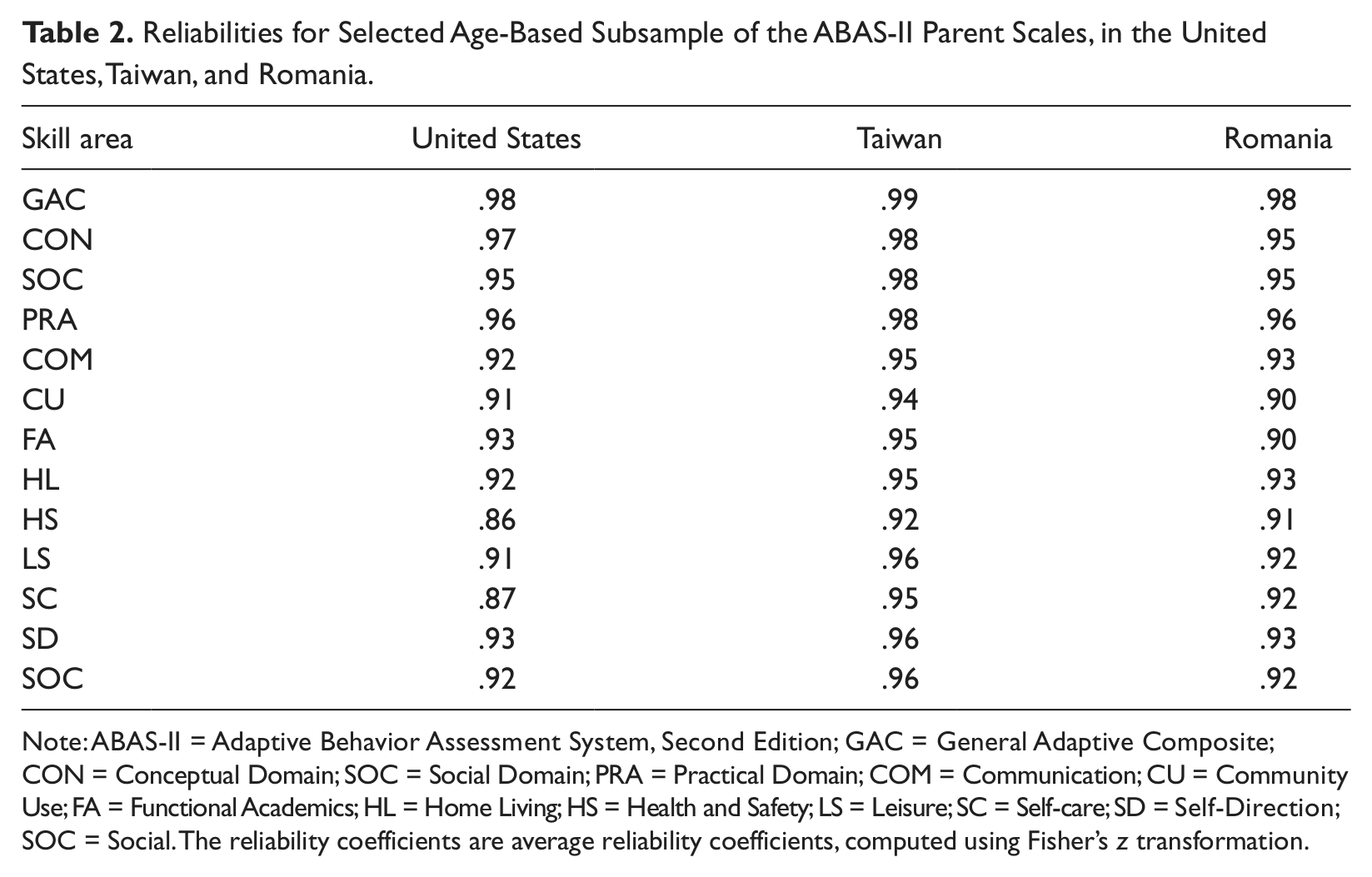
Note: ABAS-II = Adaptive Behavior Assessment System, Second Edition; GAC = General Adaptive Composite; CON = Conceptual Domain; SOC = Social Domain; PRA = Practical Domain; COM = Communication; CU = Community Use; FA = Functional Academics; HL = Home Living; HS = Health and Safety; LS = Leisure; SC = Self-care; SD = Self-Direction; SOC = Social. The reliability coefficients are average reliability coefficients, computed using Fisher’s z transformation.
Intercorrelations
Intercorrelations between the scales for the Romanian, Taiwan, and U.S. versions are reported in Table 3. The intercorrelations of skill area data generally are high and comparable, with medians of .62 for the United States, .64 for Romania, and .67 for Taiwan. All skill areas correlate highest with their respective adaptive domain, albeit with somewhat lower correlations (i.e., in the upper .60s) for the four skill areas that comprise the practical domain for the United States. The correlations between the three adaptive domains are high, in the upper .70s to lower .80s for all three versions, with medians of .78 for Romania, .81 for the United States, and .82 for Taiwan. Coefficients between the nine skill areas and the GAC are high yet somewhat lower for the United States (median of .75) than for Taiwanese and Romanian versions (medians of .84 for both). Kendall’s W coefficient of concordance between the skill area intercorrelations as reported in the three correlation matrices, W = .61, χ2(35) = 63.59, p < .01, shows good concordance. Kendall’s coefficient of concordance between the skill areas and GAC, W = .66, χ2(8) = 15.82, p < .05, also shows an acceptable and high level of concordance.
Correlations for the ABAS-II Parent Scales, in the United States, Taiwan, and Romania.
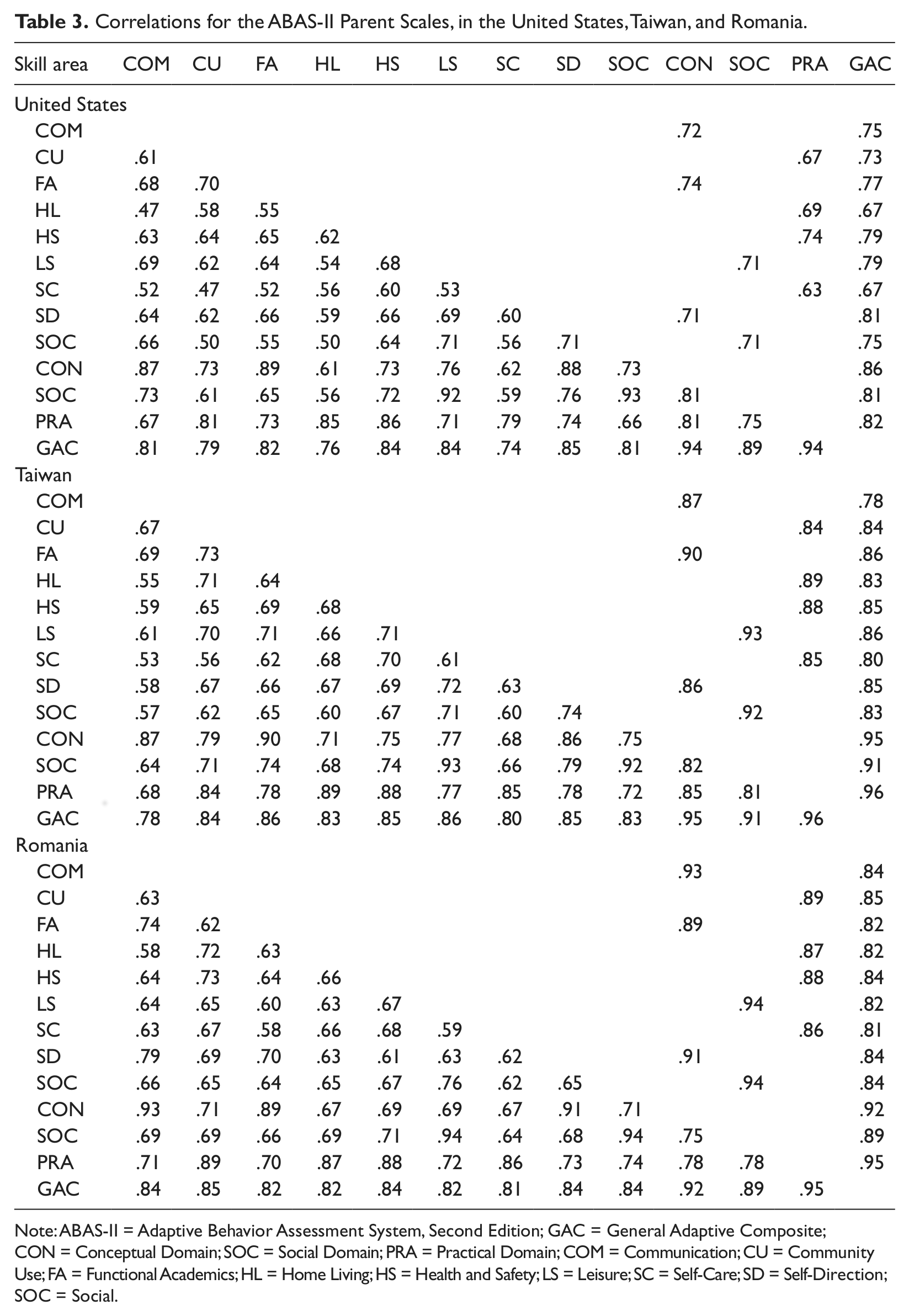
Note: ABAS-II = Adaptive Behavior Assessment System, Second Edition; GAC = General Adaptive Composite; CON = Conceptual Domain; SOC = Social Domain; PRA = Practical Domain; COM = Communication; CU = Community Use; FA = Functional Academics; HL = Home Living; HS = Health and Safety; LS = Leisure; SC = Self-Care; SD = Self-Direction; SOC = Social.
Construct validity
Correlations between the GAC, the three adaptive domains, and nine skill areas are reported in Table 3 for the three versions. The similarity between the three correlation matrices, computed as Kendall’s W = .61, χ2(35) = 63.6, p < .01, display a high level of similarity. Kendall’s W = .60, χ2(14) = 25.4, p < .05, indicates an acceptable level of similarity when the patterns for the relevant correlations between skill scores and adaptive domains are considered.
Confirmatory factor analysis
Confirmatory factor analyses for the three versions are reported in their respective test manuals. The data are summarized in Table 4. Two competing models have been tested, namely a one-factor model and a three-factor model. Support for a one-factor model would offer support for the use of the GAC, while support for a three-factor model would offer support for the use of three domain scores. A review of data from the adjusted goodness-of-fit index (AGFI) and the root mean square error of approximations (RMSEA) shows a slightly better fit for the three-factor model for the U.S. version and a slightly better fit for the one-factor model for the Romanian and Taiwanese versions. The fit indices for all three versions are below the conservative threshold (RMSEA < .05 or RMSEA < .08) typically used in rigorous fitting standards. Differences between one- and three-factor models are minimal in all three versions. The analyses, when interpreted conservatively, fall short of a good model fit in both these cases. However, the data offer some slightly better support for the three-factor model.
Fit Statistics for Confirmatory Factor Analyses on the ABAS-II (Adaptive Behavior Assessment System, Second Edition) Parent Data in the United States, Taiwan, and Romania.

Note: AGFI = adjusted goodness-of-fit index; RMSEA = root mean square error of approximations; Model 1 = one factor. Model 2 = three factors.
Discussion
A main purpose of this research was to examine similarities and differences in key psychometric qualities between the U.S.-developed ABAS-II and its Romanian and Taiwan adaptations.
Considerable Similarities in Psychometric Qualities
The data generally display considerable similarities among the three versions. For example, score consistency was displayed on all 54 domain scores, on 148 of the 162 skill area scores, and on 14 of the 18 GACs.
Reliability estimates generally are both high and comparable for all three versions, with coefficients generally in the high .90s for the GAC and three domain scores and in the low .90s for the skill scores. However, some differences in reliability estimates appear, most commonly on scores for younger children (i.e., ages 7.0-7.3), fewer for older children (i.e., ages 12.0-12.3), and fewest for the oldest children (i.e., age 16). This pattern is consistent with other evidence that stability estimates for adaptive behavior generally are lower for younger children and higher for older children and adults (Sattler & Hoge, 2006). Reliability estimates require item variance. Some items for young children display little variance (e.g., answers complex questions that require careful thoughts and opinions; questions political or current events). These behaviors are exhibited rarely by 7-year-olds, thus contributing to low internal consistency.
Intercorrelations are moderate, as desired, and display concordance. All skill areas correlate highest with their respective domains, thus providing evidence of the measures’ construct validity. Confirmatory factor analyses, while not showing a robust fit for even the original U.S. data, show a similar fit for the three versions. In addition, the test adaptation process verified that the behaviors assessed by the ABAS-II also are relevant in Romania and Taiwan.
Test Adaptation Process
The test adaptation process also verified the applicability and usefulness of principles promulgated by test adaptation guidelines. These include linguistic translations that are consistent with terminology used in the original test yet appropriate for use in a second language, thus promoting user comprehension; the cultural relevance of adaptive behavior items; and the maintenance of the test’s administration, format, and scoring design.
The concept and measurement of adaptive behavior are becoming more widely accepted internationally. Countries interested in developing a new measure of adaptive behavior may find some assurance in the test adaptation process used in the Romanian and Taiwanese adaptations. If consistent with their needs, objectives, and broader intent, an existing scale of adaptive behavior, perhaps originally developed abroad, may be selected, one that is consistent with current theory and has an established record of suitable psychometric and clinical data. Professionals then would engage in the test adaptation process, informed by the International Test Commission’s test adaptation guidelines <http://www.intestcom.org/guideline> and by the steps taken and exemplified in the Romanian and Taiwanese adaptations, steps that have proven utility in generating a reliable and valid adapted version of the measure. Tassé and Craig (1999) outline additional suggestions for the cross-cultural assessment of adaptive behavior.
Care Is Needed to Ensure the Scale Is Suitable for the Person Being Assessed
Although the three scales display similar psychometric properties, the selection and clinical use of measures of adaptive behavior always should consider the match between a test’s content and a person’s opportunities, expectations, and standards for adaptive behavior development. When using scales of adaptive behavior, clinicians are advised to consider a person’s opportunities and expectations governing the acquisition of adaptive behavior. This advice is particularly warranted when assessing the adaptive behaviors of recent immigrants and other recent arrivals to a country.
Children’s Adaptive Behaviors May Be Similar Cross-Nationally
Casual observers of children’s behaviors in Romania, Taiwan, and the United States may believe cultural differences found in these countries result in significant differences in children’s daily behaviors. However, closer inspection reveals considerable similarities in the behaviors that constitute daily life for these children and youths. The findings from this study suggest behaviors that characterize children’s independent display of behaviors associated with meeting their daily personal and social needs, including behaviors expected in domestic and social environments, are similar in these three countries. This finding adds to our understanding of foundation behaviors that may characterize children’s growth and development in many countries.
The dominance of similarities over differences in adaptive behavior, especially in older children, is consistent with current scholarship: Differences seen in the daily behaviors during early childhood due to parental influences generally give way to more similarities seen in these behaviors during later childhood and adolescence due to increasingly stronger peer-group and broader cultural and socialization influences (Harris, 1995).
Future Research
This study seemingly is the first to examine similarities and differences in the cross-national assessment of adaptive behavior in children and youth. Similar research with children, youth, and adults in other countries may add importantly to this scholarship. The use of age-equivalent data on each adaptive behavior item may assist us in determining the normal age when each of the approximate 250 skills that comprise the ABAS-II develops. Cross-national and, within a country, cross-cultural information, including possible racial/ethnic and social class differences, may add importantly to our developmental scholarship.
Adaptive behaviors develop most rapidly during the first 4 or 5 years of life. Cross-national and cross-cultural research that examines adaptive behavior development during this important period also may add importantly to our understanding of early childhood development. The extent these early forming behaviors are influenced by parent care and early education may have important public policy implications.
Research on the joint use of data from a measure of adaptive behavior along with measures of other qualities is encouraged. For example, the joint use of adaptive behavior and intelligence data to make high-stakes decisions (e.g., to diagnose intellectual disability) warrants more attention, including the establishment of score cutoffs that inform diagnosis, intervention, and prognostic decisions. In addition, data from some measures of intelligence have shown cultural, racial/ethnic, and socioeconomic status (SES) differences. Whether adaptive behavior adds to or mitigates these differences should be ascertained.
Footnotes
Declaration of Conflicting Interests
The authors declared no potential conflicts of interest with respect to the research, authorship, and/or publication of this article.
Funding
The authors received no financial support for the research, authorship, and/or publication of this article.