



Abstract
The M5-50 is a five-factor theory instrument based on the International Personality Item Pool (IPIP) that has had difficulties with the five-factor model fitting well. The openness domain’s factor structure has a history of concerns that might relate to the connected yet distinguishable facets of openness/intellect. This study explored the factor structure and interdomain correlations within the openness domain of the M5-50 in 255 college students. Results indicate that no significant interdomain correlations exist between Openness and the other M5-50 domains. In addition, results suggest that having one factor convey the aspects of the openness domain construct does not explain the structure of the domain as well as a three-factor solution; the three-factor solution in the M5-50 includes commonalities to the distinct IPIP facets of artistic interests and intellect while the third factor demonstrates less emergent facets of the domain. Implications of the findings include a suggested review of the openness domain in the M5-50 and interpretations of openness/intellect in vocational settings.
Personality is traditionally measured using copyrighted instruments; however, their large-scale use means high costs for researchers and practitioners. The International Personality Item Pool (IPIP; Goldberg, 1999) is a database developed as a public alternative to privately owned broad-bandwidth instruments, measuring neuroticism, conscientiousness, agreeableness, extraversion, and openness to experience factors, or domains, with their subordinate facets. Factors in IPIP-based five-factor theory (FFT) instruments show similarity with proprietary FFT instruments, suggesting an overlap in conceptualizations and good internal consistency across personality dimensions (Gow, Whiteman, Pattie, & Deary, 2005).
Openness to Experience or Openness/Intellect?
Openness to experience is a global personality trait that can be said to measure a host of related concepts such as curiosity, intellectualism, imagination, and aesthetic interests (McCrae, 1994). However, as a single factor, openness seems to have an unstable, inconsistent, or incongruent conceptual grouping (Caspi, Roberts, & Shiner, 2005); with the lowest factor scale correlations on the IPIP (Goldberg, 1999; Gow et al., 2005), the openness domain shows levels of gender discrepancy and invariance that differ from the other factors (Gomez, 2006). Renaming the domain to include an aspect that suggests its multifaceted nature (e.g., openness/intellect) is favored by many researchers, as these two major facets underlie the domain called openness and seem related, but still distinct from one another, across factor analyses of multiple instruments (DeYoung, Peterson, & Quilty, 2007; Johnson, 1994). For instance, the openness facet, but not the intellect facet, has been related to implicit learning (Kaufman et al., 2010) and creativity (Nusbaum & Silvia, 2011). Meanwhile, the intellect facet, but not the openness facet, has been related to brain activity measuring working memory in fMRI scans (DeYoung, Shamosh, Green, Braver, & Gray, 2009) and fluid intelligence (Nusbaum & Silvia, 2011).
More broadly, the openness domain exhibits practical significance as it seems to be a marker of creativity and potential enjoyment of such occupations. Feist’s (1998) meta-analysis showed that the domain called openness was the predominant personality trait in individuals with artistic and scientific creativity. Even in adolescence, a high openness domain score relates to creative potential and achievements in arts and sciences (Kerr & McKay, 2013). In Larson, Rottinghaus, and Borgen’s (2002) meta-analysis of FFT and vocational interests, the openness domain correlated with artistic and investigative interests.
Openness Domain in the M5-50
In a confirmatory factor analysis of the M5-50, Socha, Cooper, and McCord (2010) claimed a reasonable fit to their proposed model based upon a root mean square of appropriateness (RMSEA) of .068. However, this RMSEA merely approached, but failed to reach, the desired levels. Socha et al. (2010) acknowledged the possibility of misspecified factor loadings due to the low comparative fit indice (CFI) of .706 in their final proposed model, which is alarming because CFIs often look more suggestive of an appropriate model fit than other comparative models (Brown, 2006).
Socha et al. (2010) failed to find a satisfactory factor solution for the M5-50 and suggested that future work should consider alternative models. We hypothesized that exploratory factor analyses would demonstrate a two-factor structure within the openness domain corresponding to the openness/intellect facet dualism, and would provide an alternative model for further research on the M5-50. We expected that the other domains within the M5-50 would have clear one-factor solutions.
Method
Participants
The sample included 255 college students from a midsized southeastern university (n = 166) and a community college. Groups included 49.4% males (n = 126). Community college students were older (m = 21.35) than university students (m = 19.85), t(250) = −4.49, p < .01. Participants received no compensation for completing the measures.
Measure
The M5-50 (McCord, 2002) is a 50-item IPIP-based FFT instrument measuring overall personality domains without exploring individual facets. Ten items measure each domain. Answers within the M5-50 are reported on a scale of one to five. Surveys were administered in randomized order on paper and online. Approximately half of the students at the university completed the survey online. The M5-50 was scored and normed based on age and sex using a computerized worksheet.
Results and Discussion
Missing data was handled through pairwise deletion for correlations and listwise deletion for the principal component analysis (PCA). Groups were homogeneous across settings, F(1,238) = .375, p = .541 and across sexes, F(1,238) = .002, p = .965. Domain intercorrelations and Cronbach’s α scores are in Table 1. The openness domain had no significant correlations with any other domain, and it had lower internal consistency than all other domains.
M5-50 Domain Cronbach’s α and Inter-Domain Correlations.

Note. *p < .05.
PCA was used in order to identify independent facet-like structures existing within each of the M5-50 domains. The openness domain had a factor solution that differed from the other domains; openness appeared to have three clear factors while the other domains had one clear factor (see Table 2). In this analysis, the adequacy of the correlational matrix for the openness domain was acceptable: Kaiser–Meyer–Olkin = .696; Bartlett’s test of sphericity χ2 = 690.501, p < .001. Based on eigenvalues generated with Monte Carlo PCA for parallel analysis and visual inspection of the scree plot (see Figure 1), a three-factor solution emerged for the openness domain items that accounted for 59.88% of variance.
Eigenvalues and Percentages of Variance for Factors of the M5-50.

Note. *denotes significant eigenvalues based on randomly generated eigenvalues.
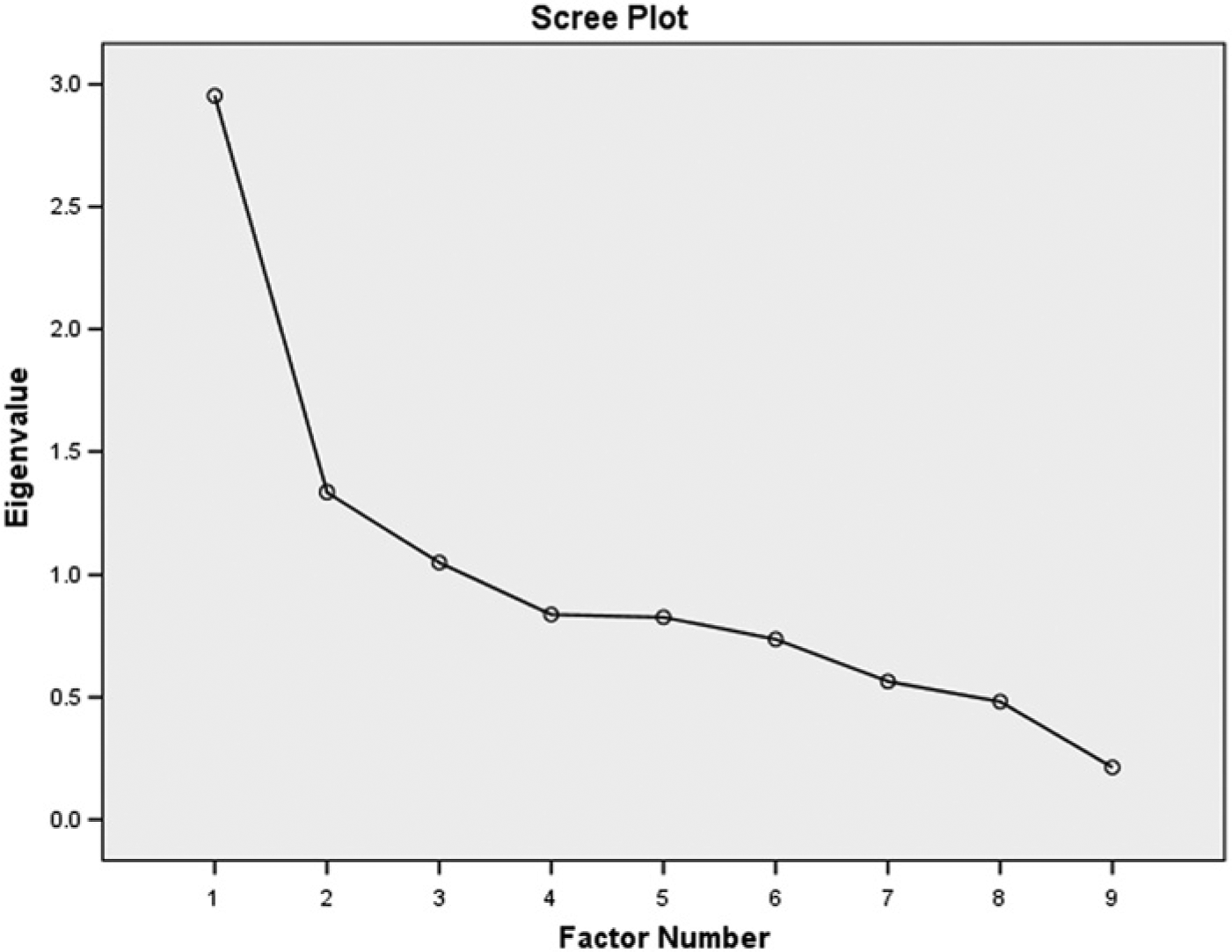
Scree plot of openness.
A maximum likelihood factor analysis (MLFA) with Promax rotation was performed on the 10 items. Three factors were extracted. The model seemed problematic as item 20 was a Heywood case with a communality of 1.013. This item, “vote conservative” reverse-scored, seemed redundant with item 8, “vote liberal,” and was excluded from further analyses.
A second MLFA excluding item 20 improved the fit (Kaiser–Meyer–Olkin = .746; Bartlett’s test of sphericity χ2(36) = 521.526, p < .001; goodness-of-fit χ2(12, n = 255) = 11.645, p = .475). Table 3 describes means, standard deviations, rotated factor loadings, and communalities of items within the openness domain, as well as factor correlations. With a cutoff of .4, significant at .05 with .80 power given the sample size (Hair, Black, Babin, Anderson, & Tatham, 2006), two of the nine variables did not load on any factor and had low communality values of .161 and .196. Communalities for the variables that loaded on factors ranged widely between .185 and .794. An oblique (Promax) rotation was requested as personality facets are conceptually correlated. Within the rotated component matrix, Factor 1 had three items related to artistic interests, Factor 2 had two items related to intellect, and Factor 3 had two items that relate to various secondary facets of the openness domain such as imagination and liberalism (Goldberg, 1999). The artistic interests and intellect factors within the openness domain of the M5-50 are consistent with the openness/intellect model, in which facets related to aesthetics, art, and feelings are markers of openness and facets related to ideas and abstraction are markers of intellect (DeYoung et al., 2007; Johnson, 1994).
Means, Standard Deviations, Maximum Likelihood Factor Analysis (MLFA) with Promax Rotation Factor Loadings, Communalities, and Factor Correlations for Openness in a Three-Factor Solution.
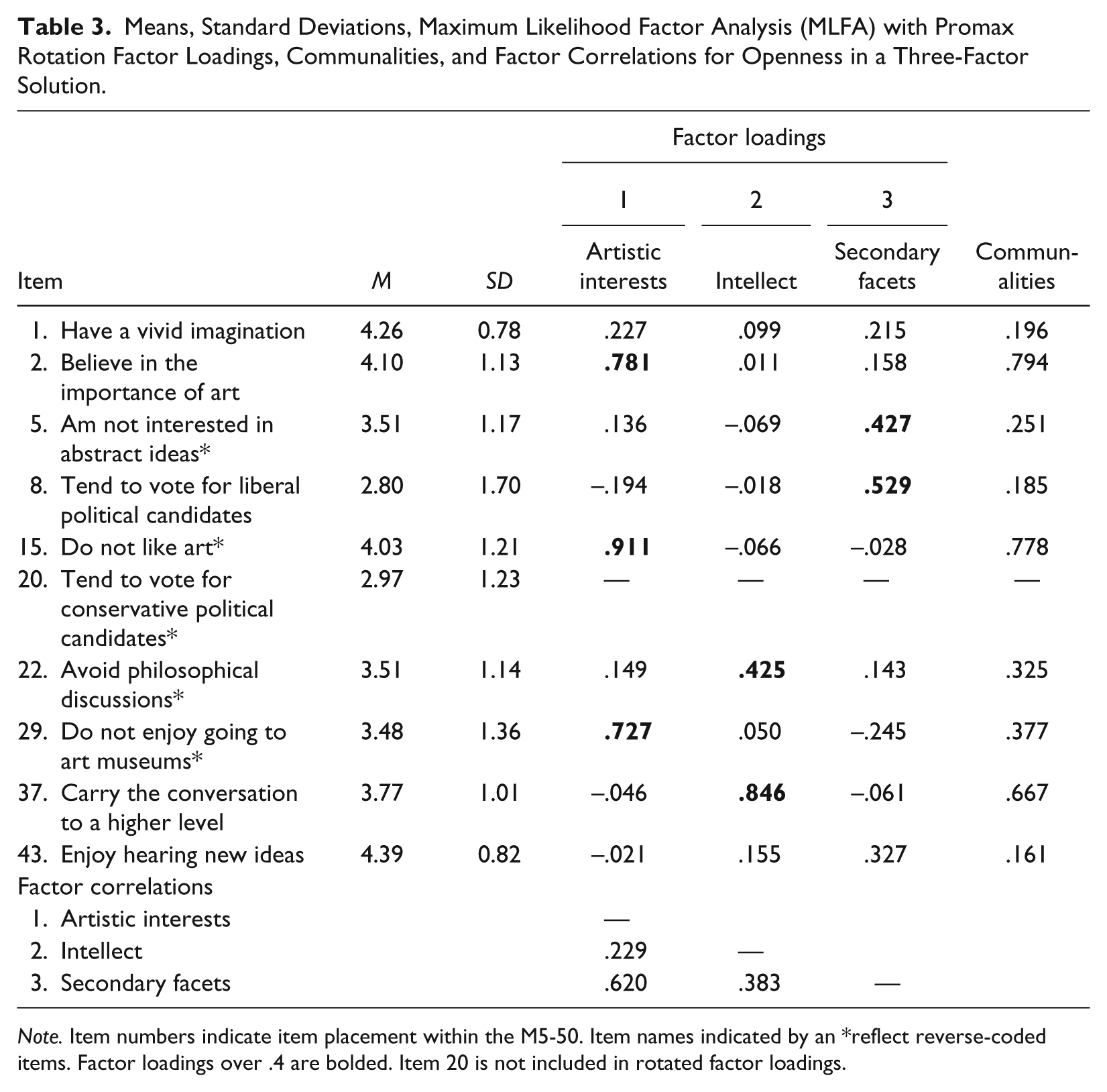
Note. Item numbers indicate item placement within the M5-50. Item names indicated by an *reflect reverse-coded items. Factor loadings over .4 are bolded. Item 20 is not included in rotated factor loadings.
Although the lack of correlation to other factors in the M5-50 was inconsistent with an initial review of the M5-50 (Socha et al., 2010), the structure of the openness domain suggested by this MLFA helps to satisfy the question of how to achieve better M5-50 model fit for future studies. An acceptable Cronbach’s α, despite a fragmented factor, suggests that the factors found within the M5-50’s openness domain may be subordinate facets that share variability with a higher-order domain, and are related but distinguishable as the openness/intellect model specifies.
Practical Implications
The M5-50 appears to adhere to the two-factor openness/intellect model of the openness domain better than it does as the one domain construct it was conceptualized to be. Researchers should consider conducting a confirmatory factor analysis (CFA) of the M5-50 using the different factor structures of openness domain items found within this study in order to verify if these models have better fit than Socha et al. (2010). If the fit does not improve, perhaps a revision of the M5-50 items, especially items regarding voting preference, might result in factors that resemble the literature more closely as intellect and artistic interests are markers of openness/intellect while liberalism is a secondary facet (DeYoung et al., 2007; Johnson, 1994). By including items which conceptualize voting preference twice, the M5-50 may inflate the role of the liberalism facet onto a measure of the openness domain beyond its importance.
Vocational psychologists, particularly those focused on creative individuals, should differentiate between the openness and intellect facets when incorporating FFT into advising plans as they relate to different interests. The openness facet relates to artistic vocational interests while the intellect facet relates to investigative vocational interests (Johnson, 1994; Larson et al., 2002). As such, differentiation of these two constructs with the openness domain allows for a more complete measurement of the complex interplay involved within artistic and scientific creativity.
Footnotes
Declaration of Conflicting Interests
The authors declared no potential conflicts of interest with respect to the research, authorship, and/or publication of this article.
Funding
The authors received no financial support for the research, authorship, and/or publication of this article.