



Abstract
The Polish Temperament Styles Questionnaire (PTSQ), derived from Student Style Questionnaire (SSQ) was developed to measure four bipolar temperament styles: extroverted versus introverted, practical versus imaginative, thinking versus feeling, and organized versus flexible. The study focuses on factorial validity and measurement invariance (configural, metric, and scalar) across gender and age groups using data from 1,022 students ages 8 to19. Confirmatory factor analysis (CFA) supports the four factor model, and multigroup confirmatory factor analysis (MGCFA) supports measurement invariance for both age and gender groups.
Temperament refers to stylistic and relatively stable traits that subsume intrinsic tendencies to act and react in somewhat predictable ways to people, events, and other stimuli (Joyce, 2010). The Student Style Questionnaire (SSQ; Oakland, 2012; Oakland, Glutting, & Horton 1996) is used to measure four bipolar temperament styles in childhood and adolescence based on the work of Jung as well as Meyers and Briggs: extroverted versus introverted, practical versus imaginative, thinking versus feeling, and organized versus flexible styles. The four bipolar styles assess qualities that impact children’s academic and social development and therefore are of potential importance when used in an educational context (Oakland et al., 1996).
Extroverted–introverted styles describe where people generally derive energy. Those with an extroverted style preference generally are energized by the outside world, especially by contact with people. They generally learn by talking, enjoy large groups, have many interests and friends, and respond quickly. In contrast, those with an introverted style preference generally are energized by their inner world of ideas or mental life. They generally learn by reflecting and writing, prefer small groups or solitude, have fewer interests and close friends, and respond hesitantly and cautiously.
Practical–imaginative styles describe how people generally prefer to code information and envision their world. Those with a practical-style preference generally attend to facts, objects, and details. They generally are realistic and pragmatic, understand things literally, enjoy sequential learning, and notice details. In contrast, those with an imaginative style preference generally view the world in terms of generalizations, possibilities, and insights. They generally are insightful, visionary, theory oriented, enjoy metaphor and symbols, learn by intuitive leaps, and focus on generalizations.
Thinking–feeling styles describe how people generally prefer to make decisions. Those with a thinking style preference generally use objective standards and strive for honesty and fairness. They generally are analytical and quizzical, value logic over sentiment, display brief businesslike interactions, strive for fairness, and favor truth and justice. In contrast, those with a feeling style preference generally use personal standards and strive for harmony. They generally are trusting, sympathetic, seek harmony, value sentiment over logic, display tactful and friendly interactions, strive for harmony and are compassionate.
Organized–flexible styles describe when people generally prefer to make decisions. Those with an organized style preference generally like to use lists, finalize decisions, and make decisions as soon as possible. They generally want to plan and rely on schedule, are dependable, keep their personal space neat, and enjoy a predictable structure. In contrast, those with a flexible style preference generally like to delay decisions and keep their options open. They generally are flexible in their commitments, seek opportunity for play, tolerate disorder in their personal space, and enjoy surprise and changes (Oakland et al., 1996).
Prior research used the SSQ to examine children’s temperament development in 21 countries (Oakland, 2012), thus leading to cross-national comparisons. However, despite the instrument’s somewhat widespread use, few studies have examined its factorial structure and measurement invariance (Benson, Oakland, & Shermis, 2009). The Polish Temperament Styles Questionnaire (PTSQ) is the Polish version based on SSQ’s items. The current study focuses on the factorial validity of the four bipolar model as well measurement invariance of the model across gender and age group. Information on measurement invariance provides evidence of the degree an instrument measures the same latent dimension(s) in all groups (Raykov, Marcoulides, & Li, 2012). This information may be especially important in research with children if the validity of data from self-report measures are questioned due to the children’s young ages and measurement demands.
Method
Participants
Data were collected on 1,022 students (51% female), ages 8 through 19 (M = 14.1, SD = 3.3), from both urban and rural areas in central and eastern Poland in schools that agreed to participate in the study. The sample was divided into two age groups: younger one, ages 8 to 14 (n = 512), and older one, ages15 to 19 (n = 510). Children whose parents granted permission to participate in the study completed the PTSQ during their school lessons in about 15 to 20 min. Volunteer university students trained in its administration methods administered the scale consistent with the SSQ’s directions.
Instrument
The PTSQ was derived from the SSQ. Each of its 69 forced-choice items has two alternatives that allow for an assessment of preferred behaviors associated with one of the four bipolar styles: extroversion (E) or introversion (I), practical (P) or imaginative (M), thinking (T) or feeling (F), and organized (O) or flexible (L). The reliability of the instrument was assessed by the Index of Quality of Saris and Gallhofer (2007), based on data collected in this study: EI = .82, PM = .77, TF = .73, OL = .86. The index corresponds to the correlation between the latent variable and the observed variables.
Data Analysis
According to Benson et al. (2009), SSQ items were assigned into parcels and parcels were introduced into confirmatory factor analysis (CFA) for the entire group and separately for the two age and two gender groups. Test for measurement invariance was carried out using multigroup CFA. This method involves setting cross-group constraints and comparing more restricted models with less restricted models (Byrne, Shavelson, & Muthén 1989; Chen, 2007). There are three levels of measurement invariance (Vandenberg & Lance, 2000): (a) configural (all groups have the same pattern of factor loadings), (b) metric (the factor loadings are constrained to be equal across the compared groups), and (c) scalar (indicator intercepts are constrained to be equal across groups). Scalar invariance is required to compare construct means across groups; its presence indicates that the scales were used in a similar way in each group.
Cutoff criteria suggested by Chen (2007) were used to determine whether the fit of more restrictive models deteriorated significantly. In samples larger than 300, the criteria for identifying a lack of metric invariance compared with configural invariance were a change greater than .01 in Comparative fit index (CFI), supplemented by a change greater than .015 in Root Mean Square Error of Approximation (RMSEA), or a change greater than .03 in Standardized Root Mean Square Residual (SRMR). The criteria for identifying a lack of scalar invariance compared with the metric invariance model were a change larger than .01 in CFI, supplemented by a change larger than .015 in RMSEA, or a change larger than .01 in SRMR.
Results and Discussion
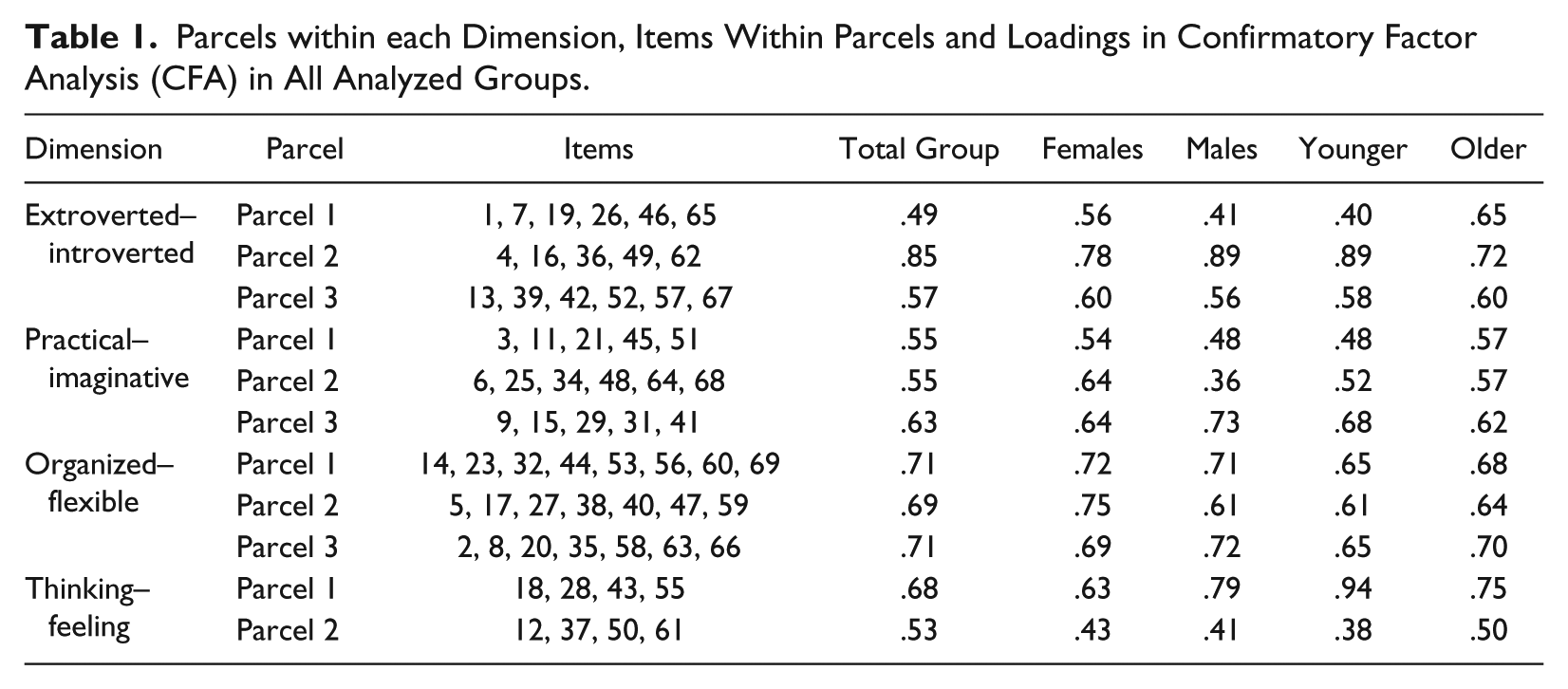
The tested model in AMOS 20 is presented on the Figure 1. Descriptive statistics and covariance matrix are available from the first author upon request. Parcels within each dimension, items within parcels, and loadings in CFA in all analyzed groups are presented in Table 1. The model fit coefficients for each group are reported in Table 2.
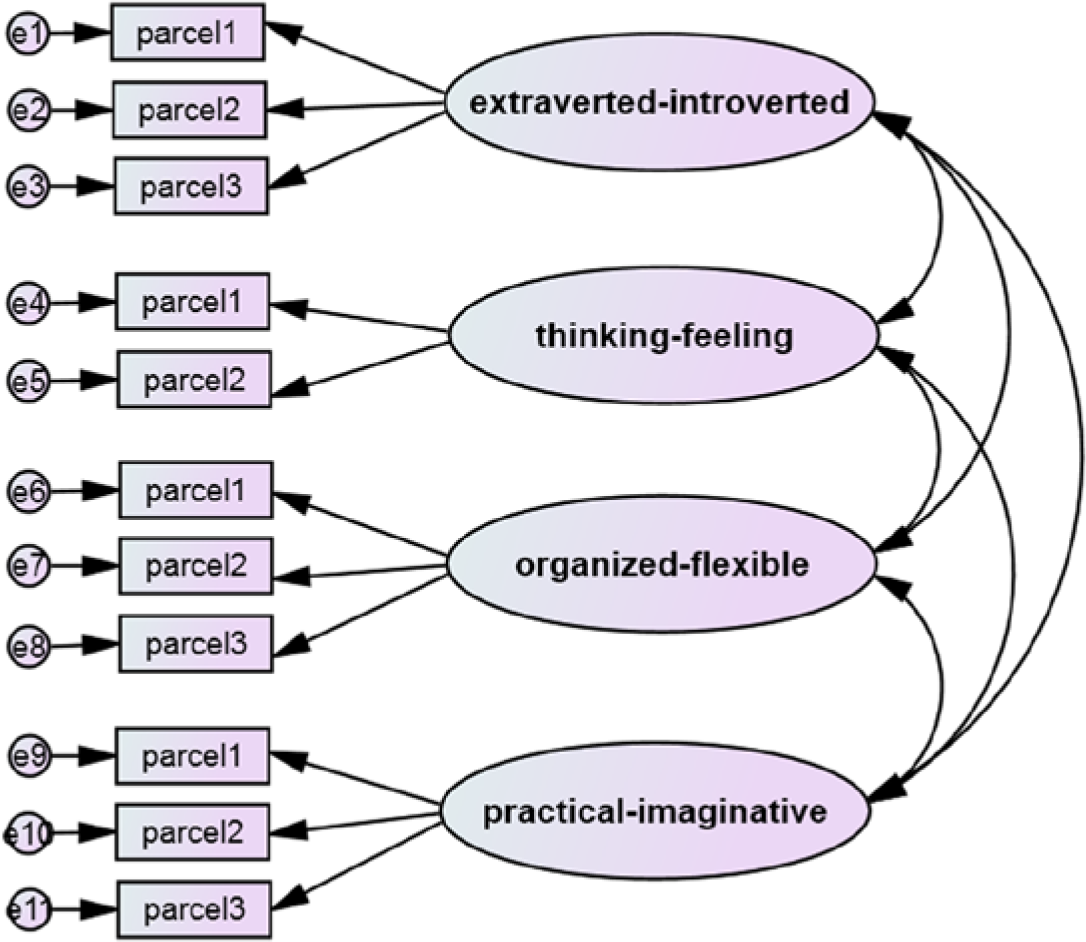
Measurement Model of PTSQ Tested in CFA.
Parcels within each Dimension, Items Within Parcels and Loadings in Confirmatory Factor Analysis (CFA) in All Analyzed Groups.
Global Fit Measures For the Single Sample CFAs With the PTSQ (df = 38).
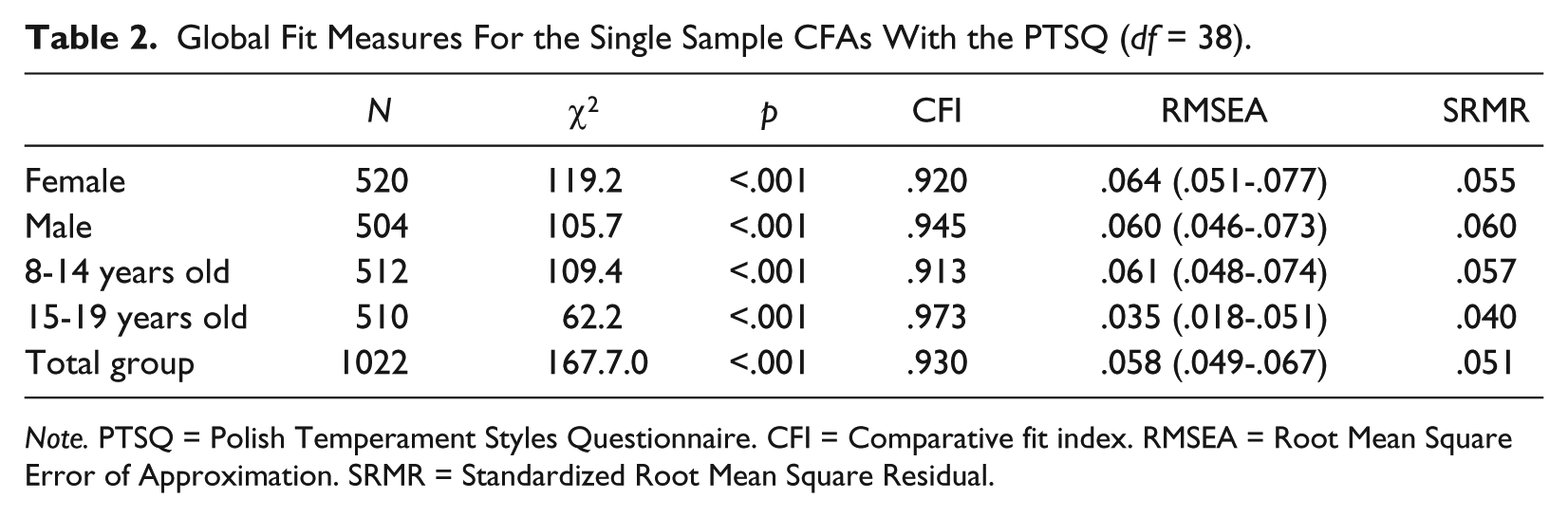
Note. PTSQ = Polish Temperament Styles Questionnaire. CFI = Comparative fit index. RMSEA = Root Mean Square Error of Approximation. SRMR = Standardized Root Mean Square Residual.
The models for the total group, the two age groups, as well as for male and female meet standard criteria (e.g., Hu & Bentler 1999). Data on the global fit measures from the multigroup CFA for the two age groups and two genders are reported in Table 3.
Global Fit Measures For the MGCFA Across Gender and Age Groups With the SSQ.

Note. MGCFA = Multigroup Confirmatory Factor Analysis. SSQ = Student Style Questionnaire . CFI = Comparative fit index. RMSEA = Root Mean Square Error of Approximation. SRMR = Standardized Root Mean Square Residual.
Configural metric and scalar invariance were supported for both gender groups. Metric invariance also was supported for the two age groups. However, changes in CFI and RMSEA exceeded criteria needed to accept the most restrictive model indicating full scalar invariance. Partial scalar invariance was established after releasing intercepts in three parcels (Parcel 1 loading on extraversion–introversion, Parcel 2 on practical–imaginative, and Parcel 3 on organized–flexible styles). Partial invariance is sufficient for conducting meaningful between-group comparisons (Steenkamp & Baumgartner, 1998). Therefore, comparisons of means between gender and age groups, while treating temperament in its dimensional form, is meaningful and justified because scalar measurement invariance was established.
To summarize, results from the CFA provide support for the test’s theoretical four factor structure. Support for measurement invariance was found for both age and gender groups. Full metric invariance, supported across age and gender group, enables comparisons of temperament correlates. Also, full scalar invariance, evident across gender, and partial scalar invariance evident across age groups, enable comparisons of means across age and gender groups (Vandenberg & Lance, 2000). Establishing measurement invariance is especially important in cross-sectional studies with young children because of doubts whether the measurement instrument provides reliable results due to age-related cognitive differences yet similar demands within the measurement instrument. The results suggest the PTSQ items are understandable to children as young as 8 years and the structure of temperament is similar for younger and older children. Information from the four bipolar styles is thought to be useful in educational context because it provides insights on how children learn and how temperament-related instructional methods may facilitate learning, taking into account individual differences between children in their temperament styles (Oakland et al. 1996). The factorial structure and measurement invariance provide support for the meaningful use of temperament data from the PTSQ in research and practice.
Footnotes
Declaration of Conflicting Interests
The authors declared no potential conflicts of interest with respect to the research, authorship, and/or publication of this article.
Funding
The authors disclosed receipt of the following financial support for the research, authorship, and/or publication of this article: This research was supported by grant no. NN106 132439 in the years 2010–2012 of the Polish Ministry of Science and Higher Education and partially by the University Research Priority Program, University of Zürich, awarded to the second author.