




Abstract
This article assessed the measurement invariance of the Adolescent Student Burnout Inventory (ASBI) across gender and educational track, and investigated the main and interaction effects of gender and educational track on the facets of student burnout with a sample consisting of 2,216 adolescent students from China. Multigroup confirmatory factor analysis was used to test measurement invariance of the ASBI, and the Multiple-Indicator, Multiple-Cause Models (MIMIC) was used to test the main and interaction effects of gender and educational track on the facets of student burnout. Results showed that the three-factor (exhaustion, cynicism, and reduced efficacy) structure of student burnout was invariant across gender and educational track. It was also shown that boys suffered more cynicism than girls; the educational track affected the student burnout; the interaction effect of gender and educational track were found on reduced efficacy in Grade 9 students, and on exhaustion and reduced efficacy in Grade 12 students.
The concept of burnout has been expanded to students recently (Campos, Zucoloto, Bonafé, Jordani, & Maroco, 2011; Parker & Salmela-Aro, 2011; Schaufeli, Martinez, Pinto, Salanova, & Bakker, 2002). The original was developed and applied to workers (Freudenberger, 1974; Maslach, Schaufeli, & Leiter, 2001). Following Maslach Burnout Inventory–General Survey (MBI-GS; Schaufeli, Leiter, Maslach, & Jackson, 1996), which is the most widely used self-report test of work burnout, Schaufeli et al. (2002) developed the MBI–Student Survey (MBI-SS) for students and proposed a three-factor structure for the MBI-SS: exhaustion, cynicism, and reduced efficacy. Exhaustion refers to feeling exhausted because of study demands. Cynicism, in turn, is manifested in an indifferent or a distal attitude toward one’s study, especially a cynical attitude toward one’s academic work as a student. Reduced efficacy can be defined as diminished feelings of competence as well as less successful achievement as a student.
Although the three-factor model of student burnout has been generally accepted and supported by the majority of studies (Parker & Salmela-Aro, 2011; Salmela-Aro & Tynkkynen, 2012), there are still debates about it. First, the original three-factor model has been supported by the studies mainly conducted among various European or U.S.-based populations (Dyrbye et al., 2006; Jennings, 2009; Lillemon & Haddad, 2010; Mccarthy, Pretty, & Catano, 1990; Salmela-Aro & Tynkkynen, 2012; Schaufeli et al., 2002). A number of studies recently found that a four-factor model fits even better than the three-factor model, particularly among populations that are demographically distinct from those on which the MBI-SS was developed (Aypay, 2011; Hu & Dai, 2007). More importantly, the MBI-SS is not invariant across countries (Schaufeli et al., 2002), which means the culture adaption may be a problem in terms of student burnout in different countries. All of these imply that student burnout may have a different structure in Mainland China. Actually, studies conducted in China showed that the factor structure of the student burnout was controversial: The three-factor model was confirmed in junior middle-school students (Wu, Dai, & Zhang, 2007) and college students (Zhang, Gan, & Cham, 2007; Zhang, Gan, & Zhang, 2005), but the four-factor model was found in high school students (Hu & Dai, 2007). Is the three-factor structure of student burnout acceptable in Mainland China? This study aims to examine the factor structure of student burnout in a large Mainland Chinese adolescent population.
Second, gender, educational track, and their interactions may all play a role in the differences seen in student burnout (Salmela-Aro, Kiuru, & Nurmi, 2008; Salmela-Aro & Tynkkynen, 2012; Tram & Cole, 2006). In Chinese educational systems, attending college-entrance examination is almost the only way one can go to college. After adolescents enter the high school to prepare for college-entrance examination, they come under increasing pressure to succeed academically as they face the transition to tertiary education (Fang & Hu, 2006). So, educational track may have an important impact on student burnout (Salmela-Aro & Tynkkynen, 2012). As to the impact of gender on student burnout, it has been found that girls experience more depression (Moksnes, Moljord, Espnes, & Byrne, 2010), exhaustion, inadequacy, and overall burnout (Salmela-Aro et al., 2008; Salmela-Aro & Tynkkynen, 2012) than boys. However, less is known about the measurement invariance of student burnout across gender and education track, especially in Mainland China adolescent population. The establishment of measurement invariance across groups is a logical prerequisite to conducting substantive cross-group comparisons (e.g., tests of group mean differences, invariance of structural parameter estimates; Vandenberg & Lance, 2000). If measurement invariance does not hold, differences in observed scores may not be directly comparable (Meade, Lautenschlager, & Hecht, 2005). Thus, the second aim of this article is to examine the measurement invariance across gender and educational track of the best-fitting model identified in the above analysis. And then, the main and interaction effects of gender and educational track on the facets of student burnout are investigated.
Method
Participants and Procedure
A total of 2,216 participants (47.4% boys) from 10 schools in 4 provinces of Mainland China were recruited whose ages ranged from 11 to 20 (M = 15.34, SD = 1.94). Among the participants, 18.4% were in the equivalent of the United States’ Grade 7, 15.0% were in the Grade 8, 12.7% were in the Grade 9, 18.8% were in the Grade 10, 17.1% were in the Grade 11, and 18.0% were in the Grade 12.
Participants completed surveys in school during a specified class period lasting approximately 45 min. Before self-reported questionnaires were administrated to the participants, their parents (or legal guardians) were requested to provide informed consent. Children then provided assent for their own participation. This study underwent review by the Human Subjects Review Committee at Guangdong University of Foreign Studies.
Measure
The Adolescent Student Burnout Inventory (ASBI)
The ASBI (in Chinese) was originally developed by Wu, Dai, and Wen (2010; Wu et al., 2007) on the basis of the MBI-SS (Schaufeli et al., 2002). The inventory consists of 16 items measuring three factors of student burnout: (a) exhaustion (four items), (b) cynicism toward the meaning of study (five items), and (c) sense of inadequacy at studying (seven items). The ASBI consists of nine positive-affect items (e.g., I want to give up my studies) and seven negative-affect items (e.g., I study with energy). Higher scores on the ASBI indicate more burnout symptoms (Wu et al., 2010). Every item was rated on a 5-point Likert-type scale ranging from 1 (completely disagree) to 5 (strongly agree). The seven positive-affect items were reversed by recoding before conducting the analysis. The ASBI has been validated (Wu et al., 2010; Wu et al., 2007) and frequently used in the studies related to student burnout in China (e.g., Wu, Dai, Wen, & Li, 2012; Zou, Xie, & Quan, 2013).
Data Analysis Strategy
Missing data
The original sample included 2,337 adolescents, with 121 participants failing to respond to the items. A growing body of research has emphasized potential problems with traditional pairwise, listwise, and mean-substitution approaches to missing data (Graham & Hoffer, 2000). The expectation maximization (EM) algorithm, the most widely recommended approach to imputation for data that are missing at random, was implemented for the sample.
Analytic steps
Our analyses contained three steps. First, confirmatory factor analysis (CFA) was conducted on the whole sample. The CFA tested the fit of two competing models. Then, we assessed measurement invariance of the best-fitted model from the CFA, across gender and education track. Finally, we investigated the main effects of gender and educational track, and their interaction effect on the facets of student burnout by using the Multiple-Indicator, Multiple-Cause Models (MIMIC).
Stage 1: Baseline confirmatory factor analysis
Descriptive statistics were performed by the SPSS program (IBM, SPSS version 18). The multivariate skew test and kurtosis test were performed using Mplus 6.1 software (Muthén & Muthén, 1998-2007). Results of skew test and kurtosis test showed that the distribution of the data was non-normal. The skewness was 2.043 ± 0.113 (M ± SD), and the kurtosis was 254.778 ± 0.953. Thus, we used maximum likelihood estimation with a mean-adjusted chi-square (MLM), which is robust to non-normality. Confirmatory factor models were specified and estimated using Mplus 6.1 software.
Two alternative theoretical models were estimated separately: (a) a three-factor model (M1) with three correlated latent factors, namely, exhaustion, cynicism, and reduced efficacy, underlying the ASBI items and (b) a four-factor model (M2) based on M1 in which the exhaustion items were separated into two factors.
Following generally accepted practice, we evaluated the fit of each model by examining multiple fit indices (Kline, 2010). We used the chi-square, root-mean-square error of approximation (RMSEA), Tucker–Lewis index (TLI), comparative fit index (CFI), and the Bayesian information criterion (BIC) to identify the best-fitting model.
Stage 2: Factorial invariance across gender and education track
After identification of the best-fitting model of the ASBI, we tested measurement invariance across gender and education track. First, Model A tested configural invariance by allowing all parameters to vary. Model B constrained factor loadings across groups (testing factor loading invariance). Model C additionally constrained error variances (testing error variance invariance). Model D additionally constrained factor variances and covariances (testing factor variance-covariance invariance).
Nested models in the current study were compared using the MLM (Satorra-Bentler) χ2 together with changes in the RMSEA, CFI, and TLI. According to the suggestion of Cheung and Rensvold (1999, 2002), tests of the change in CFI are superior to chi-square difference tests of invariance, because they are not affected by the sample size. A value of CFI difference <.01 indicates that the invariance hypothesis should not be rejected; mean differences exist when CFI differences are .01 to .02, and definite differences exist when CFI differences are >.02 (Cheung & Rensvold, 1999, 2002).
Stage 3: MIMIC
Notwithstanding the importance of testing for invariance in factor structure, there is also reason to investigate the mean level of effects on the three facets of the ASBI. Kaplan (2000) suggested the MIMIC approach, which is similar to a regression model in which latent variables (e.g., three dimensions of student burnout) are “caused” by discrete grouping variables (e.g., gender, educational stage) represented by single indicators. This MIMIC model assessed the role of gender (male = 0, female = 1), educational stage (Grade 7 to Grade 12), and their interaction as a predictor of student burnout. Being a multinomial predictor, educational stage was represented by five dummy variables with Grade 7 as the reference point. Hence, positive beta weights for dummy variables indicate higher scores for Grade 8 to Grade 12 students compared with Grade 7 students, and negative beta weights for dummy variables indicate lower scores for Grade 8 to Grade 12 students compared with Grade 7 students.
Results
Stage 1: Baseline Confirmatory Factor Analysis
Table 1 summarized the fit indices of two competing models using the MLM estimation method in the whole sample. As can be seen in Table 1, M1 (three-factor model) and M2 (four-factor model) fitted the data well (CFIs > .90, TLIs > .90, and RMSEAs < .08). Overall, two models had the similar results in terms of the fit indices, but M1 was more parsimonious, and the structure was easier to be explained. So, we accepted M1 as the better model.
Goodness-of-Fit Indices and Model Comparisons for Tested Models.

Note. TLI = Tucker–Lewis Index; CFI = Comparative Fit Index; AIC = Akaike Information Criterion; BIC = Bayesian information criterion; RMSEA = root mean square error of approximation; CI = confidence interval. M1 = three-factor model; M2 = four-factor model.
Stage 2: Factorial Invariance Across Gender and Education Track
Four models were tested in each of the multigroup CFAs assessing invariance of factor structure across gender and educational stage. Model A allowed all parameters to be freely estimated; Model B held factor loadings invariant across groups; Model C held factor loadings and error variances/covariances invariant; and model D held factor loadings, error variances/covariances, and factor variances/covariances invariant.
The results (see Table 2) from the analyses of the measurement invariance across gender revealed that all the four steps of invariance testing resulted in significant MLM χ2 (all ps < .01) but excellent fit indices (CFIs > .95, TLIs > .95, and RMSEA < .08) and equivalent fit indices (ΔCFIs < .01, ΔTLIs < .01). All goodness-of-fit indices reported here indicated that the four models reflecting different degrees of invariance were acceptable. In summary, there is measurement invariance across gender, that is, the ASBI items have the same meaning for boys and girls.
Goodness-of-Fit Indices and Model Comparisons for Measurement Invariance Models Across Gender.

Note. MLM = Maximum likelihood estimation with a mean-adjusted chi-square; TLI = Tucker–Lewis Index; CFI = Comparative Fit Index; RMSEA = root mean square error of approximation; CI = confidence interval; Δχ2 = change in χ2 relative to the preceding model; Δdf = change in degree of freedom relative to the preceding model; ΔTLI = change in Tucker–Lewis Index relative to the preceding model; ΔCFI = change in Comparative Fit Index relative to the preceding model.
p < .05. **p < .01.
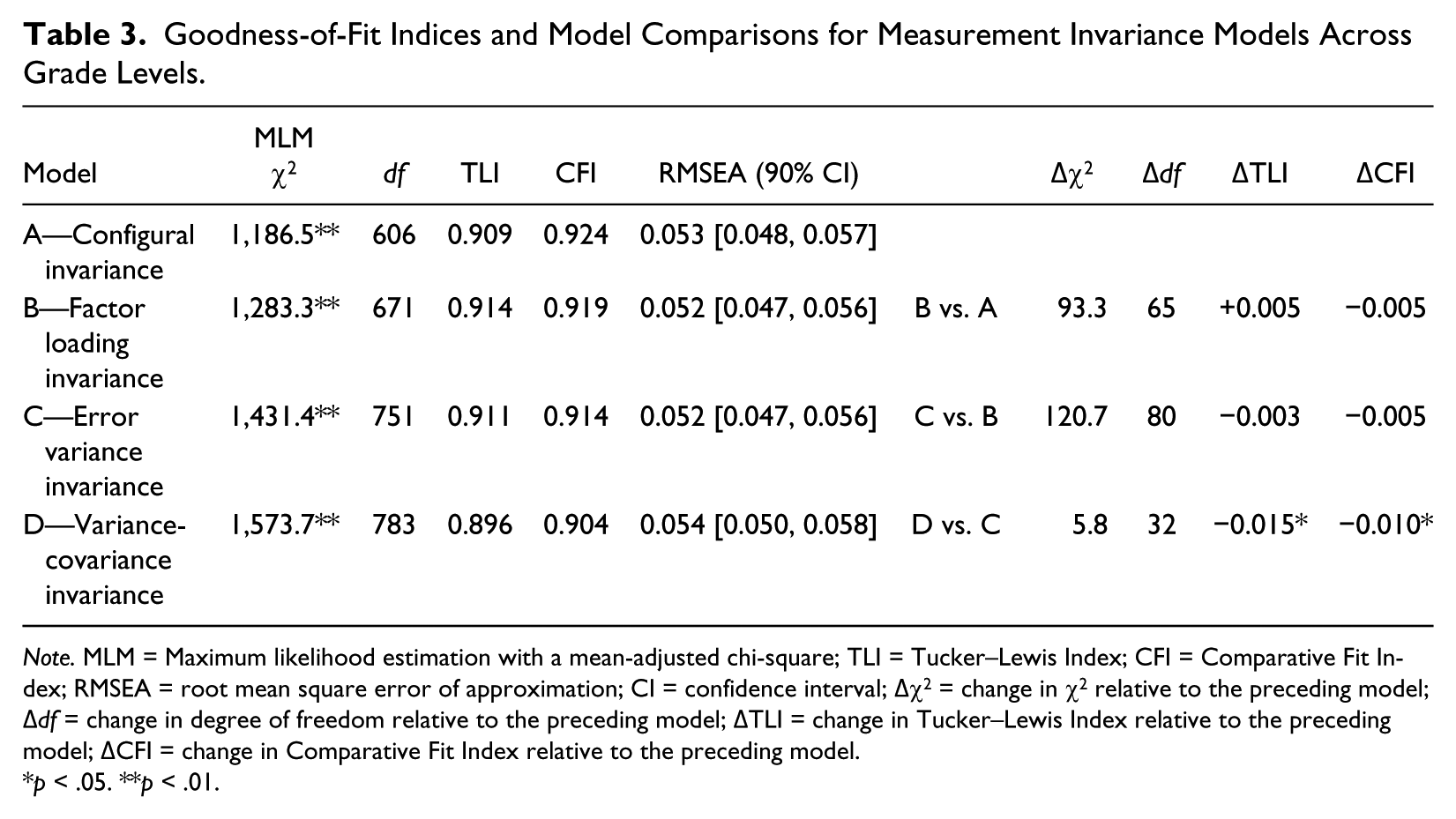
Table 3 showed results of the measurement invariance across educational stage. The configural invariance model (Model A) and the factor loading invariance model (Model B) provided excellent fit to the data. Comparing the error variance invariance Model (Model C) with the factor loading invariance Model (Model B), we obtained equivalent fit indices (ΔCFIs < .01, ΔTLIs < .01). Hence, Model A to Model C were acceptable. Therefore, the ASBI items have the same factor loadings, error variances/covariances across different grades (7-12).
Goodness-of-Fit Indices and Model Comparisons for Measurement Invariance Models Across Grade Levels.
Note. MLM = Maximum likelihood estimation with a mean-adjusted chi-square; TLI = Tucker–Lewis Index; CFI = Comparative Fit Index; RMSEA = root mean square error of approximation; CI = confidence interval; Δχ2 = change in χ2 relative to the preceding model; Δdf = change in degree of freedom relative to the preceding model; ΔTLI = change in Tucker–Lewis Index relative to the preceding model; ΔCFI = change in Comparative Fit Index relative to the preceding model.
p < .05. **p < .01.
However, the variances-covariances invariance Model (Model D) provided poor fit to the data (TLIs < .900, ΔCFIs > .01, ΔTLIs > .01). This suggested that the ASBI might have different factor variances and covariances across different grades (7-12).
Stage 3: MIMIC
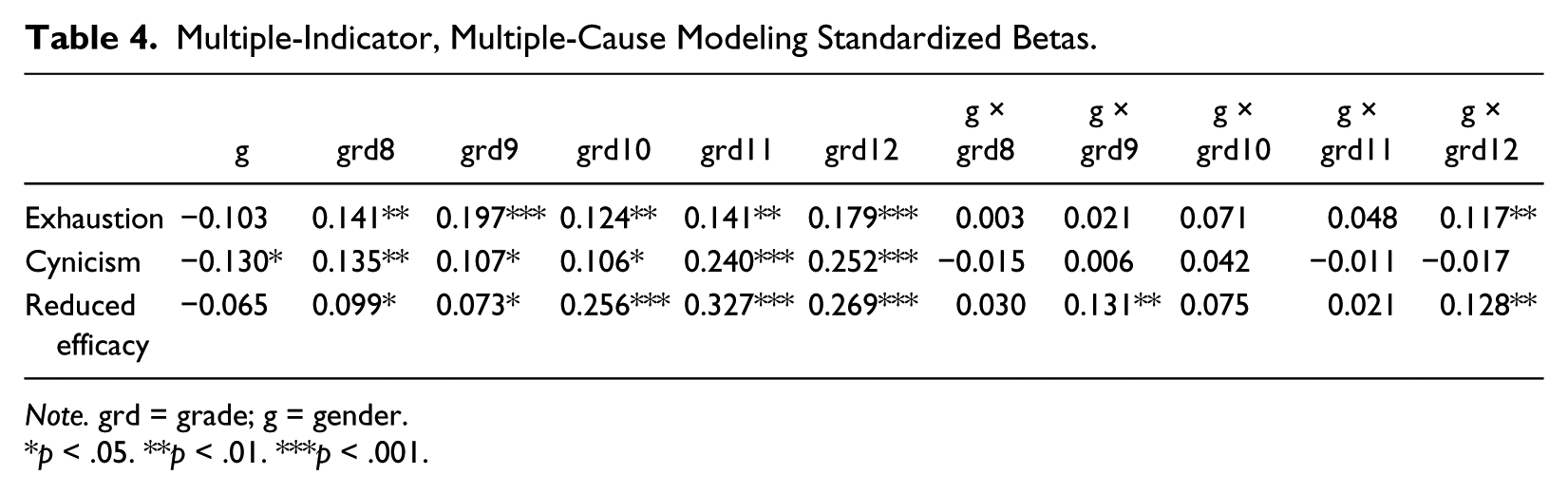
The previous analyses explored possible differences in factor structure as a function of gender and educational stage. It was also of interest to explore possible mean-level differences in student burnout as a function of gender, educational stage, and their interaction. MIMIC modeling is the analytical method used to examine this and involved structural equation models in which gender, educational stage, and their interaction are used as predictors of the student burnout. The model yielded a good fit to the data (TLI = .945; CFI = .956; RMSEA = .030). Beta coefficients were presented in Table 4, along with the main effects and interaction effects. Results showed that there is significant gender difference on cynicism. Compared with girls, boys were significantly lower (β = −.13**) on cynicism—that is, boys had more negative attitudes toward studying than girls. Gender had no significant effect on exhaustion and reduced efficacy.
Multiple-Indicator, Multiple-Cause Modeling Standardized Betas.
Note. grd = grade; g = gender.
p < .05. **p < .01. ***p < .001.
Results in Table 4 indicated that there are significant stage differences on each factor of student burnout with reference of Grade 7. It is interesting to see that the interaction effects of gender and education track on student burnout were significant at Grade 9 when junior middle school students transit to high school and Grade 12 when high school students transit to university. Specifically, the interaction effect of gender and Grade 9 on reduced efficacy was significant—that is, girls had lower efficacy (β = .131, p < .001) than boys at Grade 9, while the difference of efficacy between girls and boys at Grade 7 was not significant. The interaction effect of gender and Grade 12 on exhaustion (β = .117, p < .001) and reduced efficacy were significant (β = .128, p < .001)—that is, girls were more exhausted and had lower efficacy than boys at Grade 12, while the differences between girls and boys at Grade 7 were not significant.
Discussion
The primary purpose of this study was to test the measurement invariance of the ASBI across adolescent’s gender and educational track in Mainland China. CFA was conducted to get the baseline structure of student burnout at first. CFA results revealed that the 16 items of the ASBI can be interpreted in terms of three dimensions, including exhaustion, cynicism, and reduced efficacy. This result is consistent with previous research (Dyrbye et al., 2006; Jennings, 2009; Lillemon & Haddad, 2010; Mccarthy et al., 1990; Salmela-Aro & Tynkkynen, 2012; Schaufeli et al., 2002; Wu et al., 2007; Zhang et al., 2007; Zhang et al., 2005).
Results of the multiple groups CFA contrasting the girl sample with the boy sample indicated that the ASBI represented the same measurement of three factors of burnout in each of the two groups. All models reflecting different degrees of invariance were acceptable, suggesting that the ASBI’s factors have the same meaning across gender. Thus, comparison studies involved in burnout across gender are meaningful. As to the measurement invariance of the ASBI across educational track, the results showed the ASBI items had the same factor loadings, error variances/covariances across different grades (7-12), suggesting that the ASBI’s factors have the same meaning across educational track. Hence, the ASBI can be used when comparing differences of student burnout across gender and grades.
Then, the main and interaction effects of gender and educational track on the facets of student burnout were investigated using MIMIC analysis. Education track appeared to play a critical role in student burnout. It is worthwhile to notice that higher grade students suffered more in three components of student burnout than Grade 7 students. As the students go into the higher grades, they have to study harder to get better scores aiming to enter a good university. An effort-driven process of highly taxing study demands exhaust a student’s energy and might play a role in increasing the burnout. From the opinion of demands-resources theory (Schaufeli & Bakker, 2004), one may feel exhaustion if his or her resources cannot meet the demands. To cope with the situation, the higher grade students are more likely to take a negative attitude toward their studies and have lower efficacy.
The results showed that boys had higher levels of cynicism than girls, and this is consistent with previous work (Salmela-Aro & Tynkkynen, 2012; Weckwert & Flynn, 2006). By using a two time-point longitudinal study, Salmela-Aro and Tynkkynen (2012) found that boys suffered the most from cynicism, while girls suffered the most from school burnout. It is likely that girls may turn the stress inward and feel inadequate, while boys may direct it outward toward school and other institutions and feel cynicism. However, the results of the present study revealed that gender had no effect on exhaustion and low efficacy. These results contradict the previous studies showing that college girls experienced higher exhaustion and lower efficacy than boys (Weckwert & Flynn, 2006; Yang, 2004). The controversy may be due to different educational tracks (high school vs. university), and more research is needed on this topic.
As to the interaction between gender and the educational track, the results showed that Grade 9 girls have lower efficacy and Grade 12 girls have more exhaustion and lower efficacy. In China, Grade 9 and 12 are the most important transition points when students face entrance examination and school selection for entering senior high schools and universities, respectively. Girls are more likely to use venting and endurance coping styles, which could make one exhausted easily (Cheng, Shan-yan, & Hui, 2005), so they feel exhausted and reduced efficacy after a long time of pressure. These results are consistent with previous research, showing that differences in efficacy between girls and boys emerge when students transit to middle or junior high school (Wigfield, Eccles, MacIver, Reuman, & Midgley, 1991; Wigfield, Eccles, & Pintrich, 1996), with girls typically showing a decline in self-efficacy beliefs (Schunk & Pajares, 2002).
This study provided an enhanced understanding of the validity of student burnout. There are, however, a number of potential limitations that are important to consider when interpreting findings: First, it is important to recognize that the data collected in the study are cross-sectional. Tracking the same students over time and assessing factor structure from a longitudinal perspective would be important and attractive. Second, the participants in this study are students from China. It is important to conduct research that examines the same structure of the ASBI using data derived from different countries.
Conclusion
The present investigation indicated that three factors represented the structure of the ASBI. Furthermore, the three-factor structure was shown to be invariant across subgroups of boys and girls. Findings from the present study also provided evidence supporting the same structure of the ASBI in students from Grades 7 to 12.
Periods of transition in schooling affected student burnout. Higher grade students suffered more in exhaustion, cynicism, and reduced efficacy than Grade 7 students. Gender had an effect on student burnout—boys suffered more cynicism than girls.
Gender and the educational track had interaction effects on reduced efficacy in Grade 9 students, and on exhaustion and reduced efficacy in Grade 12 students compared with Grade 7 students. Overall, girls suffered more than boys at transition periods. The findings of this research have implications for studies relevant to student burnout and presented new insights and opportunities for educators and parents seeking to reduce the harmful outcomes of student burnout.
Footnotes
Declaration of Conflicting Interests
The author(s) declared no potential conflicts of interest with respect to the research, authorship, and/or publication of this article.
Funding
The author(s) disclosed receipt of the following financial support for the research, authorship, and/or publication of this article: This research was funded in part by grants from the National Natural Science Foundation of China (31271116), Project on Humanities and Social Sciences of Ministry of Education of China (12YJC190031, 11YJCZH079), and National Statistics Research Program of China (2012LY136).