



Abstract
This study was designed to examine the factor structure and psychometric properties of the English as a Foreign Language Reading Anxiety Inventory (EFLRAI). A total of 939 non-English major students responded to the EFLRAI. Exploratory and confirmatory factor analyses were performed using a principal component analysis and structural equation modeling. Reliability analysis was also conducted to provide an indication of the internal consistency (reliability) of the measurement instrument. The findings of the study confirmed the adequacy of the three-factor model for the EFLRAI and also indicated decent reliability through internal consistency for the measure. The results not only support the EFLRAI’s multidimensionality, but also indicate the usefulness of the EFLRAI in reading anxiety research among non-English major students. The limitations of the study are discussed and recommendations for further research are provided.
The pertinent literature demonstrates that many students who pass the university entrance exam enter tertiary education underprepared with respect to their English as a foreign language (EFL) reading abilities (Dreyer & Nel, 2003; Haghani, 2004; Martínez, 2008). Although various factors can account for students’ poor performance in EFL reading, it seems that EFL reading anxiety plays a major part (Saito, Horwitz, & Garza, 1999; Saito & Samimy, 1996; Sellers, 2000). Foreign language reading anxiety as a distinct type of anxiety is experienced by language learners during the process of reading foreign language texts (Saito et al., 1999). It is found that anxious EFL readers may not recall or grasp fully the material learned before (Horwitz, Horwitz, & Cope, 1986; Sellers, 2000) and thus may be less active in class (Ely, 1986; Horwitz et al., 1986). Recent studies show that Iranian students, particularly those who are non-English majors (i.e., their fields of study are other than English related majors), feel anxious when they are required to read texts in English (Mirhassani & Hosseini, 2006; Rahemi, 2009), and as a result, they do not perform well on EFL reading tests (Maleki & Zangani, 2007) and experience higher levels of demotivation (Atef-Vahid & Fard Kashani, 2011). As Saito et al. (1999) rightly put it, further research is still warranted to find out “exactly why students feel anxious about reading” (p. 217).
Most researchers suggest that educators should address learners’ reading anxiety by such approaches as creating a friendly atmosphere in English language classes in Iran (Atef-Vahid & Fard Kashani, 2011; Jafarigohar & Behrooznia, 2012) or by delivering a practical intelligence instruction (Tabatabaei & Hekmatipour, 2013). However, as Sellers (2000) asserts, we cannot properly address this issue until we know in what contexts EFL reading anxiety occurs. We need to gain an in-depth insight into the nature of EFL reading anxiety. One possible way to reduce it is by developing a measure that can properly capture this construct. To our knowledge, except for the Persian version of the English as a Foreign Language Reading Anxiety Inventory (EFLRAI) developed by Zoghi (2012), no attempt has been made to design such a measure specifically for undergraduate, non-English majors. These students are typically required to study English in English for General Purposes (EGP) courses and are often reported to experience reading anxiety (Rahemi, 2009; Razavi, 2008).
The value of the EFLRAI apparently lies with its ability to help reading educators know in what contexts EFL reading anxiety occurs and act accordingly. In fact, early identification of anxious EFL readers could make it possible for reading educators to take appropriate action. An increase in a given dimension of the EFLRAI may guide educators’ practices in the way they ameliorate EFL reading anxiety.
Moreover, the EFLRAI can help reading anxiety researchers avoid the “valid-test” fallacy—a problem that occurs when we elicit information on language learning behavior (Norris & Ortega, 2003). In fact, the “valid-test” fallacy arises when a measure is used for a population that it is not suited. In reading anxiety studies, this problem continues to happen. Almost in the majority of the investigations related to EFL reading anxiety, an internationally recognized instrument known as Foreign Language Reading Anxiety Scale (FLRAS) developed by Saito et al. (1999) has been used (e.g. Ghonsooly & Loghmani, 2012; Hayati & Ghassemi, 2008; Kuru-Gonen, 2007; Sellers, 2000). FLRAS was originally designed to measure anxiety related to foreign language (French, Japanese, and Russian) reading. This inventory has frequently been used in the context of English as a foreign language. As was argued before, generalized inventories are not suitable in various settings; in fact, general inventories are not transferable across sociocultural domains and, consequently, their outcomes can be less valid than claimed (LoCastro, 1994; Perry, Ball, & Stacey, 2004). By using the EFLRAI, this will no longer be the case with undergraduate non-English major students. Hence, there needs to be a measure like the EFLRAI that can encompass those aspects of reading anxiety typically experienced by EFL learners in the context of tertiary education. Otherwise, there is a danger that reading researchers mis-measure or mis-evaluate this attribute.
Zoghi (2012) developed the EFLRAI in response to the above shortcomings of the FLRAS. His pioneering work revealed the multidimensionality of EFL reading anxiety. Three main sources, as the results of his study showed, accounted for non-English major students’ reading anxiety reactions in tertiary education: (i) Top-down Reading Anxiety (TRA) that is mainly reader-specific and consists of readers’ background and cultural knowledge. This type of anxiety source lies within EFL readers and can be considered as personal (Items 1-7); (ii) Bottom-up Reading Anxiety (BRA) that is text-specific in nature. The textual elements such as the vocabulary and grammatical levels of the text give rise to reading anxiety (Items 8-21); and (iii) Classroom Reading Anxiety (CRA) that concerns the setting in which the first and second factors interact, namely the way reading lessons (EFL texts) are delivered (by the instructor) to the learners (readers). In other words, CRA as a third anxiety-provoking source, is context-relevant and arises from the classroom settings where the teacher, reader, and text interact (Items 22-27).
The abovementioned factors had been produced using qualitative data analysis. Thus, to provide statistical support for this finding, it was considered necessary to conduct a factor analytic study on the EFLRAI so that it could be possible to re-assess and also to firmly establish construct validity of the EFLRAI for use among non-English majors in tertiary education. Besides, to our knowledge no studies have yet been conducted to statistically assess the factor structure of this newly developed measure. Thus, the primary purpose of this study was to extend the existing research on EFL reading anxiety measurement by testing the psychometric properties and the factor structure of the EFLRAI among Iranian university non-English majors by means of both exploratory factor analysis (EFA) and confirmatory factor analysis (CFA).
Methods
Participants of the Study
This study was conducted in the academic year of 2011-2012 at Islamic Azad University–Ahar Branch located in the eastern Azarbaijan province of Iran. Through cluster sampling, a sample of 939 students was randomly chosen. The selected students were studying different undergraduate programs offered by the faculties of (i) humanities (n = 326), (ii) basic sciences (n = 224), and (iii) technical and engineering (n = 389). Of the 939 participants, 63.9% were males (n = 564), with a mean (SD) age of 24 (2.66) years, and 36.1% females (n = 375) with a mean (SD) age of 20 (2.45) years. Some students (n = 22) did not indicate their age and gender in the study. The study cohort consisted of both monolinguals and bilinguals, that is, they were able to speak only Farsi or both Azeri and Farsi. Students’ proficiency level of English was also estimated through self-reports placed in the first section of the instrument (EFLRAI). Results showed that the self-reported English proficiency level of students ranged mainly from low to medium (42.6% = poor; 38.3% = fair; 15.6% = good; 3.5% = excellent). No incentive was provided for students participating in the study.
Via the algorithm available through SPSS, the sample (n = 939) was randomly divided into two so that it could be possible to have two samples, one of which was used for EFA (n = 469) and the other one for CFA (n = 470). To ensure the equality of the samples, a set of statistical comparisons was performed on their demographic characteristics. There were no statistical differences between the samples.
Instrument of the Study
The research instrument of the study, the EFLRAI, consists of 27 items that are rated on a 4-point Likert-type format, with 1 (totally disagree) to 4 (totally agree). Scores range from a low of 27 to a high of 108, with higher scores reflecting greater perceived EFL reading anxiety. The EFLRAI has three sections that match the three factors emerged in the qualitative data analysis in Zoghi’s (2012) study. The three sections are (i) TRA, (ii) BRA, and (iii) CRA. The EFLRAI has previously been reported as having acceptable validity and reliability (Zoghi, 2012).
Procedure
Verbal consent for conducting the study was secured both from the academic administration office of the university and from the instructors of the classes. Within a period of three weeks in the academic year of 2011-2012, the EFLRAI questionnaires were administered by the current researchers to 939 students at the Islamic Azad University, Ahar Branch in Iran. Respondents were instructed to rate each item of the 27-item instrument on a 4-point Likert-type scale of 1 = totally disagree to 4 = totally agree. Although some respondents did not provide information for a couple of items, almost all of the questionnaires were fully completed and returned. The data were then entered into SPSS 16 for relevant analysis.
Statistical Analysis
Participants’ responses to the EFLRAI were coded and entered into SPSS 16. Prior to the testing of factor structure, it was deemed necessary to provide an initial descriptive overview of both sample data sets. Descriptive statistics related to nonnormality, as well as to the detection of outliers were obtained. Results, encompassing the following statistics: mean, standard deviation, skewness, and kurtosis, did not indicate any strong violation of the related assumptions. Thus, it was tenable to conduct the intended statistical tests.
Although we were aware of the factor structure of the EFLRAI, it was considered appropriate to perform EFA before CFA as no EFA study had ever been conducted on the inventory. The following is a brief explanation that may further the appreciation of the statistical techniques used in this study.
The EFLRAI was first factor analyzed using a principal component analysis (PCA) available in SPSS 16. PCA was performed to identify the factor structure and also examine the construct validity of the EFLRAI. The nature of PCA is exploratory rather than confirmatory (Tabachnick & Fidell, 2007). Such an EFA of the instrument items meant that the factors that were originally used in the development of the EFLRAI (Zoghi, 2012) were ignored in the statistical exploration of factors, namely, each item was analyzed with every other item regardless of the factor in which it was placed.
Subsequently, confirmatory structural equation modeling (SEM) was conducted using LISREL 8.80 (Jöresbog & Sörbom, 2006). SEM is a confirmatory technique, as compared with PCA (Tabachnick & Fidell, 2007). This analysis calls for a priori hypotheses about (a) the number of factors, (b) whether the factors are correlated or not, and (c) which items load onto and reflect which factors. In addition to the above statistical procedures, we also estimated the internal consistency or reliability of the EFLRAI by determining the coefficient alpha. To examine the inter-relationship between the EFLRAI components (factors), Pearson’s correlation coefficients (r) were calculated.
Evaluation of Model Fit
CFA requires several statistical tests to ensure a good fit between the model and the data. In this study, it was necessary to evaluate the overall fit of the model by the data. Hooper, Coughlan, and Mullen (2008, p. 56) citing Crowley and Fan (1997) assert that there are no hard and fast rules for assessment of model fit and we need to use various fit measures as “different indices reflect a different aspect of model fit.” From among various model fit statistics used as goodness-of-fit indexes, we calculated the chi-squared test (χ2) and its ratio with degrees of freedom (χ2 / df), goodness-of-fit index (GFI), adjusted goodness-of-fit index (AGFI), normed fit index (NFI), comparative fit index (CFI), and root mean square error of approximation (RMSEA), as recommended by Boomsma (2000), Kline (2010), and Tabachnick and Fidell (2007).
Given the above metrics, it should be noted that some of them have different acceptable thresholds. For this study, a good model fit was defined by chi-p ≥ 0.05, GFI ≥ 0.90, CFI close to 1.0, AGFI ≥0.90, RMSEA ≤ 0.05, and NFI ≥ 0.90 (Boomsma, 2000; Kline, 2010; Tabachnick & Fidell, 2007). In addition to the GFIs assessment, construct validity of the EFLRAI was also tested in terms of convergent validity and discriminant validity.
Results
EFA
To meet the criteria of the PCA approach for identifying the factor structure, the suitability of data was first assessed. The preliminary analysis of the correlation matrix indicated moderate Pearson correlation coefficients, that is, many coefficients were .3 and above. Moreover, the value of the determinant of the correlation matrix (.000518) for these data was greater than the necessary value of .00001, indicating that multicollinearity was not a problem for these variables. As all items in the EFLRAI correlated reasonably well with all others and none of the correlation coefficients were large, no items were eliminated at this stage.
The Kaiser–Meyer–Olkin (KMO) measure of sampling adequacy, Bartlett’s test of sphericity, and the anti-image correlation matrix were checked. The KMO analysis verified the sampling adequacy for the analysis, KMO = .93, in which according to Kaiser’s (1974) recommendations, values above 0.9 are excellent. The KMO values for individual variables were also examined on the diagonal of the anti-image correlation matrix. The value should be greater than 0.5 for all variables. For these data all values were well above 0.5. The rest of the anti-image correlation matrix represented very small partial correlations between the variables.
Bartlett’s test of sphericity for these data reached statistical significance (χ2 = 2413.4, N = 469, p < .001), suggesting the factorability of the correlation matrix. All this information assured us that we could use the PCA approach to identify the factor model. Given the theoretical conceptualization of the multiple dimensions of the measure, we used the Direct Oblimin rotation when conducting the PCA. To choose the number of final components, a combination of different criteria, that is, Kaiser−Guttmann criteria, Cattells’ scree test, parallel analysis, and Ruscio and Roche’s (2012) comparison data was used.
The Kaiser−Guttmann criteria (eigenvalues over one) demonstrated three components that accounted for 59.34% of the total variance. The first factor (component) with a factor weight ≥ 0.79 accounted for 13.23% of the variance. This component representing TRA consists of 5 items. The second factor identified as BRA with a factor weight ≥.56 accounted for 25.78% of the variance. This component includes 10 items. The third factor, that is, CRA, with a factor weight ≥0.55, accounted for 20.33% of the variance. This component is made up of 5 items.
Similarly, the parallel analysis revealed a three-component solution. Cattells’ scree test, however, showed one principal component that was not followed by an obvious break in the eigenvalues function. The Ruscio and Roche’s comparison data technique indicated that three factors should be retained. Finally, we decided to retain three principal components because (i) three methods out of four provided more solid evidence for the appropriate number of factors and (ii) a priori expectations as to the factor structure also aided us in the decision about the correct number of factors (Table 1).
Summary of Exploratory Factor Analysis (EFA) Results for EFLRAI (n = 469).
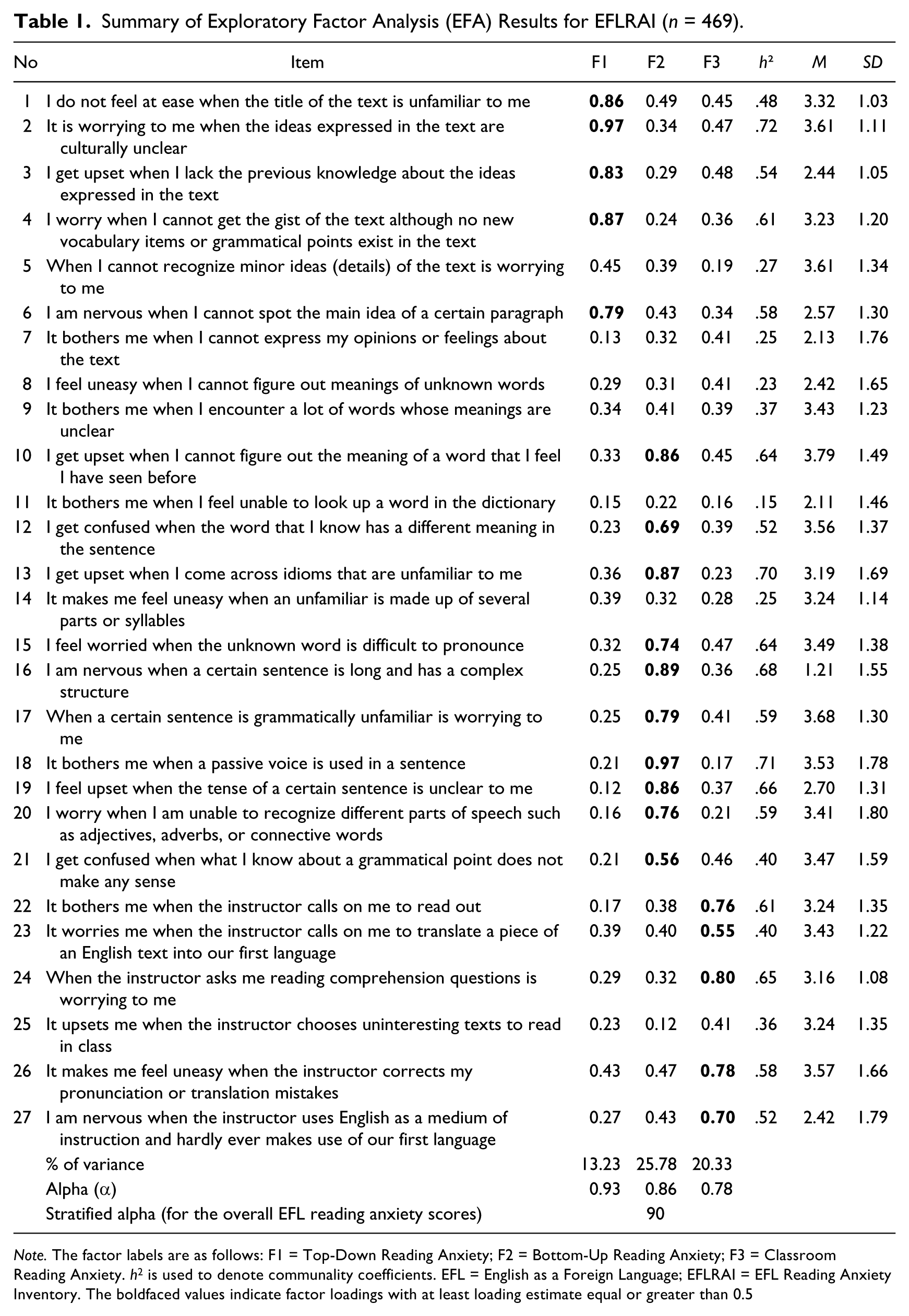
Note. The factor labels are as follows: F1 = Top-Down Reading Anxiety; F2 = Bottom-Up Reading Anxiety; F3 = Classroom Reading Anxiety. h2 is used to denote communality coefficients. EFL = English as a Foreign Language; EFLRAI = EFL Reading Anxiety Inventory. The boldfaced values indicate factor loadings with at least loading estimate equal or greater than 0.5
Factor loadings of 0.5 or greater were considered acceptable for this study. Based on the recommendation of Hair, William, Barry, Rolph, and Ronald (2006), factor loadings should have at least a loading estimate of 0.5 and ideally exceed 0.7. Seven items (5, 7, 8, 9, 11, 14, and 25) out of total 27 items did not meet this criterion. As such, we decided to exclude them and the final model consisted of 20 items. The means, standard deviations, and communalities for each item were also estimated as shown in Table 1. Except for the 7 excluded items (5, 7, 8, 9, 11, 14, and 25), for the remaining items, communalities were estimated as moderate with a range of 0.40 to 0.72. Items 5, 7, 8, 9, 11, 14, and 25 had a low communality magnitude (h2 ≤ 0.37), suggesting that these items do not correlate with other items in the data set. For the sake of comprehensibility, the translated English version of the EFLRAI items is presented in Table 1.
An item-total correlation test was performed to check if any item in the measure is inconsistent (does not correlate) with the total score, and thus can be discarded. The analysis showed that correlation values were greater than 0.3. Accordingly, no item needed to be dropped. As well as the reliability analysis for each of the three hypothesized subscales, the stratified alpha was also computed. The alphas for each of the proposed components (αBRA = .86, αTRA = .93, and αCRA = .78) indicated acceptable and good subscale reliability (Nunnaly & Bernstein, 1999). Stratified alpha is intended for cases where components of a scale can be grouped into subscales. Given the fact that the EFLRAI is multidimensional, the stratified alpha was calculated for the total item pool (representing an overall EFL reading anxiety score) and found to be very good (stratified α= .90). As is evident, the EFLRAI has re-exhibited decent reliability.
CFA
This was the first study to investigate the factor structure of the EFLRAI via EFA. In light of the problems associated with the EFA approach (Kinnear & Gray, 2009), the dimensionality of this measure was necessary to be confirmed through confirmatory factor analysis.
In confirmatory SEM, to assess whether the proposed model fits the data, it is necessary for the model to be identified. In fact, model identification is concerned with whether there are enough pieces of information to identify a solution (Hair et al., 2006). To determine the identification status of the model, we checked the degrees of freedom (Meyers, Gamst, & Guarino, 2013). The proposed model was over-identified with the degrees of freedom that were positive (df = 1). Due to the positive values for degrees of freedom, it was assumed that the proposed model would meaningfully be solved (Meyers et al., 2013).
The model was designed to reflect the hierarchical structure of the three-factor model. However, to rule out the possibility of other potential models, a unidimensional one-factor model and a two-factor model were also tested (based on combinations of pairs of the existing factors as a single factor). It was thought that this might be an important step in establishing the EFLRAI factor structure and lend more support to the plausibility of the theoretically derived three-factor model.
Unlike EFA, CFA yields many goodness-of-fit measures to evaluate a hypothesized model. For this reason, we examined the three-factor model along with the one-factor model and the two-factor model to test the fit of the posited models. We conducted CFA using LISREL 8.80 statistical package (Jöresbog & Sörbom, 2006). Compared with the one-factor model and the two-factor model, almost all of the fit indexes confirmed a three-dimensional hierarchical structure of EFL reading anxiety (Table 2). Because of space considerations, the interpretation of the results for the three-factor model is provided below.
Goodness-of-Fit Indices for the Posited Models of EFLRAI (n = 469).
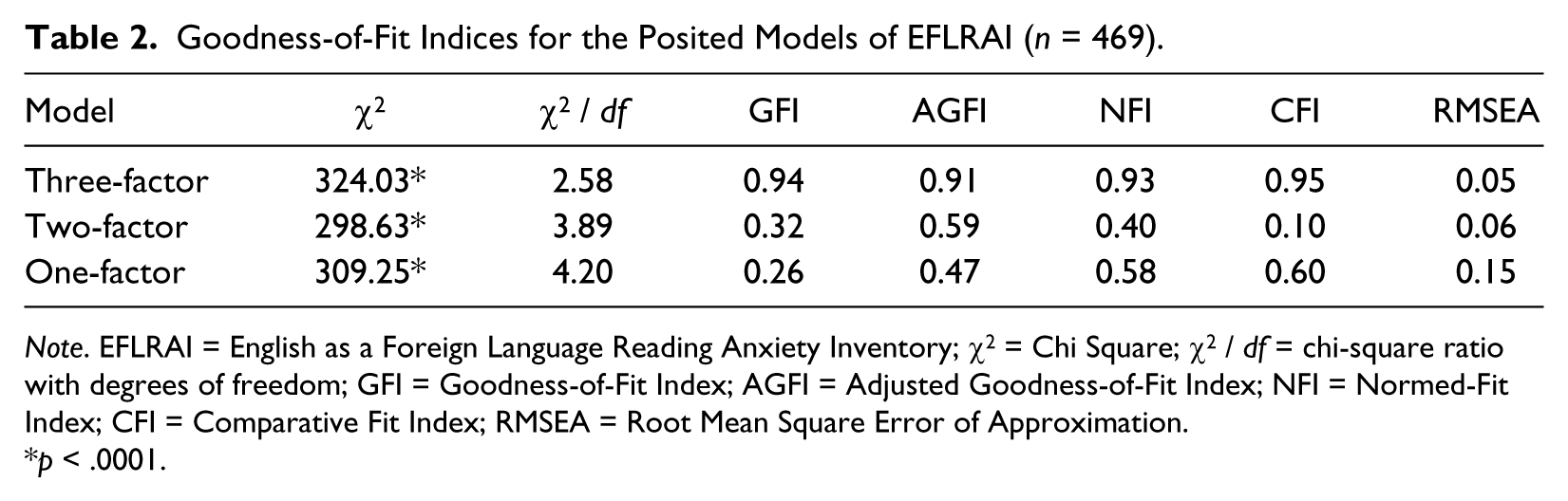
Note. EFLRAI = English as a Foreign Language Reading Anxiety Inventory; χ2 = Chi Square; χ2 / df = chi-square ratio with degrees of freedom; GFI = Goodness-of-Fit Index; AGFI = Adjusted Goodness-of-Fit Index; NFI = Normed-Fit Index; CFI = Comparative Fit Index; RMSEA = Root Mean Square Error of Approximation.
p < .0001.
The results, as shown in Table 2, indicated that the chi-squared test was significant (p = 0.00), meaning that the three-factor model had no good fit to the observed data. It is evident in most research studies that the p value is sensitive to large sample size, that is, larger samples produce larger chi-squares, leading to a significant p value. That may explain why the chi-squared test is not considered to be a very useful fit index by most statisticians (Jöreskog, 1969; Stevens, 2001). As the chi-squared fit test may have been affected by the sample size of this study, we decided to check the ratio of chi-square to degrees of freedom as a better index for assessing a good model.
For the normed χ2 / df ratio, values less than 3 represent a reasonable fit (Hair et al., 2006). It is evident in Table 2 that the χ2 / df ratio is less than 3 (χ2 / df = 2.58) in this data sample, meaning that the three-factor model provided acceptable fit for the data. Although the normed chi-square ratio is used as a popular way of evaluating model fit, other fit indexes have been offered to supplement and test the goodness of the model fit.
In viewing Table 2, the values of GFI, AGFI, NFI, and CFI indicated a goodness-of-fit between the three-factor model and the sample data (GFI = 0.94; AGFI = 0.91; NFI = 0.93; and CFI = 0.95). Much in the same way, the value obtained for the RMSEA indicated a well-fitting model (RMSEA = 0.05). As it is clear, almost all the GFIs used in this study provided statistical support for the three-factor model.
Having fulfilled the GFIs assessment, we decided to ensure construct validity with the presence of both convergent and discriminant validity. First, the convergent validity was assessed by checking the loading of each observed indicators on their underlying latent construct (Anderson & Gerbing, 1988). No loading was less than the recommended level of 0.5 (Hair et al., 2006). Then, average variance extracted (AVE) as measure of convergent validity was calculated. The convergent validity, that is, AVE for each factor (AVETRA = 0.74, AVEBRA = 0.64, AVECRA = 0.52) exceeded the recommended 0.5 benchmark (Fornell & Larcker, 1981). All this suggests that adequate evidence of convergent validity was provided. Fornell and Larcker (1981) suggested that AVE can also be used to gauge discriminant validity (sqr[AVE]), which is the square root of the AVE compared with the construct correlations. As such, discriminant validity was determined and found that the AVE of each construct is above its squared correlation with other constructs. Following Fornell and Larcker’s guidelines, the results obtained lent adequate evidence for discriminant validity of the present three-factor model.
In examining Figure 1, it becomes evident that in the hypothesized EFLRAI model there are 20 observed variables, 3 factors (F1 through F3), 3 covariances (two-way arrows), and 40 regression coefficients (one-way arrows)—20 leading from the “F”s to the factor loadings, and 20 indicating the impact of random measurement error on the factor loadings.

Observed and latent variables of the hypothesized EFLRAI model (n = 470).
Discussion
In the current study, attempts were made to fine-tune the pre-existing EFL reading anxiety inventory (EFLRAI). Findings of the study provided further support for the multidimensionality of EFL reading anxiety reported in Zoghi’s (2012) research. An interesting point regarding this study is that it was able to demonstrate that what was qualitatively obtained could be confirmed quantitatively through statistical analyses, namely statistics can be used to verify qualitative analyses. A principal component factor analysis with Oblimin rotation was used to determine the underlying structure of the data. Similar to previous qualitative research (Kuru-Gonen, 2007; Zoghi, 2012), it was found that EFL reading anxiety is multidimensional and three main sources account for non-English major students’ reading anxiety reactions in tertiary education, namely, (1) TRA, (2) BRA, and (3) CRA.
Findings of the study support that the current 23-item EFLRAI (Farsi version) is a potentially valid and reliable measure and can be used for non-English majors in tertiary education. The EFLRAI can be of great use to educational institutions, practicing instructors, and those who participate in in-serve training programs. The measure can be introduced to them and they become aware of different anxiety-related factors affecting EFL reading performance. While these educational practitioners learn about their students’ perceptions regarding factors producing reading anxiety, they can take effective steps to eliminate those factors that provoke reading anxiety in their students. The EFLRAI can, in fact, help instructors have a multidimensional evaluation of reading anxiety, which is crucial when seeking a solution for its effective reduction.
An increase in the first component of the EFLRAI may have instructors shift their instructional focus to such personal and reader-specific factors as lack of sufficient background and cultural knowledge relevant to the reading material. As for the second component, higher scores on this factor can be an indication for instructors to change the textual features of the reading texts, or rather linguistic structures such as vocabulary and grammatical levels of texts and make them more appropriate to EFL learners’ proficiency level. In addition, if a rise of scores on the third component of the EFLRAI is noted, this may indicate that there is a need for a change in the way reading lessons are delivered in the classroom setting. Instructors may then realize that they need to opt for and adopt contextually responsive methodologies that can convert EFL classrooms into “anxiety-free zones.” Inappropriate instructional methods in general and unaccommodating classroom environment, in particular, can be potential sources of reading anxiety for EFL learners.
Similarly, results obtained from the EFLRAI can help reading researchers with their studies in the field of affect. They may conduct various lines of, for instance, correlational research to find out about the relationship between EFL reading anxiety and language proficiency, gender, reading strategies, or learning strategies.
As there have been no studies to validate the EFLRAI through the CFA approach, we are unable to compare the study’s findings with previous research. This indicates that there is a need for further research to compare the results from this study and also evaluate the fitness of the three-factor model. Therefore, we recommend that other researchers not only from Iran, but from other parts of world, should use their own data set and re-assess the model fit. This could provide the opportunity for cross-cultural examination of the EFLRAI. In addition, such a cross-culturally validated instrument could safely be used in EFL reading anxiety research in various EFL contexts.
Limitations of the Study
In spite of different strengths of this study, which include a large and representative sample of a known population, random sampling, and the use of appropriate methodology in the factorial validation of the EFLRAI, there are some limitations. The data collection was confined to only one institution, that is, other university majors were not represented. Therefore, research studies with other university majors would ensure better generalization of the findings of the study.
Self-reported studies generally suffer from specific methodological problems due to the way that research participants behave. Such problems may also have been present in this study: (1) recall bias (remembering or not remembering experiences or events that occurred at some point in the past) and (2) exaggeration (the act of representing outcomes more or less significant than is actually suggested from other data); respondents may feel too embarrassed to reveal private details.
In this study, EFA uncovered and CFA confirmed three distinct factors associated with the EFLRAI. Although CFA can determine how well the model fits to the data, one should bear in mind that a good fit between the model and the data does not indicate that the model is correct, but rather a “good model fit” only suggests that the model is plausible (Schermelleh-Engel, Moosbrugger, & Müller, 2003). In this study, the three-factor structure was proven to be better compared with a one-factor structure and even with a two-factor structure. The fact that we did not find support for a two-factor model and even for a more parsimonious one-factor model leads us to conclude that the development of a three-factor model should be continued. However, further studies are needed to re-examine the plausibility of and also assess the stability of the factor structure underlying the EFLRAI.
Conclusion
It is clear-cut that development of a measurement instrument is a multifaceted undertaking. The results of this study provided statistical support for the utility of the EFLRAI as a conceptually stable and psychometrically valid and reliable instrument for measuring EFL reading anxiety among non-English major students in tertiary education. With the introduction of the EFLRAI, it is hoped that the present study can help add to our growing body of knowledge that we have about the assessment of EFL reading anxiety.
We believe that for an affect-related instrument, validity needs to be established in view of the complex and highly multivariate field of practice (e.g., ELT, in our case). In studies involving development of affect-related instruments, there seems to be a need to re-direct researchers’ attention to the fact that a valid instrument is developed in a way that it is valid for a specific context in which it is obtained. Affect usually undergoes the process of changing and also develops in different situations for different reasons. Thus, different measures of anxiety “should ideally be developed in the surroundings in which they will be used” (Kozina, 2012, p. 266). In other words, we need to use a particular instrument according to the context in which it is to be applied. This is what Zoghi (2012) has done with the EFLRAI through the phenomenological study in which EFL learners’ experiences were transformed into an instrument that can be used to capture the experiences of many EFL learners undergoing the same experience of EFL reading anxiety.
Footnotes
Declaration of Conflicting Interests
The author(s) declared no potential conflicts of interest with respect to the research, authorship, and/or publication of this article.
Funding
The author(s) received no financial support for the research, authorship, and/or publication of this article.