



Abstract
Through an examination of measurement invariance, this study investigated whether attachment-related dimensions (i.e., secure base, safe haven, and negative interactions as measured with the Network of Relationships Inventory—Behavioral Systems Version) have the same psychological meaning for early adolescents in their relationships with parents and teachers. Data were gathered for a sample of 297 families with an adolescent in Grade 7 (Mage = 11.40; 62% boys). The results indicated that perceived attachment-related dimensions have a similar meaning in parent–child and teacher–child relationships (weak metric invariance), but that no direct comparison of observed means should be made (lack of strong metric invariance). In addition, it seemed that teachers fulfill the function of secure base rather than safe haven in early adolescence.
Keywords
Over the past two decades, researchers have emphasized the developmental and educational significance of the affective quality of relationships between teachers and children (for an overview, see Davis, 2003). The affective quality has been mainly evaluated using dimensions derived from parent–child attachment research (e.g., Pianta, Hamre, & Stuhlman, 2003). These relationship dimensions typically comprise measures of (a) the degree to which teacher–child communication is open, warm, and harmonious and to which the child uses the teacher as a safe haven; (b) the degree to which the child uses the teacher as a secure base from which to explore the environment (vs. is overly dependent on the teacher); and (c) the degree of negative interactions, conflict, resistance, and disharmony in teacher–child interactions (Verschueren & Koomen, 2012).
However, little is known about similarities and differences between the attachment-related dimensions addressed in research on teacher–child relationships and similar attachment-related dimensions in parent–child relationships. More specifically, it is uncertain whether these dimensions have the same psychological meaning for children across both relationships. In addition, it seems that most studies considering teacher–child relationships from an attachment perspective have focused on children in elementary school (Koomen, Verschueren, & Thijs, 2006). It remains unclear whether children in secondary school still rely on their teachers as a safe haven and/or a secure base. The current study aims to clarify these issues by investigating similarities and differences in early adolescents’ perceived attachment-related dimensions in both relationships.
Attachment and Caregiving Behaviors in Parent–Child and Teacher–Child Relationships
Children organize their behavior in specific ways around their attachment figure. When children feel threatened, distressed, or upset, they tend to turn to the attachment figure for safety and comfort, using him or her as a safe haven. A sensitive attachment figure who accurately interprets the child’s behavior soothes the child and responds promptly and appropriately to its needs, makes the child feel safe, and will strengthen the child’s eagerness to explore its environment while using the attachment figure as a secure base (for overviews, see Bakermans-Kranenburg, van IJzendoorn, & Juffer, 2003). The caregiving behaviors considered sensitive may vary as children get older. For older children, the sensitive behaviors of attachment figures may include encouraging, giving assistance to, reassuring the child, and showing interest in his activities (e.g., Pianta, Sroufe, & Egeland, 1989).
For most children, parents are the primary attachment figures to which they direct their attachment behavior (Ainsworth, 1979). Not surprisingly, children’s attachment relationships with parents, and with mothers in particular, have been the main focus in the attachment literature. When school-age children are physically separated from their primary attachment figures (i.e., their parents) and can no longer rely on these attachment figures in all situations, they may need to rely on other people to fulfill their attachment needs (Goossens & van Ijzendoorn, 1990; Mayseless, 2005). In the school context, the teacher may play this role (e.g., Verschueren & Koomen, 2012). School-age children may address their attachment behaviors to teachers, using them as the so-called ad hoc attachment figures (Zajac & Kobak, 2006, p. 380). In addition, Mitchell-Copeland, Denham, and DeMulder (1997) assume that teachers may provide a safe haven and secure base. Several scholars have provided empirical support for these assumptions in primary and elementary school. Children indeed have been shown to turn to teachers in times of distress caused by pain, sickness, fear, and danger and thus seem to perceive their teacher as a safe haven (Koomen & Hoeksma, 2003; Koomen, Hoeksma, Keller, & De Jong, 1999). Also, children seem to use their teacher as a secure base. For example, Lisonbee, Mize, Payne, and Granger (2008) found a close teacher–child relationship to predict cortisol decreases in children, indicating lower levels of stress, making children want to explore their environment. Studies that adopt an attachment perspective on teacher–child relationships have often included teacher–child conflict in addition to measures of safe haven and secure base (Verschueren & Koomen, 2012) to obtain a measure of negative affective relationship quality, and to investigate the possible detrimental effects of conflicted teacher–child relationships on psychosocial adjustment (e.g., Doumen et al., 2008).
In sum, three attachment-related dimensions (i.e., safe haven, secure base, negative interactions) are generally included in teacher–child relationship research from an attachment perspective. Despite the similarities in attachment and caregiver behaviors between parent–child and teacher–child relationships, it is unclear whether children grant the same psychological meaning to these attachment-related dimensions in both relationships. Hence, the legitimacy of comparisons of means and scores on attachment-related dimensions between both relationships is questionable. In addition, as studies on attachment-related dimensions in teacher–child relationships have generally been conducted with primary and elementary school samples, it is uncertain whether these dimensions remain relevant for early adolescents in secondary school.
Measurement Invariance of Attachment-Related Dimensions
The Network of Relationships Inventory—Behavioral Systems Version Questionnaire (NRI-BSV; Furman & Buhrmester, 2009) is a complementary version of the NRI (Furman & Buhrmester, 1985). Whereas the NRI is based on Weiss’ (1974) and Sullivan’s (1953) conceptualization of social provisions and social needs of interpersonal relationships, the NRI-BSV is based on behavioral systems theory (e.g., attachment). More specifically, the NRI-BSV provides a tool to compare child-perceived parent–child and teacher–child relationships along relevant attachment-related dimensions in terms of the frequency of the different attachment behaviors. However, before we can make such comparisons and conclude, for example, that in children’s views parents are more often relied on as a safe haven than teachers, it is paramount to test whether the underlying constructs (e.g., safe haven) have the same psychological meaning for children across teacher–child and parent–child relationships. In other words, we need to ascertain that similar constructs are measured in the same way. If this is not the case, no comparisons can be made. In addition, examining measurement invariance will inform us of the need to conceptualize both relationships differently from an attachment perspective.
The present study will address this equivalence question by investigating the measurement invariance of the NRI-BSV across adolescent-rated parent–child and teacher–child relationships. As stated by Vandenberg and Lance (2000), verifying an instrument’s measurement invariance is equally important as verifying reliability and validity. Hence, our main research goal is to gain more insight into the resemblances among and differences between attachment-related dimensions in parent–child and teacher–child relationships as seen through the eyes of early adolescents. Through an examination of measurement invariance, we will take a statistical approach to achieve this goal.
Developmental Considerations
Studies on attachment and caregiver behaviors in teacher–child relationships have generally been conducted with early to middle childhood samples. In secondary school, teacher–child relationships have been mainly studied using more general measures of social support or from a social-motivational framework in which students’ academic motivation, achievement, and classroom learning is attained through teachers’ involvement, structure, and autonomy support (Wentzel, Battle, Russel, & Looney, 2010). To our knowledge, the potential value of an attachment perspective on teacher–child relationships in early adolescence has not been addressed explicitly to date. The examination of measurement invariance of attachment-related dimension will give us an insight into how early adolescents perceive these dimensions. Moreover, we will investigate whether teachers fulfill the function of safe haven and secure base for early adolescents as well.
Method
Participants and Procedure
The study was conducted in Flanders, the Dutch-speaking, northern part of Belgium. Due to urbanization, Flanders is one of the most densely built (1,200 people per square mile) and inhabited (6,350,765 people) regions in Europe (Tempels, Verbeek, Pisman, & Allaert, 2011). The study sample consisted of 297 families with a child in Grade 7. These families were recruited via undergraduate students from educational sciences, as part of a class on pedagogical assessment. Each student chose an adolescent in his or her neighborhood, which led to a convenience sample. During a home visit, both parents and the adolescent signed an informed consent form. Next, the adolescent completed the questionnaires under the supervision of the undergraduate student. Of the participating adolescents, 62% were boys. The mean age was 12 years and 4 months (range 11-14 years, SD = .569). For the majority of the adolescents (96%), both parents had the Belgian nationality. Of the participating families, 89% were intact, 5% were stepfamilies, and 6% were single-parent families. Most parents completed higher education (66% of mothers, 50% of fathers). The remaining parents finished (some years of) high school (28% of mothers, 39% of fathers) or completed primary school (2 fathers or 1%).
Measures
NRI-BSV
Attachment-related dimensions in parent–child and teacher–child relationships, as perceived by early adolescents, were measured with two attachment scales of the NRI-BSV (Furman & Buhrmester, 2009): relying on the other as a safe haven when upset or distressed (Seek safe haven) and using the other person as a secure base to engage in non-attachment behaviors (seek secure base). In addition, we included the subscale negative interactions to obtain a measure of negative relationship quality. Evidence for the reliability and validity of the NRI-BSV has been reported (Furman & Buhrmester, 2009). The two attachment scales both contain three items. The Negative Interaction Scale is a nine-item index of the degree to which a child experiences conflict, antagonism, and criticism in the relationship with his parents or teachers. All items are listed in the appendix. Children rated the items about their relationships with parents and teachers respectively on a five-point Likert-type scale (1 = Little or None, 2 = Somewhat, 3 = Very Much, 4 = Extremely Much, 5 = the Most). Scale scores were computed by averaging the item scores. Higher scores indicate higher presence of the dimension concerned. The reliabilities of the latent constructs were estimated by means of omega (Ω; Hancock & Mueller, 2001; McDonald, 1999), a specific measure for internal consistency reliability within a latent factor framework. The reliabilities were acceptable to good: Parent–child relationship; Ω = .82 (Safe haven), Ω = .69 (Secure base), Ω = .90 (Negative interaction). Teacher–child relationship: Ω =.74 (Safe haven), Ω =.77 (Secure base), Ω = .90 (Negative interaction).
Statistical Analyses
Measurement Invariance of Perceived Attachment-Related Dimensions
The covariance matrix and mean structure were analyzed, considering the three teacher–child attachment-related dimensions as repeated measures of the analogue parent–child attachment-related dimensions in the framework of structural equation modeling (SEM) using Mplus version 6 (Muthén & Muthén, 1998-2010). Hence, we investigated measurement invariance of a single group across time (i.e., multiple indicator growth model with two time points). By correlating the similar dimensions “over time” (e.g., safe haven parents with safe haven teachers), we take into account the dependency of the dimensions (which is needed as the items were rated by the same adolescent).
Robust maximum likelihood estimation (MLR) was used to correct for non-normality of our data. Following a procedure proposed by Meredith (1993), measurement invariance was examined by testing different levels of invariance in a hierarchical, stepwise manner, starting with the least constrained model, and then progressively placing equality constraints on the parameters across both types of perceptions.
Prior to testing for measurement invariance, the three-factor structure as measured by the NRI-BSV (i.e., safe haven, secure base, negative interactions) was tested for adolescents’ ratings of parents and teachers separately (e.g., Meredith & Teresi, 2006). After establishing these two baseline models, a test for configural invariance will reveal whether the factor structure (as established in the two baseline models) is the same across adolescents’ ratings of parents and teachers. In other words, this test will reveal whether early adolescents use the same conceptual framework to answer attachment-related questions regarding parents and teachers. If configural invariance holds, the invariance of factor loadings can be investigated. When both configural invariance and invariance of factor loadings are found to hold, weak metric invariance is established (Widaman & Reise, 1997). In this study, a test of weak metric invariance addresses questions like the following: Is the strength of the relation between a particular behavior (e.g., seeking comfort when upset) and the underlying “safe haven” construct the same for children’s relationships with parents and teachers? In other words, do the constructs have an equivalent meaning across both relationships? Do early adolescents perceive and interpret the content of the items in exactly the same way for parents and teachers? A lack of weak metric invariance means that the respective construct is measured on different scales (Widaman & Reise, 1997), which indicates that the same attachment-related behaviors in parent–child and teacher–child relationships as rated by adolescents (in our case: items) reflect the underlying attachment-related dimensions in different ways.
If weak metric invariance holds, the invariance of intercepts can be investigated. When both weak metric invariance and invariance of intercepts are found to hold, strong metric invariance is established (Widaman & Reise, 1997). Tests of strong metric invariance assist in answering the following question: Does a particular score for the underlying “safe haven” construct mean the same in adolescent-rated parent–child and teacher–child relationships? A lack of strong metric invariance implies that one or more items have different means across parent–child and teacher–child attachment-related dimensions, as rated by adolescents. However, in this case it is often still possible to make some useful and meaningful comparisons between adolescents’ perceptions of parents and teachers, by excluding the items that fail the test of invariance (i.e., taking into account the effects of partial measurement invariance; Byrne, Shavelson, & Muthén, 1989).
Opinions on the usefulness of additional aspects of measurement invariance diverge. Whereas some authors stress the importance of testing for invariance of the regression residual variances (or strict metric invariance) as well (Meredith & Teresi, 2006; Widaman & Reise, 1997), others claim this test is overly restrictive and of minor interest and importance (e.g., Vandenberg & Lance, 2000). Byrne (2008) states that the test is only important if one wants to measure invariance of item reliabilities. Because of the lack of consensus in the literature, we decided not to test for invariance of regression residual variances.
As indicated earlier, we first tried to establish the three-factor structure of attachment (i.e., initial CFA) separately for each measurement occasion (e.g., Meredith & Teresi, 2006). Next, we tested three different levels of invariance (i.e., configural, weak metric, and strong metric invariance) in a hierarchical, stepwise manner (Meredith, 1993). We started with the least constrained model to investigate invariance of the factorial structure across measurement occasions (i.e., configural invariance). Then we progressively placed equality constraints on the parameters across measurement occasions (i.e., testing weak and strong metric invariance, respectively). First, we estimated the three nested models separately and evaluated their model fit by means of the robust Satorra–Bentler scaled chi-square statistic (S-Bχ2) to better approximate chi-square under non-normality (Satorra & Bentler, 1988), the Comparative Fit Index (CFI; Bentler, 1990), the Standardized Root Mean Square Residual (SRMR), and the Root Mean Square Error of Approximation (RMSEA; Steiger, 1990). Generally, S-Bχ2 values as small as possible are considered indicative of good fit. CFI values ≥.90 are considered indicative of acceptable fit and CFI values ≥.95 of good fit. SRMR values ≤.08 are indicative of good model fit. RMSEA values ≤.06 are considered indicative of good fit, ≤.08 of fair fit, between .08 and .10 of mediocre fit, and > .10 of poor fit (Hu & Bentler, 1999). Second, we compared the three nested models sequentially by testing the decrease in model fit with the S-Bχ2 difference test (Satorra & Bentler, 2001). If the ΔS-Bχ2 is significant, measurement invariance does not hold. Cheung and Rensvold (2002) stated that the Δχ2 value should not be used solely as indication of measurement invariance and recommended the use of change in fit statistics such as change in CFI as a more practical approach to determining the extent to which models are equivalent. Cheung and Rensvold (2002) considered a change in (absolute value of) CFI exceeding 0.01 as a significantly worse fit indicating non-invariance. Chen (2007) also recommended change in CFI as the main criterion to test measurement invariance and considered ΔCFI equal to or exceeding .005 as a significantly worse fit indicating non-invariance when sample size is small (i.e., total N ≤ 300). In our study, we adopted the most recent and stringent decision rule of Chen (2007) concerning ΔCFI.
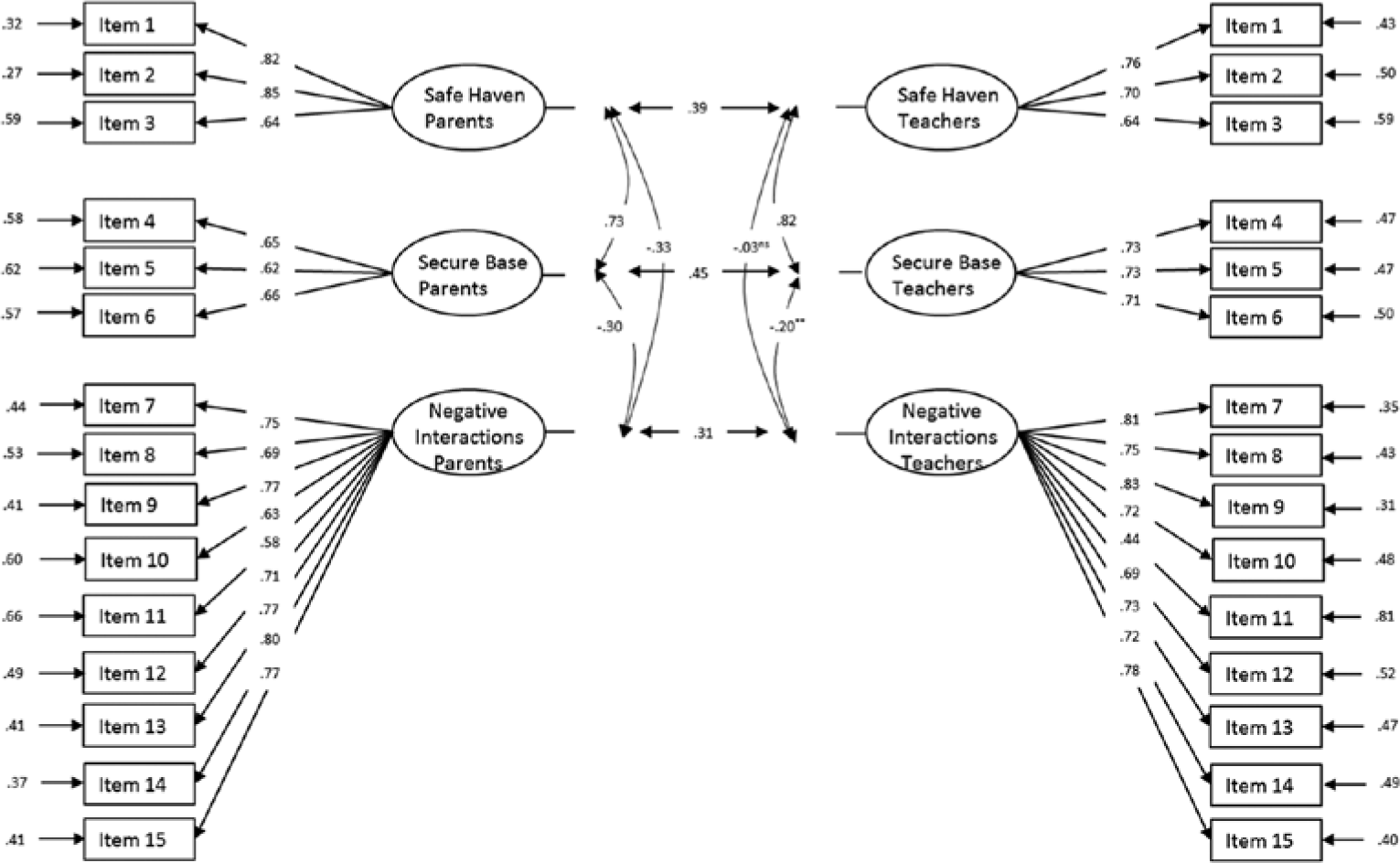
Three-factor 15-indicator baseline model including standardized factor loading estimates, standardized residual item variances, and factor covariances.
Results
Descriptive Statistics
Bivariate Pearson correlations between the study variables are presented in Table 1. Similar parent–child and teacher–child attachment-related dimensions were moderately associated (rs ranging from .31 to .33). Table 1 also presents means and standard deviations of the study variables. It seems that the early adolescents in our sample rely strongly on teachers as a secure base (M = 2.93 with 3 = very much). Contrarily, they seem to rely less on teachers as a safe haven (M = 1.61 with 1 = little, 2 = somewhat).
Bivariate Correlations, Means, and Standard Deviations of the Study Variables (N = 297).
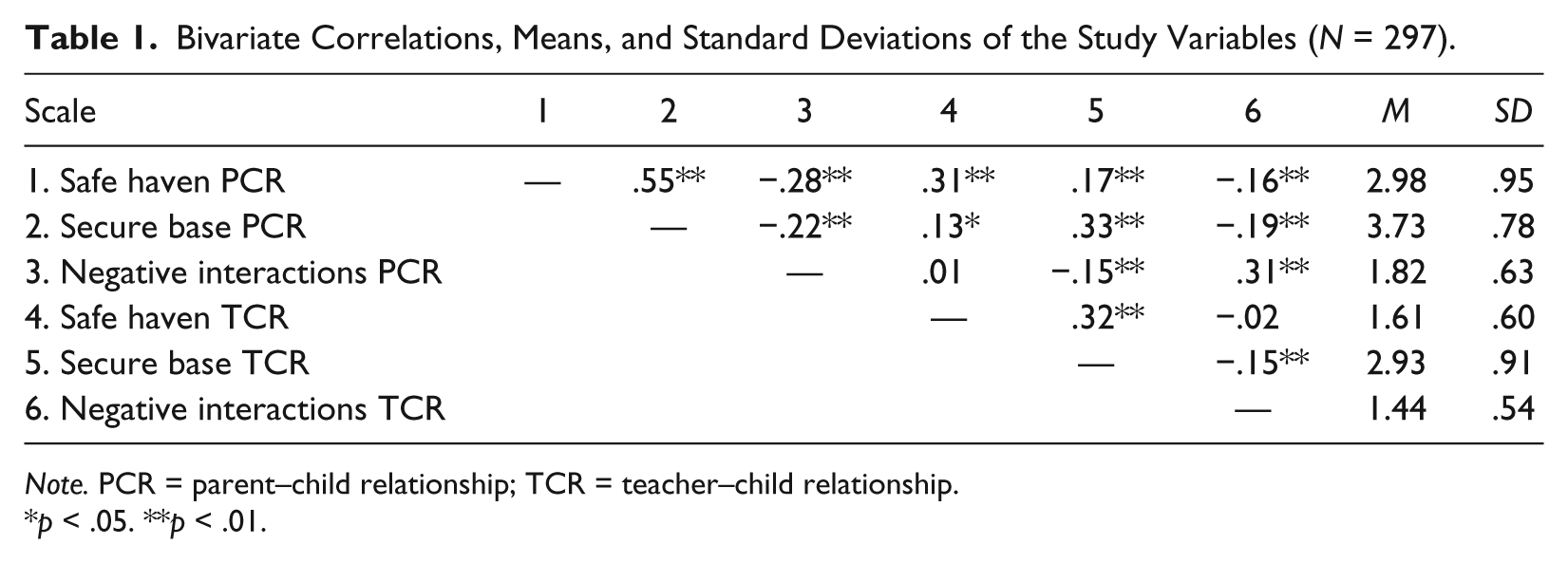
Note. PCR = parent–child relationship; TCR = teacher–child relationship.
p < .05. **p < .01.
Measurement Invariance of Perceived Attachment-Related Dimensions
As mentioned earlier, prior to invariance analyses, the three-factor structure as measured by the NRI-BSV (i.e., baseline model) was tested for each measurement occasion separately (i.e., for ratings of parents and teachers; e.g., Meredith & Teresi, 2006). The three-factor (i.e., safe haven, secure base, and negative interactions) 15-indicator model yielded a good fit both for adolescents’ ratings of parents, S-Bχ2(87) = 186.536, p < .001, CFI = .939, RMSEA = .062, and SRMR = .044; and teachers, S-Bχ2(87) = 180.158, p < .001, CFI = .933, RMSEA = .060, and SRMR = .049. Moreover, the three-factor model yielded significantly better model fit compared with an alternative two-factor model (i.e., one positive and one negative attachment-related dimension), for ratings of parents, ΔCFI = .020 > .005, ΔS-Bχ2(2) = 33.39, p < .001, as well as teachers, ΔCFI = .075 > .005, ΔS-Bχ2 (2) = 75.99, p < .001. We could thus confirm the hypothesized factor structure of the NRI-BSV for adolescents’ ratings of parents and teachers separately.
Having established these three-factor models as best fitting for adolescents’ ratings of parents and teachers separately, the configural invariance model (Model 0) was estimated using both sets of adolescents’ ratings simultaneously. Hence, a test for configural invariance (Horn & McArdle, 1992) will reveal whether the three-factor 15-indicator structure of attachment (as established in the two baseline models) is the same across adolescents’ ratings of parents and teachers. In other words, this test will reveal whether early adolescents use the same conceptual framework to answer attachment-related questions regarding parents and teachers. If configural invariance holds, we will use the fit statistics as baseline fit statistics for further examination of measurement invariance. We investigated configural invariance by constraining the number of factors and the pattern of fixed and freely estimated parameters to be equal across adolescents’ ratings of parents and teachers. Factor covariances were also postulated. Hence, this is the weakest type of invariance. The three-factor 15-indicator model fitted our data well, S-Bχ2(390) = 651.537, p < .001, CFI = .923, RMSEA = .048, and SRMR = .049. We could thus verify the factorial structure of the NRI-BSV across adolescents’ ratings of parents and teachers (Figure 1). Inspection of the modification indices revealed a substantial covariance between negative interactions Items 7 and 9 and between Items 14 and 15, for both parent–child and teacher–child relationships, which were not attributable to the negative interactions factor. These items seemed to be similarly phrased (see the appendix). We allowed these two error covariances, re-specified, and re-estimated our model. The fit of our baseline model became even better, S-Bχ2(386) = 566.009, p < .001, CFI = .947, RMSEA = .040, and SRMR = .047. We can conclude that the factor structure is similar, that is, the three latent constructs are related to the same set of indicators across parent–child and teacher–child relationships as rated by adolescents. All of the items loaded significantly on their factor (p < .001), with factor loadings exceeding the .40 value.
To investigate whether the strength of the relation between the items and the underlying construct is the same for teachers and parents, we tested for the invariance of factor loadings, hence establishing weak metric invariance (Model 1; Horn & McArdle, 1992). We constrained the unstandardized factor loadings to be the same across adolescent ratings of parent–child and teacher–child relationships, but intercepts were allowed to differ. This model fit our data well, S-Bχ2(398) = 592.045, p < .001, CFI = .943, RMSEA = .041, and SRMR = .052. We compared Model 1 with the configural invariance Model 0. The statistics ΔS-Bχ2(12) = 21.193, p = .05, and ΔCFI = .004 < .005 indicated that the invariance of factor loadings did not result in a significantly worse model fit compared with Model 0, which supports weak metric invariance. We can conclude that adolescents calibrate measures of attachment to parents and teachers in the same way. Thus, a particular item score will show the same amount of increase for the same amount of increase on the latent factor (i.e., the regression slopes are equal across both parent and teacher ratings), which is an indication of construct validity.
To be able to test for latent factor mean differences, both the factor loadings and the item intercepts are supposed to be equal. We tested for strong metric invariance (Meredith & Teresi, 2006) by constraining the item intercepts and the factor loadings to be equal across adolescent ratings of parent–child and teacher–child relationships (Model 2). This model did not have an acceptable fit, S-Bχ2(410) = 1063.573, p < .001, CFI = .809, RMSEA = .073, and SRMR = .222. Moreover, the difference in model fit between this model and the model with equal factor loadings was significant: ΔS-Bχ2(12) = 429.509, p < .001, and ΔCFI = .134 > .005. We thus cannot conclude that full invariance of intercepts holds. We used modification indices to find out which intercepts were non-invariant. The two items with the strongest non-invariance belonged to the factors Secure base (Item 5) and Negative interactions (Item 13). Item 5 (referring to the encouragement of pursuing goals and future plans) had a higher intercept for teachers, indicating that compared with parents, teachers received a higher score on this item given the same level of Secure base. Item 13 (referring to the degree of hassling and nagging each other) had a higher intercept for parents, indicating that, compared with teachers, parents received a higher score on this item given the same level of Negative interactions. When we allowed these items’ intercepts to vary across the two groups, we obtained a slightly better model fit, S-Bχ2(408) = 1032.439, p < .001, CFI = .818, RMSEA = .071, SRMR = .181. However, the difference in model fit remained significant, ΔCFI = .125 > .005, ΔS-Bχ2(10) = 403.585, p < .001. Hence, we cannot conclude that partial invariance of intercepts holds and may not test for relative latent mean differences between parent–child and teacher–child attachment-related dimensions. In other words, observed mean differences may be caused by differences in latent means or differences in item intercepts.
Discussion
The main goal of the present study was to investigate measurement invariance of perceived attachment-related dimensions across parent–child and teacher–child relationships. Our findings supported weak metric invariance. This implies (a) that early adolescents use the same multi-dimensional structure to respond to attachment questions regarding teachers and parents and (b) that the behaviors probed in the NRI-BSV-items are equally good indicators of the underlying attachment-related dimensions in teachers and parents. Hence, an important prerequisite for making meaningful comparisons between both relationships is met. Meeting this prerequisite is considered sufficient in the context of basic research on correlates of constructs (Koomen, Verschueren, van Schooten, Jak, & Pianta, 2012; Meredith & Teresi, 2006). However, full nor partial strong metric invariance held, implying that a particular score on the underlying attachment-related dimensions does not mean exactly the same for parent–child and teacher–child relationships. Strong metric invariance is not necessary when investigating correlates of constructs. However, for applications in which one wants to directly compare particular scores or frequencies of attachment behaviors between relationships, the lack of strong metric invariance implies that no fair comparison can be made (Koomen et al., 2012).
Possible reasons for the lack of strong metric invariance can be put forward when we look more closely at the two items with the strongest non-invariance. Item 5 (referring to the encouragement of pursuing goals and future plans) had a higher intercept for teachers, indicating that compared with parents, teachers received a higher score on this item given the same level of Secure base. This item may have a more educational connotation (referring to educational choices and careers) when filled out for teachers than the other secure base items. Consequently, this item is endorsed more than expected based on the latent variable score. To obtain strong metric invariance, we strongly suggest future research to replace item 5 by an item without this specific connotation. Item 13 (referring to the degree of hassling and nagging each other) had a lower intercept for teachers, indicating that, compared with parents, teachers received a lower score on this item given the same level of Negative interactions. This item may be less typical for negative teacher–child interactions as compared with parent–child interactions. Consequently, this item is endorsed less than expected based on the latent variable score. To obtain strong metric invariance, we strongly suggest future research to drop this item, especially given the relatively large number of items in the negative interaction scale.
Regarding the second goal of the present study, we confirmed the value of an attachment perspective on teacher–child relationship research in early adolescence in two ways. First, the three attachment-related dimensions are distinguishable as expected and indicative behaviors are similar as indicative behaviors in parent–child relationships. Second, teachers fulfill the function of secure base rather than safe haven for early adolescents. Hence, early adolescents generally perceive their teachers as caregivers who encourage them to try new things and to pursue their goals and future plans. The limited safe haven function of teachers might be explained by the increased importance of peers to fulfill functions of safe haven in early adolescence (Nickerson & Nagle, 2005) and the increased self-regulating capacities due to major changes in the adolescent brain (Keating, 2004). These differential results highlight the added value of attachment-related dimensions over one general support measure to evaluate the affective quality of teacher–child relationships.
Limitations and Future Directions
The present study used a convenience sample of mostly highly educated, two-parent families, making generalization of the results to the population less easy. Although we have no theoretical grounds to presume that our results would differ substantially from results obtained in a randomly selected sample, we still strongly suggest that future studies include larger, more heterogeneous, randomized samples of adolescents. The findings of the present study permit future researchers to compare the effects of individual differences in perceived teacher–child and parent–child attachment-related dimensions (as measured with the NRI-BSV) on students’ psychosocial and academic adjustment, preferably in a multiple-wave longitudinal research design. Also, we encourage future research to explore possible gender differences. In the present study, we were unable to test this given the size of our study sample.
Conclusion
The current study contributes to developmental psychological research by providing a unique insight into early adolescents’ views on their affective relationships with their teachers and parents. We demonstrated that teachers fulfill the function of secure base rather than safe haven in early adolescence, and that perceived attachment-related dimensions, as measured with the NRI-BSV, have a similar meaning in parent–child and teacher–child relationships (weak metric invariance), but that no direct comparison of observed means should be made (lack of strong metric invariance).
Footnotes
Appendix
Acknowledgements
The authors thank all the undergraduate students for their assistance with data collection.
Declaration of Conflicting Interests
The author(s) declared no potential conflicts of interest with respect to the research, authorship, and/or publication of this article.
Funding
The author(s) disclosed receipt of the following financial support for the research, authorship, and/or publication of this article: Funding was provided through Grant GOA/12/009 (“STRATEGIES” project) of the “BOF” (Bijzonder Onderzoeksfonds), KU Leuven, University of Leuven.