



Abstract
C. R. Snyder conceptualized hope as a cognitive construct that reflects people’s motivation and capacity to strive toward personally relevant goals. Using this definition, Snyder and colleagues developed and validated the Hope Scale (HS). This study is the first study to examine the psychometric properties of the HS in a sample of high school students (N = 1,012 Portuguese students). Reliability, factor structure, and criterion-related validity were investigated. The results support the psychometric properties of the scale, as well as the two-factor structure of Agency and Pathways. Findings from this study suggest that the HS can be used with high school students and Portuguese-speaking samples.
Approximately 20 years of systematic research has illustrated the importance of hope in understanding human development and flourishing. Research has linked high hope to many positive outcomes, including life satisfaction, social competence, work, academic and sports performance, health and longevity (e.g., Berg, Rapoff, Snyder, & Belmont, 2007; Ciarrochi, Heaven, & Davies, 2007; Gilman, Dooley, & Florell, 2006; Snyder et al., 1997).
Hope theory (Snyder et al., 1991) has received much attention both within and outside the field of psychology. According to this theory, the construct of hope is conceptualized as a trait-like cognitive capacity encompassing affirmative beliefs about one’s ability to achieve individual goals. Snyder’s formulation of hope is conceptualized as consisting of two components: Pathways, or the individual’s perceived means available to achieve goals; and Agency, or the belief in one’s ability to succeed in using the identified Pathways. Pathways and agency thinking are positively related, additive and reciprocal, but neither component alone defines hope, nor are they synonymous.
Research on hope was stimulated by the development of Hope Scales (HS). Although the HS (Snyder et al., 1991) has been developed for measuring hope in individuals ages 16 and older (whereas the Children Hope Scale [CHS] is a hope measure for children ages 7 through 15; Snyder et al., 1997), there are no studies examining the psychometric properties of the HS with students younger than college years. In addition, adaptation of the HS to different languages is needed to allow valid evaluations and cross-cultural comparisons. The influences of cultural and societal factors are valuable factors to further explore the characteristics of the hope construct. To fill this gap and to validate a psychometrically sound measure, the present study sought to (a) explore the characteristics of the HS when used with a sample of high school students; (b) perform the validation of a Portuguese version of the HS, using confirmatory factor analysis (CFA) for the first time in a group of individuals from non-English-speaking backgrounds; (c) examine the association between hope and psychological and academic outcomes (i.e., life satisfaction, mental health, and academic achievement [AA]); and (d) examine associations between hope and demographic variables (i.e., age, gender, and grade level). Based on the past studies with school-age students (e.g., Gilman et al., 2006; Valle, Huebner, & Suldo, 2004), we expect moderate to high correlations between hope and psychological and academic outcomes, and a non-significant correlation between hope and demographic variables.
Method
Adaptation to Portuguese language
Based on the International Test Commission (ITC) Guidelines on Test Adaptations (e.g., Van de Vijver & Hambleton, 1996), the HS was subjected to a translation process of the items involving a two-person English–Portuguese translation team, a two-person back translation team not privy to the original version, and a discussion group to achieve full consensus for the lexical and cultural equivalence. Two authors of this article performed content validity analysis through verification that wording expresses desired content. After lexical equivalence and content validity were defined, a cognitive debriefing analysis was performed with 12 individuals who represented the focus group in terms of age and school level (age M = 16.22 and school level M = 11). After the items were refined, an identical questionnaire format to the HS was submitted for a pilot study with 146 individuals, 11th and 12th grade students with a mean age of 16.8 years. A reliability analysis was conducted with a Cronbach’s alpha of .82 . These students were not incorporated into the sample of the current study.
Participants
The sample consists of 1,012 Portuguese students enrolled in Grades 11 (58.03%) and 12 (41.97%) from nine schools in the north of Portugal. Participants were aged 16 to 18 years (M = 16.98, SD = 1.74) and 55.53% were female. Two weeks after the first data collection, 991 of the 1,012 students completed the same questionnaires, yielding a return sample of 97.92%. As reported by school officials, the 21 students who did not participate at the re-test were absent on data collection dates.
Measures
Hope Scale (HS)
The HS is a 12-item scale designed to measure the trait aspect of hope in individuals aged 16 and older (Snyder et al., 1991). This scale consists of four items measuring Agency, four items measuring Pathways, and four filler items. This scale has exhibited acceptable psychometric properties (Cronbach’s alphas range from .74 to .84) with a wide range of samples (Snyder, 2002).
Students’ Life Satisfaction Scale (SLSS)
The SLSS (Huebner, 1991) is a self-report measure with seven items that evaluates child and adolescent (8-18 years) life satisfaction. The internal consistency of the SLSS has been reported as .82 (Huebner, 1991). The SLSS has been validated for Portuguese students (Marques, Pais-Ribeiro, & Lopez, 2007), with a Cronbach’s alpha of .89.
Mental Health Inventory–5 (MHI-5)
The MHI-5, a short version of the MHI-38, measures psychological distress and psychological well-being (Ware, Snow, Kosinski, & Gandek, 1993). Internal consistency coefficients range from .67 to .95 (Ware et al., 1993). The MHI-5 has been validated for Portuguese children and adolescents (Marques, Pais-Ribeiro, & Lopez, 2011) with a reported Cronbach’s alpha of .82.
Academic achievement (AA)
Students’ AA reports were obtained from students’ school records; grades were calculated by summing each subject scores and dividing by the total number of subjects, resulting in an average score for each student (possible range of scores between 1 and 20, from lowest to highest achievement)
Procedure
Approval to collect data was provided by the administrator from each school, students, and their parents. A total of 1,012 of the students (approximately 72% of the total number of students invited to participate) returned signed parental permissions forms. Comparison of mean scores on AA indicated no significant differences between refusers and participants. Measures were administered in groups of 20 to 35, with the size of the group depending on the availability of sufficient space and adult assistance. Confidential completion of all measures was ensured, and the sequence of the presented measures was counterbalanced to guard against ordering effects. In the re-administration of the survey 2 weeks later, administration procedures were the same as the first data collection.
Results
Reliability and Descriptive Statistics
Table 1 presents the descriptive statistics of the HS. The Agency and Pathways subscales displayed a strong positive correlation, r(1,012) = .68, p < .005. The total scale showed a high level of internal consistency (Cronbach’s α = .86), as did the Agency (= .79) and Pathways (= .81) subscales. The 2-week test–retest reliability of the four items of both the Agency and Pathways subscales and the total eight items of the Portuguese HS equal .72, .74, and .80 respectively.
Descriptives of the Hope Scale (N = 1,012).

Factorial Validity
Results of the CFA for the single-factor hope model and for the two-factor Agency and Pathways model are summarized in Table 2. Considering the sensitiveness chi-square fit index and its associated probability to large sample size (N > 1,000), further fit indices are reported (Byrne, 2001). In the overall sample, the one-factor model fit was acceptable with most of the indices inside the recommended ranges, and the factor pattern coefficients values ranged from .63 to .76, p < .001. The two-factor model was a good fit, with all items significantly and appropriately loaded on the Agency and Pathways factors, p < .001. The factor pattern coefficients ranged from .65 to .77. When the one-factor and two-factor models were statistically compared, the two-factor model fit was significantly better χ2(1) = 101.96, p < .001.
Goodness-of-Fit Indices for Hope Scale Models (N = 1,012).
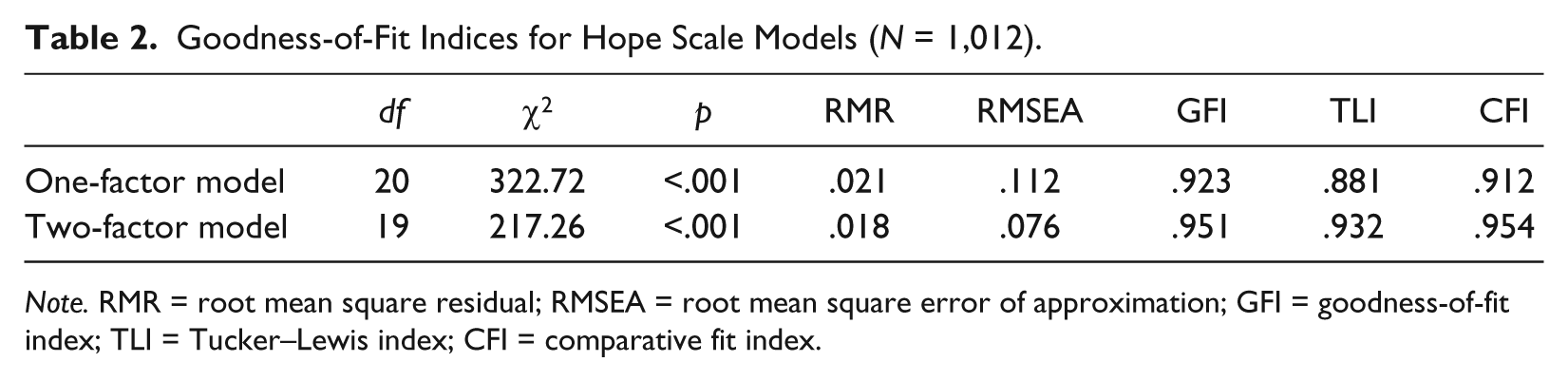
Note. RMR = root mean square residual; RMSEA = root mean square error of approximation; GFI = goodness-of-fit index; TLI = Tucker–Lewis index; CFI = comparative fit index.
Finally, as the estimated correlation between the Agency and Pathways factors in the two-factor model was large (ρ Agency × Pathway = .83), the Fornell and Larcker’s (1981) procedure was applied to evaluate discriminant validity. First, we calculated the estimate of average variance extracted for the Agency factor, ρ vc(η) = .713, and the Pathway factor, ρ vc(η) = .727. Second, the average variance resulting from Agency and Pathways factors was compared with the square of the correlation between both factors. The variance shared between Agency and Pathways factors (ρ Agency × Pathway = .711) was less than the average variance in the items explained by each Agency and Pathways factors, ave ρ vc(η) = .720, which satisfies the discriminant validity criterion (Fornell & Larcker, 1981).
Criterion-Related Validity
Criterion-related validity of the Portuguese version of the HS was assessed through analysis of correlations with life satisfaction, mental health, and AA. Results are reported in Table 3.
Correlation Matrix Between Hope Scale and Subscales and Other Variables in the Study (N = 1,012).
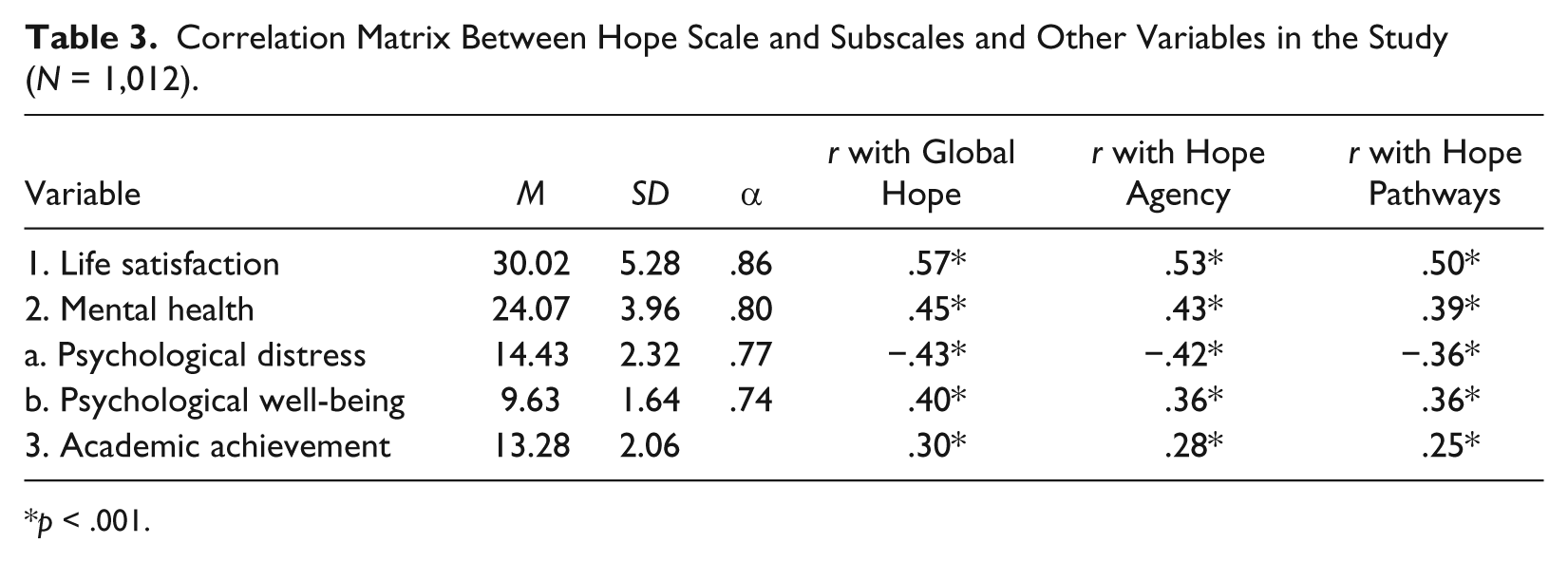
p < .001.
Hope and Demographic Factors
T tests were conducted to investigate group differences based on gender and grade level. There were no significant differences found based on gender or grade level and no significant correlations with age for Global hope, and Agency and Pathways subscales.
Discussion
The Portuguese version of the HS demonstrated adequate reliability and validity for research purposes. Specifically, this version revealed a high level of internal consistency for both subscales and for global hope and support that agency and pathways are related, but not synonymous. Other studies from other countries (e.g., Creamer et al., 2009) reported similar findings (i.e., evidence satisfying the discriminant validity criterion).
The test–retest reliability over a 2-week period is acceptable and consistent with previous studies (e.g., Snyder et al., 1991). The CFA results provide support for the two-factor structure of Snyder’s model of hope in the Portuguese population, with all items loading on the Agency and Pathways factors as expected. Moreover, the two-factor model of hope was a significantly better fit than the one-factor model. Other factorial studies have supported the hypothesized scale structure of two factors (Babyak, Snyder, & Yoshinobu, 1993; Creamer et al., 2009; Magaletta & Oliver, 1999; Roesch & Vaughn, 2006). According to Snyder’s (2002) theory of hope, agency and pathways are distinct but highly related entities, but it is only when these two components act together that hope is operative. Using the total hope score as a single variable in research is useful if researchers recognize the variable represents a higher-order latent variable and not a unidimensional first-order construct (Snyder, 2002). Indeed, one of the most significant obstacles in studying hope as a unitary construct may be that it becomes difficult to discern the unique contribution of agency and pathways thinking on outcome (for further discussion on this topic, see Chang, 2003).
Global hope showed a significant and positive correlation with life satisfaction, mental health, and AA. These findings replicate findings from previous studies of students from other countries and younger students (e.g., Gilman et al., 2006). Furthermore, Agency and Pathways components of Hope are not differentially associated with life satisfaction, mental health, and AA, thus adding further support for the two-factor hope model hypothesis. Consistent with past studies (e.g., Valle et al., 2004), hope showed a non-significant association with age, gender, and grade level.
There were limitations to the current study, including the generalizability of the study results. Also, multimethod studies using non-self-report hope measures (e.g., teacher and peer ratings) are important to complement our survey-based findings.
Conclusion and Future Research
This study provides new and preliminary evidence for the validity, reliability, and utility of the HS in high school students and to Portuguese-speaking samples. Future research studies could explore additional indicators of reliability (e.g., test–retest stability with longer time intervals) and validity (e.g., predictive validity, incremental validity).
The Portuguese version of the HS adds to the existing hope literature and adds diversity to a research pool that has been dominated by North American samples. With both the HS and the Portuguese version of the CHS (Marques, Pais-Ribeiro, & Lopez, 2009) available in Portuguese, it is feasible to explore understudied world topics, such as the trajectory of hope across the child and adult life span. Finally, hope theory and the Portuguese version of the HS can be used to inform and validate hope-based interventions with Portuguese adolescents and adults. These programs are likely to focus on goal setting, identifying, and implementing pathways to goal attainment, and agency to maintain goal pursuit (Marques, Lopez, & Pais-Ribeiro, 2011) even in the face of challenges or under adverse conditions.
Footnotes
Declaration of Conflicting Interests
The author(s) declared no potential conflicts of interest with respect to the research, authorship, and/or publication of this article.
Funding
The first author received financial support for the research from Fundação Calouste Gulbenkian (Grant reference 21-116175-B).