



Abstract
This research aimed to construct and validate the School Conflict Negotiation Effectiveness Questionnaire (SCNEQ). This objective is both based on the increasing relevance of the area of constructive conflict management in schools and also in the scarcity of instruments that try to measure these dimensions in the educational context. We used two samples of students from middle and high school in two urban public schools, one with 622 students and another with 505, the last one to confirm validation. The results of the samples show values of Cronbach’s alpha of .84 and .87, respectively. The data suggest the feasibility and validity of SCNEQ to assess the construct under study. We consider it relevant to continue the psychometric studies of the scale, so future research should address this topic in depth. Concerning the findings, results of the present study reveal that affective groups statistically differ in their self-reported conflict management styles.
Introduction
When speaking about school, the educative and formative role it has to develop must be raised even further nowadays, so it is able to generate well-being and safety to those who participate in it, aspects that are present in the negotiation skills of its different partakers. School is a social institution that is charged with two main responsibilities by society: to educate and to protect the children and their development. Providing a safe and complete education for all the students is a difficult challenge, since the conflicts at school facilities are increasing.
Although definitions of conflict abound, there is some consensus around that it is marked by some degree of tension, uncertainty, and unpleasantness (Rahim, 2011). Folger, Poole, and Stutman (1995) see conflict as the interaction of interdependent people who perceive incompatible goals and interference from each other in achieving those goals. Being a process, conflicts tend to form self-reinforcing cycles (escalation patterns) that can be frequent in the interdependence relationships in schools (Deutsch & Coleman, 2012). So, to build peace, all students need to know how to resolve conflicts in constructive, nonviolent, problem-solving ways. Negotiation can be helpful, because it allows people to reach, very often, mutual gains (Gelfand, Fulmer, & Severance, 2011), and it is a way to solve conflicts constructively, which is pertinent to sustain a culture of peace in school communities (Deutsch & Coleman, 2012).
Thus, developing skills of conflict management and negotiation in schools is something of interest, and there is a perspective of relevance and some consensus (Deutsch, 1990, 1991, 1994), in addition to a plurality of approaches that the theme has scientifically raised. So, in a pragmatic vision to stimulate the functional potential of conflicts, it is appropriated to build and validate an instrument that evaluates the Conflict Negotiation Effectiveness within the school context, precisely the main objective that underlies the elaboration of the SCNEQ—School Conflict Negotiation Effectiveness Questionnaire.
To build SCNEQ, we based fundamentally on the Mastenbroek’s (1989, 1991) strategic model of negotiation efficacy and also added the Bazerman and Neale (1992) rational negotiation perspective (aims to establish a higher rationality by the negotiator that can lead to better results). From the perspective of Mastenbroek (1989, 1991), the negotiation process involves performing different activities to solve progressively a set of dilemmas and problems that arise during the process of negotiation. The conduct of negotiators can be evaluated according to the extent in which they adopt four criteria: obtaining positive results (obtaining substantial results is identified as the main objective of the negotiation), influence the balance of power (describes a dimension of looking for influence on the balance of power, that is fundamental to obtain a certain stability between parties), develop a constructive climate (it is based on the development of a more favorable setting for the negotiation act), and promote flexible dynamics (refers mainly to a procedural flexibility, to elect a flexible dynamic between negotiators).
Method
Participants
Two samples were used for the elaboration of the SCNEQ. The sample from Study 1 is formed by 622 students and the one from Study 2 by 505, from two public Portuguese schools. In the first sample, 232 (37.3%) students are male and 390 (62.7%) female, with an average age of 15.8 (SD = 1.58). Sample 2 is formed by 214 (42.4%) boys and 291 (57.6%) girls, with an average age of 15.9 (SD = 1.60). In both samples, ages are comprised between 12 and 22. Because there is no scale about conflict negotiation in school context in Portugal, we selected high school students because we considered that it is in this school level that important cognitive, affective, and motivational transformations occur and can lead to several conflicts.
Instrument
The SCNEQ can be applied as a measuring instrument of the students’ opinions and attitudes facing some aspects related to conflict negotiation effectiveness in educational context. With the example of an item, the dimensions under evaluation are Negotiation Influence (NI; for example, “For a good negotiation I must consider that the other party is wrong”), Negotiation Climate (NC; for example, “I try to make my opponent feel at ease during the resolution of a conflict”), Negotiation Rationality (NR; for example, “I can accept criticism from my opponent”), Behavioral Firmness-Flexibility (BFF; for example, “I usually participate actively in negotiation situations”), and Constructive Solutions (CS; for example, “To achieve an agreement it is crucial to analyze the interests of each party”).
The questionnaire was built having as basis the following theoretical models of the literature of the area: the Negotiation Effectiveness Questionnaire (Serrano & Rodríguez, 1993), Mastenbroek’s (1989, 1991) model, and Bazerman and Neale’s (1992) Rational Negotiation Perspective.
The subjects respond to the 21 items indicating the extent to which the referred statement is valid to them in 5-point Likert-type scale, from strongly disagree (1) to strongly agree (5). The conflicts negotiation effectiveness in school context can, therefore, be evaluated through the sum of the score in the respective subscales: NI, NC, NR, BFF, and CS.
Procedure
The SCNEQ was applied in classroom context, taking into consideration the students’ age level and the grade they attended, in two moments throughout the school year, in both schools. At a first stage, data which enabled to validate the instrument were collected. At a second stage, the inventory was again applied to a different sample. This second application aimed to build a new empirical matrix that enabled the confirmation and the validation of the first analyses carried out. With these two studies, we aimed to evaluate the psychometric properties of the instrument.
Results
Exploratory Analysis
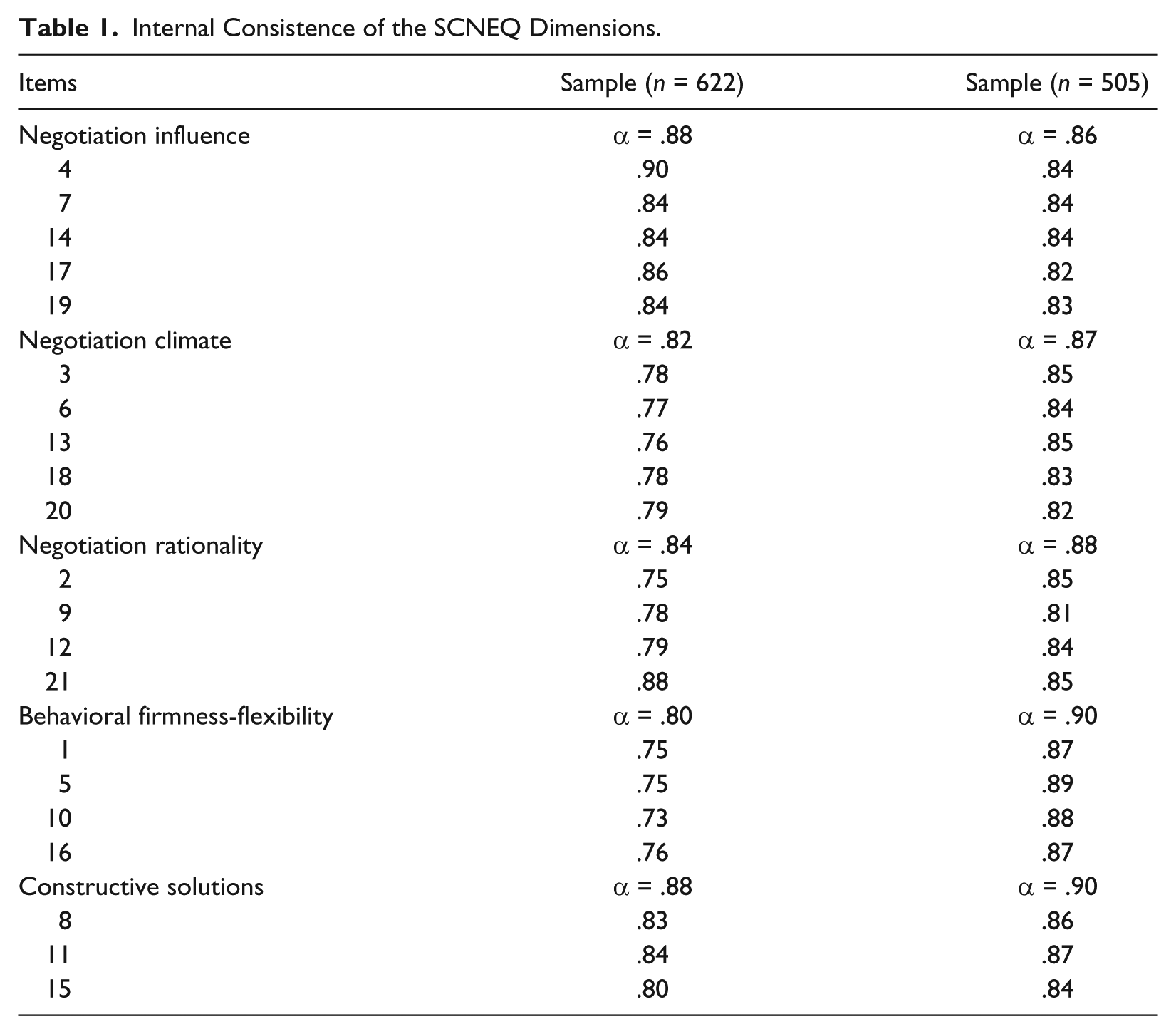
Due to the Likert-type form of the items, the internal consistency calculation, that aims to analyze the extent to which the items that compose the test form a homogeneous whole, was carried out having as basis the determination of Cronbach’s alpha index. In Study 1, the factors NI, NC, NR, BFF, and CS correspond to the alphas .88, .82, .84, .80 and .88, respectively, and, in Study 2, they correspond to the alphas .86, .87, .88, .90, and .90 (cf. Table 1), fact that confirms their good internal consistency (Arbuckle, 2012). In addition, we can conclude that SCNEQ has a robust alpha coefficient, being of .84 in Study 1 and of .87 in Study 2.
Internal Consistence of the SCNEQ Dimensions.
In the analysis of the factor structure in main components with varimax rotation (cf. Table 2), all isolated factors that showed an eigenvalue equal or superior to the unit were taken into account. The data of Study 1 (N = 622) point to the existence of five factors with an explained variance of 66.9%. The NI factor explains 16.5% of the variance and refers to the NR dimension, the fourth factor, BFF explains 12.1%, and the CS factor has an explained variance of 11.1%. In Study 2 (N = 505), the results point again to five factors with an explained variance of 71.9%.
Factor Structure of the SCNEQ.
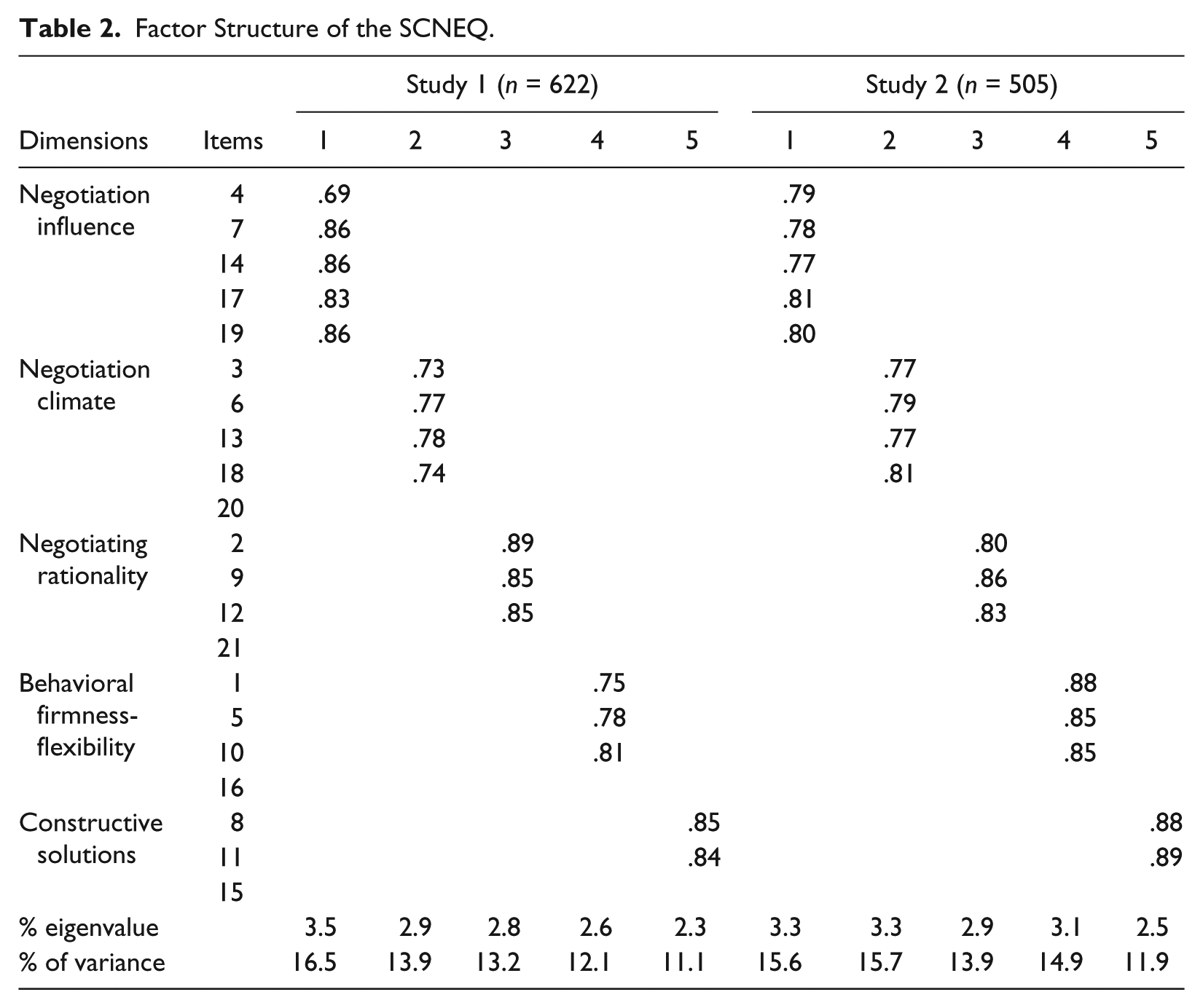
The analyses to the SCNEQ scales reveal adaptive values to the Kaiser–Meyer–Olkin (KMO) index of .84 in Study 1 and of .86 in Study 2. Bartlett’s test of sphericity presents adequate values in Study 1, χ2(210) = 6,033.931, p < .001, and in Study 2, χ2(210) = 5,870.157, p < .001.
Confirmatory Analysis
The statistic treatment of the data was done having as basis the SPSS/AMOS 21 program (Arbuckle, 2012). After the analysis of the results, all cases with missing values were removed, to facilitate the parameter estimation, using the maximum likelihood (ML) estimation method in the AMOS program. We have also chosen to maintain the outliers, as the descriptive statistic of each sample still showed to be adequate. The adjustment of the model was evaluated based on the most commonly used statistical indexes: χ2, χ2 / freedom degrees, goodness-of-fit index (GFI), and adjusted goodness-of-fit index (AGFI; Jöreskog & Sörbom, 1993), comparative fit index (CFI; Hu & Bentler, 1999), Tucker–Lewis index (TLI; Hair, Anderson, Tatham, & Black, 2005), and root mean square error of approximation (RMSEA; Byrne, 2001).
We have analyzed the dimensionality and the structure of the SCNEQ testing different models in accordance with the data in the literature, aiming to identify which one better respects the structure of the construct. The Measuring Model 1 is based on the following assumptions: (a) the answers given by the students can be explained by five factors (NI, NC, NR, BFF, and CS), (b) the loading factor shown by each of the items is associated only to the factor that is supposed to be measured (target loading factor) and the zero-loading factor in the other factors, (c) there is no correlation between the estimation errors associated to each of the items, and (d) according to the theoretical rational in which the questionnaire is based, the five factors are correlated. Model 1 presents the following adjustment indexes: Study 1 (n = 622)—χ2(179) = 360.954, p < .001, χ2 / d.f. = 2.017, GFI = .948, AGFI = .933, CFI = .969, TLI = .964, RMSEA = .040 (.034-.046); Study 2 (n = 505)—χ2(179) = 313.867, p < .001, χ2 / d.f. = 1.753, GFI = .946, AGFI = .930, CFI = .976, TLI = .972, RMSEA = .039 (.031-.046). The values obtained in the goodness indexes suggest that the global adjustment of Model 1 is robust. Model 2 (cf. Figure 1 and Table 3) is based on the following assumptions: (a) the answers given by the students from the sample can be explained by five first-order factors (NI, NC, NR, BFF, and CS) and a second-order factor (Negotiation Effectiveness), (b) the loading factor is demonstrated by each items is related only to the first-order factor that is supposed to measure and the zero-loading factor in the remaining factors, (c) there is no correlation between the estimation errors related to each item, and (d) the covariance between the five first-order factors can be totally explained by the regression in the second-order factor. This model presents the following adjustment indexes: Study 1 (n = 622)—χ2(184) = 374.730, p < .001, χ2 / d.f. = 2.037, GFI = .946, AGFI = .932, CFI = .968, TLI = .963, RMSEA = .041 (.035-.047); Study 2 (n = 505)—χ2(184) = 318.921, p < .001, χ2 / d.f. = 1.733, GFI = .945, AGFI = .931, CFI = .977, TLI = .973, RMSEA = .038 (.031-.045). Table 3 shows us the measure of the linear correlation between the variables that exist in the model.
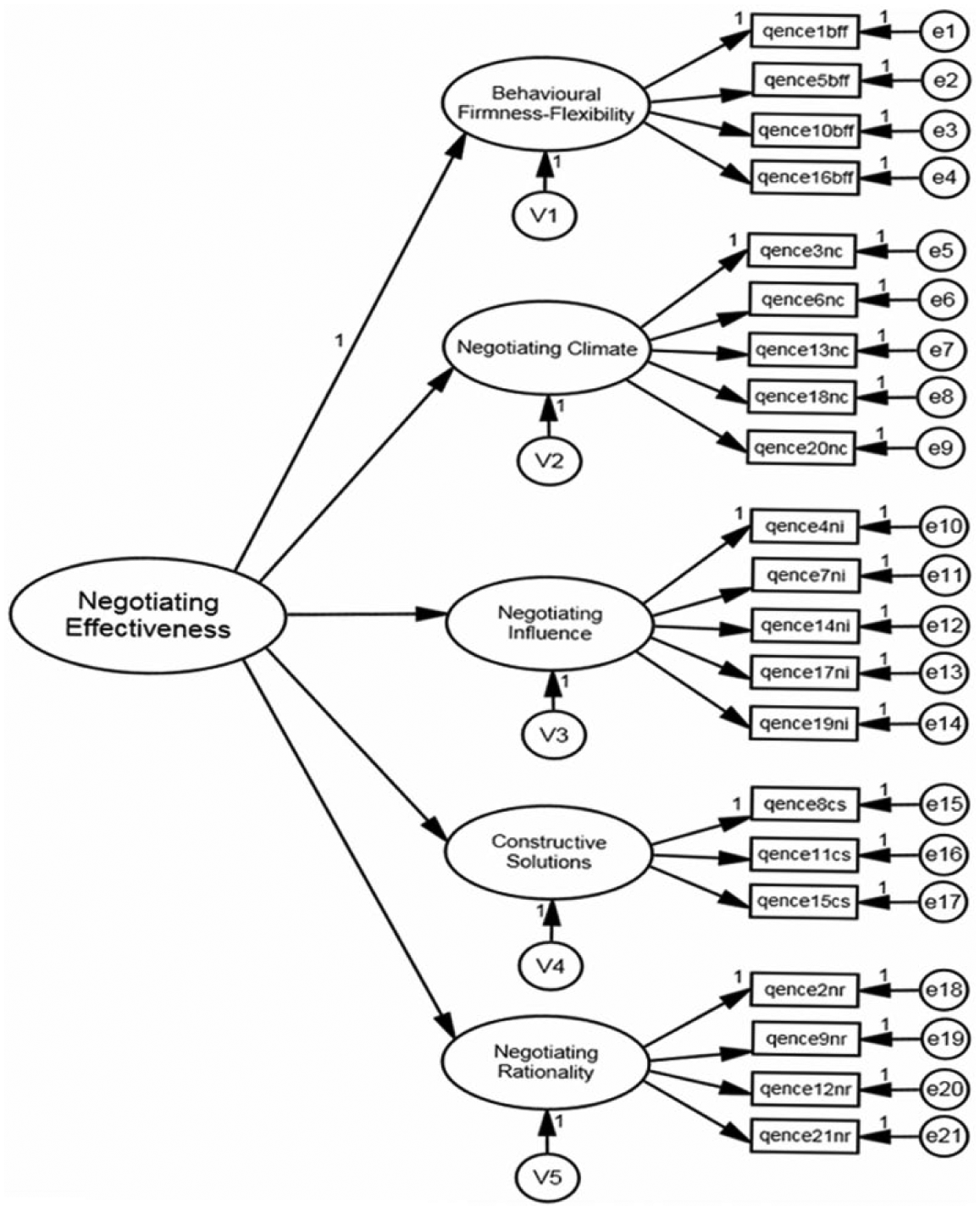
Pictorial specification of Model 2.
Correlations Between the SCNEQ Factors (Pearson’s Correlation Coefficients) and Descriptive Statistics.

Note. BFF = Behavioral Firmness-Flexibility; NC = Negotiating Climate; NI = Negotiating Influence; CS = Constructive Solutions; NR = Negotiating Rationality.
In both studies, the results obtained in the goodness indexes indicate that the global adjustment of Model 2 is robust. We have chosen this model as it is in conformity with the theoretical assumptions on which the questionnaire is based.
The estimated parameters for Model 2 present adequate and statistically significant values (cf. Table 4). There are no parameters that show inadequate estimations as negative variances or estimation errors superior to one (Byrne, 2001).
Results of the Comparison of the Models.

Note. CR = critical ratio; BFF = Behavioral Firmness-Flexibility; NC = Negotiating Climate; NI = Negotiating Influence; CS = Constructive Solutions; NR = Negotiating Rationality.
Conclusion
Although the construct of the negotiation effectiveness within the school context is somewhat recent, the results reveal the importance of its impact in the understanding of our students’ behavior. The SCNEQ, evaluating the opinions and the attitudes shown by the students, can represent a major contribution. In fact, in literature, we found studies that relate conflict negotiation with personal, motivational, environmental, and academic achievement variables (Aceves, Hinshaw, Mendoza-Denton, & Page-Gould, 2010). Although there is also investigation about disruptive behaviors in school context, research concerning specifically students conflict styles and tactics still remains recent and scarce.
This importance is even more significant if we bear in mind that there is no instrument, in the Portuguese context, designed to evaluate the construct under study in any of the levels of teaching. The data enable us to conclude that the SCNEQ shows psychometric characteristics that configure it as a feasible instrument to evaluate the respective construct, thus enabling it to be used in future studies, as a powerful tool in educational intervention.
It would be interesting to build negotiation effectiveness measures not only from items of questionnaires that measure the construct as an attitude but also through behavior indicators. The access to a confirmatory factor analysis of these data would enable us to identify the communalities of the construct measured from different sources of information.
The progressive use of SCNEQ will allow for a wider gathering of data that facilitate the understanding, not only of this instrument in diversified populations but also of the processes that contribute to conflict negotiation effectiveness in school context.
Footnotes
Declaration of Conflicting Interests
The author(s) declared no potential conflicts of interest with respect to the research, authorship, and/or publication of this article.
Funding
The author(s) received no financial support for the research, authorship, and/or publication of this article.