




Abstract
This study examines the factor structures of Personal and Classroom Achievement Goals and the relationships between them. Multilevel structural equation modeling was used to examine data from a sample of 3,544 Italian 10th-grade students (184 classrooms) who completed the Patterns of Adaptive Learning Scales (PALS). Findings about the factor structure of personal goals were consistent with studies in other cultural contexts. The scales showed measurement invariance both across gender and across various immigrant backgrounds. Boys showed lower levels of mastery and higher levels of performance-approach than girls. Immigrant students scored higher than the native students on all Performance scales. At the group level, a measurement model including mastery and performance-approach goal structures showed good fit indices. In classrooms more oriented toward mastery, students’ personal goals tend to be in the same direction. Classroom performance-approach goal structures were related to performance-avoidance personal orientations but not to performance-approach personal orientations.
Achievement goals are mental representations that lead students to modify their behavior with regard to a competence-related result or outcome that they are committed either to attaining or to avoiding (Hulleman, Schrager, Bodmann, & Harackiewicz, 2010). They can be divided into mastery goals and performance goals (Ames & Ames, 1984). In the first case, the focus of students is on the acquisition of new skills for themselves, whereas in the second, their main concern is to show and prove their competence to others. A further distinction for performance goals has been proposed in the literature (e.g., Elliot & Church, 1997; Elliot & Harackiewicz, 1996; Xiao et al., 2015) on the basis of the difference between approach and avoidance. The focus of performance-approach goals is on the attainment of good grades and on obtaining favorable judgments, whereas that of performance-avoidance is to be free from negative evaluations (Elliot & Church, 1997). Many studies have investigated the relationship between this trichotomous model of personal goals (i.e., mastery, performance-approach, and performance-avoidance) and achievement at school. The results have shown that mastery goals are usually a good predictor of academic success and learning, whereas performance-avoidance goals have a more negative relation to achievement (Hulleman et al., 2010; Paulick, Watermann, & Nückles, 2013). With regard to performance-approach goals, in a review of the literature, Brophy (2005) pointed out that their positive impact on students’ performance appears to range from weak to non-existent.
Achievement goal theory has also provided a framework for studying the influence of classroom environment on students’ goals and learning (Meece, Anderman, & Anderman, 2006). According to the theory, teachers may propose different goal structures in the classroom by means of instructional and evaluation strategies and styles of teaching (Kaplan, Gheen, & Midgley, 2002). Following the trichotomous model of personal goals, Midgley and colleagues (2000) proposed that classroom goal structures can be focused on (a) personal improvement and the comprehension of what is studied (a mastery goal structure), (b) interpersonal comparisons and competition to demonstrate competence (a performance-approach goal structure), and (c) engaging in academic work to avoid demonstrating incompetence (a performance-avoidance goal structure). Several studies have examined the relationship between classroom goal structures and variables related to achievement. The results show that a mastery goal structure in the classroom generally leads to more positive outcomes than a performance goal structure (Murayama & Elliot, 2009; Polychroni, Hatzichristou, & Sideridis, 2012). According to various studies (Bong, 2005; Midgley & Urdan, 1995; Urdan, 2004), the goal structures of the classroom directly influence students’ adoption of personal goals that are consistent with the classroom orientation. However, these findings are based on students’ perceptions at the individual level, and they are distinct from results related to students’ ratings at the classroom level, where the group structure of the measures must be considered to avoid biases in the assessment (Miller & Murdock, 2007). Regarding this point, there is evidence (Kaplan et al., 2002; Murayama & Elliot, 2009) that there might be no significant variance between classrooms concerning performance-avoidance goal structure: a fact that could lead to unreliable measures (Ludtke, Robitzsch, Trautwein, & Kunter, 2009; Morin, Marsh, Nagengast, & Scalas, 2014). In summary, there is a wide consensus in the literature about the different dimensions of achievement goals (Brophy, 2005), but there are still some open questions as regards their factor structures and relationships when their different levels of assessment (i.e., the student for personal goals and the group for classroom goals) are taken into consideration.
The present study, based on a large sample of Italian students and classrooms, aims to clarify the discussed open issues by means of multilevel structural equation modeling (SEM). Personal goals were examined at the student level at which, according to the theory and to preceding studies (Middleton & Midgley, 1997; Midgley, 2002), we expected three correlated but distinct factors: Mastery, Performance-Approach, and Performance-Avoidance personal goals. The measurement invariance of the scales was tested across gender and immigrant background, and differences in latent means were also examined. Prior studies (Anderman & Midgley, 2002; Midgley et al., 2000) on the factor structure of these students’ level scales have provided evidence for their discriminant validity as well as some support for the invariance of the measures across gender and ethnic groups.
Classroom goal factor structure, consistently with the nature of this specific construct, which implies (Ludtke et al., 2008) a shared perception based on students’ rating of the goal orientation of their classroom as a whole, was tested at the group level (Huang & Cornell, 2015). In accordance with the theory, we tested both a three-factor structure (Anderman & Midgley, 2002) and a two-factor structure (mastery and performance-approach classroom goals), which does not include the classroom goal of performance-avoidance, given the preceding evidence about its lack of variance among classrooms (Murayama & Elliot, 2009). Prior research (Anderman & Midgley, 2002; Middleton, Gheen, Midgley, Hruda, & Anderman, 2000) on the scales has been conducted at the student level (providing evidence for three distinct dimensions of individual perception), but to the best of our knowledge, no study has investigated the psychometric properties of the scales at the classroom level.
Finally, by means of a multilevel model, which took into consideration the measurement and the sampling error of the group constructs, we tested the hypothesis, prevalent in the literature based on assessments of learning environments at the individual level, that shared perceptions of goal structures directly influence the adoption of consistent personal goals.
Method
Participants and Procedure
The data analyzed in the present study came from a sample of 3,544 Italian 10th-grade students from 184 classrooms who took part in the National Evaluation of Learning in 2014 (National Institute for the Evaluation of the Education System, 2014). Participating students were sampled from the whole population of Italian lower secondary schools using a two-stage cluster sampling design. In the first stage, 115 schools were sampled from the whole population of Italian lower secondary schools. In the second stage, one or two complete classes of 10th graders were randomly selected in each school, and all the students in each of these classes were assessed for the survey. The average age of the students was 15.53 years (SD = .67), 48.4% of the students were female, and 9.5% of the students had an immigrant background (they had both parents who were born outside Italy).
Data were collected in the classes during an ordinary school day by means of a questionnaire. Students were given a standardized introduction, which informed them of the purpose of the study and gave instructions on how to complete the questionnaire.
Materials
The scales used in the present study were adopted from the revised version of the Patterns of Adaptive Learning Scales (PALS; Midgley et al., 2000). The Italian PALS was pre-tested on a small group of subjects (N = 27), upon which comprehension and ease of answering were assessed by means of techniques of thinking aloud. The Personal Achievement Goal Orientations measures consist of three scales: Mastery Goal Orientation (four items—for example, “It’s important to me that I learn a lot of new concepts this year”), Performance-Approach Goal Orientation (four items—for example, “One of my goals is to show others that I’m good at my class work”), and Performance-Avoidance Goal Orientation (four items—for example, “It’s important to me that I don’t look stupid in class”).
As regards the Perception of Classroom Goal Structures, the corresponding three PALS scales were adopted: Classroom Mastery Goal Structure (four items—for example, “In our class, how much you improve is really important”), Classroom Performance-Approach Goal Structure (three items—for example, “In our class, getting good grades is the main goal”), and Classroom Performance-Avoidance Goal Structure (four items—for example, “In our class, it’s very important not to look dumb”).
Students responded to the statements on a 4-point Likert-type scale, ranging from “I completely disagree” to “I completely agree.”
Analytic Strategy
Consistent with the hierarchical structure of the research questions and data of the present study (students nested within classes), all analyses were conducted using the multilevel modeling with complex survey data framework of Mplus 7 (Muthén & Muthén, 1998-2012). The analyses were performed using SEM techniques with Robust Maximum Likelihood (MLR) estimator, and the fit of the tested models was judged by conventional criteria, using both the MLR chi-square test statistic and several fit indices (comparative fit index [CFI], root mean square error of approximation [RMSEA], standardized root mean square residual [SRMR]; Hu & Bentler, 1999; Schreiber, Nora, Stage, Barlow, & King, 2006). The small amount of missing data (ranging from 0.3% to 7.2%) was handled using the Full Information Maximum Likelihood (FIML) method as implemented in Mplus (Muthén & Muthén, 1998-2012).
In the first stage of analysis, a confirmatory factor analysis (CFA) was performed to test the measurement model of the Personal Achievement Goal Orientation scales at the student level. The “Type = complex” approach was used to take into consideration the hierarchical structure of the data and to compute correct estimates and test statistics. The internal consistency of the scale was measured by means of coefficient alpha. Subsequently, the measurement invariance of the scales across gender and immigrant background (native vs. immigrant) was examined at the configural, metric, and scalar levels, by means of a hierarchical series of multigroup CFAs, imposing increasingly restrictive equality constraints on the model’s parameters (van de Schoot, Lugtig, & Hox, 2012). In each step of the analysis, the fit of the nested models was compared using two tests (Cheung & Rensvold, 2002): the corrected chi-squared difference test and the change in CFI values (ΔCFI ≤ .01). Finally, the latent mean differences across gender and immigrant background were estimated on each of the three personal achievement goal orientations.
In the second stage of analysis, multilevel CFAs (within-class level and between-classes level) were performed to test the two measurement models hypothesized for the Perception of Classroom Goal Structures scales. Cross-level measurement invariance was established using the chi-square difference test based on log-likelihood values for comparing the factorial invariance model, in which all the factor loadings were constrained so as to be equal between the two levels, with the configural invariance model, in which factor loadings were allowed to vary between the levels (Heck & Thomas, 2009; Mehta & Neale, 2005). Finally, the intra-class correlation (ICC1) and reliability of the scale (ICC2) were estimated (Morin et al., 2014).
In the third stage of analysis, a multilevel SEM was tested to examine the influences of the shared perceptions of classroom goal structures on the personal achievement goal orientations. Factorial scores were computed for each of the three factors of personal achievement goal orientations and were used in the model to avoid the problems with convergence that frequently occur with multilevel SEM when there are too many parameters (e.g., all the items of the questionnaires). All the variables were included in the multilevel model as having both between-classes and within-class variance components.
Results
The Measurement Model of the Personal Achievement Goal Orientation Scales
A three correlated factors model (Mastery, Performance-Approach, and Performance-Avoidance) was hypothesized for the Personal Achievement Goal Orientation scales and tested with a CFA. The results showed the following fit indices: χ2(51) = 367.998, p < .001, CFI = .972, RMSEA = .044, SRMR = .033. Except for the chi-square test (probably affected by the large size of the sample used in the present study), all the fit indices indicated a good fit of the model with the empirical data (Hu & Bentler, 1999; Schreiber et al., 2006). The standardized parameter estimates for the measurement model are presented in Figure 1. All the factor loadings were statistically significant (p < .001) and above .60, indicating the existence of a satisfactory relationship between each latent variable and its measured indicators (Bagozzi & Yi, 1988; Harrington, 2009). The three latent factors were significantly correlated with each other (p < .001). As expected, Performance-Approach and Performance-Avoidance were highly correlated with each other, and their correlation with Mastery was small. The three subscales showed good internal consistency (i.e., between .8 and .9; Nunnally & Bernstein, 1994), with coefficient alpha values of .81 for Mastery, .85 for Performance-Approach, and .77 for Performance-Avoidance.
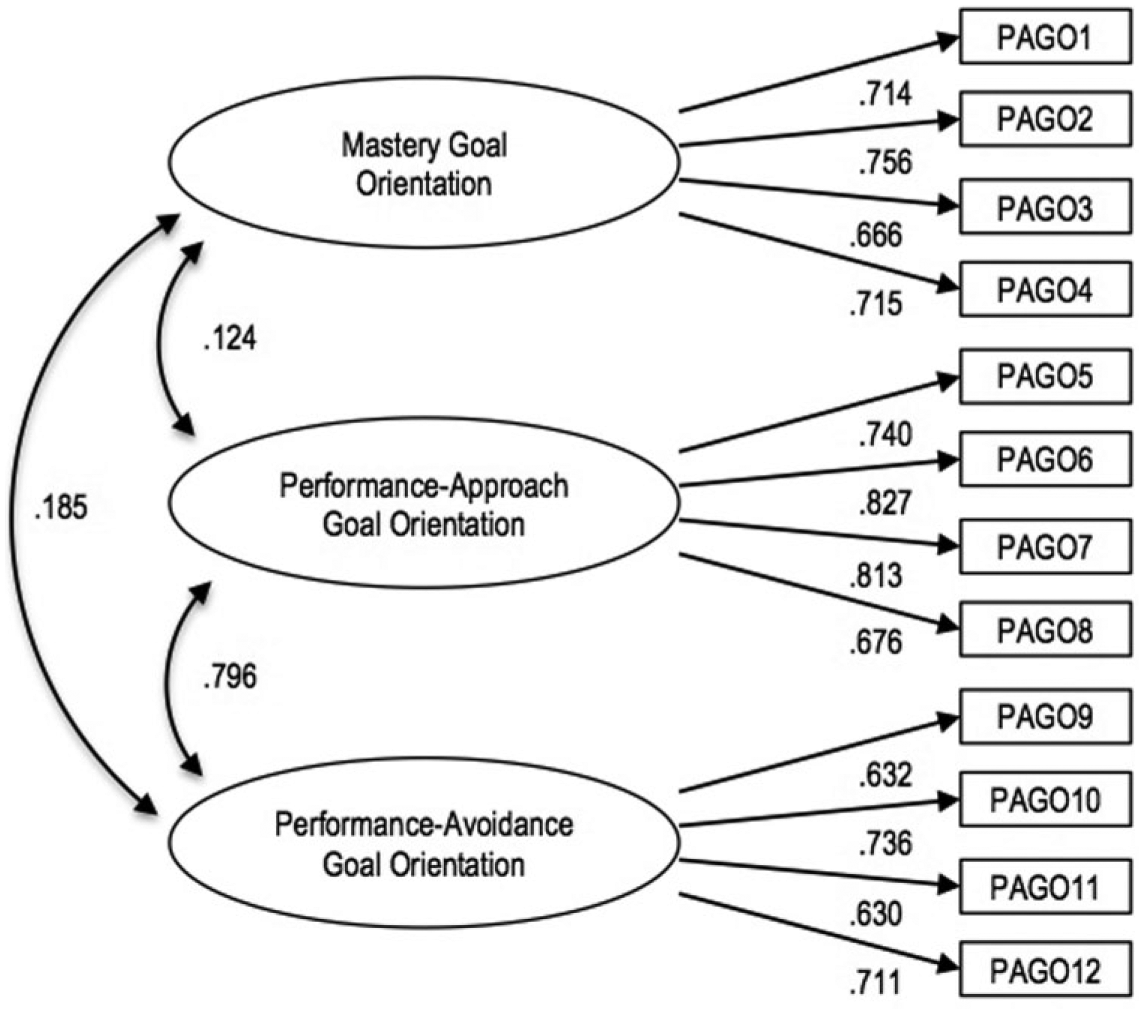
Results of the CFA performed on the Personal Achievement Goal Orientation scales.
The results of the multigroup analysis performed to examine the measurement invariance of the Personal Achievement Goal Orientation scales across gender and immigration background are summarized in Table 1.
Summary of Fit Statistics for the Assessment of Measurement Invariance Across Gender and Immigrant Status.
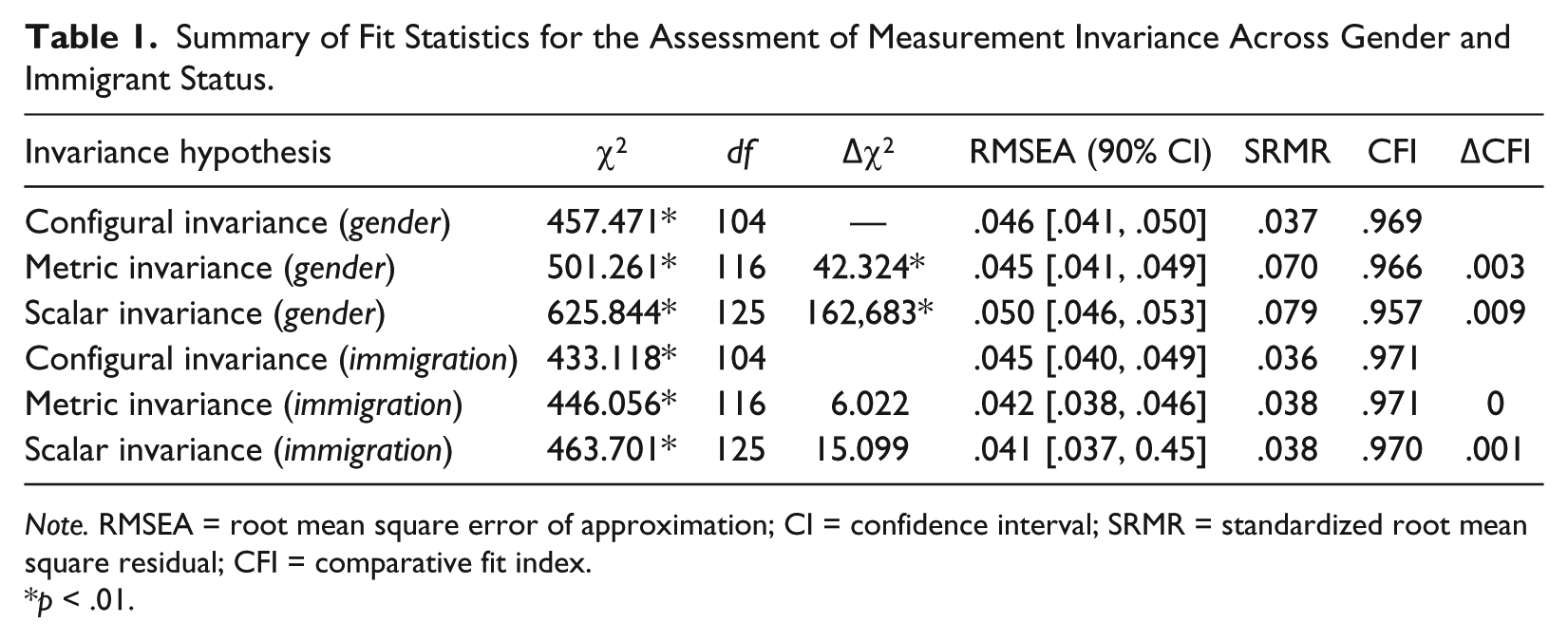
Note. RMSEA = root mean square error of approximation; CI = confidence interval; SRMR = standardized root mean square residual; CFI = comparative fit index.
p < .01.
The indices of both configural invariance models (across gender and across immigration background) were very close to those of the general model tested above and indicated that these models fit the data well (Table 1). The comparison of the configural invariance models with the models with all the factor loadings constrained to be equal cross groups confirmed the full metric invariance of the scales across the groups taken into consideration. In fact, in the immigration background analysis, the chi-square difference test was not statistically significant and the CFI was unchanged. In the analysis across gender, the difference in the CFI was smaller than the cutoff criterion (ΔCFI = .003), but the chi-square difference test was statistically significant. Given that this test could not be reliable with a large sample size and there was no substantial difference in CFI, we concluded that the hypothesis of metric invariance across gender could be retained. Finally, the results of the comparison of the metric invariance models with the models in which all the item intercepts were constrained to be equal across groups showed the full scalar invariance of the scale both across gender and immigration background. In fact, in the immigration background analysis, the chi-square difference test was not statistically significant and the CFI was practically unchanged (ΔCFI = .001). In the cross gender analysis, the change in the CFI value was smaller than the cutoff criterion (ΔCFI = .009) and provided empirical support for the scalar invariance hypothesis, although the chi-square difference test was statistically significant.
Finally, Table 2 shows the results of the analysis of the latent mean differences across gender and immigration background on the three factors of the Personal Achievement Goal Orientation scales. Mastery Goal Orientation proved to be significantly higher in girls than in boys, whereas Performance-Approach Goal Orientation proved to be higher in boys than in girls. Boys and girls did not differ on Avoidance-Approach goal orientation. The students with an immigration background showed higher levels of Performance-Approach and Avoidance-Approach than the native students, whereas there was no difference between these two groups on Mastery Goal Orientation levels.
Results of the Latent Factor Mean Differences Tests.
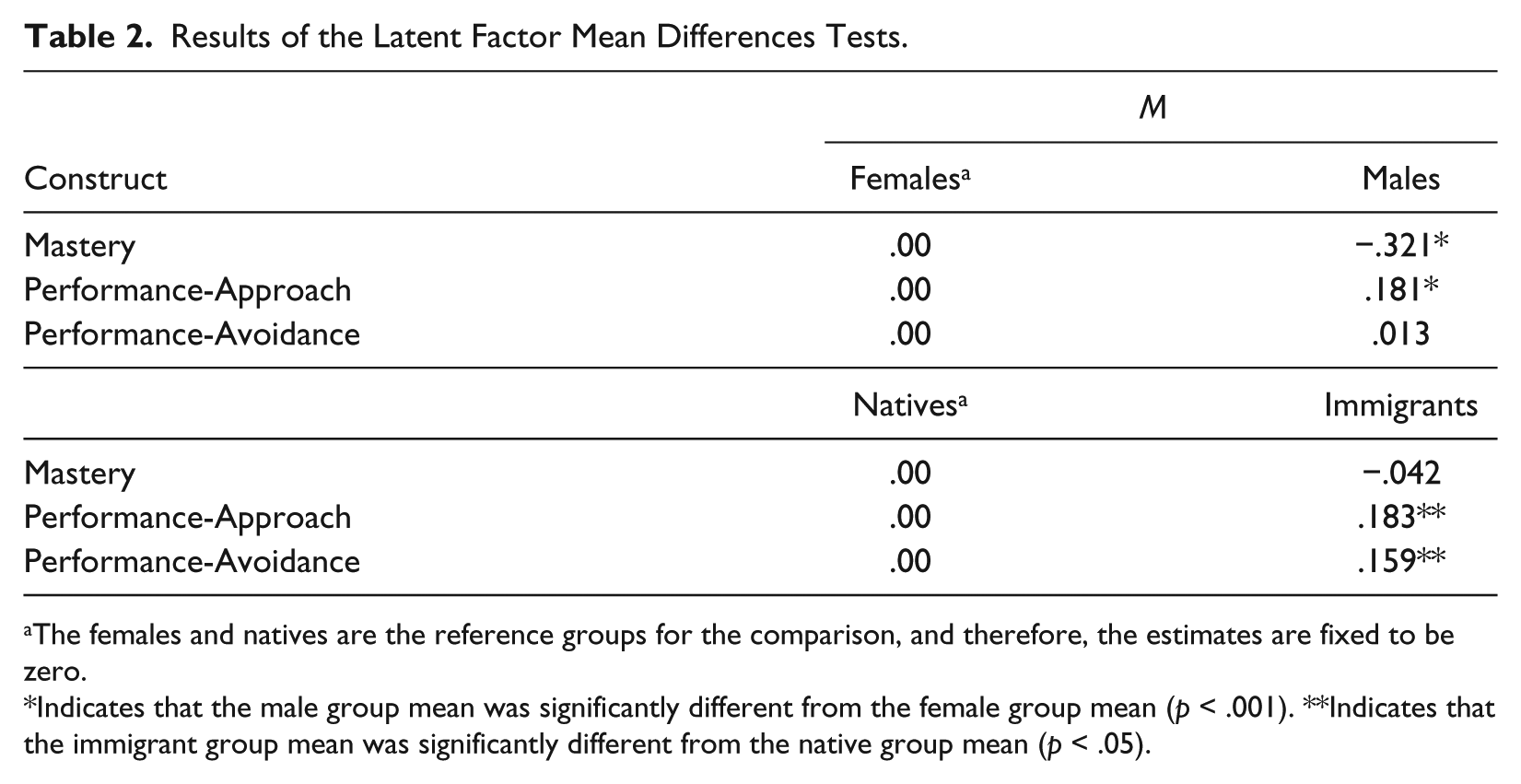
The females and natives are the reference groups for the comparison, and therefore, the estimates are fixed to be zero.
Indicates that the male group mean was significantly different from the female group mean (p < .001). **Indicates that the immigrant group mean was significantly different from the native group mean (p < .05).
The Measurement Model of the Perception of Classroom Goal Structures Scales
The results of the multilevel CFA on the three-factor model (Classroom Mastery, Performance-Approach, and Performance-Avoidance structures) of the Perception of Classroom Goal Structure scales showed the following fit indices: χ2(92) = 452.894, p < .001, CFI = .960, RMSEA = .033, SRMR = .041. The ICC1 was .12 for Mastery, .08 for Performance-Approach, and .04 for Performance-Avoidance. The reliability of the scale was .71 for Mastery, .62 for Performance-Approach, and .48 for Performance-Avoidance.
The results of the multilevel CFA on the two-factor model (Classroom Mastery and Performance-Approach) of the Perception of Classroom Goal Structure scales showed the following fit indices: χ2(32) = 212.729, p < .001, CFI = .960, RMSEA = .040, SRMR = .044. The ICC1 was .12 for Mastery and .08 for Performance-Approach. The reliability of the scale was .71 for Mastery and .62 for Performance-Approach.
On the whole, these results showed that both models had good fit with the data. However, in the three-factor model, the values of ICC1 and ICC2 of the Performance-Avoidance subscale were not satisfactory (Morin et al., 2014). For this reason, we decided to keep the model with two factors, which is presented in Figure 2. All the factor loadings of this model (Figure 2) were statistically significant (p < .001), being nearly .50 for one item (Item 1 at the within level) and above .55 for all the other items. The log-likelihood difference test between the factorial invariance model and the configural invariance model was not statistically significant, χ2(5) = 2.105, p = .834, thus confirming that the Perception of Classroom Goal Structures scales had the same factor structure at both the between-classes level and the within-class level.
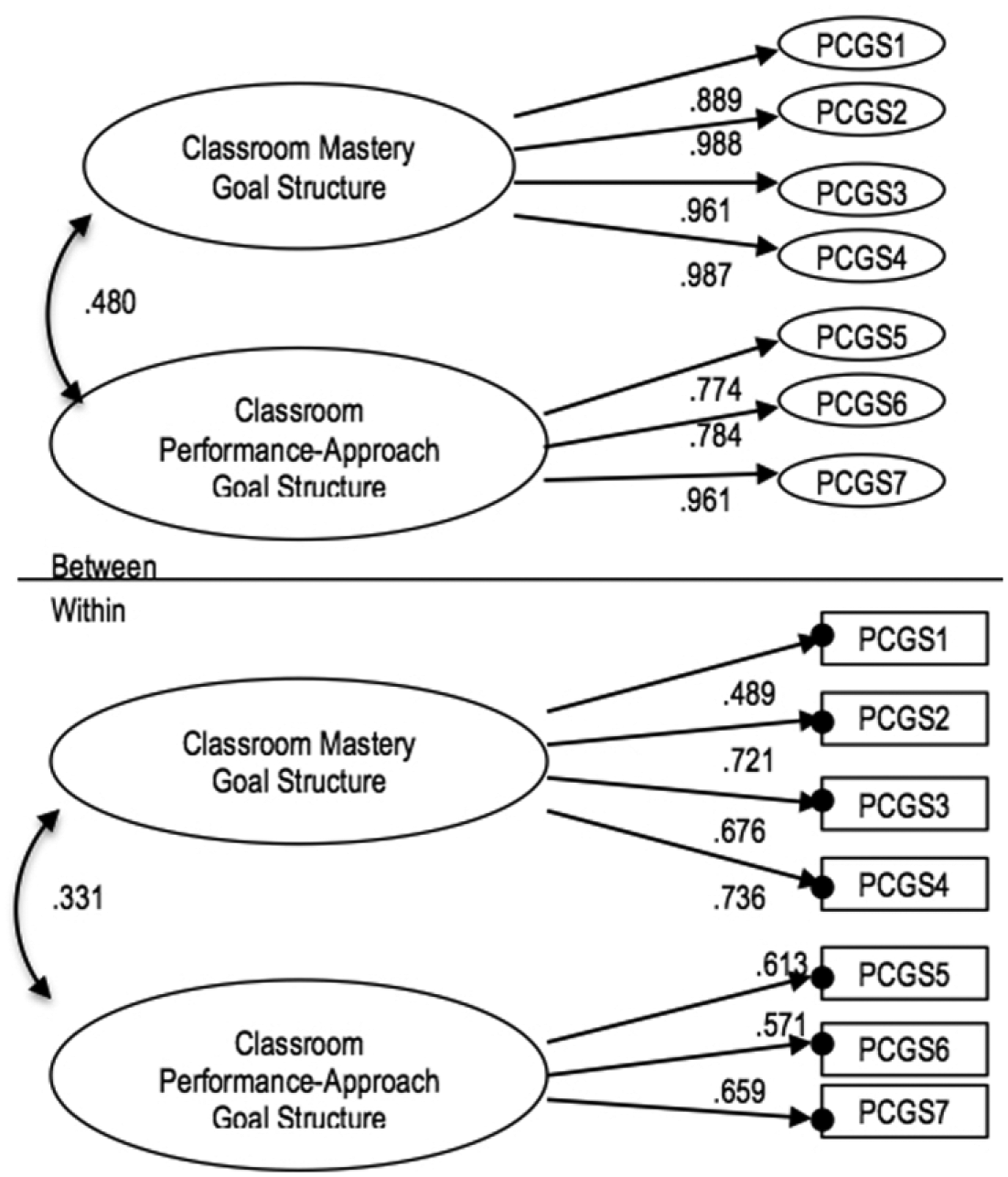
Results of the multilevel CFA performed on the two factors model of the Perception of Classroom Goal Structures scales.
The Multilevel SEM
The results of the multilevel SEM, which examined the influences of the classroom goal structures on the personal achievement goal orientations, are illustrated in Figure 3.

Results of the multilevel SEM analysis, which examined the influences of the classroom goal structures on the personal achievement goal orientations.
All the fit indices indicated a close fit of the model with the data: χ2(68) = 316.589, p < .001, CFI = .977, RMSEA = .032, SRMR = .037. The results showed that the Mastery Goal Structure of the classroom influenced significantly and positively the Mastery Goal Personal Orientation of the students (Figure 3): In a classroom with higher levels of Mastery Goal Structure, students showed higher levels of personal orientation toward Mastery Goals. Classroom Performance-Approach Goal Structure had a positive influence on Performance-Avoidance Personal Orientation, but it did not significantly affect students’ Performance-Approach Personal Orientation. Thus, the hypothesis that the shared perceptions of classroom goal structures directly influenced the adoption of consistent personal goals was only partially confirmed.
Discussion
The current study aims to investigate the factor structures of Personal and Classroom Achievement Goals and the relationships between them, taking into consideration their different levels of assessment. As regards personal goals, the results were much as expected, as they show that the Personal Achievement Goal Orientation scales measure three related but separate factors: Mastery, Performance-Approach, and Performance-Avoidance. The reliability of the scales in terms of their internal consistency is also good. This is in line with previous studies in other cultural contexts (e.g., Anderman & Midgley, 2002). The scales also showed full measurement invariance across gender groups as well as across groups with different immigrant backgrounds. As regards differences between groups of students, the results indicated that in the Italian context, the mean for boys in the Mastery scale was lower than that for girls and higher than that of the girls in the Performance-Approach scale. These findings are consistent with results from other studies on personal goals and motivations in international research (Roeser, Marachi, & Gehlbach, 2002; Urdan, 1997) as well as in the Italian context (Alivernini & Lucidi, 2008; Alivernini, Lucidi, & Manganelli, 2008; Manganelli, Lucidi, & Alivernini, 2014). With regard to immigrant background, the present study showed that in Italy, the mean results of immigrant students were higher than those of native students for Performance-Approach goals as well as for Performance-Avoidance goals. This is substantially in line with previous research conducted in the United States (Urdan, 2004) according to which immigrant students tend to score higher in Performance-Approach goals, whereas the results regarding Performance-Avoidance goals are less clear-cut (Elliot & McGregor, 2001; Urdan, 2004). In the Italian context, immigrant students are less socially integrated in the classrooms than their native peers (Alivernini & Manganelli, 2011, 2016; Cavicchiolo, Alivernini, & Manganelli, 2016), and it can be supposed that they feel obliged to perform well so as not to let their parents down (Urdan, 2004), because they often made great sacrifices by moving to another country to get better opportunities for themselves and their children.
As regards classroom goal structures, the results from multilevel CFA performed on the three-factor model showed that the Performance-Avoidance scale has a low ICC (ICC1 = .04) and a low reliability (ICC2 = .48). This result, which is in line with some previous findings (Kaplan et al., 2002; Murayama & Elliot, 2009), poses a reliability problem as regards the measurement of the class structure of Performance-Avoidance. At the same time, the results showed good fit indices for the posited two-factor model of Mastery and Performance-Approach Classroom Goal Structures. These two scales showed acceptable levels of reliability and ICC: 11% of the variance of the Mastery Goal Structure and 8% of the Performance-Approach Goal Structure lie between classes. Our findings also proved the cross-level measurement invariance of the scales, thus indicating they had the same factor structure at both the between-classes level and the within-class level.
The results from the structural model indicated that in classrooms that are more oriented toward Mastery, students’ personal goals tend to be in the same direction. This finding is completely consistent with the existing literature (e.g., Bong, 2005; Church, Elliot, & Gable, 2001; Roeser, Midgley, & Urdan, 1996). However, the Classroom Performance-Approach Goal Structure was found to be related to Performance-Avoidance Personal Goals, but not to Performance-Approach Personal Goals. This latter result is consistent with Murayama and Elliot (2009) who tested the relationship between Performance-Approach Goal Structures and Personal Performance Goals at the classroom level, as we did in the present study. Moreover, the pattern of our findings is in line with Brophy (2005) who showed how each student’s perception of classroom goals is also a complex function of his or her self-perceptions. According to the author, if performance-approach goals that reinforce social comparisons in the classroom are adopted, there is a strong risk that students will shift from personal performance-approach goals to personal performance-avoidance goals that are intended to avoid appearing incompetent in the eyes of others.
Finally, it is important to point out some limitations of the present study. First, one must bear in mind that although it is based on a large random sample of students, its cross-sectional design does not allow us to analyze the interplay between classroom goals and personal goals over time. A second limitation is related to the importance of including socioeconomic variables in educational psychology researches (Midgley, 2002; Murdock, Anderman, & Hodge, 2000). Future studies should address the issues of their influences on personal goals and group goal structures, given also the evidence of their interaction at various levels with motivational variables (e.g., Alivernini, 2013; Alivernini & Manganelli, 2015; Alivernini, Manganelli, & Lucidi, 2016; Manganelli, Lucidi, & Alivernini, 2015).
In conclusion, one should note that there is general consensus in the literature (e.g., Ludtke et al., 2009; Marsh et al., 2012; Marsh et al., 2009; Morin et al., 2014) that traditional assessment methods of classroom goals at the student level induce various bias, although they are still widely used (see Murayama & Elliot, 2009, for a review). The present study shows that when the multilevel structure of the constructs is taken into consideration, most of the previous findings about Classroom Structures and Personal Goals can be replicated in a different cultural context. This is especially true for the basic psychometric properties of the PALS as a measure of personal and group goals, which have proved to be very good in a large sample of Italian students and invariant across various sub-populations. In addition, our study suggests that when classroom goals are consistently assessed at the group level, the problematic relationship between the encouragement of performance-approach goals and the adoption of personal performance-avoidance goals that, according to the literature, emerges on the long term (Brophy, 2005; Middleton, Kaplan, & Midgley, 2004; Midgley, Kaplan, & Middleton, 2001; Senko & Harackiewicz, 2004) might also be revealed on a shorter time scale.
From a more general perspective, our study suggests that in the assessment of learning environments, it is important to bear in mind the structure of the measures at the classroom level, because their reliability can be seriously overestimated if it is not evaluated on the basis of the systematic variation for groups of students who share the same context.
Footnotes
Declaration of Conflicting Interests
The author(s) declared no potential conflicts of interest with respect to the research, authorship, and/or publication of this article.
Funding
The author(s) received no financial support for the research, authorship, and/or publication of this article.