



Abstract
The purpose of the present study was to adapt and validate the Need for Cognition Scale–Short Form (NfC-SF) in the Greek language. A multistep process was followed, including (a) the translation and adaptation of the questionnaire, (b) a reliability analysis of the instrument’s items in combination with an exploratory factor analysis with 177 secondary school students, and (c) a confirmatory factor analysis for defining the underlying structure of the scale, using a sample of 532 secondary school students. The statistical analyses validated a 14-item version of the NfC-SF for measuring the cognitive motivation of secondary school, Greek-speaking students. The present study also extends previous research about the underlying structure of the NfC by suggesting that method effects should be considered in measurement models for improving scale validity.
Introduction
Need for cognition (NfC), represents a stable individual trait, which relates to the dispositional motivation to engage in cognitively demanding efforts. Since its introduction, NfC has been examined in a vast corpus of research studies; in a comprehensive review study published two decades ago, there were already more than 100 empirical studies focusing on NfC (Cacioppo, Petty, Feinstein, & Jarvis, 1996), while two decades later, about 1,900 studies have cited the original study of Cacioppo and Petty (1982), who introduced and defined the concept of NfC. Although there are numerous studies investigating NfC, Petty, Briñol, Loersch, and McCaslin (2009) discussed the utility and significance of NfC in relation to the following four domains: (a) individual beliefs and attitudes, (b) decision-making processes, (c) interpersonal interactions, and (d) other applied areas such as survey research, advertising, media, law, and health.
This ever-increasing corpus of NfC-related empirical studies would not be feasible, if a validated instrument for measuring NfC did not exist in the first place. Cacioppo and Petty (1982), who have defined NfC as “an individual’s tendency to engage in and enjoy thinking” (p. 116), have developed the NfC scale for differentiating cognitive motivation among adults. The NfC scale consists of 34 items, scored on a 5-point Likert-type scale. Half of the items are positively worded (e.g., “The notion of thinking abstractly is appealing to me”), while the remaining items are negatively worded (e.g., “I like tasks that require little thought once I’ve learned them”). A short form of the NfC also exists (NfC-SF), as described in Cacioppo, Petty, and Kao’s (1984) study and consists of 18 items scored on a 9-point Likert-type scale.
Previous studies have supported the validity of both NfC scales across different cultures and languages, including Chinese, French, German, Spanish, and Turkish. However, none of the NfC scales has been validated in Greek, even though the underlying factor structure of the scale and the responses to the scale can be differentiated among cultures (Forsterlee & Ho, 1999). In addition, most of the validation studies are focused on adults, with few studies validating the NfC scales for children or adolescents (Preckel, 2014). Validating scales with subjects from the intended target population is important, because if the items do not represent the same factors at different ages, a shift in the internal structure of the measure might occur (Soubelet & Salthouse, 2016).
Another reason to continue investigating the NfC scale is to provide more data about its underlying factor structure, which is still debated. In particular, the most reported competing NfC factor structures relate to (a) a unidimensional NfC factor model, which assumes that there is one underlying dominant factor; (b) “trait–method models,” which take into account the potential effect of positively and negatively worded items comprising the scale; and (c) two-factor models, which assume that the NfC-SF is composed of two factors, defined by the polarity of items (Forsterlee & Ho, 1999; Hevey, Thomas, Pertl, Maher, & Craig, 2012).
Taking into account the research areas that still need to be investigated, the present study was guided by two research goals. The first goal was to translate, adapt, and validate the NfC-SF in a different cultural context and age group, that is, in the Greek language to be used with secondary school Greek-speaking students in Cyprus. The second goal was to build on previous research in relation to the hypothesized internal structure of the NfC-SF and employ confirmatory factor analyses to evaluate a set of competing NfC models. We next present the methodological steps which were adopted to address these goals.
Stage I: Translation and Adaptation
The translation and adaptation of the NfC-SF to Greek (NfC-SF-GR) employed a systematic approach, using forward and backward translation procedures to preserve the meaning, denotation, and conceptual equivalence of each item (Sumathipala & Murray, 2000). As a result of this process, the items were translated, adapted, and refined by simplifying the wording to enhance clarity and conciseness. This stage was completed with a 30-min focus group to test the items with twelve 10th- and 11th-grade students of mixed academic ability. Based on the comments received from this cohort of students, some of the items were further simplified to ensure that the wording of the scale was understandable to the target age group.
Stage II: Exploring the Underlying Factor Structure of the NfC-SF-GR
The second stage of this study involved an exploration of the underlying factor structure of the NfC-SF-GR, employing exploratory factor analysis (EFA), as a form of a replication analysis.
Sample and Materials
The sample was comprised of 177 Greek-Cypriot high school students (40.7% boys and 59.3% girls). The students attended 10th and 11th grades (M age = 15.35 years) at an urban high school. Participants responded to the NfC-SF-GR, which was composed of the 18-item NfC-SF Scale (Cacioppo et al., 1984).
Data Analysis and Results
After reversing the nine negative-polarity items, the item-to-total correlations were examined for items not consistent with the rest of the scale to purify the NfC-SF-GR (DeVellis, 2003). The cutoff point for the correlation coefficient was .4; any items below this cutoff point were eliminated from the analysis. As a result, two positively worded items (P10 and P18) as well as two negatively worded items (N7 and N12) were deleted from the scale.
The Kaiser-Melkin-Olkin test (KMO = 0.89) and the Bartlett spherical test, χ2(91) = 1,022.99, p < .01, verified the appropriateness of the 14 items, which were retained for the factor analysis. The Principal Component Analysis (PCA) extracted two factors with eigenvalues greater than 1, which were subjected to varimax rotation. The rotated component matrix indicated that the 14 retained items correlated highly and evenly on the two factors. The first rotated factor comprised of all seven positive-polarity items, and the second rotated factor consisted of all seven negative-polarity items. An examination of the rotated component matrix for the first factor showed satisfactory coefficients for all of the seven positively worded items, which ranged from .63 to .77. In addition, the coefficients for all seven negatively worded items were also satisfactory, as it ranged from .53 to .70. The Cronbach’s α for the two factors was 0.81 and 0.86, respectively; Cronbach’s alpha for the complete NfC-SF-GR was .89 (Table 1).
Exploratory Factor Analysis for the NfC-SF-GR.
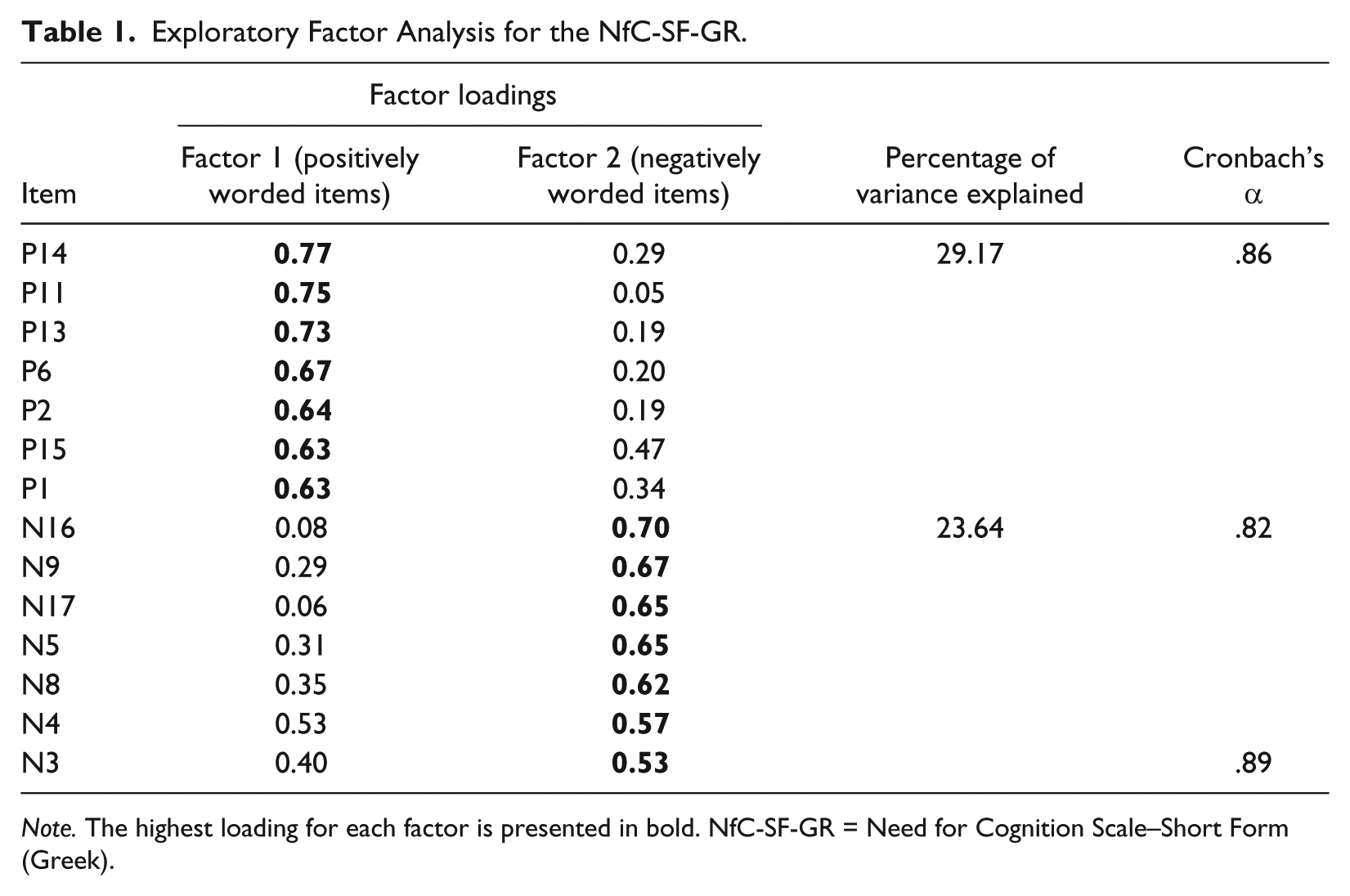
Note. The highest loading for each factor is presented in bold. NfC-SF-GR = Need for Cognition Scale–Short Form (Greek).
Stage III: Verifying the Factor Structure of the NfC-SF-GR
The third stage of this study consisted of a confirmatory factor analysis (CFA) in an effort to verify the factor of the NfC-SF-GR by evaluating the following nine competing factor structures (see Figure 1): (a) Model 1, a unidimensional model; (b) Model 2, with two correlated factors defined by the polarity of items; (c) Model 3, with two independent factors defined by the polarity of items; (d) Model 4, a unidimensional model with correlated errors among the positively worded items; (e) Model 5, a unidimensional model with correlated errors among the negatively worded items; (f) Model 6, a unidimensional model with correlated errors among the negatively as well as among the positively worded items; (g) Model 7, which includes one global NfC factor and one method factor containing the positively worded items; (h) Model 8, which includes one global NfC factor and one method factor containing the negatively worded items; and (i) Model 9, which includes one global NfC factor and two uncorrelated method factors defined by the polarity of items.

The nine factor models of the Need for Cognition (NfC) scale.
Overall, two different approaches were employed to account for method effects in the trait–method models (Models 4-9): Correlated Traits-Correlated Uniqueness (CTCU) and Correlated Traits-Correlated Methods (CTCM; Marsh & Grayson, 1995). The CTCU approach evaluates method effects, taking into account the error covariance among positively worded items (Model 4), the negatively worded items (Model 5), or both (Model 6). The CTCM approach, in addition to a substantive factor, employs latent method factors for controlling the variance of items worded in the same direction: a method factor for positively worded items (Model 7), for negatively worded items (Model 8), or both (Model 9).
Sample and Materials
The sample comprised of 532 Greek-Cypriot high school students (35.2% boys and 64.8% girls) from thirty-one 10th- and 11th-grade classrooms from five urban high schools (M student age = 15.68 years). Participants responded to the revised 14-item version of the NfC-SF-GR.
Data Analysis and Results
The fitness of the internal structure of the NfC-SF-GR was evaluated for the nine tested models. In particular, a variety of fit indices were employed, given that the chi-square index is inadequate as a stand-alone fit index because of its sensitivity to sample size: goodness-of-fit index (GFI), incremental fit index (IFI), normed fit index (NFI), and comparative fit index (CFI), which should all be higher than 0.90 for an acceptable model fit (Bentler & Bonett, 1980). The standardized root mean square residual (SRMR) and root mean square error of approximation (RMSEA) were also reported, with values below 0.08 indicating sufficient fit.
Results of the structural equation modeling (SEM) analysis did not provide support for two of the nine tested models (Table 2). Model 1, which assumes a unidimensional model, had unacceptable fit indices. Model 3, which assumes two independent factors defined by the polarity of items, had the worst fit. In addition, in Model 6, the solution was unidentified and inadmissible after imposing equality constraints among similar error covariances (Model 6a). On the contrary, the results of the SEM analysis provided support for the Model 2, which assumes two correlated factors defined by the polarity of items. However, although the model of the two correlated factors had acceptable fit indices, the rest of the trait–method models (4, 5, 7, 8, and 9) provided better fit indices. The best fit indices were observed for Model 4, which represents a unidimensional model with correlated errors among the positively worded items, followed by Model 5, which represents a unidimensional model with correlated errors among the negatively worded items.
Goodness-of-Fit Statistics for Each of the Tested Models.
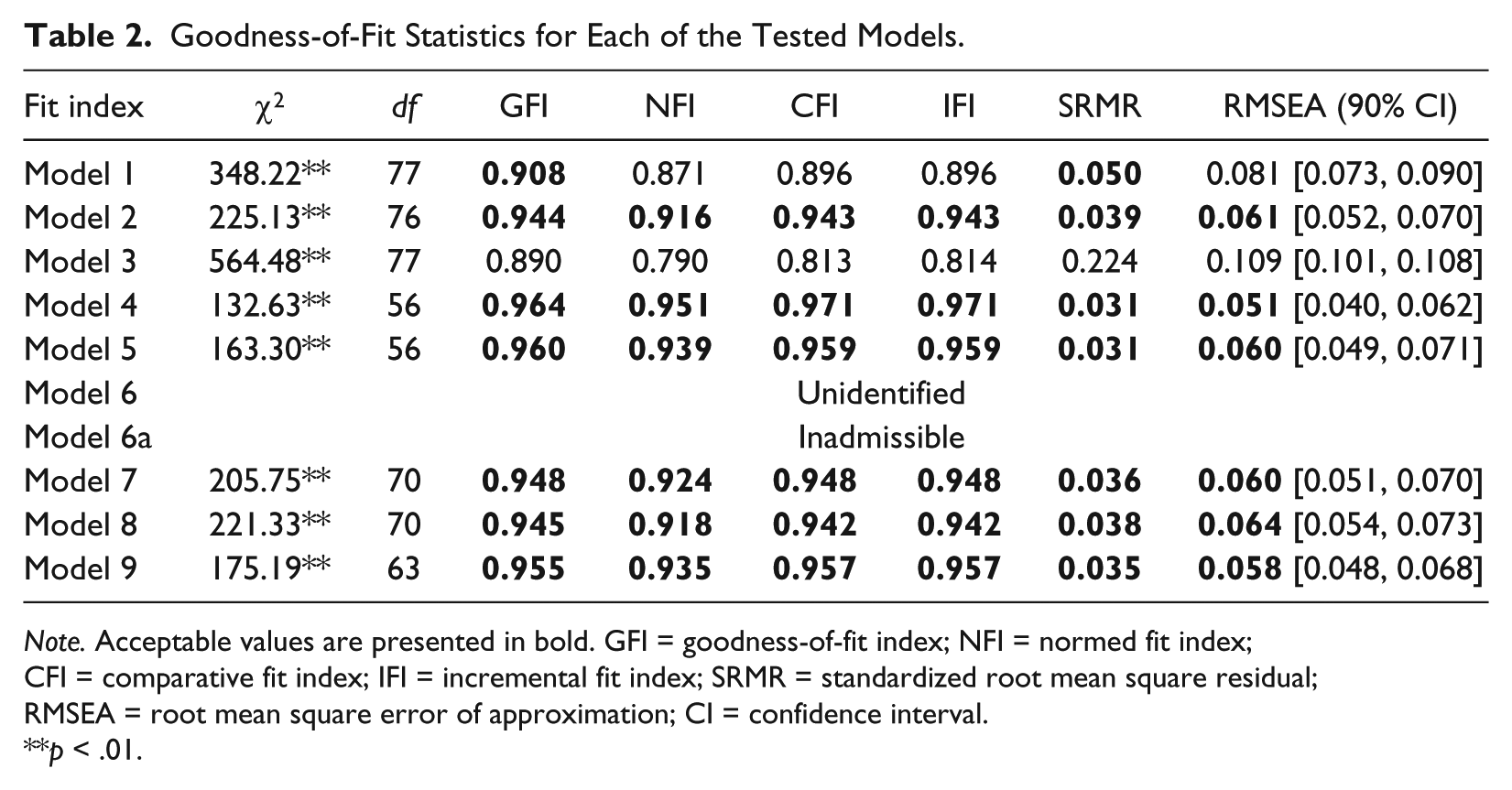
Note. Acceptable values are presented in bold. GFI = goodness-of-fit index; NFI = normed fit index; CFI = comparative fit index; IFI = incremental fit index; SRMR = standardized root mean square residual; RMSEA = root mean square error of approximation; CI = confidence interval.
p < .01.
Discussion
The present study adapted and validated the NfC-SF questionnaire with participants from a different cultural context and age group (Greek-Cypriot secondary school students), while also seeking to verify the NfC-SF’s internal structure.
The process for adapting and validating the NfC-SF-GR followed widely accepted norms about questionnaire translation and adaptation, and validated this questionnaire using sufficiently large sample sizes. As part of the validation process, four items (N7, P10, N12, and P18) were initially removed, due to their low item-to-total correlations. These findings coincide with previous studies validating NfC-SF, which also reported on the need to remove items in different cultural settings such as the Chinese (Kuang, Shi, Cai, & Wang, 2005), the Turkish (Gülgöz & Sadowski, 1995), or the Australian (Forsterlee & Ho, 1999).
An EFA with the retained 14 items was in accordance to the study of Forsterlee and Ho (1999), indicating two distinct factors defined by the polarity of items. However, the findings of our CFA indicated that this two-factor structure was simply an artifact of method effects, related to the wording of the items. According to our CFA, the NfC-SF-GR provides a unidimensional measure for cognitive motivation. However, the present study found that all of the trait–method factor models, except Model 6, provided acceptable fit indices, indicating that ratings from this scale are affected by method effects. In particular, according to the two best fitting models (Models 4 and 5), it seems that the factorial structure of the NfC-SF-GR is affected by response styles, depending on item wording. These findings are aligned with previous studies, which explored the underlying NfC structure with secondary school students (Bors, Vigneau, & Lalande, 2006; Preckel, 2014), suggesting that the underlying factor structure of the NfC could better be explained by a unidimensional trait–method effect model, as method effects should be considered for improving scale validity.
Overall, beyond confirming the factor structure of the NfC-SF-GR, the findings of the present study bear important implications on the topic of data collection through rating scales with both negative and positive items. Specifically, the present study supports previous research suggesting that the negative-item method effects may be received as threat for the factorial structure of a given scale (Dodeen, 2015). Prior research has, nonetheless, presented several suggestions on how to deal with this method effects problem. Marsh (1992) suggested solutions such as eliminating the negatively worded items from rating scales or including fewer negative items, whose presence will contribute toward controlling for possible response bias. In this context, it seems that the method effects related to the NfC-SF could be further researched. Until then, it seems that CFA could provide a methodological tool which takes into account both the factorial structure of the NfC construct and the method effects, thus contributing to the construct validation of NfC.
Conclusion and Future Research
The present study resulted in a 14-item version of the NfC-SF-GR, as a validated measurement of cognitive motivation, for use with secondary school Greek-speaking students. Future studies could be conducted to collect additional data on validity, such as the investigation of the relationship of NfC and the Big Five personality traits (see Ypofanti et al., 2015), or how NfC is related to other personality traits, such as self-esteem (see Michaelides, Koutsogiorgi, & Panayiotou, 2016). Future research could also investigate the applicability of the NfC-SF-GR with subjects of other ages, such as younger children or adults.
Footnotes
Declaration of Conflicting Interests
The author(s) declared no potential conflicts of interest with respect to the research, authorship, and/or publication of this article.
Funding
The author(s) received no financial support for the research, authorship, and/or publication of this article.