



Abstract
In this research, we examined the construct of a school engagement scale using exploratory structural equation modeling (ESEM). This study involved a translated measurement model that was originally developed by Li and Lerner for U.S. youth, and data from a sample of eighth-, ninth-, and 11th-grade Chinese adolescents (N = 364). First, the results indicated that instead of the three factors (cognitive, emotional, and behavioral engagement) that have been found in previous research on school engagement, four factors emerged for the current sample: school compliance, participation, emotional engagement, and cognitive engagement. Second, the factor structure was gender invariant in the ESEM framework. We further found that female students scored higher than males on school compliance and emotional engagement. Third, the convergent correlations among school engagement subscales and academic performance were in line with theoretical expectations. Finally, based on the differences between this study and previous studies in Western countries, the need for a more thorough investigation in the conceptualization and measurement of school engagement among youth in China was discussed.
Keywords
Youth school engagement has been conceptualized in Western cultures as the extent to which students are psychologically committed to, emotionally connected with, and actively participating in academic activities in school (Fredricks, Blumenfeld, & Paris, 2004). In Western countries, and primarily the United States, a robust body of research suggests that youth school engagement is critical to academic outcomes as well as future well-being (e.g., Fall & Roberts, 2012; Li, 2011; Li, Lerner, & Lerner, 2010; Wang & Eccles, 2013). For example, a higher level of school engagement has been found to be associated with better academic competence, a lower likelihood of dropping out of school, and a higher likelihood of healthy social and emotional outcomes (Fall & Roberts, 2012; Li, 2011). However, little work has been conducted to conceptualize and assess the structure of school engagement in China. The present study seeks to begin to address this gap in knowledge by examining school engagement among a cohort of secondary school students in Guangdong Province in China.
School Engagement: Theory and Measures
Social scientists in Western cultures have introduced various conceptualizations of school engagement. A major shift over the past two decades has involved moving from a single-dimensional structure, involving mostly behavioral attributes, to multidimensional conceptions of engagement (Wang & Degol, 2014). Although there are debates about the number of dimensions, there is a growing consensus that school engagement is a tri-dimensional construct including behavioral, emotional, and cognitive components (Fredricks et al., 2004; Wang & Eccles, 2013).
Defining multiple dimensions of school engagement enables researchers and educators to discern the roles of different aspects of school engagement (Glanville & Wildhagen, 2007). For example, behavioral engagement is focused on participation, which often refers to involvement in school-based activities or points to the absence of disruptive behaviors (e.g., Archambault, Janosz, Fallu, & Pagani, 2009). Emotional engagement represents a student’s emotional reaction to school, teachers, and schoolmates, such as a student’s interest and excitement toward these contextual factors (Li, 2011). Cognitive engagement considers a student’s investment in learning, self-regulation, personal goals, and strategic learning processes (Appleton, Christenson, Kim, & Reschly, 2006; Greene, Miller, Crowson, Duke, & Akey, 2004).
This tri-dimensional construct of school engagement has gained popularity in recent empirical studies (e.g., Fall & Roberts, 2012; Glanville & Wildhagen, 2007; Li & Lerner, 2011; Wang & Fredricks, 2014). For example, Li and Lerner (2011) and Wang, Willett, and Eccles (2011) have developed measurements based on Fredricks and colleagues’ (2004) tri-dimensional conceptual model. For both studies, which involved large samples of adolescents, the measures showed good convergent and discriminant validity and had measurement invariance across male and female adolescents, among youth from different socioeconomic backgrounds, and between racial groups (Li & Lerner, 2011; Wang et al., 2011).
Nevertheless, the structure of school engagement in Eastern countries, such as China, has not been systematically evaluated (Lam et al., 2012, 2014). For example, Lam et al. (2014) tested the psychometric structure of a tri-dimensional model of school engagement among adolescents from 12 countries including China. However, by aggregating the data across 12 countries, the researchers performed confirmatory factor analyses (CFAs) without discussing the specific contexts in China (or the other countries) and how these contexts may alter theories and measurement of school engagement. Therefore, the study may have masked the nuances that are unique to Chinese culture.
School Engagement in Chinese Contexts
A growing body of empirical studies shows how contextual factors differentially influence academic outcomes in Eastern and Western countries. These factors have included school settings, classroom practices, peer relationships, academic expectations from parents, and educational policies (e.g., Hannum, Kong, & Zhang, 2009; Kim, 2005; Liao, Lee, Roberts-Lewis, Hong, & Jiao, 2011; Zhai & Gao, 2009). These differences may shape school engagement in different ways. For example, research suggests that classroom discussions in China are not encouraged and are sometimes replaced by teacher-centered question-and-answer sessions, where teachers are inclined to pressure students to agree with them (Li & Ni, 2011). While participation in classroom discussions is conceptualized as a component of behavioral engagement in the Li and Lerner (2011) measurement model, this activity is generally inhibited in classrooms in China. Therefore, this behavior might not accurately reflect youth behavioral engagement with school.
Moreover, in Chinese culture, working hard and having good grades are considered to be important ways for children to avoid disgracing their parents, to alleviate a guilty conscience, and to maintain good relationships with their parents (e.g., Kim, 2005; Zhai & Gao, 2009). Thus, the emotional component of engagement is potentially less necessary among Chinese youth, because the youth are asked to work hard to attain good grades regardless of their excitement and interests toward school and their learning. However, the research in China is far from conclusive and additional research is needed to confirm the structure of school engagement in Chinese contexts.
Research Purpose
The current study focuses on exploring the structure of school engagement among youth in China. The emerging literature on the conceptualization of school engagement among Chinese students suggests that school engagement is also comprised of behavioral, emotional, and cognitive components (Lam et al., 2012). Therefore, we began with the measurement model developed by Li and Lerner (2011) to explore the structure of school engagement.
Specifically, we tested whether a measure validated in the United States (Li & Lerner, 2011) would be valid for a Chinese sample and, if valid, whether the measure would be invariant across gender. To conduct the study, we ran exploratory structural equation modeling (ESEM; Marsh, Morin, Parker, & Kaur, 2014) to identify and verify factors of school engagement in a sample of Chinese middle school and high school students. We also conducted multi-group analyses in the ESEM framework to test measurement invariance across male and female students. Finally, hierarchical multiple regressions were employed to examine the concurrent validity of the measures.
Method
Participants
The present investigation used data from adolescent participants in a cross-sectional study that was conducted in Guangdong Province, China. The data were collected by a research team at South China Normal University (SCNU) at the beginning of the fall academic semester in 2011. The sample included 364 Chinese youth from six urban middle and high schools in Zhanjiang City, Guangdong. Participants were 13 to 20 years old (M age = 16.70 years, SD = 1.69). Of the 364 participants, 214 (58.79%) were female. Participants were in the eighth, ninth, and 11th grades. A plurality of the sample reported that their mothers had an education of sixth grade or less (47.61%). In addition, 34.57% reported their mothers finished middle school, 9.04% reported their mothers finished high school, and 2.39% reported their mother graduated from college.
Zhanjiang is a developing city in Southeastern China with approximately 1.4 million inhabitants living in urban areas. Most of the people speak both Mandarin and Cantonese as their native languages. As the economy is developing in the city, more migrant workers are moving into Zhanjiang city, which makes the city representative of most urban areas in Southeastern China.
Measures
A Chinese version of the Li and Lerner (2011) school engagement survey instrument was used. The survey was translated and back-translated by a graduate student from SCNU. In addition, students’ recent standardized test scores were collected to indicate academic performance and were used in the analyses to test the concurrent validity of the school engagement measures.
School engagement
A translated version of a school engagement questionnaire (Li & Lerner, 2011) was used to measure school engagement. The 15-item questionnaire consists of three subscales: Behavioral Engagement, Emotional Engagement, and Cognitive Engagement. All questions used a 4-point scale. In the Behavioral Engagement subscale, five questions asked participants to decide how often they participate in a set of activities (never, sometimes, often, and always). An example of a Behavioral Engagement question is “How often do you complete homework on time?” In the Emotional and Cognitive subscales, five items for each asked participants how much they would agree with each of the presented statements (strongly disagree, disagree, agree, and strongly agree). Examples of Emotional Engagement and Cognitive Engagement are, respectively, “I am happy to be at my school” and “school is very important for later success.”
Covariates
Age and sex were assessed in the survey. In addition, the survey measured maternal education by asking about mother’s highest level of education, with four categories ranging from sixth grade or less to a bachelor’s degree or above.
Academic performance
Teachers at participating schools reported scores of the participants’ most recent standardized tests of Chinese, Math, and English. Each test was scored from 0 to 100. A sum of all test scores was computed to indicate students’ academic performance (M = 219.95, SD = 26.18).
Procedure
The data collection was performed by the research team from SCNU and facilitated by classroom teachers at the six participating schools. Classroom teachers gathered students in the classrooms and gave each student a paper survey to complete. Before students started the survey, teachers read the instructions to the youth. Participants were instructed that they could skip any questions they did not wish to answer. When collecting the completed survey forms from the teachers, the researchers also obtained students’ recent standardized test scores from the teachers.
Analysis Plan
ESEM was employed to test the measurement structure of school engagement among a sample of youth in China. ESEM provides an overarching framework that integrates the benefits of confirmatory factor analysis (CFA), structural equation modeling (SEM), and traditional exploratory factor analysis (EFA; Marsh et al., 2014). The traditional independent clusters model of confirmatory factor analysis (ICM-CFA) assume that all cross-loadings between items and factors are exactly zero (McDonald, 1985). However, ESEM recognizes some potentially true influence of a factor on indicators that present some residual association with the factor over their association with their a priori factor. In addition, ESEM extends the exploratory nature of EFA by providing confirmatory tests of a priori factor structures and multi-group tests of full measurement invariance.
All models were estimated using Mplus 7.4 (Muthén & Muthén, 1998-2010) using a robust weighted least square estimator (WLSMV) with theta parameterization. Robust WLSMV was chosen as the preferred method in the present study, because recent research suggests that WLSMV is theoretically justified for EFA and shows fewer convergence problems than other estimation methods (e.g., maximum likelihood or robust maximum likelihood; Barendse, Oort, & Timmerman, 2015). A geomin rotation was used to explore the number of factors (Asparouhov & Muthén, 2009). Geomin is an oblique type of rotation which allows the correlations between the factors to be freely estimated. In addition, items loading on their a priori structure and all cross-loadings were allowed. Missing data were accounted for with the WLSMV estimator, which treated missingness as a function of the observed covariates (Muthén & Muthén, 1998-2010). A group of fit indices was considered to determine model fit: χ2 goodness-of-fit statistic, comparative fit index (CFI), the Tucker–Lewis index (TLI), the root mean square error of approximation (RMSEA), and weighted root mean residual (WRMR). Nonsignificant values of χ2, RMSEA value smaller than .08, and CFI values greater than .90 indicate that a hypothesized model fits the data (Hu & Bentler, 1999). As χ2 is sensitive to sample size, we relied on the other fit indices to decide model fit. When comparing nested models with increased equal constraints across multiple groups, we applied the DIFFTEST command in Mplus on all chi-square difference tests. In addition, changes in RMSEA, CFI, and TLI greater than .01 were considered significant as discussed by Chen (2007).
Four steps were taken sequentially to test the structure of the school engagement scale among the sample of Chinese youth. First, a one-factor model was estimated with all 15 items as indicators of a single latent construct, school engagement. Then, a three-factor model was estimated. The model fit statistics were compared with the single factor model using the model fit indices (CFI, TLI, RMSEA). Third, based on the unique contexts in China as discussed above, a four-factor model was examined and the model fit statistics were compared with the traditional three-factor model.
For the fourth step, using the theoretically and statistically preferred model, measurement invariance between male and female students was tested using the MODEL option in Mplus for testing measurement invariance. We also put equal constraints on residual variance manually to test for residual invariance. Specifically, we tested whether the measurement model was configural, scalar, and residual invariant across male and female students. Configural invariance is defined as the same factor loading pattern across groups with no equality constraints. Scalar invariance adds equality constraints on the item thresholds and the factor loadings between male and female students. Residual invariance, or “strict” invariance, places additional equal constraints on all item residual variances. We did not test metric invariance, because the testing of loading invariance only (metric invariance) with categorical variables is not recommended (Mplus version 7.1 language addendum; Muthén & Muthén, 1998-2010). Although it is possible to identify and analyze the metric model with polytomous items, the identification constraint used for the polytomous case must be carefully modified (Millsap, 2012). Alternatively, a metric invariance test is considered unnecessary if the scalar invariance holds.
Finally, we reported mean differences among male and female students, and we tested the concurrent validity of the scale by examining the relationship between the school engagement subscales and students’ standardized test scores, acknowledging the potential associations between school engagement and academic performance (Pietarinen, Soini, & Pyhältö, 2014; Wang & Eccles, 2013). Multiple regression models, controlling for age, sex, and maternal education, were conducted to estimate whether the school engagement subscales were, either independently or together, predictive of students’ academic performance.
Results
ESEM
One-factor model
As a first step to evaluate the baseline model, a one-factor model was estimated with all 15 items as indicators of a single latent construct. The results suggested that the model does not have adequate fit, χ2 = 647.17, df = 90, p < .01; CFI = .77, TLI = .73, RMSEA = .13, WRMR = 1.95.
Three-factor model
A three-factor model was then estimated to test whether three factors could be extracted as originally designed by Li and Lerner (2011). The results indicated that the three-factor model did not fit the data well, χ2 = 335.02, df = 63, p < .01; CFI = .89, TLI = .81, RMSEA = .11, WRMR = 1.18.
Four-factor model
A four-factor model was estimated based on previous findings that suggested that Chinese students may act differently on different items in the behavioral engagement domain. The results showed that the model had an acceptable model fit, χ2 = 163.81, df = 51, p < .01; CFI = .95, TLI = .91, RMSEA = .08, WRMR = .75. In addition, this model had significantly better fit than the one-factor model and the three-factor model. Factor loadings for the 15-item model and the 12-item final model are presented in Table 1.
Factor Loadings Based on an Exploratory Structural Equation Model With Geomin Rotation for the 15-Item Model and the 12-Item Final Model.

Note. Items with a have been reverse coded. Loadings in bold are values above .50.
As shown in Table 1, three items (Items 9, 10, and 11) had factor loadings lower than .50 and were removed from further analyses (Stevens, 1992; Tabachnick & Fidell, 2007). Taking into account the content of items from the measurement model as well as factor loadings, the school engagement scale was then comprised of four factors, with a total of 12 items. Model fit indices suggested that the 12-item, four-factor model had an excellent model fit, χ2 = 50.01, df = 24, p < .01; CFI = .98, TLI = .96, RMSEA = .05, WRMR = .44.
The four-factor model consisted of emotional engagement, cognitive engagement, school compliance, and participation. Emotional engagement (Items 6, 7, and 8) represents students’ emotional connections to school. Cognitive engagement (Items 12, 13, 14, and 15) represents students’ academic goals and perceived value in learning. School compliance (Items 1, 2, and 3) and participation (Items 4 and 5) represent different aspects of behaviors in school. School compliance reflects a student’s adherence to rules and assignments given by a teacher, and is similar to findings from extant literature (Wang et al., 2011). Participation reflects a student’s active enrollment in school activities. Correlations among the latent factors can be found in Table 2. Note that the correlation between participation and cognitive engagement was not statistically significant, r = .11, p > .05.
Correlations Among Latent School Engagement Factors Derived From the Final Exploratory Structural Equation Model.

p < .05. **p < .01.
Mixed Effects of School
To account for the clustered nature of the data (i.e., students from different schools), we fit linear mixed models for different dimensions of school engagement and computed intraclass correlation coefficients (ICCs) for the observed variables nested within the cluster. In addition to school engagement variables, fixed-effects covariates include sex, gender, and maternal education (observed variables). Random factors were present at the school level (cluster). The ICCs for school compliance, participation, emotional engagement, and cognitive engagement were close to zero (ICCs < .05), indicating that the individual-level observations were statistically independent and fixed-effect modeling was preferred in the subsequent analyses (Pornprasertmanit, Lee, & Preacher, 2014).
Measurement Invariance by Gender
We next tested the measurement invariance across male and female students. On top of the final measurement model developed from the ESEM procedure, a series of nested models were performed to test configural, scalar, and residual invariance. First, to test configural invariance, the factorial structure was set to be the same between male and female students (Model 1). Results show that the model reached configural invariance, χ2 = 87.06, df = 48, p < .05; CFI = .98, TLI = .96, RMSEA = .05, WRMR = .68. We then placed equal constraints between male and female students on all factor loadings and item thresholds (Model 2). Results showed that Model 2 was not statistically different from Model 1, χ2 = 145.74, df = 100, p < .01; CFI = .98, TLI = .96, RMSEA = .05, WRMR = .98; Δχ2 = 67.16, Δdf = 52, p > .05. Finally, the residual invariance test yielded significant chi-square difference, χ2 = 147.05, df = 112, p < .01; Δχ2 = 24.52, df = 12, p < .05. However, changes in CFI, TLI, and RMSEA did not exceed the threshold of .01 criteria, CFI = .97, TLI = .96, RMSEA = .05, indicating that the model difference may be accepted and the measurement model held residual invariance.
Latent mean differences between male and female students were estimated in the strict invariance model. Results suggested that compared with males, female students scored higher on the school compliance scale (standardized mean difference = .40, p < .05) and emotional engagement scale (standardized mean difference = .39, p < .05). No statistical differences were found between males and females on cognitive engagement and participation. Means and standard deviations for the aggregated school engagement subscales can be found in Table 3.
Means, Standard Deviations, and Valid N of Cases for School Compliance, Participation, Emotional Engagement, and Cognitive Engagement by Sex.
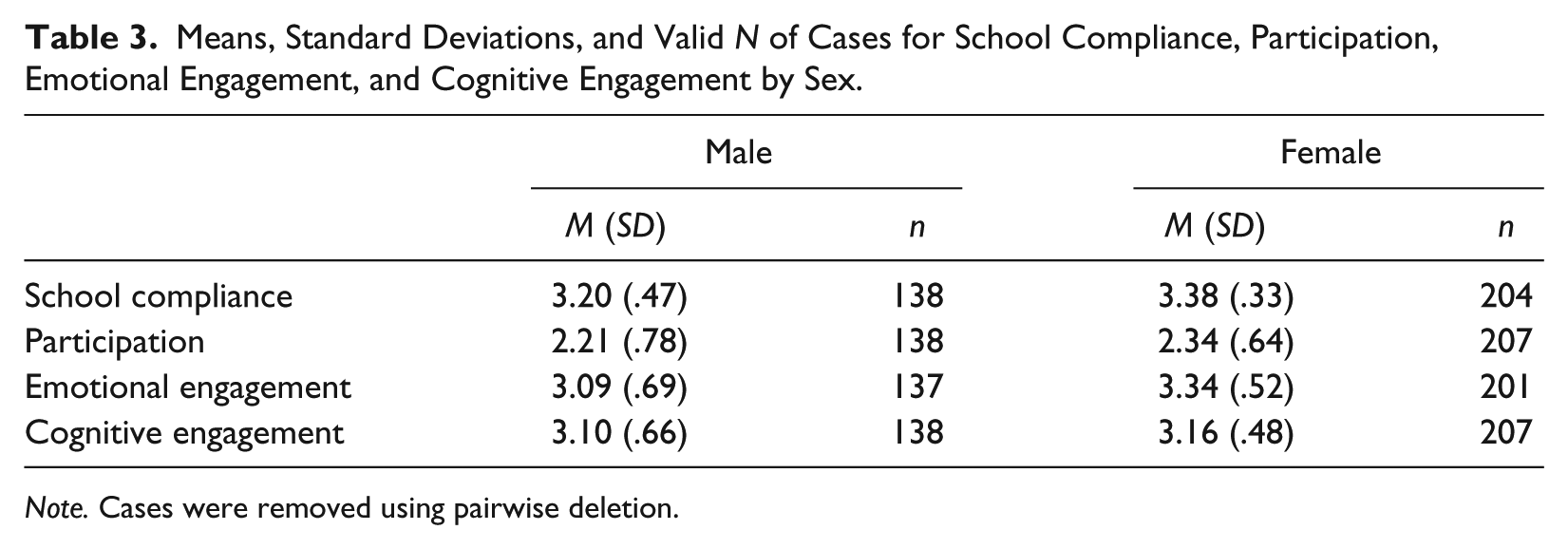
Note. Cases were removed using pairwise deletion.
Validity Test
Finally, we tested the concurrent validity of the school engagement scale. Regression models were run to assess the unique contribution of the full scale (Model 2), each school engagement subscale entered separately (Models 3-6), and all of the subscales entered together (Model 7) predicting youth academic performance. All models accounted for sex, age, and mother’s education (see Table 4).
Parameter Estimates and Approximate p Values for Regression Models That Describe the Relations Among Factors of School Engagement and Students’ Recent Standardized Test Scores, Controlling for Sex, Age, and Mother’s Education.
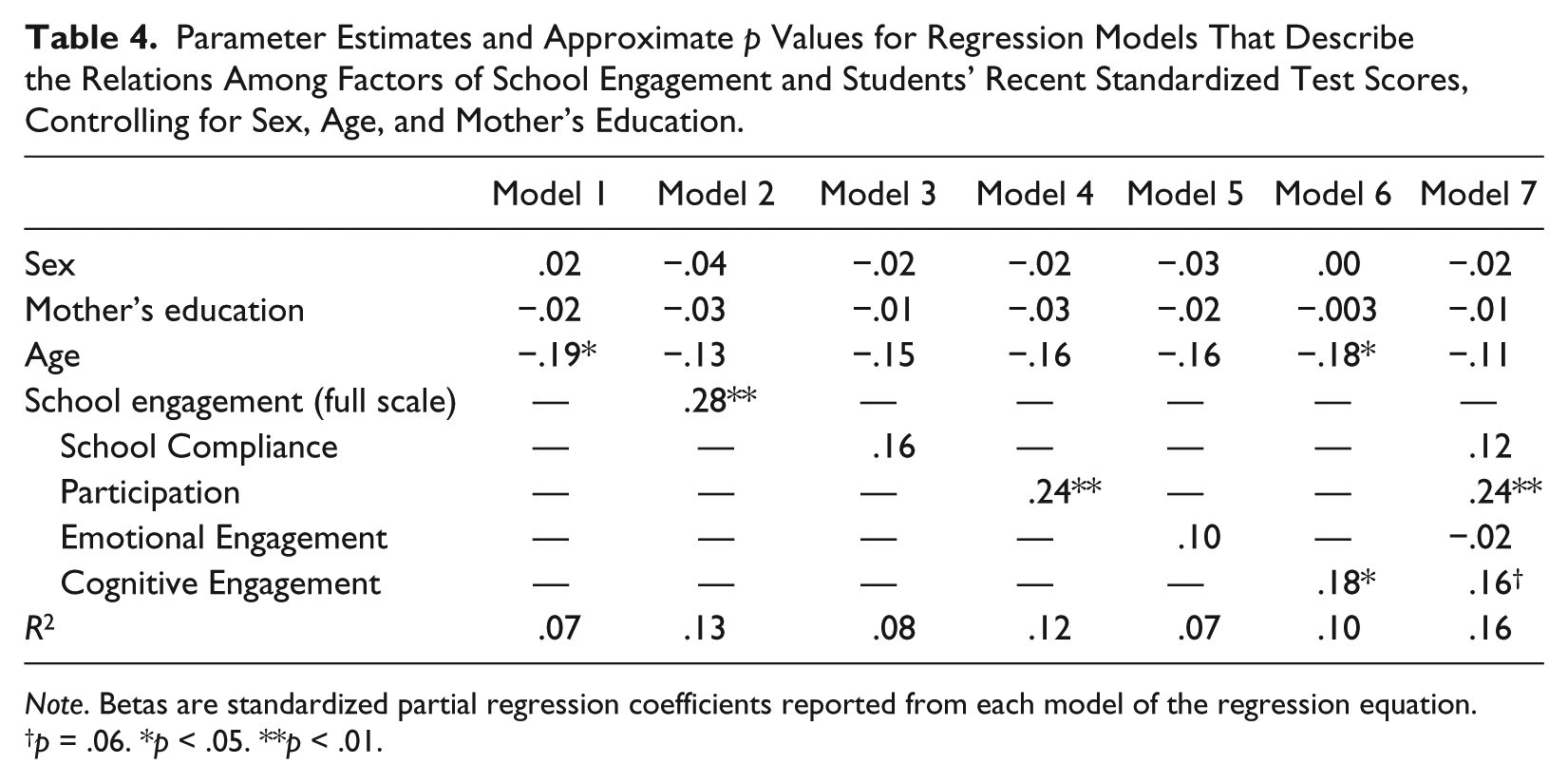
Note. Betas are standardized partial regression coefficients reported from each model of the regression equation.
p = .06. *p < .05. **p < .01.
The full school engagement scale significantly predicted academic performance. Participation significantly predicted academic performance in Model 4 and Model 7. Cognitive engagement was found to be a significant predictor in Model 6 only, while other subscales of school engagement was not included in the model. In addition, neither school compliance nor emotional engagement was a significant predictor of academic performance.
Discussion
The purpose of this study was to investigate the psychometric properties of a school engagement scale among Chinese students. Based on Fredericks and colleagues’ (2004) theoretical model and the Li and Lerner (2011) measurement model, this study surveyed a sample of adolescents in China and used ESEM to explore the structure of the measurement model. The results support the conceptualization of school engagement as a metaconsturct with at least behavioral, emotional, and cognitive aspects. However, the behavioral component was comprised of two factors, participation and compliance. In addition, results suggested that the scale was invariant between male and female students. Finally, the correlations of the school engagement subscales with academic performance provide evidence of concurrent validity.
The findings from this study are generally consistent with extant literature on school engagement in Western societies. For example, a multidimensional construct showed significantly better model fit statistics compared with a unidimensional construct (Fredricks et al., 2004; Furlong & Christenson, 2008). However, the three-factor model as originally designed by Li and Lerner (2011) yielded poor model fit. Instead, we found a four-factor model that fit the data adequately. In particular, we retrieved two independent subscales from the original Behavioral Engagement subscale. Although we make no conclusions on the number of dimensions of school engagement among youth in China given the exploratory nature of this study, this finding is consistent with research suggesting that students in China are expected to comply with the requirements of adults without questioning (Zhai & Gao, 2009). Accordingly, students “respect the teacher’s authority without preconditions” (Wang & Mao, 1996, p. 148), which may separate students’ voluntary efforts in school, such as participating in classroom discussions, from complying with school rules.
In addition, the insignificant correlation between participation and cognitive engagement provides additional evidence to support the argument above. Generally speaking, students who recognize the importance of education in their lives should be likely to invest more in their education and try harder at it. Therefore, it has been suggested that cognitive engagement is related to behavioral engagement (Li & Lerner, 2013). However, participation was not significantly correlated with cognitive engagement. It is plausible that adolescents who value learning more are also more likely to adhere to school rules. However, because voluntary efforts such as participating in classroom discussions are somewhat discouraged by the educational contexts in China, increases in cognitive engagement is not likely to be associated with changes in levels of participation.
Responses for the subscales of school engagement were found to be different across sex in the present study. For example, compared with boys, girls were more compliant to school and more emotionally engaged with school. These findings were consistent with the extant literature showing differences in engagement by sex (Archambault et al., 2009; Lam et al., 2012). For example, previous research suggests that girls might have higher social relation scores with parents and teachers and, therefore, may be more compliant to the rules made by adults, and more emotionally attached to school than boys (Goodenow, 1993).
For the Compliance subscale, we note that there are only two items. This could be considered problematic as many researchers have noted that a factor should have at least three indicators to avoid model under-identification or unstable measurement models (Kline, 2005). However, even a single-item measure may be sufficient for some constructs that are narrowly defined, if the item can be interpreted in a meaningful way (Bergkvist & Rossiter, 2007; Drolet & Morrison, 2001). In addition, Yong and Pearce (2013) provided an empirical guideline that suggests that a factor with two variables can be considered reliable when the variables are highly correlated with each other, but fairly uncorrelated with other variables, which was confirmed in the present study. Although these two items may suggest a subconstruct of school engagement, we recommend that future research should include additional items of participation to determine if compliance is a valid dimension of school engagement among Chinese secondary students.
Regression results showed that participation was significantly correlated with the students’ academic performance. In addition, the correlation between cognitive engagement and academic performance was marginal. These findings were consistent with previous research conducted with U.S. samples that indicates that active participation predicts academic functioning (Li et al., 2010). School engagement, as an overall concept, was also found to be associated with students’ academic performance. This result is consistent with results that were found in Western countries and in other research in China that showed a positive link between school engagement and academic performance (e.g., Lam et al., 2012; Wang & Eccles, 2013).
It is interesting to note that, after demographic variables were accounted for and all four aspects of school engagement included in the model, only participation significantly predicted academic outcomes. However, we also discussed that active participation, such as expressing one’s opinion on a question, is not encouraged in Chinese classrooms (Li & Ni, 2011). These findings may suggest that, even though participation is not encouraged, it could be an important factor for educators in China to consider in attempts to improve students’ academic success.
We did not find a significant correlation between emotional engagement and students’ academic performance. Although contrary to school engagement research in Western cultures (e.g., Fall & Roberts, 2012; Wang & Eccles, 2013), this finding is understandable given the unique Chinese educational context. In China, students are expected by adults to work hard in school and get good grades regardless of their emotional connection with school (e.g., Kim, 2005; Zhai & Gao, 2009). Therefore, students who do not feel a part of their school may still get a good grade, because they internalized the requirements to perform well and were actively doing so. For example, the active compliance to rules and requirements can establish a foundation for students to acquire the necessary knowledge and skills for academic success (Fredricks et al., 2004). However, given the exploratory nature of the current study, more research needs to be conducted with samples of Chinese youth to have a much deeper understanding of the relationship between emotional engagement and academic performance.
The low correlation between cognitive engagement and academic performance may result from the classroom culture in China. Research on the Chinese classroom environment has found that students are asked to accommodate to teachers’ learning goals and expectations instead of having their own (Li & Ni, 2011). Therefore, because all students are instructed to internalize similar cognitive processes, the measure of cognitive engagement may not reflect the true cognitive motives the students have, and thus may not be a good predictor of academic performance. Alternatively, we note that cognitive engagement alone was a significant predictor of academic performance. It is possible that cognitive engagement, defined by personal goals and values in learning, may not have a direct relationship with academic performance. Rather, cognitive engagement may be mediated by other factors, such as active participation (Pietarinen et al., 2014; Sedaghat, Abedin, Hejazi, & Hassanabadi, 2011).
Finally, three items were excluded from the analysis because of low factor loadings. However, these items have loaded on factors that have been validated in the United States. First, regarding the item about school being fun and exciting, students in China believe that they are obligated to go to school and to be deferential to adults (e.g., Kim, 2005). Instead of nurturing academic interest and provoking thoughtful insights, schools prefer monotonous learning activities and unconditional obedience, thus possibly undermining excitement for learning. Similarly, the question about enjoying class is not necessarily consonant with the uniformed classroom experience defined by teacher-centered sessions (Li & Ni, 2011). In addition, as learning was a part of the teacher-centered activity, students may internalize parents’ and teachers’ values, goals, and expectations such as perceiving school as useful and important for the future. However, students may lack the initiative to learn as much as they could at school, because the highly structured school environment tends to discourage such initiative. Therefore, trying to learn more may not be part of the cognitive engagement construct. These findings pointed to the need to revise the conceptualization and measurement of school engagement for students in China.
Limitations and Implications for Future Research
Interpretation of the findings from the present study should be made with caution. The results are based on a relatively small, convenience sample of participants from one developing city in China. To understand whether the revised school engagement measure is a valid and reliable measure for Chinese students, future studies should more systematically collect samples that are representative of China or at least a region within China.
In addition, this study took an etic approach in exploring the structure of school engagement in China. That is, the measurement model was based on a theoretical model from Western cultures and empirical studies of U.S. samples. Question wording and theoretical perspectives used in the conceptual and measurement model of school engagement may have different meanings for Chinese youth. As the results from the current study show that the structure of school engagement is different from the structure reported in Western countries, we recommend an emic approach for future studies, such as starting with qualitative interviews to collect perspectives directly from youth in China to conceptualize, measure, and study school engagement.
In conclusion, the current study found a multidimensional structure for school engagement in a Chinese sample and validated a four-factor structure for measuring school engagement. The findings suggested two separate subscales in behavioral engagement. In addition, the findings call for a more thorough investigation of the roles of different dimensions of school engagement in the Chinese contexts. As more work is needed to confirm this measurement structure and its relationship with youth academic performance, future research may offer a rich, new way of understanding the dynamic between youth, schools, and learning in China.
Footnotes
Declaration of Conflicting Interests
The author(s) declared no potential conflicts of interest with respect to the research, authorship, and/or publication of this article.
Funding
The author(s) received no financial support for the research, authorship, and/or publication of this article.