



Abstract
The psychometric properties of the French version of the Trait Emotional Intelligence Questionnaire–Child Short Form (TEIQue-CSF) were investigated in a sample of 556 children 9 to 13 years of age. The internal consistency and temporal stability were satisfactory. A significant difference for gender, but not for age, was observed. With regard to the factor structure, the best fit was found for a two-factor solution, emotion control and socioemotionality. Regarding convergent validity, positive correlations were found with the total and all except one-factor scores of the Emotion Awareness Questionnaire score (EAQ30). Evidences of concurrent validity were demonstrated, with negative correlations with State-Trait Anxiety Inventory for Children (STAIC) and childhood anxiety sensitivity index (CASI). Results also showed a positive correlation with Children’s Social Desirability Scale (CSD). In conclusion, these findings provide additional support for the use of the TEIQue-CSF for researchers and practitioners who want to assess emotion-related constructs in children.
Introduction
Emotions are an integral part of human life. From a very young age, they significantly affect our perception of the world and how we express ourselves or cope with difficulties and social interactions (Luminet, 2008). They are a source of information about the achievement of our purposes and satisfaction of our needs (Mikolajczak, Quoidbach, Kotsou, & Nelis, 2009). Emotions help the body to cope with different situations and to facilitate action (Frijda, 1986), to orient decision-making (Damasio, 1994), and to guide social interactions (Keltner & Kring, 1998).
An emotional state is a set of reactions in response to certain characteristics of the environment at a given time. This requires that the individual evaluates an event as relevant to achieve his or her goals and as important for the self (cognitive appraisal; Folkman, Lazarus, Dunkel-Schetter, DeLongis, & Gruen, 1986). According to Lazarus and Folkman (1984), when facing stress, people first evaluate the importance of the situation (primary appraisal) and then the resources they have to react to (secondary appraisal). Emotional responses are determined by the properties of an event and by a set of stable individual characteristics (Luminet, 2008). The determinants of adaptive emotional responses include the way the individual will experience the situation, which is largely influenced by the level of emotional competences or emotional intelligence (EI) of the person (Mikolajczak, Quoidbach, et al., 2009).
EI
Many constructs have been proposed to account for differences in the way people attend to, experience, and react to emotional situations. EI is one of them (Petrides & Furnham, 2000, 2003) According to Petrides and Furnham (2003), “the construct of EI posits that individuals differ in the extent to which they attend to, process, and utilize affect-laden information of an intrapersonal (e.g., managing one’s own emotions) or interpersonal (e.g., managing others’ emotions) nature” (p. 31). EI is characterized by the capacity to feel, identify, understand, regulate, and use one’s own emotions and those of others (Mikolajczak, Petrides, & Hurry, 2009). These authors distinguished trait EI (or “trait emotional self-efficacy”) from ability EI (or “cognitive-emotional ability”). This distinction is based on the assessment method used to operationalize the EI construct. Ability EI is defined as emotion-related cognitive abilities that can be measured with maximum-performance tests. Trait EI concerns emotion-related dispositions and self-perceptions located at the lower levels of personality hierarchies, and measured via self-report questionnaires (Petrides, Pita, & Kokkinaki, 2007). This distinction is based on the assessment methods used to operationalize the EI construct, which are fundamentally different, even though their theoretical domains may overlap (Petrides and Furnham, 2003).
EI and Mental Health
In the adult population, EI has been found to be associated with indicators of physical and mental health (e.g., Mikolajczak, Luminet, & Menil, 2006; Schutte, Malouff, Thorsteinsson, Bhullar, & Rooke, 2007). The literature examining the relationship between EI and emotional disorders in adolescents and children is burgeoning. In adolescents, trait EI is negatively associated with somatic complaints, anxiety, depression, anger, disruptive behavior, and deliberate self-harm (e.g., Gugliandolo, Costa, Cuzzocrea, Larcan, & Petrides, 2015; Mikolajczak, Petrides, & Hurry, 2009; Williams, Daley, Burnside, & Hammond-Rowley, 2009), and positively associated with adaptive coping styles, self-esteem, academic performance, prosocial behavior, and better peer relations and socioemotional competence (e.g., Charbonneau & Nicol, 2002; Mikolajczak, Petrides, & Hurry, 2009; Perera & DiGiacomo, 2013). In children, negative associations have been found between trait EI and disruptive behavior, aggression, anxiety, depression, emotional instability (e.g., Andrei, Mancini, Mazzoni, Russo, & Baldaro, 2015; Russo et al., 2012), and emotional symptoms as judged by teachers (Mavroveli, Petrides, Shove, & Whitehead, 2008). A positive association has been observed between EI scores and peer-rated prosocial behavior, social competence, and academic achievement (e.g., Andrei et al., 2015; Mavroveli, Petrides, Sangareau, & Furnham, 2009).
Evaluation of EI
EI has primarily been studied in adults and young adults, less frequently in adolescents and fairly rarely in children, largely as a consequence of the lack of appropriate measurement tools (Mavroveli et al., 2008). To our knowledge, few instruments are available to assess the emotion-related constructs in children. Alexithymia, which refers to a limited ability to recognize one’s own emotions and to verbalize them, a difficulty distinguishing bodily sensations stemming from emotional arousal, and an impoverished fantasy life, can be assessed with the Alexithymia Questionnaire for Children (AQC; Rieffe, Oosterveld, & Meerum Terwogt, 2006; see also Sifneos, 1996). However, the alexithymia construct does not include important dimensions of emotional competence such as the ability to identify emotions in others and emotional blunting (Lahaye, Luminet, Van Broeck, Bodart, & Mikolajczak, 2010). To address this gap, Rieffe, Oosterveld, Miers, Meerum Terwogt, and Ly (2008) developed and validated the Emotion Awareness Questionnaire (EAQ30) for children. In addition, a child form of the Trait Emotional Intelligence Questionnaire (TEIQue-CF) was created (Mavroveli et al., 2008). Although both questionnaires investigate closely related dimensions of emotional competences in children and adolescents, they differ (Lahaye et al., 2010). The TEIQue-CSF measures not only basic emotional competences such as emotion expression and perception but also outcomes of emotional competence such as peer relations, self-esteem, self-motivation, and self-control skills (Lahaye et al., 2010).
The TEIQue
The TEIQue-CF (Mavroveli & Petrides, 2017; Mavroveli et al., 2008) is a 75-item questionnaire that assesses nine facets of EI: adaptability, affective disposition, emotion expression, emotion perception, emotion regulation, low impulsivity, peer relations, self-esteem, and self-motivation. This questionnaire has been also validated in Serbian (Banjac, Hull, Petrides, & Mavroveli, 2016). A short measure of child EI has also been developed: the TEIQue-CSF (Mavroveli et al., 2008), which contains 36 items and provides a global score of EI in children. This short version allows to save time and thus to provide an economic advantage. The TEIQue-CSF has been translated and validated in Greek and Slovak (Babalis, Tsoli, & Stavrou, 2013; Kaliska & Nábělková, 2015).
Factor Structure of EI
Emotional competence changes with age, becoming more complex and multidimensional (Roskam, 2012). Studies suggest that the factor structure of EI in children is originally unifactorial. It becomes bifactorial (emotion control contained variables that concerned the control of emotions such as low impulsivity, emotion regulation, and socioemotionality, included the facets with emotionality and sociability such as peer relations, and emotion expression) as children move toward late childhood and preadolescence (Mavroveli & Petrides, 2017; Russo et al., 2012), and progress to a four-factor structure for EI in adults (well-being, self-control, emotionality, and sociability; for example, Mikolajczak, Luminet, Leroy, & Roy, 2007; Petrides, 2009). Thus, children’s emotional competence appears to show significantly less differentiation than that of adults (Russo et al., 2012). Emotional competence changes with age, becoming more complex and multidimensional (Roskam, 2012).
The main aim of the present study was to examine the psychometric properties of the French version of the TEIQue-CSF. First, we aimed for a representative assessment of all the facets of the trait EI domain. Two models were examined: a one-factor solution and a two-factor solution involving the factors of “socioemotionality” and “emotion control.” Consistent with the results of Mavroveli and Petrides (2017) and Russo et al. (2012), we hypothesized that a two-factor solution would be the most appropriate for this age range. Second, we examined the effects of gender and age, assuming that participants would not differ on these two variables (e.g., Mavroveli et al., 2008; Russo et al., 2012). Third, the instrument’s reliability (internal consistency and test–retest reliability) was investigated. Fourth, its convergent validity was evaluated by examining the relationships between the TEIQue-CSF and another emotional competence scale, the EAQ30 (Rieffe et al., 2008; translated and validated in French by Lahaye et al., 2010). Moreover, given that some studies have observed a link between EI and social desirability (Charbonneau & Nicol, 2002; Kluemper, 2008), the susceptibility of the TEIQue-CSF to a socially desirable response pattern was investigated, with Children’s Social Desirability Scale (CSD). Finally, concurrent validity was assessed regarding anxiety and anxiety sensitivity symptoms, as EI is associated with psychological adjustment indicators such as anxiety (e.g., Williams et al., 2009).
Method
Participants
Data were collected from two samples recruited from several regular primary and secondary schools in the French-speaking part of Belgium. The first sample comprised 556 children (268 boys, 288 girls; M = 11.0 years, SD = 1.0) and was used for descriptive, factor analysis, and internal consistency testing. In this sample, a first subsample, comprising 356 children aged 9 to 13 years (173 boys, 183 girls; M = 11.1 years, SD = 0.8), was used to evaluate convergent validity and susceptibility to socially desirable responses. A second subsample, comprising 200 children aged 9 to 13 years (95 boys, M = 10.6 years, SD = 1.17; 105 girls, M = 10.7 years, SD = 1.27), was used to evaluate concurrent validity. To investigate the TEIQue-CSF’s test–retest reliability, a second sample was recruited, composed of 30 children aged 10 to 12 years.
Measures
TEIQue-CSF
This instrument comprises 36 items answered on a 5-point Likert-type scale with higher scores reflecting higher EI; total scores range from 36 to 180 (Mavroveli et al., 2008). This scale provides a comprehensive coverage of aspects of the child personality relating to emotion and measures global trait EI. It was translated according to the International Test Commission guidelines for test adaptation (Hambleton, 2001). Items were first translated into French and then back-translated into English. The translation and back-translation process was conducted entirely by bilingual individuals and was supervised by two of the authors of this article (M. Lahaye and O. Luminet). The various reliability and validity parameters of the scale appeared satisfactory, with a Cronbach’s alpha of .86 for the original version (Mavroveli & Petrides, 2017).
EAQ30
The EAQ30 (Rieffe et al., 2008; translated by Lahaye et al., 2010) is a 30-item questionnaire designed to evaluate how children feel and think about their own and others’ feelings using a 3-point response scale, with total scores ranging from 30 to 90. It includes six subscales: (a) Differentiating Emotions reflects the ability to identify one’s emotions and to differentiate and understand their causes, (b) Verbal Sharing of Emotions captures the ability to communicate one’s feelings to others, (c) Bodily Awareness reflects the cluster of physical sensations of emotions, (d) Not Hiding Emotions reflects the overt expression of emotions (note that this dimension differs from impulsive tendencies to show one’s emotions), (e) Analyses of Emotions captures the willingness to face one’s own emotions, and, finally, (f) Attending to Others’ Emotions reflects the willingness to face other people’s emotions. Higher scores reflect greater emotional ability, except for Bodily Awareness, in which a higher score implicates lower attention to bodily symptoms. The various reliability and validity parameters of the French scale were satisfactory, with a Cronbach’s alpha of .74 for the total score, and 0.68, 0.73, 0.68, 0.71, 0.65, 0.69, respectively, for the subscales (Lahaye et al., 2010).
Childhood anxiety sensitivity index (CASI)
This instrument is an 18-item questionnaire designed to assess anxiety sensitivity in children using a 3-point response scale, with scores ranging from 18 to 54 (Silverman, Fleisig, Rabian, & Peterson, 1991; translated by Vanasse, Houde-Charron, & Langlois, 2010). Higher scores reflect more anxiety sensitivity. The reliability and validity of the French scale appear satisfactory, with a Cronbach’s alpha of .82 (Stassart & Etienne, 2014).
State-Trait Anxiety Inventory for Children (STAIC)
These are two 20-item scales using a 3-point response scale, with scores ranging from 20 to 60: a State scale, which measures transitory anxiety reactions to particular situations, and a Trait scale, which measures a stable predisposition to react anxiously, regardless of the situation. Higher scores reflect more state and trait anxiety (Spielberger, Edwards, Lushene, Montuori, & Platsek, 1973; translated by Turgeon & Chartrand, 2003). The reliability and validity parameters for the French scale are satisfactory, with Cronbach’s alphas of .77 and .82, respectively, for the State and Trait scales (Turgeon & Chartrand, 2003).
CSD
The CSD (Baxter et al., 2004; translated by Lahaye et al., 2010) is a 14-item questionnaire designed to assess children’s tendency to present themselves in an overly positive manner using a dichotomous response scale (true–false). Higher scores indicate a higher tendency to respond in a socially desirable way. The internal reliability of the French scale is acceptable, with a Cronbach’s alpha of .71 (Lahaye et al., 2010).
Procedure
The agreement of school principals was obtained to conduct the survey. Children and their parents received written information about the study. Written informed consent was obtained from the children and their parents. Children anonymously completed the self-reported measures in a paper and pencil format. The Ethics Board in an area of Belgium approved the research protocol.
For the first sample, the children were given oral and written instructions about the procedure and completed the questionnaires in class: the TEIQue-CSF, the EAQ30 (Rieffe et al., 2008), and the CSD (Baxter et al., 2004). The second sample completed a set of self-report measures at home: the TEIQue-CSF, the CASI (Silverman et al., 1991), and the STAIC (Spielberger et al., 1973). And the third sample was recruited from two classes within a school in Liège, and completed the TEIQue-CSF in class after receiving oral and written instructions about the procedure at two time periods separated by 2 weeks.
Results
Confirmatory Factor Analysis
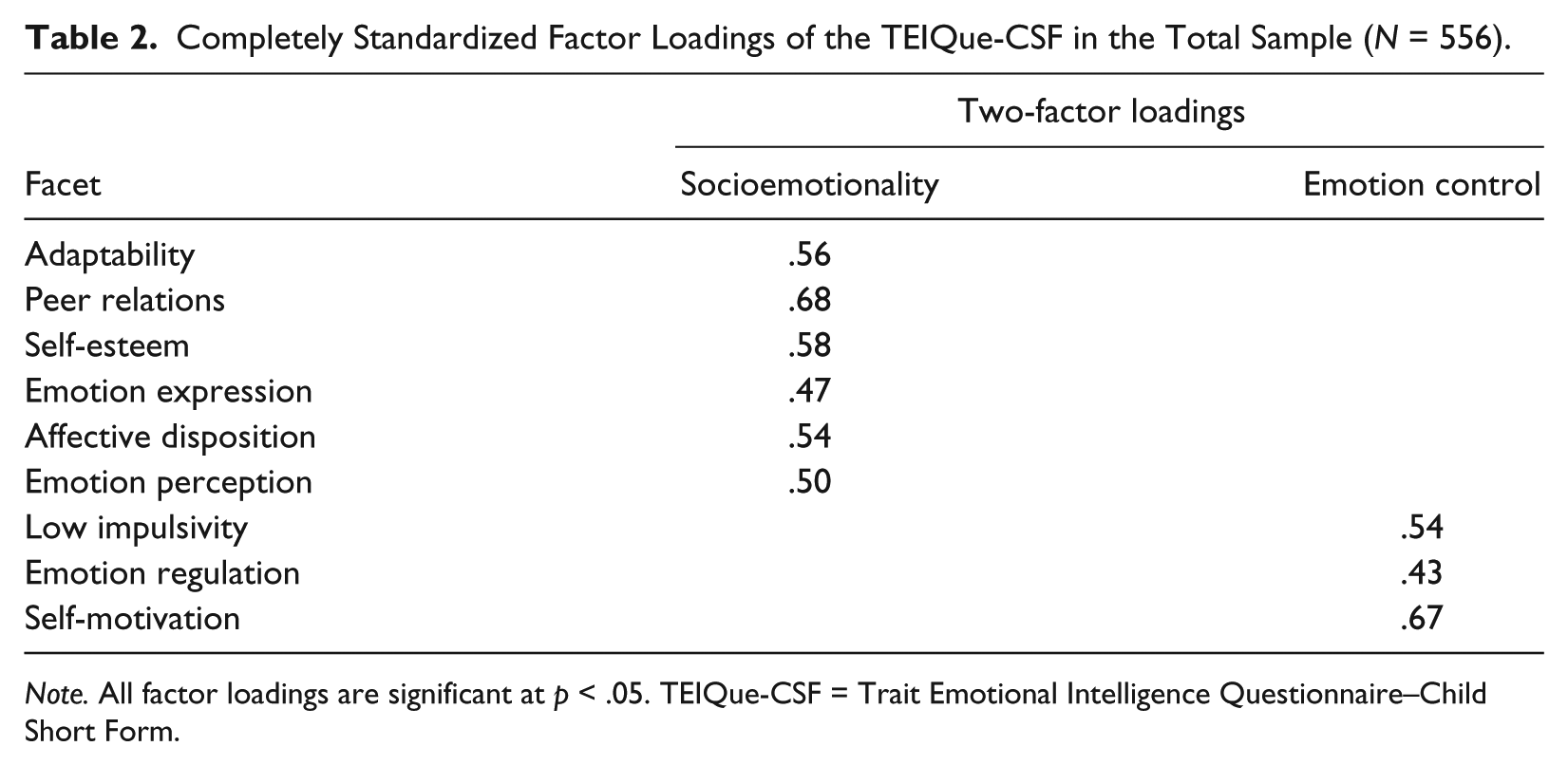
We performed a confirmatory factor analysis (CFA) to compare the one-factor solution with the two-factor solution using the estimation of robust maximum likelihood (RML) procedure with LISREL 8.80 (Jöreskog & Sörbom, 2006). Like Mavroveli and Petrides (2017) and Russo et al. (2012), the focus has been on the relationship between the constructs and not on the individual items. And thus, we have investigated the relationship between the nine facets that represent the trait EI sampling domain rather than the analyses of individual items. We created nine facets that were defined by the items representing each of the nine EI facets. For the two-factor solution (Mavroveli & Petrides, 2017), the socioemotional factor is composed of six facets (adaptability, affective disposition, emotion expression, emotion perception, peer relations, self-esteem), and the emotion control factor is composed of three facets (emotion regulation, low impulsivity, self-motivation).
To determine which model best fit our data, we used a combination of indexes, including a root mean square error of approximation (RMSEA) of .05 or less (ideally) or between .05 and .08 (reasonably), the goodness-of-fit index (GFI), the comparative fit index (CFI), the normed fit index (NFI) over .90, and a nonsignificant chi-square test (χ2/df), with values smaller than 5. We also considered the expected cross-validation index (ECVI) and Akaike information criterion (AIC; Akaike, 1987). Smaller values are preferred, as they indicate simpler models with good fit, whereas large values can indicate poorly fitting models (for the cut-off values of several goodness-of-fit indices, see Diamantopoulos & Siguaw, 2000).
Goodness-of-fit indices are presented in Table 1. The two-factor solution was the best one, providing the best fit to the data. This model had the lowest RMSEA, the lowest χ2/df values and the highest NFI, CFI, and GFI, with values above the recommended 0.90 criterion. The two-factor model also had the lowest AIC and ECVI values. The completely standardized factor loadings of the nine facets (Table 2; Figure 1) were all significant and greater than .30 (salient loading; Gorsuch, 1983).
Goodness-of-Fit Indices for the Two Models Tested in the Total Sample (N = 556).

Note. RMSEA = root mean square error of approximation; NFI = normed fit index; CFI = comparative fit index; GFI = goodness-of-fit index; AGFI = adjusted goodness-of-fit index; ECVI = expected cross-validation index; AIC = Akaike information criterion.
Completely Standardized Factor Loadings of the TEIQue-CSF in the Total Sample (N = 556).
Note. All factor loadings are significant at p < .05. TEIQue-CSF = Trait Emotional Intelligence Questionnaire–Child Short Form.

Structural model of French version of Trait Emotional Intelligence Questionnaire–Child Short Form (with completely standardized loadings) in the total sample (N = 556).
According to Mavroveli and Petrides (2017), the TEIQue-CSF was constructed as an index of a single trait EI score, and therefore, it is not appropriate for further analyses at the facet level. This is the reason we did not perform analyses at the facet level.
Descriptive Analyses
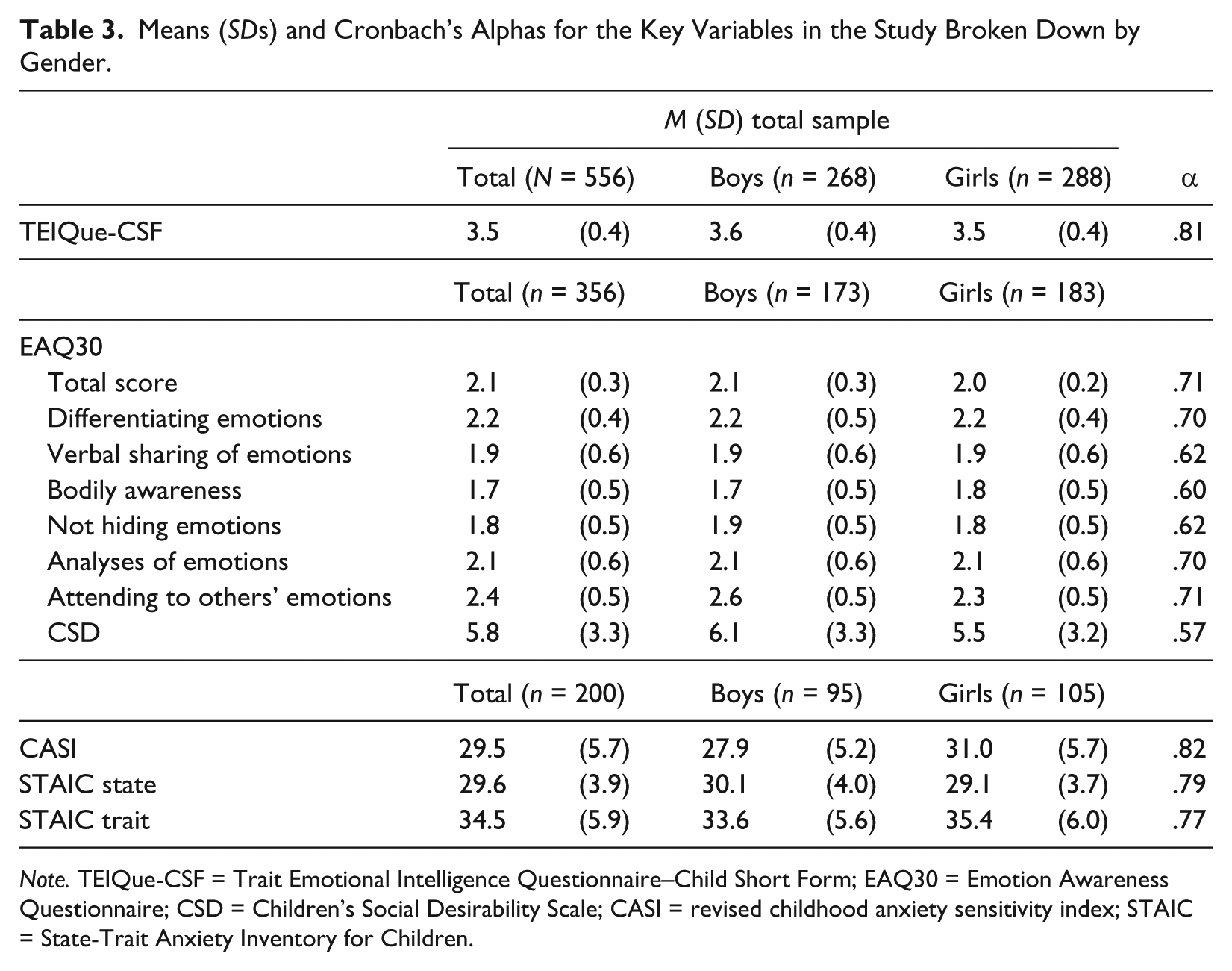
Descriptive statistics are presented in Table 3. A t test revealed significant gender differences on the TEIQue-CSF scores, t(554) = −3.07, p = .002, d = .02, with higher means for boys. The gender effect held true when age was controlled for. Age did not correlate significantly with TEIQue-CSF score (r = .04, p = .323).
Means (SDs) and Cronbach’s Alphas for the Key Variables in the Study Broken Down by Gender.
Note. TEIQue-CSF = Trait Emotional Intelligence Questionnaire–Child Short Form; EAQ30 = Emotion Awareness Questionnaire; CSD = Children’s Social Desirability Scale; CASI = revised childhood anxiety sensitivity index; STAIC = State-Trait Anxiety Inventory for Children.
Internal Consistency
The TEIQue-CSF’s reliability was assessed using Cronbach’s alpha (α). We obtained a good Cronbach’s alpha of .81 with an interitem correlation of .11. We also tested for potential gender differences in reliability. The results revealed good Cronbach’s alpha for both genders, .83 (interitem correlation: .12) for boys and .81 (interitem correlation: .11) for girls. The Cronbach’s alpha (α) of the other questionnaires is presented in Table 1.
The skewness and kurtosis indices of the TEIQue-CSF indicated a normal distribution (skewness = –.187, σ = .10; kurtosis = .208, σ = .21). Results of the Shapiro–Wilk test for normality (W = .99, p = .105) indicated a tolerance of the null hypothesis that the population is normally distributed.
Test–Retest Reliability
Test–retest reliability was assessed by conducting a Pearson product-moment correlation analysis between TEIQue-CSF scores collected at two periods separated by 2 weeks. The correlation was r = .79, p < .001.
Convergent and Concurrent Validity
Convergent validity was tested by Pearson product-moment correlations between the TEIQue-CSF and the EAQ30 (and their subscales). The results are presented in Table 4. TEIQue-CSF scores correlated positively with the total EAQ30 score and the subscales, except for the bodily awareness factor. The pattern of results remained the same for boys and girls, and when age was introduced as a covariate.
Convergent and Concurrent Validity of the TEIQue-CSF.

Note. TEIQue-CSF = Trait Emotional Intelligence Questionnaire–Child Short Form; EAQ30 = Emotion Awareness Questionnaire; CSD = Children’s Social Desirability Scale; CASI = revised childhood anxiety sensitivity index; STAIC = State-Trait Anxiety Inventory for Children.
p < .05. **p < .01. ***p < .001.
Concurrent validity was tested by Pearson product-moment correlations between the TEIQue-CSF, CASI, and STAIC (state-trait). As expected, the TEIQue-CSF scores were negatively associated with state-trait anxiety and anxiety sensitivity scores (Table 4). The pattern of the results remained the same when age was introduced as a covariate and when the same analyses were executed separately for boys and girls, except for the CASI scores. TEIQue-CSF scores correlated with CASI scores for boys, but not for girls.
Susceptibility to Socially Desirable Responses
TEIQue-CSF scores were positively associated with social desirability scores. Pearson product-moment correlations are presented in Table 3. The same analyses were computed separately for boys and girls. The results showed a correlation of .40 (p < .001) for boys and .30 (p < .001) for girls.
Discussion
This study provides preliminary supportive evidence of the validity of the TEIQue-CSF. This instrument seems to be appropriate for researchers and practitioners who want to assess emotion-related constructs in children. In the literature on adults, an expanding body of evidence highlights the importance of EI as a predictor in several domains of health, such as social, physical, and psychological health (e.g., Malouff, Schutte, & Thorsteinsson, 2014). However, in children, this research domain is less established. It is therefore crucial to have a valid tool to better understand the impact of EI on children’s physical, mental, academic, and social well-being. From a clinical perspective, the TEIQue-CSF enables practitioners to identify children with lower emotional competences so they can better guide their interventions.
Factor Structure of TEIQue-CSF
A two-factor solution seems to be best for this age range. Consistent with related studies (Mavroveli & Petrides, 2017; Russo et al., 2012), the factor structure of trait EI tends to become multifactorial as children move toward late childhood and preadolescence. From the age of 6 to 8, children internalize emotional regulation strategies. Consequently, emotions can be expressed without being automatically perceptible to an observer through differentiated signs (e.g., crying). Then children become more capable of consciously discriminating the expressive and interoceptive components of emotion. They acquire a more comprehensive understanding of emotions in terms of causes, functions, expression, and regulation, which later results in the development of typical emotional skills in adults (Roskam, 2012).
Reliability Analyses
The data presented herein show that the internal consistency and temporal stability of the TEIQue-CSF are satisfactory, and similar to the indices observed in the literature (Babalis et al., 2013; Kaliska & Nábělková, 2015).
Gender and Age Effect
Regarding demographic data, gender differences in TEIQue-CSF scores were observed, with boys scoring higher. These results are inconsistent with previous research that found no gender effect on children’s EI scores (e.g., Mavroveli et al., 2008; Williams et al., 2009), and do not reflect the idea that girls are more expressive, more aware of their emotions, and have better self-regulatory abilities than boys (Brody, 2001; Tamres, Janicki, & Helgeson, 2002). However, the same gender difference was also observed by Lahaye et al. (2010) with the global EAQ30 score. A potential explanation is that girls were less confident of their emotional competence or expected more from themselves (Lahaye et al., 2010). Another explanation could arise from different facets evaluated with the concept of EI, such as self-esteem, self-motivation, and self-control skills. These skills are generally described as more masculine than feminine, consistent with gender role stereotypes (Boldizar, 1991; Stake & Eisele, 2010). Future research should further investigate these gender differences to understand better the mechanisms underlying them. It is important to note that the effect size obtained in this study was very small, which is similar to others studies examining gender effects in EI (Banjac et al., 2016; Fernández-Berrocal, Cabello, Castillo, & Extremera, 2012).
No age effect was observed on the TEIQue-CSF score. This result had also been observed in another study that used the long form questionnaire on children in the same age range (Russo et al., 2012). This observation was not surprising because our sample includes a small age range (9-13 years), corresponding to the same emotional developmental phase (Denham, 2005). Before the age of 6 years, children develop and internalize intrapersonal emotional regulation competences. Later, these strategies will stabilize and be refined (Roskam, 2012). Keefer, Holden, and Parker (2013) observed that trait EI does not seem to change between 12-13 and 17-18 years of age; it only partially changes between ages 10 and 11.
Validity Analyses
The TEIQue-CSF shows good convergent validity with the EAQ30. EI scores correlated positively with the total EAQ30 score and subscales, except for the bodily awareness factor, for which no significant correlation was observed. This result might be explained by the way this factor was conceptualized, taking into account the intensity of bodily attention and not how attention is paid to bodily sensations (e.g., attention to the present moment vs. hypervigilance and somatization). The way in which attention is paid to bodily sensations would be more related to EI than the intensity of attention. These results suggest that the body awareness factor in the EAQ30 may need to be revised.
The concurrent validity of the TEIQue-CSF was investigated in relation to anxiety sensitivity and trait anxiety. The results showed that EI scores were negatively associated with anxiety symptoms. The pattern of relationships is similar for girls and boys. These data are consistent with past studies and emphasized the link between EI and psychological health described in the literature (Gugliandolo et al., 2015; Williams et al., 2009). The pattern of relationships is similar for girls and boys, except for the CASI, where TEIQue-CSF scores correlated to CASI scores for boys, but not for girls. This result is surprising and could be due to a lack of statistical power producing parasitic results. Without any strong explanations of gender-specific effects, it is necessary to replicate the findings before offering tentative theoretical explanations.
Social Desirability
Social desirability is described as an individual characteristic that potentially biases responses to self-report measures (Cronbach, 1946). In this study, we observed a significant correlation between TEIQue-CSF scores and the CSD, suggesting the need to administer a social desirability questionnaire in parallel with the TEIQue-CSF. The relationship between trait EI measures and social desirability has also been observed in other studies (Charbonneau & Nicol, 2002; Kluemper, 2008). Some authors have suggested a complementary theoretical link between the constructs themselves. Individuals with a high EI are able to effectively understand and perceive emotion within themselves and others, and make use of their emotions by controlling and directing them toward constructive activities (Law, Wong, & Song, 2004). Specifically, it seems that individuals with high EI are likely to have socially desirable emotion-focused behaviors, such as emotion regulation, self-motivation, and low impulsivity, and may have a greater tendency to exhibit impression management behavior associated with social desirability (Kluemper, 2008; Mesmer-Magnus, Viswesvaran, Deshpande, & Joseph, 2006). In this context, social desirability could represent a trait described as “social adjustment” (McCrae & Costa, 1983), which may theoretically be similar to the concept of trait EI (Kluemper, 2008). Moreover, a strong link was observed between EI and the general factor of personality (GFP), reflecting a substantive higher order personality factor linked to high score on the Big Five dimensions (openness, extraversion, conscientiousness, agreeableness, and emotional stability). The GFP is a construct that represents a tendency toward socially desirable behaviors. High-GFP individuals may provide more socially desirable responses to personality surveys explaining the presence of measurement biases in personality assessment (van der Linden, Dunkel, & Petrides, 2016; van der Linden et al., 2017)). However, such findings highlight the necessity for future research using trait measures of EI to control for social desirability (Kluemper, 2008).
Trait and Ability EI
In the EI literature, an important distinction is done between trait EI and ability EI (e.g., Petrides & Furnham, 2000). Trait EI concerns how people perceive their own emotional and social effectiveness, and thus is measured by self-report scales, while ability EI assesses emotional competence through performance testing. A weak correlation is usually observed between ability and trait EI measures, supporting the idea of different constructs or reflecting different aspects of the same general mechanisms. (Brannick et al., 2009). An assessment of EI on the basis of a mixed model, including both ability and trait EI, could allow for a more complete evaluation of the different mechanisms involved in EI.
Limitations
Some limitations of this research must be acknowledged. First, all variables were measured through self-reports. Future research should use multiple sources of informants (e.g., parents, teachers, etc.). Second, the concurrent validity of the TEIQue-CSF was only assessed using anxiety symptom measures. It would be important to include objective health measures or an indicator of academic competence to confirm the instrument’s construct validity. Third, additional studies should test the TEIQue-CSF’s incremental and predictive validity, which were not investigated in this study. Finally, this study assesses the psychometric properties of the short version of the TEIQue, which does not allow one to measure all the different facets of EI. Future investigations should focus on the study of the long version of the instrument in French.
Conclusion
In conclusion, TEIQue-CSF appears to be an easy, fast, and reliable instrument for identifying EI in children for both clinical and research purposes. The TEIQue-CSF is integrated into a validated conceptual framework that is well established theoretically and empirically in the adult and adolescent population.
Footnotes
Acknowledgements
The authors thank Marie de Munck for her help in collecting data.
Declaration of Conflicting Interests
The author(s) declared no potential conflicts of interest with respect to the research, authorship, and/or publication of this article.
Funding
The author(s) received no financial support for the research, authorship, and/or publication of this article.