



Abstract
Brewer, Young, and Barnett reported a comprehensive psychometric evaluation of a new adult theory of mind measure (A-ToM) with a sample of high-functioning autism spectrum disorder (ASD) adults. Although correlations with existing theory of mind (ToM) instruments (i.e., the Strange Stories; the Frith- Happé animations) were reported, relationships with independent putative indicators of ToM development such as social–behavioral and interpersonal proficiencies were not examined. Here, we provide convergent validity data by examining the relations between A-ToM performance, and the social–behavioral skills and interpersonal relationships of ASD adults with IQs exceeding 85. ToM predicted interpersonal relationship quality via the mediating variable, social–behavioral skills, providing evidence of convergent validity for the A-ToM. Alternative models of the relationship between the three variables are described, as are the challenges associated with the interpretation of self-report social and interpersonal functioning measures.
Keywords
Theory of mind (ToM) deficits are considered to characterize individuals with autism spectrum disorder (ASD), independent of age and intelligence (Baron-Cohen, 2001). ToM allows individuals to interpret the mental states of others and predict their reactions and behavior during social interactions (Baron-Cohen, 2001). Although a number of ToM measures have been used with ASD adults, comprehensive psychometric evaluations with large samples are lacking. Recently, however, Brewer, Young, and Barnett (2017) conducted an evaluation of the A-ToM (adult theory of mind test) with a sample (N = 163) of ASD adults within the normal range of intellectual functioning (IQ ⩾ 85). Brewer et al. examined reliability, the instrument’s factor structure, concurrent validity, and discriminant validity. Here, we report convergent validity data, examining the relationship between ToM performance, social–behavioral skills and interpersonal relationships, thereby refining our understanding of the relationship between ToM and some broad indices of social development.
Recognizing the intentions behind another individual’s facial expressions, body language, and tone of voice requires well-developed ToM. ToM is also crucial for interpreting the intentions behind figurative speech such as sarcasm, irony or metaphor, and understanding the impact of socially inappropriate remarks on others (e.g., Happé, 1994). Many or all of these skills and abilities are also vital for effective social communication. It might be expected, therefore, that ToM deficits would undermine the development of adaptive and sophisticated social–behavioral skills which, in turn, would likely limit the quality of interpersonal relationships the individual might establish (cf. Whitehouse, Durkin, Jaquet, & Ziatas, 2008). Yet, there have been few large sample studies of ToM in ASD adults within the normal range of intellectual functioning, let alone studies exploring the links between ToM measures, social–behavioral skill development and interpersonal relationship quality. What is known is that many ASD adults are characterized by (a) ToM deficits relative to IQ-matched controls (Brewer et al., 2017); (b) social–behavioral skill deficiencies reflected in inability to maintain reciprocal communication, poor understanding of unwritten rules of communication, social awkwardness and intrusiveness, failure to maintain appropriate interpersonal distance, dominating conversations with accounts of their own interests, and insensitivity to others’ feelings (Whitehouse et al., 2008); and (c) problems with interpersonal relations such as finding it hard to form age-appropriate relationships, having few friends or long-term partners, and distancing themselves from others to avoid the stress associated with social interactions (Engström, Ekström, & Emilsson, 2003; Howlin, 2000).
We hypothesized, therefore, that there would be positive relationships between A-ToM performance, social-behavioral skills and the quality of interpersonal relationships in ASD adults, with social–behavioral skills mediating the relationship between ToM and interpersonal relationship quality. These relationships were examined using the social (i.e., ToM) subscale of the A-ToM (Brewer et al., 2017) and self-report measures of social–behavioral skills and quality of interpersonal relationships developed for this study.
Method
Participants
Forty-two participants (24 male, 14 female, four other) were recruited from the Flinders University ASD database, comprising individuals who had volunteered to participate in research studies and provided informed consent. They were aged 16 to 62 years (M = 35.29, SD = 14.4), with Wechsler Abbreviated Scale of Intelligence-II (WASI-II, Wechsler, 2011), full-scale IQs of 86 to 138 (M = 109.5, SD = 14.2). All participants had been diagnosed either with autistic or Asperger’s disorder using Diagnostic and Statistical Manual of Mental Disorders (4th ed., text rev.; DSM-IV-TR; American Psychiatric Association [APA], 2000) criteria or with ASD using Diagnostic and Statistical Manual of Mental Disorders (5th ed.; DSM-5; APA, 2013) criteria by at least two independent professionals (e.g., pediatrician, psychiatrist, psychologist). 1 Participants responded to a phone, email, or postal invitation for a study exploring people’s social behaviors and interpersonal relationships. The study, including participant introduction and debriefing materials, was approved by the relevant institutional ethics committee.
Measures
ToM
Brewer et al. (2017) described the development and psychometric evaluation of the A-ToM measure. The A-ToM requires participants to (a) view short videos in which actors engage in naturalistic interpersonal interactions and (b) immediately describe the intent of the actors’ communications. Similar to the pencil-and-paper strange stories test (Happé, 1994), six items (specifically, social or ToM items) require inferences about the actors’ mental or social inferences (including examples of faux pas, sarcasm, white lie, bluff or persuasion, and perspective taking or misunderstanding), with another six physical items used as a control measure. Brewer et al. (2017) demonstrated acceptable inter-rater agreement, test–retest reliability, and item-total correlations. A principal components analysis highlighted social and physical item dimensions, and the instrument produced the hypothesized discrimination between ASD and non-ASD adults on the social items and concurrent relationships with extant measures of ToM.
In the present study, the social items provided the ToM measure. Participants’ A-ToM social (ToM) scores were obtained 2 to 3 years prior to the convergent validation measures and were accessed from the adult database on which participants were registered. Participants’ scores could range from 0 to 12 on the social scale, with a high score indicating superior performance.
Social–behavioral skills and interpersonal relationships questionnaires
These scales included 18 social–behavioral skill items reflecting a range of social situations and behaviors likely to be experienced by high-functioning adults, and 13 interpersonal items covered different aspects of typical adult relationships. The development of the content and format of these items are outlined in Supplemental Materials, and the items are shown in Table 1 of Supplemental Materials. Participants responded on a 6-point scale (1 = strongly disagree; 6 = strongly agree) to the instruction: “Please read each statement and think about how this relates to you personally within the last year.” For social–behavioral skill items, Cronbach’s α = .81 and item-total correlation coefficients ranged from .08 to .62; for interpersonal relationship items, α = .87 and item-total correlation coefficients ranged from .24 to .77.
Procedure
Participants received an online link directing them to an introduction letter and allowing them to elect to participate. They were instructed: “In the following section of this study you will be presented with a number of questions regarding your social behaviors and interpersonal relationships. Please answer to the best of your ability.” They completed the social–behavioral skill and interpersonal relationship questionnaires before being debriefed.
Results
Participants’ scores on the A-ToM social items ranged from 2 to 12 (M = 8.81, SD = 2.57); descriptive statistics for the social–behavioral and interpersonal relations scales are shown in Table 1 of Supplemental Materials. Male and female participants did not differ significantly on any of these scales, although sample sizes for the contrasts are small (see Table 2, Supplemental Materials).
Significant positive correlations were found between (a) A-ToM social subscale performance and social–behavioral skills, r = .35, 95% confidence interval (CI) = [.05, .59], p = .02 and (b) social–behavioral skills and interpersonal relationships, r = .64, 95% CI = [.42, .79], p < .001. The latter correlation provides an indication of convergent validity of the measures. The correlation between A-ToM social performance and interpersonal relationships was also positive but not statistically significant, r = .19, 95% CI = [–.12, .47], p = .24. (Similar patterns existed for males and females; see Table 3, Supplemental Materials.) We used the SPSS macro PROCESS (Hayes, 2013) to investigate whether the relationship between A-ToM social performance and interpersonal relationship quality was mediated by social–behavioral skills, with 10,000 bootstrap samples used to estimate the pathways. Figure 1 shows path coefficients and associated CIs and effect sizes; CIs not including zero denote significant relationships. The results revealed a significant indirect relationship between A-ToM social performance and interpersonal relationships, with social–behavioral skills mediating the relationship between A-ToM performance and interpersonal relationships.
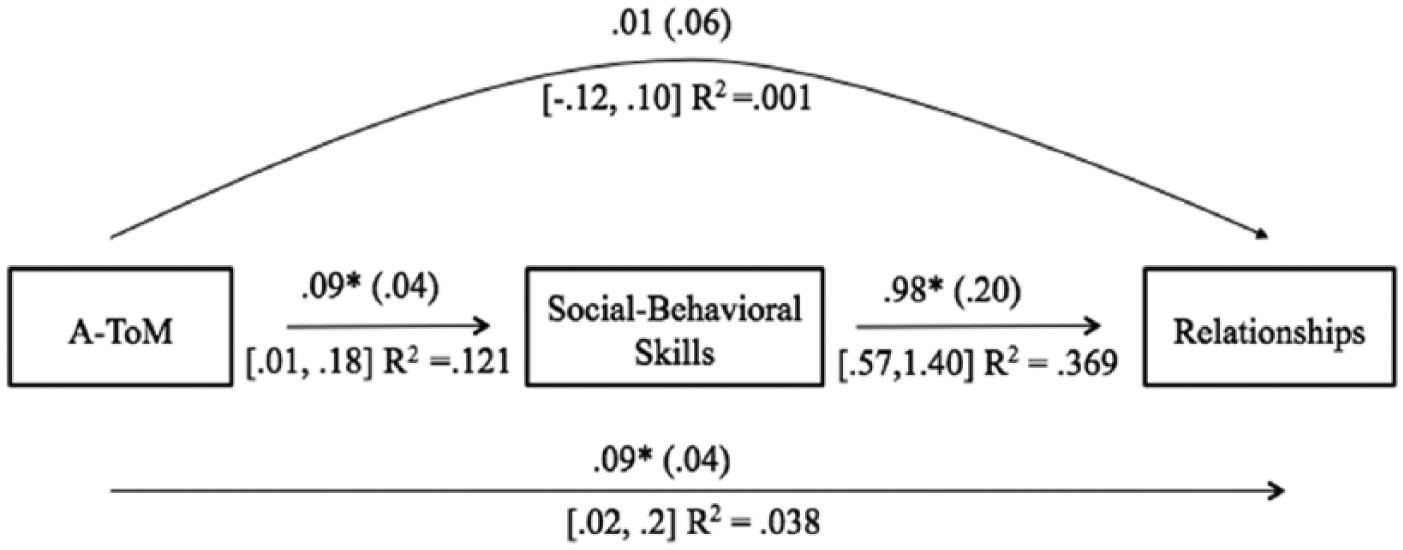
Path analysis (PROCESS; Hayes, 2013) depicting direct and indirect (the lowest path) relationships between A-ToM social scores, social–behavioral skills, and interpersonal relationships.
Discussion
We detected positive relationships between ToM, social–behavioral skills, and interpersonal relationships in ASD adults within the normal range of intelligence, with social–behavioral skills mediating the relationship between ToM and interpersonal relationships. These findings extend the concurrent and discriminant validity data reported by Brewer et al. (2017) for the A-ToM. Although the effects depicted in Figure 1 involving the ToM measure are not particularly strong, modest relationships are not surprising given the complex network of variables shaping development of social–behavioral competencies.
Various interpretations of these convergent validity data are possible. For example, ToM may be crucial for the development of social–behavioral skills which, in turn, promote the development of high-quality interpersonal relationships. Alternatively, growing up within a strong interpersonal network may underpin high-level social skills, with skills in both of these domains also enhancing ToM development. Until research permitting causal inferences is conducted, we can only conclude that social–behavioral skills and the quality of interpersonal relations would appear to be linked with A-ToM.
Although our findings add to the body of validity data for the A-ToM, questions remain about what the specific questionnaire responses mean in terms of the real extent of any difficulties that ASD adults experience in the social–behavioral and interpersonal relationship domains. Our findings depend on self-reports and, although respondents used the full response scale range, in the absence of independent observations or behavioral measures, the accuracy of these reports is unknown. For example, it is possible that participants provided more optimistic evaluations than significant others without ASD might have provided on their behalf.
It might be argued that self-reports of ASD adults are compromised because participants lack insight into their own situation. Yet, although there is little argument that ASD individuals may experience difficulty interpreting the mental states of others or appreciating the impact of their behavior on others, recent research clearly challenges the view that ASD adults are unable to provide meaningful self-reports on their personality and social traits (e.g., Schriber, Robins, & Solomon, 2014). Moreover, we doubt that the observed patterns would have emerged if individuals lacked insight into their own strengths and weaknesses. Although it is possible that “insightful” individuals might inflate their self-assessments and report strong social skills and relationships, it seems unlikely that individuals with limited insight would consistently self-report poor social skills and relationships as would be required to produce the relations detected. Nevertheless, future research designed to build on the validity data for the social–behavioral and interpersonal relationship scales would be desirable.
Finally, our findings suggest that, as well as being used to highlight ToM deficits, the A-ToM could provide clinicians with a crude pointer to the likely quality of an individual’s social–behavioral repertoire and interpersonal relationships.
Supplemental Material
Supplemental_Materials__July_2018 – Supplemental material for Convergent Validity of the A-ToM (Adult Theory of Mind) Test for Individuals With Autism Spectrum Disorder
Supplemental material, Supplemental_Materials__July_2018 for Convergent Validity of the A-ToM (Adult Theory of Mind) Test for Individuals With Autism Spectrum Disorder by Neil Brewer, Jordana Zoanetti and Robyn L. Young in Journal of Psychoeducational Assessment
Footnotes
Declaration of Conflicting Interests
The author(s) declared no potential conflicts of interest with respect to the research, authorship, and/or publication of this article.
Funding
The author(s) disclosed receipt of the following financial support for the research, authorship, and/or publication of this article: This research was supported by a Faculty of Social & Behavioural Sciences Research Grant to N. Brewer and R. L. Young, and the Hamish Ramsay Fund.
Notes
References
Supplementary Material
Please find the following supplemental material available below.
For Open Access articles published under a Creative Commons License, all supplemental material carries the same license as the article it is associated with.
For non-Open Access articles published, all supplemental material carries a non-exclusive license, and permission requests for re-use of supplemental material or any part of supplemental material shall be sent directly to the copyright owner as specified in the copyright notice associated with the article.
