



Abstract
The purpose of this study was to identify whether maladaptive perfectionism predicts elevated symptoms of anxiety in a sample of primarily Puerto Rican middle school students. Participants included students (N = 128) from Grades 6 through 8 (48% male; average age = 11.9 years) who attended an urban, bilingual, public, charter school. Results suggested both general and specific links between maladaptive perfectionism and anxiety disorder symptoms. More specifically, socially-prescribed perfectionism (SPP) uniquely predicted symptoms of panic whereas self oriented perfectionism (SOP) uniquely predicted symptoms of social anxiety across the sample. These findings provide support for the previously established connection between various anxiety symptoms and perfectionism and demonstrate that such a connection exists in Latino adolescents. Given the strong relationship between different types of maladaptive perfectionism and anxiety, theoretical and cultural considerations should be considered to help better understand the nature of how perfectionism is linked to anxiety disorder manifestations. Future studies implementing more control and longitudinal designs may be useful to better understand how perfectionism may function as a transdiagnostic mechanism in the development and maintenance of anxiety in adolescents, and specifically those who identify as Latino.
Over the past two decades, anxiety disorders continue to be the most common psychiatric diagnoses during childhood and adolescence (Kessler et al., 2012). In fact, 12-month prevalence rates have risen from 15.4% in 1990 to an estimated 24.6% as of 2010 (Benjamin, Costello, & Warren, 1990; Kessler et al., 2012). Anxiety-related problems during adolescence are associated with a host of negative consequences spanning across several domains including interpersonal relationships, academic performance, and familial interactions (Kessler, Wang, & Zaslavsky, 2005). Compared with other psychiatric diagnoses, anxiety disorders are the second highest predictor for not completing high school or college, second only to conduct disorder (Kessler, Foster, Saunders, & Stang, 1995). Furthermore, among high school graduates, anxiety disorders have the highest predictive value for not attending college when compared with mood, substance abuse, and conduct disorder (Kessler et al., 1995). Thus, anxiety remains an important construct to study within a youth population.
Despite the growing body of knowledge on the prevalence and impact of anxiety disorders, much of the research examining psychological adjustment is based largely on Caucasian youth, with little focus on ethnic minorities (Anderson & Mayes, 2010; Ginsburg & Silverman, 1996; Sue, 2009; Varela, Niditch, Hensley-Maloney, Moore, & Creveling, 2013). According to the U.S. Census Bureau (2009), Latinos make up the nation’s largest minority group with approximately 15.4 million Latinos younger than the age of 18 years, accounting for 18% of students in grades kindergarten through 12. In addition to being the largest ethnic minority group, Latino adolescents tend to have the highest prevalence rate of anxiety-related problems (Roberts, Roberts, & Xing, 2006). Alegría and colleagues (2008) estimated a lifetime prevalence rate of 15.7% for anxiety disorders among Latinos. Despite the high prevalence of anxiety disorders in Latino adolescents, only a few studies have investigated potential predictors of anxiety in this population (Anderson & Mayes, 2010; Varela et al., 2013).
Researchers have attempted to identify culture-specific theories related to the development of internalizing disorders, such as anxiety, in Latino youth. It has been suggested that Latino culture emphasizes the restraint of emotional reactivity and placement of one’s needs secondary to the needs of the family unit, values represented in collectivistic cultures (Varela, Weems, Berman, Hensley, & Rodriguez de Bernal, 2007). Related to these values is the culturally related concept of simpatía. Simpatía is a cultural value observed in many Latino communities, which suggests that individuals should strive to be agreeable, empathize with others, and be respectful of others, even if it causes personal distress (Anderson & Mayes, 2010). It has been suggested that this value is likely reinforced throughout childhood development, and stresses the importance of putting one’s own needs second to that of the family or larger group. It is therefore reasonable for Latino youth to feel that they are expected to control their internal emotions or suppress the expression of anxiety (Anderson & Mayes, 2010; Varela et al., 2007).
Specific to the expression of anxiety symptoms in Latino youth, Varela and colleagues (2007) found that Latino youth are more likely to endorse a higher frequency of somatic symptoms when compared with Caucasian peers who present with similar anxiety disorders. Thus, it has been hypothesized that because emotional expression of anxiety may not be normative in Latino culture, somatic expression may be more culturally accepted (Varela et al., 2007). However, these findings are preliminary and further research is needed to explore these cultural factors. Regardless of culture, the recognition of the detrimental effects of anxiety disorders in youth has led to increased focus on understanding potential predictors of anxiety. In regard to this, investigating transdiagnostic mechanisms of anxiety, such as perfectionism, may help better understand the experience of anxiety in adolescents, and specifically those who identify as Latino.
Maladaptive Perfectionism
Although the majority of literature discusses adults, maladaptive perfectionism is a construct gaining attention in its relationship to youth anxiety disorders (Affrunti & Woodruff-Borden, 2014; Flett et al., 2016). Currently, perfectionism is defined as striving to achieve the highest expectations possible while becoming greatly disappointed if those expectations are not met (Frost, Marten, Lahart, & Rosenblate, 1990; Hewitt & Flett, 1991). Perfectionism is generally viewed as a dimensional construct, ranging from a positive factor in achievement (Hamachek, 1978) to a maladaptive aspect of neuroticism (Flett, Hewitt, & Dyck, 1989; Pacht, 1984). Although potentially adaptive to one’s environment, maladaptive perfectionism is associated with a host of psychological difficulties including feelings of failure, guilt, indecisiveness, procrastination, shame, and low self-esteem (Hollender, 1965; Pacht, 1984; Solomon & Rothblum, 1984; Sorotzkin, 1985). Furthermore, maladaptive perfectionism has been linked to increased social stress, psychological distress, elevated symptoms of depression and anxiety (Blatt, 1995; Cox & Enns, 2003; Enns, 1999; Smith et al., 2016; Smith, Saklofske, Yan, & Sherry, 2017), alcohol dependence, anorexia, and personality disorders (American Psychiatric Association, 1994; Burns & Beck, 1978; Pacht, 1984). Although much of the literature has previously been focused on adult perfectionism, there is preliminary evidence which suggests perfectionism in adolescents is linked to elevated stress and maladjustment (Flett et al., 2016).
The Multidimensional Model of Perfectionism
The multidimensional model of perfectionism distinguishes between two subtypes of maladaptive perfectionism, self-oriented perfectionism (SOP), and socially prescribed perfectionism (SPP; Hewitt & Flett, 1991). A key distinction between these two subtypes is the source of the perfectionistic standard. Hewitt and Flett’s (1991) model delineates SOP as the tendency to set unreasonably high standards for oneself with a strong motivation to achieve them perfectly. In contrast, SPP refers to the rigid belief that others hold unrealistically high expectations while engaging in harsh criticism if those expectations are not met (Hewitt et al., 2011; Hewitt et al., 2002; Hewitt & Flett, 1991). To better understand youth perfectionism as a predictor of anxiety symptoms, much of the limited research on youth perfectionism has studied these subtypes separately (Affrunti & Woodruff-Borden, 2014; Flett et al., 2016).
SOP
Not only do individuals presenting with SOP hold high standards for themselves (Hewitt & Flett, 1991), but they engage in self-criticism when these standards are not met (Egan, Wade, & Shafran, 2011). In a study of undergraduate students (n = 245) at a Japanese university, participants who demonstrated higher levels of SOP took longer to respond to failure/mistake words than those with lower levels of SOP. This suggests that those with SOP may hold an attentional bias toward stimuli related to making mistakes and may spend more time ruminating about the situation to achieve their high standards (Kobori & Tanno, 2012).
Individuals with SOP tend to not only strive to achieve their high standards but also demonstrate high motivation to avoid perceived failures (Hewitt & Flett, 1991). When individuals do not meet these perfectionistic standards, they engage in self-blame (Hewitt, Mittelstaedt, & Wollert, 1989) and experience low self-regard (Hoge & McCarthy, 1983). With such a great degree of motivational and cognitive efforts focused on striving to succeed at their own high standards and avoiding failure, it is not surprising that individuals demonstrating higher levels of SOP tend to demonstrate higher levels of anxiety (Flett et al., 1989; Hewitt et al., 2002), worry, and depression (Flett, Coulter, Hewitt, & Nepon, 2011).
SPP
Individuals with SPP tend to believe others will evaluate them harshly when expectations are not met (Hewitt & Flett, 1991). Important to note is that the SPP individual assumes, rather than actually knows, what standards others hold. In addition to assuming others hold exceedingly high standards for them, it is not uncommon that the SPP individuals believe they cannot meet the demands of the socially prescribed standards, resulting in increased self-criticism and fear of negative evaluation (Hewitt & Flett, 1991). In addition, recent findings indicate that individuals demonstrating SPP are even more likely to experience increased stress when individuals in their social environment actually hold higher expectations (Smith, Speth, et al., 2017). Given this increased likelihood of experiencing self-criticism and fear of negative evaluation, it is not surprising that higher scores of SPP are strongly predictive of elevated symptoms of social anxiety disorder in adults (Alden, Bieling, & Wallace, 1994; Jain & Sudhir, 2010) and maladjustment in adolescents (Flett et al., 2016).
Another characteristic of individuals with SPP that may lead to negative emotional reactions is perceived lack of control over and ambiguity about outcomes (Hewitt & Flett, 1991). This perception is problematic because when individuals perceive their environment to be ambiguous and uncontrollable, they are likely to develop a bias toward threatening stimuli (Daleiden & Vasey, 1997; Higa & Daleiden, 2008; Suarez & Bell-Dolan, 2001; Waters, Craske, Bergman, & Treanor, 2008). If the vast majority of stimuli being interpreted are perceived as threatening, the likelihood of experiencing elevated levels of anxiety increases (Waters et al., 2008). In support of this, it has been found that adolescents with elevated levels of SPP are more likely to display elevated levels of anxiety (Essau, Leung, Conradt, Cheng, & Wong, 2008; Hewitt et al., 2002), worry, depression, and rumination (Flett et al., 2011). In fact, a recent study found that in an adolescent sample, SPP was significantly more associated with negative psychiatric symptoms as compared with SOP (Flett et al., 2017).
Despite increased focus on maladaptive perfectionism, much of the research has been with Caucasian samples. In fact, only two relatively recent studies have empirically investigated the relationship between maladaptive perfectionism in Latino samples (Chang, Hirsch, Sanna, Jeglic, & Fabian, 2011; Ortega, Wang, Slaney, Hayes, & Morales, 2014). One study on Latino college students (n = 121) indicated that maladaptive perfectionism significantly predicted elevated depression, anxiety, and loneliness (Chang et al., 2011), suggesting a need to further investigate perfectionism in this population. Ortega and colleagues (2014) expanded on this topic by studying maladaptive perfectionism among 207 Latino undergraduates. Results supported the idea that Latinos reporting perfectionistic qualities were more prone to anxiety, depression, and deflated self-esteem. Moreover, and perhaps relevant to Latino culture was the finding that participants’ perception of how well they meet family expectations and standards was predictive of anxiety, depression, and deflated self-esteem (Ortega et al., 2014).
The purpose of this study was to identify whether maladaptive perfectionism predicts elevated symptoms of specific anxiety disorders in a sample of Latino middle school youth. Specifically, the two subtypes of maladaptive perfectionism, SOP and SPP, were tested as predictors of specific anxiety symptom subtypes (social, general, school, separation, and panic). While not specifically looking at specific diagnoses of this sample, the goal was to understand how the core characteristic of each subtype of anxiety might be related to the maladaptive perfectionism subtypes. It was hypothesized that different subtypes of maladaptive perfectionism, SOP and SPP, would predict specific anxiety symptomatology. Although part of this prediction was exploratory, it was specifically hypothesized that SOP and SPP would predict generalized anxiety and SPP would predict social anxiety.
Method
Participants
One hundred twenty-eight Latino, primarily of Puerto Rican descent, middle school students participated in this study. All participants were students in a bilingual public charter school in a large urban metropolitan area on the East Coast of the United States. The school offers kindergarten through eighth grades and is located in a lower socioeconomic neighborhood. This sample was drawn from all students in the sixth, seventh, and eighth grades, and all students were offered the opportunity to participate. In total, there were approximately 140 students across the three grades; thus, our sample represents about 90% of the intended population. Participants reported being 11 years old (39.8%), 12 years old (27.3%), 13 years old (21.1%), 14 years old (3.9%), or 15 years old (0.8%). The sample was equally split across genders, with females accounting for 52.3% of the sample. Forty-eight percent of the participants identified as being in the sixth grade, 24.2% were in the seventh grade, and 27.3% were in the eighth grade. Although data were not collected regarding participant socioeconomic status (SES), the school counselor has indicated the students typically come from lower SES communities.
Measures
The Screen for Child Anxiety Related Emotional Disorders (SCARED)
The SCARED (Birmaher et al., 1997) is a self-report measure of childhood and adolescent anxiety disorders. It consists of 41 items rated on a 3-point Likert-type scale (0 = not true or hardly ever true of me; 2 = very true or often true of me). Adolescents are asked to rate various statements (i.e., “I worry about other people liking me” and “I get really frightened for no reason at all”) with higher scores indicating the presence of anxiety-related symptoms. Specifically, adolescents receive an overall score and five separate subscale scores linked to specific anxiety disorders including Panic Disorder, Generalized Anxiety Disorder, Separation Anxiety Disorder, Social Anxiety Disorder, and Significant School Avoidance. The SCARED has demonstrated strong overall internal consistency (α = .90) and good test–retest reliability. In addition, the SCARED has demonstrated acceptable discriminant validity compared with measures of depression as well as when comparing overall scores with subscale scores and between subscale scores (Birmaher et al., 1999).
The Child–Adolescent Perfectionism Scale (CAPS)
The CAPS (Flett et al., 2016) is a self-report measure designed to assess two dimensions of maladaptive perfectionism: SOP and SPP. The CAPS contains a demographic face sheet and 22 items rated on a 5-point Likert-type scale (1 = false—no true of me at all; 5 = very true of me). Adolescents are asked to rate their agreement with various statements (i.e., “It really bothers me if I don’t do my best every time”) with higher scores indicating greater perfectionism. The CAPS has demonstrated strong internal consistency (α = .85) and test–retest reliability (α = .83) over a 5-week period (Castro et al., 2004).
Procedure
The institutional Internal Review Board approved all procedures for this research study. This study was part of a larger collaboration that exists between an inner-city public charter school and a psychology graduate program. Students and a faculty member in the graduate school program provided services to the school such as facilitating groups that focus on coping skills, specifically targeting anxiety. To identify students that would benefit from services, a routine school assessment of mental health is periodically administered to middle school students. Graduate students administer the measures in each of the classrooms of the middle school. The graduate students are available to answer questions and instruct the students on how to complete the provided measures. Once the measures are completed, the questionnaires are reviewed to determine eligibility in one of the coping skills groups. For this study, all middle school students who completed this screening process were potential participants. Assessment measures were scored and entered into a de-identified SPSS data file.
Results
Perfectionism Predicting Anxiety
Mean scores and standard deviations were calucated and are listed in Table 1. To determine whether SOP and SPP predicted overall anxiety symptoms, a standard multiple linear regression was conducted. A Pearson correlation was computed between SOP and SPP and was found to be statistically significant, but the coefficient was not large enough to suggest multicollinearity, r (128) = .61, p < .001. A multiple regression statistic was found to be significant, F(2, 125) = 33.91, p < .001. The adjusted R squared value was .34, indicating that approximately 34.0% of the variance in anxiety was explained by a combination of SOP and SPP. Overall, SOP (B = .56, β = .39, t = 4.23, p < .001) and SPP (B = .41, β = .27, t = 2.99, p < .001) significantly predicted a broad spectrum of total anxiety symptoms.
Means and Standard Deviations of Subscales of Perfectionism and Anxiety.
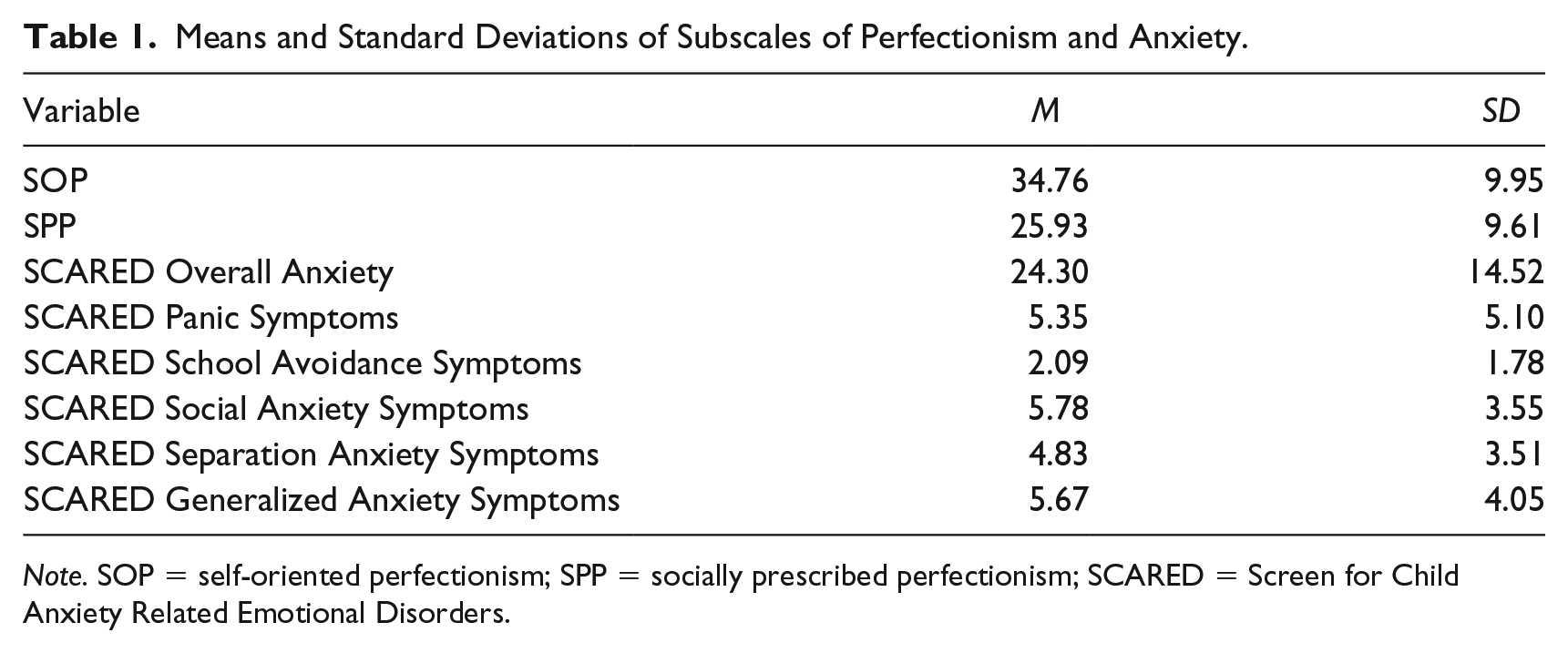
Note. SOP = self-oriented perfectionism; SPP = socially prescribed perfectionism; SCARED = Screen for Child Anxiety Related Emotional Disorders.
A standard multiple linear regression analysis was conducted to determine whether SOP and SPP predicted panic symptoms. The multiple regression statistic was found to be significant, F(2, 125) = 15.69, p < .001. The adjusted R squared value was .19. It was found that SPP (B = .18, β = .33, t = 3.26, p = .001) significantly predicted panic symptoms; however, SOP did not (B = .08, β = .16, t = 1.60, p = .113).
To investigate whether SOP and SPP predicted symptoms of school avoidance, a standard multiple linear regression was computed. The multiple regression statistic was found to be significant, F(2, 125) = 24.68, p < .001. The adjusted R squared value was .27. Hence, SOP (B = .05, β = .28, t = 2.96, p < .01) and SPP (B = .06, β = .31, t = 3.22, p < .01) significantly predicted symptoms of school avoidance.
A standard multiple linear regression analysis was utilized to determine whether SOP and SPP predicted social anxiety symptoms. The multiple regression statistic was found to be significant, F(2, 125) = 10.98, p < .001. The adjusted R squared value was .14. Thus, SOP (B = .12, β = .35, t = 3.31, p = .001) significantly predicted symptoms of social anxiety; however, SPP did not (B = .02, β = .06, t = 0.59, p = .558).
To examine whether SOP and SPP predicted separation anxiety symptoms, a standard multiple linear regression was run. The multiple regression statistic was found to be significant, F(2, 125) = 15.32, p < .001. The adjusted R squared value was .18. Results indicated that SOP (B = .10, β = .29, t = 2.86, p < .01) and SPP (B = .07, β = .20, t = 2.00, p < .05) significantly predicted symptoms of separation anxiety.
A standard multiple linear regression analysis was conducted to determine whether SOP and SPP predicted symptoms of generalized anxiety. The multiple regression statistic was found to be significant, F(2, 125) = 36.24, p < .001. The adjusted R squared value was .36. Therefore, SOP (B = .18, β = .44, t = 4.92, p < .001) and SPP (B = .10, β = −.22, t = 2.48, p = .01) significantly predicted symptoms of generalized anxiety.
Discussion
Results of the current study indicate perfectionism was associated with overall anxiety in this sample. These findings are consistent with the literature demonstrating a relationship between perfectionism and anxiety (Essau et al., 2008; Flett & Hewitt, 2002; Hewitt et al., 2002). Although this relationship has been consistently demonstrated in adults (Flett & Hewitt, 2002; Flett, Hewitt, Blankstein, & Koledin, 1991), research has begun to address the relationship between perfectionism and anxiety in adolescents. Specifically, SOP and SPP have been found to significantly correlate with anxiety in adolescents in the United States (Hewitt et al., 2002) as well as other cultures (Essau et al., 2008). In addition, increased social stress has been found to strengthen the correlation between SOP and anxiety (Hewitt et al., 2002). However, neither of these studies specifically investigated the relationship between the two subtypes of perfectionism and specific anxiety disorders. The present study sought to extend the knowledge base of this relationship by investigating whether subtypes of perfectionism contribute to the variance of anxiety symptom severity.
To our knowledge, no other studies have explored the relationship between perfectionism and anxiety in a subgroup of Latino adolescents. In fact, Latino adolescents remain an overall understudied population in terms of understanding their experience of anxiety. Research has indicated that internal emotional distress, such as anxiety, may be expressed differently in a Latino population than in non-Latinos (Pina & Silverman, 2004; Varela et al., 2007). For example, Latin American and Columbian adolescents are more inclined to express internalizing symptoms as somatic complaints than White non-Latino adolescents (Varela et al., 2007). Although some culture-specific theories have been presented, additional research is needed to the further elucidate underlying mechanisms of anxiety in this rapidly growing population. It is our hope that the findings of this study will help inform future researchers as to how this sample of adolescents of Puerto Rican descent might experience perfectionism and anxiety. Thus, although tentative, the results of this study may be interpreted through lens of the broader Latino culture.
Both SOP and SPP predicted generalized anxiety (GAD) symptoms. These findings are consistent with past research, indicating SOP and SPP are significantly associated with uncontrollable worry (Flett et al., 2011). Flett and colleagues (2011) explained that the relationship between perfectionism and worry may be attributed to a fear of future failures and mistakes related to exceedingly high expectations. Chronic uncontrollable worry is a key characteristic of GAD; therefore, perfectionistic youth may engage in worry and worry-related behaviors as a means to prevent future failures and mistakes that they fear and/or distract themselves from the negative emotions associated with pathological worry. In addition, both Latino boys and girls have been found to experience higher rates of self-reported worry compared with their Caucasian peers (Chorpita, Tracey, Brown, Collica, & Barlow, 1997). Thus, it is not surprising that the present study found both types of perfectionism to be highly associated with symptoms of GAD in this sample.
Both SOP and SPP predicted separation anxiety (SAD) symptoms. Little is known about the possible relationship between SAD and perfectionism; therefore, it is difficult to interpret this finding. One noteworthy consideration is the composition of the sample. Ginsburg and Silverman (1996) reported that Latino children are twice as likely to present with SAD as compared with non-Latino children. Consistent with Ginsburg and Silverman (1996), the mean score for SAD in our sample bordered on the clinical range. A possible explanation for the higher rate of SAD in Latino children may be attributed to the concept of familismo, which refers to family being the central support system for the individual (Clark & Huttlinger, 1998, as cited in Ortega et al., 2014). Furthermore, within the broader theme of familismo is the idea of confianza, encouraging trust and reliance on family members rather than people outside of the extended family system (Cervantes & Castro, 1985). Therefore, Latino children may be more dependent on their families for support and, hence, report higher levels of anxiety when asked about being separated from their family.
SPP uniquely predicted panic symptoms, suggesting that when Latino adolescents perceive others as holding unreasonably high expectations, they tend to experience more autonomic symptoms and a subsequent fear of these somatic feelings. In fact, research has indicated that anxiety in Latino children often manifests itself somatically. Latino youth are more likely to endorse somatic symptoms (Varela et al., 2007) and a subsequent fear of those symptoms (e.g., anxiety sensitivity; Pina & Silverman, 2004) when compared with Caucasian peers demonstrating similar levels of anxiety. It has been hypothesized that because emotional expression of anxiety may not be normative in Latino culture, somatic expression may be more culturally accepted. Therefore, perfectionistic youth concerned with how they are being perceived by others may be more likely to express anxiety in this culturally acceptable manner.
SOP uniquely predicted social anxiety, which may suggest that when Latino adolescents hold unreasonably high standards for themselves, they demonstrate increased worry and fear of negative evaluation. This finding was contrary to previous research indicating that there is a relationship between SPP and social anxiety in Caucasian adults (Alden et al., 1994; Jain & Sudhir, 2010). However, it has been found that individuals displaying higher self-imposed perfectionistic standards (SOP) are prone to an attentional bias toward failure and mistakes (Kobori & Tanno, 2012). The tendency to shift one’s attention internally has been linked to social anxiety (Higa & Daleiden, 2008; Kley, Tuschen-Caffier, & Heinrichs, 2012). Culturally, the concept of simpatía may be useful for understanding how Latino youth may attempt to perfectly restrict their emotions as a display of cultural respect in social situations. However, highly striving to be in full control of emotional responses in social situations may have an unintended effect of developing feelings consistent with social anxiety. Thus, the anxiety associated with SOP may be related to this attentional bias as well as the self-focused nature of this perfectionistic subtype.
Limitations
This study has several potential limitations. The generalizability of this study is limited to the specific school from which the sample was drawn. This sample consisted of children living in an urban setting, attending the same school, and mostly of Puerto Rican descent. The entire Latino population consists of many diverse subgroups other than Puerto Ricans; thus, the results of this study should be considered cautiously in regard to Latinos descending from other countries (Guarnaccia, Martinez, & Acosta, 2005). The scope of this study is intended to be a pilot study exploring potential relationships that may exist between maladaptive perfectionism and anxiety within this specific school. Thus, generalized inferences cannot be made about these constructs within the much broader Latino community.
Another limitation is that participants were not necessarily presenting with clinical levels of anxiety, but rather represented a wide range of endorsed anxiety levels. Future studies may be well served by looking more closely at youth with clinical displays for anxiety-related problems. In addition, the school from which the data were collected is a unique setting. The school requires children to apply and be accepted to attend; therefore, the participants themselves may be coming from unique families, different from those whose adolescents attend neighborhood public schools. Moreover, the selected school is relatively homogeneous and promotes Latino culture, something not typically seen in a traditional school setting. All of these factors limit the generalizability of the results to other populations.
By only using self-report measures, the results are limited to how the adolescents view themselves in relation to the constructs being studied. For example, the measure of perfectionism may not accurately capture all aspects of perfectionism, or the participants may have been hesitant to endorse items they perceived to be negative. Specifically, self-report measures are susceptible to social desirability bias (Holden & Fekken, 1989) and the potential for items to be misunderstood. Using data collected from multiple reporters is a more comprehensive approach to assessing child and adolescent functioning, although for internalizing symptoms, self reports tend to be most reliable (Achenbach, McConaughy, & Howell, 1987). In addition to the potential for social desirability, the original data were collected in the participants’ school; their responses may have been impacted by concerns that teachers or other school officials would have access to their responses. This may have influenced how they responded to the self-report measures.
Future Directions
A relationship between maladaptive perfectionism and anxiety disorders in youth has been demonstrated through previous literature and findings from the current study (Affrunti & Woodruff-Borden, 2014). However, increased exploration of the developmental course of perfectionism as it relates to psychological functioning in youth is needed. For example, in the adult literature, SPP has generally been found to be more consistently linked to anxiety than SOP (Arthur & Hayward, 1997; Flett et al., 1991). However, both SOP and SPP have been linked to anxiety in adolescents (Essau et al., 2008; Flett et al., 2011; Hewitt et al., 2002). Additional attention should be given to constructs that may impact these relationships in adolescents. Prior research has indicated that social/environmental stress uniquely interacts with SOP in the prediction of anxiety (Hewitt et al., 2002).
Moreover, researchers should continue to identify underlying mechanisms of anxiety disorder symptoms in youth given the high prevalence rates. Considering the growing Latino population and the existing exploration of this population’s psychological health (Chang et al., 2011; Ortega et al., 2014), Latino youth should receive increased attention. Specifically, investigating the impact of acculturation within Latino samples could provide more insight on the development of anxiety in Latino youth (Sirin, Ryce, Gupta, & Rogers-Sirin, 2013). In addition, to ensure accurate evaluation of anxiety within this population, further investigation of valid measurement of anxiety symptoms in Latino youth is needed.
Conclusion
Overall, our results are consistent with the body of literature suggesting there is a strong link between adolescent maladaptive perfectionism and anxiety. More specifically, our study has identified predictive links between the two subtypes of maladaptive perfectionism (SOP and SPP) and specific types of anxiety symptoms. In general, when using the SCARED, both SPP and SOP appeared to be predictive of overall anxiety, separation anxiety, school avoidance, and generalized anxiety. However, SOP uniquely predicted social anxiety, whereas SPP uniquely predicted panic symptoms.
In considering all of the findings from this preliminary study, the role of self-focused attention, worry, and rumination appears to be linked to SOP. In contrast, SPP seems to be more linked to the experience and fear of the autonomic symptoms of panic. The differences found here may be associated with the nature of each type of perfectionism, but additional research is warranted to more accurately identify the underlying psychological processes mediating these associations. Taken all together, these results should be interpreted tentatively until results are replicated in additional, larger, Latino samples. However, a clear finding that can be taken from these results is that highly perfectionistic Latino adolescents in this sample did tend to demonstrate various symptoms of anxiety disorders.
Footnotes
Declaration of Conflicting Interests
The author(s) declared no potential conflicts of interest with respect to the research, authorship, and/or publication of this article.
Funding
The author(s) received no financial support for the research, authorship, and/or publication of this article.