



Abstract
Although research has established that feelings of not mattering are associated with distress, the factors and processes that contribute to these associations have not received much consideration. The current study was conducted to address three themes. First, mattering was evaluated from a motivational perspective by examining mattering and regulatory focus. Second, the uniqueness of low mattering in predicting distress was investigated when considered along with other predictors (i.e., self-esteem and regulatory focus). Finally, a negative inferential style involving perceptions of negative social feedback was tested as a cognitive mediator of the link between mattering and distress. Mattering was correlated moderately with a promotion self-regulation focus. Regression analyses showed that mattering was also linked uniquely with distress beyond the variance predicted by self-esteem and regulatory focus. In addition, the association between low mattering and distress was mediated by negative social feedback. Our findings highlight the need for further investigation of mattering as a unique contributor to distress and the factors associated with mattering.
The concept of mattering was introduced by Rosenberg and McCullough (1981), and refers to the need that people have to feel important and significant to others. Mattering is distinguishable from general self-worth because it reflects the degree to which people feel valued and cared about by others (Rosenberg & McCullough, 1981). Clearly, it should be the case that the person who feels a sense of mattering should be resilient and psychologically healthy, whereas the person who feels a sense of not mattering may be prone to various forms of distress given the psychological pain that should accompany a personal sense of being unimportant and insignificant. Mattering may be especially relevant in promoting a resilient orientation to interpersonal stress, which refers to stress arising from adverse social interactions that may contribute to the experience of distress (see Flett, 2018b).
Rosenberg (1985) suggested that mattering could be the most important component of the self-concept and Oyserman and colleagues (2007) concluded that a feeling of mattering is “ . . . fundamental to well-being” (p. 505). In a recent article, Flett et al. (2019) presented the argument that a sense of mattering is central to the health, well-being, and psychosocial adjustment of emerging adults at universities and colleges, and assessment and promotion of a sense of mattering are vital to the mission of institutions. Unfortunately, despite these statements, mattering is a variable that has not received the conceptual or empirical attention it warrants in the psychological literature.
The current article focuses on the association between feelings of not mattering and psychological distress. Research has shown that feelings of not mattering are associated with distress in university students (Cha, 2016; Dixon & Kurpius, 2008; Joeng & Turner, 2015), children (Flett, Su, et al., 2016), adolescents (Dixon et al., 2009), and adults in the community (Taylor & Turner, 2001). This link between low mattering and psychological distress extends to links between not mattering and negative forms of psychosocial adjustment. Recently, for instance, mattering was negatively correlated with both loneliness and social anxiety in 232 university students (Flett, Goldstein, et al., 2016). This study also found that mattering was uniquely related to loneliness and social anxiety, after taking into account the variance attributed to the Big Five personality traits.
The findings outlined above are generally in keeping with the sociometer model (Leary et al., 1995), which can be extended to the concept of mattering. The sociometer model states that self-esteem is part of a gauge that reveals cues from the social environment concerning the degree to which one will be included or excluded by others. Mattering may function in a similar way, especially given the research linking it with less loneliness and social anxiety.
At present, several important issues related to mattering and maladjustment remain to be explored and there is a general need to heighten awareness of the mattering construct and the protective role of mattering. Accordingly, the current investigation was designed to address some significant voids in terms of what is known thus far about individual differences in mattering. First, at present, little is known about mattering from a general motivational perspective even though Rosenberg and McCullough (1981) characterize mattering as both a feeling and a motive. Given this emphasis on mattering as a psychological need (see Rosenberg & McCullough, 1981), Flett (2018a) issued an explicit call for motivational research on mattering, and posited that mattering should be associated with regulatory focus such that mattering would be associated with a promotion orientation, whereas not mattering would be associated with a prevention orientation.
How do promotion focus and prevention focus differ? According to the regulatory focus theory, it was proposed that there are two distinct motivational orientations: promotion and prevention (Higgins, 1997). A positive promotion orientation is designed to maximize pleasure and those with this orientation are highly focused on achievement and growth. In contrast, a defensive prevention orientation is designed to avoid pain and those with this orientation are focused on preventing failure. It has been suggested that the promotion orientation stems from nurturance-oriented parenting (Higgins & Silberman, 1998), so it follows that a promotion orientation should be clearly evident among people who feel like they matter to others because mattering should reflect the experience of warmth and responsiveness from caring others. To our knowledge, the current research is unique because it is the first study to examine whether mattering is associated with these motivational orientations.
Research is needed to address the link between mattering and regulatory focus not only to address the void in research on mattering and motivation, but also in recognition of how regulatory focus relates to psychological distress. Several studies have shown that depression and anxiety are associated with a prevention focus and low levels of promotion focus (e.g., Klenk et al., 2011; Llewellyn et al., 2013; Miller & Markman, 2007), and interventions designed to increase the promotion orientation and decrease the prevention orientation have been effective in reducing distress (Strauman et al., 2015). In the current research, it was hypothesized that mattering would predict unique variance in depression and social anxiety beyond motivational orientations. In addition, mattering was pitted against self-esteem with the expectation that mattering would be distinguishable from self-esteem by predicting unique variance in these distress measures. This would be in keeping with evidence that mattering remained a significant negative predictor of depression and this held above and beyond the variance accounted for when self-esteem was included as a predictor of depression (Rosenberg & McCullough, 1981).
A related purpose of this research was to begin to examine the link between not mattering and psychological distress from more of an explanatory perspective by considering likely mediators of the association between mattering and psychological distress. The current study focused on the role of individual differences in perceived social feedback, given that the feeling of mattering itself involves a perception of how people are regarded by others. Specifically, the present study assessed perceived maladaptive inferential feedback from others with a cognitively based measure known as the Social Feedback Questionnaire (see Dobkin et al., 2007). This scale was designed to examine perceptions of the social interactions that follow after experiencing a stressful event and assesses a particular form of social support (or alternatively, social undermining) that occurs. This instrument measures the degree to which people are perceived as directing and expressing kind and supportive versus unkind and unsupportive messages toward the self that are consistent with creating, maintaining, or exacerbating either a hopeful or a hopeless outlook. Negative social feedback has been associated with depression, hopelessness, negative affect, and state anxiety (Dobkin et al., 2007). Moreover, negative social feedback has uniquely predicted hopelessness and depression, over and above life hassles and depressogenic cognitive style (Dobkin et al., 2007). More recently, negative social feedback was correlated with greater levels of depression and social anxiety (Nepon et al., 2011).
In the current study, it was postulated that feelings of mattering to others in general should be associated with less reported negative social feedback from others. Moreover, this negative inferential style should be relevant to the link between low mattering and distress. Flett (2018a) proposed that people who feel like they do not matter have developed negative cognitive orientations and pessimistic expectations about their future, especially in the social domain. It would follow from the research with the Social Feedback Questionnaire that people who feel like they do not matter have a tendency to report the type of negative social interactions that would reinforce the negative social cognitions maintaining or exacerbating symptoms of depression. Accordingly, the current study evaluated the possibility that the social–cognitive style reflecting negative inferential feedback mediates the anticipated negative association between mattering and distress.
This research is important to conduct specifically with university students for various reasons, most notably, the troubling increase over the last decade in the prevalence of mental health problems among undergraduate students, including increases in mood and anxiety disorders, and suicide-related outcomes (see Duffy et al., 2019). The relevance of mattering in student mental health has been identified as a key focus (see Flett, 2018b).
Aims and Hypotheses
In summary, the present study examined how individual differences in mattering relate to individual differences in levels of regulatory focus, self-esteem, perceived negative social feedback, depression, and social anxiety. Specific predictions that were tested include the following:
Method
Participants
The sample comprised 155 university students (125 women, 29 men, one undeclared). Their mean age was 20.7 years (SD = 4.3 years). Participants were recruited from a large university and received credit toward their final grades in introductory psychology. There were no inclusion or exclusion criteria. Many students (58.1%) were in their first year of university. The most commonly reported intended majors were psychology (24.5%) and kinesiology (14.2%).
Procedure
This study was reviewed and approved for compliance to research ethics protocols at the university where the research took place. A series of self-report questionnaires were administered in randomized order in an online study after participants provided informed consent.
Materials
Table 1 presents the means, standard deviations, and alpha coefficients for each measure described below. The alphas were .85 or higher, demonstrating good internal consistency, given the recommendation that alphas should be .70 or higher (Nunnally, 1978).
Means, Standard Deviations, and Alpha Coefficients for All Measures (N = 155).
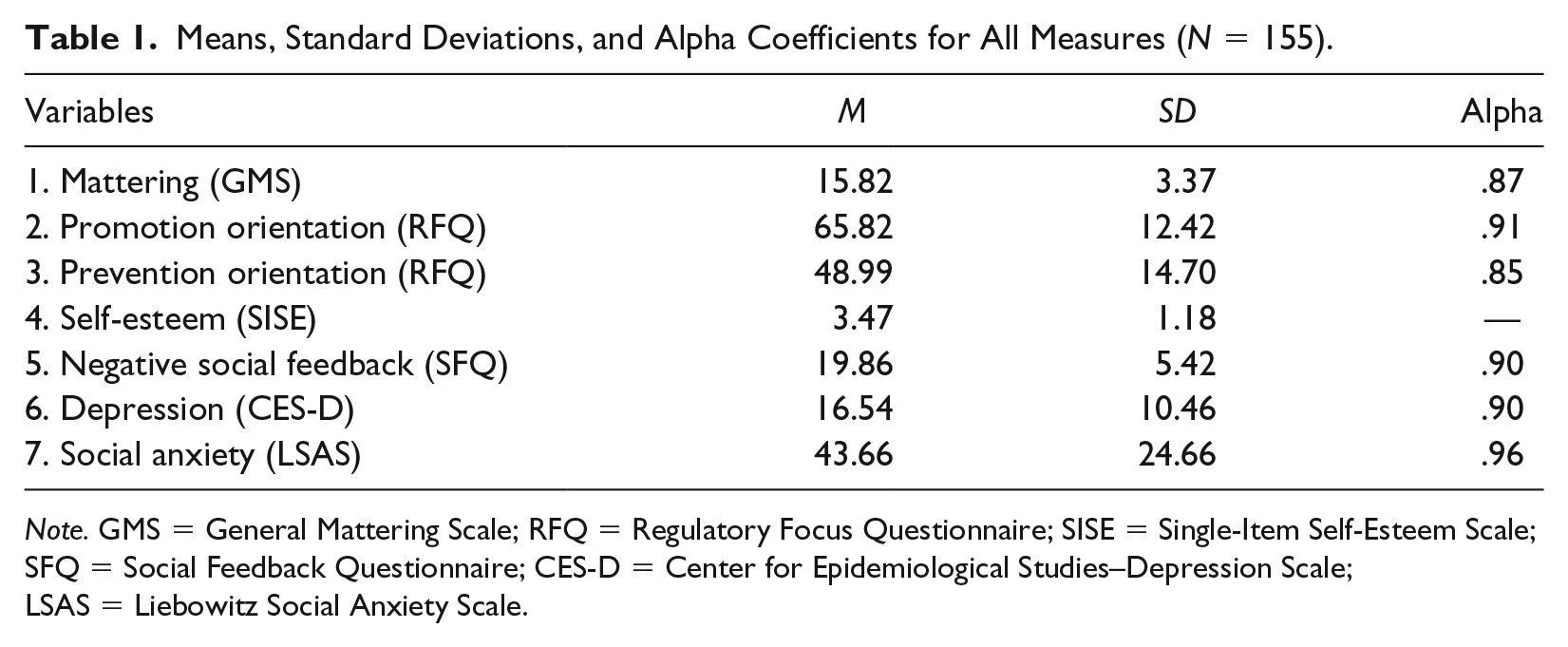
Note. GMS = General Mattering Scale; RFQ = Regulatory Focus Questionnaire; SISE = Single-Item Self-Esteem Scale; SFQ = Social Feedback Questionnaire; CES-D = Center for Epidemiological Studies–Depression Scale; LSAS = Liebowitz Social Anxiety Scale.
The General Mattering Scale (GMS)
This five-item scale measures the extent to which people perceive that they matter to others (Marcus & Rosenberg, 1987). A representative item is, “How much do others pay attention to you?” Items are rated on a scale ranging from 1 (a lot) to 4 (not at all). The possible score range for this scale is 5 to 20. The items were reverse coded, such that higher scores reflect higher perceptions of mattering. This measure is unidimensional with high internal consistency (Taylor & Turner, 2001).
Regulatory Focus Questionnaire (RFQ)
The RFQ is an 18-item scale with two subscales comprising nine items each: Promotion (e.g., “I frequently imagine how I will achieve my hopes and aspirations”) and Prevention (e.g., “I frequently think about how I can prevent failures in my life”; Lockwood et al., 2002). Items are rated from 1 to 9, with 9 representing very true of me. The possible score range for each subscale is 9 to 81, with elevated scores indicating elevated levels of promotion and prevention. Both subscales possess good internal consistency and construct validity (Lockwood et al., 2002).
Single-Item Self-Esteem Scale (SISE)
This scale comprises one item assessing global self-esteem (Robins et al., 2001). The single item is, “I see myself as someone who has high self-esteem” and it is rated on a scale ranging from 1 (strongly disagree) to 5 (strongly agree). A higher score on this measure indicates higher self-esteem. Research has established that this scale possesses good psychometric properties (Robins et al., 2001). The single-item measure was used to reduce the burden of the number of questionnaires for participants to complete because this was part of a larger study on personality and adjustment. In addition, to our knowledge, there has been no previous study examining the link between mattering and self-esteem with the single-item measure.
Social Feedback Questionnaire (SFQ)
The SFQ is a 15-item scale measuring perceptions of the receipt of inferential feedback from others (Dobkin et al., 2007). Respondents must rate each statement on a scale ranging from not at all to often, and prior to each statement, the phrase “People I talk to have given me this message” appears. Most sample items reflect negative experiences such as someone telling you “There must be something wrong with you” and “Your future is bleak.” However, a few items reflect positive experiences such as being told by someone “You are a good person.” The possible score range for the SFQ is 15 to 45, with greater scores reflecting a greater frequency of perceived negative social feedback. This scale is unidimensional with good psychometric properties (Dobkin et al., 2007).
Center for Epidemiological Studies–Depression Scale (CES-D)
The CES-D is a 20-item scale assessing the frequency of depressive symptoms over the past week (Radloff, 1977). Sample items include “I felt sad” and “My sleep was restless.” The possible score range for the CES-D is 0 to 60, with greater scores indicating a greater frequency of depressive symptoms. The psychometric properties of the CES-D have been established (Radloff, 1977).
Liebowitz Social Anxiety Scale (LSAS)
The LSAS is a 24-item measure assessing the frequency of social phobia in the areas of social interaction (e.g., “Going to a party”) and performance (e.g., “Speaking up at a meeting”; Liebowitz, 1987). Respondents rate how often they felt fear or anxiety, in addition to how often they avoided each activity over the past week. A total social anxiety score was used in the current study, which combines the sums of both fear or anxiety and avoidance. The possible score range for total social anxiety is 0 to 144, with higher scores reflecting higher levels of social anxiety. The LSAS possesses good reliability and validity (Liebowitz, 1987).
Results
Data Analytic Plan
Correlational analyses were first conducted to examine the links among the variables. Regression analyses were performed next to test the hypothesis that mattering would predict depression and social anxiety, over and above self-esteem and the motivational orientations of promotion and prevention. The normality of the outcome variables was examined prior to conducting these regression analyses. The distributions of both depression and social anxiety did significantly differ from normal. Consequently, the robust bootstrapping procedure was employed, which does not impose the normality assumption. In all, 2,000 bootstrap samples were generated to provide estimates, standard errors, and 95% bias-corrected confidence intervals (CIs). Lastly, a structural equation model was performed with AMOS Version 18 software using maximum likelihood estimation procedures to test the hypothesis that negative social feedback would mediate the link between low mattering and distress. To examine whether the indirect effect of low mattering on distress through negative social feedback was significant, 2,000 bootstrap samples were generated to obtain 95% bias-corrected CIs.
Descriptive Statistics
As noted earlier, the basic descriptive statistics for our sample are shown in Table 1. It is worth noting the obtained CES-D mean exceeds the cutoff of 16 that Radloff (1977) proposed as reflecting the presence of at least mild depression. The GMS mean was in keeping with the norms for the GMS reported in Flett (2018a).
Correlational Analyses
Table 2 displays the correlations among mattering, promotion, prevention, self-esteem, negative social feedback, depression, and social anxiety. Mattering was positively correlated with the promotion orientation, but not with the prevention orientation. In contrast, self-esteem was correlated with both types of regulatory focus. It is noteworthy that mattering, relative to self-esteem, had a significantly stronger association with the promotion orientation (z = 1.76, p < .05). Mattering was also associated with greater self-esteem, and reduced negative social feedback, depression, and social anxiety. Self-esteem was associated with reduced negative social feedback, depression, and social anxiety.
Correlations Among the Variables (N = 155).
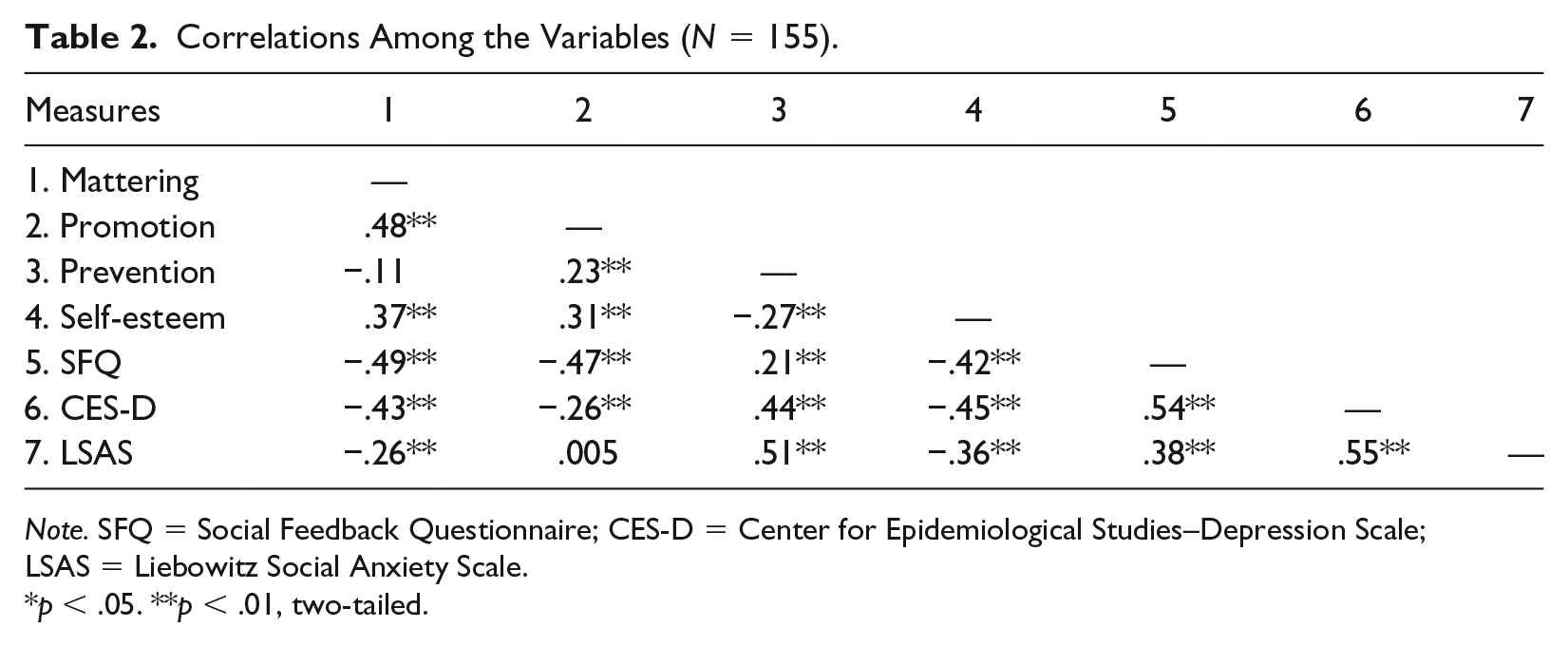
Note. SFQ = Social Feedback Questionnaire; CES-D = Center for Epidemiological Studies–Depression Scale; LSAS = Liebowitz Social Anxiety Scale.
p < .05. **p < .01, two-tailed.
The promotion orientation was associated negatively with depression, but not with social anxiety. In contrast, the prevention orientation was positively associated with both depression and social anxiety. Finally, negative social feedback was linked with elevated depression and social anxiety. Negative social feedback was also robustly and negatively linked with the promotion orientation and positively associated, albeit to a lesser extent, with the prevention orientation.
A partial correlation was performed to test whether mattering was still significantly linked with a promotion orientation, after controlling for self-esteem. The results revealed that mattering was indeed still robustly correlated with the promotion orientation (r = .41, p < .001).
Regression Analyses
Next, two hierarchical multiple regression analyses were performed. These analyses were conducted to examine which variables are important in uniquely predicting depression and social anxiety with the particular goal of establishing the unique predictiveness of mattering. The first regression was conducted with self-esteem and both motivational orientations entered into the first predictor block, with mattering entered into the next predictor block, and with depression entered as the outcome (see Table 3). The results revealed that the motivational orientations and self-esteem predicted 37.6% of the variance in depression scores, F(3, 151) = 30.35, p < .001. Mattering predicted an additional 3.4% of the variance in depression scores, F(4, 150) = 26.06, p < .001. All the variables were significant unique predictors of depression: Mattering, promotion, and self-esteem were negatively linked with depression, whereas prevention was positively linked with depression.
Multiple Regression Results for Variables Predicting Depression.

Note. R² = .376 for Step 1, ∆R² = .034 for Step 2. CI = confidence interval.
p < .05. **p < .01. ***p < .001.
The next regression was conducted with the same variables entered as predictors and with social anxiety entered as the outcome (see Table 4). The motivational orientations and self-esteem predicted 31% of the variance in social anxiety scores, F(3, 151) = 22.64, p < .001. Mattering predicted an additional 1.9% of the variance in social anxiety scores, F(4, 150) = 18.38, p < .001. Regarding the individual predictors, prevention was positively linked with social anxiety and self-esteem was negatively linked with social anxiety. Collectively, these regression analyses demonstrated that mattering predicts both depression and social anxiety, over and above promotion, prevention, and self-esteem.
Multiple Regression Results for Variables Predicting Social Anxiety.

Note. R² = .310 for Step 1, ∆R² = .019 for Step 2. CI = confidence interval.
p < .01. ***p < .001.
Mediation Analysis
A structural equation model was tested to investigate whether negative social feedback mediates the association between low mattering and psychological distress (see Figure 1). In this model, mattering was the predictor, negative social feedback was the mediator, and a latent distress variable comprising depression and social anxiety was the outcome. This model was an excellent fit, χ²(1) = 0.48, p = .491, comparative fit index (CFI) = 1.00, Tucker–Lewis index (TLI) = 1.02, standardized root mean square residual (SRMR) = 0.01, root mean square error of approximation (RMSEA) = 0.00, 90% CI = [0.00, 0.19], pclose = .568. Mattering was negatively linked with negative social feedback, which was, in turn, related to greater distress. Mattering was still negatively related to distress after taking into account the mediator. The 95% CI for the mediated effect of low mattering on distress through negative social feedback was [−1.15, −0.37]. Because this interval does not contain zero, the indirect effect is considered significant. Therefore, negative social feedback mediated the relation between low mattering and distress.

Mediational model of mattering, negative social feedback, and distress.
Discussion
The current study was conducted to extend what is known about the mattering construct in several respects, as well as furthering our understanding of the role of individual differences in mattering among university students, including many students who are coping with mental health issues. Most notably, one of the unique contributions of this research is that the association between mattering and regulatory focus was established. In addition, the ability of individual differences in mattering to predict unique variance in psychological distress was evaluated when mattering was pitted against other established predictors of psychological distress (i.e., self-esteem and the prevention and promotion orientations). Finally, a structural equation model was performed to assess whether a factor that taps a negative inferential style involving the perception of negative social feedback directed at the self mediated the association between low mattering and psychological distress in university students.
As expected, in terms of the association with regulatory focus, our results showed that mattering was indeed robustly correlated with the promotion orientation, such that greater levels of mattering were linked with greater levels of a promotion orientation. However, mattering was not significantly correlated with a prevention orientation. Moreover, this association between mattering and the promotion orientation remained significant after controlling for self-esteem, which is a recognized antecedent of regulatory focus (see, for instance, Lanaj et al., 2012). Thus, the relation between mattering and promotion was not simply due to their respective associations with self-esteem. The pattern of correlations involving mattering and self-esteem further highlighted their distinctiveness. For example, whereas mattering was associated with promotion but not prevention, self-esteem was associated jointly with elevated levels of promotion and diminished levels of prevention. Overall, our results suggest that mattering deserves consideration as an antecedent of regulatory focus. It can be inferred that interactions with people who convey that they care and make a young person feel valued and significant seem to be a positive motivational orientation that should foster resilience and positive forms of striving behavior. It is reasonable to conclude that people high in mattering pursue self-regulation promotion goals and, as suggested by Klenk et al. (2011), they are focused on making good things happen and reacting with happiness when they do happen and sadness when they do not happen.
The current work begins to address the paucity of research on the motivational aspects of individual differences in mattering, but clearly, more research is needed. The present research focused on general motivational orientations, and it would be fruitful in future research to examine motivational variables specific to the academic context, as well as the social context.
A robust test of mattering was whether individual differences in levels of mattering could predict unique variance in psychological distress when pitted against other protective factors (i.e., self-esteem and motivational orientations). It was found that once other predictors had been included in the regression analyses, mattering was still able to predict unique variance in both depression and social anxiety. The additional variance predicted by mattering was relatively low and, thus, it is evident that there is still significant variance remaining to explain, suggesting that other predictors need to be considered. Although some past research has established that mattering can predict significant unique variance in depression beyond self-esteem (e.g., DeForge et al., 2008; Marshall, 2001; Rosenberg & McCullough, 1981), to our knowledge, this is the first study to assess this issue with the highly content valid single-item self-esteem measure being used as the self-esteem scale and with promotion and prevention orientations included, as well. The regression results involving social anxiety are in keeping with previous research demonstrating that mattering is uniquely linked with social anxiety, after controlling for the Big Five personality domains (Flett, Goldstein, et al., 2016). Collectively, these results have important implications on several levels. For instance, the results are consistent with our contention that the feeling of not mattering is a specific vulnerability that is actually the core vulnerability for certain people who are prone to the experience of psychological distress. At a more general level, these results represent an illustration of the need for the positive psychology field to expand by incorporating a strong focus on the potentially protective role of feelings of mattering. Future research in the positive psychology area could also include self-compassion, which has been associated positively with mattering (Joeng & Turner, 2015), but has not yet been assessed with promotion and prevention orientations or perceived negative social feedback, to our knowledge.
Our correlational results with the SFQ also suggested that low feelings of mattering are linked with a negative inferential style in social support situations that contributes to feelings of helplessness, hopelessness, and depressive symptoms. People who have a diminished sense of mattering to others, relative to people who feel like they matter, tend to perceive and report a history of receiving unsupportive feedback from others following the experience of life events. This negative cognitive style and the inferences about social feedback comprising it could quite conceivably exacerbate feelings of not mattering and reacting in ways that prolong or exacerbate distress.
A structural equation model was then evaluated to test whether this negative inferential style would mediate the link between low mattering and distress. In this model, mattering was the predictor, negative social feedback was the mediator, and a latent distress variable comprising depression and social anxiety was the outcome. This model was an excellent fit and demonstrated that reports of negative social feedback directed at the self did indeed mediate the relation between low mattering and distress. These findings point to the need to conduct future longitudinal research that evaluates whether negative social feedback mediates the link between low mattering and distress over time. Perhaps future research should also explore the possibility that the relation between low mattering and negative social feedback is bidirectional. In addition, research is needed on the actual social experiences of university students with low reports of mattering to assess whether feelings of not mattering are reflected in actual social exchanges.
The results from this study have several additional implications. For instance, theories in the mattering literature should be expanded to include a stronger emphasis on cognitive processes and structures and motivational orientations. Further research is needed on mattering from a motivational perspective, and a scale measuring the motivation to matter would be a way to advance our understanding of this important construct (for a related discussion, see Flett, 2018a). Our findings also have clinical and counseling implications. It would be important in counseling to make university students feel like they matter, particularly those with a history of being treated as though they do not matter. Promotion-focused clinical interventions as well as interventions that target perceptions of negative social feedback could be used to help improve the well-being of people who feel like they do not matter. Possible interventions are discussed at length in Flett (2018b) and Flett et al. (2019).
The limitations of the current study must be acknowledged. This study was cross-sectional and, therefore, it cannot be determined whether there are any causal or longitudinal associations between mattering and promotion orientation, negative social feedback, depression, and social anxiety. All the measures in this study were based on self-reports that are potentially susceptible to response bias. Future research should use more objective measures, such as physiological indicators of distress. In addition, this research was conducted with a convenience sample of primarily female university students. Given the gender imbalance, potential gender differences could not be explored. Future work should be conducted with clinical and community samples in various cultures, with a wide range of age groups, and a gender balance to assess the generalizability of our findings.
In summary, the results of the current study demonstrated uniquely that mattering is associated with a regulatory focus characterized by an emphasis on promotion but not prevention, and this attests to the potential usefulness of viewing the mattering construct from a motivational perspective and conducting additional research on mattering and motivation. This study also suggested that feelings of mattering protect students from experiencing depression and social anxiety, and this may be due, at least in part, to the fact that feelings of not mattering in students were linked with a negative inferential style that emphasizes previous unsupportive social exchanges after experiencing stressful situations. Given the pattern of findings that emerged from this research, it seems that the promotion of feelings of mattering has significant potential in terms of enhancing well-being and limiting the experience of psychological distress. It has been suggested recently that the promotion of mattering is worth considering by colleges and universities seeking to enhance the well-being of college students and university students (Flett et al., 2019), and students who develop a sense of mattering will most likely have the kind of positive motivational orientation that leads to a sense of engagement and literally “staying the course” when difficult challenges are experienced.
Footnotes
Declaration of Conflicting Interests
The author(s) declared no potential conflicts of interest with respect to the research, authorship, and/or publication of this article.
Funding
The author(s) disclosed receipt of the following financial support for the research, authorship, and/or publication of this article: The first author was supported by a Canada Research Chair in Personality and Health.
