



Abstract
This investigation (1) elucidates genuine interest in the context of learning from Dewey’s perspective, (2) assesses construct validity evidence for a genuine interest conceptual model using data from the Factors Effecting Ethics Learning survey, and (3) assesses measurement invariance of the genuine interest constructs between male (n = 352) and female (n = 188) Taiwan high school students. Results provide support for genuine interest as a two-dimensional construct. Second-order factor analysis shows that latent variables of genuine interest in learning socio-scientific issues and interpersonal communication ethics-related issues are represented by sub-latent constructs of learning interest and learning enjoyment. Assessment of gender invariance in the conceptual model provides evidence of measurement equivalence.
A recurrent and apparently systemic problem within formal education is students’ lack of interest in classroom learning (Dewey, 1903; Jack & Lin, 2014, 2017). This situation is especially acute among students studying science subjects (Jack & Lin, 2017; Potvin & Hasni, 2014) and the teaching of ethics-related issues (e.g., Reynolds, 2008). Mediating positive change of interest from absence to engagement in such classroom subjects necessitates a learning ecology conducive to students’ need to experience (1) positive emotion states (e.g., satisfaction, accomplishment, and enjoyment) and (2) cognition of how the content of learning is meaningfully relevant to their natural and acquired personal interests and knowledge schema (Jack & Lin, 2018; Ng, Bartlett, & Elliott, 2018). However, absent from copious extant investigations assessing students’ enjoyment and interest in learning is the exploration of a potential second-order interest construct of genuine interest as an emergent property from the sub-latent constructs of interest and enjoyment. This absence has potential implications in terms of how current notions of interest and the resulting measurement of interest are conceptualized—namely, that potential sources of construct irrelevant variance may be inherent in such models due to (1) lack of consideration of how emotional elements (such as enjoyment) are involved or (2) how distinct subgroups (such as gender subgroups) might vary in how they understand and respond to instruments intended to measure a genuine interest construct. Consideration of these sources of invariance would align with recommendations from the Standards for Educational and Psychological Testing (AERA, APA, & NCME, 2014), in that, any resulting increased predictive capacity afforded by such consideration strengthens validity inference and can facilitate meaningful and practical guidance in the field. The extent to which such construct irrelevant variance might meaningfully be accounted for also would align with contemporary notions of validity (e.g., Cook, Brydges, Ginsburg, & Hatala, 2015; Kane, 2013), which focuses on the importance of inferences made from test scores as evidence of validity. Thus, this study purposes to extend understanding of the genuine interest construct by: (1) constructing a measurement model for genuine interest, (2) examining the fit of this model to data obtained from the FEEL (Factors Effecting Ethics Learning) survey (Jack, 2018) collected from grade 10 (15-year-old) Taiwan students, and (3) evaluating the measurement invariance (MI) of the constructs between traditionally recognized genders.
Literature Review
Genuine interest in learning has been documented in education literature since the 19th century (e.g., Chang, 2014; Dewey, 1903; Jack & Lin, 2018; Pierson, 1999). Earlier philosophers of education such as Johann Friedrich Herbart (Forghani-Arani & Anne, 2012) and John Dewey (Jonas, 2011) were keen to emphasize the critical importance of nurturing students’ genuine interest in learning as an educational goal. Describing his perspective of genuine interest, Dewey (1903) states: “Genuine interest in education is the accompaniment of the identification, through action, of the self with some object or idea, because of the necessity of that object or idea for the maintenance of self-expression” (p. 12). As well, Dewey states: “Genuine interest, according to the Herbartians, is always immediate; absorbed, that is, in the value of the object. It is involuntary—that is, precedes, and is independent of, the awakening of any desire” (p. 28).
These two perspectives describe genuine interest as (1) a cognitive expression of identification and (2) an immediate and involuntary emotional response to an object or idea. Concerning pleasure in characterizing “legitimate” (i.e., genuine) interest, Dewey states: [Pleasure] is the accompaniment of activity. It is found wherever there is self-expression. It is simply the internal realization of the outgoing energy. This sort of pleasure is always absorbed in the activity itself. It has no separate existence in consciousness. This is the type of pleasure found in legitimate interest (p. 11).
This study posits that Dewey’s notion of genuine (i.e., legitimate) interest reflects a correlation of learning interest (attention) and learning enjoyment (emotion) independent of external coercion for learning involvement. No study to date has empirically evaluated support for a latent construct of an emergent genuine interest, as such interest was understood by Dewey. The following section provides a theoretical framework that is congruent with Dewey’s notion of genuine interest.
Theoretical Framework
In this section, interest and emotion are first outlined, followed by delineation of Dewey’s notion of genuine interest in the context of learning.
Interest and Emotion
Interest
Interest arises from a desire to engage information content or an activity in pursuit of the learning itself. A crucial aspect of learning interest is attention. Ribot (1903) defines attention as “the momentary inhibition, to the exclusive benefit of a single state, of this perpetual progression” toward focus (p. 4). Ribot’s idea is that attention momentarily directs and unifies mental energies into an undistracted state of absorption. As Dewey (1913) states, “Attention is never directed to the essential and important facts, but simply to the attractive wrappings with which the factors are surrounded” (p. 5). Within such a mind state, any meaningful relevance associated with the student to present material facts and conditionals can color their learning interest as either a positive or negative experience. Meaningful (-ness) is here understood as an extension by significance of a recognized personal value. Relevance in this context is understood as recognition of connection. Learning that is understood by the student as meaningfully relevant is therefore learning that adds some significant value to (i.e., provides a recognizable connection with) their personal life (Jack & Lin, 2017).
Emotion
Enjoyment arises from the exhilaration one feels from an experience sufficient to arouse cognitive impression(s) of previous subjective states of happiness during learning. Skidelsky (2017) differentiates “happy” from “enjoyment” in the following example, wherein he states: Reading a succession of reports on a parliamentary drama as it unfolds can evoke the same feelings of tension and relief that one would feel were one there in person, and so can be said to constitute an “experience” of that drama. The same could not be said for a single summary report, although it might contain exactly the same information. This latter might suffice to make one happy about the affair, but only the former could provide enjoyment of it. (p. 441)
According to Skidelsky, “enjoyment” differs from “happiness” in how the descriptor used contextualizes emotion to a frame of time. Shidelsky’s phrase “evoke the same feelings” refers to the recall of how happy one felt during some associated prior experience. The memory of the “happy” experience/s carries a value potential for motivating a person forward in anticipation and expectation of duplicating, repeating, or continuing this previous “happy” perceptual state.
Arnold (1960) states “Emotion follows only upon a judgment that ‘this particular thing is good or bad for me here and now,’ whether this judgment is intuitive or reflective” (p. 310). Positive learning emotion can thus be understood as an encounter, either intuitively derived in the moment of an activity or from deliberate reflection (i.e., contemplation), of an experience previously perceived or judged by the student as a personal good. From this perspective, negative learning emotion can be contrarily understood as an encounter, either intuitively derived in the moment of an activity or from deliberate reflection (i.e., contemplation), of an experience previously perceived or judged by the student as lacking a personal good. The investigators of this study posit that these two opposed poles of judgment potential (i.e., being good or not being good to self) convey postures of meaningful relevance students hold toward objects and activities of learning.
Dewey’s Notion of Genuine Interest
Addressing issues involved with students’ lack of interest in classroom learning requires critical examination of how a more relevant construct of genuine interest can be conceptualized, and consideration of how both interest (as reflected by self-directed attention) and enjoyment (as reflected by spontaneous emotional arousal) can contribute to this understanding. Dewey’s notion of genuine interest (1903, 1913) provides grounding for this examination. Modeled on these ideas, this study posits that Dewey’s notion of genuine interest can be formulated such that: Interest in learning is genuine iff it is enjoyably satisfying.
Signified by the above proposition is that self-directed attention (i.e., interest; e.g., volitional focus) or emotional arousal (i.e., the felt sense of happiness and pleasure; e.g., attraction) separately are insufficient to generate genuine interest in learning. Investigators of this study posit that a genuine interest in learning which is reflective of Dewey’s sense of legitimate interest is evoked if and only if (iff) there exists a correspondence between self-directed attention and spontaneous arousal of felt (i.e., emotion-based) satisfaction.
Previous studies have used narrative in describing how genuine interest reflects a presence of a simultaneous interest and/or enjoyment within positive learning experiences (e.g., Brophy, 2008; Chang, 2014; Jack & Lin, 2018; McPhail, Pierson, Goodman, & Bunge Noffke, 2004; Swarat, Ortony, & Revelle, 2012; Xu, Coats, & Davidson, 2012). However, no studies have attempted empirical validation of Dewey’s notion of genuine interest by structural analytic assessment of how data collected from survey items support the same sub-constructs of interest and enjoyment and whether measurement of genuine interest is uniform across specific heterogeneous groups.
Investigation of gender inequality in achievement and student attitude toward learning STEM (science, technology, engineering, and mathematics) at the primary and secondary education levels continues to be of concern to educational professionals and policy makers throughout the world (UNESCO, 2018). Pushback against this inequality in STEM-related learning has helped to propel improvement of survey instruments for a stronger understanding of the learning needs, perceptions, and attitudes of boys and girls toward these subjects. Data collected from the FEEL survey assist in this effort by establishing and making measurably transparent boys’ and girls’ genuine interest in learning socio-scientific issues specific to contemporary developments in science and technology.
Another element of concern among educational professionals and policy makers is the social and emotional development of students (Grant et al., 2017). In an evidence-based study from the RAND Corporation, Grant et al. state: “Among educators and researchers, there is a growing acknowledgement that student success depends not only on achievement in core academic subjects but also on learning a broader range of intrapersonal and interpersonal competencies” (p. ix). Data collected from the FEEL survey assist in this effort by establishing and making measurably transparent boys’ and girls’ genuine interest in learning issues related to interpersonal competencies.
As MI is such a critical and fundamental first step to a valid statistical demonstration of uniformity or “fairness and equity” (Kim & Kamphaus, 2018) in measures of students’ attitudes, this study focused on traditional gender grouping distinction for heterogeneous significance.
Thus, this study extends beyond narrative descriptions of genuine interest by: (1) proposing a statistical model of genuine interest consisting of second-order latent factors, where each is supported by two first-order latent subscales, that is, (a) interest and (b) enjoyment; (2) testing the adequacy of this model using data collected from Taiwan high school students using the FEEL survey (Jack, 2018); and (3) assessing MI of the genuine interest constructs by gender.
Research Questions
Does the measurement model demonstrate a good statistical fit to data from 10th grade Taiwan students? Does the measurement model demonstrate MI between genders?
Methodology
Participants
Data from N = 540 10th grade (15-year-old) Taiwan students from three metropolitan university preparatory high schools in southern Taiwan were used. Three hundred fifty-two (65.19%) students identified themselves as men; 188 (34.81%) students identified themselves as women; and no other self-identified sex- or gender-related types were reported. Among the 352 male students, majors of study were engineering (n = 156) and engineering and biology (n = 196). Among the 188 female students, majors of study were engineering (n = 60) and engineering and biology (n = 128).
FEEL Survey
FEEL Survey Items and Subscales.

Note. FEEL = factors effecting ethics learning; ISSI = interest in socio-scientific issues; ESSI = enjoyment from socio-scientific issues; IICI = interest in interpersonal communication issues; and EICI = enjoyment from interpersonal communication issues. † = Item was referred to in a study by Tsai & Jack (2019).
Ethics
Taiwan adheres to a centralized set of ethics guidelines that all researchers are required to follow. The funding agency for the FEEL survey data collection did not require investigators to submit a research plan to a nationally centralized ethics board for the approval of this study.
Construct Validation
This study employed confirmatory factor analysis (CFA) to assess construct, discriminant, and convergent validity evidence for the FEEL survey by fitting and comparing a series of competing models. Chi-square statistics were computed for each fitted model. However, because the chi-square statistic is known to be sensitive to large sample sizes (e.g., Hu & Bentler, 1999), we applied four alternative criteria to assess the goodness of fit of the GIM conceptual model to the FEEL survey data: (1) root mean square error of approximation (RMSEA ≤ .06; Steiger & Lind, 1980), (2) nonnormed fit index (NNFI ≥ .90; Tucker & Lewis, 1973), (3) comparative fit index (CFI ≥ .90; Bentler, 1990), and (4) McDonald’s noncentrality index (McDonald’s NCI ≥ .90; Hu & Bentler, 1999). The results from a comparison of these competing confirmatory models (see Figure 1) were used to answer research question 1. Conceptual models.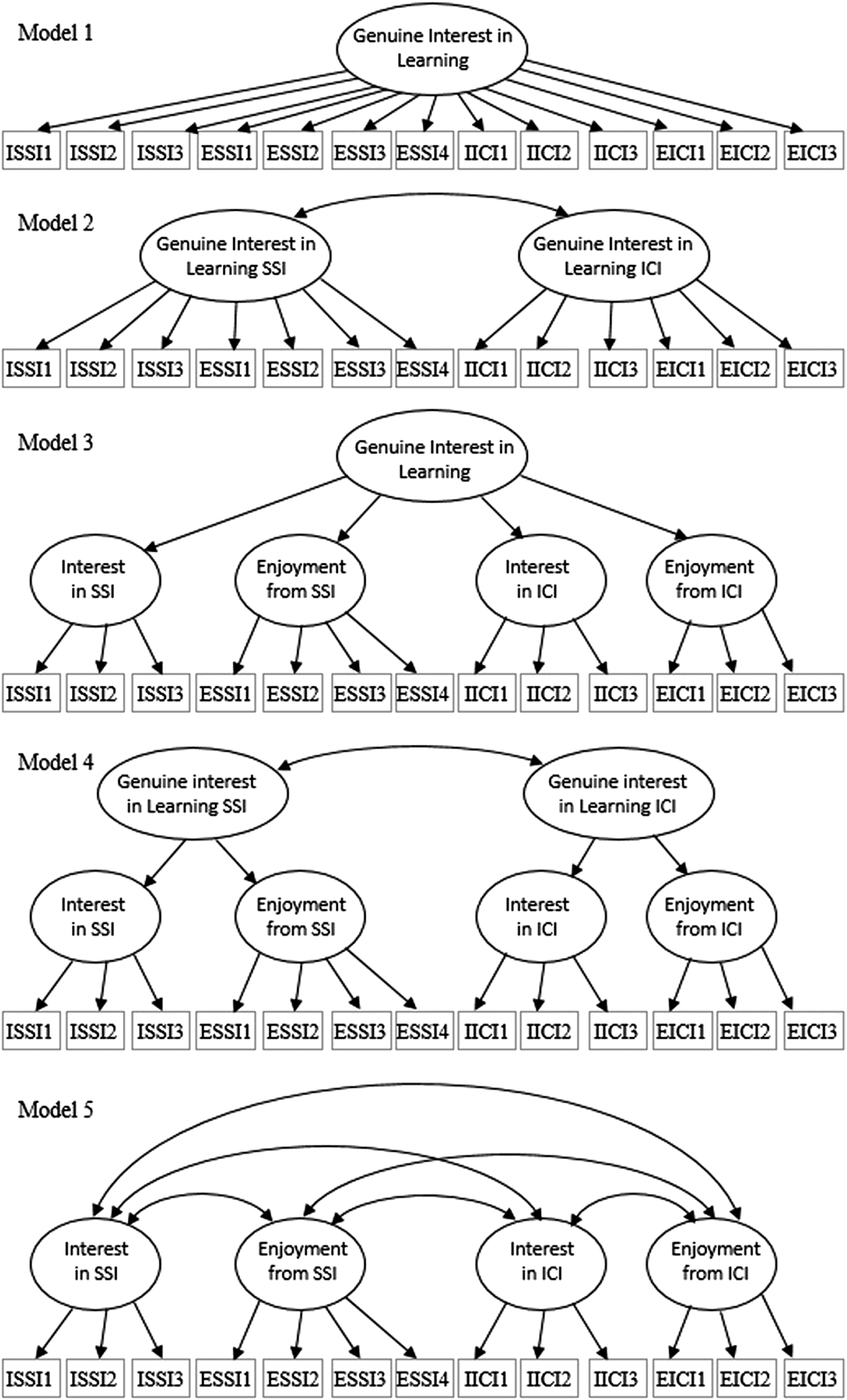
Second, MI analysis was used to determine if the FEEL survey items representing the hypothesized latent constructs were measured equivalently across genders. To assess gender invariance, a set of increasingly constrained, nested measurement models were fitted to the data, where these models represented configural invariance, metric invariance, scalar invariance, and residual error invariance (Dimitrov, 2010). As recommended by Cheung and Rensvold (2002), in addition to comparing models by assessing the statistical significance of the observed difference in the chi-square statistic (Δχ2), we assessed whether the observed change in the CFI (ΔCFI) exceeded .01 as evidence of lack of invariance. The MI analyses results were used to answer research question 2. All analyses were carried out using the lavaan package (Rosseel, 2012) in R.
Results
Descriptive statistics did not reveal evidence of excessive nonnormality for either single data or two group (gender class) data. Skewness: Mdn (median) = −.37, range = −.63 to .12; kurtosis: Mdn = .07, range = −.98 to .99. For group samples, skewness: Mdn = −.47 and −.16, Min (minimum) = −.61 and −.62, Max = .15 and .12; kurtosis: Mdn = .19 and −.13, Min = −1.05 and −.80, and Max (maximum) = 1.08 and .89.
CFA
Chi-square and Goodness-of-Fit Statistics for First- and Second-Order Models.
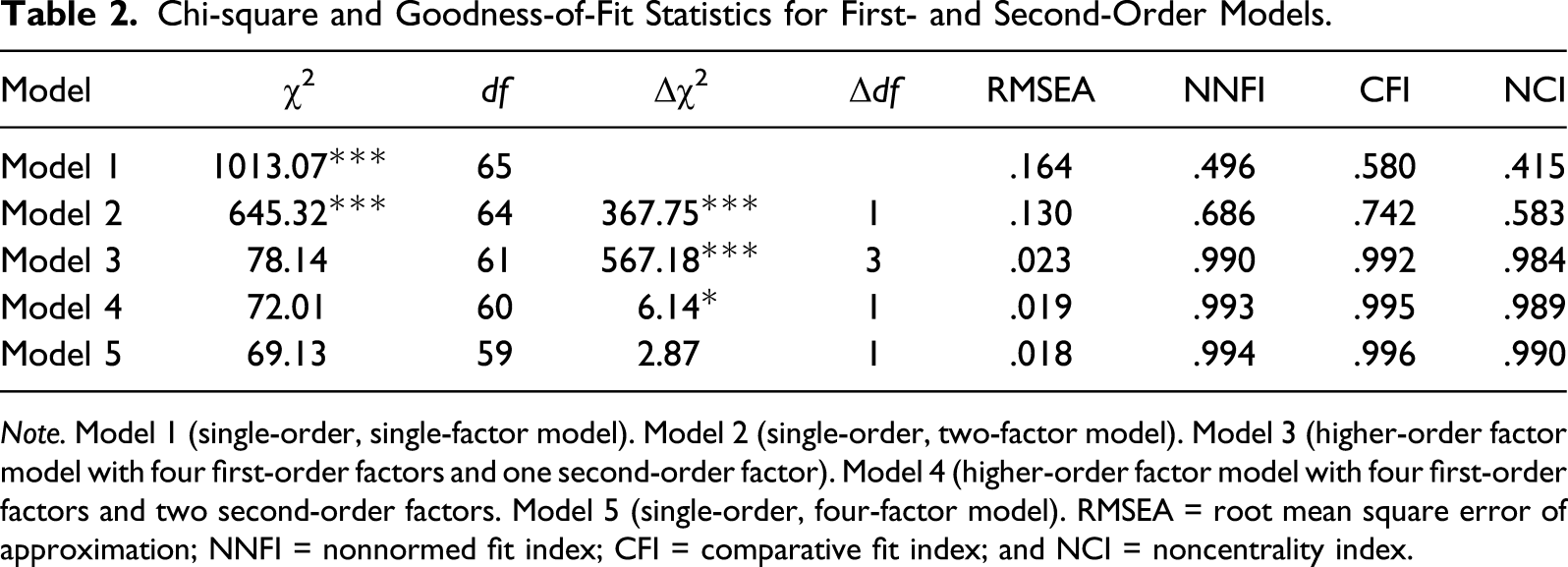
Note. Model 1 (single-order, single-factor model). Model 2 (single-order, two-factor model). Model 3 (higher-order factor model with four first-order factors and one second-order factor). Model 4 (higher-order factor model with four first-order factors and two second-order factors. Model 5 (single-order, four-factor model). RMSEA = root mean square error of approximation; NNFI = nonnormed fit index; CFI = comparative fit index; and NCI = noncentrality index.
The second fitted model (Model 2) was a two first-order factors model specifying that all socio-scientific issue items were loaded onto a single first-order latent factor, and all interpersonal communication issue items were loaded onto another single first-order latent factor. Results for Model 2 revealed a better fit than Model 1 but still not acceptable to the data, with χ2(64) = 645.32, p < .001; CFI = .742, NNFI = .686, NCI = .583, and RMSEA = .0130. Compared to Model 1, however, Model 2 showed a statistically significant improvement in model fit [Δχ2(1) = 367.75, p < .001].
The third fitted model (Model 3) was a second-order factor model specifying that four first-order latent factors (described in Table 1) were loaded onto a single second-order latent factor (genuine interest). Results for Model 3 revealed a good fit to the data, with χ2(61) = 78.14, p = .069; CFI = .992, NNFI = .990, NCI = .984, and RMSEA = .023. Compared to Model 2, Model 3 showed a statistically significant improvement in model fit [Δχ2(3) = 567.18, p < .001].
The fourth fitted model (Model 4) was a second-order factor model with two second-order factors. This model specified that the ISSI and the ESSI first-order latent factors were loaded onto the second higher-order factor GI-SSI. The IICI and the EICI first-order latent factors loaded were onto the second higher-order factor GI-ICI. Similar to Model 3, this model showed a good fit to the data, with χ2(60) = 72.01, p = .138; CFI = .995, NNFI = .993, NCI = .989, and RMSEA = .019. Additionally, compared to Model 3, Model 4 showed a statistically significant improvement in model fit [Δχ2(1) = 6.14, p < .05], indicating Model 4 as consistent with the data and supportive of the structural validity of the GIM.
Finally, a single-order factor model (Model 5) positing four latent constructs (ISSI, ESSI, IICI, and EICI) was fitted to the data. This model showed a good fit to the data, with χ2(59) = 69.13, p = .172; CFI = .996, NNFI = .994, NCI = .990, and RMSEA = .018. Compared to Model 4, however, Model 5 did not demonstrate a statistically significant improvement in model fit [Δχ2(1) = 2.87, p = .090]. Thus, evidence supported Model 4, a model that describes genuine interest in learning interpersonal communication and socio-scientific issues as represented by four first-order factors and two second-order factors, as best representing the data.
Figure 2 shows the final fitted estimates for Model 4. Each factor loading differed significantly from zero, providing evidence for convergent validity (Graham, Guthrie, & Thompson, 2003). Discriminant validity was assessed by comparing (1) a model in which the correlation between GI-SSI and GI-ICI was constrained to unity, with (2) a model in which the correlation was freely estimated (Anderson & Gerbing, 1988). Results showed a statistically significant difference (∆χ (1)2 = 6.14, ∆df = 1, p < .05), demonstrating that the two latent constructs measured distinct yet related constructs. This test is equivalent to the comparison of Models 3 and 4 presented previously. Additionally, a 95% confidence interval for the correlation between second-order factors was (.602 and .928), which affirmed that these factors were psychometrically distinct. Higher-order factor model with two second-order factors (model 4) showing standardized factor loadings, inter-factor correlation, factor variances, and residual variances.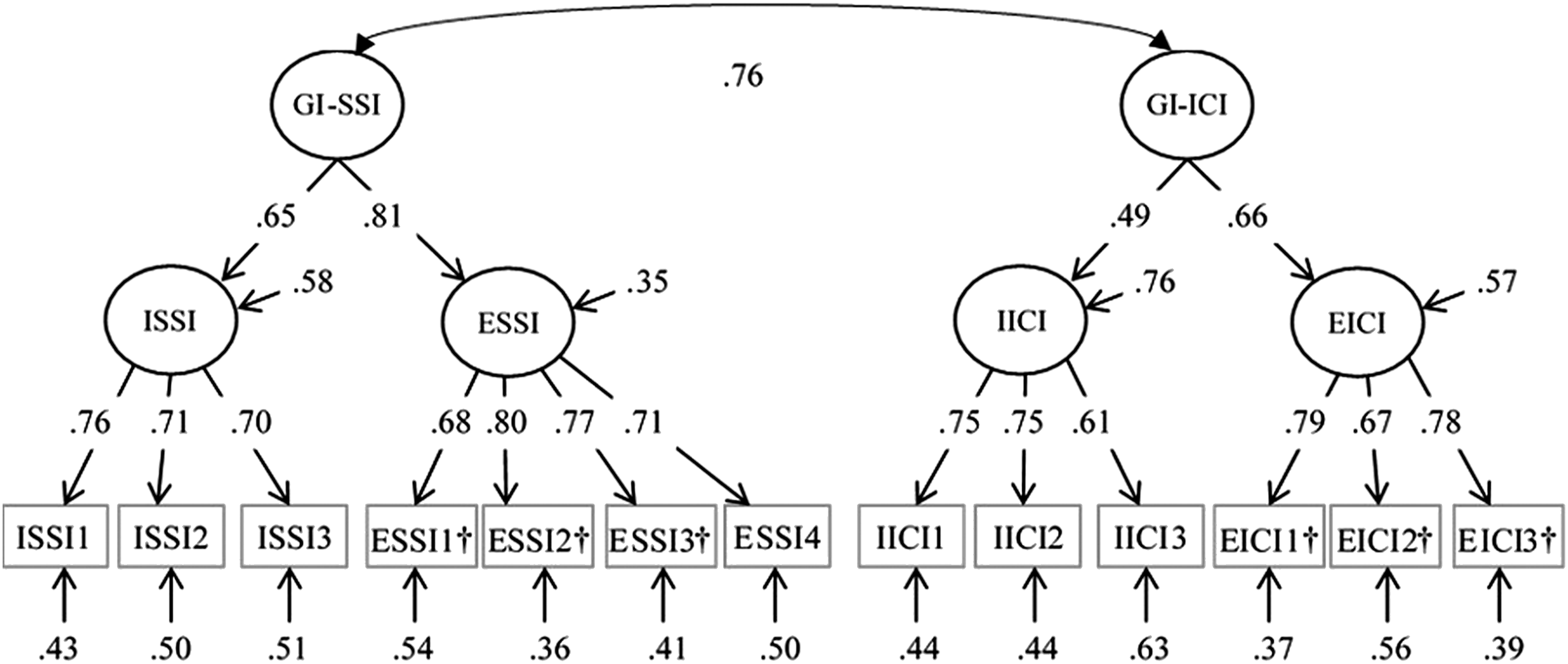
The results from these confirmatory models provide support for the structural, discriminant, and convergent validity of the second-order GIM model configuration (Figure 2) fitted to the FEEL survey data.
MI
Goodness-of-Fit for Models Testing Invariance for Gender.

Notes. *p < .05, **p < .01, ***p < .001. T1 = configural invariance, T2 = metric invariance (first-order factors), T3 = metric invariance (second-order factors), T4 = scalar invariance (first-order factors), T5 = scalar invariance (second-order factors), T6 = residual invariance (first-order factors), and T7 = residual invariance (observed indicators). RMSEA = root mean square error of approximation; NNFI = nonnormed fit index; CFI = comparative fit index; and NCI = noncentrality index.
Changes in Goodness-of-Fit Statistics across Levels of Invariance.

Note. T1 = configural invariance, T2 = metric invariance (first-order factors), T3 = metric invariance (second-order factors), T4 = scalar invariance (first-order intercepts), T5 = scalar invariance (second-order intercepts), T6 = residual invariance (first-order factors), and T7 = residual invariance (observed indicators). CFI = comparative fit index; and NCI = noncentrality index.
Evaluation of the model representing configural invariance (Model T1) assesses the hypothesis that a common factor structure holds across gender—that is, each group has the same number of dimensions and patterns of factor loadings. Results from the configural model [χ2(120) = 151.51, p < .05; CFI=.986, NNFI = .982, NCI= .971, and RMSEA = .031] support the notion of configural invariance by gender for the GIM.
Models representing metric invariance by gender for first-order (Model T1) and second-order (Model T2) factors next were assessed. Beginning with a configurally invariant model, Model T2 further constrained the model by constraining the first-order factor loadings to be equal across groups. Results from Model T2 showed a good fit to the data [χ2(129) = 160.59, p < .05; CFI=.986, NNFI = .983, NCI= .971, and RMSEA = .042],and a comparison between Models T2 and T1 showed no statistically significant change in the chi-square statistics [∆χ2(9) = 9.08, p = .430], with a decline of ΔCFI and ΔNCI values less than the cutoff values (∆CFI ≤ .01, ΔNCI ≤ .0082) recommended by Cheung and Rensvold (2002) and Meade, Johnson, and Braddy (2008), respectively. Similarly, when the additional constraints representing metric invariance of the second-order factors were introduced (Model T3), the model showed a good fit to the data [χ2(131) = 160.75, p < .05, CFI=.987, NNFI = .984, NCI= .973, and RMSEA = .029], with no statistically significant [∆χ2(2) = .16, p = .925] change in the chi-square statistics and no substantial change in the relevant fit indices (CFI and NCI). This means that the metric invariance was supported for the first-order and second-order factors.
Scalar invariance for first-order factors next was tested by additionally constraining first-order item intercepts for the observed items to be equivalent across groups (Model T4). This model demonstrated a good fit to the data [χ2(136) = 168.07, p < .05; CFI = .986, NNFI = .984, NCI = .971, and RMSEA = .030], with no statistically significant [∆χ2(5) = 7.32, p = .198] or substantial [∆CFI = .001, ΔNCI = .002] change in the relevant fit indices. Similarly, additional constraints imposed to equate the origins of the second-order factors (Model T5) resulted in a well-fitting model [χ2(138) = 168.21, p < .05; CFI = .987, NNFI = .985, NCI = .972, and RMSEA = .028], and there is no statistically significant [∆χ2(2) = .15, p = .929] change in the relevant fit indices, and changes in the fit indices did not exceed the aforementioned criteria. Results from Models T4 and T5 thus provided evidence of gender scalar invariance of the FEEL survey constructs.
Investigators next tested whether the residuals of first-order items were equal across the groups (Model T6). This model showed a good fit to the data [χ2(149) = 186.00, p < .05; CFI=.984, NNFI = .983, NCI= .966, and RMSEA = .030]. A comparison between Models T6 and T5 (Table 3) showed no statistically significant change in the chi-square statistics [∆χ2(11) = 17.79, p = .087] and no substantial change in the relevant fit indices. Similarly, when a model with all residuals constrained (Model T7) was compared to Model T6, no statistically significant increase in the chi-square statistics [∆χ2(2) = .13 and p = .936] nor substantial change in the relevant fit indices was observed. These results provide evidence of residual (i.e., “strict”) invariance for the latent variable model. These results indicate that the residuals of genuine interest in socio-scientific issues (GI-SSI) and genuine interest in interpersonal communication issues (GI-ICI) are equivalent between girls and boys.
Discussion
This study, which investigated the tenability of a hypothesized two-dimensional construct of genuine interest among 10th grade (15-year-old) Taiwan students based on Dewey’s notion of learning interest, had two objectives in view: (1) provides construct validity evidence for a measurement model of genuine interest using data from the FEEL survey (Jack, 2018); and (2) assesses the MI of the measured constructs between traditionally recognized genders. Results provided support for a hierarchical model (Model 4) representing genuine interest both in learning socio-scientific issues and in learning interpersonal communication issues, and where these factors were represented by two higher-order factors of interest (cognitive attention) and enjoyment (emotional experience). Analyses also revealed that the measurement model demonstrated properties of MI between the two genders considered. These results show that these Taiwan high school students, regardless of gender, possessed equal understanding of the FEEL survey items. As such, educational learning interest specialists may find the construct of genuine interest, as detailed and assessed in this study, a useful refinement toward the goal of providing validity evidence for a measure of genuine interest in learning ethics-related subjects among students in the context of the classroom setting.
This study used the FEEL survey items to measure students’ self-assessed interest in and enjoyment from learning ethics-related subjects related to socio-scientific issues and interpersonal communication issues. Investigators discovered that regardless of gender, students had equivalent understanding of instrument items pertaining to ethics-related socio-scientific issues and nonscience-related interpersonal communication issues. This gender invariance in the measurement of this construct lends empirical support to the use of this tool for inferential use in the field. Users of the FEEL survey can be confident, for example, that if gender differences in genuine interest are observed in a particular population, such differences reflect true differences in the degree to which the gender subgroups vary in this construct, and that resulting interventions to address these gaps in genuine interest may thus hold increased potential for success in that they are targeting real differences rather than measurement artifacts. This gender invariance also suggests that potential predictive relationships supported by the data—for example, the use of FEEL scores to predict success in science courses or engagement in science activities—can meaningfully be compared for distinct gender groups. The results of this study also suggest that using the FEEL survey to collect data longitudinally throughout students’ high school years may provide investigators both a theoretical construct and a customizable tool conducive to a more precise and discriminating identification of those factors which invite positive or negative effect on students’ experience of genuine interest in learning ethics-related subjects, as each changes over time and in context of societal priorities.
Limitations
Several limitations were present in this study. First, generalizations from this study are limited to students whose academic major was either engineering or engineering and biology from three Taiwan university preparatory high schools. High school students whose academic major in Taiwan university preparatory high schools is different from the majors investigated here, or Taiwan high school students engaged in specific vocational programs, may or may not demonstrate the same distinct manifestations of or noticeable differences from the constructs proposed in this study. In addition, despite results demonstrating equivalent understanding of ethics-related socio-scientific issues and nonscience-related interpersonal communication issues among disproportionate gender samples, construct validity evidence from other 10th grade Taiwan university preparatory high school students whose major study is in another field of science is needed to cross validate these results. Duplicating this investigation among university preparatory high school tenth grade students whose major focus of academic study is in the less gender-disproportioned social sciences or humanities disciplines, and among Taiwan high school students engaged in vocational programs, also may be appropriate to further determine whether the results of this study are generalizable among larger aggregates of students. Further investigation certainly is warranted.
Conclusion
The purpose of this study was to validate Dewey’s notion that a genuine interest is evoked if and only if there exists a correspondence between self-directed attention (i.e., interest) and emotion-based satisfaction (i.e., enjoyment). We have attempted to accomplish this by structural analytic assessment of how data collected from the FEEL survey items support the same sub-constructs of interest and enjoyment and whether measurement of genuine interest is uniform across specific heterogeneous groups. To the best of our knowledge, no extant study to date has carried out empirical validation of Dewey’s notion of genuine interest. This study provides such an empirical first step and presents a potentially scalable structural analytic assessment with uniform validity across specific heterogeneous gender groups based upon Dewey’s notion of genuine interest. Results of this study may assist practical insight for construction of assessment instruments and add valuable clarification to education research literature on student interest in learning.
Footnotes
Acknowledgments
The authors would like to express their sincere gratitude to Marvin G. Connatser for his incisive and expert editing of this manuscript and to the anonymous reviewers who offered their comments regarding the content and structure of this manuscript.
Declaration of Conflicting Interests
The author(s) declared no potential conflicts of interest with respect to the research, authorship, and/or publication of this article.
Funding
The author(s) disclosed receipt of the following financial support for the research, authorship, and/or publication of this article: This work was supported by Taiwan Ministry of Science and Technology: [Grant Number MOST 108-2511-H-110 -005 -MY2].
