



Abstract
Given possible developmental and/or cultural differences in the meaning and levels of hope among children, we evaluated the validity, measurement invariance, and latent mean differences for the Chinese version of the Children’s Hope Scale (CHS) across gender. Our sample comprised 2045 Chinese adolescents (46.4% men), with a mean age of 12.94 years. Confirmatory factor analyses (CFAs) supported one-factor and two-factor models. Cronbach’s alphas, mean inter-item correlations, and test–retest coefficients supported their reliability for both models. Also, multigroup CFA for both models indicated measurement invariance across gender. Analyses of latent means revealed no significant gender differences for the CHS total or Agency factor. However, men scored higher than women on the Pathways factor. Such differences suggest consideration of gender when assessing and promoting hope in Chinese adolescents.
Introduction
Hope is critical to individuals’ pursuit and achievement of goals. Within the context of studies of hope among children and adolescents, (Snyder et al., 1991) theory of hope has been the most widely employed. Snyder defined hope as a positive cognitive-motivational construct, incorporating two components. The motivational component involves agency, which refers to the ability to initiate and sustain motivation to achieve desired goals. The cognitive component involves pathways thinking, which refers to the perceived cognitive capability to generate multiple routes or pathways to achieve desired goals. These two components are theorized to reinforce each other during goal pursuit and attainment.
Adolescence is a key period of mental and physical development (Silverberg, 1990). It is also a critical period for protecting adolescents from psychosocial problems (Gray, Taffe, Keating, 2012). During adolescence, Chinese adolescents appear to bear particularly heavy burdens in the major life domain of schooling, more than Western adolescents (Zhao, Zhu, & Ma, 2009). Thus, the levels and importance of hope for adolescents may vary across development or cultures, although cross-age and cross-cultural studies remain sparse. Nevertheless, hope has been shown to be crucial for adolescents’ positive development in studies of adolescents from various cultures. Hope appears to facilitate the establishment of positive qualities in adolescents, such as readily exploring their environments, forming positive relations with others, and making appropriate commitments to future adult roles (Callina, Johnson, Buckingham, & Lerner, 2014). Furthermore, high hope adolescents typically display better academic achievement, physical health behaviors, and mental health outcomes, such as greater life satisfaction and optimism and fewer internalizing and externalizing problems (Merkaš & Brajša-Žganec, 2011).
Snyder and his colleagues developed the Children’s Hope Scale (CHS) to evaluate individual differences in hope among children of ages 8–16 years (Snyder et al., 1997). The CHS is a six-item dispositional, self-report measure addressing the two dimensions of Agency and Pathways. Because the two dimensions of hope are conceptualized to be synergistic, Snyder, Cheavens, and Michael (2005) recommended that the CHS total score as well as the separate scores for the Agency and Pathways subscales be interpreted for a comprehensive understanding of hope. Previous studies have provided promising evidence for the reliability and validity of the CHS in different countries, such as China (Zhao & Sun, 2011), America (Shadlow, Boles, Roberts, & Winston, 2015), and South Africa (Savahl, Casas, & Adams, 2016). In various studies, the two-factor structure proposed by Snyder et al., 1997 has been supported (Jovanović, 2013; Zhao & Sun, 2011).Despite the support for the two-factor model of the CHS, a one-factor model has also been used (Ciarrochi, Heaven, & Davies, 2007). For instance, Pulido-Martos, Jiménez-Moral, Lopez-Zafra, and Ruiz, 2014 recommended the use of the total score, given that the separate subscale scores did not fit their sample data well. Edwards, Ong, and Lopez, 2007 and Guse, Bruin, and Kok (2016) also recommended the use of the total CHS score, interpreted as the overall level of hope in youth.
Beyond studies of its internal structure, research has been conducted with the CHS to evaluate its external relations with other variables. Evidence for validity has been offered through a meaningful array of correlations with other measures. For instance, hope, as measured by the CHS, has been associated with positive individual and social–environmental characteristics (Merkaš & Brajša-Žganec, 2011). Moreover, studies have shown that higher scores on the CHS protect adolescents from negative outcomes, such as depressive symptoms (Wong & Lim, 2009; Jovanović, 2013). Furthermore, researchers have addressed convergent and discriminant relations of the Agency and Pathways subscales. For example, Jovanović (2013) found that scores on Agency subscale were more closely linked to scores on optimism and self-esteem measures, whereas scores on Pathways subscale were more closely linked to scores on self-efficacy and resilience measures, and both CHS subscales showed strong correlations with measures of positive affect. Subsequently, a deeper understanding of adolescents’ hope is of considerable importance, particularly for adolescents in the context of schooling in China.
Extant research on hope, using the CHS, has also addressed gender differences in hope among adolescents. The existing studies have typically, but not always, demonstrated lack of mean differences across gender in hope in children (Snyder et al., 2005; Snyder, Lopez, Shorey, Rand, & Feldman, 2003) and adolescents (Jovanović, 2013). Because adolescents may experience differing gender-based expectations and stereotypes related to their specific environments and developmental levels; hope reports may be quantitatively different for boys and girls in some circumstances (Hendricks-Ferguson, 2006). Indeed, previous research has suggested that boys and girls may display different levels of hope across the differing stages of development. For example, Bernardo (2015) found that girls reported higher hope than boys in seventh grade, whereas girls reported lower hope than boys in 10th grade. Regarding China in particular, Chinese men are exposed to higher expectations than women for achieving their goals (Wang, Yuan, & Yang, 2013). Thus, gender differences in adolescents’ hope in China seem plausible.
Given the gender differences in hope in previous studies, it seems important to consider the possibility that there are gender differences in how the dimensions of hope are experienced and reported during adolescence in particular contexts (Bernardo, 2015; Hendricks-Ferguson, 2006). Furthermore, because the majority of research on the structural validation and invariance of the CHS has been conducted with Western adolescents, it is unclear to what extent these findings can be generalized to adolescents in China, given the substantial cultural differences between China (i.e., more collectivistic) and Western countries (i.e., more individualistic) (Daphna, Coon, & Markus, 2002). Prior to further study of the nature and origins of hope differences among youth from differing cultures, the nature and magnitude of the relations between gender and hope in Chinese mainland adolescents remain unknown. Thus, evidence is needed regarding the measurement invariance across gender for hope scales, such as the CHS, in Chinese mainland adolescents.
As an important statistical tool in establishing the validity of making comparisons across groups, such as gender groups, tests of measurement invariance facilitate the determination of whether observed differences reflect true differences in the relevant construct or whether the differences reflect possible gender-based measures’ biases, for example, biases related to the interpretation of the meaning of items across genders (Cheung & Rensvold, 2002). Thus, we employed multigroup confirmatory factor analysis (MGCFA), which is frequently used to assess measurement invariance across groups or time (French & Finch, 2008). Also, latent mean differences across gender may be examined if at least two items per factor exhibit metric and scalar invariance (Steenkamp & Baumgartner, 1998). Latent means are better indicators of true differences than observed means because they are not associated with measurement error (Brown, 2006).
With a sample of Chinese adolescents, we thus addressed the psychometric properties of the CHS through examinations of its (a) factor structure using confirmatory factor analyses techniques, (b) measurement invariance for the CHS total scale and its two subscales across gender, and (c) latent mean differences for the one-factor model and the two-factor model between Chinese men and women adolescents. Also, we evaluated its internal consistency, test–retest reliability, and relations with four theoretically related measures. This study thus extended beyond previous research by addressing the psychometric properties of the CHS with adolescents from a non-Western culture, including testing for gender differences in levels of hope.
Method
All procedures in our study were in accordance with the ethical standards of Hunan Normal University Institutional Review Board and 1964 Helsinki declaration, as well as its later amendments or comparable ethical standards. Informed parental consent and student assent were obtained from all participants.
Participant
The sample comprised 2045 participants who were recruited using cluster sampling. A total of 949 (46.4%) participants were men and 1096 (53.6%) were women. The participants ranged in age from 11 to 16 years (M = 12.94; SD = 1.12 years), and grade levels ranged from 7 to 9 (M = 8.10; SD = 0.86). Most participants (95.6%) were Han, the predominant nationality in China. All participants spoke the Mandarin language. There was no significant gender difference in age (t = −1.591, p >.05).
Procedure
Participants were from three cities representing different levels of economic development in the Hunan province of China. Four classes in each grade (7–9) were selected randomly from three middle schools in each city. Prior to participation, 2208 participants were informed about the purpose of the study, and consent forms were sent to their parents. A total of 2190 students returned consent and assent forms. Participants took about 30 minutes to complete study questionnaires supervised by trained research assistants during the school day in the students’ regular classrooms without the attendance of teachers. Our final sample size was 2045, with a 93.3% effective response rate. A total of 598 participants were randomly selected to complete the CHS twice across a 1-month interval to examine its test–retest reliability.
All measures were administered in the students’ primary language of Mandarin. The translation of the CHS for this study was originally conducted by a native Chinese speaker with a strong knowledge of English. Then, a native English speaker who was fluent in Chinese performed a back translation from Chinese to English. Discrepancies between the Chinese and English translators were resolved by their agreement. The Chinese version was judged to be an accurate translation of the original English version. Both the Chinese and English items were also evaluated by other authors to ensure equivalence in meaning.
Measurements
Children’s Hope Scale (CHS)
The CHS is a six-item self-report scale. Students rated items using a Likert-type format from 1 (none of the time) to 6 (all of the time), yielding a total score from 6 to 36. Higher scores denoted higher hope. In the original study, Snyder et al. (1997) reported that internal consistency coefficients ranged from .74 to .81, with a 1-month test–retest coefficient of .71 for the total score. Also, Zhao and Sun (2011) assessed the two-factor model with Chinese adolescents, reporting alpha coefficients of .74, .55, and .59 for the total, Agency, and Pathway scores, respectively, with a test–retest reliability coefficient of .71 for the total score. In the current study, both one-factor and two-factor models of the CHS were examined.
Brief Multidimensional Students’ Life Satisfaction Scale (BMSLSS; (Seligson, Huebner, & Valois, 2003) and Chinese Validation by Zeng, Ling, Huebner, He, & Lei, 2017.
The BMSLSS is a 6-item self-report measure assessing students’ life satisfaction, with response options ranging from 1 (terrible) to 7 (delighted). Total scores ranged from 6 to 42; higher scores reflected higher general life satisfaction. Cronbach’s alpha for the BMSLSS among Chinese adolescents was .77 in a previous study (Tian, Zhang, & Huebner, 2015) and .85 in the current study.
Rosenberg Self-Esteem Scale (RSES; Rosenberg, 1989, Chinese Version, (Ling, Huebner, Liu, Liu, Zhang, & Xiao, 2015).
The RSES consists of 10 items designed to assess positive global self-evaluations. Response options ranged from 1 (strongly disagree) to 4 (strongly agree), with total scores ranging from 10 to 40. Past research with Chinese adolescents yielded an alpha coefficient of .63 (Chan, 2012). For the present study, the alpha was .65.
Multidimensional Scale of Perceived Social Support (MSPSS); (Zimet, Dahlem, Zimet, & Farley, 1988), Chinese Version, Ling et al., 2015).
The MSPSS is a 12-item self-report measure of support from family, friends, and others. Participants responded to a 7-point scale ranging from very strongly disagree (1) to very strongly agree (7). Higher total scores indicated greater perceived overall social support (Ling et al., 2015). Evidence of its reliability and validity has been provided for Chinese adolescents (Zhao, Wang, & Kong, 2014). In our study, its alpha coefficient was .91.
The Revised Life Orientation Test (LOT-R; Scheier, Carver, & Bridges, 1994, Chinese Version, Ling et al., 2015).
The LOT-R was designed to measure participants’ dispositional optimism. Respondents answered 10 items each on a 5-point Likert scale (1 = strongly disagree to 5 = strongly agree). Vassar and Bradley (2010) reported a Cronbach’s alpha coefficient of .75 with Chinese adolescents. Its alpha coefficient was .64 in the current study.
Data Analyses
The SPSS statistical 17.0 version was used to analyze t-tests, test–retest reliabilities, and internal consistency reliabilities of the CHS. Given the very low rate of missing data (.2%) in this study, we used mean replacement based on data split by group.
Confirmatory factor analyses and MGCFA were computed with AMOS 17.0 software by using maximum likelihood (ML) as the estimation method. The one-factor and two-factor structures of the CHS were examined through CFA in the complete sample and in both gender subsamples. In this study, we utilized multiple, complementary fit indexes to evaluate model fit: the comparative fit index (CFI), Tucker–Lewis Index (TLI, a non-normal fitting index), standardized root mean square residual (SRMR), and root-mean-square error of approximation (RMSEA). Hu and Bentler (1999) tentatively denoted CFI ≥.90 as an “adequate” fit and values greater than .95 as a “good” fit. They also cautiously designated fit indices for RMSEA and SRMR ≤.06 and .08, respectively, as “good” and values less than .08 and .10 as “mediocre” (Hu & Bentler, 1999).
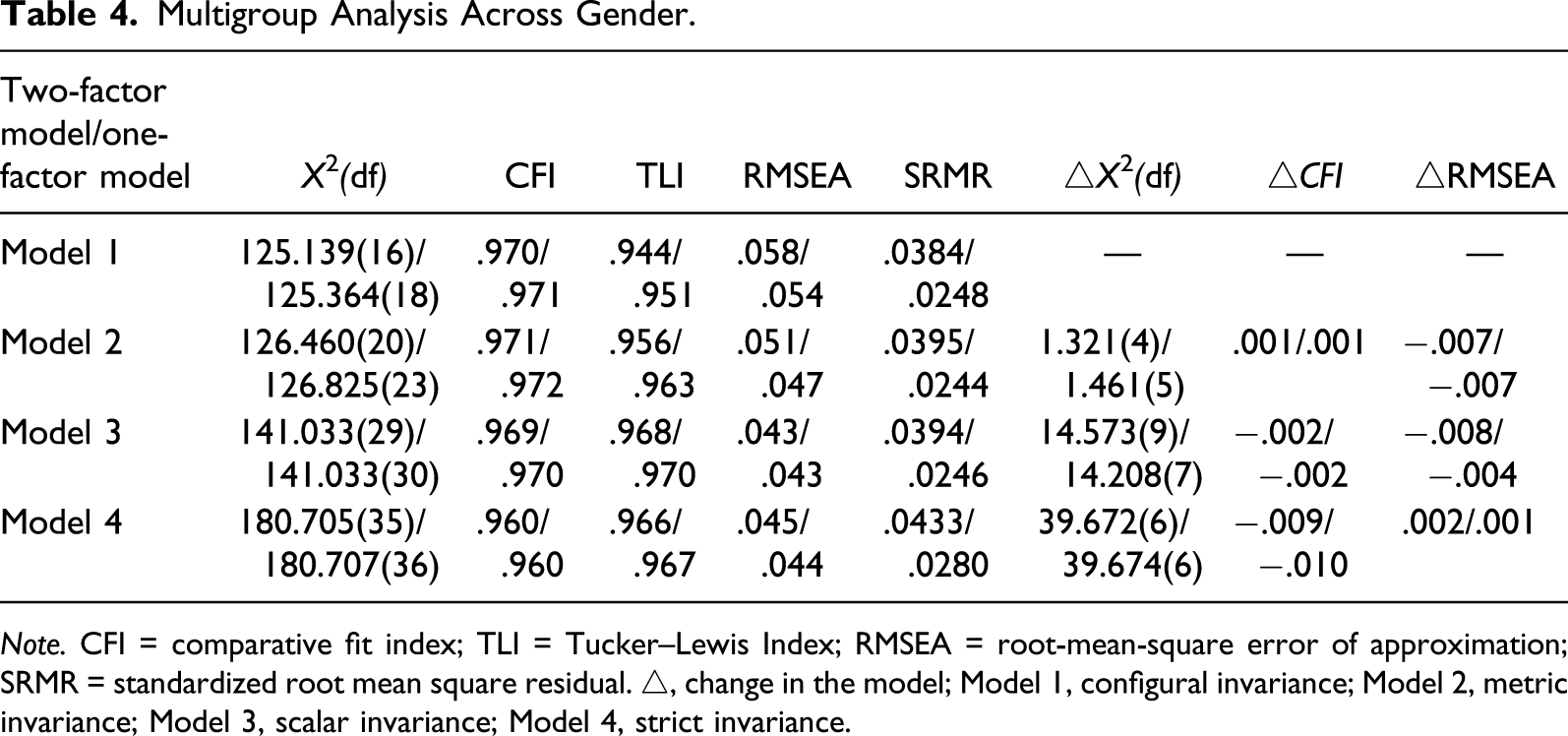
Multigroup confirmatory factor analysis procedures were used subsequently to examine whether the CHS demonstrated measurement invariance across gender. Four nested models were estimated by default: configural model, metric model, scalar model, and strict model (Vandenberg & Lance, 2000). Configural invariance (Model 1) was the baseline model that relaxed all equality constraints. Metric invariance (Model 2) tested the invariance of factor loadings among groups by placing equality constraints on these parameters. Scalar invariance (Model 3) not only tested the invariance of factor loadings but also the equality of intercepts across groups and covariance groups. The strict invariance (Model 4) was tested with factor loadings, intercepts of variables, and error variances all being set to be equal across gender (Liu, 2008). The change in CFI (△CFI ≤ .010) and the change in RMSEA (△RMSEA ≤ .015) were considered as evidences of equivalence between different consecutive models (Cheung & Rensvold, 2002).
Finally, latent mean differences across gender were tested. In the structural means model, the male group served as the reference group with its latent mean being constrained to 0, while the female group was estimated freely. The critical ratio (CR) was chosen as the index to evaluate whether the latent means were different across groups (Tsaousis & Kazi, 2013). If the CR was higher than 1.96 or lower than −1.96, the estimate of equality was rejected. Therefore, a higher score for the latent mean was regarded as a positive value for the comparison group relative to the reference group, whereas a negative value indicated a lower score for the latent mean for the comparison group.
Results
Internal Structure
Model Fit Statistics for the CFA Models.
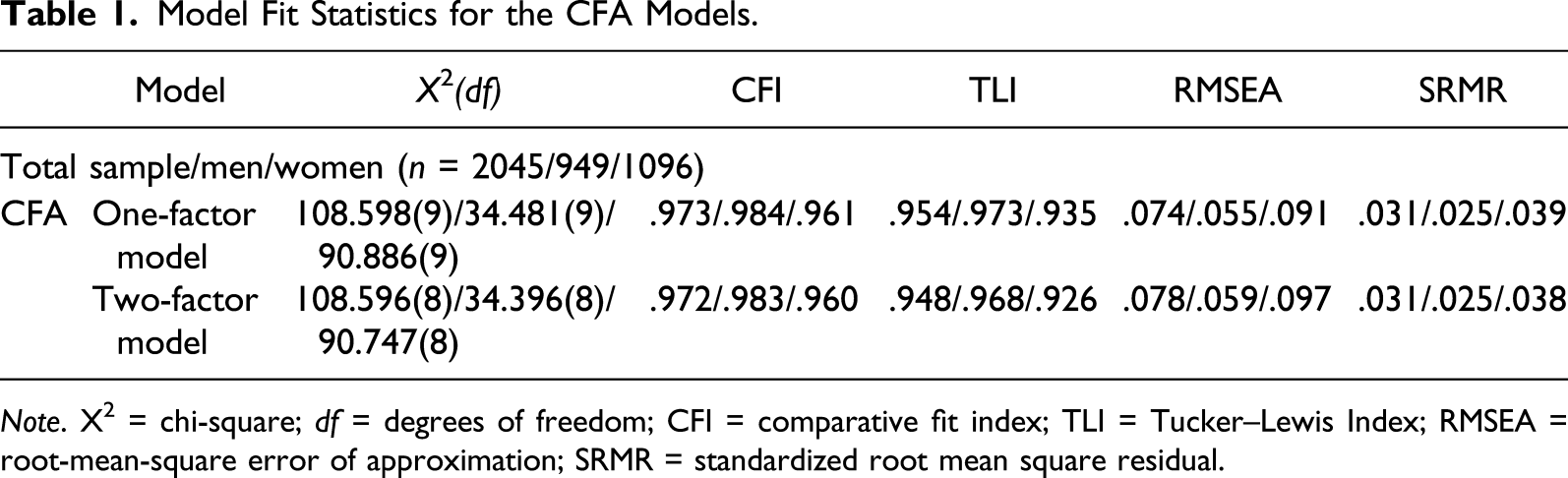
Note. X2 = chi-square; df = degrees of freedom; CFI = comparative fit index; TLI = Tucker–Lewis Index; RMSEA = root-mean-square error of approximation; SRMR = standardized root mean square residual.
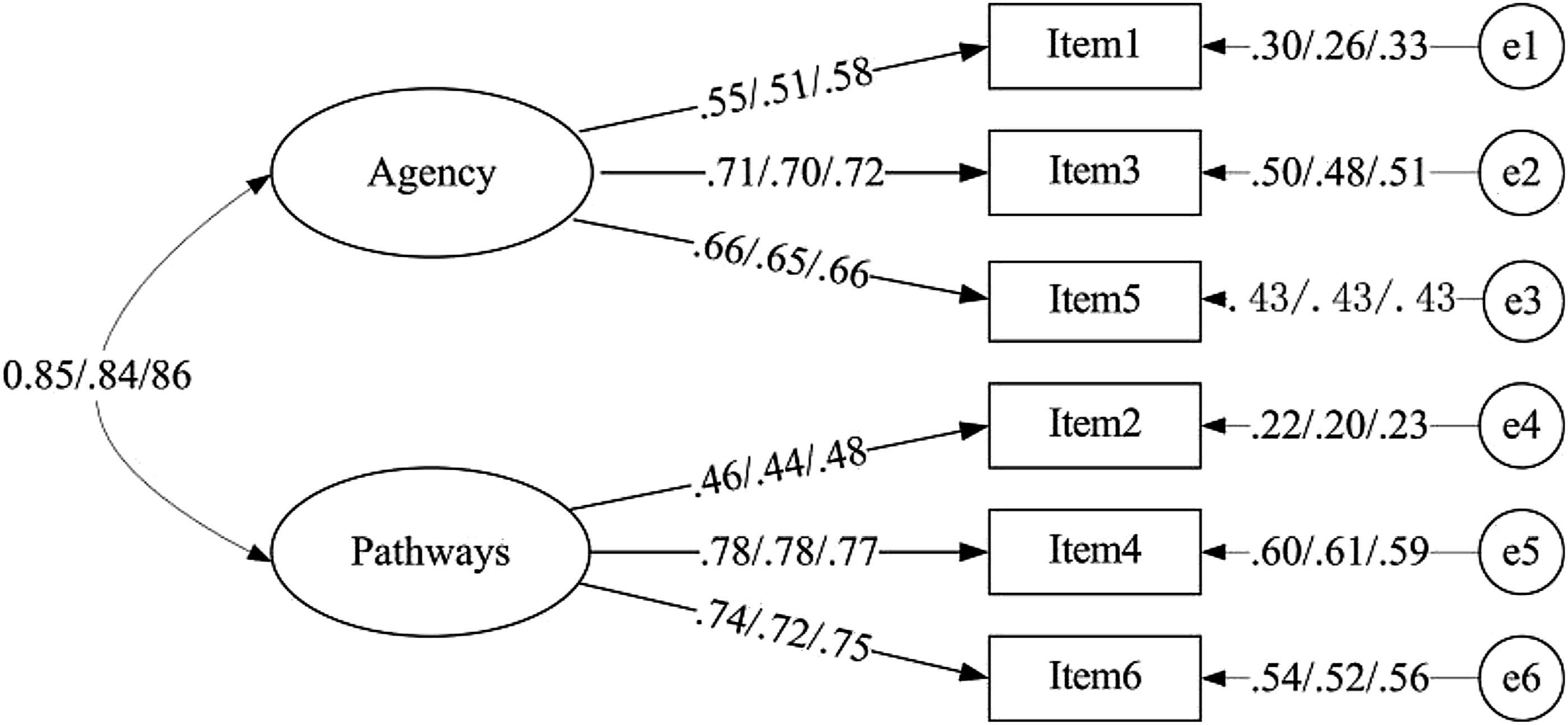
Standardized parameter estimates of Agency factor and Pathways factor of CHS (full sample/men/women). Note. CHS = Children’s Hope Scale.
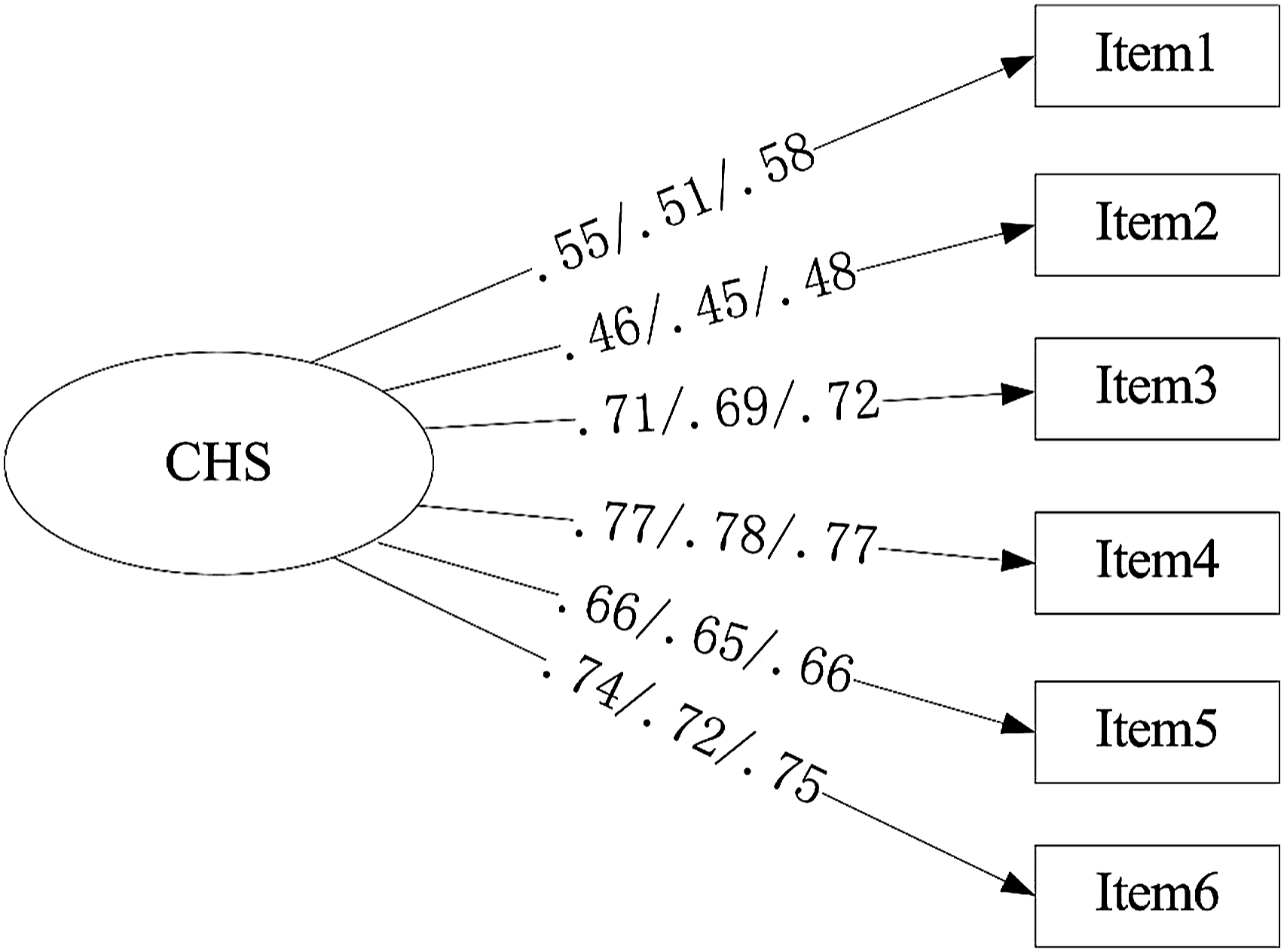
Standardized factor loadings of CHS full scale (full sample/men/women). Note. CHS = Children’s Hope Scale.
External Relations
Comparison of BMSLSS, REES, MSPSS, and LOT between Low- and High-Level Group.
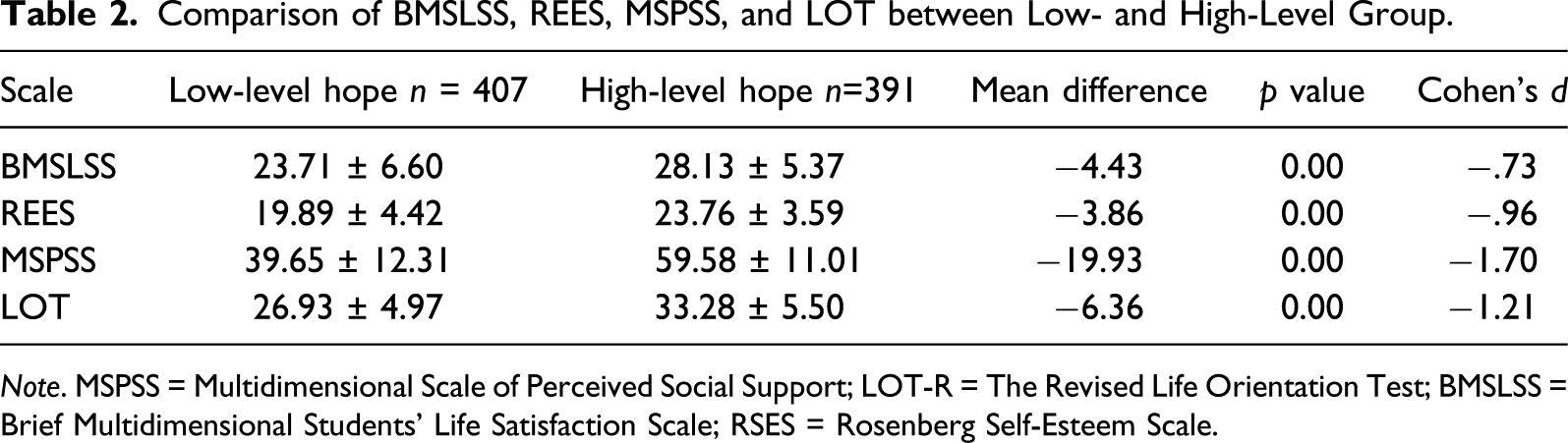
Note. MSPSS = Multidimensional Scale of Perceived Social Support; LOT-R = The Revised Life Orientation Test; BMSLSS = Brief Multidimensional Students’ Life Satisfaction Scale; RSES = Rosenberg Self-Esteem Scale.
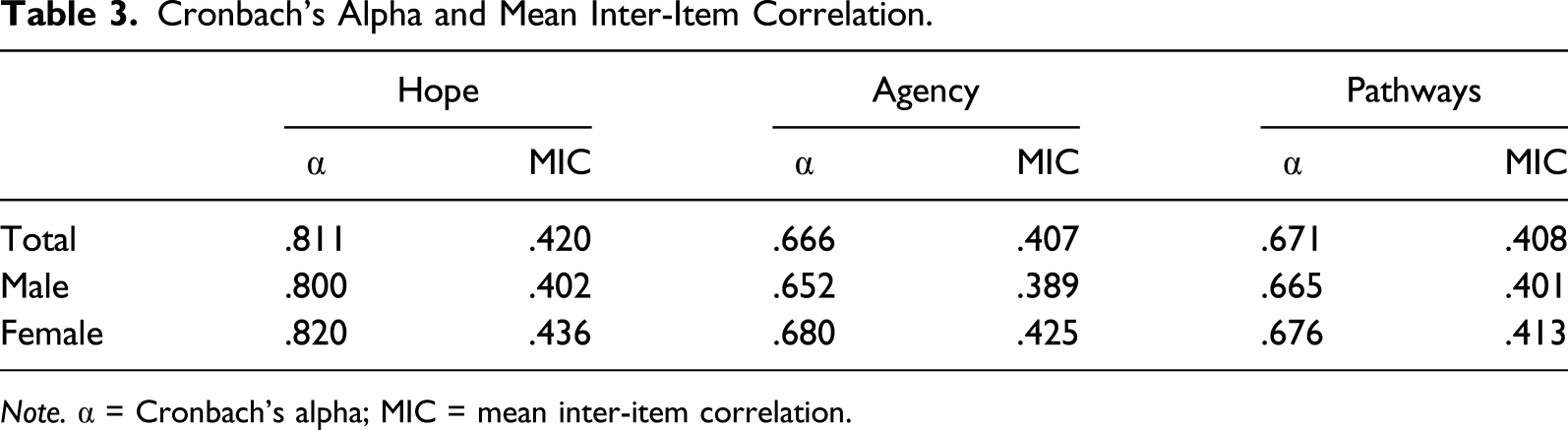
Cronbach’s Alpha and Mean Inter-Item Correlation
Cronbach’s Alpha and Mean Inter-Item Correlation.
Note. α = Cronbach’s alpha; MIC = mean inter-item correlation.
Temporal Stability
Test–retest reliability provides an estimate of temporal stability, which is particularly important for measures purporting to address psychological constructs that incorporate state- and trait-like properties, like hope. The 1-month test–retest correlations for the CHS total, Agency, and Pathways scores were all statistically significant (p < .001), with r(584) = .739, r(584) = .710, and r(584) = .709, respectively.
Measurement Invariance Across Gender
Multigroup Analysis Across Gender.
Note. CFI = comparative fit index; TLI = Tucker–Lewis Index; RMSEA = root-mean-square error of approximation; SRMR = standardized root mean square residual. △, change in the model; Model 1, configural invariance; Model 2, metric invariance; Model 3, scalar invariance; Model 4, strict invariance.
Latent Mean Differences
Given that invariance was achieved for the configural, metric, scalar, and strict models, the latent factor mean differences across gender were computed, along with Cohen’s d effect size indices (Cohen, 1988). For the one-factor model, the latent factor CHS means were not significantly different between boys and girls (CR = −1.899, d = .08). For the two-factor model, the latent factor CHS means were not significantly different between boys and girls for the Agency subscale (CR = −.874, d = .04). However, the latent means were significantly different between boys and girls for the Pathways subscale, with boys reporting a higher mean level than girls (CR = −2.429, d = .11).
Discussion
Based on Snyder et al. (1997) and Zhao and Sun (2011), we examined one-factor and two-factor models of the CHS in a large sample of Chinese adolescents, subsequently assessing its measurement invariance and latent mean differences across gender. We further examined its internal consistency, test–retest reliability, and relations with theoretically related variables.
First, consistent with previous studies (Edwards et al., 2007; Jovanović, 2013), our CFA results for one- and two-factor models for the CHS all exceeded relative standards. Nevertheless, the RMSEAs for both models were slightly higher than the acceptable range for our female sample, which was also consistent with previous research (Dixson, 2017). According to Browne and Cudeck (1992), .05 < SRMR and RMSEA < .10 are also considered acceptable.
In this study, the fit indices for the one-factor model were slightly better than the two-factor model, but not statistically different given the chi-square difference test. Thus, both models revealed an acceptable fit to the data among Chinese adolescents, providing preliminary evidence for the use of the CHS with Chinese adolescents. Additionally, although Item 2 (“I can think of many ways to get the things in life that are most important to me”) showed a lower factor loading than the other items in both models, the mean inter-item correlations were acceptable. Such a low factor loading for Item 2 may be a result of translation of context-specific concerns. In more collectivistic cultures (e.g., China), individuals tend to be socialized to be part of interdependent groups with common fates, goals, and values (Daphna, Coon, & Markus, 2002). Thus, adolescents more likely rely on their parents or others to find ways to obtain the things in life that are most important to them. Thus, it does not appear warranted to revise or discard Item 2. In addition, because Zhao and Sun (2011) argued persuasively that the retention of Item two is essential to the construct validity of the Pathways subscale, we retained Item two in both models in subsequent analyses.
The finding of support for both models suggested that the total score as well as the Pathways and Agency scores are meaningful and interpretable with Chinese adolescents (cf. Snyder et al., 2005). This conclusion is important when researchers wish to distinguish the two components of hope. For example, Franke, Huebner, and Hills (2017) evaluated the role of Pathways thinking separately from Agency in a test of a theory of positive emotions with adolescents.
Second, consistent with previous studies (Ling et al., 2015; Ling et al., 2016; Merkaš & Brajša-Žganec, 2011), significant differences emerged between the high and low hope groups on the BMSLSS, REES, MSPSS, and LOT; that is, adolescents with high (vs. low) hope reported the expected higher levels of life satisfaction, self-esteem, social support, and optimism. These findings also provide supportive evidence for the validity of the CHS.
Third, the reliability coefficients for the CHS total score were acceptable (α ≥ .800) for the total, male, and female sample. However, the coefficients for the Agency and Pathways subscales were somewhat lower than the widely accepted .70 cutoff for research (Nunnally & Bernstein, 1994). These findings are consistent with previous studies, suggesting that the internal consistency of the Agency and Pathways subscales could be considered adequate, particularly given the small number of items (i.e., three) in each subscale (Jovanović, 2013). The mean inter-item coefficients in our study were well between the lowest (.10) and the highest cutoff values (.50), also supporting the internal consistency of the Chinese version of the CHS (Bentler, 1990). Finally, considering that the 1 month test–retest reliabilities exceeded .70, the reliability of the CHS overall appears acceptable.
Fourth, the results of our study illustrate that the CHS can be utilized to assess hope among both female and male Chinese adolescents. The MGCFA results revealed that both the one-factor and two-factor structures were invariant across gender, suggesting that Chinese boys and girls interpret the CHS similarly and that the CHS measures the same constructs across gender. Therefore, the CHS may be used in mean-level comparisons of Chinese male and female adolescents.
Finally, tests of latent mean differences demonstrated no statistically significant differences across gender on the total score for the one-factor structure or on the Agency subscale for the two-factor structure among Chinese adolescents. These equivalent mean scores indicated that both Chinese boys and girls reported equivalent levels of hope toward achieving their desired goals. This comparability may be due to the possibility that goals representing similar standards are more motivating to students and especially enhance their sense of agency (Gherasim, Butnaru, & Mairean, 2013; Merkaš & Brajša-Žganec, 2011). However, men scored higher on the Pathways subscale than women, which might reflect differences in Chinese parents’ expectancies and parenting styles for male and female adolescents (Wang et al., 2013). In China, men are more likely to be raised to be strong, capable, and independent individuals as well as to be rewarded for outperforming others (Su, Mcbride, & Xiang, 2015), whereas women are raised to be kind-hearted, honest, and considerate (Zeng et al., 2017). These differences, in turn, may lead Chinese men to be more likely than women to develop higher expectations for pursuing and persisting at individual goals (White, 2010). Thus, Chinese male adolescents may become more active than women in seeking ways to overcome obstacles and achieve their goals.
Limitations
Limitations of this study should be noted. First, participants’ ages ranged from 11 to 16 years. Given that hope is a malleable construct (Callina et al., 2014); Merkaš & Brajša-Žganec, 2011), a wider age range might be considered in future research to investigate the generalizability of gender differences across different age groups. Second, although a large sample was utilized, its homogeneity was relatively high because participants were all from one province. Studies with more nationally representative samples should be conducted to confirm the generalizability of our findings. Third, all data were collected through self-report measures. Future research should employ multi-method approaches, such as incorporating ratings of knowledgeable others. Finally, cross-sectional research designs, such as the design of this study, do not capture the dynamic nature of adolescents’ possible changes in hope levels. More longitudinal research is needed to investigate the stability of hope among youth and particularly to investigate its antecedents, correlates, and consequences across differing age, gender, and cultural groups.
Conclusion
Our results provided promising preliminary evidence for the reliability and validity of the Chinese version of the CHS. Both the one-factor and two-factor models were supported, providing preliminary support for the use of both subscale scores as well as its total score with Chinese adolescents. Moreover, the results of measurement invariance tests suggested that the CHS may be used in cross-gender comparisons among Chinese adolescents. No gender differences for the CHS Total or Agency factor, whereas men scored higher than women on the Pathways factor. Pending replication, such differences suggest implications related to differential risk levels and intervention efforts for promoting hope in male and female early adolescents in China.
Footnotes
Declaration of Conflicting Interests
The author(s) declared no potential conflicts of interest with respect to the research, authorship, and/or publication of this article.
Funding
The author(s) disclosed receipt of the following financial support for the research, authorship, and/or publication of this article: This research was supported by the Key Program for Research on Women’s Theory and Practice of Hunan Province (Grant No. 18ZDB04).
