




Abstract
The simple views of reading (SVRs) and writing (SVWs) reflect useful frameworks for the psychoeducational evaluation of literacy difficulties. They describe reading comprehension and written expression as the outcome of oral language, decoding, and transcription skills. Prior research has demonstrated that these components explain the vast majority of variance in comprehension and written expression. However, subtests’ specific task demands can influence the relationships among these components within the models. As a result, practitioners should know the degree to which various test batteries operationalize these frameworks. Using correlations from school-age participants provided in the technical manual, these analyses investigated the SVR and SVW within the Woodcock–Johnson IV battery through structural equation modeling. Results suggest that the battery’s measures conform to many of the expectations stemming from the SVR/SVW. However, its comprehension and written expression measures appear less language-influenced and more affected by decoding/spelling. Implications for psychoeducational practice are discussed.
The simple view of reading (SVR) and the simple view of writing (SVW) are popular literacy models (Burns et al., 2021; Catts, 2018). They provide practitioners with an interpretational basis for the evaluation of written language difficulties and a set of research findings that can be used to evaluate norm-referenced achievement batteries. Most contemporary achievement batteries provide scores for practitioners to organize psychoeducational evaluations around these models. However, not all batteries operationalize them in the same way or to the same degree. Before practitioners can apply the SVR or SVW to their evaluation efforts, they should know the degree to which an achievement battery conforms to research findings from these models. This investigation analyzes the SVR and SVW within the Woodcock–Johnson IV Tests of Achievement (Shrank et al., 2014).
The Simple Views of Reading and Writing
It can be helpful to think of the SVR and SVW together because they describe reading and writing skills in similar ways. Literacy represents deriving meaning from print and using print for expression and communication. The simple views describe these outcomes, reading comprehension in the case of the SVR and written composition in the SVW, as a function of components: a phonics-based skill (decoding or spelling) and oral language-based skills, linguistic comprehension or idea generation (Gough & Tumner, 1986; Juel et al., 1986). Frequently, researchers operationalize these later components with standardized oral language measures (Foorman et al., 2018; Kim & Schatschneider, 2017). More recently, theorists have revised the SVW to also include a self-regulation component and transcription (handwriting and spelling), stressing their collective coordination within the writer’s working memory (Berninger & Amtmann, 2003). Collectively, these models can be applied to multiple languages, orthographies, and writing systems (Catts, 2018; Graham & Eslami, 2020; Florit & Cain, 2011; Yeung et al., 2017).
Of course, the SVR/SVW includes shortcomings that practitioners and researchers alike must acknowledge. Both models appear to minimize the complexity of their components and outcome variables (Catts, 2018; Kim & Schatschneider, 2017). Expanded models unpack these skills, highlighting roles for phonology, orthography, morphology, semantics, and rapid naming skills. They also add other cognitive and conative sources of influence such as students’ motivation and beliefs about literacy, general background knowledge, understanding of genre, text features, or reading and writing strategy use (Kim, 2020a, 2020b; Pressley et al., 2009). Also, the simple views do not provide details around the mental processes leading to comprehension or written expression. Via elaborations and inferences from text, reading comprehension involves the construction of a situational or mental model, integrating the text with the reader’s background knowledge (Lenhard et al., 2013). As others have stressed, a reader’s comprehension varies based on the type of text and the purpose(s) for reading (Catts, 2018). Yet, scholars stress that the simple view of reading was not intended to be a complete explanation of reading development or the reading process but rather a broad, general framework of individual differences causing poor comprehension (Tunmer & Chapman, 2012). These causal implications make these models useful foundations for psychoeducational literacy assessment.
Many research efforts linking psychoeducational assessment practices to intervention highlight correlations between cognitive and achievement constructs (McGrew & Wendling, 2010; Zaboski et al., 2018). The SVR and SVW are advantageous for practitioners because their components have been investigated through intervention and longitudinal studies, better supporting causal interpretation of their effects on comprehension or composition. Meta-analyses of interventions have demonstrated effects for self-regulation and transcription interventions on written composition (Graham et al., 2012). Oral language intervention, and strategy instruction, in particular (linked to the language side of these models; Scarborough, 2009), can increase comprehension and composition (Berkeley et al., 2010; Graham et al., 2012; Melby-Lervåg & Lervåg, 2014; Silverman et al., 2020). Decoding or phonics instruction can increase comprehension (Double et al., 2019; Wanzek et al., 2019). Equally important to stress, many components demonstrate skill-by-treatment interactions (Conner et al., 2009). For instance, students struggling to acquire decoding skills display more literacy growth in classrooms with explicit decoding instruction. Alternatively, students with stronger decoding skills but lower language skills make more literacy growth with meaning-focused instruction.
Though intervention studies can support models’ causality assumptions, causality should not be overstated. It is conceivable that the relationships highlighted here could be reciprocal, or even reversed. For instance, when students read to comprehend, they simultaneously practice both language comprehension and decoding skills. Comprehension cannot happen through decoding alone (Pressley & Wharton-McDonald, 1997). Similarly, students practice spelling and language skills when writing. As a result, comprehension or composition intervention could increase performance in component skills. Floyd et al. (2012) tested the direction of influence between decoding and comprehension with nonequivalent path models. They found that modeling an effect from decoding to comprehension provided a better fitting model than modeling an effect from comprehension to decoding. This directionality of effect could explain why students often need to acquire a certain level of competence in word decoding before comprehension interventions are most useful (Willingham, 2006).
Structural equation modeling studies can provide benchmarks for how achievement batteries operationalize these models. They provide three general expectations for the relationships among components. First, components should explain sizeable variance in reading comprehension or written composition. Decoding and oral language skills generally explain close to 100% of reading comprehension variance, when these relationships are evaluated with latent variables (Lonigan et al., 2018). Similarly, broad oral language, spelling, and handwriting fluency latent factors have explained over two-thirds of variance in written composition in prior studies (Kim & Schatschneider, 2017). Second, studies have demonstrated that the relationship among these constructs will vary over grade levels, generally as a function of students’ decoding (or transcription) competency (Garcia & Cain, 2014). In earlier grade levels, when students are acquiring decoding and transcription skills, those skills tend to demonstrate a larger effect on comprehension and composition (Berninger, 1999; Lonigan et al., 2018; Limpo & Alves, 2013). When students gain fluency in those skills, oral language skills demonstrate stronger effects. Third, even though decoding and transcription appear conceptually distinct from oral language skills, most of the variance they explain appears to be common variance; decoding and oral language skills can explain additional, unique variance in some reading comprehension variables (Cutting & Scarborough, 2006; Lonigan et al., 2018).
Relations Between Constructs Can Vary as a Function of Task Demands
Practitioners should expect that the measurement of these skills conforms to the three findings outlined above. While test manuals generally provide initial validity evidence for practitioners to consider, they usually do not analyze the effects of these components beyond subtest intercorrelations. Nevertheless, it is important information because the relationship among these constructs can vary based on tests’ task demands (Kilpatrick, 2015). More plainly, reading comprehension tasks differ in their requirements for language and decoding skills. Comprehension stems from the readers interaction with features of the text (Pressley & Wharton-McDonald, 1997). Nation and Snowling (1997) first demonstrated that performance on comprehension measures requiring passage reading and verbal responses was more dependent on language skills than decoding. Alternatively, sentence-completion tasks appear more influenced by decoding skills. These findings have been extended to other tasks and tests by other researchers (Eason et al., 2013; Keenan et al., 2008; Spear-Swerling, 2004). Similar research on written composition appears less developed, though it is reasonable to assume that writing tasks also vary in their requirements for language and transcription skill.
This variability across measures can have important clinical implications (Kilpatrick, 2015). Examinees with strong language skills can compensate for decoding challenges on language-loaded measures, potentially masking an arduous reading process. Measures that are too decoding-focused may not provide results that are consistent with students’ comprehension performance in the classroom, especially in later grade levels when students read lengthy textbooks. Furthermore, they may overpredict later comprehension performance for strong decoders when comprehension measures begin requiring more language competency.
Purpose of this Investigation
Within commercially available measures, these models have been investigated directly in the Kaufman Test of Educational Achievement-Third Edition (KTEA-3; Kaufman & Kaufman, 2014; Parkin, 2021). The relationship between oral language and reading/writing components in the battery largely conformed to many SVR/SVW research findings. Decoding and oral language explained nearly 100% of comprehension variance across all grade levels in the normative sample; oral language and spelling explained approximately two-thirds of performance on the written expression task. The effects for these components changed across grade levels. Oral language skills became the stronger influence on reading comprehension at about grade 3 and on the writing measure in grade 5. As would be expected, most of the variance explained in reading/writing outcomes was common across predictors, though oral language and decoding or spelling also explained unique variance, depending on grade level. Importantly, the KTEA-3 demonstrated a more language-oriented reading comprehension factor, though its two comprehension subtests varied in their decoding and language demands across grade level. In the Wechsler Individual Achievement Test-Third Edition (Wechsler, 2009), oral language and decoding skills explained close to 50% of comprehension variance (Parkin, 2018) and over 25% of variance in written composition (Parkin et al., 2020), though these last studies were conducted with a referral sample and manifest variables.
To inform the assessment process and better link achievement results to intervention efforts, practitioners should know the degree to which the WJ-IV operationalizes the SVR and SVW. The battery includes three reading comprehension and two written expression tasks that likely vary in their demands for oral language and decoding or transcription skills, respectively. Practitioner-oriented materials have asserted the relative contribution of these skills to comprehension and written expression measures. For instance, an assessment bulletin (Proctor et al., 2015) suggested that students with dyslexia frequently demonstrate a systematic pattern on the battery’s three comprehension measures, stemming from potential differences in the tasks’ oral language and decoding requirements (Kilpatrick, 2015). They would perform strongest on Reading Recall, due to its longer passages, less strongly on Passage Comprehension, and finally, perform worst on Reading Vocabulary. Similarly, on the writing measures, students with dyslexia would perform strongest on Writing Samples, less strongly on Writing Fluency, and even lower on Spelling.
This investigation reports the degree to which WJ-IV oral language and decoding or transcription-related skills explain variance in its reading comprehension and written expression measures, both at the latent factor and subtest level, and describes trends across the school-age participants in its normative sample. Results may inform practitioners’ selection and interpretation of achievement measures during the psychoeducational assessment process.
Methods
Participants
As standard scores were not available, data came from the WJ-IV correlation matrices, included within the battery’s technical manual (McGrew et al., 2014, p. 310-312). The entire normative sample includes 7416 individuals between the ages of 2 to over 90 years. It broadly conforms to the US 2010 census projections for multiple pertinent demographic variables. These analyses focused on the school-age segment of the normative sample; participants included individuals aged 6 to 8 (n = 825), 9 to 13 (n = 1572), and 14 to 19 (n = 1685). Note that due to the number of subtests included in the battery and the large normative sample, not all participants completed all subtests. The correlation matrices used here resulted from planned incomplete or missing data collection when the sample was constructed (McGrew et al., 2014).
Instrument
The WJ-IV consists of three individual batteries containing multiple cognitive, academic, and oral language tasks. These analyses focused on measures within the oral language and academic achievement batteries (Shrank et al., 2014). All reliability coefficients can be found in the battery’s technical manual (McGrew et al., 2014).
These analyses included two measures from the oral language battery required to create the Oral Language cluster score. Picture Vocabulary requires examinees to orally name pictures they see. Oral Comprehension requires examinees to listen to a passage and identify a missing word.
From the achievement battery, analyses included multiple measures of reading and writing skills. Letter–Word Identification requires examinees to name or read isolated letters and words orally. Word Attack is similar, though stimuli consist of phonetically regular nonsense words. These measures form the WJ-IV Basic Reading Cluster. Analyses also included all measures required to form the regular and extended Reading Comprehension clusters. Passage Comprehension requires examinees to determine a missing key word in a written passage. In Reading Recall, examinees recall details of stories they read. When completing Reading Vocabulary, examinees provide an antonym or synonym to words they read. For writing measures, these analyses included Spelling, in which examinees spell words from dictation. They also included Writing Samples, a measure that requires examinees to write sentences to complete short passages, and Sentence Writing Fluency, which requires examinees to quickly formulate and write short sentences. The last two measures can be combined to create the Written Expression Cluster.
Data Analysis
Analyses employed multiple models to operationalize the simple views of reading and writing. The simple view of reading was modeled in three ways. All models included decoding and oral language latent factors constructed from the aforementioned subtests. They varied based on the construction of a reading comprehension factor. The first model created a latent comprehension factor consistent with the WJ-IV Reading Comprehension Cluster, defining it with Passage Comprehension and Reading Recall. The second model added the Reading Vocabulary measure to the factor, making the factor consistent with the Reading Comprehension-Extended Cluster. The third model removed the common factor, modeling the influence of decoding and oral language on the three comprehension subtests as manifest variables. These last two models are illustrated in Figure 1. Models Operationalizing the Simple View of Reading with Standardized Coefficients. Note. The first model which includes a latent reading comprehension factor was modeled twice, once with RV and once without. LWI = letter/word identification; WA = word attack; OC = oral comprehension; PV = picture vocabulary; PC = passage comprehension; RR = reading recall; RV = reading vocabulary. Coefficients correspond to results from the ages 6 to 8, ages 9 to 13, and ages 14 to 19 correlation matrices.
The simple view of writing was evaluated with two models. Each model included Spelling as a manifest variable and the previously described oral language latent factor. The first model constructed a written expression latent factor from Writing Samples and Sentence Writing Fluency, analogous to the battery’s Written Expression Cluster. The second model included these measures as outcomes, modeled as manifest variables. Figure 2 illustrates these models. Models Operationalizing the Simple View of Writing with Standardized Coefficients. Note. SP = spelling; OC: oral comprehension; PV = picture vocabulary; WS = writing samples, SW = sentence writing fluency. Coefficients correspond to results from the ages 6 to 8, ages 9 to 13, and ages 14 to 19 correlation matrices. *denotes nonsignificant path.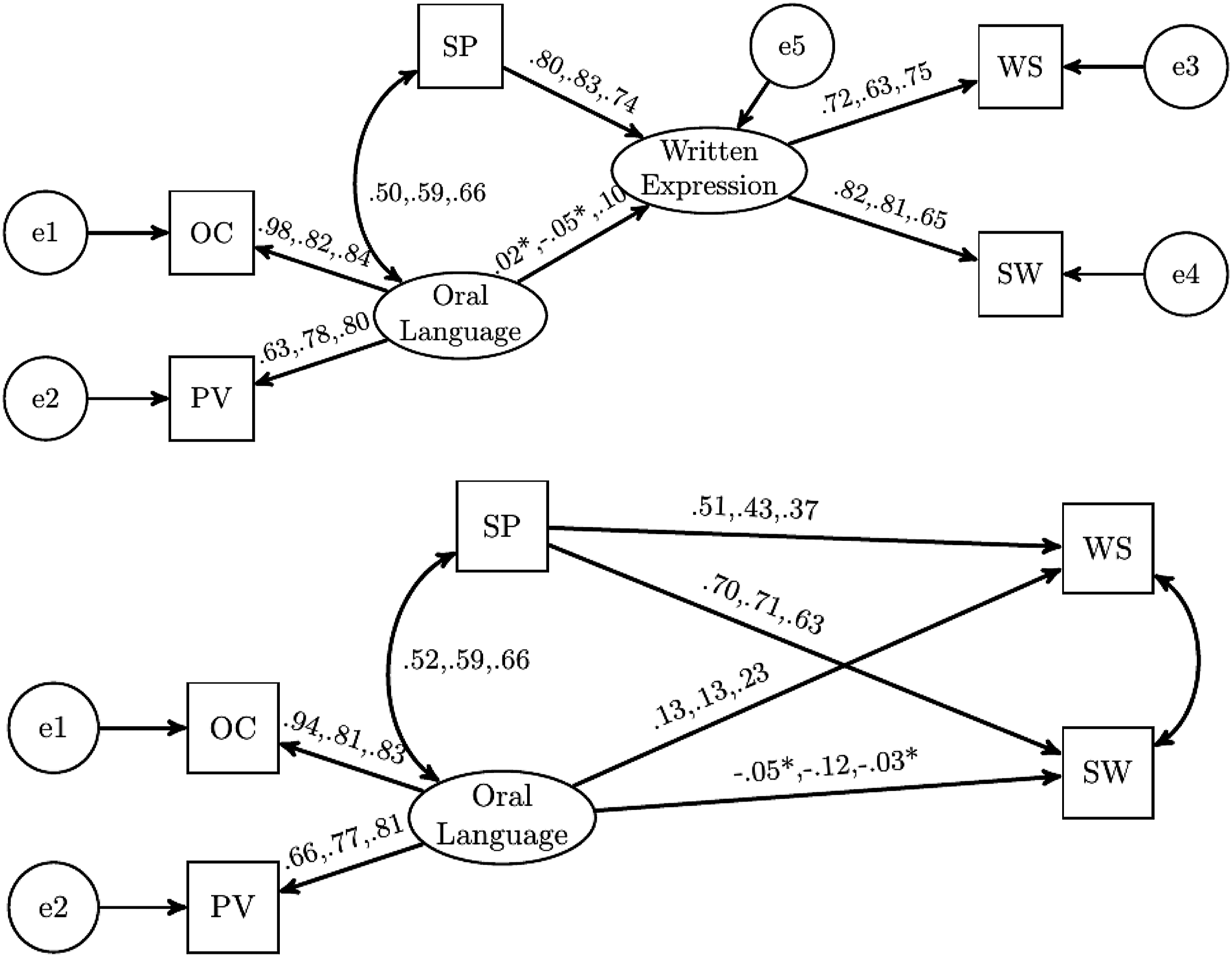
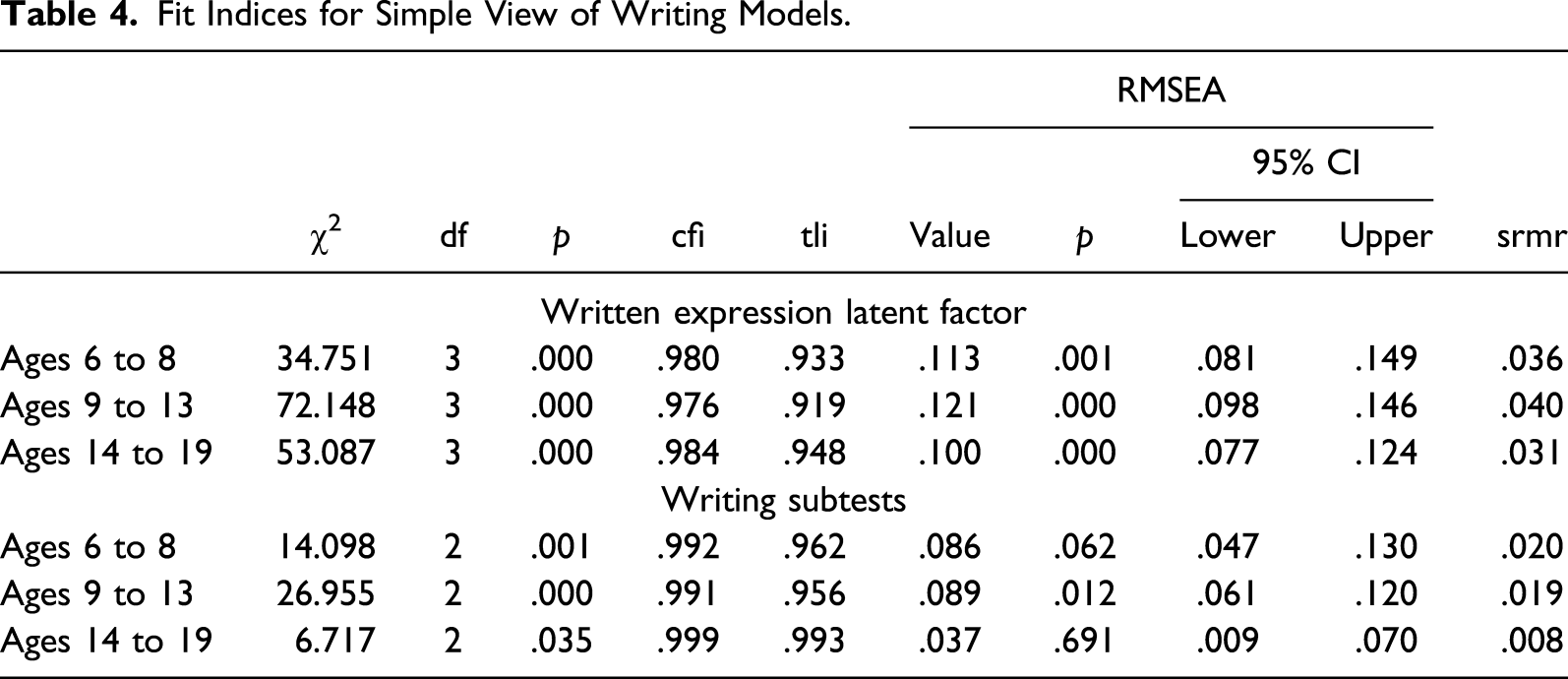
All models were analyzed in R (R Development Core Team, 2015), using the lavaan package (Rosseel, 2012). Model fit was determined from multiple measures (Keith, 2014). These included χ2, where a nonsignificant p value indicates appropriate model fit, the root mean square error of approximation (RMSEA), where values lower than .08 suggest an adequate fit, the comparative fit index (CFI), and Tucker–Lewis index (TLI), where values greater than .90 represent adequate fit. They also included the standardized root mean square residual (SRMR), where values lower than .08 can represent an adequate fit.
To determine the relative influence of SVR and SVW components on their respective outcomes, models simultaneously regressed the reading comprehension and written expression variables on predictors. The Wald test was used to determine the equivalency between regression coefficients. Unique variance explained by predictors was investigated through sequential regression, with each predictor entered last in the equation using the methods described by Beaujean (2014).
Results
Results of the Simple View of Reading Analyses
Fit Indices for Simple View of Reading Models.

Effects of Decoding and Oral Language Factors on Reading Comprehension Factors.

Note. Unique: explained variance with the predictor entered last into the model.
Effects of Decoding and Oral Language Factors on Reading Comprehension Subtests.

Regression results from the comprehension subtests underscored these findings (see Table 3). The effects of decoding on each comprehension subtest were not equivalent for all age groups (ages 6–8, W (2, 825) = 59.91, p < .001; ages 9–13 W (2, 1572) = 74.57, p < .001; and ages 14–19 W (2, 1865) = 74.71, p < .001). Likewise, oral language effects differed across the subtests as well (ages 6–8, W (2, 825) = 102.86, p < .001; ages 9–13 W (2, 1572) = 207.29, p < .001; and ages 14–19 W (2, 1865) = 228.15, p < .001). Passage Comprehension and Reading Recall appeared most dependent on decoding skills. Alternatively, Reading Vocabulary demonstrated the strongest oral language influence.
Results of the Simple View of Writing Analyses
Fit Indices for Simple View of Writing Models.
Effects of Spelling and Oral Language Factors on Written Expression Factor and Subtests.

Note. Unique: explained variance with the predictor entered last into the model.
arepresents paths with p > .05.
Discussion
The SVR and SVW represent strong interpretational bases for standardized achievement batteries. Intervention research provides support for causal interpretation of these models’ components on comprehension and composition (Graham et al., 2012; Double et al., 2019; Conners et al., 2009). Past investigations provide benchmarks for the interrelationships among these constructs within achievement batteries. A battery’s decoding and oral language skills should explain the vast majority of comprehension variance, and much of the explained variance should be common among these predicators. Further, decoding should display the dominant effect at younger age groups or grade levels, while oral language’s effect should be stronger at higher grade levels. There are similar patterns in the writing domain. Oral language and transcription skills have previously explained approximately two-thirds of variance in written expression (Kim & Schatschneider, 2017; Parkin, 2021). Similarly, transcription and language should describe significant common variance, and oral language skill should increase in effect as age increases.
Results of these analyses suggest that the WJ-IV indeed conforms to many of these findings, though with important nuances that require consideration. Decoding and oral language explained more than three quarters of variance in the standard reading comprehension factor and close to 90% of variance in the extended comprehension factor. As would be expected, decoding’s effect on comprehension appears to decrease in the older age groups, and likewise, the effect of oral language increases. However, oral language never becomes the more dominating influence. The comprehension clusters on the WJ-IV largely appear influenced by decoding skills, even for older school-aged examinees. Oral language influence on the extended comprehension factor became consistent with decoding in the 9 to 13 and 14 to 19 age groups, though it never became stronger.
Results from analysis of the comprehension subtests clarify these findings. Both Passage Comprehension and Reading Recall appear significantly influenced by decoding skills. Alternatively, Reading Vocabulary appears more strongly influenced by oral language. Its inclusion in the extended comprehension factor boosted oral language’s effect on that factor. Previous research has reported that comprehension tasks with shorter, sentenced-based stimuli usually are more influenced by decoding than oral language (Keenan et al., 2008). Thus, it should be no surprise for a factor constructed from Passage Comprehension to be influenced by decoding skills. However, the relative contribution of oral language to performance on Reading Recall and Reading Vocabulary was not as expected. Some scholars have suggested that Reading Recall was added to the WJ-IV to provide balance to the decoding-heavy Passage Comprehension subtest (Francis et al., 2006; Kilpatrick, 2015). However, that does not appear to be the result, at least according to these analyses. Instead, Reading Vocabulary acts as the source of significant oral language influence, even though it does not require the lengthier passages usually required of language-oriented comprehension tasks.
The WJ-IV–based writing models also conform to many of the findings related to the SVW. Spelling and oral language explained approximately two-thirds of variance in written expression, operationalized with the WJ-IV Writing Samples and Sentence Writing Fluency subtests. Spelling represented the dominant effect. The same pattern occurred in the written expression subtests. Both Writing Samples and Sentence Writing Fluency performance was largely explained by spelling skills. It may appear counterintuitive that spelling displayed a strong effect, controlling for oral language skills. After all, poor spelling is not penalized in either of these subtests to minimize its effects. It could be possible that the variance explained by spelling reflects a missing common cause between the written expression measures and spelling. Alternatively, the effect could also suggest that spelling skills cannot be completely controlled for in a writing measure. (In the same way, decoding skills cannot be controlled for in a reading comprehension measure.) Spelling reflects knowledge of spoken words’ orthographic representations and their meaning (Berninger et al., 2006). Mather and Wendling (2015) provide examples of how spelling can impact writing, even in a writing task without spelling penalties. When generating language to convert into text, developing writers may narrow their ideas by filtering them through words they can spell. The relatively short responses required by Writing Samples and Sentence Writing Fluency (at least compared to other standardized writing tasks) may limit the words available to examinees. Perhaps as a result, spelling becomes a stronger influence over oral language.
Implications for Practice and Future Studies
These analyses hold implications for practice. Primarily, they suggest that examinees performance on the WJ-IV written expression and reading comprehension measures may appear more consistent with their spelling or decoding scores than their oral language scores. This is neither good nor bad, but practitioner should be aware of this trend to make appropriate interpretations and intervention recommendations. Results also suggest that practitioners should strongly consider including the extended comprehension cluster in their reading evaluations. When modeled as a latent factor, that cluster was more consistently influenced by both components of the SVR, especially at later ages or grade levels, when oral language typically becomes the stronger influence on comprehension (Catts, 2018). Results further suggest that a previously described performance profile for disabled decoders (Proctor et al., 2015) may require more investigation. While convention suggests that students with lower decoding skills (relative to oral language) should perform strongest on longer comprehension tests like Reading Recall, these results suggest that their strongest performance would be on Reading Vocabulary, given its relative oral language influence. However, this is just a hypothesis that requires empirical validation.
Additional comparative research is necessary to guide test selection, both across standardized achievement batteries and diverse samples. For instance, a similar study within the Wechsler Individual Achievement Test-Fourth Edition (Pearson, 2020) could be helpful. An aforementioned study using KTEA-3 suggested that its comprehension and written expression measures generally required more oral language competence relative to decoding or transcription (Parkin, 2021). Collectively, the results of that study and this one may mean that the KTEA-3 and WJ-IV could identify different students for reading or writing supports. Analysis with a sample that has completed both batteries could clarify this assertion. Replication of these analyses with students referred for learning challenges could better confirm assertions about their performance across the WJ-IV (e.g., Proctor et al., 2015). For instance, perhaps Reading Vocabulary appears more impacted by oral language in the typically developing normative sample because decoding acts as an access skill that is well developed for them. In a sample where decoding and oral language appear less associated with each other, decoding’s effect may increase. Presumably, in that group, the relationship between oral language and decoding/spelling would be smaller than in the normative sample, while the association of those components with comprehension or written expression would be consistent across groups. That appeared to be the case in an analysis with the WIAT-III written expression and language measures (Parkin et al., 2020). Conceptualizing decoding as an access skill suggests that the relationship between decoding and oral language could be modeled with a directional path (Schneider, 2013). A larger path model with additional variables hypothesizing differing influences on language and decoding could provide nonequivalent models to test the direction of this path further (Keith, 2014).
Limitations
Of course, there are limitations to these analyses. Some of them stem from the measures used to operationalize these models. On the writing side, the SVW is incomplete; these analyses do not include measures of self-regulation or working memory. Additionally, it goes without saying that the WJ-IV battery is a complicated collection of tests. As a result, there are likely many more important relationships among its measures than were tested here. These analyses used subtests that create the battery’s prescribed cluster scores, but as evident from the WJ technical manual (McGrew et al., 2014), there are multiple indicators of oral language/Crystalized Intelligence within the battery that likely vary in their association with reading comprehension. This variability is important for practitioners to note, as some scholars suggest that reading and listening comprehension should be assessed with similar or parallel tasks (Kim, 2020c). For instance, Story Recall is a parallel task to Reading Recall as both require examinees to recall details of relatively brief passages. While it is not classified as a measure of oral language, adding Story Recall to an oral language composite could likely affect the results described here. Thus, while focused analyses of specific segments of the battery are important (Dombrowski et al., 2019), so too are full analyses, such as those conducted on the entire battery within the technical manual (McGrew et al., 2014). Pertinent to the results described here, the full-battery CFA documented unique cross-loadings in the comprehension and composition subtests. For instance, Reading Vocabulary cross-loaded on both a reading/writing and Crystalized Intelligence factor, while Reading Recall cross-loaded on both reading/writing and a retrieval factor. Those cross-loadings likely explain the lower language influence in the core reading comprehension battery.
Other limitations stem from the methods and analyses used here. First, analyses did not directly test for invariance across age groups, as available data were limited to correlations; covariance of standard scores was not available for analysis. Second, while the SVR/SVW make causal inferences about the relationships within the models, and many of those relationships have been investigated through instructional, longitudinal, and intervention research, the data here remain correlational, insufficient to make causal inferences by itself.
Lastly, study limitations also stem from the theories behind these analyses. Both the SVR and SVW represent one view on literacy, describing “proximal causes of individual differences in reading” (Tunmer & Chapman, 2012, p. 454). Listening comprehension and decoding may appear comprehensive in the explanation of reading comprehension problems, yet there are also studies that documented a portion of their sample with generally typical decoding and listening comprehension skills that struggled with reading comprehension (Duke & Cartwright, 2021). Other models add self-regulation skills (akin to the SVW) and also include constructs that might account for the lack of independence between decoding and listening comprehension. Semantic and morphological skills, reading fluency, and cognitive flexibility applied to letter/sound associations could account for this relationship (Duke & Cartwright, 2021).
Conclusions
The WJ-IV operationalizes the SVR and SVW in many important ways. When evaluated with latent factors, its decoding and oral language measures explain the majority of reading comprehension and written expression variance. In both literacy domains, decoding and spelling skills appear to be the dominant predictor of higher order skills. Practitioners may better document the influence of oral language in examinees’ comprehension performance by considering the extended reading comprehension cluster.
Footnotes
Declaration of Conflicting Interests
The author(s) declared no potential conflicts of interest with respect to the research, authorship, and/or publication of this article.
Funding
The author(s) received no financial support for the research, authorship, and/or publication of this article.
