




Abstract
The current study aimed to develop a measure of anticipated teacher–student relationship quality to be used with preservice teacher populations that is operationally similar to a measure commonly used with inservice teachers (i.e., short-form of the Student–Teacher Relationship Scale). To date, teacher–student relationship quality has been a construct studied solely with inservice teacher populations. Two hundred and thirteen preservice teachers participated in the current study. Results suggest that the developed measure of anticipated teacher–student relationship with preservice teachers demonstrated response trends similar to the measure used with inservice teachers except that preservice teachers anticipate more conflict with future students than inservice teachers report with current students. Additionally, results show the developed measure fits the two factor structure of the original scale and exhibits concurrent validity via associations with teacher self-efficacy beliefs. Implications for measuring anticipated teacher–student relationship quality within teacher education programs and future directions for research are discussed.
Keywords
The quality of the relationship that a student shares with his or her teacher is associated with a multitude of academic and behavioral outcomes, such as engagement in learning activities, interpersonal skills, environmental adaptability, and achievement across multiple domains (Baker, 2006; Birch & Ladd, 1997; Hajovsky et al., 2021; Hamre & Pianta, 2001; Hughes, 2011; Mashburn & Pianta, 2006; Mason et al., 2017; Roorda et al., 2017; Rudasill et al., 2013). Teacher–student relationship quality (TSRQ) is a construct that has historically focused on teachers currently in the field [i.e., inservice teachers (ISTs)]. Although the use of the data gathered from specific teacher–student pairings has allowed for the implementation of interventions to improve relationship quality in the classroom (e.g., Gehlbach et al., 2016; Spilt et al., 2012b), the field’s focus on ISTs has overlooked a critical population and developmental period to focus on improving teacher–student relationships—preservice teachers (PSTs) in teacher education programs. Similar to other psychological constructs where the focus has transitioned from ISTs to being shared with PSTs (e.g., self-efficacy, commitment, burnout, and locus of control), examining TSRQ in a PST population would not only allow the field to better understand the development of PSTs’ anticipated relationships with future students but also give teacher educators the opportunity to intervene and correct potentially negative conceptualizations of future relationships before the PST enters the classroom.
Conceptualization and Measurement of Teacher–Student Relationship Quality
As a construct, TSRQ represents the affective relational bonds and quality of interactions between teachers and students in a classroom setting. In contemporary literature, TSRQ has been conceptualized as two related but distinct constructs, operationalized as closeness and conflict (Birch & Ladd, 1997; Pianta, 2001). Closeness is defined as the level of warmth and comfort in communication and is described as a dyadic feature associated with the nature and quality of interactions that can help a student feel secure and safe to navigate the academic setting. Conflict is characterized as having challenging interactions that can lead to negative rapport and hostile or unfriendly relationship qualities that promote noncompliance (Ladd & Burgess, 2001). Teachers’ ratings of conflict with a student have demonstrated longitudinal stability (e.g., Hajovsky et al., 2020a; Howes et al., 2000), which some scholars suggest is evidence that it is more child-specific (e.g., Pianta & Stuhlman, 2004). Although the behaviors that result in negative teacher–student interactions might initially emerge from the child in a new classroom setting, teacher self-efficacy beliefs have demonstrated negative associations with ratings of conflict. These results suggest it is possible that strong teacher self-efficacy beliefs might buffer negative, conflictual interactions in the classroom (e.g., Hajovsky et al., 2020a; Hajovsky et al., 2020b). Dissimilar to conflict, the longitudinal trajectory of teachers’ ratings of closeness with a student demonstrates an exponential decline during primary school (e.g., Hajovsky et al., 2020a; Jerome et al., 2009). Even with the decline, teachers with strong self-efficacy beliefs consistently rate their relationships with students as being closer than those with low self-efficacy beliefs over time (e.g., Hajovsky et al., 2020a; Hajovsky et al., 2020b).
Researchers have conceptualized TSRQ within multiple theoretical frameworks, most commonly relying on attachment theory (see also Ainsworth & Bowlby, 1991) as a way of connecting teacher–student closeness and conflict with their empirical outcomes, such as developmental trajectories, academic achievement, and social skills (e.g., Hajovsky et al., 2020b; Hajovsky et al., 2021; Spilt et al., 2012a). In summary, attachment theory suggests that children develop schemata for interpersonal relationships based on early experiences with parents and caregivers. These schemata for relationships are extended to teachers and peers as soon as the child enters school. During this time, patterns of interactions with teachers begin to define whether the relationship is warm and supportive or conflictual and oppositional. Throughout the earlier literature, in which TSRQ was positioned within an attachment theory framework, student dependency on teachers was an important facet of relationship quality (Pianta, 1992, 2001). Dependency is distinct from closeness and conflict in that it represents the extent that a student relies on the teacher to function, with higher levels of dependency being negatively associated with academic outcomes (Hamre & Pianta, 2001).
The Student–Teacher Relationship Scale (STRS) was the first instrument developed to measure levels of perceived closeness, conflict, and dependency with students from a teacher’s perspective (Pianta, 1992). This instrument was used extensively during the 1990s and early 2000s (Baker, 2006; Birch & Ladd, 1997; Hamre & Pianta, 2001), as well as being a part of the data collection protocol for various large-scale studies (e.g., NICHD, ECLS-K). It was replaced by the revised version in 2001 (Pianta, 2001). The revised version was similar to the one from 1992 in that it was comprised of 28 items measuring closeness (11 items), conflict (12 items), and dependency (5 items). Although the three-factor model of this instrument held up in some studies (e.g., Koomen et al., 2012), the dependency factor frequently displayed psychometric issues that would manifest as poor internal consistencies and weak factor loadings (e.g., Drugli & Hjemdal, 2013; Webb & Neuharth-Pritchett, 2011). Ultimately, the dependency items were not always measuring the same underlying construct. The short-form version of the STRS (STRS-SF; Pianta, 1992, 2001) never contained items measuring perceived dependency.
The STRS-SF operationalizes TSRQ with 15 items measuring closeness (7 items) and conflict (8 items). The closeness and conflict subscales of the STRS-SF have demonstrated acceptable levels of internal consistency for their use (see also Taber, 2018; Vaske et al., 2017), with reliability estimates generally exceeding 0.85 (e.g., Hajovsky et al., 2021; Koomen et al., 2012; Mason et al., 2017). Although some researchers have used a total score derived from all the items of the STRS-SF (e.g., O’Connor & McCartney, 2007), researchers often use separate conflict and closeness subscale scores (Hajovsky et al., 2021; McCormick & O’Connor, 2015; Zee et al., 2017). Conflict and closeness subscale scores have consistently demonstrated large negative correlations (e.g., Keith, 2019). The STRS-SF closeness and conflict constructs have demonstrated strong discriminant validity within United States (Murray & Murray, 2004) and Norwegian samples (Drugli, 2013). Furthermore, different samples with the conflict and closeness subscales have demonstrated longitudinal factorial invariance (Hajovsky, et al., 2021; Mason et al., 2017). Additionally, the two separate constructs have demonstrated differential stability over time (Bosman et al., 2018; Hajovsky et al., 2020a; Spilt et al., 2012a) as well as predictive validity with academic achievement, self-efficacy, and academic engagement (Hajovsky et al., 2020a; Hajovsky et al., 2017; Roorda et al., 2011).
Studying TSRQ with ISTs has uncovered many important findings. Although the literature is replete with examples of TSRQ being associated with students’ behavioral outcomes, social and emotional development, and academic achievement, some researchers have discovered that investigating TSRQ can uncover potential biases that teachers hold about students. For example, some findings have demonstrated systematic differences in teachers’ ratings of TSRQ for boys and girls, with men being reported as less close and more conflictual than their female peers (Baker, 2006; Hughes & Kwok, 2007; Mantzicopoulos & Neuharth-Pritchett, 2003; Spilt et al., 2012a). Additionally, other findings have suggested that teachers report higher levels of conflict with African American students compared to their Asian and Caucasian peers, even when considering the same behaviors and interactions (Hajovsky et al., 2020a; Hughes & Kwok, 2007; Murray et al., 2008; Spilt et al., 2012a). Given the well-documented consequences of ignoring negative stereotypes that teachers hold about different groups of students (e.g., inequitable educational opportunities and outcomes due to differential expectations of students via Pygmalion effect and stereotype threat; Jordan & Lovett, 2007; Rosenthal & Jacobson, 1968; Steele & Aronson, 1995; Weinstein et al., 2004), investigating PSTs’ perceptions of their anticipated relationships with students provides an optimal opportunity to intervene and change attitudes before any hidden biases can unintentionally derail a student’s educational and developmental progress.
Conceptualizing and Operationalizing Teacher–Student Relationship Quality for Preservice Teachers
We conceptualize TSRQ for PSTs as the pattern of interactions that they anticipate having with their future students. When measuring TSRQ in an IST population, the focus is on the pattern of interactions that emerges from individual teacher–student relationships. For PSTs, this focus is shifted toward the schemata that they maintain about their future students in aggregate. It is theoretically defensible, but not yet empirically supported, to suggest that associated constructs found within data collected from ISTs will also be present in data collected from PSTs. For example, PSTs with stronger self-efficacy beliefs should rate anticipated conflict with future students lower than their peers with weaker self-efficacy beliefs. Likewise, experimental manipulations of future student demographics through vignettes should lead to discrepancies in PSTs’ ratings of anticipated closeness and conflict similar to those found when ISTs rate relationship quality with students from ethnically and racially diverse backgrounds. Indeed, the value in similar operational definitions in measuring TSRQ between ISTs and PSTs is increased when we can statistically associate ratings from PSTs during their time in a teacher education program to their ratings after entering the field as an IST.
Adapting a commonly used instrument to measure beliefs in a new target population is not a novel undertaking. In the literature focused on PST development and training, it is common for researchers to adapt instruments that were originally developed for ISTs (see also Chesnut & Burley, 2015 for a comparison). In some instances, the changes are quite minimal, such as changing the initial priming sentence before the items (e.g., frequently done with the Teacher Sense of Efficacy Scale; Tschannen-Moran & Hoy, 2001) or changing a few words in each item to shift the focus from the present to the future (e.g., measuring commitment to a future career; Chesnut, 2017). In other instances, the changes can be quite noticeable and potentially undermine the validity of the initial construct being measured (e.g., adapting an IST stress measure to PSTs that have not yet entered the classroom; Chan, 2002). In teacher education programs, PSTs are frequently confronted with academic opportunities to reflect on disciplinary practices, techniques for building rapport with students, and instructional accommodations. As such, measuring PSTs’ perceived relationship quality with future students would not invalidate the construct; however, minor revisions to language are needed.
We selected the STRS-SF to adapt for use with PSTs given its prevalence in the literature and frequent use in large-scale, longitudinal studies. The original STRS-SF was designed to measure a teacher’s perceived closeness and conflict with individual students, as evidenced by the instrument’s instructions (i.e., “Please reflect on the degree to which each of the following statements currently applies to your relationship with this child”) and item phrasing (e.g., “This child spontaneously shares information about himself/herself”). To connect with our conceptualization of anticipated TSRQ for PSTs, the instrument’s instructions and items should be phrased such that they direct the PSTs’ focus toward the schemata that they maintain about their future students in aggregate. We accomplished this by adapting the instructions to “(p)lease respond to each of the statements by considering the extent that they apply to your anticipated relationships with future students in your classroom. While all relationships are individual, please think about your anticipated relationships with your future students, in general.” Likewise, the items were adapted to direct attention toward a future body of students (e.g., “The students and I will always be struggling with each other”). Aside from the mentioned revisions to the instructions and items, the adapted measure contains the same 7 items to measure anticipated closeness with future students and the same 8 items to measure anticipated conflict with future students.
Purpose of the Current Study
The purposes of the current study were to develop a measure of TSRQ for PSTs that is operationally similar to what is used for ISTs (i.e., the STRS-SF; Pianta, 2001), to confirm the factor structure of this measure, and to examine the concurrent validity of the measure with an empirically associated construct, self-efficacy beliefs for teaching (e.g., Hajovsky et al., 2020a; Hajovsky et al., 2020b). To accomplish these goals, we first adapted the STRS to focus on anticipated relationships with future students, instead of relationships with current students. Then, we utilized the factor structure of the STRS with ISTs to confirm the factor structure of the newly developed measure for PSTs. Finally, we examined the associations between anticipated TSRQ and self-efficacy beliefs for teaching. The current study aims to support the use of an adapted STRS-SF instrument with PSTs via the examination of the factor structure and reliability of the items (i.e., confirmatory factor analysis, Cronbach’s alpha, and McDonald’s omega) and its concurrent validity (see also AERA, APA, & NCME, 2014).
Methods
Participants
The target population for the current study was undergraduate, preservice teachers (PSTs) in the school of education at a public Midwestern University in the United States of America. The context for the current study was just prior to the impact of the COVID-19 pandemic in this region, which began in the late spring of 2020. During this time, the school of education was admitting approximately 150 new students to the teacher education program (TEP) each year. Prior to formal admission into the TEP, university students can enroll in foundational coursework (e.g., educational psychology and human development) that will apply to the degree. Once successfully admitted, PSTs complete 3 years of coursework, including a year-long residency placement in a partnering school in the state.
Two hundred and thirteen PSTs participated in the current study. These PSTs were in different stages of the TEP, with approximately 21% identifying as freshmen (N = 45), 23% sophomores (N = 48), 26% juniors (N = 55), and 31% seniors (N = 65). Approximately 26% of the PSTs indicated having just entered their residency placement (N = 55). This nearly equal distribution is mirrored in reported credit hours completed, with respondents indicating between 0 and 157 hours, with an average of 62.1 hours (SD = 38.6). Approximately 16% of the PSTs identified as men (N = 34), with the rest identifying as women. When given the option to select the racial and ethnic groups that apply to them, most of the PSTs identified as Caucasian (99%, N = 210), with fewer identifying as Native American (3%, N = 6), Hispanic (1%, N = 3), and Asian (0.5%, N = 1). The PSTs ranged in age from 18 to 38 years of age, with an average of 20.7 years (SD = 2.5). Although the range of the PSTs’ ages is wider than what is traditional for undergraduate students, only 6% were older than 25 years (N = 13). Most of the PSTs indicated they were majoring in elementary education (82%, N = 174), with the remaining indicating various subject areas to be taught in a secondary setting (e.g., Math, English, History). Compared to the recorded student data, the sample obtained for the current study was demographically similar to the target population.
Data Collection
Data were collected from PSTs in undergraduate TEP courses using an online questionnaire. Instructors of these courses forwarded recruitment materials and a link to the online questionnaire to further ensure anonymity of responses. Although self-report measures have been criticized for social desirability bias, undue influence of sequential items, and other factors that may cause error variance (e.g., Spector, 1994), we attempted to maintain optimally valid and reliable responses by first ensuring anonymity of the PSTs and then randomizing the presentation order of the instruments in the questionnaire. We collected data on the following constructs.
Anticipated Teacher–Student Relationship Quality
Preservice teacher anticipated teacher–student relationship quality (ATSRQ) was measured using an adapted version of the STRS-SF (Pianta, 2001). The STRS-SF is a 15-item instrument frequently used to measure teachers’ perceptions of their relationship quality with individual students in terms of patterns of closeness (TSCl; 7 items) and conflict (TSCn; 8 items). In the large-scale studies using the STRS-SF (e.g., ECLS:K-2011, NICHD), the items comprising the TSCl and TSCn subscales have consistently demonstrated good internal consistencies, with Cronbach’s alphas ranging from .85 to .90 (Tourangeau et al., 2018). On a 5-point rating scale, ranging from (1) “definitely does not apply” to (5) “definitely applies,” PSTs responded to prompts about their anticipated closeness (e.g., “The students will openly share their feelings and experiences with me.”) and conflict (e.g., “Dealing with the students will drain my energy.”) with items that are in alignment with the wording of the original STRS-SF items. The adapted items from the ATSRQ instrument are presented in the supplemental files. The items within the adapted TSCl and TSCn subscales demonstrated acceptable levels of internal consistency in the current data with Cronbach’s alphas of 0.80 for both, as they exceed the thresholds (e.g., α ≈ .70) commonly set for instruments with low-stake outcomes (e.g., interest is in general beliefs and attitudes and not identifying specific individuals for remediation; see also Taber, 2018; Vaske et al., 2017). McDonald’s omega coefficients, which are estimates of internal consistency that do not make assumptions about the relations of the items to the underlying latent factor (see also Hayes & Coutts, 2020), were calculated for both TSCl and TSCn independently, with an ωTSCl = .81 and ωTSCn = .77.
Preservice Teacher Self-Efficacy Beliefs
Preservice teacher self-efficacy (TSE) beliefs were measured using the short-form of the Teacher Sense of Efficacy Scale (TSES; Tschannen-Moran & Hoy, 2001). The TSES is a 12-item scale that measures three areas of teacher self-efficacy (i.e., self-efficacy for student engagement, instructional strategies, and classroom management). On a 9-point rating scale, ranging from (1) “none at all” to (9) “a great deal,” PSTs responded to prompts regarding their perceived abilities to engage in a variety of teaching tasks. For student engagement, participants responded to questions like, “how much can you do to motivate students who show low interest in school work?” For instructional strategies, participants responded to questions like, “to what extent can you use a variety of assessment strategies?” For classroom management, participants responded to questions like, “how much can you do to control disruptive behavior in the classroom?” The items within the TSES demonstrated acceptable internal consistency in the current data with a Cronbach’s alpha of .92. McDonald’s omega was calculated for TSE, with a ω = .92.
Data Analysis
To address the goals guiding the current study, we prepared and analyzed the data using R (R Core Team, 2021, ver. 4.0.5). To address the first analytic goal, focusing on the factor structure of the ATSRQ measure, we specified four possible factor structures via confirmatory factor analysis (CFA) using the lavaan package (Rosseel, 2012, ver. 0.6–8) in R. Although prior investigations using variants of the STRS have consistently demonstrated independent factors for TSCl and TSCn (e.g., Drugli & Hjemdal, 2013; Koomen et al., 2012; Ogelman & Seven, 2014), it is possible the items represent a different underlying framework when measured in PSTs. First, we specified a single-factor model in which all the ATSRQ items were used as manifest indicators of an overall ATSRQ latent variable. Second, we specified a two-factor model in which the seven items measuring TSCl were used as manifest indicators of the first latent variable (TSCl) and the eight items measuring TSCn were used as manifest indicators of the second latent variable (TSCn). Third, we specified a hierarchical model in which the TSCl and TSCn latent variables were representative of an overarching ATSRQ latent variable. Finally, we specified a bifactor model in which all the ATSRQ items were used as manifest indicators of an underlying ATSRQ latent variable and the residuals of the TSCl items were used as indicators of the TSCl latent variable and the residuals of the TSCn items were used as indicators of the TSCn latent variable. The latent variables in these CFAs were scaled using the effects coding method so that the latent variable means could be compared with prior findings in the literature (see also Little, 2013; Little et al., 2006). Given the historical trend of non-Gaussian distributions within the TSRQ literature (i.e., TSCn demonstrating a positive skew and TSCl demonstrating a negative skew), the Satorra–Bentler correction was applied to the models (Satorra & Bentler, 1994). Model fit to the data was examined with the χ2 statistic, root mean square error of approximation (RMSEA), comparative fit index (CFI), and standardized root mean square residual (SRMR). RMSEA estimates less than 0.08, CFI and TLI estimates greater than 0.90, and SRMR estimates less than 0.10 indicate acceptable model fit to the data (Cangur & Ercan, 2015; Iacobucci, 2010; Little, 2013).
To address the second analytic goal, focusing on the concurrent validity of the ATSRQ measure, we correlated the TSCl and TSCn subscales of the adapted measure with an empirically associated construct, TSE, using both a CFA and a Spearman correlation. To examine the association between TSCl, TSCn, and TSE using a CFA, we modeled TSE as a latent variable in the model used to address the first goal of the study, specifying covariance parameters between the factors. Although this approach would be adequate to address the second analytic goal, extant literature is replete with examples of researchers using the Pearson correlation to examine associations between the composite scores of TSCl, TSCn, and theoretically connected constructs with ISTs (e.g., Hamre & Pianta, 2001; Hughes, 2011; Murray & Murray, 2004). However, these measures, including TSE, commonly violate the distributional assumptions of the Pearson r. As such, the lack of a distributional assumption for the Spearman ρ makes it a more appropriate test for examining the associations between these constructs and provides an initial estimate for future researchers aiming to use composite scores of TSCl, TSCn, and TSE. We used the psych (Revelle, 2020, ver. 2.0.12) and RVAideMemoire (Hervé, 2021, ver. 0.9–79) packages in R to calculate the Spearman ρ between the composite scores for each construct (i.e., TSCl, TSCn, and TSE) and confidence intervals. Effect sizes of the correlations between TSCl, TSCn, and TSE were interpreted according to field standards (Keith, 2019). Specifically, we identified correlations greater than .05 as small, greater than .10 as moderate, and greater than .25 as large.
Results
Missing Data and Descriptive Statistics
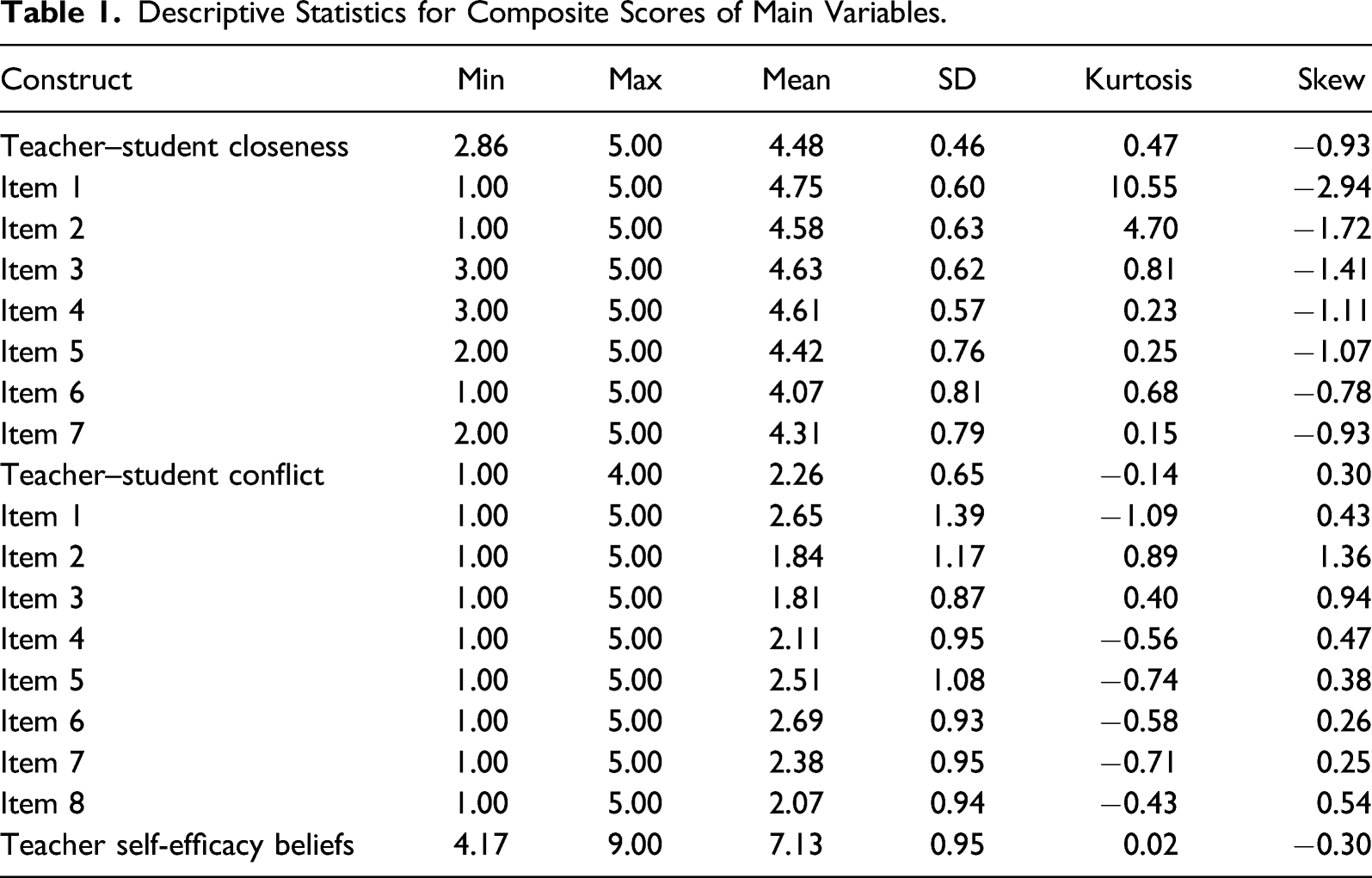
Descriptive Statistics for Composite Scores of Main Variables.
Factor Structure of Anticipated Teacher–Student Relationship Quality
The CFA models for the four competing factor structures of the ATSRQ (i.e., single factor, two factors, hierarchical, and bifactor) resulted in one model exceeding the threshold for acceptable model fit, one model demonstrating poor fit to the data, and two models failing to converge. Although the single-factor CFA model was one of the models that successfully converged, the poor fit indices meant it was not a good representation of the underlying factor structure [χ2 (90) = 263.90, p ≤ .001, RMSEA = .10, 95% CI (.09; .11), CFI = .75, and SRMR = .09]. The two-factor CFA model demonstrated acceptable fit indices, meaning it was a good representation of the underlying factor structure [χ2 (89) = 152.51, p ≤ .001, RMSEA = .05, 95% CI (.04; .07), CFI = .93, and SRMR = .06]. The hierarchical and bifactor models failed to converge on a solution, indicating that neither of these models represented the underlying factor structure of the ATSRQ. Ultimately, the results of these CFA models corroborate prior findings from investigations using the STRS-SF with ISTs that TSCl and TSCn are indeed distinct but correlated constructs with PSTs.
Results From the CFA on TSCl and TSCn Items From the ATSRQ.

Notes: TSCl = teacher–student closeness; TSCn = teacher–student conflict.
Concurrent Validity of Anticipated Teacher–Student Relationship Quality
The CFA model with all three constructs (i.e., TSCn, TSCl, and TSE) represented as latent variables indicated acceptable model fit to the data with χ2 (132) = 209.92, p ≤ .001, RMSEA = .06, 95% CI (.04; .07), CFI = .93, and SRMR = .06. TSE was positively correlated with TSCl (r = .16) and negatively correlated with TSCn (r = −.21). The Spearman ρ correlations were estimated between the composite scores of TSCl, TSCn, and TSE to examine their associations while taking into account their deviations from normality. The results indicated that TSE was positively correlated with TSCl [ρ = .19, 95% CI (.04; .33), p < .01] and negatively correlated with TSCn [ρ = −.19, 95% CI (−.33; −.04), p < .01]. Both of these calculated ρ′s would be indicative of moderate effect sizes using Keith’s (2019) standards and are consistent with findings from prior research (e.g., Hajovsky et al., 2020a). The Spearman ρ between TSCl and TSCn was slightly smaller than the standardized estimate reported in the two-factor CFA model, with a ρ = −.43 [95% CI (−.54; −.30), P < .001].
Discussion
The purposes of the current study were to develop a measure of TSRQ for PSTs that is operationally similar to what is used for ISTs (i.e., STRS-SF; Pianta, 2001), to confirm the factor structure of this measure, and to examine the concurrent validity of the measure with an empirically associated construct, self-efficacy beliefs for teaching. The products and results from the current study offer preliminary, yet robust evidence of progress toward our goals with an adapted ATSRQ instrument for PSTs. This instrument is operationally similar to the STRS-SF, with 7 items measuring anticipated closeness with future students and 8 items measuring anticipated conflict with future students. Descriptive statistics for the closeness and conflict subscales of the ATSRQ are comparable to recently published results using the STRS-SF with ISTs (e.g., Hajovsky et al., 2020a; Hajovsky et al., 2020b; Hajovsky et al., 2021; Mason et al., 2017). One observable difference between PST and IST samples is that PSTs anticipated slightly more conflict with their future students than ISTs experienced with their current students. Although there is a precedent for PSTs to report inflated ratings of self-efficacy that decrease as they enter the field (i.e., lower self-efficacy beliefs as a function of calibration with real abilities; Woolfolk-Hoy & Spero, 2005), there is not any prior literature on this topic to explain the difference. Results from the CFA with item-level data from the ATSRQ demonstrated a factor structure for PSTs that is comparable to the STRS-SF when used with ISTs. Finally, results from the Spearman correlations between anticipated closeness, anticipated conflict, and teacher self-efficacy beliefs provided limited evidence of concurrent validity for the ATSRQ. In research with ISTs using the STRS-SF, recent studies have reported effect sizes similar in size to the ones reported in the current study (e.g., Hajovsky et al., 2020a; Hajovsky et al., 2020b).
Implications for Using the Anticipated Teacher–Student Relationship Quality With Preservice Teachers
We adapted the ATSRQ instrument and examined its psychometric properties to allow researchers to measure anticipated relationship quality with future students in forthcoming studies focusing on PST development and preparation. As teacher education programs work to align their curricula with likely professional experiences, it is imperative that teacher educators, school psychologists, and educational researchers study in PST populations the immediate and longitudinal characteristics of constructs that have demonstrated importance in the field. Current research is replete with examples of studies investigating professionally relevant constructs with PST populations, including culturally responsive teaching and disciplinary beliefs (e.g., Siwatu et al., 2016), self-efficacy and outcome expectation beliefs (e.g., Siwatu & Chesnut, 2014), and commitment to the profession (e.g., Chesnut & Burley, 2015). The relationships that PSTs anticipate having with their future students is a construct that teacher educators can address through instructional and field experiences and is likely to demonstrate individual trajectories that ultimately overlap with how individuals perceive their relationships with students once they enter the profession. The value of being able to measure, track, and intervene in the beliefs that PSTs maintain about their relationships with future students will not be lost on those working with PSTs. Although we might be able draw on the extensive literature examining TSRQ in IST populations, especially given the operational similarity between the STRS-SF and ATSRQ instruments, the current study is the first to investigate this construct with a PST population. As such, the findings from the current study need to be interpreted considering the limitations.
Limitations and Future Directions for Research
In addition to the caveats already discussed, there are three limitations that warrant attention. First, the sample in the current study was comprised of individuals from a single teacher education program in the Midwestern United States. Although the results from our sample demonstrated comparable trends to the results from multiple studies with ISTs, these findings might not generalize to PSTs from other universities or geographical regions. Further research with diversified samples is needed to improve the fields understanding of PSTs’ anticipated closeness and conflict with future students. Our sample of PSTs is likely to teach in rural, suburban, and smaller metropolitan areas where most of the students identify as Caucasian. As such, their schemata of future students might be qualitatively different than PSTs expecting to teach in larger urban districts or in locations where greater cultural and linguistic diversity is likely to be a prevalent characteristic. We recommend future studies aim to diversify samples to include PSTs that might have significantly different schemata of their future students.
The second limitation concerns the cross-sectional nature of the data collected. As prior research with ISTs has highlighted, the different components of TSRQ have distinct longitudinal trajectories and strong associations with diverse metrics of student outcomes. Additionally, multiple studies have demonstrated the longitudinal stability and factorial invariance of the STRS-SF with IST populations (Hajovsky et al., 2020a; Hajovsky et al., 2021; Mason et al., 2017). Given that data for the current study were collected once from each PST, we do not know if responses to the ATSRQ instrument are longitudinally stable and factorially invariant. We recommend future studies aim to include data from more than one wave to examine the stability and invariance of the latent variable over time and determine the test–retest reliability of the adapted instrument.
Finally, the data used for the current study were self-reported by PSTs. The use of self-report ATSRQ data relies on the assumption that PSTs have developed schemata of future students and can honestly represent their attitudes about anticipated closeness and conflict with these students. This assumption might not hold for PSTs that have poorly or inaccurately constructed schemata of future students. We recommend future studies leverage qualitative and experimental designs to reduce concerns with these limitations. For example, researchers might utilize phenomenological designs to explore the characteristics of the schemata that PSTs have about their future students regarding anticipated relationship quality. Additionally, researchers should aim to manipulate these schemata by using experimental vignettes to determine if qualitatively different groups of future students result in significantly different ratings of anticipated relationship quality. Given the prevalence of evidence suggesting systematic differences in ISTs’ ratings of TSRQ with students from different races and genders, continuing this research with PSTs would not only strengthen these assumptions but also lend validity to ATSRQ as a construct.
Footnotes
Declaration of conflicting interests
The author(s) declared no potential conflicts of interest with respect to the research, authorship, and/or publication of this article.
Funding
The author(s) received no financial support for the research, authorship, and/or publication of this article.
