



Abstract
This study aimed to explore the effects of mattering, social media addiction, online activity, school connectedness, age, and gender on anxiety/depressive symptomatology among U.S. adolescents. A nationally representative Qualtrics panel sample consisting of 441 adolescents (Mage = 17.3; SDage = 1.67) participated in this study. The results of a three-step hierarchical multiple regression analysis indicated that gender, social media usage, and mattering were most strongly associated with adolescent distress (i.e., anxiety/depressive symptom reporting). For the full predictive model with all six predictors added, mattering was found to significantly improve the prediction of adolescents’ anxiety/depressive symptomatology, contributing an additional 12.8% of explained variance. For this sample, adolescent girls participants reported experiencing more anxiety/depressive symptoms. Furthermore, higher levels of social media usage, indicative of an addictive stage, and lower levels of mattering were related to more significant anxiety/depressive symptomatology. Overall, mattering was found to significantly correlate with adolescent distress, online activity, problematic social media usage, and school connectedness, evidencing its importance in addressing adolescent mental health.
Understanding adolescent mental health is paramount to the wellness of American society. According to the Centers for Disease Control and Prevention (Centers for Disease Control and Prevention, 2020), the second leading cause of death among adolescents (ages 15–19) is suicide. Mental health concerns are among the top risk factors of adolescent suicide, including bipolar disorder, depression, substance use disorder, and psychosis (Shain & American Academy of Pediatrics Committee on Adolescence, 2016). Mental health concerns among adolescent populations are prevalent, and 50% of mental health concerns begin by age 14 (Kessler et al., 2005). According to the National Survey of Children’s Health, 26.9% of 12–17 year olds had one or more mental, emotional, developmental, or behavioral problems (Child and Adolescent Health Measurement Initiative, 2019). Additionally, it appears that mental health concerns among adolescents are trending upward in recent years. Specifically, 16.7% of adolescents received mental health services in a mental health setting in 2019, compared to 11.8% in 2002 (Substance Abuse and Mental Health Services Administration (Substance Abuse and Mental Health Services Administration, 2020). Additionally, 9.0% of adolescents (ages 12–17) had a past year major depressive episode in 2004, but that percentage increased to 15.7% in 2019 (Substance Abuse and Mental Health Services Administration, 2020).
Regarding anxiety, the National Comorbidity Survey Replication-Adolescent Supplement (NCS-A) results indicated that 3.03% of adolescents have a generalized anxiety disorder (GAD), with female adolescents twice as likely as males to have GAD (Burstein et al., 2014). Among all adolescents with anxiety disorders (e.g., separation anxiety disorder, panic disorder, specific phobia, and social phobia), researchers found that age-of-onset spanned from 4.9 years old (specific phobia) to 11.5 years old (panic disorder) for female adolescents and 5.0 years old (specific phobia) to 9.8 years old (GAD) for male adolescents (Burstein et al., 2012). Therefore, in light of the prevalence of mental health concerns among adolescent populations, it is important to examine potential predictors of mental health symptomatology. Specifically, given the ubiquitous nature of the internet and the growing prevalence of problematic social media use among adolescent populations (Banyai et al., 2017), it is essential to examine these factors in relation to adolescent mental health. Additionally, adolescents’ psychological well-being has been correlated with both their connection to school (Klinck et al., 2020) and their perceived sense of significance in the world (Marshall & Tilton-Weaver, 2019), making school connectedness and mattering important constructs to investigate as well. The simultaneous examination of social media addiction, school connectedness, and mattering will contribute to our understanding of adolescent mental health. Furthermore, the use of a nationally representative sample of adolescents will allow us to gather some unique information regarding the psychometric features of the General Mattering Scale.
Social Media Addiction and Mental Health
Social media usage is widespread among adolescent populations and represents a potentially powerful influencer in adolescent mental health. Indeed, according to the Pew Research Center (2018), 72% of adolescents (ages 13–17) use Instagram, 69% use Snapchat, 51% use Facebook, and 32% use Twitter. Only 3% of the sample reported not using any of the online platforms listed in the survey. Additionally, 95% of the adolescents reported owning or having access to a smartphone, and 45% of adolescents noted they are online almost constantly throughout the day (Pew Research Center, 2018). Furthermore, Rideout and Robb (2019) found that the median age of first social media use is 14 years old, and 63% of respondents between 13 and 18 years of age use social media every day.
There are many potential benefits to social media use among adolescents (e.g., connecting with friends, gaining information about world events, and socialization), yet there are risks to social media use, including social media addiction. For example, among a sample of over 5000 adolescents in Hungary, 4.5% were found to be at risk for problematic social media use (Banyai et al., 2017). Additionally, among over 500 social media users (spanning from adolescents to adults), researchers found that 4.9% were at high risk for social media addiction (Pontes et al., 2018). The following components mark social media addiction: the behavior is most salient in the person’s life, used for mood modification, is a source of conflict, and the user experiences tolerance, withdrawal, and relapse (Griffiths, 1996, 2005).
Social media addiction has been associated with a variety of detrimental outcomes, including low self-esteem and depressive symptoms (Banyai et al., 2017), fear of missing out and emotion regulation difficulties (Pontes et al., 2018), and delay discounting (i.e., the preference for smaller immediate rewards over larger but delayed rewards; Turel et al., 2018). Among adolescents, Wartberg and Kammerl (2020) found significant associations between problematic social media use and a variety of variables, including antisocial behavior, emotional distress, self-esteem issues, and problematic internet gaming. Additionally, among a sample of Turkish adolescents, researchers found that social media addiction significantly correlated with more depression and less self-esteem (Kircaburun, 2016). Moreover, a meta-analysis of studies examining problematic smartphone use among children and young people concluded that females and youth aged 17–19 had the highest rates of problematic smartphone use, and problematic smartphone use was associated with more anxiety, depression, stress, poor sleep quality, and poor educational attainment (Sohn et al., 2019). Furthermore, among a Norwegian sample of 16–88 year olds, researchers found that being female, being younger, and being single were predictors of social media addiction (Andreassen et al., 2016). Additionally, higher levels of anxiety, obsessive compulsive disorder, and attention deficit hyperactivity disorder were associated with higher addictive social networking scores (Andreassen et al., 2016). Thus, existing research implicates social media addiction in the experience of various mental health concerns among adolescent populations.
School Connectedness and Mental Health
The exploration of adolescent mental health also requires consideration of school connectedness or perceived belongingness in the school setting. Aside from their living environment, adolescents spend most of their time in school. School connectedness refers to the extent to which “students feel personally accepted, respected, included, and supported by others” at school (Goodenow, 1993, p. 80).
Previous research has illuminated the relationship between school connectedness and mental health symptoms among adolescent populations. For example, among adolescents (11–16 years old) in England, researchers found a significant, inverse correlation between school connectedness and conduct problems as well as emotional difficulties (Oldfield et al., 2016). Additionally, in a regression analysis, school connectedness predicted more prosocial behavior among the sample (Oldfield et al., 2016). Among 152 Australian adolescents (12–18 years old), researchers found a negative correlation between depression and school connectedness (large effect size, r = −.70) and a stronger impact of school connectedness on depressive symptoms than parental attachment (Shochet et al., 2008). Finally, Klinck et al. (2020) studied depression, anxiety, and school connectedness among a large sample of American adolescents (11–14 years old) and found a bidirectional relationship between school connectedness and depression. Specifically, high levels of school connectedness at baseline predicted lower levels of depression at the second time point (6 months later). Additionally, higher levels of depression at baseline predicted lower levels of school connectedness at the second timepoint. Moreover, school connectedness demonstrated significant, negative correlations with both anxiety and depression at baseline (Klinck et al., 2020). Therefore, it appears that adolescents’ sense of belonging to their school environment can influence their experience of mental health symptomatology.
Mattering and Mental Health
Another variable relevant to the study of adolescent mental health symptomatology is mattering. Rosenberg and McCullough (1981) introduced and defined the construct of mattering as the degree to which a person perceives him or herself to be important to others. Flett (2018) noted, “mattering reflects a person’s need to feel significant in the eyes of other people” (p. 31). Mattering is distinct from self-esteem and aligns with positive psychology as a crucial component of well-being (Flett, 2018). For instance, in the study of 247 undergraduate students, researchers found that mattering was a significant predictor of depression and that ruminative brooding (i.e., mental preoccupation with one’s distress) mediated the relationship between mattering and depression (Flett et al., 2020).
Scholars have proposed that the construct of mattering is particularly relevant to the experience of adolescents (Rosenberg & McCullough, 1981). Indeed, in the study of middle school students in the United States, researchers found significant correlations between mattering and anxiety and depression; specifically, as mattering decreased, anxiety and depression increased (Dixon et al., 2009). Furthermore, among a sample of adolescents in Canada, researchers found that decreased mattering to parents was associated with higher levels of depression (Marshall & Tilton-Weaver, 2019). Importantly, mattering can be assessed as a global variable (e.g., sense of mattering in general) or in relation to a specific other (e.g., parents, close friends, and teachers; Marshall & Tilton-Weaver, 2019). Existing research indicates that mattering is an important correlate of adolescent mental health.
Purpose of the Study
Independently, the factors of social media addiction, school connectedness, and mattering have been linked to adolescent mental health symptomatology. The purpose of the present study was to examine these variables in the same model to determine the relative importance of each factor in explaining adolescent anxiety/depressive symptomatology. Specifically, we aimed to explore whether mattering significantly accounts for the variance in adolescent anxiety/depression after controlling for demographic variables, school connectedness, and social media addiction. As such, the current study addressed the following research questions: 1. Research question 1: What are the levels of social media addiction, school connectedness, mattering, and anxiety/depressive symptomatology among U.S. adolescents? 2. Research question 2: What are the relationships between social media addiction, school connectedness, mattering, and anxiety/depressive symptomatology among U.S. adolescents? 3. Research question 3: To what extent can the variance in anxiety/depressive symptomatology be accounted for by mattering after controlling for age, gender, the average number of hours spent online per day, social media addiction, and perceptions of school connectedness?
Method
Procedures
After obtaining Institutional Review Board approval, we contracted with Qualtrics to procure the sample used in this study via online panels. Following a pilot test of our online survey through a soft launch (e.g., releasing the survey to a small number of people to estimate potential response rates and assess for issues with survey flow or logic), Qualtrics staff emailed a study participation link to a sample of U.S. adolescents who met our pre-defined inclusion criteria (participants between 13 and 19 years of age). Using a stratified sampling method, they procured a sample representative of national demographics related to gender identity, race/ethnicity, and geographic location. The participation link was sent to 1800 adolescents, with 441 individuals opting to complete the study (24.5% response rate). Each participant who completed the survey was compensated for their participation. The median time to completion was logged as 5.43 minutes.
Participants
Within the original sample of 441 participants, one individual did not record a response for the age question and was discarded from further analysis. Of the remaining 440 participants, ages ranged from 13 to 19, with an average of 17.3 years (SD = 1.67). In terms of gender identity, 50% (n = 220) participants endorsed a female identity, 49.1% (n = 216) a male identity, and 0.9% (n = 4) other. Participants’ racial/ethnic composition was 63.4% (n = 279) White, 13.2% (n = 58) Latino(a)/Hispanic, 11.1% (n = 49) African American/Black, 5% (n = 22) Asian/Asian American, 0.9% (n = 4) Multiracial, and 0.7% (n = 3) other. A small segment of the sample (5.7%; n = 25) chose not to respond to this item. A larger percentage (40%) of our sample reported having graduated from high school. Of those students still in school, 21.8% (n = 96) reported being in 12th grade, 12.3% (n = 54) in 11th grade, 10.5% (n = 46) in 10th grade, 7.3% (n = 32) in ninth grade, 5.5% (n = 24) in eighth grade, 2% (n = 9) in seventh grade, 0.2% (n = 1) in sixth grade, and 0.4% (n = 2) in fifth grade.
Consistent with our research focus, we collected additional information related to participants’ online activity and social media usage. Participants reported spending a median of 5.5 hours per day online (IQR = 4–10), with a median of 10 hours (IQR = 5.25–15.75) reported as the most hours spent online in any single day. Participants also reported engaging in social media across multiple platforms (Md = 3; IQR = 2–7.5). Among the social media platforms accessed, Snapchat was the most popular (35.2%; n = 155), followed by Instagram (25.9%; n = 114), Facebook (17.5%; n = 77), Twitter (8.4%; n = 37), Pinterest (3.4%; n = 15), Tumblr (3.2%; n = 14), Musical.ly (1.6%; n = 7), and WhatsApp (1.4%; n = 6). Fifteen participants reported no use of any social media platforms.
Measures
Participants completed a total of four survey questionnaires and a demographic data sheet. Survey questionnaires used included the following:
Bergen Social Media Addiction Scale
The Bergen Social Media Addiction Scale (BSMAS) is a six-item scale adapted from the BFAS (Andreassen et al., 2012), where the term “Facebook” was replaced with the more generic term “social media” (Andreassen et al., 2016). The measure is used to assess for social media usage in the past 12 months, with each of the items corresponding to diagnostic themes of addiction (e.g., salience, craving, mood, loss of control, withdrawal, and conflict) (Andreassen et al., 2016). Participants are asked to respond to each item using a 5-point Likert-type scale with values ranging from 1 (very rarely) to 5 (very often). Sample questions include “How often during the last year have you used social media to forget about personal problems?” and “How often during the last year have you become restless or troubled if you have been prohibited from using social media?” Scores are summed to produce a total score ranging between 6 and 30 with scores greater than 19, indicating an increased risk for problematic social media usage (Banyai et al., 2017). Alternatively, Golbeck (2017) identifies a scoring approach with scores of 4 or 5 on at least four items representing a risk of problematic usage. Andreassen et al. (2012) reported a coefficient alpha of .83 for their initial development of the unidimensional scale. For the current study, we calculated a coefficient alpha of .77, which evidenced sufficient internal consistency for the BSMAS with our adolescent sample.
Psychological Sense of School Membership
The Psychological Sense of School Membership (PSSM) is a five-item scale assessing students’ degree of connectedness to their school (Goodenow, 1993). Participants respond to these items using a 5-point Likert scale with values ranging from 1 (strongly disagree) to 5 (strongly agree). Sample questions include “I feel proud of belonging to my school” and “the teachers here respect me.” For those individuals no longer in school, they were asked to recollect their time in school when noting their level of agreement with each statement. Scores are summed together and subtracted by five to produce a total score ranging between 0 and 20, with higher scores indicating greater perceptions of school connectedness. Estimates of internal consistency for the five-item PSSM scale ranged between .77 and .88 (Goodenow, 1993). For the current study, we calculated a coefficient alpha of .57. Because our coefficient alpha was low, we examined bivariate correlations between individual items and the total PSSM score for participants. All correlations were significant, and we decided to keep the five-item scale in our study based on the premise that the low alpha value may be due to the limited number of items on the scale (Tavokol & Dennick, 2011).
General Mattering Scale
The General Mattering Scale (GMS) is a five-item scale assessing the degree to which individuals perceive themselves as important and mattering to others (Rosenberg & Marcus, 1987). Participants respond to each item using a 4-point Likert-type scale with values ranging from 1 (not at all) to 4 (very much). Sample questions include “How important do you feel you are to other people?” and “How much do you feel others would miss you if you went away?” Scores are summed to produce a total score ranging from 5 to 20, with higher scores indicating a greater sense of mattering. The GMS has been shown to be reliable across various samples, with coefficient alphas ranging between .63 and .85 (Rosenberg & Marcus, 1987; Rosenberg & McCullough, 1981; Dixon Rayle, 2005). For the current sample, we calculated a Cronbach’s alpha coefficient of .81.
Patient Health Questionnaire-4
The Patient Health Questionnaire-4 (PHQ-4) is a four-item scale assessing anxiety and depressive symptoms over the most recent 2-week period (Kroeke et al., 2009). Participants respond to each item using a 4-point Likert-type scale with values ranging from 1 (not at all) to 4 (nearly every day). Sample questions include “Over the last 2 weeks, how often have you been bothered by feeling nervous, anxious, or on edge?” and “over the last 2 weeks, how often have you been bothered by little interest or pleasure in doing things?” Scores are summed to produce a total score. Total scores range from 0 to 12, with a score of 9 or higher representing an elevated risk of adverse experiences. While an elevated PHQ-4 score by itself is not diagnostic, it does serve as an indicator that additional assessment may be warranted. For the current sample, we calculated a Cronbach’s alpha coefficient of .83 which is consistent with values reported in other studies.
Data Analysis
Statistical Power Analysis
An a priori sample size calculation was used to determine the minimum number of participants needed to detect the specified effects. The calculation was made based on a conservative effect size estimate (f 2 = .02), with six predictors, the desired power level of .80, and an alpha level of .05. Based on these factors, a minimum of 395 participants would be needed to detect a small effect size. Based on this finding, we considered our sample of 440 U.S. adolescents sufficient to explain relationships between predictor and criterion variables.
Results
Psychometric Analyses
Because limited information related to the scale’s construct validity exists, we conducted a confirmatory factor analysis (CFA) to compare the factor structure of the GMS in our sample to the initial factor structure proposed by the scale’s author. A proper solution converged in eight iterations with item loadings ranging between .50 and .78 and all five items loading significantly on the latent variable. Values for each of the fit indices (CFI = .98, TLI = .97, RMSEA = .07) except for χ 2 /df met suggested thresholds (see Dimitrov, 2012). However, because the chi-square statistic is biased with large sample sizes (Ullman, 2006), and all other metrics indicated a strong model fit, we chose to use the full five-item GMS in this study.
Research question 1
Descriptive Statistics for All Study Variables.
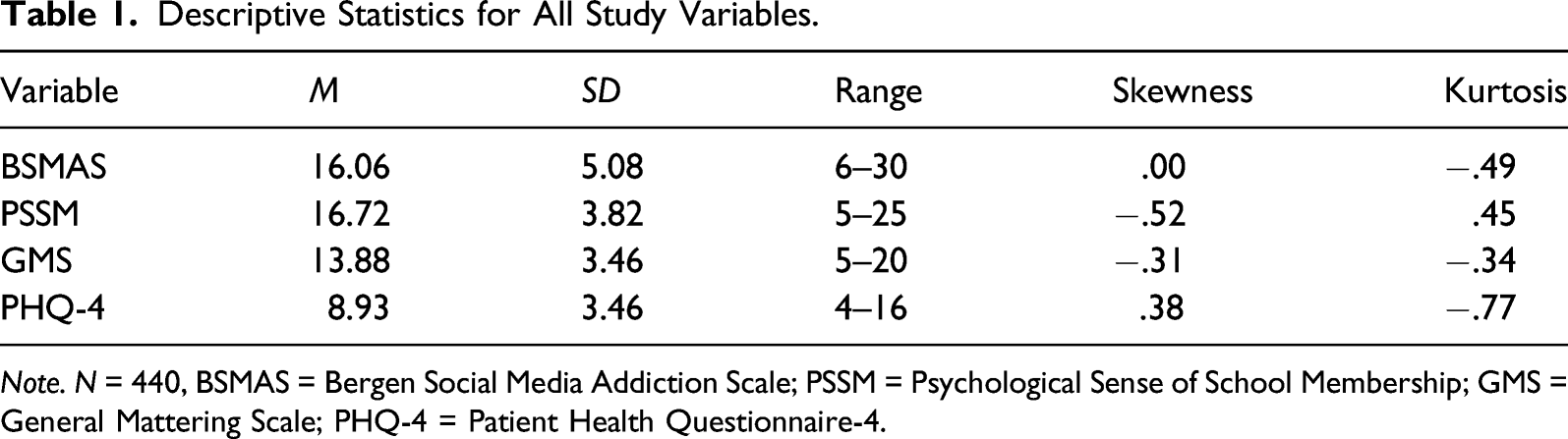
Note. N = 440, BSMAS = Bergen Social Media Addiction Scale; PSSM = Psychological Sense of School Membership; GMS = General Mattering Scale; PHQ-4 = Patient Health Questionnaire-4.
Research question 2
Intercorrelations Among Study Variables.

Note. BSMAS = Bergen Social Media Addiction Scale; PSSM = Psychological Sense of School Membership; GMS = General Mattering Scale; PHQ-4 = Patient Health Questionnaire-4. *p < .05.
Research question 3
Hierarchical Regression Model Examining Variance in Anxiety/Depressive Symptoms Explained by Predictor Variables.
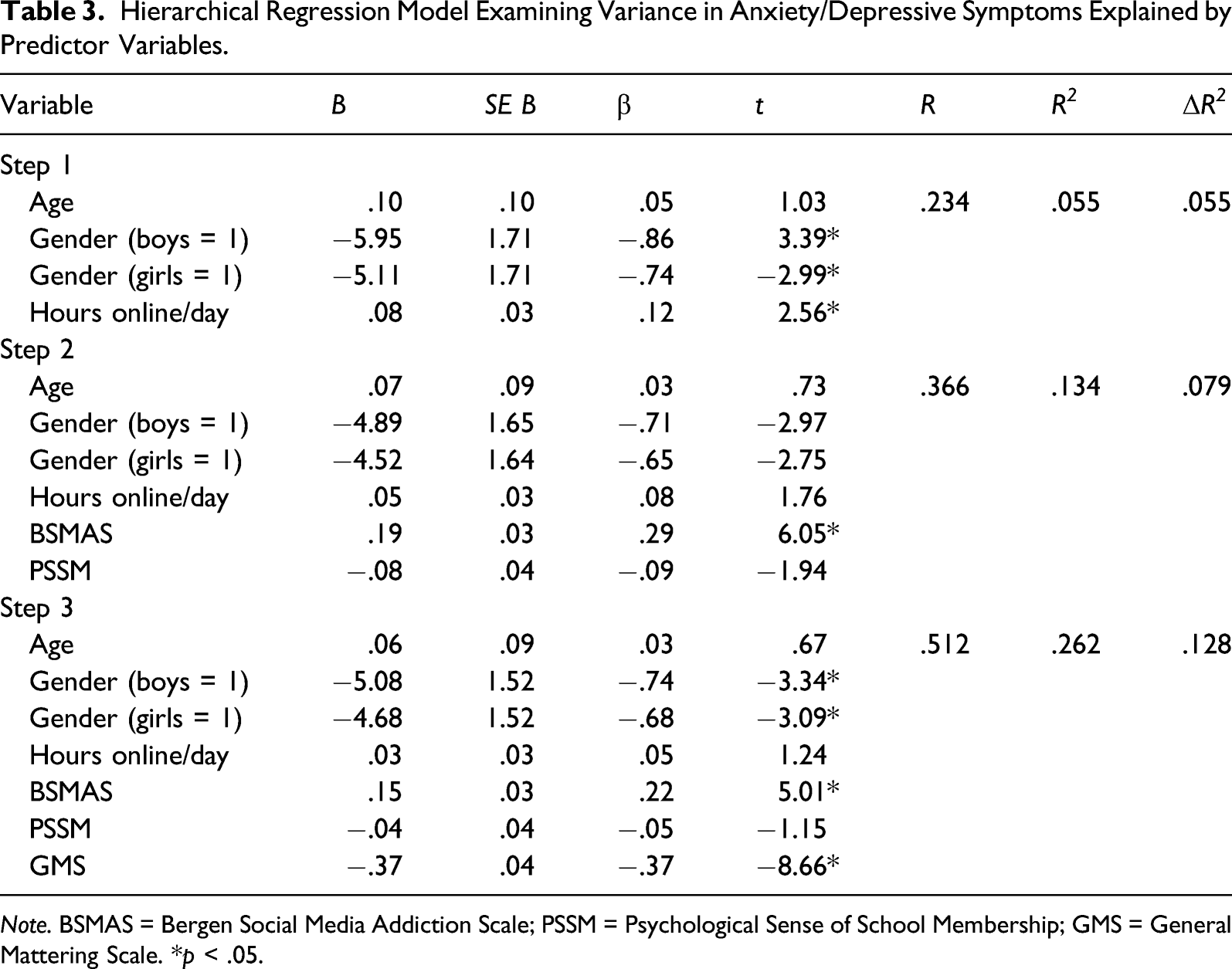
Note. BSMAS = Bergen Social Media Addiction Scale; PSSM = Psychological Sense of School Membership; GMS = General Mattering Scale. *p < .05.
Discussion
The current study explored the relationships among social media addiction, anxiety and depressive symptoms, school connectedness, and mattering in a nationally representative sample of adolescents. Previous researchers have indicated adolescents present with negative correlates to social media addiction such as depression (Banyai et al., 2017) and emotion regulation difficulties (Pontes et al., 2018). Similarly, adolescents in the current sample who reported more problematic social media use were more likely to endorse adverse mental health outcomes, such as more anxiety and depressive symptoms. Researchers purported that the neural development of adolescents results in a greater risk of emotional sensitivity when engaging with social media (Crone & Konijn, 2018). Thus, they may be at risk for such negative mental health outcomes with a higher frequency of social media use. The results of our study contribute to this body of literature by revealing an inverse correlation between mattering and social media addiction (r = −.18). Albeit a small association, this correlation indicates that students who do not feel of importance to others may use social media compulsively, perhaps as a way to feel significant via an online presence. This notion corresponds to previous findings indicating that social media addiction is linked to lower levels of self-esteem (Banyai et al., 2017; Wartberg & Kammerl, 2020). In addition, researchers have found a positive correlation between social media addiction and difficulties in emotion regulation among adolescents (Wartberg et al., 2021). Therefore, social media use may be a means of mood modulation among adolescents with low levels of mattering.
Furthermore, researchers determined that gender may impact these associations. For example, adolescent females demonstrated positive correlations between problematic smartphone use and depressive symptoms (Sohn et al., 2019). The current study results expand upon previous findings, in which identifying female and higher levels of social media addiction were associated with more anxiety and depressive symptoms. The correlational nature of the results should be considered. Indeed, the results of longitudinal studies of social media use among adolescents demonstrated that females with more depressive symptoms reported more frequent social media use (Heffer et al., 2019), suggesting causality in which the depression predicts the use. Thus, the relationship between social media addiction and mental health outcomes warrants continued exploration.
Adolescents spend a great deal of time in the school environment; therefore, researchers consider school-related constructs when exploring this population. For example, researchers established relationships between school connectedness (Klinck et al., 2020) and a sense of significance (Marshall & Tilton-Weaver, 2019) with mental health concerns among adolescents. Our results corroborated previous findings in which higher levels of mattering were associated with fewer anxiety/depressive symptoms. Additive to this body of research was exploring how assessing school connectedness and mattering may play a role in adolescents’ experiences with social media and mental health outcomes, such as depression and anxiety. Indeed, adolescents in the current study who felt they mattered were less likely to be addicted to social media. Moreover, they reported fewer anxiety and depressive symptoms. Additionally, the more adolescents felt connected to their school, the more they believe they matter. This result is consistent with previous research in which young adolescents (M = 11.47 years) with more school connectedness and mattering predicted wellness (Watson, 2017). Therefore, school connectedness and mattering may be protective factors for adolescents’ experiences of social media addiction and mental health outcomes such as anxiety and depressive symptoms. Researchers highlighted the importance of mattering toward well-being (Flett, 2018), and it appears that it may offer protection against threats to wellness among adolescents.
This study also adds to the empirical support for the mattering construct. The results of our hierarchical regression analysis support mattering as a unique construct separate from other closely related variables, including school connectedness. Furthermore, the additional analyses we conducted to evidence the internal consistency of the GMS support its use as a valid measure of mattering, especially among adolescents. In the future, researchers seeking to assess mattering can confidently employ the GMS as a part of their selected instrumentation.
Limitations and Future Studies
Results of the current study should be interpreted in the context of limitations. Although a stratified sample procedure was utilized to support generalizability, the adolescent participants were representative of those only in the United States and may not represent global experiences. Moreover, participants represented an older adolescent population, with an average age of 17.3 years (SD = 1.67). Finally, the results are correlational and not causal. Some researchers have indicated that cross-sectional design may limit understanding of social media in relationship to mental health outcomes (Heffer et al., 2019). Thus, researchers may consider ways to assess several factors associated with adolescent well-being.
Conclusion
The prevalence of mental health problems among adolescents is a growing concern. Given the numerous adverse effects of poor mental health, researchers have invested considerable time and energy into investigating potential precipitants and predictors of mental health issues such as anxiety and depression among the adolescent population. Our study adds to this body of literature by identifying the strength of gender, social media usage, and sense of mattering as predictors of adolescent anxiety/depressive symptomatology.
Footnotes
Declaration of Conflicting Interests
The author(s) declared no potential conflicts of interest with respect to the research, authorship, and/or publication of this article.
Funding
The author(s) received no financial support for the research, authorship, and/or publication of this article.
