




Abstract
This article is the first attempt to validate the Entrepreneurial Intention Questionnaire (EIQ) in secondary education students. It is based on the Theory of Planned Behavior (TPB) and includes its constructs: attitude towards entrepreneurship, subjective norm, entrepreneurial self-efficacy, and entrepreneurial intention. The promotion of entrepreneurship in early education requires valid and reliable measures to assess the desired outcomes and evaluate the effectiveness of the interventions. The EIQ presents good psychometric qualities in a Spanish sample of high school students (N = 226): (a) The four-factor structure fits the data with factor loadings ranging between .378 and .862; (b) Each dimension presents satisfactory reliability results (above .7); and (c) The dimensions reproduce expected relationships with entrepreneurial attitudes. Additionally, competing models of the TPB have been tested to provide evidence to support a modified version of the original TPB model. Consequently, the EIQ is adequate for secondary education in Spain, being especially useful for longitudinal studies.
Keywords
Introduction
Entrepreneurship is an important factor in the economic development of countries (Acs et al., 2017). Entrepreneurship is considered as a result of a conscious and planned decision (Liñán & Chen, 2009), which can be promoted and taught through education and experience (Iyigün, 2015). From the European Commission (2016), entrepreneurship is understood as a lifelong skill that must be introduced in the early stages of education. Some European countries are actively promoting entrepreneurial education in secondary education. In the Spanish context, the Organic Law of Education (LOE 2/2006, 2006) includes autonomy and personal initiative as competencies that must be promoted in compulsory education (Bernal-Guerrero, 2014). Entrepreneurship is considered a key competence for secondary education since the Organic Law for the Improvement of Education Quality (LOMCE 8/2013, 2013). According to Johansen and Schanke (2013), almost 90% of secondary schools in Norway provide some kind of entrepreneurial education.
Fostering entrepreneurial education in secondary schools is considered as a key instrument for the promotion of innovation systems and entrepreneurship (Fagerberg & Srholec, 2008). Huber et al. (2014) concluded that early entrepreneurial education is essential, due to the fact that entrepreneurial skills could be easier developed if they are promoted from early education. Longitudinal studies evidence that students who took a junior entrepreneurship program in high school were more likely to participate in entrepreneurial ventures (Elert et al., 2015).
Despite a tendency in government policy to promote entrepreneurial education in early education, research has focused on university students (Longva & Foss, 2018; Mwasalwiba, 2010; Nabi et al., 2017). Although not prevalent, some research has explored the effectiveness of entrepreneurial education in secondary students (e.g., Athayde, 2012; Peterman & Kennedy, 2003; Sánchez, 2013). Within the methodological rigorous impact studies, effectiveness could be measured through an improvement in entrepreneurial attitudes (Athayde, 2012), entrepreneurial self-efficacy (Bergman et al., 2011; Sánchez, 2013), or entrepreneurial intention (Sánchez, 2013; Schröder & Schmitt-Rodermund, 2006), among other outcomes. Among all these possible variables, the most frequently used to assess the impact of entrepreneurial education is entrepreneurial intention (Bae et al., 2014; Longva & Foss, 2018; Martínez-Gregorio et al., 2021).
The entrepreneurial intention could be understood as “the conscious state of mind that precedes action and directs attention toward entrepreneurial behaviors such as starting a new business and becoming an entrepreneur” (Moriano et al., 2012, p. 165). Its importance resides in its predictive power on behavior (Armitage & Conner, 2001). Although some controversy regarding the intention-behavior link exists in the entrepreneurship field, recent research supports Krueger’s claim (2000) who considered entrepreneurial intention as the single best predictor of entrepreneurial behavior. Since Kautonen et al. (2015) carried out a longitudinal study that supported the effect of entrepreneurial intention on behavior, some authors have added evidence in the same direction (Figueiredo & Lyons, 2021; Gieure et al., 2020).
Regarding the conceptualization of entrepreneurial intention and its antecedents, the most frequent theoretical framework is the Theory of Planned Behavior (TPB) (Ajzen, 2001; Liñán & Fayolle, 2015). This theory posits three antecedents of intention: attitude toward the behavior, subjective norm, and perceived behavioral control. Other factors are considered to influence intentions through these (Moriano et al., 2012).
The first antecedent is attitude towards entrepreneurship, which is the positive or negative personal evaluation of the condition of being an entrepreneur (Kolvereid, 1996). Subjective norm refers to social support to carry out (or not) an entrepreneurial behavior (Liñán & Chen, 2009). Currently, some controversy regarding the effect of subjective norm exists. Since Armitage and Conner (2001) questioned its predictive power, alternative models have been tested. Heuer and Liñán (2013) satisfactorily tested a modified model in which subjective norm has an indirect effect on entrepreneurial intention through attitudes towards entrepreneurship and perceived behavioral control. Finally, perceived behavioral control is defined as the perceived ease to perform an entrepreneurial behavior. Although Ajzen (2002a) stated perceived behavioral control has the third component of the TPB, numerous studies have replaced perceived behavioral control with entrepreneurial self-efficacy (Krueger et al., 2000; Moriano, 2005; van Gelderen et al., 2008). Despite being related constructs, Ajzen (2002b) emphasized their differences, including the controllability component in perceived behavioral control. In their meta-analytic review, Armitage and Conner (2001) supported a distinction between self-efficacy and perceived behavioral control, concluding that self-efficacy could be a better predictor of entrepreneurial intention.
A related topic of interest is how this variable could be measured. In the beginning, measuring entrepreneurial intention in the general population was controversial at times (Liñán & Chen, 2009; Thompson, 2009). Some studies used single items to measure intention (Barba-Sánchez & Atienza-Sahuquillo, 2018; Krueger et al., 2000; Shahin et al., 2021), or defined entrepreneurial intention as the opposite of organizational employment (Kolvereid, 1996). The scale most frequently used was developed by Liñán and Chen (2009). This scale follows the structure of the TPB, including 4 subscales: entrepreneurial intention, subjective norm, attitude towards entrepreneurship, and perceived behavioral control. With this scale, Liñán and Chen (2009) tried to solve the “need to develop more adequate reliable and valid instruments to analyze entrepreneurial perceptions and intentions.” (p. 594). However, some authors have developed alternative scales (e.g., Asghar et al., 2019; Kautonen et al., 2015; Thompson, 2009). One of the most interesting ones is the Entrepreneurial Intention Questionnaire (EIQ), initially developed by Moriano (2005) and updated latterly by Rueda et al. (2015). Surprisingly, despite being different scales, the scale published by Moriano (2005) and Rueda et al. (2015) and the one by Liñán and Chen (2009) share the same name. From now on, in this article, the EIQ will refer to the scale developed by Rueda et al. (2015).
Unlike previous scales, the EIQ follows Ajzen’s (2002a) recommendations of how to measure attitudes and subjective norms as a composite measure (Moriano et al., 2012). This scale has been validated in different countries (Da Fonseca Oliveira et al., 2016; Laguía et al., 2017; Rueda et al., 2015), and it has been used in cross-cultural studies (Moriano et al., 2012). Nevertheless, most of the samples were with university students (Laguía et al., 2017), and it has never been validated for secondary or high school students.
As previously stated, little attention has been paid to the early stage do Paço et al. (2011) of compulsory education. However, recently, some scales have been validated in secondary samples to measure basic business knowledge (Bernal-Guerrero, et al., 2020), entrepreneurial competencies (Cárdenas-Gutiérrez et al., 2021), entrepreneurial personality (Ortuño-Sierra et al., 2021) or attitudes towards entrepreneurship (Oliver & Galiana, 2015). Sánchez (2013) was the first to attempt to explore entrepreneurial intention in the context of secondary school Spanish students, whereas do Paço et al. (2011) satisfactorily tested the TPB model with secondary students. But there is still a need to develop reliable and valid instruments to measure entrepreneurial intention in secondary education. More studies are needed to gather robust validity evidence for the use of entrepreneurial scales with adolescents and young people (Ortuño-Sierra et al., 2021).
This study aims to adapt and validate the EIQ (Rueda et al., 2015) in a Spanish sample of secondary students. The objectives are specifically for secondary student population: (a) to test the factorial structure of the scale, (b) to analyze its reliability, (c) to test the relationships between TPB constructs and entrepreneurial attitudes, as external validity evidence, and (d) to study the adequacy of competing models of TPB (Heuer & Liñán, 2013), in which subjective norm has a different role.
Method
Sample and Procedure
Our sample consisted of 226 secondary students from high schools of Valencia (Spain). 58.8% were girls (n = 133). The age of the participants ranged between 11 and 17, with an average age of 14.03 (SD = 1.46). 56.2% attended public high schools (n = 127), whereas 41.2% attended private institutions (n = 93).
Data came from a cross-sectional study that met the ethical standards of the American Psychological Association. The research received the ethical approval of the Ethical Commission of the University of Valencia (UV-INV_ETICA-1218680). Questionnaires were distributed online (92.48%, n = 209) or in paper in the high schools (7.52%, n = 17), as required for some schools. Questionnaires were administered once the secondary school authorities and parents had been informed about the objectives and procedure of the survey and had approved the protocol. Each family had to sign an informed consent to allow the participation of their children. Participation was voluntary and not rewarded. Anonymity and confidentiality were guaranteed. The questionnaire took about 25 minutes to complete, approximately.
Instruments
The survey included a set of socio-demographic questions and the following scales:
‐ EIQ (Rueda et al., 2015). In this study, we used a version of the EIQ adapted to the high school context. The EIQ scale is available under request to the original authors (Rueda et al., 2015). This scale included four subscales: attitudes towards entrepreneurship, subjective norms, entrepreneurial self-efficacy, and entrepreneurial intention. All items were measured through a Likert scale ranging between 1 and 7.
As mentioned, the EIQ follows Azjen’s (2002a) recommendations, measuring attitudes and subjective norms as composite measures. Consequently, attitude towards entrepreneurship was measured with two groups of six items. The first group of questions asked about the expected results of entrepreneurship (i.e., “Creating a new company or becoming an entrepreneur would mean for you… 1. Facing new challenges”) and the second one, about the desirability of these results (i.e., “Indicate how desirable are they for you in your everyday life… 1. Facing new challenges”). Both sets of items are multiplied, and a higher score means a more positive attitude toward entrepreneurship. Subjective norms were measured as a composite measure, too. It included three items asking about the perception of their close contacts about entrepreneurship (i.e., “Indicate the extent to which they agree if you decide to pursue a career as an entrepreneur… 1. My closest family”) and three items asking about the importance given to these people (i.e., “Indicate to what extent do you care about what they think as you decide on whether or not to pursue a career as an entrepreneur… 1. My closest family”) These sets of items should be multiplied to obtain the 3 final items for subjective norm.
Regarding entrepreneurial self-efficacy, it was measured by 6 items (i.e., “If you were to create your own business, to what degree would you be able to complete the following tasks? 1. Define your business idea and strategy of your company”). The subscale of entrepreneurial intention was composed of 5 items asking about the likelihood of the individual following an entrepreneurial career (i.e., “Do you think that in the future you will create your own company?”). The psychometric properties of the scale in secondary students are reported in the present paper.
We carried out some modifications to the original scale to adapt it to secondary education students. The dimensions of attitudes towards entrepreneurship and self-efficacy remain identical. When measuring subjective norm, Rueda et al. (2015) considered five groups of relevant people: close family, close friends, colleagues, partners, and children. Some of these items do not apply in adolescence. Consequently, the modified version asks for the perception about entrepreneurship and the importance given to close family, friends, and teachers. Regarding the dimensions of entrepreneurial intention, Items 1, 2, and 6 remain identical. Item 3 has been adapted by changing “if the opportunity presents itself” to “If you had the opportunity to choose freely the career to follow, what would you prefer?”. Item 4 asked for the probability of starting a business in the next 5 years. It has been changed to “Imagine you are finishing your studies; with what probability would you consider creating your own business from then to 5 years in time?” Lastly, Item 5 has been removed because it asked for the entrepreneurial intention in the following 12 months, which is impossible for students 12–16 years old.
Entrepreneurial Attitudes Scale for Students (EASS) (Oliver & Galiana, 2015). This scale measures six entrepreneurial attitudes: proactivity, professional ethics, empathy, innovation, autonomy, and risk-taking. Each attitude constitutes a subscale with 3 items. All items were measured through a Likert scale ranging between 1 (“strongly disagree”) and 6 (“strongly agree”). The six-factor structure fit the data adequately (χ2(120) = 220.516 (p < .01), CFI = .965, SRMR = .048, RMSEA = .061 [CI .048–.073]) and Composite Reliability Index (CRI) for each subscale were: .67, .70, .81, .83, .86, and .56, respectively. These results support the psychometric properties reported by Oliver and Galiana (2015).
Statistical Analysis
The validation of the scale was carried out following previous objectives. Factorial validity was tested via confirmatory factor analysis (CFA) with Weighted Least Square Mean and Variance corrected. The model fit of the data was assessed following several fit criteria recommended in the literature (Hu & Bentler, 1999): chi-square statistics, a comparative fit index above .90, the root mean squared error of approximation (RMSEA) under .08 and the standardized root mean squared residuals (SRMR) under .08.
The statistical analysis of the scale included items’ means, standard deviation, inter-item correlation, and corrected item-total correlations. Reliability was assessed via Cronbach’s alpha and CRI (Raykov et al., 2010), both considered adequate when values ≥.70 (Hair et al., 2014).
Evidence for external validity was obtained correlating the TPB constructs (attitudes towards entrepreneurship, subjective norms, entrepreneurial self-efficacy, and entrepreneurial intention) with the attitudes included in the EASS (proactivity, professional ethics, empathy, innovation, autonomy, and risk-taking).
Additionally, competing TPB models were tested via structural equation modeling with the aforementioned fit criteria. Jöreskog (1993) proposed three uses of structural equation models as a way of testing a theory: strictly confirmatory, alternative models and model generating. In this paper, alternative models have been used to determine, between two models, which TPB approach fits the data better. Model 1 was the traditional TPB model (Azjen, 2001), whereas Model 2 was a modified version based on Heuer and Liñán (2013) that considers the indirect effect of the subjective norm on the entrepreneurial intention through attitudes towards entrepreneurship and entrepreneurial self-efficacy.
To perform the analysis, we used IBM SPSS 26 Statistics and Mplus 8.5 (Muthén & Muthén, 1998-2017).
Results
Factorial Structure
The four-factor structure proposed in previous literature fit the data adequately: Factorial structure. Note. All the factor loadings were statistically significant (p < .001). ESE = Entrepreneurial Self-Efficacy.
As expected, all factors were positively correlated. The correlations between entrepreneurial intention and attitudes, subjective norms and entrepreneurial self-efficacy were .567, .346, and .665, respectively. The theoretical antecedents of entrepreneurial intention showed a positive correlation between them: attitudes and subjective norm .563, attitudes and self-efficacy .593, and subjective norm and self-efficacy .409.
Reliability and Descriptive Statistics
Means (M), Standard Deviations (SD), Skewness (g1), Kurtosis (g2), Inter-Item Correlations, and Corrected Item-Total Correlations for the EIQ (rit).
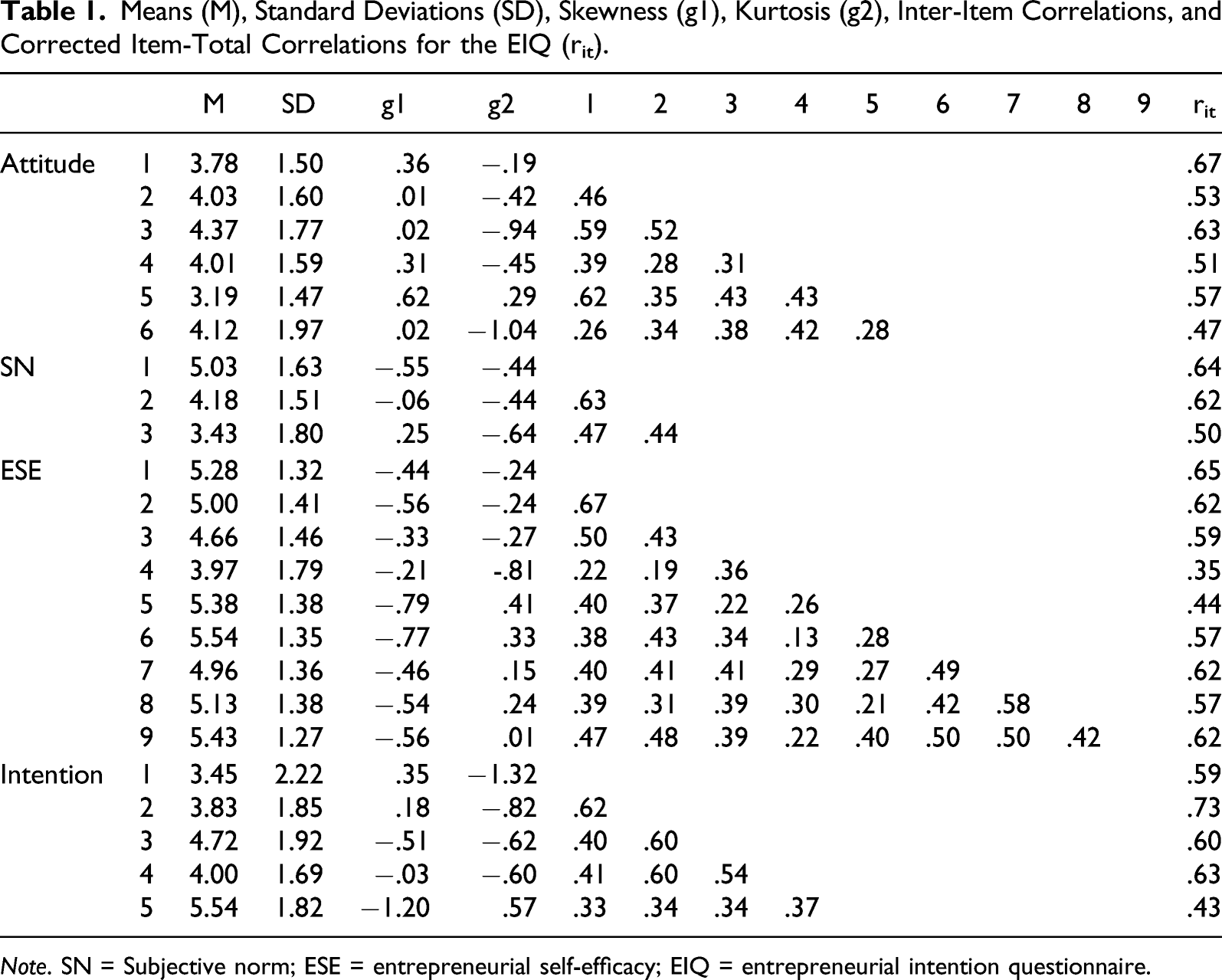
Note. SN = Subjective norm; ESE = entrepreneurial self-efficacy; EIQ = entrepreneurial intention questionnaire.
External Validity
Correlations Between EIQ and EASS for Students Dimensions.
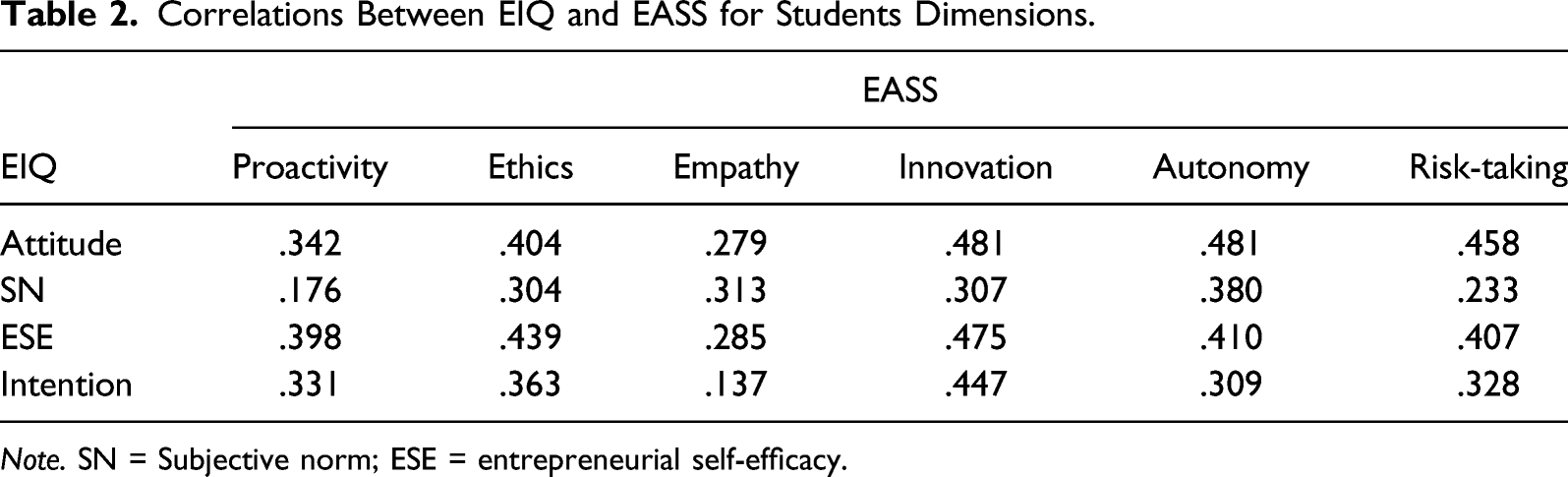
Note. SN = Subjective norm; ESE = entrepreneurial self-efficacy.
Competing TPB Models in Secondary Students
Finally, competing TPB models were tested in secondary education students. Firstly, we tested the goodness of fit of the traditional TPB model proposed by Azjen (2001). As theory suggested, Model 1 was proposed with the dimensions of attitude, subjective norm, and entrepreneurial self-efficacy as antecedents of entrepreneurial intention. The model fit the data satisfactorily:
Figure 2 presents the structural equation model with the structural coefficients. As can be seen, the stronger predictor of entrepreneurial intention was the entrepreneurial self-efficacy (β = .50, p < .001), followed by attitude (β = .27, p < .001). Although high correlations were in place for subjective norm with attitude (β = .56, p < .001) and entrepreneurial self-efficacy (β = .40, p < .001), it had no direct effect on entrepreneurial intention (β = −.01, p > .05). Moreover, the relationship between attitude and self-efficacy was strong (β = .59, p < .001). Model 1 explained 49.5% of the variance of entrepreneurial intention. Model 1. Traditional theory of planned behavior model. Note. * p < .001.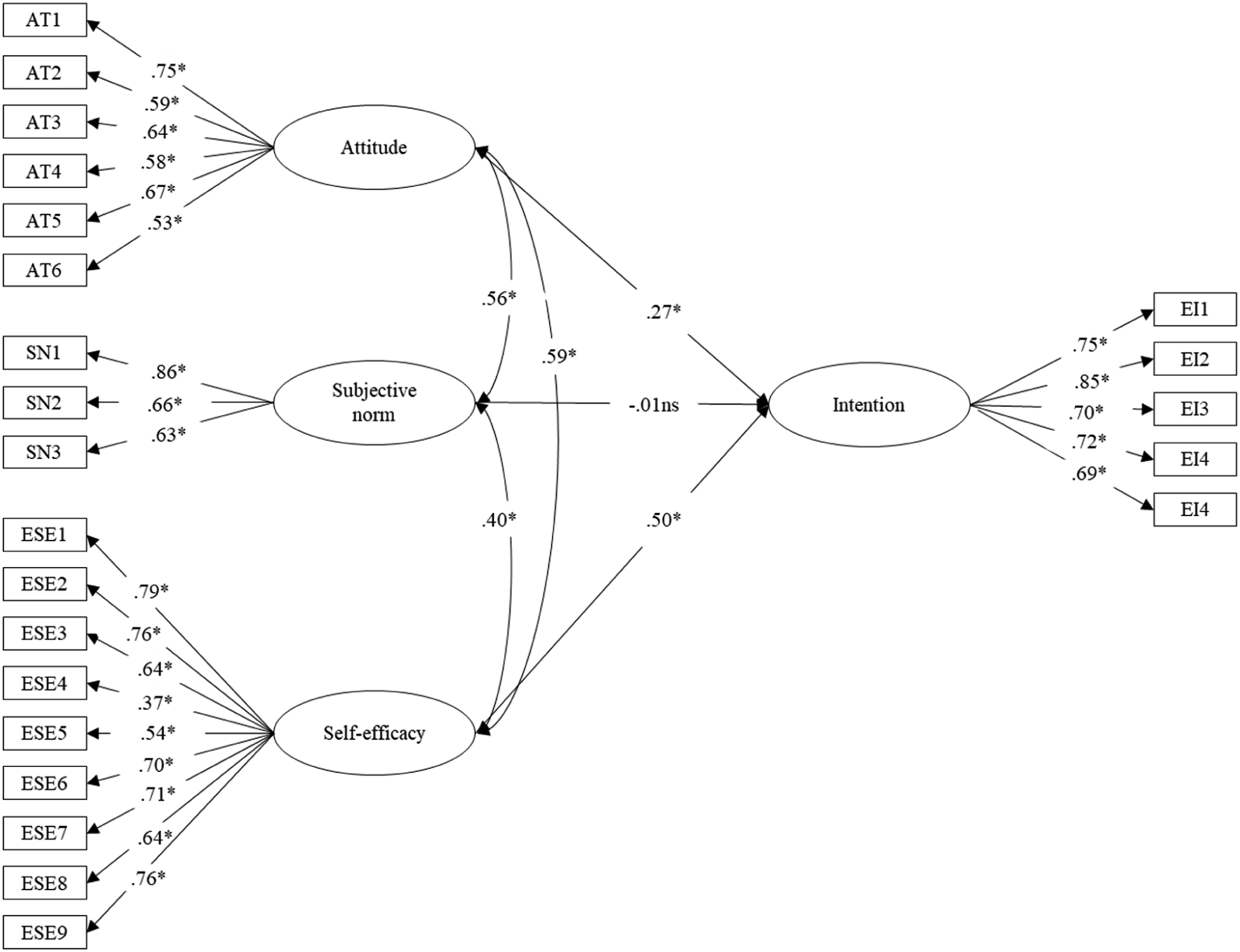
Next, a modified TPB model based on Heuer and Liñán (2013) was tested (Model 2). Model 2 differs from Model 1 in that it includes an indirect effect of subjective norm on entrepreneurial intention through attitudes towards entrepreneurship and self-efficacy, instead of a direct effect. The model presented a satisfactory fit to the data:
Figure 3 shows Model 2 with the standardized structural coefficients. The effects of attitudes towards entrepreneurship and self-efficacy are similar to Model 1: β = .26 (p < .001) and β = .50 (p < .001), respectively. Subjective norm explained 31.5% of attitude toward entrepreneurship and 16.5% of self-efficacy. Consequently, it showed a statistically significant indirect effect on entrepreneurial intention (β = .35, p < .001). Model 2 explained 48.6% of the variance of entrepreneurial intention. Model 2: Modified theory of planned behavior model.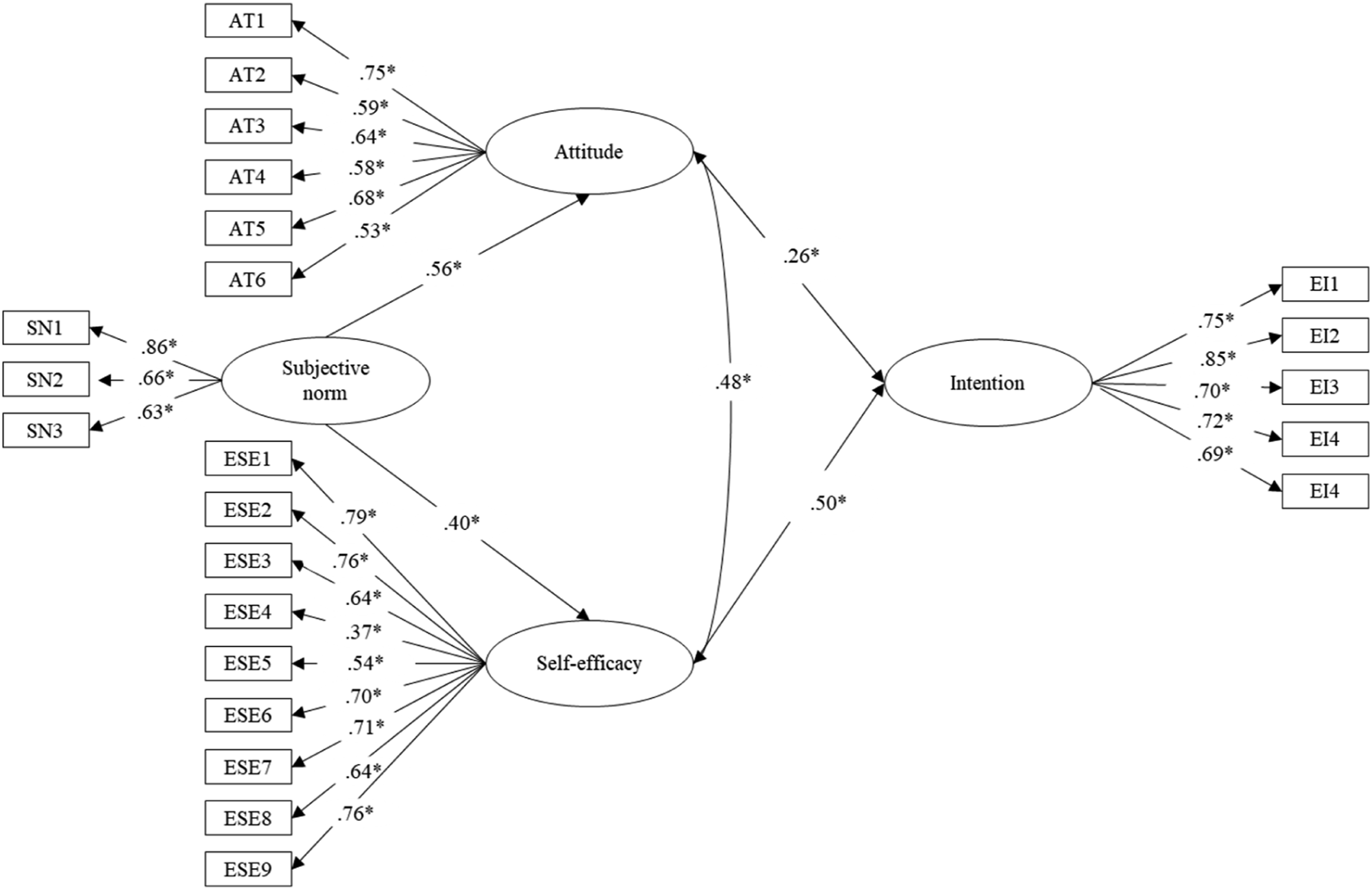
From a strictly statistical point of view, there were no differences between models’ fits (instead of models’ adjustments) adjustments (Δ
Discussion
The growing interest in entrepreneurial education (Aparicio et al., 2019) in the early educational stages is a challenge for researchers (Aggarwal & Shrivastava, 2021; Bernal-Guerrero & Cárdenas-Gutiérrez, 2017; Liñán & Fayolle, 2015). To follow recent governmental educational recommendations and policies, it is crucial to have adapted entrepreneurial programs and reliable instruments to measure their effectiveness. Consequently, the aim of this study was to provide evidence about the adequacy of the EIQ (Rueda et al., 2015) in secondary school student samples.
The EIQ has shown satisfactory psychometric properties that support its use in secondary education. Following the TPB model, the EIQ reproduces a four-factor structure that includes the dimensions of entrepreneurial intention and its three antecedents: attitude, subjective norm, and entrepreneurial self-efficacy. Moreover, all items present high and statistically significant factor loadings into their theoretical latent factor. Our results are similar to those found in previous studies with samples of university students in different countries (Da Fonseca Oliveira et al., 2016; Laguía et al., 2017; Rueda et al., 2015).
Regarding the reliability results, Cronbach alphas and CRIs are all above the cut-off value of .70 for all dimensions. The CRIs are provided to complement the reliability study as they have been considered a more accurate measure of reliability (Raykov et al., 2010).
Once the factorial validity and reliability are established, the psychometric study is complemented with evidence of external validity. Each dimension is correlated with the entrepreneurial attitudes included in the EASS (Oliver & Galiana, 2015).
Finally, the adequacy of the TPB model in secondary education is supported. Specifically, both models show satisfactory goodness-of-fit indices. As expected and evidenced in previous studies, attitudes and entrepreneurial self-efficacy are antecedents with an impact on entrepreneurial intention. However, the direct effect of subjective norm on entrepreneurial intention proposed in the traditional TPB model is not supported. This result is consistent with the traditionally weak role of subjective norm in the model (Armitage & Conner, 2001; Liñán & Chen, 2009) and in accordance with non-significant direct effects in previous studies (Autio et al., 2001; Esfandiar et al., 2019; Krueger et al., 2000; Schlaegel & Koenig, 2014). Previous EIQ validation studies with university samples showed low direct effect of subjective norm on entrepreneurial intention, ranging between .08 and .15 (Da Fonseca Oliveira et al., 2016; Laguía et al., 2017; Rueda et al., 2015). Liñán and Chen (2009) suggested the possibility of an indirect effect of subjective norm through entrepreneurial self-efficacy and attitude. This effect has been tested following Heuer and Liñán’s (2013) proposal. Agreeing with recent research (Farooq, 2018; Kruse, 2020), subjective norm seems to be an antecedent of attitudes towards entrepreneurship and self-efficacy. Despite not having a direct effect on entrepreneurial intention, it remains theoretically relevant by presenting a moderate indirect effect.
This result is contextualized in a Spanish secondary school student sample. Cultural context and sample characteristics are relevant in the study of subjective norm. Moriano et al. (2012) found that the direct effect of subjective norm could vary across countries, not being as significant in Spain as in India or Netherlands. However, the effect of subjective norms is not consistent across studies. Kautonen et al. (2015) hypothesized that differences in the effect of subjective norm across studies could be related to samples, being subjective norm less important in students’ samples than in the adult population.
The traditional TPB model validated with the EIQ explains 49.5% of the variance of entrepreneurial intention, whereas the modified version explains 48.6%. Both percentages are a little higher than the previously found in EIQ validations with university samples, which ranges from 39 to 46.5% (Da Fonseca Oliveira et al., 2016; Laguía et al., 2017; Moriano et al., 2012; Rueda et al., 2015). When TPB is tested with other questionnaires, the quantity of explained variance is also similar in the adult population (Kautonen et al., 2013; 2015) and secondary students (do Paço et al., 2011; Roy et al., 2017). To achieve a better explanation of entrepreneurial intention, researchers have explored different pathways. One alternative is the integration of the TPB model with the Entrepreneurial Event Model (EEM) (Shapero & Sokol, 1982), which could increase the percentage of explained variance of entrepreneurial intention up to 50–60% (Esfandiar et al., 2019; Schlaegel & Koenig, 2014; Solesvik et al., 2012). Another fruitful alternative is considering personality traits as background variables in the TPB model, which could increase the predictive power up to 40–80% (Eid et al., 2019; Karimi et al., 2017; Maheshwari, 2021; Munir et al., 2019; Roy et al., 2017). Consequently, although TPB antecedents seem to be the most predictive variables (Maheshwari, 2021), other constructs should also be measured in secondary education to complement the EIQ.
The present study has limitations that should be considered for generalization. First, the study was carried out with Spanish students. The sample size fits the literature recommendations according to the structural complexity of the model (Soper, 2021; Westland, 2010) in order to test the Structural Equation Model (for 4 latent and 23 observed variables with a desired statistical level of .8, anticipated overall effect size of .25 and probability of .05 the minimum required is 209 cases). However, to generalize the results and strengthen this evidence, it is necessary to continue research on the application of this scale in different contexts. Second, the study design was cross-sectional and the antecedents of entrepreneurial intention were measured at the same time as entrepreneurial intention. These design characteristics do not allow us to make any causal inferences. Finally, the intention-behavior gap is not studied. As a result, the predictive validity of the scale considering entrepreneurial behavior as the final outcome is not evidenced.
In conclusion, the adapted version of the EIQ has evidence of validity and reliability measuring TPB constructs in secondary education in the Spanish-speaking context. Consequently, this scale could be used in future research to evaluate the prevalence of entrepreneurial intention in high schools. It is a useful and standardized instrument to test the effectiveness of entrepreneurship programs. Additionally, our results suggest the adequacy of the EIQ for longitudinal studies, since it is one of the few scales that have validations that support its use in secondary education and university.
Footnotes
Acknowledgments
Sara Martínez-Gregorio is a researcher beneficiary of the FPU program from the Spanish Ministry of Science, Innovation and Universities (FPU18/03710).
Declaration of Conflicting Interests
The author(s) declared no potential conflicts of interest with respect to the research, authorship, and/or publication of this article.
Funding
The author(s) received no financial support for the research, authorship, and/or publication of this article.
Ethical Approval
All ethical guidelines were followed as required for conducting human research. The research received the ethical approval of the Ethical Commission of the University of Valencia.
Data Availability
The datasets used and/or analyzed during the current study are available from the corresponding author on reasonable request.
