




Abstract
Based on the dichotomous classroom goal structure model and TARGET framework, this study developed and validated a new Dichotomous Classroom Goal Structure Questionnaire (DCGSQ). A total of 339 seventh-grade students in Beijing completed the two-phase survey in Study 1. Exploratory factor analysis and reliability analysis were used to assess the psychometric quality of the questionnaires in Study 1. The revised DCGSQ was further validated in Study 2 among 583 seventh-grade students in Beijing. The results of confirmatory factor analysis indicated that an 8-factor model best fit the data. The criterion validity of the DCGSQ was supported by the relations between its eight instructional dimensions and student self-efficacy.
Introduction
Achievement goal theory is one of the dominant frameworks for studying achievement motivation (Elliot & Thrash, 2001; Pintrich et al., 2003). Previous studies have found that contextual characteristics in the classroom can encourage children to adopt profoundly different definitions of what teaching and learning are about: positive or negative achievement goals (Bardach et al., 2020; Wang & Rao, 2019). Positive achievement goals are related to developing new skills and improving one’s level of competence, whereas negative goals are related to threats and anxiety (Church et al., 2001; Meece et al., 2006). With the importance of student personal goals in learning, research on classroom goal structure (CGS) provides a window into the effects of the learning environment on student achievement-related motivations and outcomes (Ames, 1992). Understanding student perceptions of CGS inspires educators to better capture student perceptions of the contextual characteristics in educational settings and to examine their effects.
In early CGS research, a dichotomous CGS was proposed based on goal orientation theory. A mastery classroom goal structure (MCGS) describes student perceptions of classrooms, which emphasize effort, task mastery, and diligence in improving students’ skills. Conversely, a performance goal structure (PCGS) involves the perception of classrooms that highlights students’ ability to outperform others (Ames, 1992). Empirical studies show that MCGS is related to adaptive cognition, emotion, and achievement outcomes, whereas PCGS is associated with maladaptive outcomes (Michou et al., 2013; Wolters, 2004). A combination of MCGS and PCGS can also be transmitted in classrooms (Wang & Rao, 2019). Although some new models have been proposed in recent years (Peng et al., 2018), the dichotomous CGS construct remains the focus in CGS research (Hofverberg & Winberg, 2020; Wang & Rao, 2019).
Researchers have identified six dimensions of instructional practices called the TARGET framework involved in the shaping of MCGS (Ames, 1992; Epstein, 1988). Specifically, tasks refer to the design of learning activities and assignments. Appropriate tasks should be varied and present moderate challenges. Authority refers to choices provided for students to control their learning. Recognition refers to rewards, incentives, and praise in classrooms, which should be made privately and based on students’ learning progress. The grouping dimension involves the use of heterogeneous cooperative groups and peer interaction to encourage working with others. The evaluation dimension focuses on methods that assess improvement and effort. The final dimension concerns time and relates to taking into account students’ individual needs in pace and workload. Previous studies support the positive features of the TARGET framework that facilitate MCGS (Meece et al., 2006). Studies on PCGS have also found that classroom practices that are opposite to those suggested in the TARGET framework, such as the uniform assignment of tasks, public recognition, homogeneity, limited grouping, and evaluation based on comparative outcomes, are closely linked to student PCGS (Ames, 1992; Meece et al., 2006). Moreover, some researchers have pointed out that the recognition dimension is closely linked to the evaluation dimension and have suggested combining them into a single dimension (Ames, 1992; Wang & Rao, 2019).
To date, there are two different ways to measure dichotomous CGS. The first is to measure the dichotomous CGS as a holistic construct in which all activities in classroom settings are associated with learning and performing on a meta-level to assess the salience of either MCGS or PCGS. The Patterns of Adaptive Learning Survey (Midgley et al., 2000) is the most widely accepted scale in this situation (Duchesne et al., 2012; Koskey et al., 2010), and it demonstrates good psychometric properties (Wolters, 2004). However, this measurement method ignores student perceptions of specific instructional practices in classrooms. The second way is based on the TARGET framework to investigate student perceptions of specific mastery instructional practices, such as the Goal Structure Questionnaire developed by Lüftenegger et al. (2017). In addition, many studies adopted this approach by choosing a few mastery dimensions from the TARGET framework (Greene et al., 2004; Lau & Lee, 2008). However, the second measurement method ignores PCGS in classrooms. Thus, ignoring specific instructional dimensions or examining singular classroom orientation presumably leads to limitations in terms of content validity compared with considering classroom instruction in its entirety (Church et al., 2001).
To obtain a more comprehensive framework to understand student perceptions of specific instructional practices based on dichotomous classroom orientation, some researchers have suggested examining dichotomous CGS using TARGET dimensions (Bardach et al., 2020; Wang & Rao, 2019). The only study that adopted the combination approach was Tapola and Niemivirta (2008), who developed a classroom perception and preferences questionnaire (CPPQ) comprising five subscales: emphasis on learning, emphasis on ability and evaluation, emphasis on autonomy and choice, emphasis on individualistic work, and emphasis on task variety. However, considering several limitations that have been identified in its design, the CPPQ has not been widely used in subsequent studies. First, the five subscales of the CPPQ were derived from exploratory factor analysis (EFA) results, and not all TARGET dimensions were fully represented. Specifically, the CPPQ lacks items that measure group and time dimensions, which are core dimensions of the TARGET framework. Second, the psychometric quality of the CPPQ was assessed by EFA, and the internal consistency reliability of different subscales only provided preliminary information. Therefore, an instrument that comprehensively assesses the dichotomous CGS based on all TARGET dimensions needs to be designed and validated.
Researchers have stressed the need to extend the consideration of cultural and social environments when considering the applicability of Western motivation theories and instruments in a non-Western context (Hau & Ho, 2010; Lau & Lee, 2008). In China, Confucian learning virtues such as diligence, persistence, and enduring hardship align with the emphasis on improvement and effort, which are mastery-oriented (Ding et al., 2010; Li, 2003). When Chinese teachers transmit these values to classrooms, classrooms seem to be MCGS. On the other hand, since Chinese students must participate in public examinations if they want to be promoted to the next educational level (Salili & Lai, 2003), Chinese classroom environments tend to be highly competitive, placing great importance on social comparison and achievement (Hau & Ho, 2010; Rao & Chan, 2010). This means that PCGS might also be emphasized in Chinese classrooms. However, since there is no validated instrument to measure the dichotomous CGS in the Chinese context, these discussions about Chinese classrooms are largely fragmented, descriptive conjectures based on the theoretical literature (Rao & Chan, 2010; Salili & Lai, 2003).
In this context, our principal aim was to develop a reliable instrument to assess dichotomous CGS based on the TARGET framework with Chinese students. An instrument with good psychometric properties should provide a good basis for testing dichotomous CGS in Chinese educational contexts. The development of the Dichotomous Classroom Goal Structure Questionnaire (DCGSQ) consisted of two steps. Initially (Study 1), items of multiple, interrelated TARGET subdimensions that, in concert, constitute a superordinate and uniform overall perceived dichotomous CGS were proposed, and the initial version of the questionnaire was administered to a small group of students. EFA and item-total correlation and reliability analysis were undertaken to assess its psychometric quality. The questionnaire was then revised (Study 2) based on our findings and administered to a larger sample of students. Confirmatory factor analysis (CFA) was conducted to provide further validation for the revised questionnaire. In addition, previous studies have indicated that MCGS has positive effects on student self-efficacy, while PCGS has no positive effects (Bardach et al., 2019; Uçar & Sungur, 2017). Thus, the relationships between different instructional dimensions of the DCGSQ and student self-efficacy were also examined using structural equation modeling (SEM) to provide support for its criterion validity.
Study 1: Initial Validity and Reliability Estimates
Method
Participants
Study 1 administered a two-phase survey to test the initial reliability and validity of the DCGSQ. Since the results of the initial survey were unsatisfactory, the DCGSQ was revised based on the first study’s results and a second survey was conducted. A total of 154 (81 boys) seventh-grade students with a mean age of 13.3 years (SD = 0.62) completed the first-phase survey in early March 2021. They were from two average-achieving middle schools in the urban area of Beijing. A total of 185 (93 boys) seventh-grade students with a mean age of 13.7 years (SD = 0.68) in another two average-achieving middle schools in the urban area of Beijing in late March 2021 completed the second-phase survey. All data were recorded with paper and pencil. All study participants provided informed consent, and the study design was approved by the appropriate ethics review board.
Instruments
The DCGSQ structure was designed based on the dichotomous CGS model (Elliot & Thrash, 2001) and TARGET framework (Ames, 1992). Considering the high overlap between the recognition dimension and evaluation dimension, this study referred to previous studies (Ames, 1992; Wang & Rao, 2019) and grouped these two dimensions into the same dimension. The questionnaire consisted of 32 items measuring 10 aspects of the TARGET framework under two orientations (mastery-oriented and performance-oriented): mastery-task, mastery-autonomy, mastery-recognition/evaluation, mastery-grouping, mastery-time, performance-task, performance-autonomy, performance-recognition/evaluation, performance-grouping, and performance-time. All items are rated on a scale ranging from 1 (totally disagree) to 6 (totally agree) and refer to students’ learning experiences in their Chinese language classes. Chinese language class was chosen as the focus of the study because previous research on achievement goals in secondary schools has found native language instruction and learning to be particularly important domains of inquiry (Lüftenegger et al., 2017; Wolters, 2004). In mainland China, teachers of major subjects, including Chinese language, generally would not be changed during students’ junior secondary grades. The original questionnaire is in Chinese. The English translation of the DCGSQ is shown in Electronic Supplementary Material (ESM) 1 and ESM 2.
Instrument Development
The development of the measurement instrument consisted of several steps. First, we formulated 4–6 new items for each dimension that were derived from the conceptual understanding of 10 aspects of the TARGET framework (the framework of the DCGSQ is provided in ESM3). Second, to ensure content validity, we revised these items using three focus groups. Group A comprised two university professors of our research group. Group B comprised two front-line teachers who had experience teaching seventh-grade students in the Chinese language, and Group C comprised 12 seventh-grade students in another school in Beijing. The 46 items were used as a preliminary version of the DCGSQ in the first-phase survey, which contained two obvious subscales: MCGS and PCGS. From the list of 46 items that were originally generated, the research team narrowed the number of items to 16 in two subscales based on an iterative process of item-by-item discussion of relevance, coverage, readability, and adherence to the guidelines of proper item wording and scale construction (Gehlbach, 2015). The second-phase survey ensured that the MCGS and PCGS contained four subscales, respectively. After a two-phase survey, the research group then completed and reviewed the 32-item survey to ensure (a) having an efficient and balanced instrument; (b) representation of all proposed structures; and (c) good psychometric properties of the scales (reliability and validity).
Data Analysis
Cronbach’s alpha and item-total correlations were used to examine the internal consistency of the DCGSQ subscale. EFAs using the principal axis factor extraction method were conducted to determine the most plausible number of latent factors explaining the variance in DCGSQ items. Direct oblimin rotation was used according to the factors that were expected to be correlated. In addition, the number of factors to retain was statistically determined by Kaiser’s eigenvalue >1, Cattell’s scree test and parallel analysis (Tabachnick & Fidell, 2013; Turner, 1998). Meanwhile, to determine which items in the solution adequately represent the factors, the loadings for each of the items on the factors should be at least 0.40 and not cross-loaded onto any other factors (Costello & Osborne, 2005).
Results
EFA
Using the first-phase survey sample for the 46 items included in the initial EFA, the KMO measure of sampling adequacy was 0.93, and Bartlett’s test of sphericity (χ2 = 7072.364, df = 1035) was statistically significant (p < .001), indicating that these items were suitable for factor analysis. The EFA results of the first-phase were somewhat ambiguous; Kaiser’s eigenvalue cutoff suggested an eight-factor solution, and Cattell’s scree plot showed one distinguishable bend between the second and third factors. The examination of parallel analysis indicates that 2 actual eigenvalues should be retained (please refer to the results of the parallel analysis in ESM 5).
Based on these results, we identified two factors: Factor 1 contained obvious mastery-oriented items, and Factor 2 contained performance-oriented items. The two factors were consistent with a dichotomous CGS model, but the TARGET factors under the two orientations were not distinguishable. As some researchers have pointed out, instructional factors of MCGS and PCGS may appear in one classroom simultaneously (Tapola & Niemivirta, 2008; Wang & Rao, 2019). These findings suggested that when we tested the instructional factors of MCGS and PCGS together in the same EFA, there was overlap of the instructional factors under two orientations. Thus, we deleted the cross-loaded items (the factor loadings of all items in the first-phase survey are shown in ESM (6), revised the DCGSQ, and conducted an EFA separately for the MCGS and PCGS in the second phase.
An EFA was conducted on the 16 items of the MCGS of the second-phase survey. The KMO measure of sampling adequacy (0.90) and Bartlett’s test of sphericity (p < .001) showed that the 16 items of the MCGS were suitable for EFA. Kaiser’s eigenvalue and parallel analysis generated four factors, and the factor solution accounted for approximately 65.16% of the total variance. According to the EFA results, Factor 1 comprised items mainly from mastery-task (3 items); Factor 3 comprised items from mastery-group (4 items), and Factor 4 comprised items from mastery-recognition/evaluation (4 items). Factor 2 comprised items from the subscales of mastery-autonomy (3 items) and mastery-time (2 items), so Factor 2 was labeled mastery-autonomy/time. The combination of mastery-time and mastery-autonomy dimensions was also supported in the study of Lüftenegger et al. (2017), who argued that the time dimension is closely linked to the design of autonomy. All factor loadings of the 16 items after axis rotation were >0.40 (ESM 1).
A similar analysis for the PCGS of the second-phase survey, KMO measure of sampling adequacy (0.89), and Bartlett’s test of sphericity (p < .001) showed that the PCGS was suitable for EFA. Kaiser’s eigenvalue and parallel analysis also generated four factors, and the factor solution accounted for approximately 64.93% of the total variance in the PCGS. According to the EFA of the PCGS, Factor 1 comprised items from performance-task (3 items); Factor 2 comprised items from performance-autonomy (3 items), and Factor 4 comprised 4 items from performance-recognition/evaluation. Factor 3 comprised items from the subscales of performance-group (4 items) and performance-time (2 items), but the nature of these two dimensions was quite different, which made it difficult to justify their combination.
Reliability Analysis
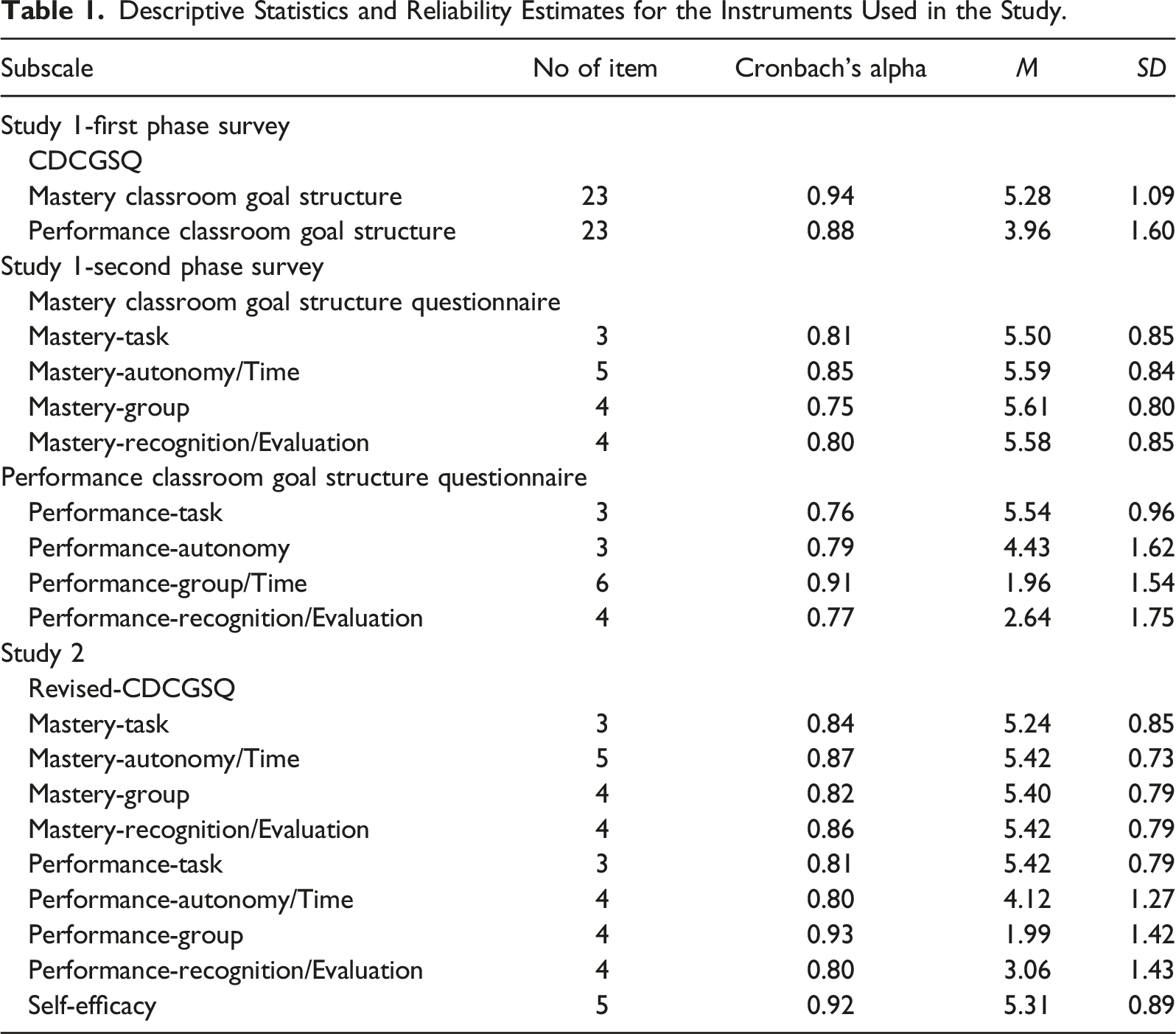
Descriptive Statistics and Reliability Estimates for the Instruments Used in the Study.
Study 2: Confirmatory Factor Analysis and Evidence of Validity and Reliability
Method
Participants
Participants were seventh-grade students with a mean age of 13.5 years (SD = 0.43) from four schools in Beijing. Among the 594 students who were recruited for this study, 583 (98.15%) completed the questionnaires with paper and pencil in mid-April 2021. Among the four schools, two are located in the urban area and have adequate advanced learning resources, whereas the other two are located in the suburban area and have limited learning resources. In terms of academic achievement on standardized tests, students in urban schools rank higher than students in suburban schools. Students in urban schools generally come from families with higher socioeconomic status than students in suburban schools. The participating students in each school were randomly selected to ensure that the entire sample was educationally and socioeconomically diverse. All study participants provided informed consent, and the study design was approved by the appropriate ethics review board.
Instruments
Revised DCGSQ
The revised DCGSQ was almost the same as that used in Study 1. Only two items of the performance-time dimension were changed. First, since the time dimension was closely linked to the dimension of autonomy (Lüftenegger et al., 2017), we revised the item PTIME1 to strengthen the link between time and autonomy in the autonomy/time subscale. Second, given that the item PTIME2 was cross-loaded on the factor of performance-recognition/evaluation (ESM 2), we deleted PTIME2 directly according to Costello and Osborne (2005). The revised 31-item DCGSQ possesses two orientations (mastery-oriented and performance-oriented), and each type of orientation assesses student perceptions of their CGS from four dimensions (task, autonomy/time, group, and recognition/evaluation). The entire questionnaire is shown in ESM 4.
Self-Efficacy Questionnaire
The self-efficacy questionnaire was adopted from a validated Chinese student self-efficacy questionnaire (Jia et al., 2020), which was developed by Midgley et al. (2000). This scale has five items to measure student confidence in learning and performance in class. The items were rated on a scale ranging from 1 (totally disagree) to 6 (totally agree). A high score indicates that students have a high level of confidence in their learning abilities. The results of CFA (RMSEA = 0.018, SRMR = 0.028, CFI = 0.955, and TLI = 0.910) and internal consistency reliability (Table 1) showed that the scale is suitable for measuring Chinese student self-efficacy.
Data Analysis
The dichotomous CGS measurement model was examined using CFA with Mplus 8 The measurement model, see Figure 1. The model combined four latent variables of the MCGS (mastery-task, mastery-autonomy/time, mastery-group, and mastery-recognition/evaluation) based on the EFA results of the MCGS in Study 1, three latent variables (performance-task, performance-group, and performance-recognition/evaluation) based on the EFA results of the PCGS in Study 1, and one additional latent variable (performance-autonomy/time), which was revised according to previous studies (Ames, 1992; Lüftenegger et al., 2017). The fit indices used to select the best fitting model included X2, the comparative fit index (CFI ≥ 0.90), the Tucker–Lewis index (TLI ≥ 0.90), the root mean square error of approximation (RMSEA < 0.05) and standardized root mean square residual (SRMR < 0.08) (Hu & Bentler, 1999).
Cronbach’s alpha was computed to assess the internal consistency reliability of the revised DCGSQ. In addition, relationships were calculated between the DCGSQ dimensions and student self-efficacy using SEM.
Results
CFA
The CFA results of the dichotomous CGS model met the general criteria of an adequate fit. The factor loadings of the 31 indicators for the dichotomous CGS model were 0.54–0.94 (p < 0.05), indicating that all items substantially represented the factor they were designed to measure. Thus, the dichotomous CGS model with eight factors was considered acceptable.
Reliability Analysis and Descriptive Statistics
Cronbach’s alpha, and means and standard deviations of the revised DCGSQ are reported in Table 1. The Cronbach’s α values of the eight subscales of the revised DCGSQ ranged from 0.80 to 0.93, showing acceptable reliability. Figure Models of the Factorial Structure of the Dichotomous Classroom Goal Structure.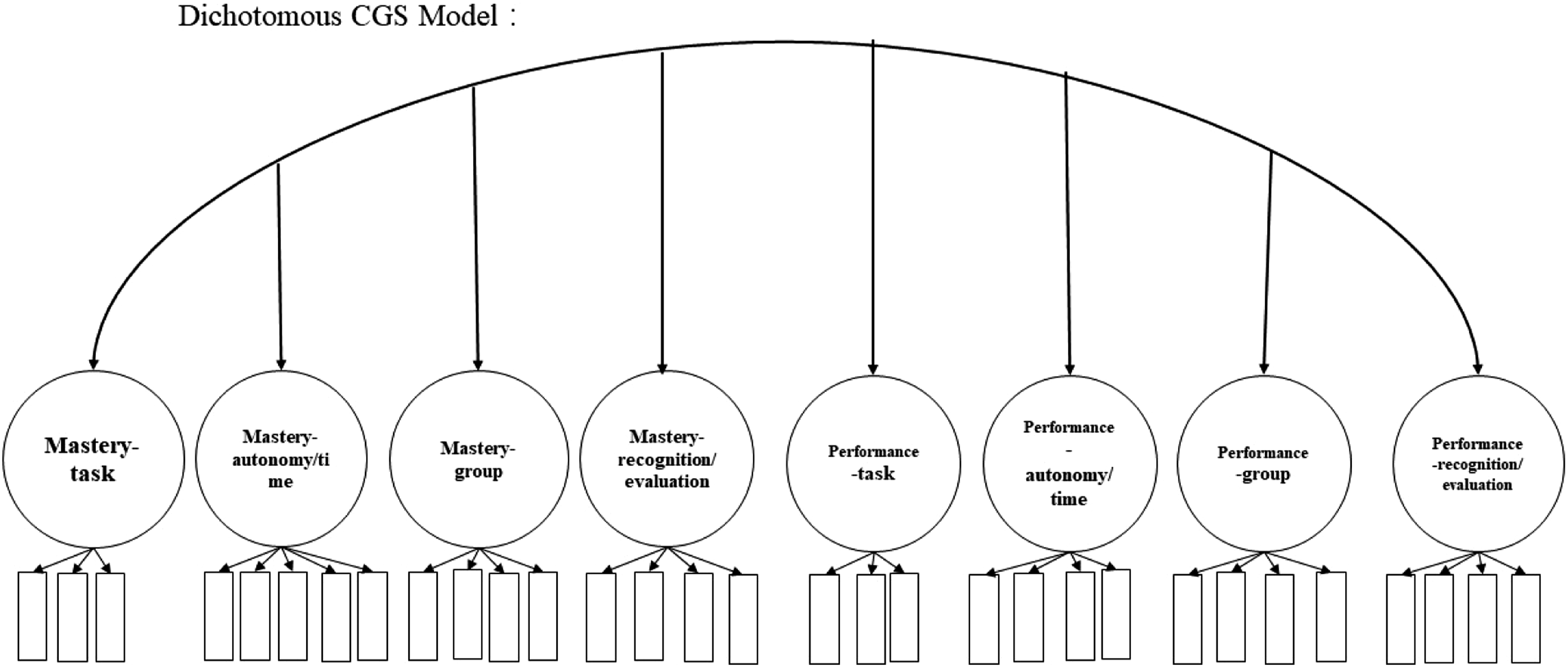
The mean values of the four mastery-oriented variables were much higher than the scale midpoint, with mastery-autonomy/time and mastery-recognition/evaluation having the highest scores (M = 5.42). All mean values of the performance-oriented variables were lower than those of mastery-oriented variables. Among the four performance-oriented variables, the mean values of performance-task and performance-autonomy/time were higher than the scale midpoint, but those of performance-group and performance-recognition/evaluation were lower.
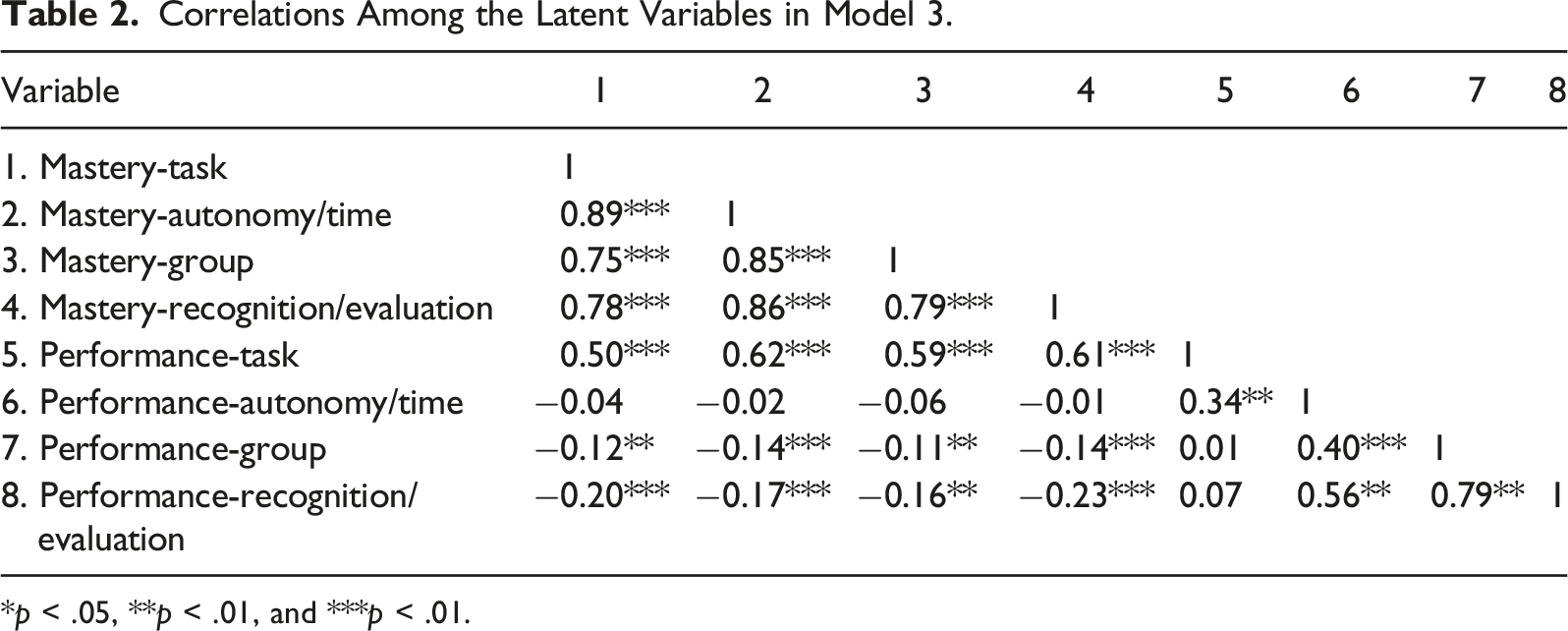
Correlations Among the Latent Variables in Model 3.
*p < .05, **p < .01, and ***p < .01.
Relationships with External Criteria and Construct Validity
Index of Measurement Models.


Significant Standardized Path Estimates Among the Latent Variables in the SEM (R2 = 0.365, p < .001).
Discussion
This study aimed to develop and validate a measurement instrument that adequately assesses a dichotomous CGS within the TARGET conceptualization. The proposed framework of the original DCGSQ was mainly derived from the dichotomous CGS model (Elliot & Thrash, 2001) and the TARGET framework (Ames, 1992). The EFAs in Study 1 indicated there were MCGS and PCGS in the DCGSQ and further proposed four subscales in the MCGS and PCGS, respectively. Four revised dimensions, that is, task, autonomy/time, group, and recognition/evaluation in MCGS and PCGS, were identified based on the EFA and validated by CFA in Study 2 using a larger sample. The results showed that the dichotomous CGS model had a satisfactory overall model fit. These results confirmed that the dichotomous CGS possesses two orientations (mastery-oriented and performance-oriented), and the four components (task, autonomy/time, group, and recognition/evaluation) in the two orientations are integral for constructing the dichotomous CGS. To compensate for the lack of core dimensions of TARGET in the original CPPQ, the DCGSQ adds items measuring group and time dimensions. Moreover, compared to previous CGS instruments which either focus on a holistic construct of CGS (Midgley et al., 2000) or emphasize only the instructional dimension of MCGS (Greene et al., 2004; Lau & Lee, 2008; Lüftenegger et al., 2017), the DCGSQ provides a more comprehensive framework to understand student perceptions of the instructional practices.
Using the revised DCGSQ, the study showed that Chinese students perceive a high degree of MCGS in classrooms. The results echo prior studies that traditional Confucian culture emphasizes effort and improvement (Ding et al., 2010; Li, 2003). Nonetheless, some PCGS dimensions, such as performance-task and performance-autonomy/time, also exist in current Chinese classrooms, indicating that some Chinese teachers assume uniform and rote tasks and provide limited personalized time for student learning. Influenced by Confucian culture, traditional Chinese classrooms are always described as teacher-dominated and authoritarian (Rao & Chan, 2010). However, the mean value of the performance-group and performance-evaluation were lower than the scale midpoint, suggesting that students perceived a low degree of performance-group and performance-evaluation. These results echo those of local studies conducted after the implementation of the new Chinese curriculum in mainland China, suggesting that more recently Chinese teachers are placing greater emphasis on cooperative learning and students’ development of skills rather than on grades (Lau & Chen, 2013; Li et al., 2020). It is worth mentioning that the correlations between most performance subscales (except for group and recognition/evaluation) were lower than the correlations among mastery subscales, indicating that the dimensions of PCGS are more complex and unstable than the dimensions of MCGS. Additionally, the positive correlations between performance-task and mastery-oriented variables support the multiple CGS perspective that teachers could create a learning environment that contains both MCGS and PCGS to facilitate student learning (Linnenbrink, 2005). It also highlights the necessity of integrating the dichotomous CGS model and the TARGET framework in examining classroom goal structure.
When the relationships among all variables were examined simultaneously in the SEM, only mastery-task and mastery-group had significant and positive relationships with student self-efficacy, indicating that these two types of instructional practices are the most important in developing Chinese student self-efficacy (Uçar & Sungur, 2017). Consistent with previous studies (Urdan, 2004), most performance-oriented variables showed no significant positive relationship or exhibited significant negative relationships with self-efficacy in SEM. However, contrary to expectations, SEM indicated that performance-recognition/evaluation had a positive effect on student self-efficacy. At first glance, this result is inconsistent with Western studies showing that performance-oriented instruction usually does not have positive effects on student learning (Ames, 1992; Urdan, 2004). From a cultural perspective, Chinese classrooms tend to be teacher-centered, top-down (Rao & Chan, 2010), and highly competitive (Hau & Ho, 2010). Given the high-stakes testing and teacher-centered culture, Chinese student self-efficacy may rely more on teachers’ performance-recognition/evaluation.
Overall, the present study offered preliminary evidence for adequate reliability and validity of the newly developed DCGSQ. The DCGSQ can be used to identify the strengths and limitations concerning instructions of teachers in training student achievement motivation and thus can be useful for teachers improving or adjusting their instruction to facilitate student achievement motivation and learning. Some interesting cultural differences between the findings of this study and previous studies on CGS were also revealed. Meanwhile, based on the limitations of the study, some directions for future studies are suggested. First, the representativeness of the sample was limited by the use of only seventh-grade students in Beijing. Future studies may involve more students from different grade levels, areas, and cultural contexts to verify whether the factor structure of the model is consistent across different demographic subsamples. Second, considering the limitation of the cross-sectional study design and the use of student self-reports, multiple methods, such as interviews and classroom observations, should be employed in future studies for triangulation. Third, the results regarding the external validity of this study are limited by the correlational study design. Future studies with longitudinal designs and involving more learning outcomes (e.g., personal goals, achievement performance) should further explore the complicated causal relationship between different aspects of instruction and students’ learning processes in class.
Footnotes
Declaration of Conflicting Interests
The author(s) declared no potential conflicts of interest with respect to the research, authorship, and/or publication of this article.
Funding
The author(s) received no financial support for the research, authorship, and/or publication of this article.
