



Abstract
Children with autism spectrum disorder (ASD) display variable verbal cognitive profiles despite a historical requirement for a language delay in autistic disorder. This study compared the Verbal Comprehension Index (VCI) to the newly created ancillary index score, the Verbal Expanded Crystallized Index (VECI) of the Wechsler Intelligence Scale for Children, Fifth Edition (WISC-V) in a group of children with ASD. Using the ASD sample from the standardization data of the WISC-V, results indicated the VCI and VECI were significantly different for the ASD group but not for the matched controls. Follow up analysis of the ASD group revealed the VCI and VECI were significantly different for those with language impairment but not for those without language impairment. Psychologists should consider administering all verbal subtests of the WISC-V to children with ASD given the VECI may better capture the language impairment seen in this population.
Introduction
Cognitive performance of children with autism spectrum disorder (ASD) 1 has been studied extensively throughout the years, with many studies specifically looking at the various versions of the Wechsler Intelligence Scales (WIS) (Happe, 1994; Mayes & Calhoun, 2003; Nader et al., 2015; Oliveras-Rentas et al., 2012; Zander & Dahlgren, 2010). The majority of this research indicates children with ASD perform more poorly on verbal measures compared to their typically developing peers, which is not surprising given their deficits with social communication (Dawson et al., 2007) as well as the historical requirement of language delay required for a diagnosis of autistic disorder. Specifically, children with ASD tend to have the most difficulty with the Comprehension subtest, a traditional part of the Verbal Comprehension Index (VCI). Previous research has demonstrated that children with ASD (IQ > 70) performed significantly lower on the Comprehension subtest compared to the Similarities and Vocabulary subtests with the Wechsler Intelligence Scale for Children, Revised (WISC-R; Wechsler, 1974), Wechsler Intelligence Scale for Children, Third Edition (WISC-III; Wechsler, 1991), as well as the Wechsler Intelligence Scale for Children, Fourth Edition (WISC-IV; Wechsler, 2003), thus, suggesting that this population has deficits in language comprehension and social reasoning (Oliveras-Rentas et al., 2012; Mayes & Calhoun, 2008).
Cognitive Assessment in ASD
Recent estimates suggest 31.6% of children with ASD have a comorbid intellectual disability (IQ less than or equal to 70) with 24.5% scoring between 71 and 85 (Christensen et al., 2016). With over half the population of this group falling below one standard deviation of the mean, accurate assessment of intellectual ability is vital. Furthermore, children with higher IQ (>70) display more positive effects of intervention with better gains in adaptive skills and better generalization of social communication skills across environments (Ben-Itzchak et al., 2014). Given the comorbidity of intellectual disability and the relationship of cognitive ability to intervention outcomes, cognitive assessment is a necessary component of an evidence-based assessment of ASD (Aiello et al., 2017).
In a school-based evaluation, an assessment of cognitive ability and verbal skills can help the Individualized Education Plan (IEP) team determine the appropriate placement within the classroom. Children with lower cognitive skills may benefit from pull-out or push-in services with a licensed special education teacher who specializes in services with children who have moderate to severe disabilities whereas other children may benefit from these services with special educators who work with students with mild disabilities. Assessment of cognitive abilities along with adaptive functioning can help the team determine what functional goals should be included in IEPs and are related to child engagements in interventions and success of IEP goals (Ruble & McGrew, 2013). Additionally, during a diagnostic evaluation in a clinical setting, assessment of intelligence assists in selecting severity specifiers. In determining severity level of ASD with the Diagnostic and Statistical Manual of Mental Disorders (5th ed.; DSM–5; American Psychiatric Association, 2013) criteria, cognitive ability should be considered, along with adaptive functioning, severity of symptoms, and language skills (Mehling & Tasse, 2016).
Verbal Ability in Children with ASD
It is well known that one of the main characteristics of ASD is deficits in social communication, but these deficits are not synonymous with language delays or language impairments (Miller et al., 2016; APA, 2013). Since the DSM-5 includes the specifier of “with or without language impairment” for an ASD diagnosis, it is crucial to examine the different profiles observed for children with and without language impairment. Research has shown that lower scores on most measures of verbal ability as well as lower global IQ scores are associated with those with an accompanying language impairment, whereas those without an accompanying language impairment are associated with higher global IQ (see e.g., Lindgren et al., 2009; Mayes & Calhoun, 2007; Rice et al., 2005). Of note, prior research has shown that individuals with ASD without language impairment (often referred to in the literature as having “high-functioning autism”), demonstrate poor performance on assessments of comprehension, categorizing items based on similarities, as well as demonstrate difficulties in morphology, pragmatics, and semantics (Boucher, 2012; Howlin, 2003; Mayes & Calhoun, 2007; McGregor et al., 2012; Rice et al., 2005). However, children without language impairment are still able to exhibit typical understanding of basic word meaning as well as demonstrate overall appropriate expressive language abilities (Howlin, 2003; Rice et al., 2005).
The relationship between verbal ability and ASD symptomology has been observed using various measures of cognitive abilities. Joseph et al. (2002) examined this relationship using the Differential Ability Scales (DAS; Elliott, 1990) and the Autism Diagnostic Observation Schedule (ADOS; Lord et al., 1999) to assess children diagnosed with high-functioning autism. Results of this study showed that children with lower verbal abilities than nonverbal abilities appeared to have more communication and social deficits (Joseph et al., 2002), suggesting that severity of language impairment is an essential mediating factor in the presentation of communication symptoms in autism. In addition, for school-age children with autism, the severity of social symptoms differed based on the pattern and degree of discrepancy between cognitive abilities, primarily verbal and nonverbal abilities. (Joseph et al., 2002).
Deficits in pragmatic language skills are common in ASD and remain throughout the lifespan (Guerts & Embrechts, 2008). Deficits in the structure of language, on the other hand, are more prevalent in the preschool period and can improve as children with ASD age. Happe (1994) first looked at ToM and the verbal deficits seen in children with ASD. Using the WISC-R, she found that children who failed a ToM task had a lower overall IQ and performed the weakest on the Comprehension subtest compared to children with ASD who did not fail the ToM task. Implications regarding the language loading of a test are not unique to the Wechsler scales. In fact, children and adolescents with ASD performed poorer on the verbal scale of the Stanford-Binet Intelligence Test, Fifth Edition (SB-5; Roid, 2003) compared to the WISC-IV (Baum et al., 2014). The verbal instructions of the SB-5 exceed that of most of the verbal subtests in the WISC-V, which may account for the differences in performance between tests. These researchers, however, did not address how the language skills of the individuals with ASD could account for differences in performance (Baum et al., 2014).
Wechsler Verbal Subtests
WISC-V Subtest Descriptions.
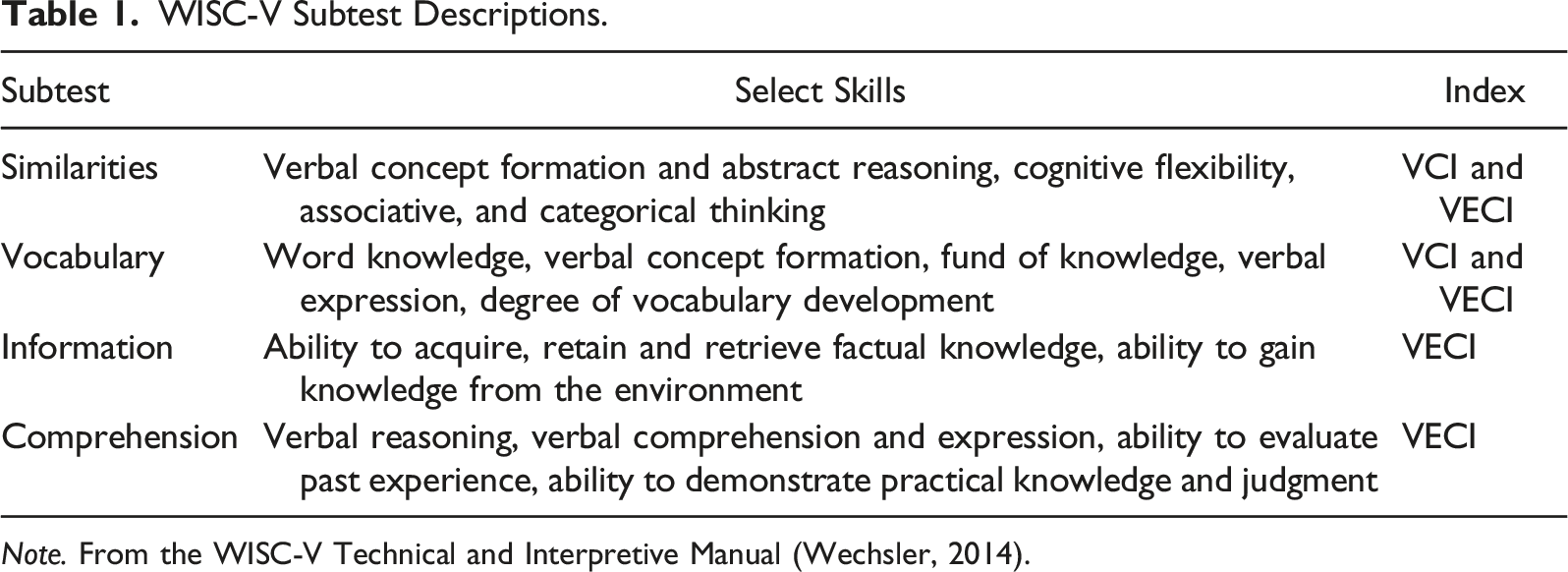
Note. From the WISC-V Technical and Interpretive Manual (Wechsler, 2014).
The Comprehension subtest has been described as having a greater language load, resulting in individuals with ASD to find it more challenging compared to the Similarities and Vocabulary subtests, which tend to be more simplified (Kuehnel et al., 2019). Indeed, responses from neurotypical individuals tend to be much longer on the Comprehension subtest which is frequently required to achieve high scores. In fact, several studies have suggested that children with ASD perform strongest on Similarities compared to the other verbal subtests (see e.g., Mayes & Calhoun, 2008; Wechsler, 2003; 2014; Zayat et al., 2011). Because the WISC-V VCI is only comprised of the two arguably more linguistically simplified subtests, the social communication deficits inherent in ASD may be minimized, resulting in higher VCI scores, which could present as more intact language skills than are actually present.
The removal of the Comprehension subtest in the VCI on the WISC-V places less emphasis on practical knowledge and judgment (Kuehnel et al., 2019). This could be helpful when measuring the verbal skills of children who lack theory of mind (ToM; Fadda et al., 2016) and struggle with executive functioning (Leung et al., 2016); however, information needed to assist in making special education eligibility decisions may be lost. Furthermore, the lack of a comprehensive assessment of verbal abilities may create an inability to determine strengths and weaknesses necessary for designing interventions (Kuehnel et al., 2019).
Kuehnel et al. (2019) found there was a statistically significant increase in VCI scores from WISC-IV to WISC-V for a group of children with ASD. Paired-samples t-tests revealed individual performance on Similarities decreased from the WISC-IV to the WISC-V, but there were no other statically significant changes in performance between versions of the verbal subtests. For both versions of the WISC, children with ASD performed the worst on the Comprehension subtest, consistent with pervious literature utilizing the WISC-IV and earlier versions of the WISC (Kuehnel et al., 2019). Based on the results obtained from this study, it is likely the removal of the Comprehension subtest contributed to the enhanced VCI score on the WISC-V despite a significant decrease in the Similarities score. This brings about concerns as to whether the VCI on the WISC-V can adequately portray all individuals’ verbal intellectual ability (Kuehnel et al., 2019) which is a concern given the test is also included as an important component of a diagnostic assessment battery or educational eligibility evaluation.
Previous revisions of the WISC did not display significant changes in verbal abilities among children with ASD. When comparing the verbal index on the WISC-III to the WISC-IV, there were no significant differences demonstrated between the VIQ and VCI (Nader et al., 2015). For children diagnosed with Asperger’s it appeared that, although not significant, the VCI on the WISC-IV was higher than the WISC-III VIQ. It should be kept in mind that the Coding and Arithmetic subtests were included in the WISC-III VIQ which could be related to the lower score since the Coding subtest also tends to be an observed weakness in children with ASD. Studies also found that the Comprehension subtest of the WISC-III and WISC-IV remained the lowest for the ASD group and was considered a significant weakness for the Asperger group. (Nader et al., 2015)
Most of the available research on the verbal abilities of children with ASD utilized children who were diagnosed with criteria from the Diagnostic and Statistical Manual of Mental Disorders, Fourth Edition (DSM-IV-TR; APA, 2000) or previous versions. This classification system provided separate diagnostic groups not maintained by the Diagnostic and Statistical Manual of Mental Disorders, (DSM-5; APA, 2013) for individuals with ASD symptomology. Within most of the research on cognitive abilities with children with ASD, functional level historically has been defined by IQ with research defining “high-functioning” as children with an IQ above 70 but utilizing IQ alone without consideration of adaptive functioning does not support the specifiers provided in the DSM-5 (Alvares et al., 2020). Furthermore, some studies define a “verbal” child with ASD as having an IQ above 70 (Brignell et al., 2018); however, one does not define the other. Research has shown no discrepancies between expressive and expressive language skills across cognitive ability levels (Kwok et al., 2015) providing evidence that IQ level should not be utilized to describe language skills. With social communication as a hallmark criterion for ASD, it is important to understand the verbal cognitive abilities of children with ASD and if these may differ based on their language skills. To date, no research has explored the cognitive strengths and weaknesses of children with ASD according to specified language skills according to DSM-5 classification. Since special education law typically defines the autism educational category through the lens of the current DSM, research to further understand these specifiers directly relates to the educational classifications used for eligibility.
Verbal abilities have also been related to ASD symptomology and adaptive skills in children with ASD. Using the DSM-IV-TR classification system, individuals with ASD were not diagnosed with or without language impairment, but past literature suggests language skills and verbal IQ have been related on other versions of the WISC. Oliveras-Rentas and colleagues (2012) found the ADOS Communication score was negatively (where high scores reflect poorer communication skills) correlated with WISC-IV VCI in a group of children with ASD who were considered high functioning (IQ > 70). In addition, they found that the ADOS Reciprocal Social Interaction score was also negatively correlated with the VCI, primarily the Vocabulary and Comprehension subtests, in which both the ADOS Reciprocal Social Interaction score and the Comprehension subtest demonstrate an understanding of social behavior. Findings from Oliveras-Rentas et al., (2012) can be further supported by Klin et al. (2007) who illustrated a strong relationship between the Vineland Adaptive Behavior Scales (Sparrow et al., 1984) Communication scores and the VIQ on the WISC-III. Additional evidence is demonstrated by Black et al. (2009) who showed that autism social symptoms were associated with significant discrepancies between WISC-III and WISC-IV verbal and nonverbal composites. Black and colleagues derived a Nonverbal IQ (NVIQ) and Verbal IQ (VIQ) from subtests across the WISC-III and WISC-IV to create comparable index scores. Specifically, those who performed significantly higher on the VIQ (Similarities and Vocabulary) than the NVIQ (Block Design and Matrix Reasoning or Object Assembly) exhibited fewer social symptoms compared to those who scored significantly higher on the NVIQ than the VIQ.
WISC-V Expanded Index Scores
As described above, the most recent version of the WISC simplified the VCI by only including two verbal subtests. As clinicians and school psychologists began using the new test, practitioners desired more comprehensive index scores for a variety of clinical and educational purposes (Raiford et al., 2015). In response, the publishers of the WISC-V created a separate technical report providing expanded index scores in the areas of Verbal Comprehension and Fluid Reasoning. Specifically, the Verbal Expanded Crystallized Index (VECI) and the Expanded Fluid Index (EFI) were developed for situations where practitioners needed a more comprehensive view of the child’s abilities in these areas (Raiford et al., 2015). According Raiford et al., (2015), these scores were calculated from the normative sample of the WISC-V, and Technical Report #1 for the WISC-V includes a table of derived scores.
To derive the VECI, practitioners calculate the sum of scaled scores from all four verbal subtests (primary and secondary) including Vocabulary, Similarities, Information, and Comprehension. See Table 1 for a description of each of these subtests. Raiford et al. (2015) provide a table with the VECI scores for the equivalent sum of verbal scaled scores. Furthermore, Raiford et al. (2015) present interpretive information for the new index score. Specifically, they provide the following guidelines: High VECI scores indicate strong crystallized ability, a well-developed verbal reasoning system and fund of acquired general factual and practical knowledge. High scores also imply strong word knowledge acquisition, effective information retrieval, good ability to reason and solve verbal problems, and effective communication of learned material. Low VECI scores may occur for a number of reasons, including poorly developed word knowledge, factual knowledge, and/or practical knowledge and judgment; difficulty retrieving acquired information; problems with verbal expression; or general difficulties with reasoning and problem solving (Raiford et al., 2015, 5).
Purpose of the Present Study
To date, no research has been published that evaluates the utility of the VECI in practical settings, including evaluations of children with ASD in schools and clinics. In light of the historical research documenting verbal ability difficulties for these children, coupled with the changes to the index scores of the WISC-V, the present study sought to compare the VCI to the VECI for children with ASD by answering the two following research questions: (1) Do scores on the VCI and VECI differ for children with ASD and their non-clinical peers? (2) Is language impairment status of the ASD group (i.e., diagnostic specifier of with language impairment or without language impairment) associated with differences in these index scores? By answering these questions, this study will help inform clinicians and school psychologists when assessing children with ASD using the WISC-V and help them establish an informed decision for choosing to add subtests to the core battery.
Methods
Procedures
This study was approved by the authors’ Institutional Review Board. The current study utilized the ASD special population data from the standardization sample of the WISC-V obtained from NCS Pearson, Inc. All children were administered the WISC-V according to standardization procedures included in the Technical and Interpretative Manual of the WISC-V. The Verbal Expanded Crystallized Index (VECI) was calculated by the third author for all children according to the guidelines from the WISC-V Technical Report #1: Expanded Index Scores. All scores were cross-checked by the first author for accuracy.
Participants
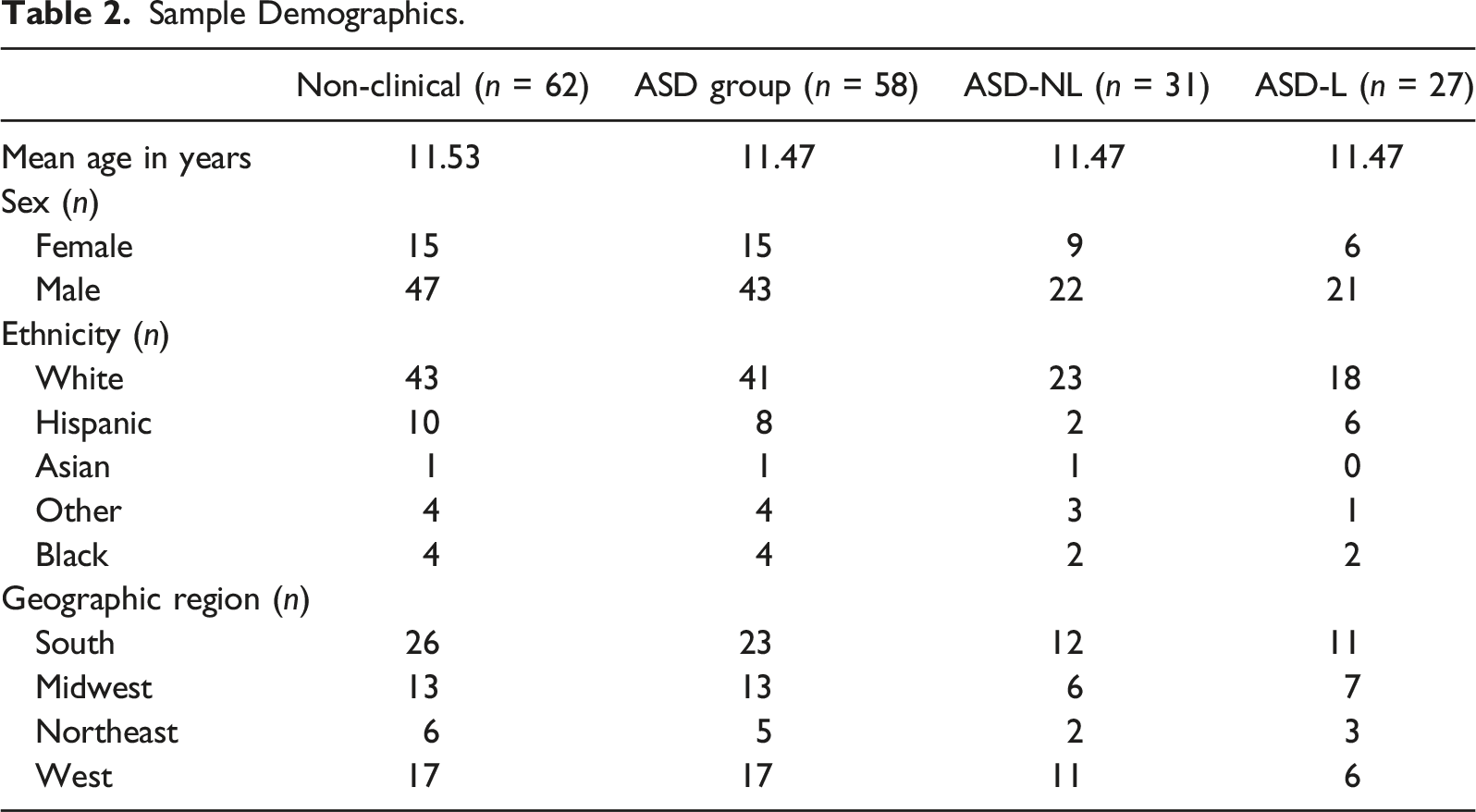
Sample Demographics.
Measures
The WISC-V is an individually administered test of intelligence for use with children aged 6:0 years–16:11 years. According to Aiello et al. (2017), it is the most frequently chosen test of cognitive ability by school psychologists conducting evidence-based assessments of ASD within the schools. 10 primary subtests are administered to obtain the five Primary Index Scores and the Full Scale IQ, and 11 additional subtests are available. These additional subtests can be used to calculate Ancillary and Complementary Index scores. See the WISC-V Technical and Interpretive Manual for more information on the test structure. For the purposes of the present study, only the VCI and VECI were included in the initial analysis. See Table 1 for a description of verbal skills measured in each subtest that comprised each index. To control for the difference in overall cognitive ability between the language impaired and non-language impaired ASD groups, a second analysis included the Nonverbal Index (NVI). The NVI was chosen given the lack of overlap in subtests that make up the verbal indexes and the NVI.
Data Analysis
Repeated measures analysis of variance (RMANOVA) models were utilized to compare the VCI to the VECI for both the non-clinical and autism groups. The within subjects factor was test (VCI and VECI), and the between subjects factor was group (ASD and non-ASD). A second RMANOVA was used to investigate assessment score differences between the ASD-L and ASD-NL.
Results
Descriptive Statistics
Mean Scores.
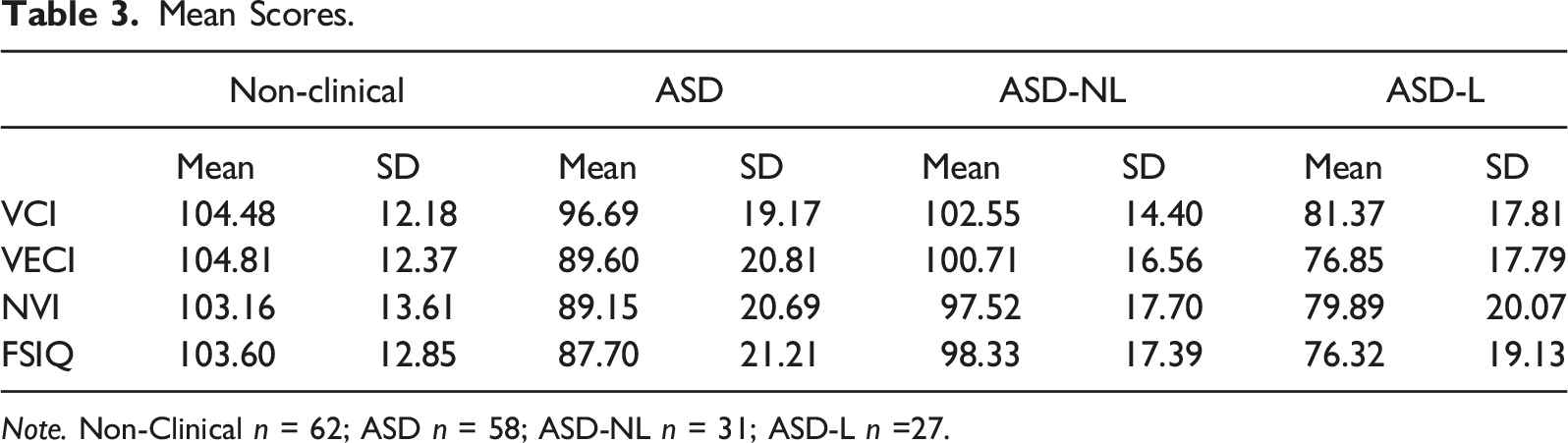
Note. Non-Clinical n = 62; ASD n = 58; ASD-NL n = 31; ASD-L n =27.
Repeated Measures ANOVA
Results of the RMANOVA indicated there was a statistically significant interaction between group (ASD or non-clinical) and test (
The RMANOVA was fit to the data including NVI as a covariate to adjust for potential differences in cognitive ability between the groups. The results of this analysis were similar to those for the unadjusted model. Specifically, the interaction between group and test remained statistically significant (
A second RMANOVA was conducted on the ASD group to ascertain whether identification of a language impairment accounted for the group difference between ASD and non-clinical subjects. Alpha was set at .025 to control for Type I error, and results indicated a statistically significant interaction between ASD subgroup and test (
As with the RMANOVA comparing the ASD and non-clinical groups, a separate model was fit to the data including the NVI to control for cognitive ability. The results for the group by test interaction was not statistically significant when NVI was accounted for in the analysis (
Discussion
Evidence-based assessment of ASD includes the use of appropriate measures of cognitive ability (Aiello et al., 2017). Educational evaluations should include a measure of intelligence to best guide IEP goals, educational placement, and adaptive skill intervention planning. Furthermore
To answer our first research question, a RMANOVA revealed the VCI and the VECI significantly differed in the ASD group but not the non-clinical group. These results remained consistent even when controlling for intellectual functioning as conceptualized by the NVI. These findings are consistent with previous research showing a statistically significant increase in VCI from the WISC-IV to the VCI of the WISC-V in a group of children with ASD but not in neurotypical peers (Kuehnel et al., 2019). The statically significant difference in VCI found in Kuehnel et al.’s (2019) study was attributed to the inclusion of the Comprehension subtest in the VCI of the WISC-IV but not the WISC-V. This finding, coupled with previous research indicating the Comprehension subtest is a significant concern for children with ASD (Nader et al., 2015; Oliveras-Rentas et al., 2012), and suggests the difference in performance on the VCI compared to the VECI for the ASD group is likely due to the inclusion of this area of weakness into the overall index. Additionally, these findings provide evidence that the non-clinical group performed more uniformly among all verbal subtests of the WISC-V compared to the ASD group.
These results should be interpreted in light of the typical difference scores seen in the normative sample of the WISC-V (Courville et al., 2016). Specifically, the WISC-V Administration and Scoring Manual includes base rates for the difference scores between the various indexes as seen in the normative sample. According to the manual, a seven-point difference score (the amount the VECI and VCI differed in our first analysis for the ASD group), where the VCI is larger than another Primary Index Score, has a base rate on average of 32 for the overall sample and 18 for those with an FSIQ less than or equal to 79. These base rates suggest this level of difference among the Primary Index Scores is common in the normative sample. Our results are still noteworthy, however, given the overall changes in the subtests that make up these indexes.
Given the heterogeneity of ASD, as well as the differences in IQ cutoff between the ASD groups included in our study, it is important to understand these results based on a more specified breakdown of this group. Our second research question sought to elucidate if the language status of the ASD group accounted for any differences in performance on the two verbal index scores. Analysis revealed that the VCI and VECI significantly differed for the children with ASD and accompanying language impairment but not the children with ASD without accompanying language impairment; however, once NVI was controlled for, the difference between the two groups disappeared. Although the two groups were defined by their language skills, these findings suggest more heterogeneous verbal skills across all children with ASD. Previous literature found strengths and weaknesses in verbal abilities across what was defined as “low-functioning” and “high functioning,” (Nader et al., 2015). Furthermore, the current study is one of the first to look at the verbal abilities of children with ASD as classified using the current DSM-5 specifiers. The standardization process of the WISC-V was occurring as the criteria shifted from the DSM-IV-TR to the DSM-5 classifications; therefore, the current sample included children originally identified as having Autistic Disorder and Asperger’s Disorder and reclassified as with or without language impairment.
Results of this study suggest school psychologists should consider administering all four verbal subtests when completing a psychoeducational evaluation of a child with ASD to best understand their verbal strengths and weaknesses. Having a more comprehensive representation of cognitive abilities can assist in developing more appropriate IEP goals (Ruble & McGrew, 2013). For a child suspected of having ASD, administering the additional subtests could provide more information, within the scope of a comprehensive evaluation, that helps inform a case conference committee of eligibility. Specifically, if a child displays a verbal cognitive weakness on Comprehension, the results of this current study suggest that piece of information can be helpful in making an eligibility recommendation when other assessment data also provides evidence of ASD. In essence, by not administering the subtests associated with the VECI the clinicians risk miscommunicating the possible severity of the condition leading to possible incorrect interventions. Additionally, test results typically “live” in the child’s educational records throughout school and thus faulty information could be used for transition planning when an individual moves into vocational or higher education settings.
Limitations and Directions for Future Research
The current study was limited to the standardization sample data of the WISC-V available from NCS Pearson. A sample of 27 children with ASD with accompanying language impairment and 31 children with ASD without accompanying language impairment were available for analysis along with their demographically matched controls. Specific information regarding the diagnostic process and determination of language impairment status was unknown to the authors. This study should be replicated with a larger, independent sample of children with ASD, and specific measures of language skills should be included in the study. More information regarding the interaction between of verbal cognitive abilities and language skills should be explored. Furthermore, only children who were English-fluent were included in the study; therefore, these results cannot be generalized to language learners. Future studies should explore the verbal abilities of children with ASD who are fluent in other languages.
Future research should also explore the differences between the VECI and VCI in other groups with neurodevelopmental disabilities as well as those with ASD who have comorbid conditions. Diagnostic information available to the authors was limited and did not include information on any preexisting comorbid conditions for the children diagnosed with ASD. Completing this study with an independent sample would allow researchers to further divide the group by comorbid conditions to account for confounding variables.
Conclusion
Assessment of cognitive abilities is an essential part of a comprehensive psychoeducational evaluation of ASD (Aiello et al., 2017). With the constant updates of cognitive tests and evolving diagnostic criteria, school psychologists must be abreast of the research supporting the use of the measure with the various populations they work with. Given the importance of understanding student skills when planning interventions, it is vital for clinicians to understand how children with ASD perform on tests of verbal ability. Our findings indicated significant differences in a newly developed index of verbal abilities on the WISC-V, the VECI, compared to the VCI for children with ASD who have accompanying language impairment. School psychologists should consider administering all verbal subtests of the WISC-V to better understand the verbal strengths and weaknesses of this population.
Footnotes
Declaration of Conflicting Interests
The author(s) declared no potential conflicts of interest with respect to the research, authorship, and/or publication of this article.
Funding
The author(s) received no financial support for the research, authorship, and/or publication of this article.
