




Abstract
This study evaluated the factor structure, measurement invariance, criterion-related and incremental validity of the Chinese version of the Academic Grit Scale (AGS) among 723 adolescents from mainland China. Results of exploratory and confirmatory factor analyses supported the single-factor model, exhibiting scalar invariance across gender and partial scalar invariance across groups (i.e., middle and high school students). The AGS total score showed internal consistency and temporal stability when used one month later. Moreover, academic grit was shown to be positively correlated with academic achievement, general grit, and dimensional student engagement. Academic grit also predicted academic achievement after isolating the effects of the related variables (i.e., general grit and student engagement) and overlapping components of academic grit and the related variables. Overall, the Chinese version of the AGS demonstrated adequate reliability and validity and was shown to be a useful tool for examining academic grit in Chinese adolescents.
Introduction
Grit was first conceptualized as a non-cognitive trait which espouses passion and perseverance for temporally remote ambitions in life (Duckworth et al., 2007; Duckworth & Quinn, 2009). Duckworth et al. (2007) defined grit as consisting of two components: perseverance of effort and consistency of interests. Perseverance of effort involves one’s tendency to maintain commitment and sustain effort during difficult times. Consistency of interests refers to one’s ability to stay concentrated on and passionate about specific interests and goals over time. A considerable body of cross-sectional studies have demonstrated that grit is beneficial to higher academic achievement, academic engagement, and autonomous motivation (Lan & Moscardino, 2019; Muenks et al., 2017; Werner et al., 2019). Longitudinal studies have also shown that grit can be used to predict school grades (Jiang et al., 2019; Postigo et al., 2021a, 2021b; Tang et al., 2020). Due to its crucial role in academic outcomes, grit has been considered to be an essential topic of research within academic literature (Credè et al., 2017; Lam & Zhou, 2022).
Many researchers have treated grit as a domain-general construct which has been generally measured using the Original Grit Scale (Grit-O; Duckworth et al., 2007) or the Short Grit Scale (Grit-S; Duckworth & Quinn, 2009). However, a growing number of research has called for the adoption of domain-specific grit measurements (Cormier et al., 2019; Schmidt et al., 2019), adapting the instructions and items of both the Grit-O or the Grit-S for use in different contexts. For instance, Schmidt et al. (2019) adjusted the items of the Grit-S by adding a specific domain to the items (e.g., “In mathematics I finish whatever I begin” or “In school I finish whatever I begin,” emphasis added by the authors). Results have shown that school-specific (e.g., school-specific grit or mathematics grit) rather than domain-general grit positively and significantly predicted the grade point average (GPA) of selected high school students in Germany. Similarly, Cormier et al. (2019) adapted the Grit-O for use in school and sports contexts. They asked participants to assess how each item best described them “as an athlete in sport” or “in their academic pursuits at school,” and all items of the Grit-O were preceded by phrases such as, “As an athlete in sport…” or “In my academic pursuits….” Study results revealed that grit tended to vary in different contexts, and that students reported higher sport-specific grit than school-specific or domain-general grit. Furthermore, school-specific grit (i.e., perseverance of effort) positively and significantly predicted high-school and university GPAs moreso than did general grit. These results provide support for the conceptualization and measuring of grit as a domain-specific construct.
Theoretical and methodological issues have been raised which challenge the two-factor model of grit, however. First, there are various ongoing debates about the dimensionality of grit. Both the Grit-O and Grit-S were initially validated with two first-order factors (i.e., perseverance of effort and consistency of interests) and one second-order factor of grit (Duckworth et al., 2007; Duckworth & Quinn, 2009). However, previous studies have shown that perseverance of effort and consistency of interests are independent from one another, rather than being a part of a hierarchical construct underpinned by these dimensions (Credè et al., 2017; Disabato et al., 2019; Tyumeneva et al., 2019). Moreover, there is evidence supporting a single first-order factor (Areepattamannil & Khine, 2018; Gonzalez et al., 2020). Furthermore, based on the two-factor model of grit (i.e., perseverance of effort and consistency of interests), Postigo et al. (2021) developed the Oviedo Grit Scale to measure grit in Spanish. Their findings showed that the 10-item Oviedo Grit Scale demonstrates an essentially unidimensional internal structure. Second, one of the major shortcomings regarding the theoretical validity of the two-factor model of grit is the inability of the consistency of interests factor to predict school outcomes (Datu, 2021). Although consistency of interests has been significantly associated with emotional exhaustion (Teuber et al., 2020), prior research has demonstrated that consistency of interests does not correlate with academic achievement (Akos & Kretchmar, 2017; Muenks et al., 2017; Jiang et al., 2019) or academic engagement (Datu et al., 2016; Tang et al., 2022). Finally, there is debate about the reliability of both the Grit-S and the Grit-O. Some previous studies have shown that either the subscale or the total scale of the Grit-S does not show acceptable internal consistency (Cronbach’s alpha <.70; Arco-Tirado et al., 2018; Guerrero et al., 2016; Oriol et al., 2017) in Western society contexts. There is also evidence that the consistency of interests subscale has poor reliability coefficients in non-Western and collectivist settings (Datu et al., 2016; Disabato et al., 2019).
These aforementioned controversies on the theorizing and measurement of grit have prompted the reconceptualization of grit and the development of other measuring instruments. Considering the variation of grit over time (Wong & Vallacher, 2018; West et al., 2016) and the importance of adopting domain-specific assessments of grit, Clark and Malecki (2019) reconceptualized grit as a malleable and domain-specific skill that encompasses determination, resilience, and focus in the pursuit of challenging long-term goals in an academic context. Determination is the devotion of one’s efforts to the accomplishing of long-term goals. Resilience involves putting effort into the pursuit of goals despite obstacles, and is analogous to perseverance of effort. Focus refers to the prioritizing of accomplishing academic goals above other life interests. Using this conceptual framework, 40 items were developed to evaluate adolescents’ grit within academic domains. Content validity analysis, exploratory and confirmatory factor analyses, and internal consistency reliability were used to devise the Academic Grit Scale (AGS), with the final version of the AGS (including four determination items, four resilience items, and two focus items) showing excellent internal consistency. The results of exploratory and confirmatory factor analyses supported a singular construct of academic grit rather than a three-factor model among selected middle school students in the United States. Academic grit has also been found to be associated with higher academic achievement, as well as increased life and school satisfaction. Furthermore, academic grit has demonstrated incremental validity in predicting academic achievement, GPA, life satisfaction, and school satisfaction above and beyond that of general grit (Clark & Malecki, 2019). Overall, the AGS has been shown to be a simple and effective tool for measuring adolescents’ academic grit in a Western cultural context.
Limitations of Prior Research
It must be noted that previous studies on the psychometric characteristics of the AGS do have several limitations. First, there is little evidence regarding the AGS′ validity in non-Western societal contexts (e.g., Chinese mainland). Therefore, the current study focused on validating the AGS among Chinese adolescents for two reasons. China has traditionally been recognized as a prototypical collectivist culture, placing high value on social harmony to the point that it takes precedence over individual goals and values (Hofstede, 1980). Influenced by Confucianism, Chinese culture also places a greater emphasis on tenacity and toil, which is reflected, for example, in a well-known Chinese story titled, “The Foolish Old Man Removes the Mountains” and an ancient Chinese saying: “If one works with constant effort, one can grind an iron rod into a needle” (“Zhi yao gong fu shen, tie chu mo cheng zhen”). In other words, Chinese cultural beliefs are that if one perseveres in doing similar tasks and invests huge effort, one will ultimately succeed in achieving their goals (Li et al., 2018). Perseverance in the pursuit of success is also a mainland Chinese cultural norm (Tao & Hong, 2000), leading Chinese students and their parents to credit academic success to hard work rather than inherent talent. They also tend to believe that sheer hard work can make up for a lack of talent in the pursuit of an accomplishment (Fwu et al., 2016). In accordance with the framework of positive cross-cultural psychology (Lomas, 2015), which represents an emerging range of work trending toward a more relativistic approach, validating a Chinese version of the AGS has potential implications for future cross-cultural studies on academic grit. According to the Programme for International Student Assessment 2018 (Schleicher, 2018), students in a number of Chinese cities and provinces (e.g., Beijing, Shanghai, Zhejiang province, and Jiangsu province) have superior academic performances in reading, mathematics, and science compared to cities in other nations. If academic grit is associated with greater accomplishment among Chinese students (Datu & Yang, 2021; Xu et al., 2021), then measuring academic grit has implications for sustaining competitive academic performance among secondary school students in China and in other competitive societies (e.g., Singapore, Macau, and Taiwan). It is therefore necessary to explore the factor structure, internal consistency, and test–retest reliability of the Chinese version of the AGS.
Second, measurement invariance reflects the degree to which an instrument’s scores demonstrate construct equivalence across groups. Prior findings have shown that females report higher academic grit than males, and sixth graders reported significantly greater academic grit than eighth graders (Clark & Malecki, 2019). The current study did not consider construct equivalence across gender and grades. Furthermore, entrance to higher education in China is determined by the annual gaokao (National College Entrance Examination). High school students tend to experience enormous academic pressures and devote almost all of their time to academic activities (Teuber et al., 2020). Therefore, the current study also examined the measurement invariance of the Chinese AGS across gender and groups (i.e., middle school students or high school students) and evaluated their latent mean-level differences.
Third, there is scarce evidence regarding the criterion-related validity of academic grit. Furthermore, student engagement may overlap with academic grit (Clark & Malecki, 2019; Muenks et al., 2017). Student engagement refers to the extent to which students are actively and productively involved in a learning activity, with consideration of their behavioral, cognitive, emotional, and agentic engagement (Fredricks et al., 2004; Reeve et al., 2020). More specifically, behavioral engagement comprises effort, exertion, perseverance, attention, and focus. Emotional engagement involves emotions generated by interactions with schoolwork including enthusiasm, interest, satisfaction, and enjoyment during learning activities. Cognitive engagement is conceived utilizing complex and strategic learning strategies such as elaboration, task focus, attentional control, and the adoption of self-regulatory processes. Agentic engagement is the proactive, constructive, and reciprocal actions which students initiate to catalyze their academic progress and create a more supportive learning environment for themselves (Skinner et al., 2016; Reeve et al., 2020). According to the concept of academic grit, those with more grit are more engaged in their academic activities, and previous studies also have demonstrated that grit is highly linked to academic engagement (Muenks et al., 2017; Steinmayr et al., 2018). Therefore, we hypothesized that academic grit is also associated with behavioral, cognitive, emotional, and agentic engagement.
Previous findings have revealed that academic grit is highly and positively correlated with perseverance of effort, while academic grit is minimally but positively linked to consistency of interests (Clark & Malecki, 2019). Although this finding generates evidence for the criterion-related validity between academic grit and domain-general grit, the study relied on the two-factor model of grit. Recently, Datu et al. (2017) have proposed a triarchic model of grit in collectivist settings on the basis of the original two-factor model of grit. The triarchic model of grit incorporates a new dimension of grit, namely adaptability to situations, which refers to one’s capacity to constantly calibrate one’s behaviors and plans depending on situational and contextual factors (Datu, 2021). In collectivist settings, self-concept is deeply intertwined with interpersonal and situational factors (Suh, 2007; Vignoles et al., 2016), and individuals might tend to adopt relatively flexible and context-sensitive strategies to achieve long-term goals (Datu et al., 2017; Datu, 2021). Furthermore, students in collectivist cultures also have socially oriented motivation to perform well academically (Chang et al., 2000; Xie et al., 2022). Therefore, it is reasonable to underscoring the importance of adaptability in successfully achieving long-term goals in collectivist settings. Indeed, adaptability in changing situations has been shown to be linked to higher levels of career self-efficacy, academic engagement, and motivation in collectivist settings (Datu, 2017; Datu et al., 2017; 2022). Furthermore, exploring a variety of passions rather than consistently focusing on only one goal across time is shown to be beneficial to adolescents (Harter, 1990). In this regard, we anticipated that perseverance of effort and adaptability to situations, rather than consistency of interests, would be linked to academic grit among Chinese adolescents.
Fourth, there is scarce evidence regarding the incremental validity of academic grit. Researchers are starting to investigate whether grit predicts academic outcomes beyond the established conceptually and empirically related predictors (Muenks et al., 2017; Steinmayr et al., 2018; Werner et al., 2019), as some studies have failed to find such a significant predictive effect of grit on achievement-related measures (e.g., Bazelais et al., 2016; Flanagan & Einarson, 2017). Following this logic, research is also needed to investigate potential incremental validity of academic grit after controlling theoretically related constructs (i.e., domain-general grit or student engagement) when predicting academic outcomes (i.e., academic achievement). Based on Duckworth et al.’s (2007) theoretical assumption, one previous study showed that academic grit predicted self-reported academic achievement and GPA above and beyond that of general grit based on a series of hierarchical regression analyses (Clark & Malecki, 2019). However, the results of hierarchical regression analyses can potentially result in biased parameter estimates caused by issues of multicollinearity (Werner et al., 2019), owing to high correlations between academic grit and domain-general grit. In contrast, commonality analysis can isolate the unique and combined contributions of each construct and take multicollinearity issues into account (Nimon, 2010; Nimon et al., 2008). It is therefore important to examine the predictive ability of the unique and combined components associated with academic grit and related constructs (e.g., domain-general grit or student engagement). These resulting findings can then provide evidence for whether adopting domain-specific grit in achievement domains is merited not, while also evaluating the criterion-related validity of the Chinese AGS.
The Current Study
Our study aimed to investigate the factor structure and reliability of the Chinese AGS among Chinese middle and high school students. We explored the factor structure of the Chinese AGS. Moreover, we examined measurement invariance and mean-level differences of the Chinese AGS across groups (middle and high school students) and gender. Given Clark and Malecki’s (2019) findings, we anticipated that females and middle school students might report higher academic grit than males and high school students. Furthermore, we examined the internal consistency and test–retest reliability of the Chinese AGS.
This study also examined the criterion-related validity of the Chinese AGS. As already mentioned, we expected that academic grit would be positively related to general grit (i.e., perseverance of effort and adaptability to situations), self-reported academic achievement, and student engagement (i.e., behavioral, cognitive, emotional, and agentic engagement). More importantly, we explored the incremental validity of the Chinese AGS on self-reported academic achievement. We used hierarchical regression analysis and regression commonality analysis to investigate the predictive utility of the unique and overlapping components associated with academic grit and general grit (i.e., perseverance of effort, consistency of interests, and adaptability to situations) on academic achievement among middle school students. Furthermore, according to the self-system model of engagement (Skinner et al., 2016), student engagement can be considered a determinant of academic achievement, and student engagement (i.e., behavioral, cognitive, emotional, and agentic engagement) has been found to be associated with academic achievement (Reeve et al., 2020). Therefore, analogously, we also investigated the predictive utility of the unique and overlapping components associated with academic grit and student engagement (i.e., behavioral, cognitive, emotional, and agentic engagement) on academic achievement among middle school students. We did not make any prior assumptions about the unique or overlapping relationships between grit and the theoretically related constructs (i.e., student engagement and domain-general grit) in predicting academic achievement. We did control for the effects of gender, age, and subjective social status to minimize endogeneity bias (Antonakis et al., 2014), as studies have consistently shown significant correlations among gender, age, subjective social status, and academic engagement (Liu et al., 2020; Sun et al., 2016).
Method
Participants and Procedure
A total of 850 Chinese adolescents from four cities in China were recruited between October and December 2021 via a convenience sampling approach. Senior undergraduate students majoring in psychology read the study instructions out loud in participants’ classrooms, and the middle or high school students participated voluntarily in this study. Of the participants, 420 middle school students from 10 classes in two middle schools completed the paper-and-pencil questionnaires in their mental health education course. The questionnaires were presented in the following order: the AGS, the Triarchic Model of Grit Scale (TMGS), self-reported academic performance, and demographic characteristics (i.e., gender, age, registered permanent residence, subjective social status, and highest educational attainment of parents). Before they handed in their completed questionnaires, participants were reminded by their instructors to go over their answers carefully to ensure no values were missing. The other 430 high school students from 10 classes across two high schools completed an online version of the questionnaires in an evening self-study course that took place in their assigned classrooms. The online questionnaires were presented in the following order: the AGS, the Student Engagement Scale (SES), self-reported academic performance, and demographic characteristics (i.e., gender, age, registered permanent residence, subjective social status, and highest educational attainment of parents). Missing values are not allowed in the online questionnaires, so participants were unable to leave any questions unanswered. To minimize the effects of random responses or inattentiveness, a validity check question (e.g., “Please indicate ‘strongly agree’ for this question”) and an item on self-reported diligence (i.e., “I verify that I have carefully and honestly answered all questions on this survey”) were included in the questionnaires. Only those who accurately responded to both the validity check and diligence questions were included in the final sample. In total, 763 participants (389 middle school students and 374 high school students) responded accurately to both the validity check and diligence questions.
Univariate and multivariate outliers were excluded as per the procedure recommended by Leys et al. (2013, 2018). No cases of univariate outliers were identified, and 40 cases of multivariate outliers were identified in total across the middle and high school students. After dealing with multivariate outliers, the final sample size was N = 723 participants (369 middle school students and 354 high school students), including 178 seventh graders (24.62%), 191 eighth graders (26.42%), 178 tenth graders (24.62%), and 176 eleventh graders (24.34%). Participants’ ages ranged from 12 to18 years (M age = 14.52, SD = 1.66), and more than half were female (54.8%, n = 396), coming predominantly from urban areas (68.74%, n = 497). Regarding their parents’ highest levels of education, most had completed secondary education (55.19%, n = 399) or higher education (40.39%, n = 292), while the rest had only completed primary education (4.42%, n = 32). Four weeks after the initial survey had been completed, 117 participants were invited to once again complete the AGS to assess test–retest reliability, and 105 valid responses were received.
Measures
The Academic Grit Scale
The 10-item AGS measures academic grit as a single-factor structure (Clark & Malecki, 2019). The items (e.g., “I push myself to do my personal best in school”) are rated on a seven-point Likert scale ranging from 1 (“not at all like me”) to 5 (“very much like me”). A higher score indicates a higher level of academic grit. The Chinese version of the AGS was developed using the back-translation method. When the Chinese version was developed, the final Chinese version and the English back-translation version were assessed by Kelly N. Clark, a developer of the original scale. Corresponding items are included in Appendix 1 of the online supplementary materials.
The Triarchic Model of Grit Scale
The Chinese version of the TMGS measures domain-general grit (Datu & Zhang, 2021). Participants answer the ten items (e.g., “Changing plans or strategies is important to achieve my long-term goals in life”) using a four-point Likert scale ranging from 1 (“definitely false”) to 4 (“definitely true”). This measure includes three subscales: perseverance of effort, consistency of interests, and adaptability to situations. The TMGS has shown an acceptable factorial structure and good internal consistency in Chinese technical–vocational college students (Datu & Zhang, 2021). In the middle school student sample (n = 369), the three-factor model of grit revealed an adequate level of fit to the data: χ2 = 89.83, df = 32, comparative fit index (CFI) = .946, Tucker–Lewis index (TLI) = .924, root mean square error of approximation (RMSEA) = .070, 90% CI = [.053, .087]. The Cronbach’s alpha coefficients for the perseverance of effort, consistency of interests, and adaptability to situations subscales were .86, .72, and .77, respectively.
The Student Engagement Scale
Student engagement was assessed using the SES (Reeve et al., 2020). This measure consists of four subscales: behavioral (five items), emotional (five items), cognitive (four items), and agentic (five items) engagement. Respondents answer items (e.g., “During classroom learning, I express my preferences and opinions”) on a seven-point Likert scale ranging from 1 (“strongly disagree”) to 5 (“strongly agree”). The English version of the 19-item SES was translated into Chinese. In the high school student sample (n = 354), the four-factor model revealed an adequate level of fit to the data: χ2 = 417.256, df = 146, CFI = .915, TLI = .900, RMSEA = .072, 90% CI = [.064, .081]. The Cronbach’s alpha coefficients for the four subscales ranged from .84 to .89.
Academic Achievement
We asked participants report their overall average grades in all academic subjects in the current term, from 1 (“fail”) to 5 (“excellence”) as school regulations prohibited the gathering of students’ academic achievement from their campus census files. Self-reported academic achievement has shown to be not only a good indicator of actual grades (Clark & Malecki, 2019; Datu & Yang, 2021) but also to be a more reliable indicator of the student’s current performance in a domain than a single grade (Steinmayr et al., 2018). Moreover, recent meta-analysis from mainland China has demonstrated that there is a moderate relationship between family socioeconomic status and overall academic achievement, although family socioeconomic status correlates more strongly with language achievement (in either or both Chinese and English) than with science/math achievement or general achievement (Liu et al., 2020). Thus, self-reported overall achievement is one of the valid indicators of an adolescent’s reported grades.
The MacArthur Subjective Social Status Measure
The MacArthur Subjective Social Status measure presents respondents with a picture of a “social ladder” with 10 steps, and is used to assess subjective social status. Respondents are asked to choose the step that corresponds to their perceived social position in their community. Studies have shown that subjective social status is positively correlated with income, occupation, and education (Hu et al., 2012; Operario et al., 2004).
Data Analytic Strategies
Factor Structure Analyses
Descriptive statistics for the academic grit scale (n = 723).
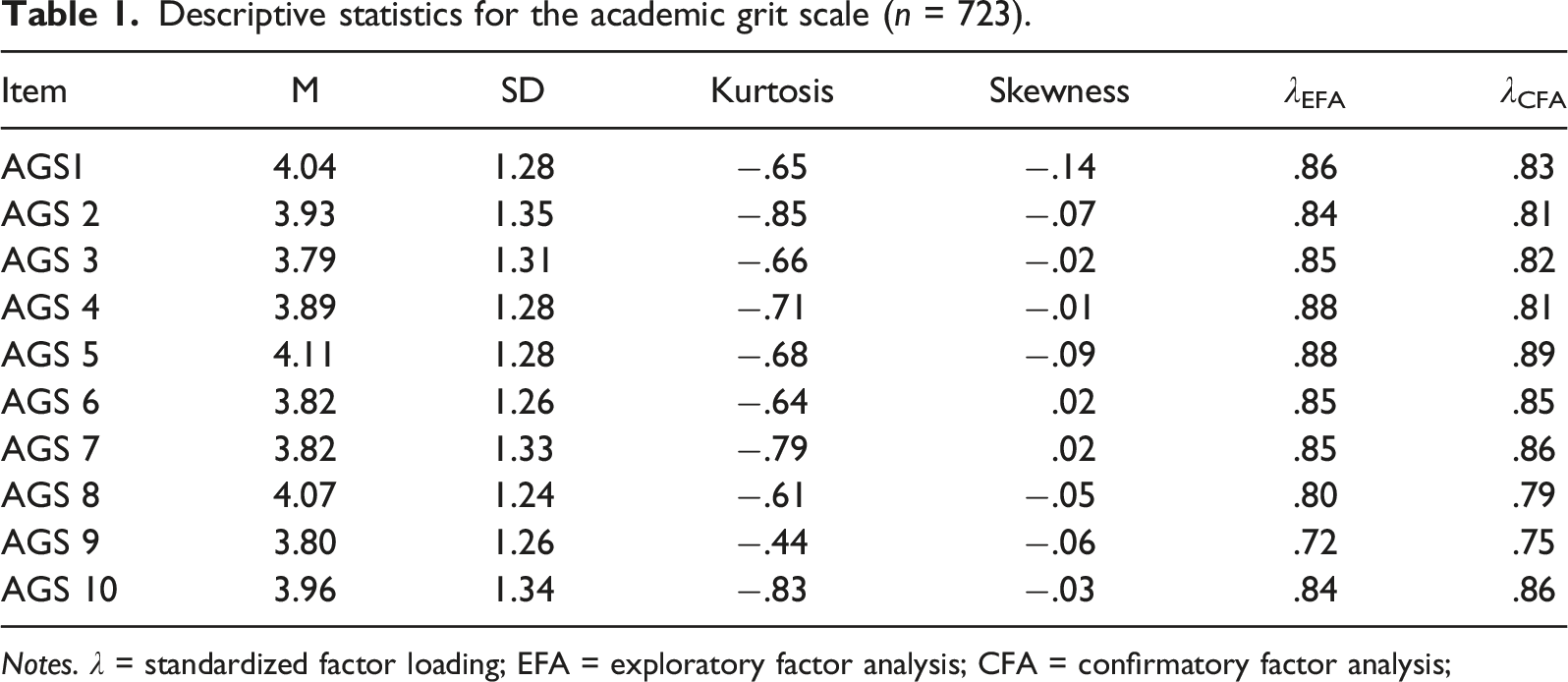
Notes.
Measurement Invariance and Mean Comparisons
Measurement invariance tests were conducted in the following sequence (Putnick & Bornstein, 2016): (a) configural invariance, (b) invariance of the factor loadings (metric invariance), and (c) invariance of the thresholds (scalar invariance). We reported chi-square difference tests to evaluate fit improvement. As the chi-square difference test is dependent on sample size (Cheung & Lau, 2012; Cheung & Rensvold, 2002), changes (Δ) in goodness-of-fit indices were also used in tests of invariance. A CFI diminution of .010 or less between a model and its preceding model indicate that the measurement invariance hypothesis should not be rejected (Chen, 2007; Cheung & Rensvold, 2002). If scalar invariance fails, a partial invariant scalar model can be established based on modification indices (Putnick & Bornstein, 2016). When results supported scalar invariance or partial invariant scalar across gender and samples (i.e., middle school students and high school students, or online and paper and pencil samples), latent means were compared (Putnick & Bornstein, 2016). We also conducted a gender × sample factorial ANOVA to examine whether any gender or sample level differences existed in academic grit for the current sample.
Internal Consistency and Test–Retest Reliability
The internal consistency of the AGS was evaluated using Cronbach’s alpha coefficient. As suggested by Barker et al. (1994), alpha coefficients between .70 and .79 suggest acceptable consistency, from .80 to .89 indicate good consistency, and above .90 indicate excellent consistency. The test–retest reliability of the AGS was examined using the Pearson correlation and intraclass correlation coefficient. An intraclass correlation coefficient between .60 and .74 indicate good test–retest reliability, and more than .75 suggest excellent test–retest reliability (Cicchetti, 1994).
Criterion Validity and Incremental Validity
We performed Pearson correlational analyses between the AGS and the other scales using SPSS 25.0 to assess criterion validity. We also conducted a series of hierarchical regression analyses in the high school student sample (n = 354) to test the incremental validity of the AGS for academic achievement after controlling for student engagement (i.e., behavioral, emotional, cognitive, and agentic engagement) and demographic characteristics (e.g., gender, age, and subjective social status). Moreover, we reversed the entry order of predictors such that academic grit was entered into the regression analysis with demographic characteristics, then followed by the four student engagement scales. Similarly, we implemented a sequence of hierarchical regression analyses in the middle school student sample (n = 369) to test the incremental validity of the AGS for academic achievement above and beyond demographic characteristics (e.g., age gender, subjective social status), perseverance of effort, consistency of interests, and adaptability to situations. We also reversed the entry order of predictors such that academic grit was entered into the regression analysis with demographic characteristics, then followed by the three general grit scales. Given the high correlations between academic grit and criterion-related variables, we used variance inflation factors (VIF) and condition indices to examine individual predictors for potentially strong contributions to (near) multicollinearity (Marcoulides & Raykov, 2019; Belsley, 1991). Variance inflation factors above 5 could be contributing considerably to multicollinearity (Marcoulides & Raykov, 2019). Condition indices in the range of 30–100 suggest moderate to strong multicollinearity among predictors (Belsley, 1991). We also used a structural equation model to investigate the incremental validity of the Chinese version of the AGS. The results are available in Appendix 2 of the online supplementary materials.
Finally, we conducted a commonality analysis using the R package “yhat” (Nimon & Oswald, 2013) to further elucidate how much of the variance in academic achievement is attributable to each of the unique and combined effects of academic grit and criterion-related variables (i.e., student engagement and general grit) among middle school students and high school students.
Results
Descriptive Statistics
Descriptive statistics of the 10 items of the AGS for the total sample are presented in Table 1.
Tests of Factorial Structure
EFA and CFA models fit and tests of measurement invariance.
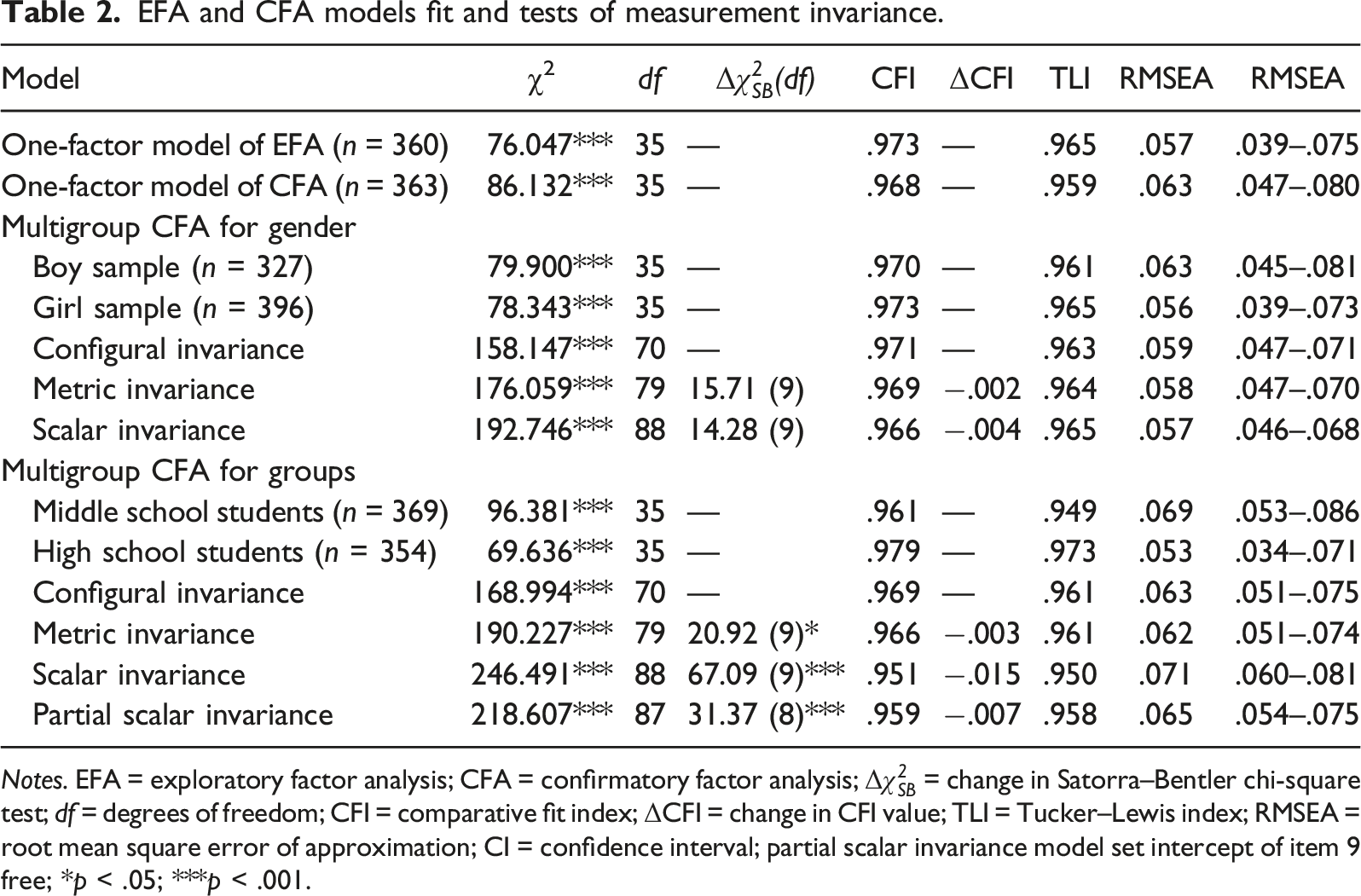
Notes. EFA = exploratory factor analysis; CFA = confirmatory factor analysis;
Measurement Invariance and Mean Comparisons
As shown in Table 2, all invariance models across gender (from the configural invariance model to the scalar invariance model) fit the data well (CFI and TLI >.95; RMSEA <.08). These results support scalar invariance of the single-factor model across gender (ΔCFI = −.004). A test of the latent mean difference indicated the absence of latent means difference between girls (M = 0) and boys (M = .04, p > .05). Similarly, all invariance models across samples (from the configural invariance model to the scalar invariance model) fit the data well (CFI and TLI >.95; RMSEA <.08). But the scalar invariance of the single-factor model across samples was not supported (ΔCFI = −.015). Based on the modification indices, we conducted the partial scalar invariance model with item 9 freely estimated. The results supported partial scalar invariance across samples (ΔCFI = −.007). A test of the latent mean difference indicated that middle school students (paper and pencil sample, M = 0) reported higher mean scores than high school students (online sample, M = −.85, p < .001), with a large effect size (Cohen’s d = .85).
Moreover, the results of the gender × sample factorial ANOVA revealed the statistically non-significant interaction effect of gender and sample: F(1, 723) = .10, p = .76. There was a significant main effect for the sample, where middle school students or the paper and pencil sample (M = 4.38) reported higher academic grit than the high school students or the online sample: (M = 3.44), F(1, 723) = 158.44, p < .001, partial η2 = .18. Nevertheless, there was a non-significant main effect for gender (Mboy = 3.95, Mgirl = 3.90), F(1, 723) = .23, p = .63.
Internal Consistency and Test-Retest Reliability
The Cronbach’s alpha of the AGS was .94, indicating excellent internal consistency (Barker et al.,1994). The Pearson correlation coefficients (r) between Time 1 and Time 2 (four weeks apart) for the AGS total score was .82. The intraclass correlation coefficient was .82. These findings indicate mostly good test–rest reliability (Cicchetti, 1994).
Criterion Validity and Incremental Validity
Middle School Student Sample (Sample 1a, n = 369)
Means, standard deviations, and correlation matrix among criterion variables in middle school students (n = 369).
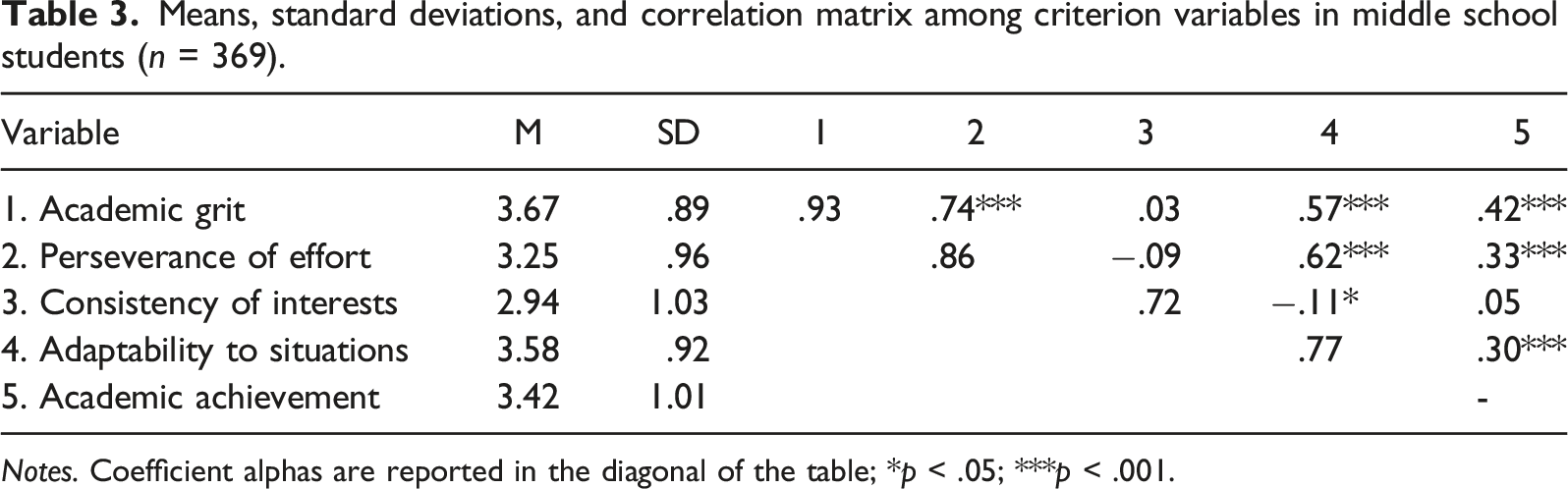
Notes. Coefficient alphas are reported in the diagonal of the table; *p < .05; ***p < .001.
Results of hierarchical regression analyses testing incremental validity of academic grit on academic achievement in middle school students.
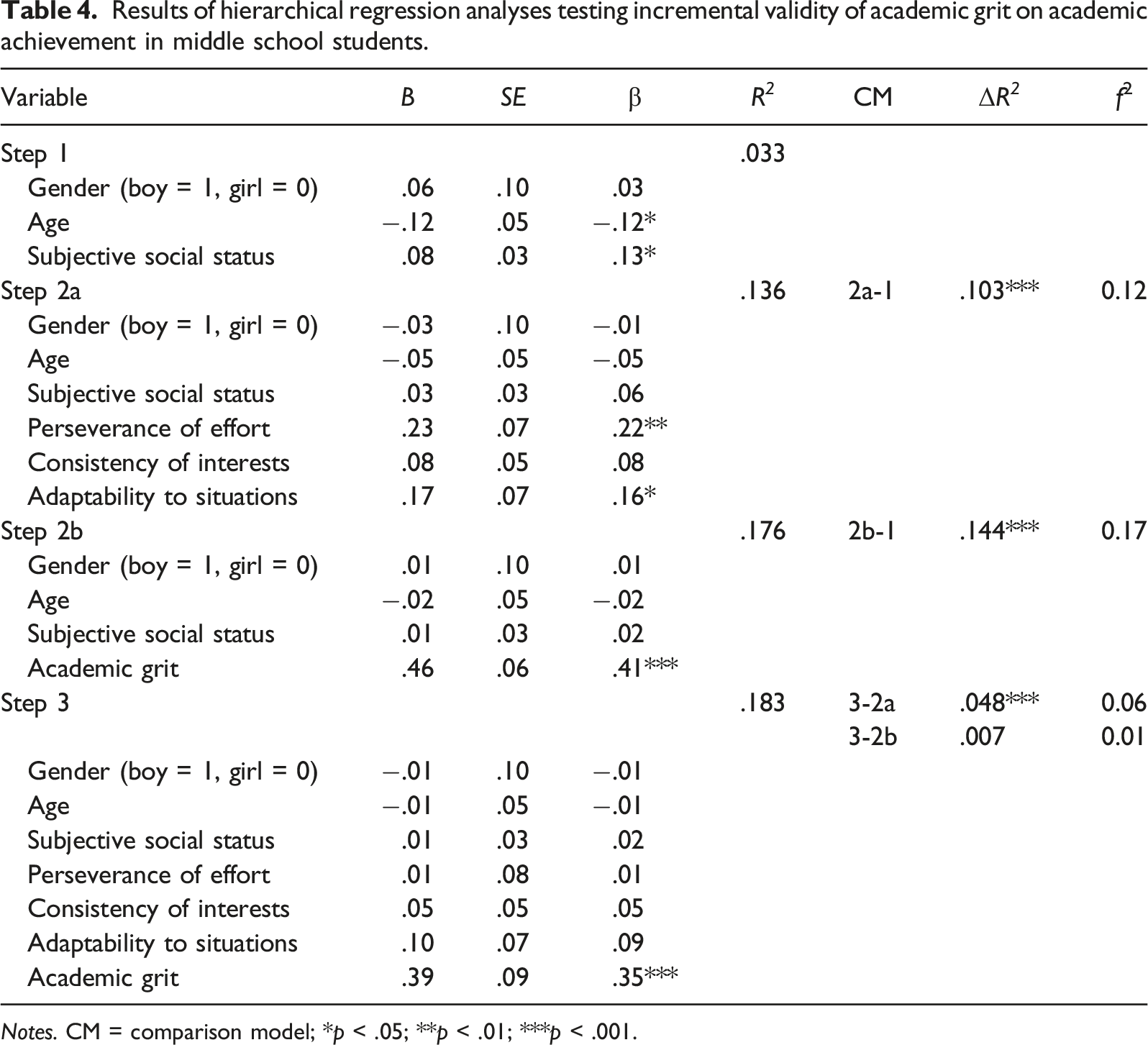
Notes. CM = comparison model; *p < .05; **p < .01; ***p < .001.
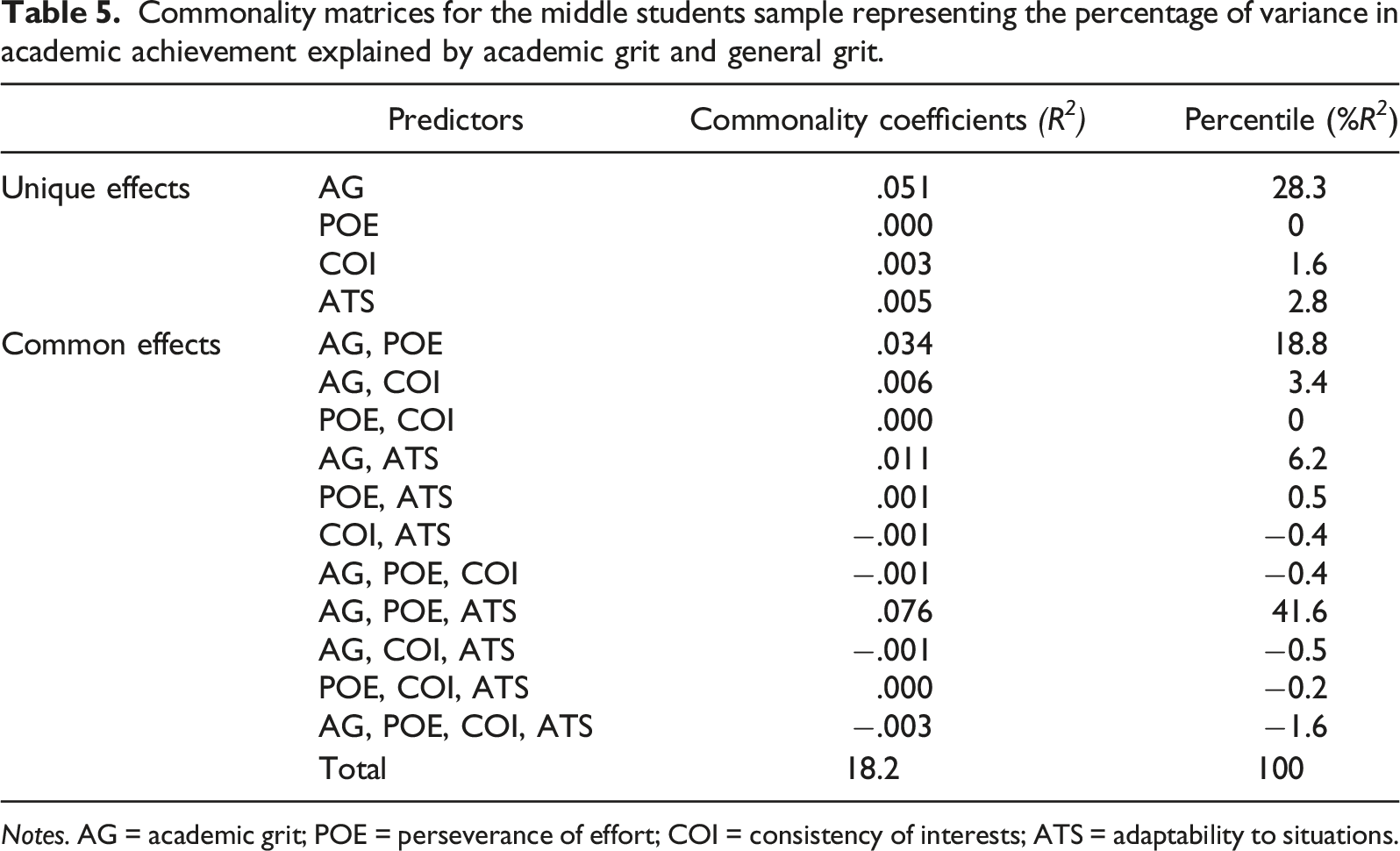
Commonality matrices for the middle students sample representing the percentage of variance in academic achievement explained by academic grit and general grit.
Notes. AG = academic grit; POE = perseverance of effort; COI = consistency of interests; ATS = adaptability to situations.
Means, standard deviations, and correlation matrix among criterion variables in high school students (n = 354).
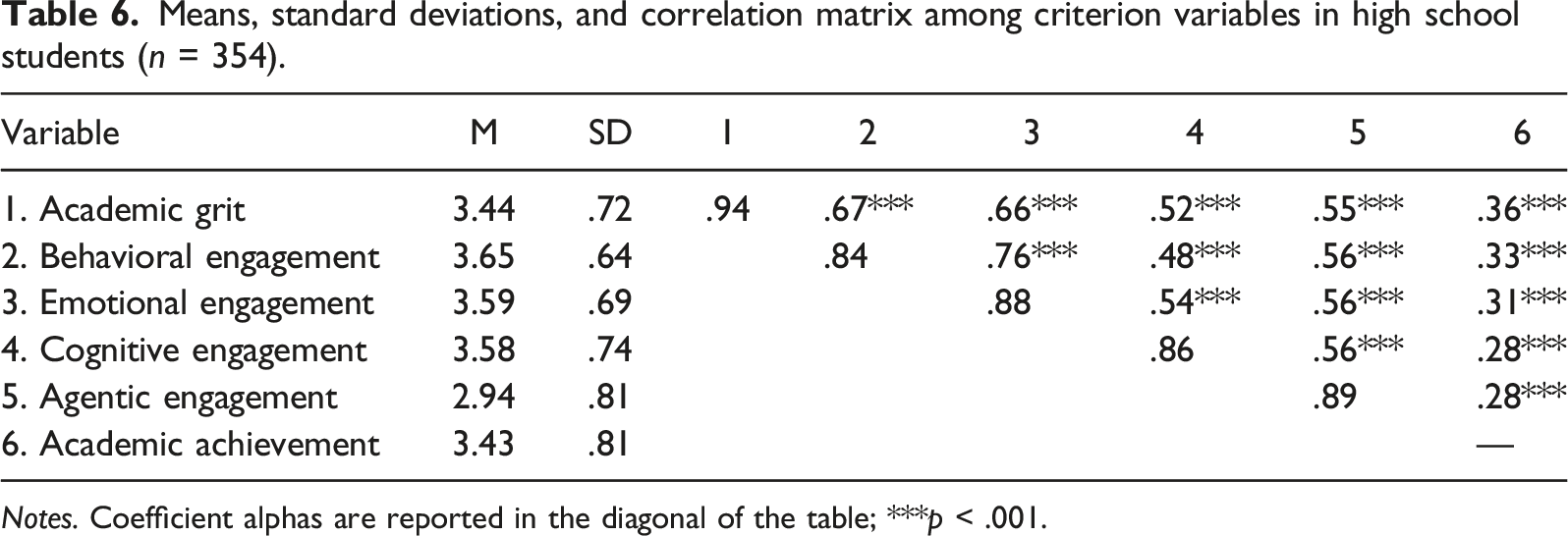
Notes. Coefficient alphas are reported in the diagonal of the table; ***p < .001.
High School Student Sample (Sample 1a, n = 354)
Results of hierarchical regression analyses testing incremental validity of academic grit on academic achievement in high school students.
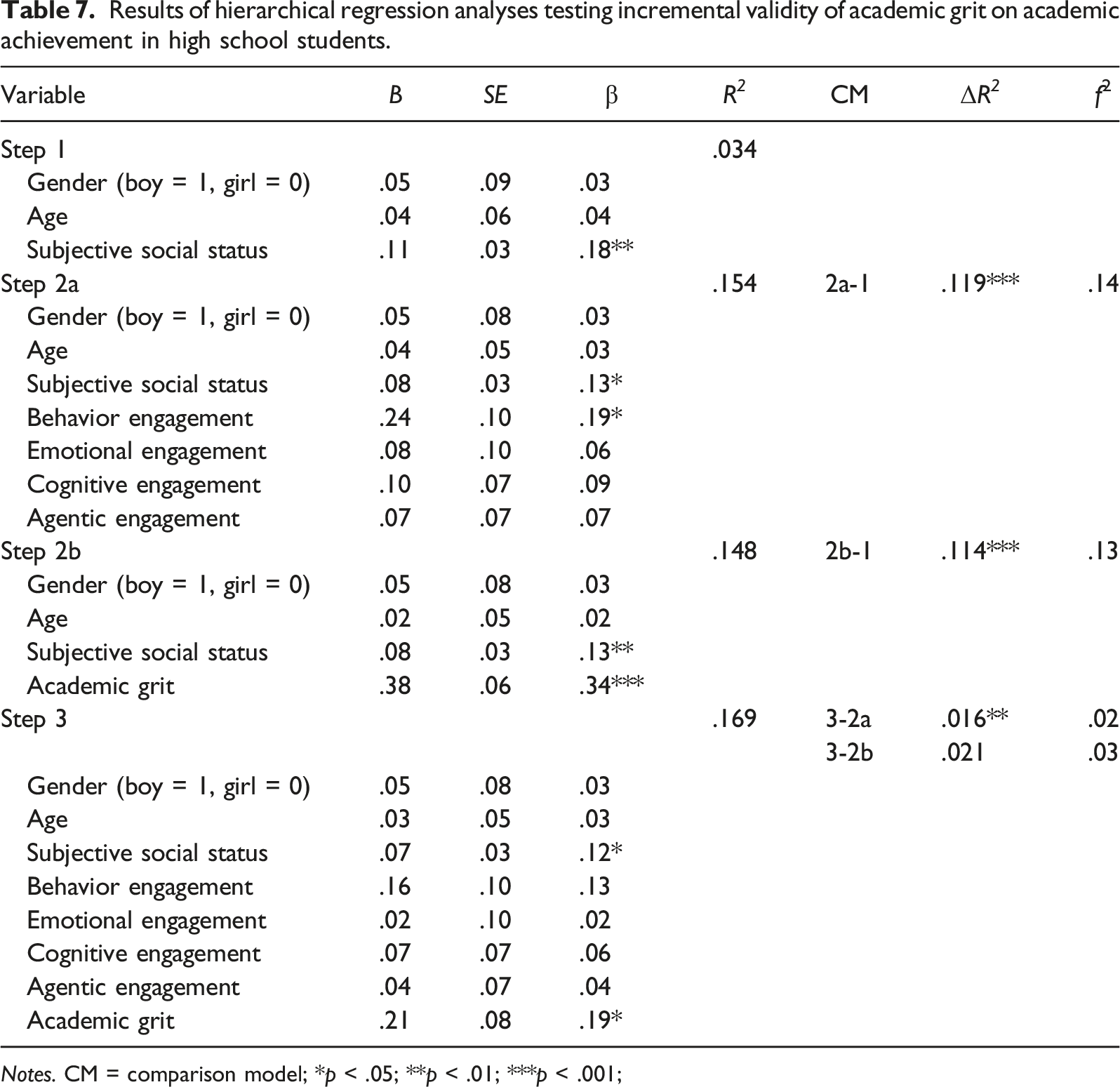
Notes. CM = comparison model; *p < .05; **p < .01; ***p < .001;
Commonality matrices for the high students sample representing the percentage of variance in academic achievement explained by academic grit and general grit.
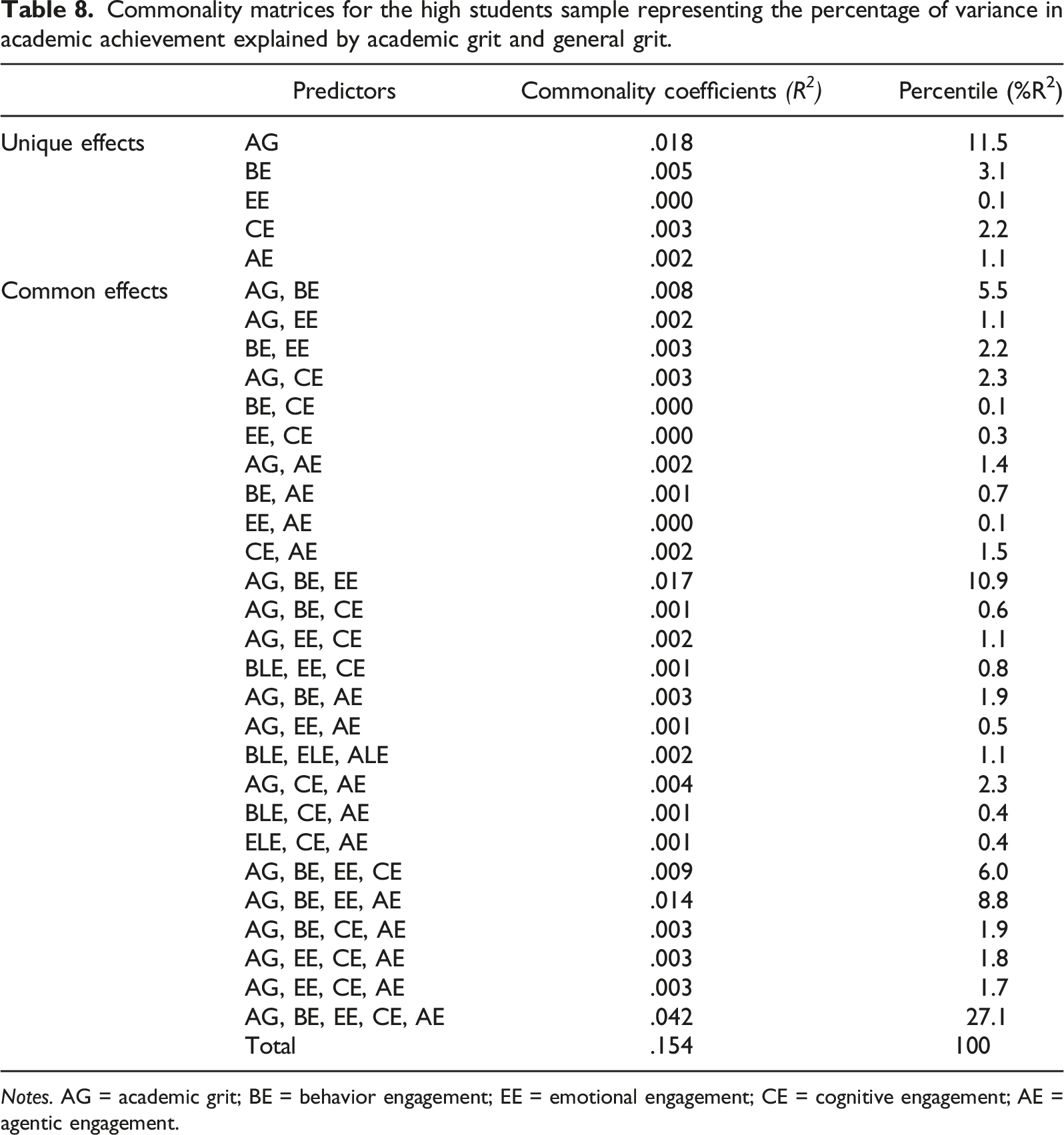
Notes. AG = academic grit; BE = behavior engagement; EE = emotional engagement; CE = cognitive engagement; AE = agentic engagement.
Discussion
An emerging body of research has underpinned the importance of assessing the domain specificity of grit (Clark & Malecki, 2019; Cormier et al., 2019; Schmidt et al., 2019). Clark and Malecki (2019) conceptualized grit within the domain of education as an individual characteristic or skill that encompasses determination, resilience, and focus in the pursuit of challenging long-term goals. Their AGS has been developed and validated within the context of Western societies, however, little research has been done on the psychometric properties of the AGS in non-Western or collectivist contexts (Wang, 2021). The current study addressed this gap by exploring the factorial validity, measurement invariance, criterion-related validity, and incremental validity of the AGS in Chinese adolescents.
Our results support the same single-factor structure as proposed by the original AGS (Clark & Malecki, 2019), showing scalar invariance across gender and partial scalar invariance across groups (i.e., middle school students and high school students, or online and paper and pencil samples). For one item (“When it comes to completing work in school, I always try my hardest”), the intercept was larger in the high school group than in middle school group. This may be reflective of group variations in response styles or response reference frameworks (Han et al., 2019). It is also probable that increased experience of academic demands and academic challenges in high school make them more conscientious with regards to making greater effort, resulting in somewhat higher responses on this item (Teuber et al., 2020). The Chinese version of the AGS was shown to have good internal consistency and temporal stability. Overall, these findings indicate that the Chinese version of the AGS is a suitable instrument for comparing academic grit across gender and across groups (i.e., middle school students and high school students, or online and paper and pencil samples).
Inconsistent with our assumption and previous research findings (Clark & Malecki, 2019), there was no significant difference across gender on the latent means of academic grit. This finding corroborates a past meta-analytic review which demonstrated a lack of gender differences in general grit (Credè et al., 2017). It is likely that academic grit may not vary across gender given that the students recruited for this investigation came from urban areas where, while growing up, they would have been equally expected and commended for their perseverance, self-discipline, and hark work in learning (Li et al., 2022). By contrast, middle school students reported higher mean scores on academic grit than high school students, which is consistent with our prediction. Clark and Malecki (2019) speculated that academic grit might decrease with grades during adolescence, as various academic indicators (e.g., school participation, self-regulated learning, and mastery goal-orientation) demonstrate declines. It is important to note that in the current study, the middle school students and high school students completed the AGS through paper-and-pencil or online methods, respectively. This might lead to mixed results. We cannot determine whether a specific group (i.e., middle school students or high school students) or administered format (i.e., paper-and-pencil or online) led to the group differences. Further study is required to investigate possible group differences (middle school students and high school students) in academic grit.
Our findings do show that academic grit is positively linked to perseverance of effort, which is consistent with previous findings (Clark & Malecki, 2019). Contrary to our expectation, however, academic grit was positively correlated with adaptability to situations, while the association between academic grit and consistency of interests was not statistically significant and approached zero. Previous findings have shown that perseverance of effort is positively related with adaptability to situations, while perseverance of effort is insignificantly associated with consistency of interests among Chinese technical-vocational college students (Datu & Zhang, 2021). To some extent, this is because Chinese students tend to exhibit higher interdependency and possess a greater level of diligence in addressing changing situational demands or fluctuating expectations from others, who they consider to be important (Datu et al., 2017; Datu, 2021). Collectively, these findings also provide preliminary evidence for the construct validity of the Chinese version of the AGS.
Our findings demonstrate that academic grit is positively correlated with academic achievement and dimensional engagement (i.e., agentic, behavioral, cognitive, and emotional engagement). In adolescent research, academic grit has been shown to be positively associated with self-reported academic achievement and GPA, school satisfaction, and life satisfaction (Clark & Malecki, 2019; 2022). Similarly, general grit has demonstrated a positive association with academic achievement and engagement (Lam & Zhou, 2022; Hodge et al., 2018). These results support the optional functioning of grit in academic contexts (Datu, 2021; Duckworth et al., 2007), generating evidence regarding the criterion-related validity of the Chinese AGS.
The contribution of the current research is its use of commonality analysis to isolate the unique and combinatorial effects of academic grit and general grit, as well as academic grit and student engagement, in predicting self-reported academic achievement. Because of the high correlations among academic grit, dimension of general grit, and student engagement, estimates from a standard multiple regression are likely to be unstable, as was demonstrated across the middle and high school student groups. Commonality analysis can account for multicollinearity by analyzing whether the redundancy or the overlapping component of academic grit and theory-related traits predict academic achievement. The results of the commonality analysis showed that a large portion of academic achievement is explained by shared overlap among academic grit, perseverance of effort, and adaptability to situations (41.6%), as well as by overlap among academic grit and perseverance of effort (18.8%). These findings are not surprising, as the determination and resilience aspects of academic grit are very similar to perseverance of effort, and perseverance of effort is highly related with adaptability to situations. Academic grit (28.3%) – rather than the general grit dimension (4.4%) – uniquely explained a large portion of academic achievement. This result provides evidence for the claim that the definition of academic grit does not align seamlessly with previous definitions of general grit (i.e., passion and perseverance toward long-term goals; Duckworth et al., 2007). Our results also show that academic grit has the potential to be conceptually and empirically distinct from general grit with its own influence on academic outcomes. This result also corroborates existing evidence on the merit of adopting domain-specific grit in achievement domains (Clark & Malecki, 2019; Cormier et al., 2019; Schmidt et al., 2019).
Finally, our results demonstrate that the overlap amongst academic grit and dimensional engagement (i.e., agentic, behavioral, cognitive, and emotional engagement) is the most predictive of academic achievement. However, academic grit and dimensional engagement (i.e., agentic, behavioral, cognitive, and emotional engagement) also have unique predictive roles on academic achievement. These results suggest that academic grit is related to yet distinct from student engagement (i.e., agentic, behavioral, cognitive, and emotional engagement). As mentioned previously, academic grit highlights determination, resilience, and focus in the pursuit of challenging long-term goals within the domain of education. Student engagement, meanwhile, can be considered as constructive, enthusiastic, willing, emotionally positive, cognitively focused participation in academic work which influences learning and achievement in the short term (Skinner et al., 2008). In this regard, effort, working hard, persistence, and focus are also highlighted in the conceptual framework of academic grit and student engagement (Clark & Malecki, 2019; Skinner, 2016). Nevertheless, student engagement also comprises cognitive strategies (e.g., elaboration), initiating or accelerating academic progress and creating a supportive learning environment to which academic grit does not refer. Furthermore, in the present study, academic grit explained more variance in students’ academic achievement than the dimensions of student engagement. This result is not consistent with the previous finding in general grit research that behavioral engagement in school explained more variance in students’ grades than either consistency of interests or perseverance of effort (Muenks, et al., 2017; Steinmayr et al., 2018). These findings generate evidence regarding the incremental validity of academic grit in predicting academic achievement above and beyond student engagement.
Our results have several implications for both researchers and practitioners. First, due to the sound psychometric characteristics of the Chinese version of the AGS, our results show that the measure can be used in school-wide screenings to evaluate Chinese teenagers' degree of grit in academic settings. As our results show that academic grit has a larger predictive utility in terms of academic achievement than the general grit dimension when isolating shared effects of academic and general grit, the Chinese version of the AGS may be more appropriate for investigating Chinese teenagers' education-specific outcomes, in comparison to the TMGS. Second, considering that there is an overlap between academic grit and student engagement (i.e., agentic, behavioral, cognitive, and emotional engagement), as well as the fact that little variance of academic achievement was explained by student engagement after factoring shared effects of academic grit and student engagement, it seems best to use the AGS alone. However, student engagement (i.e., agentic, behavioral, cognitive, and emotional engagement), which uniquely underlines cognitive strategies (e.g., elaboration), initiative improvement of academic progress, and creates a conducive learning environment, is still distinct from academic grit. Therefore, it is not necessarily the case that one construct (academic grit) is superior than the other (student engagement), but rather that the two constructs (academic grit and student engagement) should be considered comprehensively to better understand students’ performance of short- and long-term goals.
Although our study provides preliminary evidence to support the validity and reliability of the AGS among Chinese adolescents, there are nonetheless limitations which should be acknowledged. First, the participants in the current study were recruited using a convenience sampling method. Future studies with more diversified samples (e.g., elementary school students, university students) are needed to enhance the generalizability of our findings. Second, our results relied on self-report questionnaires in which all items were not randomized, and this may have increased the likelihood of common method bias. Future investigations should use data from multiple sources (e.g., teacher-report, official school records) to overcome this limitation. Third, the present study used a cross-sectional design which could not generate insights on how academic grit may relate to cross-temporal changes in academic achievement. Furthermore, academic grit is considered to be a malleable construct, and as such, longitudinal research is needed to assess the stability of academic grit and the longitudinal relationship between academic grit and academic achievement. Fourth, the criterion-related measures (i.e., the SES and the TMGS) have shown acceptable factorial structures and good internal consistency in the present study. Nevertheless, follow-up studies are warranted to investigate the psychometric properties of these criterion-related measures among Chinese adolescents. Finally, although there is merit in adopting domain-specific grit in achievement domains, our research did not examine the predictive utility of the AGS for academic achievement against using a domain-modified version of Duckworth’s Grit Scales (i.e., the Original Grit Scale or the Short Grit Scale) nor a domain-modified version of the TMGS. It would be interesting to use commonality analysis to isolate both the unique and combined contributions of each construct to understanding academic outcomes.
Supplemental Material
Supplemental Material - Validating the Chinese Version of the Academic Grit Scale in Selected Adolescents
Supplemental Material for Validating the Chinese Version of the Academic Grit Scale in Selected Adolescents by Hui Tang, Shujing Zhou, Xiaoqing Du, Qiyun Mo, and Qiang Xing in Journal of Psychoeducational Assessment
Footnotes
Declaration of Conflicting Interests
The author(s) declared no potential conflicts of interest with respect to the research, authorship, and/or publication of this article.
Funding
The authors disclosed receipt of the following financial support for the research, authorship, and/or publication of this article: This study was funded by the general topic of pedagogy during the 13th Five-Year planning of National Social Science Foundation “Research on the Present Situation, Influencing Mechanism and Coping Strategies of Young Students’ Academic Frustration Based on Core Literacy” (No. BBA180078).

Supplemental Material
Supplemental material for this article is available online.
References
Supplementary Material
Please find the following supplemental material available below.
For Open Access articles published under a Creative Commons License, all supplemental material carries the same license as the article it is associated with.
For non-Open Access articles published, all supplemental material carries a non-exclusive license, and permission requests for re-use of supplemental material or any part of supplemental material shall be sent directly to the copyright owner as specified in the copyright notice associated with the article.
