



Abstract
This study aimed to translate the Japanese version of the Life Skills Scale for Adolescents and Adults (LSSAA) into Chinese, English, and Korean, simplify it, and assess its reliability and validity. Validation was performed using individual data of 9941 high-school students from China, Japan, Korea, and the United States collected by the 2021 “Survey on Experiences and Attitudes Related to the Corona Crisis” conducted by the National Institution For Youth Education. Confirmatory factor analysis showed that the four-factor model of the LSSAA fit the data for all four countries. Testing of the measurement invariance of the four-factor model among the four countries supported the adoption of a weak invariance model, and the LSSAA scores were comparable across all four countries. These results suggest that the LSSAA has good reliability and validity and applies to adolescents in English-speaking countries and some Asian counties.
Keywords
Introduction
Life skills are defined as “abilities for adaptive and positive behavior, that enable individuals to deal effectively with the demands and challenges of everyday life” (World Health Organization, 1994). These psychological abilities support self-efficacy, mental health, and well-being and are essential for a fulfilling social life (Botvin et al., 1990; Maddah et al., 2021). A framework developed by the World Health Organization (1994) proposes that there are ten core life skills: decision-making, problem-solving, creative thinking, critical thinking, effective communication, interpersonal relationship skills, self-awareness, empathy, coping with emotions, and coping with stress. Recently, novel definitions of life skills have been proposed that include these skills and more specific ones that are necessary for adaptation to modern society, such as teamwork, time management, and leadership (Cronin & Allen, 2017; World Health Organization, 2020), but the World Health Organization (1994) definition remains in widespread use as the fundamental definition of life skills (e.g., Ghasemian & Venkatesh Kumar, 2017; Ndetei et al., 2019; Tiwari et al., 2020). Activities have been devised to foster personal skills (such as coping with stress and emotions) and interpersonal skills (such as forming and maintaining good relationships), prevent the development of negative emotions and problem behaviors, and ultimately promote positive health behaviors and good mental health (e.g., Botvin et al., 1990; Fagan & Mihalic, 2003). Currently, research is being conducted to develop procedures that will more effectively enable the implementation of psychoeducational programs aimed at improving life skills, called life skills training (LST) or life skills education (LSE) to verify the effectiveness of such programs (e.g., Ghasemian & Venkatesh Kumar, 2017; Maddah et al., 2021; Tiwari et al., 2020; Velasco et al., 2021).
LST or LSE, with many life skills measures, such as the Life Skills Development Scale-Adolescent Form (Darden, Ginter, and Gazda, 1996) and Life Skills Development Inventory-College Form (Picklesimer & Miller, 1998), is often conducted in educational institutions, and life skills education from childhood to adolescence has been much studied (e.g., Botvin, 2000; Botvin et al., 1997; Donaldson et al., 1994; Savoji & Ganji, 2013). These life skills were developed based on surveys of students and focused on the life skills necessary for school life. These scales employ Brooks’ (1984) classification of life skills into four categories: interpersonal communication/social relations skills, problem-solving/decision-making skills, identity development/purpose in life skills, and fitness/health maintenance skills. In a recent study, psychological scales have been developed to measure life skills in young athletes; in this context, teamwork, goal setting, time management, emotional skills, interpersonal communication, social skills leadership, problem-solving, and decision-making are the life skills that mostly support sporting activities (Cronin & Allen, 2017).
Attempts are now being made to create a life skills scale that applies to a more diverse range of subjects so that the role of life skills in social life in adulthood and beyond can be assessed. Kase, Bannai, and Oishi (2016) applied text mining to organize information on lay perceptions of life skills more objectively but also built on earlier work using qualitative research methods such as literature review and open-ended surveys to define life skills (Brooks, 1984; Evans & Poole, 1987; World Health Organization, 1994). They collected free descriptions of the life skills used in daily life from 400 adolescents and adults and classified their contents via text mining into 40 behavioral and cognitive abilities that are considered important life skills by adolescents and adults. These abilities included those recognized in existing scales such as “positive thinking” and “interpersonal manner” (e.g., Darden, Ginter, and Gazda, 1996) but also capabilities that are needed by adolescents and adults living in a modern information society, such as “media search,” a “skeptical attitude toward information,” and “profit/loss consideration” (Kase, Bannai, & Oishi, 2016). Thus, the results highlighted the life skills needed by Japanese adolescents and adults as well as core behavioral and cognitive abilities recognized in existing life skills frameworks.
The Life Skills Scale for Adolescents and Adults (LSSAA; Kase, limura, Bannai, & Oishi, 2016) was developed based on the life skills definitions generated by Kase and colleagues (2016) and the World Health Organization (1994). It measures four factors: “decision-making skills” (DM; the ability to make effective decisions using logical thinking and imagination), “coping with emotion skills” (CE; the ability to think positively and manage emotion), “effective communication skills” (EC; the ability to actively and successfully communicate one’s thoughts to others), and “interpersonal relationship skills” (IR; the ability to understand others’ feelings based on their words and actions and express empathy for them in word and action) (Kase, limura, Bannai, & Oishi, 2016). These psychosocial skill types aggregate the components extracted by Kase and colleagues (2016) and are considered to be core post-adolescence life skills. Although the LSSAA was developed in Japan, its foundation on the life skills framework of the World Health Organization (1994) indicates that its content should be internationally applicable.
The LSSAA has been used to measure the effectiveness of educational programs in Japan (e.g., Nakayama & Moriya, 2018; Yabunaka et al., 2022) and as a reference framework for defining life skills and developing measurement scales outside of Japan (e.g., Kutsal & Nazli, 2021; Mediawati et al., 2022). It has also been used in theoretical research into relationships between concepts and has reported associations with major health-related indicators such as those measuring mental health, depressive tendencies, loneliness, and positive orientation toward life (e.g., Kase, limura, Bannai, & Oishi, 2016, Kase, Ueno, Shimamoto, & Oishi, 2019; Yano, Kase, and Oishi, 2021). Thus, the LSSAA is considered a valid measure of core life skills in educational settings and is based on international definitions of such skills. Therefore, if the LSSAA applies to diverse cultures, it has the potential to contribute to the research area by enabling international comparative studies on life skills. However, the only standardized Japanese version of the scale is a 21-item LSSAA with unknown utility for cross-cultural research.
In reviewing the content of the LSSAA, the number of items that comprise the scale should be taken into account. In many cases, such as large-scale epidemiological surveys, web surveys, and experiments or interviews that require repeated measurement, simpler scales are needed to reduce the burden on respondents and obtain more accurate responses (Gosling et al., 2003). In particular, the scales measuring life skills will be used primarily in educational settings, where students will be asked to repeat responses before and after intervention programs, experiments, and interviews, under time-sensitive situations in the classroom and after school. Therefore, scales should include as few items as possible while ensuring a certain degree of reliability and validity. Although a minimum of two items is required for confirmatory factor analysis and the calculation of reliability coefficients, which are essential for validating reliability, factors consisting of two items are prone to technical problems in the analysis (Kline, 2016). To avoid this problem, it is recommended that a factor includes at least three items (Kline, 2016). Therefore, when making a shortened version of the LSSAA, which contains four subscales, it is desirable to select three representative items from each subscale for a total of 12 items, so that content validity is not impaired. Furthermore, to confirm whether a certain level of validity is maintained after the number of items is reduced, it is necessary to verify criterion-related validity by checking the correlation between the LSSAA and external indicators that are theoretically assumed to be related to the LSSAA. In this study, we used interpersonal satisfaction and mental health as external indicators, as these are concepts that show certain relationships to life skills. Several studies have found that enhancing life skills improves positive interpersonal relationships and mental health (e.g., Ndetei et al., 2022; Sobhi-Gharamalke et al., 2010; Weitlauf et al., 2000; Wright et al., 2011). In other words, the higher the effective communication and interpersonal skills, as assessed by the LSSAA, the better the interpersonal satisfaction, and the higher the decision-making and emotional coping skills, the better the mental health status.
In this study, we also re-examined and reorganized the content of the items that make up the scale so that it can easily measure a single factor where the life-skill domain of interest is limited, such as in educational settings or large-scale surveys, as well as translating the LSSAA into English, Chinese, and Korean and conducting a survey in each country to examine its cross-cultural reliability and validity.
Methods
Participants and Ethics
Individual data was extracted from the 2021 “Survey on Experiences and Attitudes Related to the Corona Crisis” conducted by the National Institution For Youth Education, in which the authors were involved. The survey was completed by 9941 high-school students in China (1316 males, 1531 females; mean grade = 1.97, SD = 0.77), Japan (1781 males, 1898 females; mean grade = 1.92, SD = 0.82), Korea (791 males, 797 females, mean grade = 1.92, SD = 0.81), and the United States (914 males, 913 females; mean grade = 2.00, SD = 0.82). The survey received approval from the research ethics committee of the previous affiliation of the second author. Secondary analysis was conducted with data-use approval from the National Institution For Youth Education. Data collection was conducted in each county by selecting the institutions to be surveyed to avoid regional or demographic bias.
Measurement
English Version of the LSSAA.

Notes. Decision-making skills: items 6, 7, and 11; coping with emotion skills: items 4, 5, and 10; effective communication skills: items 1, 9, and 12; interpersonal relationship (IR) skills: items 2, 3, and 8. Versions in other languages are available at https://osf.io/wzsy6.
In addition, mental health was measured using a scale measuring recent mental health status, and also satisfaction with IRs was measured to assess criterion validity. Recent mental health status was developed regarding the Kessler 10 (Kessler et al., 2002) and the Self-Rating Depression Scale (Zung, 1965). This scale requires responses to six items (e.g., “Have you felt any of the following recently?”) using a 4-point Likert scale (1, never, to 4, often), with higher scores indicating worse mental health. Scores on this scale are expected to negatively correlate with each of the LSSAA subscale scores. Interpersonal relationship satisfaction was measured with a scale originally developed by the National Institution For Youth Education (2022). Participants respond to eight items (e.g., “I have a good relationship with my family,” “b. My parent(s) or guardian(s) understand me,” “I feel at peace at home,” “I like being with my parents (or guardians),” “I enjoy being with my friends,” “I prefer associating with my friends through social media networks rather than face-to-face,” “I like being alone,” and “I have someone who can help me when things are tough.”) on a four-point Likert scale (1, strongly disagree, to 4, strongly agree), with higher scores indicating greater satisfaction with interpersonal relationships. Scores on this scale are expected to correlate positively with each of the LSSAA subscale scores.
Statistical Analysis
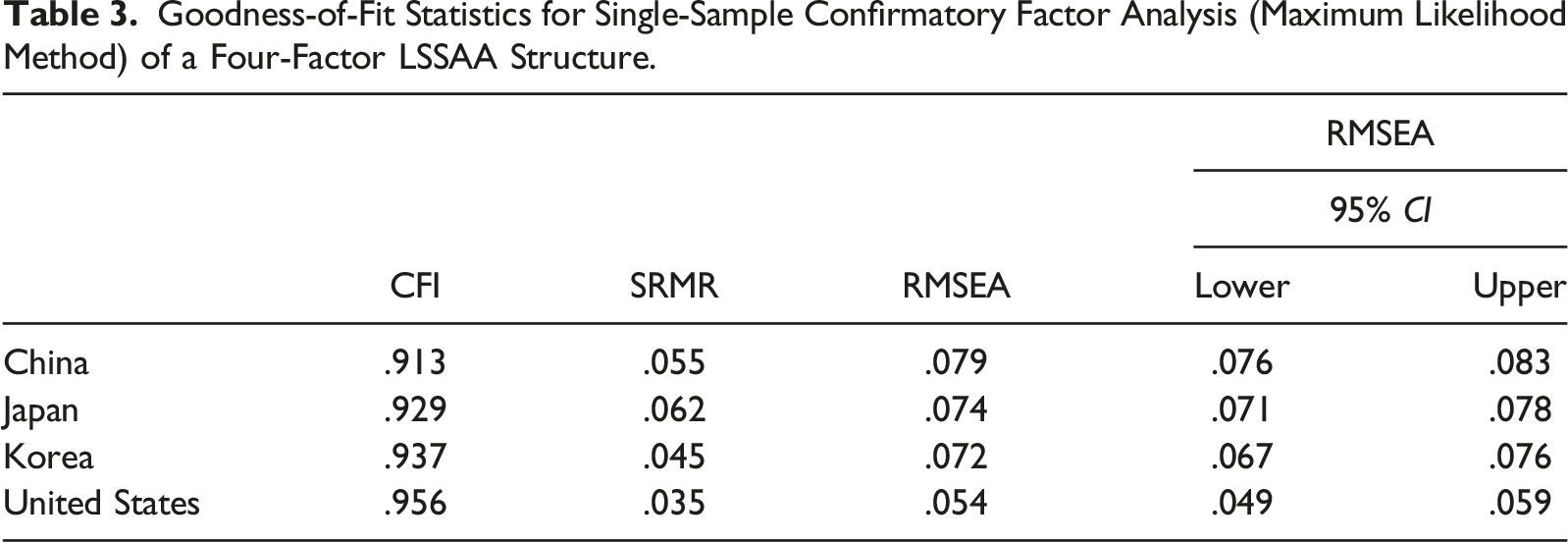
First, descriptive statistics and reliability coefficients (Cronbach’s α and McDonald’s ω) were calculated for the LSSAA, and Pearson correlations between each subscale score were computed. Next, we conducted a confirmatory factor analysis of the original four-factor model (Kase, limura, Bannai, & Oishi, 2016) and tested for measurement invariance. A significance level of 5% was used throughout the study. Model fit was assessed using the comparative fit index (CFI), standardized root mean square residual (SRMR), and root mean square error of approximation (RMSEA). The model was considered to fit the data when CFI >.90, SRMR <.08, and RMSEA <.10. Statistical analysis was performed using HAD version 17 (Shimizu, 2016) and the lavaan (Rossell, 2012) and semTools (Jorgensen et al., 2021) packages in R version 4.1.3 (R Core Team, Vienna, Austria). Measurement invariance tests were conducted across four countries using multi-group CFA. We compared the model fit between three models (configural invariance model: the numbers of factors and observed variables are constrained to be equal between groups; weak invariance: the factor loadings of each item are constrained to be equal between groups; and strong invariance: both loadings and intercepts are constrained to be equal between groups) using the likelihood ratio test and examined the differences in CFI (ΔCFI), SRMR (ΔSRMR), and RESEA (ΔRMSEA). The best-fitting model was selected and assessed using the model fit criteria described above.
Results
Descriptive Statistics and Reliability
Descriptive Statistics of the LSSAA for Each Country.
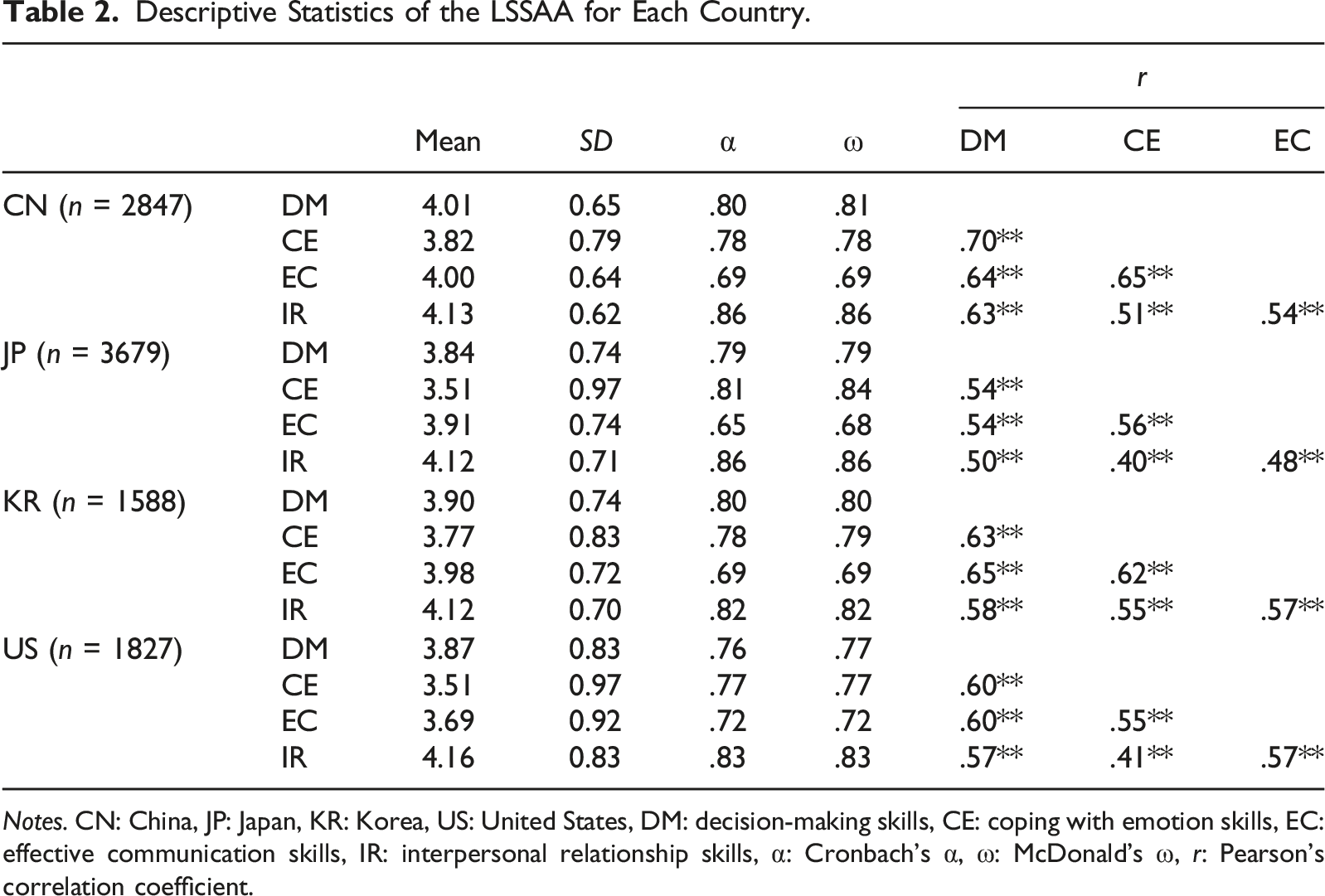
Notes. CN: China, JP: Japan, KR: Korea, US: United States, DM: decision-making skills, CE: coping with emotion skills, EC: effective communication skills, IR: interpersonal relationship skills, α: Cronbach’s α, ω: McDonald’s ω, r: Pearson’s correlation coefficient.
Confirmatory Factor Analysis and Measurement Invariance
Goodness-of-Fit Statistics for Single-Sample Confirmatory Factor Analysis (Maximum Likelihood Method) of a Four-Factor LSSAA Structure.
Standardized Factor Loadings from Confirmatory Analyses of the LSSAA.
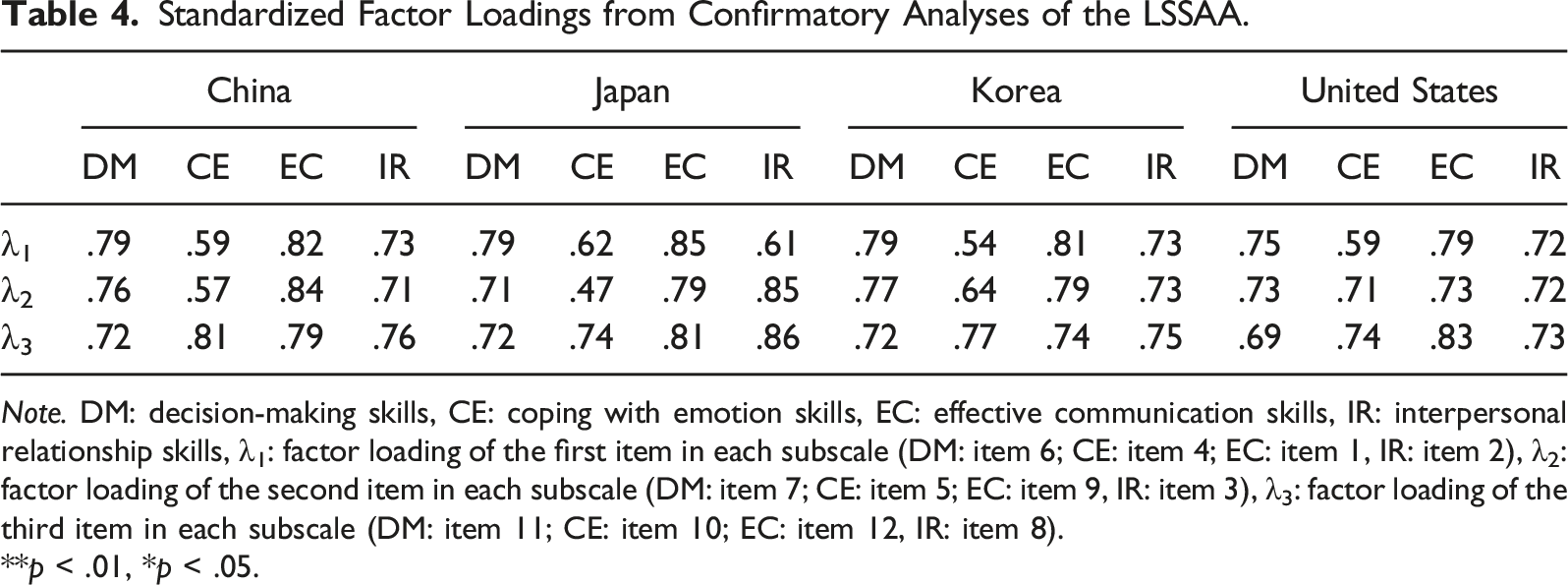
Note. DM: decision-making skills, CE: coping with emotion skills, EC: effective communication skills, IR: interpersonal relationship skills, λ1: factor loading of the first item in each subscale (DM: item 6; CE: item 4; EC: item 1, IR: item 2), λ2: factor loading of the second item in each subscale (DM: item 7; CE: item 5; EC: item 9, IR: item 3), λ3: factor loading of the third item in each subscale (DM: item 11; CE: item 10; EC: item 12, IR: item 8).
**p < .01, *p < .05.
Measurement Invariance of a Four-Factor LSSAA Structure.
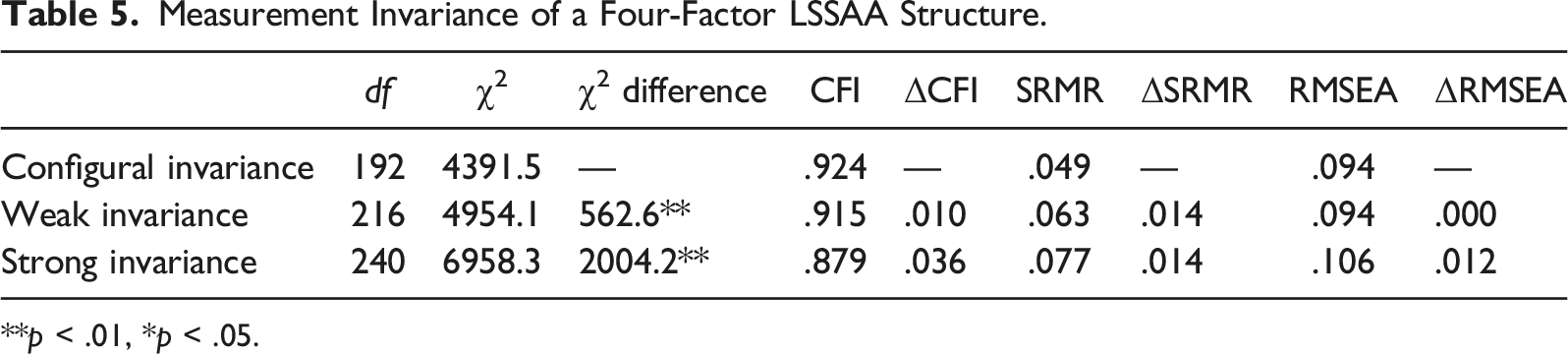
**p < .01, *p < .05.
Criterion Validity
Correlations Coefficients Indicate the Relationships between LSSAA Subscale Scores and Standard-Related Indicators (N = 9939).
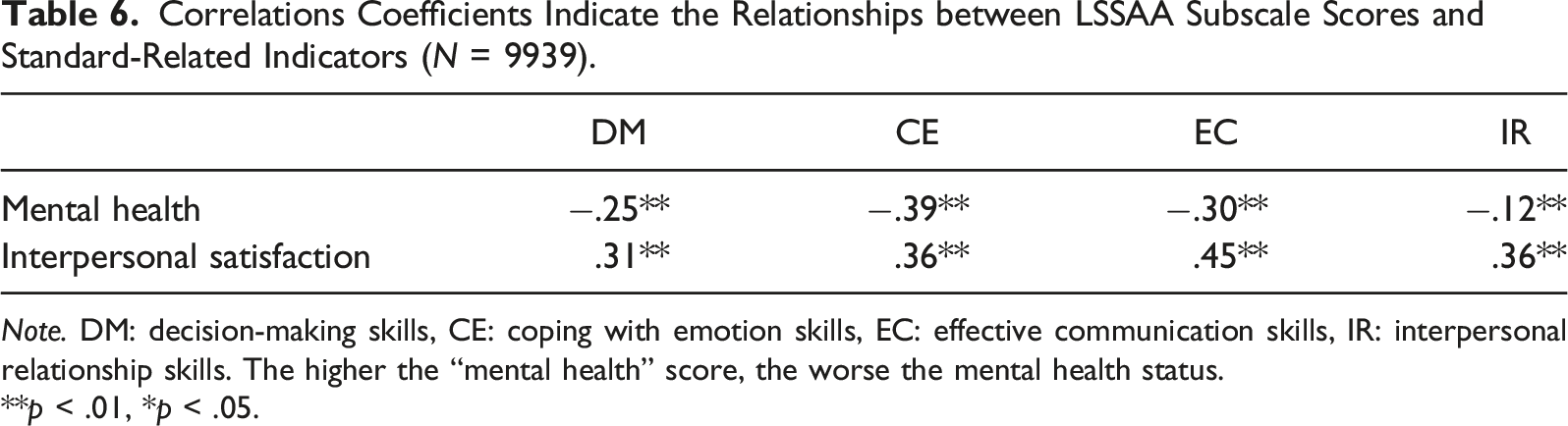
Note. DM: decision-making skills, CE: coping with emotion skills, EC: effective communication skills, IR: interpersonal relationship skills. The higher the “mental health” score, the worse the mental health status.
**p < .01, *p < .05.
Discussion
This study aimed to verify the reliability and validity of the 12-item version of the LSSAA among adolescents in China, Japan, Korea, and the United States. An overview of the results shows that the LSSAA has a certain degree of reliability for each subscale, and its factor structure is comparable across the four countries. Additionally, the LSSAA scores correlated with external indicators, and the validity of the LSSAA, although consisting of only three items, was found to be robust.
Internal Consistency
The internal consistency of the LSSAA was evaluated by calculating reliability coefficients. Only EC had Cronbach’s alpha values below .70 (for all countries except the United States). EC was measured by items asking whether the individual could honestly communicate their feelings or express them non-verbally (item 1 and 9) or could effectively explain their thoughts to others (item 12). These two types of skills are both important for communication (Evans & Poole, 1987; World Health Organization, 1994) but do not necessarily occur together. It is possible to be adept in one type and unskilled in the other. This diversity may have driven down the reliability coefficient; however, it was necessary to broadly capture the content of EC with just a few items, and the items retained have apparent content validity. In addition, EC scores were moderately or strongly positively correlated with the other subscale scores, indicating that the items did capture life skills. The reliability coefficients for the three other subscales were comparable with those obtained in studies using the 21-item version of the LSSAA (e.g., Kase, limura, Bannai, & Oishi, 2016; Yano et al., 2021), confirming that the small number of items in the 12-item version did not compromise its reliability. The reliability coefficients obtained were generally above .70, and the correlation coefficients between subscale scores ranged from .40 to .70, indicating that each measures a construct that correlates to one broad concept of life skills but is also somewhat independent. This suggests that it is possible to feed each subscale score of the LSSAA into the analysis and to statistically examine changes in scores. For example, it could be determined whether the LSSAA subscale scores are changed before and after the intervention.
Structural Validity and Measurement Invariance
The four-factor structure of the LSSAA was confirmed to have configural and measurement invariance across the four countries, indicating that each of the four subscale scores can be used in analyses within a variety of populations. As different education and training methods aim to improve specific types of life skills (World Health Organization, 1994) and the scale enables their effectiveness to be measured separately for each skill, this scale will be useful for intervention-related research. The LSSAA, with its confirmed simple four-factor structure, is thus a scale that can be used in both practical and theoretical studies, as we see, on the other hand, in a theoretical study looking into the relationship between life skills and other variables, scores for different skills could also be put into the analytical model as observed variables. A weak measurement invariance of the three-factor structure model on the LSSAA was confirmed, which should allow us to compare the relationship among subscale scores and other variables across countries. In other words, it would be possible to compare dissimilarities in the relationships among the variables in the statistical model across four countries, including the LSSAA scores. However, as strong measurement invariance was not observed, when comparing means among subscale scores across different countries, it is necessary to note the possibility of response bias and to limit the scope of consideration.
Criterion-Related Validity
The relationships between the LSSAA subscale scores and external criteria were consistent with those hypothesized. Mental health scores were significantly negatively correlated with scores on all four subscales. All of the subscale scores were significantly positively correlated with interpersonal satisfaction scores, where, in addition, CE in particular, which is a skill directly related to the maintenance and promotion of mental health (Kase, limura, Bannai, & Oishi, 2016; World Health Organization, 1994), showed the highest correlation with mental health scores among the four subscale scores. EC and IR are related to the maintenance of good relationships (Kase, limura, Bannai, & Oishi, 2016; World Health Organization, 1994), and scores on the EC and IR subscales of the LSSAA showed relatively high correlations with interpersonal satisfaction scores. These results suggest that it has content validity that allows some diversity between items without impeding the characterization of the life skills being measured, and this although the LSSAA comprises only a small number of items. When designing a study using the LSSAA and when interpreting the results by feeding subscale scores into a statistical analysis, it should be noted that the values of the correlation coefficients for criterion-related indicators are only moderate (rs = |.12| to |.45|). Because IR satisfaction and mental health are indices defined by various factors other than life skills, it is necessary to set appropriate control variables according to the purpose and hypothesis of the research before using them.
Conclusion and Future Directions
Of high significance for research on life skills is the finding that the scale was applicable in both English-speaking countries and Asian countries including China, which has a large population. Furthermore, the LSSAA can measure four factors with twelve items, reducing the psychological burden on respondents and allowing for accurate answers, and can be easily applied to educational settings because it allows for repeated measurements. As the reliability and validity of the LSSAA were tested in high-school students in the current study, future studies should apply the LSSAA in late-adolescent and adult samples to confirm its applicability. It would also be useful to verify the test-retest reliability of the LSSAA in a longitudinal study to validate the feasibility of using it for testing the efficacy of LSTs.
Supplemental Material
Supplemental Material - Cross-Cultural Validation of the Short Form of the Life Skills Scale for Adolescents and Adults in Adolescents in Four Countries
Supplemental Material for Cross-Cultural Validation of the Short Form of the Life Skills Scale for Adolescents and Adults in Adolescents in Four Countries by Takayoshi Kase and Shintaro Endo in Journal of Psychoeducational Assessment
Footnotes
Declaration of Conflicting Interests
The author(s) declared no potential conflicts of interest with respect to the research, authorship, and/or publication of this article.
Funding
The author(s) disclosed receipt of the following financial support for the research, authorship, and/or publication of this article: This work was supported by the Japan Society for the Promotion of Science, Grant-in-Aid for Scientific Research (grant numbers: 17K13149 and 19K14393).

References
Supplementary Material
Please find the following supplemental material available below.
For Open Access articles published under a Creative Commons License, all supplemental material carries the same license as the article it is associated with.
For non-Open Access articles published, all supplemental material carries a non-exclusive license, and permission requests for re-use of supplemental material or any part of supplemental material shall be sent directly to the copyright owner as specified in the copyright notice associated with the article.
