



Abstract
The present study examined the convergent validity between two frequently used achievement goal instruments: Patterns of Adaptive Learning Scales (PALS) and the Achievement Goal Questionnaire 3 × 2 (AGQ 3 × 2). Confirmatory factor analysis and structural equation models tested for relationships both within and across the scales in a sample of undergraduate students (N = 363). Main findings suggested that the PALS and AGQ 3 × 2 had stronger relationships within their respective instruments then between the scales. The PALS and AGQ 3 × 2 instruments had some similarities between mastery goals, but relationships between the performance goals of these two instruments were weaker or uncorrelated. These findings suggest/highlight the ongoing disparities in the measurement of achievement goal theory. Future research should consider that the PALS and AGQ 3 × 2 goal instrumently likely measure different theoretical constructs.
Introduction
The Patterns of Adaptive Learning Scales (PALS; Midgley et al., 2000) and versions of the Achievement Goal Questionnaire (AGQ; Elliot & McGregor, 2001; Elliot & Murayama, 2008; Elliot et al., 2011) are not congruent measurements of achievement goals (Hackel et al., 2016; Holden et al., 2021; Muis, et al., 2009; Strunk et al., 2021). The incongruent measurement of achievement goals parallels the differing characterizations of achievement goal theory’s constructs and irresolute conclusions surrounding revisions of the theory itself (Hulleman et al., 2010; Senko et al., 2011). These historical and contemporary disagreements in the theoretical conceptualization and methodological advancement of achievement goals has not decreased the usage of these instruments in multiple academic domains (Hulleman et al., 2010; Noordzij et al., 2021; Senko & Dawson, 2017). The continued use of incongruent achievement goal theory instruments continues with the latest version of the AGQ (AGQ 3 × 2; Elliot, et al., 2011).
Unlike previous AGQ instruments, the AGQ 3 × 2 has not yet been compared with the PALS (i.e., AGQ, AGQ-Revised; Hackel et al., 2016; Holden et al., 2021; Strunk et al., 2021). This is concerning since both the PALS and AGQ 3 × 2 instruments continue being used extensively in contemporary research under the same achievement goal theory (e.g., see Somers et al., 2022, for use of PALS; see Thomas, 2022, for use of AGQ 3 × 2). The current study helps to partly resolve the outstanding issue of whether the AGQ 3 × 2 and PALS hold congruent constructs despite past research suggesting important theoretical and measurement issues in achievement goals.
Achievement Goal Theory
Achievement goal theory originated in the mid-1980s from a social-cognitive perspective primarily concerned with adaptive and maladaptive patterns within achievement motivation (Nicholls, 1984) and motivation for learning (Dweck, 1986). Early theorists posited two primary goal orientations: learning (or mastery) and performance. Individuals with a mastery goal orientation are motivated to increase their own competence and often exhibit auspicious patterns in learning situations (Dweck, 1986). Those with a performance goal orientation are motivated to demonstrate their competence and outperform peers (Dweck, 1986). Early achievement goal theorists asserted that mastery goals were adaptive and beneficial for learners, whereas performance goals were maladaptive and not conducive towards resiliency or success (Dweck, 1986; Dweck & Leggett, 1988; Ames, 1992).
Over the years, achievement goal theory became the theoretical framework for hundreds of empirical studies concerning achievement outcomes among diverse populations of learners and across a wide array of learning environments (Hulleman et al., 2010; Noordzij et al., 2021; Strunk et al., 2021). Achievement goal theory has also been subject to revisions, which includes the addition of an approach versus an avoidance qualification for both mastery and performance goal orientations (Pintrich, 2000). The theory acknowledged more complex relationships between goal orientations then previously theorized, such as the potential for performance goals and achievement goals to work synergistically or the potential for various goal orientations to have constructive influences that are contingent upon differing outcomes (Senko, et al., 2011; Urdan & Mestas, 2006; Uttman, 1997). To be sure, metanalyses of achievement goal theory research assert that outcome measures are contingent upon how constructs are conceptualized (Hulleman et al., 2010; Senko & Dawson, 2017). Despite these problems, no research has yet compared the PALS to the most recent version of the AGQ, the AGQ 3 × 2, despite both instruments continuing to be included in metanalyses where the construct inconsistencies between the instruments is acknowledged (e.g., Senko & Dawson, 2017).
Comparing Achievement Goal Measurement Instruments: PALS and AGQ
Theorists differentiated between mastery goals and performance goals at the outset of achievement goal theory and early proponents of the theory advocated for an adoption of mastery goals (Dweck, 1986; Nicholls, 1984). Accordingly, early versions of the PALS and AGQ were primarily concerned with the delineation between mastery and performance goals (Midgley et al., 2000; Elliot & McGregor, 2001). Over the following three decades, various developments in achievement goal theory prompted revisions of the AGQ (Elliot & Murayama, 2008; Elliot et al., 2011). Namely, these revisions were the AGQ-R (Elliot & Murayama, 2008) and the AGQ 3 × 2 (Elliot et al., 2011). To date, the PALS has not yet undergone similar revisions.
While no research has yet compared the PALS and the AGQ 3 × 2, there have been investigations comparing the PALS to the AGQ-R. Research examining the convergent validity between the PALS and the AGQ-R found that the two instruments operationalized mastery-approach comparably, but measurements of performance goals did not converge (Hackel et al., 2016). Other research using a meta-analytic confirmatory factor analysis to compare the instruments found that their observed data fit theoretical models better without the mastery-avoidance construct (Strunk et al., 2021). Research comparing the motivational goal profiles of the PALS and AGQ-R found that not only do the instruments discriminate goal-patterns differently, and do so across learning domains, but the instruments may be measuring separate perceptions of goals entirely (Holden et al., 2021). It is presently unknown whether the PALS and the revised AGQ 3 × 2 will provide more comparable and consistent measurement results for achievement goal theory between each other.
Norming and Terminology Differences
The PALS and AGQ 3 × 2 instruments aim to measure academic motivation through one’s achievement goal orientation and conceptualization of competency (Midgley, 2000; Elliot et al., 2011). The PALS instrument was normed with classes of 6th grade elementary school students and considers two conceptualizations of competency (i.e., mastery and performance) by measuring three potential achievement goals: mastery-approach, performance-approach, and performance-avoid (Midgley, 2000).
Elliot et al. (2011) proposed the AGQ 3 × 2 with a goal of parsing mastery-based goals into two separate constructs of competency (i.e., absolute (task), or intrapersonal (self)), while maintaining the competency through performance construct and terming it interpersonal (other). The AGQ 3 × 2 instrument was normed with undergraduate students in an introductory psychology class and it measures six potential achievement goals: task-approach, task-avoid, self-approach, self-avoid, other-approach, other-avoid (Elliot et al., 2011). Thus, it should be noted that the PALS and the AGQ 3 × 2 developed from different theoretical and methodological choices.
Theoretical Differences
The construct of competency for an orientation of approach-based or avoidance-based performance goals in PALS is seemingly analogous to the approach-based or avoidance-based interpersonal (i.e., other) goal orientation of the AGQ 3 × 2. This construct uniformity does not exist similarly when comparing mastery goals between the instruments. The conceptualization of mastery goal orientation remains a singular construct within PALS and it has bifurcated twice into a four potential orientation framework in AGQ 3 × 2. Within the AGQ 3 × 2 exists a delineation of competence for task completion (i.e., absolute) and competence for one’s personal performance trajectory (i.e., intrapersonal). Approaching or avoiding an absolute goal is concerned with demonstrating task-based competence or avoiding task-based incompetence, respectively. Meanwhile, approaching or avoiding and intrapersonal goal is concerned with attaining self-based competency or avoiding self-based incompetency, respectively (Elliot, et al., 2011). Between the PALS and the AGQ 3 × 2 exist a stark difference in theoretical conceptualizations of achievement goals.
Present Study
The PALS and AGQ instruments (i.e., AGQ-R and AGQ 3 × 2) are the two most prominent instruments to measure achievement goal orientations. Extant evidence suggests that these instruments have differed in their theoretical orientations from their respective onset and current usage (Hackel et al., 2016; Hulleman et al., 2010; Senko et al., 2011). The instruments’ persistent wide usage, ongoing theoretical distinctions, and current attempt by the AGQ 3 × 2 to remedy these issue leads to the current question of whether the two most popular achievement goal theory measures have comparable theoretical properties. Given past differences in the PALS and AGQ instruments (Hackel et al., 2016; Strunk et al., 2021; Holden et al., 2021), we hypothesize that AGQ 3 × 2 will largely differ from the PALS. We specifically hypothesize that mastery goals will align between the PALS and AGQ 3 × 2 as suggested by Hackel et al. (2016). We also hypothesize that performance goals will differ between the PALS and AGQ 3 × 2.
Method
Participants
Participants came from undergraduate educational psychology courses at an American university. Over two semesters, a total of 363 college students participated in the study. Students self-reported their ethnicities as predominately Hispanic/Latinx (48%), White (35%), Indigenous (9%), multicultural (3%), Black/African-American (2%), Asian (1%), and all other ethnicities (2%). Participants ages ranged from 18-64 years old (M = 25 years, SD = 9 years; mode = 20 years old). Self-reported gender was 77% female, 20% male, and 3% non-binary.
Instruments
Achievement Goals
Patterns for Adapted Learning Strategies
PALS is a well-established and validated achievement goal instrument (Huang, 2012; Midgley et al., 1998, 2000). Fourteen items appear in the PALS to measure three achievement goals: mastery-approach, performance-approach, and performance-avoid goals. The mastery-approach goal scale has five items (e.g., “One of my goals is to learn as much as I can in my educational psychology class.”). The performance-approach scale has five items (e.g., “One of my goals is to show others that I’m good in my educational psychology class.”). There are four items for the performance-avoid scale (“It’s important to me that I don’t look stupid in my educational psychology.”). Responses were on a 4-point Likert scale (1 = Strongly disagree, 4 = Strongly agree). Internal reliabilities for all scales were strong (mastery-approach α = .90; performance-approach α = .88; performance-avoid α = .79).
Achievement Goal Questionnaire 3 × 2
The AGQ 3 × 2 has six separate scales (task-approach, task-avoid, self-approach, self-avoid, other-approach, other-avoid), with each scale having three items (Elliot, et al., 2011). Responses are on a 7-point Likert scale (1 = not true of me, 7 = extremely true of me). Example approach items are “To know the right answers to the questions on the exams in my educational psychology class” (task-approach), “To perform better on the exams in my educational psychology class than I have done in the past” (self-approach), and “To do well compared to others in my educational psychology class on the exams” (other-avoid). Example avoid items are “To avoid getting a lot of questions wrong on the exams in my educational psychology class” (task-avoid), “To avoid performing poorly on the exams in my educational psychology class compared to my typical level of performance (self-avoid),” and “To avoid performing poorly relative to my fellow students on the exams in my educational psychology class” (other-avoid). Internal reliabilities for all scales were strong (task-approach α = .92, task-avoid α = .89, mastery-approach α = .87, mastery-avoid α = .88, other-approach α = .92, other-avoid α = .96).
Procedures
Data collection occurred across two sequential semesters in autumn. Participants had unlimited time to finish the surveys, but most were completed in under 45 minutes. All surveys occurred online. Participants received partial class credit for their involvement. Participants gave informed consent to study participation after local IRB study approval. The study followed all appropriate ethical guidelines.
Results
Analyses consisted of two confirmatory factor analyses (CFA) and structural equation models (SEM). The CFAs assessed the factor structures of the latent constructs for the PALS and AGQ 3 × 2 instruments. The SEMs examined the convergent validity between the PALS and the AGQ 3 × 2. Model fit for CFAs and SEMs came from absolute fit indices and incremental fit indices (Hu & Bentler, 1999; Jackson, Gillaspy & Purc-Stephenson, 2009). Absolute fit utilized the chi-square test and p-value as well as the Root Mean Square Error of Approximation (RMSEA) score. A RMSEA values equal or less than 0.08 suggests acceptable fit between model and data (Browne & Cudeck, 1992). The Comparative Fit Index (CFI) tested incremental fit. Model fit for CFI is acceptable if scores exceed 0.90, while having a good fit if the CFI score is higher than 0.95. CFA and SEM analyses utilized AMOS version 28.
CFA PALS
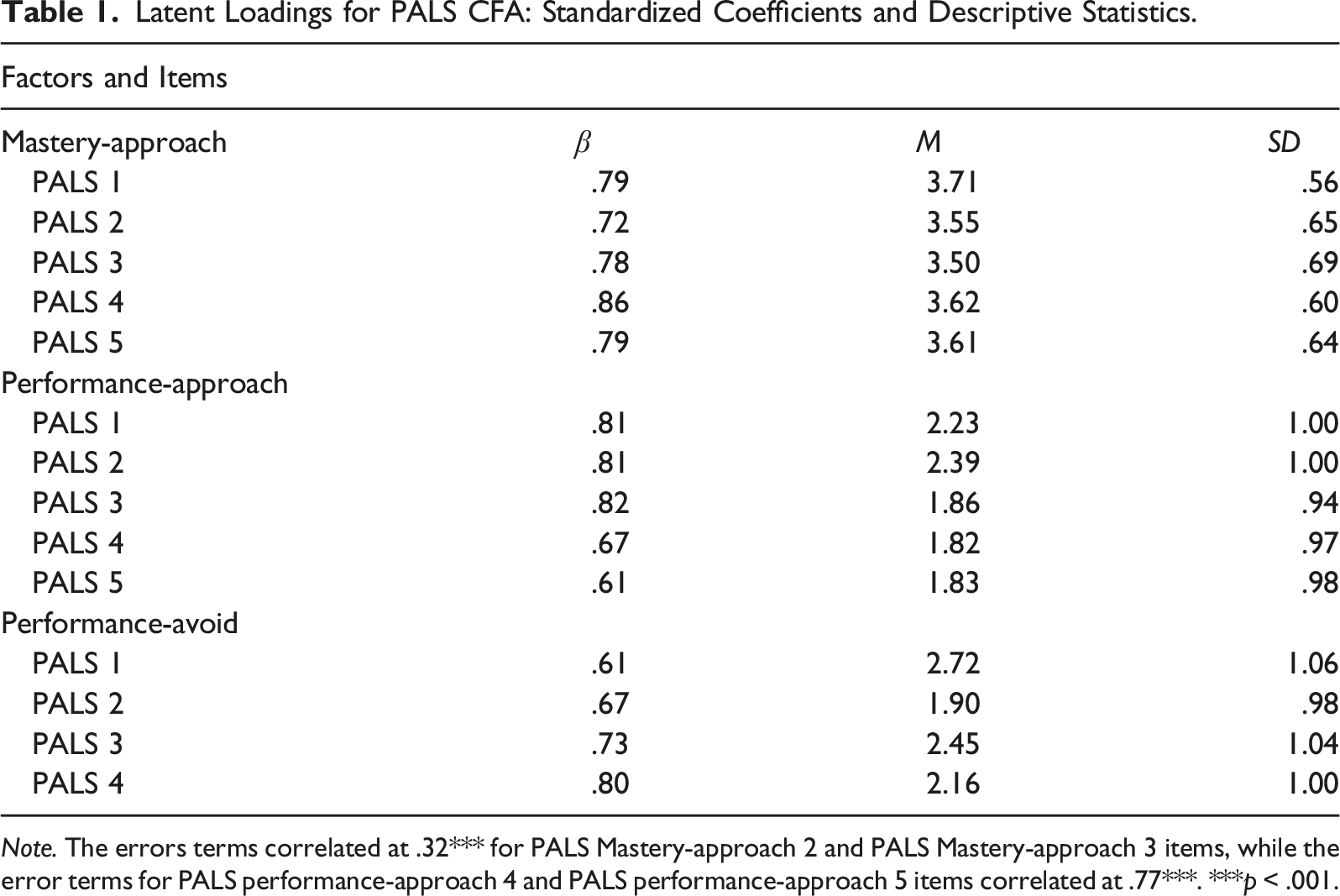
The first CFA measured the latent structure of the PALS’ three goals: mastery-approach, performance-approach, and performance-avoid. Results of the CFA suggested a good model fit for the PALS data and the model, χ2 (72, N = 363) = 211.07, p < .001, RMSEA = .07 (.06, .09), CFI = .95. As seen in Figure 1, all items loaded significantly onto their latent constructs from .61 to .86 (See Table 1 for loadings). The mastery-approach and performance-approach latent constructs correlated with each other. In addition, performance-approach and performance-avoid constructs significantly related with each other. The CFA findings, therefore, support that items load onto their respective constructs, while several constructs relate with each other. CFA PALS. Note. ***p < .001, **p < .01. Latent Loadings for PALS CFA: Standardized Coefficients and Descriptive Statistics. Note. The errors terms correlated at .32*** for PALS Mastery-approach 2 and PALS Mastery-approach 3 items, while the error terms for PALS performance-approach 4 and PALS performance-approach 5 items correlated at .77***. ***p < .001.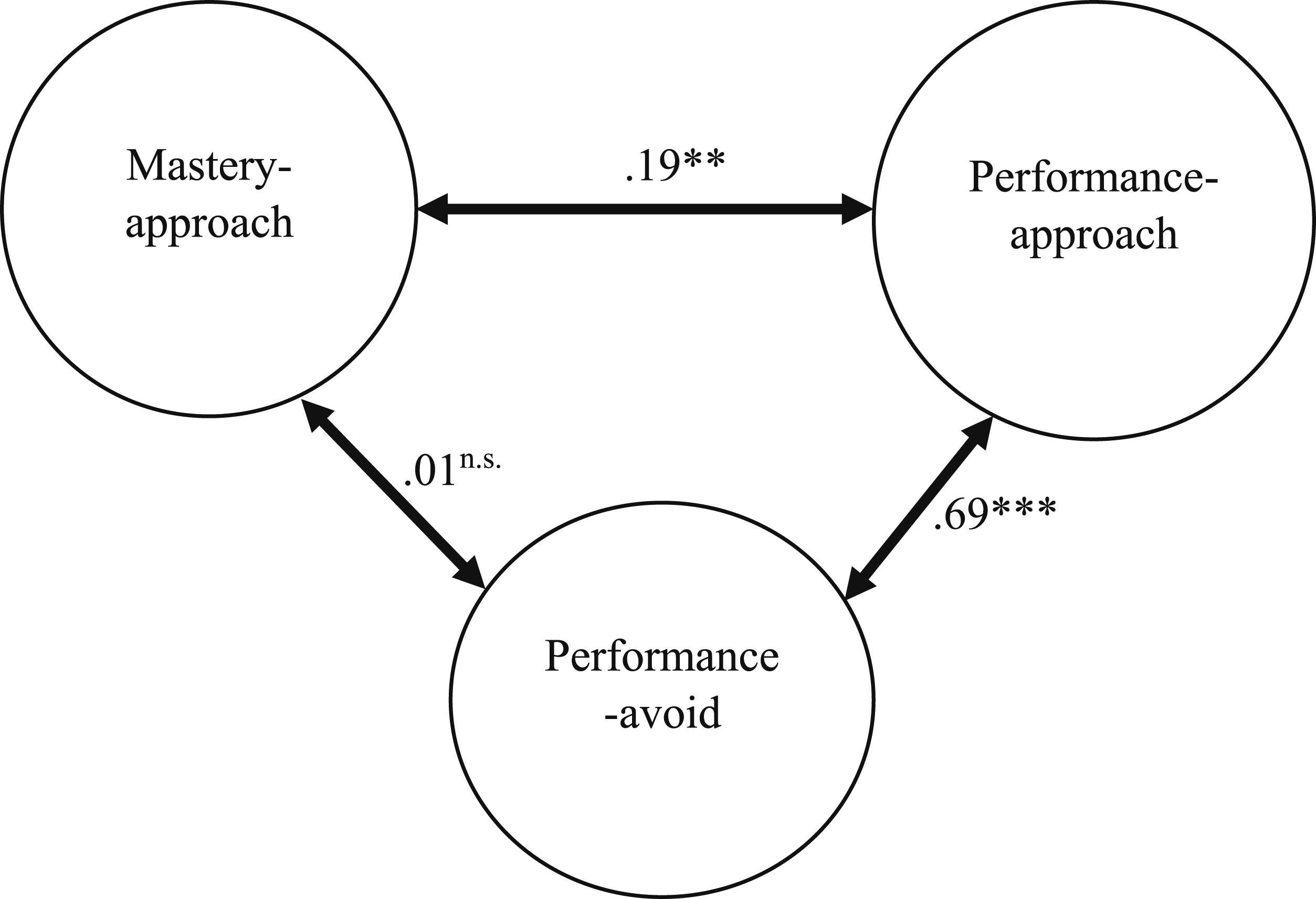
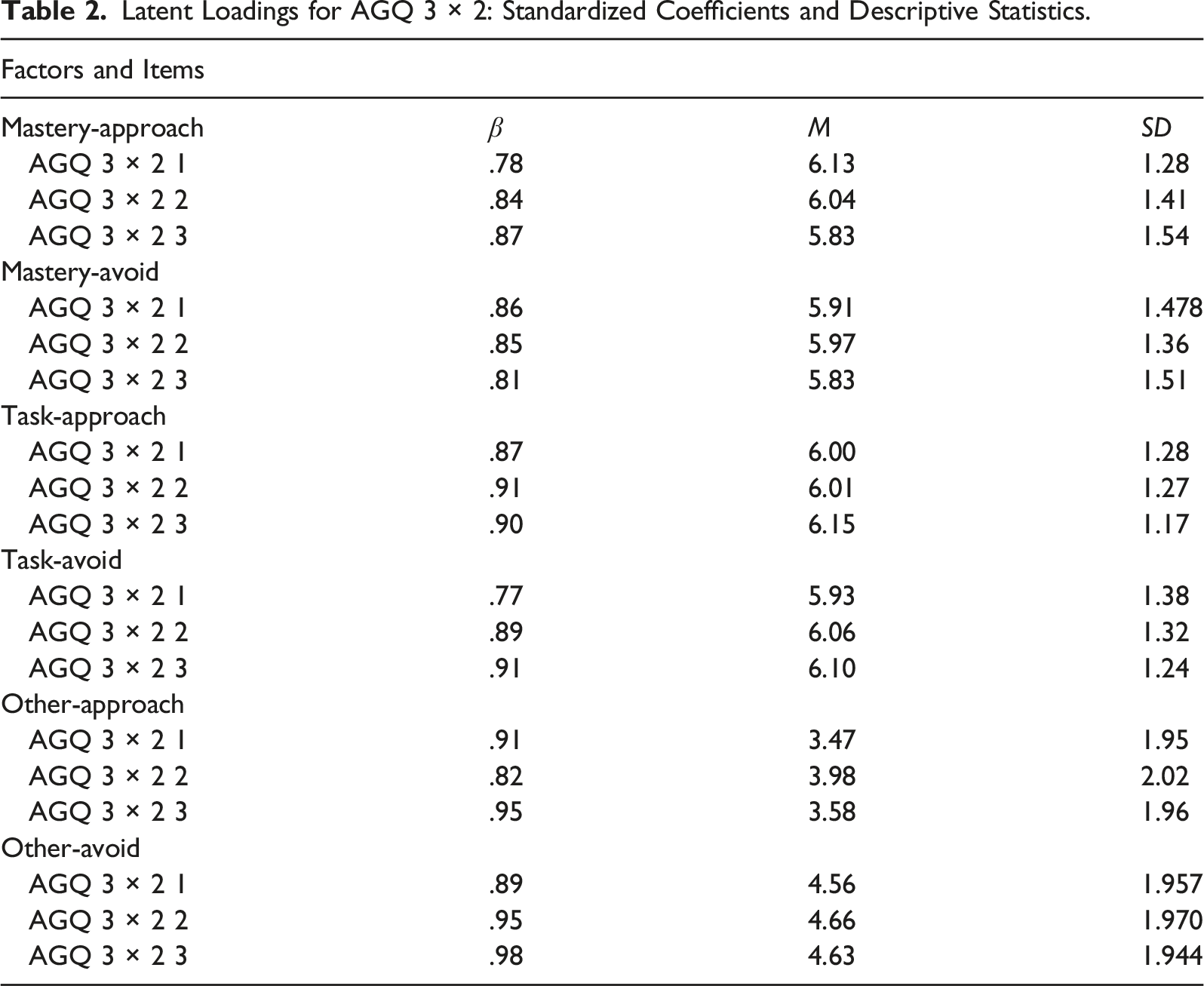
CFA AGQ 3 × 2
Latent Loadings for AGQ 3 × 2: Standardized Coefficients and Descriptive Statistics.
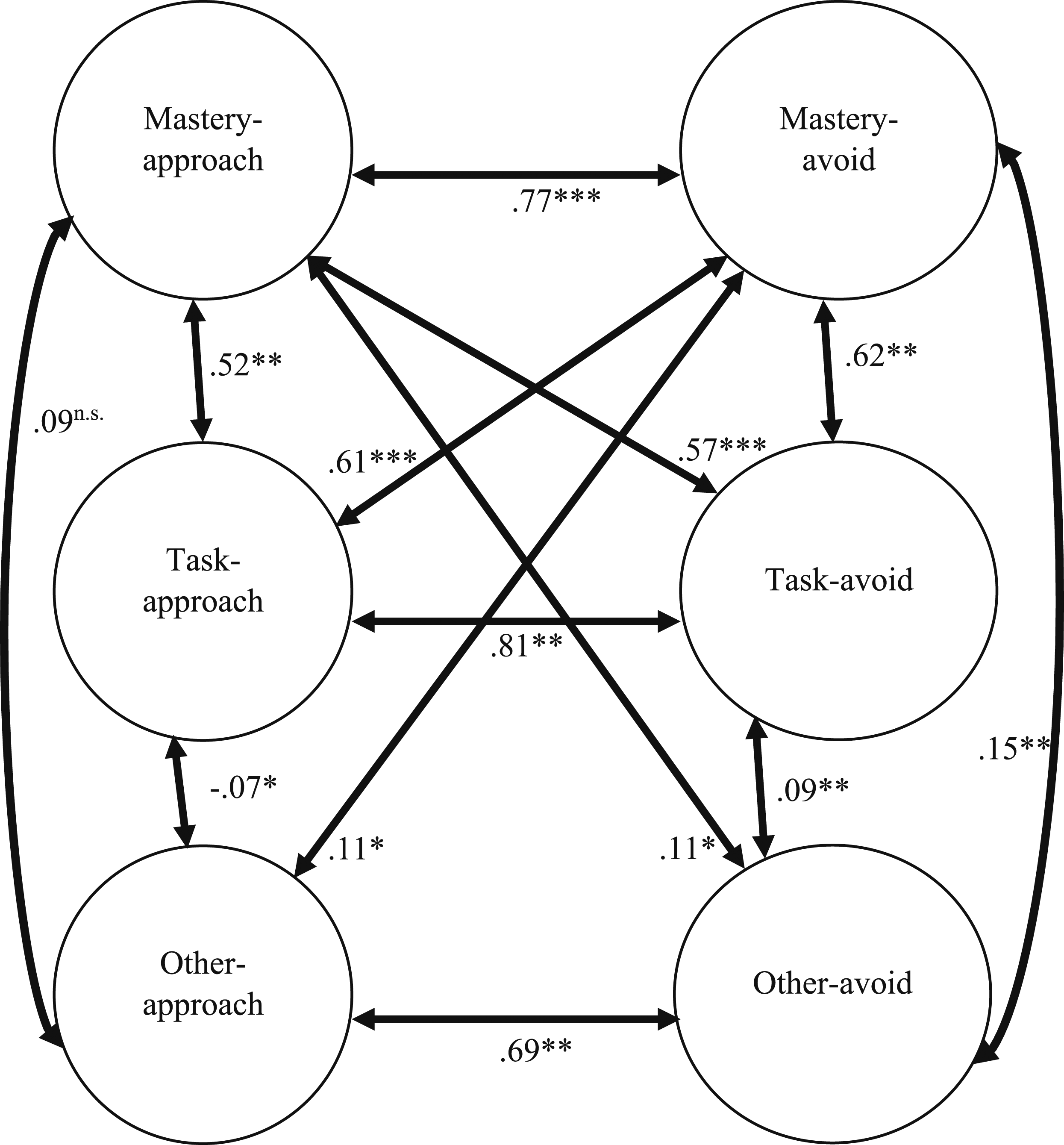
CFA AGQ 3 × 2. ***p < .001, **p < .001.
SEM: PALS and AGQ 3 × 2
The first structural equation model (SEM) tested whether the PALS and AGQ 3 × 2 related with each other. This model included all latent variables of the PALS and AGQ 3 × 2 with paths aligning with their theoretical equivalents (e.g., PALS mastery-approach and AGQ 3 × 2 mastery-approach, PALS performance-approach and both AGQ 3 × 2 task-approach and other-approach). This model fit was not adequate, χ2 (443, N = 363) = 1519.32, p < .001, RMSEA = .08 (.08, .09), CFI = .88. Instead, two separate analyses tested for mastery and performance goals separately.
The SEM tested whether PALS mastery-approach corresponded with AGQ 3 × 2 mastery-approach. In alignment with Hackel et al., (2016), we excluded the mastery-avoid construct as the PALS lacks this variable. The mastery goal SEM had good model fit, χ2 (18, N = 363) = 46.25, p < .001, RMSEA = .07 (.05, .09), CFI = .98. As seen in Figure 3, the PALS and AGQ mastery goals related with each other. SEM Mastery PALS and AGQ 3 × 2. Note. ***p < .001.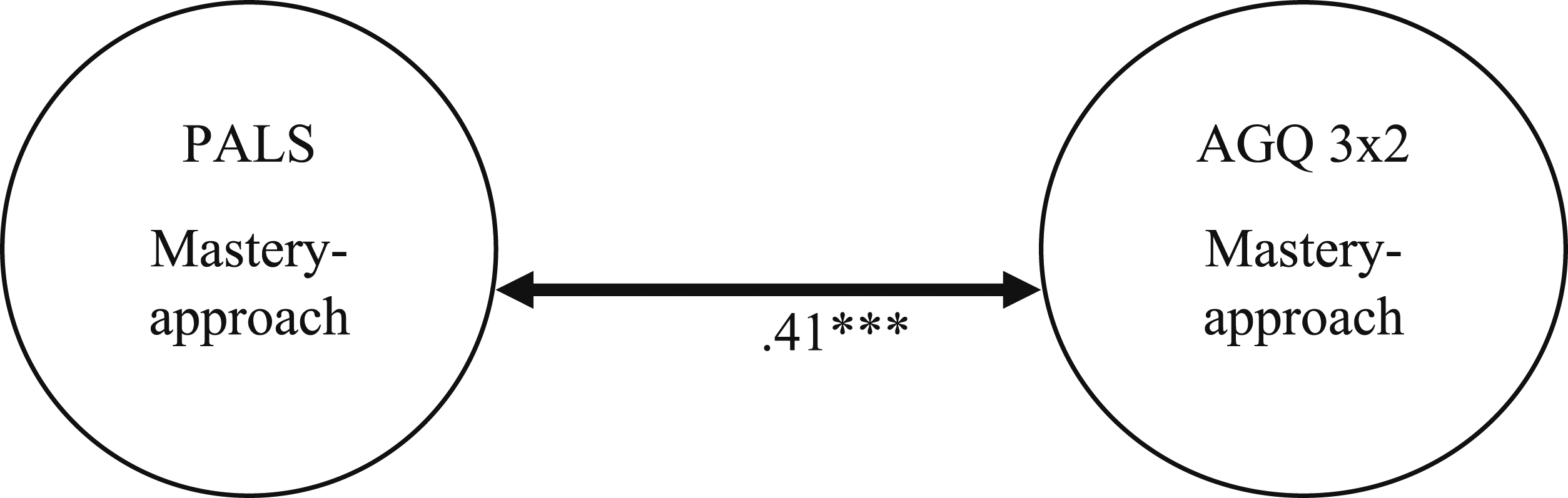
The second SEM examined the relationship among performance goals of both the PALS and AGQ 3 × 2. The model fit was adequate, χ2 (179, N = 363) = 561.34, p < .001, RMSEA = .08 (.07, .08), CFI = .94. Of note, the PALS performance-approach and performance-avoid goals aligned to a small, but significant, degree with AGQ 3 × 2 other-approach and other-avoid goals, respectively (see Figure 4). There was less or no relationship between PALS performance-approach and performance-avoid goals with the AGQ 3 × 2 task-approach and task-avoid scales. Further, and similar to the mastery goals, there was a much stronger relationship between the PALS performance goals as well as between the AGQ 3 × 2 performance goals than between PALS and AGQ scales. This occurred even though the PALS performance goals, AGQ task goals, and AGQ other goals were in theorical opposition to each other (i.e., approach and avoid). Thus, the PALS and AGQ had much stronger correlations within their own scales than between the PALS and AGQ scales for both performance and mastery goals. SEM Performance PALS and AGQ 3 × 2. ***p < .001, **p < .001.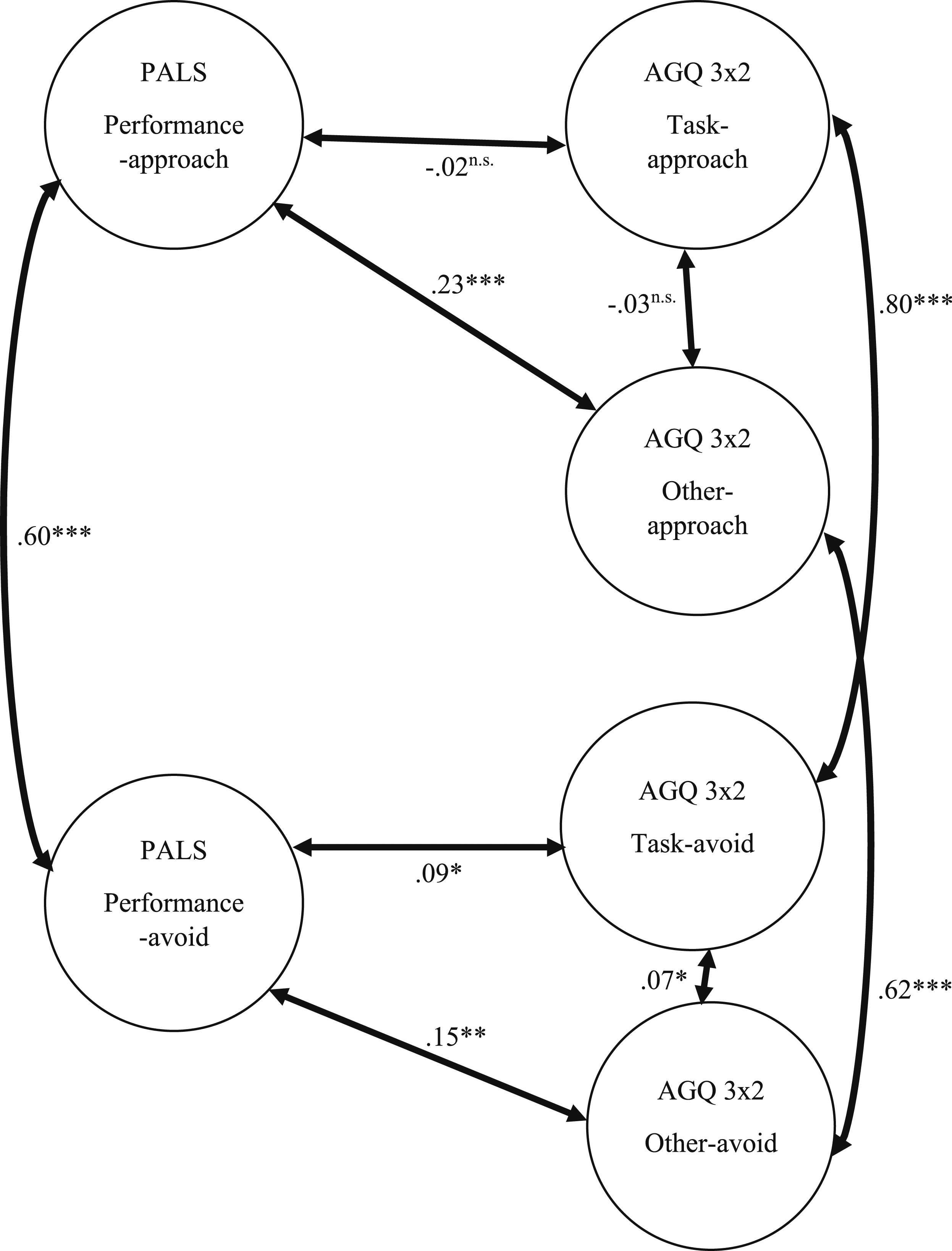
Discussion
The current study examined the convergent validity of two commonly employed achievement goal theory instruments: PALS and AGQ 3 × 2. Results of the study suggest that correlations were stronger within each scale than were between the instruments. This was particularly evident for performance goals, but also appeared for mastery goals. For example, theoretically contrasting goals within each scale (i.e., approach and avoid) related more closely to each other than to theoretically similar goals on the opposing scale. These findings suggest that corresponding constructs in the PALS and AGQ 3 × 2 scales differ in the aspects of achievement goals they assess and that more differences than similarities exist between the two scales.
Mastery Goals
SEM analyses found moderate relationships between the PALS and AGQ 3 × 2 for measurement of mastery goals. This correlation was not as strong as the comparison of the PALS and AGQ by Hackel et al. (2016), which found comparable measurement of mastery achievement goal between the two scales. The AGQ 3 × 2 therefore appears to correlate less with the PALS than the original AGQ for mastery achievement goals within the current study. The moderate correlation observed between the PALS and AGQ 3 × 2 for mastery goals are consistent with conclusions by Strunk et al. (2021) that the two scales are more comparable when mastery-avoid goals are removed from the AGQ. This suggests the inclusion of mastery-avoid goals in the AGQ 3 × 2, but not the PALS, may be a reason for reduced correlation between the two measures. The PALS and AGQ 3 × 2 therefore appear to measure similar constructs for mastery goals, though the scales differ in that the PALS does not measure mastery-avoid goal orientation.
Performance-Approach Goals
Analysis of performance-approach goals found weak relationships between corresponding measures in the PALS and AGQ 3 × 2. This contradicts with current use of AGQ 3 × 2 task-approach and other-approach constructs to represent the PALS performance-approach construct in motivational research. However, this finding is similar to the conclusions of Hackel et al. (2016) that performance-avoid goals for the PALS and AGQ do not relate to each other. It therefore appears the PALS and AGQ 3 × 2 quantify performance-approach goals in different ways (e.g., Hulleman et al., 2010; Senko et al., 2011). Similar to mastery goals, the observed inconsistency between PALS and AGQ 3 × 2 performance-approach goals may be due to differences in the wording and focus of each scale. Items in the PALS for performance-approach revolve around demonstration of competence and focus on the individual (Midgley et al., 2000). Performance-approach in the AGQ 3 × 2 is conceptualized as either task-approach or other-approach with items that focus on performance relative to the task or others (Elliot, 2011). Thus wording suggest both theoretical and methodological differences in the how the PALS and AGQ 3 × 2 operationalize performance-approach goals. This suggests the PALS and AGQ 3 × 2 measure dissimilar performance-approach constructs.
Performance-Avoid Goals
In the current study, correlations between the PALS performance-avoid and the AGQ 3 × 2 other-avoid and task-avoid scales were the weakest of all the correlations. This aligns with the lack of relationship found between the PALS and AGQ 2 × 2 for performance-avoid goals by Hackel et al. (2016). Similar to performance-approach goals, the lack of association between scales for performance-avoid may be due to differences in the items used. The PALS measures performance-avoid goals by using statements centered on the individual and their appearance to others, whereas the AGQ 3 × 2 frames performance-avoid items around social comparison. Respondents may give different answers for each scale depending on the importance they place on how they are perceived by others. For example, someone more concerned with appearing competent than how they rank socially may respond differentially to the appearance-focused items found in the PALS than to the comparison-focused items in the AGQ 3 × 2. Dissimilarity in how items are articulated may therefore contribute to the lack of association between the PALS and the AGQ 3 × 2.
Within Measure Relationships
Correlations between different goal types within each scale were generally high, which contrasts to the weak-to-moderate relationships observed between scales for corresponding goal constructs in the current study. This appeared even for opposing goals such as performance-approach and performance-avoid. This aligns with the findings of Holden et al. (2021) that the PALS and AGQ-R scales measure different aspects of achievement goals. The differential focus of each scale (PALS on ability and AGQ 3 × 2 on social comparison) may contribute to both the differences between and similarities within the two scales. For example, even though performance-approach and performance-avoid goals are contrasting concepts, the fact that they are both measured in relation to social comparison may be a reason for the high correlation between these constructs (Hackel et al., 2016). This idea is supported by Hulleman et al. (2010) and Strunk et al. (2021) who suggest that item wording can influence the extent different achievement goals correlate with each other. It therefore appears there are more similarities within than between each scale, supporting that the PALS and AGQ 3 × 2 do not provide equivalent measures of achievement goals.
Implications
The findings of the study have important theoretical implications. As the PALS and AGQ 3 × 2 appear to measure different constructs, it raises the question as to which, if any, of the two scales accurately represent the achievement goals proposed by achievement theory. Given the results in the present study, it may be the case that each scale is quantifying dissimilar constructs. This suggests a potential need for revision of the PALS and AGQ 3 × 2, or considering the two instruments to be sufficiently dissimilar as not to treat the instruments being equivocal achievement goal measures.
Limitations and Future Directions
There are several limitations to the present study. Firstly, the study was domain specific in focusing only on data from undergraduate educational psychology students. Future research could therefore consider measuring across multiple academic domains to see if findings generalize across content areas. Likewise, future research could investigate if the findings generalize across age groups. Measurement of achievement goals in young children and adolescents using the PALS and AGQ 3 × 2 may provide different results given that children typically only begin social comparison around age eight (Dijkstra et al., 2008) and adolescents tend to be more preoccupied with what others think of them (Elkind, 1967).
Another limitation of the present study is the unequal representation of genders in the sample. There were no a priori reasons to suggest gender influences participant scoring on the PALS and AGQ 3 × 2. However, future research could be conducted with a more representative sample to investigate generalizability of the results.
The current study also did not investigate underlying mechanisms for why differences exist between the PALS and AGQ 3 × 2. Future research could therefore explore the reasons for lack of correlation between the two scales. As the present study was only conducted at one time point, it was also not possible to investigate if there were any changes in relationship between the two scales over time. To test this, longitudinal research could be conducted comparing scores on the PALS and AGQ 3 × 2 at different time points throughout a unit of education. Furthermore, the study only investigated relationships between self-reported scores on the PALS and AGQ 3 × 2 by participants on an online survey. The models used in the study therefore did not look at how similar the two scales are at predicting outcome variables. Additional research could collect data on educational outcome variables to compare how similar these are for corresponding achievement goals in each scale. This may provide a fuller picture of the extent to which the PALS and AQG 3 × 2 should be used as equivalent measures of achievement goals in practice.
Conclusion
There is a large body of extant research on achievement goal theory. Still, from its inception, there are theoretical and methodological differences within achievement goal theory. For instance, previous findings suggest that PALS and AGQ-R, an earlier revised version of AGQ 3 × 2, are not convergent (e.g., Hackel et al., 2016). The present study findings support those findings using the PALS and AGQ 3 × 2 instruments. The two instruments’ goal constructs do not converge, especially for performance goals. The PALS performance goals focus more on an individual’s competence, whereas the AGQ 3 × 2 performance goals are more relevant to the task or social comparison. Thus, the PALS and AGQ 3 × 2 are incongruent in their measurement of achievement goals. Future researchers should be hesitant in believing or utilizing these different instruments as equivalent achievement goals measures.
Footnotes
Author Contributions
Authorship order came from randomly selecting names. All authors contributed equal amounts to the manuscript. Portions of this manuscript first appeared at the 2022 American Psychological Association National Convention.
Declaration of Conflicting Interests
The author(s) declared no potential conflicts of interest with respect to the research, authorship, and/or publication of this article.
Funding
The author(s) received no financial support for the research, authorship, and/or publication of this article.
