



Abstract
This article draws on a sample of city managers, assistant city managers, and department heads in U.S. local government jurisdictions to examine whether theoretical assertions about the relationships between performance-related pay, public service motivation, and employee job satisfaction hold empirical merit. Contrary to theoretical expectations, findings from an ordered logistic regression and a series of Monte Carlo simulations suggest performance-related pay is associated with greater job satisfaction, especially among employees who possess stronger public service motives. Results also suggest variable pay may be particularly important to employees who have lower levels of public service motivation.
Introduction
Over the past decade, interest in linking pay to performance has witnessed a dramatic resurgence in the public sector (Houston, 2009; Perry, Engbers, & Jun, 2009). At the national level, evidence of this trend can be found in President Obama’s call to revamp the General Schedule to incorporate pay-for-performance (Losey, 2009). Former President Bush actively sought to introduce a “flexible” human resource management system that integrated enhanced human capital policies and pay-for-performance in the Departments of Defense and Homeland Security (Bush, 2002; Homeland Security Act of 2002 [Pub. L. No. 107-296]; Losey, 2009; Perry et al., 2009). Furthermore, increasing numbers of state and local governments have also implemented performance-related pay 1 over the past three decades (International Public Management Association for Human Resource [IPMA-HR], 2007; Kellough & Lu, 1993; Kellough & Nigro, 2002).
Although variable pay is clearly a reality for many public employees, scholars have largely denounced its use, arguing performance-related pay frequently fails to increase individual and organizational performance (Houston, 2009; Ingraham, 1993; Kellough & Lu, 1993; Kellough & Nigro, 2002; Milkovich & Wigdor, 1991; Perry et al., 2009; Perry, Mesch, & Paarlberg, 2006). A substantial body of research has accrued indicating performance-related pay (a) typically fails to improve employee motivation, satisfaction, commitment, and performance, (b) is easily affected and limited by a variety of contextual factors, (c) often depends on the clarity of job responsibilities, and (d) frequently suffers from implementation breakdowns (Ingraham, 1993; Kellough & Lu, 1993; Kellough & Nigro, 2002; Perry et al., 2009).
Several scholars have also argued public service motivation 2 and performance-related pay may be linked in important ways (Houston, 2009; Moynihan, 2008; Perry et al., 2009). Drawing on motivation “crowding” theory (Frey, 1997; Frey & Osterloh, 2005; Le Grand, 2003; Weibel, Rost, & Osterloh, 2010), Houston (2009) and Moynihan (2008) have suggested variable pay systems overlook and may even diminish the altruistic intentions of public sector employees. Empirically though, we know relatively little about the relationship between performance-related pay and public service motivation (e.g., does variable pay actually crowd out or diminish public service motivation?).
This article provides—to the author’s knowledge—the first empirical examination of the relationships between variable pay systems, public service motivation, and employee job satisfaction among a sample of senior local government managers. It addresses the following research question:
Research Question 1: Do employees in cities with variable pay systems demonstrate lower levels of public service motivation and job satisfaction than employees in cities without performance-related pay?
Answering this question provides insight into whether the theoretical relationships anticipated by public service motivation scholars hold in practice. Such efforts are particularly important insofar as public service motivation scholars have called for practitioners to abandon the use of performance-related pay altogether or, alternatively, design motivational systems that place greater emphasis on altruistic (rather than economic) rewards (Houston, 2009; Moynihan, 2008). More simply, this article provides a first look at whether public service motivation and performance-related pay are always fundamentally opposed.
Performance-Related Pay and Public Service Motivation: An Overview
Performance-related pay has long been popular among government officials in the United States (Ingraham, 1993; Kellough & Lu, 1993; Perry, 1991; Perry et al., 2009). In part, the concept’s attractiveness reflects the seemingly logical assumption that superior performance should be tied to higher pay (Kellough & Lu, 1993; Kellough & Nigro, 2000) and that pay can be used to motivate and control employees (Houston, 2009; Perry et al., 2009, 2006). That said, many government officials also view performance-related pay as a necessary ingredient in the design of robust human resource management systems. The assumption, in this case, is that performance-related pay helps organizations attract and retain the best and brightest employees, and, when implemented well, variable pay systems will improve organizational flexibility, increase cost savings, and generate better outcomes for citizens (IPMA-HR, 2007, p. 4).
Scholars, however, have questioned the efficacy of utilizing performance-related pay in public organizations on several grounds. First, research consistently demonstrates performance-related pay can be difficult to implement effectively—politically and practically—in the public sector (Ingraham, 1993; Kellough & Lu, 1993; Milkovich & Wigdor, 1991; Perry et al., 2009; but see Schay, 1988; Thompson & Rainey, 2003). Second, public organizations are often unable to provide financial remuneration large enough to meaningfully and permanently alter employee behavior and organizational culture in ways that lead to lasting performance gains (Houston, 2009; Kellough & Lu, 1993; Kellough & Nigro, 2000; Perry et al., 2009; Sanders, 2004). Third, it can be tremendously difficult to design and manage variable pay systems that accurately gauge and link employee performance to rewards; such systems require substantial clarity and the development of standardized criteria, which can be especially challenging for many public organizations (Kellough & Lu, 1993; Perry et al., 2009). Unfortunately, absent a standardized, clearly designed variable pay system, employees are less likely to believe they are judged and rewarded fairly (Kellough & Lu, 1993; Kellough & Nigro, 2000; Rubin, 2009; Rubin & Kellough, 2012). Fourth, performance-related pay has generally failed to produce anticipated results, especially with respect to employee motivation, commitment, and productivity (Houston, 2009; Kellough & Lu, 1993; Kellough & Nigro, 2000; Perry et al., 2009; Sanders, 2004). Fifth and finally, scholars have also raised normative concerns about the use of performance-related pay in public organizations, arguing variable pay may cause employees to engage in goal displacement and gaming, ignore due process outcomes, and overlook other relevant organizational values (Houston, 2009; Moynihan, 2008, pp. 257-258). Together, these factors have caused many scholars to question the overall utility of performance-related pay in the public sector. 3
Public service motivation scholars have advanced the argument against performance-related pay a step farther, suggesting variable pay systems mistakenly assume employee action and behavior is primarily knavish (or, self-interested) and best controlled or harnessed through extrinsic mechanisms (Houston, 2009; Moynihan, 2008; Perry et al., 2009; see also, Frey, 1997; Le Grand, 2003). These scholars assert the logic supporting the use of performance-related pay in the public sector overlooks the knightly (or, altruistic) motivations of many public employees (Houston, 2009; Le Grand, 2003; Moynihan, 2008; Perry et al., 2009; Weibel et al., 2010). 4 Furthermore, efforts to harness the self-interested inclinations of public workers may actually diminish employees’ public service motives and increase the likelihood workers will act against organizational interests (e.g., by engaging in gaming or goal displacement) to maximize personal gains (Houston, 2009; Moynihan, 2008).
Much of the argument set forth by public service motivation scholars draws on motivation “crowding” theory (Deci, Koestner, & Ryan, 1999; Houston, 2009; Moynihan, 2008; Perry et al., 2009; see also Deckop & Cirka, 2000; Frey, 1997; Weibel et al., 2010). Crowding theory—particularly the work of Deci and colleagues—demonstrates financial and performance-based incentives can reduce intrinsic motivation among employees (see also Deckop & Cirka, 2000; Weibel et al., 2010); research also reveals such measures might affect one’s civic behavior (Frey, 1997; Moynihan, 2008).
Applying the crowding logic, public service motivation scholars maintain performance-related pay can result in a net loss in employee motivation (Houston, 2009; Moynihan, 2008). Simply, although well-designed and well-implemented variable pay systems may increase extrinsic motivation, public service motivation scholars fear these systems will also simultaneously reduce intrinsic motivation among workers (Houston, 2009; Moynihan, 2008). A net loss in employee motivation occurs when the decline in intrinsic motivation—in this case, public service motivation—is greater than the increase in extrinsic motivation associated with the introduction of performance-related pay (Frey & Osterloh, 2005; Houston, 2009, p. 47). Practically, strong, fairly robust performance bonuses are necessary to offset any losses in public service motivation. Yet, prior research demonstrates the public sector is often incapable of providing such benefits (Kellough & Lu, 1993; Kellough & Nigro, 2000). Consequently, public service motivation scholars have proposed that incentive systems in the public sector should be redesigned to promote intrinsic motivation—especially public service motivation—rather than extrinsic motivation and variable pay (Houston, 2009; Moynihan, 2008; Perry et al., 2009).
The push to focus on intrinsic motivation reflects a significant body of research indicating public service motivation and employee job satisfaction are linked (Cerease & Farinella, 2006; Kim, 2005; Pandey & Stazyk, 2008; Steijn, 2006). This research strongly suggests public sector employees value opportunities to fulfill their public service motives (Pandey & Stazyk, 2008) and that the introduction of market mechanisms and variable pay in public agencies are likely to leave workers with robust public service motives feeling disconnected from their organizations and incapable of satisfying their altruistic intentions (Houston, 2009; Kellough & Nigro, 2002; Moynihan, 2008). These workers are more likely to demonstrate lower job satisfaction and higher turnover as a result (Moynihan, 2008; Verquer, Beehr, & Wagner, 2003). 5 As such, efforts to introduce performance-related pay may come at the cost of public service motivation and individual and organizational performance.
Although there are clearly strong theoretical reasons to suspect performance-related pay may crowd out or diminish the altruistic motives of many public sector employees, we know little about the actual relationship between public service motivation and variable pay (Houston, 2009; Perry et al., 2009). We have insufficient empirical evidence variable pay systems crowd out public service motivation and that the crowding effect translates into harmful individual and organizational outcomes. In many respects, the lack of empirical evidence on this topic stems from difficulties associated with testing for the crowding effect, which, to be examined thoroughly, requires panel or time-series data (Weibel et al., 2010). Nevertheless, one technique useful in beginning to determine whether the theoretical claims levied by public service motivation scholars hold merit is to draw comparisons across cities with and without variable pay systems. If the theoretical arguments made by public service motivation scholars are correct, we would anticipate employees in cities without variable pay systems should report higher levels of public service motivation and job satisfaction than employees in cities with variable pay. Using this approach, the current article provides an examination of the relationship between performance-related pay, public service motivation, and job satisfaction.
Sample and Measures
Data for this study come from two sources: Phase IV of the National Administrative Studies Project (NASP-IV) and the International Public Management Association for Human Resources’ (IPMA-HR) 2007 Total Compensation Benchmarking Survey. 6 NASP-IV is multimethod study, a key part of which involved a survey administered nationwide during 2007 to a sample of city managers, assistant city managers, and department heads in the U.S. local government jurisdictions with populations at, or above, 50,000 residents. The sample consisted of 3,316 potential respondents. Departments surveyed included Finance/Budgeting, Public Works, Personnel/HR, Economic Development, Parks and Recreation, Planning, and Community Development.
Upon completion of the study, data had been collected from 1,538 individuals, yielding a response rate of 46.4%. The 1,538 respondents represent 545 different jurisdictions—with 1 respondent from 126 jurisdictions, 2 respondents from 130 jurisdictions, and 3 or more from 289 jurisdictions. The mean age of respondents was 51.4 years with an interquartile range of 10 (25th percentile being 47 and 75th percentile being 57). As expected in this sample, a sizeable majority of respondents were male (70.6%), White (85.9%), highly educated (more than 60% with graduate degrees), and well compensated (68.3% with annual salaries above US$100,000). Approximately 28% of respondents were general managers (i.e., city managers or deputy/assistant city managers), and the remainder managed specific city departments or functions. This distribution closely matched the distribution of functional specializations in the sample. 7
Although NASP-IV includes general data on compensation, detailed information on variable pay systems was not collected. Consequently, this article also relies on data assembled in the 2007 Total Compensation Benchmarking Survey conducted by the IPMA-HR. The IPMA-HR study focuses wholly on compensation systems in U.S. government organizations. In the study, IPMA-HR collected information from 640 respondents at all levels of government about their organizations’ compensation and variable pay systems (IPMA-HR, 2007). Results indicate 45% of all organizations surveyed maintain some form of variable pay system. Among organizations with variable pay systems, approximately 88% use pay-for-performance. More than half of all responses in the study came from city governments (IPMA-HR, 2007).
City-wide data on variable pay systems from the IPMA-HR study were subsequently pooled with individual responses from the NASP-IV survey. The IPMA-HR and NASP-IV samples had 156 cities in common. Because NASP-IV included multiple responses within cities, this resulted in a combined data set with 502 respondents. Within the combined data set, 300 respondents were employed in 95 cities without variable pay, whereas 202 respondents were employed in 61 cities with some form of variable pay. 8 Demographic statistics and functional specializations mirror those of the broader NASP-IV sample. For instance, approximately 65% of respondents were male, 84% were White, 66% had graduate degrees, and 73% earned at least US$100,000 per year.
Study Measures
When possible, study variables are measured using responses from multiple survey items taken from commonly employed and previously validated scales. Variables considered in this article include job satisfaction, public service motivation, variable pay, reward satisfaction, goal and role clarity, and human resources red tape. 9 Only the performance-related pay variable is new. Reliability estimates (Cronbach’s alpha coefficients) for study variables range from .65 to .85, and fall at, or near, the .70 level recommended by Nunnally and Bernstein (1994). A brief discussion of study measures appears below; a complete list of items and reliability estimates can be found in this article’s appendix.
Job satisfaction
The primary dependent variable in this study is employee job satisfaction, which is measured using two items from the Michigan Organization Assessment Questionnaire (Cammann, Fichman, Jenkins, & Klesh, 1979; Cook, Hepworth., Wall, & Warr, 1981; Seashore, Lawler, Mirvis, & Cammann, 1982). 10 Job satisfaction has been defined as the “pleasurable or positive emotional state resulting from the appraisal of one’s job or job experience” (Locke, 1976, p. 1300). Past research demonstrates job satisfaction is the single most reliable predictor of employee turnover, which imposes considerable costs on organizations (Mobley, Griffeth, Hand, & Meglino, 1979; Moynihan & Pandey, 2008; Llorens & Stazyk, 2011). Conversely, higher levels of job satisfaction may lead to performance gains for organizations. Research also indicates those employees capable of fulfilling their public service motives are more likely to report high levels of job satisfaction (Kim, 2005; Pandey & Stazyk, 2008; Wright & Pandey, 2008).
Public service motivation
Public service motivation is measured using five items from Perry’s (1996) original research on the topic. These items were included in the 1996 Merit Principles Survey (conducted by the U.S. Merit Systems Protection Board) and have been employed in several research articles (Alonso & Lewis, 2001; Kim, 2006; Naff & Crum, 1999). The items capture different dimensions of public service motivation, including an individual’s sense of civic duty, compassion, and self-sacrifice.
Variable pay system
The measure of performance-related pay is adapted from the 2007 Total Compensation Benchmarking Survey, conducted by IPMA-HR. The survey asked respondents to indicate whether their organization had variable pay systems incorporating each of the following: skill-based pay, spot awards, competency-based pay, team-based pay, gain-sharing, and pay-for-performance (IPMA-HR, 2007). Several of the cities in common between the NASP-IV and IPMA-HR surveys lacked variable pay systems of any kind (60%); the remainder (40%) used some form of variable pay system (36% had pay-for-performance systems). 11 Responses were grouped into two categories based on the type of compensation system a city had in place: a standard compensation system without variable pay (assumes a value of zero) or a variable pay system (assumes a value of 1). 12
Reward satisfaction
Employee reward satisfaction is measured using three items developed by Paul Spector (1985) for the Job Satisfaction Survey. These items are commonly utilized in public management and public service motivation research. They are included in this study because employee dissatisfaction with rewards may dampen the overall effect of performance-related pay on job satisfaction (and public service motivation). Moreover, although public employees may be primarily motivated by altruistic intentions, compensation and extrinsic rewards still exert a strong influence on many individuals (Rainey, 1982, 1983).
Organizational goal clarity
Goal clarity is measured using three items adapted from the work of Rainey and colleagues (Rainey, 1983; Rainey, Pandey, & Bozeman, 1995). Clear organizational goals help define and shape employee attitudes and behaviors (Bandura, 1997; Bandura & Locke, 2003; Locke & Latham, 2002; Rainey, 1989). Conversely, ambiguous goals may increase employee stress and other undesirable outcomes (Pandey & Rainey, 2006). For instance, employees confronted with ambiguous goals may be less likely to believe their values are similar to those of their organization or to be satisfied in their jobs; these employees may also find it more difficult to draw connections between pay and performance—a necessary ingredient in robust variable pay systems.
Individual role clarity
Role clarity is measured using three items developed by Rizzo, House, and Lirtzman (1970). These items are commonly employed in public administration research (Stazyk, Pandey, & Wright, 2011). Role clarity decreases uncertainty and perceived conflicts between organizational demands and employee needs and expectations (House & Rizzo, 1972; Rizzo et al., 1970). Employees expressing high degrees of role clarity may be more likely to believe their values and goals align with those of their organization and to express greater job satisfaction.
Human resources red tape
Human resources red tape is measured using four items developed by Rainey (see, for example, Rainey et al., 1995) and found in several scholarly publications (Pandey & Scott, 2002; Stazyk et al., 2011). Research consistently demonstrates bureaucratic red tape negatively affects various work-related constructs, including public service motivation and job satisfaction (Pandey & Stazyk, 2008; Pandey & Wright, 2006). Moreover, the effectiveness of any given variable pay system is likely to be contingent, at least in part, on the pervasiveness of human resources rules and red tape. Table 1 presents descriptive statistics and correlations for each of the study measures reviewed.
Descriptives and Intercorrelations.
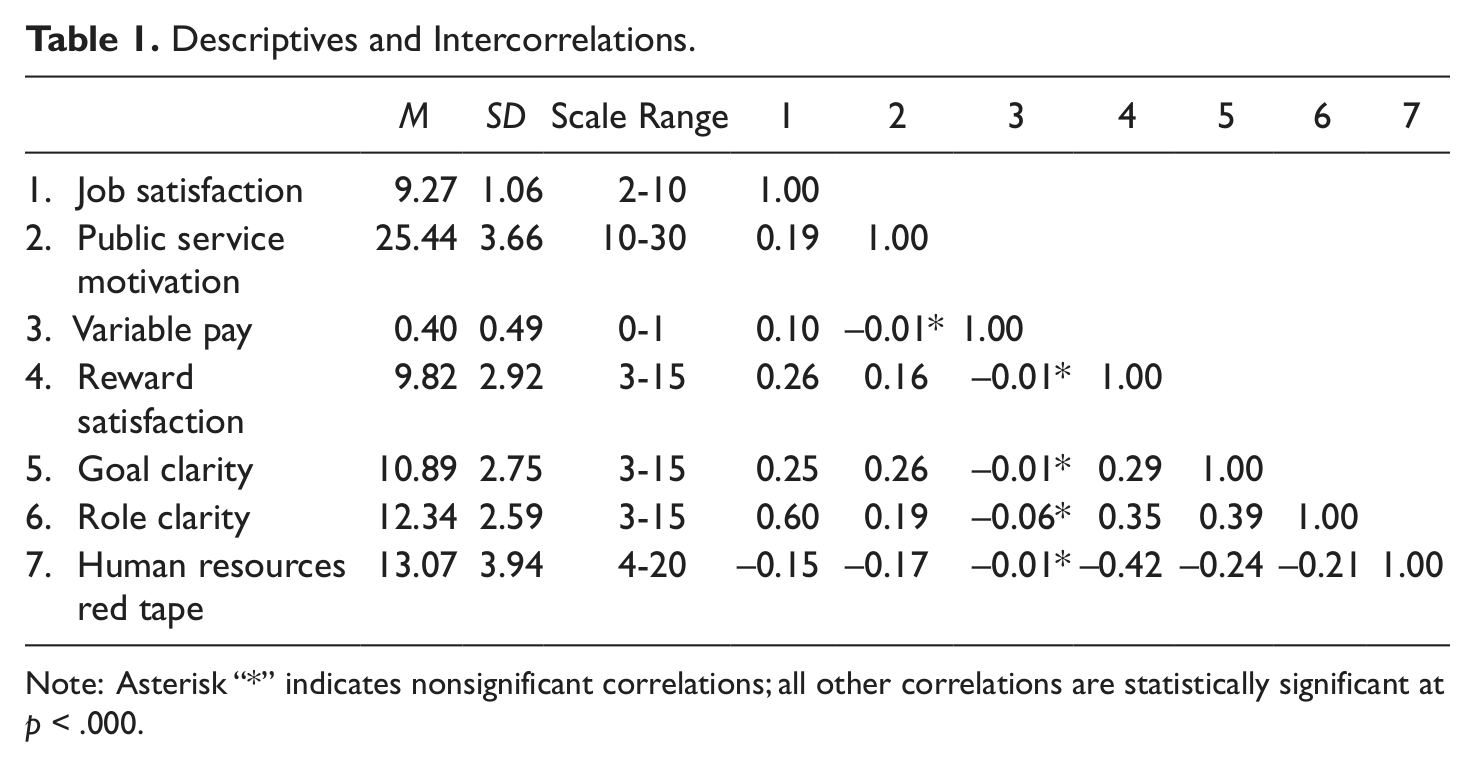
Note: Asterisk “*” indicates nonsignificant correlations; all other correlations are statistically significant at p < .000.
Of particular note in Table 1 is the fact that variable pay is uncorrelated with public service motivation, reward satisfaction, goal and role clarity, and human resources red tape. This finding provides reason to suspect the relationships between performance-related pay, public service motivation, and other commonly studied topics in public administration are more complicated than often assumed—at least among the current sample.
Methods and Results
Using cross-sectional data makes it difficult to capture the dynamic relationships between job satisfaction, public service motivation, and variable pay, especially in a manner that adequately tests for the presence of a crowding effect. Nevertheless, various statistical techniques exist that allow researchers to make comparisons across groups or quantities of interest in ways that provide opportunities to begin drawing inferences between empirical findings and existing theory. This article employs one such methodology. More specifically, two interrelated steps are pursued to empirically test theoretical expectations. First, an ordered logistic regression is used to examine the relationship between job satisfaction and all other study variables. Although the ordered logit offers little evidence about the presence of a possible crowding effect, it provides a necessary first step in this article’s broader endeavor. Second, relying on the ordered logit findings, a series of Monte Carlo simulations are conducted to examine the relationship between job satisfaction, public service motivation, and variable pay concomitantly. These simulations allow one to draw comparisons across individuals with varying degrees of job satisfaction and public service motivation who work in cities with and without variable pay. Existing theory suggests those individuals who work in cities without variable pay should report higher levels of public service motivation and feel more satisfied in their jobs. Results for the ordered logit and Monte Carlo simulations are presented below.
Ordered Logit Approach and Results
The first step in examining the relationship between job satisfaction, public service, motivation, and variable pay requires conducting an ordered logistic regression. Ordered logistic regression is a maximum likelihood estimation technique that allows one to test an ordinal-level dependent variable by assuming the variable follows a latent continuous probability distribution (Long, 1997). This approach also assumes independent variables increase or decrease the likelihood of a particular outcome on a dependent variable (and values of the latent variable more generally); independent variables are treated as being linearly related to the latent variable and are linked to actual outcomes on the dependent variable through the likelihood function. The ordered logit serves two basic purposes in this article. First, it allows one to examine whether changes across levels of public service motivation and variable pay matter with respect to job satisfaction. Second, and more important, the ordered logit is a necessary precursor to the Monte Carlo simulations found below. These simulations are based on the ordered logit findings and provide predicted probabilities across particular levels (and areas) of interest.
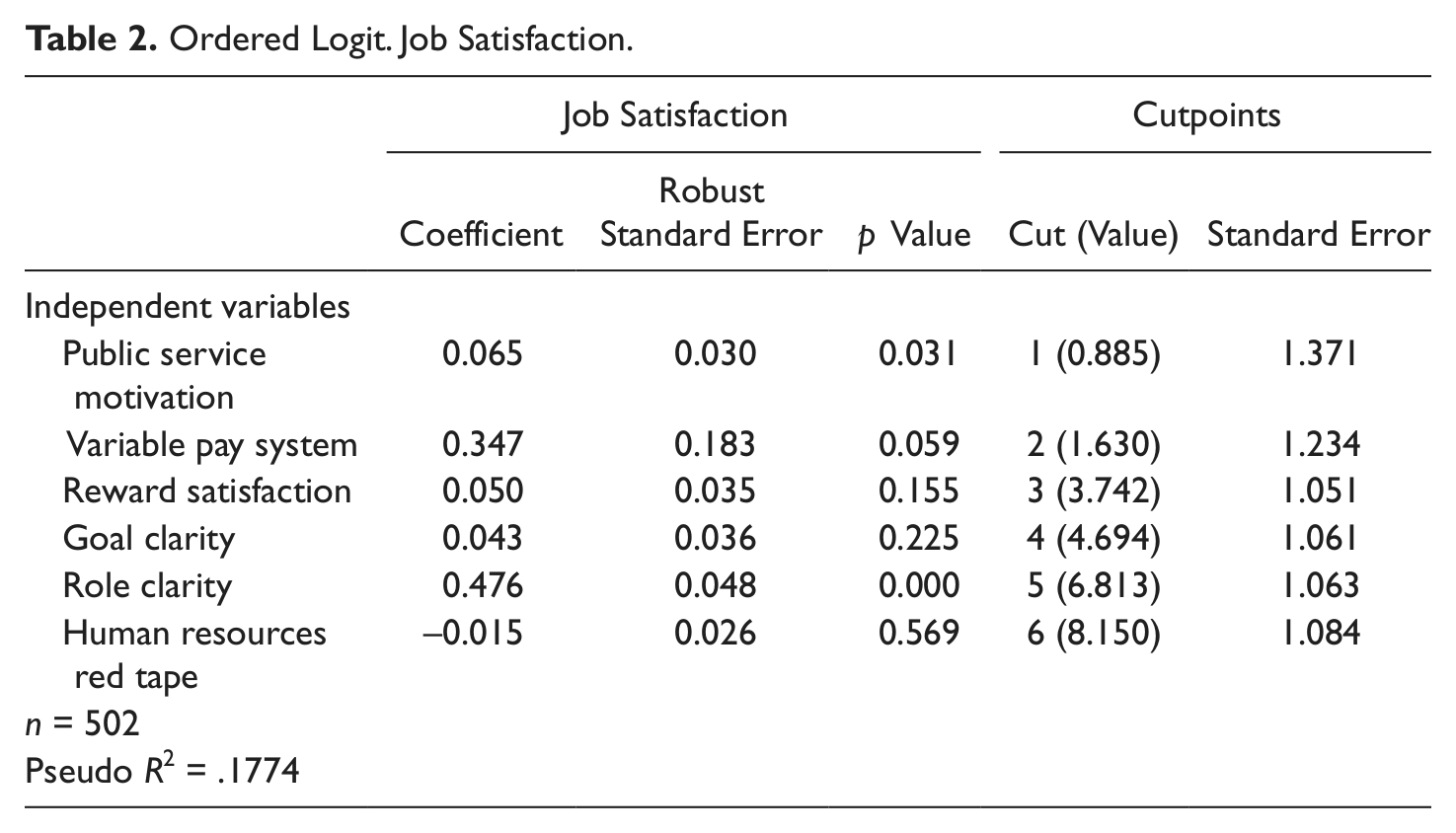
In the ordered logit, job satisfaction is regressed on the public service motivation, variable pay, reward satisfaction, goal and role clarity, and human resources red tape variables. Results are clustered by city with robust standard errors. Table 2 presents detailed findings. 13 Results indicate public service motivation (p = .03), variable pay (p = .05), and role clarity (p = .00) all have positive, statistically significant relationships with job satisfaction. Findings suggest those individuals who work under a variable pay system—rather than a standard compensation system—(a) have higher levels of public service motivation, (b) enjoy greater role clarity, and thus, (c) are more likely to report greater job satisfaction. It is interesting that reward satisfaction (p = .15), goal clarity (p = .22), and human resources red tape (p = .56) are not statistically significant in the current model. The nonsignificant findings for these variables may reflect unique sample characteristics. For instance, city managers, assistant city managers, and department heads may find themselves somewhat removed or insulated from the harmful effects of human resources red tape. Future studies should attempt to verify these findings. Unfortunately, the ordered logit tells us little about how public service motivation, variable pay, and job satisfaction may be simultaneously related to one another in the current sample. To address this shortcoming, a second model, employing a series of Monte Carlo simulations, is conducted.
Ordered Logit. Job Satisfaction.
Variable Pay Simulations
As a second step, this article employs the Clarify program to conduct a series of Monte Carlo simulations based on the likelihood function specified earlier (Tomz, Wittenberg, & King, 2001). Clarify allows one to generate predicted probabilities that can be used to simultaneously draw comparisons across cities with and without variable pay and at different levels of public service motivation and job satisfaction (Tomz et al., 2001). The program computes these probabilities using real situations drawn from the NASP-IV/IPMA-HR data (King, Tomz, & Wittenberg, 2000, p. 350). Results incorporate stochastic behaviors and are based on 1,000 parameter estimates derived from their asymptotic distribution (Tomz et al., 2001). Clarify is useful in drawing the types of comparisons called for in this article because the program “. . . computes quantities of interest based on all estimated coefficients, regardless of their level of statistical significance. This is not problematic because the true quantities of interest are usually the predicted values. . .not the coefficients themselves” (Tomz et al., 2001, p. 19).
To generate predicted probabilities in Clarify, it is necessary to set values for each variable included in the model. 14 Comparisons are made between cities with (1) and without (0) performance-related pay (denoted, respectively, in the model as having either a variable pay system or standard compensation). Comparisons are also drawn across levels of public service motivation and job satisfaction. Public service motivation values are varied to capture low (21.78), average (25.44), and high (29.10) levels of public service motivation. Job satisfaction values are varied to reflect below average (8), average (9), and high (10) levels of job satisfaction. All other variables (i.e., reward satisfaction, goal and role clarity, and red tape) are set at their mean values (see Table 1). Simulation results appear in Table 3 and Figure 1.
Predicted Probabilities: Job Satisfaction, Public Service Motivation, and Variable Pay.

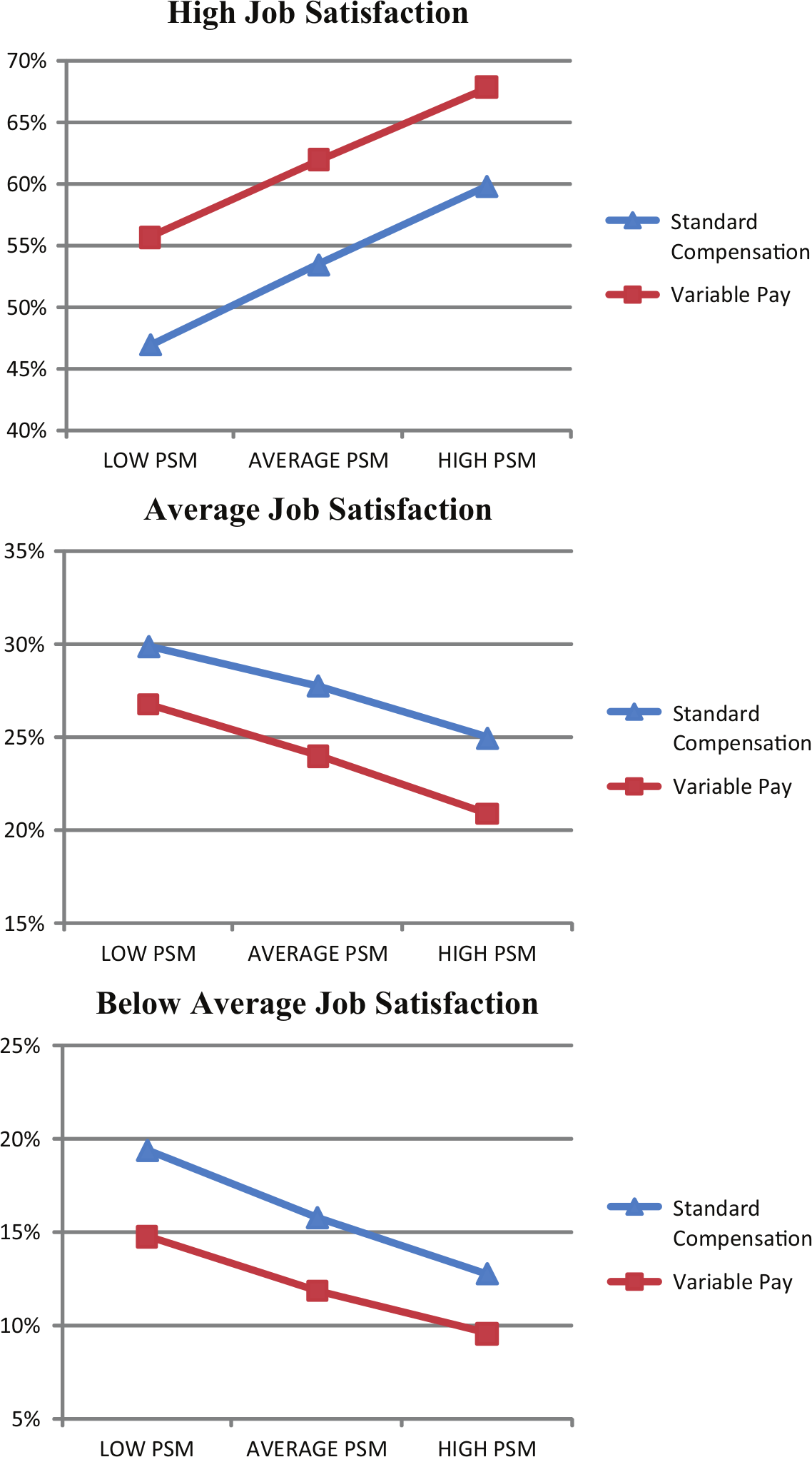
Predicted Probabilities.
Two overarching conclusions may be drawn from these results. First, looking only at Table 3, findings indicate the probability an employee will have high job satisfaction is generally greater in cities with variable pay systems rather than standard compensation. Results also indicate public service motivation matters. Employees are more likely to report a high level of job satisfaction when they also have higher levels of public service motivation; in cases of average or low public service motivation variable pay systems matter more. Nevertheless, the probability an employee will have high job satisfaction is greatest (67.9%) in cities with rather than without variable pay. If the theoretical assertions levied by public service motivation scholars held true, job satisfaction and public service motivation should be highest in cities with standard compensation rather than variable pay systems under the assumptions that variable pay systems can crowd out public service motivation and diminish employee job satisfaction.
Second, assuming organizations prefer having highly satisfied employees because of its implications on performance and turnover, results in the average and below-average job satisfaction rows of Table 3 are also enlightening. These rows generally indicate employees are less likely to have average and below-average job satisfaction when variable pay systems (compared to standard compensation) are present. Employees are also less likely to have lower levels of job satisfaction when they have higher levels of public service motivation. Taken together, these findings suggest variable pay may be particularly important when employees have lower levels of public service motivation. For example, looking at the below-average job satisfaction row, the probability an employee will have below-average job satisfaction is greatest when an employee has low public service motivation and works under a standard compensation system (19.4%); conversely, the probability an employee will have below-average job satisfaction is lower (14.8%) in cities that maintain a variable pay system. This suggests variable pay might be useful in offsetting lower levels of job satisfaction when employees fail to possess strong altruistic motives.
To more fully demonstrate these findings, Figure 1 provides a comparison of cities with and without variable pay systems. As with Table 3, results are grouped by high, average, and below-average job satisfaction. The y-axis provides a range of predicted probabilities corresponding to those reported in Table 3. The x-axis captures instances of low, average, and high public service motivation. In the first panel, results demonstrate employees are more likely to have high job satisfaction in cities with variable pay systems (rather than standard compensation). Furthermore, the likelihood an employee will have high job satisfaction increases when employees have higher levels of public service motivation. Conversely, turning to the second and third panels of Figure 1, findings indicate those employees in cities with variable pay system are less likely to have average and below-average job satisfaction. The lowest levels of average and below-average job satisfaction exist among employees with higher levels of public service motivation. Taken together, these findings suggest organizations with variable pay systems and staffed by employees with strong public service motives are more likely to have highly satisfied workers. Furthermore, results provide no evidence performance-related pay harms either employee job satisfaction or public service motivation among the current sample. The subsequent section reviews and discusses these findings in greater detail.
Discussion
Findings from this study are provocative in two respects. First, results provide no evidence performance-related pay crowds out public service motivation among the sample considered. In this sense, current findings conflict with theoretical expectations levied by public service motivation scholars (Houston, 2009; Moynihan, 2008). Theory suggests public sector employees value opportunities to fulfill their altruistic intentions and that an emphasis on performance-related pay should leave employees feeling disconnected from their organizations, incapable of meeting their public service motives, and subsequently, less likely to be satisfied in their jobs. In the worst-case scenario, variable pay might cause workers to focus on maximizing personal gains at the cost of their altruistic motives. If true, employees in cities without variable pay should report higher levels of public service motivation and job satisfaction, concomitantly, than employees subject to performance-related pay. Current findings, however, do not support these theoretical assertions. Instead, results indicate employees with the highest job satisfaction and strongest reported service motives are most likely to work in cities with performance-related pay. Conversely, employees are less likely to demonstrate average or low job satisfaction in cities with variable pay. In fact, results suggest performance-related pay may be particularly useful when employees have lower levels of public service motivation; these employees are more likely to be satisfied in their jobs if performance-related pay is available.
Second, current findings also conflict with much of the broader research on performance-related pay in the public sector (Ingraham, 1993; Kellough & Lu, 1993; Perry et al., 2009). The majority of this research provides ample evidence variable pay harms individual and organizational performance. There are, however, at least two possible explanations why past and present results differ. First, the preponderance of existing research examines the impact of performance-related pay in either federal or state agencies; studies examining variable pay at the local level are far less common (see, for example, Kellough & Lu, 1993, pp. 50-51). Second, this study differs from past research insofar as it primarily considers the relationship between public service motivation, performance-related pay, and job satisfaction. To the author’s knowledge, this is the first effort examining variable pay, public service motivation, and job satisfaction simultaneously. Consequently, future studies are necessary to verify results.
Taken together, results from this study imply assumptions about the relationship between public service motivation and performance-related pay may be overstated. At the very least, findings urge caution in treating public service motivation and variable pay as inherently conflicting or seemingly dichotomous concepts. Instead, results suggest performance-related pay and public service motivation may work in tandem—at least in some cases—to motivate employees. Findings also point to the real need to consider the theoretical and empirical links between public service motivation and performance-related more carefully. For instance, if, as past research demonstrates, public organizations find it difficult to provide financial incentives great enough to meaningfully alter employee behavior, why should we assume these bonuses are nonetheless powerful enough to crowd out one’s public service motives?
Despite these findings, the current study suffers from several shortcomings worth mentioning and useful in guiding future research efforts. First, as previously stated, a true test of the crowding effect requires panel or time-series data to determine causality. Our understanding of the relationships between this study’s constructs specifically, or employee motivation and individual and organizational outcomes more generally, would benefit greatly from research employing more robust data sources. Second, it is extremely difficult to accurately and adequately measure employee motivation, and even more challenging to gauge how intrinsic and extrinsic motivation may interact with one another. Nevertheless, future research should more fully consider the complex, dynamic interrelationships between intrinsic and extrinsic motivation. Third, this research employs a relatively small sample of city managers, assistant city managers, and department heads. Although the focus on local government employees represents an important contribution of this research, workers at other organizational levels and in other settings might respond quite differently to performance-related pay. Future research would do well to examine how setting and context matter. For instance, to what extent does level of government affect employee expectations about, and satisfaction with, performance-related pay? Alternatively, to what extent does satisfaction with performance-related pay reflect unique job attributes and characteristics (e.g., are scientists and engineers different than social workers)? Fourth and finally, several other factors should be considered when examining the links between performance-related pay and public service motivation specifically. It would be useful to consider (a) the pervasiveness and formality of the reward system, (b) how long the reward system has existed, (c) the precise nature and level of rewards offered, (d) where and how rewards are most frequently distributed, and (e) whether workers are satisfied with the level of performance-related pay offered. Future research should attempt to correct for these shortcomings and verify current conclusions.
Conclusions
This article provides an initial test of the association between performance-related pay and public service motivation. Findings from two models suggest the relationship is more complicated than often assumed. Variable pay appears to matter to employees despite their level of public service motivation, suggesting organizations have two, possibly complementary, mechanisms useful for motivating workers. In such cases, the key to creating satisfied, committed workers likely rests on striking an appropriate balance between providing performance-related pay and opportunities for employees to fulfill their intrinsic motives.
Results also open the discussion about performance-related pay and public service motivation to a wider range of possibilities. For instance, those factors thought to reduce the effectiveness of variable pay systems in the public sector might also limit the harmful effects of performance-related pay on intrinsic motives. In other words, public sector constraints might actually prevent, in certain circumstances, a net loss in motivation. At the very least, findings demonstrate much more research is needed on the interaction between public service motivation and variable pay—confirming calls by Perry and Houston for continued attention on performance-related pay generally and with respect to intrinsic motivation specifically.
Footnotes
Appendix
Job satisfaction (Cronbach’s alpha = .70): Job satisfaction is measured using two items from the Michigan Organizational Assessment Questionnaire (Cammann, Fichman, Jenkins, & Klesh, 1979; Cook, Hepworth, Wall, & Warr, 1981; Seashore, Lawler, Mirvis, & Cammann, 1982).
Public service motivation (Cronbach’s alpha = .84): Public service motivation is measured using five items from Perry’s (1996) original scale.
Variable pay system: The measure on performance-related pay is adapted from the 2007 Total Compensation Benchmarking Survey, conducted by the International Public Management Association for Human Resources (IPMA-HR).
Reward satisfaction (Cronbach’s alpha = .65): Employee reward satisfaction is measured using three common items developed by Paul Spector (1985) for the Job Satisfaction Survey.
Organizational goal clarity (Cronbach’s alpha = .82): Goal clarity is measured using three items developed by Rainey (Rainey, 1983; Rainey, Pandey, & Bozeman, 1995), but modified slightly throughout consecutive versions of the National Administrative Studies Projects (NASP).
Individual role clarity (Cronbach’s alpha = .85): Role clarity is measured using three items developed by Rizzo et al. (Rizzo, House, & Lirtzman, 1970).
Human resources red tape (Cronbach’s alpha = .78): Human resources red tape is measured using four items developed by Rainey (Pandey & Scott, 2002; Rainey et al., 1995).
Declaration of Conflicting Interests
The author(s) declared no potential conflicts of interest with respect to the research, authorship, and/or publication of this article.
Funding
The author(s) received no financial support for the research, authorship, and/or publication of this article.