



Abstract
Understanding work and family role transition activities is very important as without knowing the mechanism, policymakers cannot design effective family-friendly programs. This research addressed two research questions: (a) Do work and family role stressors in the public sector have cross-domain effects? and (b) Does gender moderate the cross-domain effects? The Korea Labor and Income Panel Study (KLIPS) was used as a secondary data set to address these research questions. A random-effects model (i.e., a three-level hierarchical linear model) was used to take into account heterogeneity across families and individuals. Findings revealed that work role stressors such as monthly salary and working hours were positively related to life satisfaction, but family stressors were not significantly associated with job satisfaction, partially supporting the cross-domain effect. Furthermore, gender did not moderate the cross-domain effects.
Introduction
Thanks to recent information technology such as the Internet, tablets, and smartphones, employees are able to work from anywhere at any time, resulting in blurring boundaries between work and family roles (Ilies, Wilson, & Wagner, 2009). As a result, managing conflicting work and home roles has become an important issue for both organizational scholars and practitioners as work and family role conflict is generally known to be related to negative health outcomes (Kreiner, 2006). Furthermore, there has been a growing body of studies on work and family research in public administration (e.g., J. Kim & Wiggins, 2011; Saltzstein, Yuan, & Saltzstein, 2001; Wadsworth & Owens, 2007). For example, there have been practical movements to initiate family-friendly programs such as flexible working schedules or teleworking from home to enhance public employees’ health (McCurdy, Newman, & Lovrich, 2002).
Some scholars of work–family studies (e.g., Ford, Heinen, & Langkamer, 2007; Luk & Shaffer, 2005; Matthews, Winkel, & Wayne, 2014) have been interested in the overlap between non-work (i.e., family or life) and work, believing that a person’s work and family experiences are interrelated and intertwined (Dana & Griffin, 1999). Without understanding work and family role transition activities, we cannot provide effective family-friendly programs to public employees (Lambert, 1990). Thus, this study examined the cross-domain effects of work and family role stressors. Cross-domain relations is defined as “the extent to which factors in the work domain are related to satisfaction with family life and the extent to which factors in the family domain are related to satisfaction with work life” (Ford et al., 2007, p. 57). For example, we can say that the cross-domain relation exists when work role stressors significantly affect family/life satisfaction or when family role stressors significantly influence job satisfaction.
Prior studies have some limitations. First, to my knowledge, there is no study on cross-domain effects using a sample of public employees, even though public- and private-sector jobs have different job characteristics and work environments (Rainey, 2009). Thus, little attention has been paid to the cross-domain effects of public employees. In a related vein, most studies of cross-domain effects have been heavily conducted in Western countries such as the United States and Australia (e.g., Ford et al., 2007; Hart, 1999; Parasuraman, Greenhaus, & Granrose, 1992). Studies in non-Western settings may be helpful in facilitating an understanding of national-level differences of cross-domain effects (Kreiner, 2006). Finally, although men and women have different work and family role transition activities (Powell & Greenhaus, 2010; Rothbard, 2001), there has been no study exploring gender differences on cross-domain effects. To fill those gaps, this study thus addressed two research questions using a sample of public employees from South Korea:
This study used a panel research design to control for heterogeneity problems of survey respondents (Halaby, 2004, 2006) and a three-level hierarchical linear model (HLM) for data analysis to take into account heterogeneity at the individual as well as family levels. Many prior studies (e.g., Ford et al., 2007; Luk & Shaffer, 2005) have heavily relied on subjective measurements to test cross-domain effects. However, using subjective measurements based on employees’ perceptions has limitations in implementing practical interventions (Frese & Zapf, 1988). Accordingly, this research used objective measurements such as working hours, monthly salary, and number of children. Employing both objective measurements and a strong method makes the findings of this study more reliable than prior findings on cross-domain effects.
This article is organized as follows. First, the researcher introduces the concepts of work and family role stressors and cross-domain effects. The article then provides a theoretical explanation for the cross-domain effects and gender differences in the effects, followed by a description of the research design, measurements, and data analysis. Next, the empirical findings for the research hypotheses are presented. Finally, the article discusses implications and future research directions for theory and research.
Literature Review
Work and Family Role Stressors
Roles are defined as “norms” socially constructed and expected from particular positions, such as supervisors or subordinates, in the workplace (Scott, 2001). Role itself has two important properties in the concept: (a) role expectation or demand and (b) role obligation (Secord & Backman, 1974; Voydanoff, 2002). Role expectation refers to individually perceived pressure or demand on a particular role, and role obligation refers to individuals’ behaviors to fulfill the role expectation (Cooke & Rousseau, 1984; Voydanoff, 2002). Finally, role strain is defined as an individual’s perceived difficulty in meeting role demands or expectations that are over-demanding in the total role obligation (Goode, 1960; Voydanoff, 2002).
Although stress is a very ambiguous concept, it is generally defined as an overall process through which humans mobilize resources to meet the demands imposed by a stressor (Hobfoll, 1989). In general, stressors are stimuli in the environment that cause stress, and strain is a response to or symptom of stress (Cooper, Dewe, & O’Driscoll, 2001). Work role stressors represent antecedents of role strain in completing work roles in the workplace (Ilies, Johnson, Judge, & Keeney, 2011; Parasuraman et al., 1992). For example, lack of perceived job security and longer working hours have generally been known as work role stressors (Sparks, Faragher, & Cooper, 2001). Likewise, family role stressors are representative antecedents of strain in family life, and such factors as a large number of children and low age of the youngest child have been known to be family role stressors as they require demanding family roles (Parasuraman et al., 1992; Voydanoff, 2002).
Existing research identifies a number of occupational and family stressors that are generally believed to be associated with well-being indicators, such as job and life/family satisfaction. First, job insecurity is theoretically believed to affect employees’ well-being as the threat of unemployment means the loss of social role or resources (Witte, 1999). In a 5-year longitudinal analysis in Denmark, high perceived job insecurity was found to be significantly and negatively related to self-rated health (Borg, Kristensen, & Burr, 2000). Second, the effort–reward imbalance model suggests that low rewards, such as inadequate pay, are a key variable for occupational stress (Siegrist, 1996). For example, financial concerns have been directly linked to mental health: The greater an individual’s economic concerns, the poorer his or her mental health (Rantakeisu & Jönsson, 2003). Finally, given that time is a finite resource that cannot be expanded through engagement in multiple roles, an employee’s energy may be exhausted through longer working hours, resulting in high burnout and fatigue (Sonnentag & Jelden, 2009; Valcour, 2007).
For family role stressors, being a parent is a family stressor and is associated with work/family role strain as individuals have limited time and energy, perhaps not enough to meet both work and family role demands (Frone, Russell, & Cooper, 1992; Nomaguchi & Milkie, 2003). There has been ample evidence to support that family role stressors are negatively associated with an individual’s health or strain. For instance, the number of children a person has is significantly associated with role strain (Hammer, Allen, & Grigsby, 1997; Hill, 2005; Kinnunen & Mauno, 1998), and parents with young children frequently exhibit even greater strain because they typically spend more time on child care responsibilities (Goff, Mount, & Jamison, 1990). Furthermore, a dual-earner family structure negatively affects a spouse’s well-being. For example, husbands of employed women have reported slightly lower levels of job satisfaction and quality of life than husbands of housewives, suggesting that a wife being employed has a negative effect on the husband’s well-being (Vannoy & Philliber, 1992).
In summary, this study explores the cross-domain effects of work and family role stressors that have been commonly used in prior studies (e.g., Ala-Mursula et al., 2006; Hammer et al., 1997; Sparks et al., 2001). For work role stressors, three variables—working hours, job insecurity, and salary—were selected from prior research, while another three variables were selected for family role stressors—number of children, age of the youngest child, and dual-earner family structure.
Work and Family Role Boundary and Border Theory
According to work and family role boundary theory (Ashforth, Kreiner, & Fugate, 2000) and border theory (Clark, 2000), work and family roles constitute different work and family role domains or spheres, and the domains have their own boundary, which refers to “the scope or perimeter of a role” (Ashforth et al., 2000, p. 474). These two theories fundamentally presume that individuals have different work and family role transition activities, defined as a “boundary-crossing activity, where one exits and enters roles by surmounting boundaries” (Ashforth et al., 2000, p. 472). The work and family role transaction activity occurs to the extent that work and family roles have permeability and flexibility. Permeability refers to the degree to which one role component from one domain enters into another domain, and flexibility refers to the extent to which a boundary of a role may contract or expand (Ashforth et al., 2000; Clark, 2000). For example, an individual has role permeability when he or she brings work home. However, an individual has role flexibility when he or she easily decreases role engagement in, for instance, taking care of children at home, resulting from feeling high role strain. The work and family role boundaries can be a continuum from “thin” to “thick.” Thin boundaries are permeable and integrating, whereas thick boundaries are impermeable and segmenting (Ashforth et al., 2000; Kreiner, Hollensbe, & Sheep, 2009).
The role border theory argues that depending on the role transition tendency, individuals can be identified as border-crossers and border-keepers (Clark, 2000). Likewise, the role boundary theory (Ashforth et al., 2000) maintains that any pair of roles can be placed along the continuum ranging from high role segmentation to high role integration, depending on the extent to which individuals contrast work and family role identity. That is, role segmentation implies that the more inflexible and impermeable the boundaries of a given pair of roles (i.e., work and family roles), the less likely the roles’ respective identities will contaminate one another. In contrast, role integration makes it difficult for one to decouple the roles psychologically, fully disengaging from one in favor of another (Ashforth et al., 2000).
The Cross-Domain Effects of Work and Family Role Stressors
There are two contrasting views on the role transactions between the work and family domains: (a) work and family role independence and (b) work and family role interdependence. Supporting role independence, earlier structural functionalists in sociology postulated that the work and family role domains are separate, like a closed system, in that society requires different roles at home and at work. For example, men and women have separate roles at home and in the workplace: the breadwinner role for men and the homemaker role for women (Eagly, 1987; Voydanoff, 2002). In contrast, Kanter (1977) argued that a separate work and family world is a myth. In recent years, work and family researchers (e.g., Kossek & Lambert, 2005; Kreiner et al., 2009) have emphasized the importance of work and family role interdependence.
As noted earlier, the role boundary theory fundamentally presumes that individuals have different transition activities for work–family roles, ranging from higher role segmentation to higher role integration on a one-dimension continuum (Ashforth et al., 2000; Kreiner et al., 2009). That is, some people have a high integration tendency for work–family roles, whereas others have a high segmentation tendency for those roles. For example, some people take work home, which creates an unclear role boundary between the work and family domains. In contrast, some people maintain their role boundaries separately, working only in the workplace and not at home. Individual extreme cases of role segmentation and integration are rare in the real world (Ashforth et al., 2000).
If work and family role independency were theoretically supported for an individual’s role transition activity, role stressors from one domain (e.g., home) would not empirically affect satisfaction in another domain (e.g., the workplace), implying a within-domain effect. Conversely, if work and family had role interdependency, then role stressors in one domain would affect satisfaction in another role sphere, supporting a cross-domain effect. As illustrated in Figure 1, a cross-domain effect occurs, for example, when a family role stressor such as number of kids affects job satisfaction in the work domain, regardless of whether it is a negative or positive effect. Reversely, a within-domain effect takes place when work role stressors such as excessive work hours do not affect family satisfaction in the family domain.
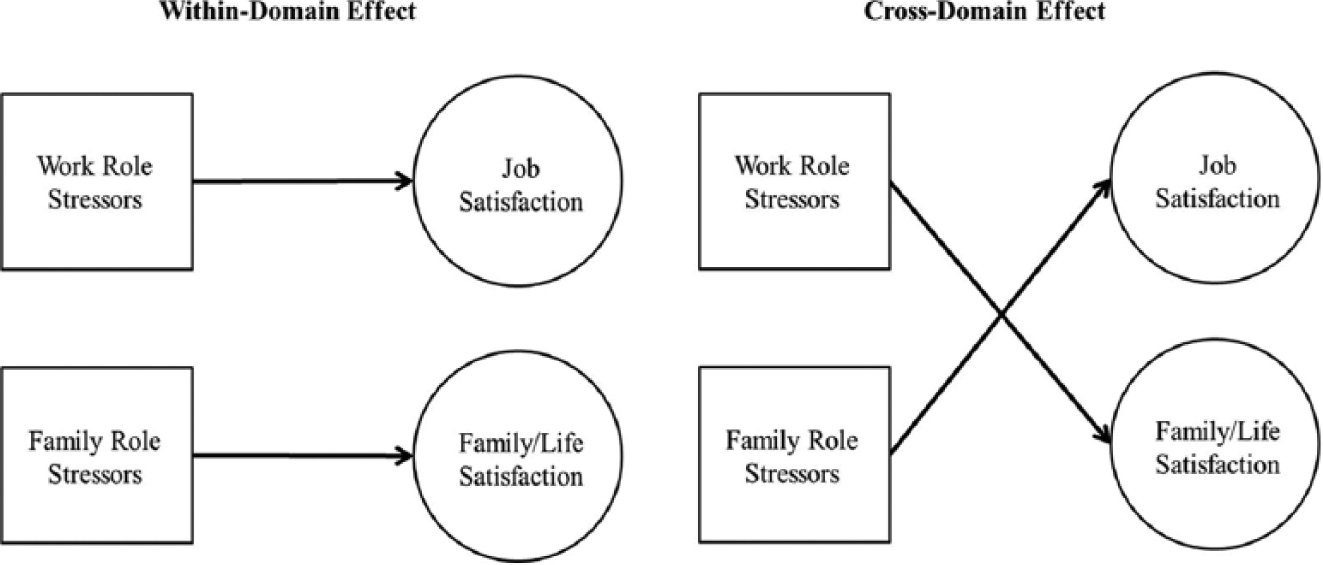
Illustrations of within-domain and cross-domain effects.
Empirical findings on the within-domain and cross-domain effects have been somewhat inconsistent. For instance, a meta-analysis reported that a considerable amount of variance in family satisfaction is explained by work domain-specific variables, whereas a considerable amount of variability in job satisfaction is explained by family domain-specific variables, thus supporting a cross-domain effect, or work and family role interdependency (Ford et al., 2007). Furthermore, Heller and Watson (2005) reported a cross-domain effect between marital satisfaction and job satisfaction using a within-individual analysis. An empirical study also supported a cross-domain effect, finding that low psychological detachment states from work were highly and positively associated with fatigue during the evening, and sleep quality was highly related to job-stress variables (Sonnentag, Binnewies, & Mojza, 2008).
Segmentation refers to “the separation of work and family, such that the two domains do not affect one another” (Edwards & Rothbard, 2000, p. 181). When individuals have a pattern of segmentation in work and family role integration, work and family domains separate, and as a result, mood or affection in one domain does not affect mood or affection in another domain (Heller & Watson, 2005). There have also been empirical studies supporting a within-domain effect by showing that work factors were the primary sources of work-to-family spillover effects, whereas family factors were the primary sources of family-to-work spillover effects (Crouter, 1984; Frone et al., 1992; Greenhaus & Beutell, 1985; Parasuraman, Purohit, Godshalk, & Beutell, 1996). For example, an empirical study found no relationship between non-work experiences and job satisfaction, nor was there a relationship between work experiences and non-work satisfaction, supporting work and family role independency (Hart, 1999).
Nonetheless, this study drew on role boundary and role border theories to hypothesize work and family role interdependency, such that
Gender Differences in the Cross-Domain Effects
As role refers to the norms socially expected for a given position, gender roles are also socially constructed. For example, behavioral differences exist between the sexes as a consequence of their socialization as women learn to be feminine, whereas men learn to be masculine (Blakemore, Berenbaum, & Liben, 2008; Maccoby, 1998). For the difference in sexes, cognitive theories of gender development, such as gender schema theory and cognitive development theory, suggest that children acquire different gender roles as they scan their environments to make sense of the world. From the scanning process, they begin to realize which sex they belong to and what traits each sex has, and then they seek behaviors similar to other members of their sex (Martin, Ruble, & Szkrybalo, 2002).
Likewise, social role theory (Eagly & Koenig, 2006; Eagly, Wood, & Diekman, 2000) argues that social structure shapes individuals’ gender belief systems. In terms of how young children are taught, men and women have different traits. For example, women tend to be feminine, meaning that they are more interpersonally oriented or have more communal traits (e.g., compassion, gentleness, nurturance, sensitivity to the needs of others) than men. In contrast, men tend to be masculine, which translates to being more task oriented or having more agentic traits (e.g., aggressiveness, decisiveness, independence, achievement; Powell & Greenhaus, 2010). Because men and women occupy their roles in society differently, they demonstrate different behaviors in the ways they adjust to the different expectations of society. For instance, men spend more time working than women do, whereas women spend more time taking care of children (Eagly et al., 2000).
Because of the different role salience between the two sexes, men and women experience different types of role strains in terms of the direction of role conflict. That is, men perceive higher role strain in the family-to-work direction (i.e., they perceive that the family role interferes with the work role) because societal expectations or norms make men more sensitive to the work, or breadwinner, role (Eagly et al., 2000; Powell & Greenhaus, 2010). In contrast, when men and women are equally involved in work and family roles, women perceive higher role strain in the work-to-family direction (i.e., the work role interferes with the family role) because societal expectations make women more sensitive to family roles (Eagly et al., 2000; Powell & Greenhaus, 2010).
Work and family role identity is socially constructed and primarily derived from individuals’ membership in social roles (Stets & Burke, 2000; Voydanoff, 2002). It is closely connected with role salience, which refers to the psychological or subjective importance of a given role to an individual (Powell & Greenhaus, 2010; Thoits, 1991). The more salient a particular role is to an individual, the more likely he or she is to invest time and energy into it (Powell & Greenhaus, 2010; Stryker & Serpe, 1994). Work role is more central to men’s identity, whereas family role is more essential to women’s identity (Cinamon & Rich, 2002). Regarding the stronger or larger relationship for the two genders, men have higher psychological job involvement than women, whereas women have higher family role involvement than men (Parasuraman & Simmers, 2001), which suggests that there are differences in role salience by gender. Therefore, men and women have different role salience for work and family roles.
There has been ample empirical evidence to support the differences in the relationships between the two sexes (e.g., Duxbury & Higgins, 1991; Parasuraman et al., 1992; Powell & Greenhaus, 2010). For example, Powell and Greenhaus (2010) reported that women have higher levels of positive spillover effects, which refers to
effects of work and family on one another that generates similarities between the two domains in terms of work and family affect (i.e., mood and satisfaction), values (i.e., the importance ascribed to work and family pursuits), skills, and overt behaviors. (Edwards & Rothbard, 2000, p. 180)
Thus, Powell and Greenhaus (2010) argued that women tend to occupy family roles that call for more feminine traits, whereas men tend to occupy roles that call for more task-oriented or masculine traits. Therefore, it is expected that women have higher cross-domain effects than men do, leading to the second set of hypotheses:
Method
Research Design and Samples
A panel research study is one type of longitudinal research design where participants take part in multiple waves and respond to the same questionnaires. Panel research design has several methodological strengths. First, it allows researchers to make causal inferences by lagging dependent variables in that the data set is collected from many individuals on several occasions across time. Second, researchers can describe and understand the patterns of change over time due to the property of longitudinal research design. Most importantly, panel research designs are particularly strong in dealing with heterogeneity bias, which occurs when unobserved factors such as personal traits are highly correlated with independent variables (Halaby, 2004, 2006; M. Kim & Polachek, 1994). The Korea Labor and Income Panel Study (KLIPS) data set was used in this study to embrace the strengths of the panel study.
KLIPS is a nationally representative longitudinal survey in which more than 10,000 individuals from more than 5,000 households have participated annually from 1998 to the present; the KLIPS project is still ongoing. KLIPS uses a multilevel cluster-random sampling frame to collect data. First, 19,025 of the 21,938 districts in rural counties and urban areas (i.e., primary sampling unit [PSU]) from the respondent list of the 1995 Korea National Census were selected. Next, 1,000 of the chosen 19,025 districts were randomly selected using a systemic sampling procedure and with the same ratio to the total population. Then, five households from each 1,000 districts were randomly selected. As a result, a total of 5,000 households and their family members originally joined the research project (for more details, please visit http://www.kli.re.kr/klips/en/about/introduce.jsp).
In KLIPS, life satisfaction as a dependent variable has been examined since the first wave in 1998, but the measurement on job satisfaction has been surveyed only since Wave 05 in 2002. Hence, panel waves from Wave 05 to Wave 11 (i.e., 2002-2008) over 7 years were used in this study for empirical analysis; the 11th data wave, surveyed in 2008, was released for public use in 2011.
One of the questions in KLIPS asks about participants’ employer type (private company, public institution, governmental enterprise, etc.). Using this variable, sub-sample data of only public employees, not including employees of governmental enterprises, were created. After excluding missing values, the total N over 7 years with unbalanced panel data (i.e., some participants left the panel survey) was 2,347.
For demographic descriptions of the samples, about 41% of the sample were women, and the mean value of age was 41.14 (SD = 10.94). Seventy-one percent had a high school education or higher. The sample also had 46.02 (SD = 10.19) working hours per week with a salary of about 2,310,000 (
Measurements
Hours of work per week
This variable was measured by asking individuals the following open question: “In general how many hours per week do you work?” The next question, also open-ended, was, “How many overtime working hours per week do you have?” Total working hours per week were computed with a summation of these two open questions (i.e., average working hours per week + average overtime working hours per week).
Monthly salary
This variable was measured by asking respondents the following open-ended question: “What is your salary per month?” This variable was transformed with a natural logarithm for easy interpretation.
Job insecurity
Job security has been defined as an individual’s expectations about job continuity (Davy, Kinicki, & Scheck, 1997). This variable was measured by one survey item asking the following: “What type of job do you have?” Responses were grouped into three categories: regular job, contractual job, or temporary job. The variable was recoded as “1” for contractual and temporary jobs and “0” for others. About 12% of the respondents reported having job insecurity.
Number of children under age 8
This variable was measured by asking respondents the following open-ended question: “How old [are your family members]?” All family members within a family reported their age; individual ages at a home were aggregated at the family level. To compute the variable, the egen command with the value option in STATA software was used.
Age of youngest child under age 8
Likewise, this variable was directly measured by asking respondents the same open-ended question: “How old [are your family members]?” This variable was also calculated with the egen command, with the rowmin option at the family level. For the variable, “0” indicated only one thing—a child less than 1 year in age; “0” did not indicate no kids under age 8. However, the data set had many missing values when “0” meant a child less than 1 year of age. To solve this problem, reverse coding was used—8 for “less than 1 year old,” 7 for “1 year old,” 6 for “2 years old,” 5 for “3 years old,” 4 for “4 years old,” 3 for “5 years old,” 2 for “6 years old,” 1 for “7 years old,” and 0 for “8 years old or higher.”
Dual-family structure
This variable was not directly assessed in the data set. Accordingly, it was necessary to generate a new variable to discern the employment status of both the father and mother in each family. A dummy (i.e., 1 for “dual-earner family”) variable was created only when both the householder and his or her spouse were working or when both householder’s son and daughter-in-law were working. Family structure varied in the context of South Korea as there is a norm in South Korea that the oldest son and his wife (i.e., daughter-in-law) should take care of their parents (i.e., typically son’s parents), living together with them.
Job satisfaction
This variable was measured using Brayfield and Rothe’s (1951) job satisfaction instrument, which uses five items: “I feel fairly well satisfied with my present job”; “Most days I am enthusiastic about my work”; “I find real enjoyment in my work”; “I hope to continue my job in the future”; and “My job is rewarding.” Survey respondents responded on a 5-point Likert-type scale ranging from 1 for strongly disagree to 5 for strongly agree (Cronbach’s α = .944).
Life satisfaction
This variable was measured via four survey questions. The first item asked about the level of satisfaction with one’s leisure life, the second item regarded the level of satisfaction with the residential environment, the third item addressed the level of satisfaction with the family, and the fourth item inquired about the level of satisfaction with social relationships. Survey participants responded on a 5-point Likert-type scale ranging from 1 for strongly agree to 5 for strongly disagree. For the purposes of this research, the survey responses were reversely recoded to simplify interpretation: 1 for strongly disagree and 5 for strongly agree (Cronbach’s α = .874).
In addition, age, educational level, and gender are controlled in this study. Age is generally expected to be related to an individual’s job and life satisfaction. For example, the younger people are, the higher life satisfaction they show (Diener, Suh, Lucas, & Smith, 1999). Second, highly educated people have been shown to have better life satisfaction (Diener et al., 1999). Third, gender needs to be controlled as men and women have different role expectations (Barnett & Hyde, 2001; Eagly et al., 2000).
Data Analysis
As noted above, the data set has panel data structure. Using an ordinary least squares (OLS) estimator for panel research design could yield biased estimates due to the violation of the assumption that residuals should be statistically independent; in panel research, an individual’s responses on dependent variables over 7 years are nested at the individual level, and as a result, model residuals tend to be correlated with each other through individuals (Cameron & Trivedi, 2010). Furthermore, work role stressors such as working hours may explain more variances at the individual level, whereas family role stressors such as number of children may explain more variance at the family level (Bryk & Raudenbush, 1992). Thus, the HLM was used in this study to address the nested data structure.
Determining the levels of HLM was achieved using a log-likelihood ratio chi-square test, as suggested by Rabe-Hesketh and Skrondal (2008). Significant model improvements by three-level models were supported by the tests (
Raudenbush and Bryk (2002) used a three-stage formulation for a three-level HLM model. The Level 1 model can be written as

Here

where NC is the number of children at house j and time t, AYC is the age of the youngest children at house j and time t, and DEF is the dummy variable of the dual-employed family at house j and time t.
Finally, the Level 3 model is specified for the intercept π00 as the following:

where

For Hypothesis 1, which predicted that work role stressors affect life satisfaction and family role stressors affect job satisfaction, Wald’s chi-square tests were used to determine the joint significance of work role stressors in life satisfaction and family role stressors in job satisfaction. Hypothesis 2 suggested that gender moderates cross-domain effects. To test the moderate effects of gender, interaction models were used (Aiken & West, 1991; Edwards & Lambert, 2007). A new series of dummy products—such as Sex × Salary, Sex × Working hours, and Sex × Job insecurity—were used to determine the joint effect of the interaction terms on life satisfaction. The moderating effect of gender was captured by the interaction terms as a set. If the model fitness were significantly improved by the dummy products when compared with the model fitness without dummy products, a moderate effect of gender on cross-domain effects would exist. For Hypothesis 2, Wald’s chi-square tests were also used.
Results
Preliminary Analysis
Table 1 shows the means, standard deviations, and bivariate correlations between the variables. For the analysis, first, mean values within individuals were generated to eliminate variances of variables within individuals over the 7-year time period as individuals had a higher tendency to respond similarly over the periods, resulting in an increase in correlation value. Using those mean values, bivariate correlations between variables were analyzed. As a result, being female was positively and significantly associated with job satisfaction, but it was negatively related to life satisfaction. Being older was also positively and significantly related to job satisfaction but negatively associated with life satisfaction. As expected, having a higher educational level was positively and significantly associated with both job and life satisfaction.
Zero-Order Correlations Analysis.
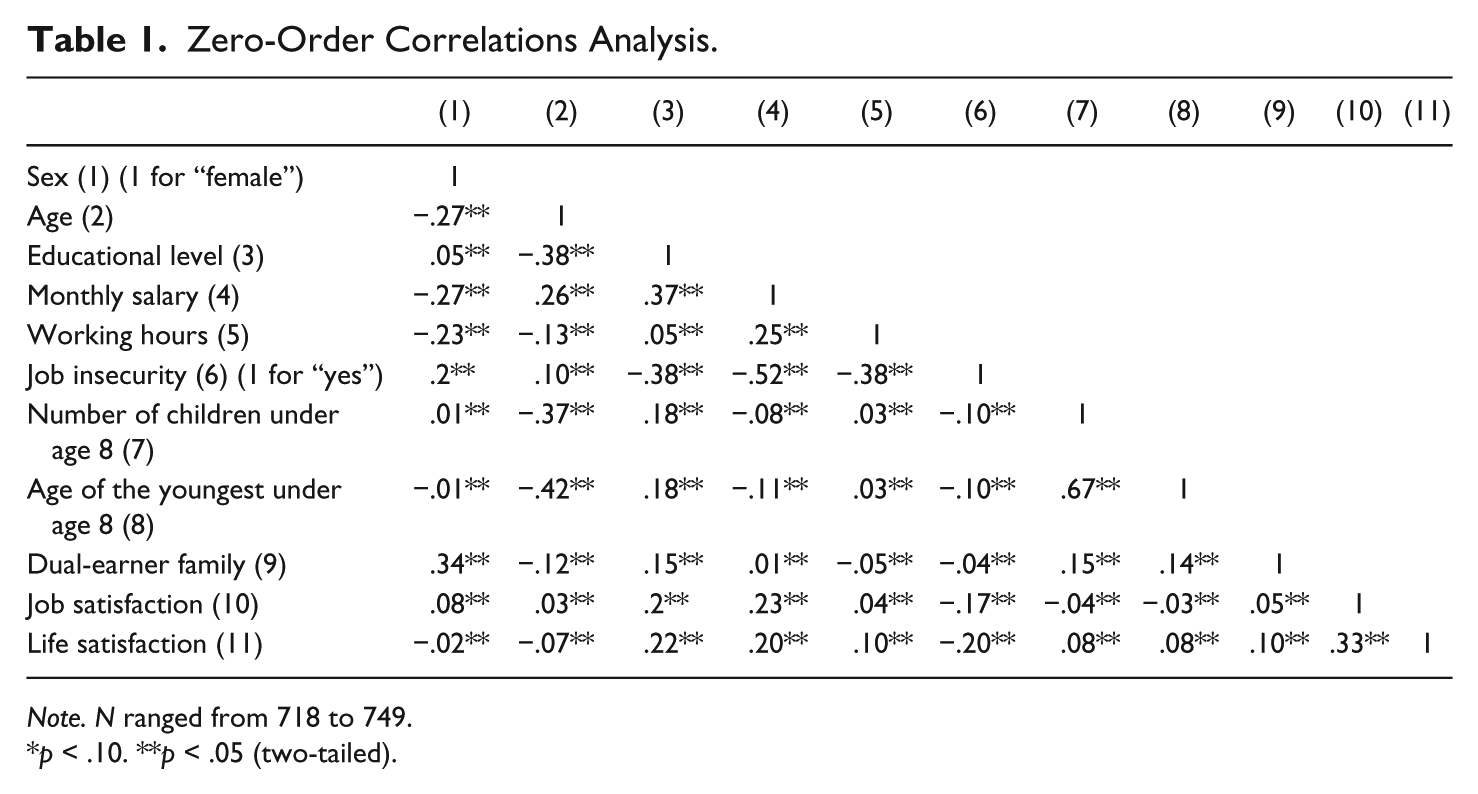
Note. N ranged from 718 to 749.
p < .10. **p < .05 (two-tailed).
Higher monthly salary was positively and significantly related to both job and life satisfaction. Unexpectedly, having longer working hours per week was significantly and positively related to job and life satisfaction. Finally, individuals reporting job insecurity exhibited lower job and life satisfaction.
Regarding the family stressors, as the number of children under the age of 8 increased, job satisfaction decreased and life satisfaction increased. Having a younger child was associated with lower job satisfaction and higher life satisfaction (as noted previously, the variable of age of the youngest child was reversely coded). Finally, having a dual-earner family was positively associated with life and job satisfaction. In addition, job and life satisfaction showed a relatively higher correlation value of .33.
Before analyzing the model, the data were screened for outliers and multi-collinearity. No outliers were identified using Cook’s D. Moreover, variance influence factor (VIF) values indicated low multi-collinearity problems; the total mean VIF value was 1.80. Furthermore, auto-correlation problems were checked using Durbin–Watson statistics as the research design had a longitudinal property, and no serious auto-correlation problems in the models were found; Durbin–Watson statistics were 1.75 for job satisfaction and 1.76 for life satisfaction.
In the modeling process, monthly salary and working hours were additionally found to have non-linear (quadratic) relationships with job and life satisfaction. As a result, monthly salary showed a reversely U-shaped relationship with job satisfaction. Accordingly, monthly salary squared was added in the modeling process.
Three-Level HLM Results
Table 2 presents the results of the three-level HLM on the cross-domain effects of work and family role stressors. First, for the control variables, being female significantly increased job satisfaction when compared with the reference dummy (i.e., being male). However, it was significantly and negatively related to life satisfaction. Being older was positively and significantly related to job satisfaction but not significantly associated with life satisfaction. Having higher educational attainment positively affected both job satisfaction and life satisfaction.
Three-Level HLM Result on Cross-Domain Effects and Moderating Effects of Gender.
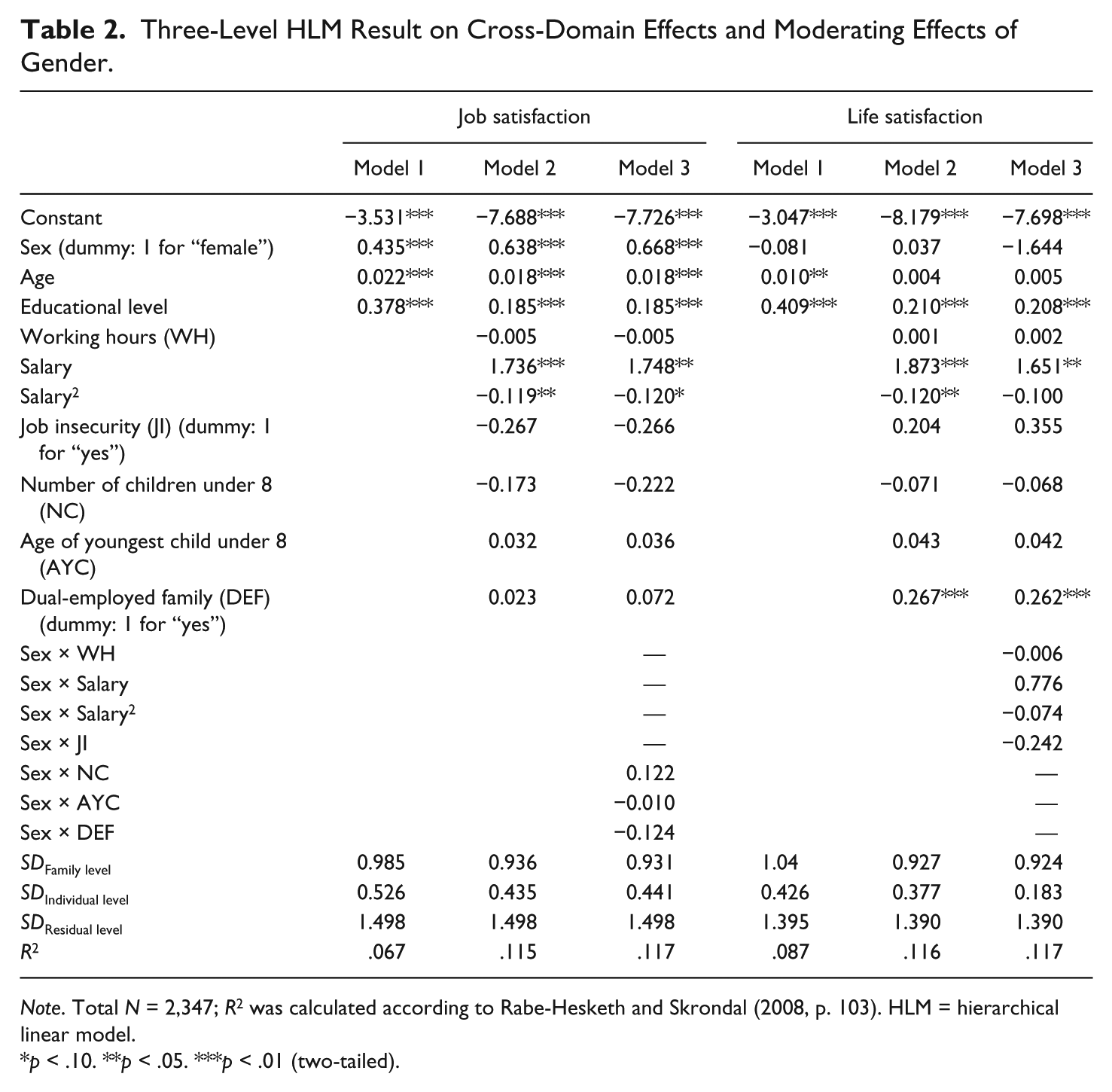
Note. Total N = 2,347; R2 was calculated according to Rabe-Hesketh and Skrondal (2008, p. 103). HLM = hierarchical linear model.
p < .10. **p < .05. ***p < .01 (two-tailed).
First, for work-related stressors, having longer working hours per week is not significantly associated with life satisfaction as shown in Model 2. Thus Hypothesis 1a is rejected. Second, having job insecurity is not significantly related to life satisfaction, which leads to the rejection of Hypothesis 1b. Third, in support of Hypothesis 1c, having a higher monthly salary is significantly and positively related to life satisfaction. In addition, it shows a reverse U-shaped relationship with life satisfaction in Model 2 as the quadratic terms are significant and negative. This implies that life satisfaction reaches a particular level, and then begins to decrease as salary increased.
Regarding family-related stressors, none are significantly and positively associated with job satisfaction in Model 2. Accordingly, Hypotheses 2a, 2b, and 2c can be rejected. Interestingly, however, the dual-earner family structure positively affects individual life satisfaction, perhaps because having dual incomes increases life satisfaction as individuals can enjoy life more with an increased family income.
As noted above, a Wald chi-square test was conducted to examine the joint significant effect of work and family role stressors on job and life satisfaction. As a result, work role stressors were jointly and significantly associated with life satisfaction (
In addition, cross-domain effects are compared with within-domain ones in terms of statistical strengths. As a result, first, work role stressors show higher cross-domain effects than within-domain ones (
Hypothesis 3a expected that gender would moderate cross-domain effects and that work role stressors would significantly affect life satisfaction. A Wald chi-square test was again conducted to examine the joint significant effect of the interaction terms, Work role stressors × Sex, on life satisfaction. As a result, the interaction terms were not statistically significant (
Discussion
Major Findings
Individuals have different linkage patterns in the work–family role transition activities, such as spillover, compensation, and segmentation (Edwards & Rothbard, 2000), as follows: (a) spillover refers to the effects of work and family roles on one another that generate similarities between the two domains, (b) compensation represents individuals’ efforts to offset dissatisfaction in one domain by seeking satisfaction in another domain, and (c) segmentation refers to the effects of the separation of the work and family domains, resulting in the domains not affecting one another. Without understanding those different types of role integration, researchers cannot identify effective family-friendly programs that help employees ameliorate their role strain (Lambert, 1990). To uncover those different types of role integration, this research addressed two research questions:
Based on findings, first, cross-domain effects were partially supported. It was found that work role stressors such as monthly salary were positively related to life satisfaction, but family stressors were not significantly associated with job satisfaction. That is, a cross-domain effect was found in the one-sided direction from work to home. This finding does not seem to be consistent with prior findings by Ford et al. (2007) or Near, Smith, Rice, and Hunt (1984). For example, Ford and his colleagues found that work role stressors are significantly associated with family satisfaction, and family role stressors are significantly related to job satisfaction. However, they reported that work role stressors are more strongly associated with family satisfaction than family role stressors are related to job satisfaction, which is somewhat consistent with the finding in this research.
The discrepancy may come from different measurements: objective versus subjective measurements of independent variables (i.e., work and family role stressors), different national cultures (the United States vs. South Korea), or different samples (i.e., private-sector employees vs. public-sector employees). In particular, different cultures at national levels (i.e., Asian vs. Western cultures) may moderate the cross-domain effects as the differences affect work values (Hofstede, 1980). In the Asian culture, individuals are trained not to bring their personal feelings or moods from home into their office or another public place as the Asian culture emphasizes collectivism more than individualism (Schmmack, Oishi, & Diener, 2002). The cultural differences may reduce the cross-domain effects from the life to work domain.
Second, this study found that gender did not moderate cross-domain effects. As shown in Table 2, the interaction terms of sex with work and family role stressors were not statistically significant. Regarding gender difference in the relationship between stressors and job and life satisfaction, empirical findings are quite inconsistent (Barnett, 1998). For example, a study by Duxbury and Higgins (1991) found that high family role involvement was significantly and negatively associated with work–family role conflict for women, whereas it was significantly but positively related to role conflict for men. However, Frone et al.’s (1992) study reported that there was no statistical difference between men and women in the relationship between stressors and well-being in terms of overall model fit from structural equation models.
To conclude, work role boundary may be thick, but not enough to impede family role components in the domain, whereas family role boundary may be thin enough to impede work role components in the life domain. Furthermore, it seems that people have similar tendencies in work and family role transition activities regardless of gender.
Theoretical and Practical Implications
This study has several theoretical and practical implications for management practice in public organizations. First, work and family role boundary theory (Ashforth et al., 2000) and border theory (Clark, 2000) presume that individuals have different levels of role transition activities, from high segmenting work and family roles to high integrating work and family roles. Ashforth and colleagues (2000) expected that the work role boundary may be thick, making it difficult to integrate the family role component into the work domain. In a similar vein, another study found that family role boundaries were more permeable than work role boundaries in that demands of the work role were permitted to intrude more into one’s family role than vice versa (Eagle, Miles, & Icenogle, 1997). The current study supports these theoretical views that family role boundary has more permeability than work role boundary does.
In addition, interestingly, monthly salary was positively associated in this study with life satisfaction. This finding may support Siegrist’s (1996) view that salary affects life satisfaction in that it means being rewarded or esteemed. Finally, this study failed to accept the research hypothesis that gender moderates cross-domain effects. This finding may theoretically imply that role identity (i.e., how men and women have salience in work and family roles) would be a more important variable to explain cross-domain effects than objective work and family role stressors (Powell & Greenhaus, 2010). The lack of a gender effect may also be evidence that traditional gender roles are becoming less clear and less salient in the 21st century, even in a more patriarchal Korean culture. As women enter the workforce in increasing numbers, the expectation for clear boundaries between men’s and women’s family roles may be eroding.
Finally, this research offers practical insights into how to enhance the well-being of public-sector employees. As noted above, first, this study found that the work role boundary is thicker than the family role boundary. This finding suggests to HR practitioners that focusing on improving working environments is more effective than improving family environments. Particularly, family-supportive working environments, such as those created via supervisor support, seem to be very important for ensuring the well-being of employees as employees who perceive that their organization is less family supportive experience more work–family conflict, less job satisfaction, and less organizational commitment than those who perceive that their organization has a more family-supportive culture (Allen, 2001). Higher supervisor support has also been significantly and positively associated with employees’ citizenship behaviors (Clark, 2001). Therefore, supervisor support and family-supportive working environments may enhance public employees’ well-being.
Limitations and Future Research Directions
This study has several limitations that should be acknowledged. First, this study was subject to systematic attrition, which is the non-random pattern with which people participating in panel research leave the survey in a panel study. When the attrition pattern of panel research design is not random, then it could be a potential problem for model estimates when systematic missing patterns are particularly correlated with model residuals (Hausman & Taylor, 1981; Lillard & Panis, 1998). Second, the measurements on life satisfaction used in KLIPS and thus this study seem to be weak. Reputable survey instruments for life satisfaction have been developed, such as the Satisfaction With Life Scale developed by Diener and his colleages (1985), and use of such instruments would perhaps be a better gauge of cross-domain effects in future studies. Third, job security can be divided into two groups of measurement: (a) actual job security and (b) perceived job security (Hellgren, Sverke, & Isaksson, 1999). Actual job security is measured by the presence of an actual tenured or non-tenured job. In contrast, perceived job security is assessed based on how individuals subjectively perceive their job security (Sverke & Hellgren, 2002). In general, high perceived job security is found to be more positively associated with an individual’s well-being than actual job security (Sverke, Hellgren, & Naswall, 2002). Using different measurements for job insecurity may show different relations for the cross-domain effects. Finally, given that life satisfaction is conceptualized as a bigger concept to include family satisfaction (Diener et al., 1999), the life role boundary may be thinner—thin enough to intrude on job role components—than the family role boundary. An empirical study to compare the differences of cross-domain effects resulting from different measurements such as life satisfaction versus family satisfaction would be beneficial in the future research.
The limitations of this study are countered by some important strengths. First, this study used objective measurements, such as salary, working hours, number of children, and so on, for testing cross-domain effects, thereby negating any possible measurement issues. Second, the study used a longitudinal research design—panel research design—which is methodologically strong in dealing with heterogeneity problems (Halaby, 2004, 2006). Second, a three-level HLM was used to address the heterogeneity issue at the family and individual levels, resulting in increased reliability of the findings. Accordingly, the research reported here could have promise as a model for future research.
Footnotes
Author’s Note
This study was partially carried out as part of author’s PhD dissertation.
Declaration of Conflicting Interests
The author(s) declared no potential conflicts of interest with respect to the research, authorship, and/or publication of this article.
Funding
The author(s) received no financial support for the research, authorship, and/or publication of this article.