




Abstract
In March 2010, the Patient Protection and Affordable Care Act and the Health Care and Education Reconciliation Act were signed into law. These Acts include a provision governing “reasonable break time for nursing mothers” for those employers and employees covered under the Fair Labor Standards Act. However, neither these Acts, nor the Pregnancy Discrimination Act, nor Title VII, nor the Americans with Disabilities Act expressly protect women from discrimination resulting from her choice to lactate at work (to include either feeding a child directly from the breast or by expressing milk to be used at a later time). Accordingly, this article examines how federal courts have treated claims of breastfeeding discrimination at work. Although courts have generally been unsympathetic to these claims, employers should consider proactive accommodation measures because recent cases indicate that courts may be willing to entertain these claims.
Keywords
Introduction
In their Healthy People 2010 report, the Department of Health and Human Services (HSS) stated that one of its national objectives was to substantially increase the rate of children who are breastfed by 2010 (U.S. HSS, 2000). The American Academy of Pediatrics recommends that children be breastfed exclusively until they are 6 months old and for children to continue to receive breast milk until age 1 (Gartner et al., 2005, pp. 465-506). Breastfeeding is encouraged by physicians, the Centers for Disease Control and Prevention (CDC), and the government because it provides substantial health benefits to both the child and the mother (National Conference of State Legislatures [NCSL], 2010). Children who are breastfed exclusively “tend to need fewer health care visits, prescriptions and hospitalizations resulting in a lower total medical care cost compared to never-breastfed infants” (NCSL, 2010). Finally, a recent study found that “[i]f 90% of US families could comply with the medical recommendations to breastfeed exclusively for 6 months, the United States could save $13 billion/year and prevent an excess 911 deaths annually, 95% of which would be of infants” (Bartick & Reinhold, 2010, p. e1052).
Despite this encouragement, according to the CDC, for children born in 2010, although 76.5% began to breastfeed, only 49.0% were breastfed at 6 months of age and 27.0% at 1 year of age (CDC, 2013). The CDC has continued to find that there are disparities in breastfeeding rates based on a family’s socioeconomic status, and children born into lower income families and those born to non-Hispanic Black women, as compared with non-Hispanic Whites, have lower rates of breastfeeding (CDC, 2015; CDC, 2010). The CDC hypothesizes that this difference is due to a number of factors, one of which being that non-Hispanic Black women return to work sooner than their White counterparts, and there is insufficient support for breastfeeding in these workplaces (CDC, 2010; citing Ludington-Hoe, McDonald, & Satyshur, 2002). A study of Maryland Special Supplemental Nutrition Program for Women, Infants, and Children (WIC) participants found that one of the most frequent reasons these women report ceasing to breastfeed is “having to return to work” (Hurley, Black, Papas, & Quigg, 2008).
For women who wish to lactate at work, adding a legal structure that ensures they are protected against breastfeeding discrimination will remove a substantial barrier in the workplace. As of June 2014, 18 states, the District of Columbia, and Puerto Rico required employers to provide space and time for mothers wishing to lactate (NCSL, 2014; U.S. Department of Labor [U.S. DOL], 2014) (Table 1). Although in those states women who choose to lactate may be able to require that companies comply with the procedural guarantees of these statutes, this does not ensure that they are protected from discrimination that may result from their choice to lactate in the workplace.
States and Territories with Laws Preventing Breastfeeding Discrimination in the Workplace (NCSL, 2014; U.S. Department of Labor [U.S. DOL], 2014).
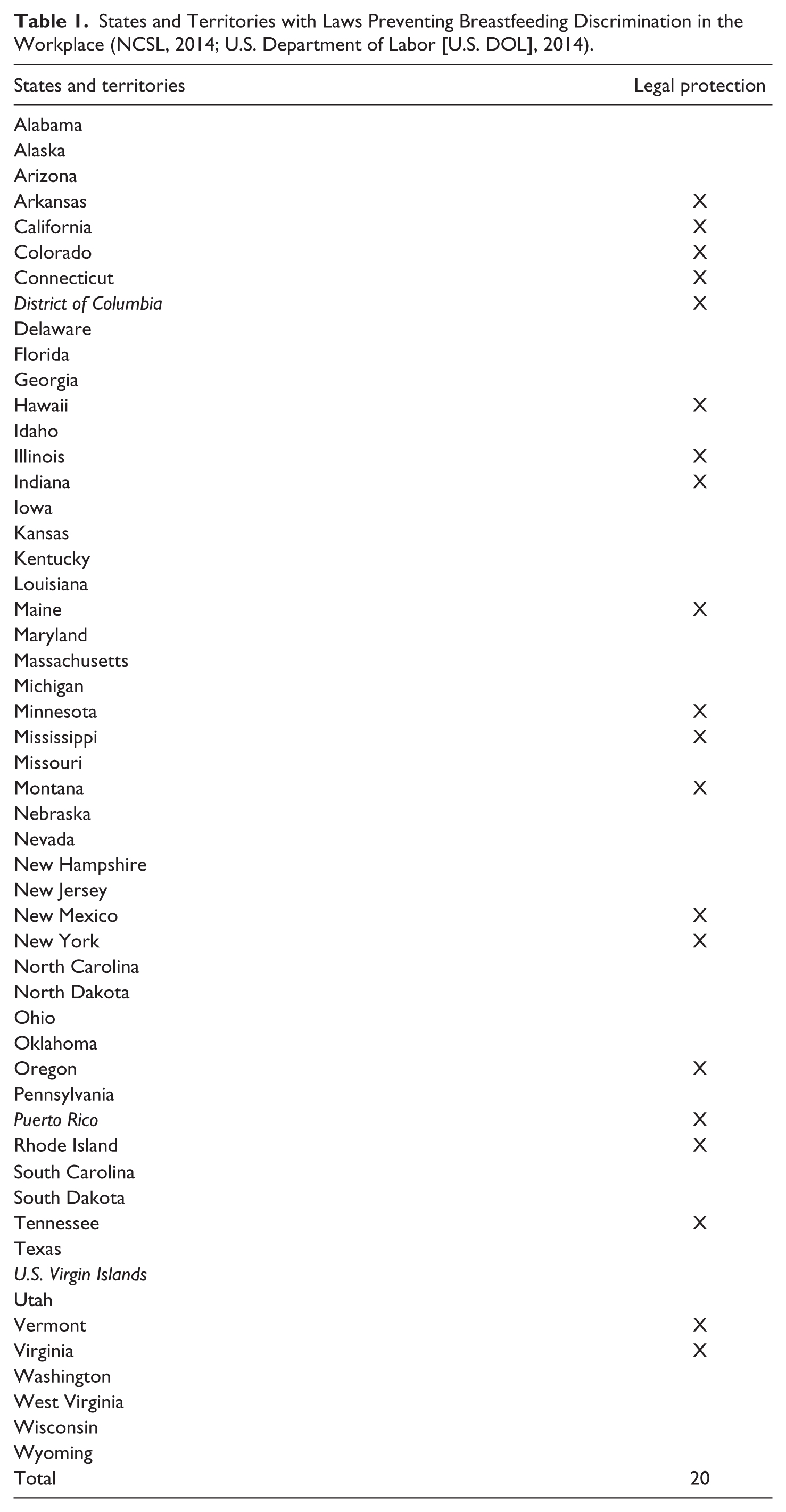
This article examines how federal courts have treated claims of breastfeeding discrimination at work. To do so, the article first situates the breastfeeding discrimination within the literature on barriers to women in the workplace. Second, it reviews common situations in which breastfeeding discrimination occurs in the workplace. Third, it reviews U.S. federal court decisions in which the plaintiff(s) filed claims alleging that they had been discriminated against for requesting to or attempting to lactate at work, prior to September 1, 2013. Because the U.S. Supreme Court has not ruled on this issue specifically, the article analyzes language contained within the decisions, both the courts’ holdings and dicta, for patterns regarding both how the court has treated and may treat claims of discrimination made under the following laws: the Pregnancy Discrimination Act (PDA), Title VII of the Civil Rights Act, the Americans With Disabilities Act (ADA), and the Patient Protection and Affordable Care Act and Reconciliation Act of 2010 (“Affordable Care Act”). Fourth, the article compares the success of specific claims of breastfeeding discrimination that were filed using state laws in California and Ohio. Finally, the article discusses the implications that these cases have on practitioners.
Literature Review
The passage of the Civil Rights Act of 1946 was pivotal in beginning to remove barriers to women in the workplace. In addition to specific protections the Civil Rights Act itself provided, its passage triggered other legislation that has helped to level the playing field for women in the workplace (Guy & Fenley, 2014). Although issues such as sexual harassment and pay inequity are still salient today, they are no longer normalized (Guy & Fenley, 2014; Reese & Warner, 2012). The Civil Rights Act of 1964 and the PDA of 1978 have made sexual harassment illegal. The recent passage of the Lilly Ledbetter Fair Pay Act of 2009 provides that the statute of limitation for individuals filing a claim of wage discrimination begins at the date of the last paycheck, substantially removing previous barriers to recovery for wage discrimination. Finally, public administration literature has provided a comprehensive review of the overall experience of women in the workplace, focusing particularly on the barriers that exist for women and the value of diversity within the workplace (for a review of this literature, see Pitts & Wise, 2010, and Riccucci, 2009).
Although there have been tremendous gains in workplace equality for women, a number of barriers still exist, including sexual harassment, pay inequity, discrimination based on appearance, issues surrounding gender definitions, and the lack of legal protections for women who choose to breastfeed or lactate at work (Guy and Fenley, 2014). Guy and Fenley (2014) argue that “on its face, the [Civil Rights] Act protects women, but in reality, the exemptions in Title VII disadvantage women because of the gaps in work history most experience during their childbearing years” (p. 45). This has been shown to affect the pay gap between men and women, as well as the gap between non-mothers and mothers (Correll, Benard, & Paik, 2007; citing Glass, 2004). To continue to remove the barriers to women in the workplace, we need to enact policies which combat these barriers.
However, it is not enough to argue for diversity or tell employers about the risks associated with discrimination. In their 2010 article, Pitts and Wise call for future research to “provid[e] practical, action-based findings for public managers and human resource practitioners” (p. 62). This study attempts to address this need by both examining the court’s current interpretation of the laws relating to claims of breastfeeding discrimination and discussing the implications that these cases have on managers and human resource practitioners.
Common Situations in Which Breastfeeding Discrimination Occurs
There are three common situations in which a woman can be discriminated against based on her decision to lactate at work: (a) the employer can fail to hire her, (b) the employer can fail to accommodate her request to lactate at work, or (c) the employer can engage in an adverse employment action against her based on her decision to lactate. The first scenario is unlikely to occur unless a woman discloses her desire to lactate at work during the hiring process. The latter two scenarios represent active and passive approaches to breastfeeding discrimination. In the second, the employer simply refuses to accommodate a request to lactate, without any further adverse action to the woman. The third scenario presents a situation in which the employer actively takes an adverse employment action against the woman based on her decision to lactate. Adverse employment actions include, but are not limited to, termination, demotion, non-selection, denial of training, denial of promotion, and oral and writing warnings or discipline. Note, however, that even if the employer accommodates a request to lactate, it is still possible that it will take an adverse employment action against that woman based on her decision to do so.
If a woman is discriminated against because of her decision to breastfeed or lactate at work, she may continue to lactate at work, but, given the current protections in the law, she does so at her own peril. Although breastfeeding advocacy groups such as La Leche League International encourage taking a stand and asserting your right to breastfeed when challenged or discriminated against, this is not an option for many women (Vance, 2005). Many women cannot afford to risk losing their jobs and, as a result, are forced to give up lactating at work or breastfeeding entirely.
The Courts’ Response to Claims of Breastfeeding Discrimination
A woman who has experienced breastfeeding discrimination in the workplace has four possible federal claims under the law. She can allege she has been discriminated against under (a) the PDA; (b) Title VII of the Civil Rights Act, alleging a sex or sex-plus claim; (c) the ADA; (d) the Affordable Care Act; or (e) some combination thereof. As will be discussed in turn, the courts have examined claims of breastfeeding discrimination under each and, until recently, have repeatedly ruled against mothers (see Table 2).
Federal Cases Examining Breastfeeding Discrimination.
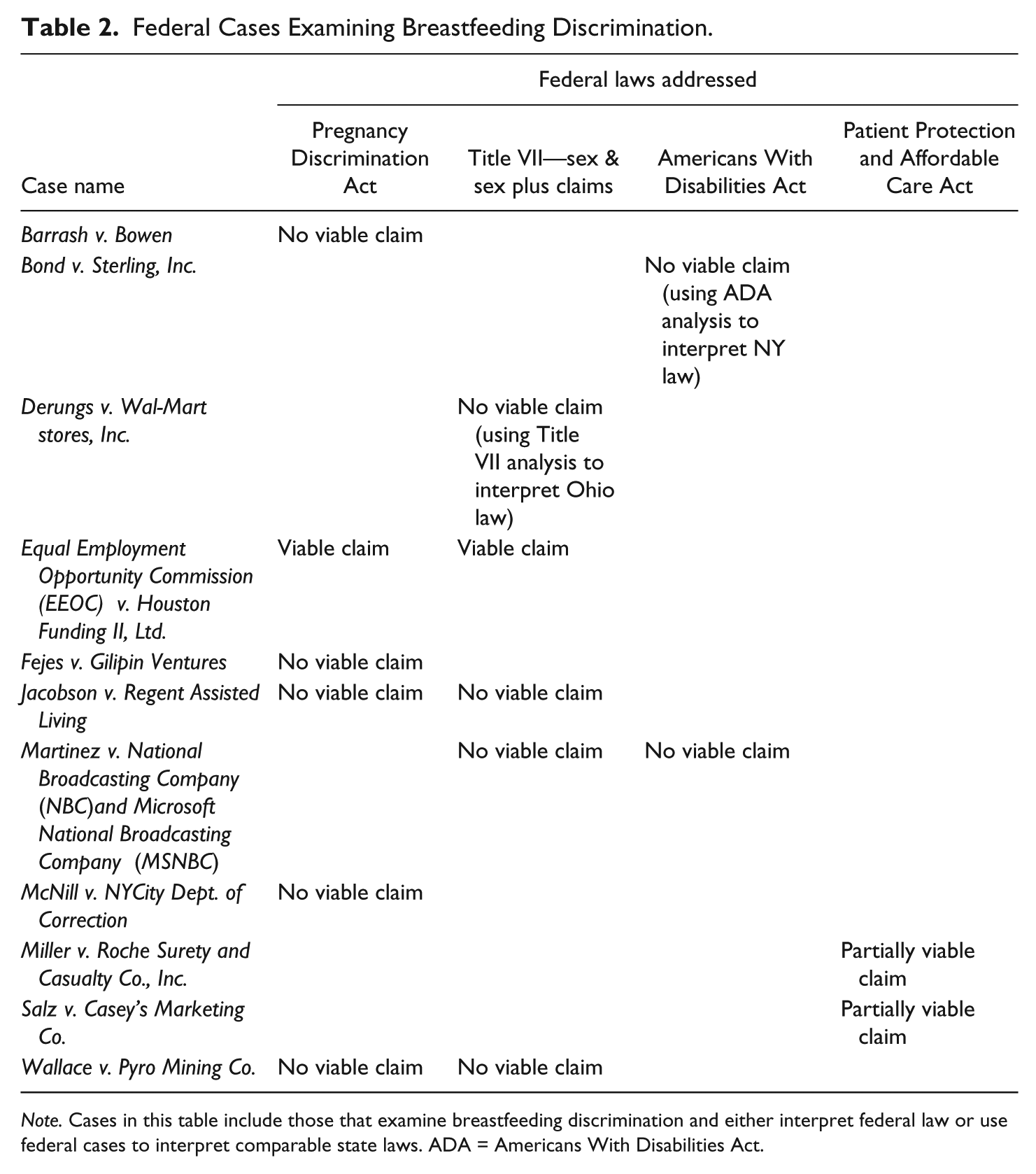
Note. Cases in this table include those that examine breastfeeding discrimination and either interpret federal law or use federal cases to interpret comparable state laws. ADA = Americans With Disabilities Act.
Pregnancy Discrimination Act
The PDA, an amendment to Title VII, “prohibit[s] sex discrimination on the basis of pregnancy” (The Pregnancy Discrimination Act of 1978; Title VII of the Civil Rights Act of 1964). Specifically, it provides that a woman may not be discriminated against “because of or on the basis of pregnancy, childbirth, or related medical conditions; and women affected by pregnancy, childbirth, or related medical conditions shall be treated the same for all employment-related purposes” (The Pregnancy Discrimination Act of 1978; Title VII of the Civil Rights Act of 1964). In “cases involving discretionary leaves of absence for breast-feeding purposes, courts have uniformly held that rules relating to regulation of breast-feeding do not violate the PDA or Title VII” (Derungs v. Wal-Mart Stores, Inc., 2004, p. 439).
In a Fourth Circuit case, Barrash v. Bowen (1988), the plaintiff claimed that she experienced actionable discrimination under the PDA when she was denied additional maternity leave so that she could continue to breastfeed her child. Although this article only addresses the need to lactate in the workplace, the underlying legal analysis in Barrash v. Bowen (1988) is the same. The Fourth Circuit dismissed her claim by simply stating that “[u]nder the Pregnancy Discrimination Act of 1978, 42 U.S.C. § 2000e(k), pregnancy and related conditions must be treated as illnesses only when incapacitating” (Barrash v. Bowen, 1988, p. 931). Because there is little argument that lactating is an incapacitating condition, the PDA provides no protection against breastfeeding discrimination.
Overall, the PDA’s protections have been defined very narrowly. Even conditions that are directly related to pregnancy are not protected; for example, “infertility is outside of the PDA’s protection because it is not pregnancy, childbirth, or a related medical condition . . . ” (Krauel v. Iowa Methodist Medical Center, 1996, pp. 679-680). A “claim of discrimination based on her status as a new parent is not cognizable under the PDA” because this status is based on her social role, rather than a medical condition (Piantanida v. Wyman Center, Inc., 1997, p. 342). The Court found that “an individual’s choice to care for a child is not a ‘medical condition’ related to childbirth or pregnancy. Rather, it is a social role chosen by all new parents who make the decision to raise a child” (Piantanida v. Wyman Center, Inc., 1997, p. 342; Jacobson v. Regent Assisted Living, Inc., 1999). Furthermore, the decision to breastfeed, even if medically necessary for the health of the child, undergoes the same analysis, and a mother’s choice to breastfeed her child is not considered a medical condition related to childbirth or pregnancy under the meaning of the PDA (Fejes v. Gilipin Ventures, 1997; Wallace v. Pyro Mining Co., 1991).
Although there has been little protection recognized under the PDA to date, in a case that was later settled out of court, the Fifth Circuit Court of Appeals in Equal Employment Opportunity Commission v. Houston Funding II, Ltd. (2013) held “that lactation is a related medical condition of pregnancy for purposes of the PDA” (p. 3). Noting that, “[t]he PDA does not define the statutory term ‘medical condition’” and, in the Court’s interpretation, lactation falls within a reasonable definition of “pregnancy, childbirth, or related medical conditions,” which are protected by the Act (Equal Employment Opportunity Commission v. Houston Funding II, Ltd., 2013, p. 3). This is significant because the Court has declared that a claim of breastfeeding discrimination could be a viable claim under the PDA, contrary to what earlier cases and other circuits have held.
In examining the terms of the PDA, there is a circuit split regarding whether lactation in the workplace is protected. A circuit split within the federal courts, or disagreement regarding how a law should be interpreted, may prompt the Supreme Court to grant certiorari to settle the split. However, unless the Supreme Court renders a decision on this issue, protection from discrimination now depends on which circuit a mother resides in. Accordingly, plaintiffs not residing in the Fifth Circuit must look to other laws for protection from discrimination.
Title VII—Sex and Sex-Plus Claims
Title VII of the Civil Rights Act of 1964 (“Title VII”) provides in relevant part that It shall be an unlawful employment practice for an employer— (1) to fail or refuse to hire or to discharge any individual, or otherwise to discriminate against any individual with respect to his compensation, terms, conditions, or privileges of employment, because of such individual’s . . . sex . . .; or (2) to limit, segregate, or classify his employees or applicants for employment in any way which would deprive or tend to deprive any individual of employment opportunities or otherwise adversely affect his status as an employee, because of such individual’s . . . sex . . . (Title VII of the Civil Rights Act of 1964).
A sex-plus claim under Title VII adds an element to the above analysis: “sex-plus” discrimination . . . exists when a person is subjected to disparate treatment based not only on her sex, but on her sex considered in conjunction with a second characteristic . . . (Derungs v. Wal-Mart Stores, Inc., 2000, p. 890; quoting Martinez v. N.B.C., Inc., 1999, p. 309).
Although the PDA is an amended portion of Title VII, the following section will address claims analyzed under the traditional Title VII analysis for sex and sex-plus discrimination. Most claims analyzed under the PDA contain at least an understandable reference to other Title VII protections. As a result, courts often analyze these claims in an overlapping application of cases.
In a seminal case simply addressing sex discrimination, the Sixth Circuit in Derungs v. Wal-Mart Stores, Inc. (2004) stated that “no judicial body thus far has been willing to take the expansive interpretive leap to include rules concerning breast-feeding within the scope of sex discrimination” (p. 439). Although this is a public accommodation case and does not directly address employment discrimination, the holding is still significant. Because the court analyzed the issues within the Title VII context, it demonstrates the court’s attitude toward whether breastfeeding discrimination claims would be successful sex or sex-plus claims under Title VII.
In Derungs, the plaintiffs each attempted to breastfeed their child in a public area within various Wal-Mart Stores in Ohio (Derungs v. Wal-Mart Stores, Inc., 2004). Each was approached by Wal-Mart staff who told them that they were not allowed to breastfeed their child in the store and that they would have to resume in the restroom or leave the store (Derungs v. Wal-Mart Stores, Inc., 2004). Plaintiffs sued under Ohio’s Public Accommodation statute that prohibits sex discrimination (Derungs v. Wal-Mart Stores, Inc., 2004).
The lower court examined their claims under the Title VII framework and stated that Title VII forbids gender discrimination in employment, but gender discrimination by definition consists of favoring men while disadvantaging women or vice versa. The drawing of distinctions among persons of one gender on the basis of criteria that are immaterial to the other, while in given cases perhaps deplorable, is not the sort of behavior covered by Title VII. (Derungs v. Wal-Mart Stores, Inc., 2000, p. 890; quoting Martinez v. N.B.C., Inc., 1999, p. 309).
Even under a sex-plus analysis, this court found that . . . [I]n a “sex-plus” or “gender-plus” case, the protected class need not include all women [but] the plaintiff must still prove that the subclass of women was unfavorably treated as compared to the corresponding subclass of men. Absent such a subclass, a plaintiff cannot establish sex discrimination. (Derungs v. Wal-Mart Stores, Inc., 2004, p. 432; citing Derungs v. Wal-Mart Stores, Inc., 2000, pp. 890-891)
This court found and the Sixth Circuit affirmed that these plaintiffs did not have a viable claim for either sex or sex-plus discrimination when analyzed under the Title VII framework (Derungs v. Wal-Mart Stores, Inc., 2004).
In Martinez v. N.B.C., Inc. (1999), the plaintiff alleged that she was a victim of sex-plus discrimination on the basis of her decision to lactate at work. In this case, the U.S. District Court for the Southern District Court of New York held that she did not have a viable claim, because “[t]o allow a claim based on sex-plus discrimination here would elevate breast milk pumping—alone—to a protected status. But if breast pumping is to be afforded protected status, it is Congress alone that may do so” (Martinez v. N.B.C., Inc., 1999, p. 311).
In addition to finding that the plaintiff had a viable claim under the PDA, the Court in Equal Employment Opportunity Commission v. Houston Funding II, Ltd. (2013) also held that the plaintiff stated a viable claim of sex discrimination by showing that her employer fired her “because she was lactating and wanted to express milk at work” (p. 4). The court remanded the decision to a lower court for findings of fact, and the case was then settled out of court. However, the case is significant in that it is the first federal court decision to recognize a claim of breastfeeding discrimination could be viable under either the PDA or Title VII.
Although recent claims rely primarily on the PDA, rather than straight Title VII analysis, often neither is successful. Accordingly, plaintiffs have begun to add claims under other Acts, such as the ADA, in an attempt to reach a successful cause of action.
Americans with Disabilities Act
The ADA provides that “[n]o covered entity shall discriminate against a qualified individual on the basis of disability in regard to job application procedures, the hiring, advancement, or discharge of employees, employee compensation, job training, and other terms, conditions, and privileges of employment” (Americans with Disabilities Act [2009]). Many have argued, under the previous version of the ADA (Americans with Disabilities Act [1991]), that discrimination based on a woman’s decision to lactate in the workplace should be protected and accommodated under this Act (Bond v. Sterling, 1998; Martinez v. N.B.C., Inc., 1999). However, these attempts to gain protection under the ADA have been unsuccessful (Martinez v. N.B.C., Inc., 1999).
Pointedly, in looking to the ADA’s definition of disability to interpret a related state statute, the U.S. District Court in Bond v. Sterling (1998) stated that “[i]t is simply preposterous to contend a woman’s body is functioning abnormally because she is lactating” (p. 311). Even “pregnancy-related complications usually will not qualify a woman for ADA protection,” it is only those conditions that present physiological impairments, such as premature labor, that would be upheld under the ADA (Bond v. Sterling, 1998, p. 310; quoting Lacoparra v. Pergament Home Centers, Inc., 1997, p. 228; citing Hernandez v. City of Hartford, 1997, p. 130). Furthermore, this court stated that “to the extent [a] plaintiff argues her child must be breast-feed [sic] as a matter of medical necessity, any disability would be that of her child alone” (Bond v. Sterling, 1998, p. 311; McNill v. New York City Dep’t of Correction, 1996). In other words, even if the child is disabled, this disability would not protect the mother from breastfeeding discrimination based on her decision to accommodate her child’s disability.
Following Bond, the U.S. District Court in Martinez v. N.B.C., Inc. (1999) dismissed the plaintiff’s ADA claim that lactation is a disability. It reasoned that is not to say that a statute requiring employers to afford reasonable accommodation to women engaged in breast feeding or breast pumping would be undesirable. As noted, however, that determination is not for the Court, the only task of which is to determine whether the ADA so provides. It does not. (Martinez v. N.B.C., Inc., 1999, p. 309)
The general condition of lactation is not a disability within the meaning of the ADA, and women who elect to lactate at work will receive no protections or have any right to an accommodation. If the ADA was found to apply to cases of breastfeeding discrimination, the protections would still be uneven based on the woman’s employer. Under Title I of the ADA, a woman who works for a state government could sue her employer to compel them to comply with the law, but typically could not recover monetary damages (Board of Trustees of the University of Alabama v. Garret, 2001).
Accordingly, as indicated in Bond v. Sterling (1998), lactation, even when it is vital to the child’s health, would not receive protection or accommodation under the ADA (1998). To qualify for employment protection to care for a child who demanded breast milk, if her employer was unwilling to accommodate her need to express milk at work, the woman would have to apply for the Family and Medical Leave Act. However, in most cases, the Family and Medical Leave Act (FMLA), or comparable state statutes, are not reasonable alternatives. In 2010, the DOL issued a notice regarding, among other things, the application of the FMLA to breastfeeding at work. It held that intermittent leave to lactate at work is not covered by the FMLA and “that expressing milk will [not] typically be associated with a serious health condition under the FMLA” (U.S. DOL, 2010).
Patient Protection and Affordable Care Act
On March 23, 2010, President Obama signed into law the Patient Protection and Affordable Care Act, and on March 30, 2010, he signed the Reconciliation Act of 2010 (The Patient Protection and Affordable Care Act [2010]). Section 4207 of these Acts provides a provision governing “reasonable break time for nursing mothers.” This provision amends the Fair Labor Standards Act of 1938 (FLSA) to include the following new language:
(r)(1) An employer shall provide—
a reasonable break time for an employee to express breast milk for her nursing child for 1 year after the child’s birth each time such employee has need to express the milk; and a place, other than a bathroom, that is shielded from view and free from intrusion from coworkers and the public, which may be used by an employee to express breast milk.
(2) An employer shall not be required to compensate an employee receiving reasonable break time under Paragraph (1) for any work time spent for such purpose.
(3) An employer who employs less than 50 employees shall not be subject to the requirements of this subsection, if such requirements would impose an undue hardship by causing the employer significant difficulty or expense when considered in relation to the size, financial resources, nature, or structure of the employer’s business.
(4) Nothing in this subsection shall preempt a State law that provides greater protections to employees than the protections provided for under this subsection (The Patient Protection and Affordable Care Act [2010]; Fair Labor Standards Act of 1938).
Although this language clearly extends new workplace protections, it is not without its limitations. If an employer has less than 50 employees and it can demonstrate that compliance with this law would impose an undue hardship, it need not comply. In addition, these new provisions only apply to FLSA-covered employees. FLSA exempts certain classes of workers from its protections, including teachers, administrative employees, outside sales employees, elder-care companions, and others (U.S. DOL, Wage and Hour Division, 2007). These exemptions mean a substantial number of vulnerable workers have no federal right to lactate at work without enduring discrimination. Finally, the new provision does not provide for remedies if a covered woman’s right to lactate at work under FLSA is violated (Salz v. Casey’s Marketing Co., 2012).
In a 2012 case from the Northern District of Iowa, the court held that, although the Affordable Care Act does include a provision governing “reasonable break time for nursing mothers,” the Act does not provide an independent cause of action for mothers who are discriminated against for lactating at work (U.S. DOL, Wage and Hour Division, 2007). Instead, mothers who perceive they have been discriminated against must file a claim with the DOL, and then, the DOL may choose to pursue the claim by either requesting compliance from the employer or seeking injunctive relief to prevent the employer from discriminating against the mother further. Although the Affordable Care Act does not provide for an independent cause of action, the court held that § 215(a)(3) provides a separate cause of action and includes separate remedies if the employer “discharge[s] or in any other manner discriminate[s] against” the mother because she “has filed any complaint . . . under or related to” the FLSA (Miller v. Roche Surety and Casualty Co., Inc., 2012; DOL, Wage and Hour Division, 2007; Fair Labor Standards Act of 1938).
To provide adequate protection from breastfeeding discrimination, either (a) legislation needs to be enacted that both covers a larger proportion of working mothers and/or provides for meaningful remedies or (b) employers must proactively enact policy that ensures that women are protected against breastfeeding discrimination.
Comparing Cases in Ohio and California: How the State Affects a Woman’s Protection From Breastfeeding Discrimination
States are free to enact legislation that offers greater protection from discrimination than existing federal laws. However, because states are not required to exceed federal protections, a federal law protecting women from breastfeeding discrimination would more uniformly protect the rights of women in the workplace. Even when state courts have looked to federal interpretation of federal statutes for guidance in interpreting state statues, this has not resulted in uniformity between state and federal discrimination laws (Sperino, 2013). Instead, by following federal interpretation, state courts have generally interpreted state discrimination statues in a way that is inconsistent with their particular state’s legislative intent (Sperino, 2013). In doing so, state courts have added a layer of complexity to interpreting discrimination protections in each state.
As of June 2014, only 18 states, the District of Columbia, and Puerto Rico either prohibit discrimination or require employers to provide space and time for mothers wishing to lactate (NCSL, 2014; U.S. DOL, 2014). Although it is positive that these states offer some accommodation, these statutes do not ensure that all women are protected from discrimination that may result from their choice to lactate in the workplace. As the cases below illustrate, a woman’s protections under state law vary widely depending on which state she lives and works in (Allen v. Totes/Isotoner Corp., 2009; Currier v. National Board of Medical Examiners, 2012; Department of Fair Employment and Housing v. Acosta Tacos, 2009).
No Protection From Breastfeeding Discrimination in Ohio
In Allen v. Totes/Isotoner Corp. (2009), the Ohio Supreme Court in a per curiam opinion affirmed the lower court’s grant of summary judgment to the employer, Totes/Isotoner (hereafter “Totes”; p. 224). In doing so, the Court substantially eroded the statutory protections granted to lactating women in Ohio.
When Allen was hired by Totes, she was still breastfeeding her 5-month-old son. During the times when she could not feed him directly, she used a breast pump. It took her approximately 15 min to complete the whole process of preparing and pumping. During her orientation with Totes, Allen was informed that she would receive two 10-min breaks and a 1/2-hr lunch break at pre-set times. Immediately thereafter, Allen talked to a Totes representative and let her know that she was lactating and requested a place to pump. The representative replied to the request later and told Allen that she could pump in the women’s restroom during her break. When Allen requested a chair for the restroom, this request was denied. Allen let the representative know that she would try to wait until her scheduled lunch break to pump, but that she was unsure whether she could do so. The second week, Allen decided that she could no longer wait to pump and began to take an additional break to do so, without first discussing it with anyone at Totes. Allen was soon discovered by her supervisor, and then, Allen requested that her need to pump be accommodated by extending her break time. Totes considered Allen’s request and made the decision to instead terminate her for taking unauthorized breaks (Allen v. Totes/Isotoner Corp., 2007).
After she was terminated, Allen filed a suit against Isotoner for wrongful termination under the Ohio Fair Employment Practices Act, as it was amended by Ohio’s PDA (Allen v. Totes/Isotoner Corp., 2007, p. 623; citing Civil Rights Commission; Pregnancy Discrimination Act). The lower court found, and the Ohio Supreme Court held, that (1) Totes did not discriminate against Plaintiff on the basis of her pregnancy; (2) Plaintiff cannot identify a clear public policy that was violated by her discharge; and (3) Plaintiff is not disabled and therefore was not entitled to Reasonable Accommodation. (Allen v. Totes/Isotoner Corp., 2007)
Ohio’s PDA provides that discrimination “‘because of sex’ and ‘on the basis of sex’ include . . . because of or on the basis of pregnancy, any illness arising out of and occurring during the course of pregnancy, childbirth, or related medical conditions” (Allen v. Totes/Isotoner Corp., 2007; citing Civil Rights Commission). Allen argued that she was discriminated against based on the fact that she was experiencing the physical condition of lactating, a condition, she argues, is related to pregnancy (Allen v. Totes/Isotoner Corp., 2007). The lower court disagreed, and the Supreme Court affirmed, stating that Allen gave birth over five months prior to her termination from Totes. Pregnant woman who give birth and chose not to breastfeed or pump their breasts do not continue to lactate for five months. Thus, Allen’s condition of lactating was not a condition relating to pregnancy but rather a condition relating to breastfeeding. Breastfeeding discrimination does not constitute gender discrimination. (Allen v. Totes/Isotoner Corp., 2007; citing Derungs v. Wal-Mart Stores, Inc., 2004, p. 439)
Based on this finding, the court summarily dismissed Plaintiff’s claims based on both sex discrimination and public policy (Allen v. Totes/Isotoner Corp., 2007). With respect to Allen’s final claim that lactation constitutes a disability and requires accommodation, the Court followed other jurisdictions’ treatment of breastfeeding discrimination under the ADA and held that post-partum lactation is not a disability under the ADA (Allen v. Totes/Isotoner Corp., 2007; citing Bond v. Sterling, 1998; Martinez v. N.B.C., Inc., 1999).
Allen did not act perfectly. Certainly, her actions would have been more defensible if she had requested an accommodated break schedule when she first discovered that it would not work to wait until her lunch break to pump. However, unless the company would have taken a dramatically different approach with her request than it did responding to her request for accommodation, it likely would have made little difference. Although Ohio has laws in place that prevent discrimination based on pregnancy and sex discrimination, these laws do not protect lactating women from discrimination after their child is born. Accordingly, some women are left unprotected.
California’s Decision to Uphold a Claim of Breastfeeding Discrimination
In a groundbreaking decision, the Fair Employment and Housing Commission of the State of California in Department of Fair Employment and Housing v. Acosta Tacos (2009) held that “breastfeeding is an activity intrinsic to the female sex. Accordingly, termination in violation of complainant’s right to return from work from pregnancy disability leave because she was still breastfeeding was discrimination on the basis of sex . . . ” (Dept. of Fair Employment and Housing v. Acosta Tacos, 2009). In doing so, it found that Acosta Tacos discriminated against Marina Chavez, the complainant, based on her decision to continue to breastfeed after returning from maternity leave (Department of Fair Employment and Housing v. Acosta Tacos, 2009).
Prior to being terminated, Chavez worked at Acosta Tacos as a cashier (Department of Fair Employment and Housing v. Acosta Tacos, 2009). After returning from an unpaid 1-month-long maternity leave to care for her premature child, Chavez resumed work at Acosta Tacos. During Chavez’s lunch break, she had the baby’s father meet her at work, and she would breastfeed their newborn in their car. She then returned to work the remainder of her shift. The following day, her second day back at work, her manager told her that he did not want her working there, and when she asked him why, he said that he was “the owner and [he] could do as [he] pleased because [he] was the one who gave orders” (Department of Fair Employment and Housing v. Acosta Tacos, 2009, p. 4). He explained that he found out that she had breastfed her newborn baby on her lunch break, that she could not breastfeed on her breaks, and that she could not return to work until she was done lactating. Chavez objected and said that she could not wait to return to work until she stopped breastfeeding, and her manager responded by firing her.
The Administrative Law Judge found that the Department of Fair Employment and Housing “established both direct and circumstantial evidence to support its allegation that Chavez’s breastfeeding was a causal factor in Acosta Taco’s decision to terminate Chavez’s employment” (Department of Fair Employment and Housing v. Acosta Tacos, 2009, p. 8). Accordingly, the Judge found that Acosta Tacos “discriminated against Chavez based on her sex in violation of the [Fair Employment and Housing] Act,” and Chavez was entitled to be compensated for any loss or injury that resulted (Department of Fair Employment and Housing v. Acosta Tacos, 2009, p. 12). As a result, Chavez was awarded back pay and damages for emotional distress (Department of Fair Employment and Housing v. Acosta Tacos, 2009). Acosta Tacos also received an administrative fine based on the violation, was ordered to develop and implement a written policy prohibiting sex and pregnancy discrimination, post said policy, train its employees on the policy, and post specific notices provided by the Agency (Department of Fair Employment and Housing v. Acosta Tacos, 2009, pp. 15-16).
This case is a landmark for the rights of working lactating women not only in California but across the United States. Until Acosta Tacos, there had never been a case that even minimally upheld a woman’s right to be free from breastfeeding discrimination in the workplace. This case addresses laws specific to California, but it paves the way for courts to adopt the same reasoning in a case of first impression under some other state-specific statutes.
Implications for Practitioners
The current legal remedies provide insufficient protections to women and insufficient deterrents to employers who discriminate against women who choose to lactate at work. Although the Affordable Care Act could provide a minor reduction in discrimination resulting from breastfeeding, additional protections should be enacted to adequately protect women from breastfeeding discrimination. This section discusses two categories of possible solutions: (a) changing existing laws or passing a new law, or (b) private remedies, such as an employer proactively enacting policies to prevent breastfeeding discrimination.
One of the primary limitations of the PDA is that, even if it were found to cover breastfeeding, it does not require an employer to accommodate (The Pregnancy Discrimination Act of 1978). The Affordable Care Act does include provisions that mandate employer compliance with respect to some workers, but provides little if any remedies for violations. Accordingly, advocacy groups promote the adoption of either an amendment to an existing law or passing a wholly separate act to provide both an appropriate level of protections and baseline accommodations. If these groups are successful, employers would be forced to comply with new regulations and be subject to liability for any failure to comply.
Regardless of whether or not the law is changed, an employer may also decide to enact policies to prevent breastfeeding discrimination (Bradbury & Jacobson, 2013; Rush, 2012). Doing so may prove to be the best strategic option for the organization because “it is [both] more desirable to avoid litigious behavior than to emerge victorious in court,” and considerable goodwill can be incurred by enacting proactive policies (Bradbury, 2007, p. 87; Bradbury & Jacobson, 2013, p. 332).
To provide adequate protection, an employer’s policy could provide employees with the option of using paid break time or provide reasonable unpaid break time to express milk. For the average 8-hr-per-day worker, this equates to between 50 min (two 10-min breaks and a 1/2-hr lunch) and 1 hr (two 15-min breaks and a 1/2-hr lunch) of already allotted break time that may be used. If the individual elects not to use the existing break time, the employer could allow her to make up her time at the beginning or end of her regularly scheduled shift. A reasonable accommodation approach would also include the employer and employee jointly developing a reasonably consistent schedule that is workable for both parties.
A comprehensive policy could also include a room or other location, in close proximity to the work area, where an employee can express milk in private. At a minimum, this room or location should include an electrical outlet and a locked door, or some other way to control who enters the space. This requirement does not mean that use of the room belongs exclusively to that individual. Rather, the room must be available for her use for this specific purpose and, at the times that she is pumping, it must be free from intrusion. It is reasonable for the employer to work with the employee(s) to set up scheduled times so that the woman has both adequate time to pump, and the room may be used for other purposes. A policy should also include access to refrigeration, although it is not necessary it be located in the private space designated for pumping.
Although employers may worry that these changes will impose a substantial cost on the company, studies show that lactation programs actually save employers money due to increased productivity and decreased absenteeism (Campbell & Chattopadhyay, 2006; Marcus, 2008). One company calculated their cost savings associated with lactation programs and found that each participant in their breastfeeding program represented a savings of almost $116,000, coupled with the costs of $2,100 it incurred for each pregnant employee who elected not to participate (Tuttle & Slavit, 2009). Finally, “financial costs may also be outweighed by public-relations benefits, particularly in states that have legal definitions of mother-friendly and/or family-friendly for which the employer might apply and receive free publicity” (Marcus, 2008).
Conclusion
Aside from one isolated case, the courts have plainly stated that breastfeeding discrimination is not protected under the current federal laws. However, this case signals that the court may be willing to change its interpretation. In addition, between 2003 and 2005, several bills were introduced to Congress that contained provisions targeting breastfeeding discrimination (Congressional Research Service [CRS], 2006). These bills proposed amending: Title VII of the Civil Rights Act to include breastfeeding as a protected activity under the Act and prohibit employment discrimination based on breastfeeding; the Internal Revenue Code to provide a tax credit to employers to recoup some of the costs associated with equipping their organizations to comply with this proposed change to Title VII; and FMLA to require both facilities and time to breastfeed each day (CRS, 2006).
Although each of these bills failed in committee and the courts disagree regarding whether breastfeeding discrimination is illegal, collectively, they signal a shift in the way that law may treat claims of breastfeeding discrimination in the future. By proactively enacting workplace policies aimed at preventing breastfeeding discrimination, employers can provide protection and accommodation for working women who have children under the age of 3 who work outside the home and wish to breastfeed their children (Marcus, 2008).
Footnotes
Acknowledgements
The author thanks Dr. Ellen Rubin and Professor Jill Hasday who reviewed early drafts of this article and provided valuable comments.
Declaration of Conflicting Interests
The author(s) declared no potential conflicts of interest with respect to the research, authorship, and/or publication of this article.
Funding
The author(s) received no financial support for the research, authorship, and/or publication of this article.