



Abstract
This study investigated the effect of moral hazard on the reporting of health problems in the public sector. Moral hazard was demonstrated by a comparison between public and private employees of self-reporting hard-to-diagnose health problems. Data for the analysis were taken from a sample of over 120,000 workers from the U.K. 2010 Labour Force Survey. Results revealed that, against the posited hypotheses, the opportunistic behavior was equal between public employees and permanent workers from the private sector. However, differences were found in reporting behavior between public employees and personnel with contractual positions where the risk of unemployment was higher.
Introduction
The interest in occupational health reporting has recently grown, mainly because the costs of occupational health problems have markedly risen in modern societies (International Labor Organization [ILO], 2004). Despite the fact that occupational accidents and sicknesses largely depends upon decisions taken by firms and workers, some of the costs and social consequences are transferred to society (Pouliakas & Theodossiou, 2013). Regulations and legal systems worldwide usually provide some protection against the consequences of occupational injuries and diseases, including the right to fair compensations and extended health care services for workers. Moreover, as technology improves, medical services not only become progressively more effective and complete but also are more expensive. As an illustrative figure, ILO (2003) revealed that annually on the job accidents and illnesses take some two million lives and cost the global economy an estimated US$1.25 trillion (US$1,250,000 million U.S. dollars), approximately 4% of world’s gross domestic product (GDP).
According to several studies, the problem of absenteeism is particularly grave in the public sector, where workers are expected to claim more sick leaves (Banerjee & Duflo, 2006). Differences on the incidence between public and private sector workers are as high as 20% to 40% depending on the country or industry (De Paola, Scoppa, & Pupo, 2014). These differences may be explained by two different reasons. First, the public sector may include some occupations and jobs where occupational risk is higher (e.g., health services or police), and therefore, workers may need to claim more “real” sick leaves. Second, same as in other sectors, workers in the public sector may benefit from the informational asymmetries associated to some pathologies such as musculoskeletal or psychological problems, and claim some fraudulent sick leaves, giving way to a moral hazard problem.
The theoretical particularities of the moral hazard problem in the public sector are well established. Moe (1984), by analyzing how politicians control public bureaucrats, established the theoretical link of the principal–agent problem to the public administration. More recently, Miller (2005) proposed an application of this theory to public decision making, concluding that the moral hazard problem may affect differently, and, more intensely, public organizations. However, empirical studies that analyze moral hazard within the employment relation, in general, and in the public administration, in particular, are scarce. In the field of health reporting, Butler, Gardner, and Gardner (1998) estimated the negative impact on productivity and efficiency of moral hazard in occupational health reporting. More recently, Butler, Baldwin, and Johnson (2006) also estimated the productivity losses of occupational injuries after returns to work. This negative effect of opportunistic behavior in health problem reporting may be particularly intense among public employees, as the form of contractual relationship between workers and administration may affect their motivation and incentive to level of work effort (Wright, 2001).
This study investigated, first, whether moral hazards affect the reporting of health problems in the public sector and, second, whether the level of moral hazard is higher in the public sector than in the private sector. I argue that there are several contractual and organizational factors that are specific to the public sector and may have an impact on moral hazard. Four types of employment forms are taken into consideration: permanent public employment, permanent private employment, temporary employment, and self-employment. Briefly, the results confirm that occupational health reporting is affected by moral hazard. They also reveal that the risk of dismissal is an effective disciplinary device, and therefore, some level of opportunistic behavior is associated to public employment. However, the analysis provides no evidence of any increase in opportunistic behavior due to the organizational features of public organizations.
Moral Hazard on Occupational Health Reporting: Public Versus Private Sector
There are some arguments expecting the moral hazard problem to be stronger, but not exclusive, within the public sector. First, in general, it is assumed that contracts in the public sector are more secure or, in other words, the risk of dismissal is lower, and therefore, public employees may have fewer consequences if they behave opportunistically. In such circumstances, some workers may self-select into public employment according to their preferences for risk (Chen & Bozeman, 2012), commitment to organizations (Boyne, 2002), or attitudes related to job demands and control (Hamann & Foster, 2014). Second, organizational incentives to control and monitor are lower than in the private sector (Dixit, 2002), and as a result, opportunistic behavior may less likely be noticed. Furthermore, because the competitive pressure of public organizations tends to be lower, managers’ incentives to control may be weaker (Busch & Gustafsson, 2002), including the control of possible false sick leaves. Public managers may also be upwardly and downwardly influenced by politicians and workers (O’Toole, Meier, & Nicholson-Crotty, 2005), making it more difficult to effectively control the organization. In this context, workers may find it easier to report health problems in public organizations than in private organizations.
However, there are also some arguments that speak in favor of public employees behaving less opportunistically. Perry and Wise (1990, p. 368) defined public service motivation as “the predisposition to respond to motives grounded to public organizations” and stressed that it is associated to civic duty and compassion. Other authors also pointed to altruism and prosocial motivation as explanation for public employees’ commitment to their jobs (LeGrand, 2003). Furthermore, some studies have found that public service motivation positively influences organizational commitment (Crewson, 1997) and the intention to remain with a firm (Steijn, 2008). Hence, extra-motivated public employees may decide to avoid reporting false health problems reducing the moral hazard problem.
In addition, following March and Olsen (1989) distinction of political processes, public organizations may be seen as integrative institutions, where participation is undertaken on the basis of commitment to organizational goals. On the contrary, private firms may respond to the characteristics of aggregative institutions, where individual participation is guided by potential personal gains. In such cases, the goal conflict that leads to moral hazard may also be stronger in the private sector than in the public sector.
Hypotheses
Inefficient Reporting of Occupational Health Problems
Simon (1951) defined employment relationships as the contractual bond where the relevant partakers are the employer (principal) and the employee (agent). He stated that such relations are ruled by a long-term contract where the buyer (employer) hires a service from a seller (employee). The employment contract is subject to a certain level of uncertainty dependent on the future performance of the employee. As uncertainty is mainly assumed by the employer, the optimal imperfect contract entitles the employer to enforce and reward working performance.
Among other factors, chiefly skills and capabilities, on-the-job performance crucially depends on workers’ health status, primarily because physical condition determines whether employees actually work or stay at home sick. When employees are absent from work, their tasks are not performed and firms will pay for some of the consequences. The employer, for example, may need to re-hire or re-train other workers to replace the absent or unproductive employee. Organizational productivity could be lowered, as the new employee may be less experienced and could lead to more difficult coordination with other workers. As mentioned above, some of these costs could be insured, for example, the compensation wage paid to the absent workers, and therefore, would not affect employment relations. However, many (for some authors, most) of these costs are assumed by the employer, altering the balance of effort and reward (Shapiro, 2001).
In absence of moral hazard, employees will report sick only when their health has deteriorated enough for them to be unable to perform their jobs. However, the un-observability of some pathologies may give incentives to some workers to save themselves the effort of working by pretending to be sick. They will receive their wage, or a proportion of it, in exchange for nothing. In such circumstances, all rational employees should claim an unobservable health problem, back pain for instance, emptying workplaces, which, obviously, is not what actually happens.
In fact, claiming false sick leaves has an expected cost, both in the private and the public sector. The cost of claiming false sick leaves may be explicit, such as financial penalties or being fired, or implicit, such as negative image among peers or reduced career opportunities. In this context, economists of crime define that cost as the combination of the penalty imposed to the cheating agent and the probability of actually being caught (Becker, 1968). When such a likelihood is low or, in this case, when external diagnosis is hard, the option of cheating becomes particularly attractive, giving way to the classical moral hazard problem. Within employment relations, moral hazard happens when the employer (principal) can only observe the final performance (working or not working) of the employee (agent). However, in cases where health problems are not easy to diagnose, the employer cannot definitely ascertain that bad performance (not working) is due to lack of effort (unwillingness to work) or chance (sickness). The employer will not be able to distinguish between real and fraudulent sick claims, and could (not) penalize some (un)justified absences.
To test the hypothesis of moral hazard affecting health reporting, in this article, the self-employed were used as a control group. From the labor economic perspective, and theoretically speaking, a single-agent scenario (or self-employment) is traditionally taken as the paradigmatic case of employment relationship where moral hazard is not possible, as the principal and the agent are the same person (Holmstrom & Milgrom, 1990). Furthermore, even if the self-employed enjoyed certain levels of coverage, they are substantially less protected by sick pay insurance as compared with paid employees. In particular, their private (and voluntary) insurance does not cover the first days of sickness (waiting days), and the percentage of the salary covered in the subsequent days is much lower (Lechmann & Schnabel, 2014). Moreover, the cost of the loss production (usually insured) is assumed by the self-employed while, in case of the paid workers, the costs are taken by the firm (Spierdijk, van Lomwel, & Peppelman, 2009). In sum, as both hard- and easy-to-diagnose health problems are accessible to observation by the principal, rational self-employed persons would never fraudulently claim to be sick, as they will assume the entire cost of the lost production. As such, it is posited:
Objective Alignment: The Risk of Dismissal
The objective alignment strategy is based on creating incentives to make the agent pursue the objectives of the principal. Within the moral hazard literature, these incentives are usually specified by considering a variable remuneration contingent on agents’ performance. Nevertheless, the application of monetary incentives to the reporting of health problems is rather controversial. There are some experiences, mainly in the United States, where some types of safety bonus have been implemented to offer incentives to avoid risky situations and to not declare fraudulent claims (Shapiro, 2001). However, unions are strongly against these types of incentive, which, they claim, could harm workers’ rights to healthy work; some workers may keep on working while sick or injured to get the bonus pay. This may be even more risky when performance pay systems are used as incentive for increasing productivity (Bender, Green, & Heywood, 2012). For that reason, they are very unpopular in Europe and may, therefore, have a limited impact in a U.K.-based sample.
The literature has identified some other incentive alignment mechanisms that might have a more plausible effect on our sample. The theory of efficiency wages by Shapiro and Stiglitz (1984) introduced the role of unemployment as a discipline device. In terms of preventing absenteeism, Leigh (1985) argued that the risk of unemployment is the most effective discipline device. Supporting this argument, a study by Boone and van Ours (2006) showed that health-related absenteeism is negatively linked to the aggregate unemployment rate; it increases (decreases) with low (high) unemployment (Askildsen, Bratberg, & Nilsen, 2005).
In this article, the risk of dismissal is measured via temporary contracts. Among other differences, temporary contracts are less protected and more insecure than public or permanent ones. The latter are normally covered against dismissal by some compensation schemes, which are not available to temporary contracts. The employer may then prefer to lay off a temporary employee rather than a public worker simply because it is cheaper or more legal, increasing the risk of dismissal of the former. Adopting a similar approach, Engellandt and Riphahn (2005) observed that temporary workers could try to prevent dismissal by exerting more effort. Bradley, Green, and Leeves (2014) also found that employment protection is robustly related with sickness absence. In this article, the authors suggest that the relationship between temporary employment and sickness absence is explained by incentives to attain jobs, and not necessarily with the risk of dismissal. Arai and Thoursie (2005) also identified strong incentive-related effects (fewer claims when unemployment is high) on the reporting behavior of temporary workers.
Organizational Monitoring
In the moral hazard literature, it is argued that monitoring can improve the observation of agents’ hidden action. Monitoring intensity is chosen by a profit-maximizing principal. Agents will be monitored to the point where the marginal cost and revenue of such activity are equal. The cost and benefit functions of monitoring are shaped by the structure of the firm. Factors such as size, ownership, and hierarchies determine the monitoring process (Bolton & Dewatripont, 2005).
Organizations are complex systems with multiple principal–agent relationships. In the usual organizational setting, the role of the principal is shared by multiple owners of the firm, while the role of the agent is assigned to employees. Without any other participants, multiple-agent organizations would be practically impossible to manage, as the supervision of multiple agents by multiple principals is impractical. To resolve this problem, a third party—managers, for example—is hired by the multiple-principal to supervise the multiple-agent. This three-tier contracting relationship was first analyzed by Tirole (1986), who argued that the supervisor and supervisee may collude to profit from the principal. This means that moral hazard could affect the monitoring activity itself and, as a consequence, the effort by supervisor and agent could both be suboptimal (Baron & Besanko, 1984). Therefore, moral hazard could increase if both the incentives to collude are strong and the number of supervision tiers is high.
In this article, the monitoring effort was measured using public sector employment. It was assumed that control over workers is weaker in the public sector than in the private sector. Moe (1984) and Miller (2005) used the principal–agent theory to analyze the decision-making process and control mechanisms of the public administration. First, the organizational structure of public organizations includes an additional contracting tier that connects the principal, the electorate or citizens, with the first-level supervisor, the government or politicians. The government then monitors the second-level tier, the public firm managers or bureaucrats who usually control the activity of the agents or the public servants. In the private sector, however, the shareholders (principals) directly hire the supervisors (managers) to control the employees (agents). Consequently, the risk of collusion should be higher in the public sector, as politicians or regulators and managers of public organizations can also collude (Dixit, 2002).
Second, in many public organizations, managers and executives are chosen among workers of the organization itself. Dixit (2002), for example, pointed out that unions are an important stakeholder or, on some occasions, even the principal of many governmental agencies. Predictably, such a type of principal will care more about particular aspects such as working conditions of employees or “colleagues.” They could also relax the control exerted over, for example, health problem claims. This organizational endogeneity may result in the creation of some informal relationships of camaraderie and indulgence between supervisor and agents, which may also encourage collusion.
Method
Dependent Variable and Sample
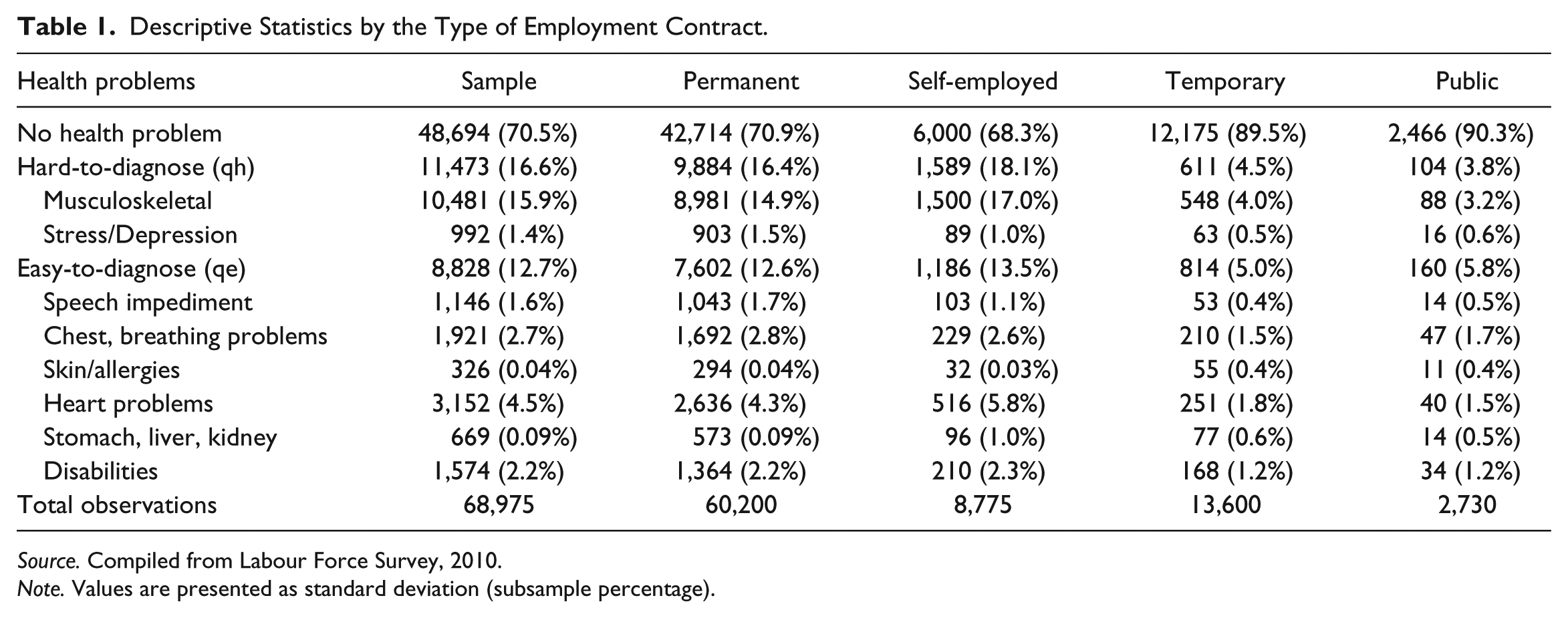
To create the dependent variable, I used data on health problems affecting professional activity. In particular, this variable compiled participants’ answers to the question “Do you have any health problem that affects the kind of paid work you might do?” and, in the case of an affirmative answer, the type of health problem was also collected (see Table 1). The U.K. Labour Force Survey (LFS) sample includes more than 120,000 individuals interviewed during the first quarter of 2010 and is fully accessible to the public.
Descriptive Statistics by the Type of Employment Contract.
Source. Compiled from Labour Force Survey, 2010.
Note. Values are presented as standard deviation (subsample percentage).
Health problems are classified into two groups, according to the condition to be diagnosed. The hard-to-diagnose (qh) variable includes all the individuals suffering from either a musculoskeletal or a stress/depression problem. The diagnosis of these health problems is a medical question studied, among others, by Wainwright, Calnan, O’Neil, Winterbotton, and Watkins (2006), for the relationship between musculoskeletal disorders and psychological biases, and by Pilgrim (2010), for the reporting of mental health problems. According to these studies, the correct diagnosis of both pathologies is especially difficult, as symptoms are not clearly visible and most of the information is obtained through the self-assessment of the patient. Furthermore, as Clarke and Cooper (2000) stressed, legislation provides guidelines for the risk assessment of physical hazard, while little guidance is given to assess the levels of occupational stress or depression.
All other health problem types are compiled into the easy-to-diagnose (qe) variable, as they are (more) easily observed by medical staff or employers. In terms of moral hazard modeling, I simply assumed that pathologies causing qh are harder to observe than pathologies causing qe, and therefore, the first will be more likely affected by moral hazard than the latter. A similar classification was adopted by Dionne and St-Michel (1991) and Bolduc, Fortin, Labrecque, and Lanoie (2002). Furthermore, Campolieti and Hyatt (2006) also found that compensation claims for back injuries and strains (hard-to-diagnose pathologies) increased on Mondays, and this may be explained by moral hazard problems on the reporting of these pathologies.
Table 1 shows the frequency of health problems by the type of employment: employee, self-employed, public employee, and temporary employee. As a preliminary result, we found that musculoskeletal problems were the most common health problem in the full sample (15.9%), and the prevalence was particularly high among the self-employed (17.0%). In apparent conflict with the moral hazard theory, health problem rates, including the hard-to-diagnose, for the self-employed were generally higher than for employees. In further contradiction, these rates were also lower for public employees. However, frequencies should be interpreted with care as different exposure to occupational risk factors was not controlled for each category.
The types of employment: Public employment definition
To test the hypothesis, we defined four types of employment: private permanent employees, public permanent employees, temporary employees, and self-employees. The categories are established and defined by the U.K.-LFS. The original sample has been restricted to individuals involved in paid work, so the inactive and unemployed were excluded.
Table 2 compares the distribution of the explanatory variables for the public employment and the full sample.
The Distribution of the Explanatory Variables: Sample Versus Public Employment.

Source. Compiled from U.K. Labour Force Survey, 2010.
Small differences were found for the occupational distribution of the public employment. In particular, [SOC 1] managerial occupations and [SOC 5] skilled occupations were faintly overrepresented while [SOC 2] professionals and [SOC 3] technical occupations were also slightly underrepresented. Stronger differences were found for the industrial distribution of public employment. In particular, regarding occupational risk, some high-risk industries, such as construction, were underrepresented, while other industries with high occupational risk, such as energy or social services, were clearly overrepresented in the public employment subsample. Regarding the remaining explanatory variables, the public sector employees were older and were more likely female, which is usually associated with higher prevalence of occupational health problems. On the contrary, public employees were more experienced, in average their tenure was 3 times longer, and therefore, their occupational risk may also be lower for that reason.
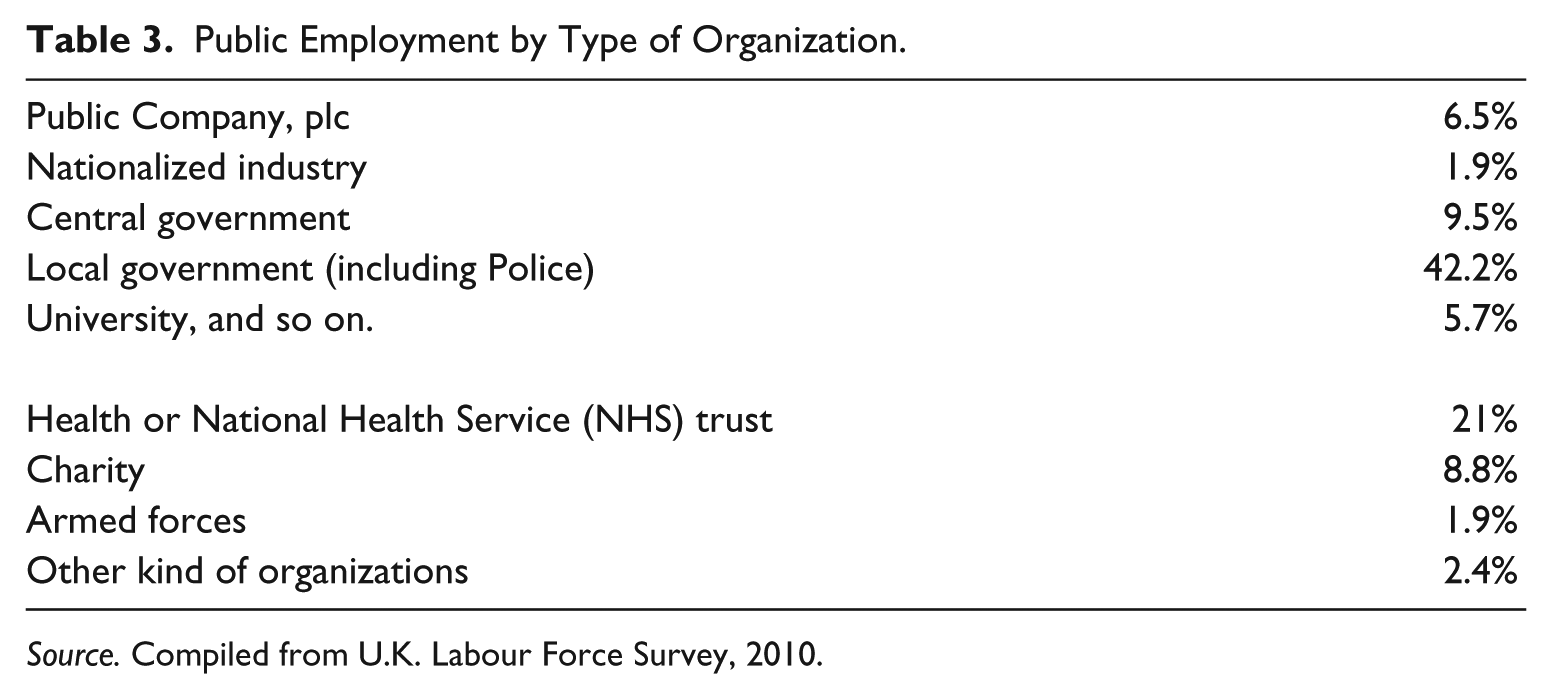
Table 3 shows the distribution of public employment by type of organization.
Public Employment by Type of Organization.
Source. Compiled from U.K. Labour Force Survey, 2010.
Around 50% of public employment was concentrated in the central and local government, while the remaining 50% referred to companies and organizations that belonged to the public sector, but were not integrated in the government. Some differences regarding the causes of moral hazard may arise between these two (board) types of organization. In particular, governmental agencies may be more affected by managerial endogamy (i.e., managers chosen among workers), while public companies may be more influenced by three-tier structures (e.g., tax payers/government/managers). Nevertheless, analyzing these differences was beyond the scope of this study and may be an interesting question to address in future research.
Model specification
The posited hypotheses were tested by estimating the likelihood of reporting a hard-to-diagnose pathology p(qh). Importantly for the model specification, easy-to-diagnose health problems (qe) were used as a proxy or latent variable for the inherent risk ϕ i of suffering a real pathology. The model specification was designed to account for differences regarding inherent risk associated to occupations, professions, or activities. The risk of working in some occupations in the public sector (e.g., health, education, or police) may be higher than working in other safer occupations such as a self-employed financial consultant. The opposite may also apply as some very risky industries such as construction or chemicals are usually run by private firms. We argued that such differences should equally affect easy-to-diagnosis pathologies and hard-to-diagnosis pathologies, and therefore, using the latter as a proxy of inherent risk, we could properly identify moral hazard. This procedure was similar to Gannon’s (2009) analysis that also used objective latent variables to control for reporting effects.
The basic model specification for hard-to-diagnosis pathologies is written as follows:

Where ϕ i is the level of inherent risk, measured with (qe), suffered by individual i, and the regressors (x) stand for observable variables related to the incentives to declare. As explained above, moral hazard within employment relations was estimated by including the following variables: self-employed (si), temporary (ti), and public employment (pui). In addition, k incentive-related control variables were considered. Wages were included as they may inhibit workers from cheating as their job becomes more valuable. Female workers usually suffer employment discrimination, and therefore, their bargaining power may be lower. Discrimination usually also affects immigrant workers, so British workers are able to enjoy better bargaining positions and may declare more hard-to-detect health problems. Finally, Tenure could reduce the likelihood of being fired, as firm-specific human capital grows with experience, increasing incentives to declare health problems.
Econometric methodology
The fundamental assumption for consistency of binary outcome models, whether declaring a health problem or not is a binary variable, is that the error term is unrelated to the regressors:
Bolduc et al. (2002) explained that the incidence of occupational health problems (inherent risk) may increase by means of ex-ante moral hazard. In particular, insurance covering financial and medical losses could diminish incentives to behave with care, augmenting the risk of accident or sickness. Turning to our specification, when inherent risk ϕ i and the model error term ui are not orthogonal or, in other words, are related by means of ex-ante moral hazard, the problem of endogenous regressors arises. If the assumption of orthogonality fails, the classic Logit and Probit binary outcome models will be inconsistent and estimates biased (Cameron & Trivedi, 2009)
In this analysis, endogeneity of inherent risk was tested by means of the Durbin–Wu–Hausman (DWH) test. This produces robust test statistics, even with heteroskedastic errors (J. Davidson, 2000). The null hypothesis of exogeneity was clearly rejected (DWH test = 732.78, p < .0001), leading to the conclusion that inherent risk, measured by the frequency of easy-to-diagnose health problems, was an endogenous regressor.
The usual solution to endogeneity is to define a set of instruments that are related to the endogenous variable while unrelated to the error term
The first condition, the strength of the relationship between these instruments and the occupational risk, has been firmly identified by previous literature (Messing, Courville, Boucher, Dumais, & Seifert, 1994). It is quite clear that general health status and the type of job will influence the risk of suffering an occupational health problem. However, regarding the second condition, it is possible that these instruments may also correlate with the error term, as, for example, accident insurance could vary from one region to another, or be more generous in some occupations than others. This is a common problem when defining instruments (Cameron & Trivedi, 2005) and will influence the choice of the estimation technique, discussed next.
The specified model was an over-identified instrumental model, where more instruments than endogenous regressors were included. All available instruments were used as, in theory, this leads to the most efficient estimator (Cameron & Trivedi, 2009). However, using unnecessary weak instruments could also generate problems such as sample bias and inconsistent estimates (Hahn & Hausman, 2002). Hansen’s test was used to check the validity of instruments. The null hypothesis was that all instruments were valid. This was the result for Hansen’s test, χ2(21) = 27.9278 (p = .1422).
Once the instrument’s validity was ascertained, the consistency of the estimators was guaranteed. However, if valid instruments are weak, estimations could be biased in finite samples (R. Davidson & MacKinnon, 2004). As mentioned above, weakness of the instruments in the analysis could be related to the possible correlation between instruments (z) and the error term in the structural equation (u). When weak instruments are present, the use of other than two-stage least squares (2SLS) estimators may provide more consistent results (Cameron & Trivedi, 2009).
In this analysis, three alternative estimators were used for the second-stage regression or structural regression. Table 3 shows results for ordinary 2SLS, generalized method of moments (GMM), and limited information maximum likelihood (LIML). The LIML estimator, less common, is based on the assumption of joint normality of errors in the structural and first-stage equations (Guggenberger, 2008). It is asymptotically equivalent to 2SLS, but recent research has found that LIML has some properties in finite samples when instruments are weak (Cameron & Trivedi, 2005).
Results
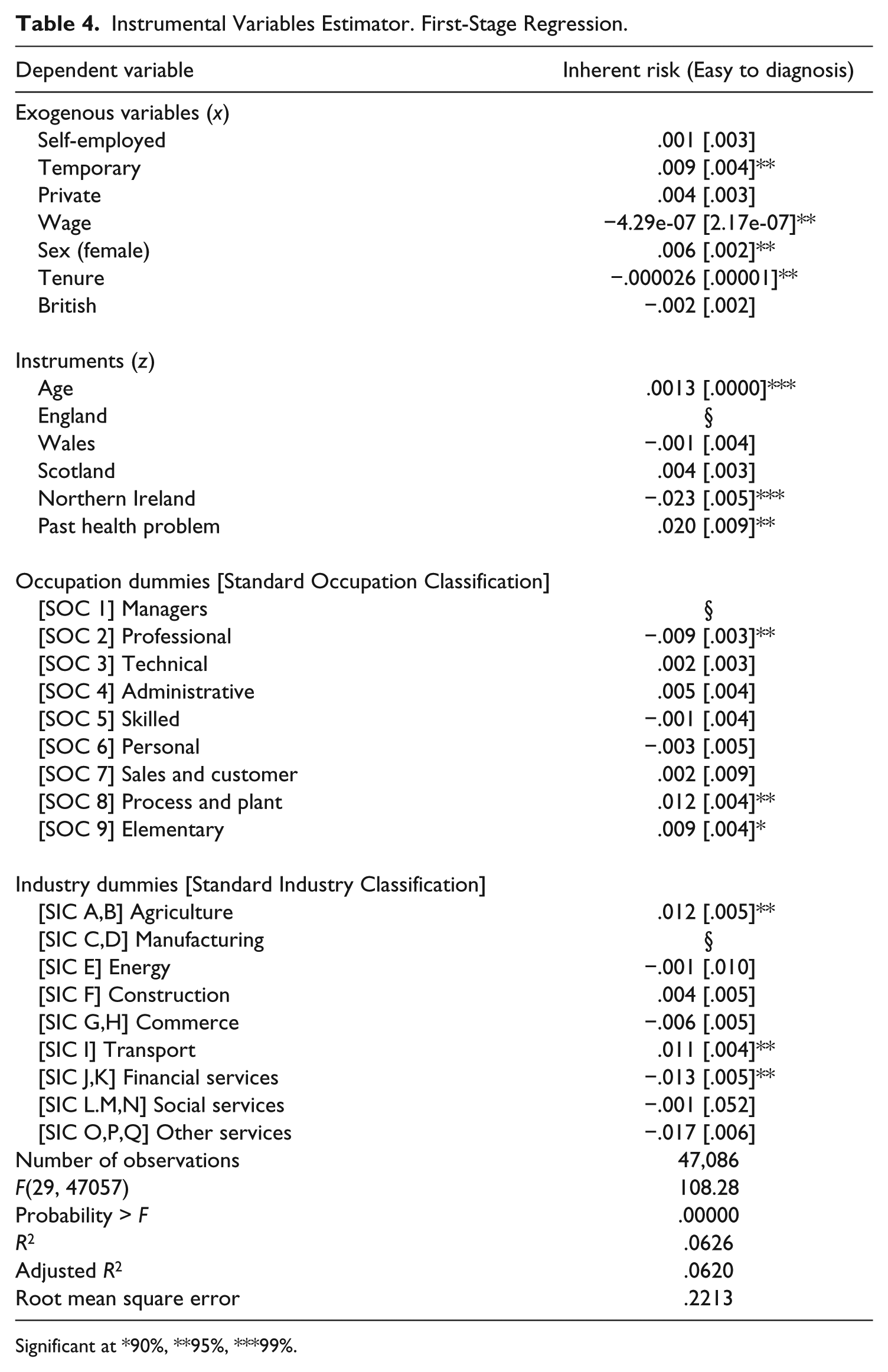
Results for the first-stage regression are shown in Table 4. At this stage, endogenous inherent risk (easy-to-detect health problems used as proxy) was estimated by means of a set of instruments. Goodness of fit measures confirmed the validity of the instruments (F = 108.28) in line with Hansen’s test results.
Instrumental Variables Estimator. First-Stage Regression.
Significant at *90%, **95%, ***99%.
Coefficients from the first-stage regression should be interpreted as the contribution of each factor to inherent occupational risk. Results showed that risk of suffering a “real” occupational health problem was positively related to temporary employment p = .009 and being female p = .006. However, high wages p = −4.29-e07, which usually ensure a better overall health condition, and tenure p = −.000026, which increases on-the-job experience, both reduced the likelihood of suffering an easy-to-detect health problem. Very importantly for the model, all proposed instruments were found to be significant.
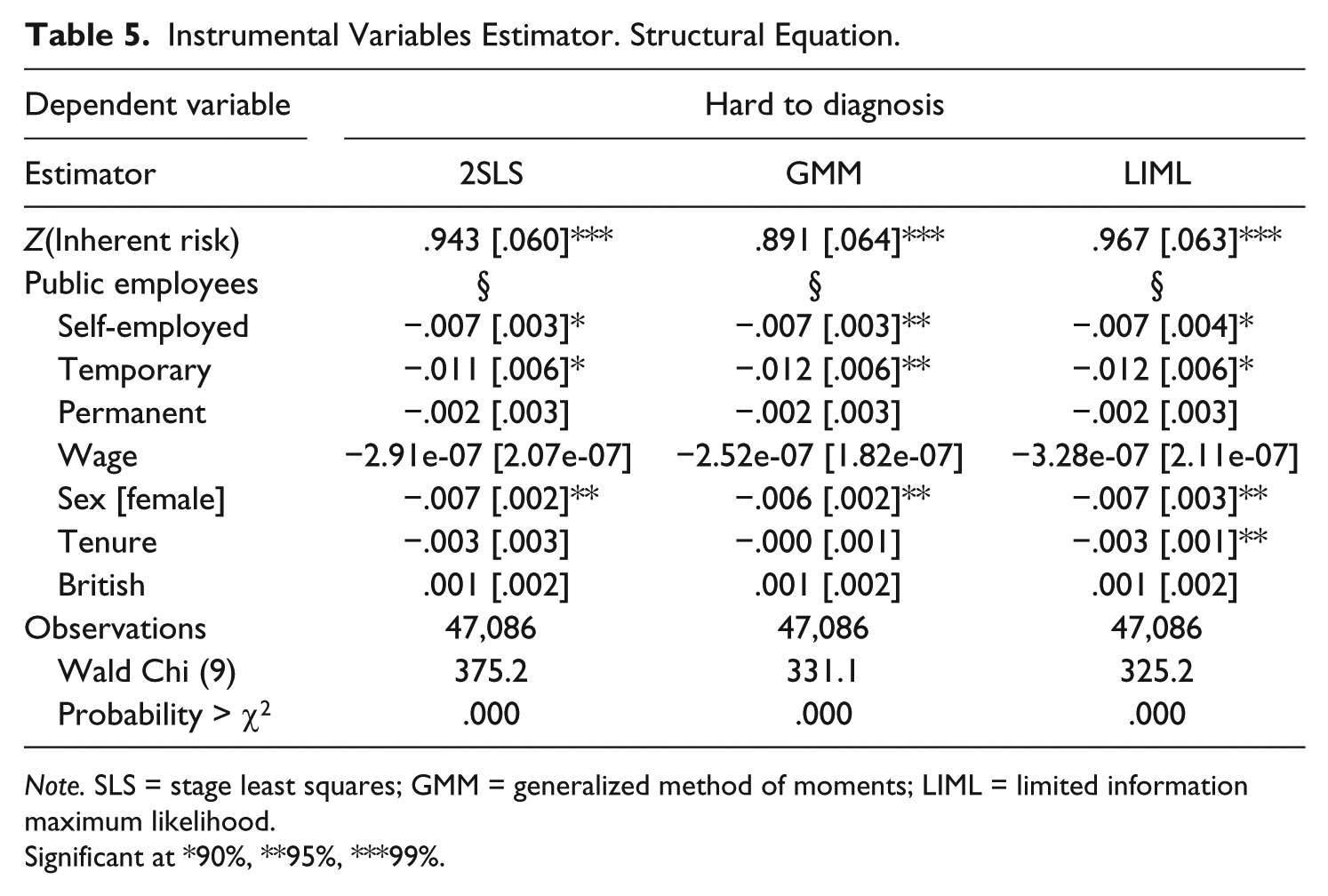
Results for the structural equation are listed in Table 5. As explained above, three instrumental variables (IV) estimation techniques were used to ensure robustness in the presence of weak instruments. The highest χ2 value was obtained from the least restrictive 2SLS model.
Instrumental Variables Estimator. Structural Equation.
Note. SLS = stage least squares; GMM = generalized method of moments; LIML = limited information maximum likelihood.
Significant at *90%, **95%, ***99%.
Instrumented, and therefore, unrelated with the error term, inherent risk was positive and significant. This merely indicates that the random component, given by the level of inherent risk associated with each individual, positively affects the likelihood of suffering a hard-to-detect health problem. In other words, results showed that stressors of, for example, chest and breathing problems (listed in Table 1) also contributed to the likelihood of hard-to-detect musculoskeletal and mental health problems.
Once endogeneity was controlled, the coefficients obtained for the incentive-related variables could be used to test the posited hypotheses. The first hypothesis was confirmed by the negative and significant coefficient obtained for the self-employed—2SLS (<90%), LIML (0% < 90%), and GMM (<95%). This provides reasonable evidence for the effect of moral hazard on the reporting of hard-to-diagnose health problems, as, holding the remaining factors constant, public employees declared more frequently than the self-employed.
Hypothesis 2 was also confirmed by the negative and significant coefficients found for the temporary variable. Holding other factors the same, the results showed that temporary employees will declare fewer hard-to-detect health problems than public employees. Following the arguments above, this finding confirms that the risk of unemployment is an effective control over the incentives to declare.
Finally, the results provide no support for the third hypothesis, as none of the estimated coefficients for public employment was significant. Hence, it cannot be argued that lower organizational monitoring, allegedly characteristic of the public sector, increased moral hazard, as the propensity to report hard-to-detect health problems was the same for employees of public and private firms.
Regarding the control variables, it was found that female workers declared fewer hard-to-detect problems. This may be explained by the precariousness of female employment, where contractual conditions are usually more insecure. This includes higher risk of unemployment, which, as argued above, could act as a discipline device on occupational health reporting.
Discussion and Conclusion
This article empirically analyzed the moral hazard problem affecting health reporting in the public sector. Very much in line with previous literature, the results show that moral hazard arises only when workers’ effort is hard to monitor, in difficult-to-diagnose pathologies, and when principal and agent do not share the same objectives (Shapiro, 2001). Furthermore, the results confirm that disciplinary devices, such as the risk of unemployment, do alter the level of moral hazard. However, contrary to our hypothesis, the analysis shows that opportunistic behavior affects the public sector in the same form and magnitude that affects the private sector.
There are two possible explanations to this evidence. First, the hypothesis of lower monitoring incentives in the public sector may be wrong. In recent years, the management of public organizations has changed rapidly to adopt some systems and procedures that used to be more common in the private sector. Performance payment, quality management, work flexibility or new supervision, and control mechanism, for example, have been consistently introduced (Hvidman & Andersen, 2014). Furthermore, Cho and Lee (2011) also found that in the public administration, the link between performance management and organizational perceived performance was significant and mediated by the role of trust in managers. In such cases, the alleged inefficiency of controlling employees may disappear, explaining our results.
Second, the lower monitoring incentives in the public sector may be compensated by moral hazard reducing factors. For example, some organizational parameters such as trust and fairness are increasingly popular in explaining some unexpected responses to the classical proposals of discipline and supervision. Some authors such as Williamson (1975) and Pfeffer (1994) argued that, in fact, lower supervision may produce some allegedly unexpected effects on workers’ efforts. In particular, voluntary effort may increase due to factors such as trust and cooperation, which could be obtained through lenient monitoring. Furthermore, Dixit (2002) stressed that some agents may get utility from some aspects of the task itself and, therefore, exert more effort given the same wage. He also argued that such agents are more likely to be employed in the public sector, as civil servants are more frequently driven by idealistic or ethical aims. Furthermore, literature on public service motivation states that prosocial motivation to help others is higher among public employees (Kjeldsen & Jacobsen, 2012), and as a result, the match between organizational and individual goals may also be stronger. Cho and Perry (2011) specifically found that intrinsic motivation was significantly associated with turnover intention of public employees. In line with this idea, this article finds that public employees are equally disciplined, even if arguably less monitored, in reporting hard-to-detect health problems. This raises new questions for investigation, such as the effect of vocation and social commitment on the attitudes of workers in the context of moral hazard.
There are some limitations to the analysis that are worth mentioning. First, the estimation of the moral hazard problem is based in the adequate control of the effect of inherent risk. In this article, we adopted the traditional approach of comparing the prevalence of some pathologies affected by moral hazard with some pathologies that cannot be affected by it. However, the model does not perfectly account for all the factors that might determine the risk associated to each specific industry, occupation, or profession. As such, some readers may be understandingly skeptical regarding the use of easy-to-diagnose health problems as proxy of inherent risk. This is a common and partially unresolved problem for the literature on health problem reporting. However, we also stress that the proposed methodology in this article, based on IV models, is based on traditional specification and, therefore, shares its strong and weak points. In addition, the IV approach does give a positive answer to some new relevant empirical issues such as the endogenity problem affecting inherent risk.
Second, to establish the “optimal” level of reporting, this article has taken the self-employed as the benchmark group, as they can accurately observe their health status. It is assumed that they will take the best rational option between staying at home or work. However, there are some reasons to believe that in some cases, for example, extreme economic need or risk proneness, some individuals, including the self-employed, may opt for an inappropriate level of risk. Butler and Worrall (1983), for example, stressed that workers were willing to undertake more risk when benefits were increased. Furthermore, in some cases, when safety bonuses or accident taxes are implemented, employees may be encouraged not to report accidents or injuries (Lanoie, 1994). In both cases, purely financial incentives may alter employees’ behavior, arguably increasing levels of occupational risk above the optimal. Employment conditions may, in some cases, generate some perverse incentives to work, while the deteriorated health condition of workers should then include advice to rest and recover. Furthermore, the mentioned problem of working while ill, known as presenteeism, has recently attracted the interest of numerous researchers and is starting to appear on the policy agendas of some governments (Hansen & Anderson, 2008). Nevertheless, few studies have addressed the problem of presenteeism in the public sector, and these studies found, for some specific occupations, that presenteeism may be affecting the public sector even more than the private sector (Ferreira & Martinez, 2012).
As a concluding remark, in light of the above, the primary unequivocal measure to be taken to improve the reporting mechanism would be a more precise definition of occupational health problems. This is particularly applicable to musculoskeletal and mental health problems, where there is no unanimous and unambiguous set of pathologies and symptoms to be monitored. Medical research and social agreement regarding the ideal condition to work is necessary to tackle the negative consequences of moral hazard on health reporting.
Footnotes
Declaration of Conflicting Interests
The author declared no potential conflicts of interest with respect to the research, authorship, and/or publication of this article.
Funding
The author(s) disclosed receipt of the following financial support for the research, authorship, and/or publication of this article: The author acknowledges the financial suport from the Spanish Ministry of Economy and Competitiveness (project ECO2013-46954-C3-1-R).