



Abstract
This article reports the results of a survey designed to assess the extent to which public administrators are knowledgeable of federal Equal Employment Opportunity (EEO) law. Findings suggest that there is significant variation among county administrators and department heads in their levels of knowledge, and that they are more familiar with Title VII of the Civil Rights Acts of 1964 than they are with other laws examined. Those who have had employment law training, who hold a Master of Public Administration (MPA) degree, and who serve as human resources directors are more knowledgeable than others. Female administrators are more knowledgeable in some aspects of the law than their male counterparts.
After decades of struggle to ensure employment equity in the public sector, we may assume that public managers clearly understand prohibitions on employment discrimination. Whether this assumption is accurate, however, remains an open empirical question. 1 Efforts to improve race relations and curb instances of discrimination have been undertaken, and much progress has been made over the years, but there is still room for improvement. 2 It is useful, therefore, to gauge public managers’ understanding of employment discrimination law and to clarify those factors that might help improve understanding. This is the purpose of the research reported in this article.
Our inquiry is grounded on an assumption that a general understanding of and adherence to the law is an essential element of professional competence for public managers, and that knowledge of the law in the area of Equal Employment Opportunity (EEO) policy is particularly important. The public administration literature argues that legal knowledge in general, and knowledge of EEO law in particular, provides a foundation for public managers to protect public values, enhance public workforce diversity, and insulate public organizations from liability. Our position regarding the importance of public managers’ legal knowledge builds upon the relevance of knowledge of EEO law to these three areas: public values, public workforce diversity, and public organizational liability.
The law announces public values that managers are then required to observe and defend. Bowman, West, and Beck (2010) argue that the law establishes “basic values or principles” that public administrators must follow and mandates how administrators “conduct their job[s]” (p. 43). Moe and Gilmour (1995) offer a more expansive view of the relevance of law for public managers and mark public law as the “foundation” of public administration (p. 136). They maintain that the loss of a public law tradition in public administrative theory has inhibited public managers’ ability to link theory and practice and has left the field susceptible to a loss of legitimacy (Moe & Gilmour, 1995). David Rosenbloom (2013) underscores the integration of managerial, political, and legal values in contemporary public administrative practice. In addition, public managers hold an important position in ensuring that public law values extend to public services that are provided by private or non-profit organizations (Rush & Zingale, 2015). Given these examples of the law’s central role in establishing and maintaining public values, it should not be surprising that the public administration literature also calls for training in the law to be a key part of a public administrators’ professional education (Rosenbloom, 1984).
One value reflected in the law is workforce diversity. Knowledge of EEO law provides public managers with a justification for public workforce diversity both through direct proscriptions against employment discrimination and through a framework for inclusion. Federal EEO statutes such as Title VII of the Civil Rights Act of 1964 (42 U.S.C. 2000e, et seq.), the Age Discrimination in Employment Act (ADEA) of 1967 (29 U.S.C. 621, et seq.), and the Americans With Disabilities Act (ADA) of 1990 (42 U.S.C. § 12101, et seq.) protect applicants and employees from racial, ethnic, sexual, age, and disability discrimination. In doing so, these statutes guide many of the decisions made by public managers with authority over hiring, promotions, work assignments, and employee discipline (Battaglio, 2015). A failure to know and follow EEO law could damage efforts to augment diversity in the public workforce and, in turn, could make government less responsive to the interests of diverse constituencies (Chambers & Riccucci, 1997; McKay & Davis, 2008; Meier, 1993; Nishishiba, 2012; Rangarajan & Black, 2007; Riccucci, 2002; Riccucci & Saldivar, 2014; Rice, 2007; Selden, 1997; Soni, 2000).
In addition, public administrators who are unfamiliar with requirements of EEO law may place themselves and their organizations at risk for statutory civil rights violations and significant penalties (Gutman, 2000). 3 French (2009) stresses the value of EEO knowledge in avoiding liability when he states, “Numerous aspects of the day-to-day operations of local governments are subject to legal scrutiny; public managers and officials must be keenly aware of the legal rights and protections that extend to both citizens and employees of local governments” (p. 92). Furthermore, previous work has acknowledged that local government administrators see Title VII employee protections as significant concerns (MacManus, 2003, p. 179), but it is unclear how well these administrators actually know this statute and other laws prohibiting discrimination.
Our objective is to begin the process of finding an answer to that question. In doing so, we study public administrators in county government. We find this focus valuable, in part, because of the rise in county government responsibilities and visibility in recent years and the fact that there is a need for further analysis of administration at the county level. In the mid-1990s, Svara (1996, p. 109) observed that there is a “tremendous imbalance” between our knowledge of leadership and professionalism in cities and our understanding of those concepts in counties (see also Benton, 2005; Menzel et al., 1992). More recently, Benton and colleagues noted an enduring shortage of research on county government and a need for further examination of county administration (Benton et al., 2007).
This article first addresses briefly the importance of EEO law to the practice of public administration. Next, we introduce a survey designed to measure the understanding of EEO law by county administrators and department heads in the state of Georgia, a state where this analysis may be particularly interesting since political leadership in the state stood firmly in opposition to civil rights legislation in the 1960s. 4 We review our findings regarding the understanding of EEO law by Georgia county administrators and department heads and develop a model to examine determinants of that understanding. We conclude with a discussion of the implications of our study and possible directions for further research.
EEO Law and Public Administration
In many respects, Title VII of the Civil Rights Act of 1964 is the foundation of federal EEO law. This is the first statute we examine. Title VII prohibits employment practices that discriminate on the basis of “race, color, religion, sex, or national origin.” By judicial interpretation, not only is overt and intentional discrimination (i.e., disparate treatment) prohibited, but the law may also proscribe acts that appear on their face to be neutral, and are even neutral in intent, but that nevertheless operate to disadvantage people distinguished on the basis of race, ethnicity, religion, or sex (i.e., disparate impact). Employment decisions that are facially neutral or neutral in intent may still adversely affect groups of people defined in terms of characteristics such as race or sex. Decisions of this nature are permitted only when an employer can show that they serve a business necessity, and the courts impose a high standard of evidence to meet such an exception. For example, examinations for employment selection that disproportionately exclude women or members of racial or ethnic minority groups will be in violation of the law unless it can be demonstrated that they are, in fact, valid selection tools that identify qualified job candidates. Riccucci and Saldivar consider the impact of such employment examinations in their 2014 analysis of local government public safety employment discrimination suits. The authors describe the lack of minorities and women represented in police, especially fire departments nationwide, and detail the challenges associated with working to remedy underrepresentation, suggesting that employers who seek to increase minority and female representation may subsequently face liability from claims of reverse discrimination (Riccucci & Saldivar, 2014).
Title VII also prohibits all forms of sexual harassment, including practices that may create an unwelcoming or hostile work environment, and the law forbids employers from retaliating against employees for filing sexual harassment claims. In addition, Title VII was amended in 1978 to prohibit discrimination against women because of pregnancy.
When Title VII was originally passed, it applied to employers and labor organizations with 25 or more employees in the private sector only. Following passage of the EEO Act of 1972, local, state, and federal government departments and agencies have also been covered. Accordingly, a public administrator who violates Title VII may subject their organization to liability. 5
The second statute we observe is the ADEA of 1967. This law is intended to protect older workers who might otherwise be subject to layoffs or terminations as employers seek younger and less expensive workers. Like Title VII, the law applied only to private sector employers and labor organizations originally, but it was extended in 1974 to cover local, state, and federal government employers. The ADEA originally protected employees and job applicants between the ages of 40 and 65, but now protects all workers 40 years of age and older. The ADEA prohibits discrimination against older workers in hiring, promotions, wages, benefits, terminations, and layoffs.
Finally, we consider the ADA of 1990. The ADA is landmark legislation intended to curtail discrimination against individuals with mental or physical impairments. Specifically, the law, which applies to private employers as well as state and local government employers, prohibits discrimination against otherwise qualified disabled persons who can perform the essential functions of a job with (or without) reasonable accommodations. The basis for the ADA was the Rehabilitation Act of 1973 (29 U.S.C. 701, et seq.). That law prohibited discrimination against qualified disabled persons by federal government agencies, federal contractors, and recipients of federal financial assistance (Kellough & Gamble, 1995). The ADA applied anti-discrimination provisions of the Rehabilitation Act to private sector employers with 15 or more employees regardless of whether they receive federal contracts and to all state and local governments regardless of their size or whether they receive federal assistance.
Under the ADA, employers must, among other things, make certain that disabled individuals have full access to the application process, ensure that examination procedures to screen job applicants are designed to test job-related skills and abilities, refrain from asking about the presence of disabilities or medical conditions during interviews, make certain that job descriptions identify essential job duties, make work facilities accessible, and require medical examinations only after conditional job offers are made. Employers may refuse to hire or promote a disabled person when that person does not possess the qualifications necessary to perform essential job duties with (or without) a reasonable accommodation or if the individual would pose a direct threat to the health or safety of other employees. Whether an accommodation is reasonable or not will depend on whether it imposes an undue hardship on the employer. Ultimately, the extent to which an undue hardship is created and the degree to which the presence of a disabled person in the workforce poses a direct threat to the health or safety of other workers are matters to be resolved by the courts. Because of the range of constraints found in the law, officials who are unfamiliar with its requirements could easily create problems for themselves and their organizations.
Collectively, the three statutes we examine provide the central elements of employment non-discrimination policy established by federal authority. They form the fundamental core of public policy intended to ensure that all employees and all applicants for employment are treated fairly. Government managers have not only a legal obligation to follow these laws but a moral obligation as well because government should set an appropriate example for the private sector. A failure by a public manager to comply with these laws will damage principles of EEO and, as we have argued, will expose government jurisdictions to costly litigation. Because compliance with these laws is so important, it is crucial for us to know whether public managers understand them and what factors are associated with varying levels of understanding.
Measuring Knowledge of EEO Law
To examine public managers’ understanding of the statutes specified above, we draw upon data from a survey of county administrators and department heads in each of Georgia’s 159 counties. Taken in concert, several analyses support the value of including many different supervisory positions when examining county managers’ levels of employment law knowledge. Both French (2009) and Buford, Lindner, and Montoya (2002) present cases that highlight the potential for local government liability stemming from actions taken across the organization. French (2009) describes incidents at the departmental level that violate EEO law and lead to judicial decisions against local governments. His cases describe multiple instances where departmental-level incidents involving interviewing and selection led to local government liability for EEO violations (French, 2009). Buford and coauthors (2002) assert, “Understanding and complying with these mandates is a shared responsibility of human resources and line management, and the consequences of meeting this responsibility are very serious” (p. 44). In addition, Selden (2005) employs Government Performance Project (GPP) data to assess county managers located across all regions in the United States. Her findings suggest that human resources responsibilities are shared in counties with interviewing, selection, and discipline often being the responsibility of the line manager (Selden, 2005).
Our survey asked respondents to evaluate 22 statements addressing issues that formed the basis for actual federal court cases in Georgia involving Title VII of the Civil Rights Act of 1964, the ADEA of 1967, and the ADA of 1990 (see Table 1). Statements involving these statutes were developed in proportion to each statute’s prevalence in litigation. For each survey statement, respondents were asked to indicate whether they were completely certain the statement is false (coded 1), somewhat certain the statement is false (coded 2), somewhat certain the statement is true (coded 3), or completely certain the statement is true (coded 4). Collectively, the statements provide a basis for a test of our respondents’ knowledge of the law. The modified Likert-type scoring enables us to assess the respondents’ substantive understanding of the law and the relative confidence they have in their opinions. We believe that it is important to know not only how well these county government administrative leaders know the law but also how certain they are of their views (whether those views are correct or incorrect). The final section of the survey requested information about the respondents’ individual characteristics such as sex, race, and date of birth as well as information related to their education, practical experience, and professional training.
Certainty of Knowledge of EEO Law (N = 504).
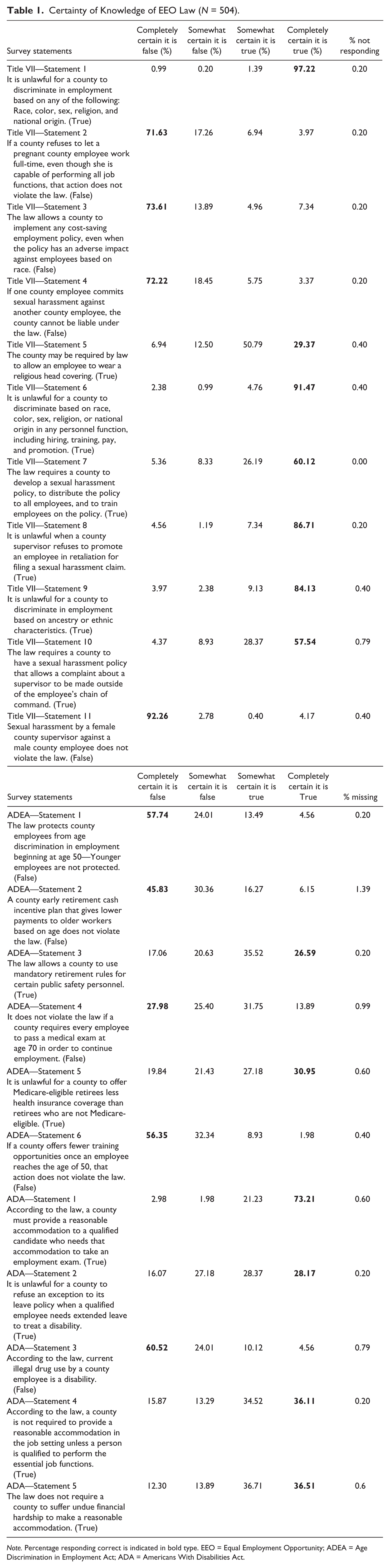
Note. Percentage responding correct is indicated in bold type. EEO = Equal Employment Opportunity; ADEA = Age Discrimination in Employment Act; ADA = Americans With Disabilities Act.
Survey implementation proceeded according to recommendations contained in Dillman’s widely utilized text on survey methods (Dillman, Smyth, & Christian, 2009). All items were initially pretested with a group of current and former local government administrative practitioners from Georgia but outside of the county administrator/department head respondent pool. To further ensure the adequacy of the instrument, the survey was also pretested with county administrators and department heads from Alabama where county government administration is similar to that in Georgia. Each of these pretest subjects received a fully formatted version of the cover letter and survey, to closely duplicate the actual survey respondents’ experience.
Based on results of the pretests, a final draft of the survey instrument was developed and delivered to 798 county administrators and department heads in all Georgia counties in October 2008. In each county, surveys were sent to the following individuals (where the positions existed): (a) the County Administrator, (b) the Human Resources Director, (c) the Sheriff, (d) the Planning and Zoning Director, (e) the Finance Director, (f) the Public Works Director, and (g) the Parks and Recreation Director. 6 To increase the likelihood that surveys would reach the intended recipients, we partnered with several Georgia county organizations and with the University of Georgia’s Carl Vinson Institute of Government. The Association of County Commissioners of Georgia, the Georgia Recreation and Parks Association, and the Georgia Government Finance Officers’ Association all provided assistance in developing an accurate list of recipient names and addresses. In addition, the Association of County Commissioners of Georgia announced the survey on their website and through their listserv of Georgia County elected and appointed officials with the goal that the endorsement of this well-known and respected organization would motivate county administrators and department heads to respond. The Georgia Local Government Personnel Association emailed all of their county members a message that described the survey and emphasized the value of their input. The Executive Director of the Georgia Recreation and Parks Association mailed each member an individually signed letter, on organization letterhead, that announced the survey, described the survey goals, and requested their participation.
Survey respondents were promised confidentiality rather than anonymity, so that non-respondents could be tracked. Because research has demonstrated that repeated communication with survey recipients using different methods of contact will increase survey participation (Dillman et al., 2009), we followed that procedure. All subjects received an initial introductory letter and survey instrument by first-class mail. A total of four additional follow-up mailings and a final round of phone calls were then made to non-respondents over an 8-week period. Usable responses were received from 504 respondents for a response rate of 63.16%. 7 Respondents were drawn from 150 (94%) of Georgia’s 159 counties.
Our first objective is to simply examine response patterns on the 22 items designed to test Georgia county administrators’ and department heads’ understanding of federal EEO law. This analysis will provide insight into how well these individuals know the law and how certain they are of their knowledge. We create separate summary measures of the respondents’ expertise in the law for each of the statutes we examine: Title VII, the ADEA, the ADA, and a composite measure of the overall understanding of all three federal laws. For example, our survey contained 11 test statements related to an understanding of Title VII (see Table 1). Statements 2, 3, 4, and 11 in that section of the survey are false, and in those instances response codes were reversed so that higher codes for all items represented greater certainty in the correct understanding of the law. We then simply summed the response codes for each respondent for all 11 items producing a summary measure that could range from 11 to 44. We subsequently subtracted 11 from each score to produce a measure with scores ranging from 0 to 33. Higher scores reflect a greater understanding of Title VII and more certainty in that understanding. Because each item was drawn from an actual federal court case in Georgia, and because a failure to properly understand any item could result in litigation and legal liability, our procedure weighs all items equally. 8
Measures were created in the same fashion for the six test items in the survey addressing issues related to the ADEA of 1967. In this section of the survey, Items 1, 2, 4, and 6 are false and were reverse coded to produce a measure with scores ranging from 0 to 18. A similar process was followed for the five test items that addressed the meaning of the ADA (producing a measure ranging from 0-15) and for all 22 items considered collectively (producing an overall measure ranging from 0-66). In the section on the ADA, Item 3 is false and was reverse coded for construction of our measure. 9 The fact that all of the items were drawn from actual federal court cases in Georgia provides content validity for our measures.
Determinants of Knowledge of EEO Law
In addition to assessing the extent of understanding of EEO law by county administrators and department heads, and the confidence with which they express their understanding, we work to identify possible determinants of their knowledge of the law. In considering the theoretical basis for factors that may be important in explaining varying levels of knowledge of EEO law as we measure it, we looked in part to general propositions drawn from the literature in psychology and education on learning theory. 10 More specifically, we drew on insights from constructivist theories, suggesting that knowledge is most easily acquired when it is associated with or related to previous experience or an existing knowledge base and context (Leonard, 2002). In other words, from this theoretical perspective, knowledge is constructed on a foundation of prior knowledge and experience. Individuals make sense of new information in the context of what is already known (see, for example, Leonard, 2002; Merriam, Caffarella, & Baumgartner, 2007; Ormrod, 1999).
With this literature on learning theory as a foundation, we identified several factors that we expect to be associated with higher or lower levels of knowledge of EEO law, including the extent to which counties have experienced previous charges of discrimination and lawsuits, the individual backgrounds or demographic characteristics of administrators such as exposure to training and educational levels, the race and sex of the administrators studied, and finally, the financial resources available in each county which we believe could be important as those resources are often positively associated with the presence of a more professional administrative workforce.
Because the challenge of potential liability from charges of discrimination and lawsuits filed against county governments is significant, we expect that experience with formal allegations of discrimination will foster an awareness of the meaning of such laws. Consequently, we assume that counties where allegations have been made previously will work to ensure that their administrators know the law and will, as a result, have more knowledgeable employees. To measure the extent to which previous charges of discrimination occurred, we obtained data on the number of Equal Employment Opportunity Commission (EEOC) charges and the number of federal employment discrimination lawsuits filed against each Georgia county for a 10-year period (1997-2007) prior to our survey. Again, we expect a positive association between each of these variables and knowledge of the law observed subsequently in late 2008 because the experience of dealing with EEOC charges or litigation will underscore the importance of the statutes at issue for the administrators in our sample. 11 We include only those cases where it is claimed that a county, as the employer, violated Title VII, the ADEA, or the ADA. By observing EEOC charges and federal lawsuits over a 10-year period prior to our survey, we ensured that there would be variation in the number of cases across the counties in our sample. For instance, with regard to EEOC charges, the number observed in our respondents’ counties ranged from 0 to 420 for the period from 1997 to 2007. The mean number of charges reported was 24.28. The number of federal lawsuits ranged from 0 to 69 in our counties during the 10-year period examined, and the mean number of lawsuits was 4.21. Obviously, one can anticipate more charges and lawsuits in counties with larger populations, so we measure both variables on a per capita basis (i.e., charges or lawsuits per 1,000 county residents). 12 In addition, because the number of EEOC charges and the number of federal lawsuits filed are strongly correlated, we include these variables in separate models and run two sets of regressions, first with our measure of EEOC charges included as an independent variable and then with federal lawsuits included. Stated formally, our first hypotheses are as follows:
We also expect that there are several characteristics of individual managers that may reflect their experience and influence the extent of their learning and understanding of EEO law. For example, the technical skill necessary to effectively manage public organizations is often the product of technical training, on-the-job experience, and formal education (Bowman et al., 2010). Two variables of particular interest with respect to technical training are (a) previous participation in employment law training and (b) possession of professional certification in human resources management. These types of preparations should sensitize managers to the nuances of the law on EEO. We asked our survey respondents to indicate whether they have participated in training on employment law and created a dichotomous variable scored 1 if the respondent had such training and 0 otherwise. Among our respondents, 285 indicated that they had experienced employment law training, and 216 had not participated in such training. We similarly measure possession of professional certification related to public human resource management practice with a binary variable coded 1 for a manager or department head who had received human resources–specific professional certification and 0 otherwise. 13 Thirty-nine of our respondents possessed such certification, whereas the remainder did not have the certification. We hypothesize that previous employment law training and possession of human resources management certification will be positively associated with knowledge of EEO law. These hypotheses can be stated formerly as follows:
We also anticipate that an understanding of EEO law will be further enhanced through the accumulation of on-the-job experience. In this regard, we include three variables: (a) years of total managerial experience in the public sector; (b) length of tenure in the current position, and because some respondents may have moved to the public sector mid-career; (c) previous managerial experience in the private sector (coded 1 if the manager has such experience and 0 otherwise). Because we believe that government may generally be more sensitive to EEO matters than typical private sector organizations, given that public jobs are valuable public resources (see Kellough, 1989, 2009), we expect that the first two of these variables (measuring time spent in a public sector career) will be positively associated with knowledge of EEO law. The reported years of total managerial experience in the public sector ranged from 0 to 58, with a mean of 20.95. The observed length of tenure in the current position ranged from 0 to 36, with a mean of 8.89. We expect that the third variable (reflecting experience in the private sector) will be negatively associated with that knowledge. Among our respondents, 203 had private sector experience, and 298 were experienced only in the public sector. We control additionally for the extent to which the respondents’ primary job responsibilities are in the field of human resources management by coding managers 1 if they are the “Human Resources Department Head” (or they have a similar job title) and 0 otherwise. We believe that managers with such job titles and responsibilities will have greater knowledge of EEO law than other managers. Sixty-one of our respondents were Human Resources Directors, while 443 had other kinds of positions. These variables led us to the four formal hypotheses specified below:
With regard to formal education, we expect that graduate education related to public administration will provide a foundation of knowledge that will provide a basis for the further development of professional administrative expertise. We therefore observe whether managers possess a Master of Public Administration (MPA) or a similar degree on the assumption that completion of an MPA will be positively associated with a manager’s familiarity with the EEO laws examined in this study. Those with MPA degrees are coded 1, and those without are coded 0. Among our respondents, 41 held MPA degrees, and 458 did not possess that degree. Thus, we assess the following hypothesis:
We also include in our models a binary variable for the respondent’s sex (female = 1, male = 0) and for race/ethnicity (minority = 1, non-minority = 0). Research into representative bureaucracy suggests that a female or non-White county administrator or department head may be sensitized to issues that affect individuals who share their demographic backgrounds (e.g., Meier, 1993; Selden, 1997). As a result, we presume that female and minority administrators may have a greater interest in and a greater knowledge of the law that protects against discrimination based on sex or race than non-minority or male administrators. For our analysis, respondents are coded as minorities if they represented their racial or ethnic identity as African American, Hispanic, Asian American, or Native American. In our group of respondents, 126 were female and 376 were male. Forty of our respondents were from minority racial or ethnic groups (primarily African American), and 461 were White. Our formal hypotheses are as follows:
Finally, the literature on county government operations suggests that the level of resources available to a county government will be positively related to the professionalism of its administrators. Benton (2005), for example, found that the level of wealth in a county was positively associated with professional county government performance. Because counties that are wealthier may be expected to have larger budgets and a greater capacity to compensate managers, we expect that those counties will have more professional administrators and part of that professionalism will include higher levels of knowledge of the law. Consequently, we believe that the size of the county budget, measured in 2007, will be positively related to the employment of managers knowledgeable of federal EEO law in 2008. The budgets observed ranged from less than US$1 million to more than US$59 million. The mean budget size was US$3.17 million. Our hypothesis for this variable is specified as follows:
Our measures of respondents’ understanding of EEO law are regressed on the variables specified above. The models are estimated with ordinary least squares (OLS) and are run first with EEOC charges included, and then rerun with federal discrimination lawsuits included.
The models are specified as follows:

where y = knowledge of EEO law, X1 = EEOC charges per 1,000 capita or federal cases filed per 1,000 capita, X2 = participation in employment law training, X3 = human resource–related professional certification, X4 = years of total management service in the public sector, X5 = years in current position, X6 = previous managerial experience in the private sector, X7 = human resources department head, X8 = MPA degree, X9 = female, X10 = racial or ethnic minority, X11 = 2007 county budget in millions of dollars, and ε = an error term.
Findings and Discussion
Our results provide interesting insight into levels of knowledge of EEO law among county administrators and department heads. We first observe the extent of that knowledge and how it varies among administrators and across the laws examined. We then turn to our regression models for an assessment of the impact of the variables specified earlier on the knowledge of the law from Title VII, the ADEA, and the ADA measured individually for each law and collectively across all three of the laws.
Response Patterns
Table 1 provides the distribution of responses to our survey items regarding Title VII, the ADEA, and the ADA. Following each statement, there is an indication of whether the statement is true or false. The next four columns show the distribution of responses, and the final column shows the proportion missing (which is typically less than 1%).
Our first observation is that our respondents appear to know the general requirements of EEO law relatively well, but they have a considerably better understanding of Title VII than they do of the ADEA or the ADA. This is not entirely surprising as Title VII forms the bedrock of non-discrimination law and is the oldest and perhaps most visible of the laws examined. When reviewing individual statements in Table 1, we see that more than 97% of those responding to our survey were “completely certain” that under Title VII “It is unlawful for a county to discriminate in employment based on any of the following: race, color, sex, religion, and national origin” (Statement 1). We believe that even a rudimentary understanding of the law should include certain knowledge that this statement is true; however, we note that more than 3% of our respondents indicated that the statement was false.
When we consider slightly more nuanced aspects of the law, understanding of Title VII declines. This is particularly troubling as it is frequently true of survey items that address sexual harassment. For example, only approximately 60% of our county administrators and department heads indicated that they were “completely certain” that “the law requires a county to develop a sexual harassment policy, to distribute the policy to all employees, and to train employees on the policy” (Statement 7). It is also a concern that less than 87% of the administrators and department heads surveyed were certain of the knowledge that “it is unlawful when a county supervisor refuses to promote an employee in retaliation for filing a sexual harassment claim” (Statement 8). Comparable results are found also for other statements.
When we shift our focus to the ADEA, the understanding of public administrators surveyed is, as noted above, noticeably lower than knowledge of Title VII. For instance, less than 28% indicated that they were “completely certain” of the fallaciousness of the statement that “it does not violate the law if a county requires every employee to pass a medical exam at age 70 in order to continue employment” (Statement 4). Likewise, only approximately 31% of the administrators and department heads responding were “completely certain” of the truth of the statement: “It is unlawful for a county to offer Medicare-eligible retirees less health insurance coverage than retirees who are not Medicare-eligible” (Statement 5). Other statements have similar responses.
There is additional cause for concern when it comes to issues that may arise from the ADA. The first item from this section of the survey is a true statement reflecting a central aspect of the ADA: “According to the law, a county must provide a reasonable accommodation to a qualified candidate who needs that accommodation to take an employment exam” (Statement 1). Most disturbing is the finding that 25 of the responding county administrators and department heads (approximately 5%) were either “somewhat” or “completely” certain that the statement is false. The county managers and department heads included in our study were queried during the 2 months immediately after enactment of the Americans With Disabilities Act Amendments Act (ADAAA) and just before those amendments went into effect on January 1, 2009. These new amendments placed additional emphasis on an employer’s responsibility to provide a reasonable accommodation, and analysis has argued that the ADAAA’s requirements remain unclear (Rush, 2012). Our findings here raise additional concerns over whether county managers are fully aware of their responsibilities.
Regression Results
We now turn to the models designed to give us insight into factors that may account for variation in the knowledge of EEO law exhibited by our respondents. Table 2 provides results for our models with EEOC charges included as an independent variable. The variable that appears to have the most consistent positive effect on knowledge of EEO law is exposure to employment law training. Recall that this variable is a dichotomy scored 1 if the respondent ever participated in such training and scored 0 if training was never experienced. The variable is significant in each of the four models specified. Importantly, this variable does not measure the extent of or length of the training. The fact that this rudimentary measure is a significant determinant of knowledge of EEO law in all four models suggests that training in employment law should be an essential part of the training of all county administrators and department heads.
Regression Results for Models With EEOC Charges.

Note. Unstandardized coefficients, standard error in parentheses. EEOC = Equal Employment Opportunity Commission; ADEA = Age Discrimination in Employment Act; ADA = Americans With Disabilities Act; HR = human resources; IV = independent variable; DV = dependent variable.
p < .05. **p < .01. ***p < .001.
It is also important to note that those survey respondents with MPA degrees are also significantly more likely than others to be knowledgeable of EEO law. This variable is significant in all models, except the one in which knowledge of the ADEA is the dependent variable. The impact of having an MPA degree is most likely present because MPA typically includes training in personnel management and EEO as part of the core curriculum. Why it is insignificant in the ADEA model is unknown, but it may be that the ADEA receives less attention in the classroom than the other statutes.
We also find that respondents who are HR directors are significantly more likely than others to know EEO law, as we expected. The coefficient on this variable is significant and positive in all of our equations in Table 2, except for the one in which Title VII is the dependent variable. As noted earlier, Title VII is probably the most visible of the laws we examine, so the advantage in understanding typically exhibited by HR directors may not be present when it comes to that law.
It is also interesting that the variable for sex (female) is positive and significant in the Title VII equation and in the equation for overall knowledge. This suggests that managers who are women are, on average, at least somewhat more knowledgeable than men of the law.
All other variables in the models fail to achieve significance. For example, contrary to our expectations, a county’s history of EEOC charges during the preceding 10-year period apparently has no effect on how well county managers and department heads understand EEO law. The variable fails to achieve statistical significance in any of the equations. From this result, it appears that administrators in counties with more experience in dealing with EEOC charges alleging discrimination during the 10 years prior to our survey are on average no more knowledgeable of EEO law than administrators in other counties. Apparently little is learned in counties where there is a history of higher rates of discrimination allegations. Of course, we should remember that not all allegations of discrimination have merit, and we have no data on the proportion of charges where there were findings of discrimination. Nevertheless, it may well be that lower levels of knowledge during the decade prior to our survey produced the higher rates of charges and those lower levels of knowledge persisted at the time of our survey. The coefficient on the variable is negative, albeit insignificant (see Note 11).
Similarly, minority administrators do not appear to be any more knowledgeable of the law than non-minority administrators, although we acknowledge that minorities are a relatively small proportion of our sample. In addition, HR certification and the other remaining variables (years in the public sector, years in position, private sector experience, and county budget) have no significant effects on levels of knowledge.
Our equations with federal court cases filed in the preceding 10-year period as an independent variable are presented in Table 3. The results here are almost identical to those in Table 2. Training in employment law is again an important determinant of knowledge of EEO legal requirements. Possession of an MPA is also important, and HR directors again appear to be more knowledgeable in general than other administrators. The results for female administrators are also the same as they were in the equations in Table 2. The only substantive difference between these findings and those exhibited in the earlier equations is that private sector experience does appear to have a negative impact on knowledge of the ADA, as we hypothesized. While the exact mechanism behind this effect is not known with certainty, it may well be that administrators or managers in the private sector are sensitized less to the requirements of the ADA than those in the public sector, as we suggested earlier.
Regression Results for Models With Federal Court Cases.

Note. Unstandardized coefficients, standard error in parentheses. ADEA = Age Discrimination in Employment Act; ADA = Americans With Disabilities Act; HR = human resources; IV = independent variable; DV = dependent variable.
p < .05. **p < .01. ***p < .001.
In Table 3, we see that a previous history of federal court cases alleging violations of EEO law is unrelated to knowledge at the time of our survey. This finding is parallel to that for a county’s previous history of EEOC charges. Also, as before, minority managers are no more knowledgeable of EEO law than non-minority managers, and all other variables (HR certification, years in the public sector, years in position, and county budget) fail to achieve significance in any of the models. 14
Conclusion
Given the importance of the federal EEO laws examined in this study, it is certainly possible (or even likely) that those respondents to our survey who are less knowledgeable of those laws may put their counties at significant risk of liability. The administrators and department heads we surveyed are most familiar with Title VII of the 1964 Civil Rights Act, as amended, but there is variation in their levels of understanding of the law. In addition, the administrators and department heads surveyed are considerably less knowledgeable and less confident of their knowledge of the ADEA and the ADA than they are of their knowledge of Title VII.
Our results also suggest that many factors contribute to administrators’ and department heads’ knowledge of federal EEO law. We believe that the most important finding here is that professional in-service training has the potential to significantly enhance knowledge of the law. With this in mind, counties should redouble their efforts to ensure that adequate training is available. Given the apparent lack of clarity among our respondents regarding prohibitions on sexual harassment, enhanced training in that area seems especially important. Further training on the ADEA and the ADA (including the 2009 amendments to the ADA) may be needed as well. Our results indicate that, in addition to employment training, an administrator’s or department head’s knowledge of the law is influenced positively by completion of an MPA degree as well as experience as a human resources department head. Female managers are also generally more knowledgeable than their male counterparts. It is interesting to see that formal accusations of past violations of the law have no apparent effect on current knowledge. A history of EEOC charges or federal court cases filed in previous years is unrelated to knowledge of EEO law at the time of our survey. Other variables are insignificant as well, including whether the administrator or department head is a member of a minority racial or ethnic group.
These findings support the combination of practical experience and educational training that is recognized as effective by research into professionalism (Evetts, 2003; Noordegraaf, 2007). Accordingly, local governments may be best able to ensure greater knowledge of EEO law with a combination of technical training in the law paired with mentoring by human resources staff members who share their practical expertise. This combination of specialized instruction and practical technique development offers a strong foundation in both the legal detail required to understand EEO and the applied skill needed to implement the law.
We see this work as an exploratory effort to develop greater insight into the extent to which public administrators in county government are knowledgeable of EEO law. We acknowledge, of course, that our study is limited to county administrators and department heads in the state of Georgia. However, as indicated earlier, we believe that Georgia provides an interesting case, given the history of hostility toward EEO law exhibited in the state in the 1960s. As it turns out, our Georgia managers are reasonably familiar with requirements of Title VII but much less knowledgeable of the ADEA and the ADA. Appropriate caution should be exercised in generalizing these results to other states, but we see little reason to expect county administrators and department heads in other states will be less knowledgeable than those in Georgia, and we believe that factors affecting knowledge of EEO law are likely to be similar regardless of which state or region of the country one is considering. Ultimately, however, that is a proposition that can be tested in additional work.
Footnotes
Declaration of Conflicting Interests
The author(s) declared no potential conflicts of interest with respect to the research, authorship, and/or publication of this article.
Funding
The author(s) received no financial support for the research, authorship, and/or publication of this article.