



Abstract
Public service motivation (PSM) has a documented, positive effect on job satisfaction—especially in the public sector. However, organizational characteristics such as red tape, hierarchical authority, and the absence of organizational goal specificity, which are often more present in public sector organizations, may have negative influences on the PSM–job satisfaction relationship. This study explores the impact of these organizational characteristics on sector differences in the PSM–job satisfaction relationship in a “hard case” setting. Using survey data with low-level, white-collar employees, we confirm a positive PSM–job satisfaction association in the public sector compared with the private sector, where we see a negative association. Furthermore, perceived red tape and the absence of organizational goal specificity have negative influences on job satisfaction; nevertheless, sector differences remain in the PSM–job satisfaction relationship when controlled for these organizational characteristics. This suggests that public or private sector status is more important for the PSM–job satisfaction relationship than other organizational characteristics.
Introduction
Understanding the relationship between public service motivation (PSM) and employee job satisfaction is vital for public sector management, as this relationship is expected to be especially pronounced in public sector organizations. The literature on PSM has already documented a positive relationship between the motivation of public sector employees to contribute to society and job satisfaction (Bright, 2008; Kjeldsen & Andersen, 2013; Naff & Crum, 1999; Vandenabeele, 2009). However, our knowledge of whether (and which) organizational characteristics affect this association is sparse. Is it in fact a matter of public or private employment sector? Or can other organizational characteristics, such as perceived red tape, hierarchical authority, and goal specificity, matter more for whether a positive association between PSM and job satisfaction can be established?
There is a general lack of understanding of how organizational characteristics influence job satisfaction in the public and private sectors (Finlay, Martin, Roman, & Blum, 1995; Hansen & Høst, 2012), and there is a specific need to understand how organizational characteristics influence the impact of PSM on this outcome variable (Scott & Pandey, 2005). Particularly interesting is how possible sector differences in job satisfaction unfold when we include factors that may affect this outcome measure both positively and negatively. In other words, do we still find a positive PSM–job satisfaction relationship in the public sector when considering the potential negative impact of organizational characteristics such as red tape, hierarchy, and a lack of goal specificity?
Drawing on Person–Environment Fit Theory (Kristof-Brown, Zimmerman, & Johnson, 2005) and the Job Demands–Resources Model (Bakker & Demerouti, 2007), we would generally expect PSM to have a stronger positive effect on job satisfaction in the public sector than the private sector. Yet, previous research has also shown that organizational characteristics such as red tape and hierarchical authority are important factors for organizations’ attempts at promoting PSM (Moynihan & Pandey, 2007b). By investigating the various organizational characteristics typically associated with public–private differences in work outcomes in terms of how they affect the PSM–job satisfaction relationship, we thus aim at providing new insights into how mangers can enhance PSM—not just in the public sector but possibly also in the private sector. Learning how PSM interacts with sector and organizational characteristics is important both to illuminate the debate on how to foster the positive impact of PSM and because the literature suggests that PSM has positive consequences in the public sector, whereas our knowledge about the PSM–job satisfaction relationship in the private sector is more sparse (Perry & Hondeghem, 2008).
This article investigates whether the effect of PSM on job satisfaction differs between sectors and according to different organizational characteristics using a survey sample consisting of 1,018 comparable, low-level, white-collar employees in public and private sector organizations. Past studies in the PSM literature have primarily investigated occupational groups, such as civil servants, public managers, and frontline public service providers, where PSM is expected to be a highly important motivational attribute (Perry, Hondeghem, & Wise, 2010). To test the boundaries of the theory, however, it is also important to examine whether PSM has an impact on occupational groups for whom this type of motivation may be less pronounced and whether this impact differs across sectors (Leisink & Steijn, 2008). In addition to exploring the role of organizational characteristics for sector differences in the PSM–job satisfaction relationship, our study therefore also contributes with a “hard case” examination of these relationships within less studied occupational groups where the validity of the PSM thesis may be more limited.
The remainder of the article is structured as follows. First, we outline the theoretical framework for studying the PSM–job satisfaction relationship and how it is expected to differ between sectors and according to different organizational characteristics. Next, we describe our case of public and private sector office workers and present the measures and method used to explore the PSM–job satisfaction relationship within this occupational group. Finally, the results are presented and discussed in relation to existing studies and by pointing out the limitations of this study and suggestions for future research.
Theoretical Framework
In his seminal piece from 1969, Locke described job satisfaction as a pleasurable or positive emotional state resulting from outcomes in a job that meets or exceeds the employee’s expectations (e.g., job satisfaction may result when an assignment is experienced as challenging to an employee who enjoys challenges). When we focus on PSM as the element in employee motivation concerned with contributing to society and providing help to others (Perry & Hondeghem, 2008), a job that is characterized by allowing the public service-motivated employee to make a pro-social difference would, thus, likely support feelings of satisfaction. To stimulate and ensure job satisfaction, the question then becomes where such jobs can be found.
Sector Differences in the PSM–Job Satisfaction Relationship
Interest in PSM has increased significantly in recent years—especially concerning the impact that it has on critical human resource issues (Perry et al., 2010). Defined as “an individual’s orientation to delivering services to people with a purpose to do good for others and society” (Perry & Hondeghem, 2008, p. vii), PSM is theoretically and empirically expected to be expressed as (at least) a general commitment and loyalty toward the public interest, compassion with people in need of social assistance, self-sacrifice, and attraction to public policy making to help improve public services (Perry, 1996). These aspects are conceptualized as dimensions of PSM, meaning that an individual’s composite PSM is considered the sum of these different expressions (Kim et al., 2013; Wright, 2008).
This conceptualization of PSM has previously been linked with public sector employment in the sense that Perry and Wise (1990) originally defined this motivation to be “grounded primarily or uniquely in public institutions and organizations” (p. 368). In recent years, however, the conceptualization of PSM has usually been defined as an attribute linked to service delivery (Perry & Hondeghem, 2008). Hence, the opportunity to act pro-socially in a job may also be possible in private sector organizations to the extent that they offer jobs that entail service delivery—either directly or indirectly. Steen (2008) thus argues that possible ways in which PSM can be expressed in commercial settings are through, for example, organizational citizenship behavior and corporate social responsibility programs/other social engagements of the company. This raises the question as to whether the PSM–job satisfaction relationship can also be found in the private sector; or rather, how does this relationship differ between sectors?
As mentioned in the introduction, a number of previous studies have confirmed a positive association between PSM and job satisfaction (e.g., Bright, 2008; Kim, 2005; Naff & Crum, 1999; Steijn, 2008; Taylor, 2008; Wright & Pandey, 2008). These studies are, however, almost solely based on empirical data collected in public sector organizations. Hence, our knowledge about whether public or private sector organizations are more favorable for supporting employee job satisfaction based on their PSM remains sparse. Within the more general management literature, some studies show that private sector employees experience more job satisfaction than public sector employees (e.g., Bogg & Cooper, 1995; Buchanan, 1974; Solomon, 1986), some find the opposite (Aryee, 1992; Steel & Warner, 1990), and some show no sector differences at all (Cho & Lee, 2001). These mixed results are partly due to their different research designs and most notably their (in most instances) limited number of control variables and lack of comparable work functions across employees in the two sectors (Baarspul & Wilderom, 2011).
Drawing on Person–Environment Fit Theory (Kristof-Brown et al., 2005), Kjeldsen and Andersen (2013) and Andersen and Kjeldsen (2013) constitute exemptions, which demonstrate that public or private employment does matter for the PSM–job satisfaction relationship—even when we compare employees performing the same jobs in the two sectors. In the public sector, a stronger relationship is seen between PSM and job satisfaction than in the private sector, and this is especially the case when the public sector employees feel that they can actually contribute to the society and help others in their current jobs and sectors; that is, when they experience a PSM–work environment fit (see also Bright, 2008; Liu, Tang, & Yang, 2015; Steijn, 2008; Taylor, 2008; Wright & Pandey, 2008). Public service-motivated employees are expected to express higher levels of job satisfaction when they have the opportunity to act pro-socially in their work environments; if not, they are likely to experience a discrepancy between what motivates them and the opportunity to fulfill this, which, according to Locke (1969), will lead to dissatisfaction. This is also emphasized by the Job Demands–Resources Model (Bakker & Demerouti, 2007) and by Hackman and Oldham (1976), who theorized that task significance leads to feelings of job meaningfulness (very likely related to the experience of making a positive difference in the lives of others), which positively affects job satisfaction. However, regardless of such opportunities to act pro-socially, it can still be argued that when comparing public and private sector employees performing similar jobs in the two sectors, there are important reasons for expecting sector differences in the PSM–job satisfaction relationship (Andersen & Kjeldsen, 2013).
Based on the most fundamental criterion for distinguishing between public and private sector organizations, namely, public or private ownership (Andrews, Boyne, & Walker, 2011; Bozeman, 1987; Perry & Rainey, 1988; Rainey, Backoff, & Levine, 1976; Rainey & Bozeman, 2000), the public sector may offer better opportunities for employees to serve the public regardless of the specific job being performed (Andersen & Kjeldsen, 2013). Because of the public ownership, employees in public sector organizations are better able to “donate effort” to the public and, hence, derive job satisfaction from fulfilling their pro-social motivation. The very foundation of public sector organizations rests on general public values adhered to serving the common good, and high-PSM public employees may thus be satisfied with their jobs because they value the opportunities to serve the public environment of their organizations (Liu et al., 2015; Perry & Wise, 1990; Wright & Pandey, 2008). In contrast, “at the end of the day,” employees in privately owned organizations donate their efforts to a private residual claimant; that is, owners and stakeholders who receive the organization’s profits. This likely makes it more difficult for them to comprehend how their (potential) PSM can be fulfilled in their current work environments (Andersen & Kjeldsen, 2013). Hence, they are likely to be less satisfied if they have these pro-social orientations and might struggle so hard to link their work to pro-social outcomes in some instances that we would even see a negative PSM–job satisfaction association in the private sector. In sum, we therefore expect an interaction hypothesis stating as follows:
The Impact of Organizational Characteristics
However, one question is how the PSM–job satisfaction relationship is affected by employees’ sector of employment; another is how the relationship unfolds if we simultaneously consider organizational characteristics other than public or private ownership. This is especially interesting, as organizational characteristics are likely to differ between organizations in the two sectors. Is it possible that the PSM–job satisfaction relationship is not as much a question of sector as it is of other supporting factors (or barriers) within organizations? This is emphasized by the Job Demands–Resources Model (Bakker & Demerouti, 2007), which outlines how different organizational aspects of the job and whether they are seen as constraining (job demands) or supportive (job resources) can influence employee motivation and various outcome measures. In addition to public or private sector of employment, this study therefore also takes the possible influence from perceptions of different organizational characteristics into account when examining PSM and job satisfaction. Specifically, we focus on the possible impacts of three particular organizational characteristics—perceived organizational red tape, hierarchical authority, and organizational goal specificity—which have previously been mentioned in relation to the examination of the organizational antecendents of PSM and job satisfaction (Finlay et al., 1995; Hansen & Høst, 2012; Moynihan & Pandey, 2007b; Scott & Pandey, 2005) and which are very likely to differ between sectors, although we have limited knowledge about it (e.g., Boyne, 2002).
In a study of the role of different organizational characteristics in stimulating PSM, Moynihan and Pandey (2007b) show that the perception of high levels of red tape among public sector employees is negatively associated with employee PSM levels. Encountering burdensome rules and constraining bureaucratic structures may imply that high-PSM employees experience difficulties in making a difference to society and others in the desired way. This can contribute to feelings of meaninglessness and reduced job satisfaction (Blau, 1960; DeHart-Davis & Pandey, 2005; Kjeldsen, 2012; Lan & Rainey, 1992). In line with the arguments behind the Person–Environment Fit Theory (Kristof-Brown et al., 2005) and the Job Demands–Resources Model (Bakker & Demerouti, 2007), perceptions of high levels of red tape may in other words decouple the PSM–job satisfaction relationship, as they might constrain employee efforts donated to the public. Hence, we would expect perceptions of more red tape to negatively condition the PSM–job satisfaction relationship.
The same line of thought likely applies to the organizational characteristic of hierarchical authority. As Moynihan and Pandey (2007b) write, “Increased levels of hierarchy are associated with many of the effects of red tape, frustrating the ability to achieve goals, and therefore might be expected to have a similarly negative effect on employee outcomes” (p. 44). Hence, the perception of greater hierarchical authority may also condition the PSM–job satisfaction relationship in a negative manner—at least when we investigate white-collar workers placed relatively low in the organizational hierarchy.
Conversely, experiencing higher organizational goal specificity may have a positive effect on the PSM–job satisfaction relationship. Organizational goal specificity represents the degree to which employees believe they understand or can explain the direction, purpose, and performance measures of the organization (Wright & Davis, 2003); hence, when employees experience greater goal specificity, it likely makes their work seem more meaningful, which can be seen as a job resource. This possibly contributes to establishing a positive PSM–job satisfaction relationship—especially if organizational goals are related to doing something good for others (citizens/clients/customers) and contributing to society. In sum, regarding the possible impact of organizational characteristics, we therefore expect three additional interaction hypotheses stating as follows:
Reintroducing the public–private sector divide, a control for organizational characteristics that cut across the two sectors may also strengthen possible sector differences in the PSM–job satisfaction relationship. Although mixed results can be found, most previous studies within the public administration and organizational behavior literature on public–private sector differences point to employees in public sector organizations as typically perceiving more red tape, more hierarchical authority, and less organizational goal specificity than employees in private sector organizations (Boyne, 2002; Rainey, 2009). Although private sector organizations are not free of red tape and hierarchical structures, the demand for accountability in public organizations often implies that they are perceived to be more bureaucratic—with multiple organizational levels, ranked positions, and a top-down order of command—than private companies (Boyne, 2002). Related to the bureaucratic structure, public organizations are also argued to place greater emphasis on rules and regulations that are likely to be experienced as a compliance burden by the employees than is the case in private companies (Bozeman, Reed, & Scott, 1992; Rainey, Pandey, & Bozeman, 1995). Finally, the existence of multiple principals in a public sector context is likely to be associated with vague and ambiguous goals, whereas private organizations focus more narrowly on profits (Chubb & Moe, 1988; Farnham & Horton, 1996; Rainey, 2009).
In sum, Wright and Davis (2003) thus emphasize that although public organizations have missions that often provide greater opportunities for employees to achieve altruistic or higher order needs, the very structure of these organizations (characterized by more red tape, etc.) can hinder the realization of these opportunities and ultimately cause an insignificant PSM–job satisfaction relationship (Wright & Davis, 2003). Including these organizational characteristics in an empirical analysis of sector differences in the PSM–job satisfaction relationship could therefore imply that the previously hypothesized sector difference is amplified. This will be explored further in the analysis below.
Data and Method
Research Design and Sample
To test the proposed hypotheses, we used survey data from a questionnaire sent to Danish low-level, white-collar employees. This occupational group performs highly comparable jobs in the public and private sectors, which is of crucial importance to insure internal validity when conducting public–private comparative studies (Baarspul & Wilderom, 2011). In addition, the choice of low-level office workers also comprises an interesting case, as most PSM studies (as mentioned in the introduction) are either conducted among public managers, civil servants, public administration students, or public service professionals, whereas studies of white-collar workers positioned relatively low in the organizational hierarchy are rare. Hence, an important argument for choosing office workers was that we expected this to be a hard case. We would generally expect office workers to have fewer opportunities to act on their PSM—especially in the private sector—as they administer the services (often with limited autonomy and citizen–client contact) rather than produce the services themselves (Leisink & Steijn, 2008).
To insure comparable office work across sectors, we obtained access to the office workers through the Danish union Handels- og Kontorfunktionærernes Forbund (HK), which organizes low-level commercial and clerical employees in both the public and private sectors. 1 One of the largest unions in Denmark, with more than 300,000 members, HK represents 45% of all Danish office workers. We used a random sample of 2,000 office workers from each sector and ended up with 697 respondents from the public sector and 346 respondents from the private sector. This corresponds to a response rate of 39% for public sector office workers and 20% for the private sector office workers (we withdrew the 464 who never received the email because of a new email address, overloaded email inboxes, etc.). 2 Compared with population characteristics received from HK for the 4,000 randomly invited participants, the age and gender distributions in our sample are roughly the same across sectors, although female private office workers and older employees are overrepresented in the sample compared with the invited participants. To adjust for these differences, the sample has been weighted. 3
Measures
All the measures used in this article are validated constructs grounded in our literature review, and the translated scales have all been thoroughly tested through pilot interviews with potential respondents in both public and private sector organizations (all the study variables and their corresponding survey questions can be found in Table A1 in the appendix).
Job satisfaction was measured using a three-item Likert-type scale construct validated by DeHart-Davis and Pandey (2005) and Moynihan and Pandey (2007a). With a Cronbach’s alpha score well above the 0.7 threshold, these items were added into a reflective measure for employee job satisfaction rescaled to range from 0 to 100. With respect to PSM, we used a well-known measurement construct originating from Perry (1996) and later refined by Coursey and Pandey (2007); Kim et al. (2013); Giauque, Ritz, Varone, Anderfuhren-Biget, and Waldner (2009); and others. The construct consists of three additive indexes for the PSM sub-dimensions, commitment to the public interest/civic duty, compassion, and attraction to public policy participation, whereas questions measuring the self-sacrifice dimension were unfortunately unavailable in the survey. Following the conceptualization of the PSM measure proposed by Wright (2008), we treat PSM as a first-order reflective and second-order formative measure, meaning that these three dimensions were added into an overall formative measure for employee PSM rescaled to range from 0 to 100. To measure the office workers’ employment sector based on the ownership criterion, the questionnaire asked in which sector they currently work, public or private (public = 1, private = 0), where “public” consists of office workers who responded that they work as state, regional, or local government employees, or in publicly owned companies (including public-owned shareholder companies and companies owned by the state, regional, or local governments). “Private” consists of office workers who responded that they work in a private company/enterprise. 4
The organizational characteristics were measured using both single-item and multi-item measures. Perceived organizational goal specificity was measured using Wright and Davis’s (2003) three-item scale building on goal-setting theory. Also, hierarchical authority and red tape were also measured by asking for the office workers’ perceptions but on the single-item 0 to 10 point scales formerly used and validated by Bozeman (2000) and Moynihan and Pandey (2007b). To take into account that job satisfaction and PSM can also be influenced by various other job and organizational characteristics as well as personal experiences and attributes, our models include a number of control variables. First, we control for gender, age, educational level, and organizational tenure, as these variables have all been shown to influence PSM and job satisfaction to a varying extent (Andersen & Kjeldsen, 2013; Bright, 2008; Naff & Crum, 1999; Pandey & Stazyk, 2008; Spector, 1997; Steijn, 2008). Next, we also control for organizational size (as this may affect, for example, the influence of perceived hierarchy on the PSM–job satisfaction relationship), perceived job autonomy (Hansen & Villadsen, 2010), and satisfaction with pay (Wright & Pandey, 2008). Especially regarding the latter, a control for pay satisfaction and opportunities for pay raises (three-item Likert-type scale measure) takes into account that appraisal processes leading to higher/lower satisfaction can also be centered on other work values and motivations than PSM. Here, satisfaction with salary as a proxy for extrinsic motivation thus seems very relevant. Finally, we also control for the specific types of office work that these low-level, white-collar employees perform: human resource management (HRM), accounting, case processing, or general administration (where the office workers have had opportunity to report more than one; hence, this control consists of four dummy variables). This is to take into account that some types of office work, such as HRM-related tasks as opposed to accounting, may provide better opportunities for office workers to experience a pro-social impact of their work potentially contributing to higher job satisfaction. 5
Confirmatory factor analyses were conducted for all of the multi-item measures used, and the scales were found to meet acceptable levels of model fit statistics and scale reliability measured by Cronbach’s alpha. 6 We also conducted a confirmatory factor analysis for the full hypothesized measurement model to validate whether the constructs were unique and only loaded on the expected latent variable. The fit statistics for the model did not indicate any serious problems in regard to the convergent and discriminant validity for the measures, χ2 = 454.56 (142), comparative fit index (CFI) = 0.95, root mean square error approximation (RMSEA) = 0.046, and standardized root mean square of residual (SRMR) = 0.040.
Descriptive statistics for the public and private office workers are shown in Table 1, which reveals that public office workers are generally more satisfied with their jobs than private office workers. The public respondents are also older and have longer organizational tenure. Furthermore, they perceive more job autonomy and their organizations are smaller in size. Interestingly, public sector office workers also seem to have higher PSM, and they perceive more red tape, which is in line with the results from previous studies (Bozeman & Bretschneider, 1994), but we do not see significant sector differences in either organizational hierarchy nor organizational goal specificity.
Results of t Tests of Sector Differences in the Study Variables (N = 1,018).
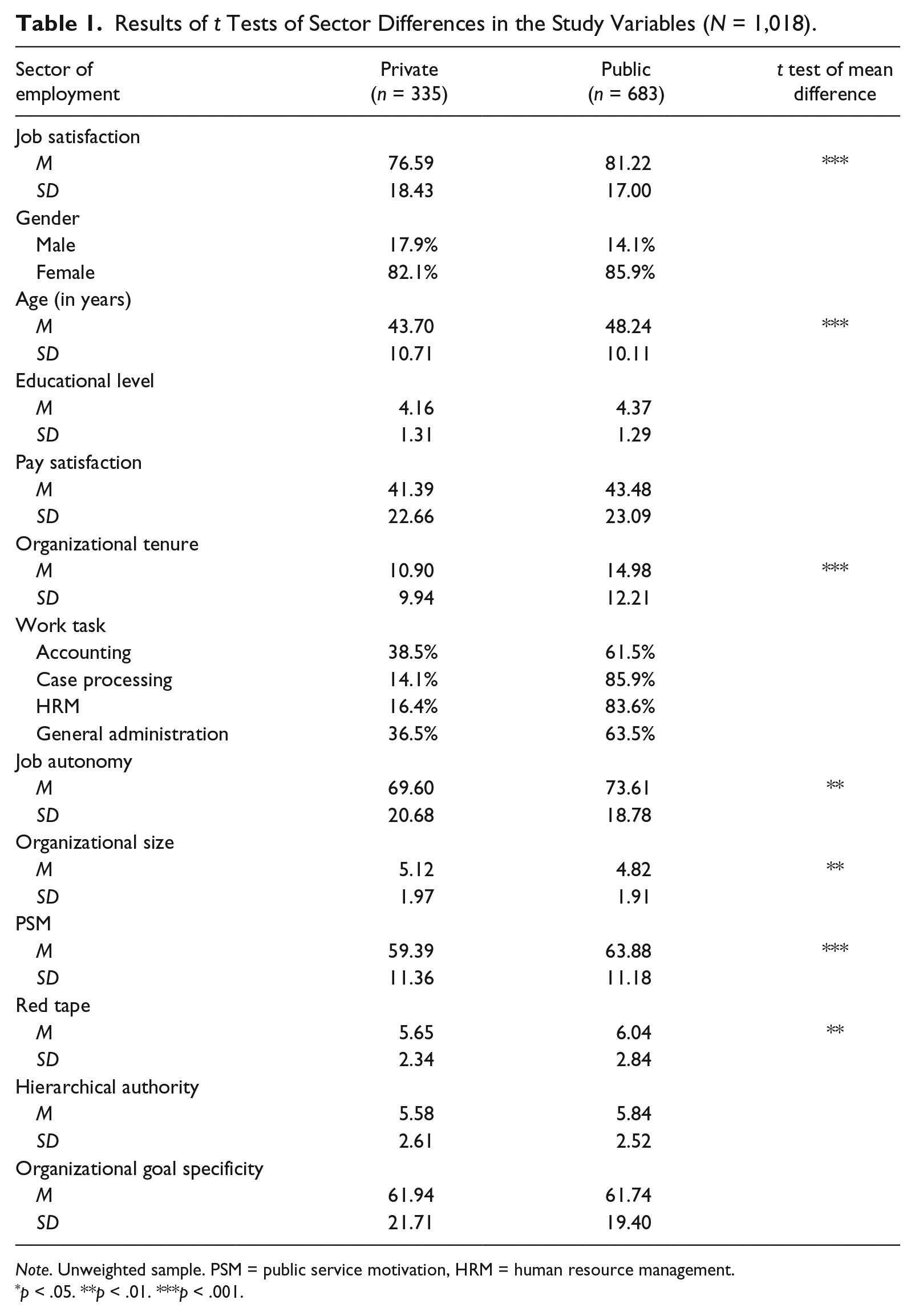
Note. Unweighted sample. PSM = public service motivation, HRM = human resource management.
p < .05. **p < .01. ***p < .001.
Method
In the following section, we will test our proposed hypotheses using multivariate statistics and, more specifically, tobit regression models. We use tobit regression—which is commonly used when the dependent variable is truncated or censored in one end of the scale (Cameron & Trivedi, 2009; Long, 1997)—because the reported job satisfaction measure is left-censored, as the office workers generally report very high levels of job satisfaction (M = 79.7, and 80% of the office workers score ≥75 on the 0-100 job satisfaction scale). With the increased numbers in one end of the scale, which would not have been the case if the scale had included more categories, tobit regression takes into account that the job satisfaction of some office workers could latently have been higher if the measurement scale had included more categories. 7
More specifically, we test our hypotheses by including interaction terms for PSM × Sector (H1) and for PSM × each of the three organizational characteristics (H2a-H2c). To separate the effects of each of these hypothesized interactive variables, they are included step-wise in hierarchical models, with Model 1 constituting the base model with all controls, PSM, and sector. Model 2 then adds the interaction term for PSM and sector. Model 3 proceeds to include the main effects of the three organizational characteristics (perceived red tape, hierarchical authority, and goal specificity), and then finally Models 4 to 6 include the interaction terms for PSM and these characteristics one-by-one (cf. Table 2). When interpreting the regression results, including interaction terms, it is important to keep in mind that once the interaction term is included, the main effects of the predictors, in our case PSM, sector, and the three organizational characteristics, are conditional estimates (e.g., Brambor, Clark, & Golder, 2006); for example, the estimated association between PSM and job satisfaction depends on whether we are considering employees in the public or private sector (and vice versa). 8 Hence, it is often recommended for ease of interpretation to illustrate graphically how the relationship between two variables changes according to the values of the interacting variable (cf. Figure 1; Agresti & Finlay, 2009). Besides this, the interpretation of regression coefficients using tobit regression models is very similar to standard ordinary least squares (OLS) regression, but the linear effect is on the uncensored latent job satisfaction variable, not the actually observed outcome (Cameron & Trivedi, 2009).
Tobit Regressions of Job Satisfaction.
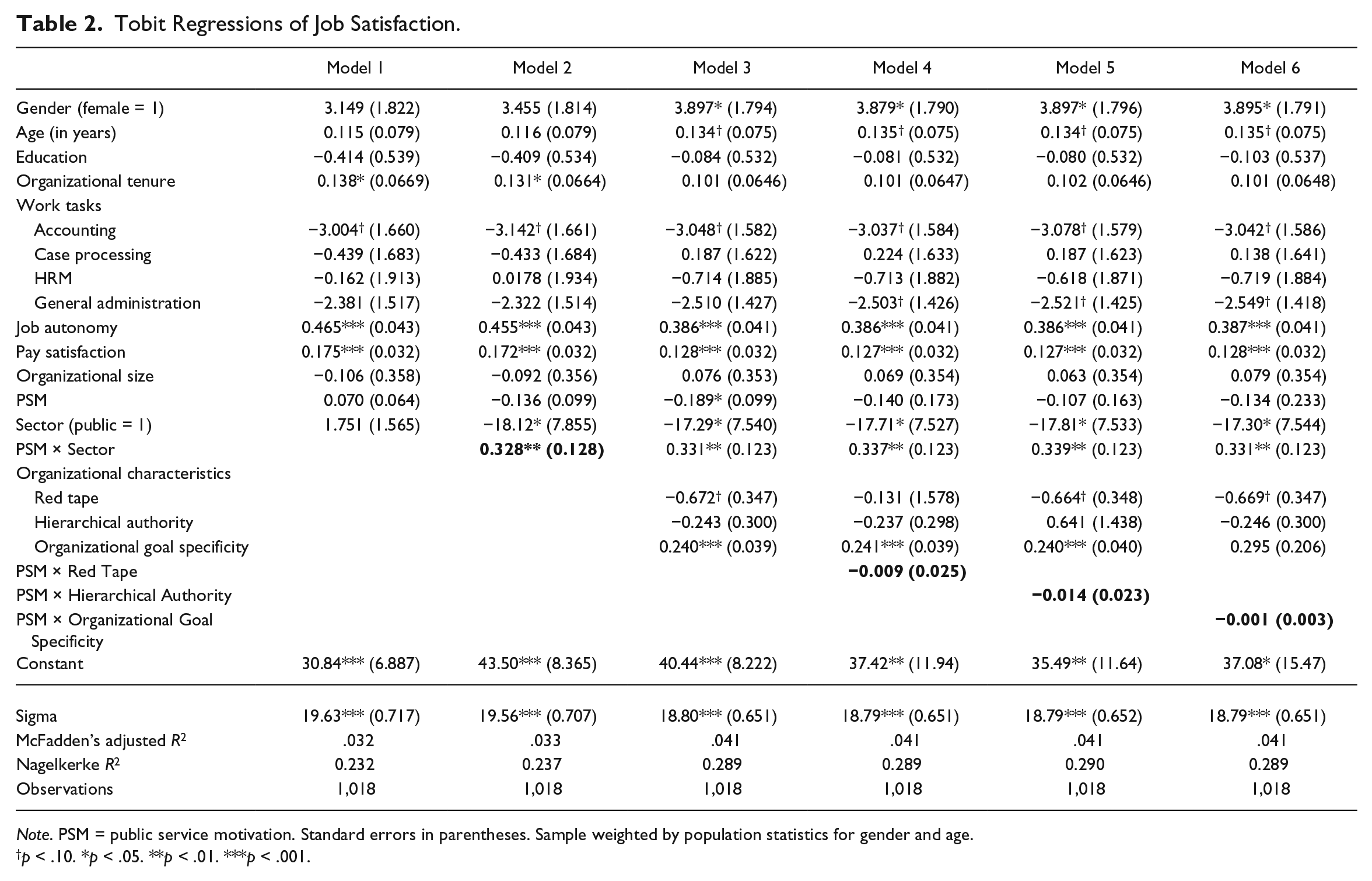
Note. PSM = public service motivation. Standard errors in parentheses. Sample weighted by population statistics for gender and age.
p < .10. *p < .05. **p < .01. ***p < .001.
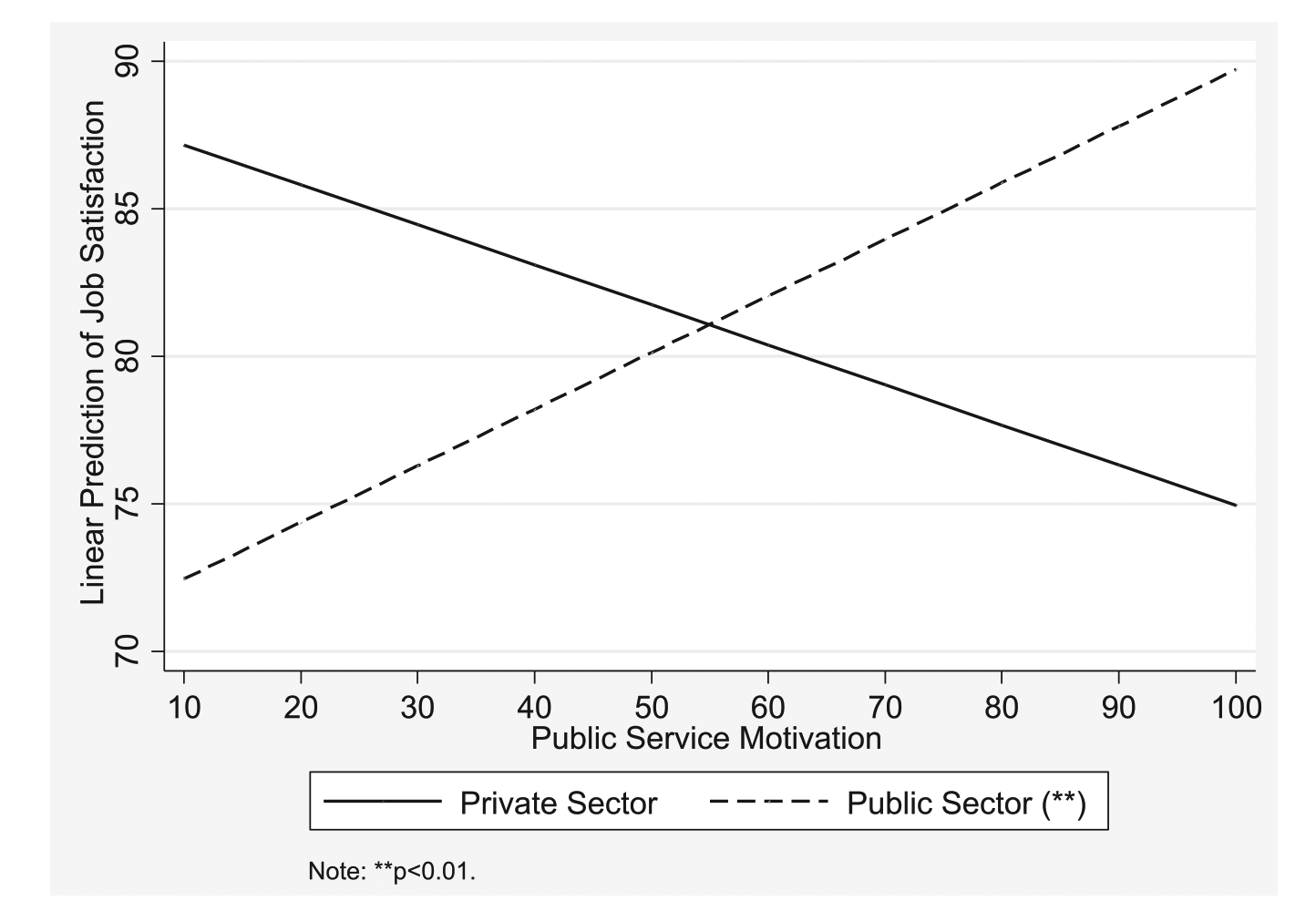
Predictive margins of sector (cf. Model 2, Table 2).
Results
Table 2 shows the results of the tobit regression models explaining job satisfaction. According to H1, we expected a positive PSM–job satisfaction relationship depending on the office workers’ sector of employment; that is, we expected the positive PSM–job satisfaction association to be stronger for public sector employees than for private sector employees. Looking toward Model 1, Table 2, we first note that there is no significant direct association between PSM and job satisfaction when controlling for a number of socio-demographic, job- and organization-related characteristics. This suggests that when investigating low-level, white-collar employees who do not work with direct public service provision, PSM does not play as significant a role for their job satisfaction as it does in the case of health care personnel and teachers (Andersen & Kjeldsen, 2013).
Turning to Model 2, which includes the hypothesized interaction term between PSM and sector, we see that it is positive and significant, indicating that the PSM–job satisfaction relationship does differ between sectors. More specifically, the coefficient for the estimated association between PSM and job satisfaction among the publicly employed office workers is 0.192 (0.328 − 0.136), whereas it is −0.136 for the privately employed office workers (insignificant). In line with the expectation from H1, there is, thus, a stronger, positive association between PSM and job satisfaction for office workers in publicly owned organizations. This result is also illustrated in Figure 1, which shows the marginal effects of PSM on job satisfaction in the two sectors. For low levels of PSM, we see that job satisfaction is actually lower among the public sector office workers than among the privately employed (as also indicated by the estimated −18.12 point lower job satisfaction for public sector office workers with PSM = 0 in Model 2). In sum, although H1 is thus confirmed, noting the very small coefficient size of the interaction term and the hardly visible increase in R2 nevertheless indicates that PSM is not a panacea for high job satisfaction in the public sector when looking at these low-level, white-collar employees.
In Model 3, we include the three organizational characteristics. Here, we find that red tape is negatively associated with job satisfaction, whereas organizational goal clarity has a positive effect. This is in line with expectations from the literature, although we find no influence of hierarchical authority on job satisfaction levels among employees. Furthermore, the results in Model 3 also show that when controlling for these organizational characteristics, the negative PSM–job satisfaction association in the private sector (which was also indicated in Figure 1) becomes significant. Although the coefficient size is small (a one-unit increase in PSM on a 0-100 scale corresponds to a 0.189 drop in job satisfaction—also on a 0-100 scale), this result still indicates that for these low-level, white-collar employees, high PSM can be a source of frustration when working in a privately owned organization.
In Models 4 to 6, we include three interaction terms, one for each of the three organizational characteristics and PSM, to test the three interaction hypotheses, H2a, H2b, and H2c, about the influence of organizational characteristics on the PSM–job satisfaction relationship. All three interaction terms are non-significant, and we therefore find no support for the three hypotheses; that is, the PSM–job satisfaction relationship does not appear to become significantly weaker if employees experience high levels of red tape, hierarchical authority, and less goal specificity. Interestingly, Model 6, Table 2, shows that the PSM × Sector interaction term is still significant and positive when controlling for the impact of organizational characteristics. This indicates that despite varying organizational characteristics across sectors and with different impacts on PSM, we still find that the PSM–job satisfaction relationship is stronger for the public sector office workers. 9
With respect to the employed controls, the tobit regression analysis in Table 2 shows that female office workers are generally more satisfied than their male colleagues, and with a coefficient of 3.8 this difference is quite substantive. Older office workers and office workers with more organizational experience are generally also more satisfied, and the same goes for office workers who experience autonomy in their jobs and who are satisfied with their pay. However, working with accounting tasks and general administration seems to have a detrimental effect on the job satisfaction of office workers. We will now discuss the results from Table 2 and make suggestions for further research while paying attention to the limitations of the present study.
Discussion
Our finding that PSM has a positive impact on employee job satisfaction among office workers in the public sector is generally in line with the results from former studies of this association (e.g., Steijn, 2008; Taylor, 2008). Furthermore, it supports the theoretical arguments derived from the Person–Environment Fit Theory (Kristof-Brown et al., 2005) and the Job Demands–Resources Model (Bakker & Demerouti, 2007), stating that the important issue is whether employees feel that they can “donate effort to the public” and experience opportunities to act pro-socially in their current work environments (Andersen & Kjeldsen, 2013). It should be noted, however, that we depart from most of these studies by using a very hard case for testing positive outcomes of PSM, as we only test the association within one occupational group, and low-level, white-collar work is not an area in which we would generally expect high levels of PSM and a high public service impact of the job (Leisink & Steijn, 2008). This can be viewed as a limitation of the current study in terms of the external validity of our conclusions. However, our findings when studying this particular occupation add empirical robustness to the current evidence of a positive PSM–job satisfaction relationship in the public sector by showing that even for occupational groups for whom PSM is expected to be of less importance (compared with, for example, extrinsic motivators) and where it may be very difficult to see how the work is related to public service, PSM still matters.
Moreover, our findings show that the PSM–job satisfaction relationship differs between sectors. After controlling for the organizational characteristics—perceived red tape, hierarchical authority, and organizational goal specificity—we see the completely opposite pattern for office workers in privately owned organizations, namely, a negative association between PSM and job satisfaction. Besides emphasizing the importance of including relevant explanatory variables when studying sector differences in job satisfaction and in work outcome measures more generally (Baarspul & Wilderom, 2011), this result indicates that PSM can also be a source of frustration. Labor market demand–supply mismatches across sectors possibly imply that high-PSM employees sometimes end up in private sector jobs and cannot subsequently fulfill their expectations and needs for acting pro-socially—or at least they experience more difficulty in seeing how this can be done, which may lead to dissatisfaction (Kjeldsen & Jacobsen, 2013; Wright & Christensen, 2010).
Although Steen (2008) and others have argued that PSM can also be a relevant type of motivation for employees working in commercial settings and have called for an empirical examination of its potential in private organizations, this negative association might not be as surprising when considering this particular occupational group with their back office, and—although important—largely invisible, often less publicly valued work. Noting also the relatively small effect sizes for the PSM–job satisfaction relationship among the public sector office workers, these results altogether question the argument of a universal positive impact of PSM. Moreover, one can question the ability of the current PSM measure to capture the relevant pro-social motivations and desires of such occupational groups not directly involved in producing public services. Future studies are thus encouraged to keep looking into sector differences in the PSM–job satisfaction relationship within occupations and settings where it may be possible to examine variations on more dimensions of publicness (Bozeman, 1987; Rainey & Bozeman, 2000) than public or private ownership to (a) get a better picture of the scope conditions for establishing a positive PSM–job satisfaction relationship in terms of capturing the more/less publicly relevant nature of the work environment, and (b) better conceptualize how PSM and pro-social motivation more broadly defined can play an important role in the work of private sector employees.
Following this result regarding a negative PSM–job satisfaction relationship for private sector office workers when controlling for organizational characteristics such as perceived red tape, hierarchical authority, and organizational goal specificity, a key contribution of this study has been to examine whether and how these organizational characteristics influence the relationship between PSM and job satisfaction and possible sector differences herein. Our results show that perceived red tape and organizational goal specificity are important explanations of employee job satisfaction—a result which is in line with the results from former studies arguing for studying the importance of organizational characteristics on job satisfaction (Finlay et al., 1995; Hansen & Høst, 2012). However, our results also show that none of these organizational characteristics significantly influence the PSM–job satisfaction relationship, and H2a to H2c were thus rejected. Moreover, the examined organizational characteristics do not explain sector differences in the PSM–job satisfaction relationship, as this association remains unaffected when we include the organizational characteristics. One reason for this unexpected finding may be that while PSM and job satisfaction can be expected to be negatively affected by, for example, high levels of red tape in an organization, studies have also shown that high-PSM individuals may perceive and work to reduce red tape (Scott & Pandey, 2005). In other words, PSM may work both as a barrier and a resource in overcoming organizational characteristics possibly seen as obstacles for contributing to society and helping others, which may imply that effects are being canceled out. Future studies should therefore focus on disentangling the interplay between PSM and organizational characteristics using research designs such as longitudinal studies and field experiments, which would be better suited for determining causality.
Related to this, one limitation of the current study is that all our variables have been measured in the same survey, meaning that our study may be prone to suffer from common source bias likely resulting from social desirability response tendencies (Favero & Bullock, 2014; Podsakoff, MacKenzie, Jeong-Yeon, & Podsakoff, 2003). Yet, we are especially interested in examining interaction effects, and it has recently been argued that this is a case where common source bias is typically of less concern (Jakobsen & Jensen, 2015). Siemsen, Roth, and Oliveira (2010) have thus shown that when true interaction effects exist, common method variance tends to attenuate these effects. Finding a significant interaction between PSM and sector in our case is therefore strong evidence that this effect actually exists. To the contrary, common source bias could have an influence on our non-findings regarding the interaction terms between PSM and the three organizational characteristics. However, it is important to note here that common source bias is especially pronounced with respect to studies with perceptual measures, whereas our sector variable and also to some extent the organizational characteristics could be argued to be more exogenous. Still, future studies would benefit from collecting data on individual-level measures and organizational characteristics from different data sources (Favero & Bullock, 2014, argue this to be the main way forward to rule out common source bias), and there should be continuous scholarly attention devoted to reducing social desirability bias in PSM measurement.
Conclusion
This study set out to compare the influence of employment sector and various organizational characteristics on the PSM–job satisfaction relationship. The main result is that this relationship differs according to employment sector: The PSM–job satisfaction relationship is positive for public sector office workers and negative for private sector office workers. Although some organizational factors such as red tape and organizational goal specificity were also found to matter for the job satisfaction of office workers, our study shows that they do not outweigh the sector difference in the PSM–job satisfaction relationship; rather, it is quite the reverse. Overall, our results thus offer strong support for employment sector and, more specifically, the public or private ownership of an organization as having a crucial role in determining the PSM–job satisfaction relationship; and yet other organizational characteristics cannot be completely dismissed.
Our results thus show that to disentangle sector differences in the PSM–job satisfaction relationship, organizational characteristics are important controls. When we find that public sector office workers, for example, experience more red tape than their private sector counterparts, this highlights the importance of including such measures when making sector-comparative studies in work outcomes. In a broader perspective, this is even more vital, as the organizational work environment is argued to be more changeable from a management and organizational perspective than, for instance, job characteristics (Wright & Davis, 2003). Although our study clearly also has its limitations in terms of, for example, being limited to only examining public or private ownership and a small range of other factors from the organizational work environment potentially influencing the PSM–job satisfaction relationship, we are among the first to examine low-level, white-collar employees, thus showing how PSM–job satisfaction dynamics unfold in the back offices of organizations. This has provided new interesting insights highlighting how PSM is not universally important in creating and preserving job satisfaction.
Footnotes
Appendix
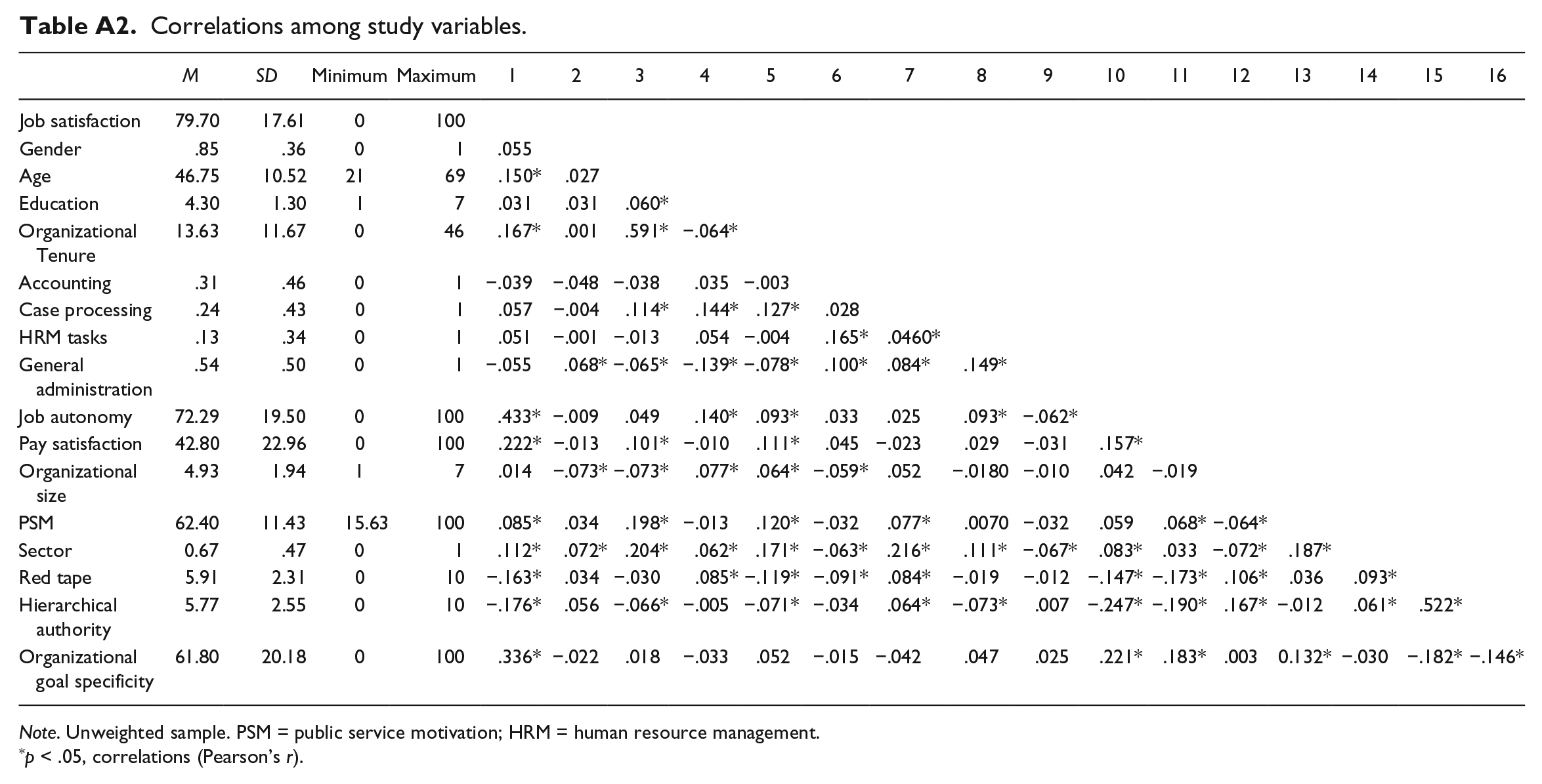
Correlations among study variables.
| M | SD | Minimum | Maximum | 1 | 2 | 3 | 4 | 5 | 6 | 7 | 8 | 9 | 10 | 11 | 12 | 13 | 14 | 15 | 16 | |
|---|---|---|---|---|---|---|---|---|---|---|---|---|---|---|---|---|---|---|---|---|
| Job satisfaction | 79.70 | 17.61 | 0 | 100 | ||||||||||||||||
| Gender | .85 | .36 | 0 | 1 | .055 | |||||||||||||||
| Age | 46.75 | 10.52 | 21 | 69 | .150* | .027 | ||||||||||||||
| Education | 4.30 | 1.30 | 1 | 7 | .031 | .031 | .060* | |||||||||||||
| Organizational Tenure | 13.63 | 11.67 | 0 | 46 | .167* | .001 | .591* | −.064* | ||||||||||||
| Accounting | .31 | .46 | 0 | 1 | −.039 | −.048 | −.038 | .035 | −.003 | |||||||||||
| Case processing | .24 | .43 | 0 | 1 | .057 | −.004 | .114* | .144* | .127* | .028 | ||||||||||
| HRM tasks | .13 | .34 | 0 | 1 | .051 | −.001 | −.013 | .054 | −.004 | .165* | .0460* | |||||||||
| General administration | .54 | .50 | 0 | 1 | −.055 | .068* | −.065* | −.139* | −.078* | .100* | .084* | .149* | ||||||||
| Job autonomy | 72.29 | 19.50 | 0 | 100 | .433* | −.009 | .049 | .140* | .093* | .033 | .025 | .093* | −.062* | |||||||
| Pay satisfaction | 42.80 | 22.96 | 0 | 100 | .222* | −.013 | .101* | −.010 | .111* | .045 | −.023 | .029 | −.031 | .157* | ||||||
| Organizational size | 4.93 | 1.94 | 1 | 7 | .014 | −.073* | −.073* | .077* | .064* | −.059* | .052 | −.0180 | −.010 | .042 | −.019 | |||||
| PSM | 62.40 | 11.43 | 15.63 | 100 | .085* | .034 | .198* | −.013 | .120* | −.032 | .077* | .0070 | −.032 | .059 | .068* | −.064* | ||||
| Sector | 0.67 | .47 | 0 | 1 | .112* | .072* | .204* | .062* | .171* | −.063* | .216* | .111* | −.067* | .083* | .033 | −.072* | .187* | |||
| Red tape | 5.91 | 2.31 | 0 | 10 | −.163* | .034 | −.030 | .085* | −.119* | −.091* | .084* | −.019 | −.012 | −.147* | −.173* | .106* | .036 | .093* | ||
| Hierarchical authority | 5.77 | 2.55 | 0 | 10 | −.176* | .056 | −.066* | −.005 | −.071* | −.034 | .064* | −.073* | .007 | −.247* | −.190* | .167* | −.012 | .061* | .522* | |
| Organizational goal specificity | 61.80 | 20.18 | 0 | 100 | .336* | −.022 | .018 | −.033 | .052 | −.015 | −.042 | .047 | .025 | .221* | .183* | .003 | 0.132* | −.030 | −.182* | −.146* |
Note. Unweighted sample. PSM = public service motivation; HRM = human resource management.
p < .05, correlations (Pearson’s r).
Acknowledgements
We would like to thank Handels- og Kontorfunktionærernes Forbund (HK) for participating in the research project and providing access to their members. Furthermore, a special thanks to former students Lars Rosgaard Kristensen and Stine Straarup who helped collect the data which they both used parts of in their master theses. Finally, we would like to thank the three anonomous reviewers for their very helpful comments and suggestions.
Declaration of Conflicting Interests
The author(s) declared no potential conflicts of interest with respect to the research, authorship, and/or publication of this article.
Funding
The author(s) received no financial support for the research, authorship, and/or publication of this article.