




Abstract
This study examines the mediating role of employee followership and job satisfaction in the relationship between person–organization (P-O) fit and turnover intention. Understanding the mechanisms that link P-O fit and turnover intention may provide useful intervention strategies for leaders and human resource professionals to effectively manage and interact with their followers. Using Hobfoll’s conservation of resources theory, we explore a three-step mediation model in which high P-O fit is related to turnover intention through employee followership and job satisfaction. This model is tested using cross-sectional survey responses from 692 faculty at an urban public university. The authors discuss the implications of the results as well as the limitations of the study for future research.
Keywords
Introduction
Person–organization (P-O) fit has become an increasingly important aspect of the employment relationship in the public management literature. Previous studies have indicated that P-O fit is significantly related to individual intention as well as attitudinal and behavioral outcomes, such as turnover intention, job satisfaction, organizational commitment, and contextual performance (Hoffman & Woehr, 2006; Kristof-Brown et al., 2005; Verquer, Beehr, & Wagner, 2003). However, several scholars have criticized that the process through which P-O fit leads to employees’ turnover intention has not received much attention in the literature (Peng, Lee, & Tseng, 2014). Given the positive employee outcomes associated with P-O fit, understanding the mechanisms through which it operates may offer additional insight for human resource professionals on how to effectively communicate with their employees and address their needs proactively.
Consistent with the recent call for understanding the psychological mechanisms of P-O fit perceptions (Peng et al., 2014; Schmitt, Oswald, Friede, Imus, & Merritt, 2008), we focus on the process through which perceived fit may affect an employee’s turnover intention through its influence on followership and job satisfaction and seek to add to the P-O fit literature in two key ways. Our first contribution is to test the mediating role of followership and job satisfaction as a causal chain in linking P-O fit to turnover intent. Several recent studies examine the psychological mechanisms of P-O fit. These studies are limited, however, in that they primarily focus on emotion-based conditions, such as job satisfaction and organizational commitment (Vilela, González, & Ferrin, 2008; Westerman & Cyr, 2004) and emotional engagement (Gregory & Albritton, 2009). However, given that work attitudes are shaped in large part as a result of undertaking their daily work (Cable & DeRue, 2002; Kristof-Brown et al., 2005), the oversight on leaving employee behavior out of the P-O fit and turnover intention equation is somewhat surprising. For example, Ryan and Deci (2000) have theorized that individuals are extrinsically motivated to engage in behaviors so as to satisfy their desire to feel belongingness and connectedness with their organizations and, thus, maintain their fit (Yu, 2009); yet behavioral implications of P-O fit on turnover intention are noticeably absent in the literature. Given that P-O fit is linked to both attitudinal (Verquer et al., 2003, offer a meta-analysis) as well as behavioral outcomes (Hoffman & Woehr, 2006), understanding the relational nature of work behaviors and attitudes may help clarify the process through which employees’ intention to turnover is shaped.
Drawing from Hobfoll’s (1989) conservation of resources (COR) theory, we hypothesize that individuals with high levels of P-O fit in terms of value congruence are more likely than others to demonstrate extra-role behaviors (i.e., followership behavior; Kelley, 1992) so as to retain and protect their P-O fit as valued conditional resources (Hobfoll, 1989). This followership behavior is, in turn, hypothesized to lead to increased job satisfaction because effective followership role fulfills important personal needs for individuals through comradeship with valued others, which helps satisfy one’s social needs (Howell & Costley, 2006). Job satisfaction is enhanced because followership role allows individuals to serve others, and provides growth and development experiences (Howell & Costley, 2006). Consistent with COR theory perspective, this increased job satisfaction is expected to minimize a loss of resources (e.g., emotional), thereby leading to a reduced intention to turnover.
Our second key contribution is to test the mediation model in a public higher education setting. Public higher education in the past decade has seen many changes, some of which included declining financial resources, changing student populations, and shifting societal expectations about the role of public universities (Lindholm, 2003). These changes prompted many to seek and demand greater responsibility on faculty because they play such a vital role in creating colleges and universities that are more responsive to the present and future generations. Consequently, the question of recruiting the best people available and retaining them has become the most salient issue for human resource professionals in higher education. Several scholars have emphasized the role of P-O fit perceptions within academic work environments as it can contribute to shaping faculty attitudes and behavior (Blackburn & Lawrence, 1995; Bowen & Schuster, 1986). However, we know very little about the extent to which P-O fit perceptions influence public university faculty (Lindholm, 2003). This is surprising, given that the large number of studies of faculty turnover have tested structural, psychological, and environmental variables as meaningful predictors (Iverson & Roy, 1994; Mueller, Boyer, Price, & Iverson, 1994; Smart, 1990), yet, the idea that behavioral and attitudinal outcomes are contingent on the fit between individual characteristics and organizational characteristics (Burns & Stalker, 1961) has not been substantiated. Frequently based on expectancy theory (Lawler, 1994; Vroom, 1964), these works suggest that perceptions of the work environment and/or perceptions of the external environment explain intent to stay. For example, Smart (1990) developed one of the earliest models that attempted at explaining a causal process leading to faculty turnover. His model showed that work environment variables, such as governance influence, research time, and campus governance independently influenced job satisfaction, which in turn affected faculty intent to leave. Implicit in Smart’s (1990) and many others’ previous works is the assumption that these structural factors affect faculty’s job experience and attitude uniformly regardless of one’s fit with the organization, a claim that contemporary fit researchers reject heavily. Research shows that fit (e.g., value congruence) perceptions have been positively associated with tenure, organizational commitment, job performance, work satisfaction, intentions to leave, and turnover (Kristof, Zimmerman, & Johnson, 2005; C. A. O’Reilly, Chatman, & Caldwell, 1991; Sheridan, 1992). In short, scholars suggest that P-O fit affects one’s experience of the job, and thus turnover intention (Siegall & McDonald, 2004). Therefore, this study extends the previous research by testing P-O fit theory’s applicability to a higher education institution.
Our theoretical approach offers alternate explanations for why people leave, providing practical insights for human resource professionals and organizational leaders trying to keep them to stay. Our analysis suggests that turnover can be reduced not only by having workers whose values are compatible with those of their organization, but also, in part, by having workers who serve their followership role effectively to maintain and protect their fit perceptions, which produces positive psychological conditions leading to reduced intention to turnover.
The remainder of this article is divided into several parts. First, a review of the relevant literature related to the relationship between P-O fit and turnover intent is presented. Next, we explore the mediating role of employee followership and job satisfaction in serial linking P-O fit and turnover intention. A description of our methodology, along with the data and measurements of each variable, follows. After providing the results of the analysis, the final sections are dedicated to discussing the implications of the study and a conclusion, respectively.
P-O Fit and Turnover Intention
Researchers of P-O fit theory posit that employees’ work attitudes and behaviors are shaped by how their personal goals and values align with those of their work environment (Edwards & Cable, 2009). P-O fit is said to occur when people and organizations share similar fundamental characteristics in terms of values and goals (Kristof et al., 2005). Two types of fit characteristics are acknowledged in the literature. The first is supplementary fit, which occurs when both the employee and the organization share similar fundamental characteristics, such as values and goals. The second is complementary fit, which occurs when one party provides what the other needs. As our study considers the extent of value congruence between organization and employees in achieving desirable employee outcomes (Gould-Williams, Mostafa, & Bottomley, 2015), our definition of the P-O fit in the present context reflects supplementary fit.
There are two dominant theories for which to understand the relationship between P-O fit and turnover intention—Attraction–selection–attrition (ASA; Schneider, 1987) and social exchange theory (Blau, 1964). According to Schneider’s ASA perspective, individuals are attracted to organizations where they see a close match in terms of their pursuit of goals and values which, if compatible, reduces the likelihood that employees will leave the organizations (Liu, Lio, & Hu, 2010). This suggests that P-O fit will be associated with reduced turnover intent because employees with high perceptions of P-O fit are more likely to consider that organizational values, along with those of their working colleagues, reflect their own identities (Gould-Williams et al., 2015). P-O fit perceptions, thus, have been found to lead to increased bond between employees and their organization, making it more difficult for employees to leave even if better prospects are offered elsewhere (Jackson et al., 1991). ASA framework is suitable for supplementary fit as it posits that people and organizations are attracted to each other based on similarity (Farooqui & Nagendra, 2014).
Other research generally supports the logic that value congruence reduces turnover intent. For example, Chatman (1991) found that value congruence reduces turnover intent and turnover among recent recruits in accounting firms. In a study of nurses in Belgium, Vandenberghe (1999) found that nurses were less likely to have quit after 12 months if they perceived high P-O fit. In a nonprofit study, Brown and Yoshida (2003) have found that attraction to mission has been found to be negatively associated with turnover. A meta-analysis of P-O fit literature also showed a significant relationship between P-O fit and turnover intention (Verquer et al., 2003).
While P-O fit and turnover intent relationship has been investigated among government agencies (e.g., Liu et al., 2010; Moynihan & Pandey, 2007), the role of P-O fit in general as it pertains to various employee and organizational outcomes has not been discussed substantively in the context of higher education. One study that came closest to such empirical testing was Siegall and McDonald (2004) who studied the effect of P-O fit value congruence on burnout among 135 university faculties at a mid-sized public comprehensive university in the west coast in the United States. They found that P-O fit was significantly negatively associated with burnout. Their study of P-O fit and burnout relationship has important implications for the present study because burnout overall can be viewed as a form of withdrawal from a stressful job, “where people not only feel detached from work (emotional exhaustion and a negative sense of accomplishment), but also depersonalize co-workers and clients as a way of psychologically pushing them away” (Siegall & McDonald, 2004, p. 292). This withdrawal is directly associated with other forms of work-related withdrawal, such as intention to turnover (Leiter, 1991) and actual turnover (Cordes & Dougherty, 1993). Accordingly, faculty members whose values are less compatible with those of their organizations may be more likely than others with high value congruence to quit. For example, faculty who value theoretical, discipline-based research are likely to experience conflicting expectations in urban public universities that “espouse commitments to community-focused research agendas, which often entail interdisciplinary approaches to solving social problems” (Daly & Dee, 2006, pp. 776-777). This conflict of interests can then lead to decisions to leave the institution (Johnsrud & Rosser, 2002).
COR Theory
To understand how P-O fit may relate to turnover intention, we turn to the COR. Established by Hobfoll (1989), COR postulates that people have inherent desires to retain, protect, and build resources (e.g., objects, personal characteristics, conditions that are valued in their own right). The theory further states that because a threat to resources can lead to emotional and/or physical exhaustion and thus to turnover intention, it is in the individuals’ best interest to engage in behaviors that help protect and maintain the existing resources (e.g., value fit).
Following recent developments in the COR theory (e.g., Kiazad, Seibert, & Kraimer, 2014; Mackey, Perrewe, & McAllister, 2016; Wheeler, Halbesleben, & Shanine, 2012), we view perceptions of person–organizational fit as a resource. In the most recent work, Mackey and his colleagues (2016) viewed perceptions of organizational fit as a personal resource because perceptions of P-O fit are generally sought after and valued, which not only provides stress-resistance potential (Edwards & Cable, 2009) but also enables the employees to protect and gain more resources. According to Hobfoll (2011), fit is an active process that is dependent on individuals and their settings evolving over time to alter the balance of resource cost and benefit. Accordingly, those with high P-O fit will thrive more easily compared with those with low P-O fit because they are able to allocate and invest their resources to get more resources and thus maximize their fit within their environment (Hobfoll, 1989). Similarly, Wheeler et al. (2012) defined fit in terms of COR. They postulate that fit (e.g., P-O or person–environment more broadly) reflects the presence of personal resources that individuals need to meet the demands of their work environment. From a resource perspective, they theorize that this fit can be seen in terms of matching the organization (e.g., supplementary) or adding something new to the individual or organization (e.g., complementary) because the key is whether or not individuals have sufficient resources to meet the demands of the environment and vice versa (Wheeler et al., 2012). In addition, Kiazad et al. (2014) conceptualized P-O fit as an instrumental job resource because it not only enables individuals to acquire things one values, but it also enhances employees’ capability and willingness to perform their work, which can allow them to acquire other resources (i.e., better pay, interesting work assignments, or advancement opportunities). (p. 538)
The COR model proposes three different ways from which workers’ turnover intention (due to stress) occurs. The first situation is when the worker sees a threat to his or her valued resources and thus anticipates potential loss. The second situation is when the worker has already lost the resource (e.g., trust from coworker, confidence in the job, or valued window office due to reorganization). The third situation is when the worker is unable to gain significant amount of resources following investment of resources (e.g., no promotion despite updated educational credentials). It is argued that any one of these three situations can lead workers to feel burnout and ultimately lead to decision to leave because the rate that work demands use up employee resources is typically greater than the rate with which resources are either restored or replaced (Hobfoll & Freedy, 1993).
According to a recent longitudinal study of P-O fit dynamics (Gabriel, Diefendorff, Chandler, Moran, & Greguras, 2014), fit perceptions among job incumbents were found to fluctuate over time depending on the work situations or affective experience from particular events. For example, a positive work experience may have a favorable psychological impact on how one evaluates his or her work environment (e.g., “I feel good, therefore I must fit”), but a challenging task may make the employee rethink the situation (e.g., “I am struggling with this task, therefore I may not belong here”). Therefore, from the COR perspective, individuals with high levels of P-O fit perceptions are motivated to engage in proactive behaviors (Yu, 2009), in the form of followership or organizational citizenship behaviors, so as to maintain their perceived sense of organizational fit. Preserving this personal resource is made easier as individuals with high P-O fit will feel good about his or her work environment (Wheeler et al., 2012). COR predicts that a person with high P-O fit would want to continue working in this environment and not want to sacrifice the positive outcomes associated with high levels of fit by leaving the employer (Wheeler et al., 2012).
Kelley (1992) viewed followers as rugged individualists who are courageous and honest enough to formulate their own meaning of life rather than pursue social goals such as money and fame. Similarly, advocates of followership theory have identified at least two characteristics of followers. First, followership researchers posit that followers are active, rather than passive, in their work and focused on cooperating to accomplish goals (Blanchard, Welbourne, Gilmore, & Bullock, 2009; Frisina, 2005; Latour & Rast, 2004). Second, followers make it a priority in working effectively with others and identifying with the leaders and share the leader’s vision (Latour & Rast, 2004). Korman (2001) posited that individuals are motivated to attain outcomes that signify personal growth. This self-enhancement process, he argues, is most likely to occur among those individuals who see their work environment as sharing their views concerning work opportunities, which in turn leads to engaging in active followership behaviors (e.g., taking the initiative to seek out new assignments above and beyond job requirements).
From the COR perspective, the aforementioned characteristics of followership are related to helping to protect valued resources. For example, for those willing to preserve their perceived fit in the organization are likely to be motivated to engage in followership behavior because it helps satisfy psychological needs for comradeship, service to others, and identification with a valued cause (Howell & Costley, 2006), which enhances followers’ self-concepts in the organization. The added personal resources through increased job satisfaction are likely to reduce their intention to turnover. Previous research has shown that job satisfaction is a strong direct predictor of turnover intention (Brough & Frame, 2004; Jin & Park, 2016; Tang, Kim, & Tang, 2000). Therefore, it is reasonable to argue that the likelihood of fear of losing resources or feeling of emotional exhaustion in the workplace may be considerably reduced by engaging in followership behaviors, which is triggered by the individuals’ fundamental motives to belong and control their work environment (Yu, 2009).
COR theory also postulates that employees who leave their current jobs are likely to need to devote substantial amount of resources (cognitive, emotional, and physical) to not only finding new jobs but also adjusting to the new environment. This is because for active followers who already have devoted many personal resources (e.g., emotional and physical) and gained precious resources (e.g., social support from coworkers and leaders) from the current work, the idea of adapting to the new tasks in the new work environment so as to regain the same recognitions they had in the previous organization may be an exhausting journey they are not willing to take. In other words, the risk of changing jobs is relatively high for employees (Peng et al., 2014). Thus, the resources accumulated as a result of performing followership behavior are likely to help the employees continue in their current jobs.
As described above, job satisfaction is implicated in the relationship between effective followership and turnover intention. Not surprisingly, several studies have linked several contextual performance behaviors such as organizational citizenship behaviors (Wei, 2012) and leader–member exchange (T. Kim, Aryee, Loi, & Sang-Pyo, 2013) to increased job satisfaction and organizational commitment (e.g., Schmitt et al., 2008; Westerman & Cyr, 2004). Sequentially, several studies have shown that these affective work experiences have led to decreased intention to turnover (Schmitt et al., 2008; Westerman & Cyr, 2004). Given the theoretical linkages provided herein, we explore the following hypothesis:
Method
Survey Administration
Data for this study were collected using an online survey from a large, research intensive, urban public university in the United States. A total of 2,713 faculty members were initially recruited from the university’s provost’s office. They were first sent an email explaining the study and containing a link to the online survey, with a final email reminder to fill out the survey sent out 1 month after to all remaining non-respondents. These procedures yielded an overall response rate of 35.8% (n = 970). However, to conduct a valid test of our research questions and stay consistent with the study goal of collecting data from faculty members whose responsibilities include teaching, service, and research, personnel involved in clerical, housekeeping, and other administrative support roles were specifically excluded. A total of 692 faculty members were accounted for in our final analysis.
Of the total respondents, 49% were male; 24% were between the ages of 21 and 40, 23% were between 41 and 50, 29% were between 51 and 60, and the remainder were older than 61 years. Sixty-two percent of participants had income greater than US$80,000, 70% were teaching and research faculty (31% were administrative and professional faculty), 35% were tenured (vs. 65% for not tenured or not on tenure track), and 88% were White. A total of 53% were in the professional areas (e.g., business, medicine), 16% in arts and humanities, 15% in social sciences and education, and the remainder were in science, technology, engineering, and mathematics (STEM). Fifty-five percent of participants held a doctorate, followed by 23% with master’s degree and 19% with professional degrees (e.g., JD). Less than 3% only had bachelor’s degree.
Nonresponse bias was checked by comparing early responses to the survey (first 10% of returned questionnaires) with late responses (last 10% of returned questionnaires), where late responses were used as a proxy for non-respondents (Armstrong & Overton, 1977). Independent sample t tests revealed no significant differences in the response patterns of early and late respondents, suggesting that nonresponse bias is unlikely to be a concern in the current study (Gould-Williams et al., 2015).
Measures
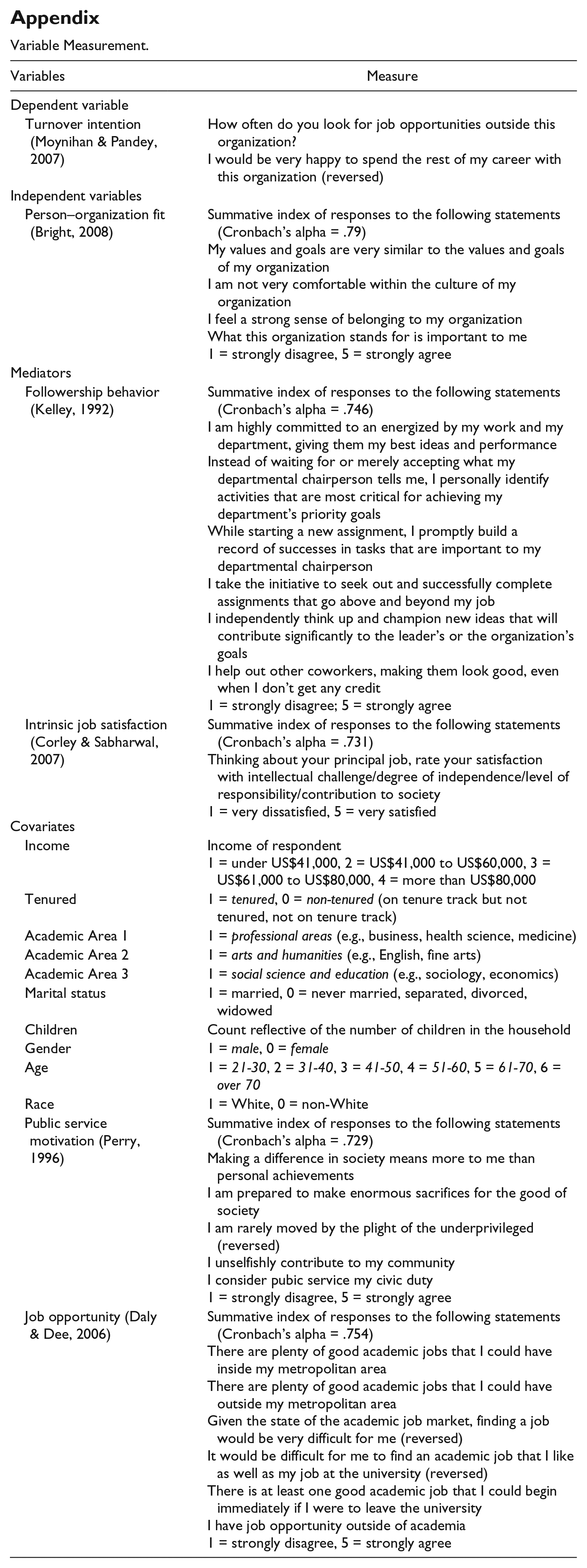
The survey instrument was designed to capture the employees’ demographic information and data on their perceptions of P-O fit, followership behavior, intrinsic job satisfaction, turnover intentions, and various control variables related to their job and the organization. Whenever possible, the study variables were measured using multiple survey items taken from previously tested scales. The appendix presents the questionnaire items, along with descriptions, coding scales, and Cronbach’s alpha for all variables utilized in the study.
One of the potential limitations in this study is that our measures are perceptual. We, however, note that perceptions matter because they help guide an individual’s interpretation of events and predict possible outcomes and in turn shape their attitudes and behavior (Wright & Pandey, 2011). Similarly, organizational research has shown that subjective measures can even be more appropriate especially when the research involves an individual’s action or behavior (Boyd, Dess, & Rasheed, 1993). Although the use of more objective measures can certainly provide a more nuanced approach, our study is consistent with a number of reviews of organizational research that supports the importance of using individual perceptions when explaining employee behavior (Parker et al., 2003; Wright & Pandey, 2011).
Dependent variable
The dependent variable for this study is the turnover intention of an employee. Following Moynihan and Pandey (2007), this is captured in our study with two questions: (a) “I would be very happy to spend the rest of my career with this organization (reversed)” and (b) “I often look for job opportunities outside this organization.” 1 Responses were recorded on a 5-point Likert-type scale where 1 = strong disagreement and 5 = strong agreement. Although intent to turnover does not perfectly mirror actual turnover, research has shown that it is highly correlated with actual turnover (Dalton, Johnson, & Dailly, 1999). The Cronbach’s alpha for these items was relatively low compared (.66) with other constructs in our research model. Two formal tests of normality—Shapiro–Wilk and Kolmogorov–Smirnov—however, indicated that the distribution of the observed values of the dependent variable and the independent variables generally conformed to the normality assumption of regression analysis (Razali & Wah, 2011).
Independent variables
This study used a supplementary and direct approach to measuring P-O fit (see Bright, 2008). Direct measures of fit are beneficial if the objective is to assess perceived fit, which involves asking respondents explicitly for their perceptions of fit with their organization. However, indirect measures of fit are used to assess actual fit, which involves an explicit comparison between separate assessments of respondent and organizational characteristics (Kristof et al., 2005). Direct measures of fit, however, have been found to be stronger and better predictors of employee outcomes than indirect measures (Kristof et al., 2005; Verquer et al., 2003). Thus, direct measures were used in the present study to assess the fit between employees and their organization. P-O fit was measured using four items from Bright (2008) whose items were developed from a review of prior research (e.g., C. I. O’Reilly & Chatman, 1986). Sample items include “My values and goals are very similar to the values and goals of my organization” and “What this organization stands for is important to me,” and are based on the 5-point agreement scale from 1 (strong disagreement) to 5 (strong agreement). The Cronbach’s alpha for P-O fit was .79.
Followership is measured with an index of six items. Four items capture the essence of active engagement that is central to effective followership (Blanchard et al., 2009; Kelley, 1992). Sample items include (a) “I take the initiative to seek out and successfully complete assignments that go above and beyond my job” and (b) “When starting a new assignment, I promptly build a record of successes in tasks that are important to my departmental chairperson.” Two items capture the essence of independent critical thinking in followership as identified by Blanchard et al. (2009): (a) “I independently think up and champion new ideas that will contribute significantly to the leader’s or the organization’s goals” and (b) “Instead of waiting or merely accepting what my departmental chairperson tells me, I personally identify activities that are most critical for achieving my department’s priority goals.” The six-item followership behavior scale was found to be internally consistent with a Cronbach’s alpha of .75. Intrinsic job satisfaction measure was adapted from Corley and Sabharwal (2007). The Cronbach’s alpha for this four-item scale was .73.
Covariates
In the interest of tightening the causal links among the study variables in our model and to guard against potentially confounding factors and epiphenomenal association, we controlled for demographic characteristics (gender, income, marital status, age, and race), structural variables (academic fields, tenure status), and external environmental factor (perceived job opportunity elsewhere) based on our review of previous faculty turnover models (e.g., Johnsrud & Rosser, 2002; Zhou & Volkwein, 2004).
We also control for one additional factor that is relevant to workers’ motivation in the public sector—public service motivation (PSM). Previous PSM studies have suggested that employees with high levels of PSM are more committed to the goals and missions of the organization and are thus expected to have lower levels of turnover intention because they are more likely than others to endure the obstacles and stresses that come with public sector jobs (Perry & wise, 1990). This is an important distinction that needs to be accounted for because in public higher education, employees with high levels of PSM are more likely to commit to the goals and missions of public higher education, some of which include addressing critical societal issues and contributing to the public good through their teaching, service to the community, and research (Fitzgerald, Smith, Book, Rodin, & CIC Committee on Engagement, 2005). PSM was measured using an aggregate of five items from Perry’s (1996) original scale commonly used as a short measure of PSM in previous studies (S. Kim, 2005; Wright & Pandey, 2008). The items used capture the three dimensions—commitment to public interest, compassion, and self-sacrifice—identified by Perry that represent the affective or normative motives most closely associated with the altruistic appeal of public sector values (Wright & Pandey, 2008). Consistent with Wright and Pandey’s assertion, we removed the fourth dimension, attraction to policy making, because it represents a rational or self-interested motive that is less valued or mission specific. The Cronbach’s alpha for the five-item PSM scale was .73.
Statistical Analysis
As illustrated in Figure 1, we propose a three-step mediated model, whereby high level of perceived P-O fit is hypothesized to increase employee’s active followership behavior, which in turn increases job satisfaction and decreases turnover intention. As a mediation model is essentially a causal model, we used joint significance test approach (Taylor, MacKinnon, & Tein, 2008), which tests each path of the mediational chain. 2 This approach entails the use of three individual regression models, one for each of the outcomes (Mediator 1–followership, Mediator 2–job satisfaction, and dependent variable-turnover intent). MacKinnon, Lockwood, Hoffman, West, and Sheets’ (2002) simulation results suggest that this approach provides the best balance between a small Type I error and high statistical power.
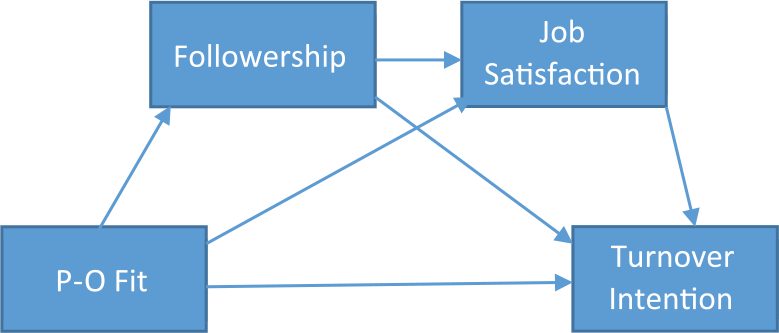
Research framework illustrating the indirect effects of P-O fit on turnover intention.
To provide formal inferential tests of our mediation hypotheses, we directly test for the indirect effects between the predictor and the criterion variable through the mediators via bootstrapping procedure (Preacher & Hayes, 2008). This procedure involves repeatedly drawing samples of size n (where n is equal to the original sample size) from the existing data, sampling with replacement, and then estimating the indirect effect in each resampled data set. Repeating this process thousands of times creates an empirical approximation of the underlying sampling distribution of the indirect effect, which is then used to construct confidence intervals for the indirect effect. Among the methods that allow for hypothesis testing of indirect effects, the consensus is that bootstrapping is superior in that it makes no assumptions about normality in the sampling distribution and has better control over Type I error (MacKinnon et al., 2002). We used 10,000 bootstrap resamples to generate 95% bias-corrected confidence intervals for the indirect effects.
Findings
Having established the methodology by which we will investigate the research question at hand, we turn our attention to the presentation of the results of the analysis. We start with the presentation of the results of our assessment for potential common method bias. Next, we turn to presentation of descriptive statistics, followed by the results of ordinary least squares regressions and the bootstrapping procedure for indirect effects.
We tested for common method bias because all data in this study were measured based on self-reported responses in a single survey. This is accomplished with Harman’s single-factor test, which is useful for examining the seriousness of bias (Podsakoff, MacKenzie, Lee, & Podsakoff, 2003), as well as post hoc statistical tests. All items were entered into an exploratory factor analysis, using unrotated principal components factor analysis, principal component analysis with varimax rotration, and principal axis analysis with varimax rotation, to examine the seriousness of the bias. In addition, all items were loaded on one factor to examine the fit of the confirmatory factor analysis model (CFA). If common method variance is largely responsible for the relationship among the variables, the one-factor CFA model should fit the data well (Mossholder, Bennett, & Martin, 1998).
The results of the factor analyses revealed the presence of seven factors with eigenvalues greater than 1.0, rather than a single factor and together accounted for 56% of the total variance. The first (largest) factor accounted for only 21% of the total variance, allowing us to conclude that no general factor was apparent. However, given the insensitivity of this test (Podsakoff et al., 2003), we tested two additional factor analyses each involving one mediator only (e.g., PSM, followership, and turnover intention only). These more conservative tests showed two distinct factors each with eigenvalues above 1, with 33% of total variance (involving followership) and 40% (involving job satisfaction) by the first factor. Finally, the CFA showed that the single-factor model had an extremely poor fit. Comparative fit index (CFI) was 0.50; non-normed fit index (NNFI), CFI, and goodness-of-fit index (GFI) were all below 0.90, which reflects poor fit (NNFI = 0.47; CFI = 0.50; GFI = 0.57). Standardized root mean square residual (SRMR) was 0.11, for which the upper threshold is 0.05. Although the results of these analyses are similar to those of others that suggest that the bias is not serious (e.g., Cho & Perry, 2012; Gould-Williams et al., 2015), it does not preclude the possibility of common method variance. Reviews of addressing common method bias in organizational research have shown mixed results. For example, in a recent empirical study that tested the effectiveness of several proposed solutions to the common-source-bias problem, Favero and Bullock (2014) suggested that the only reliable solution is to find independent sources of data when perceptual survey measures are employed. However, Conway and Lance (2010) have systematically argued against the “misconceptions that relationships between self-reported variables are necessarily upwardly biased, that other-reports (or other methods) are superior to self-reports, and/or that rating sources (e.g., self, other) constitute measurement methods” (p. 325). The common ground that these scholars agree with, however, is that though not a general substitute for finding independent sources of data, there is much that can be gained through careful survey design, which can reduce methods variance. Conway and Lance (2010) postulated that showing evidence of construct validity, lack of overlap in items for different constructs, and evidence that authors took proactive design steps to mitigate threats of method effects is much more important than post hoc statistical control strategies, which all have significant drawbacks, with some leading to even poorer empirical results. We point out two of the many procedural remedies outlined by Podsakoff and his colleagues that were taken into account in our approach. One way to control for method bias is to introduce a separation between the measures of the predictor and criterion variables (Podsakoff et al., 2003). Our original survey questionnaires (total of 114 items) in part allowed a degree of proximal separation (i.e., the physical distance between measures is increased), which should reduce the respondent’s ability and/or motivation to use previous answers to fill in gaps in what is recalled, infer missing details, or answer subsequent questions (Podsakoff et al., 2003). Indirect evidence of the effectiveness of introducing a proximal separation between the measures of the predictor and criterion variables comes from studies demonstrating that separation attenuates method biases due to context effects and question order effects (Tourangeau, Rips, & Rasinski, 2000). 3 Another method to reduce the seriousness of common method bias is to balance positively worded (i.e., agreement with the item indicates a higher score on the underlying construct) and negatively worded (i.e., agreement with the item indicates a lower score on the underlying construct) measures of each construct (Baumgartner & Steenkamp, 2001). According to Baumgartner and Steenkamp, although balanced scales do not eliminate the occurrence of acquiescence per se, they contain a built-in control for contamination of observed scores by yea-saying, because the bias is upward for half of the items and downward for the other half.
Although two of the key variables contain reversed items (turnover intention and person–organization fit), our measures do not exactly balance the number of positive and negative items, which is a limitation. Overall, although the post hoc analyses and procedural efforts in our survey are seen as mechanisms that reduce the seriousness of its bias, for studies where single method approach is unavoidable, we recommend that researchers pay close attention to the procedural remedies outlined in Podsakoff, MacKenzie, and Podsakoff’s (2012) study.
Table 1 presents descriptive statistics for the study variables. Variables comprised of multiple items are integrated by using a mean value, with a minimum value of 1 and a maximum value of 5. When looking at the descriptive statistics, respondents tended to report relatively high levels of followership and job satisfaction but more moderate levels of turnover intent, P-O fit autonomy, PSM, and job opportunity. Table 2 provides the correlation matrix of the study variables, which gives evidence of the study measures’ discriminant validity. In addition to a low average bivariate correlation (.036), the largest bivariate correlation (in absolute value)—between P-O fit and turnover intent—was .53, suggesting that no measure shared greater than two fifths of its variance with any other measure. An overview of the variables, definition, and their method of calculation is provided in the appendix.
Descriptive Statistics.
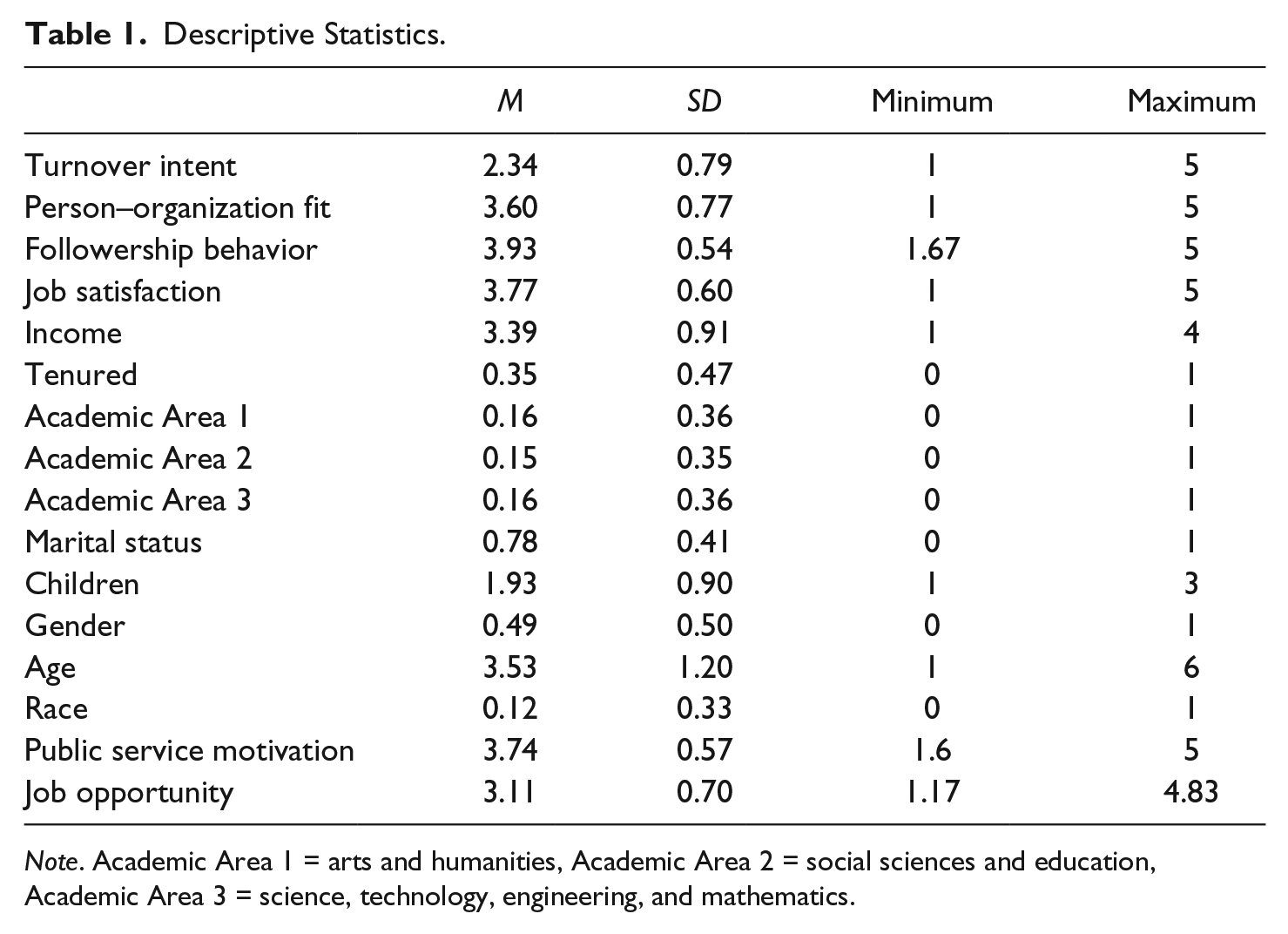
Note. Academic Area 1 = arts and humanities, Academic Area 2 = social sciences and education, Academic Area 3 = science, technology, engineering, and mathematics.
Zero-Order Correlations.

p < .05. **p < .01.
Table 3 presents the estimates of our model in the form of three ordinary least squares regressions. These estimates take the form of regressing the independent variables on followership, job satisfaction, and turnover intention. Overall, Model 1 shows that P-O fit is negatively associated with turnover intent (β = −.298, p < .0001), controlling for all other variables, including the two mediators. In other words, two individuals who differed by one unit in P-O fit perceptions were estimated to differ by 0.298 units in their intention to turnover, with the person with higher P-O fit having lower turnover intention. The effect of P-O fit on followership behavior (Model 1) was 0.221 (p < .0001). Two employees who differed by one unit in P-O fit were estimated to differ by 0.221 units on followership scale, with the faculty higher on P-O fit demonstrating greater followership behavior. Finally, demonstrating active followership behavior was associated with a significant increase on the job satisfaction scale (Model 2; β = .138, p < .01)—A one-unit increase in effective followership behavior scale was associated with a roughly 0.14 point increase in job satisfaction. Finally, Model 3 shows that job satisfaction is significantly, negatively associated with turnover intention (β = .549, p < .0001), indicating that a one-unit increase in job satisfaction scale is associated with a roughly 0.55 point decrease in employees’ turnover intention.
Path Coefficients for Mediation Models.

Note. Standard error in parentheses.
p < .05. **p < .01. ***p < .001.
Turning to the indirect effect, as shown in Table 4, the path linking P-O fit to turnover intention through followership and job satisfaction as a causal chain was statistically significant. In other words, faculty members relatively higher on perceived P-O fit scale demonstrated greater followership behavior, which in turn raised their job satisfaction, which in turn lowered their intentions to turnover. A bias-corrected bootstrap confidence interval for the indirect effect based on 10,000 bootstrap samples was entirely below zero (−.031 to −.007), supporting our mediation hypothesis.
Indirect Effects for Mediation Models.
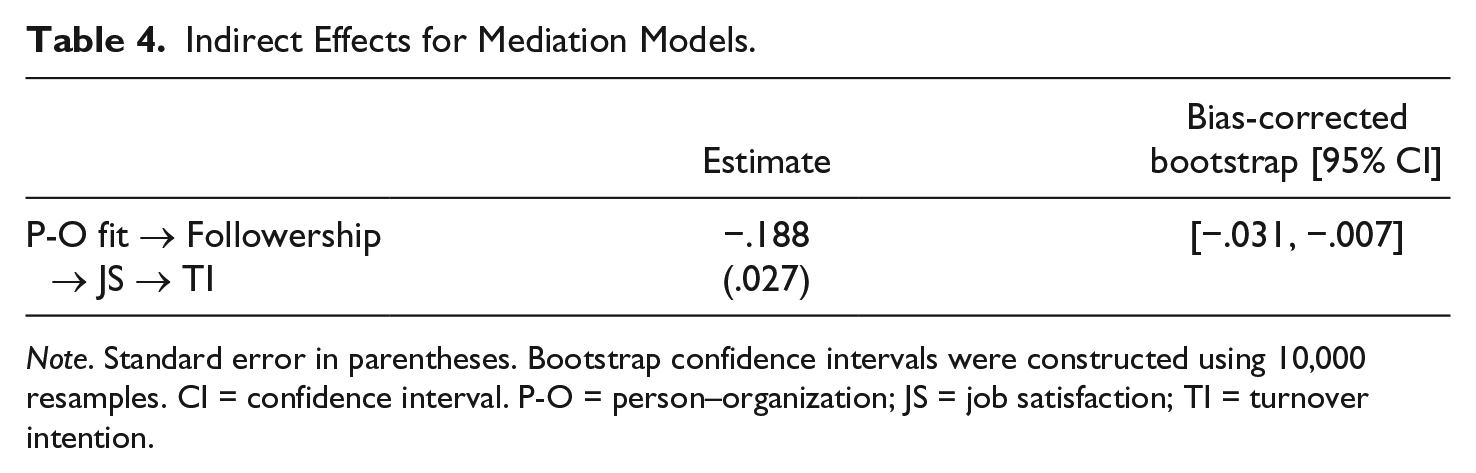
Note. Standard error in parentheses. Bootstrap confidence intervals were constructed using 10,000 resamples. CI = confidence interval. P-O = person–organization; JS = job satisfaction; TI = turnover intention.
Discussion
While past research has established the linkage between P-O fit and employee turnover intention, several important questions still remained unaddressed. This includes the mechanisms that underpin turnover intention. Our study responds to this need within the literature and explores a behavioral mechanism of P-O fit on turnover intention among faculty members employed at an urban public university.
Consistent with COR theory, our findings suggest that faculty members with high P-O fit perceptions are likely to engage in proactive behavior so as to protect and foster the fit as a valued resource, which leads to heightened sense of self-concepts and job satisfaction through comradeship in the workplace, which in turn leads to reduced intentions to turnover. It must be noted that COR theory is traditionally used to explain individuals’ coping mechanisms as a reaction to acknowledging potential threats to resource loss. Thus, our study contributes to the COR theory by recognizing that individuals can also adopt proactive behavior, such as followership, so as to foster the valued resources even when the potential threats to resource loss may not be imminent.
Although the experience of work through contextual behaviors (e.g., organizational citizenship behavior or self-starting behavior, see Fay & Frese, 2000) has often been suggested as having an immediate impact on shaping one’s work attitudes and turnover intentions (Organ, Podsakoff, & MacKenzie, 2006), the role of employee behavior was mostly taken for granted, at best, relying on hypothetical assumptions (e.g., high P-O fit will motivate employees to engage in behaviors so as to return the favor for their organizations so as to increase self-concepts and thus reduce turnover intention) but without empirically testing how the behavior mediates the P-O fit and turnover relationship. Our study contributes significantly to the literature on fit theory by incorporating followership behavior as a new viable behavioral mechanism. Future fit-attitudes models should consider other forms of contextual behavior that may mediate such relationships. Doing so may help clarify what types of coping mechanisms employees are likely to use and develop to adapt to different organizational contexts. Given that P-O fit perceptions change over time during the course of job incumbents’ tenure in an organization (Astakhova, Doty, & Hang, 2014; Gabriel et al., 2014; Yu, 2009), understanding the different behavioral mechanisms will help provide more practical intervention strategies for managerial actors to motivate their employees and suppress the potential threats to their psychological as well as physical well-being.
We posit that COR may be particularly useful in explaining why and how P-O fit is related to reduced turnover intention. For example, previous research on fit–turnover intent relationship has often relied on the use of social exchange theory perspective, which basically argues that employees finding a good fit with their organization will be encouraged to fulfill their obligation to the organization and tend to stay longer (Schneider, 1987). However, this perspective is based on the notion that workers are rather obligated to return the favor by reciprocating with behavior and attitude that benefit the organization (C. Kim & Schachter, 2015). Although the social exchange theory approach helps explain the motivation to attribute positive motives toward the organization as a result of the positive view on the actions of the organization (Cable & DeRue, 2002), how fulfilling the obligation is related to reduced turnover intentions needed more sound theoretical framework.
The results of this study are interesting, but they should be interpreted with caution as it is not without its limitations. Our use of a cross-sectional data precludes the demonstration of causal order among variables. Although the sound theoretical arguments used in our model discount some of the possible causal directions, longitudinal analyses in future studies would at least provide a more nuanced approach to confirming such causality. In addition, our measure for P-O fit was based on employees’ perception, not the actual congruence between organizational culture and employees’ values. Despite the importance we noted earlier on the role of perceived fit (Cable & DeRue, 2002), from a comparative perspective, we recognize that investigating both objective and subjective P-O fit would further validate its impact on employee outcomes. Finally, our data were collected from a single urban public research university in the United States. While this unique sample adds to the P-O fit literature, we are uncertain about the extent to which our findings based on the three-step mediation model can be generalized to employees in other university settings, which vary, for example, in size and in scope of service. More research is needed to validate these findings.
Conclusion
Overall, this study contributes to the literature by clarifying the relationship between P-O fit and turnover intention using a causal mechanism in which P-O fit indirectly influences turnover intention through its influence on followership behavior and job satisfaction in serial. One important implication of the findings for managerial actors is that high P-O fit perceptions can trigger employees to voluntarily engage in behaviors to maintain their valued resources through which their increased job satisfaction ensues, leading to a heightened sense of attachment to their organization and thus reduced intention to turnover. Therefore, for leaders trying to keep their followers satisfied and prolong their tenure in the organization, allowing their followers to explore the various types of activities beyond what is on their job requirement may present them the opportunity to choose what they like and do best, which can satisfy both the intrinsic and extrinsic desires in the organization. Employees are likely to be satisfied intrinsically because they really like what they choose to do and will be satisfied extrinsically because giving their best effort will lead to increased recognition from the leaders. We recommend that future studies utilize the integrated mechanism to provide a more nuanced approach to explaining the dynamic relationship between P-O fit and turnover intention.
Footnotes
Appendix
Variable Measurement.
| Variables | Measure |
|---|---|
| Dependent variable | |
| Turnover intention (Moynihan & Pandey, 2007) | How often do you look for job opportunities outside this organization? I would be very happy to spend the rest of my career with this organization (reversed) |
| Independent variables | |
| Person–organization fit (Bright, 2008) | Summative index of responses to the following statements (Cronbach’s alpha = .79) My values and goals are very similar to the values and goals of my organization I am not very comfortable within the culture of my organization I feel a strong sense of belonging to my organization What this organization stands for is important to me 1 = strongly disagree, 5 = strongly agree |
| Mediators | |
| Followership behavior (Kelley, 1992) | Summative index of responses to the following statements (Cronbach’s alpha = .746) I am highly committed to an energized by my work and my department, giving them my best ideas and performance Instead of waiting for or merely accepting what my departmental chairperson tells me, I personally identify activities that are most critical for achieving my department’s priority goals While starting a new assignment, I promptly build a record of successes in tasks that are important to my departmental chairperson I take the initiative to seek out and successfully complete assignments that go above and beyond my job I independently think up and champion new ideas that will contribute significantly to the leader’s or the organization’s goals I help out other coworkers, making them look good, even when I don’t get any credit 1 = strongly disagree; 5 = strongly agree |
| Intrinsic job satisfaction (Corley & Sabharwal, 2007) | Summative index of responses to the following statements (Cronbach’s alpha = .731) Thinking about your principal job, rate your satisfaction with intellectual challenge/degree of independence/level of responsibility/contribution to society 1 = very dissatisfied, 5 = very satisfied |
| Covariates | |
| Income | Income of respondent 1 = under US$41,000, 2 = US$41,000 to US$60,000, 3 = US$61,000 to US$80,000, 4 = more than US$80,000 |
| Tenured | 1 = tenured, 0 = non-tenured (on tenure track but not tenured, not on tenure track) |
| Academic Area 1 | 1 = professional areas (e.g., business, health science, medicine) |
| Academic Area 2 | 1 = arts and humanities (e.g., English, fine arts) |
| Academic Area 3 | 1 = social science and education (e.g., sociology, economics) |
| Marital status | 1 = married, 0 = never married, separated, divorced, widowed |
| Children | Count reflective of the number of children in the household |
| Gender | 1 = male, 0 = female |
| Age | 1 = 21-30, 2 = 31-40, 3 = 41-50, 4 = 51-60, 5 = 61-70, 6 = over 70 |
| Race | 1 = White, 0 = non-White |
| Public service motivation (Perry, 1996) | Summative index of responses to the following statements (Cronbach’s alpha = .729) Making a difference in society means more to me than personal achievements I am prepared to make enormous sacrifices for the good of society I am rarely moved by the plight of the underprivileged (reversed) I unselfishly contribute to my community I consider pubic service my civic duty 1 = strongly disagree, 5 = strongly agree |
| Job opportunity (Daly & Dee, 2006) | Summative index of responses to the following statements (Cronbach’s alpha = .754) There are plenty of good academic jobs that I could have inside my metropolitan area There are plenty of good academic jobs that I could have outside my metropolitan area Given the state of the academic job market, finding a job would be very difficult for me (reversed) It would be difficult for me to find an academic job that I like as well as my job at the university (reversed) There is at least one good academic job that I could begin immediately if I were to leave the university I have job opportunity outside of academia 1 = strongly disagree, 5 = strongly agree |
Declaration of Conflicting Interests
The author(s) declared no potential conflicts of interest with respect to the research, authorship, and/or publication of this article.
Funding
The author(s) disclosed receipt of the following financial support for the research, authorship, and/or publication of this article: This work was supported by the National Research Foundation of Korean Government (NRF-2013S1A2055108).