



Abstract
This article explores the relationship between employees’ public service motivation (PSM) and public administrations’ financial performance from the perspective of human resource management (HRM). The purpose of this article is twofold: first, we seek to understand the relationship between organizational financial performance and individual-level PSM by focusing on how financial performance is associated with PSM. Second, while acknowledging previous findings on the impact of employees’ work attitudes on performance, we explore the possibility of an opposite causality. After assessing several theoretical and empirical propositions that support an additional direction of causality, we use a sample of municipal employees from Poland to test how financial performance affects individual PSM. By analyzing five financial indicators, we find that financial performance might predict individuals’ PSM. We also propose that a negative relationship occurs when organizations achieve financial goals through HRM practices that negatively affect employees, such as worsening of work conditions, increased workload, and inadequate remuneration.
Introduction
Research on how human resource management (HRM) affects employee and organizational outcomes in the public sector continues to expand; however, researchers must still gain deeper understanding of several key areas, including the methods organizations can use to promote individual motivation and the consequences of individual motivation on organizations.
Understanding the effects of organizational antecedents on performance helps human resource (HR) managers improve employees’ motivation to achieve desired organizational outcomes, which is crucial for public organizations to properly function (Brewer, 2008; Messersmith, Patel, Lepak, & Gould-Williams, 2011). One important question that has only partially been explored in the public administration literature is the relationship between organizational financial performance and employees’ public service motivation (PSM). Meanwhile, the relationship that links HRM practices with PSM and other employee outcomes has been explained theoretically and has been tested empirically by several authors (i.e., Gould-Williams et al., 2014). The present article contributes to the literature by examining global organizational characteristics (i.e., financial performance) to determine whether and how these characteristics might affect PSM.
Assessing the causality that flows from the organizational level to the individual level has several potential implications for PSM research and HRM practice. First, in the reciprocal model, global organizational characteristics significantly affect PSM, even though these characteristics are somewhat detached from the individual employee level. Second, in addition to the traditionally studied individual antecedents or organizational antecedents created by employers (e.g., work environment, managerial practices and attitudes), our study examines the objective variables of the global organizational context, which are not biased by employees’ perception, yet, might affect PSM. Third, our contribution to the literature provides better understanding of the complex interrelations of individual- and organizational-level characteristics within a public organization.
Below, we review and summarize theoretical and empirical studies on the relationship between organizational variables and individual work attitudes. Next, we link the concept of PSM with overall public sector financial performance. Subsequently, we conduct a simplified empirical study on a sample of Polish cities. This empirical component further explains the situations in which financial outcomes could be positively and negatively correlated with PSM. While not without limitations, the present study illustrates our propositions and invites researchers to further investigate the topic.
Theoretical Frameworks
This article is based on two HRM frameworks that help explain interconnections between financial performance and employee motivation. The first framework, advanced by Paauwe and Boselie (2005), proposes three types of HRM performance outcomes. Financial outcomes such as profits, solvency, and external funding acquisition are important in the management of public administrations. Organizational outcomes such as productivity, quality, and effectiveness mainly affect citizens’ satisfaction. HR-related outcomes (e.g., employees’ satisfaction, commitment, and intention to quit) shape employees’ attitudes toward work. The Paauwe and Boselie (2005) model assumes that proper HRM can motivate an employee toward desired performance outcomes. Moreover, some studies have indicated that an HR program might lead to more than one type of performance outcome, suggesting that performance outcomes overlap—thus creating difficulties in separating the effects of HR programs (Arches, 1991; Boselie, 2014; Heskett, Sasser, & Schlesinger, 1997; Maslach, Schaufeli, & Leiter, 2001; Schneider, White, & Paul, 1998).
To further explain the interconnections between organizational outcomes, the present study applies the framework of HR architectures 1 advanced by Ridder, Baluch, and Piening (2012). Their HRM typology suggests that different types of performance outcomes might be (a) positively correlated, when improving one type of performance entails improvements to another type (value-based HRM); or (b) negatively correlated, when improving one type of performance comes at the cost of another (strategic and motivational HRMs). 2 When HR managers overemphasize the organizational goal (i.e., improved financial and organizational outcomes), strategic HRM prevails in an organization. While still questionable whether strategic HRM is effective in the private sector, it is harmful in public organizations (e.g., employees often become overloaded with work, burned out, and feel neglected and unimportant). Public administration scholars also note the negative impacts of market models on employee PSM, because of market norms introduced to public settings (Moynihan, 2008). Motivational HRM occurs when managers improve HR outcomes while neglecting the organization’s strategy. The financial performance in such organizations usually weakens. Successful public sector management relies on value-based HRM, which is accomplished by balancing both organizational and employees’ priorities (Ridder et al., 2012). Management recognizes employees’ PSM as a driving force for action and directs it toward organizational goals. Value-based HRM is best suited for public organizations because, ideally, employees and the organization share a similar goal, which is to serve citizens. Within a particular organization, the HR practices must be assessed to determine which approach is being implemented: Do they enhance both organizational efforts to improve financial performance and individual attitudes or prioritize one approach?
Applying the two frameworks, the present study examines the interdependence of various types of performance outcomes. Namely, we question the direction of their relations, and whether better financial outcomes and organizational outcomes would also lead to higher HR-related outcomes. The review below indicates that the link between public financial performance and PSM, as an important HR-related outcome, has been overlooked thus far.
Organizational Performance and PSM
Organizations achieve higher levels of performance by managing their HRs in an effective way. HR managers improve human capital “through development and influence employees’ behavior in the desired direction” (Paauwe & Boselie, 2005, p. 10). Previous research indicates that this positive change in employees—a HR-outcome—might affect organizational performance. Gerhart (2007), in a methodological study on the linkages between HR management and performance, defines the latter as a function of an “unstandardized regression coefficient representing the performance-HR relationship” (p. 552). Other studies showed that committed personnel is the most important factor for innovation (Holzer & Olshfski as cited by Holzer & Callahan, 1998) and extra-role behavior (Balfour & Wechsler, 1996), and that satisfied employees are more productive employees (Judge, Thoresen, Bono, & Patton, 2001; Likert, 1961; Mayo, 1933; McGregor, 1960; Yousef, 2000). The experiments of both Bellé (2013) and Pedersen (2015) suggested that simple external interventions may engage individuals’ PSM, which is expected to enhance their performance.
While recognizing the significance of prior research in this area, the present article raises the possibility of an alternative causality that may operate simultaneously with the causality illustrated in the abovementioned studies. As previous researchers of the reverse causality describe, “Indeed, the implicit causal arrow runs from anything concerning people to organizational performance, with little consideration of either reciprocal effects or the possibility that performance is the cause of anything” (Schneider, Hanges, Smith, & Salvaggio, 2003, p. 837). Few tests of reverse causalities have been previously performed: those by Stritch and Christensen (2014) for PSM and by Schneider et al. (2003) for organizational performance.
Why should we assert that the relationship can also run from financial performance to PSM? First, both empirical and theoretical evidences support a cross-level organizational effect on individual work attitudes. Beginning with earlier work on scientific management and industrial engineering that focused on the physical environment and physiological responses of workers, researchers have conducted numerous studies demonstrating how employee behaviors and attitudes are shaped by organizational structure (e.g., Hulin, 1966; Porter & Lawler, 1964), leadership and the organization’s age (Glisson & Durick, 1988), social environment (Likert, 1961), organizational culture and climate (Glisson & James, 2002), command and control systems (Cooke & Szumal, 2000; Jacobsen, Hvitved, & Andersen, 2014), and work context (Wright & Davis, 2003). Because the context in which work attitudes occur is multidimensional and includes several organizational characteristics (e.g., size, age, and hierarchy), it is important to emphasize that organizational characteristics combine to shape attitudes toward work, job satisfaction, and behavior (Rousseau, 1978).
Second, we assume a relationship between financial and HR outcomes, because some studies have shown that organizations’ performance—as one of the organizational characteristics—affects employee behavior, attitudes, and motivation. The literature generally assumes a positive association between organizational performance and greater job satisfaction (Judge et al., 2001; Ostroff, 1992; Taris & Schreurs, 2009), and between organizational performance and employee attitudes (Schneider & Bowen, 1993; Tornow & Wiley, 1991). A recent meta-analysis of nearly 100 studies also suggested that organizational performance positively and strongly correlates with job satisfaction (Cantarelli, Belardinelli, & Belle, 2016). We must acknowledge that the number of the studies about organizational characteristics affecting employees’ outcomes and attitudes outweighs the number of the studies focusing particularly on organizational performance being a determining characteristic.
Thus, the causality link running from organizational performance to employee outcomes has received less attention in the research literature. Among these rare research efforts, Vermeeren, Kuipers, and Steijn (2011) showed that work environment affects job satisfaction; in particular, performance outcomes (e.g., customer satisfaction) affect job satisfaction. Their findings were in line with a prior study of a large automobile finance company, which revealed that customer satisfaction—as a component of organizational performance—led to positive changes in employee attitudes rather than the opposite (Ryan, Schmit, & Johnson, 1996). The findings of Ryan et al. (1996) accounted for employees’ perceptions of their work environment, showing that similar attitudes among employees are a product of their shared experiences. Other research has also shown a positive association between employee satisfaction and customer satisfaction (e.g., Koys, 2001; Taris & Schreurs, 2009). Investigating measures of organizational performance other than customer satisfaction, Awamleh and Gardner (1999) found positive effects on employees’ perceptions of their leader. There is also growing evidence that potential employees gravitate to successful well-performing organizations and, once hired, they are likely to remain with such organizations (Heskett et al., 1997; Schneider et al., 1998).
Following similar logic, organizational accomplishments achieved as financial outcomes might shape employees’ work attitudes. Trust in leadership integrity, better organizational transparency, and accessibility to information about organizational performance change employees’ work attitudes by improving their emotional commitment and work engagement, both in public sector (e.g., public schools; Klein, 2012) and in private organizations (e.g., banks; Hassan & Ahmed, 2011). Although they are relatively rare, some studies have focused on the relationship between financial performance and employees’ attitudes (Denison, 1990; Schneider et al., 2003). Examining correlations between aggregated data on employee attitudes and organizations’ financial performance in 34 publicly held firms, Denison (1990) found a link between increased financial performance and a self-reported high level of work engagement. Data from 35 companies over 8 years helped Schneider et al. (2003) illustrate that financial indicators predict employees’ satisfaction more so than the reverse.
While scholars have shown that organizational financial performance can shape employees’ work attitudes (Schneider et al., 2003), to our knowledge, no one has explored—either theoretically or empirically—whether financial performance in particular can shape employees’ PSM. Moreover, research on the impact of global variables of objectively measured organizational performance on PSM, to our knowledge, has simply not yet been done. While scholars refer to the impact that high PSM employees can have on organizational performance, more often than in the reverse relationship (Bellé, 2013; Brewer, 2008; Brewer & Selden, 2000; Kim, 2005; Park & Rainey, 2008; Ritz, 2009), the present study offers a more comprehensive theoretical view.
Our third argument in support of the relationship between financial performance and PSM is built on previous studies about PSM’s context. They revealed that PSM is, to a large extent, shaped by the organizational environment where an employee operates (Liu & Perry, 2016; Moynihan & Pandey, 2007; Scott & Pandey, 2005; Stritch & Christensen, 2014; Taylor, 2008; Vandenabeele, 2008).
In sum, previous researchers suggest a link between organizational characteristics and employees’ work attitudes and motivations. Namely, they provide a starting point to assume that financial performance, when known to employees, becomes a component of the organizational environment, and therefore might affect PSM. However, we believe that more theoretical work is necessary to fully specify the nature of this relationship. Our argument is motivated by the review of previous studies discussed above and quantitative evidence from a survey of municipal employees presented below. As a consequence, we also raise the possibility that employees’ PSM not only drives organizational financial performance but can also be shaped by it through HR programs and priorities:
However, the question remains whether a competitive business-like environment that overemphasizes financial outcomes will positively or negatively affect the PSM level of public employees. At one point, PSM emerged as the notion of sectorial differences between the employees. Beginning with the first PSM studies, research has shown that public sector employees are distinctive from their private counterparts in terms of their PSM motives (Houston, 2000; Houston, 2006; Jurkiewicz, Massey, & Brown, 1998; Kim, 2005; Wittmer, 1991) that “lead to behaviors that benefit the public” (Kim & Vandenabeele, 2010, p. 703). Thus, fewer organizational and operational differences between the sectors associate with fewer differences in PSM; when the public sector closely resembles the business sector, we can expect lower PSM in the employees.
This proposition is also consistent with the Ridder et al. (2012) criticism regarding applicability of the strategic HRM approach to public organizations. According to their typology, in organizations with strategic HRM, improved financial performance may come at the cost of reduced HR outcomes. Mostly focusing on market-related demands and aiming to achieve performance outcomes such as administrative efficiency, operating efficiency, resident satisfaction, and reputation, such organizations usually overemphasize the functional importance of employees (Barney & Wright, 1998; Coff, 1997). Research highlights the negative effects of control-oriented practices (e.g., pay-for-performance systems used to advance organizational and financial outcomes) on employee satisfaction, motivation, and commitment (Cunningham, 2006; Deckop & Cirka, 2000). Competitive behaviors rewarded by management clash with the culture of public organizations, where the principles of equality and equal treatment of employees usually dominate (Theuvsen, 2004). Strategy-driven approaches often fail to consider whether the applied HR practices fit the needs and individual goals of employees, detrimentally affecting their motivation, satisfaction, and commitment (Brandl & Güttel, 2007; Theuvsen, 2004). In particular, research highlights a crowding-out of intrinsic motivation for employees after the introduction of the merit pay program and after the increase in control by pay (Deckop & Cirka, 2000). Assuming that HR practices oriented toward improved financial outcomes might negatively affect HR outcomes, the hypothesis of a negative correlation is formulated as follows:
Meanwhile, some evidence also supports a positive association between financial performance and employees’ PSM. First, research shows some positive effects of the strategic HRM oriented toward financial outcomes on HRs. If employees perceive that the intended goals of HR practices align with important strategic concerns of the organization, high levels of satisfaction and commitment are likely to occur (Boxall, Ang, & Bartram, 2011; Nishii, Lepak, & Schneider, 2008). Some research also indicates that a business-like climate can positively affect public employees and result in high performance—encouraging employees and improving their moral. This is in line with previous conceptual research on HR systems, which posits that employees value HR practices that are perceived to be relevant to fulfilling organizational goals (Bowen & Ostroff, 2004; Nishii et al., 2008).
Second, a public organization could also adopt a value-based HRM approach, which emphasizes both the core values of the mission (e.g., good financial performance) and the employees’ strengths. Commitment approaches to HRM forge links between organizational and employees’ goals, leading to the desired employee behaviors and attitudes (Arthur, 1994). In value-based HRM, organizations invest in their employees’ development, applying their new skills as a means of accomplishing their mission and goals. To the extent that such HR programs develop firm-specific human capital, they can enhance employee retention and contribute to organizational performance (Coff, 1997; Lado & Wilson, 1994; Lepak & Snell, 1999). Relational aspects to external stakeholders, emphasis on employees’ autonomy, and strong management support are the key characteristics of value-based management, which are often positively perceived by employees (Borzaga & Tortia, 2006). Building on the empirical evidence presented above, our alternative hypothesis assumes a positive association between financial performance and PSM:
Data and Method
While HR-related outcomes occur mainly on the individual level, financial performance is a global characteristic of an organization. The term “global construct” refers to constructs that are descriptive of an organization that originate in levels higher than the individual and where there is no lower-level analog. While such constructs do not depend on an individual’s perceptions and experiences, they can influence members working in a group (Hofmann, 2004). Our study follows Herman and Hulin’s (1972) approach and combines two strategies of analysis: individual differences within a single organization and objective organizational characteristics across organizational settings. The present cross-level study analyzes distinguishing factors among the types of organizations and their impact on individual-level variables, while controlling for the individual-level differences.
We selected Polish municipal governments to observe the global organizational characteristic (i.e., financial performance) for several reasons. Poland is a highly decentralized country with three tiers of self-government, of which the lowest municipal level has the strongest competencies and resources: Municipalities possess on average 80% of all decentralized budgets. The latter, in 2013, were equal to 14.1% of GDP (European Union [EU] average was 11.9%), and local government expenditures were equal to 32.5% of all public expenditures. Local and regional governments construct two third of all capital infrastructure in the country. These governments possess a high level of management autonomy, their own revenue sources, and fixed assets, and they are protected legally. Financial solvency is especially important in the decentralized states, where local governments are very much independent of the central government. Local governments must primarily depend on their own resources, both financial and human, to maintain a thriving community.
We use 2014 survey data from five well-managed cities in Poland and financial data, which are reported annually by each city’s administrators. The five cities are Bialystok (148 respondents, representing 20% of the employees that we contacted in this city who had computer access to respond), Elk (137 responses—95%), Dzierzoniow (74 responses—70%), Kutno (33 responses—21%), and Rejowiec Fabryczny (13 responses—92%).
The five cities differ by size. Two of the three smaller cities, Elk (60,000 inhabitants) and Dzierzoniow (35,000 inhabitants), belong to a category of low-income per capita cities, and the third, Kutno (45,000), is a medium-income city. Rejowiec Fabryczny is the smallest city, with a population of only 4,600. The largest city—the capital of the Podlaskie province—Bialystok (300,000 inhabitants) belongs to a category of medium-income cities. Bialystok has larger revenues per capita because it performs additional subregional functions, thus, higher expenditures than the other four.
These cities differ in terms of population and the number of staff they employ. In 2014, Bialystok City Hall employed 1,072 staff, of which 739 held clerical positions, whereas Elk employed 184 staff with 142 in clerical positions, Dzierzoniow employed 112 staff and 105 clerks, and Kutno employed 180 staff and 152 clerks, respectively. Rejowiec Fabryczny had only 18 employees with 14 clerks. The differences in staff size are not only due to population differences but also due to wider responsibilities that Bialystok has as a city with county rights. Expenditures for public administration per capita in all five cities are very different: 166 PLN in Elk, 270 PLN in Bialystok and Kutno, 336 PLN in Dzierzoniow, and 412 PLN in Rejowiec Fabryczny (1 Euro = 4.1 PLN, US$1 = 3.8 PLN).
None of these cities have any specific developmental or geopolitical advantage within Poland. Only Kutno is situated in central Poland at the cross-roads of highways and railways. The remaining four are situated in the peripheral provinces of Poland: Bialystok and Elk are located far east in the Podlaskie province—considered one of the poorest. Rejowiec Fabryczny is in the southeast Podkrapackie, and finally, Dzierzoniow is located far southwest in Dolnoslaskie province. The latter province has higher GDP than the others, but since the 1990s, Dzierzoniow has faced severe problems: a failing post-socialist industry and no advantage in roads and railway connections.
All five cities are developing relatively well as they implement very ambitious capital investment programs and are among the leaders in utilizing EU structural development funds. They are successfully catching up with better developed urban centers in Poland. The best indicator of this process is that two of these cities have gained new citizens over the last 5 years, which is quite exceptional for Poland—a country stricken by demographic crisis.
The city governments enjoy long-term political stability. Mayors are frequently reelected for three or four terms. They have implemented stable and quite successful socioeconomic development strategies. Political stability in municipal councils and in executive positions allows the cities to develop a cadre of highly qualified professionals able to program, apply for, and execute their own projects, as well as EU-funded projects. Moreover, the four larger cities use quality management systems. Dzierzoniow was the first municipality in Poland to implement this approach and even received the European Foundation for Quality Management Excellence Award in 2011.
Financial indicators
Several PSM scholars acknowledge the difficulties in measuring output and outcome of public organizations (Brewer & Selden, 2000; Kim, 2005; Ritz, 2009). They suggest that ideally, objective performance measures should be based on quantitative output data (Andersen & Pallesen, 2008), and that external performance measures created by government authorities would be more reliable than an aggregation of individual data into organizational measures (Ritz, 2009; Walker & Boyne, 2006). Organizational research scholars also recommend using situational variables collected independently from the sources of individual attitudes as they are considered to be more reliable (James, Demaree, & Hater, 1980).
Measuring the organizational and financial performance of local public organizations can be difficult because of the dissimilar and, at times, conflicting goals of each performance measure (Boyne, 2002). In measuring organizational performance, Boyne (2002) developed the Input–Output–Outcome model. Based on the relationship between these three dimensions, different aspects of performance can be measured: efficiency, effectiveness, cost-effectiveness, and so on. We address the PSM–performance relationship using a quantitative financial performance dataset, which consists of five standard financial indicators. In general, these indicators measure the solvency level of city governments; in other words, municipal ability to meet financial obligations. Fiscal capacity has been defined as “the state’s ability to raise revenue from taxes” (Besley & Persson, 2008, p. 522). As discussed below, our financial indicators go beyond the notion of taxation. Therefore, we consider “financial performance” as more appropriate terminology.
Researchers of public financial performance consider the first three indicators to be standard and valid indicators to measure public administrations’ financial performance (Wang, 2013; Wang, Dennis, & Tu, 2007). They belong to two different levels of solvency: budgetary solvency (i.e., the ability to balance the budget) and long-run solvency (i.e., the ability to pay future costs). These first three indicators measure the overall financial performance of a local public administration. Most of the determinants of this performance are outside of the control of a single employee; they reflect political and managerial choices that a single employee cannot affect.
Indicator 1—operating ratio—measures the sufficiency of revenues to cover local government expenditure. It is equal to the ratio between total revenues and total expenditures. A higher ratio indicates a better level of budgetary solvency. Indicator 2—long-term debt ratio—measures an organization’s ability to pay off its long-term debts; a higher value of this ratio is also a reflection of local authorities’ determination to close the infrastructure gap inherited after communism, even at the cost of incurring debts. Most active and entrepreneurial local governments in Poland have this ratio within the range 20% to 60%. A lower score suggests that authorities have adopted a passive approach to development; above 60% is considered to be dangerous for long-term solvency. It is calculated as the ratio of long-term debt and total revenues. Indicator 3—long-term debt per capita—measures the level of long-term debt for each resident, which is another way of approaching the same issue addressed by the previous indicator but allowing for comparison among municipalities. It is equal to the ratio between long-term debt and population.
Two more indicators are often used in Poland for benchmarking municipal performance. They are linked more to individual performance than the first group of indicators. When proactive public employees are searching and successfully applying for grants and external funding, financial performance increases according to these two indicators. Moreover, employees might be intrinsically rewarded by seeing that their efforts helped their organization obtain additional resources.
Indicator 4—external revenues (mainly EU grants) per capita—measures how successful the administration is in acquiring EU grants, which are awarded on a competitive basis and, therefore, require professional, hardworking staff and good cooperation among departments. It is counted as total revenues from EU grants per capita. A higher ratio indicates a better level of performance—especially among employees. Indicator 5—infrastructure expenditures as a share of total expenditures—measures the level of capital investments in a given year compared with all the expenditures, and signals whether filling the infrastructure gap left after communism remains a priority for local authorities. It equals the ratio between total capital investments and total expenditures. A higher ratio indicates a better level of performance, and in Poland it is usually between 10% and 40%. All five surveyed cities belong to the category of high performers.
As stated above, it is hypothesized that the financial performance of local governments is related to the level of employees’ PSM. The possible direction of the relationship (PSM dependent on financial performance) is justified by the time horizon of our variables. The indicators used to answer our research question(s) refer to fiscal year 2013, and the PSM survey was conducted in 2014. Furthermore, at least some general knowledge of the abovementioned indicators exists among the staff. Financial indicators are discussed in local government professional magazines, either as separate articles or more effectively in terms of benchmarking that allows comparisons between different cities. These magazines (Wspolnota, Gazeta Samorzadu i Administracji) are available to employees in their respective offices for consultation. The National Daily Rzeczpospolita often discusses the financial performance of local governments using benchmarks and discussing financial outcomes. Results of this benchmarking are widely discussed in the local press or on the website of the municipality.
PSM
The literature suggests that objective measures of performance correlate positively with measures of perceived performance (Bommer, Johnson, Rich, Podsakoff, & MacKenzie, 1995; Delaney & Huselid, 1996; Powell, 1992). Following these findings, we assume that employees of the studied local governments should be able to adequately perceive the objective financial performance of their organizations, and this might affect their PSM.
PSM is operationalized by the 16-item index developed by Kim et al. (2013). The scale was chosen for its modernity and its applicability to international contexts. Also, this scale measures PSM by dimensions, which makes our study a valuable contribution to global research in this field, particularly given that very few empirical studies have analyzed the associations between PSM and the dependent variables in such detail. We follow the Kim et al. (2013) study by presenting the four dimensions of PSM as an arithmetical mean of the scores of PSM’s constituent dimensions, namely commitment to public values (CPV), compassion (COM), self-sacrifice (SS), and attraction to public service (APS). The dimensions were calculated as the mean scores of their constituent factors. The initial survey included 16 items, though two were dropped due to technical reasons, and another four were dropped after the confirmatory factor analysis (see Table 1 for the summary of items).
PSM Dimensions and Items.
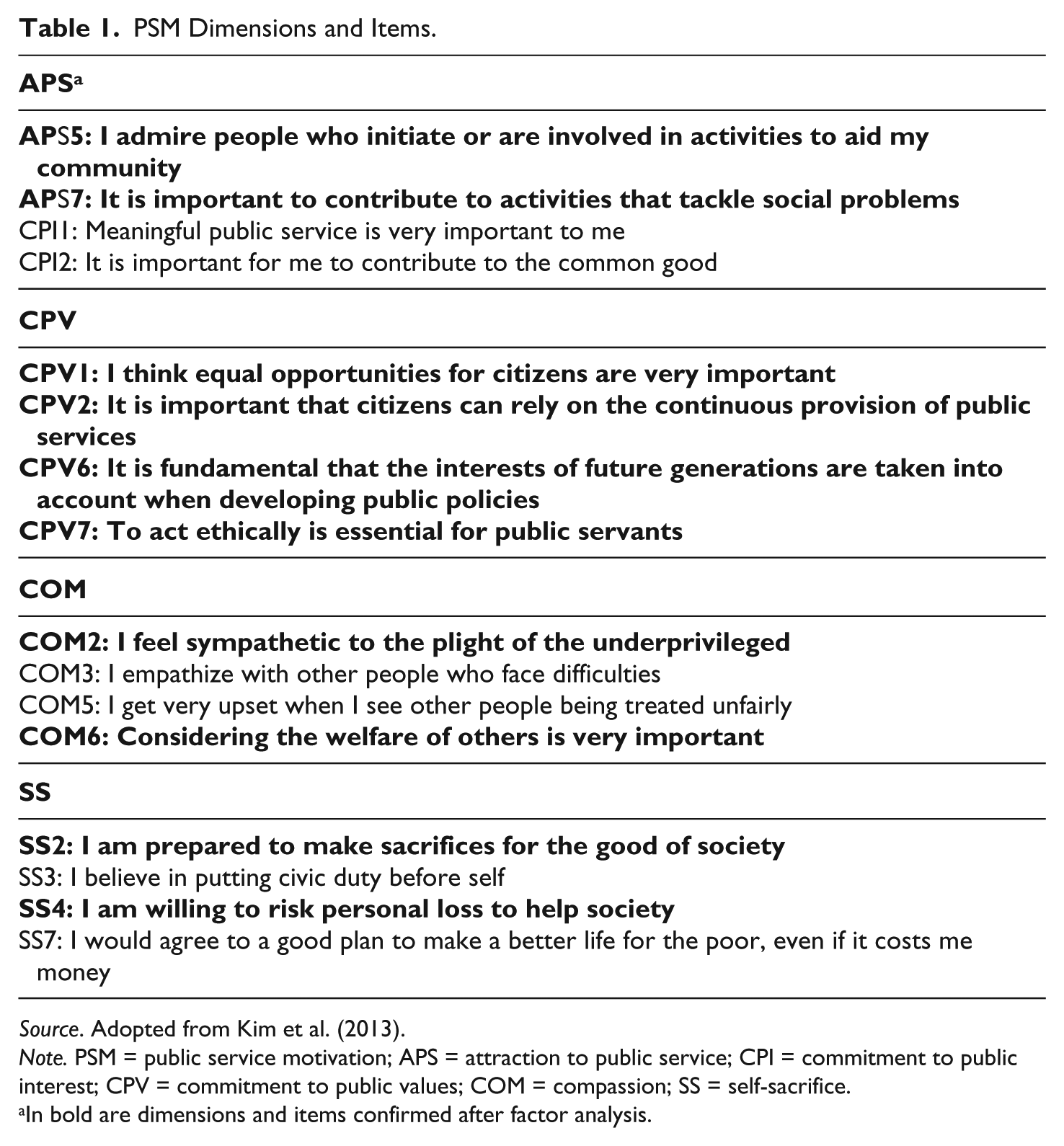
Source. Adopted from Kim et al. (2013).
Note. PSM = public service motivation; APS = attraction to public service; CPI = commitment to public interest; CPV = commitment to public values; COM = compassion; SS = self-sacrifice.
In bold are dimensions and items confirmed after factor analysis.
Controls
In addition, we control for employee gender, education, age, and tenure. Age is operationalized by self-assigning to an age group, varying from 1 to 4, where 1 indicates “less than 30 years old” and 4 indicates “more than 50.” Education has been evaluated as an ordinary variable varying from 1 to 5, where 1 indicates Lyceum (Polish equivalent to high school), 2 indicates professional school and technical school, 3 indicates bachelor’s degree, 4 indicates master’s degree, and 5 indicates doctorate.
Type of job performed (e.g., direct contact with citizens, administrative–managerial tasks, or technical support in an organization) is also a potentially interesting control variable relative to the level of PSM. We use it to capture the extent to which an employee may have opportunities to interact with the public. Therefore, dummy variables were also created to reflect job type performed by an employee: for the employees who have direct contact with citizens and for those who occupy managerial and administrative positions. The baseline is technical personnel (e.g., accounting or cleaning). For example, we expect higher level of PSM from those who have more interaction with the public than from those who spend most of their time working with other colleagues or technical equipment.
Managerial position is presented as a dummy variable reflecting whether a respondent’s position includes supervising other workers. The baseline is “No, it doesn’t.” Time in organization has been evaluated as an ordinary variable varying from 1 to 5, where 1 indicates “less than 5 years” and 5 indicates “more than 31.”
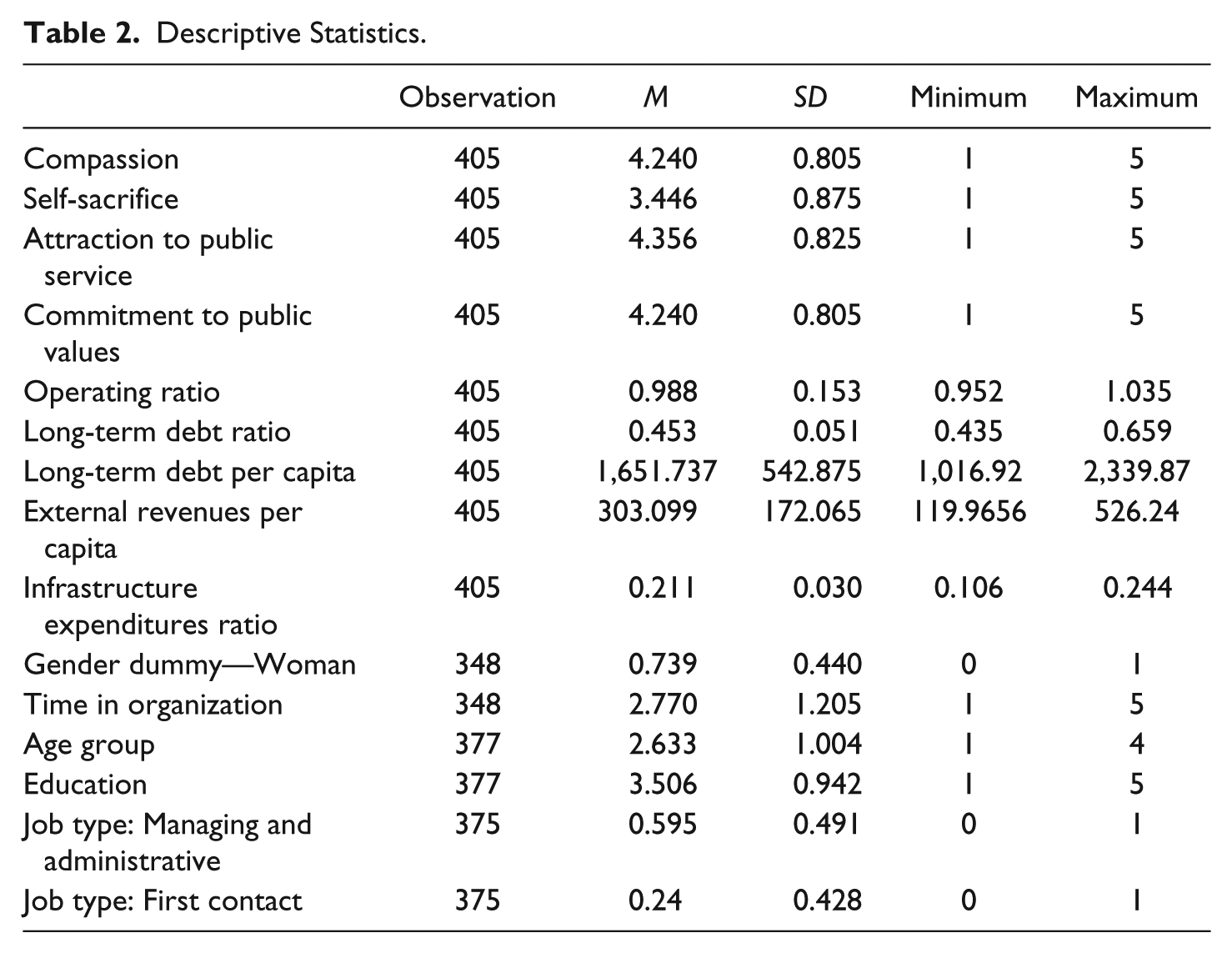
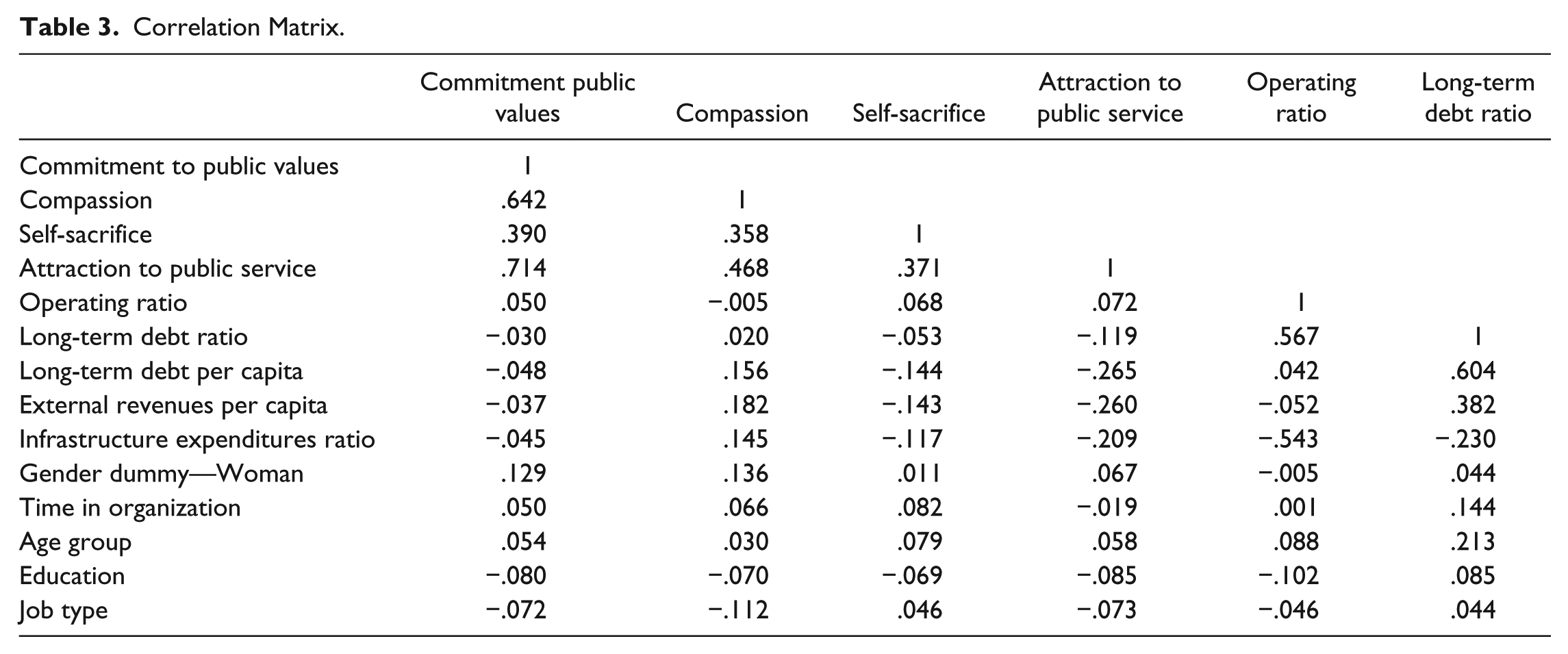
We provide basic descriptive and correlation information, respectively, in Tables 2, 3, and 4. The number of observations for the dependent and independent variables is 405. Missing values are acknowledged to exist for the control variables. Regarding the composition of our sample, most of our respondents are middle-aged women with a bachelor’s degree, who have been working in their organizations for more than 10 years. Most respondents reported working in an administrative/managerial position.
Descriptive Statistics.
Correlation Matrix.
Correlation Matrix.
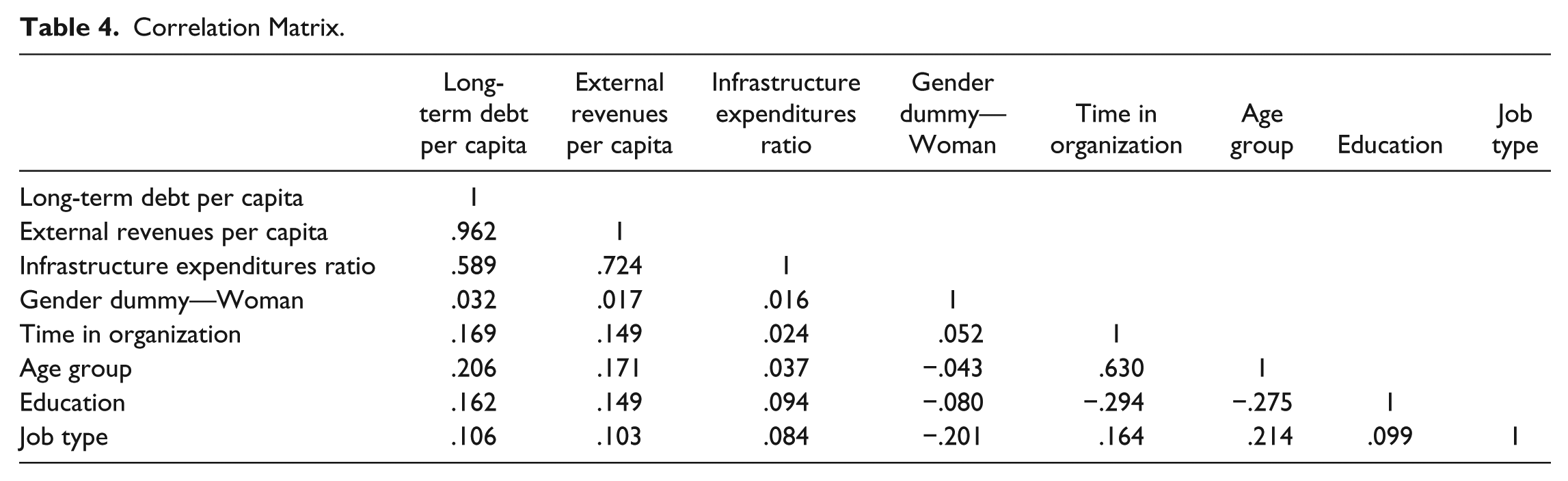
Much of the variation is observed for two of our independent variables: external revenues per capita and infrastructure expenditure ratio. Also, as Tables 3 and 4 show, multicollinearity occurs for most of the financial indicators. However, given the design of our regressions, it is not considered a problem, because each financial indicator constitutes an individual model.
In terms of limitations of the study, given the governmental-social-cultural context of these five cities, the results are likely not generalizable across other Polish cities. Acknowledging that, we also assert that generalizability is not our focus because this study constitutes an explorative analysis. Second, our statistical analysis would benefit if additional control variables (e.g., employee knowledge of government financial data) were to be added. This would provide evidence of a much clearer relationship that can be demonstrated via data alone.
Results
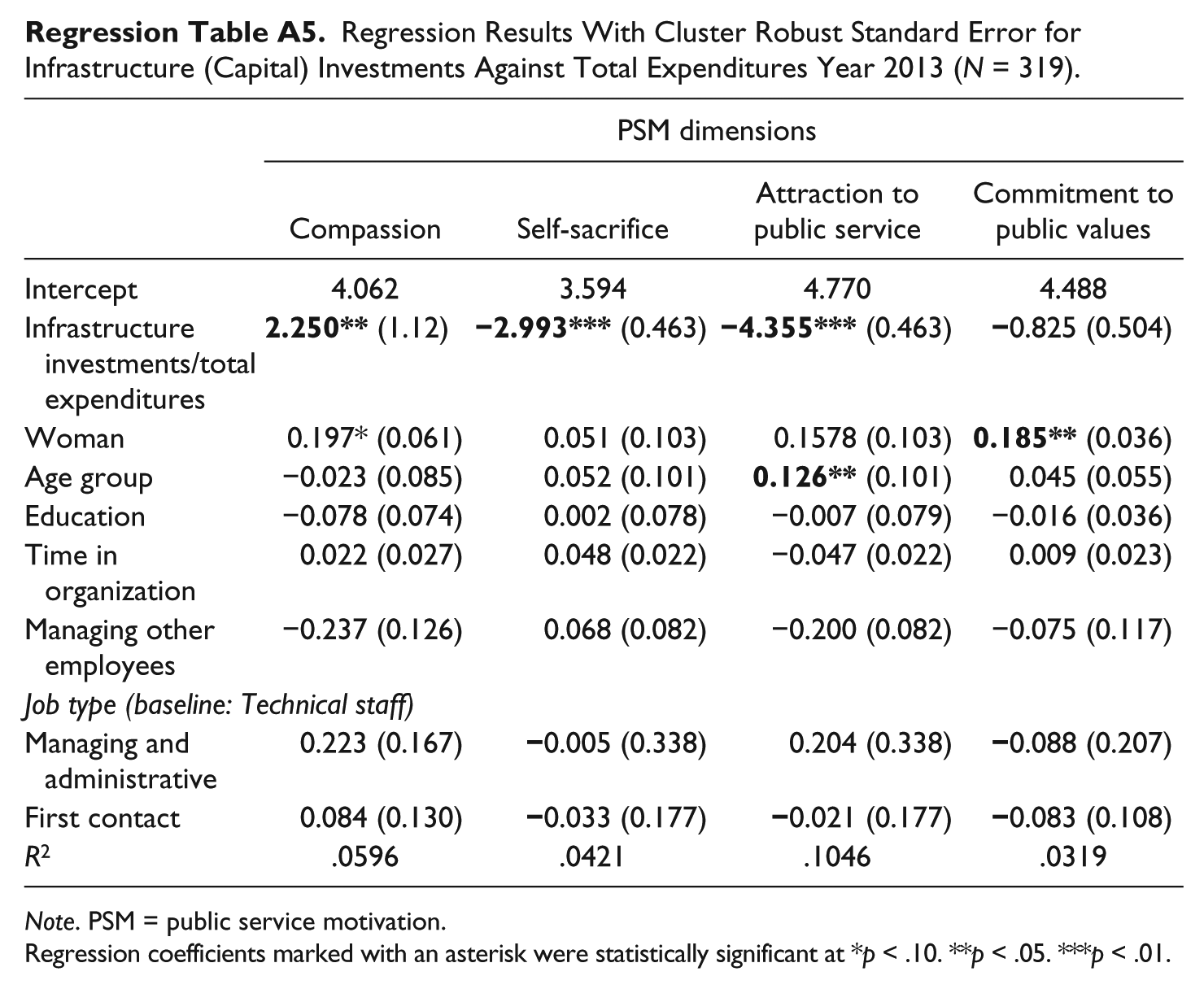
This section describes the statistical results for the models tested (see the Appendix). The tables provide regression coefficient, level of statistical significance, and cluster robust standard errors clustered at municipal level. The cluster robust option considered the nested nature of our data. Also, following Petersen (2009), the standard errors clustered by city are unbiased and produce correctly sized confidence intervals—whether the city effect is permanent or temporary. The fixed effects model also produces unbiased standard errors, but only when the city effect is permanent. In Regression Table A1, the coefficient of the 2013 Operating ratio exhibits a statistically significant and negative sign with compassion, and a statistically significant and positive sign with self-sacrifice and attraction to public service. The last dimension, commitment to public values, is not statistically significant. A few of the control variables used in the analysis are significant as well. Being a woman positively influences compassion and commitment to public values. A positive correlation is also found between age group and attraction to public service, while managing other employees is negatively correlated with both compassion and attraction to public service.
In Regression Table A2, the coefficient of the 2013 long-term debt ratio exhibits a statistically significant and negative sign with self-sacrifice and attraction to public service. However, it is positively correlated with compassion attitudes such as empathizing with other people’s difficulties or unfair treatment. Being a woman, age group, and managing others, all exhibit the same signs as in the previous model.
In Regression Table A3, the coefficient of the 2013 long-term debt per capita shows statistically significant and negative signs with self-sacrifice and attraction to public service, while it exhibits a statistically significant and positive sign with compassion. No different results are found between the financial performance indicator, gender, and age. However, the coefficient of managing other employees exhibits a statistically significant and negative sign only with attraction to public service.
In Regression Tables A4 and A5, the coefficients of the 2013 external revenues per capita indicator and of the 2013 infrastructure (capital) investments against total expenditures exhibit a statistically significant and positive sign with compassion, and a statistically significant and negative sign with self-sacrifice and attraction to public service. In Table 5, the control variables behave as previously described in Regression Table A1. In Table 5, again, being a woman is statistically significant and positively correlated with PSM, compassion, and commitment to public values. Once again, a positive correlation is found between age group and attraction to public service.
Discussion.
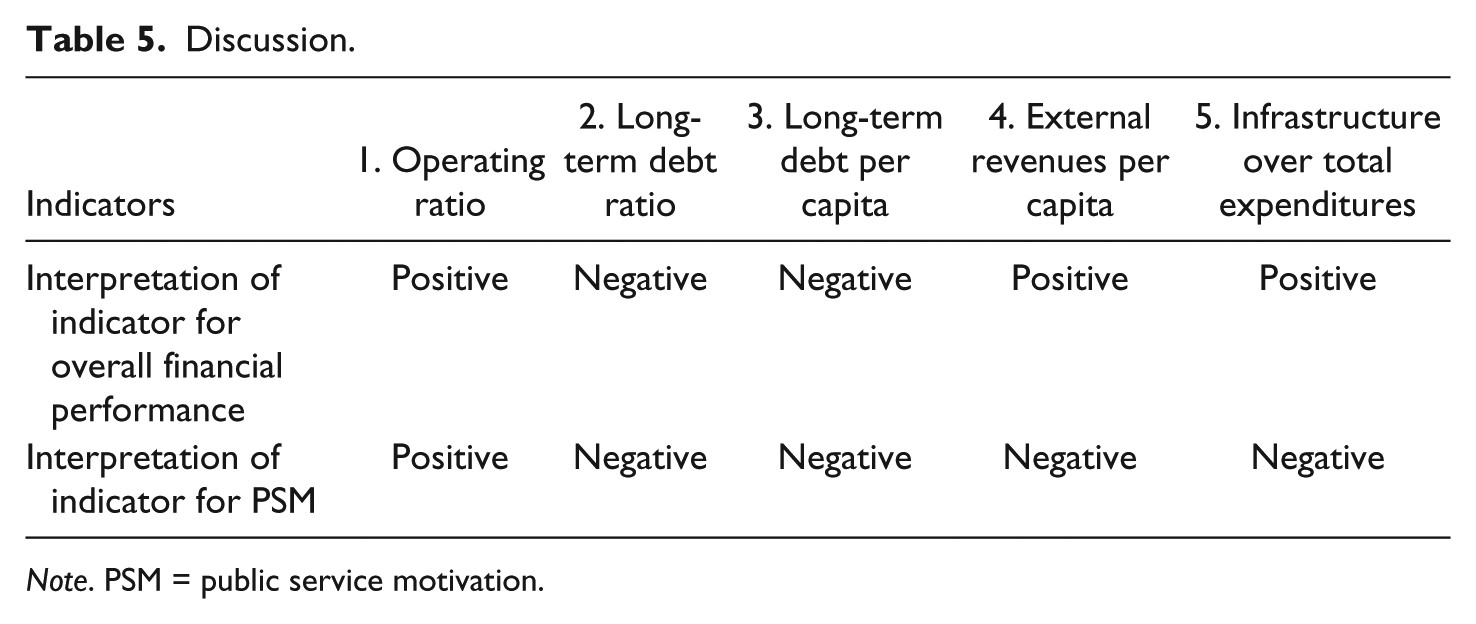
Note. PSM = public service motivation.
Across the models, commitment to public values did not correlate with any of the financial indicators. The relationship between Indicators 2 and 3 and PSM dimensions is reversed compared with Indicator 1, which is explained by the fact that higher scores of Indicator 1 and lower scores of Indicators 2 and 3 mean better financial performance. PSM dimensions and Indicators 4 and 5—external revenues per capita and infrastructure investments over total expenditures—show that the direction of the relationship is opposite to our expectations and to the first three indicators.
To conclude, we now provide further details on the R2 of the models. The models were only able to explain less than 10% of the variation in the dependent variable. This number is not a surprise, because a broad concept like PSM is difficult to explain solely through financial performance, given the fact that other factors, both within and outside the analyzed public administrations, can affect the overall level of PSM. Previous studies also revealed that employee attitudes are, at best, only weakly correlated to performance at the individual level of analysis (Siehl & Martin, 1990). However, our results are still interesting, because they consistently show that, at least partially, financial performance can explain the level of PSM of municipal employees.
Discussion
Our study focused on the relationship between PSM and the least studied aspect of organizational performance: financial performance. We found statistically significant correlations between financial indicators and individual-level PSM. In the sample of five Polish cities, we examined five financial indicators that might shape how municipal employees score in PSM (i.e., whether good financial performance of a city government supports “prosocial behavior at the work site”). Our results follow few studies that also linked financial outcomes to self-perceived employee attitudes and satisfaction (Denison, 1990; Schneider et al., 2003).
Although the implicit belief, both in practice and in academia, is that the relationship between PSM and performance runs from the former to the latter (Bellé, 2013; Brewer, 2008; Kim, 2005; Park & Rainey, 2008; Perry & Wise, 1990; Ritz, 2009), our literature review and our findings support the possibility of a reciprocal relationship. We advocate that a global construct, such as financial performance, might not only affect PSM but also predict it. Previous researchers have explained different types of organizational factors that shape employees’ physiological responses, and affect their attitudes and behaviors: physical environment (Rousseau, 1978), social environment (Likert, 1961), organizational culture (Glisson & James, 2002), centralization of the administrative systems (Jacobsen et al., 2014; Prysmakova, 2016), and organizational structure (Cooke & Szumal, 2000; Glisson, 1978; Rousseau, 1978). They also suggested that organizational performance might determine employees’ HR-related outcomes (e.g., job satisfaction; Heskett et al., 1997; Schneider et al., 1998).
We acknowledge that the available data only allow for determining the relationship between variables. Through the statistical correlation analyses employed in our study, the claims for causal relationships cannot be strongly supported. Yet, we defend our causality propositions with both our results and previous findings, suggesting that financial performance predicts employees’ satisfaction more than the reverse (Schneider et al., 1998). Further evidence of this causal relationship is that the financial data in our analyses were reported for year 2013 and the PSM data were collected in 2014, demonstrating a temporal association between the two variables. However, due to the substantial relationship of certain financial indicators with PSM found in the present study, future studies should examine variation in these variables over time.
Previous scholars have demonstrated that, aiming at improved performance, HRM could affect organizational, financial, and HR-related outcomes (Bellé, 2013; Paauwe & Boselie, 2005; Pedersen, 2015). In other words, HR managers guide employees toward desired performance outcomes. The main contribution of our study is that it supports previous arguments (e.g., Boselie, 2014) asserting that efforts to improve one type of outcome could also affect another, reemphasizing that organizational and individual outcomes are interconnected and mutually dependent on each other. Moreover, our study indicates the possibility of a reverse causality—when the achieved outcomes might affect employees’ motivation—directly through the perception of importance of such results, and also indirectly while following the required HR programs oriented toward desired performance outcomes. For the studied Polish local governments, a direct effect is pride in working for an organization that performs well financially (indicators of overall performance; for example, operational ratio). The indirect effect occurs due to the overload of work necessary for high financial performance (e.g., indicators that show how many EU and other grants were received).
Our findings are in line with the Ridder et al. (2012) typology of HR architectures for public organizations. These scholars propose that organizations, which are not primarily oriented toward profit maximization but toward societal improvement, should have a different HR architecture than business organizations, distinguishing value-based HRM as the most proper managerial style that emphasizes both organization and HR outcomes. Our results suggest that in the studied Polish local governments, adopted HRM practices, however, have an inclination toward businesslike strategic HRM, when the successes are achieved at the cost of neglecting the prosocial attitudes of employees and converting the workforce into number-producing business machines. Moynihan (2008) proposed a selection effect, when the public service led by the rules of market would attract and retain those who are primarily extrinsically motivated. Comparing our findings with PSM scores in other studies about public and nonprofit service providing organizations in Poland (Prysmakova, 2016), compassion level in the studied city halls is similar to other public organizations, and is statistically significantly lower than in nonprofits; the level of self-sacrifice is similar to public and nonprofit service providing organizations; and attraction to public service in the studied municipalities is actually higher than in Polish service providing organizations studied previously. Thus, we cannot conclude that emphases on the market models in the studied city halls have a negative selection effect on extrinsically motivated individuals. Moynihan (2008) also proposed a crowding-out effect of intrinsic motivation. Our study confirms this proposition, but only when employees have to improve performance through their hard work; our study rejects Moynihan (2008) if performance improves due to the sound decisions and hard work of leadership.
Thus, overemphasizing strategic HRM comes with advantages and disadvantages. Table 5 presents the meaning of the five financial indicators and their relationship with employees’ PSM. Despite the statistical significance, the relationship is not straightforward, because the signs vary for the financial indicators. The discussion of the results is organized into two subsections—by the type of indicator and by relationship with HR outcomes.
The first three indicators (1-3) show whether the government is able to cover all of its current expenditures and repay its debts with available resources. One way to achieve good performance in these indicators is by avoiding risky behaviors (e.g., refusing to invest in capital projects that might help close the infrastructure gap but worsen the city’s long-term solvency). Increases in these indicators do not have a direct impact on employees’ work conditions and their workload, because the decisions are undertaken by the leadership of an organization.
Meanwhile, stable growth becomes an important motivational factor for the employees of the studied municipalities. First, the employees in the Polish municipalities might be intrinsically rewarded by knowing that they are working in financially well-performing organizations. High performance in these indicators creates a positive image of their workplace, and thus motivates. Employees are likely to value HR practices for their perceived relevance to fulfilling organizational goals (Bowen & Ostroff, 2004; Nishii et al., 2008). As measured by these indicators, the Polish employees in high-performing cities declare that they are more attracted to public service and more willing to self-sacrifice. These indicators might equally reveal a value-based HRM effect, when organizational objectives coincide with individuals’ motivation, or a strategic HRM effect, when emphasizing relational aspects to external stakeholders—for instance, the EU’s appraisal of the best-performing city is positively perceived by employees, resulting in their desire to work for the organization and its mission. One way or another, increased attraction to public service is consistent with previous research showing that employees are likely to remain with organizations that perform well (Heskett et al., 1997; Schneider et al., 1998).
The results also show that when the financial situation of a Polish municipal government is improving, its employees declare more willingness to bare personal losses and to make sacrifices if it helps the society. On one hand, employees will more easily declare their desire to engage in self-sacrificing behaviors when the situation at the workplace is more stable. On the other hand, employees might identify the outcomes of their sacrifices with the financial performance stability, which will in turn reinforce their self-sacrifice desire. As previous studies show, willingness to sacrifice the self for the collectivity comes with acceptance of authority and hierarchy (Abraham, 1997). If a city develops steadily year by year due to the acknowledged hard work of the leadership, the feeling of service for the community comes with the acceptance of the authority and with higher levels of self-sacrifice. In general, as research shows, Polish public sector employees reveal a very high level of self-sacrifice, especially when compared with some neighboring countries (Prysmakova, 2016).
Second, despite higher attraction to public service and self-sacrifice (which could be found in both strategic and value-based HRMs), the first group of financial indicators have a negative association with compassion. This is the first sign that strategic HRM prevails over value-based HRM in the observed local governments. When the leader of an organization undertakes activities to improve overall financial performance of a city, employees in our sample feel less sympathetic to the plight of the underprivileged and are less considerate of the welfare of others. Thus, we observe how strategic HRM could negatively affect good intentions of the public service employees by implementing a businesslike approach toward their work. Ridder et al. (2012) referred to this as a standard drawback of strategic HRM, when the organizational strategy contrasts employees’ emotional reasoning to perform their work. A probable and apparently convincing explanation would be that employees in these municipalities have to agree with the entrepreneurial, result-oriented behaviors of the leadership. For this reason, their compassion for other staff and citizens lowers, especially, as observed in our study, in the case of employees in managerial positions. This explanation is consistent with previous theoretical propositions and empirical observations regarding the negative impacts of the business-oriented practices of the new public management (NPM) and public servants’ ethics (Maesschalck, 2004). Personal observations and interviews with the mayors of the studied cities—conducted during the administration of the surveys—support this idea by showing that many of the managerial tools developed under the NPM movement were effectively introduced into daily operational management (except for performance-related pay and formal performance contracts). Overall, however, this group of financial indicators reveals a positive association with PSM scores.
The second group of financial indicators describes whether filling the infrastructure gap remains a priority for local authorities and whether the city is able to obtain competitive EU grants (Indicators 4 and 5). Opposite to the first group, improvements in the latter require direct involvement of the staff. The high financial scores mean that the city government has professional, hardworking staff and good cooperation among departments. Meanwhile, increases in these indicators come at the cost of increasing pressure on employees to achieve higher levels of performance, as individual performance is directly related to the overall performance of an organization when measured by these indicators. For the staff, it means more work and more individual effort for the same level of compensation. Employees in managerial positions, even mid-level managers, usually work more than 8 hr a day, are under constant stress, and manage a significant number of other employees. Personal visits and observations conducted by the authors of this article during the survey distribution revealed this state of affairs for the five studied municipalities.
The results of the present study are consistent with previous findings on the negative effects of businesslike, financially oriented practices on employee satisfaction, motivation, and commitment (Cunningham, 2006; Deckop & Cirka, 2000). Similar to Theuvsen’s (2004) study, analysis of the Polish cities supports the idea that market logic brought by competition for resources, reduced funding, and higher citizens’ demand for better services clashes with the local governments’ culture established during the Solidary movement, which emphasized principles of equality and equal treatment of employees.
A typical flaw of the businesslike strategic HRM approach (Ridder et al., 2012), increased pressure on employees, is reflected in reduced desire to self-sacrifice and decreased personal attraction to perform public service. When an organization scores high on these indicators, employees might feel incapable of doing more than they are already doing, and therefore, they are unwilling to make more sacrifices or take personal losses to help society. The findings suggest that in times of work overload, municipal employees lose their initiative to launch even more services and provide more goods. In other words, they have no more energy and they experience burnout. The results are consistent with previous studies of public services: A demanding job is correlated with almost all aspects of burnout, such as emotional exhaustion, depersonalization, and decreased sense of accomplishment (e.g., Fong, 1990; Nirel, Goldwag, Feigenberg, Abadi, & Halpern, 2008). Thus, in Poland, especially in the studied municipalities, despite the constantly cultivated feeling of service for community, the post-Solidarity ethos of the public sector is visibly eroded by the competitiveness of the market economy.
Our findings show that in a well-performing municipality, as measured by Indicators 4 and 5, employees would agree to overwork themselves mainly due to their compassion. It is only the level of compassion that increases with more projects that the city launches with the help of local or EU grants. This can be explained by the fact that to improve these financial indicators, employees, indeed, act out of goodwill: They are sympathetic to citizens’ problems and truly consider citizens’ welfare. Another explanation would be that even if employees are not satisfied with their work conditions, they understand that the lives of those in need are even worse, and thus, continue working. Overall PSM score, however, is reduced in organizations that perform better in these two indicators.
The improved financial indicators of the second group also describe situations in which a city government—in need of new capital investments—might incur severe expenditure cuts. Polish cities are still legally required to maintain positive operational surplus without sacrificing their entrepreneurial spirit. For the staff, it means more work for the same compensation with little or no bonuses, which can be very demotivating. This is confirmed by our findings, which reveal that even though a city develops, new capital comes at the cost of employees who might lose their attraction to perform public service and their willingness to self-sacrifice. Compassion is the only PSM aspect that increases with more pressure and supervision from the treasurer of the municipal government. People who work in such austere conditions might truly value the welfare of others. However, the overall meaning for the second group of financial indicators, which directly affect individual workload and work conditions, is that better financial performance of municipal governments translates into lower individual PSM.
The last important observation refers to public service ethics. As shown above, both value-based and strategic HRMs possess powerful tools to change the intrinsic motivation of employees—the overall levels of their PSM. The present study reveals that commitment to public values as the public value dimension of PSM does not change with fluctuations of financial performance and associated HRM practices: None of the indicators were significantly correlated. The finding suggests that financial performance, whether it comes at the cost of work overload or austerity measures or due to smart decisions of leadership, is not connected with the system of public values. Individual attitudes toward equal opportunities, continuity of public services provision, consideration of future generations, and ethical behavior are never questioned, despite variations in the financial performance of a city government. Thus, from the financial performance perspective, commitment to public values might be a stable trait of PSM.
Conclusion
This article offers several take-home lessons for HRM and public administration. In times of increased pressure to perform well financially, the main asset of any public organization—its HRs—should be properly treated. PSM of public sector employees is what distinguishes public service provision from profit-driven business deals. Meanwhile, as our study suggests, PSM to a large extent is a fragile trait that can diminish when entrepreneurial requirements are unwisely imposed on public sector staff. We cannot expect endless self-sacrificing devotion to their work in cases where public employees are overloaded with projects and are not properly rewarded by bonus systems. Neither can we expect them to be attracted to public service when all that matters is outstanding financial performance but not fulfillment of employees’ prosocial motivations. Indicators that represent the workload (e.g., Indicators 4 and 5) are important. They could show that if financial success comes at the cost of hard work and low pay combination (overemphasizing strategic HRM), attraction to public service and self-sacrifice decline, while people will continue to work primarily due to their compassion.
Meanwhile, our study showed that knowing the local government performs financially well might have a positive impact on employees’ attraction to public service and their level of expressed willingness to self-sacrifice. Overall performance indicators might imply higher PSM. Being a part of a successful enterprise improves attraction to public service and self-sacrifice (positive side of strategic HRM). This point should be further investigated in future PSM studies in high-performing organizations, keeping in mind that business spirit in public organizations also reduces the level of compassion (a drawback of strategic HRM). Our study offers a second venue for research in the private sector literature because it is possible that the same correlations will be observed in the private sector.
Our study also showed that commitment to public values is a stable dimension of PSM, which remains independent of financial performance. It could be that organizational variables other than financial indicators or only individual-level variables are the antecedents of this dimension, which warrants further investigation.
The results of this research suggest that the studied Polish cities primarily use strategic HRM as opposed to value-based HRM, which would be more appropriate for local governments oriented toward social goals achieved through the devotion of public employees rather than maximizing citizens’ shareholder value, which comes at the cost of employee burnout. In the latter case, while the applied HR practices are indeed oriented toward improved performance, market-style management often overemphasizes financial indicators while neglecting HR outcomes. Consistent with the Ridder et al. (2012) typology, the present study suggests that when value-based HRM is not practiced, the intrinsic motivation of public service employees is likely to become lower. Practical advice for the studied governments would be to continue with the current course of action, but begin to seriously value their employees, as there is only one step left for the governments to completely adhere to value-based HRM.
Given that financial performance is only one trait of the overall performance of a public administration, HRM should make sure that all three types of Paauwe and Boselie’s (2005) performance outcomes are considered. None of the three outcomes should be prioritized, because such prioritization might deteriorate overall performance. The outcomes from different organizational levels are equally important and also interconnected. The total performance of a public organization based on value-based HRM approaches is greater than the sum of its three parts. How an organization’s performance influences individual work attitudes is important for several reasons. Analysis of the relationships between financial indicators and PSM allows municipal managers to implement HRM strategies more efficiently, while considering the desired financial performance. Based on our results, we believe that both researchers and managers should pay more attention to financial variables as they may suggest possible changes in the work conditions affecting employees’ well-being and individual performance. HRM managers should be aware that good financial performance might not necessarily translate into healthy work patterns for public sector employees who might be overstretched. Overemphasizing higher financial scores might, in fact, cloud the potentially positive atmosphere in a workplace and in the long term negatively affect motivation to work in the public sector. In other words, based on our analysis and accompanying literature review, we suggest that not only does PSM level influence performance of employees and therefore, organizations, but it also influences financial performance, as it affects work conditions, which can affect motivation for public service.
Footnotes
Appendix
Regression Results With Cluster Robust Standard Error for Infrastructure (Capital) Investments Against Total Expenditures Year 2013 (N = 319).
| PSM dimensions |
||||
|---|---|---|---|---|
| Compassion | Self-sacrifice | Attraction to public service | Commitment to public values | |
| Intercept | 4.062 | 3.594 | 4.770 | 4.488 |
| Infrastructure investments/total expenditures | ||||
| Woman | 0.197* (0.061) | 0.051 (0.103) | 0.1578 (0.103) | |
| Age group | −0.023 (0.085) | 0.052 (0.101) | 0.045 (0.055) | |
| Education | −0.078 (0.074) | 0.002 (0.078) | −0.007 (0.079) | −0.016 (0.036) |
| Time in organization | 0.022 (0.027) | 0.048 (0.022) | −0.047 (0.022) | 0.009 (0.023) |
| Managing other employees | −0.237 (0.126) | 0.068 (0.082) | −0.200 (0.082) | −0.075 (0.117) |
| Job type (baseline: Technical staff) | ||||
| Managing and administrative | 0.223 (0.167) | 0.204 (0.338) | ||
| First contact | 0.084 (0.130) | |||
| R 2 | .0596 | .0421 | .1046 | .0319 |
Note. PSM = public service motivation.
Regression coefficients marked with an asterisk were statistically significant at *p < .10. **p < .05. ***p < .01.
Declaration of Conflicting Interests
The author(s) declared no potential conflicts of interest with respect to the research, authorship, and/or publication of this article.
Funding
The author(s) received no financial support for the research, authorship, and/or publication of this article.