




Abstract
How does a body of scholarship emerge, develop, and evolve? Research is the product of a community of scholars and their collaboration over time builds and disseminates knowledge. One way to examine a scholarly community and scholarship evolution is to consider patterns of collaboration through coauthorship networks. This article conducts a social network analysis of coauthorship between public service motivation (PSM) scholars from 1990 to 2016. This analysis depicts the social structure of the field as it evolved and offers implications both for its theoretical progress and for individual scholars. In general, we find that the PSM coauthorship network has grown increasingly since 1990 but it is not a cohesive network of scholars. It consists of many disconnected subgroups that actually represent opportunities for individual scholars to build social capital and influence. We conclude with implications of our findings and we offer suggestions for further analysis.
Keywords
How does a body of scholarship emerge, develop, and evolve? Research is the product of a community of scholars and their collaboration over time builds and disseminates knowledge. One way to examine a scholarly community and scholarship evolution is to consider patterns of collaboration. Research collaboration is a mechanism through which varied perspectives and competencies may be connected to develop knowledge (Kumar, 2015). Examining patterns of collaboration can reveal the underlying social structures of a research community that can affect both the production and diffusion of knowledge (Acedo, Barroso, Casanueva, & Galan, 2006; Piette & Ross, 1992). Coauthorship is one way to identify collaboration among scholars and coauthorship patterns are one way to measure collaboration (Corley & Sabharwal, 2010; Katz & Martin, 1997; Newman, 2004). The coauthorship relationships between scholars represent instances of collaboration and together form a coauthorship network. Such networks provide us with a view of the social structure of a research community that can be analyzed over time.
This article examines collaboration among scholars in the development and dispersion of a particular area of scholarship, public service motivation (PSM). We do so by conducting a social network analysis of coauthorship between PSM scholars from 1990 to 2016. Coauthorship networks have been studied in several disciplines to understand phenomena such as the evolution and the social structure of the discipline, research impact, and the influence of individual scholars (e.g., Acedo et al., 2006; Li, Liao, & Yen, 2013; Newman, 2004; Stokes & Hartley, 1989). Our analysis differs from analyses of citation networks in public administration scholarship (e.g., Hu, Khosa, & Kapucu, 2016; Hwang & Moon, 2009; Ritz, Brewer, & Neumann, 2016; Vogel, 2014) in that by considering coauthorship networks we can map the relationships between scholars and the underlying social structure of a research field or discipline. These relationships represent not only collaboration but also resource exchange—that is, through these connections ideas, knowledge, and data are shared among scholars. These flows contribute to the growth of the field and the expansion of knowledge in a particular area.
To the best of our knowledge, the public administration and public management literature has not reflected extensively on the sociology of the field’s development or the social structure of the research community. This study contributes toward filling this gap by considering the social structural development of the PSM research stream. By analyzing coauthorship networks over time, as we have for this study, we can depict the field’s evolution in terms of the active research groups and connections between scholars (Barabàsi et al., 2002; Gonzàlez-Alcaide, Park, Huamani, Belinchón, & Ramos, 2015). Because we can identify when authors (network nodes) and links between authors (network ties) are added, we are able to offer implications based on the “dynamic and structural mechanisms” that guide the field’s evolution (Barabàsi et al., 2002). We can also offer implications for individual scholars’ social capital, influence, and productivity (Klenk, Hickey, & MacLellan, 2010; Li et al., 2013; Stokes & Hartley, 1989).
In the next sections, we discuss relevant literature and PSM as a case in particular. We then explain the data collection and analysis and present our findings. This analysis considers several factors related to collaboration within the PSM community to understand how PSM knowledge was developed and distributed. We divide the time span into epochs based on significant events in the history of the PSM scholarship and compare the structure of collaboration across these time periods. We identify influential authors within PSM using network measures and consider their network positions and connections. We also consider subgroups or clusters of the PSM research community and consider how fragmented or cohesive the community is. In general, we find that the PSM coauthorship network has grown increasingly since 1990 but it is not a tightly connected network of scholars. This article concludes with a discussion of implications for author influence and theoretical progress of the PSM field and we offer suggestions for further analysis.
Collaboration, Coauthorship Networks, and the Evolution of Scholarship
Collaboration has been defined as the “working together of researchers to achieve the common goal of producing new scientific knowledge” (Katz & Martin, 1997, p. 7) and “behavior among two or more scientists that facilitates the sharing of meaning and completion of tasks with respect to a mutually shared superordinate goal and which takes place in social contexts” (Sonnenwald, 2007, p. 645). Studies focused on collaboration have shown that it can benefit a research field as a whole as well as bestow benefits on individual researchers. Scholars who collaborate may produce higher quality research than those who do not (Presser, 1980). Scholarship is enriched by the exchange of ideas and knowledge fostered through collaboration and fields expand as new researchers are drawn into the fold (Hafernik, Messerschmitt, & Vandrick, 1997). Complex research problems can be tackled more easily by a group with varied perspectives and when labor can be divided among many (Corley & Sabharwal, 2010; Fox & Faver, 1984; Hafernik et al., 1997). For individual scholars, studies have indicated that collaboration positively affects human capital, socialization and mentoring, exchange of tacit knowledge and the ability to develop networks (Bozeman & Corley, 2004). Some have found that collaboration can result in higher quality publications and productivity although the results tend to be mixed (Corley & Sabharwal, 2010; Lee & Bozeman, 2005). Studies of research collaboration often use coauthorship as a proxy for collaboration because collaboration is not readily measurable (Bozeman & Corley, 2004; Corley & Sabharwal, 2010; Katz & Martin, 1997).
Yet some studies examine research fields by performing a citation or cocitation network analysis, which does not capture collaboration among scholars. In fact, several recent works have considered public management and public administration literature from a network perspective using citation networks (Hu et al., 2016; Hwang & Moon, 2009; Ritz et al., 2016; Vogel, 2014). Analyzing citation patterns can be a way to evaluate individual productivity (Porter, 1977). Citation networks can also identify the influential articles within a body of knowledge or the impact of a particular author or work (Hu et al., 2016; Hwang & Moon, 2009; Porter, 1977; Ritz et al., 2016). They can map what Stokes and Hartley (1989) call the intellectual influences within a research field but not necessarily the social structure (Stokes & Hartley, 1989). That is, citation network analysis cannot, for example, identify collaborative subgroups or depict how these groups are or are not connected. Coauthorship patterns offer insight where citation patterns cannot.
Thus, examinations of coauthorship patterns, or networks, can reveal the social structure as well as information about individual scholars and offer insight into collaboration (Katz & Martin, 1997; Stokes & Hartley, 1989). A coauthorship network consists of the authors who have published in a particular scholarly area as the network actors and the actors are linked together when they publish an article together. The ties may be dichotomous—that is, the existence of a tie merely indicates that at least one instance of coauthorship exists—or they may be assigned values that indicate the number of times two authors have collaborated on a published work. Coauthorship networks can reveal which scholars may play key roles in terms of brokering. A broker is an actor connecting otherwise disconnected groups of researchers, and thus can manage the flow of information, ideas, knowledge, and other resources (e.g., data or funding; Burt, 1992). They can also offer insight into advantages for individual scholars based on the social structure. For example, in knowledge-intensive work, such as research, the social network structure and ties to others can enhance an individual’s performance, influence, and capital because he or she has access to information and other resources (Cross & Cummings, 2004; Klenk et al., 2010; Li et al., 2013).
Three types of social capital may exist in a coauthorship network: structural capital, relational capital, and cognitive capital (Li et al., 2013). Relational capital resides in the ongoing interactions between coauthors that build trust (Li et al., 2013). Cognitive capital accumulates when coauthors interact and share expertise and knowledge and learn from each other; it also develops when coauthorship groups are comprised of members with varied understandings, skills, and abilities (Li et al., 2013). Structural capital is based upon the network ties, configuration, and density of connections within a network (Li et al., 2013). Centrality is one such attribute that can indicate influence within the network, as is the ability to span structural holes that connect separate groups and thus connect different types of knowledge, ideas, and resources (Brass, 1984; Burt, 1992; Klenk et al., 2010; Li et al., 2013).
Coauthorship networks are also particularly well suited to examining the evolution of scholarship over time because such networks will (or should) expand over time with the addition of new authors and with the addition of links between existing authors who publish together anew (Barabàsi et al., 2002). With coauthorship networks, the “dynamical evolution is explicitly available” in that “the paper publication year enables us to track the evolution” (Barabàsi et al., 2002, p. 592). That is, the time at which authors (nodes or network actors) and links (ties) are added is known because we know when articles were published and can thus map out the changes over time.
Coauthorship networks can be examined using social network analytic methods. Such an analysis enables us to visualize and examine the structure of relationships between authors. We can do so at both the macro, or network, level by considering the structure of the system as a whole and at the micro level, for example, to identify influential authors. The analysis enables us to identify subgroups of collaborating authors within the larger community and those who are the most connected—that is, those who collaborate the most. Those who collaborate the most are likely also to guide the direction of the research because they may have the most influence over what focus scholars take conceptually, measures used, and even the research methods employed. These central actors have the most ties to a diverse array of coauthors and they may also coauthor repeatedly with their coauthors, indicating that they are also the most prolific scholars. New knowledge is generated as researchers collaborate across institutional and country boundaries, and social network analysis can assist with visualizing this dispersion and identifying the research subgroups and relationships within the scholar community (Gonzàlez-Alcaide et al., 2015). To understand how a body of knowledge develops, it may be useful to understand the social context in which it evolves, and examining the patterns of collaboration can assist us in doing so (Gonzàlez-Alcaide et al., 2015).
PSM as a Case Study
Recent work has given some attention as to characterizing the community of scholars working on PSM (e.g., Pandey, Pandey, Breslin, & Broadus, 2017; Ritz et al., 2016). We take the next step by conducting a coauthorship network analysis. PSM research is particularly well suited for such an analysis for several reasons. First, the temporal boundary of PSM scholarship can be drawn in a relatively straightforward manner. Although Rainey (1982) is largely acknowledged to be the first scholar to coin the term, the advent of the PSM scholarship stream is typically traced to the seminal article published in 1990 by James Perry and Lois Wise (Ritz et al., 2016). Thus, we can identify a starting year of 1990. We can also identify specific epochs in its evolution as a body of knowledge based on specific events (e.g., pivotal articles that were published or a turning point in the scholarship’s focus) at a specific point in time (year of publication). The ability to draw a particular starting point assisted us in identifying the articles to include in this network—that is, articles about PSM published between 1990 and as of August 2016.
PSM is also a good case to examine because the scholarship clearly began in a particular geographic location, the United States, and then spread internationally. It can thus give us a view of the patterns of geographic dispersion over time—for example, did research collaboratives or subgroups emerge on their own in different countries or was the international dispersion driven by collaborations with U.S. authors? In addition, clear definitions of the concept exist (Perry, 1996, 1997; Perry & Wise, 1990), making it relatively straightforward to draw the boundary around a body of scholarship and identify the relevant literature. Moreover, research on motivation remains a priority in the human resources management research agenda (Perry, 2010).
We divide the study period (1990-2016) into three distinctive epochs—the initiation epoch (1990-2007), the consolidation epoch (2008-2012), and the postconsolidation epoch (2013-2016). During the initiation epoch, key contributions laid the foundation for PSM as a body of knowledge on its own terms and not a mere subset of the broad-ranging and flourishing public-private difference literature in public administration (e.g., Perry & Rainey 1988; Rainey, Backoff, & Levine, 1976). A large body of empirical PSM research during this epoch—informed by the public-private differences tradition—sought to establish that reward preferences of public employees differed from private sector employees (see Pandey & Stazyk, 2008 for an overview). Two key contributions during this period go on to have a sustained and strong influence on PSM research trajectory (see Pandey et al., 2017); the first one defined PSM and offered three research propositions (Perry & Wise, 1990) and the second proposed and validated a multidimensional measure of PSM (Perry, 1996).
Toward the end of the initiation epoch, PSM research began to be featured prominently with numerous scholarly panels dedicated to PSM at a number of academic society meetings (e.g., American Society for Public Administration [ASPA], Public Management Research Association [PMRA], International Research Society for Public Management [IRSPM], American Political Science Association [APSA]). Of particular note was a 2007 conference on PSM at Indiana University organized by Jim Perry. This conference brought together a large number of scholars from the United States and across the globe with an interest in advancing PSM research. A number of 2007 conference attendees were already playing a leadership role in creating publishing and networking opportunities for PSM scholars at academic conferences and journal symposia. The 2007 conference also provided motivation and connections for numerous other scholars to become more deeply involved with PSM research.
A compendium of the state of the art on PSM research, drawing upon the Indiana conference participants and other sources, was published in 2008 (Perry & Hondeghem, 2008). This compendium serves as a good point of reference about the key debates and the research community supporting PSM research at that time. The postconsolidation epoch witnessed significant growth in the size and composition of the community, drawing in more international members (Pandey et al., 2017; Ritz et al., 2016). There was now a substantial community of scholars across the globe, who shared research goals and assumptions. For example, Pandey et al. (2017) report a high degree of convergence on measurement of PSM during the consolidation and postconsolidation phase with nearly 80% of the studies using some version of PSM measurement devised by Jim Perry.
Data and Method
To examine the evolution of collaboration within the PSM research community, we develop a coauthorship network of PSM scholars. To identify the authors in this network, we focus on articles published between 1990 and 2016 in 10 scholarly public administration journals, following Pandey et al.’s (2017) and Ritz et al.’s (2016) journal selection (see Table 1). 1 These journals represent a core subset of public administration journals. Following Pandey et al. (2017), we identified articles in these journals using the search term “public service motivation.” To do so, we searched the Social Science Citation Index (SSCI) using Thomson Reuters Web of Science, identifying articles in these journals that included the term “public service motivation” in the title, abstract, or keywords. This search resulted in 223 articles. Because six of the journals included in our search do not have coverage in the SSCI back to 1990, we went directly to these journals and searched for the term “public service motivation” in the title, abstract, or keywords for the years not covered by the SSCI. 2 This search resulted in an additional 14 articles.
Description of Journals by Time Period.

We then examined each article in the complete list of 237 articles and determined that 24 articles should not be included as they did not actually address the concept of PSM. For the final list of 213 articles, we examined all author names and corrected instances where there were multiple variations in the spelling of a single author’s name. When we found variations in spelling for an author’s name, we went directly to the articles to confirm the multiple spellings were for the same person. Then we changed the spelling to be consistent throughout the data set (e.g., Doe, J. and Doe, J. A. became Doe, J. A. in all instances). Ultimately, we include a total of 213 articles and 213 unique authors.
We collected an electronic copy of each article as well as publication information including author(s) name, total number of authors, journal name, title, abstract, keywords, publication year, volume, issue, and pages. We also examined each article to identify the article type as conceptual, literature review, or empirical. For each of the 213 authors, we identified country of institutional affiliation and the number of PSM publications per time period. We determined country of institutional affiliation by examining the author affiliation information available on each article.
We segregated the data into three periods to analyze the collaboration patterns over time. These three time periods correspond to key points in the evolution of the PSM literature as described earlier: the initiation epoch (1990-2007), the consolidation epoch (2008-2012), and the postconsolidation epoch (2013-2016). Dividing the literature into these three epochs enabled us to compare coauthorship networks at different points in time. The journals, articles, and authors in our data set are summarized in Tables 1 through 3. Figure 1 shows the number of PSM publications by year for our 26-year time period; this figure shows a similar growth pattern as found by Ritz et al. (2016).
Description of Articles by Time Period.

Note. PSM = public service motivation.
Empirical articles on PSM are predominately quantitative. Of the 188 empirical articles in the full data set, 177 are quantitative. The remaining 11 empirical articles are qualitative or both qualitative and quantitative.
Description of Authors by Time Period.

Note. PSM = public service motivation.
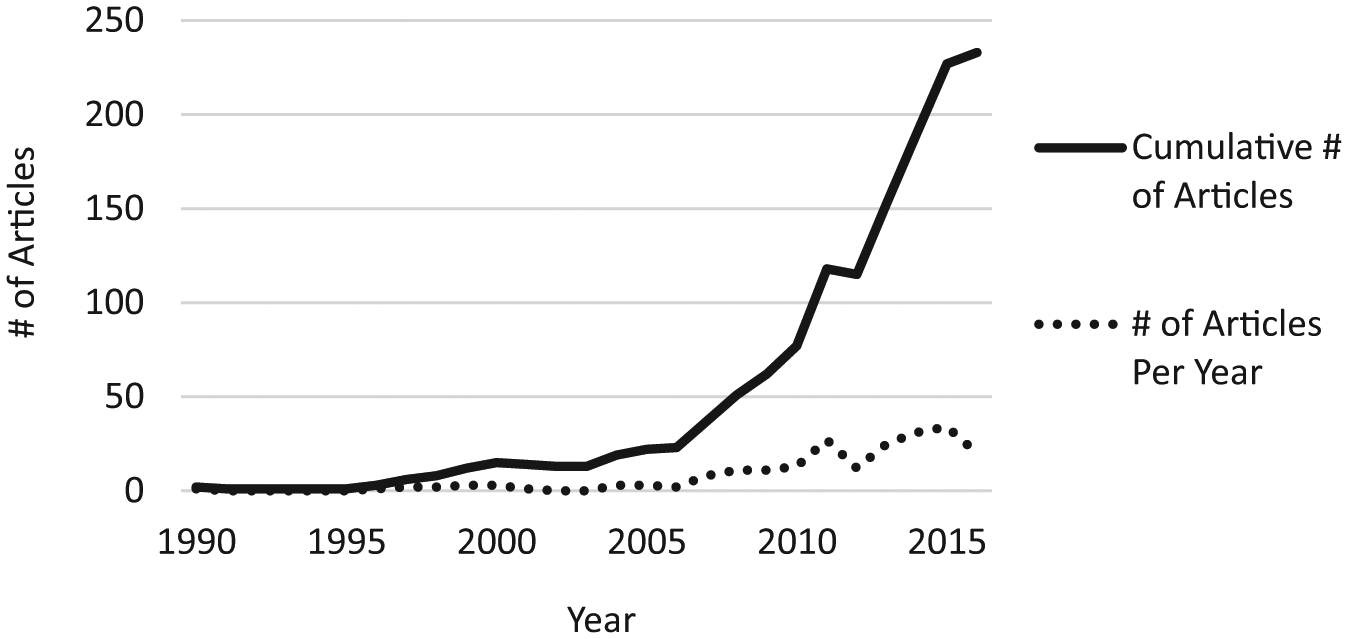
PSM articles from 1990 to 2016.
Method
To examine patterns of collaboration on PSM research over time, we use social network analysis to focus on the relationships among authors and the resulting social structure generated through the set of relationships (Wasserman & Faust, 1994). We construct a coauthorship network for each of the three time periods in our study. First, we use BibExcel software to generate a matrix of valued ties from the data retrieved from the SSCI for each time period in our data set (Persson, Danell, & Schneider, 2009). 3 In other words, for each pair of authors in the data set, BibExcel identifies how many times the pair has coauthored a publication in each of the three time periods. This number is assigned to the tie and represents a measure of tie strength. Next, using the matrix of ties for each time period, we used network analytic software, UCINET and NetDraw, to generate descriptive statistics for the network and the actors in the network as well as network graphs (Borgatti, 2002; Borgatti, Everett, & Freeman, 2002). For each of the three time periods, our network analysis examines the social structure of collaboration at the network level as well as the individual level. In addition, because there is a somewhat unusual article in the final time period—an article with 16 authors (Kim et al., 2013)—we examine this time period graphically both with and without this article included.
We began our analysis by focusing on the characteristics of the network as a whole. This macro view of the network gives us an overall understanding of how coauthors are connected to each other, which can have implications for the dispersion of knowledge and ideas, as well as collaborative efforts. Our analysis considers the network size and the density. We also note the number of isolates, or individuals who are publishing PSM articles, but do not coauthor with any others in the network. Network size is simply the total number of unique network actors, or in this case, unique authors. Density is calculated as the proportion of possible connections among actors that actually exist (Wasserman & Faust, 1994). 4 The size of a network is important because the number of actors influences how easily connections to all actors can be established. In networks with few actors, connections among all actors are more easily established. Density takes on values between 0 and 1. The closer this value is to 1, the more dense the network is. In dense networks, knowledge, information, or other resources can travel through multiple paths to reach any given actor. In a coauthorship network, the network density has implications for both the speed at which knowledge and ideas travel through the network and the extent to which they reach actors in the network. In sparse networks, pathways are limited. Knowledge, information, or other resources may not reach some actors at all or if it does, it is a slow process.
Next, we considered centralization or the extent to which the network is arranged around a single dominant actor or collection of actors. We measure network centralization by dichotomizing the network and using the Freeman centralization statistic. 5 The Freeman centralization measure indicates whether the network is dominated by one main node or actor (Borgatti, Everett, & Johnson, 2013). The Freeman centralization statistic can take values between 0 and 1. The closer this value is to 1, the more a single actor or small group of actors dominates other actors in the network (Hanneman & Riddle, 2005; Wasserman & Faust, 1994).
Finally, we examined the extent to which subgroups of actors exist in the network by focusing on connectedness. A network is considered connected if there is a direct or indirect path between all pairs of actors (Wasserman & Faust, 1994). Connectedness is important because it has implications for the extent to which and how knowledge is shared across the network or held tightly within groups. To examine the connectedness of our network, we identified components. A component is a subgroup of actors who are connected within, but are not connected to other subgroups (Hanneman & Riddle, 2005; Wasserman & Faust, 1994). The component with the most actors is considered the main component.
At the individual level, we focus on measures of power and influence within the network. First, we consider degree centrality, which is calculated for each actor as the total number of coauthorships the actor has in the network (Borgatti, 2005; Freeman, 1979). The higher an actor’s degree centrality, the more power a network actor has in terms of control of the flow of knowledge or information as well as opportunities (Borgatti et al., 2013). In terms of a coauthorship network, degree centrality represents the number of different authors to which an author is connected by coauthoring an article. Authors with a high degree centrality have more opportunities to coauthor with different individuals than those with a low degree centrality, and thus more opportunities to influence the sharing of knowledge and ideas. Next, for each actor in the network, we calculate his or her total cumulative number of publications. In a coauthorship network, authors who publish more frequently may be more likely to influence the direction and ideas of future research because their conceptual frameworks and/or findings are more widely available to other authors both due to their volume and possibly availability in a variety of journal outlets. Our results are presented and discussed below in the Findings section.
Findings
Figure 2 shows the network graph for the full time period 1990-2016 and this graph displays similar structural characteristics to the graphs across each time period. The tie width varies based on the number of times scholars have coauthored with each other; the wider the tie, the higher the frequency of coauthorship (and ostensibly the stronger the tie). The size of the network nodes varies based on the number of publications by an individual author: The larger the node, the more the publications. Circular nodes represent authors at U.S. institutions; triangular nodes indicate authors from outside the United States.

PSM coauthorship network (1990-2016).
Across all time periods, the PSM coauthorship network is a disconnected network comprised of several small subgroups of coauthors that are not tied to each other via publication activity. It is not a cohesive network. Cohesion can be viewed as the number and size of subgroups within a network; the greater the number of nodes in the main component, the more cohesive the network is (Borgatti et al., 2013). Each time period has one main component comprised of the largest number of coauthors and this main component is disconnected from the rest of the network, which is comprised of several smaller subgroups disconnected from each other. The coauthorship network is characterized by few connections overall (a sparse network) in each time period, with density ranging from 0.02 to 0.04 (see Table 4) across the time periods. From the Freeman degree centralization values of 0.08, 0.04, and 0.13 presented in Table 4, we can see that the whole network is not dominated by one particular author in any time period. The maximum number of publications (tie strength) between two authors increases slightly over time from 2 to 4 publications and the mean number of coauthors (mean degree) also increases across each time period.
Description of Network by Time Period.
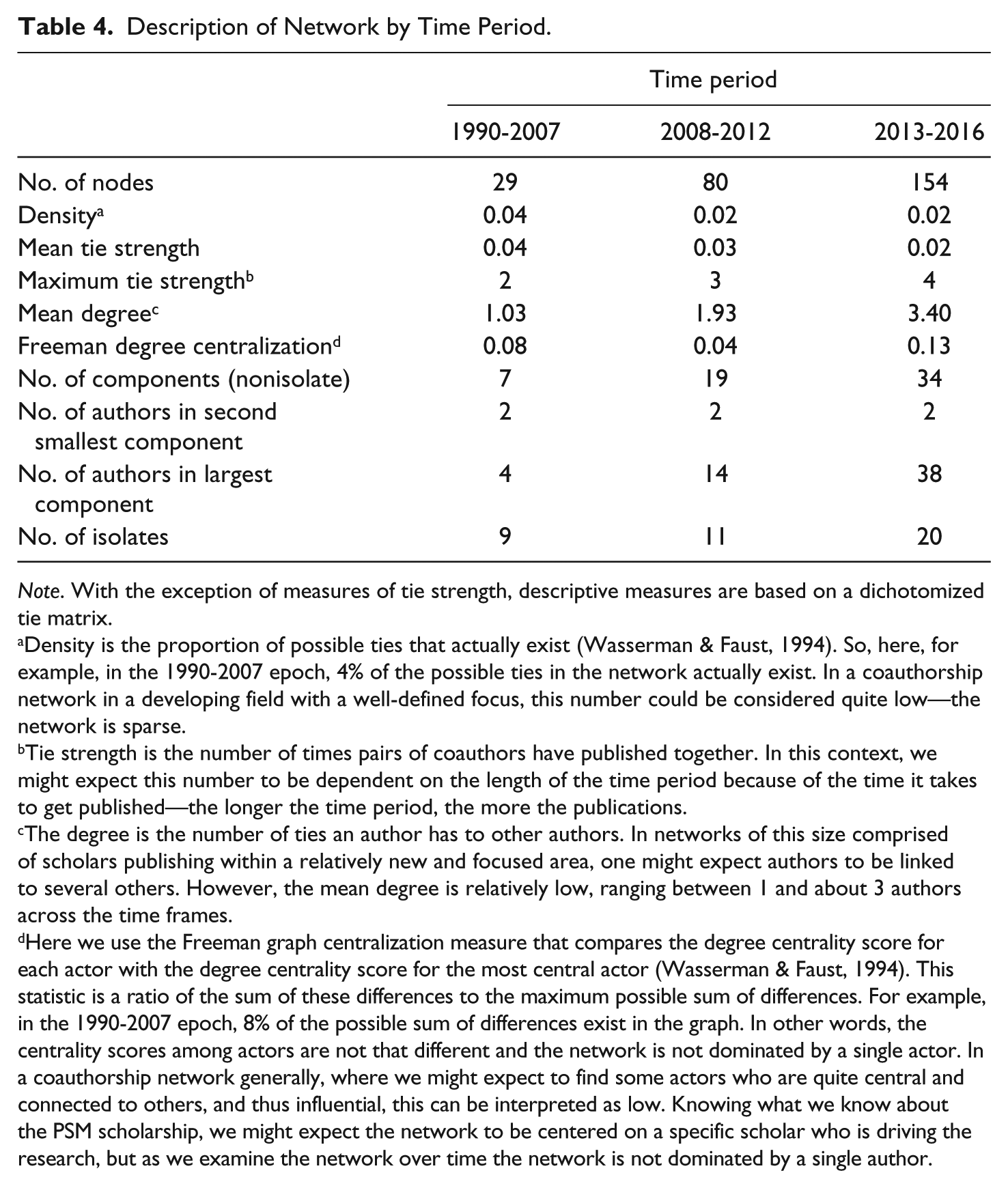
Note. With the exception of measures of tie strength, descriptive measures are based on a dichotomized tie matrix.
Density is the proportion of possible ties that actually exist (Wasserman & Faust, 1994). So, here, for example, in the 1990-2007 epoch, 4% of the possible ties in the network actually exist. In a coauthorship network in a developing field with a well-defined focus, this number could be considered quite low—the network is sparse.
Tie strength is the number of times pairs of coauthors have published together. In this context, we might expect this number to be dependent on the length of the time period because of the time it takes to get published—the longer the time period, the more the publications.
The degree is the number of ties an author has to other authors. In networks of this size comprised of scholars publishing within a relatively new and focused area, one might expect authors to be linked to several others. However, the mean degree is relatively low, ranging between 1 and about 3 authors across the time frames.
Here we use the Freeman graph centralization measure that compares the degree centrality score for each actor with the degree centrality score for the most central actor (Wasserman & Faust, 1994). This statistic is a ratio of the sum of these differences to the maximum possible sum of differences. For example, in the 1990-2007 epoch, 8% of the possible sum of differences exist in the graph. In other words, the centrality scores among actors are not that different and the network is not dominated by a single actor. In a coauthorship network generally, where we might expect to find some actors who are quite central and connected to others, and thus influential, this can be interpreted as low. Knowing what we know about the PSM scholarship, we might expect the network to be centered on a specific scholar who is driving the research, but as we examine the network over time the network is not dominated by a single author.
PSM Scholarship From 1990 to 2007
The initiation epoch, 1990-2007, begins with Perry and Wise’s (1990) seminal conceptual article on PSM, and in fact this time period contains the largest share of conceptual articles (17%). This time period is also is the longest of the three in our data set—more than 4 times as long as the others. Despite this lengthy period, only 29 authors published a total of 29 articles on PSM. Almost all (93%) articles are authored by either one or two authors. Typically, between zero and three articles were published each year, with the exception of 1 year, 2007, where there are eight articles. Publications are largely concentrated in two journals: the Journal of Public Administration Research & Theory (31%) and the Review of Public Personnel Administration (21%). Authors are affiliated primarily with U.S. institutions (83%). The five authors affiliated with institutions outside the United States come from only four countries.
The network graph for coauthorship for this first time period is shown in Figure 3. Overall, the coauthorship network is sparse and consists of several disconnected subgroups and isolates (authors who have not coauthored with any other author and so are not connected to the network). Of the 29 authors who published during this time period, almost a third (nine) are isolates. Of the 20 authors who do coauthor, they comprise seven disconnected components. The main component, the largest subgroup in the network, includes only four authors. Five of the 29 authors were from the United States. Six of the seven subgroups are comprised of authors based only in the United States; the remaining subgroup is comprised entirely of authors from outside the United States. Only two subgroups with more than two authors have closure—that is, where each author is directly connected to every other author in the subgroup and both of these subgroups are closed triads. In the remaining three subgroups with more than two authors, one author (the most central within the subgroup) is directly connected to each of the other scholars in the network, but none of the other authors are connected to each other. Only two pairs of authors published together more than one time (indicated by a tie strength of greater than one—the thicker lines in Figure 3).
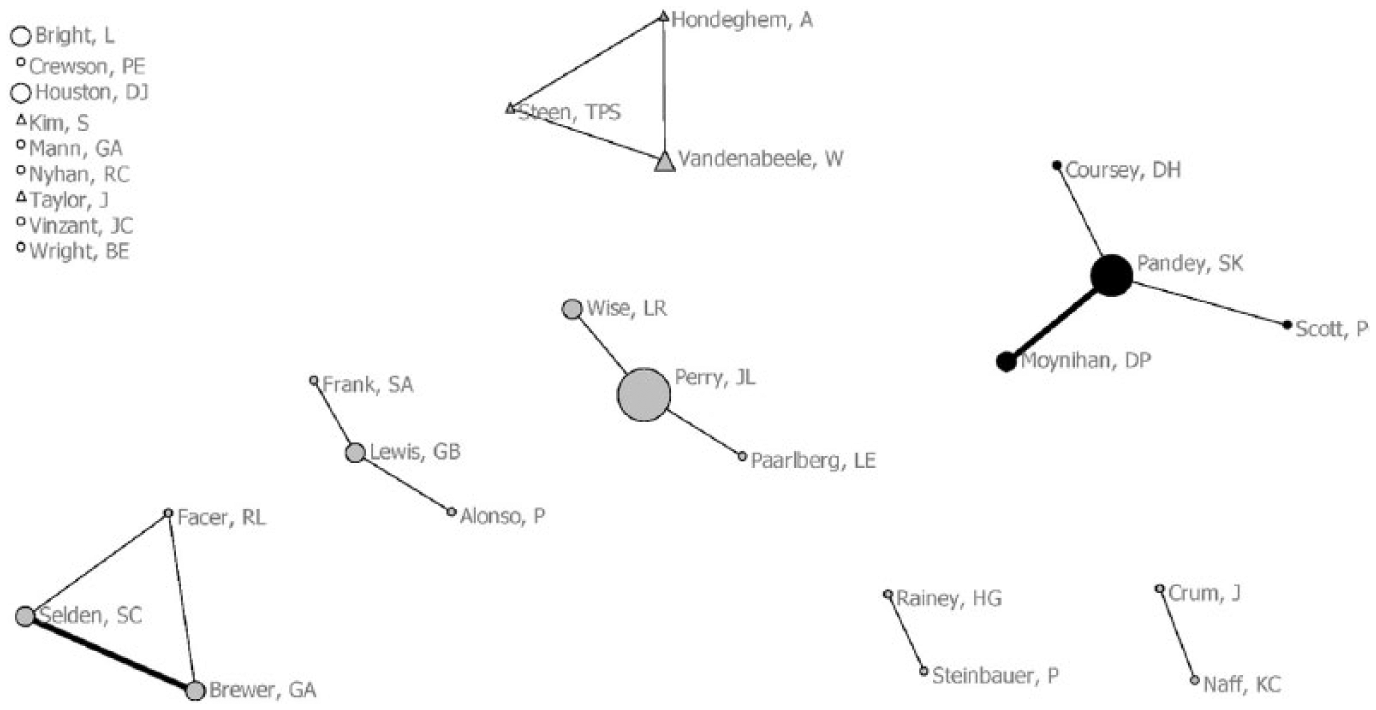
PSM coauthorship network (1990-2007).
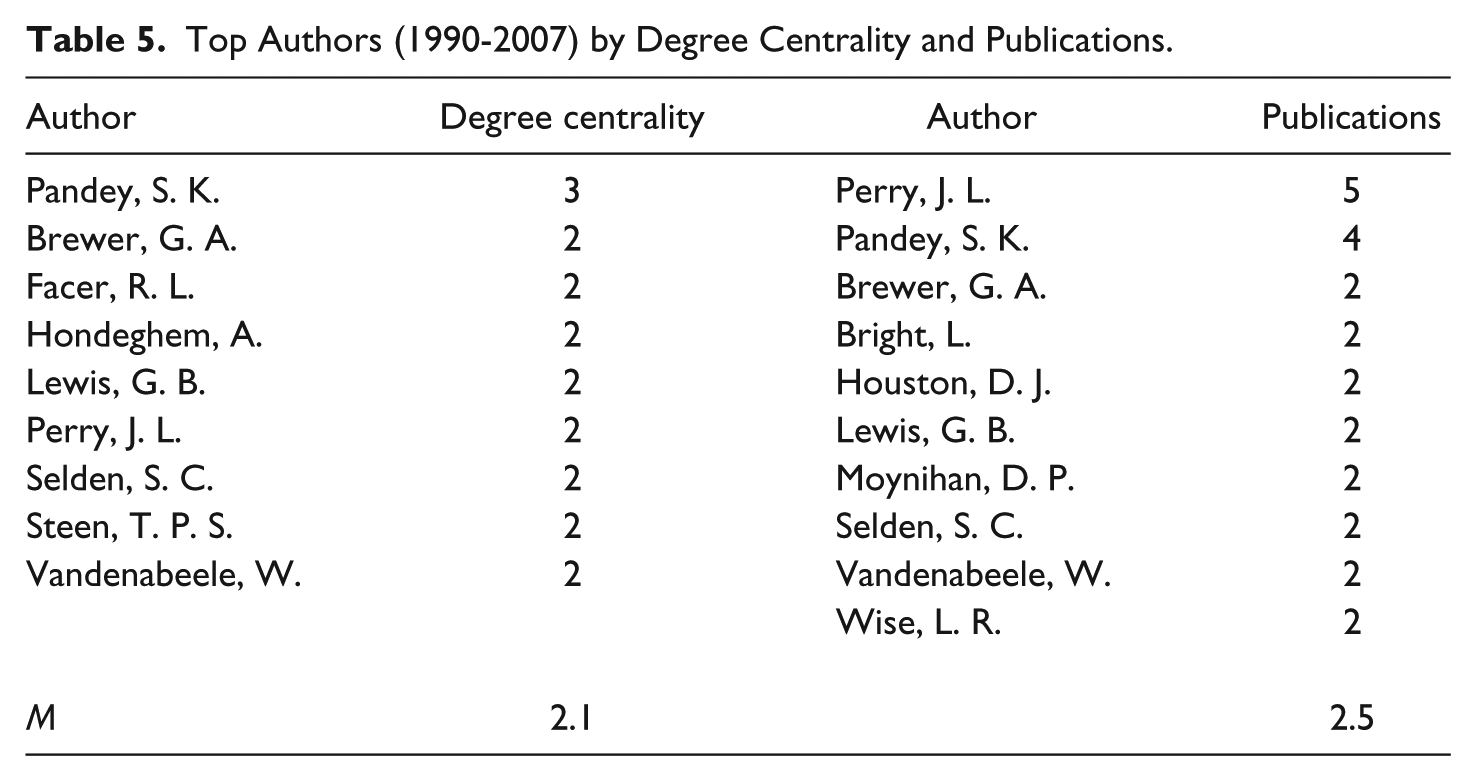
The mean degree for the overall network in the initiation epoch is 1.03 (Table 4); on average, an author coauthored with only one other author. This may have been indicative of the time period regarding general coauthoring trends within public administration literature, or it could also be indicative of the start-up mode of this time period—with relatively few scholars focusing on PSM, there were fewer opportunities for collaboration or coauthorship. Among the top 10 most published authors, nearly all published with two other authors (mean degree centrality of 2.1; see Table 5). The mean number of publications per author among the top authors (Table 5) was 2.5, and almost all (94%) of the 29 authors for this time frame published only one or two articles during this 17-year time period. James Perry and Sanjay Pandey published the most articles in this time frame—five and four articles, respectively.
Top Authors (1990-2007) by Degree Centrality and Publications.
PSM Scholarship From 2008 to 2012
During the consolidation epoch, 2008-2012, a smaller share of the articles published are conceptual (9%) and a larger share empirical (84%). As shown in Figure 1, typically, between 11 and 13 articles are published each year, with the exception of 1 year, 2011, where 27 articles are published. While articles still remain concentrated in a few journals, the journal with the highest concentration is no longer the Journal of Public Administration Research and Theory. Rather, the majority of articles appear in the International Public Management Journal (20%), Public Administration Review (18%), and the Review of Public Personnel Administration (18%). We saw 51 authors become a part of this network during this time period, for a total of 80 authors appearing in the network. These 80 scholars published a total of 74 articles—more than double the articles compared with the first time period. Yet a majority of articles (74%) are authored by only one or two authors. Authors remain affiliated with predominately U.S. institutions (51%), but the reach of PSM research has expanded globally; 39 authors are affiliated with institutions in nine countries outside the United States.
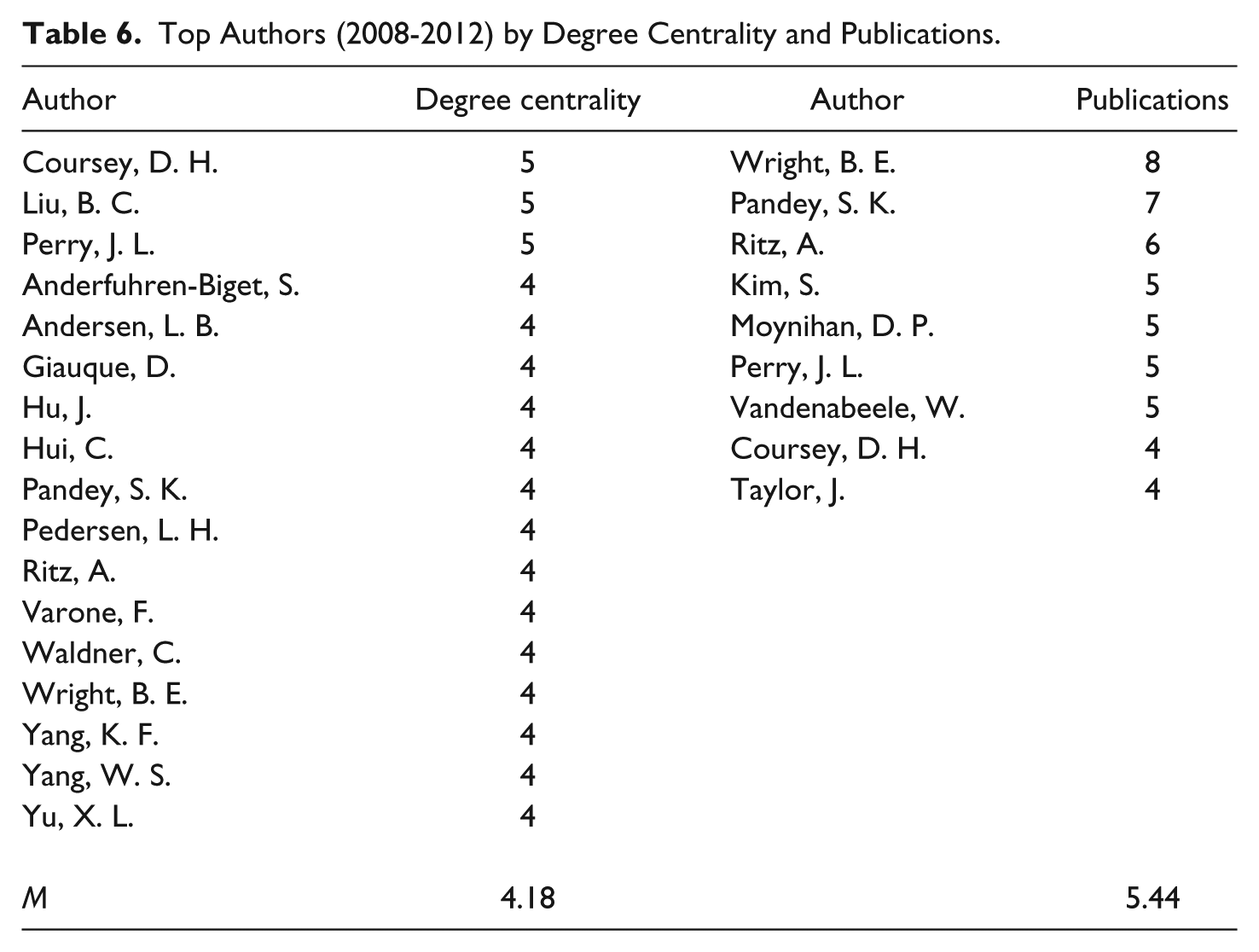
The network diagram for the 2008-2012 time period is shown in Figure 4. Like the 1990-2007 time period, the network remains relatively disconnected between 2008 and 2012. However, we do see some increases in collaboration. Although there is an absolute increase in isolates, of the 80 authors in this time period, the proportion of those who are isolates has decreased (11 authors or 14%). While the network remains relatively disconnected, more subgroups are emerging. There are more than twice as many components in this graph (19, not including isolates) when compared with the 1990-2007 time period (seven, not including isolates). Eight of the subgroups have only two authors, but four subgroups have greater than four authors. There are two closed triads and one closed subgroup consisting of five authors; a closed network indicates that each actor has ties to each other (each author has published with every other author within the subgroup). The main component has almost tripled in size to 14 authors and the most central authors are more connected than they were in the 1990-2007 time period (mean degree centrality = 4.18; see Table 6). Sanjay Pandey, James Perry, and Kaifeng Yang are brokers within the main component, connecting groups of coauthors whose only connection to each other is through these authors. These three authors are also among the most prominent in this time period based on their coauthors (degree centrality) and publications (see Table 6). Four of the coauthor subgroups include authors from both within and outside the United States. We still only see a few author dyads who publish together more than once, as noted by the thicker ties between authors in Figure 4.
Top Authors (2008-2012) by Degree Centrality and Publications.

PSM coauthorship network (2008-2012).
PSM Research From 2013 to 2016
Continuing the trend beginning in the 2008-2012 time period, empirical articles are on the rise (95%) and conceptual articles decrease (2%) in the postconsolidation epoch from 2013 to 2016. As shown in Figure 1, the quantity of yearly publications increases substantially with between 20 and 34 per year during this phase. During this time period, 154 authors published a total of 110 articles, continuing the increasing trend of PSM publication activity. PSM publications are also more widely spread among the journals in our sample. The largest share of articles appears in Public Personnel Management (21%) with the remaining articles spread among the other nine journals in our sample. The majority of articles (71%) are authored by either one or two authors. We also see an increase in PSM publishing outside of the United States during this time with 67% of publications coming from authors affiliated with institutions in 23 countries outside the United States.
Most notably, this stage uniquely begins with a 16-author article that represents an international effort to validate Perry’s multidimensional measure of PSM relying on data collected in 12 or 13 countries (see Kim et al., 2013). Overall, as shown in Figure 5, the network remains disconnected in this time period. Of the 154 authors publishing during this time period, 20 are isolates and do not coauthor with others. Excluding the isolates, there are 34 other subgroups connected within themselves but not connected to other groups. The largest component contains 38 individuals. We also see an increase in collaboration between U.S. and non-U.S. affiliated authors in this time period; eight of the subgroups include authors from within and outside the United States compared with only four in the last time period. We see a shift in the top authors in this time period with respect to the number of authors with whom they coauthor and the number of publications. As shown in Table 7, Lotte Andersen now tops the list with the highest number in both categories. In this time period, we also see some of the prior most central and most published authors lower down on the list or not appearing at all.
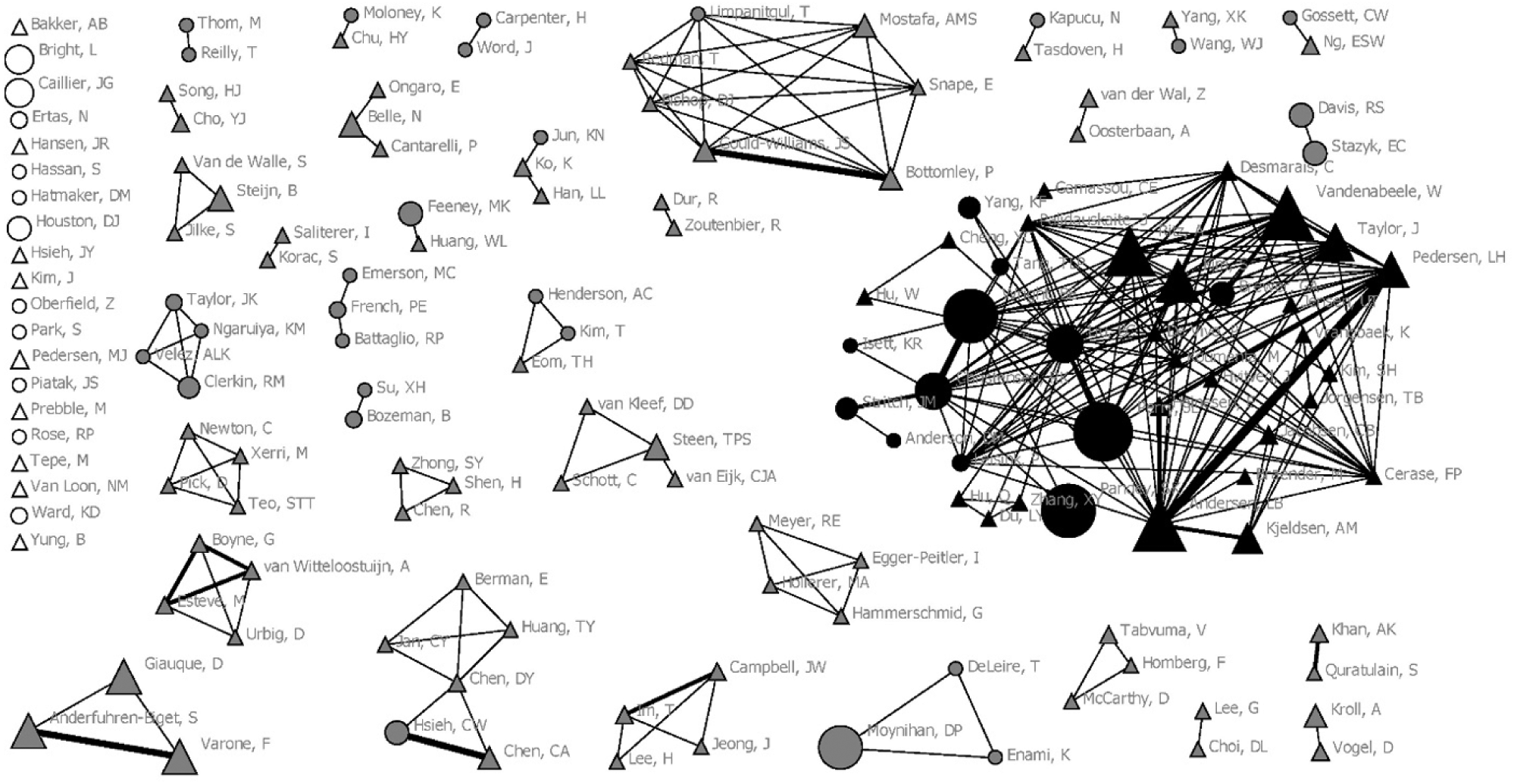
PSM coauthorship network (2013-2016).
Top Authors (2013-2016) by Degree Centrality and Publications.
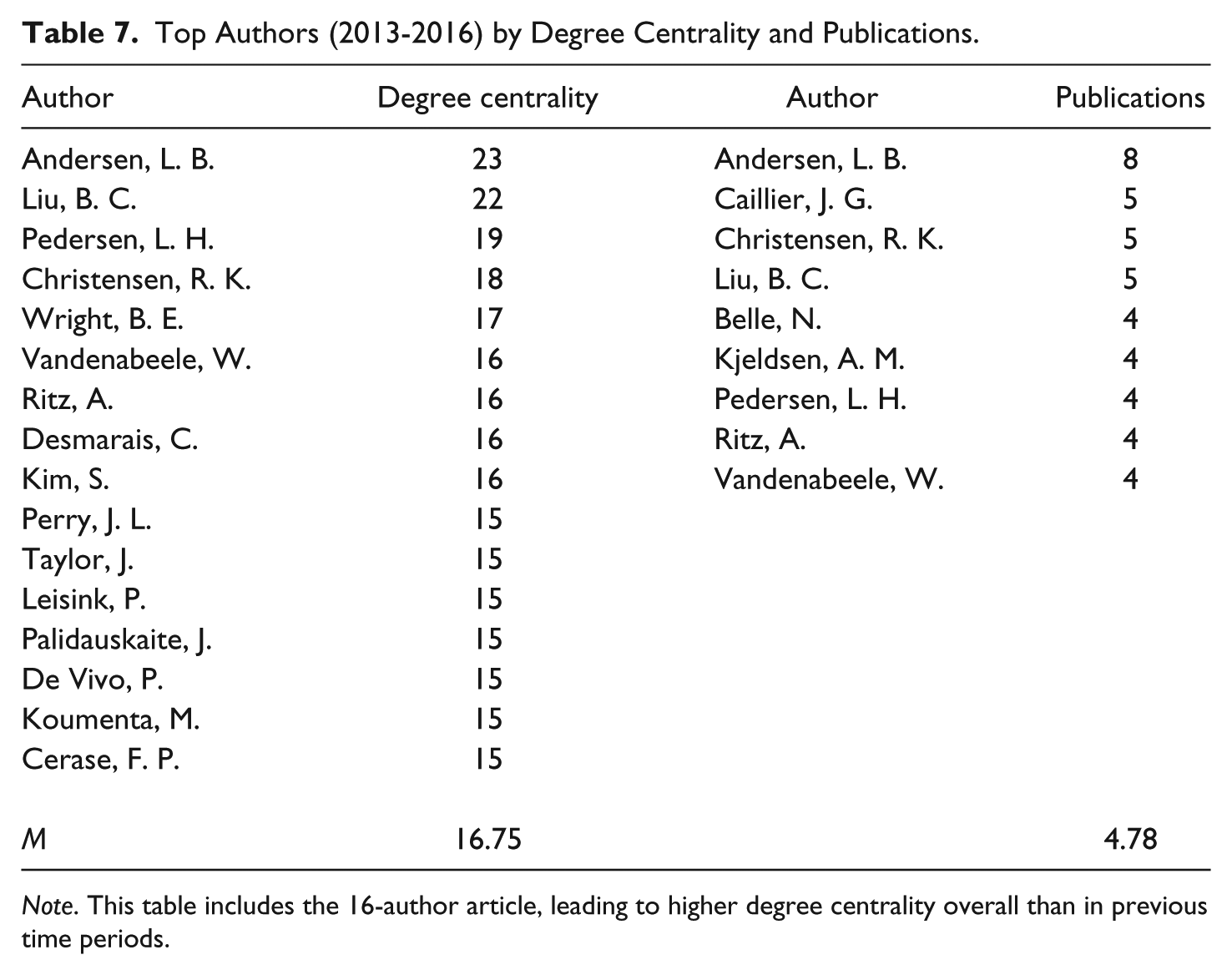
Note. This table includes the 16-author article, leading to higher degree centrality overall than in previous time periods.
Perhaps the most prominent feature of the network during this epoch is the large main component. The large size of the main component is heavily influenced by the anomalous article coauthored by 16 individuals (Kim et al., 2013). When this article is removed, the largest component is reduced to 12 authors—similar in size to the main component in the 2008-2013 time period. However, with or without the 16-person article, the most central author in terms of both degree centrality and number of publications remains the same. In addition, the overall network structure remains disconnected whether or not this anomalous article is included.
Discussion and Concluding Remarks
Our study is aimed at understanding how a research field evolves over time by examining collaboration using coauthorship networks. From our analysis, we can generate implications both for the field overall and for individual researchers. Our analysis points to several network properties that offer insight into the evolution of the field and its collaborative nature. The network overall is not a dense or cohesive network. Throughout each epoch and for the overall period, the PSM coauthorship network consists of several isolates, several small subgroups that are disconnected from each other or the main component, and one larger main component. Each subgroup represents a small, but increasing over time, number of authors who have few ties to other scholars.
Thus, while coauthorship, and thereby collaboration, is occurring within this network, it happens in small groups or dyads that may or may not be sharing information, knowledge, or ideas with each other. The lack of connectedness could hinder the dispersion of knowledge and resources and in turn the area’s growth. Tacit knowledge that is held by scholars but is not (perhaps yet) published cannot be shared without connections. And as access to ideas, tacit knowledge, and resources can influence the extent to which a scholar can advance her or his research agenda, being disconnected may lead to fewer scientific discoveries, a slower rate of discovery, or more incremental/less revolutionary discoveries.
As a scholarly area is first developing, how dense or connected the coauthorship network is may affect how quickly conceptual definitions disperse and measures are developed; these items then give rise to increasing empirical studies. In fact, it seems that the PSM scholarship began relatively slowly with a buildup of conceptual debates or a focus on measurement rather than empirical work. The initiation epoch from 1990 to 2007 is quite long but the network during this time is relatively small in terms of the number of authors. This phase also had the most conceptual articles, signaling that a relatively few scholars engaged in the debate for quite some time to lay the foundation for empirical work. This first time frame is punctuated by an increasing presence of PSM panels and articles at conferences and the publication of Perry and Hondeghem’s (2008) compendium. Their book was comprised of both conceptual and empirical contributions and effectively initiated the consolidation epoch from 2008 to 2012.
One risk of a diffuse research network is to conflate methodological concerns with theoretical ones. This can close off promising theoretical questions and inadvertently (or intentionally) present progress on methodological concerns as theoretical development. One instance of this risk becoming manifest is the 16-author study in the postconsolidation epoch—to develop and validate an international survey-based PSM measure—and the conversation in the PSM literature around this effort. The dominance of survey methodology and specific measurement instruments in the PSM scholarship (Apfel, 2013; Pandey & Marlowe, 2015) may have closed off some productive avenues for theoretical development. For example, it can be argued that the notion of “public” in PSM is undertheorized and a closer examination and integration of public values and PSM concepts can be theoretically advantageous (see Andersen et al., 2013; Bozeman & Su, 2014). In a recent review of PSM scholarship, Pandey and colleagues (2017) issue a call to “clarify public service motivation concepts” and “to prioritize theoretical goals over methodological goals” so that methodological progress is not confused with theoretical development (pp. 320-323).
It is reasonable to assume that increases in coauthored work will increase the network density and are an indication that a field is evolving into a more collaborative discipline (Corley & Sabharwal, 2010). On this basis, we may conclude that PSM is not evolving into a collaborative body of scholarship overall and instead is comprised of many fragmented subparts that represent independent microcosms. However, from this structural data alone we cannot discern whether the field is truly fragmented such that the subcomponents are driving the field in many disparate directions or whether each subgroup pushes the field forward in a congruent but perhaps incremental manner (or even whether each is attempting to push the field in a revolutionary manner). A closer look at the publications themselves, such as through a content analysis, would provide more evidence toward a sense of convergence or divergence for the field.
The network’s disconnected nature may actually indicate the range of intellectual diversity and potential for innovation. 6 That is, the lack of centralization may be an indicator of a broad scope of interest in PSM from an array of authors in different subfields of public administration and public management. Thus, rather than an individual or a clique of authors driving the intellectual development of this field, its advances may actually be driven from multiple perspectives. Although arguments in favor of homogeneous groups cite their greater performance due to a greater ease of coordination, diverse groups can enhance creativity and innovation because they are not comprised of redundant ideas and information (Reagans & Zuckerman, 2001). Moreover, while having a fragmented field of disconnected subgroups may slowdown progress in terms of efficient information sharing (Granovetter, 1983), the trade-off—a greater breadth, and potentially depth of our understanding of PSM and its effects—may be worth the cost. The potential for authors to broker between subgroups can also move knowledge forward in new ways; for example, such brokerage has been shown to enhance creativity, innovation, and productivity among teams of scientists (Reagans & Zuckerman, 2001).
Prior research has well established that network relationships facilitate knowledge transfer (e.g., Borgatti & Cross, 2003; Cross & Cummings, 2004; Hansen, 1999; Reagans & McEvily, 2003; Reagans & Zuckerman, 2001; Tortoriello, Reagans, & McEvily, 2012). From an information exchange perspective, there are both advantages and disadvantages to a dense network and a core group of scholars guiding the development of a field (i.e., a highly centralized network). On one hand, more dense structures with numerous connections among authors may foster information exchange, especially that of complex and tacit knowledge (Hansen, 1999). At the same time, these tightly connected groups may actually cause the scholarship to stagnate. For example, the research could become a victim of groupthink (Janis, 1971) where novel ideas or research methods may be stifled or quashed because they are too far from the accepted norms of the group. New authors may only be able to get past the network gatekeepers if their ideas align with the theoretical and even methodological “beliefs” espoused by those within the cohesive subgroup. Moreover, novel ideas introduced by authors already part of the core may be silenced by pressure from other group members. Thus, a danger of highly centralized coauthorship networks is that they could be susceptible to theoretical stagnation. 7
Finally, if we were to be normative in our arguments, there are likely optimal states of more and less density and connection that vary through time. For example, at early stages, a core group would initiate a conceptual inception followed by early empirical work. Because a core group consisting of strong ties and a high level of cohesion actually facilitates the transfer of complex and tacit knowledge (Hansen, 1999), the more connected this core group is, the faster the topic may become established and even enter the mainstream research agenda. Once established, however, the network must open up to avoid stagnation. More scholars, preferably from diverse areas, must contribute to the community. Thus, a more loosely connected network emerges, allowing new authors to enter, some by authoring with those in the core, others via weak ties (Granovetter, 1973). In particular, the distant and infrequent relationships, or weak ties, bring innovative ideas to the core by connecting otherwise unconnected authors and may enhance the network’s survival (Granovetter, 1973, 1983; Hansen, 1999). Porous boundaries where scholars can establish ties to the core, span boundaries, and bridge across otherwise disconnected groups may thus be advantageous for growth.
Our findings also offer insight about how a new field of research disperses geographically when it begins in one particular country. We characterize this dispersion as within and outside the United States because the PSM scholarship began in the United States. We can see the patterns of how the scholarship outside of the United States emerged and increased over time. Scholars from outside the United States emerged in this network by collaborating first primarily among themselves and in disconnected subgroups. Over time, scholars increasingly spanned geographic boundaries with more collaboration between U.S. and non-U.S. scholars emerging. However, many of these boundary-spanning collaborations still existed in small, disconnected subgroups, even in the postconsolidation epoch from 2013 to 2016.
This study also has implications for individual authors. An individual actor’s network location and centrality, such as in terms of the number of authors with whom one collaborates (degree centrality) or to whom one is connected or connects (brokerage), affects her or his power and influence (Burt, 1992; Hackman, 1985; Ibarra, 1993; Ibarra & Andrews, 1993). For scholars, this location can mean the extent to which she or he can influence the direction of scholarly advances within a particular area of expertise. It may also mean that they can increase their own productivity through collaboration—that is, being more connected may lead to being more productive (Corley & Sabharwal, 2010; Klenk et al., 2010; Lee & Bozeman, 2005).
Several opportunities exist within this network for scholars to accrue social capital, enhance their reputation, and gain influence in the field. A primary mechanism to do so in this network is through brokerage. Brokerage enables network actors to control the flow of resources between otherwise unconnected groups of actors who may represent nonredundant sources of knowledge, information, or ideas (Burt, 1992). Betweenness centrality is a network measure that indicates brokerage and is an indicator of power or influence within a network, as well as structural social capital (Borgatti et al., 2013; Li et al., 2013). We did not include betweenness centrality in our analysis because in a disconnected network it has little meaning (Borgatti et al., 2013). However, these disconnected groups may present opportunities for scholars who can position themselves as brokers between smaller collaboratives. By connecting disconnected groups of coauthors and thus enabling the flow of ideas, knowledge, and other resources, such as data or funding, that otherwise may not be shared, these individuals can themselves become more influential (Burt, 1992; Klenk et al., 2010; Li et al., 2013).
Our analysis suggests a few additional avenues for future research on the evolution of a research field. One logical next step to this research would be to study the coevolution of the coauthorship networks over time using advanced social network analytic techniques. For example, stochastic modeling of network dynamics can offer greater insight into the underlying social processes of network formation and change than the descriptive analysis presented here (Snijders, van de Bunt, & Steglich, 2010). Another future path would involve additional collection and scrutiny of author attributes. For example, an examination of mentor–student coauthorship patterns could reveal how scholarship emerges over generations of authors. More specifically, tracking whether the student continues to publish in that same research area on her or his own or with other coauthors could reveal the extent to which a mentor–student relationship may shape and expand a research area over time.
We also do not consider tie direction in this analysis, that is, we do not have data on “who seeks whom?” (Lee & Bozeman, 2005, p. 694) to establish a coauthorship relationship. Thus, we assume our dyads are not directional ties. Yet in reality, it is likely that one author initiated an invitation to coauthor, and there were specific motives behind this invitation. As Lee and Bozeman (2005) suggest, the dynamics of whether lower status scholars (e.g., not yet tenured) are seeking out higher level status scholars or vice versa (e.g., in a mentoring relationship), or whether collaboration is simply a product of proximity, may matter. In this PSM network, it may lend particular insight into why so many subgroups are disconnected and into the international dispersion of the scholarship.
The number of isolates within this network also warrants further consideration by examining author attributes. They may represent “transient” authors (Gonzàlez-Alcaide et al., 2015) who publish a “one-off” PSM article or an article that includes PSM as a concept but whose primary intent is not necessarily the advancement of the PSM scholarship per se. If such articles included PSM as a keyword, our search included it. For example, one of this paper’s authors is in the network because she published a work about organizational socialization that included PSM in the process model, but the primary intent of the paper was not about PSM per se (Hatmaker, 2015). The isolates may also be authors just entering the PSM arena or beginning their career such that they have not yet developed a reputation or the connections to coauthor with known authors in the field. They may also be authors who must publish on their own for the tenure process.
As this is a study of a coauthorship network within PSM scholarship, we are not able to generalize findings to other areas of research. However, it does provide a framework for examining how other areas of public administration and public management research evolve. This type of analysis is particularly well suited when we can define a “starting point” of the scholarship and distinct boundaries (see Laumann, Marsden, & Prensky, 1989, on network boundary specification). For example, future analyses of coauthorship networks could examine representative bureaucracy, innovation, collaborative networks, or red tape scholarship. Or future analyses may also consider the research methods employed by these scholars—that is, to see whether an array of methods and designs are used (qualitative, network analytic, experimental designs) and whether there’s been an evolution of methods over time. Such analyses may enable scholars to evaluate theoretical and empirical progress in their respective areas. It may also confirm or dispel impressions of who drives the research agenda and the potential for innovation through the intellectual diversity.
Finally, this network does not consider where connections between authors may actually exist, but in research fields other than PSM. 8 That is, between two disconnected authors in this network, there actually may be a connection between them, but not based on a PSM article. If these connections were actually shown, we may find that the network is far more dense than it is when focused solely on one research field. In addition, a coauthorship network analysis that examines multiple fields could also consider the nexus between different networks to understand how public sector scholarship (and scholars themselves) overlaps (or doesn’t).
Footnotes
Declaration of Conflicting Interests
The author(s) declared no potential conflicts of interest with respect to the research, authorship, and/or publication of this article.
Funding
The author(s) received no financial support for the research, authorship, and/or publication of this article.