



Abstract
Performance pay has been one of the main trends in public sector reform over the last decade and aims to increase employees’ motivation. However, positive results are sparse. In a majority of cases, pay scheme designers neglect that intrinsic motivation may be distorted by the introduction of extrinsic rewards (crowding out). Nevertheless, under certain conditions, performance pay schemes may also enhance intrinsic motivation (crowding-in). The perception of rewards has proven to be an especially crucial factor for the outcome of performance pay. Based on psychological contract theory, this paper analyzes the relationships between intrinsic motivation, public service motivation (PSM), personality characteristics, and the design of the performance- appraisal scheme. The empirical analysis relies on a structural equation modeling (SEM) approach. Model findings reveal that a fair, participatory, and transparent design reduces the controlling perception while fostering the intrinsic motivation of employees. In addition, participants who score high on neuroticism perceive performance pay schemes to be more controlling and have lower values of intrinsic motivation.
Keywords
Introduction
The introduction of performance-related pay in the public sector has been one of the main trends in public management reform over the last two decades. In 2005, two thirds of the Organisation for Economic Co-Operation and Development (OECD, 2005) member states had already implemented performance pay for government employees or were on the way to introducing it. By introducing performance pay, governments all over the world aim to increase employees’ motivation as well as strengthen leadership skills and enhance the quality of public services (Burgess & Ratto, 2003; Cardona, 2006; Marsden & Richardson, 1994; OECD, 1993).
However, previous evaluations have identified severe weaknesses in performance-related pay schemes in the public sector. According to Perry, Engbers, and Jun (2009, p. 43), “performance-related pay in the public sector consistently fails to deliver on its promise.” In most evaluations, researchers could not find evidence for increased motivation or increased quality of public services resulting from the introduction of pay for performance (Kellough & Nigro, 2002; Marsden, 2009; OECD, 2005; Perry, Mesch, & Paarlberg, 2006). Instead, performance pay raises many issues in the public sector. Particularly, low amounts of performance pay, problems in performance assessment of government employees, and the lack of differentiation in employees’ performance ratings are among the most criticized aspects of performance pay. Researchers claim that these weaknesses are the reasons that the goals of performance-oriented pay are not achieved (Anderfuhren-Biget, Varone, Giauque, & Ritz, 2010; Forest, 2008; Gaertner & Gaertner, 1985; Rainey & Kellough, 2000). Yet, according to Perry et al. (2009), it is not pay for performance itself that leads to dissatisfaction among government employees, but rather “its incompatibility with public institutional rules, proponents’ inability or unwillingness to adapt it to these values, and its incompatibility with more powerful motivations that lead many people to pursue public service in the first place” (Perry et al., 2009, p. 45).
More detailed studies on the effects of performance pay suggest that a pay system that is perceived as controlling may be harmful for the intrinsic motivation and public service motivation (PSM) of employees (Jacobsen & Andersen, 2014; Jacobsen, Hvitved, & Andersen, 2014). This effect goes back to motivation crowding theory. Motivation can only be crowded-in, that is, increased, if employees perceive performance pay as supportive rather than controlling (Frey, 1997; Frey & Jegen, 2001). However, it remains largely unexplained as to which variables account for a negative (“controlling”) perception of performance pay and have therefore an (in)direct influence on its success. In addition, only a few of the previous studies on intrinsic motivation have taken the features of the command system into account (Andersen, Kristensen, & Pedersen, 2015; Dickinson & Villeval, 2008; Jacobsen & Andersen, 2014). Accordingly, we lack empirical knowledge on the following research question:
We address this research question by proposing a conceptual model that explains the influence of the pay scheme feature, employees’ PSM, and neuroticism on the perception of the pay scheme as controlling. To address the outcomes of performance pay, the direct and indirect effects of these variables on employees’ intrinsic motivation are tested.
To answer the question, we relied on a survey of 21 counties and cities with council status in five federal states throughout Germany. More than 5,900 government employees participated in the study. Performance-related pay was introduced for government employees at the local and federal level in Germany in 2007. At the local level in Germany, 2% of the basic pay of all the organization’s employees in the previous year was used for performance-oriented pay. Basic principles for granting performance-related pay are codified in the collective agreement for employees in the public sector (TVöD). Based on these regulations, each organization designs its own appraisal process and defines it in agreement with the staff council.
The article is structured as follows: First, we introduce the theoretical framework and derive the hypotheses of this article from the theory. After that, we describe the method used to test our model, followed by the results of the structural equation model used to test the proposed hypotheses. Finally, the results are discussed with respect to their theoretical implications.
Theoretical Framework
Many studies are available analyzing the outcomes of performance pay in the public sector. Most of them focus on an analysis of the goals linked with performance pay, for example, improvements in motivation, performance, or leadership skills (Allan & Rosenberg, 1986; Frey & Goette, 1999; Gaertner & Gaertner, 1985; Marsden, 2009; OECD, 2005; Siciliani, 2009).
The assumption of standard economics, particularly the economic principal agent view, that is, that performance pay leads to higher performance and motivation, has been challenged by a number of different studies, finding mixed results concerning the positive impact of performance pay (Marsden, 2009; OECD, 2005; Perry et al., 2006). Motivation crowding theory can explain these mixed effects and even counters the assumption of positive effects of performance pay.
Motivation Crowding Theory
Central to motivation crowding theory is the finding that external interventions such as rewards cannot only increase people’s effort or motivation (crowding-in effect) but can also reduce it (crowding out; Frey & Jegen, 2001). Such a negative crowding-out effect especially occurs if the external intervention—such as performance-related pay—is perceived as controlling (Frey & Jegen, 2001, 594f.).
There are two psychological mechanisms explaining the negative effect of a controlling perception of external interventions. The first one is related to the need for self-determination, a main driver of human motivation (Ryan & Deci, 2000). “Self-determination means acting with a sense of choice, volition, and commitment” (Deci & Ryan, 2010, p. 1532). As Rotter (1966) argues, an intervention that is perceived as controlling shifts people’s locus of control from inside to outside of the person. Hence, the required behavior or action is not perceived to be based on self-determination anymore. As a result of the undermining of self-determination, the affected person reduces intrinsic motivation (Frey & Jegen, 2001, p. 594).
In addition, a controlling perception of external interventions can also lower a person’s self-esteem. The implementation of an external control mechanism signals to a person that the controlling person or institution effectively rejects their intrinsic motivation. The person feels that their involvement and competence is not valued and that he or she does not get the chance to show their interest and engagement. As a result, the affected person reduces their intrinsic motivation and effort (Frey & Jegen, 2001, p. 594).
These crowding-out mechanisms are especially relevant for employees who are highly intrinsically motivated, as they perform their task mainly out of enjoyment and interest in their work and not because they expect a reward for doing so (Vandenabeele, 2007; Weibel, Rost, & Osterloh, 2010). If these employees receive a reward for work that they already enjoy, the extrinsic reward might lead to the feeling that their action is externally driven and not completely based on their self-determination and enjoyment in doing their work. This effect is also referred to as the “hidden costs” of a reward (Lepper & Greene, 1978). Hence, when employees perceive a reward (performance pay) as controlling, both self-determination and self-esteem dwindle, which then decreases intrinsic motivation (Frey, 1997; Frey & Jegen, 2001).
On the other hand, a reward can crowd-in (increase) motivation if employees perceive it as supportive. Individuals feel that they are given more freedom to act, thus increasing their sense of self-determination (Frey & Jegen, 2001). In the supportive scenario, self-esteem of intrinsically motivated employees is fostered.
The overall effect of performance-oriented pay depends on the strength of both effects: If the supportive effect is stronger than its perception as controlling, performance pay will be perceived as increasing self-determination and self-esteem, and therefore increases intrinsic motivation (Weibel et al., 2010). If the controlling perception is dominant, performance-related pay is perceived as undermining self-determination and self-esteem, and therefore, motivation is crowded-out (Frey & Jegen, 2001).
Because a controlling perception of an external intervention lowers self-determination and self-esteem, and because this effect reduces intrinsic motivation, we assume that a comparable effect can be observed for pay-for-performance systems. We, therefore, test the following hypothesis:
Although motivation crowding studies have shown that the perception of performance pay influences its impact on motivation (Jacobsen et al., 2014), it remains unexplained as to which variables mitigate the controlling perception of performance pay and therefore have an (in)direct influence on its success. Particularly, several authors criticize the research on pay for performance for ignoring the link between employees’ perception of performance pay and the effect perception has on motivation (Bright, 2005; Furnham, Petrides, Tsaousis, Pappas, & Garrod, 2005; Truxillo, McCune, Bertolino, & Fraccaroli, 2012). We address this research gap in this article by using psychological contract theory and a personality trait (neuroticism) to explain the influences on employees’ perception of performance pay as controlling.
Psychological Contract Theory
As shown in the previous section, motivation crowding theory teaches us why performance pay results in increased motivation in some cases and decreased motivation in other cases. As shown, the effectiveness of performance pay depends on employees’ perception. A supportive perception leads to positive effects, while a controlling perception leads to negative effects. In this study, we take this one step further and ask why employees perceive performance pay as either supportive or controlling. To answer this question, we refer to psychological contract theory (Argyris, 1960; Guest & Conway, 2000; Rousseau, 2001).
In a nutshell, the notion of a psychological contract assumes that employees hold subjective beliefs regarding an exchange agreement with the employing organization (Rousseau, 1995). According to Rousseau (2001), psychological contracts take the form of a schema—a mental model of conceptually related elements—which is relatively stable (Beck, 1967). Individuals believe in a mutual agreement that exists as a common and binding understanding between the parties involved (Rousseau, 2001, p. 512).
A psychological contract emerges when one party believes that a promise of future return has been made (e.g. pay for performance), a contribution has been given (e.g. some form of exchange) and thus, an obligation has been created to provide future benefits. (Robinson & Rousseau, 1994, p. 246)
Hence, psychological contracts involve beliefs or perceptions regarding promises that both parties have accepted.
Although each party assumes they share an understanding of the agreement, psychological contracts are perceived subjectively, that is, each party believes that they share the same interpretation of promises and contract acceptance with the other party (Robinson & Rousseau, 1994). Beliefs can arise not only from overt promises but also from interpretations of past exchange (e.g., fairness) based on the norms of reciprocity (MacNeil, 1985). In contrast to simple expectations, the psychological contract refers to mutual obligations that characterize a relationship.
In the context of our study, we assume that employees perceive their labor in exchange for payment as the basis of their (implicit) psychological contract with their employer. With the implementation of pay for performance, the psychological contract is extended by the promise that the pay for performance system is used to reward those who demonstrate good or exceptional performance. Such a contract can of course also be breached by one of the contract parties. Contract breach arises when one party perceives another to have failed to fulfill promised obligations (Robinson & Rousseau, 1994). When a psychological contract breach occurs, the consequences are even more intense than in the case of violated expectations, because failed obligations challenge general beliefs and norms about respect or codes of conduct (Rousseau, 1989).
At this point, a connection can be made between psychological contract theory and motivation crowding theory. We assume that a breach of this implicit psychological contract leads to a controlling perception of performance pay. If an employee perceives that pay for performance is not used to reward high performers but to fulfill other means, they see the contract as being breached. As a result, employees perceive performance pay to be an instrument of control instead of support. In addition, the contract breach also has a negative impact on employees’ motivation.
Employees hold expectations about how a reward scheme should be designed to fulfill its intended purpose, that is, to be in accordance with the psychological contract. To be in accordance with the psychological contract, a performance pay system should be fair, transparent, and allow the employees to participate in the performance-appraisal process. These features are also seen as key success factors of pay for performance (Alonso & Lewis, 2001; Erez, Earley, & Hulin, 1985; Hamner, 1975; Kauhanen & Piekkola, 2006; Meyer, Kay, & French, 1965; Perry et al., 2009).
Fairness is seen as a very important aspect of pay for performance. To ensure a positive perception of performance pay, it is very important to guarantee that employees perceive a clear connection between performance and performance pay. Therefore, organizations have to implement a fair performance-appraisal system that is clearly not based on favoritism or random performance ratings to ensure that employees perceive that they can directly affect the amount of their performance pay through their performance (Brudney & Condrey, 1993; Kauhanen & Piekkola, 2006; Perry et al., 2009). If, on the other hand, compensation is perceived as unfair, employees will encounter a contract breach. However, this fairness is quite difficult to ensure in the public sector, as it is often unclear to which degree the employees can directly influence the outcome of their work (Perry et al., 2009; Stazyk, 2013).
In addition, a number of studies suggest that very few employees feel a clear connection between performance and their amount of performance pay (Alonso & Lewis, 2001; Daley, 1987; Kellough & Nigro, 2002). A perceived missing link between performance and performance-oriented pay can be caused by the feeling that other employees receive the same or even a higher amount of performance pay although they seem to perform at lower levels (Hamner, 1975). Besides this, appraisers tend to give a large number of outstanding performance ratings to compensate for the small amount of performance pay awarded in the public sector and to avoid dissatisfaction with the ratings (Allan & Rosenberg, 1986; Forest, 2008; P. S. Kim, 2002; Perry, Petrakis, & Miller, 1989). Consequently, this results in a lack of differentiation between the performance of outstanding and average employees who receive nearly the same amount of performance pay, and employees might therefore perceive the pay for performance system to be unfair.
A second feature employees expect of the performance pay scheme to be in accordance with the psychological contract is transparency. The criteria for the performance assessment are often not clear enough and contain vague indicators, leading to the perception that performance appraisals are inaccurate (Hamner, 1975; Mulvaney, McKinney, & Grodsky, 2012). Therefore, a lack of transparency produces feelings of procedural injustice or even betrayal (Rousseau, 1989).
As a third feature, employees expect a performance pay system to be participatory. This can be achieved, for example, by agreeing on goals an employee has to reach to receive performance pay. This fosters communication between appraiser and employee, as well as the employee’s self-determination in reaching the aims. The employees’ participation within the performance-appraisal process leads to an improved identification with his or her goals and, altogether, to a more positive perception of performance pay as a whole (Erez et al., 1985; Meyer et al., 1965). Besides, goals that are committed to and written down also provide a transparent basis for the performance appraisal (Kauhanen & Piekkola, 2006).
Based on psychological contract theory, we assume two effects of the performance pay scheme’s features (fairness, transparency, participation). The first one is a direct effect of the system’s features on intrinsic motivation.
However, as already stated, we also assume an indirect effect of the performance pay system on employees’ intrinsic motivation. We assume that this relationship is partly mediated by employees’ perception of the system as controlling.
PSM and Controlling Perception
Besides studying the effects of a controlling perception of performance pay and the role of the system’s fairness, transparency, and opportunities for participation, we also include an examination of employees’ PSM. PSM was introduced by Perry and Wise (1990), and has developed into a rapidly growing international research area over the last two decades (Ritz, Brewer, & Neumann, 2016).
PSM is understood as “an individual’s predisposition to respond to motives grounded primarily or uniquely in public institutions and organizations” (Perry & Wise, 1990, p. 368). Based on S. Kim et al. (2013), PSM includes four dimensions: (a) attraction to public participation, (b) commitment to public values, (c) compassion, and (d) self-sacrifice. In contrast to intrinsic motivation, PSM can be seen as an external perspective that concentrates more on the “consideration of another’s needs rather than one’s own . . .” (Piliavin & Charng, 1990, p. 30).
Several studies indicate that employees with high PSM show better job performance than their colleagues (Bellé, 2013; van Loon, forthcoming). They are performing better because they are motivated to a greater extent by their job content, their degree of autonomy in doing their work, and the work’s importance for society than by extrinsic rewards such as performance-oriented pay or a high salary (Demmke, 2005; OECD, 2005; Rainey, 1982). If a pay for performance system is not supportive of these employees, it might be perceived as an unwanted form of control. Because employees with significant PSM are putting a lot of effort into their work, performance pay may be seen as unnecessary to improve performance. Instead, employees with a high PSM might have the feeling that the real reason for implementing a performance pay system is that they are not trusted and need to be controlled. We, therefore, assume that a higher PSM results in a more intense controlling perception of performance pay.
Neuroticism and Controlling Perception
The influence of personality factors has been widely neglected in (public) management research, although some researchers have postulated the need to analyze its impact in depth (Bright, 2005; Furnham et al., 2005; Judge & Ilies, 2002; Truxillo et al., 2012). In terms of work motivation, there are surprisingly few studies that analyze the relation between personality factors and the perception of rewards.
In this study, we assess whether the controlling perception of performance pay depends on employees’ personality traits. To address this question, we investigate one of the “big five” personality factors—“the most widely accepted structure of personality in our time” (Judge & Ilies, 2002, p. 798). Personality characteristics are understood as “dimensions of individual differences in tendencies to show consistent patterns of thoughts, feelings, and action” (McCrae & Costa, 1990, p. 23). The five-factor personality model divides personality traits into five basic dimensions: extraversion, agreeableness, conscientiousness, neuroticism, and openness to experience (Costa & McCrae, 1992). Our study concentrates on one of these factors: neuroticism.
People who have high neuroticism scores tend to be anxious, unstable, depressed, and moody (Barrick, Mount, & Gupta, 2003; McCrae & John, 1992). We decided to use this personality trait because it was found to be a strong (negative) predictor of a huge variety of perceptions at the workplace (Hetland, Sandal, & Johnsen, 2008; Kirton & Mulligan, 1973) and in other contexts (e.g., Goodwin & Engstrom, 2002; Torrubia, Ávila, Moltó, & Caseras, 2001).
There have been no studies on the relationship between personality factors and the perception of performance pay as of yet. Nevertheless, there are some prior research results available on the relationship between personality and psychological contract breach. Raja, Johns, and Ntalianis (2004) found that neuroticism was positively related to perceived psychological contract breach. An experiment by Ho, Weingart, and Rousseau (2004) confirmed neurotics to report stronger negative emotive responses to broken promises but make fewer negative attributions about the party who breached the contract. Only recently, Jafri (2014) found that neuroticism was positively associated with perception of breach among 90 teachers.
These results imply that the more neurotic a person is, the higher the perceived level of contract breach. This might also influence employees’ perception of performance pay as controlling. Because a controlling perception is associated with the feeling of contract breach, we assume that neurotic individuals perceive performance pay to be more controlling.
Therefore, the following hypothesis was developed:
In this section, we propose a conceptual model outlining the relationships between features of the pay scheme, PSM, employees’ controlling perception, neuroticism, and intrinsic motivation. Figure 1 displays the conceptual model of the study:

Conceptual model on intrinsic motivation, personality, and performance pay.
Method and Data
Sample
The data used in this study are taken from a survey of all employees in 21 German district councils and cities with council status in five federal states. In the administrations surveyed, every employee’s performance gets rated at least once a year. Based on the rating’s result, the employees receive their individualized amount of performance pay. The invitation to participate in the survey was sent via email to the public employees in the period between December 2012 and February 2013. The questionnaire addressed all employees in the chosen public administrations. The response rate was 41%, as more than 5,900 government employees participated in the survey.
The average participant in the survey was female (67 %) and between 51 to 60 years old. In all, 43% had worked in the private sector before they started to work in the public sector. Only a minority of participants (23%) were responsible for rating the performance of other employees.
Measures
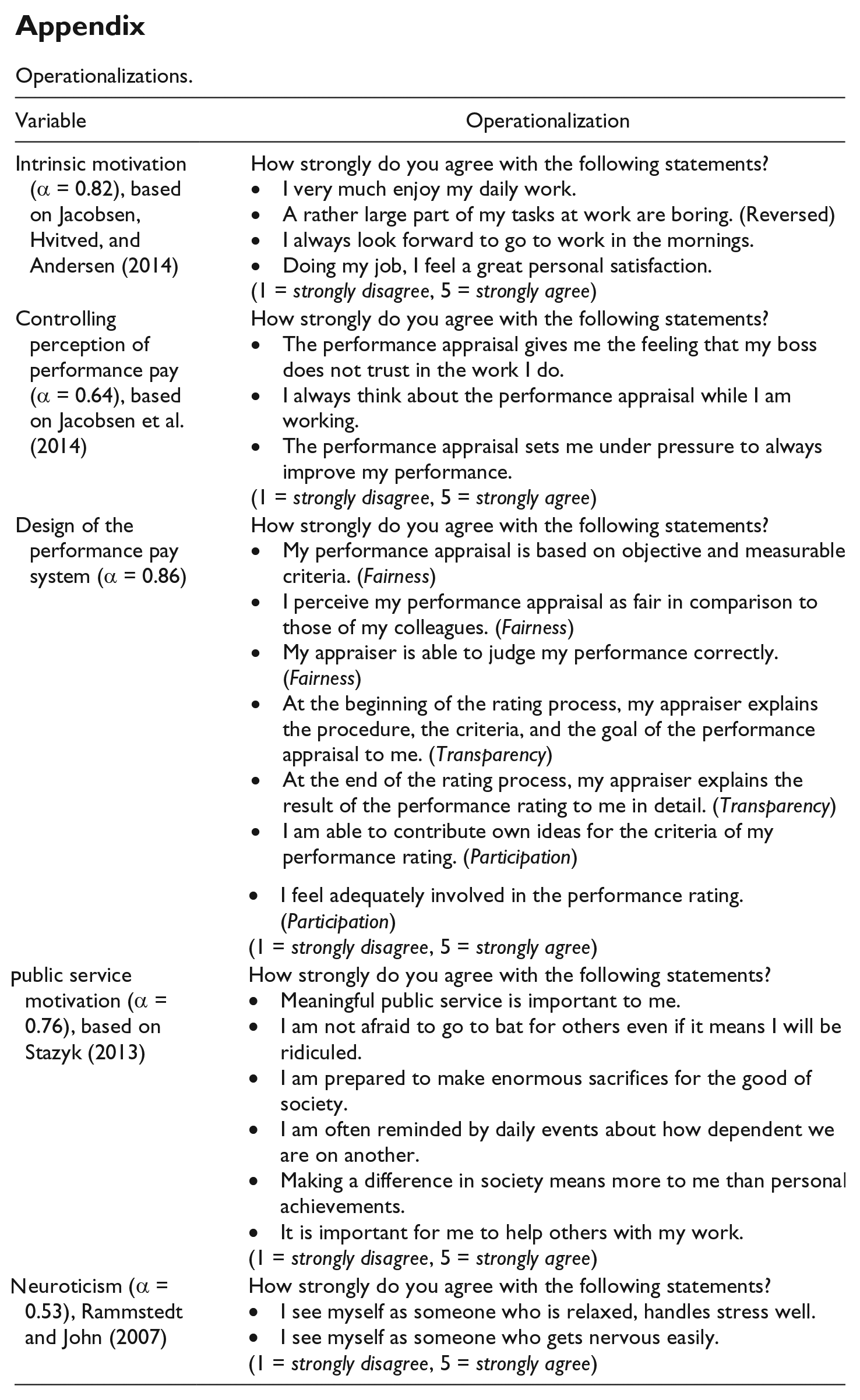
The main variables were all measured using 5-point Likert scales (1 = do not agree at all, 5 = totally agree). The scales’ endpoints were termed I absolutely don’t agree versus I absolutely agree. The detailed operationalization of all variables are displayed in the appendix.
Our first dependent variable, intrinsic motivation, was understood as employees’ enjoyment of and interest in their tasks. We used four items already tested by Jacobsen et al. (2014) to operationalize this construct. One exemplary item was, “Doing my job, I feel great personal satisfaction.” The Cronbach’s alpha of 0.82 indicated a high internal consistency.
The second dependent variable of our study was the controlling perception of the performance pay scheme. The variable referred to the scales by Jacobsen et al. (2014) and Andersen et al. (2015). However, these items had to be fitted into the context of the survey and were not used identically to those in other studies previously. The items resembled the following one: “The performance appraisal gives me the feeling that my boss does not trust in the work I do.” The applied controlling perception scale displayed an average internal consistency, with a Cronbach’s alpha value of 0.64.
The seven items reflecting the features of the performance-appraisal scheme were based on theoretical considerations developed uniquely for this study. Using an exploratory factor analysis, each of the items loaded on the same unique factor. Items displayed a high internal consistency, with a Cronbach’s alpha of 0.86.
PSM was measured by a 6-item short scale that had already been used in a number of studies and surveys (Alonso & Lewis, 2001; Brewer & Selden, 2000; Naff & Crum, 1999; Stazyk, 2013). The Cronbach’s alpha was 0.76.
Neuroticism was taken from the German version of the 10-item Big Five short scale (BFI-10). The BFI-10 includes two items per personality dimension and was validated by Rammstedt and John (2007). In contrast to the other independent variables, neuroticism scored relatively low on Cronbach’s alpha, with a value of 0.53. 1
Controls
We also included sociodemographic variables that have been proven to influence the outcome of performance pay (Alonso & Lewis, 2001; Bright, 2009; Furnham et al., 2005; Groeneveld, Steijn, & van der Parre, 2009; Lyons, Duxbury, & Higgins, 2006). Age and the length of employment in the public sector were measured in broad categories (e.g., younger than 20, 21-30 or less than 5 years, 6-15 years, etc.). Education was measured as the highest degree that employees had attained (apprenticeship, university of applied sciences, university).
The employees were also asked whether they had ever worked in the private sector, since prior studies have shown that these employees pay more interest to a high salary and monetary incentives than those in the public sector (Crewson, 1997; Demmke, 2005; Rainey, 1982). 2 Therefore, it was assumed that people who were once employed in the private sector and are now working in the public sector are still more interested in high salaries and extrinsic rewards. Besides this, it was asked whether the employees were themselves appraisers in terms of performance pay. According to prior experience with reforms, it might cause a positive difference in the perception of the reforms if one is directly involved in their development (Gabris & Mitchell, 1986; Kellough & Nigro, 2002).
Data Analysis
To test our conceptual model, we used structural equation modeling (SEM) with maximum-likelihood estimation. Because the employees in our sample were nested within counties, estimates were based on clustered sandwich estimators, relaxing the requirement of intragroup independence (Rogers, 1994; White, 1980). The overall fit of the model was evaluated with the common fit indices (Jaccard & Wan, 1996). The analysis was carried out using R. 3
Results
Table 1 gives an overview of the descriptives of the analyzed variables. One can see that PSM is of average magnitude. The mean of the positive features of the performance pay system (transparency, participation, fairness) is at 3.5, indicating that there is room for improvement. On average, the performance pay system is not perceived as very controlling (M = 1.87). Intrinsic motivation is also at an average level of 3.7.
Descriptive Statistics.

Note. Factors have been built as mean indices to make them interpretable.
Figure 2 shows the estimated structural equation model we used to test the proposed hypotheses. In addition to the proposed paths, we included a covariate PSM and features of the pay-for-performance system.
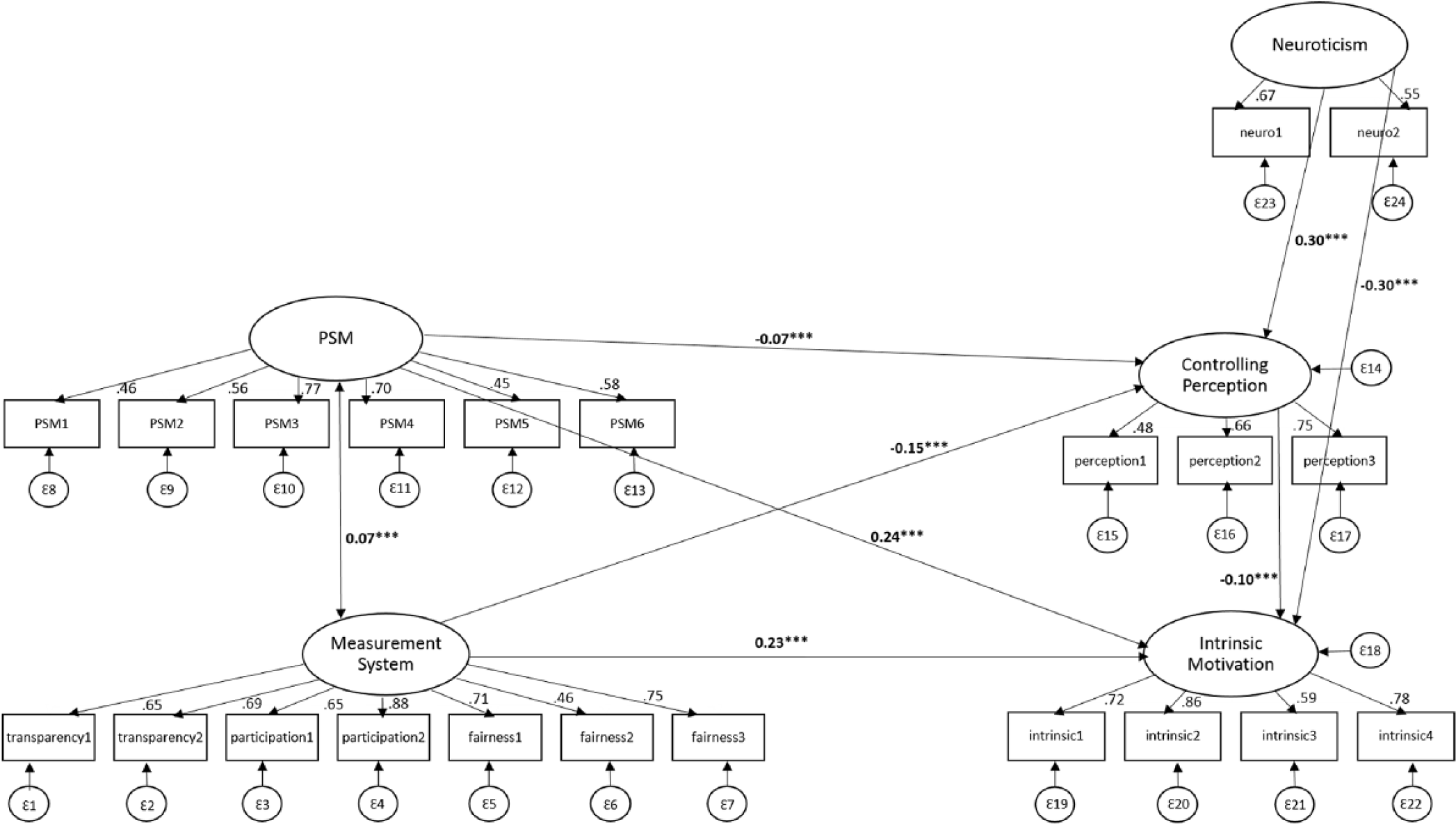
Structural equation model on intrinsic motivation and controlling perception (n = 3,666).
Fit indices 4 in total indicate a satisfactory model fit with a comparative fit index (CFI) of 0.91, a root mean square error of approximation (RMSEA) of 0.057, and a standardized root mean square residual (SRMR) of 0.052 (Acock, 2013; Wright, Moynihan, & Pandey, 2012). As in most complex models, the χ² test is significant, χ²(201 df) = 1960.5 (p < .001), indicating that the model does not perfectly replicate the specified variance–covariance matrix (Acock, 2013). Reliability and discriminant validity tests show satisfactory results, too. Of the five latent constructs in the model, all except for neuroticism show average variance extracted (AVE) scores above 0.50 (Farrell, 2010; Fornell & Larcker, 1981; Gould-Williams, Mostafa, & Bottomley, 2015). In addition, all constructs except for neuroticism show composite reliability scores of 0.70 or above (Farrell, 2010; Fornell & Larcker, 1981; Gould-Williams et al., 2015). Comparing the square root of the AVE with the correlation estimates of every pair of latent constructs reveals that, in all cases, the square root of the AVE is higher than the corresponding correlations, and therefore indicating discriminant validity (Farrell, 2010; Fornell & Larcker, 1981; Gould-Williams et al., 2015). Correlations, AVE, and composite reliability scores are displayed in Table 2. 5
Correlation Matrix, Average Variance Extracted, and Composite Reliability.
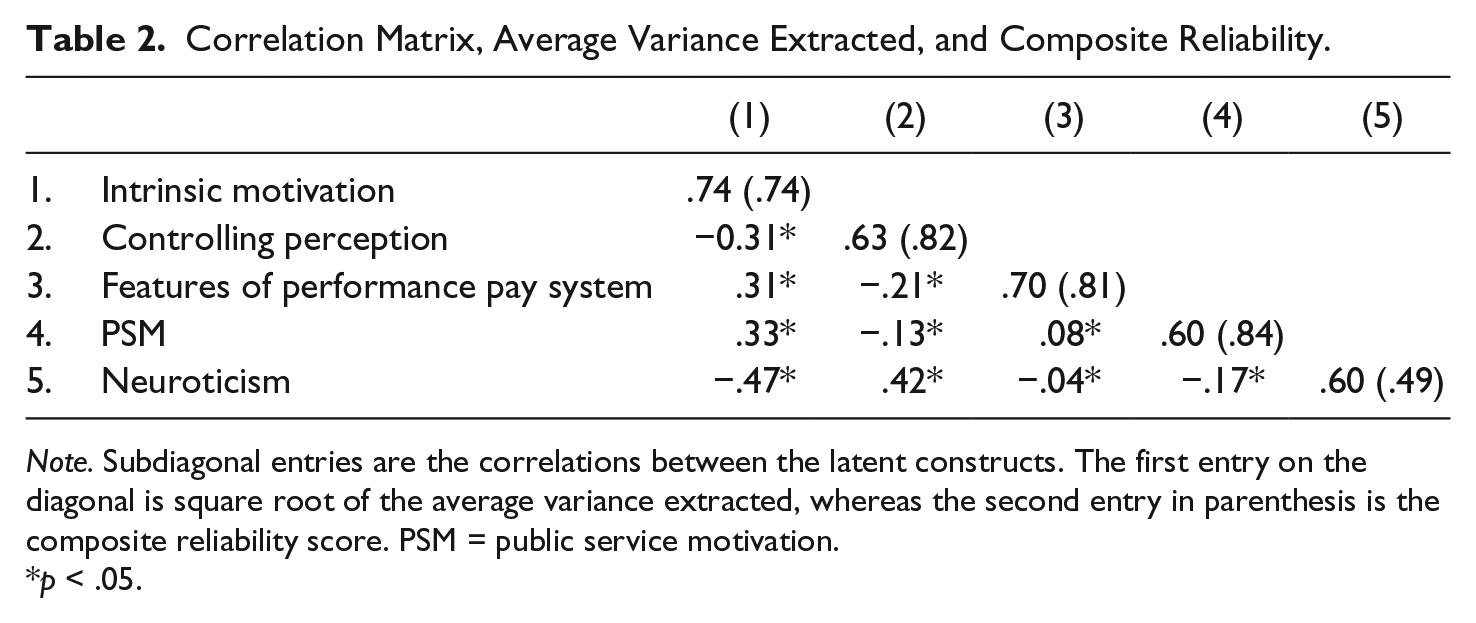
Note. Subdiagonal entries are the correlations between the latent constructs. The first entry on the diagonal is square root of the average variance extracted, whereas the second entry in parenthesis is the composite reliability score. PSM = public service motivation.
p < .05.
The estimated structural equation model supports most of the proposed hypotheses. First of all, employees perceiving pay for performance as more controlling show less intrinsic motivation (H1). The second hypothesis is also supported. A performance pay system that is perceived as participatory, fair, and transparent has a positive effect on employees’ intrinsic motivation. In addition, this effect is partly moderated by a controlling perception of the system. A more transparent, participatory, and fair performance pay system is less likely to be perceived as controlling (H3). With regard to employees’ attitudes, we can see that those participants with higher PSM perceive pay for performance as less controlling than their colleagues with lower PSM. However, this is in contrast to H4, which stated a positive relationship between PSM and controlling perception of performance pay.
The hypotheses regarding the influence of employees’ neuroticism on their controlling perception is supported (H5). Participants who are more neurotic are more likely to perceive performance pay as controlling. PSM also has a significant positive effect on employees’ intrinsic motivation, which means that employees with more PSM also have more intrinsic motivation.
Besides this, there are also significant correlations between PSM and the performance pay system’s fairness, transparency, and opportunities for participation.
We also estimated an extended structural equation model integrating control variables. This model controls for participants’ age, gender, previous experiences in the private sector, and whether they are also acting as appraisers in the performance pay system. Control variables have been regressed with both endogenous variables in the model (controlling perception and intrinsic motivation). Including control variables does not alter the coefficients in our main model. Therefore, the model is robust against adding sociodemographic control variables.
Discussion
Our analysis confirms the findings of previous studies on motivation crowding (Frey & Jegen, 2001; Jacobsen et al., 2014). Public employees’ intrinsic motivation is negatively affected if they perceive performance pay as controlling. The feeling of being controlled harms the enjoyment and motivation they find in performing their tasks. Again, this is an indication for public administrations to be careful when implementing pay for performance systems. The unintended effects can outweigh the intended ones if public employees perceive the system to be controlling.
In this article, we took up the criticism about research on pay for performance (Bright, 2005; Furnham et al., 2005; Truxillo et al., 2012) and asked at which point performance pay may be perceived as controlling. Our results indicate that this will indeed be the case if the performance pay system is perceived as unfair, nontransparent, and nonparticipatory. This effect can be explained using psychological contract theory (Argyris, 1960; Guest & Conway, 2000; Rousseau, 2001). The psychological contract “performance in exchange for a bonus” is perceived as breached by the employer if performance pay is not implemented in a fair, transparent, and participatory manner.
This results in two effects. First, it directly reduces intrinsic motivation. Employees find less enjoyment in fulfilling their tasks because they feel in some way betrayed by their organization. In addition, employees perceive a performance pay system that is not fair, transparent, or participatory as controlling, which in turn has a further negative effect on intrinsic motivation.
This also confirms previous studies suggesting that fairness, transparency, and participation are key success factors for implementing performance pay in private (Erez et al., 1985; Hamner, 1975; Kauhanen & Piekkola, 2006; Meyer et al., 1965) as well as public (Alonso & Lewis, 2001; Perry et al., 2009) organizations.
In addition to the effect of performance pay system features, we analyzed whether employees’ PSM affects the perception of performance pay as more or less controlling. The observed effect is in contrast to the proposed hypothesis (H4). The structural equation model reveals that employees with a high PSM perceive performance pay as less controlling. One possible explanation for this effect is that because people with a high PSM perform better than their colleagues (Bellé, 2013; van Loon, forthcoming), they are more likely to perceive performance pay as a measure to recognize their performance and not as a measure to control them. However, it might also be the case that this causality is reversed. In their work on the effects of student plans on teachers’ motivation, Jacobsen et al. (2014) also found a negative relationship between PSM and controlling perception. However, they assumed that a controlling perception affects teachers’ PSM negatively by crowding out PSM. Further studies should further elaborate on this fact using experimental or longitudinal research designs.
Finally, we not only tested whether the controlling perception of performance pay is a result of external factors (such as the features of the performance pay system) or employees’ attitudes (such as PSM) but also tested whether there are personality-based differences between employees themselves. This assumption can be confirmed. Neurotic employees tend to perceive performance pay as more controlling. Because they are inclined to perceive employers’ behavior as contract breach (Ho et al., 2004; Jafri, 2014; Raja et al., 2004) and react stronger to this breach (Ho et al., 2004), they also perceive performance pay as more controlling. Because of their neurotic personality, they also interpret situations as threatening (Goleman, 1997), which might also be the case for performance pay. Furthermore, their timid tendency might lead to a stronger perception of control and pressure within the performance-appraisal process (Raja et al., 2004).
The analysis of the influence of employees’ personality also extends prior knowledge on intrinsic motivation. People who score high on neuroticism display lower levels of intrinsic motivation. Although there is not much evidence in the public sector, the results confirm findings from psychology. Some studies detected that employees who score high on neuroticism are more interested in extrinsic job elements (Furnham, Forde, & Ferrari, 1999) and a high income (Berings, De Fruyt, & Bouwen, 2004) compared with other personality dimensions. Neuroticism has also been found to be a negative correlate concerning work satisfaction (Judge, Bono, Ilies, & Gerhardt, 2002).
Limitations
In spite of our contribution, the study is not without limitations. First of all, it suffers from general limitations of cross-sectional research, namely, its limited ability to derive causal relations. Although we carefully underlined the proposed hypotheses with theoretical arguments, the possibility cannot be totally excluded that the causal order of some relationships is reversed (e.g., that a controlling perception influences the perception of the performance pay system’s features). Second, as our variables were collected from a single survey, the study suffers from common-method bias (Favero & Bullock, 2015). There are two kinds of common-method bias: item-related and source-related bias. We reduced item-characteristics-related, common-method bias by avoiding difficulty through complex or abstract items and the randomization of the order of constructs and questions (Podsakoff, MacKenzie, Lee, & Podsakoff, 2003). Concerning variables on the pay scheme, we reduced social desirability problems by assuring anonymity of the respondents and including a dummy variable for the appraisers of performance pay.
However, as regards most of our variables (e.g., intrinsic motivation and PSM), individuals have a clear idea about their personal motivation, and there is no other way of providing an equally reliable source for that question (Masal & Vogel, 2016). Nevertheless, there is no statistical test to reliably estimate source-related bias (Jakobsen & Jensen, 2015).
In addition, one might raise concern about the generalizability of our results as the data of the study were collected from local governments in Germany. These organizations might be perceived as a special kind of organization dealing with a special performance pay framework. However, we believe that our results can be applied to a variety of public administrations in Western countries. By including different organizations with different performance-appraisal systems, we assured that the results are not dependent on a single system, and relationships between the tested variables are not dependent on a specific context. The performance pay regime for local governments in Germany is very flexible and allows for very different implementations of the broad idea of performance pay. We therefore believe that the results are also applicable in other countries and contexts.
Conclusion
Based on psychological contract theory, this article analyzes the relationships between intrinsic motivation, PSM, neuroticism, and the design of the performance-appraisal scheme on the basis of a survey conducted in 21 German county councils and cities with council status. The study extends research on motivation crowding theory by complementing it with psychological contract theory and a test of the antecedents of the controlling perception of performance pay.
The results clearly show the contribution of psychological contract theory: Since fairness, participation, and transparency of the pay scheme proved to be important factors in fostering intrinsic motivation and mitigating a controlling perception, organizations should ensure that both parties share the beliefs regarding promises and mutual agreements about performance pay and that these promises can effectively be met and upheld by the appraiser.
If appraisers want to avoid future psychological contract breach, they should always explain the goal and procedure of performance rating as well as the criteria on which the performance appraisal is based. This is especially the case if employees already show a tendency toward timidity or tentativeness.
Although participation, transparency, and fairness show a strong effect on the perception of performance pay, it has to be acknowledged that these aspects are not the only variables influencing employees’ acceptance of performance pay systems. Other antecedents of willingness to accept performance pay are, for example, the amount of performance pay (OECD, 2005), the percentage of employees who would receive a reward (Krauth, Liersch, Jensen, & Amelung, 2016), workplace politics (Rosen, Kacmar, Harris, Gavin, & Hochwarter, 2017), or trust in supervisors and appraisers (Sliwka, 2006). Further research should investigate these factors in a single study to evaluate the relative importance of factors influencing employees’ willingness to accept pay for performance.
Footnotes
Appendix
Operationalizations.
| Variable | Operationalization |
|---|---|
| Intrinsic motivation (α = 0.82), based on Jacobsen, Hvitved, and Andersen (2014) | How strongly do you agree with the following statements? • I very much enjoy my daily work. • A rather large part of my tasks at work are boring. (Reversed) • I always look forward to go to work in the mornings. • Doing my job, I feel a great personal satisfaction. (1 = strongly disagree, 5 = strongly agree) |
| Controlling perception of performance pay (α = 0.64), based on Jacobsen et al. (2014) | How strongly do you agree with the following statements? • The performance appraisal gives me the feeling that my boss does not trust in the work I do. • I always think about the performance appraisal while I am working. • The performance appraisal sets me under pressure to always improve my performance. (1 = strongly disagree, 5 = strongly agree) |
| Design of the performance pay system (α = 0.86) | How strongly do you agree with the following statements? • My performance appraisal is based on objective and measurable criteria. (Fairness) • I perceive my performance appraisal as fair in comparison to those of my colleagues. (Fairness) • My appraiser is able to judge my performance correctly. (Fairness) • At the beginning of the rating process, my appraiser explains the procedure, the criteria, and the goal of the performance appraisal to me. (Transparency) • At the end of the rating process, my appraiser explains the result of the performance rating to me in detail. (Transparency) • I am able to contribute own ideas for the criteria of my performance rating. (Participation) • I feel adequately involved in the performance rating. (Participation) (1 = strongly disagree, 5 = strongly agree) |
| Public service motivation (α = 0.76), based on Stazyk (2013) | How strongly do you agree with the following statements? • Meaningful public service is important to me. • I am not afraid to go to bat for others even if it means I will be ridiculed. • I am prepared to make enormous sacrifices for the good of society. • I am often reminded by daily events about how dependent we are on another. • Making a difference in society means more to me than personal achievements. • It is important for me to help others with my work. (1 = strongly disagree, 5 = strongly agree) |
| Neuroticism (α = 0.53), Rammstedt and John (2007) | How strongly do you agree with the following statements? • I see myself as someone who is relaxed, handles stress well. • I see myself as someone who gets nervous easily. (1 = strongly disagree, 5 = strongly agree) |
Declaration of Conflicting Interests
The author(s) declared no potential conflicts of interest with respect to the research, authorship, and/or publication of this article.
Funding
The author(s) received no financial support for the research, authorship, and/or publication of this article.