




Abstract
This article investigates the effects that ethical leadership, visibility of task performance and conduct, external regulation, and prosocial impact have on revealed and observed preferences for unethical behavior in public administration settings. Experiment 1 engages university students in a laboratory experiment and observes misconduct in two tasks. Ethical messages and visibility reduced subjects’ dishonesty in declaring the outcome of the task that affected their pay but did not influence the self-reported performance in the exercise tied to raising donations. For the latter task, ethical leadership and visibility interacted negatively. Monetary incentives and prosocial impact increased individuals’ unethical behavior consistently across the two tasks. Experiment 2 is a discrete choice experiment exploring public sector workers’ preferences for misbehaving on the job. While ethical leadership and visibility did not affect their preferences, a significant financial gain and the opportunity to improve the life of many people increased the willingness to behave unethically.
Keywords
Introduction
Understanding the causes and consequences of unethical behavior is key for organizations and society at large. Indeed, corruption and abuse of public office are a blight on democracies and a drain on public finances. With trust in government flagging in many countries and voter disillusionment on the rise, raising standards of integrity is more important than ever. (Organization for Economic Co-Operation and Development [OECD], 2017)
In the past few years, research on unethical behavior has increasingly gained the attention of scholars in different disciplines within the social sciences (e.g., Kish-Gephart, Harrison, & Treviño, 2010; Liu & Mikesell, 2014; Mazar, Amir, & Ariely, 2008; Menzel, 2015; Moore & Gino, 2015; OECD, 2015; Perry, 2015).
A recent meta-analysis of 137 experiments on the determinants of misconduct identified 12 drivers of dishonest behaviors and suggested specific directions that public administration scholars could take to advance research and practice in this area in our field (Belle & Cantarelli, 2017). For example, despite ethics in government remaining “at the heart of what we are about as a professional field” (Perry, 2015, p. 187), our knowledge is still scant about how ethical leaders and/or colleagues affect public employees’ behaviors (see Downe, Cowell, & Morgan, 2016; Hassan, Wright, & Yukl, 2014, for two exceptions). Similarly, although public service motivation has a long and fruitful tradition of research and practice in our field (e.g., Brewer & Brewer, 2011; Neumann, 2016; Pedersen, 2015; Perry, 2014; Ritz, Brewer, & Neumann, 2016; Van der Wal, 2015), we have a limited understanding of whether and how the desire to serve others may backfire and fuel employees’ dishonesty on the job. From a methodological perspective, public administration research on integrity and unethicality is dominated by observational designs (e.g., Menzel, 2015; Von Maravić, 2008). To the contrary, randomized trials of the drivers of individuals’ dishonesty prevail in disciplines like business, ethics, economics, management, and psychology (Belle & Cantarelli, 2017).
This article investigates whether and how individuals’ actual unethical behavior and self-reported preferences to engage in dishonest acts are influenced by four factors: ethical leadership, visibility of one’s task performance and conduct on the job, external regulation, and prosocial impact. Recent work has argued that those elements are especially relevant and timely in public administration research and practice (e.g., Belle, 2015; Belle & Cantarelli, 2017; Bolino & Grant, 2016; Downe et al., 2016). We study the effects of these factors using two randomized trials and three experimental tasks. Experiment 1 consists of a laboratory experiment in which students can engage in unethical behavior by misreporting their performance in two tasks, one that generates benefits for themselves and one that generates donations for others. Experiment 2, instead, features a discrete choice experiment in which Italian public administration workers with different managerial responsibilities and serving in different industries within the public sector indicate under what circumstances they would be more willing to engage in a specific unethical act.
Our work makes three primary contributions. First, it advances our understanding of unethical behavior in public administration settings. To the best of our knowledge, it represents the first attempt to study the independent, combined, and simultaneous effects of ethical leadership, visibility, external regulation, and prosocial impact on dishonesty. Second, this article provides unique insights on the dark sides of the four variables separately; whereas much of the available research investigates their bright sides, our work calls for more attention to their undesired effects as well. Third, this article helps efforts to triangulate results across research designs by adding novel and multiple experimental evidence on the drivers of unethical behavior to existing observational studies in public administration.
The remainder of the article proceeds as follows. The next four sections are dedicated to ethical leadership, visibility, external regulation, and prosocial impact, respectively. Each section defines the concept first and then summarizes what we know about its relation with dishonesty. Then, the article presents the method and results of Experiment 1 and Experiment 2. The article concludes with a general discussion of the findings, an acknowledgment of the study limitations, and a proposal of avenues for future research.
Ethical Leadership and Followership
Even though ethics and integrity are foundational elements of government and democracy (e.g., Adams & Balfour, 2010; Menzel, 2015; Perry, 2015), and ethical leadership is among the most relevant leadership theory in public administration and management (e.g., Van Wart, 2013), research is scant on the causal link between ethical leaders and followers’ behavior (e.g., Downe et al., 2016; Hassan et al., 2014). A recent meta-analysis synthesizing 137 experiments in 73 articles across disciplines did not locate any randomized trial on how one’s behavior is dependent on supervisor’s honesty or lack thereof (Belle & Cantarelli, 2017).
Ethical actions on the job refer to “individual behavior that is subject to or judged according to generally accepted moral norms of behavior” (Treviño, Weaver, & Reynolds, 2006, p. 952). Unethical intentions and conduct, then, can be defined as “one’s willingness or commitment to engage in an unethical behavior” and any “action that violates widely accepted (societal) moral norms,” respectively (Kish-Gephart et al., 2010, p. 2). Bureaucratic ethos and democratic ethos are two sets of administrative values that characterize research and practice on public administration ethics. (Pugh, 1991). Bureaucratic ethos (Pugh, 1991) centers on two key elements: (a) Nonelected employees in government organizations are subordinated and held accountable to elected officials who, in turn, are duty bound to communicate the public will to bureaucrats, and (b) public sector workers need to use managerial techniques in the provision of public services. Scholars have identified a critical drawback to bureaucratic ethos: When managerial principles such as efficiency and neutral competence are taken to the extreme, bureaucratic ethos can turn into administrative evil (e.g., Adams & Balfour, 1998). Democratic ethos, instead, stresses political and regime values. Adherence to standards such as benevolence, social equity, and justice would allow public administrators the ability to prevent unethical behavior in the workplace and promote the highest ethical standards (e.g., Pugh, 1991; Rohr, 1998).
The birth and growth of ethical leadership as a stand-alone concept is grounded in the social learning and social exchange theories. The former (Bandura, 1977, 1986) contends that learning is a cognitive process that occurs in social interactions through observation and reinforcement. Thus, individuals learn how to behave ethically by receiving rewards for ethical actions and punishments for unethical actions as well as by mimicking the conduct of ethical role models who are attractive and credible (Brown & Treviño, 2006). The social exchange theory (e.g., Blau, 1964; Mayer, Kuenzi, Greenbaum, Bardes, & Salvador, 2009), instead, is based on the norm of reciprocity. According to this norm, individuals feel obligated to reciprocate the benefits that they receive. This exchange process does not need to be economic, rather it can be social and consist in giving and taking trust and fairness (e.g., Mayer et al., 2009). Drawing on these two theories, ethical leaders are described as the combination of a moral person and a moral manager. The moral person is honest, trustworthy, and fair; cares about others and the society; and behaves ethically in both the personal and professional life (e.g., Mayer, Aquino, Greenbaum, & Kuenzi, 2012; Van Wart, 2013). The moral manager proactively encourages followers’ ethical behavior through role modeling, communication, and rewards/punishments (Brown & Treviño, 2006; Treviño, Brown, & Hartman, 2003). Eisenbeiss (2012) noted that leadership involves two main processes: setting goals and motivating others to pursue such goals. In ethical leadership, both aspects adhere to ethical principles and standards.
Brown, Treviño, and Harrison (2005) proposed the first definition of ethical leadership as the “demonstration of normatively appropriate conduct through personal actions and interpersonal relationships, and the promotion of such conduct to followers through two-way communication, reinforcement and decision-making” (Brown et al., 2005, p. 120). Eisenbeiss (2012) argued that four normative principles should guide the behavior of ethical leaders. The first is humane orientation, which implies that ethical leaders “treat others with dignity and respect and see them as ends and not means” (Eisenbeiss, 2012, p. 795). The second is justice orientation: ethical leaders “make fair and consistent decisions and [do] not discriminate against others” (Eisenbeiss, 2012, p. 796). The third normative principle is responsibility and sustainability orientation, which refers to “leaders’ long-term views on success and their concern for the welfare of society and the environment” (Eisenbeiss, 2012, p. 796). The fourth normative principle is moderation orientation, which relates to “temperance, humility and balanced [conduct]” (Eisenbeiss, 2012, p. 797). These four aspects appear in all characterizations of ethical leaders: They (a) demonstrate integrity and high ethical standards, (b) base their conduct on altruistic rather than selfish motives, (c) care about followers and treat them fairly, and (d) engage in explicit ethics-related communication and use reinforcement tools so that followers are held accountable and responsible for their ethical conduct. Several scales measuring ethical leadership are available. They include the 10-item Ethical Leadership Scale (Brown et al., 2005), the 38-item Ethical Leadership at Work Questionnaire (Kalshoven, Den Hartog, & De Hoogh, 2011), and the 15-item survey instrument developed by Yukl, Mahsud, Hassan, and Prussia (2013).
A few recent studies have marked a resurgence of interest in ethical leadership and followers’ honesty and dishonesty in public administration. For example, Hassan et al. (2014) surveyed 161 public managers and 415 of their direct subordinates and found that ethical leadership was associated with desired job outcomes such as lower absenteeism, higher organizational commitment, and higher willingness to report unethical behaviors. Downe et al. (2016) conducted a case study among 353 local councils and concluded that local governments consistently scoring high on ethicality also had leaders who promoted ethical conduct through actions that walk-the-talk of ethical values rather than through actions that only enforce formal rules and regulations. These findings are promising in suggesting that ethical leaders influence civil servants’ preferences and behaviors. Thus, we formulated the following hypothesis:
Visibility of Performance and Conduct and Unethical Behavior
Self-concept maintenance theory and image motivation suggest that the visibility of one’s conduct and task performance by others affects one’s behavioral decisions. More precisely, the self-concept maintenance theory (e.g., Mazar et al., 2008) predicts that individuals engage in unethical behavior only up to the point at which they are not forced to weaken their self-concept. In other words, it argues that individuals care about what they think of themselves. Image motivation (e.g., Ariely, Bracha, & Meier, 2009), then, is “the desire to be liked and respected by others and by one’s self” (Ariely et al., 2009, p. 544). Therefore, individuals also care about what others think of them.
Visibility of one’s task performance by others has recently been shown to affect individuals’ behaviors, both desired and undesired. Ariely et al. (2009) have shown that the effectiveness of monetary incentives for an activity aimed at raising financial donations is dependent on the visibility of one’s task performance by others and the visibility of one’s financial gains. A random subsample of 161 Princeton University undergraduate students who could earn a monetary payment for themselves based on their performance on the experimental task pressed X and Z sequentially on a keyboard more times when their performance and payment scheme were kept secret as compared with when those were publicly disclosed to the other participants in the room. In a similarly designed research, a contingent reward significantly increased the number of correctly assembled surgical kits when the performance and payment of the employees of a public local health authority were kept secret and only marginally when those were publicly disclosed to others (Belle, 2015).
As for undesired behaviors, extant experimental evidence shows that anonymity generates more misreporting compared with visibility (e.g., Fischbacher & Föllmi-Heusi, 2013; Mazar et al., 2008). In line with the predications of self-concept maintenance theory, stronger levels of anonymity do not seem to generate more misbehavior than weaker degrees of anonymity. For example, Mazar and colleagues (2008) manipulated anonymity of subjects’ unethical behavior by designing experimental procedures that guaranteed progressively stronger opportunities to go unnoticed. Participants randomly assigned to one of three anonymity conditions declared a higher number of correctly solved questions relative to students whose conduct and performance were visible but their misbehavior did not vary significantly across the three anonymity conditions. Similarly, the percentage of students self-reporting the outcome maximizing payoffs was not statistically different for students exposed to either stronger or weaker levels of anonymity (Fischbacher & Föllmi-Heusi, 2013).
Based on the aforementioned theoretical explanations and empirical evidence, we formulated Hypothesis 2 as follows:
External Regulation and Unethical Behavior
Early operant theories of work motivation already addressed the core idea of external regulation. The reinforcement theory developed by Skinner (1953), for instance, suggests that individuals can be encouraged to replicate desired behaviors through positive reinforcements, such as formal recognition and material rewards, or through negative reinforcements such as reduced supervision. The reinforcement theory further proposes that individuals can be led to quit undesired behaviors through punishments, such as material fines and disciplinary actions, or through extinctions that remove positive and negative reinforcements. Later on, self-determination theory (e.g., Deci & Ryan, 2000) formally described external regulation as the most controlled and least autonomous of the four regulations that compose the extrinsic motivation continuum. When individuals are externally regulated, they act exclusively to obtain a reward or avoid a punishment. In other words, “externally regulated behaviors are predicted to be contingency dependent in that they show poor maintenance and transfer once contingencies are withdrawn” (Deci & Ryan, 2000, p. 236).
A recent meta-analysis of 26 randomized trials (n = 2,776) showed that greed increases individuals’ dishonest conduct (Hedges’s g summary effect size = .45, p < .001). More precisely, one group of studies included in this meta-analysis summarizes experiments that explore the effects of offering individuals a monetary incentive on their levels of dishonesty. This meta-analysis also synthesizes studies that investigate the dishonesty effects of priming individuals to think about money, exposing them to wealth abundance, and making them worse off relative to their peers. Overall, offering subjects higher monetary payoffs or simply making individuals think about money increased their unethical behavior (Belle & Cantarelli, 2017). Scholarship on the negative consequences and correlates of bribes and corruption in public administration is also available: “Corruption in the public sector hampers the efficiency of public services, undermines confidence in public institutions and increases the cost of public transactions” (OECD, 2015). Moreover, corruption “may distort government’s public resource allocations” (Liu & Mikesell, 2014, p. 346). Based on this evidence, we formulated Hypothesis 3 as follows:
Prosocial Impact and Unethical Behavior
In a recent systematic review, Bolino and Grant (2016) defined prosocial impact as the “experience of making a positive difference in the lives of others through one’s work” (p. 1). Interested in providing a comprehensive overview of the state of the art in our knowledge about the implications of workers’ prosociality in organizations, Bolino and Grant discussed three constructs: prosocial impact, prosocial motives, and prosocial behavior. The definition of prosocial motives as “the desire to benefit others or expend effort out of concern for others” (Bolino & Grant, 2016, p. 1) aligns very nicely with the concept of public service motivation that is native to our field and has had a long and fruitful tradition of theoretical and empirical research (e.g., Perry, Hondeghem, & Wise, 2010; Ritz et al., 2016; Van der Wal, 2015). Prosocial behaviors, instead, are conceived as “acts that promote/protect the welfare of individuals, groups, or organizations” (Bolino & Grant, 2016, p. 1). Therefore, prosocial impact, motives, and behaviors are, respectively, a perception or a feeling, a state or a trait, and an action. “Compared to prosocial motives and behaviors, research on prosocial impact is nascent” (Bolino & Grant, 2016, p. 42). Scholarly efforts to investigate prosocial impact are rooted in job design and relational job design frameworks. The former suggests that the way in which jobs are structured significantly influences employees’ motivation and outcomes and that employees need to perceive their work as meaningful (e.g., Hackman & Oldham, 1976). Expanding on these predictions, the relational job design framework (e.g., Grant, 2007) argues that jobs can be structured in ways that foster employees’ prosociality.
Extant experimental scholarship has nurtured our knowledge about how prosocial impact influences behaviors. Direct contact with the end beneficiaries of one’s work, and self-persuasion exercises about the task significance of one’s effort on the job are two experimental interventions used to experimentally manipulate relational job design. These interventions have consistently been shown to improve employees’ persistence, productivity, and performance through their heightened perceptions of making a difference in others’ lives (e.g., Belle, 2013, 2014, 2015; Grant, 2008a, 2008b, 2012; Grant et al., 2007, Grant & Hofmann, 2011).
Research on the dark side of prosocial impact is also available. A recent meta-analysis of experimental work on factors that affect unethical conduct identified social influences—an umbrella term that included benefiting others—as a variable that increases dishonest behaviors (Belle & Cantarelli, 2017). Extant literature shows that individuals cheated more on experimental tasks when they could generate benefits for others through their misbehavior (e.g., Erat & Gneezy, 2012; Rigdon & D’Esterre, 2015; Schaumberg & Wiltermuth, 2014), they were given the opportunity to split the undeserved gains with others (e.g., Wiltermuth, 2011), or they could help identified victims (e.g., Yam & Reynolds 2016). In other words, extant work unveils that prosocial impact can make individuals rationalize their dishonest conduct on the grounds that, in so doing, they are benefiting others. Indeed, research on empathy and altruism suggests that the desire to help others may trigger unethical behavior: Street-level bureaucrats and case managers might be tempted to bend the rules to help clients to whom they are emotionally bound (e.g., Bozeman & Su, 2015; Perry & Vandenabeele, 2015). Based on these findings, we formulated the following Hypothesis 4.
Experiment 1
Participants
Experiment 1 was conducted at the Bocconi Experimental Laboratory for the Social Sciences (BELSS) with 120 Italian Bocconi students. They performed two tasks (i.e., die-roll and matrix for charity tasks) and filled out an end-of-study questionnaire (Appendix A). Participants were divided into five experimental groups that are fully described below. Students signed up for the time slot of their preference and experimental treatments were randomly assigned to the time slots. Students in Group 1 through 4 participated in our lab experiment in exchange for a 5-euro show-up fee and the opportunity to earn an additional 10 euros during the study. Students in Group 5 received a 10-euro show-up fee and did not have the chance to earn more money during the study. About 46% of participants were female and the average age was 21 years (SD = 1.39 years).
Task 1: Die-Roll
In Task 1, building on Fischbacher and Föllmi-Heusi (2013), subjects privately rolled a six-sided fair die and reported the outcome on a piece of paper. More precisely, participants were instructed to, sequentially, (a) privately throw the die a few times to verify its fairness, (b) privately roll the die once and memorize the figure on the faceup side, (c) put the die aside in an empty folder so that no one could ever verify the outcome, and (d) declare the result of the die-roll by writing the number on a piece of paper that was provided at the beginning of the session. This procedure ensured that participants could engage in unethical behavior by reporting an outcome of the die-roll that was different from the actual one. This procedure also guaranteed the impossibility for the experimenters to detect dishonesty at the individual level. The outcome of the die-roll that participants self-reported was our dependent variable for Task 1.
Task 2: Matrix for Charity
In Task 2, drawing on Mazar et al. (2008), participants reported how many numeric matrices they had been able to solve in 5 min. Specifically, students were presented with a piece of paper containing 20 matrices, each of which was composed of 12 numbers between zero and nine with two decimal figures. For each matrix, students were asked to find out and circle the two figures that added up to 10. They were instructed to solve as many matrices as they could in 5 min. Abundant evidence has shown that being able to solve all matrices in such a short time window is highly unlikely (e.g., Gino, Ayal, & Ariley, 2009; Gino & Mogilner, 2014; Mazar et al., 2008). At the end of the 5 min, participants were instructed to count how many matrices they solved correctly, tear up the paper with the matrices, and declare their task performance by writing the number of matrices that they solved correctly on a separate piece of paper, which was provided at the beginning of the session. Therefore, participants were allowed to behave unethically by reporting a number of correctly solved matrices different from the actual one. As in Task 1, the abovementioned procedure reassured participants that no one could ever verify his or her self-reported performance. Again, we did not measure dishonesty at the individual level. The number of matrices that participants claimed that they were able to solve correctly served as our measure of task performance (i.e., our dependent variable) for Task 2.
Experimental Treatments
Experiment 1 featured the experimental manipulation of the following variables at two levels indicated in parentheses: ethical leadership (yes vs. no), visibility of task performance (yes vs. no), and external regulation attached to Task 1 (yes vs. no); and prosocial impact attached to Task 2 (yes vs. no).
The person providing the instructions to students, who in reality was a confederate blind to the research hypotheses, administered the ethical leadership treatment. She was trained to do the following: (a) convey that, for the duration of the study, participants were going to be a team and she was the team leader; (b) state and reinforce twice that without any doubt honesty was her most important value; (c) explicitly ask participants to honestly report the number resulting from the roll of the die and the number of correctly solved matrices; and (d) explain that when she performed the same two tasks herself in the past, she decided to report her performance honestly. Students not exposed to the ethical leadership interventions did not hear any of these messages. We designed this manipulation capitalizing on the work of Hassan et al. (2014), the definition of ethical leadership provided by Yukl et al. (2013), and the selection of items of the Ethical Leadership Questionnaire (ELQ) that could most realistically fit our setting.
The manipulation of the visibility of task performance consisted of two steps. In the first step, students were asked to socialize for 5 min at the very beginning of the study session. In the second step, before performing Task 1, subjects were told that after having memorized the outcome of the die-roll and having left the die on the side, they were going to be asked to do the following: (a) stand up one at a time, (b) raise over their heads the piece of paper on which they had written the outcome, and (c) say the outcome aloud in front of everybody else in the room. This procedure for the second step in the visibility manipulation was replicated during the instructions for Task 2. More precisely, students were informed beforehand that after tearing up the paper on which they solved the matrices, they were to stand up one at a time, raise over their heads the piece of paper on which they had written the number of correctly solved matrices, and say the number aloud in front of everybody else in the room. Subjects not exposed to the visibility manipulation did not hear these instructions and, accordingly, were not required to stand up and tell their performance in Tasks 1 and 2. We built this treatment drawing on the definition of image motivation provided by Ariely et al. (2009) and adapting the experimental procedures of the other studies that manipulated performance visibility and inspired our research (Belle, 2015; Fischbacher & Föllmi-Heusi, 2013; Mazar et al., 2008).
The external regulation manipulation consisted in attaching a monetary incentive for the self to the self-reported outcome of Task 1. More precisely, before engaging in Task 1, participants were informed that upon leaving the lab at the end of the session, they were going to be paid 2 euros if they reported that the die landed on 1, 4 euros if they reported that the die landed on 2, 6 euros if they reported that the die landed on 3, 8 euros if they reported that the die landed on 4, 10 euros if they reported that the die landed on 5, and 0 euros if they reported that the die landed on 6. Students not exposed to the external regulation intervention were not given the opportunity to earn an amount of money dependent on their self-reported outcome in Task 1. This procedure replicates the original studies of Fischbacher and Föllmi-Heusi (2013) as well as Mazar et al. (2008).
The prosocial impact intervention consisted in attaching a donation toward others to the self-reported performance of Task 2. Specifically, before performing Task 2, subjects were informed that for each matrix that they claimed to have solved correctly, the experimenters would make a proportional financial donation to a local charity using their personal money. Subjects not exposed to the prosocial impact treatment were not provided with this instruction and, therefore, were not given the chance to contribute to the donations through their performance in Task 2. This intervention was inspired by the works of Ariely et al. (2009) as well as Belle (2015).
Experimental Groups
Subjects in Experiment 1 were divided into five experimental groups. Participants in Group 1 (n = 24) were exposed to the following experimental interventions: ethical leadership, visibility of task performance, external regulation attached to Task 1, and prosocial impact attached to Task 2. Subjects in Group 2 (n = 24) were exposed to the visibility of task performance, external regulation attached to Task 1, and prosocial impact attached to Task 2. Students in Group 3 (n = 25) were exposed to the ethical leadership, external regulation attached to Task 1, and prosocial impact attached to Task 2 interventions. Participants in Group 4 (n = 21) were exposed to the external regulation attached to Task 1 and prosocial impact attached to Task 2 conditions. Students in Group 5 (n = 26) were exposed to the visibility of task performance only. Table 1 shows the number of participants, experimental interventions, and self-reported task performance for each of the five groups.
Participants, Experimental Treatment, and Self-Reported Performance by Group (Experiment 1).
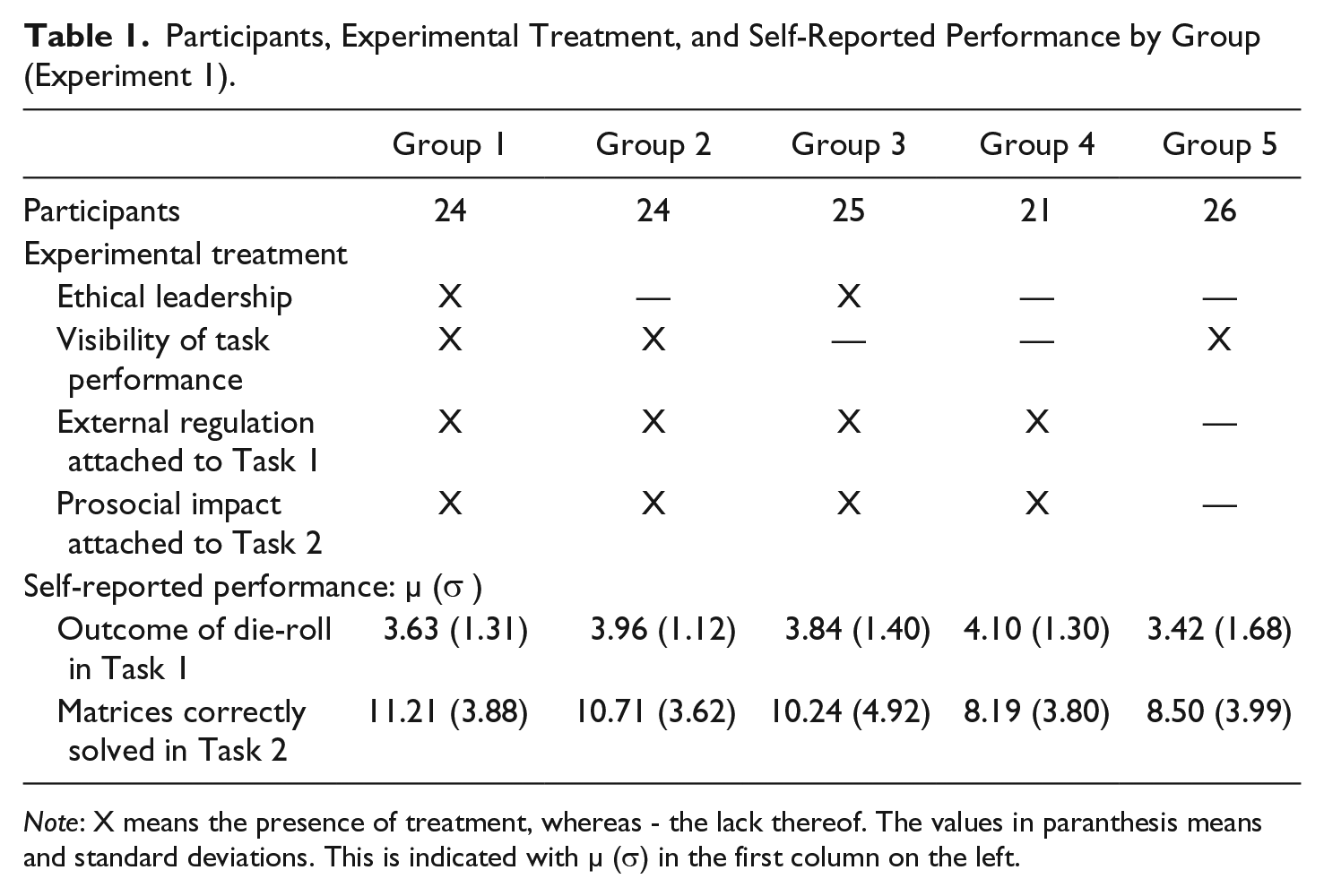
Note: X means the presence of treatment, whereas - the lack thereof. The values in paranthesis means and standard deviations. This is indicated with µ (σ) in the first column on the left.
Results
A series of independent-samples t tests indicated that our experimental interventions of ethical leadership, visibility of task performance, and prosocial impact attached to Task 2 worked as expected. In fact, the average score on the ethical leadership scale (Appendix A) was higher among subjects in the groups exposed to the ethical leadership manipulation (i.e., Groups 1 and 3) compared with that of subjects in the groups that did not receive the ethical leadership intervention (i.e., Groups 2, 4, and 5; µ = 4.97, σ = 0.63 vs. µ = 3.28, σ = 1.13; p < .000). Similarly, the score on the visibility item (Appendix A) was on average higher among students in the visibility conditions (i.e., Groups 1, 2, and 5) compared with their counterparts in the nonvisibility conditions (i.e., Groups 3 and 4; µ = 3.16, σ = 2.52 vs. µ = 0.22, σ = 0.47; p < .000). Finally, the mean score on the prosocial impact scale (Appendix A) was higher for participants in Group 1 through 4 compared with participants in Group 5 (µ = 4.78, σ = 1.16 vs. µ = 3.16, σ = 1.07; p < .000).
Table 2 reports the results of Task 1 in Experiment 1. The second column shows the p value of a series of χ2 tests investigating whether the distribution of subjects by self-reported outcome of the die-roll was significantly different from the expected distribution, separately for the pooled sample and for subsamples. Assuming unbiasedness of the die and lack of individuals’ misbehaviors, distributions should be uniform and each outcome of the die-roll should occur 16.7% (i.e., 1/6) of the times. The χ2 tests revealed that our observed distributions were significantly different from uniform at the .05 level in the majority of cases. The distributions of participants were not different from uniform at the .05 level in Group 1 and Group 4 (p = .075 and p = .057, respectively) and not different from uniform in Group 3 and Group 5. This provides two preliminary insights for our findings: Students engaged in misreporting behaviors at an aggregate level, and our manipulated variables affected unethical behavior.
Results of Experiment 1—Task 1.
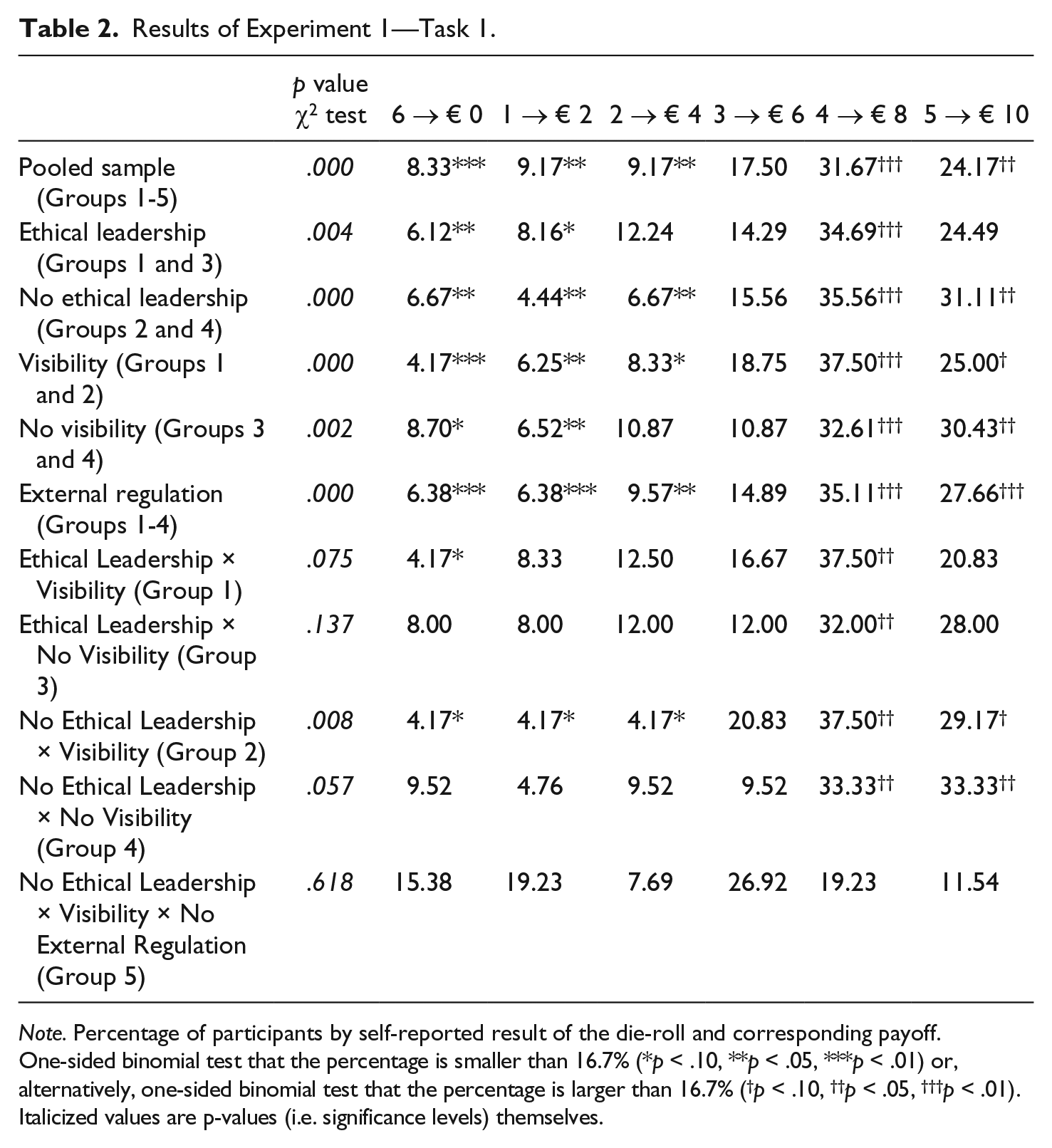
Note. Percentage of participants by self-reported result of the die-roll and corresponding payoff.
One-sided binomial test that the percentage is smaller than 16.7% (*p < .10, **p < .05, ***p < .01) or, alternatively, one-sided binomial test that the percentage is larger than 16.7% (†p < .10, ††p < .05, †††p < .01). Italicized values are p-values (i.e. significance levels) themselves.
The other columns in Table 2 show the percentage of participants by claimed outcome of the die-roll and corresponding payoff together with the findings of the binomial test that such percentages were smaller or larger than 16.7%. The percentage of participants who reported a 5 and, therefore, maximized their payoff was significantly higher than the expected 1/6 among students who did not listen to the ethical leadership speech (p = .012) but not among those who heard the ethical leadership messages (p = .104). This finding is in line with the prediction of Hypothesis 1. The percentage of participants who reported a 5 was significantly higher than the expected 1/6 among students in the secret condition (p = .015) but not higher than the expected 1/6 at the .05 level among participants in the condition in which they were asked to both socialize at the beginning of the session and report their task performance in front of others (p = .092). This provides support for Hypothesis 2. The percentage of subjects who reported a 5 was significantly higher than the expected 1/6 among students in the external regulation condition (p = .005) but not higher than the expected one among subjects whose self-reported outcome was not linked to a personal monetary gain (p = .832). This result provides empirical evidence for the expectation stated in Hypothesis 3.
An ANOVA indicated that the average number of matrices that students self-reported as correctly solved varied significantly across the five experimental groups (p = .042). Figure 1 displays the results of Task 2 in Experiment 1. More precisely, among participants who did not hear the ethical leadership speech, those in the visibility of task performance condition (Group 2) reported solving 2.51 more matrices than their peers in the no visibility condition (Group 4; p = .028). This difference was not significant in the ethical leadership condition (Groups 1 and 3; p = .447). Furthermore, among subjects in the nonvisibility of the task performance condition, those who heard the ethical leadership speech (Group 3) reported to have solved a number of matrices that was marginally higher compared with participants who did not hear the ethical leadership speech (Group 4; +2.05 matrices, p = .127).

Results of Experiment 1—Task 2.
Finally, students claimed to have solved 2.21 more matrices on average when their performance resulted in a donation to the local charity made by the experimenters (Group 5) compared with when their performance had no such prosocial impact (Groups 1 through 4; p = .046). This finding provides support to Hypothesis 4.
Experiment 2
Experiment 2 was designed as a follow-up study to analyze the external validity of the findings of Experiment 1. Experiment 2 and Experiment 1 shared the same dependent and independent variables. However, the operationalization of the constructs was different in the two randomized trials. Also, participants, experimental design, setting, and task were different in the two studies. Experiment 2 was a discrete choice experiment aimed at estimating the independent and simultaneous effect of ethical leadership, visibility of conduct, external regulation, and prosocial impact on public sector employees’ probability of engaging in unethical behavior on the job (e.g., Ryan, Kolstad, Rockers, & Dolea, 2012).
Participants
Participants in Experiment 2 were 296 Italian public sector workers recruited through the Qualtrics Software Company. About 66% of the sample had managerial responsibilities to manage personnel within their organization, whereas the other 34% did not. Average age was about 43 years (SD = 10 years) and 45% of them were female. Subjects worked in the following public sector industries: education (37%), general administration (29%), health care (17%), and other (17%). About 36% of the sample had a college degree in scientific disciplines, 35% a college degree in humanistic disciplines, and 29% did not attend college.
Task
Participants were asked to imagine themselves in the following scenario: They had a brilliant idea that they wanted to patent. To finalize their project, they would need to work on it during working hours, thus subtracting time from their job duties. Subjects were then presented with two working situations (A and B) that featured the experimental manipulations described in detail in the next section. Participants were required to indicate in which of the two situations (A or B) they would be more willing to dedicate part of their working time to finalize their idea for the patent (Appendix B). In other words, respondents were required to decide under which of two situations they would be more willing to misbehave. Each subject made eight such choices.
Experimental Treatments
The attributes and attribute levels (in parentheses) of our discrete choice experiment were as follows: ethical leadership (the leader sometimes works at personal projects during working hours vs. the leader never works at personal projects during working hours), visibility (high probability that you will go unnoticed vs. certainty that you will go unnoticed), external regulation (you will receive a moderate financial gain from the patent vs. you will receive a significant financial gain from the patent), and prosocial impact (the patent will not create benefits for others vs. the patent will improve the life of many people) (Appendix B). Therefore, we manipulated all attributes at two levels: low and high, respectively. The combination of two levels and four attributes defined the 16 possible working situations that we labeled Situation A in the survey that respondents filled out. Using a foldover approach (e.g., Ryan et al., 2012; Street, Burgess, & Louviere, 2005), we built Situation B in each scenario as a mirror image of Situation A: The level of attributes in Situation A were reversed to create Situation B. We designed the level of the attributes in Experiment 2 following up on the interventions of Experiment 1 and drawing on the same research that also inspired Experiment 1.
Results
To test whether and how ethical leadership, visibility, external regulation, and prosocial impact modify the probability of engaging in unethical behavior on the job, we fitted a multilevel mixed effects linear model. We did so to take into account the binary nature of the dependent variable (i.e., choice between working Situation A or working Situation B) and the hierarchical structure of the data that featured eight observations per participant. Table 3 displays the unstandardized row coefficients (b) with the associated standard errors (SEs), z scores (z), and p values as well as factor changes in odds (eb) for unit increase in the independent variables of Experiment 2. A positive and significant coefficient implies that the attribute had a positive impact on the take-up of a given working situation; a negative and significant coefficient implies the opposite effect.
Results of Experiment 2.
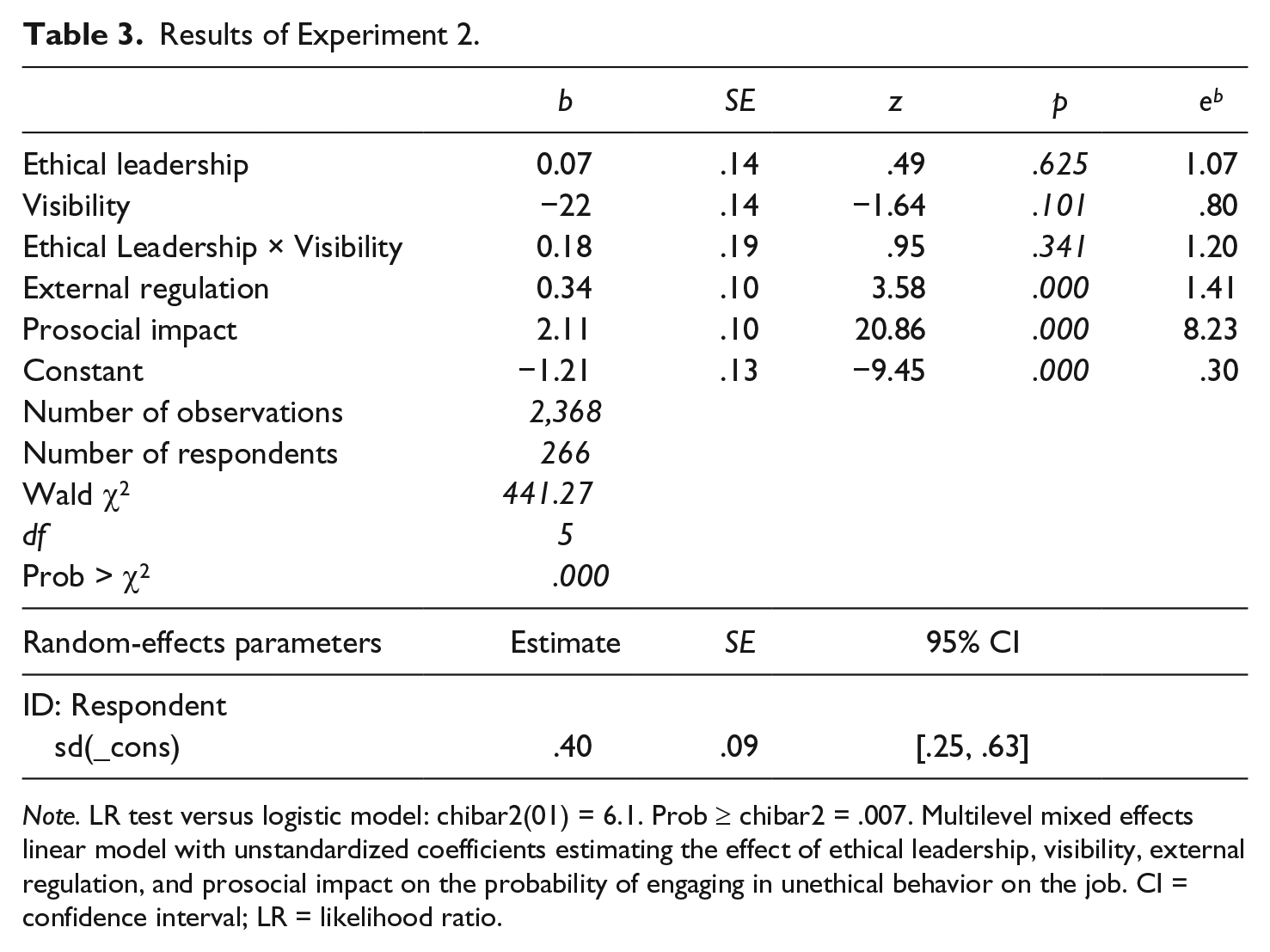
Note. LR test versus logistic model: chibar2(01) = 6.1. Prob ≥ chibar2 = .007. Multilevel mixed effects linear model with unstandardized coefficients estimating the effect of ethical leadership, visibility, external regulation, and prosocial impact on the probability of engaging in unethical behavior on the job. CI = confidence interval; LR = likelihood ratio.
Findings revealed that ethical leadership did not affect the probability that public sector workers would engage in the unethical behavior on the job: Having an ethical rather than an unethical leader did not modify their preferences for working situations. Thus, our discrete choice experiment failed to provide empirical support to Hypothesis 1. Visibility of the unethical behavior marginally decreased the probability that respondents would choose a given working situation. In particular, the odds that participants would choose a situation to engage in the misbehavior on the job decreased by 0.80 times (p = .101) under high chances of going unnoticed as compared with the certainty of going unnoticed. This provides partial support for Hypothesis 2. Unlike in the two tasks of Experiment 1, ethical leadership and visibility did not interact significantly in Experiment 2. Participants in Experiment 2 indicated that they would be more willing to behave unethically when external regulation was higher and the opportunity to make a prosocial impact was present. More precisely, keeping everything else constant, the odds that public administration workers in our sample would choose a situation in which to undertake an unethical conduct rose by 1.41 times (p < .001) when the patent provided a chance to receive a significant rather than moderate financial gain for the self and by 8.23 (p < .001) when the patent provided the opportunity to make a difference rather than no difference in other people’s lives. These findings provide support for Hypotheses 3 and 4, respectively.
General Discussion and Conclusion
This study explored whether and how having an ethical leader, being subject to performance and behavior visibility by others, receiving a monetary gain for the self, and having the opportunity to make a prosocial impact, influences individuals’ unethical behavior. Findings for the impact of ethical leadership were mixed; whereas it reduced students’ misreporting for the option with the maximum payoff for the self in the die-roll exercise, the average number of self-reported matrices was not significantly different among students exposed to the ethical leader compared with students who were not so exposed. Similarly, having an ethical rather than an unethical leader did not influence the preferences of public sector workers asked to choose a situation under which they would be more willing to engage in a dishonest behavior on the job. Overall, our data do not provide univocal support to Hypothesis 1. Unlike theoretical expectations (e.g., Van Wart) and empirical observational evidence in our field showing a positive association between ethical leadership and desired correlates (e.g., Downe et al., 2016; Hassan et al., 2014), our experiments seem to suggest that the causal link between ethical messages and individuals’ behaviors may be bound to certain conditions. The type of participants (e.g., students vs. real employees), the type of task (for instance, more or less challenging activities) and its framing (e.g., task performance vs. intent to misbehave), and the degree of realism may moderate the effect of ethical leadership on followers’ conduct. While our study is unable to test for these moderation effects, we join recent calls that encourage public administration and management scholars to spearhead experimental research in this area (e.g., Belle & Cantarelli, 2017; Hassan et al., 2014).
We found a similarly mixed pattern of results for the effect of performance and conduct visibility on dishonesty, thus not providing complete support for Hypothesis 2. Although performance visibility reduced the unethical reporting of students in the die-roll task, it did not decrease the misconduct of students in self-reporting the number of matrices correctly solved. Also, visibility of task performance did not change the probability that public sector workers would engage in unethical conduct on the job. The interaction between ethical leadership and visibility that we found in Task 2 of Experiment 1 was not statistically significant in Experiment 2. These results align partially with the concept of self-concept maintenance theory (e.g., Mazar et al., 2008) and the construct of image motivation (e.g., Ariely et al., 2009). On one hand, individuals will engage in unethical behavior not unconditionally but, instead, only up to the point that they simultaneously can maintain a positive consideration of themselves and think others have a positive impression of them. On the other hand, the boundaries are not stable, but rather may vary also as a function of the degree of visibility (and anonymity thereof) of one’s conduct and performance (e.g., Fischbacher & Föllmi-Heusi, 2013; Mazar et al., 2008). These results speak to the debate in public administration on government transparency and openness. More precisely, the degree of visibility and accountability of civil servants’ behavior on the job seem a natural integration of the current research on transparency in our field (e.g., Cucciniello, Porumbescu, & Grimmelikhuijsen, 2017)
Aligned with the predictions of reinforcement theory (Skinner, 1953) and self-determination theory (e.g., Deci & Ryan, 2000), the effect of external regulation on individuals’ unethical behavior was consistent across our randomized trials. The distribution of students by self-reported outcome in the die-roll task was significantly different from a flat distribution when students were paid accordingly to the self-reported outcome but not when they were paid a flat fee. Similarly, the opportunity to receive a significant rather than a moderate financial gain for the self affected public sector workers’ choices by increasing the probability that they would misbehave on the job. In full support of Hypothesis 3, these findings add experimental evidence on the already rich debate about the ineffectiveness of performance-related pay in public administration context (e.g., Belle, 2010; Perry, Engbers, & Jun, 2009), which “consistently fails to deliver on its promise” (Perry et al., 2009, p. 43).
Joining recent efforts to investigate the dark sides of the desire to help others in public administration settings (e.g., Belle & Cantarelli, 2017; Bolino & Grant, 2016; Perry et al., 2010; Ritz et al., 2016), evidence of the effect of having a prosocial impact was also consistent across experiments. The average self-reported number of matrices correctly solved was higher among students whose performance contributed to raising the donation to a local charity compared with their counterparts whose performance did not have any prosocial impact. Likewise, the chance to make a positive difference rather than no difference in the lives of others affected public sector workers’ preferences by increasing the likelihood that they would engage in unethical conduct on the job. In other words, our findings support Hypothesis 4 and suggest that benefiting others may serve as a rationale for public sector employees to bending the rules.
The substantive contribution of our work is twofold. On one side, it follows up on recent calls to illuminate our understanding of individuals’ decisions to act dishonestly in public administration settings (e.g., Belle & Cantarelli, 2017; Menzel, 2015; Perry, 2015; Von Maravić, 2008). On the other side, it sheds some light on the dark sides of four variables that have prominence in public human resources management (e.g., Belle, 2015; Belle & Cantarelli, 2017; Bolino & Grant, 2016; Brewer & Brewer, 2011; Downe et al., 2016; James, Jilke, Petersen, & Van de Walle, 2016; Neumann, 2016; Pedersen, 2015; Ritz et al., 2016). Taken together, our findings suggest to policy makers and practitioners alike that working under an ethical leader and working in environments that require the visibility of one’s behavior and performance may not be unconditionally successful in curbing misconduct. Also, our work encourages them to be especially alert about the undesired effects of rewarding employees with personal financial gains and highlighting employees’ ability to benefit others through their jobs in contexts where misbehaviors are possible.
The methodological contribution of our research lies in providing novel evidence of some of the drivers of unethical behavior using randomized trials. Joining recent calls to investigate causal mechanisms that drive dishonesty in public and mission-driven organizations (e.g., Belle, 2015; Belle & Cantarelli, 2015, 2017; Bolino & Grant, 2016; Hassan et al., 2014; Menzel, 2015), we urge public administration scholars to spearhead experimental work in this area and generate actionable knowledge. The use of randomized experiments might help validate the results of extant observational work (e.g., Menzel, 2015), which make up for the limitations that are inherent in the artificial manipulations of variables in experimental settings (Wright & Grant, 2010).
We fully acknowledge that our study is not immune to the same general validity threats that affect all laboratory and discrete choice experiments. Therefore, our findings should be interpreted accordingly. Although laboratory experiments maximize the internal validity of the findings (e.g., Blom-Hansen, Morton, & Serritzlew, 2015), we cannot be sure that the students who signed up for our study were systematically similar to their counterparts who did not or that their behavior would replicate outside of the laboratory in more realistic settings. Discrete choice experiments are well suited for providing causal evidence of the effects that our manipulations had on real public sector workers’ preferences for conditions under which they would engage in unethical conduct. However, the use of artificial scenarios detracts from both external and construct validity. In other words, we cannot be certain that our results would extend to more naturally occurring settings, to the use of different operations, or to different treatment levels. Indeed, these limitations are inherent in the discrete choice experiment designs, which require a series of judgment calls in the operationalization of attributes and identification of attribute levels. These limitations notwithstanding, discrete choice experiments have proven effective in predicting how individuals choose and behave in reality (e.g., Ryan et al., 2012).
Footnotes
Appendix A
Variables and Measurements (Experiment 1).

| Variable (source) | Measurement |
|---|---|
| Ethical leadership (Yukl, Mahsud, Hassan, & Prussia, 2013) | My team leader . . . • Shows a strong concern for ethical and moral values; • Communicates clear ethical standards for members; • Sets an example of ethical behavior in his or her decisions and actions; • Is honest and can be trusted to tell the truth; • Insists on doing what is fair and ethical even when it is not easy; • Regards honesty and integrity as important personal values; • Opposes the use of unethical practices to increase performance; and • Holds members accountable for using ethical practices in their work. Likert-type items (0 = disagree strongly, 6 = agree strongly). |
| Visibility of task performance | • The other people in this room know my performance on the two tasks. Likert-type item (0 = disagree strongly, 6 = agree strongly). |
| Prosocial impact (Belle, 2015; Bolino & Grant, 2016; Grant, 2008a) | I was motivated to solve the matrices because . . . • I wanted to help the charity; • I wanted to help others; • I wanted to have a positive impact on others; and • It is important to me to do good for others through my behavior. Likert-type items (0 = disagree strongly, 6 = agree strongly). |
| Gender | 0 = male, 1 = female |
| Age | Years of age |
Appendix B
Declaration of Conflicting Interests
The author(s) declared no potential conflicts of interest with respect to the research, authorship, and/or publication of this article.
Funding
The author(s) received no financial support for the research, authorship, and/or publication of this article.