



Abstract
The foundational goal of civil rights legislation is to reduce discrimination, in both the public and private sector. To understand the levels of perceived discrimination in the federal government, this research note examines 9 years of data reported under the requirements of the Notification and Federal Employee Antidiscrimination and Retaliation Act of 2002 (No FEAR Act). From 2006 to 2014, less than 1% of federal employees filed discrimination complaints each year, and the discrimination complaint rate did not significantly change over the time period. Race, color, and national origin were the most frequently claimed discrimination bases. Approximately half of all complaints alleged retaliation after filing an initial discrimination claim. In addition, federal employees most frequently claimed that discrimination occurred in the context of nonsexual harassment. This research note describes other trends in discrimination claims and proposes directions for future research.
Keywords
Over the last 50 years, public administration scholars evaluated various aspects of diversity in the public sector. Recent articles by Pitts and Wise (2010) and Bearfield (2014) observe that public administration diversity research focuses on the presence of different groups in the public sector workforce and their distribution within organizational hierarchies (e.g., Bowling, Kelleher, Jones, & Wright, 2006) and representative bureaucracy (e.g., Bradbury & Kellough, 2011; Sowa & Selden, 2003). Reviews of court cases and new legislation inform scholars and practitioners of new constraints (e.g., Bradbury & Jacobson, 2013; Riccucci, 2003; Rush, 2012), while legal histories provide context for the evolution of these constraints (Kellough, 2006; Rosenbloom, 2014). However, limited research examines the impact and effectiveness of diversity management policies (e.g., Kellough, 2006; Kellough & Naff, 2004).
Neither Pitts and Wise (2010) nor Bearfield (2014) describes studies reporting on the incidence of discrimination complaints within public organizations. One recent exception to the minimal scholarly attention paid to discrimination complaint rates in the public sector is a study conducted in Ohio, covering the period 1985 to 2005, which compared public and private sector discrimination complaint rates and examined specific complaint types (Leasher & Miller, 2012). A different study examining the use of alternative dispute resolution (ADR) in the federal government reported overall discrimination complaint rates but did not provide details on the types of complaints filed (Nabatchi & Stanger, 2013).
In light of this, this research note aims to describe rates of discrimination in the federal workforce. This is an important question to ask, not only because of the recent celebration of the 50th anniversary of the passage of the Civil Rights Act (1964), but because this information can have significant management implications. A unique data set containing 9 years of employee discrimination complaints, covering 118 federal organizations, reported under the requirements of the Notification and Federal Employee Antidiscrimination and Retaliation Act of 2002 (No FEAR Act), is used to answer this question.
The research note proceeds with an overview of the data set and brief descriptions of the No FEAR Act and the discrimination complaint process. With this information, trends in discrimination complaints and details on the types of complaints are presented. The research note concludes by outlining an agenda for future research.
Description of the Data Set
To determine the rates of discrimination in the federal workforce, this study uses a unique panel data set on formal complaints filed in agencies. The authors analyzed complaint data from the public reports required under the No FEAR Act, covering the fiscal years from 2006 through 2014. Congress enacted the No FEAR Act in 2002 in an effort to make federal agencies more publicly accountable for discrimination and retaliation against their own employees. The law requires agencies to (a) provide all current, former, and potential employees with written notification of the federal laws prohibiting discrimination and retaliation; (b) provide training; (c) file annual reports; (d) post on its public website the summary data for the current and previous five fiscal years; and (e) reimburse the Treasury for any payments made on the agency’s behalf for discrimination or reprisal claims by federal employees.
Agencies began reporting under the No FEAR Act beginning in 2002; however, reporting standards were not finalized by the Equal Employment Opportunity Commission (EEOC) until 2006 (Federal Sector Equal Employment Opportunity, 2006). Under the requirements of the No FEAR Act, agencies post annual discrimination complaint data on their public websites. These reports include data for five fiscal years and provide the total number of complaints filed and the total number of complaints alleging a particular basis or issue. The reports do not provide details on individual cases.
Cabinet departments report complaint data at the agency level. For example, in the Department of Homeland Security, Immigration and Customs Enforcement and the Transportation Security Administration post their own No FEAR Act reports. Smaller, noncabinet-level agencies post one No FEAR report for the entire agency each year, such as the Office of Personnel Management and the Environmental Protection Agency. For the remainder of the research note, we will use the word agency to refer to the federal organization reporting the data.
To assemble the data set, the authors downloaded individual agency reports over a multiyear period and compiled them into one large data set. The EEOC does not assemble the No FEAR Act reports into a publicly available, merged, comprehensive data set. Observations in the data set are organized by department, agency, and year. The sample analyzed here is restricted to those agencies with a complete panel covering the 9-year period: 118 agencies in 51 departments. In 2014, these agencies employed almost 1.62 million individuals or approximately 79% of executive agency employees.
When filing a discrimination complaint, federal employees must identify both the basis and issue underlying the complaint: 1) the personal characteristic that led the other individual to treat her inappropriately and 2) how she was negatively impacted by this treatment. The bases that individuals can claim are identified in antidiscrimination legislation: race, color, religion, reprisal, sex, national origin, equal pay, age, and disability. For the purposes of this analysis, complaints that allege a basis of race, color, or national origin are aggregated into one reported basis type, “Race / Color / National Origin.” In addition to identifying the basis for a discrimination complaint, federal employees must identify the issue underlying the complaint: appointment or hire, awards, discipline, evaluation or appraisal, examination or test, harassment (nonsexual and sexual), pay, promotion or nonselection, reasonable accommodation, and termination. The category of “Discipline” used in this analysis aggregates the number of complaints reported for five variables reported in the No FEAR reports: A category the EEOC calls, “other discipline,” demotion, reprimand, suspension, and removal.
It is important to note that the data analyzed here likely undercount the level of discriminatory behavior occurring in federal agencies. The No FEAR data do not represent a complete picture of discriminatory behavior because some portion of complaints are resolved through alternative methods, and some discriminatory events are simply never reported. When a federal employee initially contacts a human resources professional in her agency about a discriminatory event, it is not immediately counted in the public No FEAR reports. As briefly described by Nabatchi and Stanger (2013) and pictured in the figure in appendix, when an employee initially claims a discriminatory event occurred, the human resources professional collects preliminary information about the event, informs the employee about her rights and the administrative procedures, and, in many cases, offers ADR to bring the parties together to restore a constructive working relationship. If the ADR or counseling efforts are not successful, an employee can then choose to formalize the complaint, at which point it would be counted in the agency’s No FEAR report. In addition, the complex process for pursuing a discrimination complaint and concerns about independence of investigations deter individuals from filing a formal complaint.
Findings
Employees may allege one or more bases and one or more issues in any complaint, so the total number of complaints filed is the best indicator of the number of complaints an agency is receiving (Federal Sector Equal Employment Opportunity, 2006). Across all 9 years, less than 1% of federal employees in the sample filed discrimination complaints. The findings, discussed in detail below, should be interpreted as the percent of federal employees claiming that type of discrimination; decimal points should not be moved for interpretation as less than 1% of employees claim any type at any point in time in the sample.
The statistic for total complaints filed includes both complaints made using traditional bases of discrimination, age, disability, and so on, and complaints alleging reprisal. Reprisal can generally be described as retaliation taken against an employee for filing an initial discrimination complaint. Given this, reprisal may be thought of as a secondary complaint or one that would not have occurred but for the initial alleged discrimination. For this reason, reprisal complaints are assessed separately from the other types of complaints in the forgoing sections. Reprisal complaints alone constitute roughly half of all complaints filed, averaging 0.31% of federal employees claiming reprisal during the period measured (Table 1). Although reprisal complaints do appear to decrease over time, the rate of reprisal complaints did not change significantly.
Mean Complaint Rates.
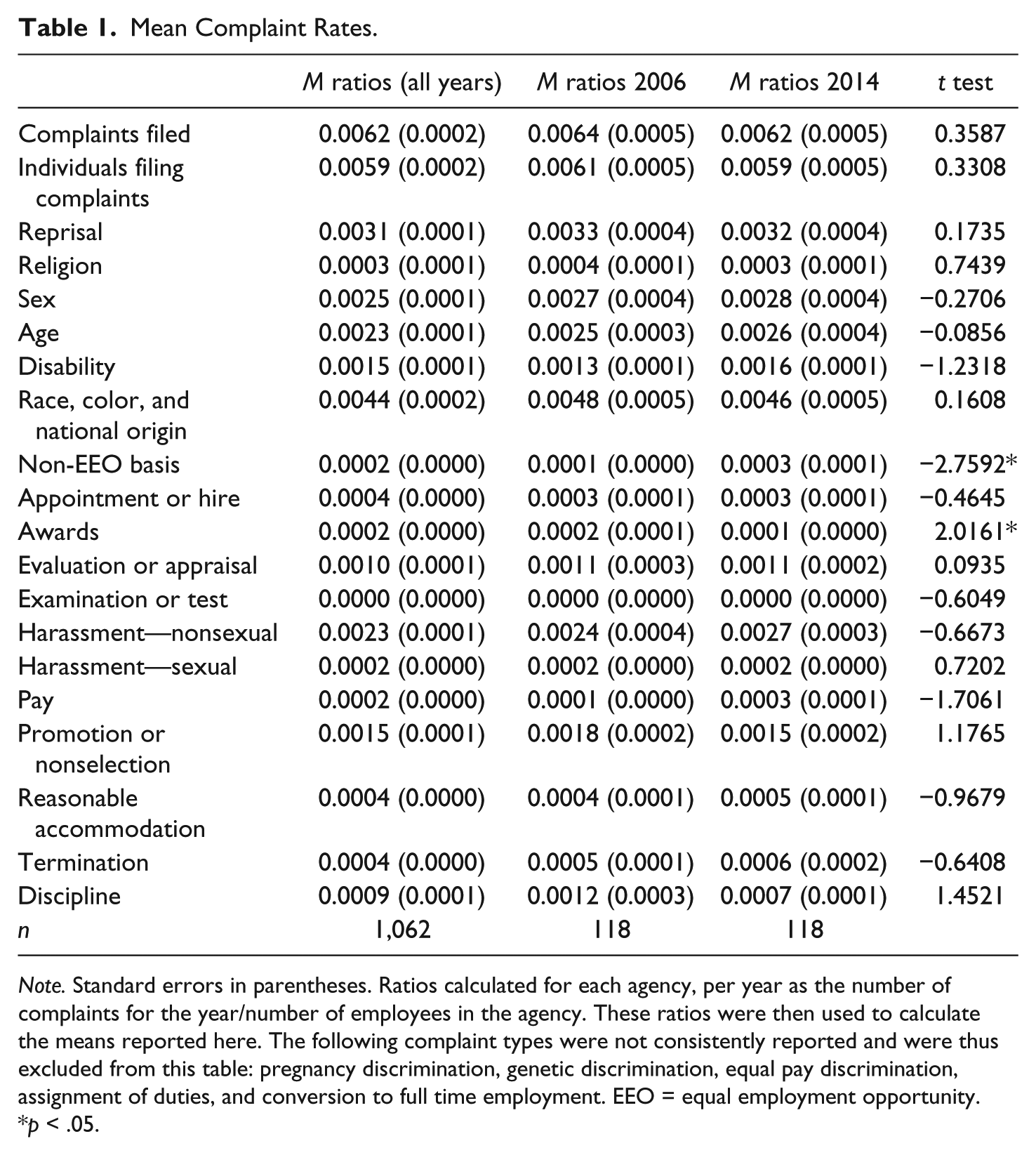
Note. Standard errors in parentheses. Ratios calculated for each agency, per year as the number of complaints for the year/number of employees in the agency. These ratios were then used to calculate the means reported here. The following complaint types were not consistently reported and were thus excluded from this table: pregnancy discrimination, genetic discrimination, equal pay discrimination, assignment of duties, and conversion to full time employment. EEO = equal employment opportunity.
p < .05.
Although knowing the overall rate of complaints filed is useful, more detail can be learned by examining the specific discrimination types: race/color/national origin, religion, sex, equal pay, age, and disability. Across the time period, it is clear that race/color/national origin complaints occurred most frequently (Figure 1). Although there was some fluctuation, the rate of complaints alleging race/color/national origin discrimination did not change in a significant way between 2006 and 2014 (Table 1). Sex-based discrimination remained the second most frequently claimed basis. Sex-based complaints also did not change significantly from 2006 to 2014, remaining level with around one quarter of 1% of federal employees claiming discrimination of this type. Despite the aging of the federal workforce, age and disability complaints have not experienced an increase over the time period. Instead, age and disability discriminations were claimed at similar rates, remaining around one fifth of 1%. Only non-EEO (equal employment opportunity) complaints experienced a significant increase from 2006 to 2014 (Table 1 and Figure 1).
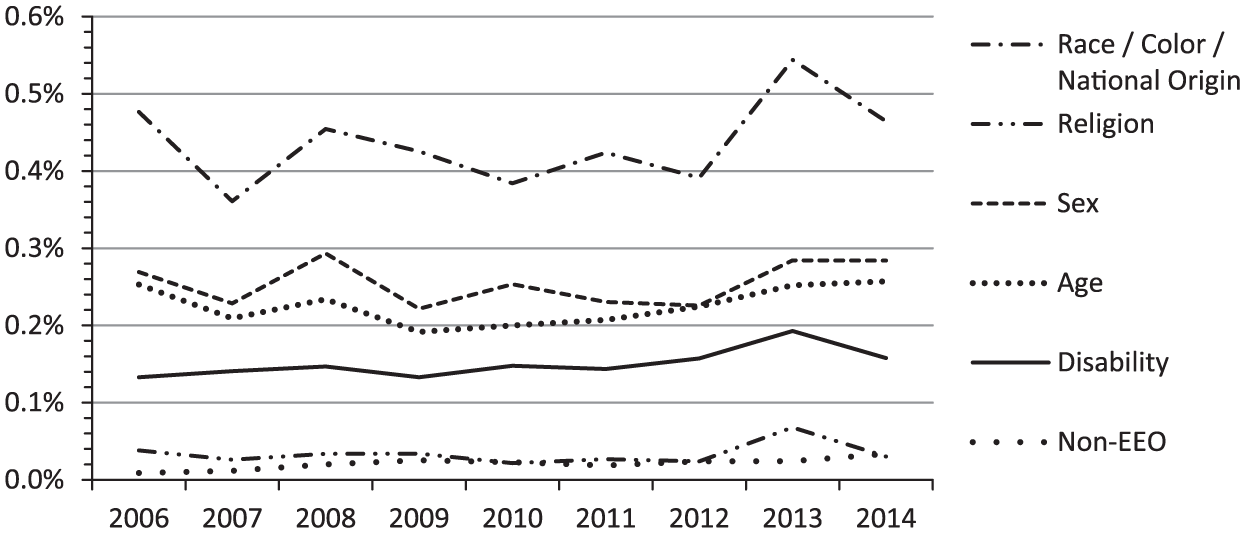
Percent of employees filing discrimination complaints by basis and year.
In addition to selecting one or more bases of discrimination when filing a complaint, the employee must identify where the federal agency engaged in one or more prohibited personnel practices in the scope of personnel management activities. This prohibited personnel practice is the issue underlying the complaint. Similar to the bases claimed in discrimination complaints, t-tests reveal that the percent of employees claiming the various issues did not change significantly over time, with one exception (Table 1). Claims alleging unfair treatment in the issuance of awards decreased over the time period studied. Nonsexual harassment is the most frequently claimed issue over this time period (Figure 2) and represents just over one third of all issues claimed. The percent of employees claiming nonsexual harassment experienced greater fluctuation over time, as compared with other issue types, but the difference was not significant between 2006 and 2014.
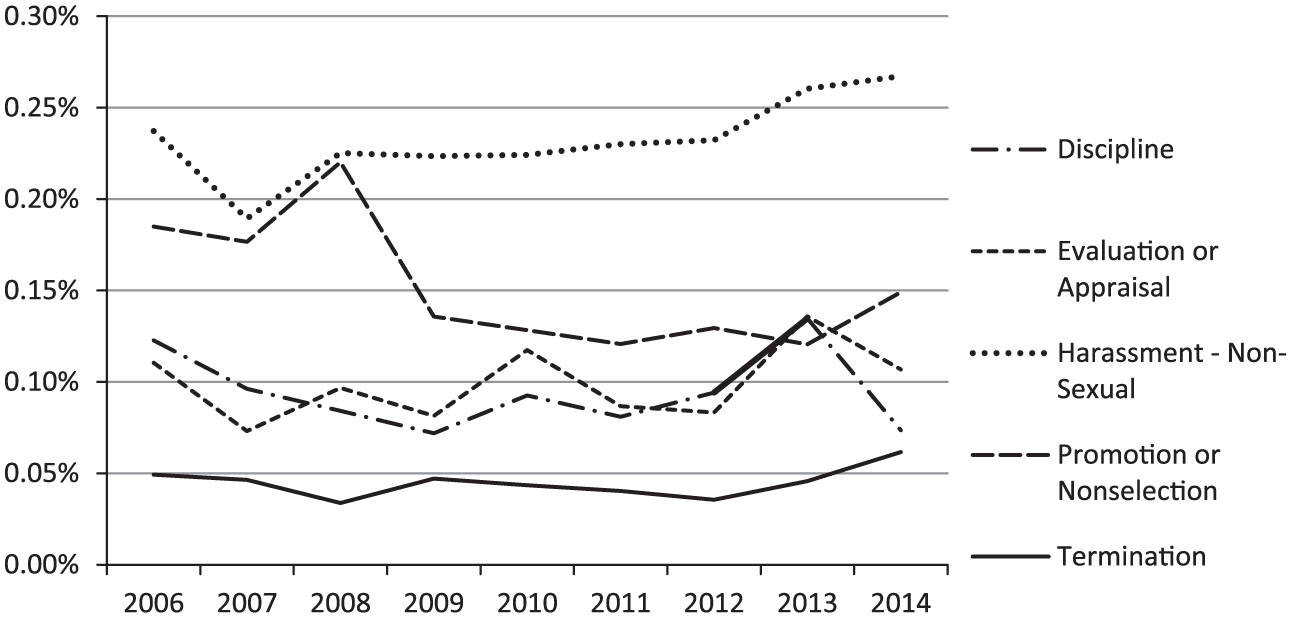
Percent of employees filing discrimination complaints by issue and year.
The next most frequently claimed issues are promotion or nonselection, discipline, and evaluation/appraisal (Figure 2). Complaints listing promotion or nonselection as the underlying issue, the second highest issue type, have decreased steadily over time but not in a statistically significant way. Over the time period, less than one fifth of 1% of federal employees claimed that discrimination had negative consequences in promotion decisions. Discipline, the fourth highest issue reported in Figure 2, is an aggregate of all complaints alleging discrimination related to one of the following disciplinary measures: demotion, reprimand, suspension, removal, and other. Employees alleged discrimination more frequently in response to discipline that took the form of suspension or reprimand, but generally, these rates are extremely low, approximately 0.03%.
A Research Agenda
The limited research on discrimination in public agencies and the results in this analysis suggest multiple opportunities for further scholarly research. First, scholars lack a concrete understanding of nonsexual harassment. The phenomenon is not covered in either public personnel scholarship or the major public personnel text books. For example, is this workplace bullying, physical violence, work product sabotage, or something else? We do not know. Given the current data available, it is not possible to determine whether nonsexual harassment is typically associated with particular discrimination bases (i.e., religion, etc.) or whether this issue occurs in isolation or paired with other issues, such as promotion. It would also be useful to understand whether nonsexual harassment is happening more frequently between peers or between supervisors and subordinates. Qualitative research using interviews with public personnel professionals and employee representatives could be extremely helpful to understand how nonsexual harassment manifests itself in the workplace. With this information, scholars could develop survey items to measure perceptions of nonsexual harassment in the workplace and explore its causes and consequences.
Reprisal deserves further study. Although the literature includes research on retaliation against whistle-blowers in the public sector (e.g., Near & Miceli, 2008), scholars should evaluate whether the causes of retaliation for filing a discrimination complaint are the same as causes for claiming retaliation for whistle-blowing. It would be useful to understand whether the rates of initial discrimination complaints are positively related to reprisal claims or whether perceptions of workplace bias are related to reprisal claims. In addition, scholars should examine the impact reprisal has on the organization, including whether the presence of a secondary, preventable reprisal is more visible to the other actors within the organization and whether knowledge of a reprisal encourages employee silence.
Focusing discrimination research only on the complaints filed likely misrepresents the incidence of discrimination behavior in public agencies, as noted previously. Scholars might consider developing models to predict broader estimates of discrimination combining two set of information with the No FEAR complaint data. First, we can estimate levels of perceived discrimination using employee survey data and compare agency-level perceptions to complaints filed. While the employee surveys conducted by the U.S. Office of Personnel Management do not include questions on discrimination perceptions, the Merit Principles Survey has included items on perceived discrimination for an extended period of time. The gap between perceptions and actual complaints filed can be further specified by including the use of ADR for resolving discrimination events with the No FEAR discrimination complaint data; agencies do report ADR usage to the EEOC but not in the public No FEAR reports. Combining the survey data on perceived discrimination with the usage and resolution statistics from ADR may allow scholars to model and/or predict levels of discrimination in federal organizations with more accuracy.
It is also worth studying the relationship between the institutional design of agency inclusion and diversity management programs and the filing of complaints. Specifically, it would be interesting to test whether complaint rates vary according to (a) whether the chief diversity officer in an agency reports to the agency head or a lower level official, (b) the mix of contractors and in-house personnel used to resolve and manage the complaint process, and/or (c) the level of training provided to employees generally or to personnel professionals in particular. If complaints are used as a measure of performance, this information could fill the gap identified by Kellough (2006) to understand the effectiveness of diversity management programs.
Federal employee perceptions of the discrimination complaint system itself may influence discrimination complaint rates. In particular, we might consider if employee perceptions of the fairness of the complaints process impact their willingness to file complaints. If employees believe the complaint system is biased in favor of management, they may be reluctant to file a complaint. Organizational justice research may be helpful to study this question (e.g., Choi, 2011; Hassan, 2013; Rubin & Weinberg, 2016). Again, qualitative research via interviews with employees and their representatives could be extremely helpful to understand why employees file complaints.
Finally, examining differences within or between departments may prove interesting. The analysis reported here focused at the aggregate level for the entire sample. One option is to identify agencies with complaint rates that are one standard deviation above and below the government-wide average and then explore lessons learned. A cursory examination of the complaint data at the agency level indicates that some agencies episodically experience spikes in their complaint rates. Agency-specific stories, or identifying patterns of agencies with consistently high or low complaint rates, may prove to be interesting and useful. Another option is to perform an in-depth analysis of an agency or department which has recently trained employees on how to prevent and address discrimination or implemented an explicit, strategic inclusion effort agency-wide. It would be valuable to learn how employees react to the initiative overall, particularly whether claims increase or decrease following training.
Conclusion
The foundational goal of civil rights legislation is to reduce discrimination, in both the public and private sectors. When examining 9 years of data reported under the requirements of the No FEAR Act, some clear trends emerge. First, the rate of complaints has stayed level, with less than 1% of federal employees filing discrimination complaints from 2006 to 2014. The data clearly indicate that race, color, and national origin remain the most frequently claimed discrimination type with little abatement. However, neither age nor disability complaints are increasing despite the aging of the federal workforce. Perceived discrimination is most frequently happening in the form of nonsexual harassment, and this dominance is consistent over the 9-year period. Finally, nearly half of all claims filed each year allege reprisal after an employee filed an initial discrimination complaint. On one hand, it is good to see that the proportion of federal employees filing formal discrimination complaints is less than 1%. On the other hand, it is frustrating that there is not a clear downward trend.
The findings presented here are important for a number of reasons. Public managers, policy makers, interest groups, and academics frequently discuss the importance of reducing workplace discrimination. However, as this data set illustrates, we have made little progress over the 9-year period studied. Scholars can play an important role by gaining a better understanding of the causes and consequences of discrimination in the public sector, particularly in relation to nonsexual harassment, reprisal, and the institutional design for hearing and resolving complaints. The No FEAR Act aimed to hold agencies accountable for discrimination, in part, by making the incidence of unfair treatment public. It is now our responsibility to use the information to learn and improve the work environment for the sake of improving organizational effectiveness.
Footnotes
Appendix
Declaration of Conflicting Interests
The author(s) declared no potential conflicts of interest with respect to the research, authorship, and/or publication of this article.
Funding
The author(s) received no financial support for the research, authorship, and/or publication of this article.