




Abstract
Public sector organizations are competing with the private sector for highly qualified staff. But the public sector lost attraction as an employer of choice. Public service motivation (PSM) and different sector rewards have been identified as alternative drivers of sector attraction. However, it is still unclear to what extent PSM is associated with sector attraction, especially when controlling for a comprehensive set of sector rewards. We investigate this sector attraction puzzle through a meta-analysis (Study 1) focusing on the relation between PSM and sector attraction and primary data collected from 600 German final-year students (Study 2). The two studies aggregate the literature on PSM and sector attraction and produce unique empirical evidence. Thus, we extend the knowledge on the relationship between PSM and sector attraction across different settings and in Germany, which enables us to derive implications for public sector recruiters.
Introduction
Public sector employers struggle to attract highly-qualified recruits and tend to lose competitions with private sector employers. Recent commercial Employer Branding Research (Universum Global, 2016) has found that in 2016, students did not perceive public sector employment as an attractive career path. Humanities and liberal arts students in the United Kingdom and the United States repeatedly rank public sector employers at the bottom of such lists. A recent survey of U.S. graduates reports that 60% lean toward private sector employment (National Association of Colleges and Employers [NACE], 2016).
Also, research does not paint a more favorable picture. For example, a series of in-depth interviews with students lead Chetkovich (2003) to conclude “[p]ublic policy students, whose training is intended to produce managers, advocates, and analysts for public programs, are increasingly likely to enter private-sector employment upon graduation and less likely than their predecessors to plan long-term careers in government” (p. 670). Similarly, according to Lee and Choi (2016), the public sector as an employer of choice has lost attractiveness, and Delfgaauw and Dur (2010) assert that too few of high-qualified people decide for careers in the public sector. Clearly, “[t]he attractiveness of the public sector as an employer is overall perceived as having rather deteriorated” (Hammerschmid et al., 2013, p. 33).
In contrast, German humanities students repeatedly ranked the Federal Foreign Office (i.e., equivalent to U.S. Department of State) as their preferred employer, and German law students ranked three public sector employers on the top ranks (i.e., the Federal Criminal Police Office, the Federal Foreign Office, and the United Nations; Universum Global, 2016). These observations indicate substantial differences in sector attraction across countries. They raise the question whether public sector employers are able to offer rewards that are likely to attract the desired candidates. Hence, it is important to distinguish between the contribution motivation makes and the contribution different rewards make to sector attraction.
An early attempt to solve the sector attraction puzzle was made by Perry and Wise (1990). Invoking the concept of public service motivation (PSM)—defined as “an individual’s predisposition to respond to motives grounded primarily or uniquely in public institutions and organizations” (Perry & Wise, 1990, p. 368)—they hypothesized that high levels of PSM lead to self-selection into the public sector. The latter is due to PSM’s nature as a prosocial motivation that is linked to the individual need to serve the common good (Kim & Vandenabeele, 2010; Perry & Hondeghem, 2008).
To date, studies investigating the link between PSM and sector attraction yield mixed results (Bullock, Stritch, & Rainey, 2015; Christensen & Wright, 2011; Hinna, Homberg, Scarozza, & Verdini, 2016; Pedersen, 2013; Ritz & Waldner, 2011; Rose, 2012; Tschirhart, Reed, Freeman, & Anker, 2008; Vandenabeele, 2008). Hence, it has remained unclear to what extent PSM is associated with sector attraction, which is an important question with strong practical implications for public sector recruitment.
We investigate this issue by conducting two related studies: Study 1 presents a meta-analysis of PSM and sector attraction studies, which is an attempt to identify whether Perry and Wise’s (1990) original proposition on the link between PSM and sector attraction holds across studies. Ultimately, this approach allows us to study the role of contingent factors such as national differences that cannot be investigated in single-country studies.
Study 2 presents an analysis of sector attraction of 600 German final-year students who qualify for entry into the highest grade of civil service careers. The aim of Study 2 is to investigate whether PSM is associated with sector attraction when controlling for a comprehensive set of potentially confounding influences where previous studies only controlled for those selectively (e.g., Rose, 2012). Thus, Study 2 extends the analysis to a comparison of different rewards that have not been included in previous studies and therefore complements the meta-analysis in Study 1.
The two studies make three distinct contributions to the literature. First, investigating the aggregated effect size across studies helps to consolidate empirical knowledge on PSM and sector attraction while simultaneously serving as a test of the classic PSM-attraction proposition (Perry & Wise, 1990). Second, moderation analyses also allow us to investigate study-level differences, in particular country group differences. Third, focusing on Germany helps us to identify unique aspects of sector attraction in a country of the Weberian-legal tradition. More specifically, we produce unique empirical evidence in an understudied country about PSM, which allows us to advance knowledge on the relationship between PSM and sector attraction in Germany and enables us to derive implications for public sector recruiters.
Sector Attraction and PSM
A number of factors may generate sector attraction, especially perceived characteristics of a specific employer. In this regard, Cable and Turban (2001) developed the employer knowledge model. Its key components distinguish between (a) employer information dimension (i.e., objectively assessed criteria such as size, centralization, or organizational values), (b) job information dimension (i.e., attributes of the job such as tasks, pay level, or career perspectives), and (c) people information dimension (i.e., a belief about the types of future coworkers and supervisors). Ng and Gossett (2013) applied this model to study preferences of millennials, which is similar to our research context. Therefore, we use the employer knowledge model as a theoretical complement to the individual-level focus generated by PSM theory.
In empirical studies, PSM has been analyzed either as a global construct or on the basis of its four dimensions: First, the attraction to public service dimension (APS) is based on instrumental motives and “focuses more on disposition to serve the public, to work for the common good, and to participate in public policy processes” (Kim et al., 2013, p. 90). Second, the commitment to public values (CPV) is norm based and “emphasizes an individual’s affective commitment to or concern for the needs of specific individuals and groups.” (Kim et al., 2013, p. 83). Third, the self-sacrifice dimension (SS), which reflects affective motives, refers to “the willingness to substitute service to others for tangible personal rewards” (Perry, 1996, p. 7), and fourth, the compassion dimension (COM), also based on affective motives, relates to “the degree to which individuals identify with the needs and suffering of others” (Kim et al., 2013, p. 83).
Public service–motivated individuals are likely to evaluate the potential future employer with respect to how well the job satisfies their other-oriented needs, which reflect Cable and Turban’s (2001) job information dimension. As Wright and Pandey (2008) state, PSM can be seen as work-related values, and the construct of PSM overlaps with public values (PV; Andersen, Jørgensen, Kjeldsen, Pedersen, & Vrangbæk, 2013). The employer knowledge model also integrates such value fit approaches, that is, the idea of congruence between an individual’s values and organizational values, which describes the person-organization fit (PO; Kristof, 1996; Kristof-Brown, Zimmerman, & Johnson, 2005). Following this line of thought, people are rather attracted to organizations promoting values they share. Regarding Schneider’s (1987) Attraction–Selection–Attrition model (ASA), which describes the single stages of the recruitment process, PO fit plays a prominent role at the first stage of attraction. In this phase, the potential employee evaluates whether the organization or the job fits. Hence, the fit concept constitutes the underlying mechanism of organizational attraction (Leisink & Steijn, 2008). In other words, sector attraction is linked to such value fit approaches that are included in the employer knowledge model. The employer information dimension (Cable & Turban, 2001) reflects such a reasoning, as values are a key element here. This is particularly relevant for PSM studies as they often draw on fit approaches (Christensen & Wright, 2011; Vandenabeele, 2008) to explain theoretically why higher levels of PSM will lead individuals to seek public sector employment. Steijn (2008) created a specific PSM-fit measure reflecting a subjective fit assessment of the individual and the organization or job. As Christensen and Wright (2011) state, “ (. . .) PSM’s effects may be a function of the degree to which an organization shares the individual’s public service values or provides opportunities for the employee to operationalize/satisfy these values (. . .)” (p. 724).
Since the seminal article of Perry and Wise (1990), subsequent studies investigated the link between PSM, its individual dimensions, and sector attraction (Christensen & Wright, 2011; Lewis & Frank, 2002; Steijn, 2008; Vandenabeele, 2008) producing inconsistent findings (Ritz, Brewer, & Neumann, 2016). The variations in the findings might be due to the cultural differences in the countries in which the studies were set. Most of the studies analyze data from either the United States (see, for example, Christensen & Wright, 2011; Clerkin & Coggburn, 2012; Rose, 2012) or Europe (see, for example, Kjeldsen & Jacobsen, 2012; Vandenabeele, 2008; Winter & Thaler, 2016). Both differ in their values and socialization, as do the different European countries, especially regarding PV and patriotism. Comparative studies (Vandenabeele, Scheepers, & Hondeghem, 2006) show such differences in both values and PSM. Another reason of the variations in the findings might be the different samples. For example, Steijn (2008) offers supporting evidence for the PSM-sector attraction link in a sample of Dutch workers, whereas Bright (2011) finds that PSM is not a predictor of occupation choices in a sample of employees in U.S. public sector organizations. However, such sample characteristics may become less influential in longitudinal datasets. Although previous studies investigating the PSM-attraction hypothesis mainly use cross-sectional data (see, for example, Carpenter, Doverspike, & Miguel, 2012; Rose, 2012), longitudinal data are more suited to reduce the biasing influence of sample specifics (Rindfleisch, Malter, Ganesan, & Moorman, 2008). But, to date, only a few studies (Choi, 2017; Wright, Hassan, & Christensen, 2017) have investigated the PSM-attraction hypothesis on the basis of panel data.
However, other authors pointed to the biasing effect of organizational socialization when studying working population samples. According to this argument, a clearer isolation of the link between PSM and sector attraction would be provided by student samples (Clerkin & Coggburn, 2012), especially by samples of students in their final-year because these individuals actively search for entry-level jobs and have not been subject to any organizational socialization in the workplace before.
A series of studies relied on such “pure” student samples. For example, Pedersen (2013) analyzed data from students enrolled in economics, political science, and law degrees. His results highlight the sensitivity of the PSM-sector attraction link to individual PSM dimensions as the study shows a positive significant association between PSM’s commitment to public interest dimension (CPI) and sector attraction. In contrast, the relation does not hold for PSM’s COM dimension. Similarly, Rose (2012) finds significant results for the attraction to policy-making dimension (ATP) but not for other PSM dimensions in a sample of U.S. undergraduate students. Other studies find clear supporting evidence that PSM is associated with sector attraction. For example, in a sample of Belgian final-year master’s students, Vandenabeele (2008) finds a positive association between PSM and public sector job preferences.
In contrast, Kjeldsen and Jacobsen (2012) cannot replicate a similar effect in a sample of Danish physiotherapy students. Similarly, Choi (2017) in a longitudinal study on actual job choice and PSM cannot confirm the PSM-sector attraction hypothesis. In addition, some studies provide only weak support for the PSM-attraction hypothesis, as only some dimensions of PSM are identified as significant predictors of sector preference (Clerkin & Coggburn, 2012). To summarize, the evidence is far from being conclusive. Hence, an aggregation of empirical evidence using meta-analytic techniques is suitable for identifying the overall association between PSM and sector attraction. Following the original proposition outlined by Perry and Wise (1990), we hypothesize the following:
Study 1: A Meta-Analysis of PSM and Sector Attraction
Recently, meta-analyses in public management became more popular. In particular, the field of PSM is almost saturated with a number of published meta-analyses. First, Warren and Chen (2013) studied the PSM and performance link, concluding that the effect is rather small for both objective and subjective performance measures. Homberg, McCarthy, and Tabvuma (2015) meta-analytically investigated the PSM-job satisfaction relationship, providing evidence for a positive aggregated effect. Homberg and Vogel (2016) took a meta-analytic glimpse at PSM and human resource management (HRM) practices. Harari, Herst, Parola, and Carmona (2017) studied a more comprehensive nomological network of PSM using meta-analysis. Their main findings highlight that effects are sensitive to national variation. However, not even in their comprehensive set of PSM correlates (e.g., organizational citizenship behaviours (OCB), commitment, career success, tenure) did they include sector attraction, which is why we address this issue in our study.
Meta-analysis is a method that aggregates empirical findings produced in original works (i.e., primary studies). Ringquist (2013) defines it as “a systematic, quantitative, replicable process of synthesizing numerous and sometimes conflicting results . . .” (p. 3). A meta-analysis, therefore, represents an “acid test” of the presence of one construct’s relation to an outcome of interest—in our case, PSM and sector attraction.
Meta-analysis relies on the computation of a standardized effect size that makes results of primary studies comparable. Studying the aggregate effect sizes can increase explanatory power and theoretical understanding (Stanley, 2001). Meta-analysis is particularly useful for generating evidence-based insights and advice for researchers, managers, and policy makers (see, for example, Ringquist, 2013). It is further a very suitable approach for synthesizing a literature consisting primarily of quantitative analyses that produced conflicting findings, as is the case with the PSM-sector attraction literature. Meta-analysis follows a prescribed sequence of steps such as the following: (a) study identification, (b) coding, (c) analysis of main effects, and (d) analysis of moderators. These steps are described in the subsequent paragraphs.
Study Identification
To be included in our analysis, a primary study must (a) be quantitative, (b) investigate the relation between PSM and sector attraction, and (c) report statistics that allow us to compute effect sizes. We conducted a keyword search on Web of Science and Google Scholar using “public service motivation” and “sector attraction” and their variants (i.e., “PSM,” “attractiveness,” “occupational choice”). We also reviewed reference lists of retrieved studies manually. To identify unpublished working papers, we checked conference programs of the past 3 years (2014-2016) of Academy of Management Annual Meeting (AoM), European Academy of Management Conference (EURAM), and European Group of Public Administration (EGPA) 2016, 2015, 2014. We also searched conference programs of International Research Society for Public Management (IRSPM), Public Management Research Conference (PMRC), and American Society for Public Administration (ASPA) (2015-2017). In total, this search generated 42 studies that appeared to qualify for inclusion in the meta-analysis. Qualitative studies had to be excluded. Also, upon closer scrutiny, other studies were excluded due to data limitations; that is, they did not allow us to compute an appropriate effect size or they did not use relevant measures. The remaining set of 22 usable studies generated 65 different effect estimates from 42 independent samples. In particular, we want to mention the two studies by Jin (2013a, 2013b), which use large international survey data (ISSP). As these data are separately collected within each country, we treat them as independent samples, which increase the number of estimates we are able to include into the meta-analyses. Nonetheless, we want to point out that these two studies account for 19 of the 65 effect sizes.
Coding
We coded the statistics provided in the tables of the main results of the identified primary studies. These included correlations, regression coefficients, and their standard errors. In many cases, this was an odds ratio (OR) as the sector preference variable is often dichotomous or categorical. In some cases, the standard error was not reported, and we had to compute the standard error based on the information provided in the output tables (e.g., significance categories indicated by asterisks). We used the software Comprehensive Meta-analysis (CMA; Borenstein, Hedges, Higgins, & Rothstein, 2009) to compute standardized effect sizes. This is a suitable choice as CMA allows for conversion of different effect sizes. The main effect size used in this study is the OR.
In addition, we coded one study-level moderator to assess country differences. Harari et al. (2017) suggest that fine-grained taxonomies, such as the Globe study culture cluster scheme (House, Hanges, Javidan, Dorfman, & Gupta, 2004), are particularly useful for identifying such effects. According to the Globe study, these country clusters are Anglo, Germanic Europe, Eastern Europe, Latin Europe, Confucian Asia, and Nordic countries. As Harari et al. (2017) argue, this is a useful approach because it creates a focus on “similarities in their cultures, administrative traditions and (. . .) geography” (p. 4). One particularly useful aspect of this classification for our study is the congruence between the Globe categories and the taxonomies of administrative traditions. According to Peters (2008), administrative traditions are “a historically based set of values, structures and relationships with other institutions that define the nature of appropriate public administration within society” (p. 118). Such coding is in line with Perry and Vandenabeele’s (2008) argument that PSM and its dimensions are heavily rooted in traditional public service values. Hence, using the Globe categories as moderators allows us to generate insights about the impact of administrative traditions on the PSM-sector attraction relationship.
We also coded a number of study-level characteristics that potentially account for variation in results and that are included in a subsequent meta-regression analysis. For example, we dummy coded as to whether the study was published or a working paper (1 = not published), whether respondents had work experience (1 = yes, 0 = no), whether the study used self-collected data or an existing large survey data set (1 = survey, 0 = self-collected), and we included a dummy for special occupations such as doctors, firefighters, or soldiers (1 = special occupation, 0 = otherwise). Ultimately, we also included the Organisation for Economic Co-Operation (OECD; 2015) trust in government index. 1
Analysis
CMA was primarily used for effect size conversion. We transferred the data to STATA and computed random effects models that allow for effect size variation across studies (as compared with fixed effect models that assume identical effect sizes across studies). Ringquist (2013) even argues that it is the most appropriate choice for all public management and policy applications of meta-analysis. Especially when considering national variation, it is unlikely that effect sizes are identical. Therefore, we take Ringquist’s approach and compute random effect models for all analyses.
Results
Table 1 displays the results of the meta-analytically derived aggregated effect sizes, which are displayed as ORs. Subgroups account for what dimension of PSM was measured and for short one- and two-item measures of PSM (often found in larger survey datasets).
Meta-Analysis—Main Results.
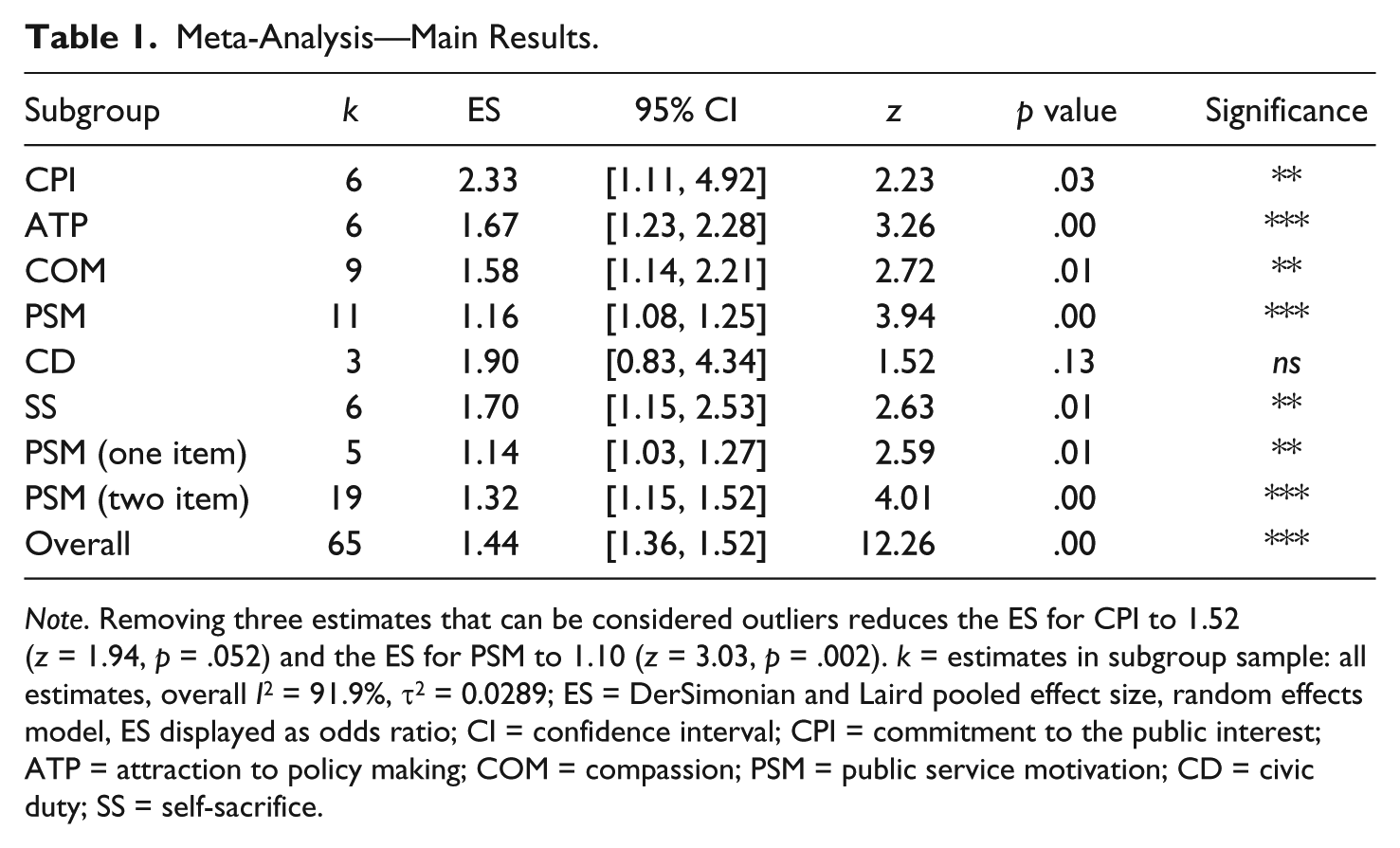
Note. Removing three estimates that can be considered outliers reduces the ES for CPI to 1.52 (z = 1.94, p = .052) and the ES for PSM to 1.10 (z = 3.03, p = .002). k = estimates in subgroup sample: all estimates, overall I2 = 91.9%, τ2 = 0.0289; ES = DerSimonian and Laird pooled effect size, random effects model, ES displayed as odds ratio; CI = confidence interval; CPI = commitment to the public interest; ATP = attraction to policy making; COM = compassion; PSM = public service motivation; CD = civic duty; SS = self-sacrifice.
Aggregate PSM is positively and significantly associated with sector attraction across studies. The CPI dimension exhibits the largest effect size. The average effect size across all included estimates is OR = 1.44 and significant. The only dimension not exhibiting a significant relationship with sector attraction is civic duty (CD). We also did a robustness check removing three effect size estimates that appeared to be extreme outliers. Removing these three estimates reduces the effect size for CPI to 1.52 (z = 1.94, p = .052) and the effect size for PSM to 1.10 (z = 3.03, p = .002). Overall, our results are consistent with Perry and Wise’s (1990) original proposition although we note that effects are rather small.
Table 2 shows the results of the influence of administrative traditions. To compute moderation analyses and to compare studies meta-analytically, we require at least two studies in each group. Yet, not all primary studies always consider the same PSM dimensions, which generates low numbers for such comparisons (i.e., one single study in some comparison groups). Hence, the results displayed in Table 2 do not include all traditions for all dimensions of PSM.
Moderation Effects of Cultural Tradition (Globe Category).
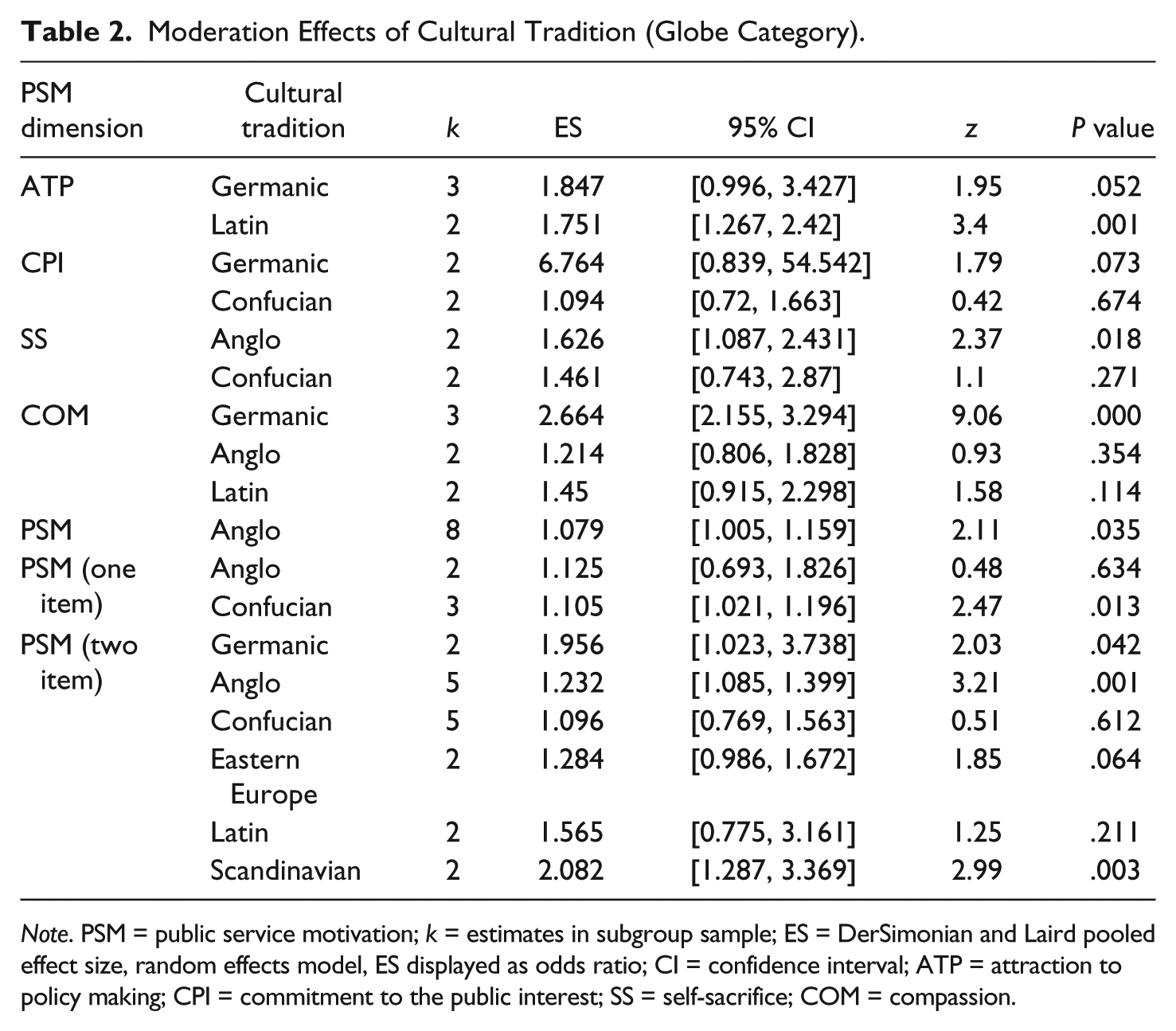
Note. PSM = public service motivation; k = estimates in subgroup sample; ES = DerSimonian and Laird pooled effect size, random effects model, ES displayed as odds ratio; CI = confidence interval; ATP = attraction to policy making; CPI = commitment to the public interest; SS = self-sacrifice; COM = compassion.
When examined closely, the results support the idea that administrative traditions shape the PSM-sector attraction relationship to some extent. For example, we find strong positive effects in the Germanic (i.e., Weberian) tradition across ATP, COM, and CPI. In contrast, the Confucian tradition does not produce significant effects in SS and CPI, nor does the Anglo Saxon tradition in the COM dimension. In summary, the results not only support the PSM-sector attraction hypothesis (H1) but also imply that more research is needed with regard to PSM dimensions and different administrative traditions.
Next, we investigate the effects of study-level variables in a meta-regression. Following procedures outlined in Ringquist (2013), we manually programmed a weighted least squares random effects meta-regression that allows for the computation of cluster-robust standard errors. In the meta-regression, we have transformed the effect sizes to Fisher’s z as Ringquist (2013) suggests the use of r-based effect sizes. We included publication status, trust in government, survey data, work experience, and special occupation as predictors. Model 1 uses the full sample, Model 2 excludes studies based on the use of large existing datasets, Model 3 uses the same sample as Model 2 but further excludes studies focusing on special occupations. Finally, Model 4 includes only published studies using self-collected data. Results are displayed in Table 3.
Meta-Regression (Effect Size = Fisher’s z).
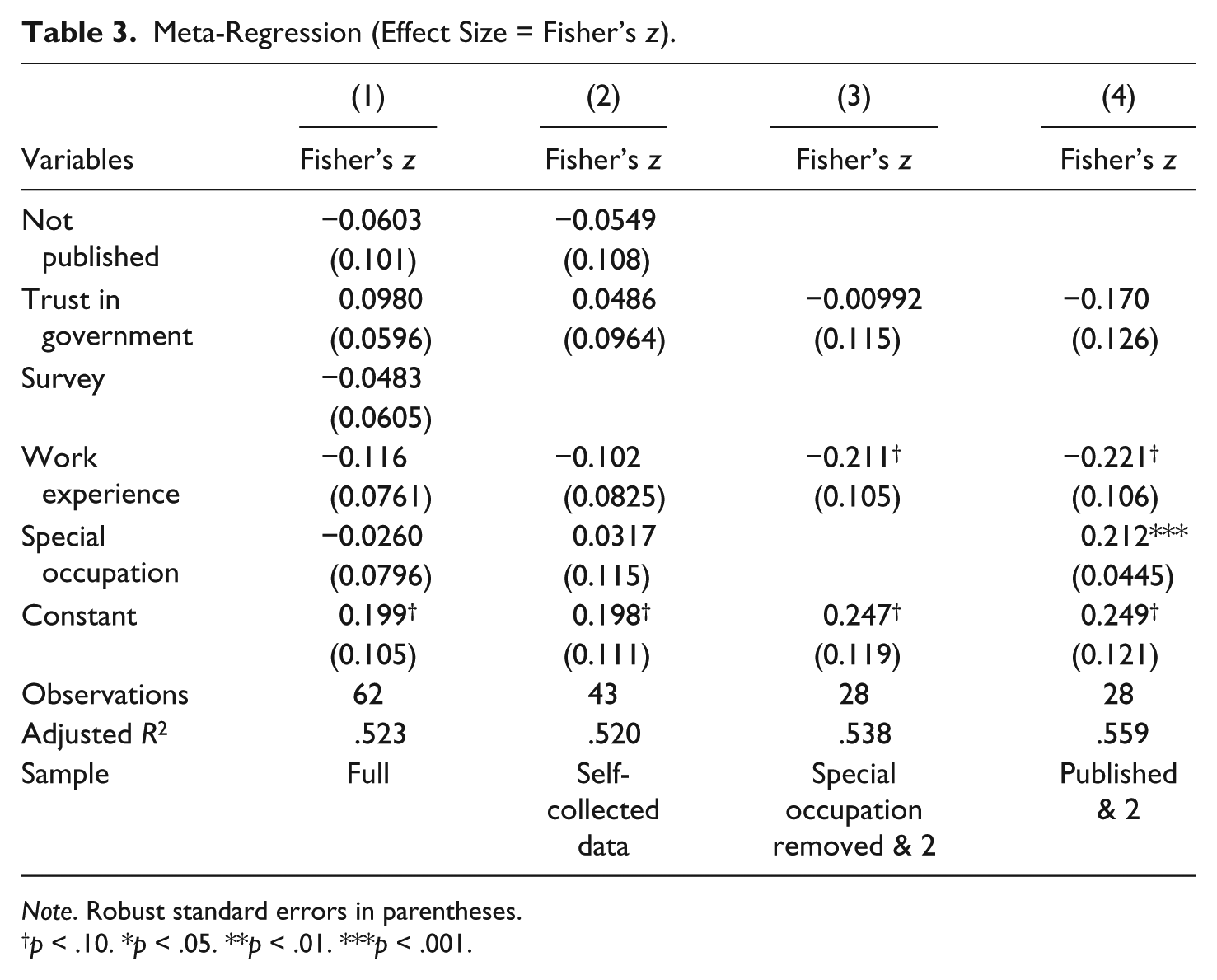
Note. Robust standard errors in parentheses.
p < .10. *p < .05. **p < .01. ***p < .001.
Only Models 3 and 4 yield significant predictors. In both models, work experience of respondents exhibits a significant negative association with the sector attraction effect size. In contrast, the special occupation variable in Model 4 exhibits a positive significant association with the sector attraction effect size.
A final concern in meta-analysis is publication bias. Publication bias refers to the issue of studies being published because they present significant findings whereas studies with nonfindings are less likely to be part of the public sphere (also sometimes labeled the “file drawer problem”). Rost and Ehrmann (2017) provide a comprehensive account of the causes of publication bias, but this is beyond the scope of this article. Nonetheless, we acknowledge that all parties involved in the publication process play a role, that is, both reviewers/editors with preferences for significant results and authors not submitting (meaningful) nonfindings. One way to investigate the presence of publication bias is to examine a funnel plot. This graph plots the effect size measure against a measure of precision (here: the inverse of the standard error). In the absence of publication bias, the plot is symmetrical. Figure 1 displays the funnel plot of our data. There is evidence for asymmetry as less precise studies that generate positive results appear to be overrepresented in the lower right-hand side of the figure. A statistical Egger test for asymmetry confirms this interpretation of the funnel plot with a positive significant constant of c = 2.34 (t = 4.38, p < 0.00). Hence, there is some evidence for publication bias in this branch of the literature.
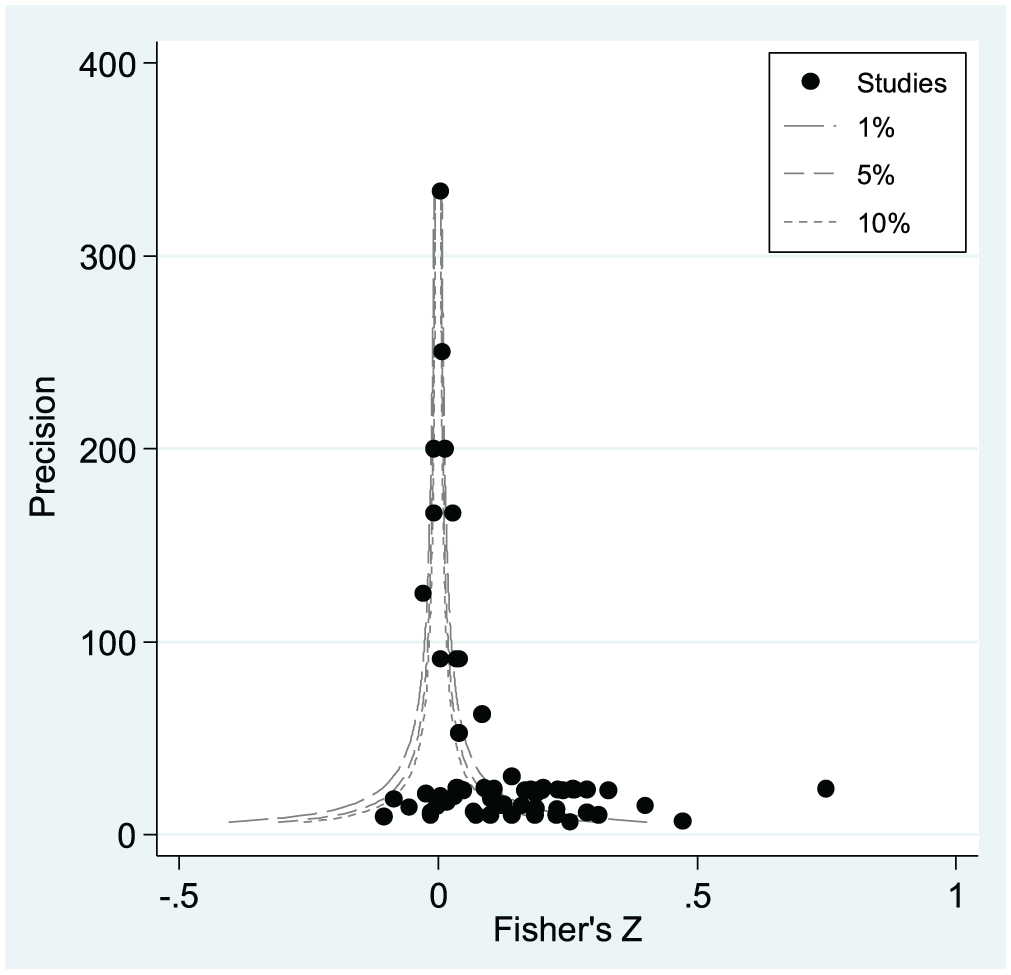
Analysis of publication bias.
Study 2: Sector Attraction and Sector Rewards
Many studies focusing on the difference between private and public sector attraction relate their arguments to differences in reward preferences (see, for example, Buelens & Van den Broeck, 2007; Lyons, Duxbury, & Higgins, 2006; Ng & Gossett, 2013; Van der Wal & Oosterbaan, 2013). The employer knowledge model (Cable & Turban, 2001) locates such considerations in the job information dimension. Consequently, potential applicants will assess sector attraction based on attributes such as pay, security, and working conditions. In this line of thought, public sector employment is often associated with higher job security but lower monetary gains and less performance rewards (Crewson, 1997; Lewis & Frank, 2002). Tschirhart et al. (2008) convey similar perceptions when stating, “[p]opular conceptions envision government employees bogged down in red tape but comfortable in secure employment, . . ., and business employees earning high pay but working in a soulless environment of bottom-line pressures” (p. 669).
Sector attraction may also be influenced by changing values of the incoming cohort of applicants (Hamidullah, 2015; Ng & Gossett, 2013) who assess work-related aspects, such as work–life balance, incentives, salary, and job security, differently than previous cohorts. But there is no agreement in previous studies on the set of potentially influential factors driving public sector employment, which makes comparison across studies difficult.
Ng and Gossett (2013) have shown for millennials especially high ethical standards, social responsibility, progressive working environment, and work–life balance are important factors contributing to a high attraction of the public sector. Focusing on PSM, Pedersen (2013) only controlled for work–family balance and job security as potential sector reward preferences and argued that pay preferences were held constant by providing an instruction to respondents declaring equal pay for the jobs they were considering. In the work conducted by Pedersen (2013), work–family balance had a positive impact on the attraction to the public sector (in comparison with the attraction to the private sector) whereas job security had a negative effect. Vandenabeele (2008) controlled for retirement pay, work–family balance, job security, fair wage, and promotion. Except for promotion, which had a significant negative effect on the choice of employment in the public sector, all other reward variable effects were positive and significant. As mentioned earlier, some studies (e.g., Christensen & Wright, 2011; Rose, 2012) show that individual dimensions of PSM have an impact on sector attraction. However, this may change when further rewards are added. Hence, it is valuable to analyze whether PSM makes a contribution to sector attraction beyond reward preferences. Thus, in contrast to previous studies, we examine whether PSM and its dimensions are stronger predictors for sector attraction than a comprehensive set of sector rewards. In contrast to PSM, we consider the term sector rewards to include outside perceptions of manifest aspects of work such as pay, career advancement, and personal development opportunities. Applicants can be assumed to build their own perceptions (correctly or incorrectly) of the size and importance of such manifest sector rewards. Early work on reward preferences suggests that public sector employees put higher values on intrinsic rewards (for a brief summary, see Wright et al., 2017). If the latter holds true for current job market entrants, and if serving the public is considered a higher level need, we should expect that PSM makes a larger contribution to sector attraction than any other extrinsically oriented reward. Considering the aforementioned reasons and the evidence for a positive relation between PSM and sector attraction as shown in Study 1, we hypothesize the following:
Method
The data were collected in June 2016. The sample consists of 600 German final-year students (master’s or Staatsexamen) studying the following subjects: law, medicine, engineering, business sciences, social science, and geography. Table 4 shows the sample description of the nonlatent variables used (additional appendices showing latent variable descriptives, survey items, and CFA results are provided upon request by the authors).
Sample Description of the Used Nonlatent Variables.
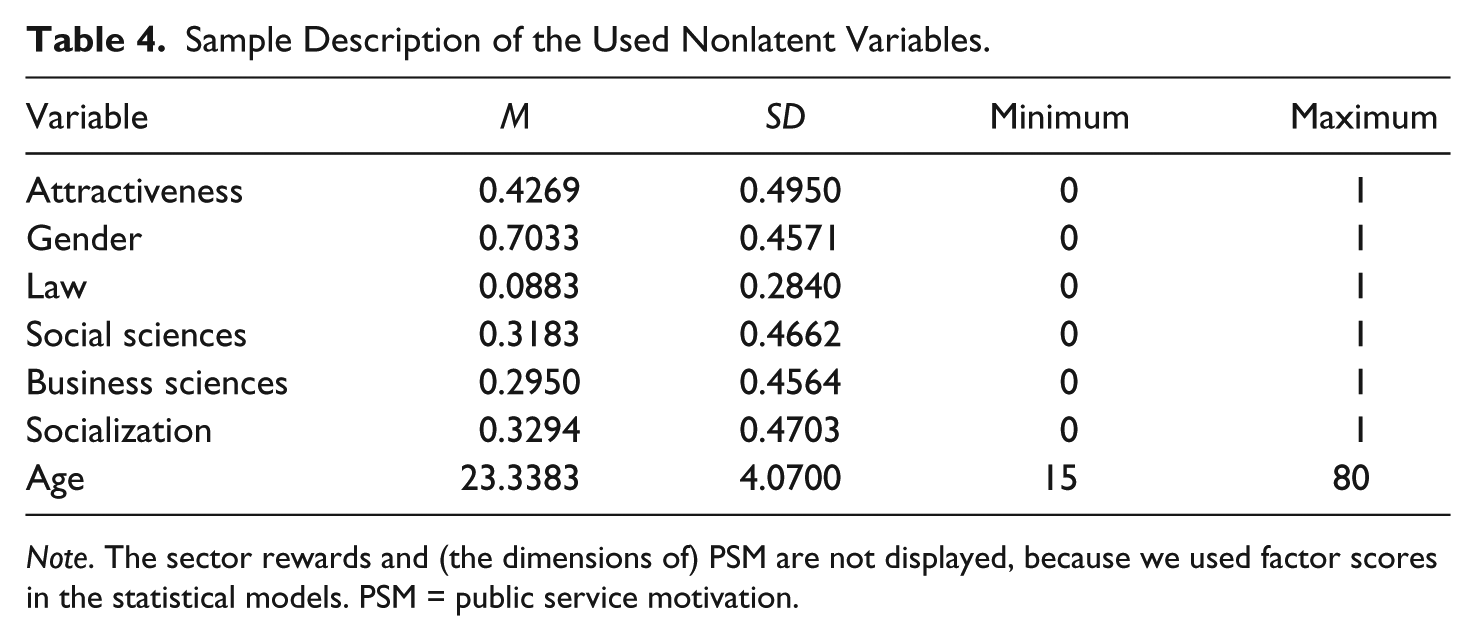
Note. The sector rewards and (the dimensions of) PSM are not displayed, because we used factor scores in the statistical models. PSM = public service motivation.
Research Context
The German context is particularly suitable to this research for a number of reasons. We know relatively little about PSM in Germany and even less about the link between PSM and sector attraction among German students. To date, two studies have addressed this question using German data: First, Ritz and Waldner (2011) have studied students of the German Federal Armed Forces. In addition to PSM, they investigated a series of other work motives (e.g., career and promotion opportunities and challenging work), which they aggregated to common factors (e.g., safe future, social responsibility, and development opportunities). They show significant effects for the two PSM dimensions “ATP” and “community orientation,” a variant of CPI. Their models also show significant effects for all work motive factors except for corporate social responsibility.
However, one should consider that the majority of these students are already locked into the military occupation, have undergone basic military training, and have already agreed to serve for a number of years after their graduation. Hence, these results could be positively biased toward public sector preference. Respondents could also be affected by postrationalization dynamics, and they are not free from socialization effects because they have already experienced military life during basic training before entering their degree programs.
Second, Winter and Thaler (2016) studied hospital ownership preferences among German medical students. Their results show support for the PSM-sector attraction link with regard to the “CPI” dimension. They further showed that research and prestige aspirations affect preferences for public hospitals. However, it has to be noted that in Germany, only a very small fraction of students is allowed to enroll into medical degrees due to high entry score requirements.
Overall, the two German studies on PSM and sector attraction provide a glimpse into two very specific populations (i.e., members of the armed forces and hospital physicians) whose work is not comparable with the majority of office-based public sector jobs. Therefore, investigating a wider sample of the German student population is a worthwhile endeavor and has the potential to generate useful insights concerning sector attraction and PSM.
Variables
The dependent variable is the dichotomous variable of sector attraction. We measured sector attraction using a modified version of Highhouse, Lievens, and Sinar’s (2003) four-item scale. This is a 7-point Likert-type scale with anchors of 1 (disagree strongly) to 7 (agree strongly). To generate the dependent variable, we first chose the two items that directly ask for an employment in the public sector (“The public sector is attractive to me as a place for employment” and “I would like to work in public service”). Second, we generated the dummy “attraction” with 0 if respondents rather disagree that an employment in the public sector is attractive (scaling points 1 to 5) and with 1 if respondents agree that the public sector is an attractive employer (scaling points 6 and 7). This dichotomization of the variable allows us to identify those respondents who clearly prefer public sector work.
Our main independent variables are PSM and job choice criteria. We assess PSM with the international PSM scale (Kim et al., 2013; 16-items, 7-point Likert-type agreement scale). A confirmatory factor analysis supported four dimensions. These four dimensions are (a) the APS dimension, (b) the SS dimension, (c) the CPV dimension, and (d) the COM dimension.
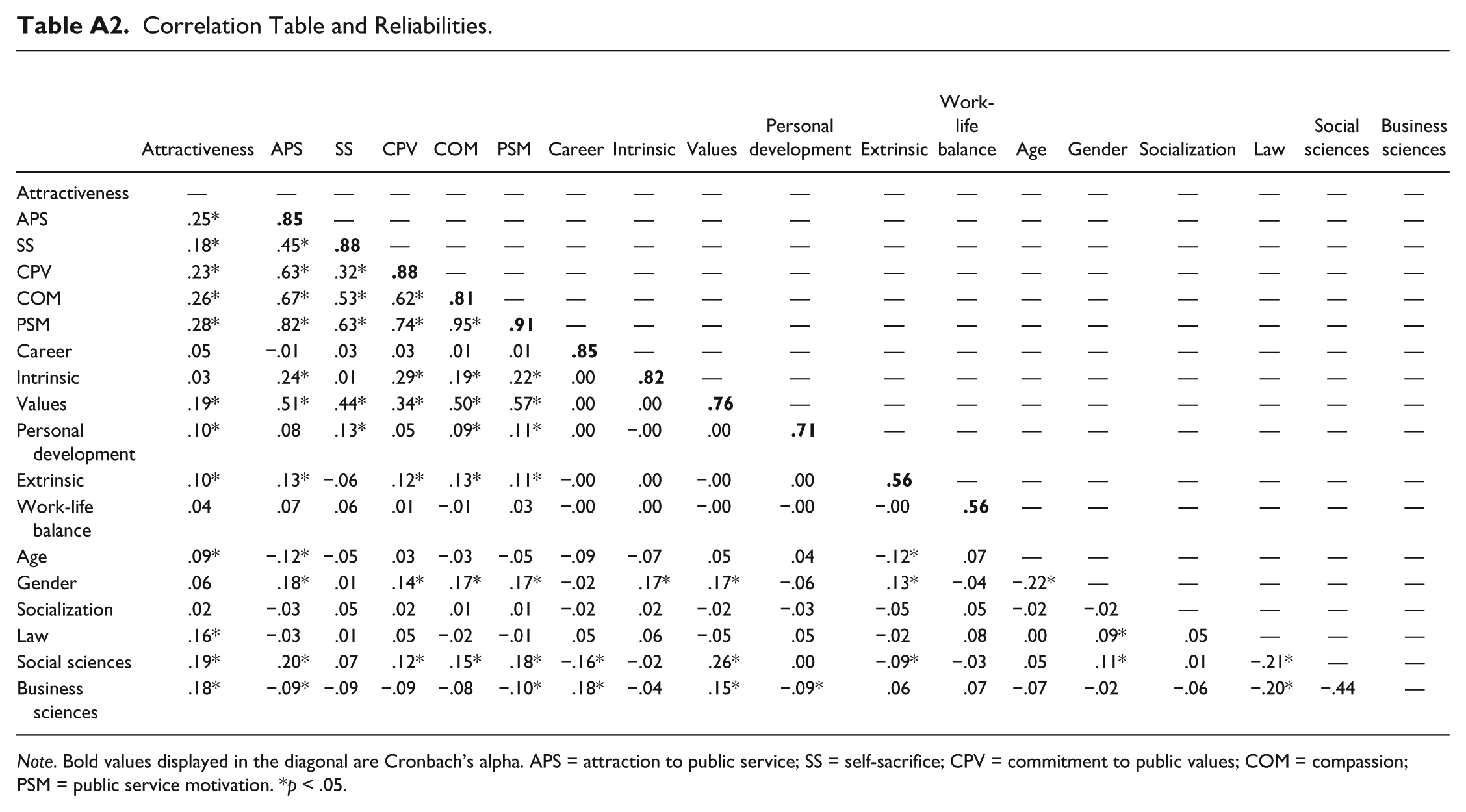
In addition to PSM, we used 30 items of job choice criteria (Ruthus, 2013). In a first step, we ran an exploratory factor analysis because of the variety of items. Then, we excluded items displaying small factor loadings (i.e., below 0.5). After a second exploratory factor analysis, we identified six factors in total: (a) the “career” factor, which includes the opportunity to take on management or project responsibility; (b) the “job design” factor, which includes the opportunity to work independently and improve professional skills to take on more challenging tasks; (c) the “values” factor, which describes the importance of social commitment of the potential employee; (d) the “personal development” factor, which includes the opportunity of training programs; (e) the “extrinsic” factor, which consists of items such as the importance of pay satisfaction; and (f) the “work–life balance” factor, which includes the importance of different working hours models. These six factors reflect the different dimensions of the employer knowledge model with particular emphasis on the job information dimension. Control variables are gender, age, family socialization (i.e., if parents worked in civil service), and the subject of study. Appendix Table A2 displays the correlation of all variables.
Due to the cross-sectional nature of the data, common method bias (CMB) may be a concern. In an attempt to delimit the influence of CMB, we followed recommendations by Podsakoff, MacKenzie, Lee, and Podsakoff (2003) for procedural remedies. As the data collection was part of a larger experimental study, measures were distributed in different parts of the survey creating proximal distance. The experiment that was part of the survey helped to vary scale properties. As we used well-established scales, clarity of items can be assumed. After data collection, we ran Harman’s single factor test, which did not indicate a factor accounting for a majority of the variance. Some authors have argued that CMB may not be as severe as portrayed in parts of the literature (Conway & Lance, 2010). Taking into account our procedural remedies, the statistical test, and established views in the literature, we consider CMB to be unproblematic in this study.
Results
We used binary logistic regression models to analyze the data. We estimated the models as follows: Model 1 shows the effects of sector reward variables on sector attraction. Model 2 includes the overall PSM variable. Model 3 shows the first PSM dimension, that is, SS. Models 4 and 5 include the remaining dimensions of PSM, that is, APS and CPV. To evaluate the model fit, we used McKelvey and Zavoina’s R2 and the Bayesian information criterion (BIC). Table 5 displays the results. For ease of interpretation, coefficients are ORs.
Logistic Regression of PSM and Sector Rewards on Sector Attraction.
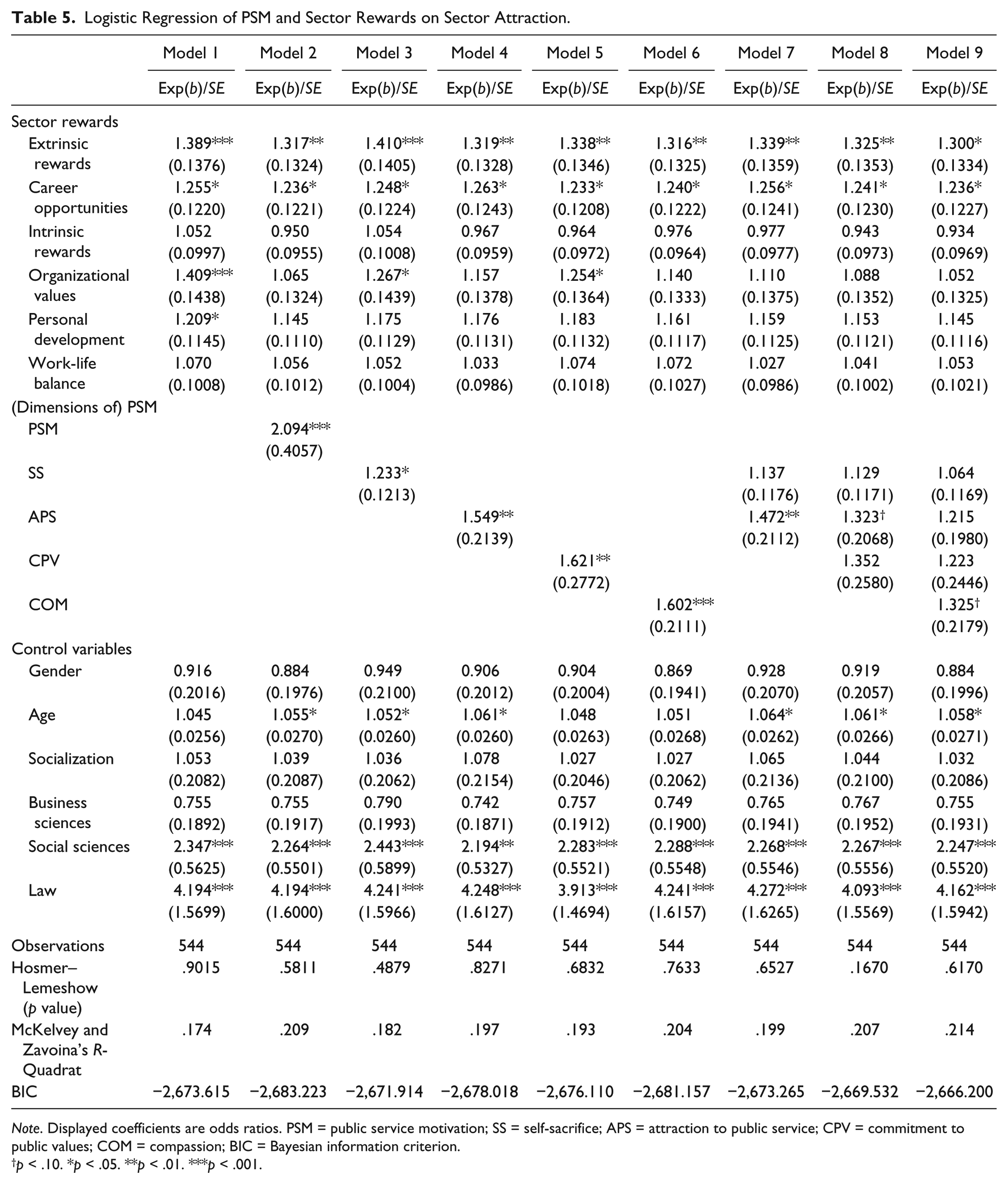
Note. Displayed coefficients are odds ratios. PSM = public service motivation; SS = self-sacrifice; APS = attraction to public service; CPV = commitment to public values; COM = compassion; BIC = Bayesian information criterion.
p < .10. *p < .05. **p < .01. ***p < .001.
Model 1 shows the effects of sector reward variables on sector attraction. The extrinsic factor, the career opportunities factor, the personal development factor, and the value factor display significant effects on sector attraction. An increase in the importance of extrinsic rewards is associated with the odds to experience high sector attraction which increase by 38.9% (p < .001). Provided that the importance of organizational values increases, the odds to experience high sector attraction increase by 40.9% (p < .001).
Model 2 adds overall PSM as a predictor. It displays a highly significant effect of PSM on sector attraction (2.094; p < .001). In contrast to Model 1, Model 2 only shows significant effects for the sector reward variables “extrinsic rewards” (1.317; p < .01) and “career opportunities” (1.236; p < .05). These results lend further support for the hypothesis that PSM is associated with public sector attraction in Germany.
Model 3 includes the SS dimension of PSM. It has a significant effect (1.233; p < .05) on sector attraction. The sector rewards variables “extrinsic rewards” (1.410; p < .001) and “career opportunities” (1.248; p < .05) are still significant. In contrast to Model 2, Model 3 also shows a significant effect for the values of the organization (1.267; p < .05). Model 4 includes the APS dimension of PSM. It has a significant effect (1.549; p < .01). In the next analytical step, the CPV dimension is included (Model 5). It shows a significant effect (1.621; p < .01). In both models, the extrinsic rewards and the career opportunities are still significant. In Model 5, the values of the organization also show a significant effect. Model 6 includes the COM dimension. It shows a highly significant effect (1.602; p < .001). The extrinsic rewards and the career opportunities are still significant.
There are similar results in Model 7, which includes the APS and the SS dimension of PSM. The APS dimension shows a significant (1.472; p < .01), but the SS dimension loses significance. In Model 8, the CPV dimension of PSM is included. In Model 9, the COM dimension is included. Both models do not show significant for any dimension of PSM except for APS in Model 8 and COM in Model 9 at the 10% level. The coefficients for extrinsic rewards and the career opportunities are significant.
Comparing the model fit indices of the single models, Model 2 and Model 9 show the best McKelvey and Zavoina’s R2 (20.90 in Model 2 and 21.40 in Model 9) as well as the smallest BICs (−2,683.223 in Model 2 and −2,666.200 in Model 9). As differences are marginal, we consider both models as equally meaningful. Model 2 includes less variables and is, hence, more parsimonious than Model 9.
Although the ORs of PSM and its individual dimensions are higher than the ORs of the extrinsic rewards and the career opportunities, we test for the equality of coefficients in a final step. The test results, which are displayed in Table 6, imply that the coefficients of PSM and extrinsic rewards as well as the coefficients of PSM and career opportunities are statistically different from one another. With regard to the individual dimensions of PSM, the test shows equal coefficients. These findings partially support hypothesis H2 as they show PSM’s contribution to sector attraction in all dimensions.
Equality of Coefficients.
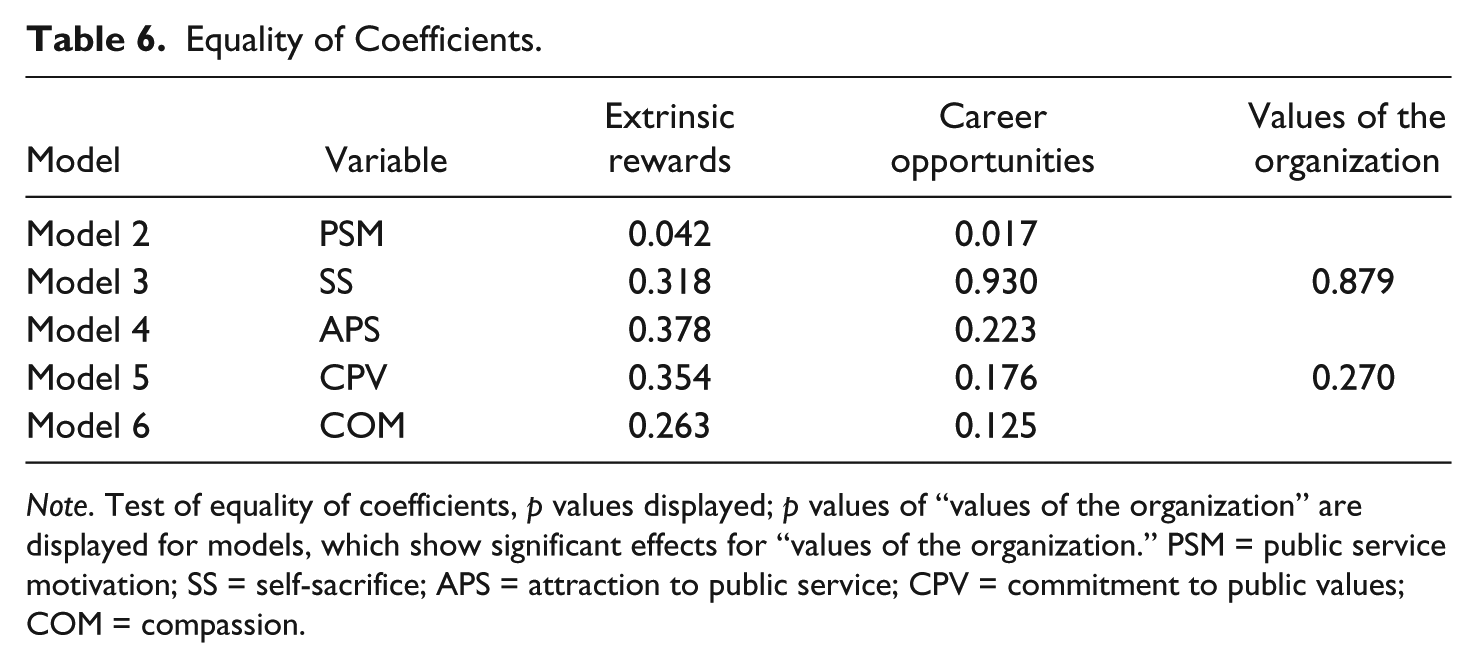
Note. Test of equality of coefficients, p values displayed; p values of “values of the organization” are displayed for models, which show significant effects for “values of the organization.” PSM = public service motivation; SS = self-sacrifice; APS = attraction to public service; CPV = commitment to public values; COM = compassion.
Discussion
This article investigated the PSM-sector attraction link from two different perspectives. First, we used a meta-analysis to establish whether the proposed association between PSM and sector attraction holds across studies. This meta-analytic approach was important as previous research has found conflicting results in this regard. Second, we focused on the relationship between PSM and sector attraction in the German context, which has not been studied in depth yet, with Germany being a country that exhibits traditional Weberian style bureaucratic features. The study is particularly relevant as we control for a comprehensive set of sector rewards and identify the contribution of PSM beyond other factors associated with sector attraction.
Study 1 provides strong support for the proposition that PSM is an important driver of sector attraction. This claim holds for aggregate PSM and for its dimensions across a number of studies. Therefore, the effect can be considered as empirically established. We also find that administrative traditions play a role in upholding the PSM-sector attraction link, which supports Vandenabeele’s (2008) institutional theory of PSM. Future research should investigate the impact such institutions have on the shaping of PSM. Finally, a meta-regression shows variations depending on the type of occupation in published studies using self-collected data. The special occupations dummy exhibits a significant positive coefficient in the meta-regression (Model 4).
A further question may relate to the sizes of the effect sizes generated in Study 1. However, instead of putting the effect sizes into Cohen’s categories of “small,” “medium,” and “large” (as these have been criticized to be quite arbitrary), we prefer to distinguish between meaningful and nonmeaningful effects. In our work, the primary focus is to establish whether there is a visible effect of PSM on sector attraction, which becomes evident even with small effect sizes. We also have some large effect sizes in our data (see, for example, Table 2, coefficient on Germanic traditions). Thus, overall, our results support the hypothesis that PSM matters for sector attraction.
The findings of Study 2 provide various insights into the relationship between PSM and sector attraction in the German context. We investigated the contribution of PSM to sector attraction while controlling for a number of employer dimensions such as pay, career opportunities, and work–life balance. In this regard, we provide a more comprehensive view than previous studies have done. In our first analytical step, we have shown that several sector rewards have a significant impact on sector attraction. Besides extrinsic rewards, career opportunities and personal development, especially organizational values, show a highly significant association with sector attraction.
Yet, the inclusion of PSM to the statistical model negates the significance of personal development rewards and value rewards. PSM is a stronger predictor than the importance of organizational values such as “social commitment of the employer” or “ecologically friendly behavior of the employer and a responsible use of resources.” The test of equality shows that PSM coefficients are different from the coefficient on extrinsic rewards and career opportunities. These findings support hypotheses H1 fully and H2 partially.
Besides extrinsic rewards and career opportunities, which are positive and significant in all specifications, the other reward variables either do not have any effect on sector attraction (e.g., intrinsic rewards and work–life balance) or lose their significance if PSM is included (e.g., values of the organization and personal development). These results are in contrast to recent findings by Breitsohl and Ruhle (2016) who do not discover any significant effects for material aspects in their longitudinal analyses of German millennials’ public sector choice. In their study, PSM is a single important driver of attraction. These different findings can be explained by the different research aims. Breitsohl and Ruhle (2016) investigate the impact of PSM and material aspects on the particular job choice and not the attractiveness of the public sector as an employer. Our results support previous findings by Van de Walle, Steijn, and Jilke (2015) who underscored the importance of extrinsic rewards for public sector attraction. The authors consider that “research should take into account the fact that people want to work in the public sector not only to serve the public good, but that factors such as money or job security also play a role” (Van de Walle et al., 2015, p. 850).
A surprising finding is the nonsignificance of the intrinsic rewards variable in all specifications. This contrasts stylized facts emerging from the rewards preferences literature (Alonso & Lewis, 2001; Crewson, 1997) supporting the view that public sector employees value intrinsic rewards more than private sector employees. Yet, this might be due to the fact that we focus on students who have not yet experienced the different types of incentive mechanisms present in public organizations. Nonetheless, these findings support the claim that the “respondents tend not to associate public sector work with being allowed to work independently, choosing one’s own working times or having an interesting job” (Van de Walle et al., 2015, p. 848). The latter may also explain in part the perceived disinterest in public sector employment among potential recruits. Hence, common (mis)perceptions of the presence of red tape in public sector organizations appear to be a relevant criterion for future employees.
In contrast to Rose (2012) and Pedersen (2013), who did not find an effect of the “COM” and “CPI” dimensions of PSM on sector attraction, our models in Study 2 show that especially these dimensions have the strongest effect on sector attraction. In his Danish sample, Pedersen (2013) highlighted that the public interest dimension of PSM is associated with increased public sector attraction, especially among law and political science students. In contrast, business students show less preference for the public sector. Our results support Pedersen’s (2013) findings. In our models, especially law students are attracted to the public sector. Such findings may be grounded in the administrative tradition of Germany. The German administration is “dominated by the typical characteristics of a Weberian bureaucracy” (Jann, 2003, p. 95). The main features of German administration (e.g., multilevel system and judicial control) have not changed in essence in the recent past. Characteristics like continuity and stability are still of particular importance (Jann, 2003). In the classical Weberian bureaucracy, especially lawyers traditionally have privileged access to public service positions.
The results of the study by Ritz and Waldner (2011) show a positive association between the APS dimension of PSM and sector attraction as well as a positive link between the “community orientation” dimension and sector attraction. Our study extends their results by identifying the strongest dimensional effects for the dimensions CPV and COM, for which they did not control. Moreover, Model 2 shows the overall positive and significant effect of PSM on sector attraction highlighting the importance of PSM in relation to sector attraction in Germany in a more generalized setting compared with Ritz and Waldner (2011). The relationship between the four subdimensions of PSM and sector attraction cannot be fully explained theoretically. Especially, the APS dimension mirrors the Weberian state characteristics as the bureaucratic tradition has a longer tradition in Germany than the democratic tradition (Vandenabeele et al., 2006). This bureaucratic sentiment can be considered as anchored in the German collective mind. It is therefore a component of the individual socialization that influences the individual level of PSM (Moynihan & Pandey, 2007). In contrast, the effect of the SS dimension is unexpected because this dimension has a negative connotation in Germany (due to historical reasons; Vandenabeele et al., 2006). The effects of COM and CPV are surprising. As observed by Vandenabeele (2008), many young potential employees are not sensitive to their CPV because they lack working experience in the public sector. Similar concerns apply to the COM dimension (Vandenabeele et al., 2006). Interestingly, Model 2, which includes the overall PSM measure, shows significant effects whereas Model 9, which includes all four subdimensions of PSM, only shows a weakly significant effect at the 10% level for the COM dimension. Although it is insightful to disentangle the effects of the different PSM dimensions, it is more consistent with our study focus to emphasize the results of the aggregate PSM construct. Furthermore, the individual dimensions on their own do not reflect the full range of PSM motives.
Limitations, Implications, and Future Research
As with all research, we need to flag some limitations. First, in Study 1, a wide range of additional study-level moderators could have been coded. The low number of subgroups in each category, however, limits the number of viable analyses. Hence, we consider our selection of moderators viable. Second, our sample in Study 2 only consists of students in their final years of study. To extend the knowledge about the relationship between PSM and sector rewards and its impact on sector attraction, further research should investigate different subsamples, such as students, employees in the private sector, and in the public and nonprofit sector. Third, the data used in Study 2 are cross-sectional in nature, limiting our ability to make causal claims. However, as others have argued (Clerkin & Coggburn, 2012; Pedersen, 2013), there is little doubt about the directionality in our design because we chose students not affected by organizational socialization. A pure student sample is ideal for the study of sector preferences (taking into account that preferences do not necessarily translate into actual job selection or desired behaviors). Nonetheless, we encourage researchers to explore the link between PSM and sector attraction using designs that put more emphasis on isolating causal effects taking into account socialization and other biasing effects.
In addition, future research should acknowledge that the public sector is highly differentiated and fragmentized such that the impact of the broad categories of administrative traditions on the link between PSM and sector attraction can only be a first step in research on this issue. Especially in the German case, the administrative system mirrors a high degree of organizational heterogeneity. Although Weberian traditions characterize the German public sector, future research should unravel the Weberian administrative tradition to its various components and explore the effects of PSM on sector attraction in the multilevel structure of local, federal, and national administration. Further research should elucidate the way in which effective HRM can apply the knowledge about PSM to attract and recruit employees.
Implications for public sector recruiters
Corroborating recent work on practice lessons for PSM (Christensen, Paarlberg, & Perry, 2017), our findings have implications for the personnel marketing of public organizations. An effective HRM needs information about the attributes of individuals and jobs that increase organizational attraction. Especially in the German local and federal administrations, the personnel marketing struggles to attract highly qualified candidates—unless the organization enjoys exceptionally high prestige (e.g., in Germany the Federal Foreign Office is frequently mentioned as an employer of choice, local government organizations are usually not).
Our findings give insights into how public organizations can optimize their recruitment practices. First, the main practical implication arising from Study 1 is that (notwithstanding the small effect sizes) the PSM-sector attraction relationship holds across studies. This finding supports Christensen et al.’s (2017) argument to “screen in” highly public service motivated candidates. Similarly, our results should encourage human resource (HR) managers to consider addressing PSM as an active recruitment tool. Job advertisements still represent one of the most prominent recruitment instruments, but they mainly emphasize merits. Public sector HR managers should also place emphasis on public service values to attract public service motivated employees. One way to achieve this is to embed PSM-related messages in job announcements (Asseburg, Homberg, & Vogel, in press), which allows public sector HR managers to align their recruitment more effectively to desired target groups. In this regard, our results arising from Study 2 suggest that it would be particularly effective to address such messages to the “APS and COM” dimensions as they display significant effects in all specifications.
Second, our empirical results imply that a combination of PSM-orientated and reward-orientated measures is most promising for recruitment. Notwithstanding the positive effects arising from PSM-focused recruitment (Christensen et al., 2017; Esteve, Urbig, Van Witteloostuijn, & Boyne, 2016), an overemphasis toward PSM in recruitment activities is not advisable either since it could produce undesired side effects. For example, highly qualified candidates who believe their extrinsic needs not satisfied to a sufficient extent may be discouraged to apply at all. Hence, public sector organizations should invest resources to identify and implement the bundle of incentives that attract their most desired candidates.
Third, our sample consists of millennials. The millennial generation is often portrayed as being less responsive to extrinsic rewards putting emphasis on ethical standards and social responsibility instead (Ng & Gossett, 2013; Taylor, 2005). In our study, however, the Millennials put a meaningful emphasis on extrinsic rewards—even to such an extent that it drives sector attraction. This is an important insight for HR managers in the public sector who are well advised not to be misled by stereotypical representations of generational preferences frequently found in the media.
Conclusion
Although we encourage HR managers to emphasize public service–related contents in their recruitment tools to address PSM-related values of applicants, our results also underscore the importance of extrinsic rewards in the attraction process. Against the background of an incoming generation, which supposedly appreciates immaterial values, it appears that balanced recruitment tools addressing also material needs are better positioned to enable public organizations to generate high levels of attraction than those featuring PSM-related rewards alone. Hence, a comprehensive research agenda of rewards and incentives attracting young professionals is necessary.
Footnotes
Appendix
Correlation Table and Reliabilities.
| Attractiveness | APS | SS | CPV | COM | PSM | Career | Intrinsic | Values | Personal development | Extrinsic | Work-life balance | Age | Gender | Socialization | Law | Social sciences | Business sciences | |
|---|---|---|---|---|---|---|---|---|---|---|---|---|---|---|---|---|---|---|
| Attractiveness | — | — | — | — | — | — | — | — | — | — | — | — | — | — | — | — | — | — |
| APS | .25* |
|
— | — | — | — | — | — | — | — | — | — | — | — | — | — | — | — |
| SS | .18* | .45* |
|
— | — | — | — | — | — | — | — | — | — | — | — | — | — | — |
| CPV | .23* | .63* | .32* |
|
— | — | — | — | — | — | — | — | — | — | — | — | — | — |
| COM | .26* | .67* | .53* | .62* |
|
— | — | — | — | — | — | — | — | — | — | — | — | — |
| PSM | .28* | .82* | .63* | .74* | .95* |
|
— | — | — | — | — | — | — | — | — | — | — | — |
| Career | .05 | −.01 | .03 | .03 | .01 | .01 |
|
— | — | — | — | — | — | — | — | — | — | — |
| Intrinsic | .03 | .24* | .01 | .29* | .19* | .22* | .00 |
|
— | — | — | — | — | — | — | — | — | — |
| Values | .19* | .51* | .44* | .34* | .50* | .57* | .00 | .00 |
|
— | — | — | — | — | — | — | — | — |
| Personal development | .10* | .08 | .13* | .05 | .09* | .11* | .00 | −.00 | .00 |
|
— | — | — | — | — | — | — | — |
| Extrinsic | .10* | .13* | −.06 | .12* | .13* | .11* | −.00 | .00 | −.00 | .00 |
|
— | — | — | — | — | — | — |
| Work-life balance | .04 | .07 | .06 | .01 | −.01 | .03 | −.00 | .00 | −.00 | −.00 | −.00 |
|
— | — | — | — | — | — |
| Age | .09* | −.12* | −.05 | .03 | −.03 | −.05 | −.09 | −.07 | .05 | .04 | −.12* | .07 | — | — | — | — | — | — |
| Gender | .06 | .18* | .01 | .14* | .17* | .17* | −.02 | .17* | .17* | −.06 | .13* | −.04 | −.22* | — | — | — | — | — |
| Socialization | .02 | −.03 | .05 | .02 | .01 | .01 | −.02 | .02 | −.02 | −.03 | −.05 | .05 | −.02 | −.02 | — | — | — | — |
| Law | .16* | −.03 | .01 | .05 | −.02 | −.01 | .05 | .06 | −.05 | .05 | −.02 | .08 | .00 | .09* | .05 | — | — | — |
| Social sciences | .19* | .20* | .07 | .12* | .15* | .18* | −.16* | −.02 | .26* | .00 | −.09* | −.03 | .05 | .11* | .01 | −.21* | — | — |
| Business sciences | .18* | −.09* | −.09 | −.09 | −.08 | −.10* | .18* | −.04 | .15* | −.09* | .06 | .07 | −.07 | −.02 | −.06 | −.20* | −.44 | — |
Note. Bold values displayed in the diagonal are Cronbach’s alpha. APS = attraction to public service; SS = self-sacrifice; CPV = commitment to public values; COM = compassion; PSM = public service motivation. *p < .05.
Declaration of Conflicting Interests
The author(s) declared no potential conflicts of interest with respect to the research, authorship, and/or publication of this article.
Funding
The author(s) received no financial support for the research, authorship, and/or publication of this article.
