




Abstract
This study examines how organizational structure, political control, and internal system responsiveness to employee complaints or grievances influence U.S. federal employees’ internal and external whistleblowing. Although prior research has investigated a number of personal, organizational, and social factors that affect whistleblowing, very little research has examined the three factors that are the focus of this study and the roles that they might play in whistleblowing behavior. The results show that (a) wider spans of control of middle-level versus upper-level managers have opposite effects on internal whistleblowing, (b) fixed terms for agency leaders are negatively related to internal whistleblowing, and (c) internal system responsiveness to employee complaints or grievances has mixed effects on internal whistleblowing. This study concludes by discussing the implications of these findings and proposing effective ways to manage whistleblowing within public organizations.
Keywords
Introduction
Whistleblowing has gained increased attention from scholars and practitioners. Despite its potential costs (e.g., being misused as employee sabotage, diminishing organizational reputations; Martin & Rifkin, 2004; Miethe, 1999), whistleblowing can offer benefits to organizations, citizens, and customers. First, whistleblowing has uncovered and addressed wrongdoings in various areas such as environmental control, financial mismanagement, and public safety (Government Accountability Project [GAP], 2017). For example, the 2014 whistleblowing case involving the Veteran Affairs Medical Center in Phoenix revealed that scheduling data had been manipulated, which resulted in patients’ deaths. Second, in addition to identifying and fixing problems, whistleblowing may promote employees’ ethical responsibilities and organizations’ tolerance for dissent (Lavena, 2016; Miethe & Rothschild, 1994).
Recognizing the importance of the topic, previous studies have mostly examined how personal factors, such as personality and demographic attributes, encourage or discourage whistleblowing (Brewer & Selden, 1998; Caillier, 2017; Cho & Song, 2015; Lavena, 2016; Mesmer-Magnus & Viswesvaran, 2005; Miceli, Near, & Dworkin, 2008; Perry, 1993; Wright, Hassan, & Park, 2016). However, little is known about how organizational factors, such as internal and external environments, affect such behavior. Among a number of these factors, this study examines how an organization’s span of control and formalization, susceptibility to political control, and responsiveness to employee complaints and grievances encourage or deter U.S. federal employees’ whistleblowing behavior through internal or external disclosure channels.
Although scholars have posited that organizational structure encourages or deters whistleblowing (King, 1999; Miceli & Near, 1992), empirical research on this question is scarce; the few exceptions have evaluated employee perceptions about organizational structure (Lavena, 2016; Miceli, Near, & Schwenk, 1991). Employee perception is a valid measure because it guides behaviors. However, a perceptual measure might not accurately reflect an organization’s structural arrangements, and obtaining variables—employee perception about organizational structure and self-reported whistleblowing behavior—from the same data source might lead to common method bias (Meier & O’Toole, 2013). This study uses archival measures of organizational structure to examine their effects on whistleblowing. Several studies have supported that public organizations in general are more centralized and formalized than private ones are in forming sub-entities and making decisions (Boyne, 2002; Rainey, 2009) and that these features influence public employees’ attitudes and behaviors. Therefore, when investigating public employees’ whistleblowing behavior, organizational structures that influence employees’ discretion and willingness to stand against their organizations or supervisors, such as organizational hierarchy and sound rules and management, merit consideration.
Furthermore, the strong influence of the political environment is a key feature that distinguishes public organizations from private ones. Federal agencies are subject to congressional and presidential controls that influence bureaucratic behaviors and outputs. Although many previous studies have concentrated on whistleblower protection laws (Miceli, Rehg, Near, & Ryan, 1999; Peffer et al., 2015), no study has addressed potential effects of political control on public employees’ whistleblowing. Considering the enactment of whistleblower protection laws and growing public attention on whistleblowing, good reasons exist to support the supposition that political authorities are interested in overseeing how federal agencies deal with whistleblowers. Thus, examining the role that political control plays in federal employees’ whistleblowing is a worthwhile endeavor.
Regarding internal system responsiveness to whistleblowers, scholars have examined the roles that employee perceptions about management support and fear of reprisal play in influencing whistleblowing (Miceli et al., 2008). Nonetheless, little research has investigated how complaint recipients and organizations respond to reports of wrongdoing or how such factors influence whistleblowing behaviors. This study attempts to fill the gap using archival measures of prompt responsiveness to employee complaints or grievances and by analyzing how such factors influence federal employees’ whistleblowing.
In the following section, this study discusses previous literature concerning the determinants of whistleblowing. Next, this study presents research hypotheses drawn from the literature. After describing the data and methodology, this study presents its findings. Finally, this study discusses implications drawn from the findings and provides suggestions for future research.
Research on the Determinants of Whistleblowing
The broadly accepted definition of whistleblowing is “the disclosure by organization members (former or current) of illegal, immoral, or illegitimate practices under the control of their employer, to persons or organizations that may be able to affect action” (Near & Miceli, 1985, p. 4). Robinson and Bennett (1995) suggested that deviant workplace behaviors fall into four types based on two dimensions that include the party affected by wrongdoing (individual vs. organization) and the seriousness of wrongdoing (serious vs. minor); the four types are individual-serious, individual-minor, organization-serious, and organization-minor. This study focuses on deviant workplace behaviors that harm U.S. federal agencies (i.e., organization-serious and organization-minor) and that may elicit whistleblowing responses. Deviant behaviors involve “any violation of law or regulation, gross mismanagement, a gross waste of funds, an abuse of authority, or a substantial and specific danger to public health or safety” (5 U.S.C. § 2302, p. 188).
Understanding the processes and types of whistleblowing is important. After observing organizational misconduct, an employee will decide to either remain silent (i.e., inactive observer) or blow the whistle using internal or external channels (Miceli & Near, 1992; Miceli et al., 2008; Miethe, 1999). An internal whistleblower exposes illegal or unethical activities to exclusively those within an accused organization (e.g., supervisor, agency official). Alternatively, an individual can report organizational wrongdoing to external parties such as Congress, law enforcement, and the media (i.e., external whistleblower). Whistleblowers typically seek external channels after finding that internal channels are ineffective (Near & Miceli, 2008).
The distinction between internal and external whistleblower is necessary because previous studies have shown that these involve different determinants (Caillier, 2017; Dworkin & Baucus, 1998; Jeon, 2017; Park & Blenkinsopp, 2009). For example, Caillier (2017) found that employees with higher public service motivation (PSM) were more likely to blow the whistle internally when they perceived wrongdoings as serious; however, this finding did not hold for external whistleblowing. In addition, Jeon (2017) showed that employees disclosed misconduct using internal channels rather than external ones when they perceived that their organizations had provided them with fair treatment and education on whistleblowing. From an organization’s viewpoint, internal whistleblowing is more desirable than external is because the latter can incur greater administrative and political costs and decrease organizational reputation (Berry, 2004; Vadera, Aguilera, & Caza, 2009). Thus, nuanced managerial approaches are needed to deal with each type of whistleblowing.
A decision to blow the whistle is a complicated process wherein various factors unfold simultaneously. To start, personal factors include dispositional (e.g., morality, self-efficacy), demographic (e.g., gender, education), and organization-related variables (e.g., supervisory status, job performance; Miceli et al., 2008). Under the combined effects of these factors, the prosocial organizational behavior (POB) model has explained that individuals who observe wrongdoings tend to disclose them when the individuals believe that they are responsible for doing so, that their perceived costs are lower than perceived benefits, and that their organizations will address the wrongdoings (Miceli et al., 2008). An employee’s decision to report wrongdoing also depends on organizational factors such as the organizational climate for whistleblowing, any threat of retaliation, management support, and organizational size (Mesmer-Magnus & Viswesvaran, 2005).
Such scholars have noted that more whistleblowing has occurred in public organizations than in private and nonprofit ones (Near & Miceli, 2008; Rothschild & Miethe, 1999). Miceli et al. (2008) claimed that the public–private distinction merits consideration in examining the determinants of whistleblowing. Although many previous studies on whistleblowing in the public sector have dealt with PSM (Brewer & Selden, 1998; Caillier, 2017; Cho & Song, 2015; Wright et al., 2016) and legal protections for whistleblowers (Miceli et al., 2008; Peffer et al., 2015), little research exists on roles that organizational structure and political control might play in public employees’ decisions to disclose misconduct. Given that elaborate organizational structure and external political influences shape bureaucratic behaviors and outputs (Rainey, 2009; Wood & Waterman, 1991), their implications for public employees’ whistleblowing are worth pursuing.
Theories and Hypotheses
This section presents research hypotheses regarding the effects of organizational structure, political control, and internal system responsiveness on federal employee’s internal and external whistleblowing behavior. Organizational structure can be defined as “the configuration of the hierarchical levels and specialized units and positions within an organization and to the formal rules governing these arrangements” (Rainey, 2009, p. 204). Among different classifications of organizational structure, many studies have used the mechanistic and organic continuum introduced by Burns and Stalker (1961). Prominent features of the mechanistic structure are a well-defined hierarchy of authority, top-down decision-making, and a precise description of rules. In contrast, organic structure is characterized by delegation of authority, lateral communication, and less emphasis on rules. Organizational structure has been found to influence employee attitudes and behaviors in a number of ways (Hansen & Høst, 2012; Selden & Wooters, 2011).
This study focuses on two dimensions of organizational structure that might influence employees’ internal whistleblowing: managers’ span of control and formalization. A span of control is defined as the number of subordinates that a manager supervises (Rainey, 2009). Span of control is related to employee discretion in the sense that an employee is more likely to have discretion at work when a manager supervises more subordinates in a limited time span (Jung & Kim, 2014; Kim, 2016; Meier & Bohte, 2001). Meier and Bohte (2001) discussed that a wider span of control offered greater discretion to minority teachers, enabling them to exercise their professional knowledge and empathy toward minority students. Adjusting span of control has been used as a reorganization strategy. For example, the National Performance Review (NPR) recommended that U.S. federal agencies should increase their span of control to empower employees and enhance organizational performance (Gore, 1993).
In an organization with a low span of control, managers may have more opportunities to suppress whistleblowing (King, 1999; Miceli & Near, 1992) that may “represent a form of organizational dissent and frequently, deviation from majority views” (Miceli & Near, 1992, p. 157). In contrast, internal whistleblowing is more likely within organizations that give employees higher job autonomy and, thus, more opportunities to raise their voices (Miethe & Rothschild, 1994). Corroborating this discussion, Miceli et al. (1991) showed that whistleblowers perceived more discretion at work than inactive observers did.
Furthermore, this study posits that formalization—the extent of procedures, rules, and responsibilities for employees and units (Pugh, Hickson, Hinings, & Turner, 1968)—may facilitate or deter whistleblowing and thus presents two possible relationships. First, formalized rules and procedures generally provide employees with stability, security, and role clarity (Feeney & DeHart-Davis, 2009; Smith, 2013). Subsequently, a set of rules and procedures concerning whistleblowing may help employees confirm wrongdoings and pursue proper procedures to disclose them (Rothwell & Baldwin, 2006; Smith, 2013). In their study of marketing research organizations, Ferrell and Skinner (1988) found that greater formalization was positively associated with employees’ constructive deviant behaviors.
In contrast, literature on rule breaking has suggested that high levels of formalization may suppress whistleblowing because organizations over-control employee behaviors (DeHart-Davis, 2007; Stazyk, Pandey, & Wright, 2011), thereby leaving little room for such behaviors to develop and pursue ethical values (Pfeffer, 1994). Similarly, DeHart-Davis (2007) noted that “fears about violating organizational norms and incurring noncompliance consequences may lower a public employee’s willingness to bend rules” (p. 895). Supporting this perspective, Weaver and Trevino (1999) found that ethics programs emphasizing formalized procedures and control were less effective in encouraging employees’ constructive deviant behaviors than those focusing on values and counseling were.
One of the prominent features of a public organization is that political authorities exert significant influence on its structure and operation (Meier & O’Toole, 2006; Wood & Waterman, 1991). The U.S. Congress and executive branch oversee federal agencies’ procedures and outputs through congressional committees, appointments, removals, and other means of control (Lewis, 2010; Resh, 2015; Wood & Waterman, 1991). A comprehensive review of how the legislative and executive branches influence federal agencies and under what conditions these oversights become effective are beyond this study’s scope. Nevertheless, scholars have shown that congressional and presidential controls affect federal agencies’ behaviors and outputs to a lesser or greater extent over time (Resh, 2015; Wood & Waterman, 1991).
Similar to formalization, this study posits that congressional and presidential controls may encourage or deter federal employees’ external whistleblowing and thus presents two competing hypotheses. First, Congress and the executive branch can promote external whistleblowing by providing federal employees with higher insulation from internal pressure and fear of reprisal (Miethe, 1999). Potential federal whistleblowers in agencies that do not support whistleblowers can consider such offices as alternative channels for disclosing misconduct. Aside from their formal authorities, Congress and the executive branch can effectively air wrongdoings through networks of agencies, commissions, media, and civic organizations. Recognizing these advantages, the GAP published guidelines to aid whistleblowers in using political officials as effective reporting sources (Devine, 1997). From the lawmakers’ viewpoint, whistleblowing may offer opportunities to take credit for fulfilling oversight responsibilities and saving costs (McCubbins & Schwartz, 1984). Attempts by the executive branch to identify and address fraud or misconduct across the vast federal government may also rely on federal whistleblowers with inside knowledge.
In contrast, Congress and the executive branch may also want to deter federal whistleblowers from using external reporting channels. Congress or the political party in control of it might not prioritize addressing wrongdoings at federal agencies and protecting whistleblowers. In addition, members of Congress who have mutually beneficial relationships with offending agencies are unlikely to be advocates for federal whistleblowers (Miethe, 1999). From the executive branch’s perspective, external whistleblowing could lower its public reputation and incur high administrative and judicial costs (Berry, 2004; Vadera et al., 2009). Despite the enactment of whistleblower protection laws, studies have pointed out that the executive branch has often attempted to alleviate whistleblower protection by raising a bar for protection and using other methods of addressing such situations (e.g., ease firing of federal employees including whistleblowers; Bernabei & Kabat, 2016).
Internal system responsiveness provides potential whistleblowers with reassurance that they will be protected from retaliation and that corrective actions will ensue (Perry, 1993). From a social exchange perspective, employees who perceive organizational support tend to reciprocate through prosocial behaviors (Cohen-Charash & Spector, 2001). To investigate this possibility for whistleblowing cases, prior research has used perceptual measures of (a) management support and organizational climate and (b) formal procedures and policies regarding whistleblowing (Miceli et al., 2008).
Beginning with the former approach, top-level management support for whistleblowers or a supportive organizational climate may lower an employee’s perceived costs of blowing the whistle (Miceli & Near, 1992; Miceli et al., 2008). A meta-analysis on the determinants of whistleblowing supported that these factors were positively associated with whistleblowing (Mesmer-Magnus & Viswesvaran, 2005). Other studies have generated inconclusive findings. In the U.S. federal government setting, supervisory support was found to have positive effects on federal employees’ whistleblowing intentions (Caillier, 2012); however, the inverse relationship was found between a supportive work environment and whistleblowing behavior (Lavena, 2016).
Turning to the latter approach, some prior research has addressed how employee perception of whistleblowing policies and procedures influences employees’ whistleblowing. Keenan (1990) showed that whistleblowing policies led managers to perceive their organizations as encouraging acts of whistleblowing and offering protection against reprisal. Likewise, in their study of police agencies, Rothwell and Baldwin (2006) found that police officers who perceived mandatory reporting policies as existing in their agencies were more likely to blow the whistle internally.
As discussed, many studies have focused on factors encouraging whistleblowing; however, little research has addressed the responsiveness of complaint recipients or organizations after whistleblowing takes place. On the subject of promoting employees’ constructive deviant behaviors, Trevino, Weaver, Gibson, and Toffler (1999) showed that internal responsiveness in processing complaints and investigating wrongdoers was more important than establishing formal procedures, structures, and staff policies concerning whistleblowing. Similarly, Miceli, Roach, and Near (1988) found that employees’ beliefs about complaint recipients’ likely responses led employees to blow the whistle internally. Heard and Miller (2006) recommended that organizations seeking to promote whistleblowing should set up clear channels for investigating reported wrongdoings, provide prompt feedback to whistleblowers, and protect them from retaliation. Overall, these studies have suggested that internal system responsiveness to whistleblowers promotes employees’ internal whistleblowing. Readers should note that these studies used perceptual measures of internal system responsiveness. Therefore, using archival measures can supplement previous findings and contribute to addressing any potential common method bias (Meier & O’Toole, 2013).
Data and Method
Data
This study used the Merit Principles Survey (MPS) 2010 conducted by the U.S. Merit Systems Protection Board (MSPB). The MPS included questions regarding whistleblowing in the U.S. federal government and has been used in previous research (Caillier, 2017; Cho & Song, 2015; Near & Miceli, 2008). The unit of analysis is the U.S. federal employee nested within the parent-level federal agency. With the stratified random sampling, the MPS 2010 was administered to 71,970 full-time employees in 18 cabinet departments and six independent agencies. Subsequently, 42,020 employees completed the survey (58.4% response rate). Because the goal of this study is to examine antecedents of whistleblowing behaviors and because the observance of wrongdoing in an organization should precede an employee’s decision to blow the whistle, this study limits the analysis to observers of wrongdoing in federal agencies (N = 2,387). This study also collects data from the FedScope website, which is operated by the U.S. Office of Personnel Management (OPM), agency statutes, and the U.S. Equal Employment Opportunity Commission’s (EEOC’s) annual report on the federal workforce.
Dependent Variables
This study used two dependent variables with two (1 = whistleblower, 0 = inactive observer) and three (1 = inactive observer, 2 = internal whistleblower, 3 = external whistleblower) nominal categories, respectively. The sample for this study only included federal employees who observed wrongdoings within their organizations; this study also used the following MPS 2010 question: “During the last 12 months, did you personally observe or obtain direct evidence of one or more illegal or wasteful activities involving your agency?” Following Caillier (2016) and Miceli and Near (1984), this study categorized those who answered “yes” on this question into inactive observer, internal whistleblower, and external whistleblower. The coding procedures are discussed below.
The subsequent survey question asked, “Did you report this activity to any of the following?” and provided 15 reporting channels with “yes” and “no” answer options. Consistent with the previous research, this study excluded the “family or friend” category because it does not align with the typical definition of whistleblowing. This study also excluded the “other” category because of its ambiguity (Caillier, 2017; Jeon, 2017). Respondents who checked “yes” to “I did not report activity” were coded as inactive observers. Internal whistleblowers were those who only selected one or more of the following reporting channels: “co-worker,” “immediate supervisor,” “higher-level supervisor,” “higher-level agency official,” and “agency Inspector General.” This study coded external whistleblowers as those who checked “yes” on one or more of the following reporting options, regardless of their internal whistleblower status: “Office of Special Counsel,” “Government Accountability Office,” “law enforcement official,” “union representative,” “news media,” “congressional staff member or member of Congress,” and “advocacy group outside the government” (U.S. MSPB, 2010).
In the current sample, no overlap existed between internal and external whistleblowers. In other words, no whistleblower used both internal and external channels. Thus, this study created a dependent variable with three nominal categories (1 = inactive observer, 2 = internal whistleblower, 3 = external whistleblower). In addition, by combining internal and external whistleblowers into one category, this study created another dependent variable with two nominal categories (1 = whistleblower, 0 = inactive observer).
Independent Variables
Span of control
By adapting the EEOC’s (2010) classification, this study created two measures for span of control by obtaining the number of employees at different organizational levels from the FedScope website. Upper-level managers’ span of control was created by dividing the number of middle-level employees (i.e., General Schedule [GS] 13-14 in supervisory or nonsupervisory status) by that of upper-level managers (i.e., GS 15 in supervisory status and career Senior Executive Service [SES] in supervisory status). Middle-level managers’ span of control was calculated by dividing the number of first-level employees (i.e., GS 1-12 in supervisory or nonsupervisory status) by that of middle-level managers (i.e., GS 13-14 in supervisory status).
Formalization
Using the method proposed by Kim (2016), the measure for formalization was created by dividing the number of pages that each federal agency’s administrative rule section contains by the number of occupations within the agency. The data sources for the numerator and denominator were the Code of Federal Regulations and FedScope, respectively.
Political control
To examine the effects of political control on external whistleblowing, this study used three variables. First, this study included a binary variable that indicated whether the agency statute specifies fixed terms for agency leaders such as agency heads and commissioners. A fixed term indicates more insulation from presidential control (i.e., the president can easily remove leaders of agencies without fixed terms; Canes-Wrone, Howell, & Lewis, 2008; Lewis, 2010). In addition, this study included the number of congressional committees that oversee agency activities, which the agency statute specifies. A greater number of committees may indicate greater congressional control, fostering external whistleblowing. The third variable was the percentage of political appointees in the agency. Following Fernandez, Cho, and Perry (2010), the measure was calculated by dividing the total number of permanent noncareer SES, nonpermanent noncareer SES, nonpermanent Schedule C, permanent executives, and nonpermanent executives by that of supervisory employees within an agency. The numbers of different types of political appointees and supervisory employees were collected from the FedScope website.
Internal system responsiveness
Drawing from the EEOC’s (2010) report on the federal workforce, this study included three variables of internal system responsiveness: (a) the percentage of pre-complaint Equal Employment Opportunity (EEO) counseling sessions that were promptly provided to employees, (b) the percentage of formal EEO complaints that were promptly investigated, and (c) the percentage of formal EEO complaints that were promptly decided. These variables indicate the extent to which a federal agency is responsive to federal employees who file (or consider filing) formal EEO complaints with EEO counselors or agencies. A federal employee can file an EEO complaint for instances of workplace discrimination based on demographic characteristics, equal pay, retaliation, and harassment.
Archival measures representing agencies’ prompt responses for whistleblowing were not available. Although the proposed indicators were not directly related to whistleblowing, they may be a good proxy for federal agencies’ responsiveness to whistleblowers for the following reasons. First, whistleblowers often face retaliation within accused organizations (Mesmer-Magnus & Viswesvaran, 2005; Miceli et al., 2008; Near & Miceli, 2008), and retaliation has constituted the most frequent basis for workplace discrimination in the U.S. federal government (EEOC, 2017). According to the EEOC (2017), about 45% of all EEO complaints filed between 2009 and 2013 were based on retaliation allegations. Second, handling of discrimination charges and whistleblowing are similar processes in the sense that they involve wrongdoers and reporters. Third, whistleblowing procedures and practices may be related to other practices that contribute to ethical, fair, and open environments (Lavena, 2016; Rothwell & Baldwin, 2006). Therefore, a federal agency that is responsive to EEO procedures is expected to be responsive to whistleblowing cases as well.
Control Variables
This study included a number of control variables that might influence employees’ whistleblowing. Based on previous whistleblowing research, the following demographic variables were included in analytical models: tenure, race, education, supervisory status, union membership, and parent status (Caillier, 2017; Mesmer-Magnus & Viswesvaran, 2005; Miceli et al., 2008). Next, the number of employees (logged) was included to account for agency size. Miceli and Near (1992) stated that whistleblowing is more likely in small organizations where employees have more job responsibilities and influence at work. In addition, the models included employee perceptions about organizational support for whistleblowing, which has been found to encourage such actions (Mesmer-Magnus & Viswesvaran, 2005; Miceli et al., 2008). A principal component analysis on four MPS 2010 questions (see appendix) was conducted to create the factor score, with the eigenvalue of 2.94 and Cronbach’s alpha of .88. This study also conducted the analysis with a summative index score (i.e., averaging the aforementioned four questions), which did not change the model findings in Table 3. Appendix provides information about the coding procedures for the control variables. Finally, the models included agency dummies to account for potential effects of unobserved agency-specific characteristics such as missions and culture.
Analytical Method
For the dependent variable with two nominal categories (1 = whistleblower, 0 = inactive observer), this study used a logistic regression with robust standard errors (see Model 1 in Table 3). In addition, a multinomial logistic regression with robust standard errors was used for the dependent variable with three nominal categories (1 = inactive observer, 2 = internal whistleblower, 3 = external whistleblower; see Models 1 and 2 in Table 3).
After dropping observations missing one or more variables used for analysis, the sample sizes for inactive observers, internal whistleblowers, and external whistleblowers were 810, 1,282, and 295, respectively. Table 1 reports the descriptive statistics from these three groups. On average, the inactive observer sample (N = 810) included more nonsupervisors and union members than were found in the internal whistleblower sample (N = 1,282; 0.68 vs. 0.59, and 0.22 vs. 0.13). The external whistleblower sample (N = 295) included more nonsupervisors (0.8) and union members (0.49) than the others did. On average, external whistleblowers perceived a lower level of support in the culture (–1.45) than inactive observers (–0.99) and internal whistleblowers (–0.92) did. Table 2 reports correlations among the variables in the sample (N = 2,387) that combines inactive observers, internal whistleblowers, and external whistleblowers.
Descriptive Statistics.

Note. Descriptive statistics are based on observations included in the models in Table 2. EEO = Equal Employment Opportunity.
Correlation Matrix (N = 2,387).
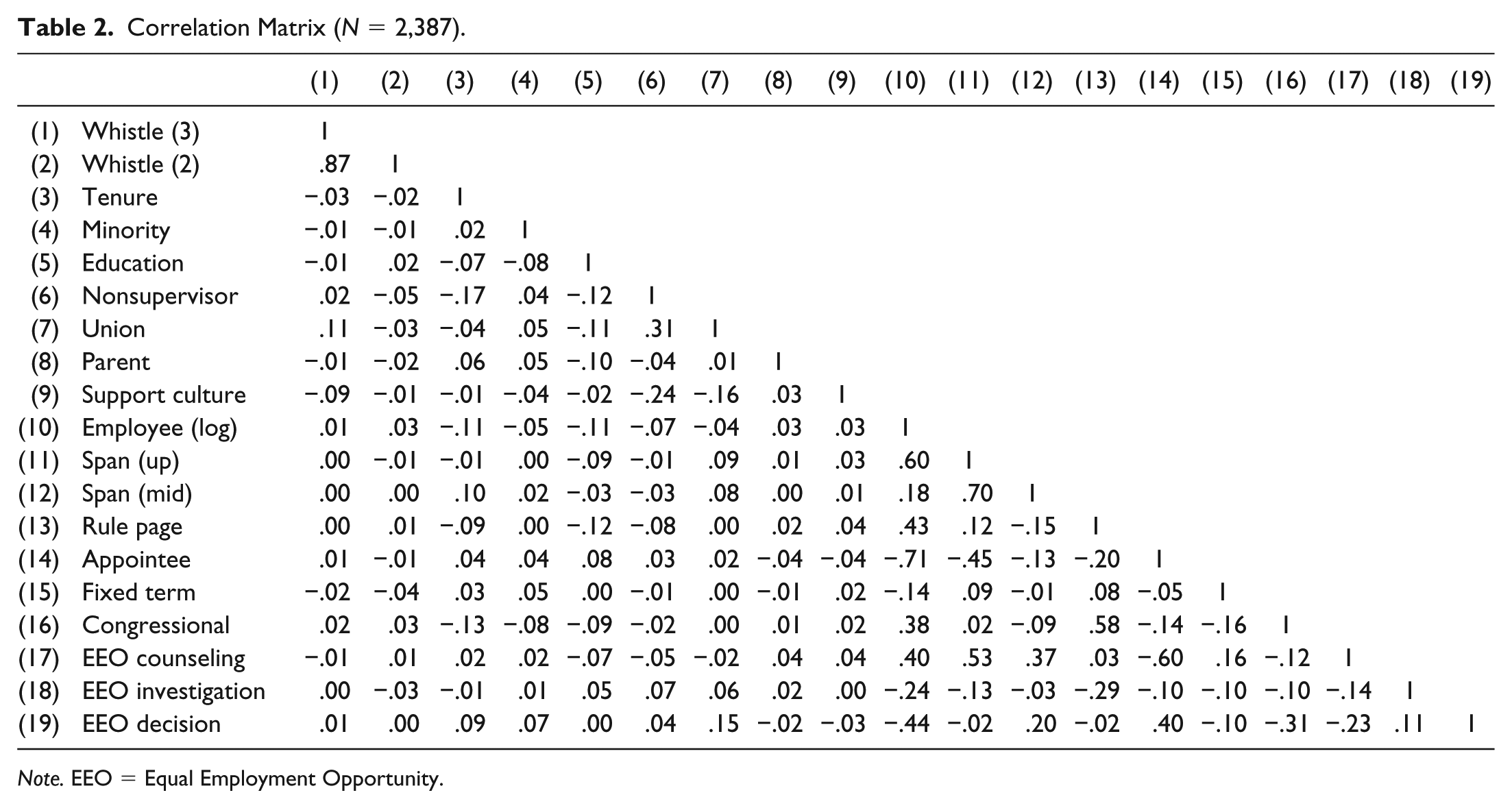
Note. EEO = Equal Employment Opportunity.
Findings
Table 3 contains three models reporting analysis results. The table reports unstandardized coefficients (βs) and marginal effects at means (MEMs). This study begins by interpreting Model 1, which displays the logistic regression findings with the dependent variable with two nominal outcomes (1 = whistleblower, 0 = inactive observer). Upper managers’ span of control is positively associated with whistleblowing (β = 1.38, MEM = 0.31, p = .053). In contrast, middle managers’ span of control is negatively associated with whistleblowing (β = −0.11, MEM = −0.02, p = .051). Regarding the effects of political control, federal employees are less likely to blow the whistle in agencies where agency leaders have fixed terms (β = −6.46, MEM = −1.44, p = .047). In addition, the increase in the number of congressional committees overseeing a federal agency is negatively associated with whistleblowing (β = −1.19, MEM = −0.27, p = .06). Prompt responsiveness for EEO procedures—proxies for internal system responsiveness for whistleblowers—shows mixed results. Prompt EEO counseling is negatively related to federal employees’ whistleblowing (β = −0.17, MEM = −0.04, p = .045). In contrast, prompt EEO investigations (β = 0.05, MEM = 0.01, p = .069) and decisions (β = 0.07, MEM = 0.02, p = .044) have positive relationships with whistleblowing.
Analysis Results.
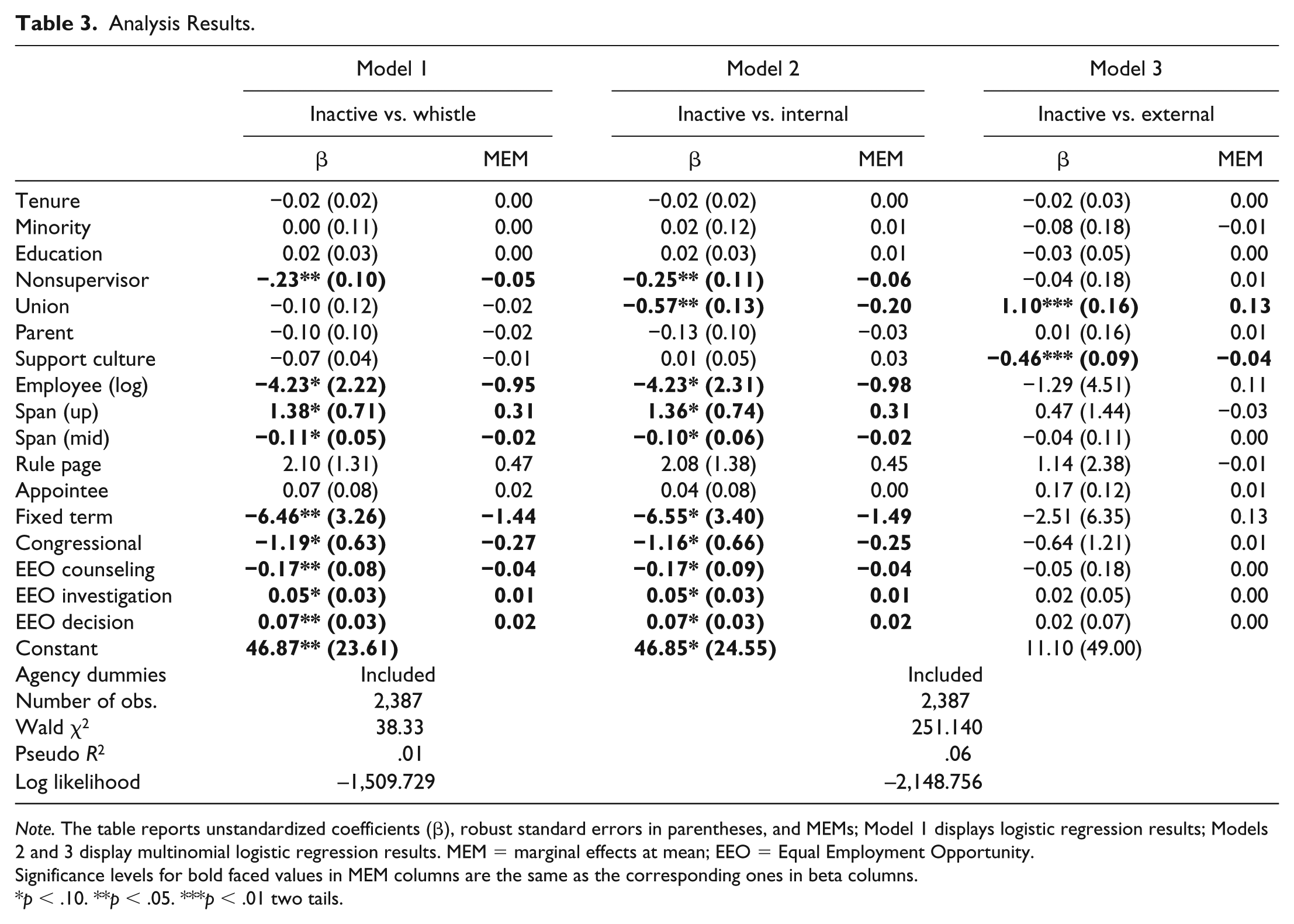
Note. The table reports unstandardized coefficients (β), robust standard errors in parentheses, and MEMs; Model 1 displays logistic regression results; Models 2 and 3 display multinomial logistic regression results. MEM = marginal effects at mean; EEO = Equal Employment Opportunity.
Significance levels for bold faced values in MEM columns are the same as the corresponding ones in beta columns.
p < .10. **p < .05. ***p < .01 two tails.
Models 2 and 3 display findings of a multinomial logistic regression with the dependent variable with three nominal outcomes (1 = inactive observer, 2 = internal whistleblower, 3 = external whistleblower). The inactive observer is a base outcome. In Model 2, upper managers’ span of control is expected to increase the multinomial log-odds for internal whistleblowers relative to inactive observers (β = 1.36, MEM = 0.31, p = .066). Conversely, middle managers’ span of control is expected to decrease the multinomial log-odds for internal whistleblowers relative to inactive observers (β = −0.1, MEM = −0.02, p = .064). In Model 3, these two variables show no significant relationships with the multinomial log-odds for external whistleblowers relative to inactive observers. Regarding the effects of political control, Model 2 shows that observers of wrongdoings are less likely to blow the whistle internally than to stay silent when they work in federal agencies that have fixed terms for agency leaders (β = −6.55, MEM = −1.49, p = .054) and are subject to greater control of congressional committees (β = −1.16, MEM = −0.25, p = .081). In contrast, Model 3 shows that these two variables are not statistically associated with the multinomial log-odds for external whistleblowers relative to inactive observers. Similar to Model 1, I determine mixed findings for the effects of prompt responsiveness for EEO procedures in Model 2. When EEO investigation (β = 0.05, MEM = 0.01, p = .095) and EEO decision variables (β = 0.07, MEM = 0.01, p = .055) increase, federal employees are more likely to blow the whistle internally than to stay silent. In contrast, EEO counseling decreases the multinomial log-odds for internal whistleblowers relative to inactive observers (β = −0.17, MEM = −0.04, p = .056). In Model 3, these three EEO variables are not significantly associated with the multinomial log-odds for external whistleblowers relative to inactive observers.
Turning to the control variables, lack of power in organizations makes nonsupervisors less likely to blow the whistle internally (see Model 2; β = −0.25, MEM = −0.06, p = .018) than supervisors; this is consistent with previous research (Miceli & Near, 1984; Rothwell & Baldwin, 2006). Being a union member yields different results for internal and external whistleblowing. Union members are less likely to disclose wrongdoings internally (see Model 2; β = −0.57, MEM = −0.2, p = .00) but are more likely to do so externally (see Model 3; β = 1.1, MEM = 0.13, p = .00). In addition, supportive cultures are negatively associated with external whistleblowing (see Model 3; β = −0.46, MEM = −0.04, p = .00).
Discussion and Implications
This section discusses the study’s findings and draws theoretical or practical implications from them. I summarize results of the hypotheses in Table 4. First, the different effects of upper-level managers’ and middle-level managers’ spans of control may indicate the role of organizational level in explaining public employees’ exercise of discretion in whistleblowing decision-making (Hypothesis 1). There are possible explanations for these findings. Perhaps employees at the low organizational levels lack power and resources in disclosing wrongdoings and have a greater fear of retaliation compared with those at the high organizational levels (Mesmer-Magnus & Viswesvaran, 2005; Miceli et al., 2008). In addition, higher-level employees with more information about overall functioning within organizations may be in better positions than lower-level employees are to identify and diagnose organizational misconduct (Keenan, 1990). These findings suggest that public organizations promoting whistleblowing should put more efforts into helping lower-level employees overcome barriers to disclosing wrongdoings internally.
Summary of Hypothesis Tests.
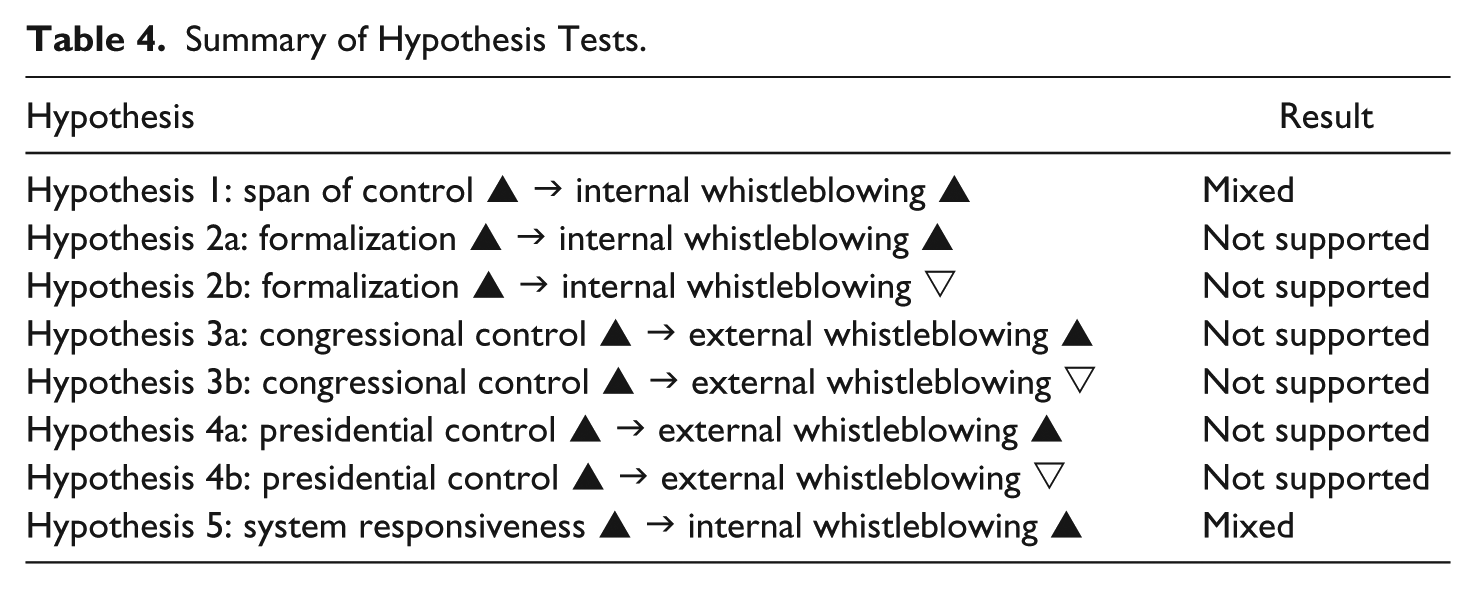
Second, this study shows that fixed terms for agency leaders and the number of congressional oversight committees have no significant relationships with external whistleblowing (Hypotheses 3 and 4). Interestingly, these variables are significantly related to internal whistleblowing, which warrants discussion. Starting with the fixed-term variable, given that whistleblowing can be regarded as a challenge to top management (Miceli & Near, 1992; Miethe, 1999), agency leaders’ greater insulation from presidential control (i.e., with fixed terms) may permit them to exert more hierarchical controls over whistleblowing. This finding suggests that presidential control over how federal agency leaders address whistleblowing is needed in addition to passing whistleblower protection laws (Near & Miceli, 2008). Regarding the negative relationship between the number of congressional oversight committees and federal employees’ internal whistleblowing, a potential explanation is that congressional control has been effective in reducing wrongdoings within federal agencies, thereby decreasing the need for internal whistleblowing. Future research may seek to examine which factors, such as congressional pressure and assistance that may defend federal whistleblowers and monitor agencies’ whistleblowing investigations, are key in decreasing mismanagement and abuse of authority within federal agencies.
Third, internal system responsiveness to employee complaints or grievances generates mixed findings (Hypothesis 5). Counterintuitively, the higher percentage of prompt EEO counseling sessions is negatively associated with federal employees’ internal whistleblowing. For interpretation of this result, this study refers to Lavena (2016) who found that U.S. federal employees were less likely to blow the whistle when they perceived their work environments as respectful, fair, and cooperative. The author provided two explanations for the findings: a supportive work environment may (a) diffuse individual responsibility for reporting wrongdoings and (b) reduce wrongdoings within agencies and, thus, the need for whistleblowing. When federal employees perceive that agencies care about their voices, such employees might believe that organizational misconduct can be prevented or detected without their disclosure, which often entails risks. Furthermore, internal system responsiveness may strengthen employees’ organizational commitment, which could limit behaviors that challenge their organization or leaders (Caillier, 2012; Kolarska & Aldrich, 1980).
In contrast, the higher percentages of prompt EEO investigations and decisions are positively related to internal whistleblowing. Internal system responsiveness may offer psychological safety to potential whistleblowers when they perceive that their voices will count and that organizations will punish wrongdoers accordingly (Miceli et al., 2008; Trevino et al., 1999). Some internal units that receive and investigate whistleblowing within federal agencies have been criticized for breaching whistleblowers’ confidentiality and misusing their information for retaliation (Devine, 1997). These findings suggest that whistleblowing policies and procedures alone are not sufficient for encouraging internal whistleblowing; such policies and procedures must be accompanied by internal system responsiveness to whistleblowers. Taken together, the findings on the three EEO measures demonstrate that federal agencies should promote the effectiveness of whistleblowing through internal system responsiveness and take proactive steps to address alleged wrongdoings before whistleblowing takes place.
Fourth, the finding that employee perception about organizational support for whistleblowing is negatively associated with external whistleblowing suggests that external whistleblowing (which often entails more extensive retaliation than internal whistleblowing does) is more dependent on employees’ psychological safety than on external factors (Dworkin & Baucus, 1998; Park & Blenkinsopp, 2009). By fostering a supportive climate for whistleblowing, organizations may reduce external whistleblowing and encourage internal whistleblowing, allowing them more opportunities to correct problems raised within organizations and to avoid external costs.
Fifth, the findings about other control variables also merit discussion. Interestingly, union members are less likely to blow the whistle internally, but they are more likely to do so externally. Union members may perceive higher psychological safety in disclosing wrongdoings to external parties; also, union members’ potential internal conflicts may discourage internal whistleblowing. Furthermore, consistent with Miceli and Near (1992), internal whistleblowing is less likely in large organizations than in small ones. The disadvantage of large organizations may be addressed by promoting a culture in which employees feel more responsibility for reporting wrongdoings (Rothwell & Baldwin, 2006).
Overall, this study suggests that organizational structure, political environment, and internal system responsiveness play meaningful roles in explaining internal whistleblowing in U.S. federal agencies. Future whistleblowing studies should consider the effects of these factors on whistleblowing behavior and further develop the POB model. Specifically, the three factors may influence employees’ sense of responsibility to report wrongdoings or their antecedents such as PSM (i.e., more likely in organizational arrangements that allow more employee discretion) and foster higher expectancy that such reports will correct wrongdoings. These considerations are particularly relevant for public organizations that typically operate under a more mechanistic structure and face greater institutional pressures than private ones, which influence bureaucratic attitudes and outcomes (Rainey, 2009; Resh, 2015; Wood & Waterman, 1991).
From a practical standpoint, public managers should adopt more holistic and strategic approaches toward managing whistleblowing. Changes in structural arrangements may be viable options for such management. Essentially, whistleblower protection laws and policies alone are not enough; managers should also make an effort (Heard & Miller, 2006; Near & Miceli, 2008). Agency leaders should offer training to increase employee awareness about whistleblowing and create supportive culture. To maintain whistleblower confidentiality and system integrity, self-monitoring and improvement in reporting channels and procedures should be carried out regularly.
Limitations and Future Research Directions
This study has limitations. First, scholars need to be cautious in generalizing this study’s findings to a broader population of U.S. federal employees. This is because some respondents excluded from the analyses might have blown the whistle if they had observed wrongdoings. Perhaps some employees were uncertain about what constitutes wrongdoings and thus did not answer the survey question concerning observance of misconduct. In addition, the MPS 2010 included a small number of executive departments and large independent agencies. Second, although timeliness of EEO procedures is a reasonable proxy for internal system responsiveness to whistleblowers, obtaining measures that directly deal with how complaint recipients or organizations respond to whistleblowing would be desirable. Third, because the MPS 2010 was administered during the Obama administration, which underscored whistleblower protection, this study’s findings, particularly regarding presidential control, may or may not hold under different presidencies. Again, scholars should exercise caution in generalizing these findings.
Next, this study presents suggestions for future research. First, future studies can investigate the effects that other dimensions of organizational structure may exert on whistleblowing; such dimensions possibly include administrative intensity, centralization, and professionalization. For example, Miceli and Near (1992) expected that internal whistleblowing was less likely in organizations utilizing top-down decision-making approaches that tend to suppress views different from those of upper management. Other components of organizational structure may also encourage or deter employees’ whistleblowing behavior by influencing their discretion and intent to risk disclosing organizational wrongdoings.
Second, another potential research question would examine how different organizational designs (e.g., matrix and divisional structure) influence whistleblowing (King, 1999). Third, investigating how the predictors examined in this study affect whistleblowing in small- or medium-sized federal agencies and other public organizations would also be worthwhile. Fourth, future research can further examine how organizational structure, political control, and internal system responsiveness influence retaliation against whistleblowers. An interesting question may be whether these factors similarly or differently explain likelihood of whistleblowing and retaliation.
Conclusion
This study contributes to whistleblowing literature (which has largely focused on personal factors) by examining the role of organizational structure, political control, and internal system responsiveness. These factors merit consideration because employee behaviors including whistleblowing are influenced by organizational structures and external environments in which organizations operate. Future research should examine to what extent employees’ whistleblowing decisions are contingent on several organizational and environmental characteristics and how such factors interact with various personal characteristics.
Footnotes
Appendix
Declaration of Conflicting Interests
The author(s) declared no potential conflicts of interest with respect to the research, authorship, and/or publication of this article.
Funding
The author(s) received no financial support for the research, authorship, and/or publication of this article.