




Abstract
Although public employees increasingly utilize social media in the workplace, public management scholarship has provided little evidence on how public employees use such tools and what role they play in professional networks. Public organizations struggle to balance policies encouraging social media use for communication and regulations that prevent time wasting or security issues. We suggest that an examination of social media communication patterns can guide public organizations to design organizational policies and address internal social media use. Combining a network approach with insights from communication and social media studies, we investigate how closeness, proximity, interactions, and resources predict public employees’ communication on social media. We develop and test a multilevel model using 2014 egocentric network data among 2,362 employees in a U.S. public university. We find that social media communication in public organizations is explained by proximity, closeness, and social interactions rather than professional interactions and access to resources.
Social media tools are Internet-based communication platforms that “build on the ideological and technical foundations of Web 2.0 and allow the creation and exchange of user-generated content,” such as text, videos, or images (Kaplan & Haenlein, 2010, p. 61). They include free platforms, such as Facebook, Twitter, and YouTube, and fee-based services such as Ning, Basecamp, and LinkedIn Premium. Some social media are designed to exclusively connect professionals in a certain field or provide a venue to socialize and exchange professional advice within organizations (Kügler, Dittes, Smolnik, & Richter, 2015). Enterprise Social Media (ESM) or GovLoop are examples of professional social media platforms.
Social media were initially designed for personal use, but they are increasingly pervasive in individuals’ professional life (Mergel & Bretschneider, 2013). As individuals utilize social media to communicate and connect with friends and family, they replicate similar practices with their colleagues. A national survey conducted by Pew Research reports that Americans utilize social media in the workplace to “make or support professional connections” (24%), “build or strengthen personal relationships with coworkers” (17%), “learn about someone they work with” (17%), and access information from someone either inside or outside their organization (12%). Studies in public organizations also consistently report that public employees utilize social media to maintain contacts and exchange information with colleagues inside and outside their agency (Fusi & Feeney, 2018; Khan, Swar, & Lee, 2014).
As social media use grows, employers have developed organizational practices and policies on social media use in the workplace. Some organizations encourage employees to use social media to communicate across departments, share information, and socialize with colleagues (Cao, Vogel, Guo, Liu, & Gu, 2012; Pandey & Bretschneider, 1997; Treem & Leonardi, 2012). Others are concerned that employees might disclose sensitive information or that social media use might decrease work productivity as employees connect with friends while at work (Dunn, 2013; Wood, 2013). Therefore, they monitor, limit, or block access to social media websites during working hours. This trend appears on the rise in public organizations where some employers adopt strict social media policies and monitor employees’ social media accounts (Tufts, Jacobson, & Stevens, 2015).
Despite growing interest, more research is needed on the role of social media in the workplace and to what extent and how public employees use social media. Scholars have built solid knowledge on social media use for organizational purposes, such as engagement with citizens, and they have examined whether public employees utilize social media tools for work purposes, mostly treating social media use as a dichotomous phenomenon (Bretschneider & Parker, 2016; Feeney & Welch, 2016; Kavanaugh et al., 2012; Medaglia & Zheng, 2017). But to the best of our knowledge, few studies have considered the networking nature of social media tools and investigated how social media are entering workplace practices of communication, socialization, and exchange among coworkers (Wukich, Siciliano, Enia, & Boylan, 2017; Yates & Paquette, 2011). As social media use in the workplace increases, these questions are important to guide social media policies and understand how social media shape work environment and outcomes in public organizations.
This article focuses on social media communication among employees in a public organization as a first step to move forward social media research. Communication is an active process of interaction that provides the basis for employees to socialize, form relationships, exchange advice and resources, and develop social norms and common values. Previous studies show that both online and offline communication have positive effects on job performance and socialization (Ahuja, Galletta, & Carley, 2003; Zhang & Venkatesh, 2013). We combine a network approach with insights from communication studies and public management research on social media to develop a set of competing hypotheses that examine how closeness, proximity, interactions, and access to resources influence social media communication with colleagues. We test our hypotheses using a unique dataset of egocentric network data from a 2014 survey administered to 2,362 employees in a U.S. public university. We utilize a multilevel model to account for both relationship (Level 1) and individual (Level 2) characteristics to predict social media communication in public employees’ networks.
We find that social media communication occurs mostly with friends, proximate colleagues, and colleagues with whom employees socialize outside the workplace. Our conclusions discuss implications of our results for human resource management and future research on social media use in public organizations.
Theoretical Framework
Public management scholars and practitioners have paid increasing attention to how and with whom public employees communicate and socialize and to the formation and composition of interpersonal networks (Kapucu, Hu, & Khosa, 2017; Maroulis, 2017; Nisar & Maroulis, 2017; Siciliano, 2017). Through socializing with colleagues, employees learn about organizational culture, practices, and social norms and adopt behavior and attitudes that are acceptable within their organization (Hatmaker, Park, & Rethemeyer, 2011). Interactions among colleagues also increase cognitive homogeneity and strengthen collective identity and social capital, which in turn facilitate knowledge sharing, access to resources, and collaboration (Leana & Van Buren, 1999).
Social media platforms provide a new and particularly rich digital environment where employees can socialize, communicate, collaborate, and share (Treem & Leonardi, 2012; Yates & Paquette, 2011). Communication studies argue that social media enhance individual agency in forming and managing relationships and shaping communication patterns (Bryer & Zavattaro, 2011; Olmstead, Lampe, & Ellison, 2016; Kane, Alavi, Labianca, & Borgatti, 2012). Kane and colleagues (2012) note “the ability of users to articulate their relational connections and view and navigate those connections involves a capacity to visualize and manipulate the network structure—that is how people establish and manage the connections between others in a network” (p. 281). On social media, such capacity is increased by the characteristics of the digital platform. Users can more easily visualize and explore connections within and across their network, gain awareness of which individuals are better connected (e.g., comparing number of friends), as well as develop new ties by searching through their list of friends and followers, deciding if they want to “follow” or “be friends” with someone, and eventually communicating with them. A survey conducted by the Pew Research shows that most individuals (63%) actively manage their online networks by choosing to deleting ties or by befriending or unfriending individuals (Madden, 2012).
Scholars and practitioners hold an optimistic view about individual agency on social media and suggested that individuals mostly leverage social media tools to expand and consolidate their network (Cao et al., 2012; DiMicco et al., 2008; Pandey & Bretschneider, 1997). However, initial studies find mixed evidence about social media use in professional environments (Boyd & Ellison, 2007; DiMicco et al., 2008). Some studies show employees take advantage of social media to connect with distant collaborators, reinforce weak relationships, and develop new ones (Kim, Kim, Park, & Rice, 2007; Lampe, Ellison, & Steinfield, 2006). Others find that employees refrain from exposing their personal life to coworkers and supervisors and utilize social media tools only with long-term friends and close colleagues (Correa, Hinsley, & Gil De Zuniga, 2010).
In public organizations, social media use likely has unique implications, which affect how employees engage with such tools (Kim & Lee, 2006). For one thing, research shows that privacy concerns with social media activities, including perceptions of risks associated with posting online, negatively impact social media use (Millham & Atkin, 2016). Public employees likely have more cautious attitudes toward privacy in the workplace because of their dual roles as citizens and government workers, and thereby they might display differential patterns in social media communication when compared with their private counterparts. For another, public organizations apply stricter rules on social media use to prevent security breaches and exposure of sensitive information (Papandrea, 2012; Tufts et al., 2015) and are less innovative in promoting social media use (Bretschneider & Parker, 2016). In response, we might expect that public employees are less willing to use social media in the workplace (DiMicco et al., 2008).
Our research combines a network approach with communication studies and public management research to develop a set of competing hypotheses that investigate the choice of public employees to communicate on social media with their colleagues. Previous research has highlighted that technology use and adoption is shaped by perceived costs and benefits (Khan et al., 2014), the task that individuals aim to accomplish (Oliveira & Welch, 2013), and the kind of uses that technology can afford (Treem & Leonardi, 2012). In the case of social media communication, we suggest that the characteristics of interpersonal relationships alter the social and instrumental costs and benefits of communicating on social media with professional contacts (Kane et al., 2012; Kim et al., 2007; Zhang & Venkatesh, 2013). In other words, as they decide to use social media tools to communicate with their colleagues, public employees will consider the affordances offered by social media as well as the nature and characteristics of their interpersonal relationships.
We focus on four relational characteristics that might influence social media communication: closeness, proximity, interactions, and resource access (Borgatti, Ajay, Brass, & Labianca, 2009; Burt, 1992, 2000; Granovetter, 1973). Closeness refers to relationships characterized by high trust, emotional support, frequency of interaction, and reciprocity (Granovetter, 1973; Lin, Cook, & Burt, 2001). Proximity describes whether two colleagues share a physical space or are physically separated, such that colleagues working in the same office are more proximate than colleagues working in different offices. Interactions capture short-term relationships that occur between two colleagues, for instance collaboration on joint tasks. Finally, resource access considers the tangible and intangible resources that are embedded and potentially exchanged between two colleagues. Particularly, we argue that employees develop relationships with colleagues in high-ranking positions or with longer tenure within the organizations to access resources.
Our hypotheses are competing because literature suggests that social media can provide a wide range of social and instrumental benefits and costs (Kane et al., 2012; Treem & Leonardi, 2012) and we aim to explore how the four relational characteristics result in distinct communication patterns which do not necessarily converge. For example, to access resources employees might need to communicate with higher ranking employees to whom they do not feel close. Similarly, public employees might evaluate social media tools based on their effectiveness to overcome spatial constraints and facilitate communication with distant collaborators or they might assign greater importance to trust or social norms embedded in close relationships which reduce privacy concerns. Given these competing effects, it is important to examine and identify the relative strength and significance of each mechanism in shaping social media communication among public employees.
Figure 1 summarizes our theoretical framework. We adopt a multilevel model as network ties are structurally embedded within individuals. Level 1 predictors represent the four relational mechanisms that are of primary interest for this study. Level 2 predictors account for individual characteristics that can affect social media communication as found by previous research (Cao et al., 2012; Khan et al., 2014; Klang & Nolin, 2011). Individual characteristics include social media use for work purposes, personal social media use, trust toward colleagues, perceptions about social media use, and gender, tenure, and education. We explore each hypothesis in the next section.
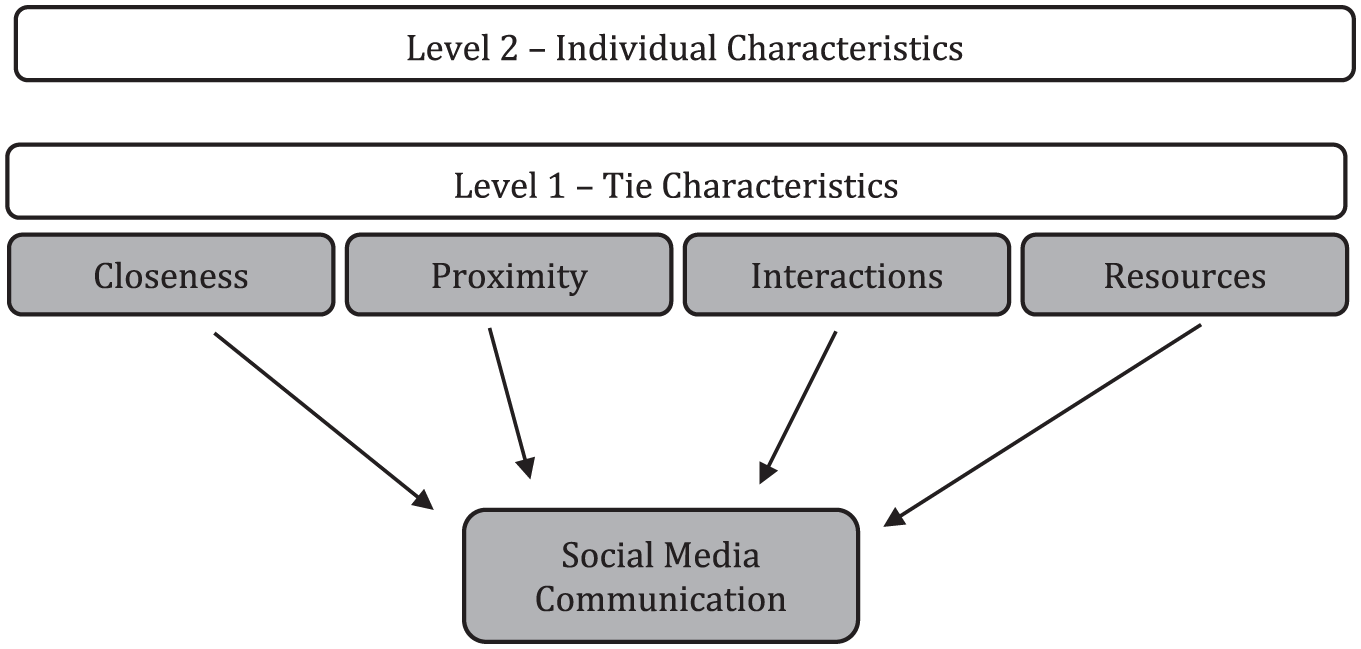
Understanding social media communication among public employees.
Hypotheses
Closeness
Close relationships are characterized by high trust, reciprocity, affection, and emotional support (Lincoln & Miller, 1979). Close relationships in the workplace are important to access support and advice from colleagues and to deal with issues such as work–life balance or emotionally intense work situations (Keiser, 2010; Lipsky, 1980). In public organizations, close relationships, such as with peers and friends, are crucial in advice and support networks (Berman, West, & Richter, 2002; Siciliano, 2015).
Previous research shows mixed findings about the effect of closeness on social media communication. Some scholars find that employees take advantage of social media tools to connect with less close colleagues (DiMicco et al., 2008; Lampe et al., 2006), primarily using social media to reinforce weak relationships and expand their professional networks. Others suggest that employees utilize social media to reinforce and maintain friendship ties with colleagues and avoid exposing their personal life to less close colleagues (Boyd & Ellison, 2007; Correa et al., 2010; Kim et al., 2007).
In public organizations, we expect that closeness will play a positive role in shaping social media communication. Public organizations tend to adopt strict social media policies, have greater security concerns, and often utilize social media in hiring and monitoring practices (Fusi & Feeney, 2017; Papandrea, 2012; Tufts et al., 2015). As employers tend to control social media use, public employees might rely on the trust embedded in close relationships to prevent negative repercussions that could derive from publicly sharing content on social media platforms. Public employees might feel more comfortable and secure in exposing pictures, videos, and other activities on their social media account to close colleagues.
Moreover, previous research finds that close ties have great relevance in public employees’ network (Berman et al., 2002). For instance, Siciliano (2017) shows that public employees tend to seek professional information from close ties. Given the importance of closeness, public employees might utilize social media as an additional communication tool to maintain and connect with close colleagues. Closeness, which includes frequent transaction and cognitive understanding, can also help compensate for the limitations of social media to transmit nonverbal and paraverbal cues, thereby facilitating message interpretation and communication on social media platforms (Zhang & Venkatesh, 2013). Hence, we expect closeness to be positively associated with social media communication.
Proximity
Physical proximity is a strong predictor of communication. Employees who share the same space more frequently interact and communicate with each other than employees who are physically separated (Cho, Trier, & Kim, 2005); in-person interactions are spontaneous and facilitate understanding of nonverbal cues (Haythornthwaite & Wellman, 1998). By contrast, relationships with colleagues in distant departments or organizations can be challenging as the physical distance reduces opportunities to interact and increases sociocognitive barriers (O’Leary & Mortensen, 2010).
Employees in public organizations face increasing pressures to act beyond the boundaries of their organization because of the growing specialization, fragmentation, and interdependence of work activities (Ansell & Gash, 2008; Thompson, 1967). Social media are advantageous in transcending physical boundaries and facilitating communication among remote individuals. Social media offer public employees the opportunity to overcome spatial constraints, facilitate coordination, increase frequency of interaction, and develop interpersonal ties with colleagues outside their working department (Bargh & McKenna, 2004; DiMicco et al., 2008; Zhang & Venkatesh, 2013). Previous studies show that public employees favorably perceive social media as tools to maintain contacts and share information with collaborators in other agencies and departments (Fusi & Feeney, 2018; Khan et al., 2014).
Moreover, public employees in different organizations and departments are likely to have different organizational cultures and practices (Hudson, Hardy, Henwood, & Wistow, 1999; Newell & Swan, 2000). Social media platforms offer a common environment where employees can communicate and share, thereby bridging the differences in group identity and organizational membership (Kane et al., 2012). GovLoop, a social media that connects public employees across different organizations, is an example of the bridging role that social media platforms can play in professional interactions (Sadeghi, Ressler, & Krzmarzick, 2012).
Given the imperative of working outside the organizational sphere and the opportunities that social media afford, we should expect that public employees will be more likely to use social media to communicate with physically distant colleagues as compared with colleagues who are physically close to them.
Interactions
Interactions are short-term relationships that cease to exist at the end of an event (Borgatti et al., 2009; Kane et al., 2012). Unlike close ties, interactions are not characterized by high trust or emotional closeness but are instrumental to work activities and social life. For instance, employees interact with one another to collaborate on joint tasks or through participation in professional networking events.
Traditional information and communications technology tools (e.g., emails) lack interactive features that can encourage socialization, making it difficult to develop new personal relationships from occasional interactions and explore weak ties (Sias, Pedersen, Gallagher, & Kopaneva, 2012). By contrast, social media tools are designed to ease and encourage connections and communication among individuals who are not close (Gil de Zúñiga & Valenzuela, 2011; Kim et al., 2007). Social media offer platforms to follow up on discussions and activities that are initiated during offline communication, exchange additional information, promote social events, and share updates among colleagues. Zhao and Rosson (2009) found that employees utilize social media tools to keep in contact with and get information from individuals they met at professional conferences. A survey from the Pew Research Center also shows that employees often use social media in the workplace “to build or strengthen personal relationships with coworkers” (Olmstead et al., 2016).
As public organizations become increasingly knowledge intensive, public employees are subject to greater pressure to maintain relationships beyond transitory events to gain knowledge, expertise, and know-how that they need to accomplish their daily tasks (Siciliano, 2017; Willem & Buelens, 2007; Zhang & Venkatesh, 2013). Social media might represent a new venue for public employees to get to know colleagues, develop close relationships out of transitory interactions, and expand their professional relationships (Kane et al., 2012). For instance, public employees might leverage social media tools to share articles, videos, or other information that can help collaborators to address work tasks, promote social events, and foster conversations among professional contacts. Hence, we argue that public employees will have incentives to use social media tools with individuals with whom they have interacted, either inside or outside the workplace, so that they can extend their relationships beyond transitory events.
Resource Access
Professional networks are fundamental to access resources that employees need to complete their work tasks and goals (Ibarra, 1993). Resources can be material, such as information, nonmaterial, such as mentorship and support, or symbolic, such as reputation (Ashford & Tsui, 1991; Morrison & Vancouver, 2000). Studies have shown that employees who have greater access to resources are more innovative and enjoy greater career advancements and mobility (Maroulis, 2017; Podolny & Baron, 1997).
Social media tools can reduce costs and efforts needed to seek resources from colleagues and might help to reinforce resource networks (Wellman et al. 1996). Visibility—“the ability to make behaviors, knowledge, preferences, and communication network connections that were once invisible (or very hard to see) visible to others” (Treem & Leonardi, 2012, p. 150)—is one of the main affordances of social media tools. Visibility facilitates the chance for employees to identify individuals with access to key organizational resources (DiMicco et al., 2008; Lampe et al., 2006). For instance, while investigating Twitter use for work purposes, Zhao and Rosson (2009) find that employees often describe Twitter as a helpful tool to select knowledgeable colleagues to work on a project.
We focus our attention on how public employees might utilize social media to access resources through communication with employees who are more highly ranked or have been working longer within an organization (“senior colleagues”). Seniority and tenure often correspond to greater access to key resources within an organization (Lincoln & Miller, 1979). Employees in more senior positions generally enjoy greater prestige within the organization, have better access to information, and greater influence over organizational decisions (Ibarra, 1993). Tenure is also a source of power and influence within an organization. Individuals who have worked longer within an organization have gained legitimacy and have more experience and knowledge about organizational practices and norms (Lin, 1999; Oberfield, 2014; Pee & Kankanhalli, 2016). Public employees are likely to connect with highly ranked employees and employees with longer tenure to access resources such as information, prestige, and influence (Nisar & Maroulis, 2017).
We argue that social media can increase the accessibility and visibility of resources embedded in ties with senior colleagues. Employees in more senior positions or with longer tenure might be more likely to post information relevant to work activities, provide discussions on work topics, and promote professional events. Public employees can communicate on social media with these employees through simple forms of communication such as comments, likes, and retweets (Haythornthwaite & Wellman, 1998; Zhang & Venkatesh, 2013). These forms of communication help create instrumental ties that require little efforts to be maintained but expand an individual’s access to resources (Ali-Hassan, Nevo, & Wade, 2015).
Hence, according to a resource-based perspective, we expect public employees to utilize social media platforms to communicate with higher ranked employees and employees with longer tenure who can help them access resources. Even if the employees do not derive immediate resource benefits, connections with those individuals constitute latent ties that can come in handy when they need to access certain types of resources the ties can confer or facilitate.
Method
Data and Sample
We test our hypotheses using survey data collected as part of the “Creative and Collaborative Information Technology (CCIT)” project conducted in 2014 by researchers at the University of Illinois at Chicago. The survey aimed to understand social media and technology use among public employees for both professional and personal purposes. Respondents were asked questions about their work activities, technology and social media use and preferences, collaboration and advice networks, attitudes toward the workplace, job characteristics, and workplace environment.
The survey collected egocentric network data about respondents’ professional relationships using two sets of questions: name generator and name interpreter questions. The name generator questions asked respondents to name 10 key individuals with whom they collaborate on two main work activities and another five colleagues to whom they “go to ask for help and advice when not sure about how to do a work task.” In total, each respondent could indicate up to 15 individuals. We removed overlapping names across collaboration and advice networks.
The names provided in the name generator questions were piped into a set of name interpreter questions. The name interpreter questions asked respondents about the nature of the relationship (i.e., whether the person was a close friend or a senior colleague), length of the relationship, frequency of communication, social media communication, and professional and social activities.
The survey was implemented through Sawtooth and administrated to 2,362 staff employees within a U.S. public research university. All employees listed in the university phonebook list were included in the study. Individuals holding a faculty appointment were excluded because faculty perform an essentially different set of work activities and utilize social media for distinctive purposes. Respondents were invited by email and the survey remained open for approximately four months. The team collected 633 responses, of which 81 were from ineligible respondents (i.e., faculty members). The final dataset included 552 responses (411 completed and 141 partials). 1 After accounting for unreachable respondents (i.e., bad email addresses), we calculated an unweighted response rate equal to 24.5% (RR2 method, American Association for Public Opinion Research, 2016) and a weighted response rate, which consider potential ineligible nonrespondents, of 27.5% (RR4 method).
Given our primary interest in network ties and social media communication, our analysis includes only individuals who reported at least one network tie and use social media for either personal or work purposes 2 . We retained 277 clusters with 2,378 relationships for analysis. Almost all respondents (95.6%) are full employees at the university and more than half of them are women (68%). The majority hold a master degree (45%), around one third have a bachelor degree (29%), and only a few hold a PhD (5%). Facebook is the most utilized social media (96.6%) but a vast majority of employees also utilize LinkedIn (86.4%), Twitter (62.7%), and Google Plus (53.7%), which are suitable for communication. YouTube (80.1%), despite widely adopted, provides no feature to directly communicate with other users. The university does not have an internal social media platform.
Variables
Dependent variable
Our dependent variable Social Media Communication measures whether public employees use social media to communicate with the colleagues they named in their collaboration and advice networks. The survey defined social media as “technologies which encourage social and interactive behavior. Social media allows, but does not require, two-way information exchange between individuals or groups. Examples of commonly used social media tools include Facebook, Twitter, YouTube, etc.” For each network member, the survey asked, “In the past month, how frequently have you communicated with these people through social media?” While this item had a 6-point response set from never (1) to at least once a day (6), we created a binary variable for two reasons. First, because about 80% of the respondents replied “never,” the original variable distribution is severely skewed. Second, given this noticeable distribution, the difference between individuals’ use and nonuse of social media with network members becomes meaningful for this study. The final variable is coded 1 if the respondents communicated on social media with that colleague at least once during the past month and 0 if “never.” In our sample, public employees utilize social media to communicate only with 24% of their professional contacts. This is equivalent to communication with one to two colleagues on social media given the average network size of 8.3.
Independent variable
We use two variables to measure each of the four theoretical constructs as each variable captures a distinct dimension and allows us to provide more nuanced results. Closeness is measured by Friendship and Tie Strength. Friendship accounts for the affective component of a relationship; it measures whether the respondent considers a colleague to be a close friend (1) or not (0). Tie Strength measures length of the relationship by looking at how long the two individuals have known each other (1 = less than a year, 2 = between 1 and 5 years, 3 = more than 5 years). Proximity is measured by Virtual Ties and Locations. Virtual Ties measures whether two employees have ever met face-to-face (1) or not (0). When two individuals have never met in person, we argue they will perceive greater physical or cognitive distance than two individuals who occasionally meet in person; in the absence of in-person meetings, social media can provide an important communication tool. Location measures physical distance among employees. It is a nominal categorical variable of four categories: “Same office or department,” “Different department,” “Different college,” and “Different university.” We use “Same office or department,” which indicates great physical proximity, as reference category. We consider two types of offline interactions. Collaboration accounts for work-related interactions. It indicates whether an individual belongs to an employee’s collaboration network (1 = Yes, 0 = No). Socialization accounts for social interactions outside the workplace. It measures whether the respondent socializes with that person outside of work (1 = Yes, 0 = No). Finally, we operationalize resource ties with two variables, Senior-Rank and Senior-Tenure. In this article, we consider resource access to be a function of seniority and tenure within the organization. While this operationalization does not fully capture expertise of single individuals, it is consistent with the broader literature that argues some key individuals can provide greater access to resources because they have a higher rank or have worked longer in the organization. For instance, employees who occupy higher position might provide access to information and symbolic resources (i.e., prestige or recognition) to junior employees. Employees who have been working longer for the organization can have more information and knowhow, especially with regard to the particular organizational settings. This measure is commonly used in network studies (Lincoln & Miller, 1979; Nisar & Maroulis, 2017). Senior-Rank indicates whether the individual is senior to the respondent (Yes = 1) or not (No = 0). Senior-Tenure indicates whether the individuals have worked longer than the respondents in the organization (Yes = 1, No = 0).
Control Variables
At the relationship level, we include gender homophily to account for its possible effect on social media communication. Gender Homophily is coded 1 if the respondent is of the same gender as his or her colleague or 0 if respondent and his or her colleague are of the opposite gender.
Drawing on the social media adoption and use literature, we include several individual-level control variables to capture employees’ perceptions of social media (Fusi & Feeney, 2018; Khan et al., 2014), use of social media technologies (Mergel & Bretschneider, 2013), and demographic characteristics (Damanpour & Schneider, 2009). Trust and Perception about Social Media are measured by indices of items using a 5-point Likert-type scale ranging from strongly disagree (1) to strongly agree (5). Trust is constructed from a scale of three items: (a) In general, I can trust the colleagues with whom I collaborate; (b) in general, I find that my colleagues are open to criticism; (c) in general, I respect my colleagues. The Cronbach’s alpha is 0.7. Perception about Social Media is measured by an index of responses to three questionnaire questions: (a) Employees who use social media at work are more connected; (b) social media tools improve employees’ ability to share ideas; (c) social media significantly improve people’s ability to network. The Cronbach’s alpha is 0.87. After confirming the scale reliability, we averaged the two scales to derive values for the two variables, respectively.
The variables about individual use of social media capture frequency of use both for work and personal purposes. Social Media Use for Work measures the length of time the respondent spends on social media for work purposes every day (1 = none, 2 = less than 10 min every day, 3 = 10-30 min every day, 4 = 31-60 min every day, 5 = 1-2 hr every day, 6 = 2-3 hr every day, 7 = more than 3 hours every day). Personal Social Media Use measures the length of time respondents spend on social media use every day (1 = none, 2 = less than 10 min every day, 3 = 10-30 min every day, 4 = 31-60 min every day, 5 = 1-2 hr every day, 6 = 2-3 hr every day, 7 = more than 3 hr every day). We believe the two variables capture different dimensions of social media use: Personal use is associated with personal penchant and capability for using social media technologies, whereas social media use for work is partially related to the nature and demand of the work in which the respondent engages.
The individual demographic characteristics include respondent Age, Tenure (i.e., how long they have worked in the university) Education, Ego Gender, Number of Supervised Employees and Network Size. Education is measured by the respondent’s highest education level (response categories: 1 = no high school diploma, 2 = high school graduates, 3 = some college, 4 = bachelor degree, 5 = master degree, 6 = PhD). Ego Gender is dummy coded 1 if the respondent is female. Number of Supervised Employees is the number of employees the respondents supervise. Finally, we controlled for the Network Size by using the total number of individuals each respondent identified in her or his network.
Table 1 displays the descriptive statistics for our variables, considering the nested data structure. The summary statistics indicates the presence of missing values. When observed exogenous variables have missing values, the cases with missing values are excluded from the analysis (listwise deletion method). Because we estimated three models, incrementally increasing in complexity, each model uses a different set of variables and therefore could be estimated on different combinations of observations. To facilitate model comparison, we had to perform the analysis on the same set of observations. Therefore, although we have 2,378 usable observations from 277 clusters, we had to select observations available in the full model (i.e., the model using the most variables), resulting in 2,236 observations from 263 clusters.
Descriptive Statistics.
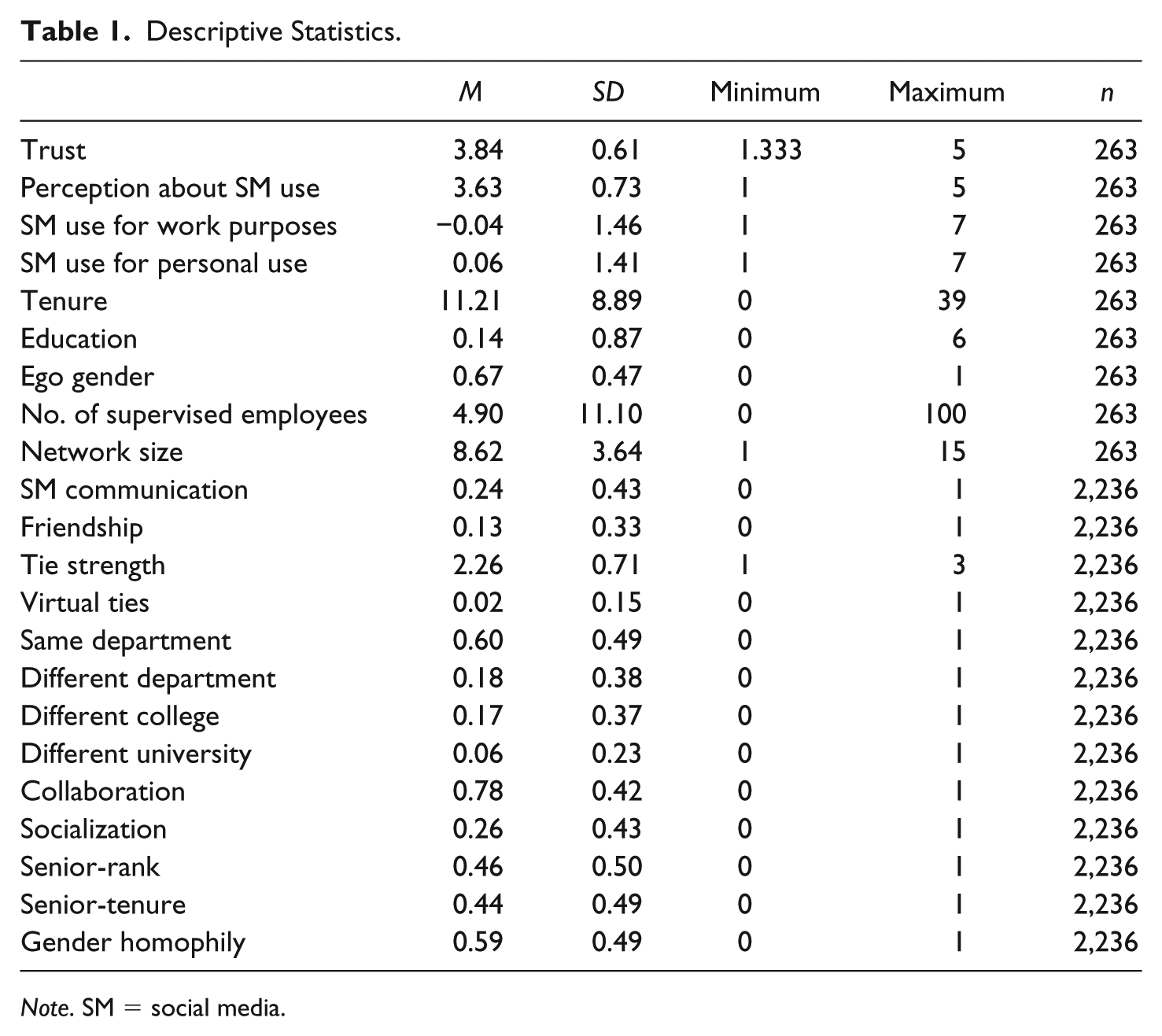
Note. SM = social media.
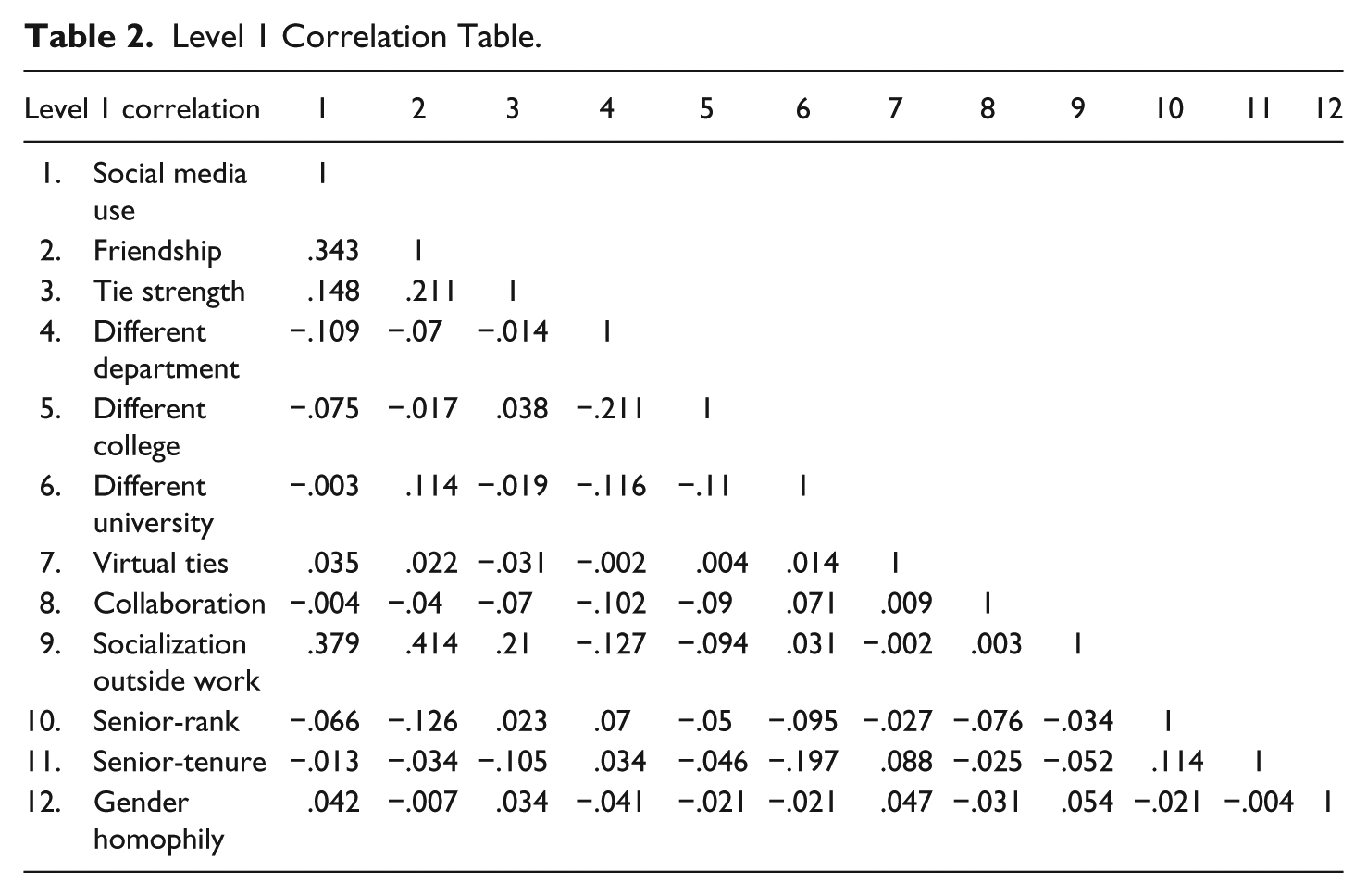
Table 2 and 3 show correlations among Level 1 and Level 2 variables, respectively. Given the hierarchical structure of the data and the zero cross-level correlations, correlations among Level 1 and Level 2 variables are displayed separately. Only Social Media Communication, deriving its variability from the relationship as well as individual characteristics, has a non-zero correlation with all the Level 1 and Level 2 variables. The data show no sign of multicollinearity.
Level 1 Correlation Table.
Level 2 Correlation Table.
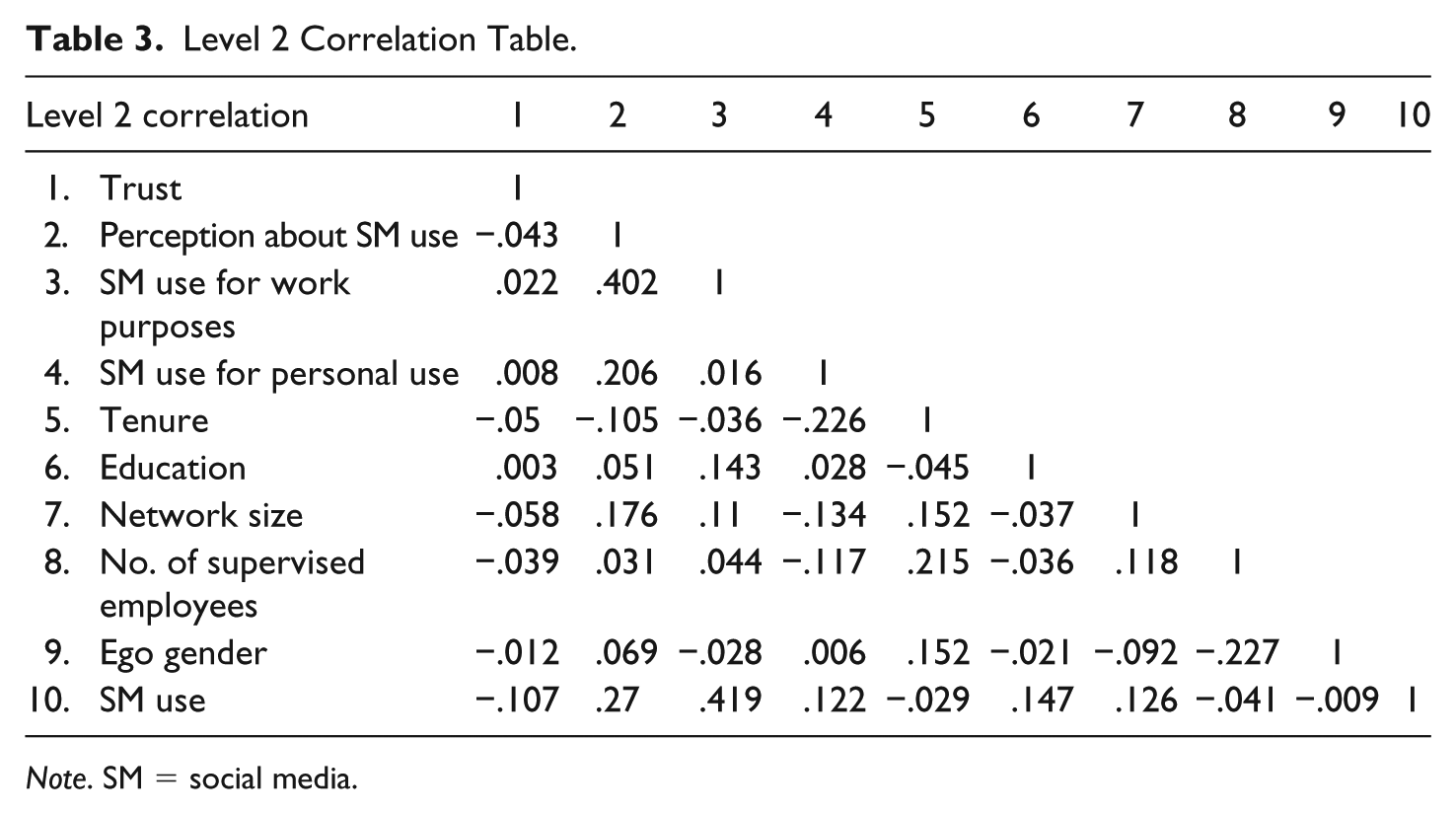
Note. SM = social media.
Data Analysis
The study uses a multilevel logistic modeling approach. A multilevel modeling approach is appropriate and necessary because the egocentric network data are hierarchically structured, with a set of relationships (Level 1) clustered within an individual (Level 2). Using a simple pooled model would violate the assumption of observation independence, which is particularly true for data nested within each subject (Snijders & Bosker, 1999). Ignoring the nested structure of data will likely reduce the standard errors of estimated parameters and increase the chance of committing Type 1 errors. Meanwhile, in a multilevel model, the outcome variable derives its variability from both Level 1 and Level 2 factors. Because we also expect individual characteristics to affect social media use, using a multilevel model would allow us to capture the Level 2 variability. Finally, given the dichotomous nature of the outcome variable, we use a logistic model.
Although it is statistically sound to estimate random slopes for the Level 1 predictors, the complexity of the model and the limited data repeatedly caused nonconvergence when the random effects were estimated. Because the nature of random effects is not of primary interest in this study, we assumed fixed-effects for Level 1 coefficients that summarize the overall relationships between the independent and dependent variables as constant across individuals. The model is written as follows. We abbreviate social media as SM in the following discussion.
Level 1 model:

where


The combined model is

This is a random intercept and fixed slopes model for a binary outcome variable. The Level 1 error variance is fixed at π2/3 and therefore no error term is specified at Level 1 (Snijders & Bosker, 1999). The intercept β0j is predicted by the Level 2 factors where the residual variance is to be estimated.
Model Results
We used Mplus 7.4 to conduct the data analysis. The first step in the analysis is to fit a model including only the intercept to evaluate the intraclass correlation coefficient (ICC) of the dependent variable. The ICC measures how similar observations within the same cluster are and provides a description of the variance components associated with Level 1 (relationships) and Level 2 (individuals). The parameter estimate is presented in Model 1 of Table 4. Both the ICC and design effect suggest the appropriateness of using a multilevel modeling approach (Muthén & Satorra, 1995). The ICC is 0.72, which is high for multilevel modeling and is attributable to the within-subject design of the data (Snijders & Bosker, 1999). It indicates that 72% of the variation in the variable Social Media Communication is attributable to individual differences. We took a deeper look at the high ICC by calculating the percentage of the alters the respondents communicate on social media. We find that 125 respondents (about 48%) do not communicate with any of their colleagues and 25 (about 10%) communicate with all of their colleagues on social media, adding up to approximately 58% of the entire sample used in the analysis. The strong consistency of more than half of the respondents in their communication patterns (i.e., either communicate with all or none of their colleagues) accounts for the high ICC observed in the sample.
Model Estimation.

p < 0.1; *p < 0.05; **p < 0.01; ***p < 0.001.
Note. SM = social media.
Based on the ICC, the design effect is 6.47. It measures how much the standard errors are underestimated in a nested sample compared with a simple random sample because observations are clustered (Maas & Hox, 2005). A design effect of 6.47 means that we would need 6.47 times as many observations to achieve the same power of 2,236 observations, had the ties all been independent from each other. After adjusting for the design effect, the effective sample size for standard error computation is 346.
After estimating the ICC, we gradually inserted the variables in the model and at each stage we checked the fit statistics to ensure that the model fit improved by the addition of variables. Because no overall fit indices are available for logistic multilevel modes, we used a sequence of nested models and conducted likelihood ratio (LR) tests for model comparison. Table 4 shows our estimated models. Model 2 estimates social media communication based on Level 1 relationship characteristics only and Model 3 included the individual characteristics to account for variations across individuals. Comparing Model 2 and Model 3 yields
Hypotheses Testing
Table 4 reports the modeling results in odds ratio to facilitate interpretation. An odds ratio greater than one suggests a positive relationship and a value lower than one indicates a negative relationship.
Hypothesis 1 proposes a positive relationship between closeness and social media communication. Both Friendship and Tie Strength are positively and significantly associated with social media communication, therefore showing consistent support for Hypothesis 1. It indicates that when public employees are close friends or have a long-term relationship with a colleague, they are more likely to communication on social media. Holding all the other Level 1 predictors at 0, the odds of social media communication increases by a factor of 5.12 when two public employees are close friends versus not close friends (p < .001) and increases by a factor of 1.50 when the length of their relationship grows by one unit (p < .05). This suggests that respondents are about 5 times more likely to communicate with close friends and 1.5 times more likely to communicate with colleagues they have known for a longer time.
Hypothesis 2 posits that public employees are more likely to communicate on social media with physically distant colleagues in their professional network. Our findings do not support Hypothesis 2. First, there is no evidence that public employees are more likely to communicate on social media with colleagues they have never met before, as indicated by a nonsignificant coefficient of Virtual Only. Second, the significant coefficient for Different Department and Different College, both lower than one, demonstrate negative effects. Compared with communication with colleagues in the same department, the odds of Social Media Communication are 0.49 times lower than with colleagues located in a different department and 0. 47 times lower than with those from a different college or major university administrative unit, holding every other Level 1 predictors at 0 (p < .001). The nonsignificant finding on Different University might be attributable to the small number of observations in this category, which account for only 6% of the network ties.
Our model offers partial support for Hypothesis 3, which expects that when public employees collaborate or socialize with colleagues within their network, they are more likely to communicate on social media with them. While the nonsignificant coefficient of Collaboration shows no effect of public employee’s collaboration on social media communication, a positive and significant effect of Socialization shows strong evidence that public employees are more likely to communicate on social media with colleagues they socialize with outside of work. Holding all the other Level 1 predictors at zero, the odds of Social Media Communication increases by a factor of 8.83 when public employees socialize outside work versus when they do not socialize outside work (p < .001).
Hypothesis 4 postulates that public employees are more likely to communicate on social media with colleagues who could help them access organizational resources. We find no support for the hypothesis by examining the effects of Senior-Rank and Senior-Tenure. Our result shows a marginally significant and negative relationship between Senior-Rank and Social Media Communication (p < .1), which indicates that public employees are less likely to use social media with higher ranked colleagues. Holding all the other Level 1 predictors at zero, the odds of Social Media Communication is 0.70 times lower when the colleague is a senior to the respondent versus not, and the relationship is marginally significant.
Among ego-level variables, we find that both Personal Social Media Use and Social Media Use for Work are significant and positively correlated to social media communication. The effect of social media use for work is larger (standardized β =1.186, p < .001) than the effect of personal social media use (standardized β =.514, p < .05). The Wald test confirms a significant difference between the two coefficients (p < .05).
Conclusion
Before discussing our results, we acknowledge some limitations of our research. First, we examine social media networks among public employees in one single public organization. There are variations in structural and cultural characteristics as well as social media policies across organizations, which can influence employees’ propensity to communicate on social media (Bryer & Zavattaro, 2011; Mergel, 2013; Vaast & Kaganer, 2013). Thereby, we are cautious about generalizing our findings. Second, the survey provides information about social media platforms utilized by our respondents, but it does not contain information on which social media tools they utilize to communicate with colleagues. Social media platforms have different technological features that can drive different communication patterns (Feeney & Welch, 2016; Kane & Alavi, 2007). For example, we might expect that employees utilize LinkedIn, a professional social media, to communicate with more senior colleagues while using Facebook and Twitter to communicate with close friends. Third, the survey did not define communication nor did ask about the content of the communication. Respondents could have differently interpreted communication, from chat messages to comments, retweets, or likes. While we invite researchers to address this gap in future research, we believe that our operationalization of the communication variables allows to capture a broad picture of how social media tools are integrated in workplace networks. Finally, we do not have information on whether an employee’s colleagues utilize social media. The ubiquity and prevalence of social media in individuals’ life alleviates this concern. As suggested by a recent Pew Research study on a nationally representative sample, the majority of Americans use social media (68%) (Greenwood, Perrin, & Duggan, 2016).
Despite these limitations, our research provides first insights on the factors that influence the likelihood that public employees communicate on social media platforms with colleagues. Social media technologies afford different uses and opportunities when compared with other ICTs, such as emails or text messaging (Treem & Leonardi, 2012). Particularly, social media provide new spaces for interaction and hold the potential to promote connections and collaboration among organization members (Vaast & Kaganer, 2013). We contribute to theory by bringing together three streams of research—public management, network theory, and communication studies—and developing four competing hypotheses on the drivers of social media communication among public employees. Our research theoretically and empirically advances research on social media use in public organizations and provides insights for future studies that aim to link social media use to workplace outcomes, such as satisfaction, knowledge exchange, and social capital.
Our data show that approximately half of the public employees in our sample communicate with colleagues on social media and that they communicate, on average, with only few colleagues (24%) within their network. Drawing from communication studies, our competing hypotheses suggest that the choice of using social media for communication is influenced by characteristics of interpersonal relationships premised on the social and instrumental costs and benefits that social media platforms can afford (Kim et al., 2007; Schmitz & Fulk, 1991; Zhang & Venkatesh, 2013). We find that public employees utilize social media to exploit communication with close ties and colleagues with whom they socialize outside the workplace, and that frequent interactions facilitated by both proximity and socialization matter for social media communication. By contrast, public employees do not utilize social media tools to overcome geographical distance or to expand communication with collaborators, distant colleagues, or senior colleagues as suggested in other studies in private organization settings (DiMicco et al., 2008; Lampe et al., 2006).
We suggest that in public organizations, where online activities are subject to significant organizational control (Jacobson & Tufts, 2013; Zavattaro, 2013), employees might perceive social media tools as inadequate to overcome physical and hierarchical boundaries. For instance, the marginally significant and negative effect of the Senior-Rank variable on social media communication points to this direction, wherein public employees seem to refrain from communicating with more senior colleagues on social media. Instead, trust embedded in close ties facilitates social media communication and positively shapes the patterns we observe. We also argue that frequent interactions, which characterize friendship and socialization ties, as well as proximity, facilitate the understanding of nonverbal cues and enhance communication through social media platforms. Finally, public employees might choose to protect themselves and their job position from possible costs stemming from privacy, security, and reputation concerns, thereby circumscribing their social media communication to colleagues they know. By doing so, public employees might be able to avoid repercussions from inappropriate comments or posts. Yet, confining communication with close ties might prevent public employees from exploring new relationships and expanding professional networks.
Our research also finds that social media use for both work and personal purposes lead to social media communication with colleagues. These results are in line with previous studies in public management, which suggest that social media use is driven by both personal and professional motives and experiences (Fusi & Feeney, 2018; Mergel & Bretschneider, 2013). We find that professional use explains more variation in social media communication with colleagues than personal use; spending more time on social media for professional purposes increases the likelihood of communicating with colleagues more than time spent on social media for personal purposes. Although scholars often imply that social media tools are blurring the boundaries between the personal and professional spheres (Sánchez, Levin, & Del Riego, 2012), it might be that some public employees actively manage such boundaries by mostly using social media for personal purposes and therefore limiting social media communication with colleagues. It could also be that employees communicate with colleagues mostly about professional matters, such that social media communication increases as public employees spend more time on social media for work-related purpose. Future studies should address our data limitations and investigate the purpose of social media communication among public employees.
Taken together, our findings provide relevant implications for human resource management and public management research. On one hand, we find that friendship ties and proximity drive communication on social media. This might provide a justification why public employers design human resource practices to monitor and limit social media use in the workplace. Social media platforms, such as Facebook or Twitter, are freely available to public employees who have agency to choose with whom and how to use such tools. Monitoring social media might be needed to prevent time wasting and lower productivity as public employees spend time with friends on social media. On the other hand, human resource practices that allow and encourage social media communication might have a positive effect on public employees’ job performance and perceptions of the work environment, as friendship and close ties in the workplace are important sources of support for professional and personal matters throughout employees’ career. Previous research shows that friendship and socialization in the workplace are positive predictors of job satisfaction, job attitude, and performance among public employees (Song, 2006; Winstead, Derlega, Montgomery, & Pilkington, 1995). Public managers often positively perceive and encourage friendship ties to promote social capital in the workplace (Berman et al., 2002). By providing new tools to maintain communication with close ties and socialize in the workplace, social media can provide social and psychological benefits to public employees. For instance, Zhang and Venkatesh (2013) find that online communication reinforces the positive effect of close ties on job performance.
Future research should examine the tradeoffs between negative and positive effects of social media use on work activities, environment, and effectiveness in light of our findings. In particular, human resource practices can benefit from a contingent approach to design social media policies. That is, the extent to which human resource practices encourage or limit social media use in the workplace need to bear in mind of the actual usage of social media among public employees as our study suggests. Previous research shows that organizational policies tend to address risks and negative outcomes rather than possible benefits and value deriving from social media use (Tufts et al., 2015; Vaast & Kaganer, 2013). This approach’s rationale is to prevent harm to the organization; yet it might also hinder opportunities for social media use in the workplace. For instance, human resources could relax social media policies to allow employees to strengthen ties and draw support from friendships in the workplace.
Our study raises a few questions for future research. We note that there are few studies on the impact of work environment, such as organizational structure, culture, policies, and monitoring practices, on social media use. It could be that public employees who perceive their work environment to be more friendly and inclusive are more likely to use social media to connect with their senior colleagues and distant collaborators, as compared with public employees working in more centralized and formalized organizations. Comparative research across public organizations will provide a better understanding of the dynamics between social media use and organizational policies, culture, and norms. We also urge more in-depth research on the breadth of social media networks, including weak ties, such as “friends” or “followers” on Facebook and Twitter. Our investigation is limited to communication, which represents strong social media ties. We have no data on colleagues with whom public employees connect on social media but do not communicate. For instance, employees might utilize social media to keep track of updates from senior staff members or gain insights about opinions and professional activities. These strategies would allow public employees to access resources and information without committing efforts into communicating with senior colleagues (Olmstead et al., 2016; Zhao & Rosson, 2009).
Overall, this research is the first step toward helping public employers think about policies for social media use and paving the way for further research on the impact that social media tools might have on workplace outcomes. We advocate for more research that integrate network theory and communication studies in public management scholarship to explore the mechanisms that regulate the formation and impacts of online networks in public organizations.
Footnotes
Declaration of Conflicting Interests
The author(s) declared no potential conflicts of interest with respect to the research, authorship, and/or publication of this article.
Funding
The author(s) received no financial support for the research, authorship, and/or publication of this article.