




Abstract
In this article, we use data collected from Wisconsin superintendents to determine the extent to which the curtailing of collective bargaining facilitated local public management reform adoption. The results show the near elimination of collective bargaining did spur substantial reform adoption in areas of performance pay and recruitment, and that longer serving superintendents and those with partisan ideologies were more likely to adopt management reforms. However, the results also indicate that curtailing collective bargaining appeared to hurt employee morale and made it more difficult to recruit and retain quality teachers. The results contribute to the public human resource literature by providing a real life case study of how public management practices change when collective bargaining is eliminated.
Keywords
In 1959, Wisconsin became the first state in the union to adopt a public sector collective bargaining law, cementing it as a leader in the public sector labor movement (Stein & Marley, 2013). Just over 50 years later, Wisconsin enacted legislation severely curtailing public sector collective bargaining, fundamentally reshaping the relationship between public sector employee and manager. Although the media coverage of Wisconsin’s new collective bargaining law, which was passed in 2011 and known as Act 10, focused largely on the political protests it spurred, the legacy of the legislation serves as a case study in public sector management reform. As Lewin et al. (2012) state, research on public sector collective bargaining is relatively sparse. Work that does exist tends to focus on political (see Anzia & Moe, 2016; Flavin & Hartney, 2015) and fiscal issues (see Brunner & Ju, 2018; Frandsen, 2016; Frandsen & Webb, 2017) rather than management concerns. At the same time, reform adoption cannot be divorced from its political context, nor from the characteristics of those adopting reforms (Riccucci & Thompson, 2008). Thus, this analysis places particular focus on the role of ideology and manager length of service in reform adoption.
The case of Wisconsin’s Act 10 provides a unique opportunity to understand what public sector managers do differently once they no longer need to bargain with public sector labor unions on substantive issues. As Ford (2015) notes, specific reforms such as longer hours, merit-pay, signing bonuses, contracting out for services, and nontraditional professional development can now be unilaterally enacted by most Wisconsin public managers. The managers arguably most impacted by Act 10 are the school superintendents overseeing the operations of Wisconsin’s 423 public school districts. The largest group employed by school districts, teachers, were long the most powerful organized special interest in Wisconsin, and had the longest and most detailed collectively bargained labor contracts prior to Act 10 (Fuller & Mitchell, 2006; Stein & Marley, 2013). In this article, we use data collected from the Wisconsin superintendents supervising teachers to answer the research question: Were superintendents more likely to adopt reforms after Act 10 allowed them to do so? More specifically, we seek to understand what superintendent characteristics made them more likely to adopt management reforms because of Act 10. The results of this analysis contribute to existing literatures on public sector human resource management and government performance (Baron, 2018; Freeman & Han, 2012; Kearney, 2010; Klingner, 1993).
The article is structured as follows. First, we present a literature review of the larger body of public administration research relating to collective bargaining and government performance. Second, we explain the Wisconsin case and its relevance to the preceding literature review. Third, we present our theoretical model, and hypotheses informed by the preceding literature review and explanation of the Wisconsin case. Fourth, we discuss our survey and methods. Fifth, we present out data and models. Finally, we present our conclusions and their implications for theory and practice.
Literature Review
This research is guided by the confluence of the public sector collective bargaining and public sector reform adoption literatures. As stated, existing literature on public sector collective bargaining and its relationship with reform adoption is relatively sparse compared with other areas of public sector human resource management. Nonetheless, there are significant strands of research exploring the politics, and performance implications, of public sector collective bargaining. We divide these strands into three specific and partially overlapping areas:
Literature describing the political context of public employee unions;
Literature describing the fiscal and performance impacts of public employee unions;
Literature describing the role of public sector organized labor and reform adoption.
Political Context of Public Employee Unions
Public employee unions operate in a unique political space that distinguishes them from their private sector counterparts. Klingner (1993) specifically details how the labor movement in general shifted its focus to public employees in response to a decline in private sector union membership. The shift in focus increased the political visibility of public sector unions, and arguably served as a precursor to future political actions limiting public sector union power. Anzia and Moe (2014) detail the relationship between public employee unions and political parties, illustrating how unions provide resources, financial, and otherwise to the Democratic Party. The growing perception of this partisan role for public employee unions similarly placed collective bargaining power as a political cause for Republican legislators (Lewin et al., 2012). The shifting political power of public employee unions prompted Kearney (2010) to ponder what their future role would be. Will unions serve a partisan political purpose, or will they create value for their membership in other ways?
Moe (2005) focused on the outsized role organized labor plays in school board elections, concluding that unions often are able to essentially bargain with themselves by electing prounion school board candidates. Hess (2008) also explores the role unions play as interest groups active in local school board elections. Brewer and Kellough (2016) speak directly to the conflicting values of politics and productivity in regard to public sector reform adoption. They specifically show how reforms can be both pragmatic and logical, and ideologically motivated at the same time. In that regard, the fiscal and performance impacts of public sector collective bargaining reforms are intimately linked to the politics originally motivating the reforms. For example, in a vacuum, limiting collective bargaining could be viewed as a positive for a employee with limited years of experience hoping to advance quickly. It could also be viewed as a positive for a teacher who desired to move to a different district but does not want to give up their years of seniority. Limiting collective bargaining could also increase manager discretion in ways that allow for more innovation. However, if collective bargaining reforms cannot be divorced from the political ideologies that motivated them, both employees and managers will forever view the potentially positive reforms through a negative political lens and hence be less likely to utilize them.
Fiscal and Performance Impacts
Lewin et al. (2012) examine the fiscal ramifications of public sector collective bargaining, finding that public employee unions in general have a smaller impact on employee wages than private unions. Brunner and Ju (2018) also study unions and wages, finding that mandatory collective bargaining laws increase public sector wages by a statistically significant margin, thus suggesting that curtailing collective bargaining would depress wages in general. However, Frandsen (2016) links collective bargaining to wage increases for firefighters, but finds no clear link between collective bargaining and wage increases for teachers specifically. Baron (2018), however, finds a decrease in Wisconsin student performance after Act 10, which the author attributes to increased teacher turnover and declining teacher salaries resulting from the enactment of the bill. Overall, existing research suggests that public sector unions generally lead to increased employee wages, though the specifics are context-dependent.
Public employee bargaining is also linked with organizational performance. Fuller and Mitchell (2006) examined Wisconsin teacher union contracts over time, concluding that the scope of collective bargaining inevitably sprawls, creating a barrier to effective school district management. Lieberman (1997) similarly argues that union power negatively impacts educational outcomes for students by making necessary interventions impossible. In a review of literature, Cowen and Strunk (2015) conclude that teacher unions generally increase the cost of K–12 education, but have neutral to small negative effects on performance. However, this performance literature is limited, prompting Moe (2009) to call for additional studies that speak to the impact of collective bargaining on school district performance. Ultimately, the link between collective bargaining and performance is not direct, but a function of the extent to which a bargained contract limits or prohibits effective management and implementation.
Public Sector Organized Labor and Reform Adoption
Most relevant to this study is the literature on public sector collective bargaining and management reform adoption. Nigro and Kellough (2008) find that state-level collective bargaining reforms tend to follow a predictable path. First, there is a move toward decentralization of human resource functions, then a move to deregulate, and finally a placing of limits on employee protections. Coggburn (2000) also illustrates a relationship between unionization and reduced efforts to deregulate in the states. Hoang and Goodman (2018) explore the link between public pension benefits and collective bargaining in state and local government, showing how economic conditions, like the 2008 recession, are a confounding variable in said link.
A common thread running through the literature on collective bargaining and reform adoption is the role ideological motivations play in their creation. Much focus in existing literature is placed on the politics surround statewide reforms, and certainly ideology played a major role in the passage of Act 10 (Brewer & Kellough, 2016; Stein & Marley, 2013). The case of Wisconsin Act 10 is unique in that it was a statewide reform primarily impacting local governments. The focus of this article is school district management, which was dramatically changed in a nonstandardized way by Act 10. Arguably, Act 10 is best described as an empowering reform as opposed to a mandated reform. The state did not institute performance pay or other reforms, but instead removed a barrier to their implementation at lower levels of government.
A review of Wisconsin pre-Act 10 teacher contracts by Ford (2015) shows the majority of contracts were devoted to defining the relationship between employee and manager, that is, working conditions and worker protections. The topics subject to collective bargaining in pre-Act 10 union contracts go far beyond issues of wages and employee benefit contributions. The bulk of bargained contracts dealt with what Herzberg (1966) deemed hygiene factors that, when manipulated, can decrease employee dissatisfaction but ultimately not manifest in employee satisfaction that increases organizational performance (Herzberg et al., 1993). The factors that can increase performance, what Herzberg (1966) called motivation factors, include achievement, recognition, and the work itself (Ford, 2015).
Presumably, in a postcollective bargaining environment, public sector managers can find new ways to manipulate motivation factors that were impossible when the relationship between manager and employee was focused on bargained hygiene factors. On one hand, the curtailing of collective bargaining could change management practices for the better by making them more personalized and focused on improved organizational performance. On the other hand, the loss of collective bargaining could expose incompetent managers by removing a contract that dictates a clear course of action vis-à-vis managing employees. Furthermore, the mere step of curtailing bargaining could alienate employees, making any attempt to manipulate motivation factors futile. As an enabling reform, Act 10 did not guarantee that local managers actually did anything differently. Thus, we seek to understand the characteristics of superintendents that actually did do something differently because of Act 10. Based on the literature review, we suspect the personal ideologies of superintendents, as well as their comfort level in their position as measured by length of service, will impact reform adoption behavior.
The Wisconsin Case
The Wisconsin case is of particular relevance for several reasons. First, Wisconsin has a 50-plus year history of public sector collective bargaining (Stein & Marley, 2013), as well as an extremely powerful teachers union (Fuller & Mitchell, 2006). Second, Wisconsin’s Act 10 was dramatic in scope and in the surrounding political controversy it spurred. Third, the changes in Wisconsin have influenced collective bargaining reforms in other states (Baron, 2018; Lewin et al., 2012). The actual Act 10 legislation had several components. First, Act 10 limited the scope of collective bargaining to total combined base wages for all employees. Previously, pay scales, length of school day, class size, and anything under the blanket item “working conditions” was subject to collective bargaining. Second, Act l0 limited total pooled compensation increases to the rate of inflation unless higher increases are approved via a citizen referendum. For example, if a district spent US$1,000,000 in total teacher compensation in Year 1, and inflation was 2%, the teacher union could bargain only to increase total teacher compensation to US$1,020,000 in Year 2. Third, Act 10 required public employee unions to recertify annually, with a majority of all union members required to vote yes to recertify. Fourth, Act 10 required that public employees pay higher percentages of their health care and pension contribution costs. Previously, unions had bargained for local governments to cover the employee contributions of health care and pension costs. Notably, police and firefighters were exempted from Act 10 and remain the only public employees in Wisconsin with pre-Act 10 collective bargaining power (Stein & Marley, 2013).
Reviews of Wisconsin pre-Act 10 school employee bargaining agreements by Ford (2015) show the extent to which power over working conditions, that is, the factors influencing employee satisfaction and potentially organizational performance, shifted to public sector management over labor as a result of Act 10. A typical bargained contract included policies relating to the topics displayed in Table 1.
Issues Present in Typical Pre-Act 10 Teacher Contract.

After Act 10’s enactment, Wisconsin school districts were forced to develop new employee manuals detailing policies that were formerly bargained. A review of a convenience sample of 23 publicly posted employee manuals from districts represented in our superintendent survey show a wide diversity in the length and detail of post-Act 10 manuals. On average, manuals were 59 pages long, with a range of 16 to 173 pages. Longer manuals tended to be very similar to the former collectively bargaining contract, while shorter manuals tended to give more discretion to school district management. Heneman et al.’s (2018) analysis of teacher pay reform in 25 Wisconsin school districts provides insight into how post-Act 10 employee manuals were created. Heneman et al. (2018) found some districts formed formal work teams with representation from across the district. Many districts engaged diverse stakeholders in different degrees of collaboration. Finally, some districts chose to phase in changes over multiple years. The main takeaway from our review of manuals and the work of Heneman et al. (2018) is that there was not one standard way school district management developed post-Act 10 employee policies. We suspect, as discussed in the next section, that approaches to post-Act 10 reform adoption were a function of superintendent ideology and tenure.
Conceptual Framework and Hypotheses
Guiding our study is the idea that collectively bargained education employee contracts prevent school district superintendents from adopting education reforms. Hence, in concept, the curtailing of collective bargaining should empower school district administration to enact potentially impactful reforms including but not limited to merit-pay, increased instruction time, and virtual learning. The basic argument is maximizing organizational performance requires giving managers the freedom to manage via one-on-one relationships and contracts with teachers and staff. Collectively bargained contracts, in concept, limit the ability for managers to create the individualized working conditions and incentives that maximize performance. Because Act 10 is an enabling reform as opposed to one that mandates school districts to adopt specific reforms, we suspect manager characteristics to play a role in determining what districts adopt reforms and what districts do not.
Of course, this conceptual framework is itself controversial. Eberts (2007), Ravitch (2010, 2013), and others point to a positive link between teacher unions and organizational outcomes. Nonetheless, the conceptual framework is guided by both practitioner and scholarly arguments over the links between collective bargaining and organizational performance. Then-Governor Scott Walker very publicly pushed Act 10 as a reform designed to improve public performance by limiting union power (see Ford, 2015; Stein & Marley, 2013). Conservative groups in Wisconsin have pointed to performance gains attributable to Act 10 (Flanders & Roth, 2018; Healy, 2016). Moe (2009) speaks directly to the negative impact collective bargaining has on subpopulations of students in California schools. And there is no shortage of education policy research making the case against collective bargaining in the public education sector (Epstein, 2004; Hill, 2004; Howell, 2005).
The key link in the chain between the elimination of collective bargaining and changes in public organizational outcomes is reform adoption by management. Removing collective bargaining as a barrier can only logically improve performance if managers actually do something different once bargaining is eliminated. If managers simply continue with current practice after bargaining is eliminated, there is no mechanism by which performance gains can be realized. Early research on the Reinventing Government movement and New Public Management by Kearney and Hays (1998) and Peters and Savoie (1996) speculated that simply increasing manager discretion would not lead to them ultimately using said discretion for various reasons, including having an established organizational culture, as well as established internal systems and processes. However, there is limited empirical evidence to actually confirm or refute this speculation. The case of Wisconsin superintendents offers a rare opportunity to understand if and why managers did things differently because of the increased managerial discretion obtained via the elimination of collective bargaining. We specifically test the two hypotheses explained as follows:
Hypothesis 1 is based on the idea that longer serving superintendents would be more secure in their position and thus more likely to take the risk of adopting reforms that were not embraced by organized labor prior to Act 10. Davis (2013) argues that labor unions serve as a barrier to school superintendents innovating in ways that improve organizational performance. The mechanism by which unions block superintendent innovation is exerting political influence over the school board (Davis, 2013; Hess & Leal, 2005; Moe, 2005). In the Wisconsin case, the curtailing of collective bargaining did not immediately reduce teacher union influence; unions still had the capacity to be active in school board politics and, thus, had the capacity to act as a check against superintendent reform adoption. Logically, a longer serving superintendent would have comparably more political power and/or credibility with the school board and hence more ability to take actions opposed by the union:
Riccucci and Thompson (2008) argued that the impacts of civil service reforms flow directly from the political context in which they were created. Ford and Ihrke (2018) illustrated this in a study showing local government officials still viewed Act 10 primarily through an ideological lens 5 years after its passage. Conservative city council members generally supported the curtailing of collective bargaining while liberals generally opposed it. More broadly, public labor unions, and teacher unions specifically, are viewed as political interest groups aligned with liberal causes (Baron, 2018; Flavin & Hartney, 2015; Hess & Leal, 2005). Given the political nature of Act 10 and labor politics, we expect conservative superintendents to be more comfortable with the curtailing of collective bargaining and, thus, more likely to adopt reforms because of Act 10.
Survey and Methods
We test our hypotheses using a combination of data collected through a survey of Wisconsin superintendents and school district data from the Wisconsin Department of Public Instruction (DPI). The survey instrument was comprised of 28 questions related to school district management, superintendent-school board relations, and reform adoption. Specific survey items were adopted from previous surveys conducted by Ford and Ihrke (2016) and developed in consultation with Wisconsin superintendents from multiple school districts. The survey itself was first e-mailed to all 422 available Wisconsin superintendents in June 2017. (Note: Milwaukee Public Schools were excluded because of their internal rules preventing participation in this type of research.) Superintendents who did not respond to the first e-mail request were mailed a paper survey. The survey was closed in September 2017. A total of 191 school superintendents responded for a total response rate of 45.26%.
Due to the politically sensitive nature of Act 10, and upon recommendation of the superintendents who consulted on our survey design, respondents were given the option of responding anonymously. A total of 29 superintendents representing school districts could not be identified and thus not matched with district-level data. Survey data from the 162 identifiable superintendents (who comprise 38.06% of all Wisconsin superintendents) were matched with school district data collected from DPI. The matched data allow for comparison of the demographics of school districts overseen by superintendents in our sample with the demographics of Wisconsin school districts in general as a check against survey response bias. Districts in the sample had student bodies that were 85.4%White, compared with 84.8% for all districts. The average size of districts in the sample was 1,689.0 students, compared with 1,839.0 students for all districts. The average district in the sample had a student body comprised of 32.8% low-income students compared with 34.8% low-income students in all districts. The average district in the sample had an accountability rating on Wisconsin’s 0 to 100 school report card of 74.1 compared with 74.3 for all districts. Finally, 56.1% of districts in the sample were rural, compared with 54.7% of all districts. Overall, the average districts in our sample were slightly smaller, but otherwise similar in demographics, urbanity, and academic performance, with the average Wisconsin school district. Although this comparison cannot fully eliminate the possibility of response bias, the similarities give us confidence in the representativeness of our sample.
A survey was used to understand not just what actions the superintendents took, but whether superintendents indicated the actions were taken explicitly because of Act 10. For example, a total of 29.82% of survey respondents report adopting performance pay after Act 10 was enacted. However, when asked if they adopted performance pay specifically because of Act 10, only 24.56% answered yes. Meaning, a small number of superintendents who adopted teacher performance pay believe they could have done it without Act 10 via the collective bargaining process. In other words, a small number of superintendents do not connect some specific reform adoptions with the elimination of collective bargaining. In theory, all of the reforms included in the survey instrument could have been enacted via the collective bargaining process. The reality that very few Wisconsin school districts had adopted any reforms listed in the survey prior to Act 10 is telling, but it is nonetheless important to understand the role the near-elimination of collective bargaining played in the superintendents’ decision-making processes.
Data and Models
Of the 191 surveyed superintendents, 70.9% were male, 94.74% were White, and the average age was 51.76 years old. A majority of superintendents (80.63%) identified as moderate/nonpartisan in their personal politics, however, 12.04% and 7.33% identified as conservative and liberal, respectively. As can be seen in Table 2, Wisconsin superintendents hold nuanced views regarding Act 10. Respondents lean neutral to agree that Act 10 strengthened the financial health of their school districts. However, they disagree that fiscal savings from Act 10 were sufficient to offset school aid cuts that followed the passage of the legislation. A strong majority, 88.81%, disagree that Act 10 strengthened the morale of their district’s workforce. A strong majority of 72.39% disagree that Act 10 has made it easier to attract high quality teachers, while 61.65% agree that Act 10 has made it more difficult to retain teachers. Superintendents are split on the extent to which Act 10 has made their job easier, with 35.07% in agreement and 37.31% in disagreement.
Superintendent Opinions About Act 10 (N = 191).

Overall, the descriptive results from the survey show that Act 10 caused, in the eyes of superintendents, significant difficulties in the areas of employee morale, teacher recruitment, and teacher retention. In areas of innovation and reform, the results are more mixed. Some 42.1% of respondents disagree that Act 10 has increased innovation; however, a large percentage (38.35%) are neutral on the topic of innovation. Tables 3 and 4 display the reforms school districts represented by superintendents in our sample enacted between 2012 and 2017. Note the list of reforms included in the survey instrument were chosen after consultation with multiple Wisconsin superintendents regarding what reforms are being adopted that were formerly subject to collective bargaining. A substantial portion of superintendents report adopting teacher performance pay, online learning or virtual education, and teacher layoffs. As can be seen in Table 4, the reforms most likely to have been adopted because of Act 10 are teacher performance pay, teaching signing bonuses, and teacher layoffs.
Has Your School District Adopted Any the Following Reforms/Made Any of the Following Changes in the Past 5 Years?

Has Your School District Adopted Any the Following Reforms/Made Any of the Following Changes in the Past 5 Years BECAUSE of Act 10, that is, Did Act 10 Enable You to Make These Reforms?
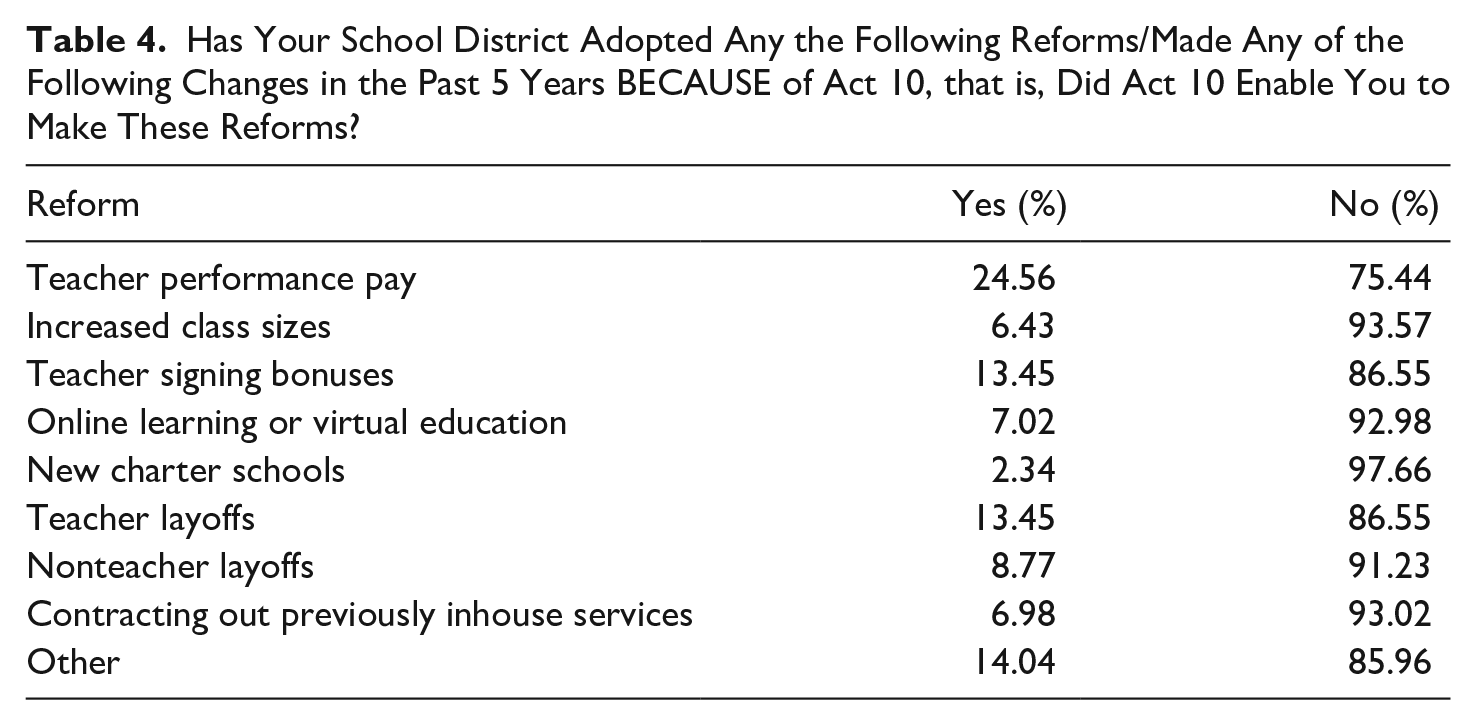
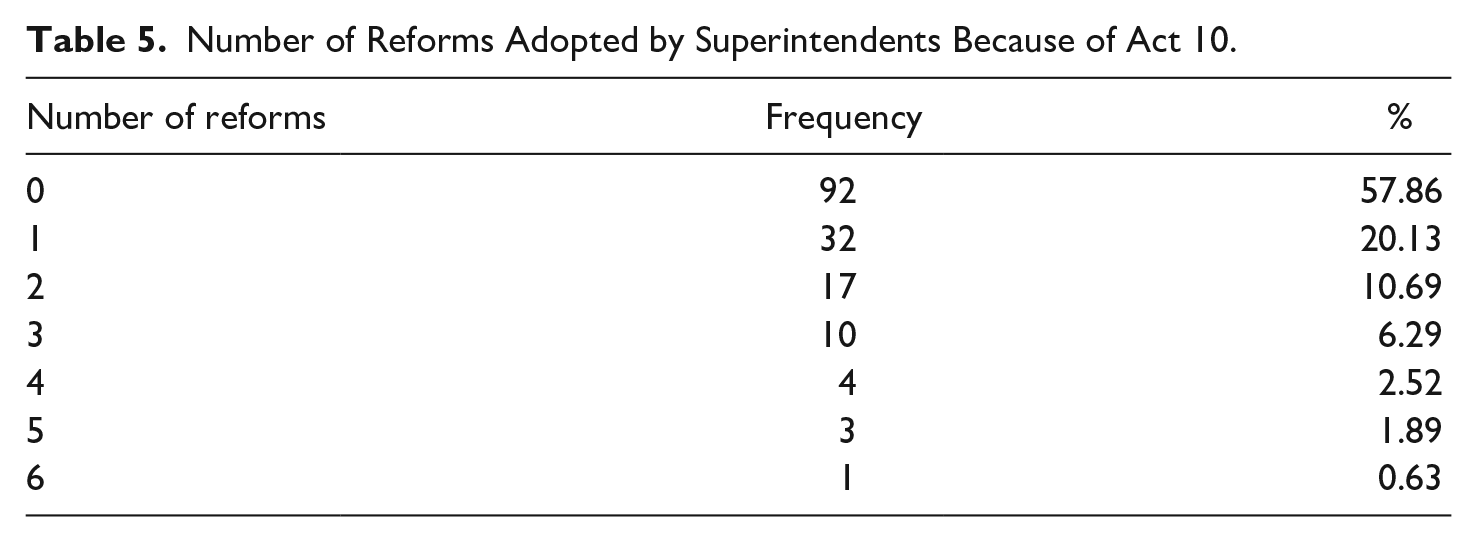
The results displayed in Table 4 serve as the basis for the dependent variables used in the models testing the hypotheses. The first dichotomous dependent variable indicates that a superintendent adopted at least one of the reforms displayed in Table 4 because of Act 10. Of the 162 identifiable respondents, a total of 42.10% adopted at least one reform. 1 The second dependent variable indicates the total number of reforms adopted by superintendents. As can be seen in Table 5, 24.07% of respondents reported adopting multiple reforms because of Act 10. Together, the two dependent variables measure both whether respondents adopted any reforms because of Act 10, and the extent to which they embraced Act 10 by adopting multiple reforms formerly made more difficult because of collective bargaining.
Number of Reforms Adopted by Superintendents Because of Act 10.
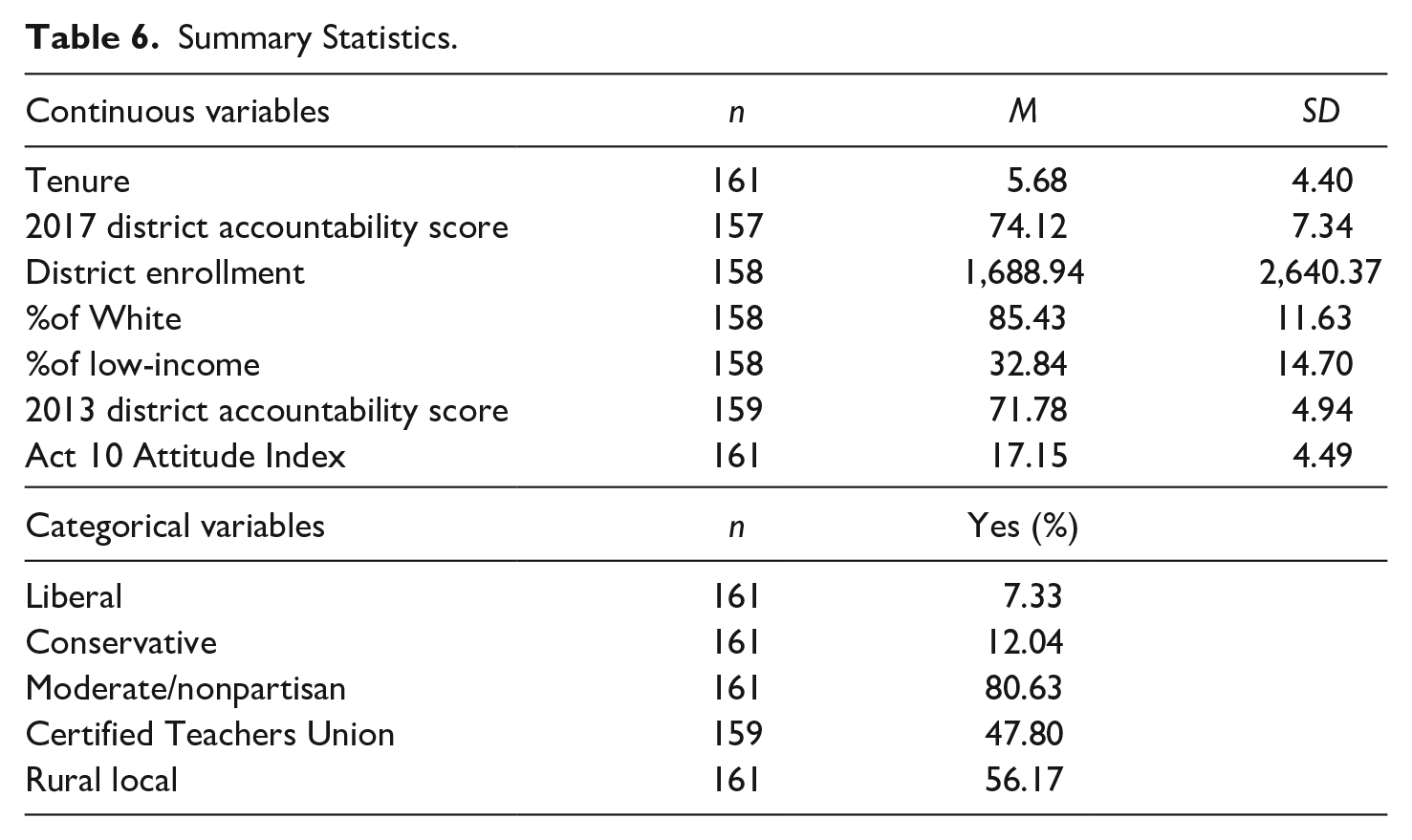
The summary statistics for variables included in the models predicting reform adoption are displayed in Table 6. The focal variable Tenure refers to the number of years a superintendent has served in their position. As stated earlier, it is hypothesized that longer serving superintendent are more secure in their position and thus more likely to have adopted reforms because of Act 10. The second independent variable, ideology, is a categorical variable indicating self-identified ideology. The dichotomous control variable Rural indicates that the respondent represents one of the 55.17% of rural school districts in our reduced sample. Urbanity is controlled for due to the possibility that rural areas more supportive of former Governor Walker were more likely to embrace Act 10 (Cramer, 2016). The variable Union is dichotomous variable indicating if a superintendent represents a district that still has a certified teachers union as of 2017. The Act 10 Attitude Index is an additive index comprised of superintendent responses to the eight items displayed in Table 1. The items hold together well with a Chronbach’s α of .82. Higher levels on the Act 10 Attitude Index indicate that the respondent had a more positive attitude regarding Act 10, that is, was supportive, while lower levels indicate a comparatively less positive opinion of Act 10. Control variables for student racial and socioeconomic status, school district size, and school district academic performance measured via the state calculated 0 to 100 accountability score are also included in models to control for the possibility that reform adoption is a function of student population or district performance as opposed to changes in collective bargaining.
Summary Statistics.
We first test the hypotheses using four logistic regression models predicting whether or not a superintendent reported adopting at least one of the listed reforms because of Act 10. Models 1 and 2 control for school performance using the Wisconsin accountability score for 2017. The accountability score is a composite measure of academic performance used to rate school districts on a scale of 0 to 100. The year of 2017 is used because it is the same year in which the superintendent survey was administered. Models 3 and 4 control for school performance using the accountability score for 2013. Using the older 2013 score as a control accounts for the possibility that lower or higher performing districts were more likely to adopt reforms in the immediate years after collective bargaining was curtailed. Models 2 and 4 control for the superintendent’s attitude toward Act 10. The multiple models are included as a robustness check to ensure reform adoption is simply not a function of past school performance, or one’s attitude toward Act 10. The results, displayed in Table 7, are partially consistent with both hypotheses. In all four models, longer serving superintendents are more likely to adopt a reform, and in all four models, conservatives are more likely than moderates/nonpartisans to adopt a reform because of Act 10.
Logistic Regression Predicting Reform Adoption.
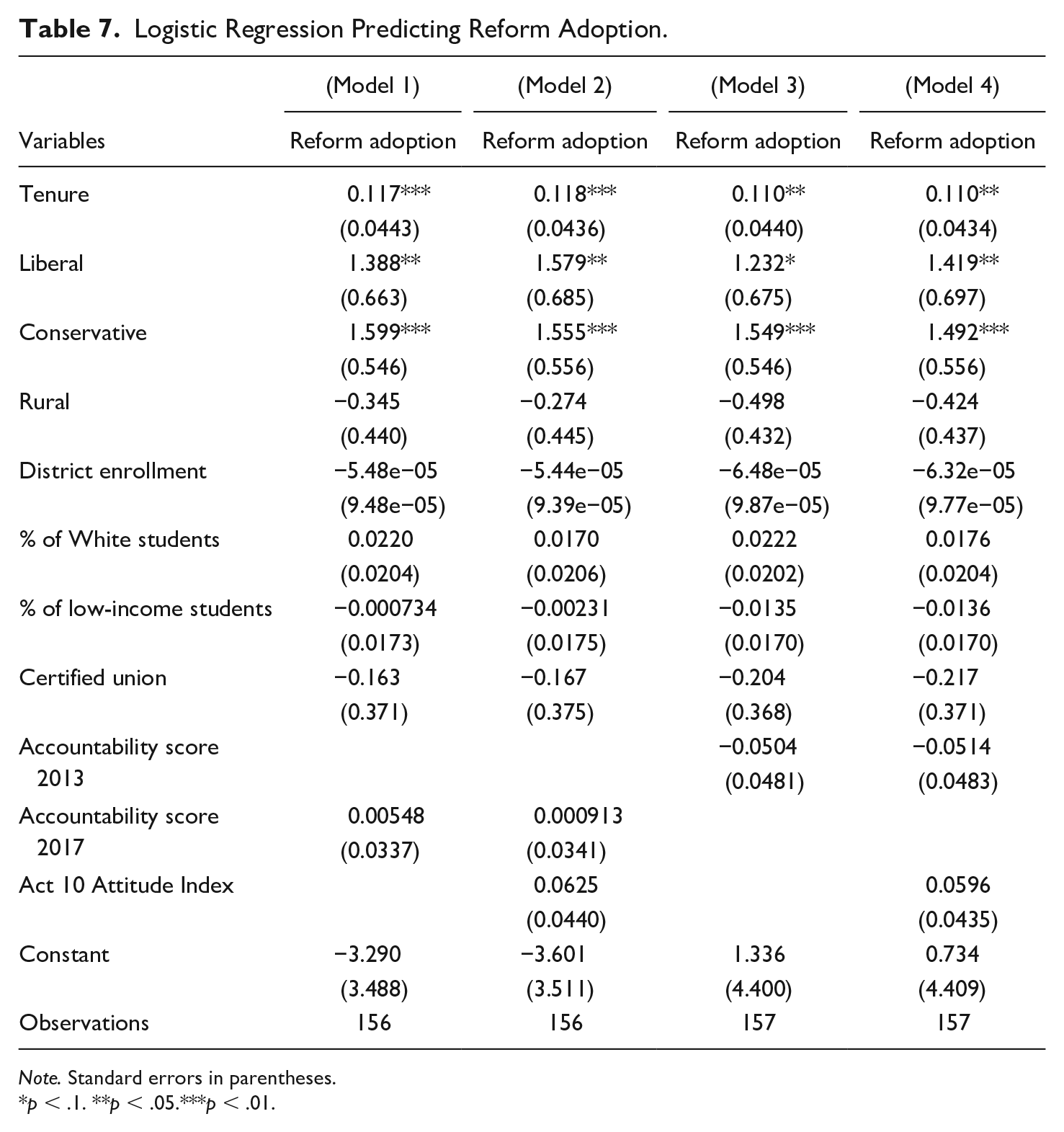
Note. Standard errors in parentheses.
p < .1. **p < .05.***p < .01.
Interestingly all four models show that liberals are also significantly more likely to have adopted a reform than moderate/nonpartisan superintendent. Thus, the results show that merely indicating an ideological preference makes it more likely to adopt a reform because of Act 10. To better understand the role of ideology in reform adoption, we created a margins plot (based on Model 2) showing the likelihood of reform adoption by ideology across the Act 10 Attitude Index. As can be seen in Figure 1, conservative superintendents were more likely to have adopted a reform because of Act 10 compared with both liberals and moderate/nonpartisans across the span of the Act 10 Attitude Index. A comparison of specific reform adoption by ideology showed this relationship was consistent across reform types, that is, conservative were slightly more likely than liberals to adopt reforms regardless of the specific reform in question.
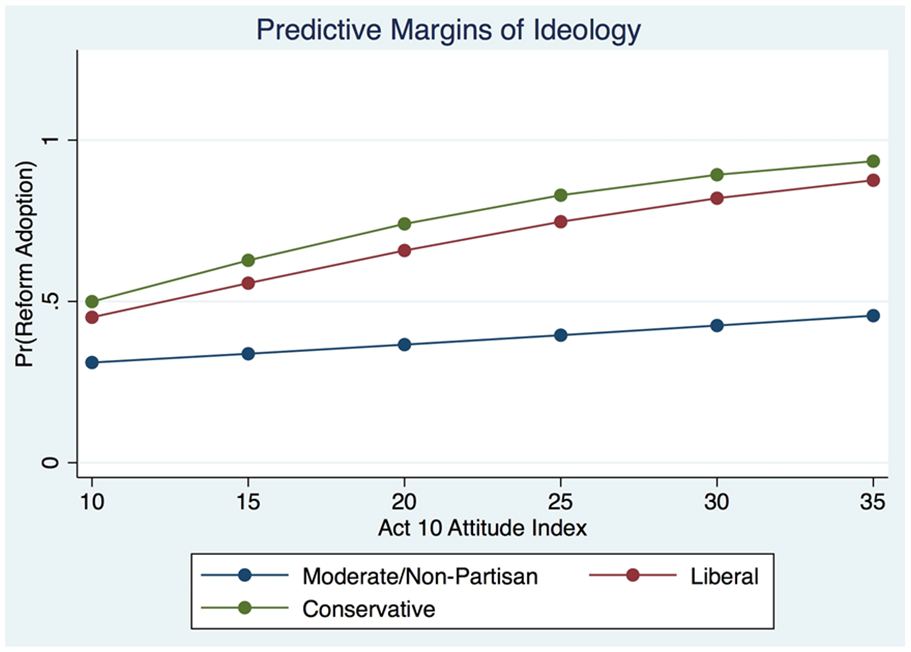
Act 10 Attitude and Reform Adoption by Ideology.
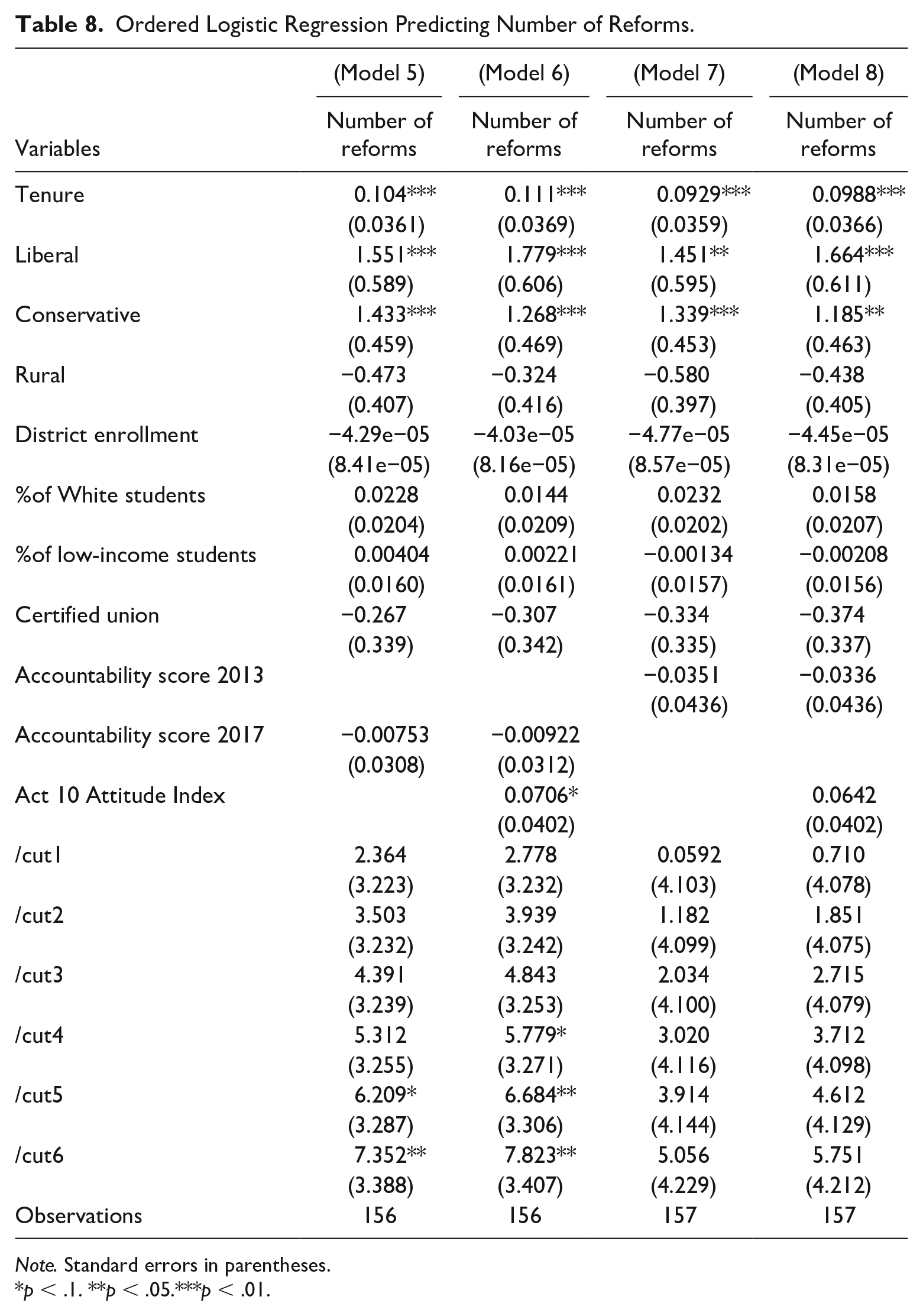
The results of four ordered logistic regression models with the same control variables and robustness checks as the logistic regression model are displayed in Table 8. In all four models, Brant tests were not significant, indicating that they meet the parallel regression assumption. The results indicate that conservatives, liberals, and longer serving superintendents were more likely to have adopted multiple reforms. Unlike the logistic regression model, one of the control variables, the Act 10 Attitude Index, is statistically significant on Model 6. However, none of the other control variables are statistically significant. The results partially support both hypotheses.
Ordered Logistic Regression Predicting Number of Reforms.
Note. Standard errors in parentheses.
p < .1. **p < .05.***p < .01.
Conclusion and Discussion
Wisconsin’s Act 10 dramatically altered the relationship between public employees and public sector managers in Wisconsin. The presented Wisconsin case provides a unique opportunity to determine the extent to which collective bargaining serves as a barrier to public sector reform adoption. Broadly, the presented findings are consistent with early speculation on the limited willingness of managers to exercise increased discretion simply because they were given the power to via a human resource reform. Foremost, the survey results show that Act 10 spurred substantial reform adoption in Wisconsin school districts. Almost one out of four surveyed superintendents reported implementing performance pay specifically because of Act 10. Substantial percentages of superintendents also used their enhanced authority to lay off teachers, and to implement teacher signing bonuses. However, the same superintendents report that Act 10 hurt employee morale and made teacher retention and recruitment more difficult. It is possible that adopted reforms were a reaction to a more challenging employee management situation created by Act 10 as opposed to a desire to improve organizational performance. This finding is consistent with Riccucci and Thompson’s (2008) conclusion that reforms flow from their political contexts. The lack of a relationship between school district performance and likelihood of reform adoption provides further reason to suspect that adopted reforms were not always proactive attempts to improve performance.
The support for Hypothesis 1 also shows that longer serving public managers are more apt to take controversial steps like reform adoption than shorter serving public managers. Given the perceived negative impact of Act 10 on employee morale, the fact that longer serving superintendents were nonetheless more apt to make changes formerly prevented by collective bargaining laws demonstrates that political capital and willingness to take risks comes with seniority. We note it is also possible that these superintendents have more supportive school boards that in turn give them more leeway in decision-making (see Ford & Ihrke, 2016). Although the relationship between school boards and superintendents regarding support for reform is beyond the scope of this study, it is an area where future research is warranted.
The partial support for Hypothesis 2 is more complicated. Consistent with Brewer and Kellough (2016), we find that Wisconsin’s collective bargaining reform continues to be viewed through an ideological lens, even by public sector managers. Although a previous survey of local elected officials by Ford and Ihrke (2018) found views on Act 10 to be influenced by ideology, this is the first evidence that nonelected public sector managers working in a post-Act 10 environment also view it through an ideological lens. However, it is not just self-identified conservatives who are more likely to have adopted reforms, self-identified liberals also were more likely to adopt reforms compared with nonpartisan/moderate superintendents (though not as likely as conservatives). It is possible that public sector managers willing to identify with a political ideology are overall more willing to take chances in their position, that is, more willing to be proactive as opposed to reactive to school board demands. Or it is possible that moderate/nonpartisan superintendents are simply less likely to indicate taking action as a result of a politically charged reform. Regardless, it is clear that political ideology influences local-level public manager reform adoption in post-Act 10 Wisconsin. More research is needed to better understand the nuances of how specific ideological identification impact specific reform adoption.
The presented findings have implication for both practice and research. Overall, our analysis shows that reform adoption in postcollective bargaining in Wisconsin school districts is a function of superintendent ideology and tenure, and not simply a result of removing the perceived barrier of collective bargaining. From a policy standpoint, simply eliminating public sector collective bargaining does not guarantee that management reforms will be adopted. Although a substantial numbers of superintendents did adopt reforms because of Act 10, 57.86% report no reforms as a result of Act 10. In other words, a local government enabling reform like Act 10 is no guarantee that managers will actually do things differently once bargaining is removed as a theoretical barrier. Accordingly, more resources should be devoted to aiding public sector managers in navigating a postcollective bargaining environment if management changes and improved outcomes are expected. Wisconsin’s reform partially followed the pattern identified by Nigro and Kellough (2008); it decentralized management, but the specifics of human resource reforms varied widely depending on the actions of the local executive. Hence, eliminating collective bargaining via a blunt policy change may remove a barrier to improving organizational performance, but it is unlikely to improve performance if managers do not have the tools to actually adopt and implement the specific reforms that improve performance. Related, the management potential of a reform like Act 10 is undermined if public employees are alienated by it. Superintendents report major morale, recruitment, and retention issues spurred by Act 10. No doubt these issues make specific reforms from Wisconsin superintendents difficult to implement effectively. To put it another way, replacing one potential barrier to innovation, collective bargaining, with another barrier, employee dissatisfaction, will not lead to organizational improvement.
Of course, this study has several potential weaknesses. Our focus on school districts could limit generalizability. However, previous work by O’Toole and Meier (2011) demonstrate how general public management insights can be drawn from the public education context. As previously mentioned, additional data about the school boards who hire superintendents could yield more information about the working relationships between boards and school district administrators. There is also more need to understand what exactly is in all new employee manuals; unfortunately, not all are publicly posted at this time. Related, there is a need for more research on the specific implementation of reforms in a postcollective bargaining environment. In Wisconsin, we now know what types of reforms are being adopted, but more district-level case studies and more surveys of public employees are needed. There is also opportunity for comparative work between Wisconsin and states that have made less dramatic changes to public sector collective bargaining. Broadly, there is a need for additional research that explores collective bargaining and public sector unions through a management lens as opposed to a political lens. Yes, labor unions are powerful interest groups, but they also help define the relationship between public sector employee and manager. It is important to understand the extent to which, and specifically how, the nature of that relationship can be improved in ways that improve public performance.
The legacy of Wisconsin’s Act 10 is a work in progress. As public employees and managers adapt to the new environment over time, and as the dramatic political battle over Act 10 grows more distant, its legacy may become less ideological. As this study shows, changing the scope of collective bargaining will change public management. What is not known is whether collective bargaining reform will actually improve public sector performance. The success or failure of a broad public management reform like Act 10 is both dependent on what managers actually do as a result of the reform, and the extent to which public employees embrace the reform. Those are the factors by which the success or failure of Act 10 should be judged.
Footnotes
Declaration of Conflicting Interests
The author(s) declared no potential conflicts of interest with respect to the research, authorship, and/or publication of this article.
Funding
The author(s) received no financial support for the research, authorship, and/or publication of this article.
