



Abstract
Merit principles have served as central tenets of the U.S. civil service system since the late 19th Century, but in recent decades reforms have been proposed and implemented that weaken central aspects of merit. This makes it important to seek evidence about how government employees perceive the status of merit principles and to examine relationships that exist between adherence to merit principles and work in federal agencies. Analysis indicates that federal employees who perceive adherence to merit principles also perceive a better quality of work life, compared to employees who see their agencies as less supportive of merit principles. Employees who perceive greater adherence to merit principles in their organizations report greater general satisfaction with their agencies as workplaces, higher levels satisfaction with leadership and recognition received, lower turnover intentions, and better quality of work unit output.
Keywords
For 138 years, the U.S. civil service has been grounded on a set of core principles designed to ensure that public employment is based on merit rather than political connections. These principles of merit, first articulated in the Pendleton Act of 1883 (22 Stat. 403), operate to secure a system in which employees (1) earn their positions on the basis of open and competitive examinations of their qualifications, (2) are politically neutral in the conduct of their duties, and (3) are protected from political manipulation or politically motivated removal from the civil service. 1 Notably, however, this foundation of merit has been weakened over time by political executives seeking greater control of the civil service and by civil service “reforms” intended to expand managerial flexibility and reduce employee rights (Battaglio & Condrey, 2006; Brewer & Kellough, 2016; Rainey, 2014; Selden & Brewer, 2011).
A recent example of such action is Executive Order 13957 issued by President Donald J. Trump on October 21, 2020, which aimed at stripping civil service protections away from broad segments of the federal workforce by shifting them from the merit-based competitive service into a new “Schedule F” within the excepted service (Lipton, 2020; Wagner, 2020). Employees moved to Schedule F would essentially become “at will” workers. They would have no union representation, hiring rules would be more flexible, and transferred employees would be subject to removal without cause. In effect, the Trump order was intended to allow political leaders to hire and fire employees as they wanted. All employees deemed by agency heads to have “confidential, policy-determining, or policy-advocating responsibilities” would be transferred into Schedule F. This change could have affected hundreds of thousands of federal workers and in the process would have substantially eroded principles of merit that have formed the basis for the system since the latter part of the 19th Century (Yoder, 2020). Politically neutral competence, the hallmark of civil service that confers legitimacy to public administration, could have been irreparably harmed. Indeed, in late November of 2020, after the Presidential election, President Trump’s budget agency, the U.S. Office of Management and Budget, rushed to shift 88% of its workforce into Schedule F, and the U.S. Office of Personnel Management (OPM) took similar steps (Rein, 2020).
Clearly, President Trump’s Executive Order would have substantially weakened merit in the federal service if it remained in place. When the order was issued, many observers expressed concern about the erosion of merit principles and damage done to important values central to merit systems, such as neutral competence and due process. 2 On January 22, 2021 (2 days after his inauguration), President Biden, through Executive Order 14003, rescinded Trump’s Order creating Schedule F, along with three earlier orders from 2018 that made it easier to fire federal employees, restricted the scope of collective bargaining (which was already highly constrained), and prohibited employees in union positions from conducting union business while at work. 3 Nevertheless, President Trump’s orders demonstrated the fragility of merit procedures and highlighted what is at stake for the civil service when merit comes under attack.
Merit principles are intended to limit the reach of partisanship into public management. They require employees be hired on the basis of their ability to perform their jobs, and in doing so, they foster good performance. Merit principles promote fairness in the management of public employees and provide additional benefits. Knowledge of due process rights and expectations of fair treatment, for instance, can lead public employees working under merit system rules and procedures to form more favorable impressions of their agencies as places to work than they would otherwise. These positive attitudes, in turn, can promote better individual performance on the job (Alexander & Ruderman, 1987; Greenberg, 1996; Rainey, 1997). Working in more secure merit structures can also enhance workplace satisfaction, lower turnover intentions, and lead to better quality work-unit output. These are issues examined in this article. Evidence of these kinds of positive effects of adherence to merit principles can buttress and reinforce the foundation of merit-based civil service and modern public administration.
Data for this study come from the 2010 Merit Principles Survey conducted by the U.S. Merit Systems Protection Board (MSPB). The survey was taken midway through President Barack Obama’s first term in office and just before the midterm Congressional elections that autumn, closing on July 15, 2010. The 2010 survey provides the most recent examination of federal employee opinions on how well their supervisors and agencies are adhering to legally mandated merit principles. More recent data on these issues are not available. In fact, 2010 was the only year this complete set of questions on merit principles was included in a MSPB survey, and the wording of the complete set of survey questions was taken directly—and in many cases “word for word”—from the law defining merit principles (5 USC
Civil Service Reform and Merit Principles
The Pendleton Act of 1883 established a merit system for civilian employees in the U.S. federal government, and the subsequent Civil Service Reform Act of 1978 (CSRA) further codified the underlying merit system principles into law (5 USC
Nevertheless, as was noted previously, traditional merit-based civil service systems are designed to remove partisanship, favoritism, and patronage from the public service. Core merit principles are enforced through rules intended specifically to limit the discretion of managers, supervisors, and leaders of public agencies. Central personnel agencies, such as OPM at the federal level, establish civil service regulations, and review agency practices to enforce compliance. Because these regulations restrict the actions of political executives and line managers, some political leaders contend that the rules and restrictions are excessive, overly bureaucratic, and cumbersome. 5 For decades, politicians have proposed and enacted reforms aimed at eliminating the alleged excesses of traditional centralized personnel systems and seeking to “let managers manage” in order to make the bureaucracy more efficient and responsive to elected officials. 6 As a consequence, the U.S. civil service system has evolved over time, as has the federal workforce. The central personnel system is now a more decentralized structure with much authority centered in individual federal agencies.
Interestingly, these types of civil service reforms are not limited to the U.S. federal government. Civil service systems are in transition everywhere. Selden and Brewer (2011), for example, examined changing patterns of civil service coverage and employee job protections in U.S. state civil service systems during the period 1999 to 2006. In that study, personnel directors in many states reported that state civil service coverage had become more limited during the study period; job protections had decreased; and employee turnover had increased. The evidence indicated some states were replacing civil servants with large numbers of non-classified workers, thereby circumventing merit system protections. Similar evidence has been reported at the local level in the U.S. (Battaglio & Condrey, 2006), in other state-level studies (Kellough & Nigro, 2006), and internationally (e.g., Bekke et al., 1996; Bouckaert & Halligan, 2007; Brewer, 2001; Brewer & Walker, 2013). The implication is that civil service reforms that aim to eliminate or limit merit principles are a widespread phenomenon (see e.g., Hays & Sowa, 2006 and Kellough & Nigro, 2006). 7
Merit Principles and Their Effects
Issues regarding the significance of merit in public employment have been widely discussed but seldom studied empirically (Ingraham, 2005, 2006; Kettl, 2015). Previous research on the erosion of merit principles has featured theoretical arguments but very little observational evidence on their status. Spirited rhetorical claims exist on both sides of the merit system reform debate, but the actual level of employee support for merit principles, and the influence of those principles on their working lives in government agencies, begs for more systematic analysis.
In this study, the initial objective is to understand the degree to which employees perceive support for merit principles within their agencies. This is a critical question because the trend toward personnel system decentralization allows individual agencies to have substantial control over hiring, firing, and rewarding employees, and as noted, the thrust of reform has sought to weaken or dismantle merit-based employee protections. Federal agencies may vary in their adherence to merit principles as a result. Given this context, it is important to know what federal employees think about the implementation of merit in their organizations. It is always possible that civil service policies actually implemented are substantially different from intended policies (Khilji & Wang, 2006). Employee perceptions of those policies can provide insight into how the policies are implemented and subsequently how they may impact organizational environments and performance (Wright & Nishii, 2006). Researchers have long acknowledged that employees are well positioned to judge the reality of policy implementation (Budhwar, 2000; Cunningham & Hyman, 1995, Larsen & Brewster, 2003, Maxwell & Watson, 2006; Renwick, 2003; Whittaker & Marchington, 2003). Consequently, the first questions addressed in our analysis are: “What is the evidence on employee perceptions of adherence to merit principles within the 24 largest federal agencies, and how do those perceptions vary from agency to agency?” Answers to these basic questions provide insight for understanding the status of merit in federal employment.
To the extent that federal employee perceptions of merit system integrity vary across the agencies studied, the question of what factors may help to explain that variation in individual employee perceptions arises. Supervisory status could be one important independent variable because supervisors by virtue of their positions may have more positive attitudes than nonsupervisory employees (Brewer, 2005; Hage & Aiken, 1970). In addition, perceptions of the implementation of merit principles may vary with years of experience in the federal service. It may well be that workers with less tenure will be more optimistic than those with more years of service. Employees with longer tenure will have been through more of the repeated efforts at reforms that potentially threaten merit, and hence may be more skeptical about support for merit principles in their organizations. It is likely also that minority ethnic and racial status will impact these perceptions, and consequently, variables denoting whether respondent employees are Hispanic or black are examined in subsequent analyses with the expectation that minority employees who generally are more likely to experience problems of discrimination will be less likely to believe merit principles are promoted. 8 Finally, employee level of education is included in the analysis. We expect that employees with more education will be more sensitive about merit principles and potential threats to them, and hence the relationship between level of education and perceptions of adherence to merit principles will be negative. All of these variables have been found in earlier work to be related to employee perceptions of several dimensions of organizational management and performance. 9
The final question examined, and perhaps the most important question, is whether agency adherence to merit principles promotes positive organizational and work-related attitudes as reflected in general satisfaction with the organization as a workplace, satisfaction with agency leadership and recognition received, lower turnover intentions, and perceived quality of work-unit output. As previously noted, employee perceptions of their agencies as good places to work are important because they indicate a generally positive perception of the organization that can impact employee performance (Rainey, 1997). Employee satisfaction with agency leadership and recognition received is examined because it may be positively associated with productive work behaviors such as organizational commitment and positive organizational citizenship behavior (Rainey, 2014). Concern about employee turnover intentions is warranted because of what they communicate about employee commitment to their agencies. While turnover intentions may not accurately predict actual turnover, researchers have found that an expression of intent to turnover is a good indicator of general dissatisfaction or lack of commitment to an organization (Cohen et al., 2016; Jung, 2010). Finally, perceptions of work unit performance are also a key indicator of an important aspect of the quality of work life. Research has shown that employees who perceive that they work in high-performing work units are happier and more productive workers (Leisink et al., 2021; Walker et al., 2012).
In short, employee satisfaction with their organizations as places to work, satisfaction with agency leadership and recognition received, lower turnover intentions, and perceived quality of work-unit output are all indicators of how employees see their agencies. The question is whether employees who perceive greater adherence to merit principles by their organizations also exhibit positive attitudes on these aspects of their work and their agencies.
Data and Methods
Data for this study come from the 2010 Merit Principles Survey (MPS) conducted by the U.S. Merit Systems Protection Board. This survey represents the most comprehensive and intensive attempt to analyze merit principles and to emphasize agency responsibilities for leading and managing federal employees ever undertaken by the MSPB (U.S. Merit Systems Protection Board, 2013, p. iii).
10
In the survey, the MSPB administered a battery of 25 merit system effectiveness questions (see Appendix) taken from the federal statute specifying merit principles (5 USC
Fairness: perceptions of fairness of the agency’s human resources practices and decisions, especially matters related to hiring and pay;
Protection: perceptions of effectiveness of measures taken to protect employees from inappropriate influences and improper actions, including leadership attributes such as openness, tolerance of criticism, and willingness to act to prevent or rectify such actions; and
Stewardship: perceptions of utilization and development of employees and organizations, in matters such as leadership, alignment, support, and efficiency.
The first two dimensions of fairness and protection reflect priorities emphasized in the Pendleton Act of 1883, while the third dimension of stewardship reflects additional goals stressed by the Civil Service Reform Act of 1978. We replicated the MSPB factor analysis and formed weighted additive indices for the three dimensions by multiplying individual responses to each item comprising each dimension of merit by the item factor loading and then summing those products. 11 These individual-level measures were then aggregated to the agency level (see Appendix for a list of the measurement items for each dimension). Cronbach’s alpha (α) for the three indices are: fairness .920; protection .878; and stewardship .817, which demonstrates high levels of internal consistency.
The Appendix also shows the measurement and response choices for other variables in the study, including general satisfaction with the employee’s agency as a workplace (“I would recommend my agency as a place to work”), satisfaction with agency leadership and recognition received (a simple 3-item additive index, Cronbach’s alpha = .784), turnover intention (“How likely is it that you will leave your agency in the next 12 months?”), and perceived quality of work unit output (“My work unit produces high quality products and services”). The question about employees’ general satisfaction with their agencies as places to work asks for a more global assessment of their working environment, as compared to the items measuring satisfaction with agency leadership and recognition received.
Evidence on employee perceptions of agency adherence to merit principles reflected in the concepts of fairness, protection, and stewardship in the agencies examined is presented first, and patterns in these perceptions and variation across agencies are noted. Next, models examining the possible determinants of individual employee perceptions are presented. Finally, models are developed in which employee satisfaction with their organizations as places to work, satisfaction with agency leadership and recognition received, turnover intentions, and perceived quality of work unit output are regressed on perceptions of merit principle adherence and a set of control variables including supervisory status, years of service, minority status, level of education, and employee public-service motivation. This latter variable is included because earlier work has shown that public-service motivation is strongly associated with the kinds of employee perceptions examined here (see, Ritz et al., 2016). Unobserved agency fixed-effects are controlled in all of the models through the use of agency dummy variables since the focal point for merit system integrity has largely shifted to the agency level as the federal personnel system has become more decentralized. 12
Findings and Discussion
Table 1 provides descriptive statistics for all variables in our models and gives insight into variation of the concepts examined. Table 2 shows federal employee perceptions of merit system fairness, protection, and stewardship. This table reports means for the 24 largest federal agencies reported individually and for all respondents regardless of agency, which provides an indication of these perceptions for the federal workforce as a whole. The scores, which are created by multiplying individual responses to each item comprising the dimension of merit by its factor loading and then summing and aggregating them by agency, can be used to compare agency status on the three dimensions of fairness, protection, and stewardship.
Descriptive Statistics for Variables in the Models.
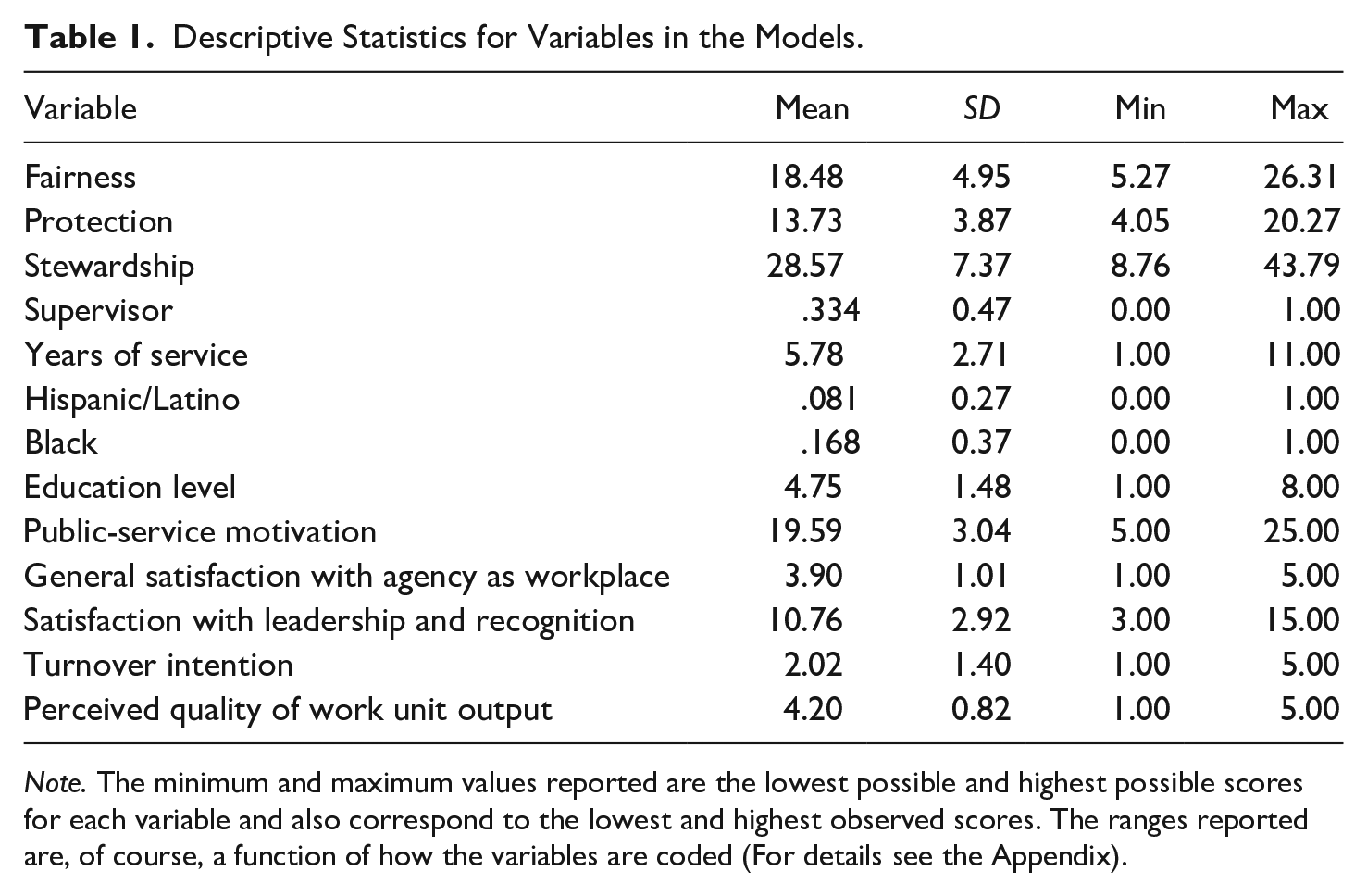
Note. The minimum and maximum values reported are the lowest possible and highest possible scores for each variable and also correspond to the lowest and highest observed scores. The ranges reported are, of course, a function of how the variables are coded (For details see the Appendix).
Perceptions of Fairness, Protection and Stewardship (Means for Each Agency and for All Respondents – Top and Bottom Three in Bold Face).
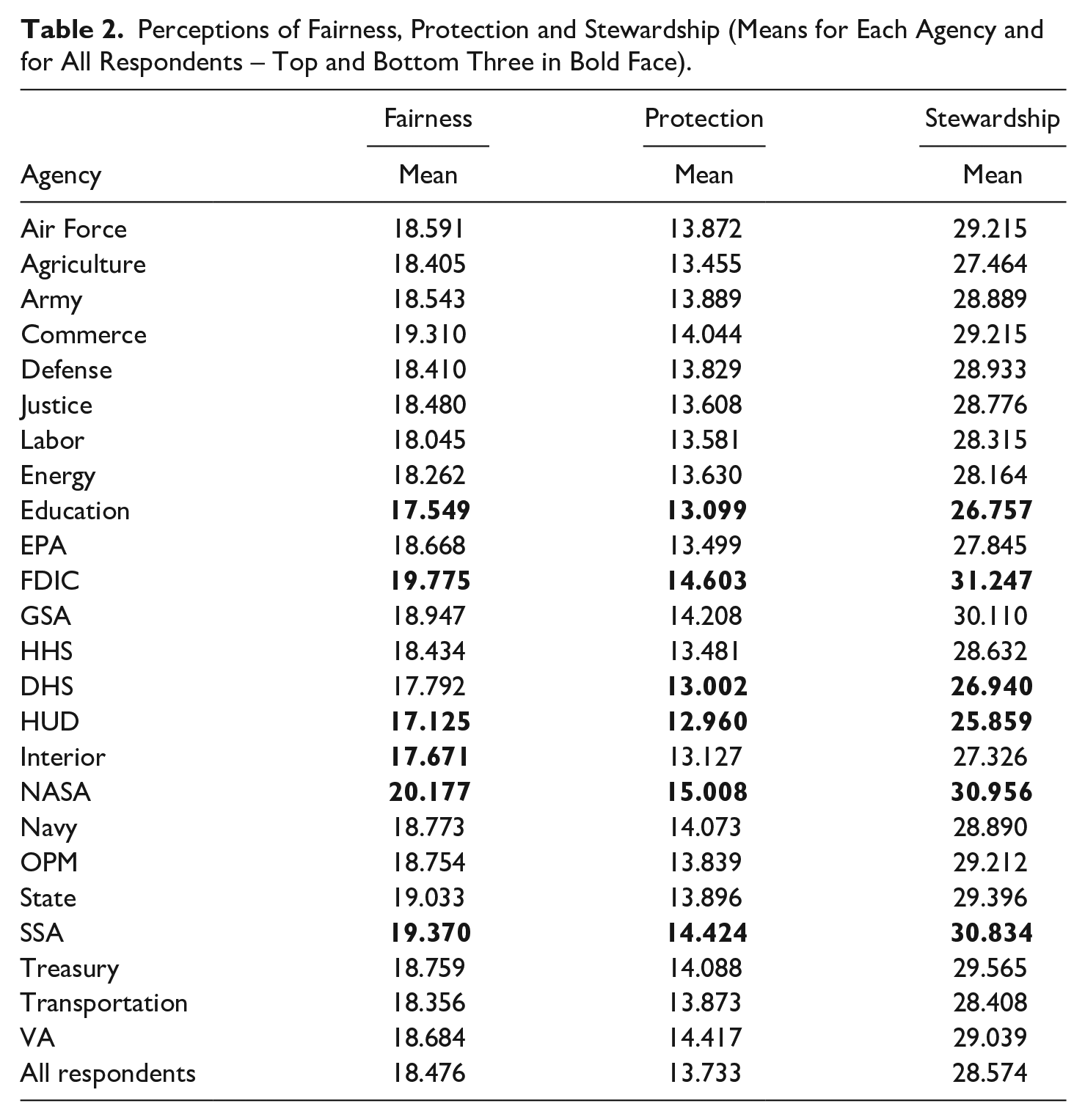
The overall mean score on fairness is 18.48 (ranging from 5.27 to 26.31), the overall mean score on protection is 13.73 (ranging from 4.05 to 20.27), and the overall mean score on stewardship is 28.57 (ranging from 8.76 to 43.79). While all three dimensions of merit receive mean scores above the mid-points of their respective scales (which is encouraging), the scores do indicate room for improvement in upholding merit principles (the scores reflect achievement of between 65% and 70% of what is possible on the scales). One important implication of these results is that respondents do not appear to show a significant positive or negative response bias related to social desirability, fear of identification and reprisals, or other factors.
As Table 2 shows, employee responses in several federal agencies indicate that those employees think their organizations are doing significantly better than average on fairness. The top three agencies, ranked in descending order on fairness from highest downwards, are the National Aeronautics and Space Administration (NASA), the Federal Deposit Insurance Corporation (FDIC), and the Social Security Administration (SSA). The three agencies receiving the lowest employee assessments, ranked in ascending order from lowest upwards, are Housing and Urban Development (HUD), the Department of Education, and the Department of the Interior. Table 2 also shows that on the dimension of merit labeled protection, the top agencies, ranked in descending order from highest downwards are, once again, NASA, FDIC, and SSA. The agencies receiving the lowest employee assessments on protection, ranked in ascending order from lowest upwards, are HUD, the Department of Homeland Security (DHS), and Education. Finally, with regard to stewardship, as shown in Table 2, the top agencies are the FDIC, NASA, and SSA ranked in descending order from highest downwards. The agencies receiving the lowest employee assessments, ranked in ascending order from lowest upwards, are HUD, Education, and DHS.
One obvious conclusion is that the highest and lowest ranked agencies are consistent performers across the key merit dimensions of fairness, protection, and stewardship. The top three agencies are the same on each dimension (although they are ranked in a slightly different order in one instance); while the bottom three agencies are almost the same in each category, with one minor exception. NASA, FDIC, and SSA are consistently in the top tier, while HUD, DHS, and Education are consistently in the bottom tier, although Education trailed behind Interior on one dimension. Despite these interesting results, we do not know why certain agencies may adhere to merit principles more than others. The more positively ranked agencies do, however, tend to score well on the “Best Places to Work” ratings developed by the Partnership for Public Service. 13 These highly-ranked agencies tend to have more professionalized workforces (i.e., a higher percentage of employees in professional and technical occupational categories), and they seem to attract less political controversy over their missions and implementation practices. They also tend to have fewer political appointees at higher levels. Conversely, the lower ranking agencies may not have adequate leadership, resources, or capacity to administer the merit system effectively. These lower-ranked agencies tend to be more politicized, and they seem to have more controversial missions and implementation practices. Thus, an agency’s mission (e.g., the degree to which the mission has a scientific or technical basis) and the degree of professionalization and politicization of its workforce may affect how well the agency adheres to merit system criteria. Some agencies, and their employees and clientele, may be more favorably disposed toward merit principles and more faithful in upholding them.
Next, factors that may affect perceptions fairness, protection, and stewardship at the individual level are examined. Table 3 displays the results of OLS regression models predicting the values of the indices for individual employees. The predictor variables include several demographic variables and agency dummy variables, which improve model specification. 14
Multiple Regression: Perceptions of Fairness, Protection, and Stewardship as Dependent Variables (Standard Errors in Parentheses).
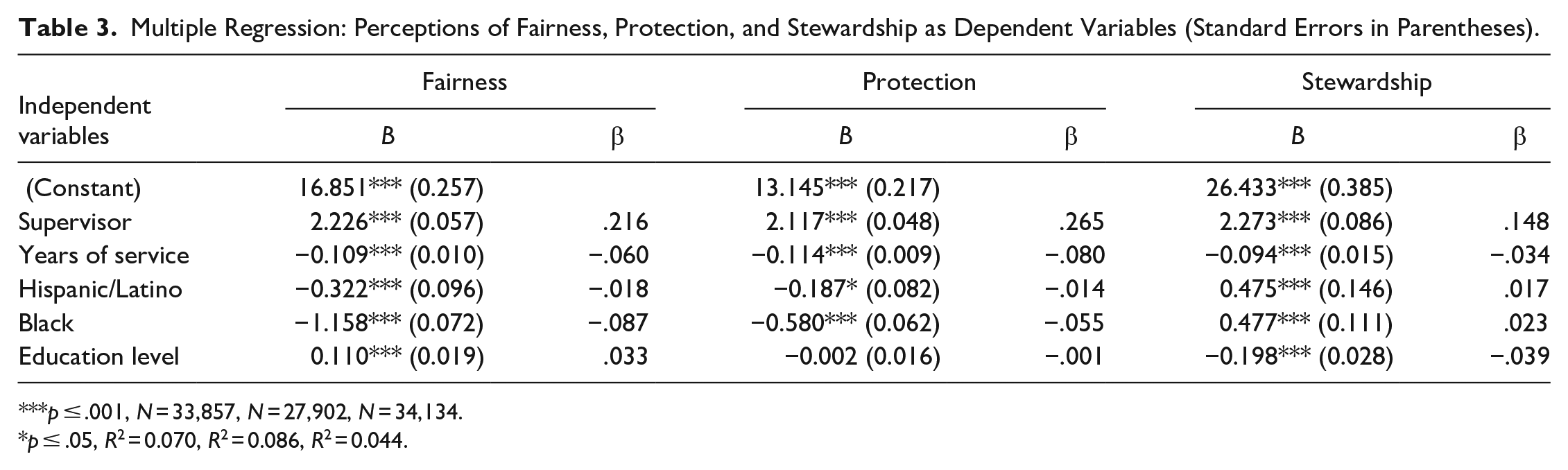
p ≤ .001, N = 33,857, N = 27,902, N = 34,134.
p ≤ .05, R2 = 0.070, R2 = 0.086, R2 = 0.044.
Table 3 shows that supervisors are more likely to express positive assessments of their agency’s adherence to the merit indices of fairness, protection, and stewardship than are non-supervisory employees. These findings echo past research showing that supervisors tend to report more positive views on a range of organizational variables when compared to non-supervisors (Brewer, 2005; Hage & Aiken, 1970). In addition, the findings show that employees with more years of federal service are less positive about their agencies’ adherence to merit principles. This finding may suggest that these more experienced federal employees have a keener understanding of how much merit principles have eroded in recent decades due to various reforms, bureaucrat bashing, and increased politicization. In addition, employees with more years of service may tend to develop a healthy skepticism as a means of coping with the challenges of federal service.
The two race/ethnicity variables also produced expected results on fairness and protection: Black and Hispanic/Latino employees reported lower scores for their agencies on these dimensions of merit. As suggested earlier, minority employees may be sensitive to the possibilities of discrimination and thus may have a keener sense of how well (or how poorly) their agencies are doing to promote fairness and to protect employees. Yet the coefficients for stewardship show that minority employees rated their agencies positively on this dimension of merit. The reason for this positive finding on stewardship is unclear. Perhaps minority employees report more positive responses because they are more sensitive to the actions their agencies are taking that are beneficial on this dimension—emphasizing performance, high standards, employee development, utilization of skills and talents, and related priorities. Lastly, the education level of respondents produced mixed results: the coefficient is positive and significant for fairness, positive but insignificant for protection, and negative (as expected) and significant for stewardship. These findings on education level are difficult to interpret given that results on the other demographic variables are more consistent. Perhaps level of education interacts with agency mission or professionalization to influence employee assessments, as alluded to earlier. It should be noted that the explained variance in all three models is relatively low, ranging from 4.4% to 8.6%.
Finally, Table 4 provides results from our four OLS regression models predicting federal employees’ general satisfaction with their agency as a workplace, satisfaction with agency leadership and recognition received, turnover intentions, and perceived quality of work unit output. 15 These models include the three dimensions of merit system administration (fairness, protection, and stewardship) as predictors, along with control variables.
Multiple Regression: General Satisfaction with Agency as Workplace, Satisfaction with Leadership and Recognition, Turnover Intention, and Perceived Quality of Work Unit Output as Dependent Variables (Standard Errors in Parentheses).
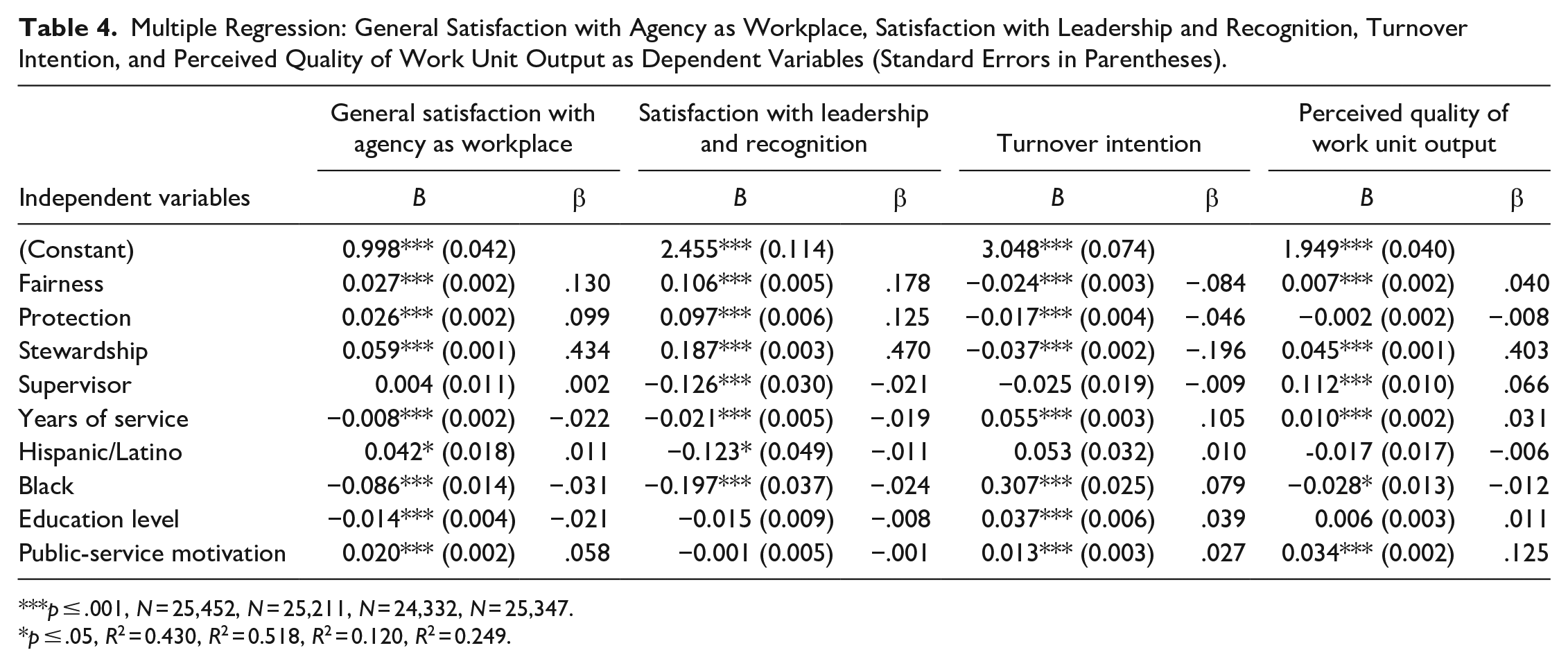
p ≤ .001, N = 25,452, N = 25,211, N = 24,332, N = 25,347.
p ≤ .05, R2 = 0.430, R2 = 0.518, R2 = 0.120, R2 = 0.249.
The explained variance in these models ranges from 12.0% to 51.8%. The coefficients for all three merit principle indices are highly significant predictors of the four dependent variables with only one exception: the protection coefficient does not attain significance for perceived quality of work-unit output. Overall, however, the results are the most salient and important findings of this analysis. The respondents’ perceptions of adherence to the three merit system dimensions and their underlying merit principles relate strongly and positively to general satisfaction with the agency as a workplace, satisfaction with agency leadership and recognition received, and perceived quality of work unit output, with the one exception noted above (i.e., protection is not significantly related to perceived quality of work unit output). The merit principle indices relate negatively and significantly to turnover intention, as expected. That is, employees who see greater support for merit principles in their agencies, are less likely to express an intent to leave the agency.
A comparison of the standardized coefficients indicates that, with some exceptions, the merit indices are more strongly related to the dependent variables than are the control variables. Very important to note are the stronger relationships between stewardship and the four dependent variables as compared to fairness and protection. It should nonetheless be acknowledged that in several instances where statistical significance is achieved, substantive significance is limited given the small size of some coefficients (e.g., the unstandardized coefficient for Fairness on Perceived Quality of Work Unit Output is only .007).
In summary, the variables representing federal employees’ perceptions of their agencies’ and supervisors’ adherence to the merit principle dimensions of fairness, protection, and stewardship relate strongly to the employees’ general satisfaction with their agency as a workplace, their satisfaction with agency leadership and recognition received, their turnover intentions, and their perceived quality of work unit output. In agencies where employees perceive greater adherence to merit principles, they report greater satisfaction with their agency as a place to work, higher satisfaction with their job, lower intent to leave the agency, and generally higher quality of work unit output. These are all important findings pointing to the positive impact of support for merit principles in federal agencies.
Results for the control variables show mixed findings, but these disparities do suggest that survey respondents differentiated between the questions they answered. They clearly did not respond in uniformly positive or negative ways. Rather, the results indicate that a general positive or negative response bias was not present. For example, the supervisor variable is not significantly related to general satisfaction with agency as a workplace or turnover intention, but the variable does show a significant negative relation to satisfaction with agency leadership and recognition received and a significant positive relation to perceived quality of work unit output. The lack of a relationship with general satisfaction with the agency as a workplace and the negative relationship with satisfaction with agency leadership and recognition received are interesting given that past research has shown that higher level employees tend report higher levels of overall job satisfaction (Brewer, 2005; Jin & Rainey, 2020; Rainey, 2014). Our variables are, however, operationalized differently from common measures of job satisfaction.
Years of service shows significant negative relations to general satisfaction with the agency as a workplace and satisfaction with agency leadership and recognition received, but it is positively associated with turnover intentions and perceived quality of work-unit output. The positive association with turnover intentions may, in part, indicate that respondents with longer tenure may be older and more likely to retire. The positive association with perceived quality of work-unit output may suggest that while some employees with longer service may develop a healthy skepticism over time, they may still feel that they and their coworkers are doing a good job.
Hispanic/Latino respondents show a slight tendency to be generally satisfied with their agency as a workplace, but they also exhibit a slight inclination to express lower satisfaction with agency leadership and recognition received. Black respondents generally express less favorable responses on general satisfaction with their agencies as workplaces, satisfaction with agency leadership and recognition received, and perceived quality of work unit output. They are also more likely to express an intention to leave their jobs. Members of racial and ethnic minority groups may express lower general satisfaction with work and organizational conditions because they are more sensitive to the possibility of inequitable treatment. Some of these employees may have experienced or observed unfair treatment in the past.
Education level relates significantly and negatively to satisfaction with agency as a workplace and significantly and positively with turnover intention. Respondents with higher education levels may have higher expectations and aspirations, which make them more easily disappointed. In addition, these employees may consider leaving because they have attractive alternatives.
Research on public-service motivation has produced complex findings in recent years, but in general, those findings are consistent with the positive results in Table 4. Public-service motivation relates significantly and positively to general satisfaction with the agency as a workplace and perceived quality of work unit output. It is also positively associated with turnover intention, suggesting that employees with higher levels of public-service motivation also are more likely to express an intent to leave their organizations. Scholars have contended that public-service motivation can help an employee maintain motivation and resilience in challenging public-service work roles (e.g., Bakker, 2015; Jin & Rainey, 2020), and these findings lend support to that interpretation. The nonsignificant relationship between public-service motivation and satisfaction with agency leadership and recognition received appears inconsistent with this interpretation; however, it may reflect higher expectations and aspirations of employees with high public-service motivation. Such employees may have concerns about supervisors and higher-level managers in their agencies, and about whether rewards and recognitions are adequate.
In general, federal employee responses indicating that their agencies are adhering to merit principles of fairness, protection, and stewardship show strong, positive, and statistically significant relationships to employee responses to questions about general satisfaction with the agency as a workplace, satisfaction with agency leadership and recognition received, and perceived quality of work unit output. The relationship of the three merit principle indices to turnover intentions is negative. These results indicate that merit system principles of fairness, protection, and stewardship are powerful variables that affect federal employees’ perceptions of their overall quality of work life. These perceptions, in turn, may influence the federal government’s ability to retain experienced employees and recruit high quality job candidates. The merit principles of fairness, protection, and stewardship thus matter a great deal to federal employees as shown by their attitudes about their jobs and their assessments of the general quality of work life in the federal service.
Conclusion
The concept of a merit-based system of personnel administration has played a historically significant role in the government of the United States and in other nations. Controversies over merit principles and related issues in the workplace, and reforms aimed at altering those principals, raise major questions about how civil service should be managed, and how the operation of the civil service can influence the quality of work life in federal agencies and work productivity in those agencies.
The analysis in this article has provided evidence on these issues by utilizing a large survey administered by the U.S. Merit Systems Protection Board to assess employee views of merit principles. The survey taps employee perceptions of merit principles across three broad categories of fairness, protection, and stewardship. It reports levels of merit system adherence in the federal government in general and in the 24 largest federal agencies.
Findings indicate that employees have generally positive impressions of the implementation of merit principles, but that certain agencies score higher than others, and the top and bottom tiers are relatively consistent across the dimensions of merit. 16 In addition, this study has provided evidence of important relationships between adherence to merit principles and critical aspects of employee work life such as satisfaction with their agencies as places to workplace, satisfaction with agency leadership and recognition received, lower turnover intentions, and perceived quality of work unit output. These findings should be emphasized. Federal employees indicate that all three dimensions of merit are central to their views about working conditions. In short, merit principles are important to employees, and they are therefore important for the civil service system as a whole. Reforms and criticisms that harm merit principles can damage the quality of work life among federal workers. The erosion of merit principles can diminish positive orientations toward agencies as workplaces, increase turnover intentions, and diminish satisfaction with supervisors, higher level managers, and rewards and recognitions. Merit principle erosion may also weaken the perceived quality of work unit output. This is an important lesson given the effort to weaken merit in public employment during the Trump administration. There are costs associated with the undermining of core merit principles.
The President of the United States has substantial authority over personnel policy within the federal bureaucracy. That authority rests on Article II of the Constitution and on a variety of Congressional enactments. 17 Executive Orders issued by President Trump regarding the civil service illustrate the scope of that authority and highlight an underlying weakness of the merit system. While President Biden rapidly repealed President Trump’s civil service orders, a future President could just as easily reinstate or even strengthen them. In addition, other actions taken during the Trump years may be more difficult to overcome. Since 2017, many departments and agencies in the executive branch have been hollowed out in the sense that they have lost significant numbers of crucial employees. During the first 9 months under Trump, 24,000 more employees left the federal service than left during the equivalent period of time at the beginning of the first Obama term, and repeated attacks on the civil service under President Trump led to many additional resignations of career employees, damaging morale as time progressed (Cassella & Ollstein, 2020). Vacant positions were left unfilled or were abolished. Substantial experience and vital institutional knowledge were lost. Employees who remained in the federal service likely experienced weakened bonds with their agencies, and their perspectives on their work may have been irreparably damaged. That is an outcome presaged by the findings of the research reported here. It could take years for the diminished administrative capacity of the government to be fully rebuilt. Those who favor civil service reform should take care to avoid destructive approaches that fail to preserve basic principles of merit, including fair and equitable treatment and protection against abuse and undue political interference. The findings from this study confirm that most federal employees yearn for a true merit system that is efficient, effective, impartial, open to all, free from political interference, and staffed by honest, competent, and dedicated employees. The challenge for everyone—reformers, policy makers, critics, federal executives, managers, and employees—is to balance the proper levels of fairness and protection with unwavering commitment to high performance and serving the public interest.
Footnotes
Appendix
Declaration of Conflicting Interests
The author(s) declared no potential conflicts of interest with respect to the research, authorship, and/or publication of this article.
Funding
The author(s) received no financial support for the research, authorship, and/or publication of this article.
