



Abstract
The public management literature has extensively explored human resources’ (HR) contribution to organizational performance. However, HR approaches are seldom explored when assessing multilevel service provision. This research studies the HR-performance relationship when organizations at different government levels contribute to service provision. Beyond directly engaged local organizations, HR in national organizations’ field offices providing ancillary services may influence local service performance; however, local organizations’ HR levels moderate this contribution. Education in Colombia allows testing this model. While local schools directly provide classroom instruction, a national agency’s (Instituto Colombiano de Bienestar Familiar, ICBF) field offices provide related services. Relative workforce size and educational attainment serve to assess HR of schools and ICBF’s field offices while high school enrollment and dropout rates capture education provision performance. Schools’ HR increase performance and moderate ICBF’s indirect influence, offering evidence for both substitutive and reinforcing relationships between local and national organizations in service provision.
Keywords
The role of human resources (HR) in public organizations’ performance has been extensively studied in the field of public management. Availability and quality of personnel are identified as core dimensions in several definitions of capacity (Christensen & Gazley, 2008; Ingraham et al., 2003) and as sources of service provision improvement (Boyne, 2003). Scholars have also explored the performance effect of HR management and practices (Gould-Williams, 2003; O’Toole & Meier, 2009; Vermeeren et al., 2014), as well as the effect of non-cognitive HR factors such as motivation (Brewer, 2008; Vandenabeele, 2007), empowerment (Fernandez & Moldogaziev, 2013), and job satisfaction (Pitts, 2009). While many of these findings correspond to local public organizations, less is known about the influence that national agencies providing related services on the ground might have on local service provision performance, and its relationship to local HR. National agencies’ field offices and local organizations may be subject to similar environmental contexts at the local level. However, they respond to different sets of incentives (Hong, 2017) and may be administratively structured in different ways. Therefore, their interaction allows to study the HR influence on service provision performance in seldom explored governance arrangements.
This gap might partially be explained by the substantial focus of the extant literature on cases in the United States where the coexistence of national and local governments on the ground is not common. To be sure, while intergovernmental collaboration and interaction exist in countries like the US, having national and local officials simultaneously playing the role of street-level bureaucrats is rare. Meanwhile, in unitary but decentralized systems in the developing world, national governments often operate, on the ground, in policy areas closely related to those that are local governments’ responsibility. Thus, performance can be conceived as the joint product of national and local contributions through their own bureaucracies at the street level. While the literature on decentralization has emphasized a financial viewpoint to understand government production functions (Bahl & Linn, 1994; Porto et al., 2018), it has rather neglected the role of organizational, administrative, and human factors (Ahmad et al., 2005). Consequently, the interaction of national and local governments through their own bureaucracies for service provision has received scarce scholarly attention (Bello-Gomez, 2020).
To address this gap in the literatures of HR management and decentralization, this research explores the interactive contribution of national and local public organizations’ HR to education provision’s performance in Colombia. While classroom instruction is directly provided by locally managed schools, the national child protection agency (Instituto Colombiano de Bienestar Familiar, ICBF) provides ancillary services that target school enrollment through field offices spread over the country. Like other countries in Latin America and the developing world overall, Colombia has a deeply uneven distribution of state capacity and outcomes across its territory (O’Donnell, 1993; Soifer, 2015). In terms of government outcomes, for instance, the 2018 census reported that 3.7% of Colombians lived in extreme poverty while some of the departamentos (provinces) reported more than 10% of extreme poverty with a maximum in the departamento of Vichada at a staggering 50% (Departamento Administrativo Nacional de Estadística, 2020). This unevenness also affects local and national governments’ capacity levels. For instance, a substantial number of teachers and national public servants do not hold a bachelor’s degree, but the specific figures vary across regions—from low 30s to 100% of college graduates.
This study uses a panel data set at the field-office level for the 2007 to 2013 period. It includes two salient HR dimensions, relative workforce size and educational attainment, as well as high school enrollment and dropout rates as measures of education provision performance. The findings validate the expected contribution of local HR on local provision performance in a context of low qualifications, high variance, and a substantial role of the central government. More importantly, this research identifies the indirect contribution of national field offices’ HR to local provision performance through the delivery of related services. The form of this relationship might depend on the nature of the delivered activities and the specific measures used to assess an organization’s HR. In this specific case, the size of national agencies’ field-office staff, even if not the best qualified, seems to contribute to the improvement of education provision in the least HR-endowed areas. Meanwhile, the best HR-endowed regions benefit from interacting with national field-office employees that are better qualified.
National and Local Public Organizations on the Ground
In decentralized governance systems, service provision often depends on blurred policy responsibilities between several levels of government. Subnational and local governments might directly provide certain goods and services, empowered to do so within a federal system (Elazar, 1987), or by a process of decentralization in unitary systems (Rondinelli et al., 1983). In either case, spaces for subnational governance have expanded across the globe in the last few decades (Hooghe & Marks, 2016). Thus, the decentralization framework allows to consider varying degrees of subnational autonomy regardless of the federal-unitary dichotomy, acknowledging that different arrangements might exist for specific policy areas and government functions. In such settings, national or central governments still play relevant roles, thus affecting local performance. Transfers and grants (Oates, 1972), assistance (Brown, 2001), guidance (Carley et al., 2015), and monitoring (Rich & Gomez, 2012) illustrate some of the relevant mechanisms through which national governments may influence local governments’ actions and performance. Moreover, the continued national role in subnational governments’ affairs may undermine local autonomy. For instance, van den Berg (2011) finds lower subnational autonomy is associated with a rise in the overall dominance of national bureaucracies in policymaking.
Among existing multilevel governance arrangements, national governments sometimes provide direct services to local communities in policy areas closely related to those under the realm of local governments. In such cases, the national government operates through administrative deconcentration, or the transfer of autonomy toward local operational offices fully accountable to the central level (Schneider, 2003). Scholars consider this deconcentration process to be a lower degree of decentralization (Rondinelli et al., 1983) as it allows for the dispersion of government capacity from the center and around the country’s territories. In providing direct services to local communities, these deconcentrated officials can also be understood as nationally dependent street-level bureaucrats and are thus subject to a greater interaction with the public and the local environment. Nevertheless, little research exists studying the relationship between a national deconcentrated bureaucracy and subnational factors (see for instance Howard & Nixon, 2003; Scholz et al., 1991; Scicchitano & Hedge, 1993), and these studies often focus on the case of the United States.
In developing-world settings, on the other hand, the joint contribution of national and local governments to local public services is common. Using their own bureaucratic apparatuses deployed in a territory, both levels of government may provide closely related services; thus, a national indirect contribution may exist over local service provision performance (Bello-Gomez, 2020). For instance, a national government may provide agricultural assistance in rural areas, while local governments manage irrigation systems. Other national governments might provide police and security services, while local governments lead initiatives for economic development and revitalization. These arrangements in closely related areas create an overlap between direct national action and direct local government action, such as between agricultural production and natural resource management in the former example. Yet, the HR contribution to service provision performance from both national and local organizations interacting on the ground remains scarcely explored.
HR and Service Provision Performance
In a broad sense, HR encompasses the human assets of organizations including personnel’s quantity, knowledge and skills, their non-cognitive elements, and the managerial tools to channel and enhance these assets toward organizational performance. Because of its multi-dimensional nature, the contribution of HR to public organizations’ performance has been studied from several perspectives. For instance, scholars have looked at the availability and quality of HR as a public organization’s internal capability, necessary to perform (Boyne, 2003; Glickman & Servon, 1998; Ingraham et al. 2003). Yet, other studies have explored the effect of non-cognitive HR factors such as motivation (Brewer, 2008; Hondeghem & Perry, 2009; Vandenabeele, 2007), empowerment (Fernandez & Moldogaziev, 2013), and job satisfaction (Pitts, 2009) on performance. While these non-cognitive elements have been incorporated at some extent in the research on strategic HR management in the public sector (Daley, 2002; Kim, 2002; Gould-Williams, 2003; Vandenabeele et al., 2013), more research is needed to “link individual dispositions to institutional context” (Perry, 2010, p. 31) thus identifying opportunities to boost organizational effectiveness.
HR management and practices have also been connected to organizational performance. Studies have identified the performance effect of HR retention and development (O’Toole & Meier, 2009), as well as the nature (Boon & Verhoest, 2018) and extent of use of HR managerial practices (French & Goodman, 2012). Furthermore, recent literature has explored the influence of managerial capacity (Melton & Meier, 2017), leadership (Vermeeren et al., 2014) and social capital (Meier et al., 2016), among other factors, on the relationship between HR management and performance.
Finally, institutional and contextual features at the system level also factor in the way HR affect organizational performance. For instance, traits of the societal and political culture including formalism, pragmatism and trust, among others, might exert influence on the operation of public administration (Peters, 2014). Meanwhile, some studies have found meritocratic recruitment is positively associated with performance (Rauch & Evans, 2000), encouraging employees’ voicing of dissent (Cooper, 2018), organizational commitment (Suzuki & Hur, 2020) and reducing corruption (Charron et al., 2017; Dahlström et al., 2012; Schuster et al., 2020). Other studies reveal that compensation, career longevity, and stability (Bersch et al., 2017), and differentiated incentive structures for politicians and public officials (Dahlström & Lapuente, 2017) are associated to reduced corruption.
HR, Service Provision, and Performance in Multilevel Arrangements
Albeit encompassing a broad range of research on HR and performance, the literature is missing the study of institutional settings offering alternative organizational arrangements such as the one previously described, in which service provision performance is the result of the combined effort of public organizations at different government levels. Figure 1 illustrates a proposed theoretical framework to understand the connection between HR, service provision, and performance in such a setting. It is important to notice that while HR is a necessary input for service provision, by no means it is sufficient to achieve performance. Researchers have pointed out at the role of management, organizational structure, financial and physical resources, among other performance drivers (Boyne, 2003), which are omitted in Figure 1’s model for simplicity.
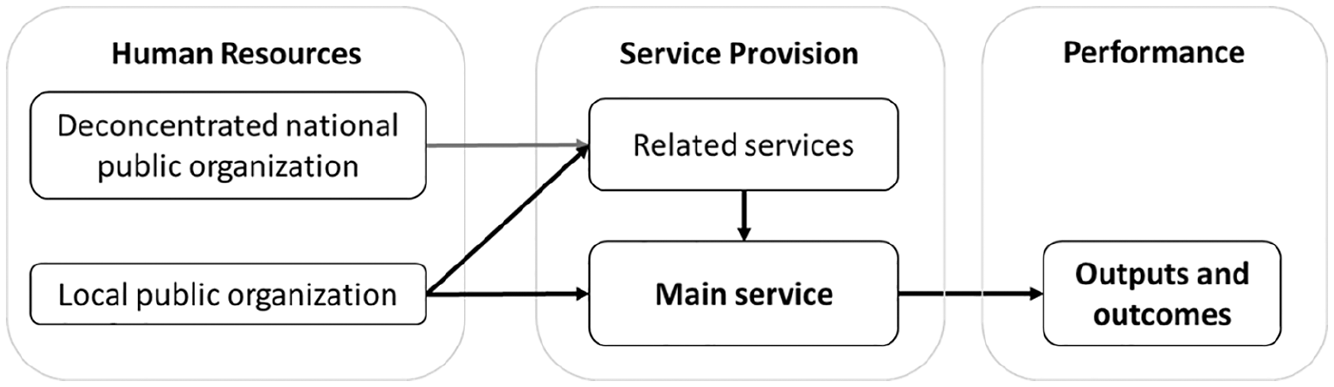
HR, service provision and performance in multilevel arrangements.
The model presents two types of organizations contributing HR to the achievement of a certain output or outcome. First, the framework presents local public organizations as the direct providers of the main service of study (e.g., school districts, hospitals, or parks and rec departments). However, these local organizations might also engage in the provision of related services that contribute to the main service’s performance. For instance, health centers might not only provide medical services, but also preventive care, and both services affect overall health outcomes. Similarly, schools often provide both class instruction and complementary services such as school lunches and transportation that also contribute to education performance.
The common approach found in the literature would correspond to exploring the direct association between these organizations’ HR and service provision performance. Yet, Figure 1 also includes the role of a deconcentrated national public organization. National agencies’ street-level work constitutes a mechanism for the national government to exert its influence on policy making and implementation at the local level (Bello-Gomez, 2020). Therefore, national public organizations, deconcentrated across the territory, can provide services closely related to those offered by local organizations, thus impacting local service provision performance. This indirect effect will depend on the nature and relationship between the activities of both agencies. For instance, national organizations may be engaged in activities that are complements or substitutes to services already provided at the local level. In any case, exploring the role of HR in multilevel service provision performance requires consideration of the existing alternatives for HR assessment.
Assessing HR: Workforce Size and Educational Attainment
Christensen and Gazley (2008) consider several HR aspects in their multi-dimensional exploration of organizational capacity, including quality and quantity of personnel as fundamental resources necessary to perform. Meanwhile, Boyne (2003) also incorporates these two aspects as resources that contribute to service provision performance. To explore the HR effect of public organizations at both levels on local provision performance, this study assesses HR from the perspective of both quantity and quality of personnel. First, HR can be assessed as the availability of public employees for service provision. The ratio between workforce size and the size of the population to be served is a rough measure of HR availability for service provision. Second, human capital theory (Becker, 1964; Mincer, 1958) provides an approach to assess HR quality, that is, people’s skills and knowledge, and its relationship to performance. Organizations compensate higher levels of training and expertise, and benefit from the degree of non-rivalry and non-excludability of human capital components (Romer, 1989).
Unsurprisingly, human capital cannot be captured with one unique measurement. Public management scholars have measured HR quality as educational attainment (Avellaneda & Suzuki, 2015), task-related experience (Carley et al., 2015), and managers’ self-reported assessments (Meier et al., 2016; O’Toole & Meier, 2009), among other measures. Each of these measures capture HR quality only in part given the complexity of people’s skills and knowledge necessary to perform. This study uses educational attainment to capture a salient part of HR quality. Formal education enables capturing codified knowledge associated with technical skills, innovation and better communication abilities (Avellaneda et al., 2020). Even though not included in this study, it is important to recognize that other components of HR quality, such as specific knowledge acquired through experience, and motivation, are likely to influence provision performance in multilevel settings.
Local HR on Education Provision Performance
As mentioned before, the relationship between local HR and performance of services provided directly at the local level has been amply explored in the literature. Particularly in street-level service provision (Eisinger, 2002), workforce size becomes a key factor to ensure services reach the desired population. Indeed, achieving minimum levels of service coverage and enrollment tends to be a priority in the developing world. In the case of education, countries face the challenge of increasing enrollment amid a scarcity of properly trained teachers (Glewwe & Kremer, 2006). Thus, a higher number of teachers, certified or not, might allow increasing the number of enrolled students, which is a paramount policy goal.
Strategies such as double-shift schooling, for instance, which allows teaching different sets of students in two daily shifts, are commonly used in the developing world (Bray, 2008). With such a strategy, more teachers allow increased enrollment and cost-effectiveness at a fixed level of infrastructure and other resources (Linden, 2001). It is important to mention that double-shift schooling implies lower instructional times than a single-shift scheme, possibly carrying negative implications for student achievement (Lavy, 2015; Pischke, 2007). However, the proper comparison in some developing-world contexts might be between some instructional time and none at all. Consider, for instance, that the gross enrollment in secondary education only reached 72% among low- and middle-income countries in 2019 (World Bank, 2020).
Multigrade schools are another example of efficient allocation of teachers’ workforce where marginal increases can lead to substantial improvements in service provision. Several Latin American countries have implemented multigrade schemes where a teacher takes charge of students from different grades in isolated rural communities (McEwan, 2008). Thus, one more teacher dispatched to a new rural community may lead to boosting enrollment, and eventually achievement, among hard-to-reach students. Moreover, more teachers may also lead to reducing class size. Scholars have found smaller classes are associated to higher student achievement (Krueger, 2003) and might lead to higher enrollment (Case & Deaton, 1999). Smaller classes may also allow teachers to identify more easily students at risk of dropping out. In turn, these teachers may be more likely to find the time to address and trace these critical cases. Therefore:
H1a: Higher local workforce size (teachers) is associated to higher performance in local provision of education.
Evidence on the relationship between teachers’ qualifications and performance is rather mixed. In the U.S., some scholars have found teachers’ qualifications do not correlate with student success (Buddin & Zamarro 2009), while others present evidence that certain qualifications, such as the type of degree (Croninger et al., 2007) or the first few years of experience (Rivkin et al., 2005), contribute to educational outcomes. However, the developing world presents wider variation of teachers’ qualifications and training than the developed world, given that the push to achieve enrollment is sometimes solved by hiring untrained or less qualified teachers (Glewwe & Kremer, 2006). The World Bank (2020) reports that 19% of secondary education teachers in low- and middle-income countries in 2019 had not received the minimum level of training required for teaching in their respective countries. In contrast, U.S.-based studies, even in considerably stringent conditions (e.g., poverty and rural isolation in Kentucky’s Appalachia in Fowles et al., 2014), address contexts where most if not all teachers have completed their college education and passed certification exams.
Greater variation and lower minimum requirements in HR quality may lead to a more salient influence of this factor for education provision performance. Indeed, Afonso and Aubin (2006) showed substantial inefficiencies in the use of resources (human and financial) for secondary education among certain developing countries compared to OECD members, which might be attributed to differences in human capital. While unqualified teachers help provide basic classroom instruction, they may be less likely than their qualified counterparts to use more effective classroom practices. Such practices might positively affect student achievement (Connor et al., 2005; Darling-Hammond, 2000; Whitebook, 2003), reduce dropout (Koedel, 2008) and improve the chances of dropouts returning to the education system (Whannell & Allen, 2011). Therefore:
H1b: The higher the educational attainment of local human resources (teachers), the higher the local education provision performance.
National Deconcentrated HR and Education Provision Performance
Following Figure 1, there is a case to be made for the influence of national organizations’ workforce on education provision performance when these national organizations provide closely related services. National organizations, through field offices, might operate activities that contribute to the achievement of local government’s main policy goals. In that case, higher performance of national organizations’ field offices would contribute to higher performance in local education provision. In turn, one would expect that deconcentrated national organizations’ HR, as a component of organizational capacity, influences these field offices’ performance.
The geographic distribution of the bureaucratic apparatus, for instance through field offices, occurs due to the need of the government to extend its reach, or capacity, across its entire jurisdiction (Mann, 1988; Soifer, 2015). In turn, administrative deconcentration, which empowers field offices, allows national organizations to bring local representation into the decision-making process (Kaufman, 1969). Thus, one can conceive administrative deconcentration as a lower degree of decentralization with restricted autonomy but allowing to incorporate heterogeneous local context conditions into policy making and implementation. For certain policy objectives, this arrangement may provide the appropriate balance between some need for policy differentiation and the incurring costs of organization and coordination (Treisman, 2007).
Deconcentration increases field-office personnel’s discretion for decision making (Whitford, 2002), counteracting though not eliminating the effect of national policy directives (Whitford, 2007). One could expect that, in exercising this discretion, field-office personnel make use of local information that is more easily accessible to them than to other officials at a higher level. Thus, better information on specific locations and local conditions and characteristics may lead to more effective implementation strategies. Meanwhile, field-office employees might also act as the point of contact between national organizations and local actors—governments, clients, or civil society. In other words, they may become the “face” of the national government in a local community, thus helping with the articulation between local and national interests. Therefore, more national field-office employees engaged in services related to education may positively influence local education performance. Consequently,
H2a: Higher national field office’s workforce size for closely related services is associated with higher education provision performance.
Not only the size of national organizations’ field-office personnel, but also their qualifications, might be related to local education performance. Better qualified personnel bring valuable skills that make them more suitable to influence their organization’s performance and indirectly contribute to local service provision performance. For instance, better qualified people are expected to communicate more directly and plan better (Fiedler, 1986). Also, they are more likely to use expertise-based intuition to make rapid and effective decisions (Salas et al., 2010). These skills are especially salient given the previously described roles of field-office employees as information gatherers and points of contact.
Moreover, from the standpoint of organizational structure, better qualified personnel also bring cost-effectiveness advantages. Organizations with more qualified field-office staff might reduce the need to relocate experts between places (Boh et al., 2007), as they would be more likely to have the adequate talent in each field office. Hence, organizations may experience reduced costs of coordination—who goes where?—and of relocated employees’ adaptation to the new local context, thus boosting effectiveness in service provision. Therefore,
H2b: The higher the educational attainment of national field offices’ public employees engaged in closely related services, the higher the local education provision performance.
Local HR as Moderator of National Deconcentrated HR’s Effect
As seen in Figure 1, it is possible that both local and deconcentrated national organizations overlap in the provision of certain services. Frequently, the “marble cake” metaphor (Grodzins, 1960) provides a useful representation of intergovernmental relations, as different levels of government share jurisdictions over specific areas for policy making and implementation (Wright, 2007). In such cases, national and local governments may provide similar services that substitute for each other. When local governments can provide an acceptable level of services on their own, having more or better qualified personnel at the national level might not contribute substantially to service provision. For instance, if local governments have built enough capacity to manage irrigation systems effectively, the impact of national government’s deployment of agricultural experts may be minimal on local agriculture performance. On the contrary, regions with less-endowed local governments might benefit from a higher capacity of national field offices for service provision. In the irrigation example, local governments with little staff or lowly qualified personnel for irrigation management could experience a substantial effect from the intervention of national agricultural experts.
Moreover, the presence of the national government providing services on the ground might induce behavior changes in local governments. For instance, local governments might decide to reallocate resources—financial, human—to other activities if the action of the national government allows to maintain a certain acceptable level of service provision. This situation is analogous to flypaper effects (Courant et al., 1979; Hines & Thaler, 1995) and other behavioral responses observed in fiscal federalism studies (Baicker, 2001; Marton & Wildasin, 2007). For instance, if the national government increases its capacity for addressing domestic violence on the ground, local governments might react by redirecting their funding and personnel to other social policy issues. Then, the overall result would be that an increase in the capacity of the national government does not lead to a substantial increase in service provision performance because of the strategic response of local governments. In the case of education provision, the national government may be providing related services that substitute other services provided by the local government—for instance, school counseling and psychological support. It might also be the case that local governments shift priorities from education to other areas as a response to the national government taking care of certain aspects of child protection. These rationales lead to the following hypothesis:
H3a: The HR contribution to education provision performance of national deconcentrated organizations engaged in related services diminishes with higher levels of local HR for education provision.
Nevertheless, an increase in national HR through field offices could also reinforce the effect of local organizations’ HR on service provision performance. As proposed previously, national organizations’ field-office employees may serve as points of contact for local organizations. In turn, better qualified officials are more likely to engage in the process of “mutual learning and adjustment” (Agranoff, 2006, p. 59) that is necessary to work collaboratively with local governments. Thus, more and better qualified staff in field offices might facilitate communication, information exchange, and collaborative decision-making with local organizations (Turrini et al., 2010). Arguably, this collaboration might be more effective for increasing service provision performance when local organizations—for instance, schools—also enjoy high levels of HR availability and quality. Thus, one might expect that:
H3b: The HR contribution to education provision performance of national deconcentrated organizations engaged in related services increases with higher levels of local HR for education provision.
These opposite, complementary hypotheses—H3a and H3b—are both plausible a priori. The overlap in service areas between national and local organizations might lead to a marginally decreasing effect of national organizations on local service performance. Yet, the role of interpersonal relationships on these collaborative arrangements might lead to a marginally increasing performance effect of national organizations’ field offices with higher local organizations’ HR. Empirical support for either hypothesis will be evident depending on the nature of the intergovernmental relationship necessary to provide services.
The Case of Colombia
Education Provision by Local Governments
Colombia is a unitary but decentralized country, according to the Constitution of 1991. The country comprises 32 departamentos and the capital district of Bogota. In turn, each departamento is divided in municipalities, with about 1,100 municipalities in the entire country. Both departamentos and municipalities have locally elected governments and particular responsibilities for policy implementation and service provision across different areas. In the case of primary and secondary education, departamentos are responsible for managing public school systems, except for certain municipalities certified by the national government that manage their own school systems. About 80% of students enrolled in primary and secondary education in Colombia attend public schools. While the country has achieved full enrollment in primary education, more than 1.1 million Colombian teenagers were not attending high school by 2013. These represented about 25% of youth between 10 and 16 years, who the Ministry of Education defines as the targeted population for high school enrollment (Ministerio de Educación Nacional, 2014). Consequently, expanding high school enrollment and ensuring students remain within the system are salient policy goals in Colombia.
Since 1994 (Ley 115), Colombian law requires meritocratic recruitment of all public-school teachers while generally expecting applicants with a bachelor’s degree in education. However, the law allowed the transition of existing public-school teachers without a bachelor’s degree to the new system. Moreover, the law also allows other college graduates and people without bachelor’s degree to apply, acknowledging the lack of supply of qualified candidates in certain parts of the country. In turn, promotion mostly depends on tenure length and further educational achievement. While private schools face similar environmental conditions, they have more flexibility in hiring practices and may be able to offer efficiency wages to secure the most competitive candidates.
Child Protection Services by National Government
While provision of education is a direct responsibility of local organizations, there is an indirect national influence through the provision of children protection services. The Instituto Colombiano de Bienestar Familiar (ICBF, Colombian Institute of Family Wellbeing) is an agency of the Colombian government established in 1968 with the mission of developing comprehensive protection of Colombian children, teenagers, and families. ICBF operates through 33 regional divisions (direcciones regionales), one for each of the 32 departamentos plus one for the capital district of Bogotá. In turn, each regional division consists of headquarters in the departamento’s capital city and centros zonales (field offices) spread across the territory. Each one of the 210 ICBF field offices has jurisdiction over a specific territory, often consisting of several municipalities. Meanwhile, in the most populated municipalities, it is common that several ICBF field offices split a municipal jurisdiction. Out of 4,381 public servants working at ICBF in 2007, 2,681 (61%) worked directly at operational field offices. 1 In their areas of jurisdiction, field offices provide direct services to the population and interact with local governments and schools.
The Colombian public personnel system uses a pay scale with five categories, which indicate certain degrees of responsibility and an expected level of education and experience needed to perform properly in the job. Inside each category there is, in turn, a more detailed gradation of salaries. From the top down, the five categories are Directivo, Asesor, Profesional, Técnico, and Asistencial. Positions classified as Profesional and above require bachelor’s degrees at a minimum. The share of ICBF employees in Profesional and above positions increased from 58.7% in 2007 to 68.9% in 2013. Furthermore, at least half of the workforce in all but one ICBF regional divisions held bachelor’s degrees over the 2007 to 2013 period. Even though these figures are not specific in terms of job tasks and type of degree acquired, they suggest an increase in human capital within the organization and a focus on higher qualified personnel.
ICBF devotes a substantial share of its resources (about a quarter of its programming budget) to serve school-age children. Thus, ICBF offers a series of programs and strategies aiming to impact pre-teenagers and teenagers in vulnerable environments. Vulnerable situations include living below the poverty line, being an internally displaced person, having committed a felony, among other situations. For instance, the agency funds “high social impact massive actions,” such as sports, cultural, and artistic events, as well as programs to reinforce protective environments for children. ICBF field offices also provide psycho-social support for vulnerable children and teenagers and programs to prevent teen pregnancy. With this portfolio of actions, ICBF attempts to protect vulnerable youth by reducing their exposure to several risk sources. ICBF and local providers of education—subnational governments and schools—also interact through the “restoration of rights” process (Ley 1098 de, 2006). Schools must report to ICBF when children are absent from classes, which triggers a process to investigate the situation, identify vulnerabilities, and make sure the child returns to a safe environment, including access to the health and education systems. Thus, ICBF actions affect, even though indirectly, outputs of education provision, such as high school enrollment and dropout rates (Bello-Gomez, 2020).
Data and Methods
This study uses a panel data set at the field-office level over 2007 to 2013, and it is built mainly from two sources. On one side, municipal-level characteristics are obtained from the Panel Municipal del CEDE (Acevedo & Bornacelly, 2014). This includes, among other variables, schools’ enrollment, dropout rates, and teacher’s staffing figures. On the other side, information on ICBF’s personnel at the field office level was obtained from ICBF’s Human Talent department. A total of 210 field offices existed during this period. Their jurisdiction was identified from the contact information for each field office on ICBF’s website (https://www.icbf.gov.co/). These field offices cover the entire Colombian territory except for the departamentos of Vaupés and Guainía, whose ICBF regional divisions operated with a different arrangement at the time. 2 Similarly, ICBF only opened field offices in the departamentos of Vichada and Amazonas in 2012.
As mentioned before, some field offices only cover portions of certain larger municipalities, thus they were grouped together to create units that cover entire sets of municipalities. For example, four field offices have jurisdiction over different parts of the municipality of Medellín, which is also the second most populated city in Colombia. Therefore, these field offices were grouped as one unit of analysis. Meanwhile, consider the case of the departamento of Cesar. Its 25 municipalities correspond to the jurisdiction of one of four field offices—Aguachica, Valledupar, Codazzi, and Chiriguaná, see Figure 2. Therefore, each one of these field offices is treated as a separate unit of analysis. After merging this information with aggregated municipal-level data, a panel was built with 160 units during 2007 to 2013.
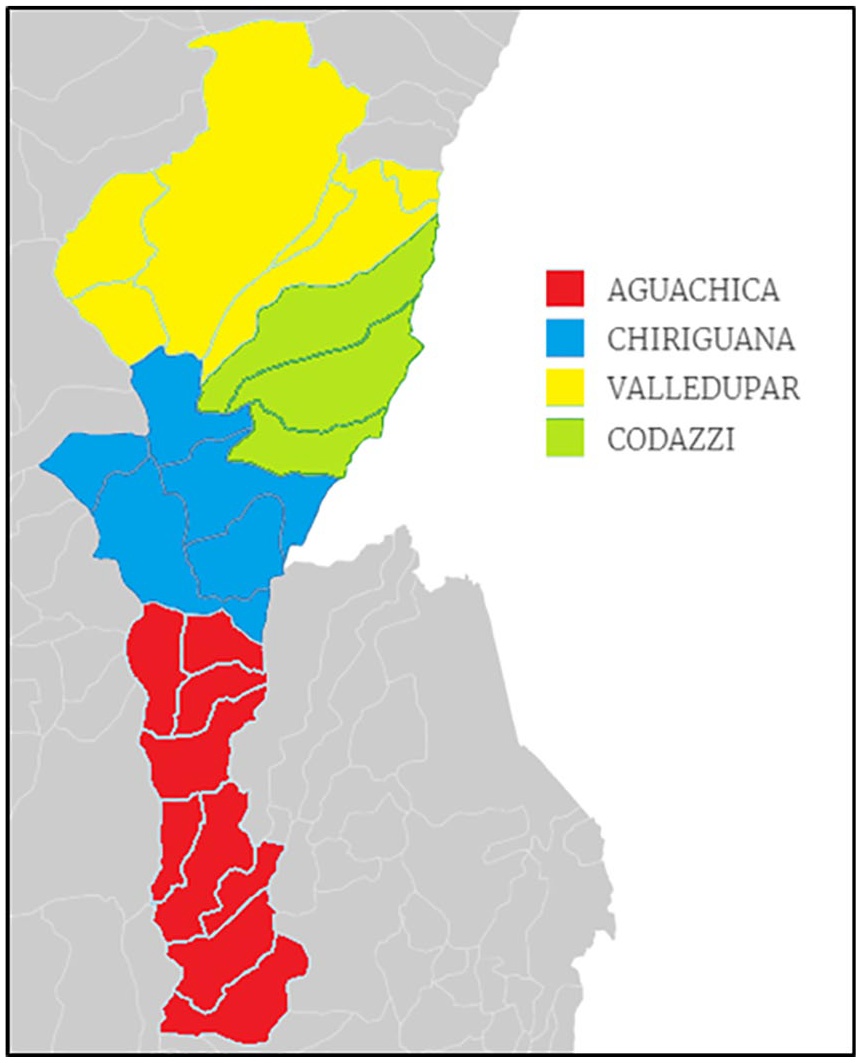
The four ICBF field offices with jurisdiction over the departamento of Cesar’s 25 municipalities.
Dependent Variables
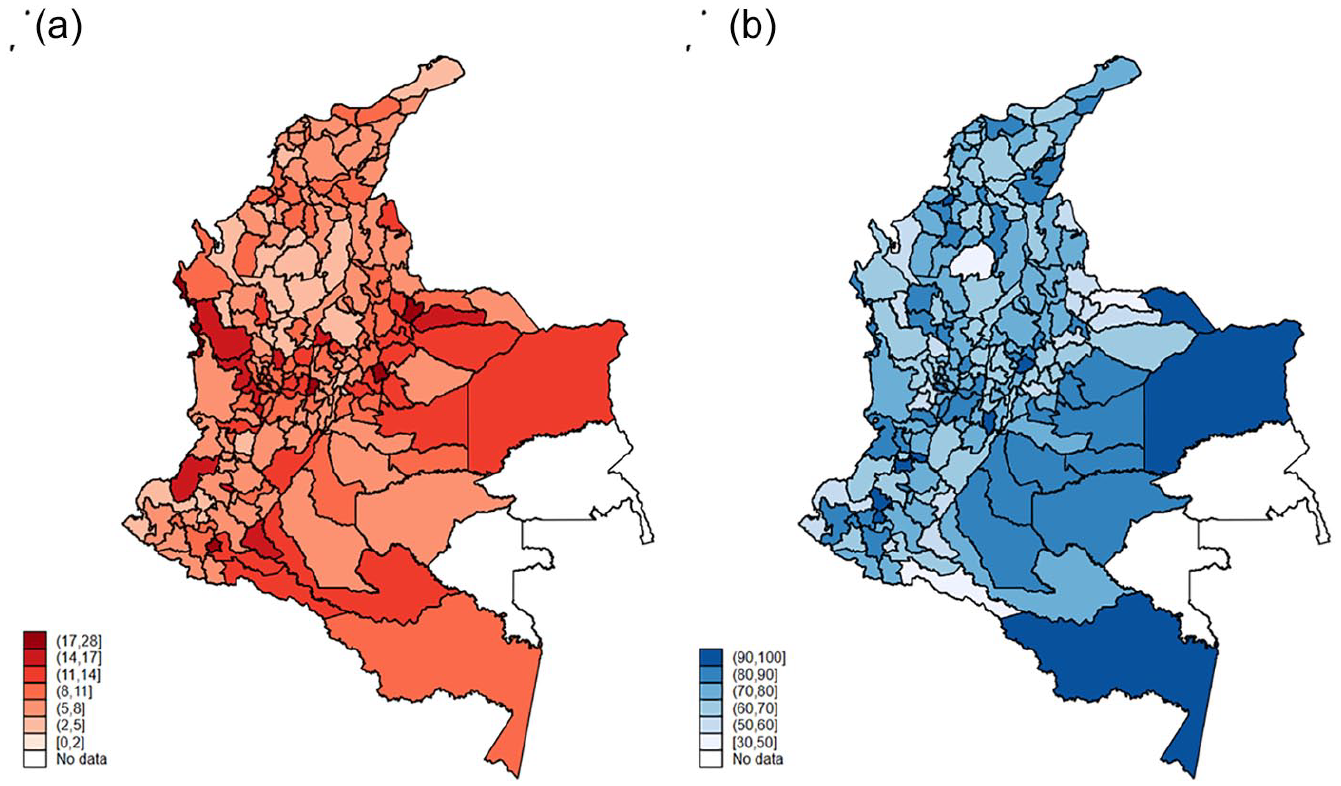
Education provision performance is assessed across two different dimensions. First, high school enrollment rate captures quantity of outputs. This measure corresponds to the total number of students enrolled in all high schools in a respective unit as a percentage of the estimated population between 10 and 16 years in that territory. Given this is a gross measure of enrollment, it is possible that rates go above 100% in certain cases where a substantial number of students outside the target age range are also attending high school. The second dependent variable seeks to measure effectiveness in education provision, which is operationalized with dropout rates jointly for primary and secondary education. A two-way ANOVA shows that 90.5% of the variation in high school enrollment is due to differences between field offices, while just 3.5% is accounted by time differences. A similar analysis for dropout rates reports 73.6% of variation between field offices and 9.8% over time. Figure 3 shows the variation in high school enrollment rates and total dropout rates across Colombia as averages for the 2007 to 2013 period.
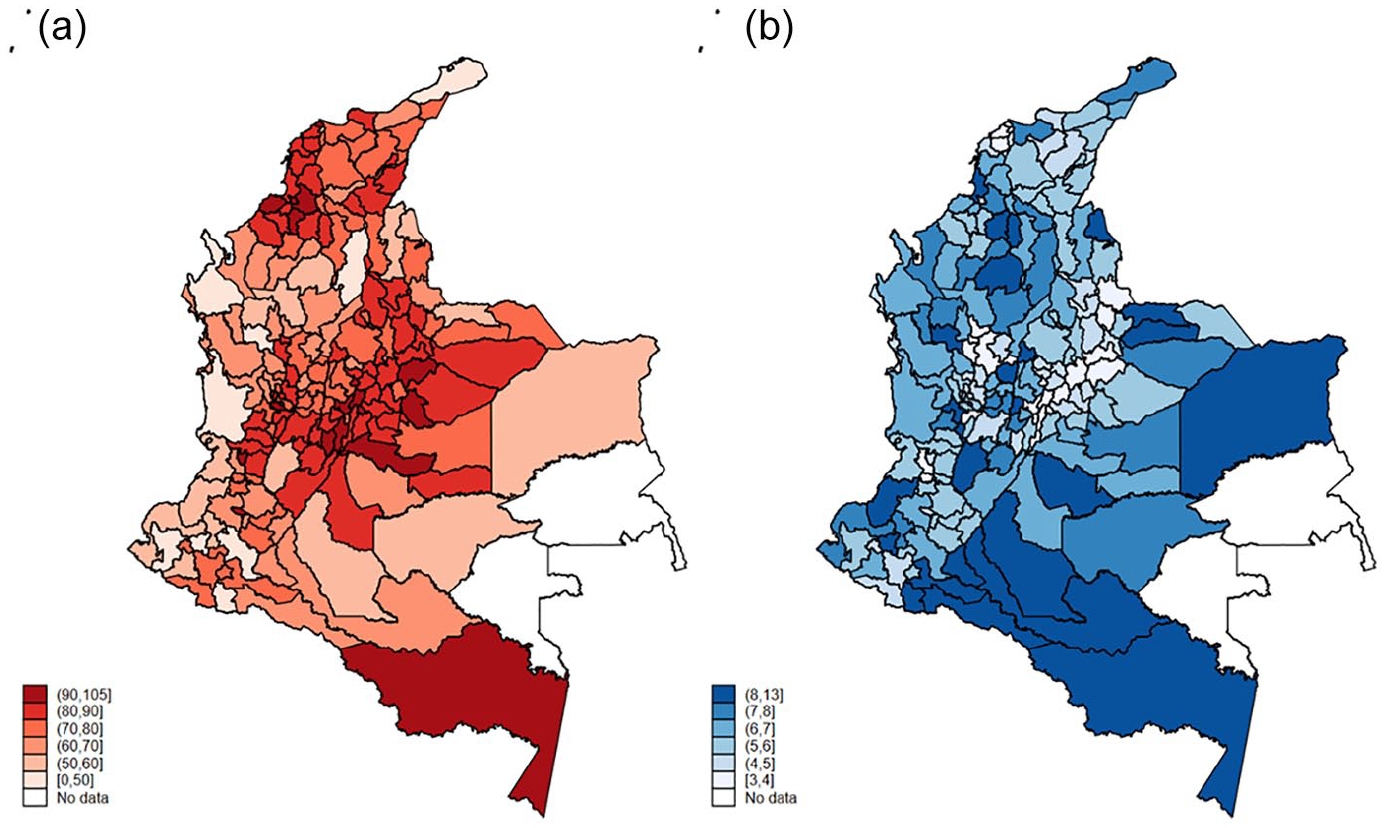
Education provision in Colombia, averages for 2007 to 2013: (a) high school enrollment (%), 2007 to 2013 and (b) Dropout rate (%), 2007 to 2013.
Independent Variables
The empirical analysis uses analogous measures of relative workforce size and educational attainment to assess HR of schools and ICBF’s field offices. The number of teachers per each 100 students operationalizes HR quantity, or the relative size of the workforce for education provision. Meanwhile, the share of teachers with bachelor’s degrees captures local HR quality as educational attainment. Measures related to high school teachers are used in relation to high school enrollment, while measures related to all teachers—primary and secondary education—are used in relation to dropout reduction. The number of ICBF employees per 100,000 people, and the share of ICBF employees with bachelor’s degrees capture national deconcentrated HR in each field office. Figures 4 and 5 present the distribution of HR measures across field offices as averages for the 2007 to 2013 period.
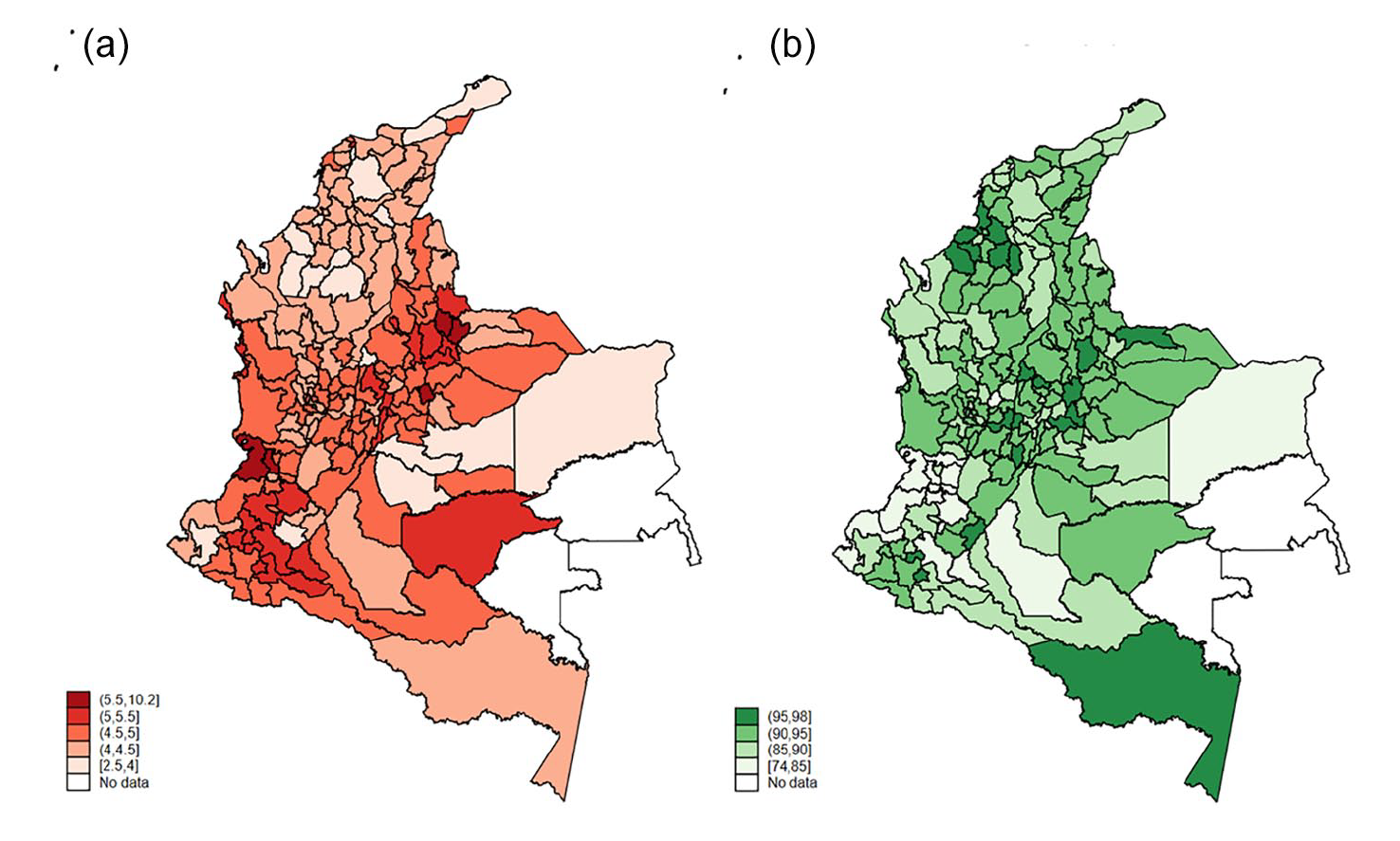
Schools’ human resources in Colombia, averages for 2007 to 2013: (a) teachers per 100 students, 2007 to 2013 and (b) share of high school teachers with bachelor’s degree (%), 2007 to 2013.
ICBF’ human resources, averages for 2007 to 2013.
It is important to clarify the use of teacher-based measures as independent variables given that a reversed causality concern may arise—for example, higher enrollment could cause the number of teachers to increase. In Colombia, subnational governments in charge of public-school systems must comply with an administrative process to request the national Ministry of Education’s permission to increase the number of teachers hired, based on an analysis of service provision capacity and financial viability. Consequently, the number of teachers might partially depend on previous enrollment, but it is unlikely to be driven by an enrollment change during the same academic year—which corresponds, in Colombia, to the calendar year. In turn, the share of teachers with a bachelor’s degree is further distanced from enrollment variations.
Control Variables
Several control variables are included in the analysis to account for the influence of environmental characteristics in service provision performance (Boyne, 2003; O’Toole & Meier, 1999). For instance, rural areas exhibit lower levels of school enrollment (Delgado, 2014) due to the diseconomies of scale in local governments’ effort to reach out to dispersed populations and provide them education. Thus, the models include rural population share to account for this influence. Moreover, Colombia has suffered the effects of an internal armed conflict since the 1960s, including the weakening of state capacity for policy implementation and service provision (Robinson, 2016). To account for this, the number of people internally displaced per each 1,000 is included in the models. Also, the models include GDP per capita in 2007 and poverty rates from the 2005 national census as proxies of economic conditions and poverty in each field office’s jurisdiction. 3
Given that ICBF is a national agency whose director general appointed by the Colombian president, the analysis needs to account for the potential allocation of ICBF personnel in certain regions to fulfill political agreements. Moreover, municipalities and departamentos aligned with the national government might be in a better position to lobby for additional resources for their territories. While the data does not allow to directly explore these effects, the inclusion of the president’s vote share in each territory helps account for them. During the period of analysis, Colombia held presidential elections in 2006 and 2010.
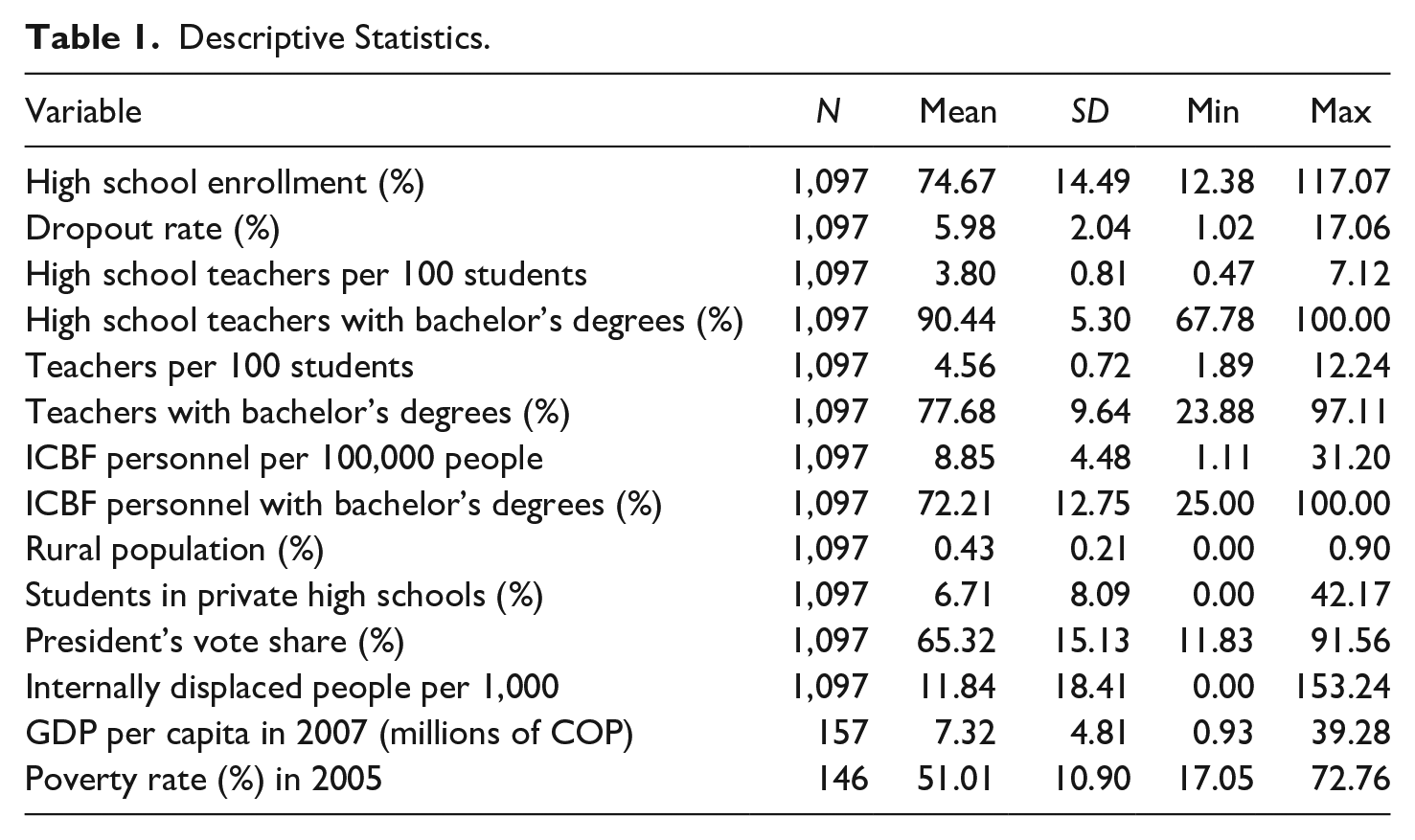
Finally, the differentiated role of private schools must be taken into consideration. Private school enrollment is not evenly distributed across Colombia. Instead, private schools are more common in bigger urban areas and more accessible to affluent families (Núñez et al., 2002). Therefore, it is likely private schools present better indicators of performance given that their students tend to enjoy more favorable social and family environments (Iregui et al., 2007). Hence, the share of private school enrollment is included as a control variable. Table 1 reports descriptive statistics for all the relevant variables incorporated in the models.
Descriptive Statistics.
Method
An ordinary least squares regression with fixed effects by departamento and year is used for the empirical analysis. Considering the overwhelming share of the variation in dependent variables explained by differences between field offices, it would be unwise to follow strict two-way fixed effects controlling by field office and time. Instead, the chosen method allows exploiting the geographic variation in the variables of interest while accounting for time trends and institutional characteristics that are likely to be common at the departamento level, such as the influence of the subnational government and school system administration and funding. Consequently, standard errors are clustered at the departamento level. Moreover, the time-invariant socioeconomic proxy variables (GDP per capita and poverty rate) remain in the model since the fixed effects are applied at the departamento and not the field-office level. The general findings hold when using a dynamic panel model with differences instead of levels of the dependent variable, and lagged values of the dependent variable as a regressor.
Results
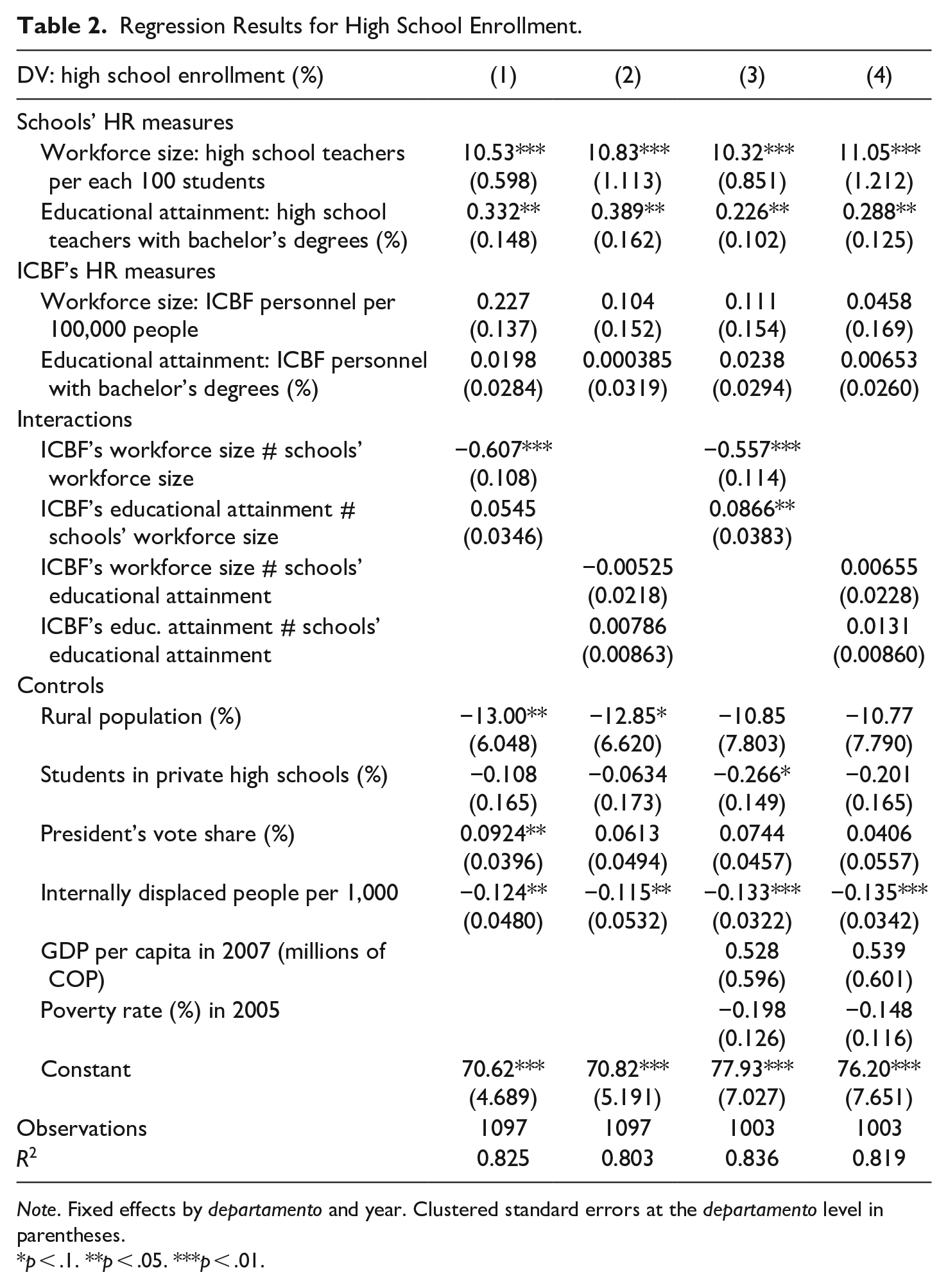
Table 2 presents the results for the regression analysis on high school enrollment rates. All the models include interactions between schools and ICBF’s HR measures, as well as fixed effects by departamento and year. Given that GDP and poverty rates are available for most but not all units of analysis, models 1 and 2 present the results without these two controls, while models 3 and 4 include all the available controls. To avoid issues of multicollinearity, HR measures are differences from each year’s mean. Variance inflation factors are below 10 in every case. Both schools’ HR measures present a positive and statistically significant relationship with high school enrollment. Holding every other variable constant, an increase in one high school teacher per each 100 students is associated with an increase of about 10.5 percentage points in high school enrollment. Meanwhile, one percentage point increase in the share of high school teachers with bachelor’s degrees is associated with an increase of 0.22 to 0.39 percentage points in high school enrollment. While coefficients are positive, there is no statistically significant evidence of a direct effect of ICBF’s HR measures, neither measured as workforce size nor educational attainment, on high school enrollment. Among control variables, the rate of internally displaced people holds negative significant coefficients across all models. One more person displaced per each 1,000 people is associated with an approximate decrease of 0.11 to 0.13 points in high school enrollment. Results are not consistent for the case of presidential vote share, rural population, and share of private-school students.
Regression Results for High School Enrollment.
Note. Fixed effects by departamento and year. Clustered standard errors at the departamento level in parentheses.
p < .1. **p < .05. ***p < .01.
While interactive terms between teacher’s educational attainment and ICBF measures are not significant, the interactions between school’s workforce size and both ICBF’s workforce size and educational attainment measures are. However, these coefficients hold opposite signs, thus deserving further exploration. Figure 6a presents the marginal effect coefficients for ICBF’s HR measures on high school enrollment across quintiles of schools’ average workforce size. Thus, for instance, the first quintile represents the 32 field offices’ jurisdictions where the average number of teachers per 100 pupils in the 2007 to 2013 period was the lowest in the country. This quantile approach allows exploring differences in the moderating effect along the distribution of local HR while a regular margins plot would only represent a linear slope for all the data.
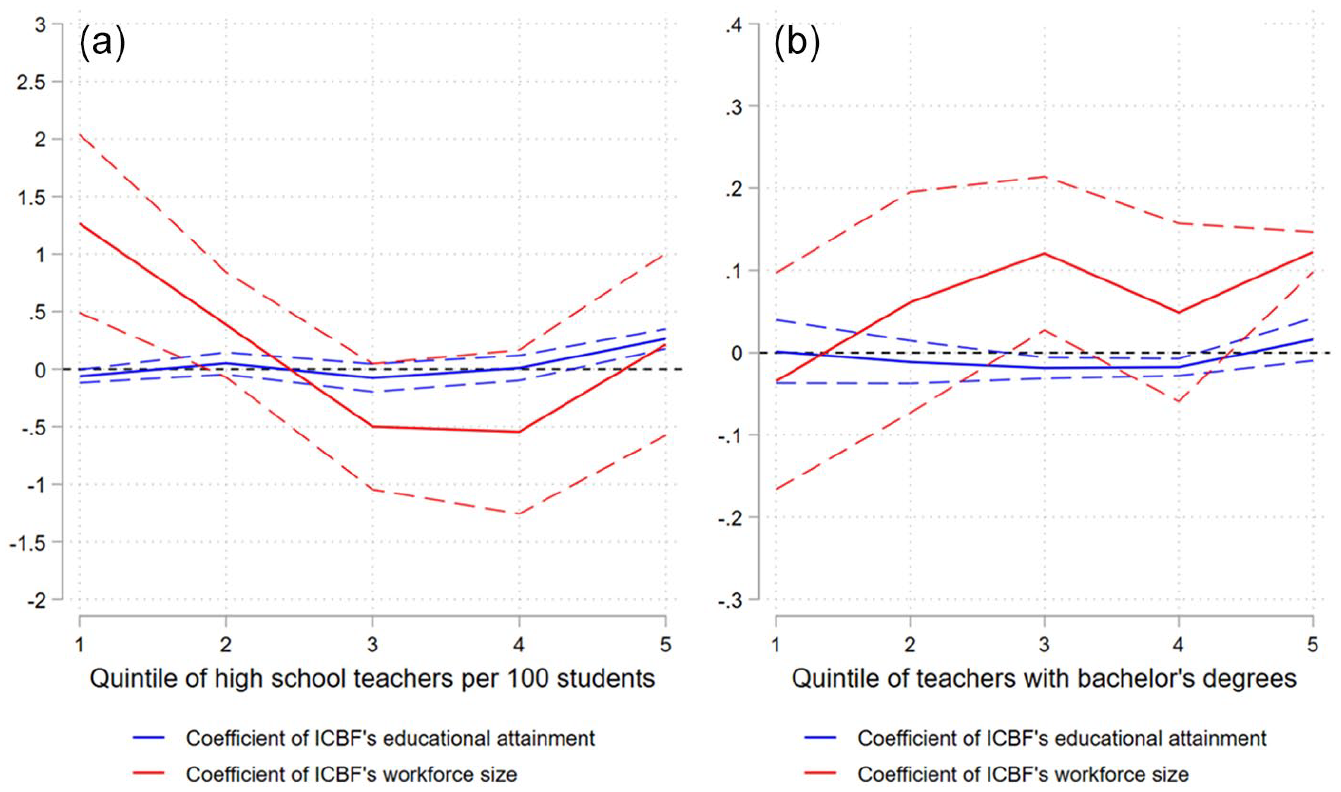
Marginal effects of ICBF human resources on education provision performance 95% confidence intervals: (a) effects on high school enrollment (%) and (b) Effects on dropout rates (%).
ICBF’s relative workforce size holds a significant relationship with high school enrollment among field offices in the lowest quintile of the distribution of schools’ workforce size. Indeed, the coefficient for the second quintile is still positive and significant at the 10% level. Within the lowest quintile of high school teachers per pupil, an increase in one ICBF employee per 100,000 people is associated with an increase in 1.2 percentage points of high school enrollment; and this effect diminishes to 0.4 percentage points in the second quintile. There is no significant effect of ICBF’s personnel per capita for higher levels of schools’ workforce size. Meanwhile, ICBF’s educational attainment only reports a significant, and positive, effect on high school enrollment for the highest quintile of schools’ workforce size. One percentage-point increase in the share of ICBF employees with a bachelor’s degree is associated with an increase in 0.26 percentage points in high school enrollment for these areas of the country.
Results for the regressions on dropout rates are presented in Table 3. All models present interactions between schools and ICBF’s HR measures. However, models 5 and 6 present the full sample, without poverty and GDP as controls, while models 7 and 8 present a restricted sample to include these socioeconomic factors. As in Table 2, variables are centered on the mean for each year to avoid issues of multi-collinearity, and variance inflation factors are below 10. Across models, local workforce size is significantly associated with a decline in dropout rates. One percentage-point increase in teachers per 100 pupils represents a decrease of 0.411 to 0.62 percentage points in dropout rates, holding every other variable constant. In turn, neither schools nor ICBF’s measures of educational attainment reports a significant direct effect on dropout rates. Surprisingly, ICBF’s workforce size presents a positive association with dropout rates in some models; however, the coefficient is not substantially significant.
Regression Results for Dropout Rates.
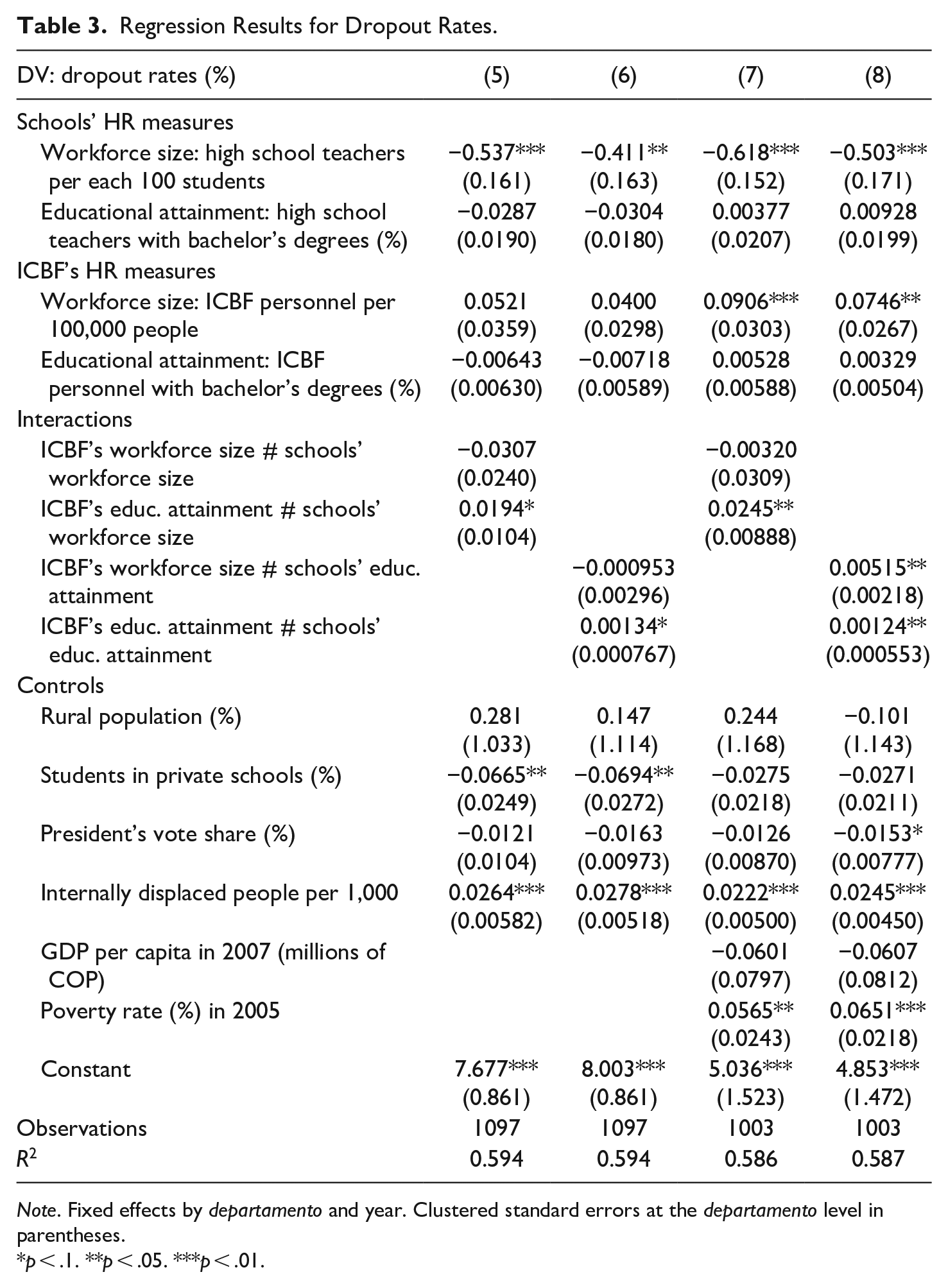
Note. Fixed effects by departamento and year. Clustered standard errors at the departamento level in parentheses.
p < .1. **p < .05. ***p < .01.
As in the case of high school enrollment, the internal displacement rate is associated with deteriorating dropout rates across all models. A rise in one displaced person per 1,000 corresponds to an increase of 0.02 percentage points in dropout rate. Meanwhile, when included in the models, one percentage-point increase in the base poverty rate in 2005 is associated with a 0.05 to 0.06 percentage-point rise in dropout rates. Rural population share does not seem to have a significant relationship with dropout rates. Other control variables do not report consistent results.
Table 3 also show a positive and significant coefficient for the interaction between the share of ICBF employees with bachelor’s degrees and both schools’ HR measures—workforce size and educational attainment. Figure 6b helps explore these results further by presenting ICBF’s marginal effects on dropout rates across quintiles of the distribution of teachers with a bachelor’s degree. Among the areas of the country with the most qualified teachers, one more ICBF employee per 100,000 people is associated with about 0.1 percentage-point increase in dropout rates. Even though this is a substantially small effect, it is still surprising. This finding might suggest that the best-endowed areas of the country, in terms of teachers’ qualifications, may have reached a point of saturation at which additional national employees in field offices are not contributing to performance. Meanwhile, there is evidence of a significant, but also insubstantial, effect of ICBF’s educational attainment on reducing dropout rates.
Discussion
These findings provide evidence in support of hypotheses H1a and H1b that school’s indicators of the relative size of the teacher workforce and their educational attainment have a positive relationship with education provision performance. One more teacher appears to allow school administrators to gain capacity on the margin, thus extending education provision to some additional students and improving the school’s ability to monitor potential dropouts. Moreover, a greater proportion of teachers above the minimum standard qualification in Colombia—having a bachelor’s degree—may be leading teachers to contribute more effectively to these education provision goals. The relationship of quantity and quality of staff with organizational performance is well-established in the literature (Boyne, 2003), including the case of education provision (for instance, Meier et al., 2016). However, this study’s results allow to generalize these relationships toward contexts where minimum qualifications are frequently not met, and where service coverage takes a central role as a policy concern.
This study presents a stringent test of ICBF’s contribution to education provision performance given that the agency’s relationship to education provision occurs through the provision of ancillary services. Indeed, results fail to provide empirical evidence of an overall direct relationship between ICBF and performance in education provision (hypotheses H2a and H2b). Yet, the study also explores the moderating effect of school’s HR measures on the ICBF’s potential effect. The relative size of ICBF’s workforce is positively associated to high school enrollment only for the regions of Colombia with the lowest schools’ workforce size. This finding provides support to hypothesis H3b and suggests that schools with few teachers can rely on the support of ICBF, not for classroom instruction or school governance, but for the provision of additional services that contribute to keeping and increasing enrollment.
Regions with better endowed schools do not appear to benefit from additional ICBF employees. However, they exhibit a positive relationship between performance and better qualified ICBF personnel on the ground, thus providing evidence for H3a. It is possible that, handling a lower workload than their counterparts in the least endowed schools, these teachers manage to engage in more meaningful collaboration with ICBF’s employees. In turn, better qualified ICBF employees can become more effective partners for these schools. The mixed evidence found in these moderating associations reflects the complexity of the relationship between local education providers and the national agency. ICBF contributes to education provision performance on the margin, but this contribution is clearly perceived only at the extremes of the distribution of school’s HR levels. Moreover, ICBF’s influence seems to depend on the type of personnel it deploys to its field offices and its proper match with school’s HR on the ground.
Conclusion
This research contributes to the literature of human resources and public management by proposing and testing a model for the relationship between human resources and performance when multiple organizations, at different levels of government, contribute to service provision. The study makes use of the uneven distribution of national and local governments’ capacity in Colombia, and their close relationship for education provision, to study the performance effect of workforce size and educational attainment as HR indicators. Schools’ workforce size and teachers’ educational attainment contribute to high school performance and decreasing overall dropout rates. Moreover, ICBF, a national government agency providing ancillary services through its field offices, contributes to education provision performance in differentiated ways that are moderated by schools’ HR levels.
There are theoretical arguments to expect the schools’ moderating effect to be either positive or negative, and the empirical evidence supports both expectations depending on the indicators analyzed. Thus, the contribution of ICBF’s workforce size is negatively moderated by schools’ workforce size, suggesting a substitution of ancillary services between ICBF and local schools. Meanwhile, ICBF’s share of employees with a bachelor’s degree exhibits a positively moderated association, hence providing evidence of a reinforcing relationship between schools and ICBF’s HR that may facilitate collaboration and improve its results. Of course, these findings depend on the specific institutional arrangements and environmental context of Colombia. However, they highlight the need to acknowledge and further explore multilevel interactions in service provision and their influence on performance. Multilevel governance has become more salient across the globe in the last few decades, regardless of whether a country’s constitutional arrangement is unitary or federal (Hooghe & Marks, 2016). Therefore, studying the relationship between different government levels through their street-level personnel is a key part of understanding service provision performance in most countries around the world. Even in highly decentralized federal countries such as the United States, while the federal government does not directly provide most services, multilevel interactions exist on the ground between state and local governments.
Two main policy implications can be derived from this research. First, decentralization scholars and policymakers until recent times downplayed the role of developing capable cadres of civil servants in charge of new responsibilities at the local level (Ahmad et al., 2005). These findings align with international organizations’ policy shift by about the importance of strengthening technical and managerial abilities of local public employees to increase efficiency and effectiveness in service provision (Izquierdo et al., 2018). Secondly, from the national government’s perspective, the way to boost national agencies’ HR across the territory should be a strategic decision based, in part, on local governments and organizations’ HR levels. For instance, if the Colombian government aims to contribute to education provision’s coverage through the work of ICBF, the agency should increase its presence in the regions with lowest education provision capacity even if its personnel is not the best qualified. On the contrary, regions with a high number of teachers per pupil and low enrollment levels might benefit more from the deployment of few but better trained civil servants that may enhance the complementary services provided by ICBF.
Further research might address some of this study’s limitations. For instance, other governance arrangements for the provision of other services—for example, healthcare, policing or job training, to mention a few—might evidence different interactions between service providers’ HR levels. Moreover, this study does not consider the institutional and non-cognitive aspects of human resources and their influence on performance. While demanding in data, within-country studies exploring this type of factors across regions might provide a more complete picture of the role of HR in multilevel service provision.
Scholars have called for research on comparative public administration to push beyond descriptive studies (Gulrajani & Moloney, 2012) and question the premature generalization of evidence based on select country cases (Haque et al., 2021). In direct response to such calls, this study expands the validity of the relationship between HR and service provision performance. Colombia offers a context where public servants’ qualifications are lower, and differences in state capacity are more salient than in the developed countries that are often the subject of study in the literature—U.S. and several Western European countries. Thus, this study contributes empirical findings to further validate our understanding of public HR in a substantially different context that is seldom studied.
This research also aligns with recent calls to consider country-level institutional factors in conducting public administration research (Milward et al., 2016; Roberts, 2018). While Colombia has progressed substantively in terms of economic and social development in the last two decades, the country still faces the need to extend social services coverage amid weakly enforced political and societal institutions at the local level. Indeed, Colombia faces a mismatch between the set of formal institutions for public service and its implementation (Sanabria Pulido, 2015). Moreover, the analysis also shows that the intensity of the country’s armed conflict, operationalized as internal displacement rate, seems to hinder the ability of local governments and other organizations to effectively utilize resources to boost performance. Each developing country faces specific challenges, and each one has developed specific strategies to tackle them, both in the government’s sphere and in society overall. The effect of these institutional arrangements on the performance of public organizations can only be explored by expanding research in public management and intergovernmental relations to these diverse international contexts.
Footnotes
Acknowledgements
The author would like to thank Claudia Avellaneda, James Perry, Amanda Rutherford, Sean Nicholson-Crotty and Lee Alston for their insightful comments and their support. Also, this research would have not been possible without the collaboration of former ICBF’s director of Human Talent, Carlos Garzón, and his team. The author is also grateful to Ricardo Bello Pascuas for his invaluable research assistance, and participants at the annual meeting of the Southern Political Science Association (SPSA) in San Juan, Puerto Rico, January 2020, and the Wright Symposium at the annual meeting of the American Society for Public Administration, online in April 2021.
Declaration of Conflicting Interests
The author(s) declared no potential conflicts of interest with respect to the research, authorship, and/or publication of this article.
Funding
The author(s) received no financial support for the research, authorship, and/or publication of this article.
