



Abstract
Using five waves of Korean Workplace Panel Survey (KWPS) data, we examine the mediating effects of internal communication channels on the relationship between strategic human resource management and organizational performance. Comparing public, nonprofit, and for-profit organizations, we demonstrate significant sector differences in communication. Our analyses show that only for-profit firms have been able to tap into the advantages of internal communication channels in an effort to improve the alignment between strategic human resource management and perceptions of organizational performance. From the findings, we suggest that public and nonprofit human resource managers may have a number of structural, cultural, and knowledge barriers to effective communication.
Keywords
Introduction
Organizations employ strategic management as a means for achieving organizational goals and managing environmental challenges (Brown, 2010). To accomplish this, organizations should foster consistency between established strategies and other practices, such as those associated with human resource management (HRM). The concept of strategic human resource management (SHRM) underscores alignment between HR practices and organizational strategies to achieve organizational goals (Becker & Huselid, 2009; Delery & Doty, 1996; Perry, 1993; Wright & McMahan, 1992). Thus, all HR functions should align with specific strategies and coordinate practices across the organization to ensure that HR practices promote strategy implementation.
To ensure alignment and coordination in organizational strategy, top management and the human resource (HR) department must constantly communicate with internal stakeholders (e.g., employees and other managers across the organization) regarding strategies and related HR practices. Communicating with internal stakeholders—internal communication—is defined as “all formal and informal communication taking place internally at all levels of an organization” (Kalla, 2005, p. 304). Internal communication is an integral part of ensuring employees understand HR practices and champion successful changes that ultimately lead to enhanced organizational performance (Bowen & Ostroff, 2004; Den Hartog et al., 2013). This entails communication between managers and employees within an organization via a number of channels, including but not limited to dyadic face-to-face encounters such as group meetings or one-on-one sessions, employee surveys, and intranet communication via email, office newsletters, and memoranda.
Although a significant body of research underscores the importance of communication as a positive driver of organizational performance (Clampitt & Downs, 1993; Farrell et al., 2012; Pincus, 1986; Schuler & Blank, 1976), the existing research falls short in explaining the utility of internal communication channels in the relationship between SHRM practices and organizational performance. Moreover, little is known as to how communication may differ by sector and if these differences play a role in the SHRM—performance relationship. Given that the adoption of SHRM in the public and nonprofit sectors has failed to keep pace with similar efforts in the for-profit sector (Akingbola, 2013; Den Hartog et al., 2013; Gould-Williams, 2004; Guo et al., 2011), this research contributes to a broader understanding of how different communication patterns across sectors strengthen the relationship between SHRM and organizational performance.
In order to compare sector differences, we examine the attitudes of human resource (HR) professionals in all three sectors. By employing the perceptions of HR professionals, our research provides an expert appraisal of the mediating effects of communication on the relationship between SHRM and organizational performance in the public, nonprofit, and for-profit sectors. Specifically, this article examines two categories of internal communication channels: vertical channels emanating from top management down to employees and horizontal channels that occur across units internally.
The rest of this article is organized as follows. We begin with a literature review that establishes our theoretical framework, including an outline of different communication patterns in public, nonprofit, and for-profit organizations. This is followed by hypotheses, methods, and findings. The last section provides concluding remarks with overall theoretical and practical implications for public service HRM.
Literature Review
Strategic Human Resource Management and Organizational Performance
Unlike classic HRM, strategic human resource management (SHRM) highlights how personnel practices should align with an organization’s strategies to achieve organizational goals (Guo et al., 2011; Wright & McMahan, 1992). Wright and McMahan (1992, p. 298) define SHRM as “the pattern of planned human resource deployments and activities intended to enable an organization to achieve its goals.” SHRM seeks to align HR practices and functions with organizational goals as a means for improving overall productivity. As such, SHRM focuses on organizational performance and HRM systems rather than routine functions or isolated personnel practices (Becker & Huselid, 2009).
The extent to which SHRM practices influence organizational performance depends on the level of alignment between internal and external contingencies (Colakoglu et al., 2009; Lepak & Snell, 2002). This entails preparing for economic, political, and industry contingencies, demands from different stakeholder groups (Colakoglu et al., 2009; Ridder & McCandless, 2010), and internal forces such as technology, culture, and structure. In this sense, SHRM is a macro-perspective based approach that matches personnel practices to evolving organizational strategies, while HRM is referred to as a micro-oriented management tool (Delery & Doty, 1996; Wright & McMahan, 1992). For example, when an organization strategizes to invest in a certain system to cope with an industrial change, SHRM is deeply involved from the beginning in plans for recruiting, training, deploying, and evaluating human capital. These HR practices are integrated efforts to achieve organizational goals, not separated activities.
SHRM has long been employed as a means for improving end products such as services and manufactured goods in the for-profit sector (Lengnick-Hall & Lengnick-Hall, 1999; Lengnick-Hall et al., 2009; Mesch et al., 1995). According to the Resource-Based View (RBV), organizational resources, especially human resources, provide businesses with a competitive advantage that competitors cannot easily imitate by connecting people (the resources) directly to the accomplishment of organizational strategies (Akingbola, 2013; Colbert, 2004). Likewise, SHRM should factor into public and nonprofit organizations’ ability to benefit from the competitive advantage of their people. Pynes (2008) contends utilizing SHRM is one of the best ways to improve organizational service quality in the public and nonprofit sectors by providing proper alignment of personnel to organizational strategies. Organizational capabilities that effectively manage and deploy human resources, including volunteers, may lead to better outcomes (Handy et al., 2008).
However, the distinct environmental forces across these sectors results in different approaches to SHRM (Akingbola, 2013). Among the many forces of each sector, some examples are mission and values in the nonprofits, market and competition in for-profit firms, and political systems and elections in public organizations. Mission-driven nonprofit organizations may emphasize collaboration with others rather than a competitive advantage, leading them to share human capital including volunteers. Public organizations in an election period may pay more attention to other activities than high-quality service provisions. For instance, they may be under pressure for policy-related decisions that can be used as advantages for the incumbent President. Therefore, understanding SHRM differences across sectors enables scholars and practitioners to know the important roles and core values of HR practices, given that achieving organizational goals is the ultimate purpose of SHRM. Whatever the particular environmental forces, when implementing SHRM, organizations have to consider how to communicate the practices associated with this approach to HRM and how effective communication can facilitate the alignment process between HRM and organizational performance.
Roles of Communication between SHRM and Performance
Internal communication has three main roles in implementing SHRM. First, internal communication disseminates information within an organization (Friedl & Verčič, 2011; Karanges et al., 2015). Successful implementation of SHRM requires different levels within an organization to communicate with each other. This ensures internal units (i.e., top management, HR department, line managers, and employees) receive appropriate information and appreciate strategies, plans, and their respective roles. Given that employee participation is a core SHRM practice (Delery & Doty, 1996), a lack of knowledge regarding organizational strategies may hinder employees from being able to participate in decision-making.
Second, internal communication promotes SHRM by playing a facilitative role among various stakeholders within an organization. Effective communication enables employees to cooperate with others and ameliorate potential conflicts between supervisors and employees or across departments (Reissner & Pagan, 2013). Lastly and more importantly, internal communication promotes organizational culture, thus reinforcing employees engagement with the organization (Karanges et al., 2015; Reissner & Pagan, 2013; Tkalac Verčič & Pološki Vokić, 2017). Indeed, research argues that engaged employees are critical assets to organizations and offer a comparative advantage (Macey & Schneider, 2008). Highly engaged employees are more likely to feel committed to their working organizations and actively participate in decision-making, thus leading to higher levels of performance (Akingbola et al., 2019; Bae & Lawler, 2000; Johansen & Sowa, 2019; Reissner & Pagan, 2013; Rich et al., 2010; Tkalac Verčič & Pološki Vokić, 2017).
Considering its critical role, organizations should develop internal communication strategies that facilitate the relationship between SHRM and organizational performance. As discussed above, internal communication should provide information on organizational strategies, support cooperation among various entities within an organization, and encourage employees to be highly engaged in organizational practices including decision-making. Such effective communication facilitates high-performance organizations.
Hypotheses: Mediating Role of Communication Channels across the Sectors
Despite the blurring of once sharp sector differences, a certain level of distinction still exists between organizations in the public, nonprofit, and for-profit sectors. The multi-dimensional view of “publicness” advanced by Bozeman (1987) assumes every organization is influenced to some extent by political and economic authority. According to this view, government organizations are more influenced by political authority than economic authority while private entities are more influenced by economic authority than political authority (Bozeman, 1987; Rainey, 2014). Considering that political and economic authorities are mainly external forces, the concept of publicness is in-line with environmental forces and complexity (Akingbola, 2013). Akingbola (2013) suggests that sectors have different core complexities: political complexity (public), social complexity (nonprofits), and market complexity (for-profit firms). Different levels of publicness and environmental forces drive differences in work characteristics and culture that in turn influence internal communication behaviors in public and nonprofit organizations.
Given their complex political environment, public organizations tend to have rigid structures and are behaviorally opaque (Fottler, 1981). Constitutional checks and balances, oversight by other governmental agencies, interest group politics, and regulations exert political power in an effort to control government agencies (Chen, 2012). For these reasons, internal communication in government tends to be centralized, constrained, rule-bound and formalized (Garnett et al., 2008). Such a communication style may limit employee engagement with organizational strategy, obscuring organizational level outcomes. Bureaucratic red tape is a further hindrance to active communication, further muting overall performance (Pandey et al., 2007).
Nonprofits are mission-oriented and their strategies tend to focus on values and societal changes (Akingbola, 2013; Frumkin & Andre-Clark, 2000). Typically, nonprofits have extensive social networks that entail constant interaction with a variety of stakeholders (Alexander, 2000). Socially complex environments such as these demand nonprofit organizations take on innovative and responsive strategies. In fact, the nonprofit sector is often identified for its entrepreneurial and innovative behavior, allowing employees work autonomy that enables internal communication without constraints (Mirvis & Hackett, 1983). However, their lack of financial and human capital resources often prevents nonprofits from making significant investments in internal communication practices (Hackler & Saxton, 2007).
The competitive/free-market environment of for-profit firms often encourages a performance-oriented culture where employees are more likely to compete with each other and are motivated by extrinsic rewards (Akingbola, 2013; Kalleberg et al., 2006). For-profit organizations tend to invest in communication technologies when they consider them to be critical for operational efficiency and effectiveness (Roberts, 2000). Consequently, fluid communication practices are encouraged through internal communication to enhance performance.
An organization chooses the amount and type of communication channels it utilizes based on what its HR strategies necessitate. For example, a face-to-face meeting along with a document is appropriate when a HR department changes a policy that affects an individual employee significantly. Effective communication leads employees to trust that “the process will not harm their work identities or endanger their jobs, that their concerns and fears are taken seriously and will be addressed” (Akingbola et al., 2019, p. 103). This necessitates linking HR departments and senior management in such communication, given the importance of SHRM to organizational level strategies (Delery & Doty, 1996; Wright & McMahan, 1992).
Employees are motivated and satisfied when they perceive that a sufficient amount of high quality managerial information is provided (Byrne & LeMay, 2006; Den Hartog et al., 2013). As such, consistent communication of core strategy elements is essential regardless of the medium (Nishii & Wright, 2007). Furthermore, using multiple channels of communication enhances the impact of communication by facilitating the cognitive ability of employees to process communicated information (Garnett, 1992). However, we still know very little about the effects of different communication channels and how they facilitate the relationship between SHRM and performance.
By focusing on the two types (vertical and horizontal) of communication channels, our research examines differences in the impact these channels have on organizations, specifically, organizational SHRM and performance. Garnett et al. (2008) found that communication has either a mediating role or a moderating role depending on organizational culture, using communication contents. Likewise, we are interested in the indirect role communication may have in achieving performance, but in this paper we specifically see internal communication channels as a means of delivering messages such as HR policies and strategies or mediating influence.
Vertical Communication Channels with Top Management
Given that SHRM corresponds to environmental changes, top-level leaders need to communicate the need for change, provide the big picture, manage resistance to change, and build trust with employees (Akingbola et al., 2019). Researchers have found that direct communication between top management and employees is pivotal for organizational success because it enhances employees’ job satisfaction, commitment, innovation, and performance (Lin, 2007; Pincus, 1986; Putti et al., 1990; Suh et al., 2018). Among various communication channels, top management may choose direct channels to employees when not only delivering critical changes of policies or strategies but also emphasizing organizational values and missions (Putti et al., 1990).
Top management including appointed and elected officials in the public sector may prioritize communication with external stakeholders rather than employees as their decisions on service delivery can be, at least partially, political (Greene, 1982; Thomas & Melkers, 2000). Political coercion and shifts in public opinion often place top administrators, political appointees, and elected officials in vulnerable positions, requiring communication with subordinates to coordinate a quick response to public demand (Garnett, 1992). Therefore, communication between the top management and employees tends to focus on public demand and related policy decisions than employees’ job satisfaction or commitment
Furthermore, the prevalence of mistrust between political appointees and civil servants, hierarchical organization, and labyrinthine rules and procedures all serve to hinder effective internal communication between the upper and lower echelons of public organizations (Garnett, 1992; Mosher, 1982). In this type of organizational culture, communication is more likely to focus on compliance than performance (Harris & Nelson, 2008). Therefore, public employees may be more likely to just follow orders or manuals without considering performance.
Contrarily, nonprofit and for-profit organizations are less constrained by red tape and have a less hierarchical structure (Chen, 2012; Feeney & Rainey, 2010; Ott & Dicke, 2012; Suh et al., 2018). Specifically, it may be easier for employees in small nonprofits to have direct communication with their top-level directors than their counterparts in the public sector. Thus, we hypothesize that vertical and direct communication between top management and employees is likely to have a positive mediating effect, but that the impact differs depending on the sector.
Hypothesis 1-a. The extent of vertical communication channels usage will have no mediating effect in the relationship between SHRM practices and perceptions of organizational performance in public organizations.
Hypothesis 1-b. The extent of vertical communication channels usage will have a positive mediating effect in the relationship between SHRM practices and perceptions of organizational performance in nonprofit and for-profit organizations.
Horizontal Communication Channels
To successfully implement SHRM, all levels within the organization, including line managers and employees, should appreciate the fundamental objectives of HR practices (Bowen & Ostroff, 2004). Given the critical role communication plays in organizational strategy (Al-Ghamdi et al., 2007), HR departments are the optimal means for communicating organizational strategies and related HR practices. HR professionals can be instrumental in building inter-departmental relationships, especially with line managers (Kim & Ryu 2011).
Horizontal communication occurs between co-workers, managers in different units, or across departments/divisions (Clampitt & Downs, 1993; Simpson, 1959). HR managers are a vital conduit for communicating with various people and units within an organization. In order to maintain the alignment demands of SHRM, HR managers need to be able to grasp each employee’s capabilities and continuously update records to manage them effectively (Pynes, 2008). HR departments must communicate with other departments in an effort to align personnel policies and practices—an important aspect contributing to employee appreciation for organizational practices, policies, and decisions. Additionally, SHRM promotes employee awareness of the ties that bind organizational practices and individual tasks (Den Hartog et al., 2013). These complex practices require professional expertise that may be more easily communicated by HR managers (Den Hartog et al., 2013; Pynes, 2008).
An organizational culture that encourages interpersonal relationships across units entails active horizontal communication. Constraints such as red tape in public organizations may lead to rigid, rule-oriented climates where HR managers are hesitant to communicate horizontally, relying on vertical communication for instructions and orders from the top (Garnett et al., 2008; Schraeder et al., 2005; Suh et al., 2018). Consequently, HR managers fail to utilize horizontal communication as a means for exchanging necessary information. This disconnect with other units may hinder the effects of SHRM on organizational performance even if HR practices are well planned.
For nonprofits, stakeholders are increasingly keen to hold them accountable; particularly, the management of their operations (Sloan & Grizzle, 2014). The dual pressure of accountability and the search for donors is a unique challenge faced by nonprofits. Given their constrained financial resources, nonprofits are hesitate to invest in internal operations including HR management (Gregory & Howard, 2009; Keating & Frumkin, 2003; Lecy & Searing, 2015). Limited investment in human resources means fewer HR professionals with the ability to communicate the relevant information in a timely and effective manner for strategic planning.
Conversely, for-profit organizations are more likely to invest in SHRM and the skills of HR professionals. For-profit organizations are performance-oriented and promote a HR culture that promotes employee goals with those of the overall organization (Harris & Nelson, 2008; Sarros et al., 2011). Employees in these environments are more likely to communicate with HR managers and actively engage in mission-critical HR practices, a strategy key to effective SHRM.
This relationship is restated in the hypothesis below:
Hypothesis 2-a. The extent of horizontal communication channels usage will have no mediating effect in the relationship between SHRM practices and perceptions of organizational performance in public and nonprofit organizations.
Hypothesis 2-b. The extent of horizontal communication channels usage will have a positive mediating effect in the relationship between SHRM practices and perceptions of organizational performance in for-profit organizations.
Data and Method
This study uses five waves of Korean Workplace Panel Survey (KWPS) data from 2005 to 2013 to examine the mediating effects of internal communication channels in the relationship between SHRM practices and organizational performance. The data also allows us to make comparisons among the public, nonprofit, and for-profit sectors. The biennial survey was established in 2005 by the Korea Labor Institute—a government-funded policy research body (Korea Labor Institute, n.d.). In order to conduct the panel survey, the Korea Labor Institute sampled industries from all three sectors, excluding the agricultural, fishery, forestry, and mining industries. The Labor Institute only included responses from for-profit firms and nonprofit firms with 30 or more employees and public agencies with 20 or more employees. Subsequently, a stratified sampling technique was applied with four categories of organizational size, 12 industries, and five regions to construct a sample of for-profit and nonprofit organizations. All public agencies meeting the 20 or more employees threshold were included in the sample. A total number of 960 samples remained in 2013 (retention rate: 54.9%) from 1,749 organizations in 2005.
For purposes of our analyses, the sample size for each wave is 870 organizations, including for-profit (N = 670), nonprofit (N = 101), and public (N = 99) organizations. We exclude schools and hospitals since they are sector-mixed subfields in Korea (Kim, 2002; Yang, 2001) and coded together in the dataset. All units are strongly balanced for the five waves, resulting in 4,350 observations. Relying on the expert opinion of HR professionals, the Korean Labor Institute surveyed HR managers or senior HR professionals in each organization for all survey questions.
Strategic Human Resource Management
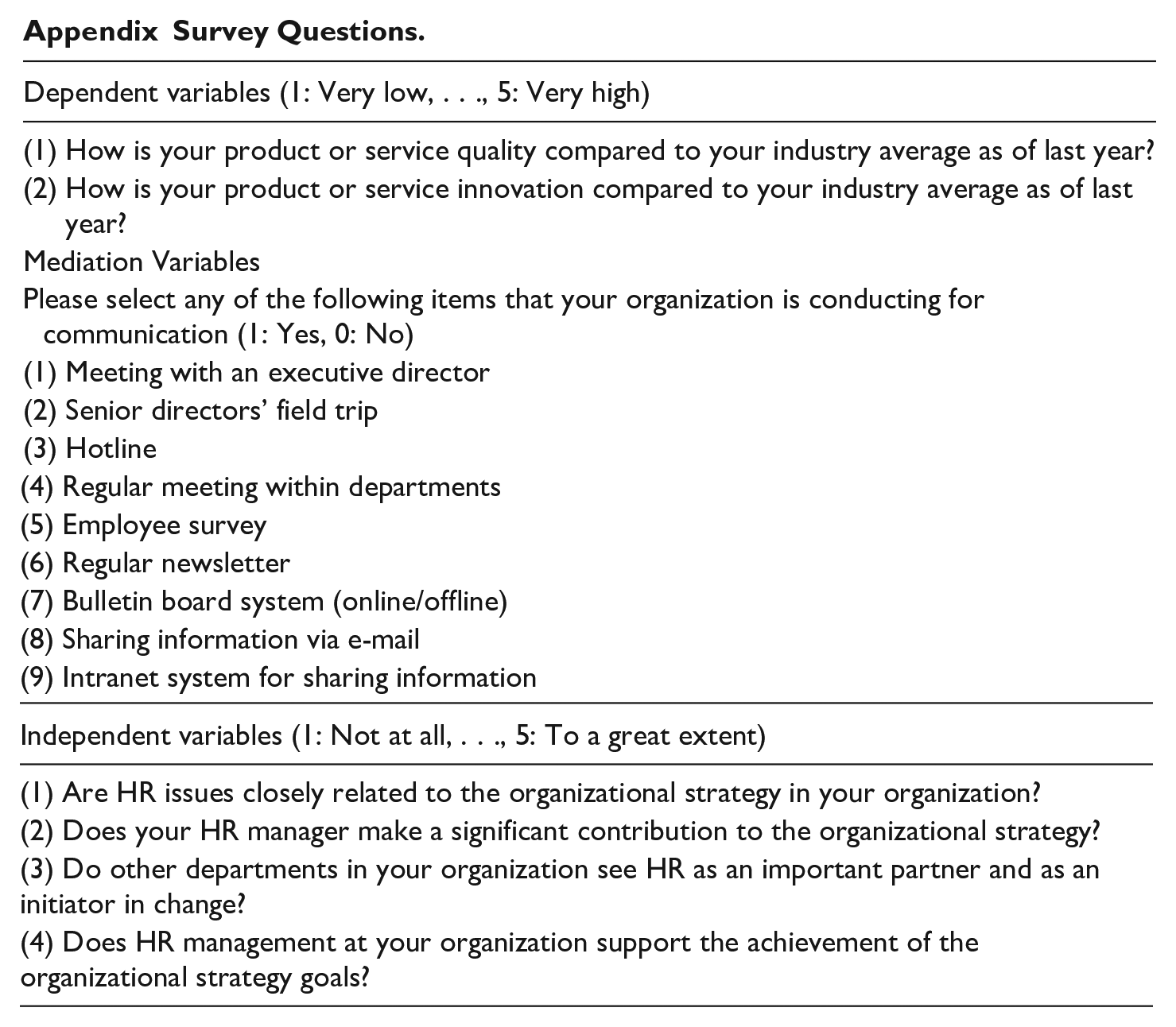
The perception of organizational SHRM was measured using four items that reflect the extent of SHRM adoption (Buller, 1988; Pynes, 2008). For each question, all respondents were asked to evaluate the extent of SHRM in their organization using a scale of 1, “not at all,” to 5, “to a great extent.” The first question asked the extent to which HR practices are connected to organizational strategies. The second question asked the extent to which the director of the HR department contributes to strategy building processes within the organization. The third question asked for the respondent’s perception of the extent to which other departmental employees consider the HR department their business partner and as initiators of innovation. The last question asked the extent to which the HR department is perceived to support their organization’s strategic goals. The Cronbach’s alpha is 0.85 for the pooled cross-sectional data of five waves. Moreover, we applied two covariances between the model’s four independent variables as shown in Figure 1.
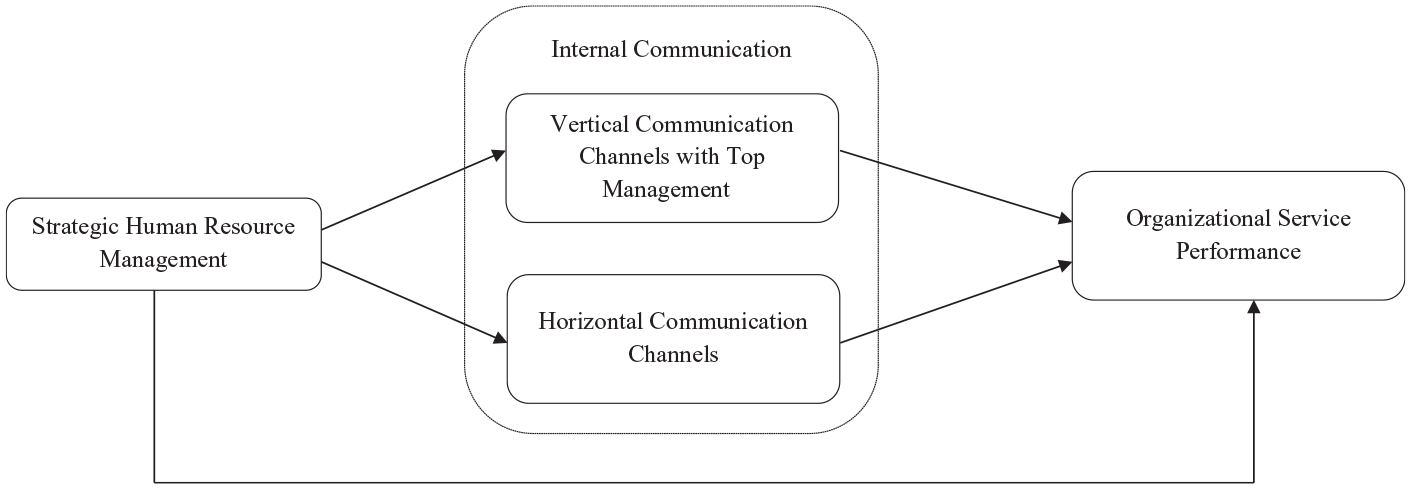
Conceptual model.
Internal Communication Channels
Among the various ways of categorizing internal communication (e.g., formal/informal or one-way/two-way) this research categorizes internal communication channels into two: vertical channels with top management and horizontal channels. The two categories of latent communication variables initially employed nine observed variables provided in the dataset that are typically used in organizations (Ruck & Welch, 2012). These nine observed variables are (1) meeting with an executive director, (2) senior directors’ field trip, (3) hotline, (4) regular meeting within departments, (5) employee survey, (6) regular newsletter, (7) bulletin board system, (8) sharing information via e-mail, and (9) intranet system for sharing information. The nine survey questions asked whether the respondent’s organization operates these communication channels (1 = operate, 0 = otherwise). Among these channels, hotline was dropped due to cross-loading. We, therefore, used eight communication channels provided in the dataset that are typically used in organizations (Ruck & Welch, 2012). The first two variables (1) meeting with an executive director, and (2) senior directors’ field trip) were loaded on one factor, “vertical channels with top management” and the rest variables were loaded on the other latent factor, “horizontal channels.”
Service/Product Performance
Since service or manufactured goods are the end-products every organization provides to their clients, they are used here as proxy measures for organizational performance. The success of public and nonprofit organizations is ultimately measured by whether they successfully deliver services, their primary mission (Sawhill & Williamson, 2001). Given that the quality of service delivery depends on an organization’s capabilities and professions, we chose perception of organizational service/product performance as the dependent variable.
While a more objective measure of performance would be desirable, we adopted subjective measures for several reasons. Organizational performance is a complicated multidimensional concept that can be diverse depending on organizational goals and stakeholders (Amirkhanyan et al., 2014; Andersen et al., 2016; Pandey et al., 2007). In order to make “apple-to-apple” comparisons across the three sectors, it is necessary for us to use a subjective measure of interior experience and perception of performance—a critical piece in “the total performance puzzle” (Andersen et al., 2016, p. 859). Research also argues that employees’ self-reports provide a comprehensive view of organizational performance, while objective measures only capture a partial view of holistic performance (Andersen et al., 2016; Moynihan & Pandey, 2005).
We measure perceptions of performance by constructing a two-factor unit from two questions in the survey. First, every respondent was asked how their organization’s service/product quality compared to that of the respondent’s own rough estimate of their industry’s average. The second question asked for the respondent’s perception of their organization’s service/product innovation by comparing it with the average in their industry. Subjects responded using a scale of 1, “very low,” to 5, “very high.” The Cronbach’s alpha is 0.72 for the pooled cross-sectional data of five waves.
Control Variables
Our model also includes a number of organizational demographic characteristics. We use the number of regular permanent employees as a measure of organization size, transformed using natural logarithms due to severe right-skewness. The natural logarithm of organization age was also included. Organizations with more employees and older organizations are more likely to have stabilized internal systems including communication media. Moreover, we also considered if the organization is located in the capital city, Seoul (1 = located in Seoul, 0 = otherwise). Organizations in the Seoul metropolitan area may have more access to financial or informational resources. Lastly, the percentage of women employees and the percentage of part-time employees were also included. Although negligible, research has found a difference in the communication behaviors of females and males (Wilkins & Andersen, 1991). Further, part-time employees are more likely to be excluded from organizational communication.
Analysis and Findings
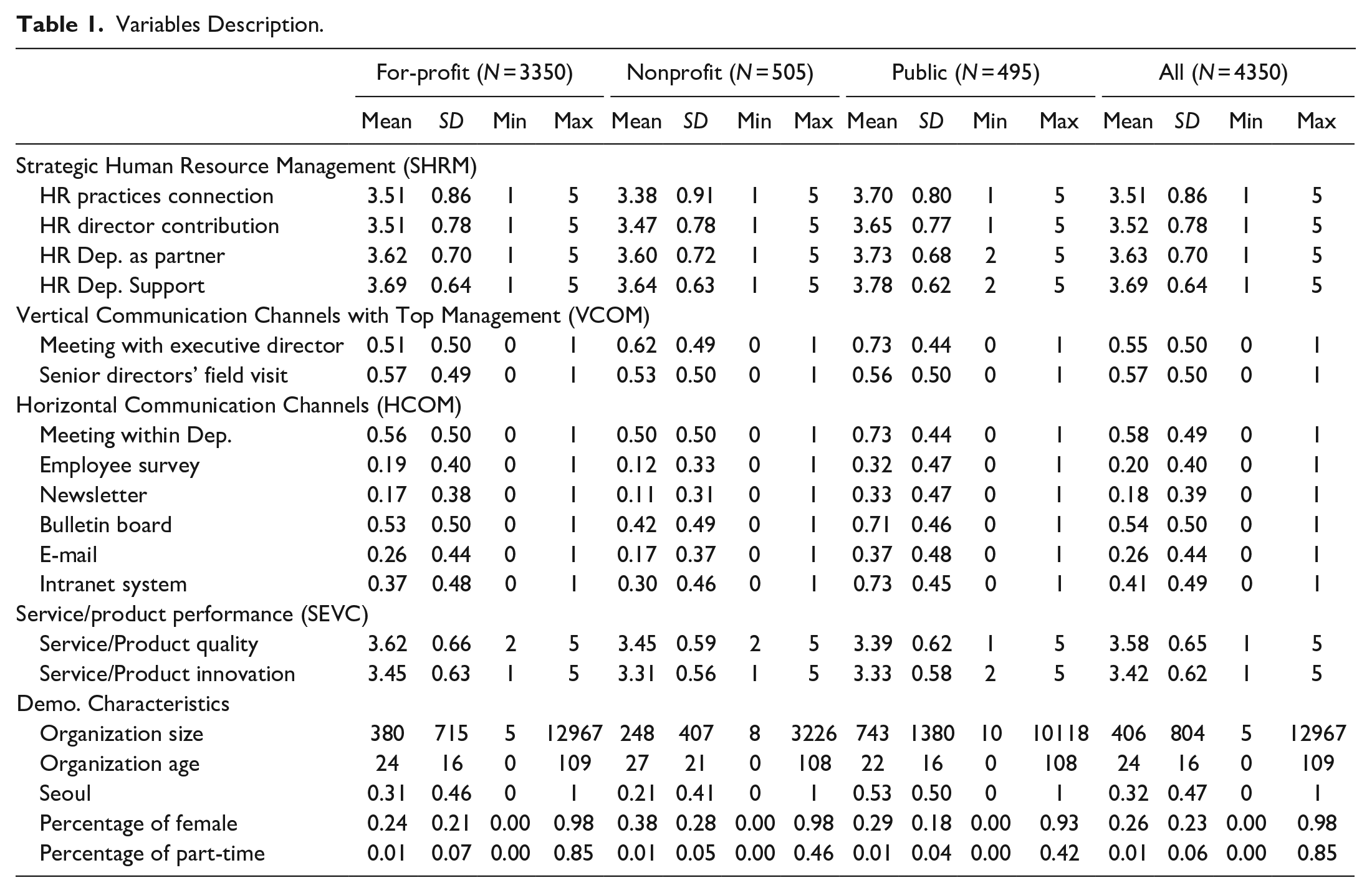
Table 1 summarizes the variables across the three sectors. The average values of the responses to the SHRM questions are 3.58 (For-profit), 3.52 (Nonprofit), and 3.72 (Public), showing that the respondents in the public organizations perceived the greatest extent of SHRM practices. Among the nine types of organizational communication, newsletter (18%) was the least used communication channel, and employee survey (20%) was the next least used, in all three sectors. On the other hand, meetings within departments (58%) and senior director field visits (57%) are the most popular communication channels in all three sectors. Thirty-one percent of for-profit, 21% of nonprofit, and 53% of public organizations responded that they are located in Seoul province. As a percentage of the workforce female employees comprise 24 % (For-profit), 38 % (Nonprofit) and 29 % (Public) respectively.
Variables Description.
The hypotheses stipulated in the previous section were tested using STATA 15 and adopting a two-stage modeling approach suggested by Anderson and Gerbing (1988) and employed by Fuenzalida and Riccucci (2019). We analyzed the measurement model as the first stage then constructed the structural model as the second stage. Initially, a preliminary test was conducted by a series of year fixed-effect regression models with five-waves panel data (Baron & Kenny, 1986). The results confirm the mediating effects of organizational communication between SHRM practices and organizational performance rather than moderating effects. Specifically, the test results show that vertical communication channels with top management may have a significant mediating effect only in the for-profit organizations.
Measurement Model
Results from a multivariate normality test suggests the variables are not normally distributed. We also consider communication channels as binary variables whether or not the organizations operate such channels. For these reasons, we used different measurement models to predict latent variables. To measure SHRM and organizational service performance, maximum likelihood estimation was used with the asymptotically distribution free (adf) option that “the standard errors are estimated in a manner that does not assume normality” (Acock, 2013, p. 15). The measurement model results indicate a good fit. With the two covariances within the model’s four independent variables about SHRM,
A confirmatory factor analysis verifies the two types of internal communication channels. Among eight communication channels, the first two channels—meeting with an executive director and senior directors’ field trip—were identified as the vertical communication with top management and the rest channels—regular meeting within departments, employee survey, regular newsletter, bulletin board system, sharing information via e-mail, and intranet system for sharing information—were identified as horizontal communication channels. Generalized SEM with Bernoulli and Probit options was used for the measurement model of two types of communication channels. The measurement model also shows a good fit,
Structural Model
We examined the model in two steps as suggested by previous studies (Fuenzalida & Riccucci, 2019; Preacher & Hayes, 2008). First, by allowing the residuals of the two types of communication channels covary (Preacher & Hayes, 2008), the total indirect effects were examined with maximum likelihood estimation with the asymptotically distribution free (adf) option. As a result, the structural model exhibited a perfect fit (RMSEA = 0.0, CFI = 1.0, and SRMR = 0.0). Table 2 reports the direct, indirect, and total effects of measures for each sector. As an independent variable, SHRM has indirect effects on perceived organizational service/product performance through communication. It has significantly positive indirect effects through communication in the for-profit sector in 4 years except for 2007. The standardized coefficients of indirect effects are .029 (p < .05), .038 (p < .01), .054 (p < .001), and .029 (p < .05) from 2005 to 2013 respectively.
Direct, Indirect, and Total Effects of Vertical and Horizontal Channels.
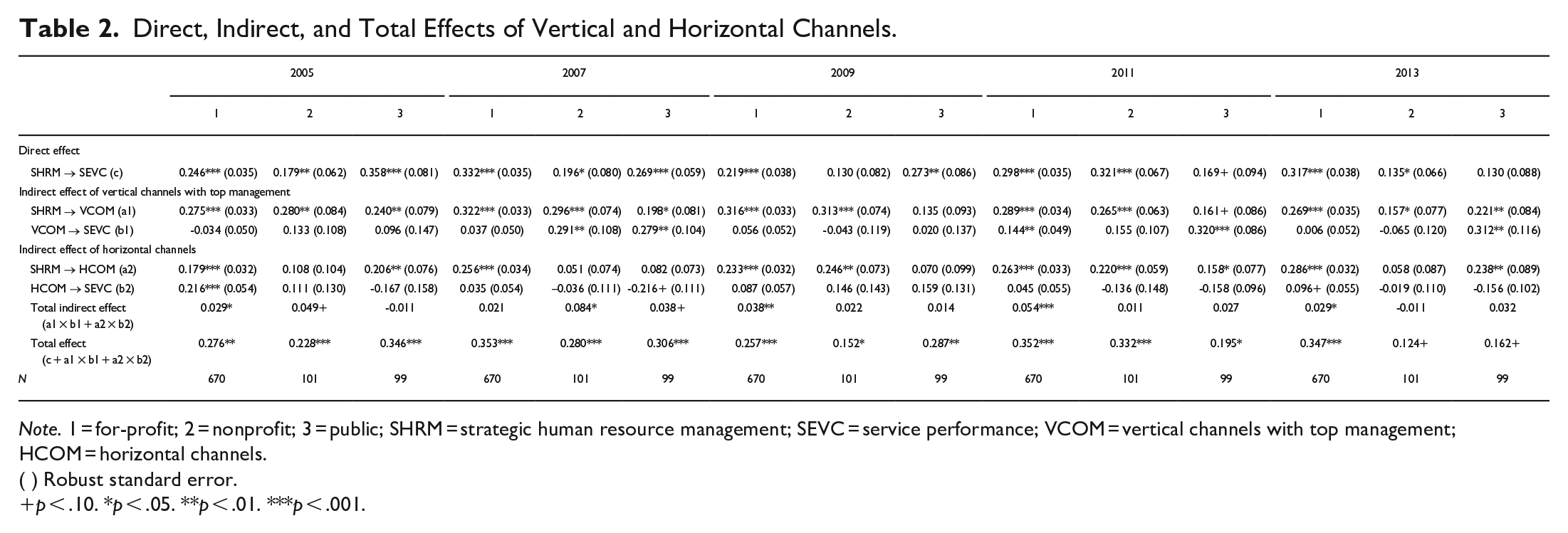
Note. 1 = for-profit; 2 = nonprofit; 3 = public; SHRM = strategic human resource management; SEVC = service performance; VCOM = vertical channels with top management; HCOM = horizontal channels.
( ) Robust standard error.
p < .10. *p < .05. **p < .01. ***p < .001.
According to MacKinnon (2008), the effect size of the mediation can be measured by ratio index which is calculated by the equation: indirect effect (a1 × b1 + a2 × b2)/total effect (c). This ratio index yielded values of 0.105 (2005), 0.148 (2009), 0.153 (2011), and 0.084 (2013), suggesting that 10.5%, 14.8%, 15.3%, and 8.4% of the total effect was explained by the indirect path through the two types of channels for each year in the profit sector. These findings indicate that internal communication channels have a partial mediating effect in the relationship between SHRM and perceived organizational performance. Partial mediation is more likely to happen than perfect mediation in the social sciences (Baron & Kenny, 1986; Jose, 2013). While the results are significant in the for-profit sector for 4 years, the indirect effects of SHRM on perceived organizational performance were significant in only 2 years for the nonprofit sector and only 1 year for the public sector.
Next, we investigated the indirect effect of two mediating variables separately because “specific indirect effects will generally, but not necessarily, be attenuated, to the extent that the mediators are correlated” (Preacher & Hayes, 2008, p. 887). The structural model exhibited a perfect fit (RMSEA = 0.0, CFI = 1.0, and SRMR = 0.0). Tables 3 and 4 describe the mediating effect of vertical and horizontal communication channels and the results are somewhat mixed in contradiction of the results from regression analyses. In the for-profit sector, vertical channels with top management have a significant mediating effect in 3 years (2005, 2009, and 2011) while horizontal channels have a significant mediating effect in 4 years (2005, 2009, 2011, and 2013). No mediating effects has been found in 2007. Contrarily, vertical channels exhibited a significant mediating effect in only 2 years (2005 and 2007) for nonprofit organizations and only 1 year for public organizations (2013). Table 4 also shows that there is no mediating effect of horizontal channels in the nonprofit and public sectors in all years.
Direct, Indirect, and Total Effects of Vertical Channels with Top Management.
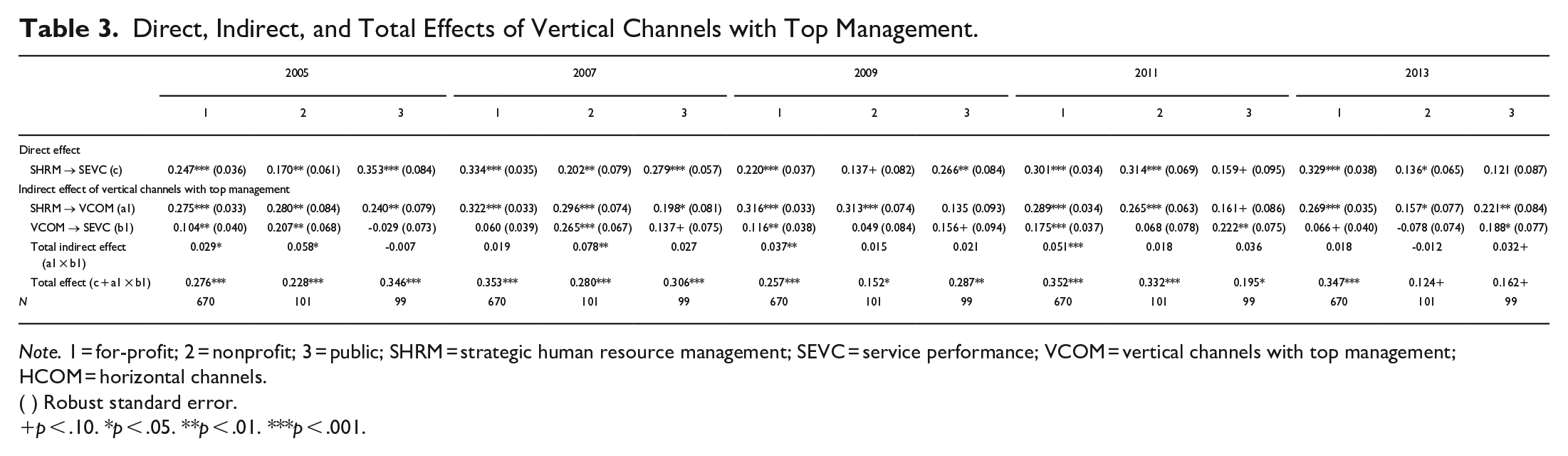
Note. 1 = for-profit; 2 = nonprofit; 3 = public; SHRM = strategic human resource management; SEVC = service performance; VCOM = vertical channels with top management; HCOM = horizontal channels.
( ) Robust standard error.
p < .10. *p < .05. **p < .01. ***p < .001.
Direct, Indirect, and Total Effects of Horizontal Channels.
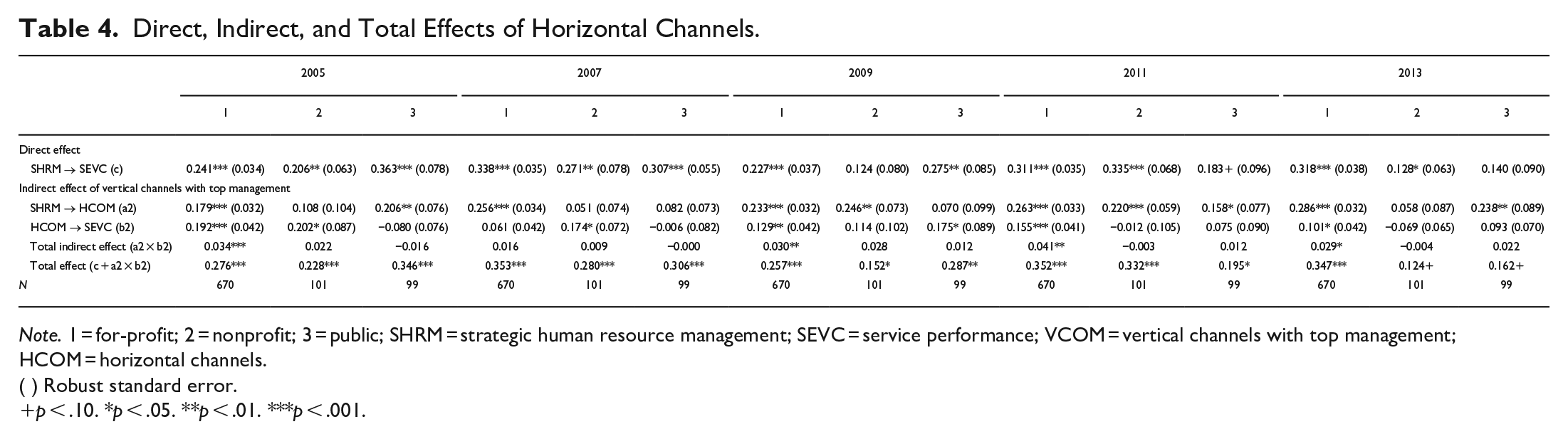
Note. 1 = for-profit; 2 = nonprofit; 3 = public; SHRM = strategic human resource management; SEVC = service performance; VCOM = vertical channels with top management; HCOM = horizontal channels.
( ) Robust standard error.
p < .10. *p < .05. **p < .01. ***p < .001.
Lastly, this study examined the mediating effects of the two types of channels using all five waves to investigate mediating effects from the previous years. Figures 2 and 3 show the mediating effects of vertical and horizontal channels from 2005 to 2007 in the for-profit sector that are missing pieces from the year-to-year analysis. There is no such across-year mediating effect in the nonprofit and public sectors. Due to the unbalanced sample size across the three sectors, we also tested the structured models using subsampling method. A hundred for-profit organizations from each wave were randomly selected for the test and the same process was conducted ten times for each wave (Yoon & Lai, 2018). Although statistical power was not always the same as Yoon and Lai (2018) pointed out, the results were sufficiently consistent in all five waves.
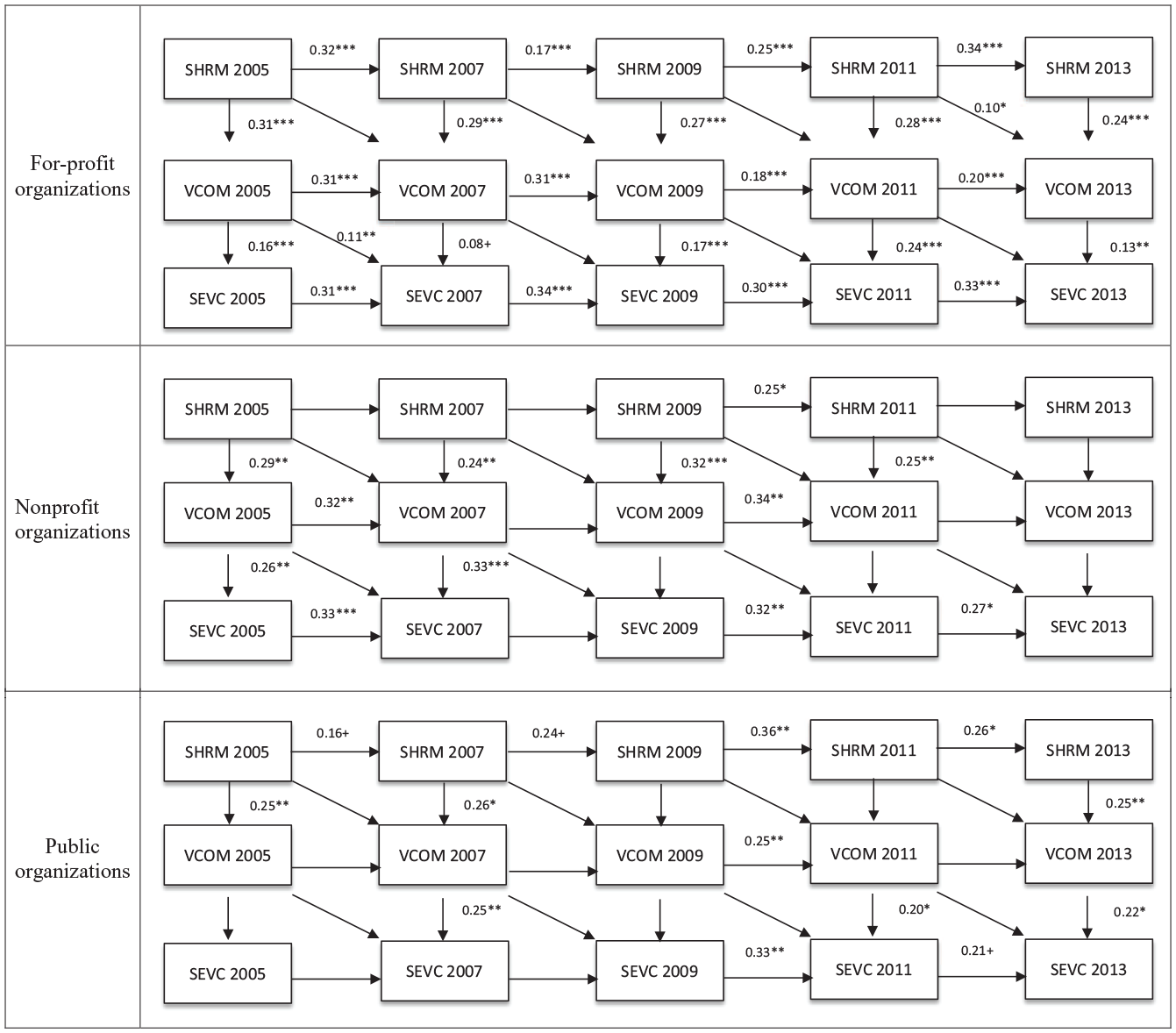
Mediation effect results of vertical channels with five-waves data.
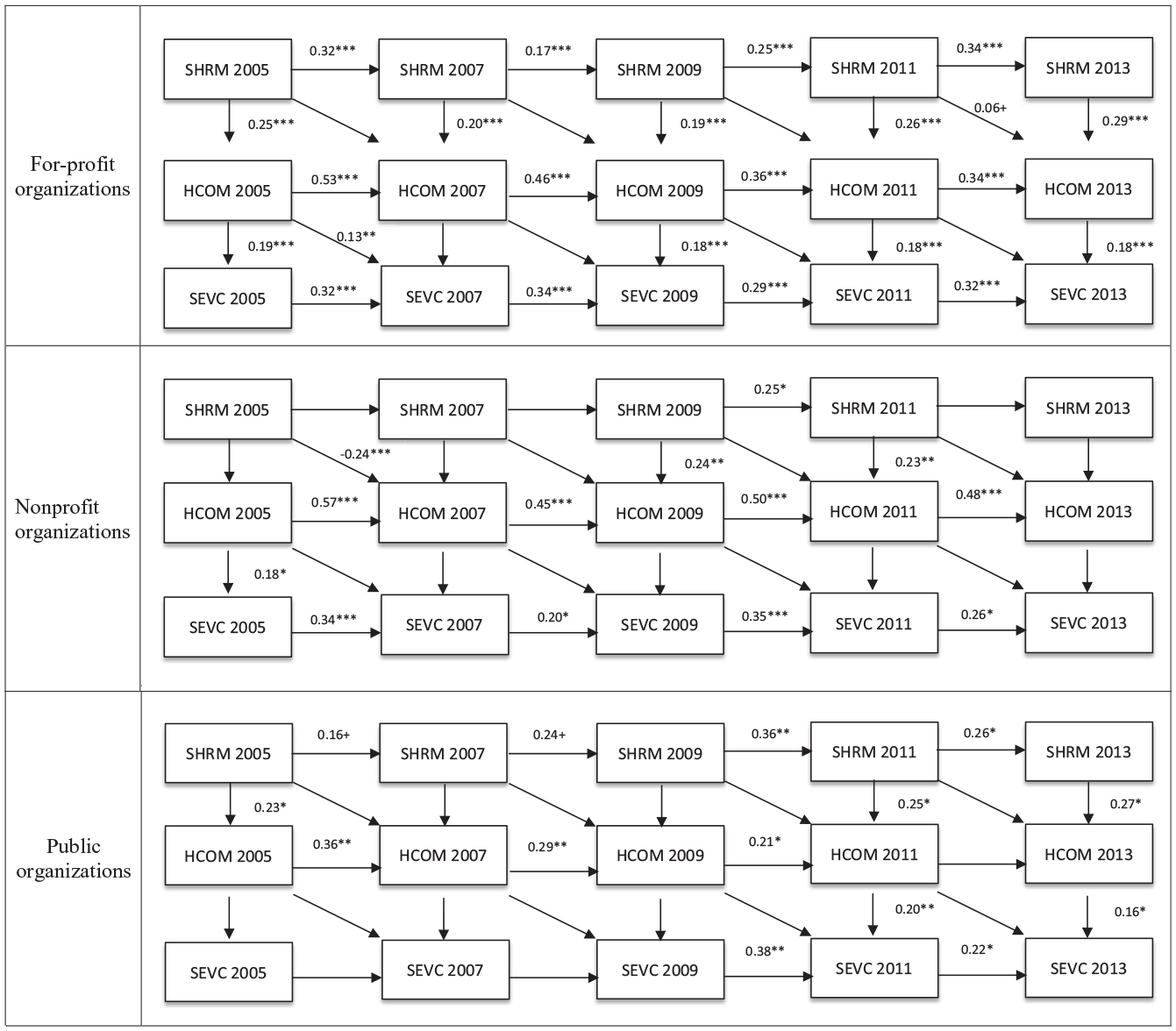
Mediation effect results of horizontal channels with five-waves data.
Discussion and Conclusion
Considering the importance of communication for successful HR applications, this study investigates the mediating effects of communication channels on the relationship between SHRM and organizational performance. In particular, we compare the impacts across public, nonprofit, and for-profit organizations using five waves of panel data from South Korea. Overall, major findings from the study indicate that there exists substantial variation in the mediating role of internal communication channels on perceived organizational performance across the sectors. We find the mediating effect of communication channels is only applicable among for-profit organizations, with communication having no mediating effect in the nonprofit and public sectors.
The results indicate that public and nonprofit organizations may experience difficulties utilizing both vertical and horizontal communication media for strengthening the relationship between SHRM and organizational performance. Although public organizations showed the highest average SHRM perception and communication media usage (Table 1), it does not guarantee effective performance. While there may be indications of more SHRM adoption and communication channel usage in public organizations, it does not relate as strongly to performance, suggesting the utility of communication channels may not be focused on the roles bridging SHRM and performance.
The results found in this article have significant implications for public and nonprofit management. While research suggests using communication as a way to foster goal clarity can improve performance (Pandey & Garnett, 2006; Pandey & Wright, 2006), our research suggests that this depends on the type of sector. It is essential for organizations to communicate clear goals to their employees allowing them to focus more on their own individual performance. However, aligning organizational goals with individual goals via effective internal communication may be more difficult in public and nonprofit organizations. Managers in the public and nonprofit sector will need to consider how best to employ communication.
Novel means for doing so will be necessary if they hope to achieve success in implementing organizational strategies and improving performance (Hackler & Saxton, 2007). Encouraging HR managers and employee participation in the organizational strategic planning process would be an essential element to improve active communication among various members within an organization. Although instrumental to SHRM, HR departments are often perceived as supporters rather than initiators within an organization (Beatty & Schneier, 1997; Ott & Dicke, 2012). Organizations tend to view HR functions as a financial burden on overall resources (Becker & Huselid, 2009; Pynes, 2008)—a misleading perception of the strategic role of human resources within organizations. HR professionals are integral to the accomplishment of organizational strategic planning. Indeed, the perceptions and experience of HR professionals have proven integral to our understanding of change, trust, and other workforce relationships linked to the overall organizational mission (Battaglio & Condrey 2009; Condrey & Battaglio 2007).
Additionally, given the intransigence of organizational culture, greater flexibility in adopting new communication channels is essential. Such channels might include social media or mobile-based application tools that emphasize more active communication patterns among individuals. To make a successful alignment between organizational strategies and HR practices, HR managers must communicate with others, including top management, line managers, and other employees. Utilizing communication channels is pivotal in this vein and using multiple communication channels can improve communication content delivery (Garnett, 1992). Further, HR managers should understand the advantages and disadvantages of each communication channel so that they can successfully utilize the different channels by combining them.
The Korean contexts may also explain the differences across the sectors. Since the financial crisis of the late 1990s Korean for-profit firms have recognized that their current HR systems are unable to cope with rapid changes in the increasingly global business environment (Bae & Lawler, 2000). As a consequence, for-profit organizations have restructured their personnel practices to be more flexible and performance-oriented (Bae & Lawler, 2000). In contrast, public organizations within Korea have continued to enjoy highly rule-bound and downward communication patterns (Kim, 2009). People tend to respect government authority, and public employees are inclined to perceive their job as prestigious, resulting in a preference for job security and seniority over lucrative offers in the for-profit sector (Kim, 2009). Thus, Koreans in public organizations are generally predisposed to a highly rigid HRM system that emphasizes a degree of rule-bounded organizational culture (Kim, 2009). On balance, Korean public employees are inclined to prioritize hierarchical order (goal compliance) over performance—a characteristic that does not necessarily negate organizational productivity (see Garnett et al., 2008). The results also show that nonprofit organization behavior in Korea seems to be closer to that of the public sector. Given the rigidity rooted in the Korean system (Kim, 2009), political authority may have a greater influence on nonprofits than their counterparts may in the West. Additionally, Korean nonprofits are not free from governmental control. Historically, nonprofits in Korea were suppressed by authoritarian regimes until the 1980s. Even still, they remain highly dependent on government institutional and financial support (Kim, 2000).
The aforementioned characteristics in the two sectors may negatively affect usage of internal communication channels as a means for improving organizational performance. Red tape and cultural constraints may hinder the efforts of public and nonprofit organizations to align their communications around HRM and performance. Research has found that rules and procedures often have a negative impact on results-oriented organizational cultures (Pandey et al., 2007). Likewise, communication’s impact on performance in rule-oriented cultures is often muted (Garnett et al., 2008; Verbeeten & Speklé, 2015).
Still, our findings have a number of limitations. Despite the importance that the sectoral characteristics such as red tape and organizational constraints may play in our analysis, the Korean Labor Institute surveys have no robust measures to account for their effect. Moreover, the extent of flexibility in HR practices is missing as well. Further evidence is necessary to untangle the impact red tape and managerial flexibility may have on communication effectiveness overall and in relation to facilitating SHRM. Second, our study is a broad comparison of sector differences that does not make distinctions according to organizational mission. Many organizations in all three sectors have unique missions, goals, and values that might play into our understanding of communication and performance.
Third, although this study examines eight types of organizational communication media, we do not account for every communication medium. For example, video conferences utilizing Zoom or Skype, increasingly adopted by many organizations in the era of globalization, were not included. International organizations in particular often use this type of communication channel. Accounting for additional mediums of communication would have provided greater external validity and perhaps more meaningful results. Level of use, quality, and formal/informal use of each communication channels are also missing from the analyses. Due to data constraints, the current study uses only the binary variables available for operating organizational communication channels.
Fourth, since the survey questions were answered by HR managers or senior HR professionals, our data do not fully capture the actual implementation of SHRM and the perceived SHRM by employees (Nishii & Wright, 2007; Purcell & Hutchinson, 2007). A mixed-method approach that emphasizes more qualitative analysis would be useful for further investigating the link between organizational communication, culture, and SHRM. Overall, the current study raises many questions, therefore, future research should keep this in mind given the potential for effective communication to improve human resource capacity, engage employees, and encourage a more robust understanding of the heuristics that influence organizational performance.
With HR departments increasingly playing a key role in strategy implementation, HR managers should participate as both strategy initiators and partners (Beatty & Schneier, 1997). The extent of an HR department’s engagement has a direct impact on the relationship between SHRM and organizational performance, and the utility of communication channels promote HR managers’ capabilities as strategy implementers. Consequently, they should strive to appreciate the type of personnel practices those strategies need and contribute to achieving the organization’s mission accordingly.
Footnotes
Appendix
Survey Questions.
| Dependent variables (1: Very low, . . ., 5: Very high) |
| (1) How is your product or service quality compared to your industry average as of last year? |
| (2) How is your product or service innovation compared to your industry average as of last year? |
| Mediation Variables |
| Please select any of the following items that your organization is conducting for communication (1: Yes, 0: No) |
| (1) Meeting with an executive director |
| (2) Senior directors’ field trip |
| (3) Hotline |
| Dependent variables (1: Very low, . . ., 5: Very high) |
| (4) Regular meeting within departments |
| (5) Employee survey |
| (6) Regular newsletter |
| (7) Bulletin board system (online/offline) |
| (8) Sharing information via e-mail |
| (9) Intranet system for sharing information |
| Independent variables (1: Not at all, . . ., 5: To a great extent) |
| (1) Are HR issues closely related to the organizational strategy in your organization? |
| (2) Does your HR manager make a significant contribution to the organizational strategy? |
| (3) Do other departments in your organization see HR as an important partner and as an initiator in change? |
| (4) Does HR management at your organization support the achievement of the organizational strategy goals? |
Declaration of Conflicting Interests
The author(s) declared no potential conflicts of interest with respect to the research, authorship, and/or publication of this article.
Funding
The author(s) received no financial support for the research, authorship, and/or publication of this article.
Author Biographies
