




Abstract
This article explores how the socio-spatial relationship between cities and nature is changing under the cultural conditions of the twenty-first century. I argue that contemporary urban parks such as New York’s High Line, along with less cultivated sites of city-nature intersections such as vacant lots, represent variations of an emergent type of social space, which I term imbricated spaces. Imbricated spaces present “city” and “nature” as active agents in their creation through the decay of the built environment and the growth of the natural environment. The transformation of city-nature imbrications into culturally valued spaces, whether through architectural intervention, artistic representation, or phenomenological experience, reflects that such spaces not only have wide resonance but that their growing presence on the urban landscape is correlated with a broader recognition of how nonhuman agency—in particular, climate change and industrial decay—is shaping the social spaces of contemporary cities.
City-nature imbrications are everywhere. Cracks in sidewalks provide room for weeds; vacant lots and abandoned buildings offer refuge for grasses, flowers, even trees; new public parks like New York’s High Line incorporate seemingly wild nature with picturesque urban vistas. Through photographs or meditative strolls among the ruins of the industrial city, many contemporary urbanites celebrate the harmony of built and natural environments. This phenomenon reflects an emergent, highly influential understanding of the socio-spatial relationship between city and nature. Whereas landscape designers and social theorists of previous eras saw “city” and “nature” as binary opposites, many contemporary cultural producers and receivers see the two abstractions as spatially and socially linked.
Where city ends and nature begins is of course a social construction. The built environment is made from materials that were once earth; though a paved street may symbolize society’s domination of the natural world, cracks in the concrete reveal that human intervention is far from the last word. But for all the varieties of ways that city and nature have intersected, they have long been accorded very different cultural meanings. Historically, these two concepts have been tightly bounded, both spatially and symbolically: Central Park’s tree-lined, walled perimeter kept the bustle of nineteenth-century Manhattan at bay; Georg Simmel ([1903] 2002) influentially argued that urban conditions were transforming the “natural” rhythms of human psychology; Romantic landscape painters like J. M. W. Turner contrasted nature’s Burkean “sublime” with the banality of the built environment.
But contemporary interventions in built and natural environments suggest that these sharp distinctions have, if not completely fallen, become increasingly blurred. In this article, I explore contemporary socio-spatial intersections of city and nature and develop the concept of “imbricated space” to understand linked representations of “urban” and “natural” forms. Imbricated spaces are social spaces that aesthetically unite representations of agentic “city” and representations of agentic “nature.” Imbricated spaces are one example of broader city-nature hybridity, which has ontological, cultural, and spatial implications (Angelo forthcoming; Wachsmuth 2012, 2014). “Imbrication” suggests the blending or layering of multiple components, which in spaces like the High Line manifests as an interweaving of built and natural materials. In these spaces, “nature” is represented as insurgent—claiming spaces that humans had once conquered. “City” is represented as decayed—through the rusting and rotting of the built environment. Imbricated spaces are distinct from most sites of urban nature, such as urban parks, which historically have been purported to offer pastoral refuge from city life—removal, rather than immersion (Cranz 1982).
I examine the “imbricated space” concept through the case study of New York’s High Line, an elevated industrial railway that twice transformed into an imbricated space of urban vistas, rusted steel, and wild grasses—first by the forces of nature and the decaying built environment and second by architects who replicated the original hybridity in transforming the space into a public park. By examining the design ideologies of the park’s cultural producers, I demonstrate the aesthetic and phenomenological appeal of imbricated city and nature and indicate how these cultural images have been institutionalized through the production of new public spaces. But far from specific to urban parks, this article theorizes the emergence of city-nature hybridity on a cultural level and considers how an understanding of its cultural and aesthetic dimensions offers a lens into broader intersections between the natural and the social.
Perspectives on “Nature” and “City”
In early sociological theory, scholars such as Simmel ([1903] 2002), Du Bois (1899), Park and Burgess (1925), and Tönnies ([1887] 1957) conceived “the city” as the space and symbol of modernity, where traditional communal affiliations were broken and social ties were reformulated under industrial capitalism and the rise of nation-states. Generally, these theorists considered pre-urban social life rooted in the rhythms of the natural world. Underlying early social scientists’ arguments were assumptions about the role of the natural environment in shaping human society. Although some recognized “nature” as socially constructed (Foster 1999, 2000), it was widely viewed as the antithesis of “the city” and “modernity.” The separation of these terms and all that each was understood to symbolize is outlined in Table 1.
The Ontological Separation of City and Nature.
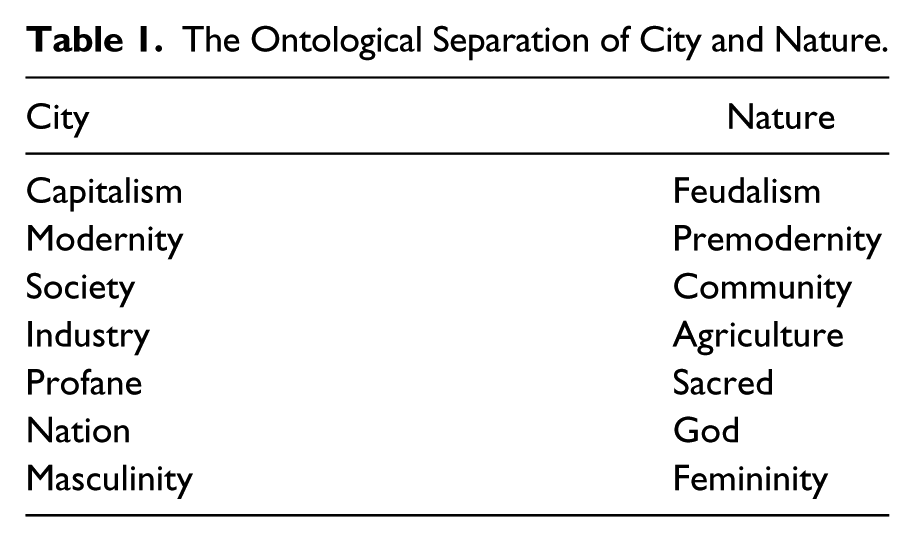
In recent decades, social scientists have more extensively theorized the ways that nature is socially constructed (Cronon 1991; Jerolmack 2012; Latour 1993). Breaking with the essentialist view of nature held by many early theorists, scholars have illustrated how groups construct ideas about nature (Agrawal 2005; Marx 1964; Williams 1973) and reproduce nature through institutions, like zoos (Grazian 2012), and social practices, such as mushroom collecting (Fine 1998) and pigeon handling (Jerolmack 2007). Urbanists have reconsidered the role of nature in the metropolis (Bennett and Teague 1999; Heynen, Kaika, and Swyngedouw 2006; Wachsmuth 2012). Many have taken an historical view to show how nineteenth-century planners designed public parks, parkways, and other “natural” elements to shape social practices and public health outcomes (Cronon 1991; Rawson 2010; Rosenzweig and Blackmar 1992; Schuyler 1986). A growing body of literature considers the social underpinnings of cities in ecological crisis, illustrating how urban growth in ecologically fragile areas, such as the American West, has had wide-ranging effects on environmental sustainability and social inequality (Davis 1998; Walker 2009). In a related vein, actor-network theorists have pushed social scientists to consider nature an autonomous “nonhuman” actor (Latour 1993; Murdoch 1996). Some scholars have gone even further, arguing that human agency has profoundly shaped nature itself, creating a new geologic era known as the Anthropocene (Clark 2014; Steffen, Crutzen, and McNeill 2007). These ideas are summarized in Table 2.
The Unity of City and Nature.

Social scientists have often considered the hybrid union of city and nature on an infrastructural level as “urban metabolism”: the networked flows of natural materials through cities that carry social and political implications (Heynen et al. 2006). Scholars like Cronon (1991), Gandy (2002), and Swyngedouw (2004) have documented how hydrologic systems, waste management, and energy supplies are imbued with power relations—“the city in a glass of water” (Swyngedouw 2004:27). The urban metabolism approach offers a lens into the ways that the control of natural resources by city governments, corporations, and landowners reproduces inequalities along lines of race, class, and gender through differential access to clean water, green spaces, and other resources (Taylor 1999; Wolch, Wilson, and Fehrenbach 2005). In a similar vein, scholars have traced political conflicts over “nature” within cities, as Martinez (2010) illustrates in her study of immigrant activists and community gardens and Greenberg (2013) examines in her analysis of competing visions of urban “sustainability.” More broadly, scholars from urban political ecology and critical urban theory have indicated how spatially delimiting “city” from its various analytical oppositions (e.g., nature, suburbs) has become problematic given the global expansion of urban infrastructure and capital flows in a process termed planetary urbanization (Angelo and Wachsmuth 2015; Brenner 2014; see also Angelo forthcoming; Tsing 2015).
Urban parks represent the preeminent site of nature-making within cities. With culturally and politically important parks developing in Western cities during rapid nineteenth-century urbanization, urban parks—particularly their pastoral, picturesque variants—have long been wrapped in the same sacred guise as “nature” more generally. Representing social ideals like democracy, beauty, public health, and spirituality while also being bound up in capitalist land-use and social control efforts (Gandy 2002; Taylor 1999), parks are a key site for understanding the social and spatial demarcation between nature and city.
The creation of urban parks as an act of cultural production emplaces the socially constructed relationship between “city” and “nature” into physical form. Like other arenas of cultural production, urban parks are produced by assemblages of actors operating within existing political-economic systems, cultural conditions, and institutional frameworks, with differential access to the resources required for creation (Griswold 1987). Like other cultural objects, urban parks are produced within a “dualist structure” (Bourdieu [1992] 1996:113) of inversely related economic and symbolic systems, wherein the symbolic value of “pure” nature can “turn[] upside down” (Bourdieu [1992] 1996:81) the economic considerations that dictate land-use decisions. In this regard, the production of urban parks most resembles the field of architecture, which Jameson (1989:5) notes is the art form “closest constitutively to the economic, with which, in the form of commissions and land values, it has a virtually unmediated relationship.” Like buildings (Gieryn 2002), parks spatially structure human activity in ways that other cultural objects do not. Parks typically require much political and economic capital to build and maintain; though the act of park creation seemingly “take[s] land out of the market economy and ‘decommodif[ies]’ it” (Zukin 2010:211), the development of parkland nevertheless structures the flows of capital as part of the “spatial rationalization of production, circulation, and consumption” (Harvey 1991:232); powerful actors will necessarily be invested in the locational, financial, and aesthetic qualities of a new park project, thus influencing the production process (Loughran 2014). Due to their public quality, parks depart from buildings in that their constituency is the broader “public,” however defined, rather than a narrower set of interests. For these reasons, the cultural production of nature through urban parks intersects directly with the power structure of a given city (Gandy 2002).
The Cultural Production of City-Nature in Historical Context
Many scholars have charted the changing social meaning of city and nature as expressed through the creation of urban parks and other cultural objects. Initial efforts at park creation in Western cities mirrored early sociologists’ ontological separation of “city” and “nature”: Urban parks were to be a sanctuary, an oasis of greenery amid the purportedly deleterious conditions of the industrial city. Strongly influenced by aesthetic philosophers such as Edmund Burke ([1756] 1990) and William Gilpin (1792), the creation of an idealized form of nature in the paintings of the Hudson River School and the writings of James Fenimore Cooper and Henry David Thoreau provided a resonant cultural image; the parks of Frederick Law Olmsted and Andrew Jackson Downing laid this image down in spatial form: a pastoral understanding of nature as spatially and spiritually distinct from urban modernity (Buell 1995; Marx 1964; Williams 1973).
The form of “nature” constructed through picturesque aesthetics was a particular one: the lush valleys, rocky fields, and rough hills found in Britain, New England, and along the American “frontier”—thereby valorizing the natural landscapes found within a few hundred miles of the cultural and economic capitals of the Anglo-Saxon world. Of course, these natural landscapes did not represent the totality of “nature,” but given the power of these representations, the picturesque aesthetic vision of nature became the preeminent cultural image in Europe and the United States by the late nineteenth century (Rybczynski 1999; Schuyler 1986).
The influence of picturesque aesthetics on urban planners and landscape architects (both nascent occupations of the nineteenth-century city) led these cultural producers to attempt to sharply divide “urban” spaces from the spaces of “nature” represented by parks. As cities like New York, Atlanta, and Chicago were still expanding outward into proximate countryside through the beginning of the twentieth century, public acquisition of the land that became parks like Central, Piedmont, and Jackson was politically and economically feasible. The relatively large size of these nineteenth-century spaces enabled landscape architects to emphasize separation from urban life. Designers of pastoral spaces introduced elements such as tree-lined perimeters, truncated vistas, and less manicured spaces that highlighted rocky outcroppings and waterfalls rather than formal gardens and fountains (see Figure 1) in order to connect urbanized nature to the images of vast wilderness valorized by picturesque aesthetics. Heavily landscaped with “air purifying” trees, along with undulating topography and “natural”-looking bodies of water, parks designed by landscape architects such as Frederick Law Olmsted, Andrew Jackson Downing, Calvert Vaux, and Horace Cleveland physically separated the spaces of parks from views of the built environment. Certainly, parks like Central Park did not embody the totality of urban parks or the presence of nature in the city—consider urban waterfronts (Bluestone 1987) or the spaces of urban livestock (MacLachlan 2007)—nor did cultural receivers always see such a sharp separation between city and nature (Warner 1987): this city-nature demarcation was, after all, a socially constructed fiction. However, such spaces did represent the primary symbolic spaces of nature within urban areas—the spaces with influential cultural and economic power, the spaces built by nineteenth-century growth machines and valorized by nineteenth-century elites, the spaces that shaped social understandings of city and nature for many decades.
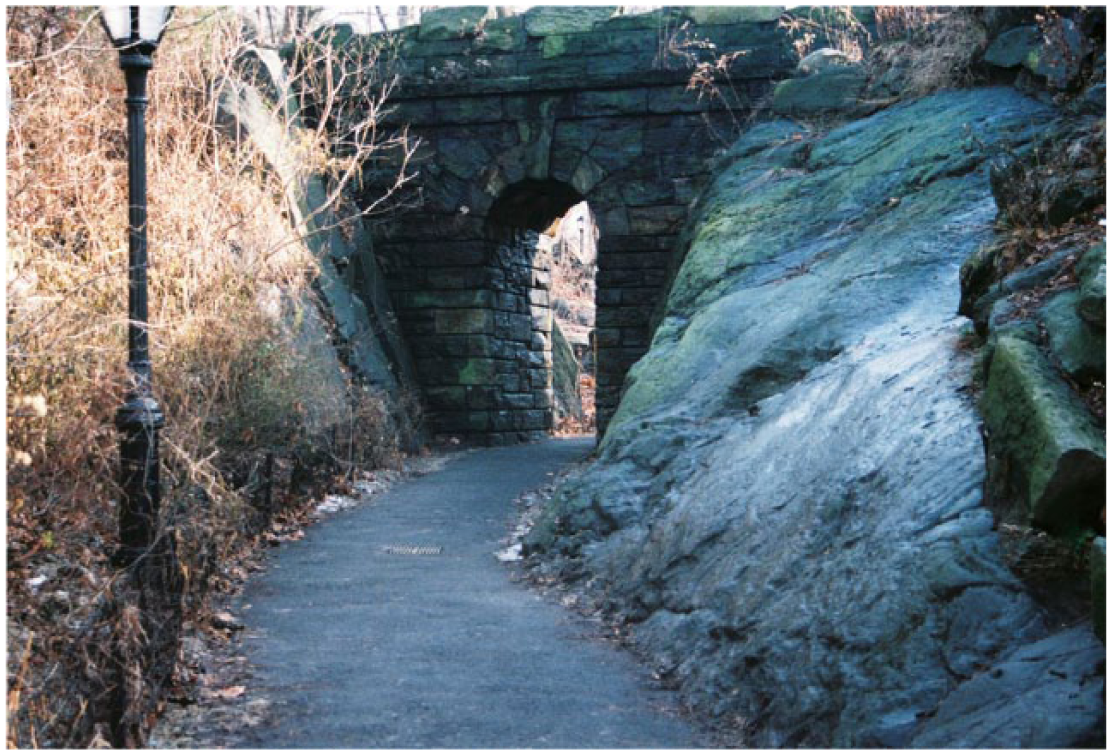
Olmsted’s picturesque design in Central Park’s Ramble. Photo by author, 2013.
Nineteenth-century Parks, Frederick Law Olmsted, and the City-Nature Binary
It is worth considering nineteenth-century parks in more detail to better illustrate how the city-nature binary was spatialized in order to draw a contrast between nineteenth-century parks and contemporary hybrid spaces. As mentioned, Central Park’s “architect-in-chief,” Frederick Law Olmsted, along with his design partner, Calvert Vaux, were important figures in nineteenth-century landscape design. Given Olmsted’s far-reaching impact on Western urbanism—as the designer of Chicago’s Washington and Jackson Parks, Boston’s Back Bay Fens, Montreal’s Mont Royal, and many other “crown jewels” of North American cities—his understanding of “cities,” “nature,” and their relationship not only reflected broader cultural ideologies but shaped them through the creation of many urban parks. As a prolific writer about urbanism, landscape architecture, and nature more broadly, Olmsted’s numerous treatises provide an excellent site to examine the “intentions” (Griswold 1987) underlying the cultural production of nineteenth-century green spaces and the city-nature binary. In what follows, I analyze key excerpts from Olmsted’s various writings; although the selections date from various points across his long career, each of the ideas he expresses—about picturesque aesthetics, socio-spatial practices, and the city-nature relationship—can be found in Central Park along with many of his other projects.
Olmsted on Picturesque Aesthetics
Olmsted’s belief in picturesque aesthetic philosophy deeply shaped his approach to landscape design. He saw a universal impulse in “the civilization of our time” to find beauty in the sorts of natural phenomena that were valorized by Gilpin and Burke. For Olmsted ([1886] 2010), these cultural tastes were a sign of “a healthy change in the tone of the human heart,” and it was the duty of landscape architects to represent these tastes in public parks: The civilization of our time . . . finds a greater pleasure in rivers than in canals; it enjoys the sea, it enjoy the distinctive qualities of mountains, crags, rocks; it is pleasantly affected by all that in natural scenery which is indefinite, blending, evasive. (Olmsted [1886] 2010:122–23)
In his 1868 address to the Prospect Park Scientific Association, Olmsted ([1868] 2010) explained his definition of a “park.” Picturesque aesthetic conditions were critical; in particular, Olmsted emphasized the importance of limiting park users’ range of vision by using “natural” elements to frame particular vistas. Following Burke, Olmsted was a proponent of introducing elements of “the sublime” into landscapes—moments that evoke terror, but safely, “at certain distances” (Burke [1756] 1990:60).
In his vision of picturesque aesthetics, Olmsted believed that natural landscapes were meant to be appreciated in the complete absence of buildings. As Rybczynski (1999) documents, he and Vaux clashed with the New York city government over the placement of architectural works in Central Park. In an essay that appeared in The Garden magazine in 1876, Olmsted ([1876] 2010:141) wrote: The objection, then, to monumental and architectural objects in works of landscape gardening is this, that, as a rule, they are not adapted to contribute to any concerted effect, but are likely to demand attention to themselves in particular, distracting the mind from the contemplation of the landscape as such, and disturbing its suggestions to the imagination.
Olmsted on Cities and Nature
A second consideration in Olmsted’s role in the development of nineteenth-century parks was how he understood the relationship between cities and nature. Like other nineteenth-century urban planners (Peterson 1979), Olmsted ([1870] 2010:225) considered dense urban spaces “unhealthy” and saw “nature”—in the form of urban parks—“as means of counteracting the evils of town life.” 1
Among American cities, Olmsted held that New York was particularly distasteful from an aesthetic and a political standpoint, commenting that “Next to the direct results of a slipshod, temporizing government of amateurs, the great disadvantage under which New York labors is one growing out of the senseless manner in which its streets have been laid out” (Olmsted [1879] 2010:114). Olmsted was a critic of rectilinear grids in general—considering Manhattan, along with Brooklyn, San Francisco, and Chicago, to be “laid out in the unhappy way” (Olmsted [1870] 2010:233). Such linearity, he held, disrupted the more pastoral streetscapes that were possible under less angular conditions. Parks like Central Park, then, beyond their roles as “fine art” and public space, were to serve as correctives to the banality of the grid.
Olmsted often invoked scientific language to argue that urban parks had a biotic in addition to a social importance. In his treatise “Public Parks and the Enlargement of Towns,” Olmsted drew connections between modern urban conditions and disease and argued that parks served a public health function in more explicit terms: Air is disinfected by sunlight and foliage. Foliage also acts mechanically to purify the air by screening it. Opportunity and inducement to escape at frequent intervals from the confined and vitiated air of the commercial quarter, and to supply the lungs with air screened and purified by trees, and recently acted upon by sunlight, together with the opportunity and inducement to escape from conditions requiring vigilance, wariness, and activity toward other men—if these could be supplied economically, our problem would be solved. (Olmsted [1870] 2010:220–21)
In addition to public health considerations, Olmsted was also concerned with the effects of urban life on city dwellers’ collective psychology. In a passage that to an extent prefigures Georg Simmel’s ([1903] 2002) identification of the “blasé metropolitan attitude,” in “The Metropolis and Mental Life,” Olmsted suggested that the adverse effects of urban life could be ameliorated through regular contact with nature: [C]onsider that whenever we walk through the denser part of a town, to merely avoid collision with those we meet and pass upon the sidewalks, we have constantly to watch, to foresee, and to guard against their movements. This involves a consideration of their intentions, a calculation of their strength and weakness, which is not so much for their benefit as our own. Our minds are thus brought into close dealings with other minds without any friendly flowing toward them, but rather a drawing from them. (Olmsted [1870] 2010:215–16)
These excerpts from Olmsted’s numerous writings reveal his cultural approach to the relationship between city and nature. Like other nineteenth-century landscape architects, Olmsted was deeply influenced by picturesque aesthetic philosophy and saw his parks as “fine arts” that would encourage contemplation and pastoral recreation. He intended that picturesque parks, with their myriad topographical changes and pastoral beauty, would provide comforting and awe-inspiring places for weary urbanites. Also motivated by the biotic concerns that would later undergird the City Beautiful movement, Olmsted hoped that his parks’ substantial flora would act to “disinfect” urban air (Olmsted [1870] 2010:220) and guard against public health crises. Olmsted saw cities as potentially unhealthy places and preferred the picturesque beauty of the New England countryside and “the advantages of civilization” that he found in the suburbs. For Olmsted and his contemporaries, nineteenth-century picturesque parks represented efforts to separate the spaces of “nature” from urban spaces—enabling city residents to appreciate natural environments in a distinctive, partitioned space.
The Emergence of City-Nature Hybridity
Despite the efforts of Olmsted and his peers, spatial manifestations of the city-nature binary as expressed in nineteenth-century urban parks were ultimately an illusion. The aesthetic ideal of complete separation between city and nature, though culturally powerful, did not fully exist in the real world—there was always hybridity in urban parks. The emergence of hybrid city-nature spaces as an archetype, however, did not occur for over a century after the construction of Central Park and other picturesque spaces. The question of how ideal park form and broader understandings of the city-nature relationship transformed between the nineteenth century and the present therefore requires consideration. Here I offer some provisional thoughts on the historical trajectories of city-nature relations and how the recent cultural convergence of built and natural forms has materialized in urban parks. What follows is not a comprehensive analysis of landscape architectural trends or an empirical documentation of how the idealized city-nature relationship transformed from a binary to a hybrid. Rather, this overview of certain relevant factors is intended as a starting point for future sociological investigations by proposing a theoretical bridge between nineteenth-century picturesque parks and contemporary imbricated spaces.
As scholars have argued, changing social conditions of twentieth-century cities prompted new uses of parks and new measures of socio-spatial control (Cranz 1982; Gandy 2002). The long transformation in the use of public parks from sites of elite or quasi-elite leisure to more populist, recreation-focused spaces described by scholars like Cranz (1982) and Rosenzweig and Blackmar (1992) corresponded with changes in the design of both new parks and existing urban green spaces—with further reverberations for the meaning of city and nature. The upward growth of the built environment over the first half of the twentieth century eventually rendered tree-lined perimeters unable to visually separate nature from city as oak trees could not keep pace with steel curtain walls. Many nineteenth-century green spaces, such as Central Park’s Sheep Meadow, became overshadowed by skyscrapers, thus sharply modifying the pastoral vistas that designers like Olmsted had in mind (see Figure 2). Additional changes were wrought by twentieth-century builders like Robert Moses, who deracinated swaths of nineteenth-century green spaces, placing more egalitarian but also more ordered forms of recreation—baseball fields, basketball courts, swimming pools—in their place (Madden 2010).
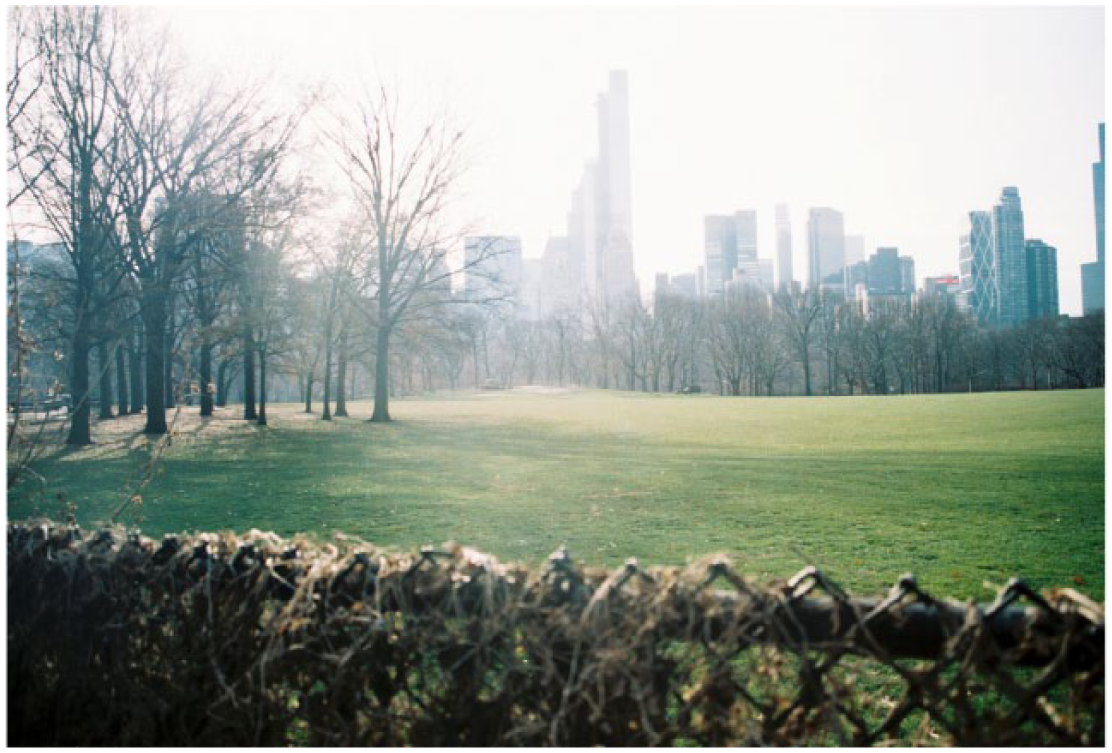
Skyscrapers modify the pastoral landscape in Olmsted’s Sheep Meadow, Central Park. Photo by author, 2013.
Paralleling changes in the design and use of existing urban parks, metropolitan-level spatial and demographic changes further altered the cultural meaning of city and nature in the twentieth century, particularly after World War II. Expanding suburbanization in the United States shifted the white middle class’s purview of nature from urban parks to suburban backyards (Duncan and Duncan 2004; Jackson 1985). Disinvestment in city centers by governments and corporations wrought a long decline in the economic fortunes of older “rust belt” areas (Sugrue 1996). As public parks are particularly visible manifestations of governmental investment (Mitchell 1995), their physical decline was a powerful image of urban decay; by the 1970s and 1980s, the symbolic meaning of urban parks was increasingly linked to the symbolic meaning of cities themselves (Davis 1990; Flusty 1994). Many parks came to lack Jane Jacobs’s (1961) “eyes on the street”—the community-level surveillance considered necessary components of safe, usable public spaces (Shepard and Smithsimon 2011). Coupled with sensationalist news coverage of park-based crimes like the 1989 Central Park jogger case, urban parks became implicated in racialized narratives of urban crime and disorder: Indeed, from the standpoint of the suburbanite or tourist, parks were seen as perhaps the most “unsafe” spaces within an “out-of-control” urban context (Greenberg 2008; Vitale 2009).
But parks were not the only spaces where definitions of city and nature were converging. Another product of disinvestment and depopulation was the proliferation of abandoned buildings, vacant lots, and disused infrastructure. As these assorted sites lost their original social functions, in some cases they were overtaken by nature—wild plants that grew within the ruins of the industrial built environment. In many circumstances, the aesthetics of decline were seen as evidence of an economic and social crisis (Greenberg 2008; Sugrue 1996). In other cases, urban decay and city-nature hybridity were bound up in “the artistic mode of production” associated with the gentrification of former industrial districts (Zukin 1982:176). Cultural desires for “authentic” urban places (Brown-Saracino 2009; Osman 2011) brought overgrown parking lots, concrete canals, abandoned piers, and unused railways into middle-class gentrifiers’ aestheticization of former industrial landscapes. Though nature’s encroachment of urban spaces was long a marker of decline, the gentrification of postindustrial neighborhoods has modified the symbolic value of these city-nature intersections as an appreciation for the natural landscapes of industrial ruin has emerged among new residents of these spaces. The popularity of “ruin porn”—the photographic portrayal of such sites as contemplative and beautiful—is a primary example of the resonance of such representations (Millington 2013). These imbricated representations, of course, require a particular standpoint to appreciate, not unlike the cultural reading of “rubble” as “ruin” (Gordillo 2014).
Images of the “industrial picturesque” (Herrington 2006) have become institutionalized through the construction of new public parks, such as New York’s High Line, that emplace city-nature imbrications in physical form. Just as nineteenth-century planners used landscape architecture to spatially construct the classical picturesque and the city-nature binary, contemporary cultural producers are mirroring these efforts in parks that highlight elements of decayed “city” and insurgent “nature.” The cultural power of these representations is reflected in the economic capital invested—$188 million and counting for the High Line 2 —and the far-flung admiration: the rush to build copycat High Lines in Chicago, Philadelphia, Mexico City, and many other places. In what follows, I examine the design ideology behind the construction of the New York version to illustrate how cultural producers actively create city-nature hybridity.
The High Line, City-Nature Hybridity, and Imbricated Spaces
New York’s High Line, a public park opened in 2009 atop an old elevated railway, serves as a useful case of city-nature imbrication. Because the park was actually built as a reproduction of the wild flora that grew within the disused rail bed, its development reveals the ideological underpinnings of city-nature hybridity more broadly. Painstaking efforts by the park’s architects to remake the appearance of agentic built and natural environments illustrates such spaces’ aesthetic and phenomenological appeal and demonstrates how these cultural images have been institutionalized through the production of new public spaces that bring these representations into wider circulation and consumption (Collins 2004).
The High Line was originally an elevated industrial rail line serving the lower west side of Manhattan that, like much of that part of the city, declined with the loss of manufacturing businesses after 1970. In the intervening years between its closure in 1980 and its redevelopment in the 2000s, the unused rail bed became home to grasses and flowers, creating an imbricated space of urban infrastructure, city vistas, and wild flora. This green landscape was fully unintended by humans—a product of the absence of the industrial and human activity that had previously taken place. The deep rail bed and the Hudson River’s breezes provided a hospitable context for wild plants to blossom. This expression of the natural environment’s agency was central to the site’s appeal once people discovered it in the 1980s (Gottlieb 1984), and indeed, representing this agency became the centerpiece of the architectural design strategy once the High Line was redeveloped as a public park (Millington 2015).
Efforts to repurpose the High Line dated to the 1980s but only became successful when the city government and local property owners made plans to demolish the structure, prompting an organized response by well-connected, culturally minded local residents (Loughran 2014). Publicizing their efforts in part through photographs of the High Line that conveyed the space’s distinctive city-nature imbrication, the Friends of the High Line—the nonprofit group that was founded to save the space—built financial, political, and cultural support for the project, helping the idea of an elevated park take hold in the public imagination. In the early 2000s, a new mayoral administration, coupled with the super-gentrification (Lees 2003) of the Meatpacking District and West Chelsea, changed the complexion of the debate. Mayor Michael Bloomberg envisioned a new High Line as a complement to the redevelopment of the West Side Yards in Midtown, where plans for a new stadium were in place as part of the city’s 2012 Summer Olympics bid (Loughran 2014). The combination of political support and the cultural and economic possibilities of a redeveloped far west side made the park proposal a reality by 2009 (Halle and Tiso 2014).
As I indicate in the following sections, the intentions behind the design and development of the “new” High Line reveal the emergent ideology of imbricated city and nature more generally. To a considerable extent, this ideology centers on the notion of nonhuman agency (Latour 2005). At the broader level of urban-environmental politics, the recognition of climatic influence on human society is reflected in the emergence of “green” planning initiatives and other policy prescriptions (Gotham and Greenberg 2014; Greenberg 2013). More particularly at the level of imbricated spaces, the High Line case makes clear that the appearance of the natural environment’s agency is central to their appeal, regardless of “who” is actually the active agent behind their creation. In contradistinction to the manicured plants of traditional public parks, flora in imbricated spaces must be deemed “authentic” by cultural receivers—namely, that “nature” had a genuine hand in creating the space—even when, as in the case of the redeveloped High Line, such greenery is carefully cultivated by people. Relatedly, the appearance of the built environment’s agency is also central. Although the built environment is by definition built by human action, the deterioration of buildings and infrastructure suggests a process of nonhuman agency that likewise contributes to the aesthetic appeal of imbricated spaces. In imbricated spaces, as in other spaces where industrial decline has been aestheticized (Zukin 1982), blighted buildings present as art objects (Gordillo 2014; Herrington 2006). In spaces like the High Line, the real or imagined agency of built and natural environments affirms for cultural receivers that city-nature hybridity is a process existing outside of human intervention and suggests that city and nature can be the creators of an aesthetically interesting space.
The High Line’s Designers as Producers of Urban Nature
Broadly conceived, the High Line’s design team included two architectural firms, a landscape designer, governmental actors, and the principals of the Friends of the High Line, the nonprofit group that spurred the creation of the park. The architectural firms—James Corner Field Operations and Diller Scofidio + Renfro—represented something of underdogs in the design process, winning over established firms like Skidmore, Owings, and Merrill and designers like Michael Van Valkenburgh, who had been commissioned for several other new parks in New York City at the time (David and Hammond 2011). At the time of selection, James Corner was an architectural professor known for his efforts to bridge traditional landscape architecture and the tenets of New Urbanism. His partners in the High Line design, Liz Diller, Ric Scofidio, and Charles Renfro, had been producing high-concept abstract architecture—in the form of installations and pop-up buildings—since the 1970s but had relatively few building credits to their name (though the firm had just won the commission to redesign New York’s Lincoln Center prior to winning the High Line competition). The team’s landscape designer, Piet Oudolf, was a well-known horticulturalist considered one of the foremost experts on cultivating wild-looking grasses (Stuart-Smith 2013).
Actors from the city government and the Friends of the High Line were involved in the design process in important ways. Although these individuals had little, if any, experience in park design, their ideas about the High Line’s aesthetics, its relationship to the city, and the sorts of socio-spatial practices the park should support were borne out not only through the selection of the design team but by providing input throughout the design process (David and Hammond 2011). These actors included Josh David and Robert Hammond, Chelsea residents who formed the Friends of the High Line to mobilize against the Giuliani administration’s demolition plans (Loughran 2014). As their nonprofit group gained financial and political support over the subsequent decade, additional actors became decision makers in the design process. These individuals included city planning chair Amanda Burden, parks commissioner Adrian Benepe, and deputy mayor Dan Doctoroff. Although these city-based actors were ultimately the clients of the actual architects, their vision for the High Line influenced aspects of the park’s design.
Given the large number of individuals involved in designing the High Line, it is impossible to create a singular vision of urban nature that all actors held in consensus. However, the various writings and interviews of the key participants reveal a shared conception of aesthetics and the city-nature relationship. In the following sections, I draw from statements by each of these actors to illustrate the common view of imbricated city and nature that was held by the design team.
The High Line’s Designers on the Aesthetics of City and Nature
Before the High Line was a celebrated park, it was an unused urban railway teeming with wild grasses and flowers. This nexus of the built environment and the natural world created a space for urban adventurers to make an illegal journey from Manhattan to what appeared to be, as a cofounder of the Friends of the High Line put it, “another world” (David and Hammond 2011:12). For the cofounders of the Friends of the High Line, the unique phenomenological experience of imbricated city and nature was the driving inspiration for the eventual park. As cofounder Robert Hammond wrote of his first visit to the “old” High Line, You walked out [onto the High Line] and you were on train tracks that were covered in wildflowers. I don’t know what I had expected. Maybe just gravel, stone ballast, and tracks—more of a ruin. . . . I just didn’t expect wildflowers. This was not a few blades of grass growing up through gravel. The wildflowers and plants had taken over [italics added]. We had to wade through waist-high Queen Anne’s lace. It was another world, right in the middle of Manhattan. (David and Hammond 2011:12)
Speaking to the idea of the “industrial picturesque” (Herrington 2006)—specifically, the ways that the aesthetic reuse of technological ruins evokes their former glory—Friends of the High Line cofounder Josh David wrote of his first time atop the High Line, There was a powerful sense of the passing of time. You could see what the High Line was built for, and feel that its moment had slipped away. All the buildings alongside it were brick warehouses and factories with smokestacks and casement windows, like buildings from a Hopper painting. (David and Hammond 2011:12)
These quotations speak to the particular sensory experience that the High Line’s designers found in the mix of built and natural environments. Although the vistas of the lower west side’s industrial landscapes were part of the site’s allure, Hammond’s reflection indicates that the unexpected presence of “nature” within the former industrial space—and especially the notion that nature created the space (“the wildflowers and plants had taken over”)—was central to his fascination with the High Line.
In transforming the “old” High Line into a park, the design team focused on recreating the appearance of agentic elements of city and nature that had made the original space so compelling. The combined efforts of the park’s cultural producers thereby made a new imbricated space through a direct act of cultural production. The logistics of creating a safe, usable public space necessitated the removal of the High Line’s original rail beds and wild flora. In their place, the park designers sought to reconstruct as many of the “old” elements as possible—for example, by reusing pieces of the original rails for aesthetic effect and utilizing a rail-inspired planked walkway—and cultivated “wild” plants, all in an attempt to keep the new space in character with the past. These elements thereby suggested to park visitors the continued agency of insurgent nature and decayed city in shaping the space, despite the fact the park was a space made by people.
Key to the exhibition of imbricated built and natural environments was the park’s concrete planking system that defined the park’s walkable area. Aesthetically, these long, narrow planks recalled the wooden planks of a railroad and enabled the park’s new natural elements to commingle with the park’s built material (see Figure 3). Citing the influence of another imbricated space, architect Ric Scofidio remarked: Rather than pouring a hardscape or a macadam path, [we designed] a planking system that could feather into the landscape. Actually we looked at concrete sidewalks, where the concrete had been broken and the grass was forcing its way through, and there was incredible tension between the green and the concrete. (Dunn and Piper 2012:6.48–7.14)
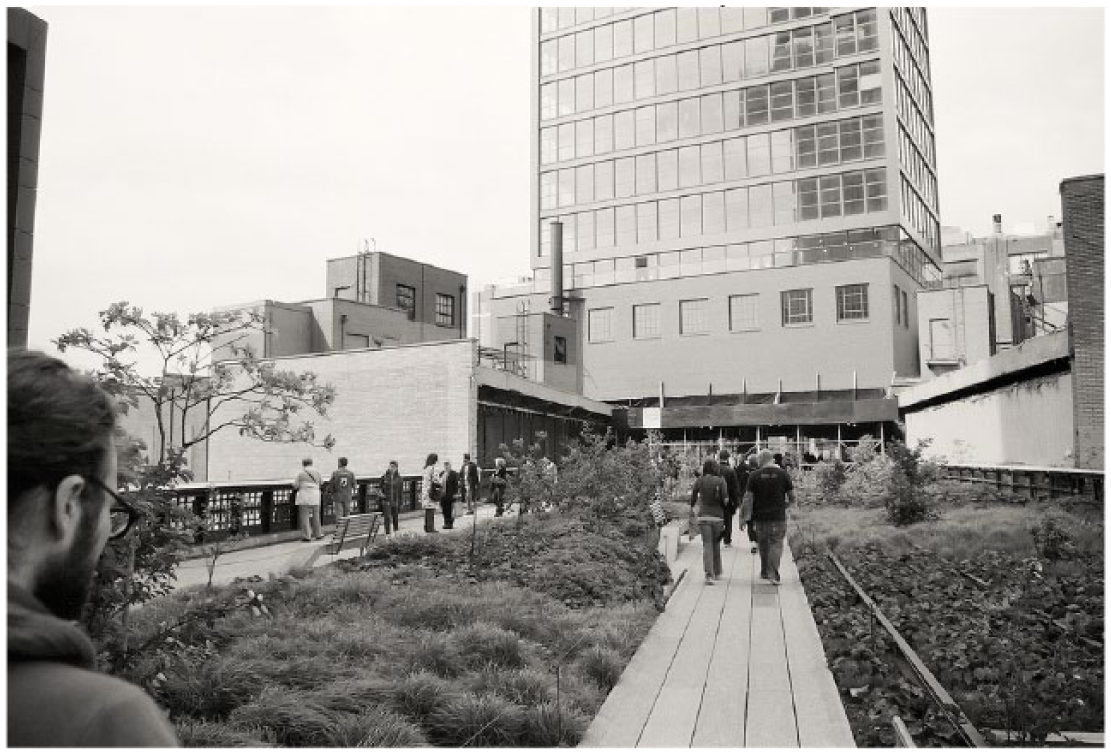
Industry and greenery at the High Line. Photo by author, 2011.
A second important aspect of the park’s design was the incorporation of plants that mimicked the space’s previously existing nature. Landscape designer Piet Oudolf was celebrated by the Friends of the High Line’s cofounders for his ability to cultivate wild-looking plants (David and Hammond 2011). Helping to differentiate the High Line’s natural aesthetics from the ordinary grasses of typical urban parks and the ornateness of botanical gardens, the “wild” grasses, flowers, and trees planted within the park suggested to park users that the appearance of nature within this urban, built context was indeed agentic and “natural” (see Figure 4).
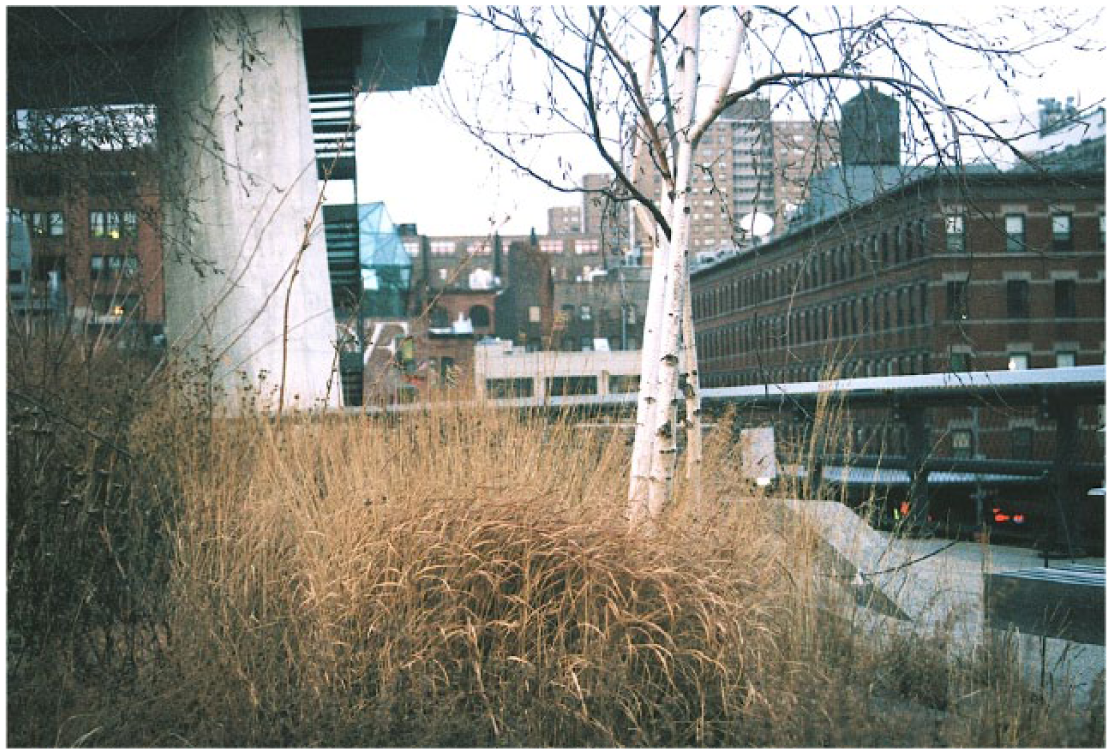
The High Line’s design team, especially landscape designer Piet Oudolf, cultivated plant life that resembled the railway’s “wild” heydey of the 1980s and 1090s. Photo by author, 2013.
Creating a “new” imbricated space on the High Line also required aspects of “the city” to recreate the phenomenological experience of the old High Line. The visual union of city and nature was done explicitly as the park’s designers drew out elements of the High Line’s industrial and built qualities in artful ways. At the “Tenth Avenue Square,” for example, part of the structure was removed to provide park-goers with a glass-enclosed view to the street traffic below (see Figure 5). Such spaces created visual exchanges between park users and people in the city; importantly, they also made mundane aspects of urban existence visible to people on the High Line.

The sunken overlook of the Tenth Avenue Square. Photo by author, 2011.
These interactions with the city are central to the experience of the “new” High Line. Bringing views of the city into a park would have been anathema to Olmsted and other nineteenth-century park designers; in the twenty-first century, this design ideology reflects the cultural convergence of city and nature and physically reproduces these ideas for park-goers to contemplate. At the High Line’s “viewing spur” at 26th Street, the park’s architects designed a metal frame to mimic a billboard that previously occupied the same space. This offered a focal point for park users to look out into the city and vice versa. Architect Ric Scofidio explained: There’s this wonderful moment . . . where there’s always been a billboard. In the restoration process, everything was ripped down, and that history would be gone. But we thought it would be nice to keep the memory of it, so at 26th Street we have that frame, but it also becomes a frame back to the city. (Dunn and Piper 2012:11.19–41)
Fellow architect Charles Renfro, speaking directly to the idea of representing the built environment’s agency, added, It’s not a one-way activity. . . . It’s a two-way activity. It’s always about a reciprocity. And so the frame is focusing the people from inside looking out, but it’s also focusing the people outside looking in. So while it might be confused with theater, it’s actually an inversion, and it turns the city into an actor and the people into actors at the same time. (Dunn and Piper 2012:11.44–12.06)
The High Line’s Designers on Socio-Spatial Practices
In addition to designing these interactions between park users and the city beyond, the High Line’s designers considered how people would move through the space. In designing the long, linear space as a walking promenade, the park’s architects intended the High Line to be a space of passive leisure—a venue for people to stroll, linger in certain areas, and have a view to the park’s greenery, to city streets below, to Midtown’s skyscrapers, and to other park users. This suggests that within the cultural conditions of contemporary cities, the place of humans is evolving vis-à-vis the city-nature convergence; spaces like the High Line are actively shaping the new meaning of nature and city as well as helping to construct a particular vision of the twenty-first century urbanite: an individual who can understand the space and appreciate the imbrication.
On the question of the new park’s intended socio-spatial practices, Friends of the High Line cofounder Josh David remarked: In Italy there’s a traditional walk called the passeggiata. In small towns and big cities, people come out in the early evening to do a leisurely, theatrical promenade through one of the main streets or a central plaza. When we started working on the High Line, I held in the back of my mind an image of the High Line as a place where something like the Italian passeggiata could happen—a place where people would come to stroll just for the sake of strolling, to be among their fellow citizens, to smile and flirt, to check out one another’s outfits, to walk with parents after an early dinner, or to meet up for a date. (David and Hammond 2011:126)
Speaking to a similar vision of passive leisure was landscape architect James Corner, who remarked on the High Line’s “Section 2” (opened in 2011, two years after the first section opened to the public): Certain things we learned in Section 1 is just how people like to linger on the High Line. That’s it’s not simply about strolling, but it’s about seating and just taking in the scene. And so in Section 2 there was an attempt to allow for more seating, to create more nooks and crannies where people can sit and relax and to try to create some settings where you can actually theatricalize the relationship between the viewer and the viewed. (Bloomberg TV 2011)
Lastly, beyond the scope of the park itself, the designers of the High Line held a vision of the park’s broader significance vis-à-vis the contemporary city. Unlike earlier generations of landscape architects, they did not see “nature” as something to be spatially separated from “the city.” Rather, cities like New York were seen as communities with interesting histories and contemporary environmental and recreational needs, which encouraged the reuse of former industrial spaces in the name of sustainability. As Friends of the High Line cofounder Robert Hammond stated: There’s not very many places in American cities or cities across the world to build new parks. All of the spaces are mostly old industrial sites. And rather than just clearing them out and starting anew and trying to recreate Central Park, you retain the industrial history, at the same time bringing in a new green use. (Wolf 2009:1.35–53)
Speaking to these same ideas, James Corner commented on how the High Line fit within his ideological approach toward cities and nature: [T]he whole environmental agenda is something that landscape architects have been trained in and have worked on for years. . . . Cities are beginning to invest in new parks, new public spaces, new waterfronts, and the transformation of many of these postindustrial inheritances from the twentieth century. . . . With the shift from an industrial economy in cities to a service economy, a lot of land is abandoned and derelict. No one knows what to do with it. The High Line is a great example of making something new. (Rhodes 2012:1–2)
In sum, the cultural producers behind the redevelopment of the High Line intended to accomplish several objectives through the creation of the park. Aesthetically, they sought to recreate an imbricated space by maintaining the appearance of agentic city and agentic nature even as the new High Line’s “natural” spaces were carefully constructed by landscape architects. In designing the park’s intended socio-spatial practices, they sought to cultivate passive leisure among park users and reorient people’s visual relationship to the city. Lastly, in terms of their conception of the broader city-nature relationship, the designers intended that the High Line would serve as a model for green interventions in contemporary cities. In achieving these things, the park’s designers reproduced the imbrication of city and nature as both space and symbol. Different in many respects from prior iterations of public parks, the cultural and economic power of the High Line and its far-reaching influence speaks to the wide resonance of city-nature hybridity.
Discussion
The design ideology of the High Line’s cultural producers illustrates a key example of the emergent city-nature relationship. Breaking from the dominant “binary” orientation, the creation of the High Line reflects the rise of a “hybrid” understanding of how city and nature intersect, where representations of agentic city and agentic nature coexist in “imbricated spaces.” This shift in the cultural orientation toward city and nature is not only symbolic. Over the intervening 150 years between the first generation of modern urban parks and the redevelopment of the High Line, both nature and cities changed in important material ways. In the United States, most cities were long ago built to their politically defined limits (Jackson 1985). While some cities, like Detroit and St. Louis, have experienced widespread “greening” through disinvestment as vacant lots proliferate on the landscape, cities that have retained their downtown core of people and capital, like New York, tend to have few open spaces for new parks. With greenfield development limited to the exurban fringe or waterfront infill (in cases like Brooklyn Bridge Park), city governments, planners, and citizens have tended to work within the spatial framework of the existing built environment, utilizing outmoded industrial infrastructure to reimagine the urban landscape.
These material changes to cities are connected to the bidirectional relationship between nature and human society. In the age of the Anthropocene (Clark 2014; Steffen et al. 2007), an awareness of global warming and the socio-environmental consequences of mass consumption and industrialization indicates the agency of nature in shaping human society and has shifted the locus of nature-oriented social movements and governmental action from the preservation of open spaces to the repurposing of urban infrastructure for environmentally friendly purposes. The mobilization of groups such as the Young Lords in 1970s Spanish Harlem (Gandy 2002) and contemporary “green anarchist” organizations, along with less radical movements like urban farming, bike sharing, and other “green” initiatives, have reoriented the interaction of the natural and the social from wilderness to urban areas, further reinforcing the idea that city and nature are interwoven, both culturally and metabolically.
While the case of the High Line indicates changes in the cultural orientation toward city and nature, it also reveals important similarities between contemporary public spaces and prior versions. Though early parks such as Central Park were intended to shelter urbanites from the tumult of city life and the High Line was to transport visitors to a skyward industrial garden, the cultural producers behind each sought to cultivate passive leisure and pastoral retreat. For nineteenth-century planners like Frederick Law Olmsted, the picturesque represented a means to frame “nature” for the audience. By using design to accentuate the “roughness” of things like rocky outcroppings and waterfalls, Olmsted and his contemporaries presented cultural receivers with an aestheticized image of the natural world. The design of the High Line, though not oriented toward scenes of “first nature,” takes up many of these same themes. From the High Line’s picturesque vistas, the rails, factories, and piers of Manhattan’s lower west side are transformed from mundane industrial materials into culturally valued art objects (see Figure 6). This transformation of cultural meaning through an imbricated space enables contemporary urbanites to contemplate the industrial past and the place of humans and cities vis-à-vis the natural world.
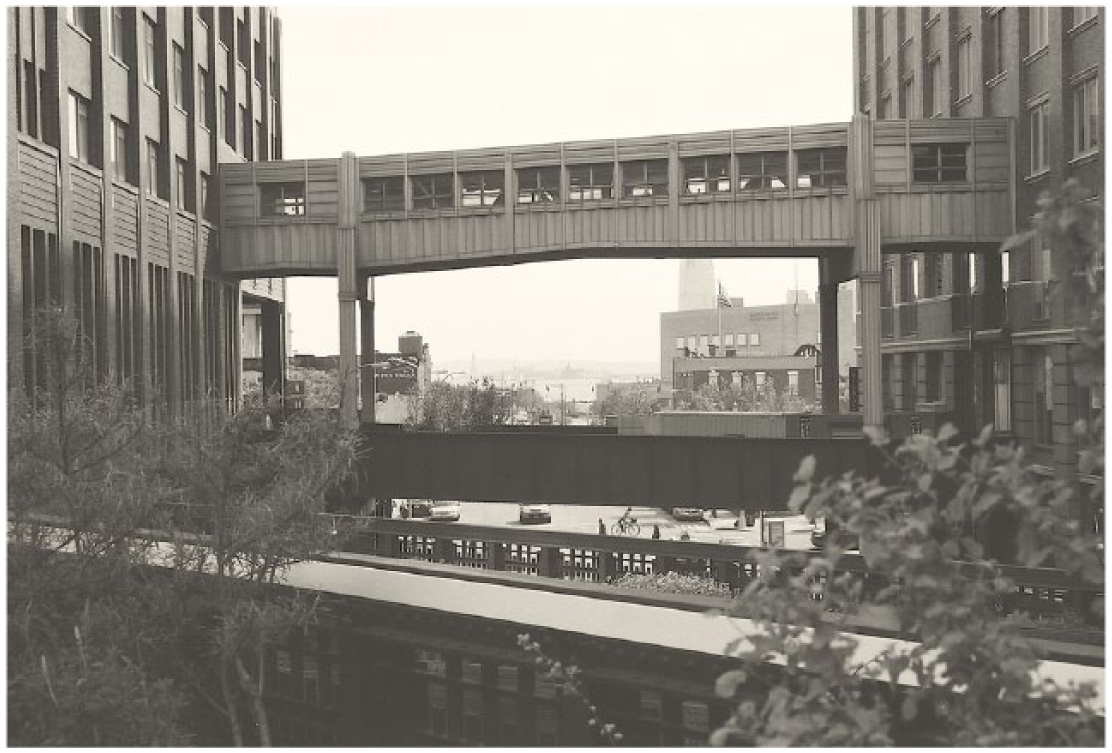
The industrial picturesque. Photo by author, 2011.
The expression of the joint agency of built and natural environments embodied by both the “old” High Line—where plant growth and industrial decay conspired to create an imbricated space—and the “new” High Line—where architectural design and horticultural efforts unite built and natural forms—indicates a particular spatial and aesthetic manifestation of the broader city-nature hybridity that has been recognized by social scientists and contemporary cultural producers and receivers alike (Angelo forthcoming; Cronon 1991; Gandy 2002; Millington 2013). Representations of city’s and nature’s agency on the High Line and in other contemporary park developments indicate a cultural shift away from the more conspicuously constructed displays of nature found in prior generations of parks and toward more “authentic” representations and also connotes an expanding appreciation for the place of “nature” in human/urban society. Though earlier cultural producers like Olmsted, along with writers, artists, and wilderness preservationists like John Muir, celebrated natural landscapes, it is a different thing to accord “nature” the agentic primacy to shape human geographies in the way suggested by the High Line and other green planning initiatives, where nature, rather than being displaced by urbanization, is now being incorporated within urban processes—for example, by rebuilding “resilient” cities after natural disasters (Gotham and Greenberg 2014) or the development of “green infrastructure” and urban farming (Colasanti, Hamma, and Litjensb 2013). Imbricated spaces quite literally bring these wide-ranging cultural and metabolic changes to the city-nature and society-nature relationships into view, presenting cultural receivers with an aesthetic of shared agency that “naturalizes” the apparent harmony of built and natural forms in contemporary urban areas.
My analysis of the High Line suggests that there is a temporal dimension to the creation of imbricated spaces. The long decline of industrial cities in the second half of the twentieth century is central to their emergence in the West; more broadly, it is clear that some amount of time must pass for the urban built environment to decay and for nature to blossom in the concrete’s cracks. It is therefore an open question as to whether imbricated spaces can be found within “new” built environments. In Chicago, for example, the city’s highly valorized Millennium Park (opened in 2004) is surrounded by skyscrapers, and the park’s central attraction, the mirrored Cloud Gate sculpture (popularly known as “the Bean”), reflects city, trees, and sky in distorted images; on the surface, these aesthetic elements might suggest an affinity with the High Line. However, the mere visual unity of urban and natural elements is an insufficient condition for an imbricated space. In their novelty, Millennium Park and other like spaces do not invite park users to reflect on the passage of time or to see decaying city and insurgent nature as active agents in the creation of social spaces. While both Millennium Park and the High Line reflect the triumph of small-scale postmodern urbanism and contemporary urban regimes’ penchant for spectacle, the parks diverge in terms of the way that “nature” is deployed (manicured vs. wild), the way that “city” is represented (new vs. old), and the representation of agency in the creation of the space (humans vs. city/nature). Certainly, architects and planners have the tools to fabricate the built environment’s “decay,” but the Friends of the High Line’s painstaking recreation of the High Line’s original imbricated space indicates that this dialectic of decay and insurgence must be deemed “authentic,” namely, that the appearance of city’s or nature’s agency in social space must be seen as legitimate by cultural producers and receivers. This question of agency and authenticity is what distinguishes imbricated spaces from other intersections of built and natural environments, broadly speaking; it is the difference between the overgrown ruins of Detroit’s Michigan Central Station (Figure 7) and manicured vines climbing the walls of a university building (Figure 8).

The iconic ruins of Detroit’s Michigan Central Station. Photo by Joe Braun (http://www.citrusmilo.com/).

Manicured ivy at Northwestern University. Photo by author, 2016.
Other cultural images of city-nature hybridity, such as photographs of imbricated spaces, recall Collins’s (2004:98) notion of “the secondary circulation of symbols.” Photographic or literary representations of city-nature hybrids are central to the “resonance” and “retrievability” (Schudson 1989) of converging natural and social forms; these second-order cultural images disseminate the power of imbricated spaces, furthering their visibility across geographic and demographic boundaries and naturalizing the political-economic and cultural structures behind their creation. “Ruin porn” connotes these sorts of images at their most problematic—creating an aesthetic of industrial and social decay that naturalizes institutional neglect (Kinney 2012)—but these images are not always tied to the racialized “re-colonization” of industrial districts (see e.g., the emergence of postindustrial bike tours in the rural Appalachian Mountains; Kracklauer 2015). The symbolic and spatial convergence of built and natural environments also has implications for ontologies of humans, city, and nature (Haraway 1991; Jerolmack and Tavory 2014; Shaw 2014), cultural dimensions of global warming and other products of the Anthropocene (Clark 2014), and the politics of urban metabolism (Wachsmuth 2012), all of which suggest the need to further interrogate the historical geographies of imbricated spaces and their related cultural objects.
Beyond contemporary urban parks, the imbricated space concept has implications for urban and cultural social scientists as it offers a lens into broader intersections between the natural and the social. As scholars have illustrated, people make meaning out of interactions with natural objects and form community around shared experiences with “nature” (Fine 1998; Jerolmack 2012). The imbricated space concept helps scholars understand one iteration of the ways that these relationships are not just symbolic but occur in culturally produced social spaces: Even practices that take place in the “wilderness” of “first nature” rely on cultural understandings about the state of nature and turn these natural spaces into social spaces through human activity (Cronon 1996). Ultimately, imbricated spaces may be one of many ways that the natural and the cultural converge at the level of social space; this article is a step in uncovering what these spaces look like and how they are created.
Footnotes
Acknowledgements
For their helpful comments, I thank Hillary Angelo, Robin Bartram, Mike Owen Benediktsson, Claudio Benzecry, Chas Camic, Ryan Centner, Jordan Conwell, Gary Alan Fine, Heba Gowayed, Caroline Graham, Wendy Griswold, Ryan Hagen, Nicholas Occhiuto, Greg Smithsimon, and the anonymous reviewers of Sociological Theory.
Author’s Note
Prior versions of this article were presented at the 2015 Annual Meeting of the American Sociological Association and Northwestern University’s Culture and Society Workshop.