



Abstract
A perennial concern in frame analysis is explaining how frames structure perception and persuade audiences. In this article, we suggest that the distinction between personal culture and public culture offers a productive way forward. We propose an approach centered on an analytic contrast between schemas, which we define as a form of personal culture, and frames, which we define as a form of public culture. We develop an “evocation model” of the structure and function of frames. In the model, frames are conceived as material assemblages that activate a network of schemas, thereby evoking a response when people are exposed to them. We discuss how the proposed model extends, and clarifies, extant approaches, and consider new directions for future research.
Sociologists use the concepts of schema, frame, and framing to understand how perceptions are organized and altered between individuals and groups, often (but not always) in attempts at persuasion. Since their introduction, different ways of defining these concepts have emerged, some more tractable than others. In this article, we propose a synthetic framework grounded in recent developments in culture and cognition studies. In what follows, we distinguish our framework from previous approaches while arguing that our formulation clarifies and maximizes the analytic utility of these concepts.
Our intervention takes as a starting point the distinction between personal and public culture recently articulated by Patterson (2014) and Lizardo (2017), who build on the work of anthropologists like Spiro (1987), Shore (1998), D’Andrade (1995), Bloch (2015), and Strauss and Quinn (1997). In this approach, personal culture is understood as aspects of a person’s memory that are shared (i.e., not idiosyncratic) and learned (i.e., not innate). This form of culture can be further divided into nondeclarative (e.g., habits, skills, judgments, biases) and declarative culture (e.g., explicitly recollected events, memorized facts, songs, and phrases).
Public culture, in contrast, is located outside of persons and therefore always material, sensuous, and tangible. This public form includes everything potentially available for interaction, like physical objects and settings, as well as sounds, human and nonhuman bodies, texts, and conversations. While distinct (and thus not reducible to either one or the other), personal and public culture are interlinked (Shore 1991). For example, while cultural symbols take an objectified, external form, they must also be coupled with the conceptions evoked in the minds of the actor perceiving the symbol (Lizardo 2016:200; Turner 1967:20). This formulation aligns with sociologists working at the intersection of culture and cognition studies (e.g., Brekhus 2015; Cerulo 2014; DiMaggio 1997; Lizardo 2014) as well as culture and materiality scholars (Dominguez-Rubio 2014; Griswold, Mangione, and McDonnell 2013; Klett 2014; McDonnell 2010; Sonnett 2004; Stoltz and Taylor 2017).
With this distinction as our point of departure, we further distinguish the concept of schema, which we propose is a nondeclarative form of personal culture, from that of frame, which we conceive as a form of public culture, which activates schemas. Second, we make an analytical distinction between a frame, which is always situational and material, from a model of a frame, which is the set of declarative instructions or nondeclarative skills used to re-create a frame. From this perspective, then, framing refers to the physical assembling of a frame, while frame modeling refers to the implicit or explicit creation of a model of a frame. We argue that distinguishing schemas from frames along the personal/public divide, and distinguishing frames from models of frames, maximizes the usefulness of these concepts for contemporary research as it affords a logically coherent, cognitively tenable, and empirically productive framework to analyze persuasion and perception.
Building on these distinctions, we propose an evocation model for frame analysis. In contrast to approaches defining frames as interpretive packages publicly transmitted and internalized by actors, we propose that frames are better thought of as situational material assemblages that activate schemas previously internalized by persons. Rather than impose meanings, frames evoke meanings. Persons compose frames through the (re)assembling of the materiality of situations that, when perceived, activate networks of schemas that evoke associated responses. Frame composition may be instrumental or expressive and may involve just one articulator (e.g., a solo artist) or a team (e.g., protesters). Actors may develop models of a frame either automatically through repeated experience with particular frames or through conscious deliberation and reflection. Models of frames may influence the reconstruction of frames in situ.
Schemas
What Are Schemas?
The modern concept of “schema” can be traced back to the eighteenth century in Immanuel Kant’s Critique of Pure Reason ([1781] 1998). “Schema” was later elaborated by the psychologists Frederic Bartlett (1932) and Jean Piaget (1952) in the early twentieth century to account for the role of an individual’s prior experiences in shaping present responses. The concept underwent a renaissance in the 1970s, with advancements in artificial intelligence (Minsky 1974), motor skill research (Schmidt 1975), cognitive psychology (Rumelhart 1975, 1980), linguistics (Fillmore 1975), political science (Axelrod 1973), and developmental psychology (Mandler 1978). In sociology, the term “schema” first appeared in this contemporary form in Cicourel (1981) 1 but remained relatively dormant until Sewell’s (1992) recasting of Giddens’s (1979:62-64) conceptualization of the duality of structure as the recursive linkage of schemas (previously rendered as “rules”) and resources. 2
Our conceptualization of schema (see Table 1 for a summary of key definitions) follows the standard treatment found across the cognitive sciences today (Ghosh and Gilboa 2014) and used increasingly by sociologists (Cerulo 2010:117; DiMaggio 1997:267; Patterson 2014:4; Vaisey 2009:1686). However, because contemporary uses of the term vary in significant ways within sociology, it is necessary to distinguish our conceptualization from others. Three aspects, in particular, are worth mentioning.
Definitions of Primary Concepts.
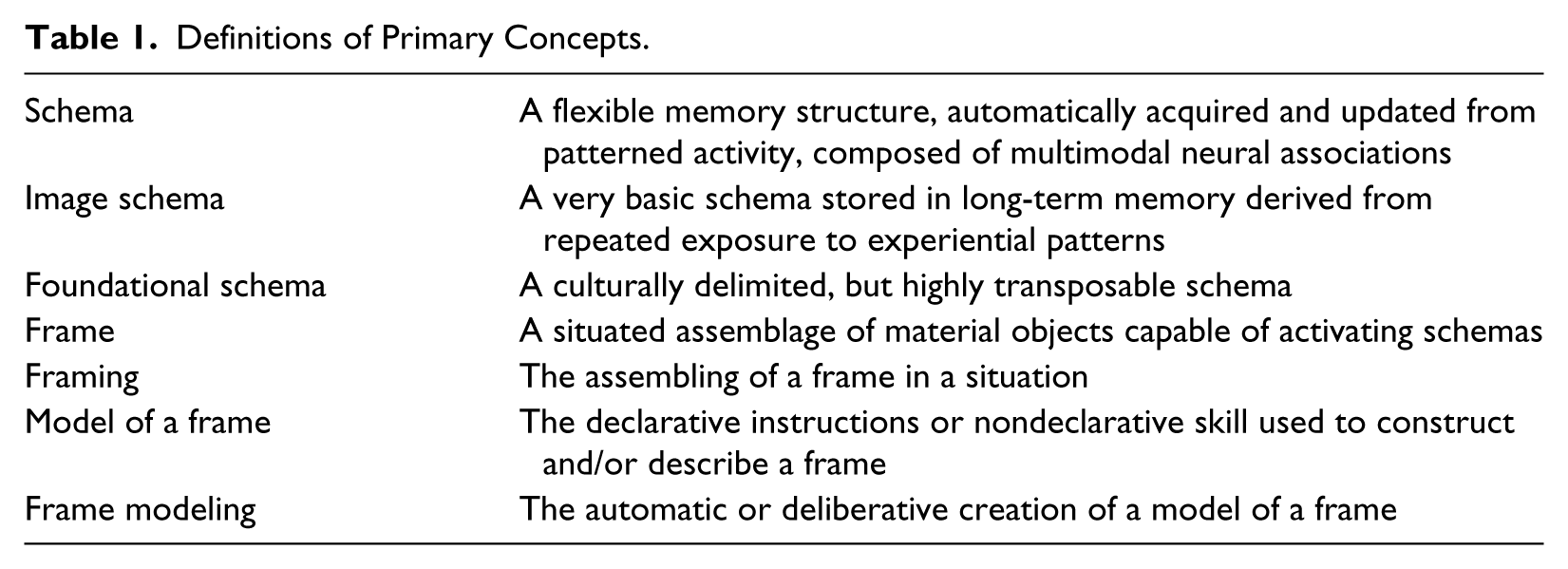
First, we define schemas as a form of personal culture—literally, entrenched multimodal (i.e., visual, aural, tactile, olfactory, kinesthetic, etc.) neural associations developed via repeated embodied experience (i.e., perceptual, sensorimotor, interactional) and stored in long-term memory. Schemas are cultural because they are learned and may be shared and distributed across persons, provided they have similar life histories and experiences (Bloch 2015; Iacoboni 2009; Lizardo 2009b). 3 The conceptualization of schema used in this article stands in contrast to uses of the term which, following Sewell (1992), are ambiguous as to whether they are talking about an external pattern or an internal mental structure (e.g., Somers 1999:125; Spillman 2016:441-424; Swidler 2001:83-88; Swidler and Arditi 1994:322). Because in our formulation schemas are memory structures located in persons, our definition is not compatible with those who deem them “virtual” objects, irreducible to “any particular location in space or time” (Sewell 1992:8). 4
Second, we define schemas as lacking specific content (see also Hutto and Myin 2012, 2017; Rumelhart and Ortony 1977:101-5). These neural associations retain relational information while producing “variables” that lack “unit detail” (Boutyline 2016; Ghosh and Gilboa 2014; Goldberg 2011) and do not necessarily prespecify default elements. 5 Schemas lack unit detail because the process of schematization involves a structured “forgetting” of detailed information (of the sort that might be retained in declarative memories) and the retention of features that are highly correlated across multiple exposures (McClelland and Rumelhart 1985). 6 This process is precisely why schemas are reusable (or “transposable”) across variable situations. Therefore a schema should not be conceived as an “image” or a “representation” in the lay sense of these terms.
Finally, schemas are a form of nondeclarative memory (Squire 1992, 2004)—acquired, used, and altered through a repeated, automatic process of schematization from experience (Lizardo 2017; Lizardo et al. 2016). 7 Schemas are not encoded in memory quickly (as one might memorize a word or phrase, for instance) but rather through a “slow learning” process of habituation, built through the ongoing exposure to redundant aspects of interaction in social and physical spaces. As nondeclarative memory, schemas are also automatically activated by qualities of the current situation, through pattern recognition, pattern filling, and, in turn, pattern updating. In sum, we argue that schemas are a personal, underspecified, and nondeclarative form of culture. To give a better sense of the sort of shift in conceptualization that this would entail, we review two kinds of schemas generally neglected by sociologists—image schemas and foundational schemas—that exhibit the three characteristics discussed above and that we offer as useful default notions of the schema concept.
Image Schemas
Schemas vary in complexity, with the simplest schemas often referred to as image schemas. Image schemas can be conceived as “simple spatial stories” (Mandler and Cánovas 2014), which emerge from the most redundant aspects of perceptual and bodily interaction with a material and spatial world. These primitive associations are stored in long-term memory (Johnson [1987] 2013), and form the basic building blocks of more abstract thought. This concept emerged in the 1980s out of the collaborative work of the philosopher Mark Johnson and the linguist George Lakoff, brought together by their mutual concern with metaphor, resulting in Metaphors We Live By ([1980] 2008; for the abridged version, see Lakoff and Johnson 1980). In this initial formulation, they referred to source domains for conceptual metaphors as “experiential gestalts.” In the late 1980s, Lakoff (2008) and Johnson ([1987] 2013) began to use the term “image schema” instead, and it quickly spread across disciplines with some variations in terminology (Mandler and Cánovas 2014).
The initial evidence for image schemas was the striking consistency among metaphors in cross-linguistic data, though the concept also finds support in developmental and neurocognitive research (Dodge and Lakoff 2005; Gibbs 2005; Gibbs and Colston 2006; Mandler 1992). A key finding in this literature is that the use of image schemas in working memory involves the reactivation of some of the very same perceptual and motor systems involved in the acquisition of that image schema (Barsalou 2016:1129; Ignatow 2007:121); this process is sometimes referred to as the principle of neural reuse (Anderson 2016). For example, the phrase “once he gets rolling, you’ll never get him to stop talking” (Gibbs and Colston 2006:262) activates the same MOMENTUM schema that would be activated if the body were actually experiencing momentum. 8 In this way, basic image schemas serve as source domains for analogical meaning-making. This grounding of abstract domains in experientially basic domains is part of the recent interdisciplinary convergence on the fundamental “embodiment” of cognition (Barsalou 2008; Cerulo 2015; Glenberg 2010; Ignatow 2007; Lizardo 2009b; Pitts-Taylor 2015; Wilson 2002).
Although image schemas are simple and acquired through early recursive exposure to and navigation/manipulation of the world, they are important for sociological analysis because they structure the meanings of more experience-distant aspects of life, such as complex social processes and abstract concepts (Hertz 2013; Kövecses 2005b, 2010, 2015; Lakoff and Johnson 2008; Schwartz 1981; Turner 1996). 9 For example, Schwartz (1981) finds that many cultures understand the abstract concepts of morality and power in terms of verticality, associating UP with moral goodness and power and DOWN with immorality and weakness. Hence, gods, heavens, and heavenly powers are typically located above, while demons, hell, and evil forces are found below (Lizardo 2009a:615; Schwartz 1981:71). Similarly, good people are often talked about as being upright (though they can fall into a low place after an immoral act [Kövecses 2005a:152]), and the U.S. Supreme Court is the high authority that overrules the lower courts (Winter 1989:1145).
When image-schematic mappings are conventionalized, actors may use them strategically to evoke certain meanings. In the case of verticality, for example, something as subtle as whether the name of a group appears on the top or bottom of a computer screen can influence how people evaluate the powerfulness of the group (Schubert 2005). Historically, political actors have used verticality to signal their relative social position, for example, by placing palaces atop hills (Abrutyn 2014:105). In addition, revolutionaries may exploit conventionalized verticality mappings by arguing that the high need to be taken down because of their base acts, and replaced with someone more suitable to that high office (Schwartz 1981:136-41). Stated more generally, the mapping from embodied experience to abstract domains undergirds much of the meaning making of interest to sociologists (Winchester 2016).
Despite the interdisciplinary relevance of image schemas and the range of potentially productive applications within sociology, very few sociologists have used them analytically—although notable exceptions include Feagin (2013:40), Frye (2012:1597), Ignatow (2004, 2007), and Lizardo (2012, 2013). Instead, sociologists using the term “schema” tend to describe more complex arrangements without considering the possibility that they comprise experiential primitives (Mandler 1992). Many typologies of schemas exist based on the degree of complexity, carrying a range of labels such as scripts, plans, stories, and, indeed, even frames (e.g., Ghosh and Gilboa 2014; Mandler 2014; Schank and Abelson 2013). Alongside these, and following the anthropologist Bradd Shore (1998), we find the concept of foundational schema particularly useful for sociologists to understand and compare the organization of cultural knowledge across times, peoples, and places.
Foundational Schemas
Like image schemas, foundational schemas are transposable but may be more complex than image schemas. Shore (1998) argues that these are “foundational” not because they are the most basic, but because they are central to the organization of many distinct domains for specific times, places, and subgroups of people. For example, Shore argues (1998:54) that the “center-periphery” schema is foundational in Samoa and the “modularity” schema is foundational for the contemporary United States.
In the case of Samoa, Shore finds that the center-periphery schema structures a wide range of social behaviors, with “the central malae (village green) and the outskirts of the village” serving as the key “references points in village orientation” (1998:270). The central malae is the locus of formal gatherings of chiefs, serious conversations, and sacred events, and the area is protected at night by chiefly edict. Outside the malae, by contrast, is the place for casual conversation and mundane activities, and in the peripheral areas of the village, certain behaviors that are severely punished if they occur on the malae are tacitly accepted or understood to “have their ‘proper’ expressions” (1998:271-72).
Shore argues that the “modularity schema” is foundational in the United States, as evident in the American tendency to approach design tasks by “[breaking] complex wholes into elementary units that are understood to be recombinable in a variety of different patterns” (1998:118). Shore finds the modularity schema at work in a variety of American institutions, including shopping malls (“interchangeable spaces on huge reconfigurable floor plans”), hamburgers (“variable configuration[s] of . . . mass-produced beef building blocks”), and television channels (“virtual worlds with no bridges between them,” divided into “segments” and “time slots”), among others (see 1998:121-25). Drawing on the historical-comparative work of John Blair (1988), Shore argues that modularity gained prominence in the United States as the result of Americans’ recursive exposure to machine-mediated environments and is foundational precisely because it can be found as an underlying organizational principle in so many settings.
Frames
What Are Frames?
The first use of the “frame” concept can be traced back to the literary theorist Kenneth Burke’s ([1937] 1984:99) Attitudes toward History, in which he argues that all “poetic forms” in history can be reduced to two “frames of reference” (acceptance and rejection). Although he offers little elaboration, Burke considers frames to be “major psychological devices whereby the mind equips itself to name and confront its situation.” Later, the anthropologist Gregory Bateson used the concept to explain the behavior of the monkeys he observed at the Fleishhacker Zoo in 1952. Similar to Burke, Bateson argued that monkeys have “psychological frames” for a “real fight” and a “play fight,” and they also were capable of “exchanging signals” indicating which is operative (Bateson 1955). In linguistics, Charles Fillmore, attempting to challenge so-called checklist approaches to word meaning (1975), argued the meaning of individual words could be specified only in relation to a semantic “frame,” but used this term interchangeably with “schema” (1976:25). Later, the cognitive psychologist Barsalou (1992) selected “frame” to refer to particularly well-formed memory structures (but considers it equivalent to schema). In his well-known treatise, Sensemaking in Organizations, the organizational theorist Karl Weick (1995)—building on Starbuck and Milliken (1988)—argued that “frames” are essential to the process of “sensemaking,” but does not provide any clear definition.
It is well known that the concept entered sociology via Goffman, who borrowed it directly from Bateson, and used “the term ‘frame’ in roughly the sense in which he [Bateson] meant it” (Goffman 1981:64). Since Goffman’s Frame Analysis, sociologists have used the concept of a frame to empirically analyze a wide range of phenomena, including social movements (Snow et al. 1986), poverty (Young 2010), education (Davies 2002), historical networks (McLean 1998), business discourse (Ghaziani and Ventresca 2005), small-group conversations (Kretsedemas 2000), racism (Taylor and Rambo 2013), and sociocultural evolution (Abrutyn, Van Ness, and Taylor 2016).
Building on Goffman’s work, some scholars have held close to the initial formation, using the concept as roughly equivalent to schemas (e.g., Oliver and Johnston 2000). Many seminal works in frame analysis have defined frames as explicitly cognitive objects that individual actors possess; they are “‘schemata of interpretation’ that enable individuals ‘to locate, perceive, identify, and label’ occurrences within their life space” (Snow et al. 1986:464, with quotes from Goffman 1974:21), and “persistent patterns of cognition, interpretation, and presentation . . . by which symbol-handlers routinely organize discourse” (Gitlin 2003:7).
Many others, however, have departed from this tradition by conceptualizing frames as public objects—that is, as a form of public culture rather than something personal. Following these formulations, a frame is a shared definition of a situation that emerges in concrete social interaction (Tannen and Wallat 1987:206-7), consisting of arranged elements that make up an “interpretive package” (Gamson and Modigliani 1989), and which crystallizes as “the outcome of negotiating” (Benford and Snow 2000:614; Gamson 1992:111). As more contemporary observers note, a frame (in the latter usage) is a “general meaning context within which social actors interpret action” (Brekhus 2015:11).
As a public object—an external “setting” or distributable “thing”—a frame is said to “[provide] an interpretive ‘footing’ that aligns schemas that participants to the interaction bring with them” (Benford and Snow 2000:614). Thus, we see in this latter approach a possible criterion to distinguish between frames and schemas, where frames are taken as public aligners and schemas are either ignored or taken as the personal things being aligned. Outside of sociology, some have maintained this analytical distinction while continuing to use the term “frame” to refer to both forms. For example, Kinder and Sanders (1990:74) note that “frames lead a double life: they are internal structures of the mind that help individuals to order and give meaning . . . [and] they are also devices embedded in political discourse . . . intended to make favorable interpretations prevail.” Adding some clarity, Chong and Druckman (2007:106; Druckman 2001:227-28) refer to these two different forms of the frame concept as frames in thought and frames in communication (see also Bizer, Larsen, and Petty 2011; Borrelli and Lockerbie 2008; Kahneman and Tversky 1979; Kelly 2012; Tversky and Kahneman 1981).
We consider frames as a form of public culture distinct from schemas, but depart from previous definitions insofar as we see frames as distinctly material and situational. In our formulation, frames are situational assemblages of material objects (i.e., public culture) that activate networks of schemas (i.e., personal culture) in receivers (for an equivalent distinction, see DiMaggio 1997:274). Following cultural sociologists studying materiality (e.g., Griswold, Mangione, and McDonnell 2013; McDonnell 2010), under the label “objects” we include everything from books, billboards, boulders, and buildings to human and nonhuman bodies, from vibrations, sounds, and conversations to sunlight, dirt, and the stench wafting from a dumpster—indeed, anything tangible.
As assemblages of the material objects in a given situation, frames reside between the standpoints of a sender(s) and a receiver(s), 10 and may consist of any perceptible medium, such as arrangements of words on a page or people on a stage, the interior design of a classroom, color schemes used in billboards, musical compositions of national anthems, or arrangements of lighting and smells in a restaurant. Given that we conceptualize frames as material assemblages, our definition excludes “internalized” forms of culture such as beliefs—i.e., embodied expectations and anticipations (Strand and Lizardo 2015)—and meanings—i.e., “the interpretation[s] evoked in a person by an object or event” (Strauss and Quinn 1997:6; see also Spiro 1987).
However, as previously outlined, objects of cultural analysis often have both internalized and externalized dimensions (e.g., Lizardo 2016:200). Actors continually offload evidence of beliefs and meanings into the material environment so as to “ease cognition” (Martin 2010:237) and communicate. As such, frames carry affinities to the schemas that were used in constructing the frame, as well as the schemas, which are activated by exposure to the frame. Related to this, declarative representations of beliefs are often front and center in the “instructions” for composing a frame—a topic to which we now turn.
Models of Frames and Frame Composition
Apart from composing a frame, actors may develop a model of a frame (see Table 2). A model of a frame is a simplified set of declarative instructions or nondeclarative abilities used to re-create a frame and may be said to be “cultural” to the extent that they are learned and shared. While a model of a frame is based on schemas, as knowledge or skill, these models are more content rich. In their declarative form, models of frames can be articulated and made public by, for example, being drawn out, expressed in spoken form, or written down as a set of instructions.
Distinctions between Framing and Frame Modeling.

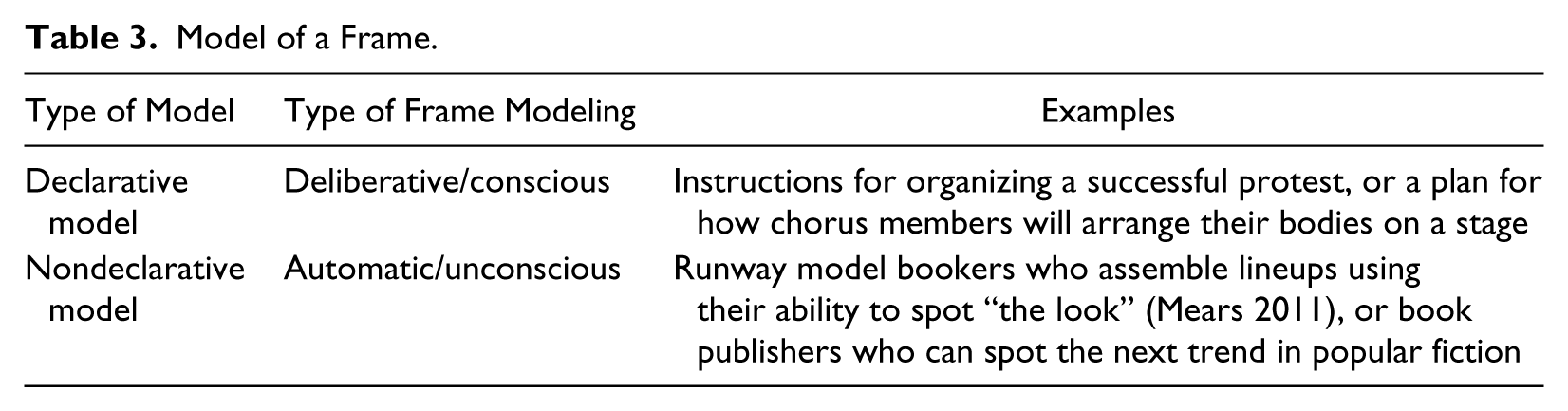
A model of a frame is not the frame itself, but the knowledge or ability to compose and/or describe the frame. Models of frames may vary in specificity, and may be created either deliberately or automatically as a result of repeated exposure to a frame (e.g., knowing what to do habitually). Models of frames constructed in an deliberative fashion may be the result of group negotiation. For example, when protest organizers explicitly discuss how they should present themselves and their message to the public (e.g., Benford 1993), they are deliberately constructing a model of a frame. This model may then be used when the movement organizers assemble the publicly available frame during the actual protest. This is to say, in the proposed framework, the subject of Benford’s (1993) empirical research would be frame modeling rather than framing, because his data capture the deliberative process through which actors construct a model of a frame in anticipation of a future framing situation. In approximate terms, frame modeling may be understood as developing a plan or developing a skill, while framing may be understood as the executing of a plan or skill. This distinction is most apparent when there is a temporal gap between planning and executing, but these processes often overlap empirically. 11 Alternatively, models of frames may develop automatically through repeated experience assembling frames. For example, much of the work of fashion model bookers involves putting together just the right assortment of models for a particular job. Skilled bookers position themselves as the “precarious tastemaker[s]” who can instinctively “recognize the look” when they see it (Mears 2011:171), despite having a hard time articulating what constitutes “the look”—that is, the particular constellation of archetypical features sought after among models.
Models of frames can exist in both declarative and nondeclarative forms (see Table 3). However, it is possible for models of frames to exist mainly as declarative instructions (with no corresponding nondeclarative know how) or as purely nondeclarative skill without a corresponding declarative form. As an example of the latter situation, a skilled orator, drawing on a nondeclarative model of speech giving, may assemble a frame that evokes strong emotions, but she may do so without knowing precisely “what” makes her speech effective. Thus, actors may assemble frames (what we refer to as framing) using either automatic or deliberative processing, depending on whether the relied on model is declarative or nondeclarative.
Model of a Frame.
The Evocation Model: How do Frames Work?
In the work of sociologists who treat frames as a form of public culture, it is not clear exactly what frames do and how they accomplish these tasks. In some formulations, frames are carefully crafted sets of beliefs and meanings facilitating collective action by bringing together individuals and organizations who share congruent or complementary beliefs and meanings. In this case, the frame is a passive object attracting similarly minded individuals. The frame is raised up like a banner, and the job of movement organizers is to make sure that the right people see the frame, or to adjust the frame so that more people are attracted to it (Snow et al. 1986).
In other accounts, the frame is considered a public interpretative tool. When individual followers “adopt” such a frame, they come to interpret the world in the same way as other group members. For example, reflecting on his research on the Nichiren Shoshu Buddhist movement, Snow writes, the “testimonies of member after member provide examples of their reinterpretation—that is, realignment—of aspects of their biographies . . . in ways that were in accord with the movement’s informing point of view” (Snow et al. 2014:25).
In both articulations frames may be said to “align” actors, but the meaning of “align” differs between “bringing together people who think the same way” and “providing a model so as to interpret the situation in the same way.” One might contend that the same frame could both attract adherents and alter their perceptions of the world; but one is left puzzling how exactly this works and, in turn, wondering when the analyst is witnessing one process or the other.
If we step back and reflect on these approaches, we see that we are a far cry from the simple understanding that frames influence thought. In fact, these approaches leave little room for frames to do such work. In the first formulation frames merely attract similarly minded individuals, and in the second formulation, frames are passive modes of interpretation as they may or may not be adopted. One benefit of our analytical distinction between schemas and frames is it allows us to propose a more parsimonious and precise conceptualization of what frames do and how they work.
Thus, we suggest the following: Frames are situational assemblages of material objects (including bodies and settings) that evoke certain responses from individuals, in part by activating particular sets of schemas. Framing refers to the process of assembling a frame in situ, which typically entails the deployment of a declarative or nondeclarative model of a frame.
The evocation model is built on three central analytic distinctions. First, we distinguish between frames and schemas and the work that they do. This distinction breaks with approaches that give frames the double role of being publicly negotiated interpretations and internalized models for interpretation. Second, our approach distinguishes between frames and models of frames. This carries two implications: first, as situational assemblages of material objects, frames cannot be internalized; nevertheless, a model of a frame (as declarative or nondeclarative knowledge or skill used in composing a frame) can be. One can memorize explicit instructions or actions for constructing situations in ways that can evoke desired responses in audiences. For example, a stagehand can memorize the instructions for assembling a venue for a small concert in ways to evoke the desired outcomes in audiences. These models may be used to reproduce a frame in different situations. In addition, our approach distinguishes between framing, defined as the assembling of a frame in situ, from frame modeling, defined as the development of a model of a frame, either deliberately or habitually.
Our evocation model of framing is not a radical departure from previous formulations, but rather makes explicit what was implicit or unclear in previous formulations and addresses their inconsistencies. First, our approach assumes that frames cause something in everyone who encounters them, regardless of the actors’ social positions or experiences. Though we recognize that individuals may vary (perhaps widely) in their response to a given frame, it is assumed that frames will always evoke a response. Second, our framework relies on the processes of activation and evocation to describe the work that frames do, rather than internalization, transmission, or imposition. Frames activate sets of interrelated schemas—ranging from transposable image schemas and foundational schemas to more complex and domain-specific schemas—which, once active, evoke a response. Third, our framework explicitly extends the sensory possibilities of frame far beyond most past usage (e.g., from text and speech to a multimodal approach that can capture all senses).
Our evocation model suggests that, when actors actively engage in framing, it is less about getting other people to “adopt” a frame and more about composing a frame. When intentionally composing a frame, the actor or team hopes an encounter with the particular material arrangement will evoke a desired response in an audience (Stoltz and Taylor 2017). For example, the generic political “march” involves people walking as a group toward a place of some symbolic significance. The marching may activate schemas for forward MOMENTUM, MERGING, and SOURCE+PATH+GOAL, which, in turn, may evoke a sense of progress and solidarity among the marchers.
Our evocation model also leaves room for confrontational framing and counterframing. Opposing actors may try to rearrange the same objects in contrasting ways (e.g., pugilists bobbing, weaving, and swinging their bodies for judges or spectators) or use different assemblages entirely (e.g., lawyers offering distinctly assembled presentations of evidence and arguments in front of a jury). We argue that in such cases, oppositional actors are not applying different interpretive packages to what is essentially the same situation, but rather creating entirely new situations.
The evocation model also presents a straightforward way of understanding the contingencies of framing. A careful actor using a particular model of a frame may painstakingly arrange objects into a particular frame in order to evoke a desired audience response, but any number of things may occur which frustrate this goal. For example, one of the authors recalls an amusement park ride which created a frame designed to evoke for the rider the sensation of flying above a California landscape. The frame was assembled with several interacting elements: riders sat in one of three stacked rows of chairs that left their feet dangling. When the ride began, the rows were elevated and moved forward to be almost surrounded by an enormous concave screen. During the ride, the chairs subtly moved and tilted with the projected video, and a hidden device emitted fragrances that matched the landscape below (e.g., orange scent over an orange grove and pine scent over a forest). The first time the author went on the ride, he was sitting on the top row. The next time, he was sitting in one of the lower rows, and the effect was less impressive. For riders in the lower rows, the frame included the dangling and kicking feet of the riders above, which hindered the ability to be completely “taken in” by the simulation. In other words, the ride produced two different frames (one with dangling feet and one without), despite perhaps intending to compose only one frame for all riders. In this way, flaws or oversights in a model of a frame may result in unexpected frames when enacted during the framing process. In addition, because frames are composed through material objects, frames may change in unintended ways when a situation’s materials change or fail (McDonnell 2016). As most amusement park goers can attest, rides commonly break down. 12
Suggestions for Future Research
To close, we briefly discuss productive avenues for empirical research that correspond to the four aspects of frame analysis as defined in our evocation model: frames, models of frames, framing, and frame modeling (see Table 4). This is not an exhaustive list, but a portrait of the potential stemming from our set of analytic distinctions and the evocation model.
Potential Research Questions.
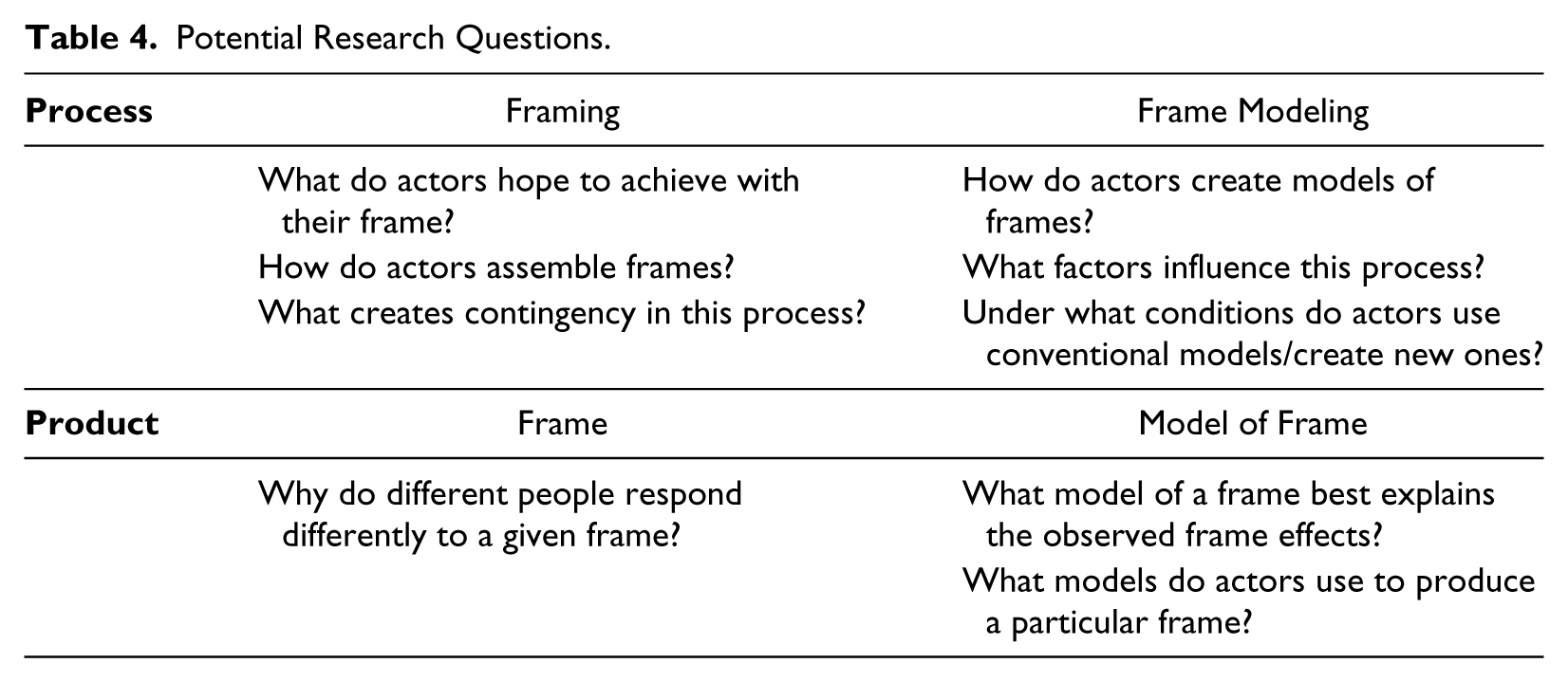
Analysts studying framing might first focus on the motivation for framing. What do actors intend to achieve through assembling the material of a situation? Then, analysts might compare framing motivations with how actors actually assemble frames. We note that this process is not necessarily limited to social dynamics through interaction. Much of the work of assembling the frame may be done by nonhuman material objects, as in the case of automated theme park rides that more or less reliably produce the same assemblage of objects hour after hour, day after day. Finally, analysts might study the contingency of framing, including discrepancies between carefully constructed models of frames and actually assembled frames in situ.
Researchers studying frame modeling might investigate how actors (including analysts) create models of frames. This area of research might benefit from analyzing variation in the cognitive pathways used in learning or thinking (e.g., following the dual-process framework [Lizardo et al. 2016]) and the social organization that supports these processes (e.g., Van Ness and Summers-Effler 2016). In addition, one could investigate the factors that affect the process of frame modeling, such as actors’ future projections about anticipated framing situations. Finally, researchers might investigate why actors rely on conventional models to compose frames in some scenarios, while creating entirely new models in others.
As it relates to models of frames, a researcher might identify the lay models of frames that actors use when assembling particular frames. For example, one could ask, what models of frames do real estate agents use when staging a house (Vercel 2018)? On what elements do they focus? Alternatively, a researcher might construct a formal model of an actual frame itself. That is, recognizing that a particular frame evoked a particular response, the researcher might ask, what was it about this frame that caused this outcome? Which elements or relations of elements were significant?
Finally, regarding frame, a researcher might study contingency in frame effects—why it is that different people sometimes respond differently to a given frame. One likely possibility is that in some cases, a frame evokes a particular response because it violates a particular cultural model, such that the frame evokes a response only in those that share a similar model. For example, a cinematographer may prolong a shot far longer than is typical, which would disorient someone who has a “sense” for how long a shot should last but maybe not someone who is new to cinema.
We conclude by emphasizing the cognitive foundations of theory construction itself (Swedberg 2014). In particular, we wish to emphasize that because words are not concepts but rather refer to concepts (Martin 2011), we are not ideologically tied to the textual labels we choose to denote our underlying concepts. We do, however, stress that if one wishes to use “frame” as a situational material configuration (and therefore public), the analyst cannot do without some consideration of the organization of (personal) culture that actors bring with them to the situation (e.g., schemas), as well as the interactional processes—in terms of framing and frame modeling—involved in both production and reception of the frame.
Footnotes
Acknowledgements
This article benefited immeasurably from conversations with Feyza Akova, Omar Lizardo, and Terry McDonnell, to whom we are grateful. Similarly, we sincerely appreciate the detailed and thoughtful comments we received from three anonymous reviewers. We also want to thank the larger community of scholars working at the intersection of culture and cognition for enriching our work both as individuals and as a team.