



Abstract
In this article, we propose the concept of “Autonomic Cycle Of Learning Analysis Tasks” (ACOLAT), which defines a set of tasks of learning analysis, whose objective is to improve the learning process. The data analysis has become a fundamental area for the knowledge discovery from data extracted from different sources. In the autonomic cycle, each learning analysis task interacts with each other and has different roles: Some of them must observe the learning process, others must analyze and interpret what happens in it, and finally, others make decisions in order to improve the learning process. In this article, we study the application of the autonomic cycle in a smart classroom, which is composed of a set of intelligent components of hardware (e.g., smart board) and software (e.g., virtual learning environments), which must exploit the knowledge generated by the ACOLAT to improve the learning process in the smart classroom. Moreover, we present the set of ACOLATs present in a smart classroom and the implementation of some of them.
Keywords
Introduction
Currently, the data analysis is a very important discipline of the artificial intelligence, due to their ability to mine data, in order to generate information and knowledge. The roots of data analysis are in several fields, particularly of disciplines as business intelligence, big data, semantic mining, linked data, data mining, among others (Aguilar, Valdiviezo, Cordero, Riofrio, & Encalada, 2016; García-Saiz & Zorrilla, 2010; Greller & Drachsler, 2012; Pardo, 2014). Specifically, learning analytics (LA) has the attention of several communities that work at the intersection of learning and information technology. In 2010, Siemens has been defined LA as “the use of intelligent data, learner-produced data, and analysis models to discover information and social connections, and to predict and advice on learning (p.1).” LA has emerged fundamental for the optimization and adaptation of learning environments; in order to adequate the strategies, resources, and tools for teaching to the learning styles and abilities of the students (Siemens, 2012).
On the other hand, the research domain in ambient intelligence (AmI) is motivated by the new advances in ubiquitous, autonomic, and pervasive computing, in order to allow the interaction of the different components of software and hardware in the environment, to reach global objectives. Specifically, (Aguilar, Valdiviezo, Cordero, & Sánchez, 2015) defines an AmI for education as any space where ubiquitous technology helps the learning process in an unobtrusive manner. Smart classroom for education is the challenge of AmI in this area. Smart classroom redefines a classroom with the integration of sensor technology, communication technology, artificial intelligence, and so on, into classrooms. The idea is to exploit the smart environments to improve a learning process, considering aspects of the educational domain (e.g., learning styles), and the advances in the information technologies (e.g., augmented reality and ubiquitous computing).
In general, the data analysis requires a set of phases, to prepare the data, extract the knowledge, among other things. In addition, the utilization of data analysis has been understood as a process of isolated designing (a task for a specific problem). In the domain of data analytical has been developed a set of technologies, algorithms, models, techniques, methods, and best practices, in order to extract specific knowledge of the processes. There is a lot of literature on data analysis (Krumm, Waddington, Teasley, & Lonn, 2014; Muñoz-Merino, Ruipérez-Valiente, Alario-Hoyos, Pérez-Sanagustín, & Kloos, 2015; Papamitsiou & Economides, 2014; Pardo, 2014; Gómez-Aguilar, Hernández-García, García-Peñalvo, Therón, 2015), but the current works do not consider the integration of a set of data analysis tasks, in order to solve complex problems. Neither there are methodologies to guide the inclusion of data analytic tasks in the activities of an organization.
Particularly, the integration of LA tasks in the context of smart classroom is very useful, due to the large quantity of information about the learning processes generated in them. The LA tasks allow discovering knowledge to improve the learning process. But their integration must guarantee the autonomy of the smart classroom in order to allow its self-adaptation. To do this, it is required sets of tasks of learning analysis to reach the goals in the smart classroom, where each task has a different role: observes the learning process, analyzes it, and makes decisions to improve it. In this way, there is an interaction and synergy between the tasks of learning analysis, in order to generate the knowledge required, with the goal of improving the learning process.
In this way, we propose the concept of “Autonomic Cycle Of Learning Analysis Tasks” (ACOLAT), to organize the different types of tasks of learning analysis to be applied to these environments, in order to improve their learning processes. In our proposition, the autonomous cycle defines a closed loop of tasks of data analysis, which supervises constantly the learning process under study. With our concept of ACOLAT, we aspire to solve the complex problems present in a smart classroom that require the integration of multiple LA tasks, with different roles. In addition, ACOLAT has implicit a methodology for the specification of autonomic cycles in the context of smart classrooms.
The remaining of this article is organized as follows: In the Theoretical aspects section, the main concepts around this work: Smart classroom and learning analytic are presented. LA in SaCI section presents our concept of ACOLAT and the utilization of autonomic cycles in the context of smart classrooms. Finally, Specification of the ACOLATs of SaCI and Implementation of one of the ACOLATs sections presented some examples of applications, and concluding remarks, respectively.
Theoretical Aspects
Smart Classroom (SaCI)
A smart classroom for the education can be defined as the exploitation of a smart environment in a learning process, considering the specific aspects of the educational domain (e.g., self-formation and competencies of learning) and the advances in the computational sciences. In previous works, we have defined a smart classroom based on the paradigm of multiagent systems, called SaCI (Salón de Clase Inteligente, for its acronym in Spanish; Aguilar et al., 2015). In (Sánchez, Aguilar, Cordero, & Valdiviezo, 2015a, 2015b; Sánchez et al., 2016), we have developed the middleware based on multiagents system, to allow the self-management of SaCI. This middleware proposes five levels, one for the management of the multiagents community, another to manage the access to services, applications, and so on, and the last one to characterize the different components (software and hardware) of SaCI.
SaCI is a smart student-centered classroom, which supports the teaching-learning process, through collaborative devices and applications that facilitate the self-training. Particularly, in SaCI is generated a lot of data about the learning processes, which can be exploited by its agents to improve the learning process. Thus, SaCI must use LA tasks to extract the knowledge hidden in the data, in order to produce useful information about the students, the learning resources, among other things, which can be used by the agents of SaCI.
SaCI has different types of components, and each one uses and generates different types of data. For example, among the main hardware devices are as follows: smart boards, cameras, sensors, and so on; these devices provide data about the interaction of the students with the learning resources. Also, among the main software components are as follows: virtual learning environment (VLE), academic system, recommender system of open educational resources, and so on, these components provide data about the learning process. Specifically, the VLE and the academic system are the main data sources of an educational institution, but as we said before, there are other sources of data in SaCI. SaCI stores a lot of academic information, interaction data, personal data, among others, which must be used by the LA tasks to extract knowledge, in order to be used by the agents of SaCI, to adequate their behavior to the requirements of the current learning process.
In previous works, we have proposed the utilization of the “Learning Analytics” paradigm in a smart classroom, in order to integrate artificial intelligence technology in the educational process (Aguilar et al., 2016, 2017). For example, in (Valdiviezo-Díaz, Cordero, Reátegui, & Aguilar, 2015) has been proposed to use the business intelligence paradigm to analyze the online tutoring process, based on the data collected on the interactions of students and teachers in a VLE, and the results recorded in the institutional academic system of evaluations. On the other hand, in (Aguilar et al., 2017; Sánchez et al., 2015a, 2015b; Sánchez et al., 2016) is presented an extension of the middleware for SaCI, based on the paradigm of cloud computing, which provides services of LA in the cloud. Also, a general framework about how the LA paradigm can be used in a smart classroom was introduced in (Aguilar et al., 2016). Finally, in (Riofrío, Encalada, & Aguilar, 2017), they use LA tasks to identify factors that influence the decision of a student to abandon their studies.
Learning Analytics
LA is defined as the use of data of an educational organization (such as data of the students, data of the learning process, etc.) to build models, in order to improve the learning process. Generally, LA deals with the development of methods that harness educational data sets in order to support the learning process. LA can extract knowledge from the smart classroom platform, to better understand students and his or her learning processes. For example, a VLE allows the generation of large amounts of data related to learning-teaching processes, which offers the possibility of extracting valuable information that may be employed to improve students’ performance.
There are several works in LA. For example, Brooks, Greer, and Gutwin (2014), Greller and Drachsler (2012), and Pardo (2014) show how the knowledge generated can be used to solve educational problems and contribute to educational decision-making. There are different interests to use LA (Cruz-Benito, Therón, García-Peñalvo, & Lucas, 2015; Greller & Drachsler, 2012):
For educational organizations, to improve current courses or develop new curriculum offerings. For administrators of educational institutions, to take decisions about matters such as marketing, recruitment, performance problems, and so on. For students, to improve their learning processes, patterns of learning, tailored materials, learning pathways, and so on. For the professors, to identify risk students of drop out or course failure, to predict the students requiring extra support and attention, and so on.
A subarea in LA is social learning analytics (SLA) which is focused on how students build knowledge together in their cultural and social context (De Laat & Prinsen, 2014; Ferguson & Shum, 2012; Shum & Ferguson, 2012), often without the support of a teacher, but through the negotiation among the various actors participating in the learning context. According to (Ferguson & Shum, 2012), SLA is on processes in which students are not solitary and participate in social activities interacting with others.
The previous works give an idea of the variety of research in LA. They show how the knowledge generated can be used to solve educational problems, support educational decision-making, but at the same time, they pose new research questions. One of them is the goal of this work, how can be organized the LA tasks in SaCI in an autonomous way, in order to improve the learning process?
LA in SaCI
Currently, in SaCI are generated a lot of data and information from its internal processes (VLEs, academic systems, recommendation systems, among others). So, the necessity of tasks for the analysis of them has grown vertiginously, in such a way that we need mechanisms to organize them automatically, with the least possible human intervention. If this data are not monitored, they can grow so much that they are no longer useful for the teaching-learning process.
Specification of ACOLAT
In general, an “Autonomic Cycle of Data Analysis” defines a set of tasks of data analysis, whose common goal is to achieve an improvement in the process under study. They interact with each other and have different roles: observe the process, analyze and interpret what happens in it, or make decisions in order to improve the process. The integration of data analytics tasks allows solving complex problems that have far been impossible to study by the amount of knowledge required for resolution. In this way, it is very important to integrate these analytical tasks, in order to use the data of the environment coherently to generate useful and strategic knowledge. In that sense, we propose the concept of the autonomous cycle of tasks of data analysis, in order to define the methodologies, tools, and strategies that allow the integration of tasks of data analytic in complex processes of decision-making.
Particularly, in this article, we propose ACOLAT, an autonomic cycle of LA tasks, in order to integrate a set of tasks of LA in complex processes of decision-making. These tasks have sense together and need to work together to reach the improvement goal. The autonomous cycle defines a closed loop of LA tasks, which supervises the learning process permanently. It is a supervision cycle of processes based on LA tasks, in order to permanently improve them. Specifically, the roles of each LA task in the autonomous cycle are as follows:
Observe the system: This set of tasks must monitor the learning process and must capture the data and information about the behavior of the educational environment. That means, they generate a picture about the current learning process. In general, some of these data can be predicted, can be estimated using other information, and requires processes of extraction and preparation, among other things. These are the type of activities, which are solved with the LA tasks that compose this group. Analyze the system: This set of tasks has the goal to interpret, to understand, to diagnose, among other things, the current situation in the learning process. That means, with these tasks are built knowledge models about the dynamics of the learning process, using the data previously prepared in the previous phase. Make decisions to improve the learning process: These tasks impact the dynamic of the learning process because they make decisions in order to improve it.
The autonomous cycle of LA tasks exploits the data from the sources of the educational environment, and data outside of them. Also, the autonomic cycle can execute data mining tasks, semantic mining tasks, among other techniques, and can use different types of knowledge representations: ontologies, cognitive maps, and so on. In addition, it requires a phase of data processing, in order to prepare the data to be used by the LA tasks.
The classical design strategy of data analysis tasks is redefined in this context, such that the middleware of the educational environment integrates into the autonomous cycle the different techniques require by the LA tasks and by the data preprocessing phase, such as graph mining, data mining, semantic mining, linked data, machine learning, among others. ACOLAT also requires a data model that characterizes the data required by the LA tasks. Normally, it is composed by the classical data warehouse generated from the transaction databases of the academic institution. However, this model must be extended with semantic information (knowledge) from external sources, as the semantic web. In addition, the information in the data model must follow the standards to describe the different aspects of the learning process (e.g., for the case of learning resources to use the learning object metadata). The data model requires specific tasks to prepare the data, which are different according to the source of information. In this way, we need to define different mechanisms to prepare the data, according to the techniques used by the LA tasks and the source of information. For example, if the LA tasks are based on data mining mechanisms and the data are internal to the organization, are necessary three steps, the extraction, transformation, and load operations; otherwise, if the LA tasks are based on big data and semantic mining, and it is an external source of information, the main tasks are collection and curation of data. Finally, in the data model, there are other services linked to tools and applications of machine learning, data visualization, linked data, and so on (Aguilar et al., 2016). Thus, ACOLAT requires the next parts:
A data model that represents the data collected from the different sources of the educational environment of from the exterior, which will be used by the different LA tasks. A unique platform that integrates the different technological tools required for the conception of the LA tasks: data mining, semantic mining, linked data, among others.
Previous works consider some of these aspects, without their integration, or for very specific problems without a complex context. None of them proposes autonomous processes of data analysis, which can permanently supervise processes, integrating mechanisms of semantic mining, linked data, tasks of social data analytics, among other things.
ACOLAT represents the definition of an autonomous cycle of LA tasks for educational environments, which can exploit the interface among cloud computing and educational environments to support LA tasks as services. ACOLAT is a closed cycle of LA tasks, which generate metrics used like feedback to optimize the pedagogical model in the educational environment.
ACOLAT in SaCI
SaCI is a smart student-centered classroom, which supports the learning process, through of devices and applications, working together to form an ambient intelligent in the context of learning processes. SaCI generates a lot of information (see section Smart Classroom (SaCI)), this information has to be exploited to improve the performances of SaCI. ACOLAT must be used in this context, to exploit this large quantity of information generated in SaCI. ACOLAT must generate reliable knowledge models for SaCI, using the large volume of both, internal and external data.
Particularly, the information of SaCI must be exploited by ACOLAT, in order to reach its main challenge: to cover the actual needs of the learners. Due to different learning patterns of students, it is vital for SaCI, to understand each student. For that, SaCI can obtain a proper understanding of a student based on the information that he or she has generated through its platform. That can be made by ACOLAT, in order to provide the necessary guidance to improve the capabilities of SaCI. In this way, to improve the learning skills of the students, SaCI should be capable of monitoring the overall performance of each student, separately, and dynamically adjust their teaching paradigm and to take decisions about the learning resources to use, among other things, in order to improve the learning of students.
Muñoz-Merino et al. (2015) presented a generic framework for LA, that act as useful guides for setting up LA, or frameworks of quality indicators for LA that aim to standardize the evaluation of LA tools (Krumm et al., 2014), but they do not propose autonomic cycles of LA tasks in the context of a SaCI, in order to provide knowledge about the activities taking place within it for improving the students’ performance on educational practices. ACOLAT extracts knowledge from the SaCI platform to better understand students and the way they learn, and this knowledge allows response to questions like: How can SaCI adapt its components to improve students’ performance? How can SaCI exploit the information in its different components?
Particularly, ACOLAT is a framework that defines a cycle of LA tasks to be implemented, in order to generate useful information for the learning process provided by SaCI. This framework combines different LA tasks with a global goal, improve the learning experiences inside SaCI, where each task provides an essential knowledge that can be used individually or globally. ACOLAT generates knowledge about learners and their learning contexts, for the purpose of understanding and optimizing the learning process and the teaching environments proposed by SaCI. ACOLAT must leverage data from SaCI to provide insight into the activities taking place within it. The metrics derived are used as feedback to optimize the pedagogical model proposed by SaCI.
In this way, SaCI can overcome the problem of management of the different learning capabilities of the students, by applying ACOLAT to define the teaching principles or the teaching methodologies on the students in SaCI in different manners. For that, ACOLAT gathers the information from SaCI, in order to provide the necessary guidance to improve their capabilities. Some of the tasks of ACOLAT in SaCI are as follows:
The collection and preparation of the data required by the LA tasks. The definition of the data model to store this data and the knowledge generated by it. The connection with the agents of SaCI, in order to provide them this knowledge, which be used to define their actions derived from this knowledge. Particularly, the metrics (knowledge) derived provide the necessary feedback to define the pedagogical model to apply in the classroom.
In the first case, the components of SaCI must be analyzed, in order to determine the source of data. For that, ACOLAT must observe (Aguilar et al., 2016):
The learning process: In this case, LA must generate indicators to understand the current learning process (paradigm, methods, tools, etc.). The student behavior: In this case, the LA tasks must generate indicators about the performance of each student.
Moreover, to define the connection with SaCI, must be defined how to exploit the metrics generated by ACOLAT to improve the learning process. With the data provided by SaCI, ACOLAT can produce a large amount of knowledge that can be distributed to the agents SaCI. Sharing and manipulation this knowledge in real time is an enormous achievement of SaCI, in order to improve its behavior.
Particularly, ACOLAT in SACI allows:
An accurate definition of the students’ problems and needs. A successful identification of the interventions and improvement strategies. An effective determination of target goals to reach, with the specific reforms. An accurate observation about the ongoing efforts and progress of the students.
In this way, SaCI exploits the knowledge hidden extracted by ACOLAT. In specific, the main ACOLATs to consider in SaCI, in order to reach its main goal of optimizing the learning process, are as follows:
ACOLAT 1: Definition of the current learning paradigm. In this case, the goal is to define a suitable learning paradigm for a class in a given course based on the data of the students. ACOLAT 2: Determination of the educational resource for a given student. The goal, in this case, is to identify the ideal educational resource that can be provided to a student in a determinate time. ACOLAT 3: Identification of students with special needs. The goal is to determine students who need more attention and needs. ACOLAT 4: Avoid student desertion. In this case, the goal is to provide a learning process that motives the student, in order to increase their interest to continue their studies.
These autonomous cycles allow to SaCI reaches its main goal: improve the learning process. The first one because the ideal learning paradigm of a given course is defined in this cycle, according to the students and the characteristics of the course, which is carried out in real time. The second one because SaCI can determine the ideal educational resource to be used during the learning process, which also depend on the students (e.g., their style of learning) and the course. The third one is important to personalize the learning process to each student, particularly for the students that need special help. The last one is very important, to avoid the desertion of the students, and for that, SaCI must define activities, strategies, among other things, which motivate these students.
Specification of the ACOLATs of SaCI
In this section, we are going to present the set of ACOLATs defined for SaCI. Each ACOLAT is defined by a set of LA tasks that observe the learning process, another set of LA tasks that analyze this learning process, and finally, a set of LA tasks that make decisions. Each ACOLAT has its own data model and its specific LA tasks.
ACOLAT 1: Definition of the Suitable Learning Paradigm for a Course (Students and Specific Topics)
The goal of this ACOLAT is to define the learning paradigm to be used in a given class during a course, based on the data about the students. For that, the first autonomic cycle is composed of a set of five tasks, which allow getting information about the students:
Determinate how students work on the social networks. Determinate how students browse the web. Determinate the student’s performance. Cluster the students by performance, current learning style, and habits. Determinate the new learning style suitable for the course or group.
The first three are observation tasks, which allow the monitoring of the behavior of the students in different contexts; the fourth is one analysis task in order to interpret the previous information to determine the styles, habits, and so on, of the different students; and finally, the last one is a decision-taking task that defines the style for the course or group. The structure of this first ACOLAT is shown in Figure 1.
Structure of the ACOLAT 1.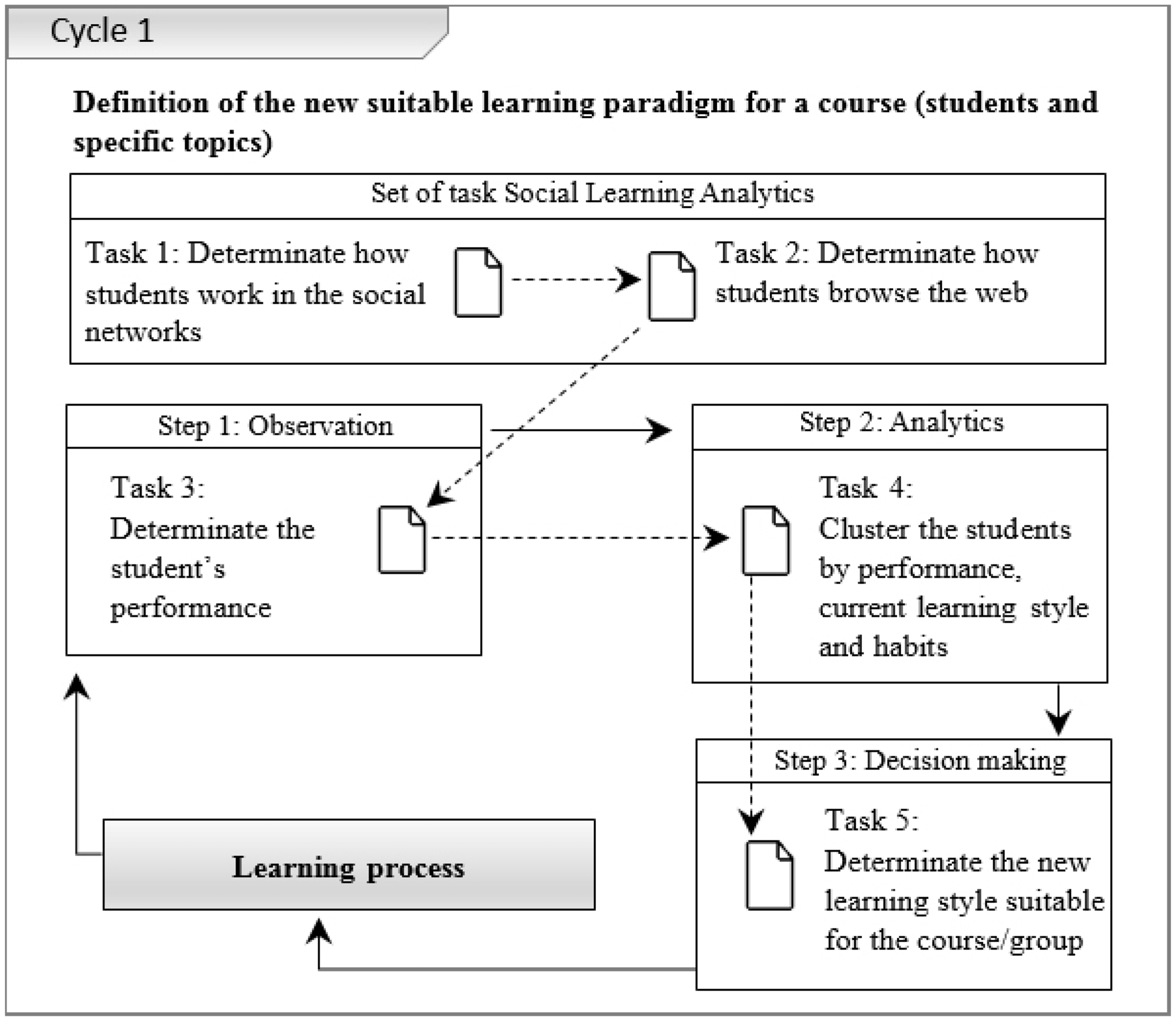
Description of the TASKS of the Cycle 1.

Step 1: Observation
Task 1: Determinate how students work in the social networks: The specific goal is to determinate the student’s behavior in their social networks, It is a SLA task (De Laat & Prinsen, 2014; Ferguson & Shum, 2012; Shum & Ferguson, 2012). Using social analytics network techniques, we determine different things, for example, the influences between the students. This task feeds the next task with data.
Task 2: Determinate how students browse the web. The idea behind this task is to discover the student’s behavior on the web, through the websites that the students visit, the interaction in each website, among other things. It is a SLA task. In this case, we need to use web mining techniques, like mining of content, mining of use, among others.
Task 3: Determinate the student’s performance. In this case, we use the academic system to identify the score of the students in the context of the class that we are interested, and then, we relate the student’s performance with the learning style used in the class.
Step 2: Analysis
Task 4: Cluster the students by performance, current learning style, and habits. In this case, we carry out a clustering of the students according to their current learning style, scores, and habits, in order to determine the main styles and habits to consider.
Step 3: Decision-making
Task 5: Determinate the new learning style suitable for the course or group. According to the previous results, the best style is selected. It is chosen based on the style that got the best performance for the class. This LA task uses a set of rules for that, but can use an approach where the centroids are approximated.
The data model of this ACOLAT is defined in Figure 2. In this Figure, we can see the fact table and dimensions, in order to have the data required for each LA task of the cycle. The data model considers the variables about the students, the web page, among others, and the results of the LA tasks, such as the preferences of the students on the web, the web browsers actions, and so on.
A partial view of the data model of the ACOLAT 1.
This data model includes the organizational data and the semantic information extracted from different semantic sources (social networks, webpages, etc.). These different types of information are included in the different dimensions of the data model, according to their characteristics. For example, in the user dimension, we have the personal information about the students, its academic record, among other things. In the browser dimension, we have the information about the behavior of the students in the web, and so on, for the rest of the dimensions. In this way, we can store the semantic and organizational information together for analysis tasks.
The SLA tasks use semantic mining techniques for extracting semantic knowledge from different semantic sources (web pages and ontologies), and the LA tasks use data mining tasks for extracting knowledge since the organizational databases, which are integrated by our ACOLATs for the semantic enrichment of SaCI.
ACOLAT 2: Determination of the Educational Resource for a Given Student
The goal of this ACOLAT is to define the adequate educational resource that can be provided to a student in a determinate time. Again, we need to define several LA tasks to reach this goal. The second autonomic cycle consists of a set of three tasks:
Classify the students by their scores and participations. Determine the relationship between the classification of the students and the educational resources used. Determine the best educational resource for a given student, according to the previous results and its learning style.
The first is an observation task, which determine the performance of the students according to several criteria; the second is one analysis task that defines the best educational resources according to the performance of the students; and finally, the last one is a decision-taking task that defines the adequate educational resources for a given student. The structure of this ACOLAT is shown in Figure 3.
Structure of the ACOLAT 2.
Description of the Tasks of the Cycle 2.

VLE = virtual learning environment.
Step 1: Observation
Task 1: Classify the students by their scores and participations. In this task, the goal is to establish a ranking of the students according to their performance. For that, it is necessary to observe and monitor the behavior of the students in SaCI, in order to determine their participation, among other things. In addition, the task groups the students by their participation using different aspects, such as their scores and participation.
Step 2: Analysis
Task 2: Determine the relationship between the classification of the students and the educational resources used. In this task, the goal is to establish the relationship between good performances and the education resource used. It is a task of analysis to match the education resources with the performance of the students, in order to determine the education resource used by the best students.
Step 3: Decision-making
Task 3: Determine the best educational resource for a given student, according to the previous results and its learning style. This task makes the decision of which of all the educational resources that had been used is the best one for a given student. This decision is made by evaluating different aspects: the student characteristics, the educational resource used by the students with the best scores, among other things.
In this case, the same data model of the first cycle can be used to obtain the goal of this cycle. For that, we need to add in the fact table the metrics generated by this new cycle, for example, the classification of the students, the best educational resources, among others.
ACOLAT 3: Identification of Students With Special Needs
The goal of this ACOLAT is to define the students that require particular attention during the learning process. Again, we define several LA tasks to reach this goal (see Figure 4). This autonomic cycle consists of the next tasks.
Classify the students by performance. Determine the tasks or activities where the students were successful or not successful. Determine where the students failed. Search new educational resources to help students in the tasks or activities where failed. Put together these educational resources, according to a logic sequence. Structure of the ACOLAT 3.

The first task is similar to the previous ACOLAT; the second and third tasks analyze the problems where the students failed, and the last tasks prepare new educational resources for the students, in order to help them to improve their performance.
Description of the Tasks of the Cycle 3.

VLE = virtual learning environment.
Step 1: Observation
Task 1: Classify the students by performance. The goal of this task is classified the student, see the description of this task in the previous ACOLAT.
Step 2: Analysis
Task 2: Determine the tasks or activities where the students were successful or not successful. The goal of this task is to find the task or a group of tasks where the students have or not failed. The general idea is to identify the activities where the students achieve better results, and to identify activities where they fail.
Task 3: Determine where the students failed. The goal of this task is to find the specify needs of the students, according to where they fail. This task uses the results of the previous task, and determine the requirement, the characteristics of the task or activities where the students failed, to identify their needs.
Task 4: Search new educational resources to help students in the tasks or activities where failed. In this task are used techniques as Linked Data, to find educational resources on the web, which can help the students to cover their needs. It is a SLA task (De Laat & Prinsen, 2014; Ferguson & Shum, 2012; Shum & Ferguson, 2012). This task can use an ontological model as SWEBOK, to define the topics to search using linked data.
Step 3: Decision-making
Task 5: Put together these educational resources, according to a logic sequence. In this task, the idea is put together the group of resources that the student needs to achieve the objectives of the course.
ACOLAT 4: Avoid Student Desertion
The goal of this ACOLAT is to prevent the desertion of the students. For that, this autonomic cycle is composed of the next set of tasks, to avoid the desertion of the students:
Classify the students by deserter or not. Predict the potential deserter. Create patterns of desertion. Avoid the desertion of the students.
The first is an observation task, which identifies potential students who may desert. With this information, the second task builds a predict model of the students that can desert. The next task builds patterns of the potential students to desert; and finally, the last one defines the strategies to apply to avoid the desertion. The structure of this ACOLAT is shown in Figure 5.
Structure of the ACOLAT 4.
Description of the Tasks of the Cycle 4.

Step 1: Observation
Task 1: Classify the students by deserter or not. The goal of this task is to classify the student, according to if the student is a deserter or not. The description of this task is similar to the first task of the previous ACOLAT.
Step 2: Analysis
Task 2: Predict the potential deserter. The goal of this task is to determine the students that potentially can deserter. For that, the task builds a predictive model using the information of the deserter students identified in the previous task.
Task 3: Create patterns of desertion. The goal of this task is to find the patterns of the potential deserters. In this way, it defines the profiles of each group of deserters. This task uses the results of the previous task, to determine the patterns.
Step 3: Decision-making
Task 4: Avoid the desertion of the students. In this task are selected the best techniques and activities of teaching, that could prevent the desertion of a student, according to its pattern of desertion.
In this case, how the previous ACOLAT, the data model of the first ACOLAT can be extended, with the metrics generated by this new cycle. It requires the same dimensions.
Implementation of One of the ACOLATs
In this section, we give an example of implementation of one of the ACOLATs of SaCI. Some ACOLATs have been implemented in previous works, for example, the ACOLAT 4 we implemented in (Riofrío et al., 2017), and the ACOLAT 2 in (Aguilar et al., 2017). We are going to implement the ACOLAT 1 because it is one of the more interesting ACOLAT, due to defines the learning style to follow in SaCI.
Implementation of the ACOLAT 1 (Definition of the Suitable Learning Paradigm for a Course (Students and Specific Topics)
In this section, we give an example of implementation of the ACOLAT 1. The data used for this ACOLAT have been taken from the SaCI moodle database, which has about 500 students. The data were prepared with the necessary operations to ensure a correct sample. Now, we explain the implementation of each task of this ACOLAT.
Determinate How Students Work on the Social Networks
To give an example of this task of analysis of data, we will assume that we use Twitter as the source of information from social networks (but it is similar for other sources, like Facebook, YouTube, etc.). The macroalgorithm of this task is as follows:
Capture Tweets. Filter the captured tweets. Generate patterns based on the captured data.
The first step captures the tweets. This step requires a program that invokes the Tweepy API. The captured tweets are stored in the JSON-formatted file. The second step reduces the number of tweets by filtering them by keywords that allow us to describe the student behaviors, such as “<student name>,” “preferences,” “<course name.” This allows getting information about what students are doing on the social networks, but also things like their interests, and so on. Finally, patterns are generated based on the captured data, using the IBM SPSS Text Analytics tool, which can extract key concepts from unstructured data and group into categories. This tool analyzes all data from the tweets and finds the frequently appeared words, which are defined as concepts. These words are collected and grouped, in order to build the pattern of behavior of the students on the Twitter platform.
Determinate the Student’s Performance
Several queries are made to the academic system of SaCl, in order to obtain the necessary data for the analysis. For example, one of them consists of obtaining the courses of the students, their description, and the scores associated. An example of one of the query is as follows:
Cluster the Students by Performance, Current Learning Style, and Habits
We use a tool for the clustering of the students according to their performances. For this article, we used Weka, specifically its clustering algorithms. In this case, the attribute used for the clustering process is “AVERAGE_SCORE,” because it defines the general performance of the students. This LA task creates several groups since the set of the student registers. This LA task provides the source of information for the next LA tasks of our autonomic cycle because it defines the centroid of each group that will be analyzed for the next tasks. This centroid describes the main learning characteristics of the students that belong to it. This algorithm must be executed each time an educational period has finished, in order to update the groups. In this way, the knowledge model of the next tasks always will be updated.
Determinate the New Learning Style Suitable for the Course or Group
For the data analysis of the previous task, the model of learning styles of Felder-Silverman was used. Using this model and the information contained in the centroids of the groups, we determined the learning styles of each group. Figure 6 represents the learning style of the groups of students, where it is observed that there is a group of 41% students with a sensitive learning style, other with 36% students with a reflexive learning style, and the last group has 23% students with a global learning style.
Learning styles of the students.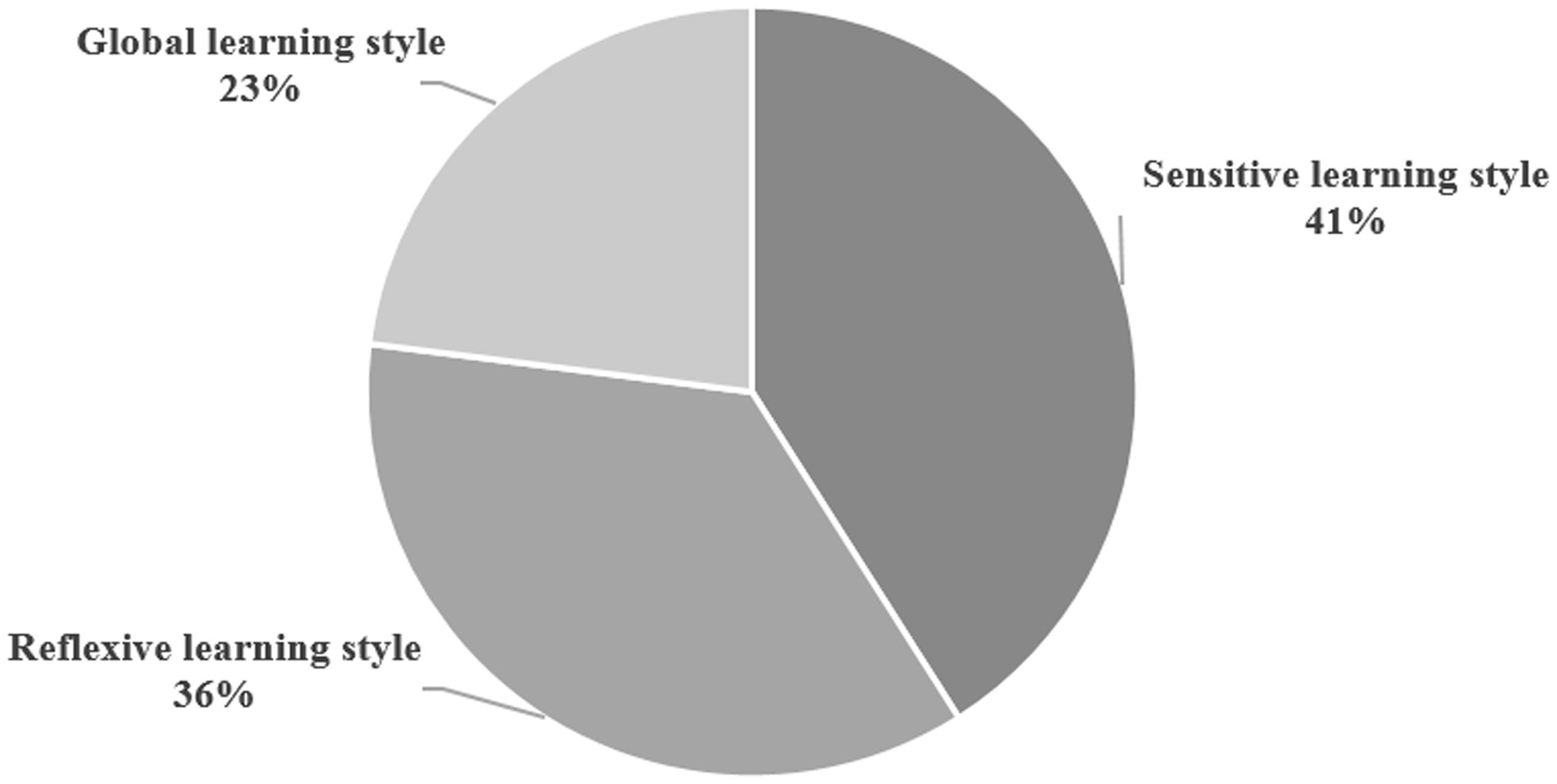
We can suppose that these learning styles are the suitable because they are based on the centroid of the groups of students. The students have been grouped according to their performance, and with their information about their interests and habits (extracted since the social networks) we can rebuild the learning styles of each group. With the centroid, we can build the pattern of interests, habits, among other things of each group, and then, with this information to build the new learning style. Normally, SaCI must use the learning styles of the groups with the best score as the suitable learning styles.
With the information of the models of learning styles of the students, it can be defined different things. For example, at the level of a course: the learning strategies to be considered, the learning groups to build the learning collaborative communities, among others. At the level of a student: who has the same characterizes or skills of learning for sharing experiences, what are the adequate strategies for him or her, among others.
Result Analysis
The results of the implementations of the first three ACOLATs indicate that they generate much useful knowledge for the SaCI agents. Some examples of SaCI agents that can use this knowledge are as follows: The recommender agent can use the learning resources determine with the LA task to guide the search of learning resources (Aguilar et al., 2017). Also, the VLE agent must use the style of learning determined by ACOLAT 1 to plan the appropriate activities of the learning process of SaCI. In general, the ACOLATs generate knowledge that is consumed by the SaCI agents to perform their tasks. This knowledge is generated as a service, such that they can use the general knowledge generated by each ACOLAT or the partial knowledge generated by the LA tasks, according to their needs.
The main point here, it is that our approach requires the definition of valid objectives for SaCI, which must be broken down and assigned to specific autonomous cycles. In general, ACOLAT allows the integration of LA tasks in SaCI to reach its main goals, based on the idea of “knowledge as a service” for the SaCI agents. This article proposes the methodology to specify the “autonomous cycle of LA tasks” for SaCI, which includes the specification of LA tasks, and the modeled of the data to be used in the cycle. The ACOLATs allow discovering knowledge to improve the learning process, guaranteeing the autonomy of SaCI in order to allow its self-adaptation. Each LA task has a different role in SaCI: observes the learning process, analyzes it, and makes decisions to improve it. This knowledge is used as services by the SaCI agent, according to their needs. In this way, there is an interaction and synergy between the LA tasks and the SaCI agents, in order to improve the learning process.
A pending task is the evaluation of the behavior of all the autonomic cycles simultaneously in SaCI. We believe it will not be a problem, because they share some data sources, but also, the data model can be easily extended. In this work, four autonomy cycles have been proposed, but maybe due to the SaCI’s own dynamics, the emergence of autonomous cycles, or the disappearance of some of them, may occur according to its needs. This will be one important aspect to study in future work.
Conclusion
The main results of this article are a methodology to specify “autonomous cycles of LA tasks” for SaCI, called ACOLAT, and the characterization of several ACOLATs for SaCI. ACOLAT allows the integration and interoperability of different possible paradigms to implement the LA tasks, in order to specify the LA as a service.
ACOLAT allows the implementation of LA tasks as services for SaCI, but can be extended to other contexts like hospitals, universities, sports centers, among other facilities. For that, it is required the specification of knowledge models, and the specification of data preprocessing tasks as capture, curation, and so on, because it allows mixing LA tasks with SLA tasks. With the incorporation of ACOLAT, new unlimited knowledge sources can be generated and distributed permanently for SaCI. So, the middleware of SaCI will allow handling large amounts of data, incorporating different mining techniques, to improve the efficiency of the processes in SaCI.
Future works must define a platform that integrates the different strategies, techniques, and tools used by the ACOLATs in the context of an environment like SaCI. In this way, for the implementation of the different ACOLATs can be used techniques such as graph mining, data mining, semantic mining, linked data, machine learning, among others. In addition, future works must evaluate the effectiveness of ACOLAT since the point of view of the pedagogic theory. For that, new metrics must be defined, in order to generate indicators about the quality and impact of the learning process in SaCI in the students.
Footnotes
Declaration of Conflicting Interests
The authors declared no potential conflicts of interest with respect to the research, authorship, and/or publication of this article.
Funding
The authors disclosed receipt of the following financial support for the research, authorship, and/or publication of this article: Dr. Aguilar has been partially supported by the Prometeo Project of the Ministry of Higher Education, Science, Technology and Innovation (SENESCYT) of the Republic of Ecuador.