




Abstract
The purpose of this study was to investigate the types of problem-solving behaviors and their effects on solution quality in an online collaborative learning context. A total of 12 preservice teachers enrolled in a computer education course participated in the study. Students in pairs, randomly assigned by the instructor, carried out a problem-solving task and then changed partners for subsequent tasks. The problem-solving processes of 25 pairings of students were analyzed. Data on their problem-solving behaviors, the quality of their solutions, and their domain knowledge were collected. Results revealed that students who demonstrated more solution-oriented behaviors led others to better solutions while collaborating. In contrast, students who had difficulty in understanding problems demonstrated more problem-oriented behaviors. The solution-oriented students also gained better domain knowledge at the end, compared with the problem-oriented ones. The effects of the student’s interactions during the problem-solving process were discussed.
Introduction
Problem solving is one of the essential skills that people should have to be successful in their daily and professional lives (Jonassen, 2000). Problem solving serves as an instructional practice where students can discover appropriate ways to achieve a goal, frequently through collaboration in group settings. Since collaborative learning is considered an effective learning strategy that enhances student interaction and facilitates deep understanding through the elaboration process, many instructors have adopted collaborative problem-solving activities, even in online learning environments (Dunlosky, Rawson, Marsh, Nathan, & Willingham, 2013; Hmelo-Silver, 2004; Schoenfeld, 1992).
To find ways to facilitate effective problem-solving collaborations in online learning environments, it is crucial to understand students’ interaction patterns. An investigation into student interactions would help clarify instruction design solutions that promote students’ positive interactions in collaborative online learning. Although researchers have investigated the effects of an instructor’s interventions and use of collaboration tools that visualize group processes (Dehler, Bodemer, Buder, & Hesse, 2011), the impact of self and peer assessment on collaboration (Phielix, Prins, Kirschner, Erkens, & Jaspers, 2011), and metacognitive guidance (Kwon, Hong, & Laffey, 2013), it is still unclear how students interact with each other, specifically when solving problems collaboratively in online learning environments, and how these affect learning. Therefore, by focusing on the problem-solving process, this study examines problem-solving patterns in peer interactions in collaborative learning, and the effect of these interactions on students’ understanding of computer programming in an online environment.
Literature Review
One of the most valued, but not fully acquired skills that prepares students for a professional work environment, is the ability to solve problems through collaboration (Hesse, Care, Buder, Sassenberg, & Griffin, 2015; Salomon & Globerson, 1989). Although educators have tried to improve students’ collaborative problem-solving skills by providing diverse opportunities, students’ actual collaboration tends to be below expectations (Barron, 2003; Brindley, Blaschke, & Walti, 2009; Kreijns, Kirschner, & Jochems, 2003; Salomon & Globerson, 1989). Frequently, the instructor fails to coordinate group processes, and the students eventually become reluctant to engage in group work (Barron, 2003; Kerr & Bruun, 1983). Understanding students’ collaborative interactions and identifying effective patterns is crucial for the instructor to facilitate the problem-solving activity.
Problem-solving process
Researchers have suggested models or structures of problem-solving processes. For example, Jonassen (2000) suggested taking a broad perspective to a problem-solving process with the following structure: problem variation (e.g., well or ill structured, complexity), representation (e.g., context, cues or clues), and individual differences (e.g., cognitive styles, general problem-solving strategies). In addition, more specific problem-solving processes have been extensively investigated (e.g., Barron, 2003; Jonassen & Kwon, 2001; Raes, Schellens, De Wever, & Vanderhoven, 2012). Hayes (1989) categorized the problem-solving process into six phases: finding the problem, representing the problem, planning the solution, carrying out the plan, evaluating the solution, and consolidating gains. Among those, there are two phases that significantly influence the quality of a solution: problem representation and solution development (Simon, 1978).
Problem representation
The quality of a solution is strongly influenced by the problem representation phase (Simon & Hayes, 1976) which has been referred to as “a cognitive structure corresponding to a problem, constructed by a solver on the basis of his domain-related knowledge and its organization” (Chi, Feltovich, & Glaser, 1981, p. 122). Usually more knowledgeable students represent problems more accurately than their less knowledgeable peers as a result of their ability to categorize a problem based on its structure rather than its surface features (Chi et al., 1981). Educational studies have examined the interactions during problem representation that led to higher group performance during problem-solving tasks (Barron, 2003; Cooke & Szumal, 1994; Jonassen & Kwon, 2001; Suthers, 2006). For example, problem-centered interactional activities have a positive impact on a group’s performance. Kapur and Kinzer (2007) examined the collaborative problem-solving process while focusing on the problem-centered interactional activities of 60 eleventh-grade science students. The results showed that interactions exchanged early on tended to lock in the later discussion and that affected the quality of problem solving (Kapur & Kinzer, 2007). This early interaction might be related to the group’s problem representation process. Krawec (2014) revealed that the quality of problem representation, as measured by paraphrasing a problem statement or visual representation of the problem, significantly predicted the accuracy of its solution.
Solution development
The solution development phase is also crucial to the quality of the solution. Chi, Glaser, and Rees (1982) investigated expertise in problem solving through a robust analysis of empirical evidence. They pointed out that there are considerable differences between novices and experts. For example, the novices will stick to the problem definition or problem representation even as they work on a solution whereas experts will move forward to the next process of problem solving. In the collaborative problem-solving process, these types of interactions might play a significant role. Tausczik, Kittur, and Kraut (2014) investigated collaborative interactions by examining an online mathematical problem-solving community where participants asked and answered mathematics questions. The researchers categorized these interactions into five different types of collaborative acts (i.e., providing information, clarifying the question, critiquing an answer, revising an answer, and extending an answer) and evaluated their impact on the solution quality. The results showed that solution-oriented interactions (e.g., “revising/extending an answer”) had a direct and immediate positive impact on solution quality. On the other hand, “clarifying the question” and “critiquing an answer” had a delayed positive impact on solution quality and little effect on the short-term results.
When students develop solutions, they tend to search their prior knowledge or experience for understandings that can trigger a solution by mapping it onto their current problem (Bransford, Brown, & Cocking, 1999; Lazakidou & Retalis, 2010). However, they can encounter a dead end if they map it onto the wrong problem and do not consider alternatives (Kapa, 2001). Considering that novice problem solvers easily propose solutions without validating whether they satisfy specific goals or are limited by a certain constraint, checking alternatives and evaluating the effectiveness of solutions are necessary processes for successful problem solving (Ge & Land, 2003). Peer interactions that challenge one another to elaborate on their ideas can facilitate the solution evaluation (SEV) process and thereby generate better solutions (Jonassen & Kim, 2010; Webb, 1982; Webb & Mastergeorge, 2003).
Interactions in online collaboration
As reviewed earlier, in the problem representation phase, a problem solver may benefit from the intensive early interactions among group members that focuses on narrowing down the scope of a problem. In addition, during the solution development process, students would be more successful if focusing on validating the solution rather than expanding on or analyzing the problem. Therefore, more task-oriented behavior in each phase would be beneficial during problem solving. The online environment might facilitate more task-oriented interactions than face-to-face interactions, which suggests that online collaboration might be as successful as face-to-face collaboration, even though it is considered challenging for students to collaborate in online environments. For example, Jonassen and Kwon (2001) compared student interactions of a face-to-face situation with an online environment during a collaborative problem-solving process. Eighteen undergraduate students formed groups of three and solved authentic business problems. The results showed that the online collaboration groups used more task-directed and focused communications and reflected more on the problem-solving nature of the task than the face-to-face groups. While group activities in an online collaborative learning environment have significant potential, there has been little research that examines the problem-solving interactions where collaboration takes place and how that impacts the solution. Online collaborative problem solving has not been sufficiently investigated in the instructional design literature. Investigating student interactions in online collaborative problem-solving settings would shed light on our understanding about the breadth of problem-solving activities well enough to support students in the task.
Context and Purpose of This Study
This study specifically considers the research context, which targeted undergraduate students’ synchronous (i.e., online conferencing) collaborative interactions during the programming-related problem-solving task in an online environment. The other contextual consideration is the group setting. To consider the individual differences, it would be necessary to investigate each individual participant’s paired activity with different group members. Considering that point, we assigned each participant to collaborate with every other peer once (i.e., dyad activity) during the semester and analyzed the interactions.
The purpose of the current study is to examine students’ collaborative problem-solving interactions in an online learning environment. The interaction patterns, elaboration process for understanding problems, and validating solutions were analyzed to reveal how these affected the quality of solutions. Specifically, the following research questions are addressed.
What types of interactions are involved during a synchronous online collaborative problem-solving process? Which types of interactions are significantly related to the solution quality? Does an individual make different types of interactions during the pair work? Do the types of interactions affect learning outcomes?
Method
Participants
Twelve undergraduate preservice teachers (eight female and four male), enrolled in a computer educator license course, were recruited with their consent. They all had majored in different subjects and had not learned any programming languages before taking the course. They knew each other because they took computer educator license courses beforehand. The participants received no compensation for their participation.
Design
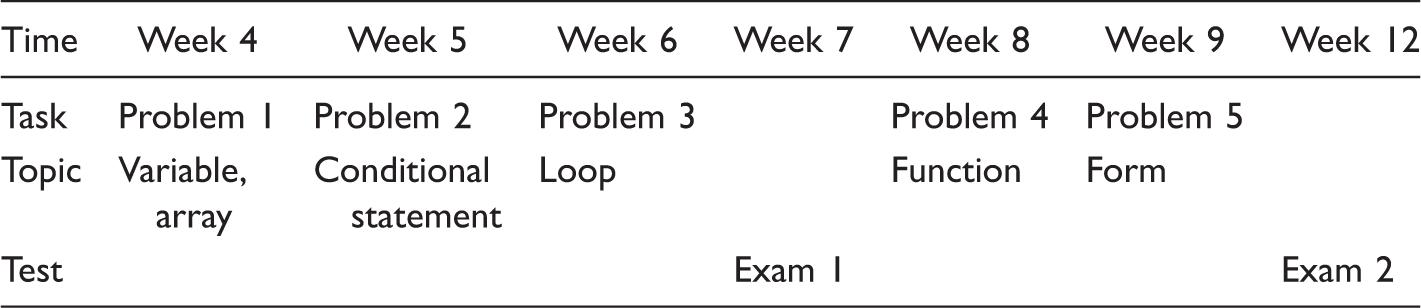
In a face-to-face class session, the participants learned the basic concepts of computer programming such as arrays, conditional statements, loops, and functions (conceptual knowledge). They also practiced writing program syntax after watching a demonstration by the instructor (syntactic knowledge). They were then asked to solve five sets of problems as a course requirement while learning the programming language. The problem-solving tasks included the debugging of erroneous syntax and completing a program by adding syntax to a blank. A total of 30 problem-solving processes (6 Pairs × 5 Tasks) were administrated. However, five cases were not recorded due to technical issues and were excluded from the analysis.
A pair of students, put together by the instructor, carried out the task within a time period of 1 week. Students met through a synchronous online conference tool that allowed screen share, chat, and audio or video conferencing. Students had tried out the conference tool in class before carrying out the first problem-solving task.
Sequences of Problems and Exams.
Measures
Problem-solving behaviors
Coding Scheme of Content Analysis.

The students’ written and verbal communications were recorded and analyzed with two independent coders. The unit of analysis was a meaning unit segmented by the coders that fitted into the coding scheme. Two coders independently coded with substantially reliable degree (Cohen’s K = .75), and discrepancies between the coders were resolved after a discussion.
Quality of solution
The solutions submitted by the students were scored based on a rubric developed by the instructor. Each problem-solving task contained four problems, which was worth four points in total.
Conceptual understanding of program
Students’ conceptual understanding of the program was assessed twice with 20 multiple choice items as illustrated in Table 1.
Analysis
Student’s problem-solving behaviors were analyzed in regard to two aspects: individual and group. At the group level, we considered a group as a unit of analysis. This approach allowed us to reveal how interactions between two students influence the quality of the solution. At the individual level, we examined each student’s problem-solving behaviors, which allowed us to classify students on the basis of their problem-solving patterns.
Results
Problem-Solving Behaviors at the Group Level
Students’ problem-solving behaviors were analyzed in a total of 25 pairings. Initially, we examined and counted the frequency of each problem-solving behavior within each problem case. To reveal the relationship between the problem-solving behaviors and the quality of the solutions, we calculated the Pearson coefficients between the frequency of behaviors and the solution scores. Results revealed that there was no statistically significant relation between the problem-solving behaviors and solution scores (Pearson coefficients ranged between −.09 and .34, p > .05).
Results extracted only from the frequency could bias our understanding because the total number of behaviors was quite different across groups. For example, the following case can be assumed: Group A analyzed a problem (i.e., problem analysis: PA) four times while Group B analyzed it five times. To solve the problem, Group A demonstrated 20 behaviors in total while Group B demonstrated 30. In this case, although Group A analyzed the problem less frequently than Group B, the proportion of the behavior (20%) was higher than in Group B (17%). In consideration of the bias, we calculated the proportion of the behaviors in each group and followed the same analysis process as discussed. Results revealed that the PA behavior negatively correlated with the solution score, r(23) = −.40, p = .047.
Problem-Solving Behaviors at the Individual Level
Twelve students’ problem-solving behaviors were analyzed individually. As we analyzed the relation between the problem-solving behaviors and the quality of the solution from the group level, Pearson coefficients were calculated at the individual level. Based on the frequency of behavior types, the PA showed a strong negative correlation with the solution score, r(10) = −.78, p = .003. Based on the proportion of behavior types, the PA again showed a strong negative correlation with the solution score, r(10) = −.82, p = .001. In contrast, a SEV revealed a strong positive correlation with the solution score, r(10) = .75, p = .005.
Problem-Solving Behaviors at the Individual Level.

Note. PD = problem detection; PA = problem analysis; SS = solution suggestion; SEV = solution evaluation; SC = solution confirmation; GR = group regulation; ST = strategy.
Combination of Individuals
Combination of Individuals.
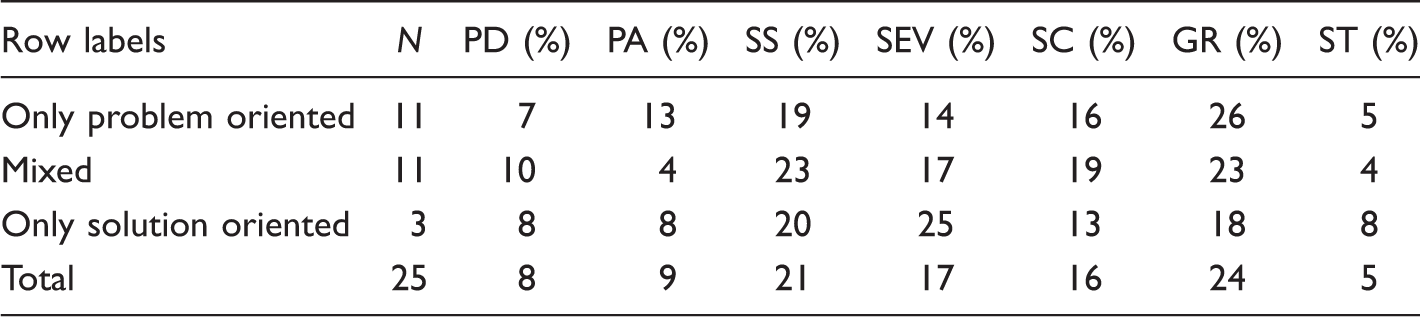
Note. PD = problem detection; PA = problem analysis; SS = solution suggestion; SEV = solution evaluation; SC = solution confirmation; GR = group regulation; ST = strategy.
The quality of solutions was compared in consideration of the combinations. As Figure 1 illustrates, when one or two solution-oriented students collaborated to solve the problems, students submitted better solutions than when only problem-oriented students collaborated, t(15, 16) = 3.93, p = .001.
Mean scores of solutions categorized according to the combination of individuals. All solution-only combinations received full credit for all of their solutions.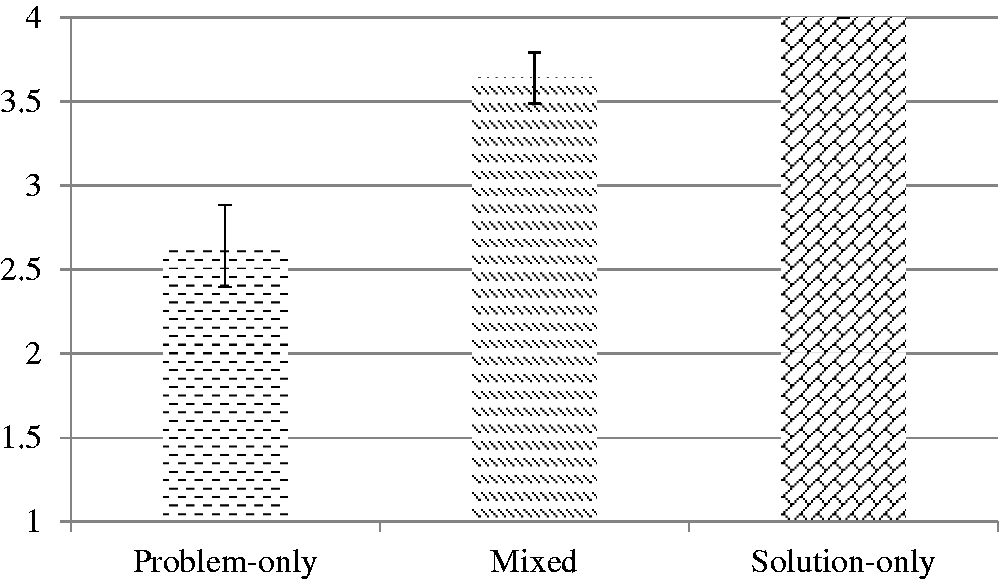
One can assume that the differences between the solutions might be due to the ability of the students rather than their problem-solving behaviors. Considering that possibility, we examined students’ programming knowledge in the middle and at the end of the problem-solving tasks (see Figure 2). Until the third problem-solving task, we did not find a significant difference between the students in terms of their domain knowledge (problem-oriented students: M = 7.73, SD = 1.39; solution-oriented students: M = 7.63, SD = 1.50). However, after competing all of the problem-solving tasks, we observed a significant learning gain from the solution-oriented students but not from the problem-oriented students (problem-oriented students: M = 7.56, SD = 1.45; solution-oriented students: M = 9.13, SD = .63). The results reject the notion that a student’s prior knowledge might affect the quality of their solutions but support the argument that a student’s problem-solving behaviors that focused on the evaluation of solutions affected the solution quality and resulted in their learning gain.
Assessment of students’ domain knowledge at two different points of time (after the third and final problem-solving tasks).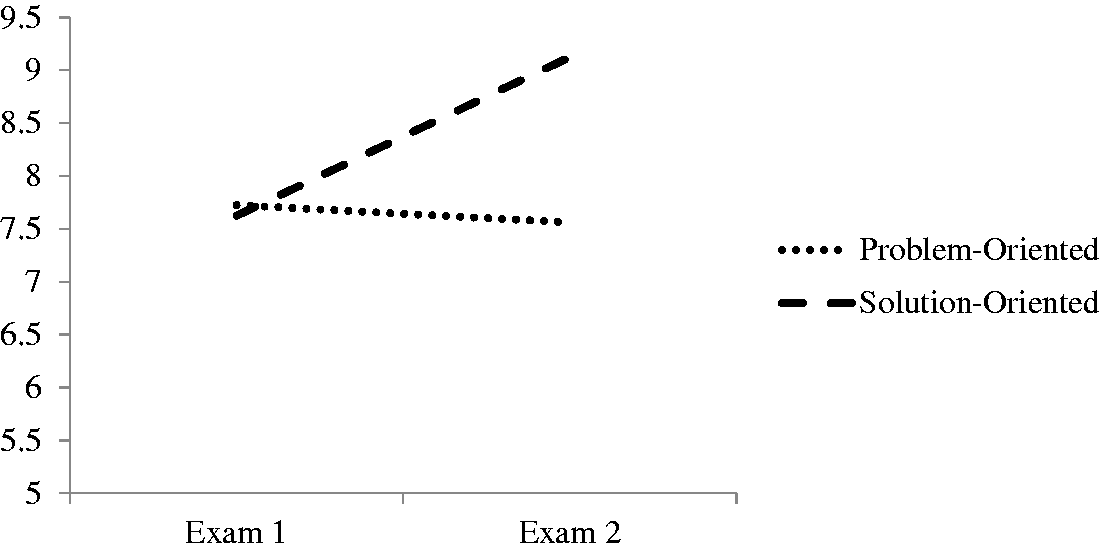
Case Analysis on Interactions
To understand the relation between the quality of the solution and the problem-solving behaviors, and especially the PA and SEV, we examined episodes within the problem-solving process.
Solution-oriented interactions
The following episodes illustrated how two solution-oriented students analyzed a problem, found a solution, and evaluated it before they confirmed the solution. The episodes particularly revealed that the solution-oriented students explicitly evaluated their solutions and shared common ground with their partner.
In the first episode, it seemed the two students understood the problem quite easily and pointed out the issue clearly. After finding the solution, they explained their rationale for the solution to one another, which ensured the quality of solution in this case.
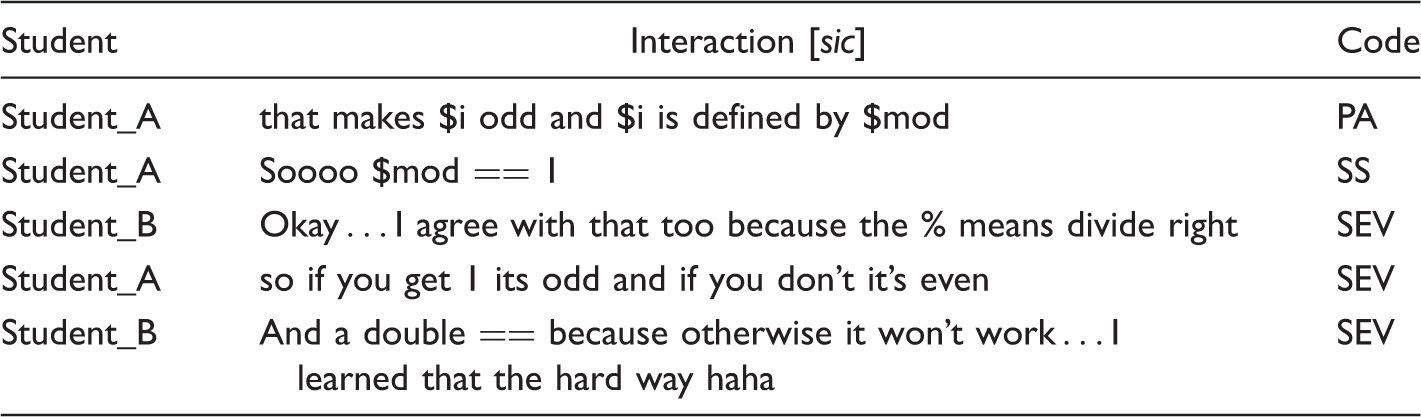
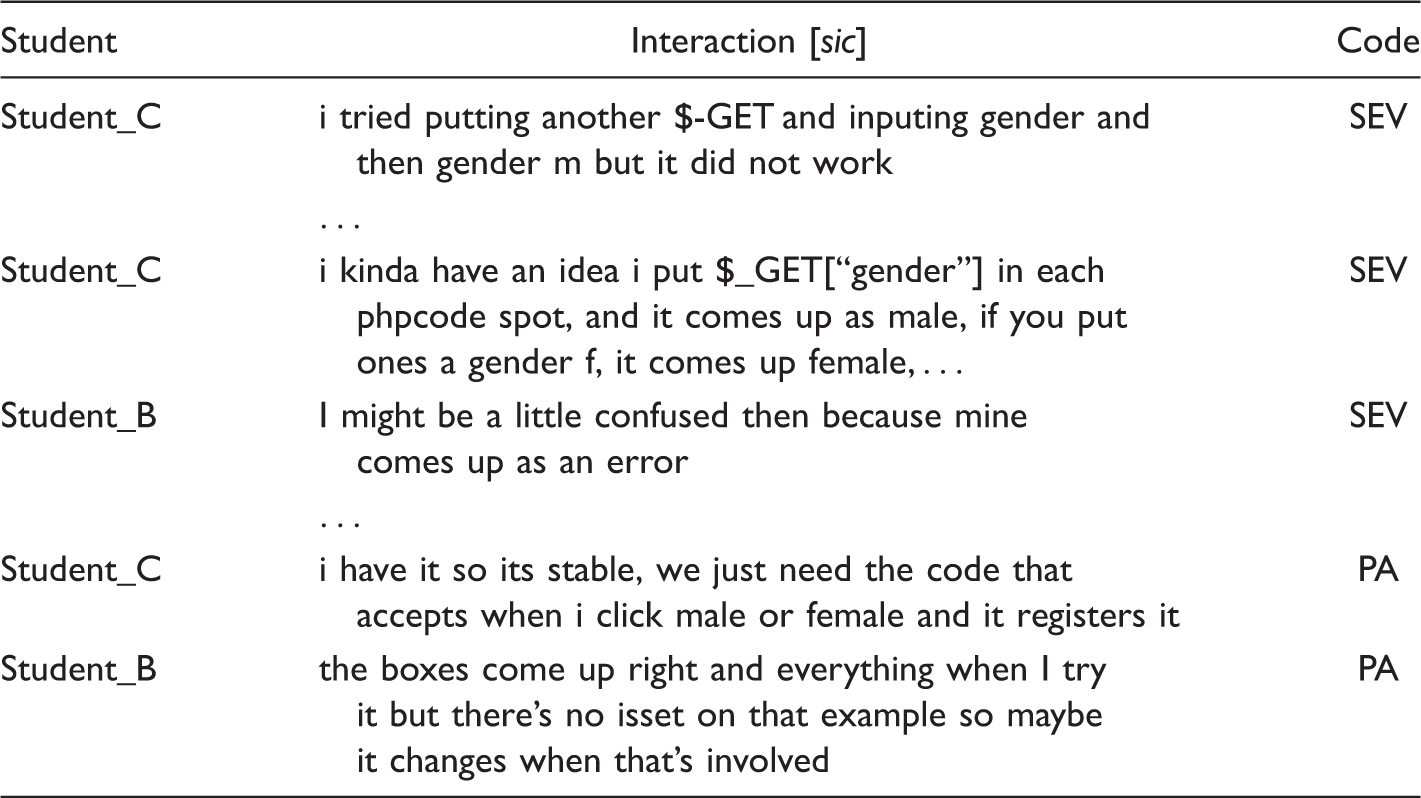
The following episode illustrates the problem-solving process that another pair of solution-oriented students faced where a problem was not solved easily. In this case, to solve the problem, the students needed to write a section of the program code that was left blank. Although they understood the problem and they conceptually knew what was required, they were not able to find a working solution in that situation. Instead they continuously evaluated their solutions and shared their rationale with each other. The noticeable interactions were that they kept explaining their alternative solutions and elaborating on their reasoning together during the problem-solving process.
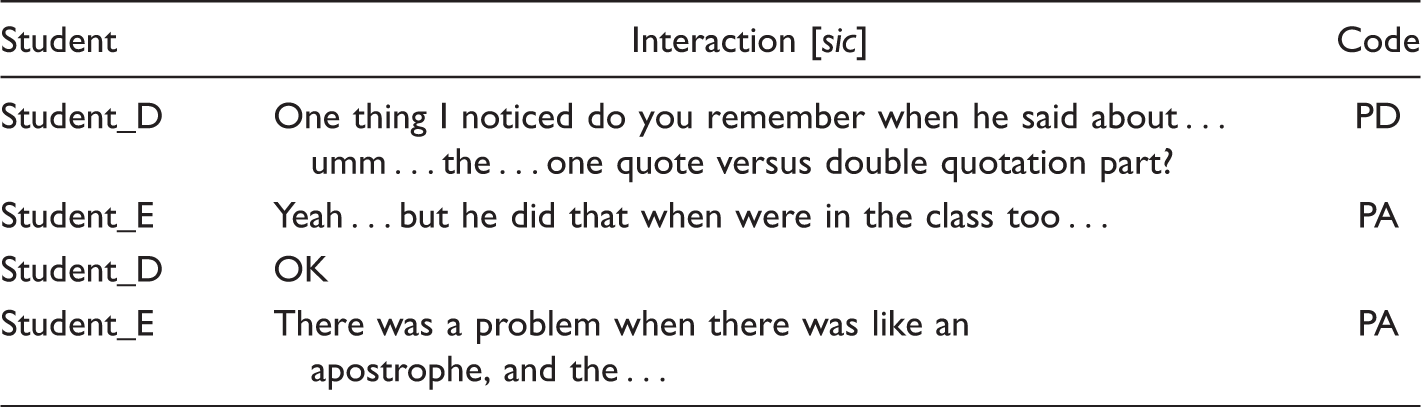
Ineffective PA
The following episodes illustrate the reasons why problem-oriented students analyzed problems so intensively without benefiting from it. In the first episode, they did not pinpoint the location of problem and discussed the difference between using the double and single quotation which was not related to the real problem. Thus the PA was not helpful to them in narrowing down the problem.
Episode 4 also describes the ineffective PA process between the problem-oriented students. They were not able to figure out which problem caused the error and checked the problematic codes line by line.
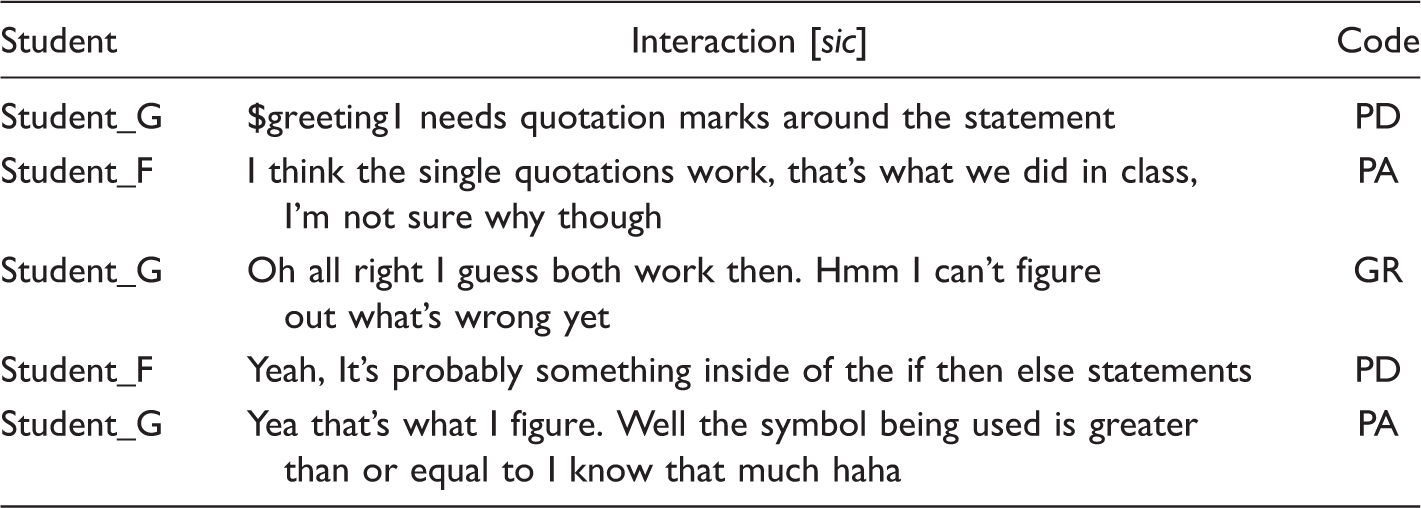
From the episodes, we found that the frequent PA behaviors represented students’ insufficient understanding of the problem: conditional statement. Although there was one syntax error causing the problem, they were not able to find it, so they checked other parts (incorrect problem detection) ineffectively. Obviously they did not discuss the structure of the conditional statements (ineffective PA) which could have guided them to the location of the syntax error.
Helpful interactions between students
In the following episode, a solution-oriented student explained his problem-solving process to his partner (problem-oriented student). We paid attention to the SEV carried out by the problem-oriented student. In this case, the solution-oriented student suggested an incorrect solution, and his partner simply agreed with it (solution confirmation) without further discussion. However, both students realized that the solution did not work and tried to figure it out. During the process, the solution-oriented student kept explaining his reasoning process and the results of modification to his partner (SEV), which enhanced their mutual understanding at the end.

In this study, students did not demonstrate this type of helpful interaction often. More frequently, the students accepted their partner’s suggestion without further discussion when they were not confident in themselves, which did not serve to elicit an explanation from their partner but rather a hasty agreement. This episode, however, showed that the solution-oriented student’s voluntarily explanation enabled him to find the correct solution as well as to educate his partner.
Discussion
The purpose of this study was to examine the types of interactions during collaborative problem solving in an online learning environment. Specifically, our research questions included the investigation of the interaction types including individual student’s interaction behaviors and their impact on the solution quality and learning outcomes. We were especially interested in the process of understanding problems and validating solutions. Regarding the interaction types, we were able to categorize the students’ interaction into two types: solution oriented versus problem oriented, on the basis of their interaction patterns. As named, the solution-oriented students were more active in evaluating solutions and trying to find correct solutions, whereas the problem-oriented students were less active in evaluating solutions and put more attention toward understanding problems. Results revealed that the more the students evaluated their potential solutions, the better were the solutions they suggested. On the contrary, when students struggled more with understanding the problems, the less likely it was they found correct solutions. Interestingly, we did not find any difference in their domain knowledge until the middle of the experiment. However, the solution-oriented students gained more domain knowledge as compared with the problem-oriented students at the end. Considering the combination of students, when working with at least one solution-oriented student as opposed to only problem-oriented students, the students found better solutions. This indicates that a solution-oriented student would lead the problem-solving process toward a SEV, and this interaction had an influence on the solution quality. It also suggests that more frequent interactions involving PA implied insufficient understanding about the problem, and this did not effectively guide them to a correct solution.
Beneficial Interaction for Problem Solving
The results of this study are consistent with previous studies stressing the importance of peer interactions in a problem-solving process (Cooke & Szumal, 1994; Liu & Tsai, 2008; Roschelle & Teasley, 1995). As Barron (2003) suggested, the success of collaboration heavily relies on the participant’s ability and motivation to maintain a shared problem-solving space. In her study, less successful collaboration groups rejected or ignored a partner’s proposals while the more successful groups elaborated on proposals by discussing or accepting. The current study extended the findings by examining the effect of elaboration during different problem-solving phases: understanding problems and evaluating solutions. While elaboration on the solution phase was beneficial to learning, elaboration on the problem phases were not, and even brought about a negative effect on learning. It should be noted that the result does not suggest the needlessness of understanding a problem but rather emphasizes the necessity for instructional intervention to facilitate the process. This study does not reveal the reason why many students (8 vs. 4) paid more attention to understanding problems as opposed to evaluating solutions. However, it was certain that their interactions in trying to understand problems were not so beneficial to developing correct solutions. Further study is necessary to disclose the reason and suggest instructional interventions.
Previous studies suggested that collaborative learning is more beneficial to novices when they collaborate with expert students (Webb, Nemer, Chizhik, & Sugrue, 1998). When combining students with different levels of competence, less able students are able to observe the more able students’ problem-solving performance, and especially their strategy, and practice it themselves in their individual task (e.g., Azmitia, 1988). However, it is also possible that the more competent students could regress when collaborating with less competent students (Tudge, 1992). As Tudge (1992) suggested, collaboration with peers having different levels of competence can cause the improvement or regression of learning.
The current study classified students on the basis of their problem-solving patterns rather than their domain knowledge. It is noteworthy that students who explicitly explained their solutions to their partners (solution oriented) were able to lead the group interactions toward a more fruitful situation. And as many studies suggested, the explicit elaboration process in regard to the solutions would also positively affect their knowledge gain (Bielaczyc, Pirolli, & Brown, 1995; Chi, de Leeuw, Chiu, & La Vancher, 1994).
Footnotes
Declaration of Conflicting Interests
The authors declared no potential conflicts of interest with respect to the research, authorship, and/or publication of this article.
Funding
The authors received no financial support for the research, authorship, and/or publication of this article.
Author Biographies
 ) focuses on the use of artificial intelligence in education, learning analytics, and adaptive learning systems. Currently, his primary research includes applications of artificial intelligence on online learning systems, in particular, specializing on conversational intelligent agents in online courses.